

Matthew 2:16
Greek (Tischendorf 8th ed.) Matthew 2:16 appears in the Greek New Testament. The text above is from the Tischendorf 8th edition. Each word links to its Strong’s number and a concise gloss. Click any word for its full Thayer’s Greek Lexicon entry.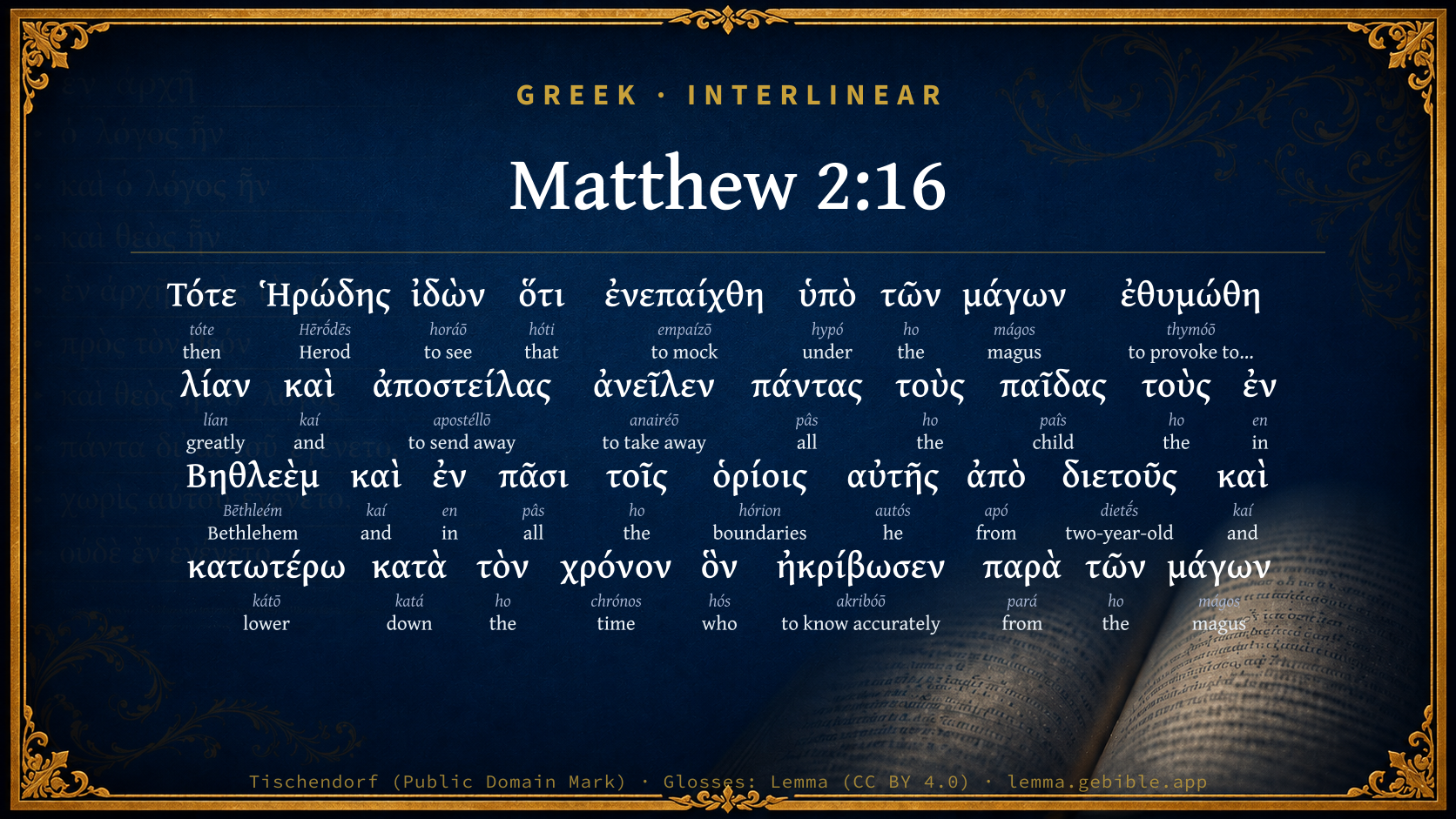
Then Herod, when he saw that he was mocked by the wise men, was exceedingly angry, and sent out, and killed all the male children who were in Bethlehem and in all the surrounding countryside, from two years old and under, according to the exact time which he had learned from the wise men.
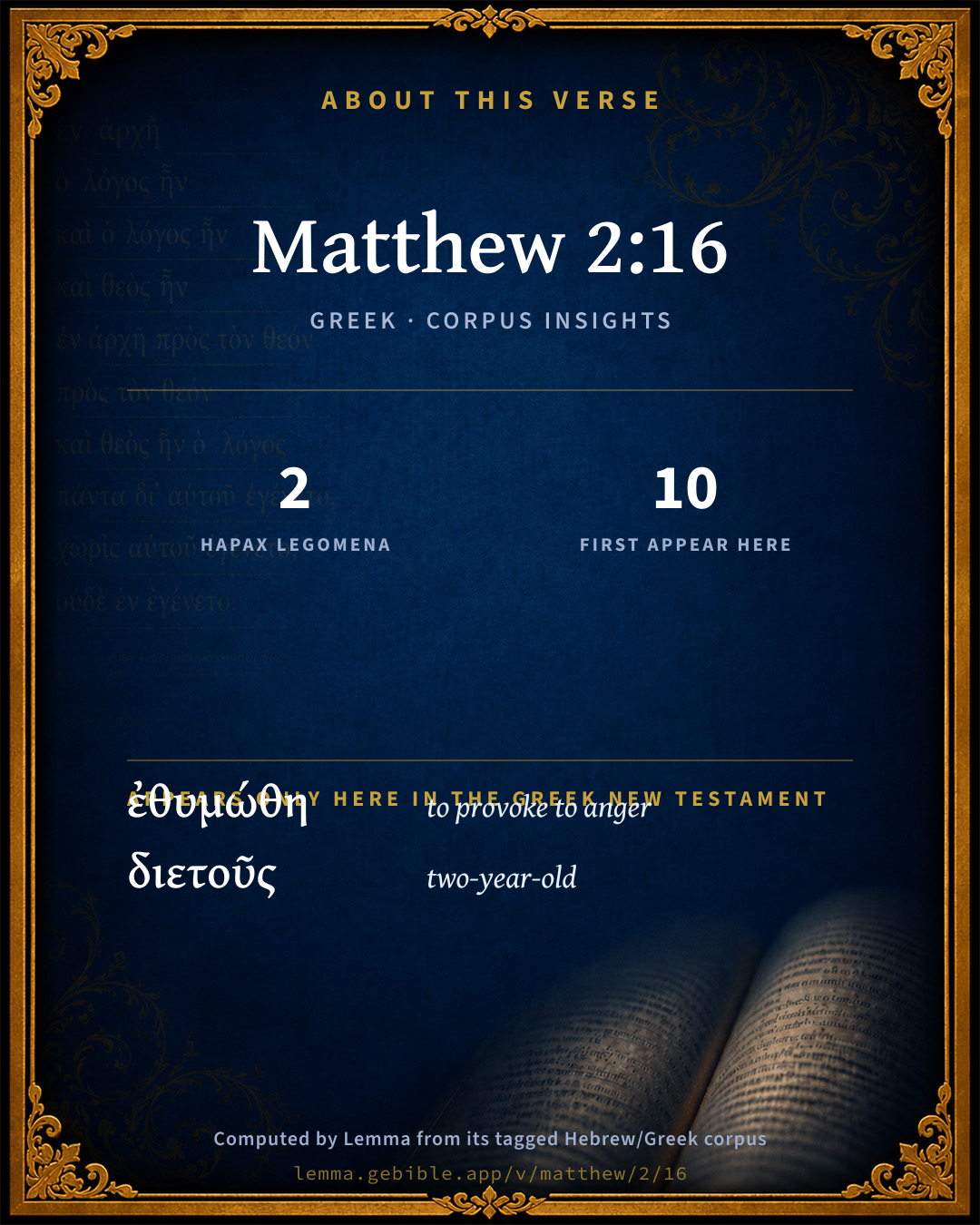
- 2 hapax legomena — only here in the Greek New Testament
- 10 first appearances in the Greek New Testament
Download a study sheet
One document with this verse’s original text, its word-by-word gloss line, the meaning frame, cross-references with their text, attributed commentary, and full source and license credits — printable, and it pastes into notes with its structure intact.
This verse Autodidact and up
A passage Seminary Student
Up to 50 verses in one chapter. A passage sheet keeps up to 6 commentary sources and 12 cross-references per verse, in the order this page ranks them, and says so on the sheet whenever that leaves anything out. Ask for a single verse and you get the Autodidact verse sheet above.
Everything on this page stays free to read, with no account — the sheet is a download of what is already on screen, not access to it.
Compare translations 3
The same verse in 3 English versions, stacked beneath the original-language interlinear above. Click any original word for its lexicon entry.
Each is an independent rendering of the whole verse — the interlinear is not word-aligned to these translations.
Highlighted words mark where these versions differ — a whole-verse word diff, not a word-by-word alignment.
-
World English Bible Public Domain
Then Herod, when he saw that he was mocked by the wise men, was exceedingly angry, and sent out, and killed all the male children who were in Bethlehem and in all the surrounding countryside, from two years old and under, according to the exact time which he had learned from the wise men.
-
King James Version Public Domain
Then Herod, when he saw that he was mocked of the wise men, was exceeding wroth, and sent forth, and slew all the children that were in Bethlehem, and in all the coasts thereof, from two years old and under, according to the time which he had diligently enquired of the wise men.
-
unfoldingWord Literal Text CC BY-SA 4.0
Then Herod, having seen that he had been mocked by the learned men, was very angry, and having sent forth, he killed all the male children in Bethlehem and in all its region, from two years and under, according to the time that he had determined exactly from the learned men.
unfoldingWord Literal Text — © unfoldingWord, licensed CC BY-SA 4.0. Word-aligned USFM3 via Door43 (git.door43.org/unfoldingWord/en_ult).
Show all 19 translations
Every available English version of this verse, each an independent rendering of the whole verse.
-
World English Bible Public Domain
Then Herod, when he saw that he was mocked by the wise men, was exceedingly angry, and sent out, and killed all the male children who were in Bethlehem and in all the surrounding countryside, from two years old and under, according to the exact time which he had learned from the wise men.
-
Berean Standard Bible Public Domain
When Herod saw that he had been outwitted by the Magi, he was filled with rage. Sending orders, he put to death all the boys in Bethlehem and its vicinity who were two years old and under, according to the time he had learned from the Magi.
-
Majority Standard Bible Public Domain
When Herod saw that he had been outwitted by the Magi, he was filled with rage. Sending orders, he put to death all the boys in Bethlehem and its vicinity who were two years old and under, according to the time he had learned from the Magi.
-
King James Version Public Domain
Then Herod, when he saw that he was mocked of the wise men, was exceeding wroth, and sent forth, and slew all the children that were in Bethlehem, and in all the coasts thereof, from two years old and under, according to the time which he had diligently enquired of the wise men.
-
American Standard Version (1901) Public Domain
Then Herod, when he saw that he was mocked of the Wise-men, was exceeding wroth, and sent forth, and slew all the male children that were in Bethlehem, and in all the borders thereof, from two years old and under, according to the time which he had exactly learned of the Wise-men.
-
Revised Version (1885) Public Domain
Then Herod, when he saw that he was mocked of the wise men, was exceeding wroth, and sent forth, and slew all the male children that were in Bethlehem, and in all the borders thereof, from two years old and under, according to the time which he had carefully learned of the wise men.
-
Geneva Bible (1599) Public Domain
Then Herod, seeing that he was mocked of the Wisemen, was exceeding wroth, and sent foorth, and slew all the male children that were in Beth-leem, and in all the coasts thereof, from two yeere old and vnder, according to the time which he had diligently searched out of the Wisemen.
-
Douay-Rheims (1899) Public Domain
Then Herod perceiving that he was deluded by the wise men, was exceeding angry; and sending killed all the men children that were in Bethlehem, and in all the borders thereof, from two years old and under, according to the time which he had diligently inquired of the wise men.
-
Young's Literal Translation Public Domain
Then Herod, having seen that he was deceived by the mages, was very wroth, and having sent forth, he slew all the male children in Beth-Lehem, and in all its borders, from two years and under, according to the time that he inquired exactly from the mages.
-
Literal Standard Version CC BY-SA 4.0
Then Herod, having seen that he was deceived by the magi, was very angry, and having sent forth, he slew all the male children in Beth-Lehem, and in all its borders, from two years and under, according to the time that he inquired exactly from the magi.
-
Unlocked Literal Bible CC BY-SA 4.0
Then Herod, when he saw that he had been mocked by the learned men, was very angry. He sent and killed all the male children that were in Bethlehem and in all that region who were two years old and under, according to the time that he had determined exactly from the learned men.
-
unfoldingWord Literal Text CC BY-SA 4.0
Then Herod, having seen that he had been mocked by the learned men, was very angry, and having sent forth, he killed all the male children in Bethlehem and in all its region, from two years and under, according to the time that he had determined exactly from the learned men.
-
Darby Bible Public Domain
Then Herod, seeing that he had been mocked by the magi, was greatly enraged; and sent and slew all the boys which [were] in Bethlehem, and in all its borders, from two years and under, according to the time which he had accurately inquired from the magi.
-
World Messianic Bible Public Domain
Then Herod, when he saw that he was mocked by the wise men, was exceedingly angry, and sent out and killed all the male children who were in Bethlehem and in all the surrounding countryside, from two years old and under, according to the exact time which he had learned from the wise men.
-
Webster's Bible Public Domain
Then Herod, when he saw that he was mocked by the wise men, was exceeding wroth, and sent forth, and slew all the children that were in Bethlehem, and in all its borders, from two years old and under, according to the time which he had diligently inquired of the wise men.
-
Free Bible Version CC BY-SA 4.0
When Herod realized he'd been fooled by the wise men, he got very angry. He sent men to kill all the young boys in Bethlehem and the regions nearby who were two years old and under. This was based on the time frame he'd discovered from the wise men.
-
Bible in Basic English Public Domain
Then Herod, when he saw that he had been tricked by the wise men, was very angry; and he sent out, and put to death all the male children in Beth-lehem and in all the parts round about it, from two years old and under, acting on the knowledge which he had got with care from the wise men.
-
Text-Critical English NT CC BY 4.0
When Herod saw that he had been fooled by the wise men, he was greatly enraged and sent men to kill all the boys in Bethlehem and in its vicinity who were two years old and under, according to the time that he had ascertained from the wise men.
-
Tyndale New Testament (1534) Public Domain
Then Herod perceavynge that he was moocked of the wyse men was excedynge wroth and sent forth and slue all the chyldren that were in Bethleem and in all the costes there of as many as were two yere olde and vnder accordynge to the tyme which he had diligetly searched oute of the wyse men.
Literal Standard Version (2020), Covenant Press — licensed CC BY-SA 4.0. Text via the HelloAO Bible API (eBible.org). Unlocked Literal Bible (unfoldingWord) — licensed CC BY-SA 4.0. Text via the HelloAO Bible API (eBible.org). unfoldingWord Literal Text — © unfoldingWord, licensed CC BY-SA 4.0. Word-aligned USFM3 via Door43 (git.door43.org/unfoldingWord/en_ult). Free Bible Version, Dr. Jonathan Gallagher — licensed CC BY-SA 4.0. Text via the HelloAO Bible API (eBible.org).
Word by word
More ways to search: Search by grammar → Find every occurrence → Compare this word →
Practice this passage: Drill this verse → Learn its vocabulary →
- Appears 1× in the Greek New Testament
- First appears here
- Part of Speech
- Verb
- Tense
- Aorist
- Voice
- Passive
- Mood
- Indicative
- Person
- 3rd person
- Number
- Singular
Full Thayer's Definition
- Τότε tóte G5119 “then” Adverb
- Ἡρώδης Hērṓdēs G2264 “Herod” Noun, Nominative, Singular, Masculine
- ἰδὼν horáō G3708 “to see” Verb, Aorist, Active, Participle, Nominative, Singular, Masculine
- ὅτι hóti G3754 “that” Conjunction
- ἐνεπαίχθη empaízō G1702 “to mock” Verb, Aorist, Passive, Indicative, 3rd person, Singular
- ὑπὸ hypó G5259 “under” Preposition
- τῶν ho G3588 “the” Article, Genitive, Plural, Masculine
- μάγων mágos G3097 “magus” Noun, Genitive, Plural, Masculine
- ἐθυμώθη thymóō G2373 “to provoke to anger” Verb, Aorist, Passive, Indicative, 3rd person, Singular
- λίαν lían G3029 “greatly” Adverb
- καὶ kaí G2532 “and” Conjunction
- ἀποστείλας apostéllō G649 “to send away” Verb, Aorist, Active, Participle, Nominative, Singular, Masculine
- ἀνεῖλεν anairéō G337 “to take away” Verb, Aorist, Active, Indicative, 3rd person, Singular
- πάντας pâs G3956 “all” Adjective, Accusative, Plural, Masculine
- τοὺς ho G3588 “the” Article, Accusative, Plural, Masculine
- παῖδας paîs G3816 “child” Noun, Accusative, Plural, Masculine
- τοὺς ho G3588 “the” Article, Accusative, Plural, Masculine
- ἐν en G1722 “in” Preposition
- Βηθλεὲμ Bēthleém G965 “Bethlehem” Noun, Proper, indeclinable
- καὶ kaí G2532 “and” Conjunction
- ἐν en G1722 “in” Preposition
- πᾶσι pâs G3956 “all” Adjective, Dative, Plural, Neuter
- τοῖς ho G3588 “the” Article, Dative, Plural, Neuter
- ὁρίοις hórion G3725 “boundaries” Noun, Dative, Plural, Neuter
- αὐτῆς autós G846 “he” Personal pronoun, Genitive, Singular, Feminine
- ἀπὸ apó G575 “from” Preposition
- διετοῦς dietḗs G1332 “two-year-old” Adjective, Genitive, Singular, Masculine
- καὶ kaí G2532 “and” Conjunction
- κατωτέρω kátō G2736 “lower” Adverb, Comparative
- κατὰ katá G2596 “down” Preposition
- τὸν ho G3588 “the” Article, Accusative, Singular, Masculine
- χρόνον chrónos G5550 “time” Noun, Accusative, Singular, Masculine
- ὃν hós G3739 “who” Relative pronoun, Accusative, Singular, Masculine
- ἠκρίβωσεν akribóō G198 “to know accurately” Verb, Aorist, Active, Indicative, 3rd person, Singular
- παρὰ pará G3844 “from” Preposition
- τῶν ho G3588 “the” Article, Genitive, Plural, Masculine
- μάγων mágos G3097 “magus” Noun, Genitive, Plural, Masculine
About this verse
These counts appear in no published source. They are computed here, from the morphology-tagged text and Lemma’s own curated glosses. What Lemma adds →
- 37
- words
- 27
- distinct lemmas
- Gospels
- section
Notable vocabulary
2 hapax legomena — words that appear only here in the entire Greek New Testament:
First appearance in Scripture
These words make their first canonical appearance in the Greek New Testament here (10 in total — showing 8):
Shared distinctive vocabulary
ἠκρίβωσεν to know accurately G198 occurs in 2 verses of the Greek New Testament. Also found in:
Cross-references
17Topical passages linked to Matthew 2:16 in the Treasury of Scripture Knowledge — connected by theme and wording, ordered by reader-vote popularity; previews shown in the World English Bible.
- Isaiah 59:7 Their feet run to evil, and they make haste to shed innocent blood: their thoughts are thoughts of iniquity; desolation and destruction are in their paths.
- Proverbs 28:15 As a roaring lion or a charging bear, So is a wicked ruler over helpless people.
- Revelation 17:6 I saw the woman drunken with the blood of the saints, and with the blood of the martyrs of Jesus. When I saw her, I wondered with great amazement.
- Genesis 49:7 Cursed be their anger, for it was fierce; And their wrath, for it was cruel. I will divide them in Jacob, Scatter them in Israel.
- Judges 16:10 Delilah said to Samson, Behold, you have mocked me, and told me lies: now tell me, Please, with which you might be bound.
- 2 Kings 8:12 Hazael said, Why weeps my lord? He answered, Because I know the evil that you will do to the children of Israel: their strongholds will you set on fire, and their young men will you kill with the sword, and will dash in pieces their little ones, and rip up their women with child.
- Proverbs 28:17 A man who is tormented by life blood will be a fugitive until death; No one will support him.
- Isaiah 26:21 For, behold, Yahweh comes forth out of his place to punish the inhabitants of the earth for their iniquity: the earth also shall disclose her blood, and shall no more cover her slain.
- Daniel 3:13 Then Nebuchadnezzar in [his] rage and fury commanded to bring Shadrach, Meshach, and Abednego. Then they brought these men before the king.
- Daniel 3:19–20 Then was Nebuchadnezzar full of fury, and the form of his visage was changed against Shadrach, Meshach, and Abednego: [therefore] he spoke, and commanded that they should heat the furnace seven times more than it was wont to be heated.
- Hosea 10:14 Therefore a battle roar will arise among your people, And all your fortresses will be destroyed, As Shalman destroyed Beth Arbel in the day of battle. The mother was dashed in pieces with her children.
- Genesis 39:14 that she called to the men of her house, and spoke to them, saying, "Behold, he has brought in a Hebrew to us to mock us. He came in to me to lie with me, and I cried with a loud voice.
- Genesis 39:17 She spoke to him according to these words, saying, "The Hebrew servant, whom you have brought to us, came in to me to mock me,
- Numbers 22:29 Balaam said to the donkey, Because you have mocked me, I would there were a sword in my hand, for now I had killed you.
- Numbers 24:10 Balak's anger was kindled against Balaam, and he struck his hands together; and Balak said to Balaam, I called you to curse my enemies, and, behold, you have altogether blessed them these three times.
- Job 12:4 I am like one who is a joke to his neighbor, I, who called on God, and he answered. The just, the blameless man is a joke.
- Proverbs 27:3–4 A stone is heavy, And sand is a burden; But a fool's provocation is heavier than both.
Cross-references courtesy of OpenBible.info (CC BY 4.0).
Lesson kit
Teaching starters — assembled from the data on this page, not authored interpretation. Every prompt links to the verse data it draws on. Edit before teaching.
Matthew, in the Gospels, opens this verse with 37 words (27 distinct Greek lemmas). Its most distinctive word is thymóō (“to provoke to anger”). A historical commentator’s framing appears above. Read the whole chapter for the surrounding context.
Discussion questions
- How does “to provoke to anger” (thymóō) shape what this verse is saying?
- 2 words here appear nowhere else in the Greek New Testament. Why might the author reach for such rare wording?
- 10 words make their first appearance in Scripture here. What does this debut establish?
- How does Matthew 2:7, which shares the word «to know accurately», read alongside this verse?
- What does the repetition of “magus” (2× in this one verse) do in this verse?
- The translations on this page render this verse differently — a whole-verse word diff, not a word-by-word alignment. What might account for the different wordings?
- Compare how The Biblical Illustrator and Joseph Benson's Commentary read this verse. Where do they agree or differ?
Things to notice
- 2 words in this verse appear nowhere else in the Greek New Testament.
- 10 words make their first canonical appearance in Scripture here.
- These translations choose different wording for 30 words in this verse.
- “magus” occurs 2× in this single verse.
- 27 distinct Greek lemmas span 37 words in this verse.
Commentary
Notes on Matthew 2:16 from classic Christian and Jewish commentators (each source and its license shown beneath its notes). The classic Christian expositions comment on the surrounding passage and are grouped to its opening verse, so a note may address several verses; the Jewish commentaries on the Tanakh (Rashi and others) are per-verse, so they appear only where the commentator wrote on this verse.
Lemma curates 59 commentaries, every one of them public domain or Creative Commons licensed, each selected and text-cleaned for this edition rather than reprinted as found. About our sources →
The Biblical Illustrator
Joseph S. Exell
The Biblical Illustrator, edited by Joseph S. Exell (c. 1880s–1900s) — public domain. Text from a community e-Sword module.
Joseph Benson's Commentary
Joseph Benson's Commentary on the Old and New Testaments (1811–1818) — public domain. Text from a community e-Sword module.
Tyndale Open Study Notes
Tyndale Open Resources
Tyndale Open Study Notes — © Tyndale Open Resources, licensed CC BY-SA 4.0. Text via the HelloAO Bible API.
Bengel's Gnomon
Johann Albrecht Bengel
Bengel's Gnomon of the New Testament — English translation (T&T Clark, Edinburgh, 1860) — public domain. Text from a community e-Sword module.
Meyer's Critical & Exegetical Commentary
Heinrich August Wilhelm Meyer
Meyer — Critical and Exegetical Commentary on the New Testament — English translation by Peter Christie, edited by Frederick Crombie (T&T Clark, 1880) — public domain. Text from a community e-Sword module.
Expositor's Greek Testament
ed. W. Robertson Nicoll
The Expositor's Greek Testament, edited by W. Robertson Nicoll (1897–1910) — public domain. Text from a community e-Sword module.
Matthew Henry's Commentary
Matthew Henry's Commentary on the Whole Bible (1708–1710) — public domain (CC PDM 1.0). Text via the HelloAO Bible API.
Jamieson, Fausset & Brown
Robert Jamieson, A. R. Fausset & David Brown
Jamieson, Fausset & Brown — Commentary Critical and Explanatory on the Whole Bible (1871) — public domain (CC PDM 1.0). Text via the HelloAO Bible API.
Adam Clarke's Commentary
Adam Clarke's Commentary on the Bible (1810–1826) — public domain. Text from a community e-Sword/MySword module.
Ellicott's Commentary for English Readers
A Bible Commentary for English Readers, edited by Charles John Ellicott (1878–1897) — public domain. Text from a community e-Sword module.
The Cambridge Bible for Schools and Colleges
gen. ed. J. J. S. Perowne
The Cambridge Bible for Schools and Colleges (gen. ed. J. J. S. Perowne; Cambridge University Press, 1878–1918) — public domain. Text from a community e-Sword module.
John Gill's Exposition
John Gill's Exposition of the Whole Bible (1746–1763) — public domain (CC PDM 1.0). Text via the HelloAO Bible API.
Trapp's Complete Commentary
John Trapp
John Trapp, A Commentary or Exposition upon All the Books of the Old and New Testament (1647–1656) — public domain. Text from a community e-Sword module.
Albert Barnes' Notes on the Bible
Albert Barnes' Notes on the Bible (1834–1885) — public domain. Text from a community e-Sword/MySword module.
Haydock's Catholic Bible Commentary
George Leo Haydock (1774–1849), Haydock's Catholic Family Bible and Commentary, 1859 edition — public domain. Excludes Psalms (Douay-Rheims chapter numbering differs from Protestant) and Deuterocanonical books (Catholic canon only).
Matthew Poole's English Annotations
Matthew Poole's English Annotations on the Holy Bible (1683–1685) — public domain. Text from a community e-Sword/MySword module.
Whedon's Commentary on the Bible
Daniel D. Whedon
Daniel D. Whedon (gen. ed.), Commentary on the Old and New Testaments (1874–1909) — public domain. Text from a community e-Sword module.
The Pulpit Commentary
The Pulpit Commentary (1880–1919), ed. H.D.M. Spence-Jones & Joseph S. Exell — public domain. Text from a community e-Sword module.
John Wesley's Explanatory Notes
John Wesley, Explanatory Notes Upon the Whole Bible (1754–1765) — public domain. Text via the GEBible commentary corpus.
Kretzmann's Popular Commentary
Paul E. Kretzmann
Paul E. Kretzmann, Popular Commentary of the Bible (1921–1924) — public domain. Text from a community e-Sword module.
Burkitt's Expository Notes on the New Testament
William Burkitt
William Burkitt's Expository Notes on the New Testament (1700–1703) — public domain. Text from a community e-Sword module.
Godbey's Commentary on the New Testament
William B. Godbey
William B. Godbey, Commentary on the New Testament (1896–1900) — public domain. Text from a community e-Sword module.
The People's New Testament
B. W. Johnson
B. W. Johnson's The People's New Testament with Notes (1889–1891) — public domain. Electronic text from the Christian Classics Ethereal Library (CCEL) ThML edition.
unfoldingWord translationNotes
Door43 World Missions Community
unfoldingWord translationNotes — © Distant Shores Media and the Door43 World Missions Community, licensed CC BY-SA 4.0. Source: git.door43.org/Door43/en_tn.
Cambridge Greek Testament for Schools and Colleges
Cambridge Greek Testament for Schools and Colleges (Cambridge University Press, 1896; 21 vols, various authors incl. Carr, Maclear, Plummer, Farrar, Lumby, Moule, M. R. James, Simcox) — public domain. Text from a community e-Sword module.
Alford’s Greek Testament
Henry Alford
Henry Alford, The Greek Testament (1849–1861) — public domain. Text from a community e-Sword module.
International Critical Commentary
International Critical Commentary — older volumes (1896–1929), various authors — public domain. Text from a community e-Sword module.
Vincent's Word Studies in the New Testament
Marvin R. Vincent
Marvin R. Vincent, Word Studies in the New Testament (1887–1900) — public domain. Text from a community e-Sword/MySword module.