Mark 5:14

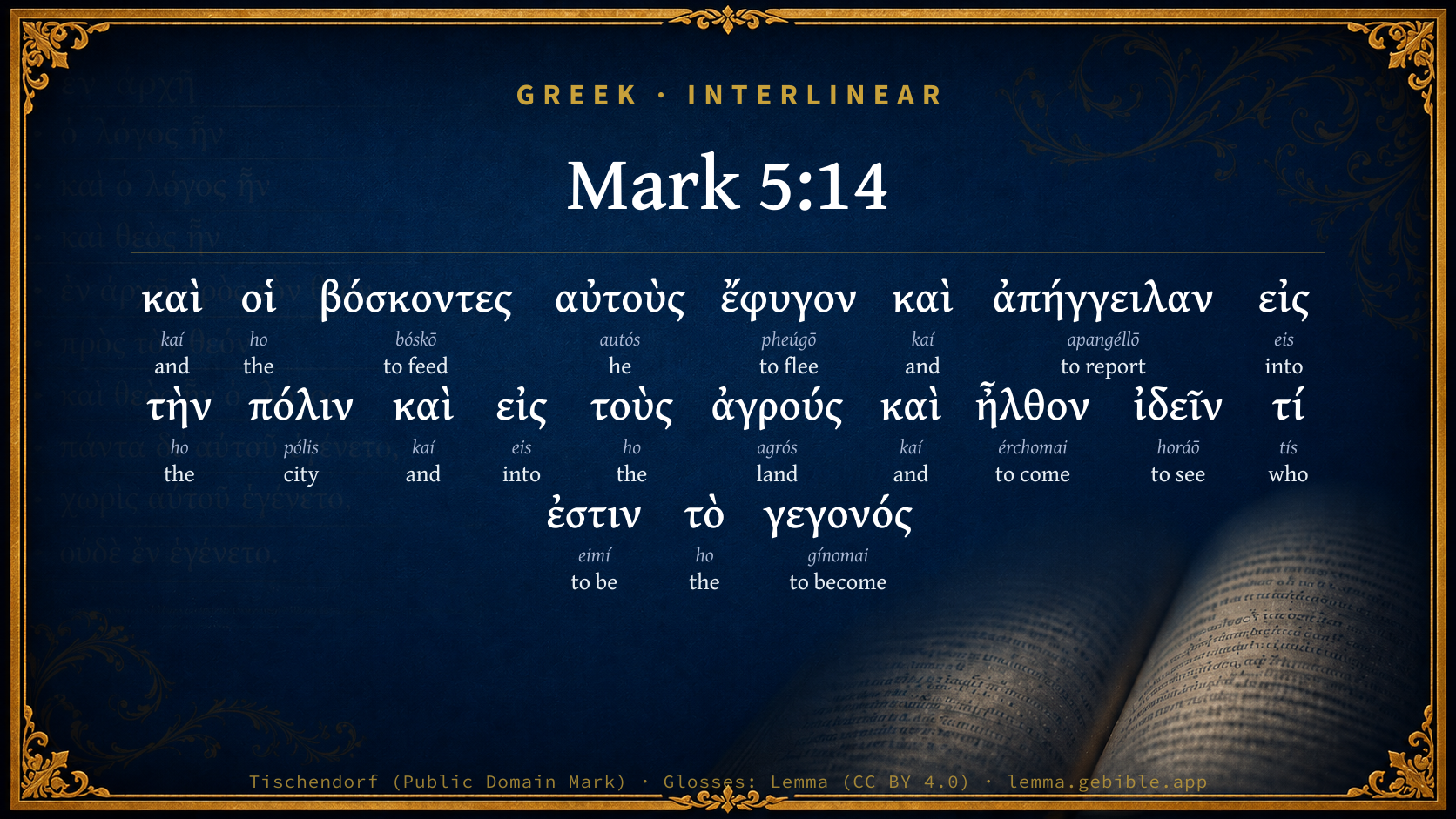
Greek (Tischendorf 8th ed.) Mark 5:14 appears in the Greek New Testament. The text above is from the Tischendorf 8th edition. Each word links to its Strong’s number and a concise gloss. Click any word for its full Thayer’s Greek Lexicon entry.
Download image
Cite this verse

Mark 5:14 (World English Bible). Public Domain. Lemma interlinear Bible study tool, https://lemma.gebible.app/v/mark/5/14.

Show BibTeX & RIS
BibTeX
RIS
English Translation
Those who fed them fled, and told it in the city and in the country. The people came to see what it was that had happened.
World English Bible · Public Domain
Download a study sheet

One document with this verse’s original text, its word-by-word gloss line, the meaning frame, cross-references with their text, attributed commentary, and full source and license credits — printable, and it pastes into notes with its structure intact.

This verse Autodidact and up

Study sheet (.html) Plain text (.txt)

A passage Seminary Student

Up to 50 verses in one chapter. A passage sheet keeps up to 6 commentary sources and 12 cross-references per verse, in the order this page ranks them, and says so on the sheet whenever that leaves anything out. Ask for a single verse and you get the Autodidact verse sheet above.

Everything on this page stays free to read, with no account — the sheet is a download of what is already on screen, not access to it.

Want to remove ads? Support Godless Engineer
Compare translations 3

The same verse in 3 English versions, stacked beneath the original-language interlinear above. Click any original word for its lexicon entry.

Each is an independent rendering of the whole verse — the interlinear is not word-aligned to these translations.

Highlighted words mark where these versions differ — a whole-verse word diff, not a word-by-word alignment.

  • World English Bible Public Domain
    Those who fed them fled, and told it in the city and in the country. The people came to see what it was that had happened.
  • King James Version Public Domain
    And they that fed the swine fled, and told it in the city, and in the country. And they went out to see what it was that was done.
  • unfoldingWord Literal Text CC BY-SA 4.0
    And the ones feeding them ran away and reported it in the city and in the countryside, and they went out to see what it is that had happened.

unfoldingWord Literal Text — © unfoldingWord, licensed CC BY-SA 4.0. Word-aligned USFM3 via Door43 (git.door43.org/unfoldingWord/en_ult).

Versions to compare (up to 4)

3 of 4 selected

Show all 19 translations

Every available English version of this verse, each an independent rendering of the whole verse.

  • World English Bible Public Domain
    Those who fed them fled, and told it in the city and in the country. The people came to see what it was that had happened.
  • Berean Standard Bible Public Domain
    Those tending the pigs ran off and reported this in the town and countryside, and the people went out to see what had happened.
  • Majority Standard Bible Public Domain
    Those tending the pigs ran off and reported this in the town and countryside, and the people went out to see what had happened.
  • King James Version Public Domain
    And they that fed the swine fled, and told it in the city, and in the country. And they went out to see what it was that was done.
  • American Standard Version (1901) Public Domain
    And they that fed them fled, and told it in the city, and in the country. And they came to see what it was that had come to pass.
  • Revised Version (1885) Public Domain
    And they that fed them fled, and told it in the city, and in the country. And they came to see what it was that had come to pass.
  • Geneva Bible (1599) Public Domain
    And the swineheards fled, and told it in the citie, and in the countrey, and they came out to see what it was that was done.
  • Douay-Rheims (1899) Public Domain
    And they that fed them fled, and told it in the city and in the fields. And they went out to see what was done:
  • Young's Literal Translation Public Domain
    And those feeding the swine did flee, and told in the city, and in the fields, and they came forth to see what it is that hath been done;
  • Literal Standard Version CC BY-SA 4.0
    And those feeding the pigs fled, and told in the city, and in the fields, and they came forth to see what it is that has been done;
  • Unlocked Literal Bible CC BY-SA 4.0
    Then those who were feeding the pigs ran away and reported what had happened in the city and in the countryside, and so people went out to see what had happened.
  • unfoldingWord Literal Text CC BY-SA 4.0
    And the ones feeding them ran away and reported it in the city and in the countryside, and they went out to see what it is that had happened.
  • Darby Bible Public Domain
    And those that were feeding them fled and reported it in the city and in the country. And they went out to see what it was that had taken place.
  • World Messianic Bible Public Domain
    Those who fed the pigs fled, and told it in the city and in the country. The people came to see what it was that had happened.
  • Webster's Bible Public Domain
    And they that fed the swine fled, and told it in the city, and in the country. And they went out to see what it was that was done.
  • Free Bible Version CC BY-SA 4.0
    The pig-keepers ran away, and spread the news all over town and in the countryside. People came out to see what had happened.
  • Bible in Basic English Public Domain
    And their keepers went running and gave an account of it in the town and in the country. And people came to see what had taken place.
  • Text-Critical English NT CC BY 4.0
    Those who had been feeding the pigs then ran off and reported it in the city and in the countryside. So the people went out to see what had happened.
  • Tyndale New Testament (1534) Public Domain
    And the swyne heerdes fleed and tolde it in the cyte and in the countre. And they came out for to se what had hapened:

Literal Standard Version (2020), Covenant Press — licensed CC BY-SA 4.0. Text via the HelloAO Bible API (eBible.org). Unlocked Literal Bible (unfoldingWord) — licensed CC BY-SA 4.0. Text via the HelloAO Bible API (eBible.org). unfoldingWord Literal Text — © unfoldingWord, licensed CC BY-SA 4.0. Word-aligned USFM3 via Door43 (git.door43.org/unfoldingWord/en_ult). Free Bible Version, Dr. Jonathan Gallagher — licensed CC BY-SA 4.0. Text via the HelloAO Bible API (eBible.org).

Word by word

More ways to search: Search by grammar → Find every occurrence → Compare this word →

Practice this passage: Drill this verse → Learn its vocabulary →

βόσκοντες
bóskō
G1006
“to feed”
Verb, Present, Active, Participle, Nominative, Plural, Masculine
Part of Speech
Verb
Tense
Present
Voice
Active
Mood
Participle
Case
Nominative
Number
Plural
Gender
Masculine
Full Thayer's Definition

Origin: a prol. form of a primary verb, cf G977 &version=kjv& G1016

TDNT: None

1. to feed a. portraying the duty of a Christian teacher to promote in every way the spiritual welfare of the members of the church
  1. καὶ kaí G2532 “and” Conjunction
  2. οἱ ho G3588 “the” Article, Nominative, Plural, Masculine
  3. αὐτοὺς autós G846 “he” Personal pronoun, Accusative, Plural, Masculine
  4. ἔφυγον pheúgō G5343 “to flee” Verb, Aorist, Active, Indicative, 3rd person, Plural
  5. καὶ kaí G2532 “and” Conjunction
  6. ἀπήγγειλαν apangéllō G518 “to report” Verb, Aorist, Active, Indicative, 3rd person, Plural
  7. εἰς eis G1519 “into” Preposition
  8. τὴν ho G3588 “the” Article, Accusative, Singular, Feminine
  9. πόλιν pólis G4172 “city” Noun, Accusative, Singular, Feminine
  10. καὶ kaí G2532 “and” Conjunction
  11. εἰς eis G1519 “into” Preposition
  12. τοὺς ho G3588 “the” Article, Accusative, Plural, Masculine
  13. ἀγρούς agrós G68 “land” Noun, Accusative, Plural, Masculine
  14. καὶ kaí G2532 “and” Conjunction
  15. ἦλθον érchomai G2064 “to come” Verb, Aorist, Active, Indicative, 3rd person, Plural
  16. ἰδεῖν horáō G3708 “to see” Verb, Aorist, Active, Infinitive
  17. τί tís G5101 “who” Interrogative pronoun, Nominative, Singular, Neuter
  18. ἐστιν eimí G1510 “to be” Verb, Present, Active, Indicative, 3rd person, Singular
  19. τὸ ho G3588 “the” Article, Nominative, Singular, Neuter
  20. γεγονός gínomai G1096 “to become” Verb, Perfect, Active, Participle, Nominative, Singular, Neuter

About this verse

These counts appear in no published source. They are computed here, from the morphology-tagged text and Lemma’s own curated glosses. What Lemma adds →

21
words
14
distinct lemmas
Gospels
section

Notable vocabulary

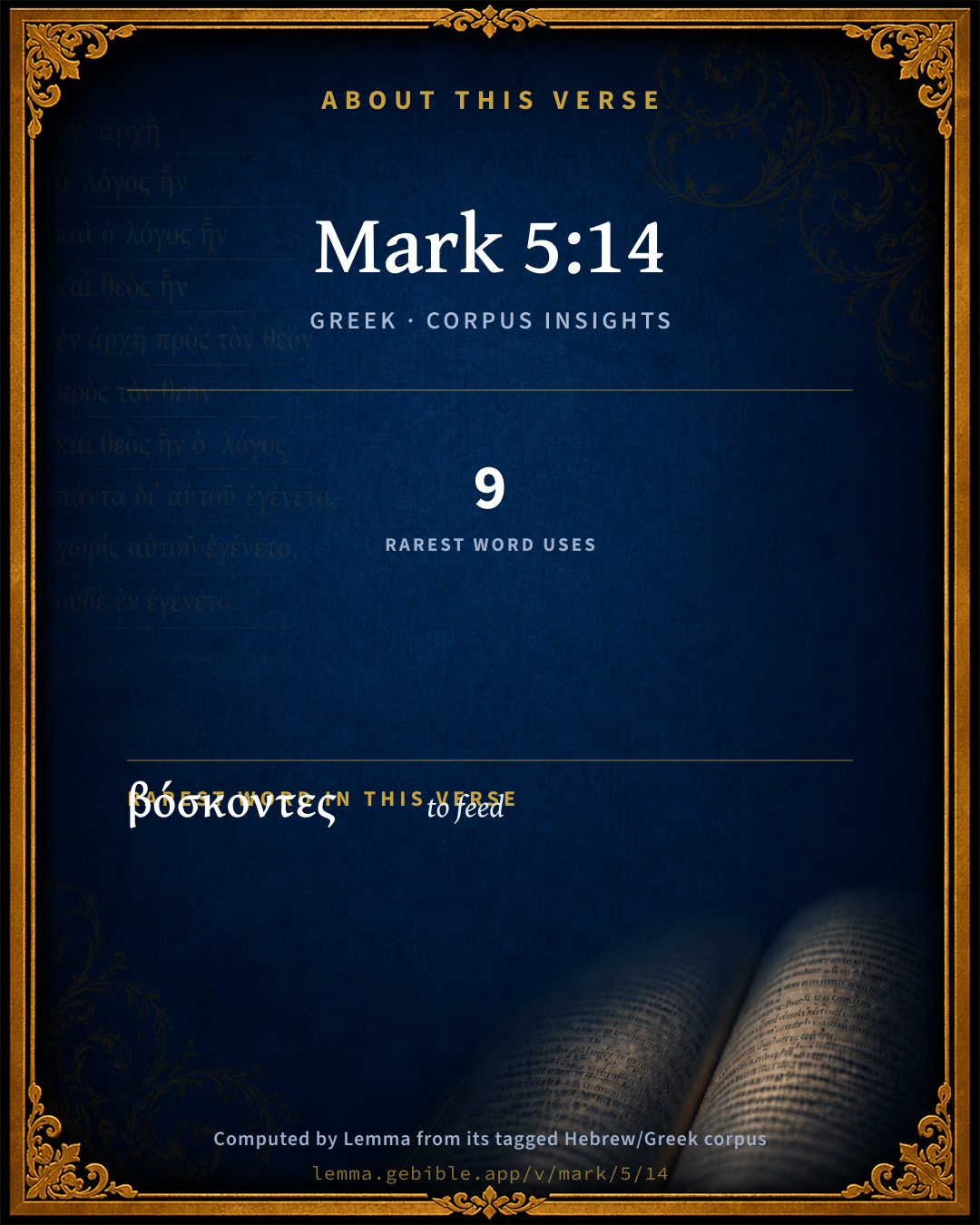
The rarest word here is βόσκοντες to feed G1006 — appearing just 9 times in the whole Greek New Testament.

Shared distinctive vocabulary

βόσκοντες to feed G1006 occurs in 9 verses of the Greek New Testament. Also found in:

Repetition

Words recur within this verse:

Cross-references

2

Topical passages linked to Mark 5:14 in the Treasury of Scripture Knowledge — connected by theme and wording, ordered by reader-vote popularity; previews shown in the World English Bible.

  • Matthew 8:33 Those who fed them fled, and went away into the city, and told everything, including what happened to those who were possessed with demons.
  • Luke 8:34 When those who fed them saw what had happened, they fled, and told it in the city and in the country.

Cross-references courtesy of OpenBible.info (CC BY 4.0).

Commentary

Notes on Mark 5:14 from classic Christian and Jewish commentators (each source and its license shown beneath its notes). The classic Christian expositions comment on the surrounding passage and are grouped to its opening verse, so a note may address several verses; the Jewish commentaries on the Tanakh (Rashi and others) are per-verse, so they appear only where the commentator wrote on this verse.

Lemma curates 59 commentaries, every one of them public domain or Creative Commons licensed, each selected and text-cleaned for this edition rather than reprinted as found. About our sources →

The Expositor's Bible

CHAPTER 5:14-20 (Mar_5:14-20)

THE MEN OF GADARA

"And they that fed them fled, and told it in the city, and in the country. And they came to see what it was that had come to pass. And they come to Jesus, and behold him that was possessed with devils sitting, clothed and in his right mind, even him that had the legion: and they were afraid. And they that saw it declared unto them how it befell him that was possessed with devils, and concerning the swine. And they began to beseech Him to depart from their borders. And as He was entering into the boat, he that had been possessed with devils besought Him that he might be with Him. And He suffered him not, but saith unto him, Go to thy house unto thy friends, and tell them how great things the Lord hath done for thee, and how He had mercy on thee. And he went his way, and began to publish in Decapolis how great things Jesus had done for him: and all men did marvel." Mar_5:14-20 (R.V.)

THE expulsion of the demons from the possessed, their entrance into the herd, and the destruction of the two thousand swine, were virtually one transaction, and must have impressed the swineherds in its totality. They saw on the one hand the restoration of a dangerous and raging madman, known to be actuated by evil spirits, the removal of a standing peril which had already made one tract of country impassable, and (if they considered such a thing at all) the calming of a human soul, and its advent within the reach of all sacred influences. On the other side what was there? The loss of two thousand swine; and the consciousness that the kingdom of God was come nigh unto them. This was always an alarming discovery. Isaiah said, Woe is me! when his eyes beheld God high and lifted up. And Peter said, Depart from me, when he learned by the miraculous draught of fish that the Lord was there. But Isaiah's concern was because he was a man of unclean lips, and Peter's was because he was a sinful man. Their alarm was that of an awakened conscience, and therefore they became the heralds of Him Whom they feared. But these men were simply scared at what they instinctively felt to be dangerous; and so they took refuge in a crowd, that frequent resort of the frivolous and conscience-stricken, and told in the city what they had seen. And when the inhabitants came forth, a sight met them which might have won the sternest, the man sitting, clothed (a nice coincidence, since St. Mark had not mentioned that he "ware no clothes,") and in his right mind, even him that had the legion, as the narrative emphatically adds. And doubtless the much debated incident of the swine had greatly helped to reassure this afflicted soul; the demons were palpably gone, visibly enough they were overmastered. But the citizens, like the swineherds, were merely terrified, neither grateful nor sympathetic; uninspired with hope of pure teaching, of rescue from other influences of the evil one, or of any unearthly kingdom. Their formidable visitant was one to treat with all respect, but to remove with all speed, "and they began to beseech Him to depart from their borders." They began, for it did not require long entreaty; the gospel which was free to all was not to be forced upon any. But how much did they blindly fling away, who refused the presence of the meek and lowly Giver of rest unto souls; and chose to be denied, as strangers whom He never knew, in the day when every eye shall see Him.

With how sad a heart must Jesus have turned away. Yet one soul at least was won, for as He was entering into the boat, the man who owed all to Him prayed Him that he might be with Him. Why was the prayer refused? Doubtless it sprang chiefly from gratitude and love, thinking it hard to lose so soon the wondrous benefactor, the Man at whose feet he had sat down, Who alone had looked with pitiful and helpful eyes on one whom others only sought to "tame." Such feelings are admirable, but they must be disciplined so as to seek, not their own indulgence, but their Mater's real service. Now a reclaimed demoniac would have been a suspected companion for One who was accused of league with the Prince of the devils. There is no reason to suppose that he had any fitness whatever to enter the immediate circle of our Lord's intimate disciples. His special testimony would lose all its force when he left the district where he was known; but there, on the contrary, the miracle could not fail to be impressive, as its extent and permanence were seen. This man was perhaps the only missionary who could reckon upon a hearing from those who banished Jesus from their coasts. And Christ's loving and unresentful heart would give this testimony to them in its fullness. It should begin at his own house and among his friends, who would surely listen. They should be told how great things the Lord had done for him, and Jesus expressly added, how He had mercy upon thee, that so they might learn their mistake, who feared and shrank from such a kindly visitant. Here is a lesson for these modern days, when the conversion of any noted profligate is sure to be followed by attempts to push him into a vagrant publicity, not only full of peril in itself, but also removing him from the familiar sphere in which his consistent life would be more convincing than all sermons, and where no suspicion of self-interest could overcloud the brightness of his testimony.

Possibly there was yet another reason for leaving him in his home. He may have desired to remain close to Jesus, lest, when the Savior was absent, the evil spirits should resume their sway. In that case it would be necessary to exercise his faith and convince him that the words of Jesus were far-reaching and effectual, even when he was Himself remote. If so, he learned the lesson well, and became an evangelist through all the region of Decapolis. And where all did marvel, we may hope that some were won. What a revelation of mastery over the darkest and most dreadful forces of evil, and of respect for the human will (which Jesus never once coerced by miracle, even when it rejected Him), what unwearied care for the rebellious, and what a sense of sacredness in lowly duties, better for the demoniac than the physical nearness of his Lord, are combined in this astonishing narrative, which to invent in the second century would itself have required miraculous powers.

William Robertson Nicoll, ed., The Expositor's Bible (London: Hodder & Stoughton, 1887–1910) — public domain. 65 of 66 books (1 Corinthians is not separately keyed, as that volume carries no machine-parseable verse references); section-level commentary keyed to the opening verse. Introductory and overview sections not keyed to a specific passage are excluded.

Bengel's Gnomon

Johann Albrecht Bengel

Mar 5:14. Ἀνήγγειλαν, announced it) to those to whom the swine had belonged, in the city and in the fields [the country].

Bengel's Gnomon of the New Testament — English translation (T&T Clark, Edinburgh, 1860) — public domain. Text from a community e-Sword module.

Expositor's Greek Testament

ed. W. Robertson Nicoll

Mar 5:14-20 . Sequel of the story .

Mar 5:14 . εἰς τὴν πόλιν , etc.: the herds of course ran in breathless panic-stricken haste to report the tragedy in the city and in the neighbouring farms ( ἀγρούς ). καὶ ἦλθον , etc.: and the people in town and country as naturally went to see what had happened. Their road brings them straight to Jesus (Mar 5:15 ), and they see there a sight which astonishes them, the well-known and dreaded demoniac completely altered in manner and aspect: sitting ( καθήμενον ) quiet, not restless; clothed ( ἱματισμένον here and in Luk 8:35 ), implying previous nakedness, which is expressly noted by Lk. (Luk 8:27 ), sane ( σωφρονοῦντα ), implying previous madness. For this sense of the verb vide 2Co 5:13 . Some take the second and third participle as subordinate to the first, but they may be viewed as co-ordinate, denoting three distinct, equally outstanding, characteristics: “sedentem, vestitum, sanae mentis, cum antea fuisset sine quiete, vestibus, rationis usu” (Bengel) all this had happened to the man who had had the Legion! ( τὸν ἐσχ . τ . λεγιῶνα ) ἐσχηκότα , perfect in sense of pluperfect. Burton, § 156. ἐφοβήθησαν : they were afraid, of the sane man, as much as they had been of the insane, i.e. , of the power which had produced the change.

The Expositor's Greek Testament, edited by W. Robertson Nicoll (1897–1910) — public domain. Text from a community e-Sword module.

Adam Clarke's Commentary

Verse 14. The swine] Instead of τους χοιρους, BCDL, three others, Syriac, Coptic, AEthiopic, Vulgate, and Itala, read αυτους, them-And they that fed THEM fled. Griesbach has adopted this reading.

Adam Clarke's Commentary on the Bible (1810–1826) — public domain. Text from a community e-Sword/MySword module.

John Gill's Exposition

And they that fed the swine,.... Not the owners, but the keepers of them, the swine herds, "fled"; being astonished at the power of Christ, affrighted at the noise of the devils, and terrified at the sight and loss of the swine:

and told it in the city and country; or "in the fields": they went into the city of Gadara, and told the story of the dispossession of the devils out of the man, that had been for some time troublesome in those parts; and of their entrance into the swine, and the destruction of them: and they went into the fields, or country adjacent; they went to the "villages" thereabout, as the Syriac and Ethiopic versions render the word; or to those houses that were in the fields, scattered about, here, and there one, and where perhaps the owners of the herd lived: and they not only hasted away to the owners of the swine, to acquaint them with what had happened, in order to remove all blame from themselves, and any suspicion of negligence in them; to make it appear that it was not their fault, or owing to any carelessness of theirs the swine perished; as that they suffered them to go too near the sea side, and did not keep a good lookout, and were not, as they should have been, between them and the sea, to have prevented such an accident: this they not only did, but the affair, in all its circumstances, being such an amazing one; as the dispossession of the devils out of the man; the health, the calmness, and happy condition the dispossessed was in; the entrance of the devils into the swine; their madness, and precipitant running into the sea, and suffocation there; that they told it to every body they met with, whether in the fields belonging to Gadara, or in the city itself; which drew out a large concourse of people to see what was done to the man that had been possessed, and to the swine, and also to see the person who had done all this; and which made the miracle the more notorious; city and country rung of it: so that, as Matthew says, "the whole city came out to meet Jesus", Mat 8:34; and Luke observes, that "the whole multitude of the country of the Gadarenes round about besought him to depart", &c. Luk 8:37. So we sometimes read, in the Jewish writings, of the men, or inhabitants of the field, as opposed to the men, or inhabitants of the city, who differed both in their clothes and diet.

"The garments, , "of the children", or "inhabitants of the city", who live deliciously, and do no work, are broad, like women's; but the garments, , "of the children of the field"; such as do business in the field, are short (i):''

and so of their food, it is observed (k), that the bread, "of the men of the field", which the gloss explains by , "the children", or "inhabitants of a village", is what they put much flour into; but the bread, "of a city", which the gloss interprets of , "the children", or "inhabitants of a walled town", or "city", is what they do not put much flour into.

And they went out to see what it was that was done: that is, the inhabitants of the city of Gadara, and those that dwelt in the villages, and in lone houses in the fields, went forth to the places where the possessed man used to be, and where Jesus and he now were, and where the swine used to feed, to see with their own eyes, and satisfy themselves of the truth of the narration the swineherds gave them.

(i) Bab. Sabbat, fol. 12. 1. & Gloss. in ib. (k) T. Bab. Beracot, fol. 37. 2.

John Gill's Exposition of the Whole Bible (1746–1763) — public domain (CC PDM 1.0). Text via the HelloAO Bible API.

Trapp's Complete Commentary

John Trapp

14 And they that fed the swine fled, and told it in the city, and in the country. And they went out to see what it was that was done.

Ver. 14. {See Trapp on "Mat 8:33"}

John Trapp, A Commentary or Exposition upon All the Books of the Old and New Testament (1647–1656) — public domain. Text from a community e-Sword module.

The Pulpit Commentary

And they that fed them fled, and told it in the city, and in the country. St. Matthew mentions only the city. St. Mark"s narrative is more full. No doubt many of these swineherds lived in the country districts; and so the fame of the miracle was spread far and wide. The swineherds would take care that the owners should understand that it was through no fault or carelessness on their part that the swine had perished; but that the destruction was caused by a power over which they had no control. And theyi.e. the ownerscame to see what it was that had come to pass. Their first care was to see the extent of their loss; and this was soon revealed to them. They must have seen the carcases of the swine floating hither and thither in the now calm and tranquil sea; and when they had thus satisfied themselves as to the facts, "they came to Jesus." St. Mark here uses the historic present, "they come to Jesus," that they might behold him of whom these great things were told, as well as the man out of whom the evil spirits had gone when they entered into the swine. They were, of course, concerned to know the magnitude of their loss, and the mode in which it had happened, that they might see whether there were any means by which it might be made up to them.

Unfriendly heralds of Christ.

I DIFFICULTY OF GETTING THE GOSPEL TRULY AND FAITHFULLY PREACHED.

II CONTRAST THIS WITH THE RAPID SPREAD OF FALSE NOTIONS ABOUT CHRIST, HERESIES, UNSETTLING ALARMS, ETC,

III COMPENSATIONS.

1. The existence of Christ is made known. By-and-by his character will vindicate itself.

2. Curiosity is aroused and feeling excited. Almost anything is better than indifference. And the witnesses of his truth and grace are everywhere.

3. The disciples of Christ are compelled to vindicate their Master. M.

The Pulpit Commentary (1880–1919), ed. H.D.M. Spence-Jones & Joseph S. Exell — public domain. Text from a community e-Sword module.

Kretzmann's Popular Commentary

Paul E. Kretzmann

The effect of the miracle:

v. 14. And they that fed the swine fled, and told it in the city and in the country. And they went out to see what it was that was done.

v. 15. And they come to Jesus, and see him that was possessed with the devil and had the legion, sitting, and clothed, and in his right mind; and they were afraid.

v. 16. And they that saw it told them how it befell to him that was possessed with the devil, and also concerning the swine.

v. 17. And they began to pray Him to depart out of their coasts.

A sad sequel: pigs held in higher esteem than man. Note the pithy, vivid narration of the evangelist. The swine herders fled and announced to the owners in the city and the vicinity the fate of their property, and these came to verify the report, probably with some resentment against the man that had deprived them, even if only indirectly, of their swine. Their way led directly to Jesus, and they could now gain the conviction that the former demoniac was thoroughly healed. He that had formerly run through the hills with loud cries now sat at the feet of Jesus as quietly as anyone else might have done; he that had formerly discarded all clothing was now fully clothed; he that had formerly raved in madness now had the full use of his mind and senses. It was a sight which might well fill them with fear. And as they were standing around, the witnesses of the miracle related the entire story, the cure and the subsequent catastrophe, which had resulted in the loss of the swine. Jesus, by this miracle, had again proved Himself the mighty Deliverer from the power of Satan. This much must be evident to all. It was a visitation of mercy upon these people that the great Prophet from Galilee had come into their midst. But here it proved to be true what experience testifies to in a thousand cases: the power of the devil over the heart of man is more insidious and terrible than that over the members. The eyes of these people were not opened. They began, all of them, to urge Him to leave the country. "They took heart to desire Christ’s departure, in a conflict of fear and anger, of fawning and obstinacy. " They spurned the time of their visitation. The Lord often tries people whom He would make His own, by sending them some form of misfortune to cause them to turn from the service of earthly things to Him. But they do not know the things that belong to their peace, they are hidden from their eyes. They feel resentment against the Lord, they refuse to accept His mercy, and choose for themselves the path that leads to destruction.

Paul E. Kretzmann, Popular Commentary of the Bible (1921–1924) — public domain. Text from a community e-Sword module.

unfoldingWord translationNotes

Door43 World Missions Community

in the city and in the countryside

It can be stated clearly that the men gave their report to the people who were in the city and countryside. AT: "to people in the city and in the countryside" (See: Ellipsis)

Legion

This was the name of the many demons that were in the man. See how you translated this in Mark 5:9.

in his right mind

This is an idiom meaning that he is thinking clearly. AT: "of a normal mind" or "thinking clearly" (See: Idiom)

they were afraid

The word "they" refers to the group of people who went out to see what had happened.

translationWords

pig

Jesus

demon-possessed

unfoldingWord translationNotes — © Distant Shores Media and the Door43 World Missions Community, licensed CC BY-SA 4.0. Source: git.door43.org/Door43/en_tn.

Cambridge Greek Testament for Schools and Colleges

14. καὶ οἱ βόσκοντες ([956][957][958][959][960][961][962][963]) rather than οἱ δὲ βόσκοντες. See on Mar 1:14. αὐτούς ([964][965][966][967][968][969]) rather than τοὺς χοίρους ([970][971]). ἦλθον ([972]c[973][974][975][976][977] 33) rather than ἐξῆλθον ([978][979][980][981] etc.).

[956] Codex Sinaiticus. 4th cent. Discovered by Tischendorf in 1859 at the Monastery of St Katharine on Mount Sinai. Now at St Petersburg. The whole Gospel, ending at Mar 16:8. Photographic facsimile, 1911.

[957] Codex Alexandrinus. 5th cent. Brought by Cyril Lucar, Patriarch of Constantinople, from Alexandria, and afterwards presented by him to King Charles I. in 1628. In the British Museum. The whole Gospel. Photographic facsimile, 1879.

[958] Codex Vaticanus. 4th cent., but perhaps a little later than א. In the Vatican Library almost since its foundation by Pope Nicolas V., and one of its greatest treasures. The whole Gospel, ending at Mar 16:8. Photographic facsimile, 1889.

[959] Codex Ephraemi. 5th cent. A palimpsest: the original writing has been partially rubbed out, and the works of Ephraem the Syrian have been written over it; but a great deal of the original writing has been recovered; of Mark we have Mar 1:17 to Mar 6:31, Mar 8:5 to Mar 12:29, Mar 13:19 to Mar 16:20. In the National Library at Paris.

[960] Codex Bezae. 6th cent. Has a Latin translation (d) side by side with the Greek text, and the two do not quite always agree. Presented by Beza to the University Library of Cambridge in 1581. Remarkable for its frequent divergences from other texts. Contains Mark, except Mar 16:15-20, which has been added by a later hand. Photographic facsimile, 1899.

[961] Codex Regius. 8th cent. An important witness. At Paris. Contains Mar 1:1 to Mar 10:15; Mar 10:30 to Mar 15:1; Mar 15:20 to Mar 16:20, but the shorter ending is inserted between Mar 16:8 and Mar 16:9, showing that the scribe preferred it to the longer one.

[962] Codex Campianus. 9th cent. At Paris. Gospels complete.

[963] Codex Sangallensis. 9th or 10th cent. Contains the Gospels nearly complete, with an interlinear Latin translation. The text of Mark is specially good, agreeing often with CL. At St Gall.

[964] Codex Sinaiticus. 4th cent. Discovered by Tischendorf in 1859 at the Monastery of St Katharine on Mount Sinai. Now at St Petersburg. The whole Gospel, ending at Mar 16:8. Photographic facsimile, 1911.

[965] Codex Vaticanus. 4th cent., but perhaps a little later than א. In the Vatican Library almost since its foundation by Pope Nicolas V., and one of its greatest treasures. The whole Gospel, ending at Mar 16:8. Photographic facsimile, 1889.

[966] Codex Ephraemi. 5th cent. A palimpsest: the original writing has been partially rubbed out, and the works of Ephraem the Syrian have been written over it; but a great deal of the original writing has been recovered; of Mark we have Mar 1:17 to Mar 6:31, Mar 8:5 to Mar 12:29, Mar 13:19 to Mar 16:20. In the National Library at Paris.

[967] Codex Bezae. 6th cent. Has a Latin translation (d) side by side with the Greek text, and the two do not quite always agree. Presented by Beza to the University Library of Cambridge in 1581. Remarkable for its frequent divergences from other texts. Contains Mark, except Mar 16:15-20, which has been added by a later hand. Photographic facsimile, 1899.

[968] Codex Regius. 8th cent. An important witness. At Paris. Contains Mar 1:1 to Mar 10:15; Mar 10:30 to Mar 15:1; Mar 15:20 to Mar 16:20, but the shorter ending is inserted between Mar 16:8 and Mar 16:9, showing that the scribe preferred it to the longer one.

[969] Codex Sangallensis. 9th or 10th cent. Contains the Gospels nearly complete, with an interlinear Latin translation. The text of Mark is specially good, agreeing often with CL. At St Gall.

[970] Codex Alexandrinus. 5th cent. Brought by Cyril Lucar, Patriarch of Constantinople, from Alexandria, and afterwards presented by him to King Charles I. in 1628. In the British Museum. The whole Gospel. Photographic facsimile, 1879.

[971] Codex Petropolitanus. 9th cent. Gospels almost complete. Mar 16:18-20 is in a later hand.

[972] Codex Sinaiticus. 4th cent. Discovered by Tischendorf in 1859 at the Monastery of St Katharine on Mount Sinai. Now at St Petersburg. The whole Gospel, ending at Mar 16:8. Photographic facsimile, 1911.

[973] Codex Alexandrinus. 5th cent. Brought by Cyril Lucar, Patriarch of Constantinople, from Alexandria, and afterwards presented by him to King Charles I. in 1628. In the British Museum. The whole Gospel. Photographic facsimile, 1879.

[974] Codex Vaticanus. 4th cent., but perhaps a little later than א. In the Vatican Library almost since its foundation by Pope Nicolas V., and one of its greatest treasures. The whole Gospel, ending at Mar 16:8. Photographic facsimile, 1889.

[975] Codex Cyprius. 9th cent. One of the seven uncials which have the Gospels complete, the others being אBMSUΩ. At Paris.

[976] Codex Regius. 8th cent. An important witness. At Paris. Contains Mar 1:1 to Mar 10:15; Mar 10:30 to Mar 15:1; Mar 15:20 to Mar 16:20, but the shorter ending is inserted between Mar 16:8 and Mar 16:9, showing that the scribe preferred it to the longer one.

[977] Codex Campianus. 9th cent. At Paris. Gospels complete.

[978] Codex Sinaiticus. 4th cent. Discovered by Tischendorf in 1859 at the Monastery of St Katharine on Mount Sinai. Now at St Petersburg. The whole Gospel, ending at Mar 16:8. Photographic facsimile, 1911.

[979] An asterisk denotes that the word is not found elsewhere in N.T., and such words are included in the index, even if there is no note on them in the commentary.

[980] Codex Ephraemi. 5th cent. A palimpsest: the original writing has been partially rubbed out, and the works of Ephraem the Syrian have been written over it; but a great deal of the original writing has been recovered; of Mark we have Mar 1:17 to Mar 6:31, Mar 8:5 to Mar 12:29, Mar 13:19 to Mar 16:20. In the National Library at Paris.

[981] Codex Bezae. 6th cent. Has a Latin translation (d) side by side with the Greek text, and the two do not quite always agree. Presented by Beza to the University Library of Cambridge in 1581. Remarkable for its frequent divergences from other texts. Contains Mark, except Mar 16:15-20, which has been added by a later hand. Photographic facsimile, 1899.

14. τοὺς ἀγρούς. “Farms” or “hamlets” (Mar 6:36; Mar 6:56); so only in the plur. Excepting Act 4:37, the word occurs only in Mk, Mt. and Lk.

τὸ γεγονός. “What had really happened”; they hardly knew what to believe, and they came to see for themselves.

Cambridge Greek Testament for Schools and Colleges (Cambridge University Press, 1896; 21 vols, various authors incl. Carr, Maclear, Plummer, Farrar, Lumby, Moule, M. R. James, Simcox) — public domain. Text from a community e-Sword module.

International Critical Commentary

14. Καὶ οἱ βοσκοντες αὐτοὺς ἔφυγον καὶ ἀπήγγειλαν—And those feeding them fled and brought the news.

Καὶ οἱ, instead of Οἱ δὲ, Tisch. Treg. WH. RV. א ABCDLM Δ two mss. Lat. Vet. Syrr. αὐτοὺς, instead of τοὺς χοίρους, Tisch. Treg. WH. RV. א BCL Δ 13, 69, 124, 346, Latt. Memph. Pesh. ἀπήγγειλαν, instead of ἀνήγγειλαν, Tisch. Treg. WH. RV. א ABCDKLM II etc.

εἰς τὴν πόλιν καὶ εἱς τοὺς ἀγρούς—to the city and to the farms. πόλιν is the city Gergesa (Gerasa) in the neighborhood.1 ἀγρούς denotes the farms or hamlets in the vicinity. καὶ ἦλγθον—and they came, viz. the inhabitants generally.

ἦλθον, instead of ἐξῆλθον, they came out, Tisch. Treg. WH. RV. אc ABKLMU II* 33, etc. Memph. Harcl.

International Critical Commentary — older volumes (1896–1929), various authors — public domain. Text from a community e-Sword module.

Lesson kit

Teaching starters — assembled from the data on this page, not authored interpretation. Every prompt links to the verse data it draws on. Edit before teaching.

Mark, in the Gospels, opens this verse with 21 words (14 distinct Greek lemmas). Its most distinctive word is bóskō (“to feed”). A historical commentator’s framing appears above. Read the whole chapter for the surrounding context.

Discussion questions

  1. The word bóskō carries the sense “to feed.” How does it shape the verse?
  2. How does Matthew 8:30, which shares the word «to feed», read alongside this verse?
  3. What does the repetition of “into” (2× in this one verse) do in this verse?
  4. These translations render this verse differently; the difference is in the English rendering, not the original. What questions does that raise?
  5. Compare how The Expositor's Bible and Bengel's Gnomon read this verse. Where do they agree or differ?

Things to notice

Reading settings

Reading text

Shown beneath each verse's original-language words.

Old Testament
Old Testament edition

Read the OT as the Masoretic Hebrew (MT) or the Greek Septuagint (LXX).

English shown for the Greek Septuagint (in the Hebrew ↔ Greek comparison).

Comparing translations? Open the Compare panel on any verse page to stack up to four side by side.