Matthew 23:34

Greek (Tischendorf 8th ed.) Matthew 23:34 appears in the Greek New Testament. The text above is from the Tischendorf 8th edition. Each word links to its Strong’s number and a concise gloss. Click any word for its full Thayer’s Greek Lexicon entry.
Download image
Cite this verse

Matthew 23:34 (World English Bible). Public Domain. Lemma interlinear Bible study tool, https://lemma.gebible.app/v/matthew/23/34.

Show BibTeX & RIS
BibTeX
RIS
English Translation
Therefore, behold, I send to you prophets, wise men, and scribes. Some of them you will kill and crucify; and some of them you will scourge in your synagogues, and persecute from city to city;
World English Bible · Public Domain
Download a study sheet

One document with this verse’s original text, its word-by-word gloss line, the meaning frame, cross-references with their text, attributed commentary, and full source and license credits — printable, and it pastes into notes with its structure intact.

This verse Autodidact and up

Study sheet (.html) Plain text (.txt)

A passage Seminary Student

Up to 50 verses in one chapter. A passage sheet keeps up to 6 commentary sources and 12 cross-references per verse, in the order this page ranks them, and says so on the sheet whenever that leaves anything out. Ask for a single verse and you get the Autodidact verse sheet above.

Everything on this page stays free to read, with no account — the sheet is a download of what is already on screen, not access to it.

Want to remove ads? Support Godless Engineer
Compare translations 3

The same verse in 3 English versions, stacked beneath the original-language interlinear above. Click any original word for its lexicon entry.

Each is an independent rendering of the whole verse — the interlinear is not word-aligned to these translations.

Highlighted words mark where these versions differ — a whole-verse word diff, not a word-by-word alignment.

  • World English Bible Public Domain
    Therefore, behold, I send to you prophets, wise men, and scribes. Some of them you will kill and crucify; and some of them you will scourge in your synagogues, and persecute from city to city;
  • King James Version Public Domain
    Wherefore, behold, I send unto you prophets, and wise men, and scribes: and some of them ye shall kill and crucify; and some of them shall ye scourge in your synagogues, and persecute them from city to city:
  • unfoldingWord Literal Text CC BY-SA 4.0
    For this reason, behold, I am sending to you prophets and wise and scribes. From them you will kill and crucify, and from them you will whip in your synagogues and pursue from city to city,

unfoldingWord Literal Text — © unfoldingWord, licensed CC BY-SA 4.0. Word-aligned USFM3 via Door43 (git.door43.org/unfoldingWord/en_ult).

Versions to compare (up to 4)

3 of 4 selected

Show all 19 translations

Every available English version of this verse, each an independent rendering of the whole verse.

  • World English Bible Public Domain
    Therefore, behold, I send to you prophets, wise men, and scribes. Some of them you will kill and crucify; and some of them you will scourge in your synagogues, and persecute from city to city;
  • Berean Standard Bible Public Domain
    Because of this, I am sending you prophets and wise men and teachers. Some of them you will kill and crucify, and others you will flog in your synagogues and persecute in town after town.
  • Majority Standard Bible Public Domain
    Because of this, I am sending you prophets and wise men and teachers. Some of them you will kill and crucify, and others you will flog in your synagogues and persecute from town to town.
  • King James Version Public Domain
    Wherefore, behold, I send unto you prophets, and wise men, and scribes: and some of them ye shall kill and crucify; and some of them shall ye scourge in your synagogues, and persecute them from city to city:
  • American Standard Version (1901) Public Domain
    Therefore, behold, I send unto you prophets, and wise men, and scribes: some of them shall ye kill and crucify; and some of them shall ye scourge in your synagogues, and persecute from city to city:
  • Revised Version (1885) Public Domain
    Therefore, behold, I send unto you prophets, and wise men, and scribes: some of them shall ye kill and crucify; and some of them shall ye scourge in your synagogues, and persecute from city to city:
  • Geneva Bible (1599) Public Domain
    Wherefore beholde, I send vnto you Prophets, and wise men, and Scribes, and of them ye shall kill and crucifie: and of them shall ye scourge in your Synagogues, and persecute from citie to citie,
  • Douay-Rheims (1899) Public Domain
    Therefore behold I send to you prophets, and wise men, and scribes: and some of them you will put to death and crucify, and some you will scourge in your synagogues, and persecute from city to city:
  • Young's Literal Translation Public Domain
    `Because of this, lo, I send to you prophets, and wise men, and scribes, and of them ye will kill and crucify, and of them ye will scourge in your synagogues, and will pursue from city to city;
  • Literal Standard Version CC BY-SA 4.0
    Because of this, behold, I send to you prophets, and wise men, and scribes, and of them you will kill and crucify, and of them you will scourge in your synagogues, and will pursue from city to city,
  • Unlocked Literal Bible CC BY-SA 4.0
    Therefore, see, I am sending you prophets and wise men and scribes. Some of them you will kill and crucify, and some you will whip in your synagogues and drive them out from city to city.
  • unfoldingWord Literal Text CC BY-SA 4.0
    For this reason, behold, I am sending to you prophets and wise and scribes. From them you will kill and crucify, and from them you will whip in your synagogues and pursue from city to city,
  • Darby Bible Public Domain
    Therefore, behold, *I* send unto you prophets, and wise men, and scribes; and [some] of them ye will kill and crucify, and [some] of them ye will scourge in your synagogues, and will persecute from city to city;
  • World Messianic Bible Public Domain
    Therefore, behold, I send to you prophets, wise men, and scribes. Some of them you will kill and crucify; and some of them you will scourge in your synagogues and persecute from city to city,
  • Webster's Bible Public Domain
    Wherefore behold, I send to you prophets, and wise men, and scribes; and some of them ye will kill and crucify, and some of them ye will scourge in your synagogues, and persecute them from city to city:
  • Free Bible Version CC BY-SA 4.0
    That's why I'm sending you prophets, wise men, and teachers. Some of them you will kill, some of them you will crucify, and some of them you will flog in your synagogues, hunting them from town to town.
  • Bible in Basic English Public Domain
    For this reason, I send you prophets, and wise men, and scribes: some of them you will put to death and put on the cross, and to some of them you will give blows in your Synagogues, driving them from town to town;
  • Text-Critical English NT CC BY 4.0
    Therefore, behold, I am sending you prophets, sages, and scribes. Some of them you will kill and crucify, and some of them you will flog in your synagogues and persecute from town to town.
  • Tyndale New Testament (1534) Public Domain
    Wherfore beholde I sende vnto you prophetes wyse men and scribes and of the ye shall kyll and crucifie: and of the ye shall scourge in youre synagoges and persecute from cyte to cyte

Literal Standard Version (2020), Covenant Press — licensed CC BY-SA 4.0. Text via the HelloAO Bible API (eBible.org). Unlocked Literal Bible (unfoldingWord) — licensed CC BY-SA 4.0. Text via the HelloAO Bible API (eBible.org). unfoldingWord Literal Text — © unfoldingWord, licensed CC BY-SA 4.0. Word-aligned USFM3 via Door43 (git.door43.org/unfoldingWord/en_ult). Free Bible Version, Dr. Jonathan Gallagher — licensed CC BY-SA 4.0. Text via the HelloAO Bible API (eBible.org).

Word by word

More ways to search: Search by grammar → Find every occurrence → Compare this word →

Practice this passage: Drill this verse → Learn its vocabulary →

μαστιγώσετε
mastigóō
G3146
“to scourge”
Verb, Future, Active, Indicative, 2nd person, Plural
Part of Speech
Verb
Tense
Future
Voice
Active
Mood
Indicative
Person
2nd person
Number
Plural
Full Thayer's Definition

Origin: from G3148

TDNT: 12:35,6

1. to scourge
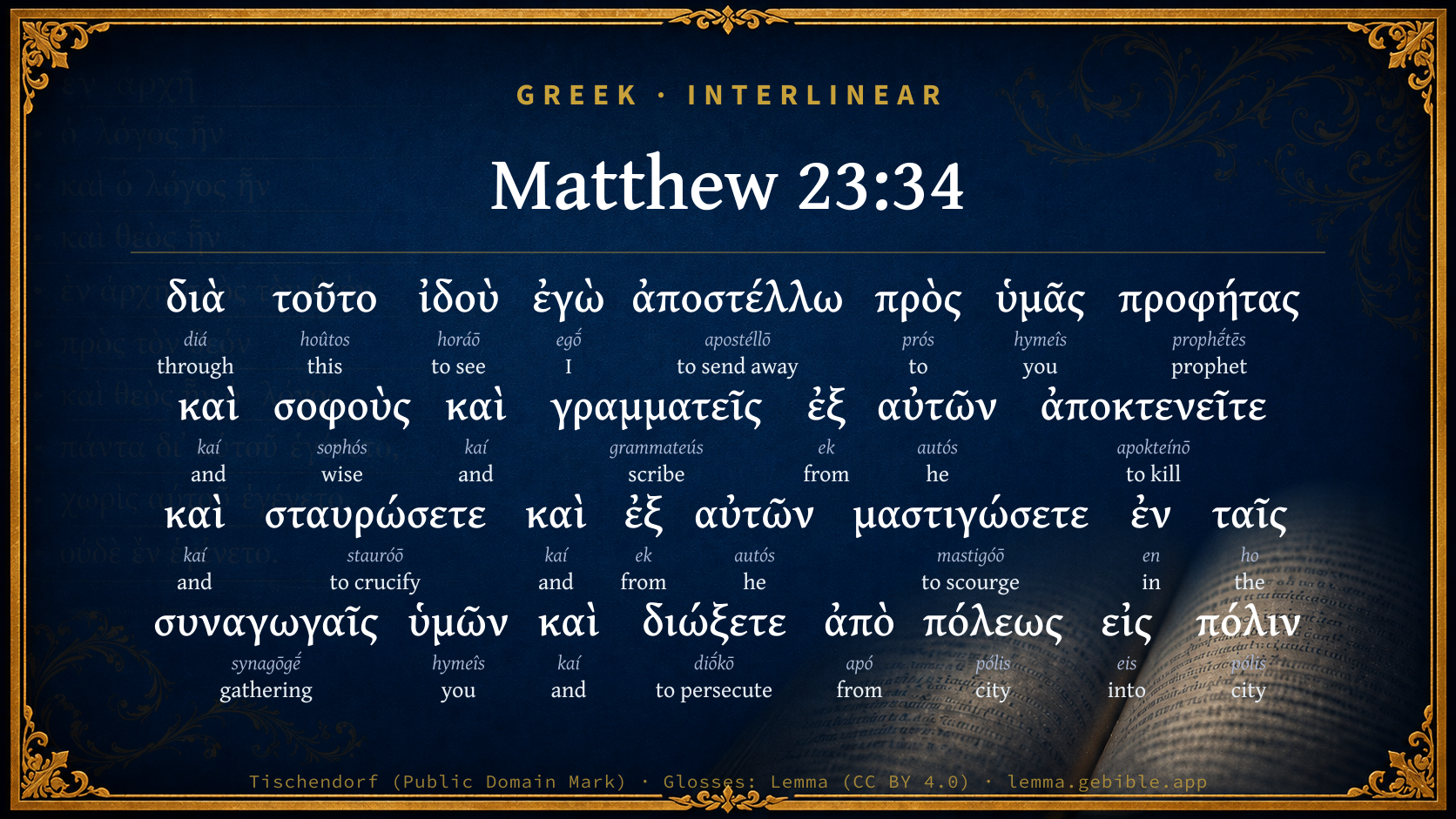
  1. διὰ diá G1223 “through” Preposition
  2. τοῦτο hoûtos G3778 “this” Demonstrative pronoun, Accusative, Singular, Neuter
  3. ἰδοὺ horáō G3708 “to see” Verb, Aorist, Middle, Imperative, 2nd person, Singular
  4. ἐγὼ egṓ G1473 “I” Personal pronoun, 1st person, Nominative, Singular
  5. ἀποστέλλω apostéllō G649 “to send away” Verb, Present, Active, Indicative, 1st person, Singular
  6. πρὸς prós G4314 “to” Preposition
  7. ὑμᾶς hymeîs G5210 “you” Personal pronoun, 2nd person, Accusative, Plural
  8. προφήτας prophḗtēs G4396 “prophet” Noun, Accusative, Plural, Masculine
  9. καὶ kaí G2532 “and” Conjunction
  10. σοφοὺς sophós G4680 “wise” Adjective, Accusative, Plural, Masculine
  11. καὶ kaí G2532 “and” Conjunction
  12. γραμματεῖς grammateús G1122 “scribe” Noun, Accusative, Plural, Masculine
  13. ἐξ ek G1537 “from” Preposition
  14. αὐτῶν autós G846 “he” Personal pronoun, Genitive, Plural, Masculine
  15. ἀποκτενεῖτε apokteínō G615 “to kill” Verb, Future, Active, Indicative, 2nd person, Plural
  16. καὶ kaí G2532 “and” Conjunction
  17. σταυρώσετε stauróō G4717 “to crucify” Verb, Future, Active, Indicative, 2nd person, Plural
  18. καὶ kaí G2532 “and” Conjunction
  19. ἐξ ek G1537 “from” Preposition
  20. αὐτῶν autós G846 “he” Personal pronoun, Genitive, Plural, Masculine
  21. ἐν en G1722 “in” Preposition
  22. ταῖς ho G3588 “the” Article, Dative, Plural, Feminine
  23. συναγωγαῖς synagōgḗ G4864 “gathering” Noun, Dative, Plural, Feminine
  24. ὑμῶν hymeîs G5210 “you” Personal pronoun, 2nd person, Genitive, Plural
  25. καὶ kaí G2532 “and” Conjunction
  26. διώξετε diṓkō G1377 “to persecute” Verb, Future, Active, Indicative, 2nd person, Plural
  27. ἀπὸ apó G575 “from” Preposition
  28. πόλεως pólis G4172 “city” Noun, Genitive, Singular, Feminine
  29. εἰς eis G1519 “into” Preposition
  30. πόλιν pólis G4172 “city” Noun, Accusative, Singular, Feminine

About this verse

These counts appear in no published source. They are computed here, from the morphology-tagged text and Lemma’s own curated glosses. What Lemma adds →

31
words
23
distinct lemmas
Gospels
section

Notable vocabulary

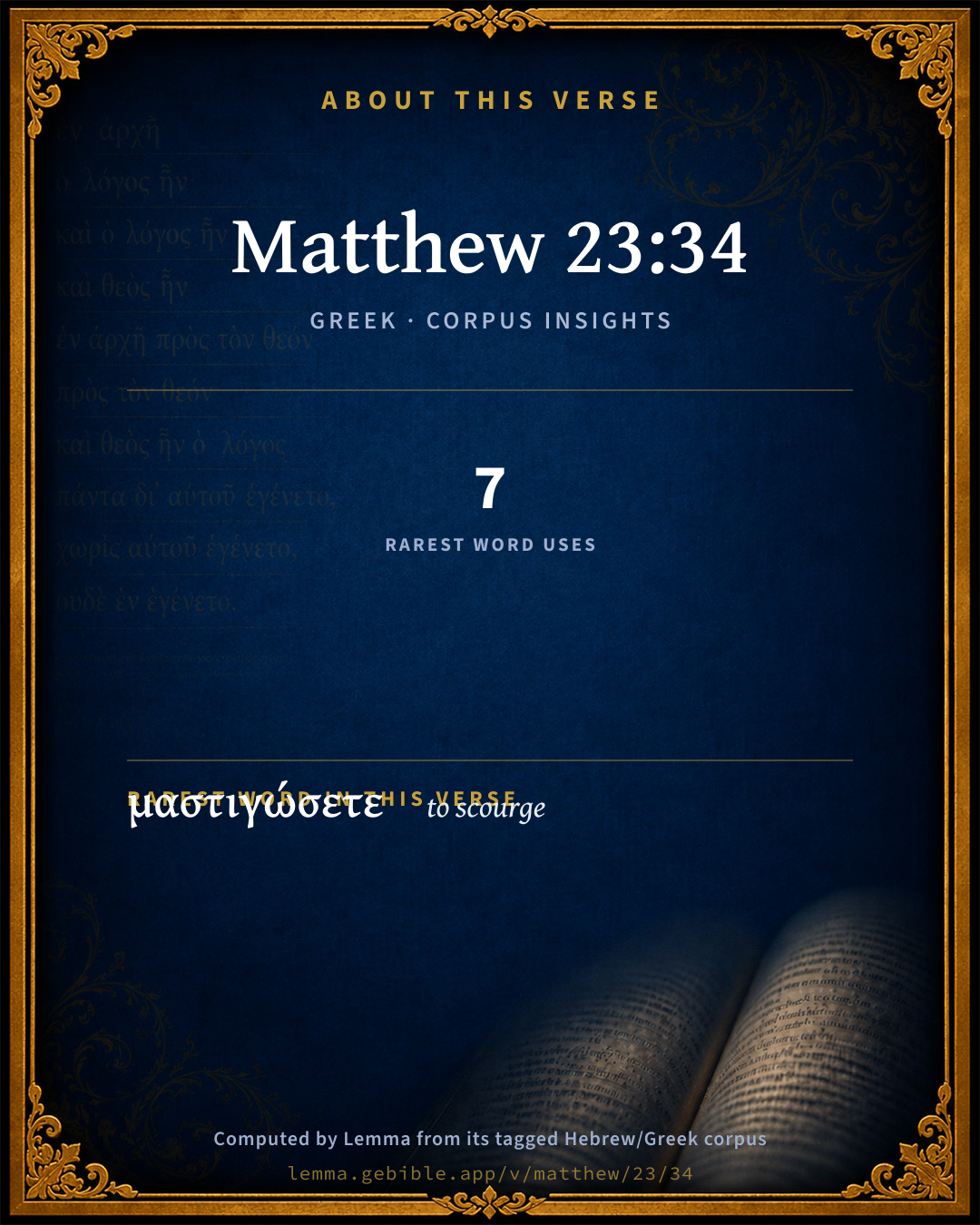
The rarest word here is μαστιγώσετε to scourge G3146 — appearing just 7 times in the whole Greek New Testament.

Shared distinctive vocabulary

μαστιγώσετε to scourge G3146 occurs in 7 verses of the Greek New Testament. Also found in:

Repetition

Words recur within this verse:

  • πόλεως city G4172 ×2
  • καὶ and G2532 ×5
  • ὑμᾶς you G5210 ×2
  • ἐξ from G1537 ×2
  • αὐτῶν he G846 ×2

Cross-references

31

Topical passages linked to Matthew 23:34 in the Treasury of Scripture Knowledge — connected by theme and wording, ordered by reader-vote popularity; previews shown in the World English Bible.

  • Matthew 10:16–17 "Behold, I send you out as sheep in the midst of wolves. Therefore be wise as serpents, and harmless as doves.
  • Matthew 13:52 He said to them, "Therefore, every scribe who has been made a disciple in the Kingdom of Heaven is like a man who is a householder, who brings out of his treasure new and old things."
  • Colossians 1:28 whom we proclaim, admonishing every man and teaching every man in all wisdom, that we may present every man perfect in Christ Jesus;
  • Matthew 10:23 But when they persecute you in this city, flee into the next, for most assuredly I tell you, you will not have gone through the cities of Israel, until the Son of Man has come.
  • Matthew 23:34–36 Therefore, behold, I send to you prophets, wise men, and scribes. Some of them you will kill and crucify; and some of them you will scourge in your synagogues, and persecute from city to city;
  • Luke 11:49–51 Therefore also the wisdom of God said, 'I will send to them prophets and apostles; and some of them they will kill and persecute,
  • Acts 13:1 Now in the assembly that was at Antioch there were some prophets and teachers: Barnabas, Simeon who was called Niger, Lucius of Cyrene, Manaen the foster-brother of Herod the tetrarch, and Saul.
  • 2 Chronicles 36:15–16 Yahweh, the God of their fathers, sent to them by his messengers, rising up early and sending, because he had compassion on his people, and on his dwelling-place:
  • Proverbs 11:30 The fruit of the righteous is a tree of life. He who is wise wins souls.
  • Matthew 28:19–20 Therefore go, and make disciples of all nations, baptizing them in the name of the Father and of the Son and of the Holy Spirit,
  • Luke 24:47 and that repentance and remission of sins should be preached in his name to all the nations, beginning at Jerusalem.
  • John 16:2 They will put you out of the synagogues. Yes, the time comes that whoever kills you will think that he offers service to God.
  • John 20:21 Jesus therefore said to them again, "Peace be to you. As the Father has sent me, even so I send you."
  • Acts 1:8 But you will receive power when the Holy Spirit has come upon you. You will be witnesses to me in Jerusalem, in all Judea and Samaria, and to the uttermost parts of the earth."
  • Acts 5:40 They agreed with him. Summoning the apostles, they beat them and charged them not to speak in the name of Jesus, and let them go.
  • Acts 7:51–52 "You stiff-necked and uncircumcised in heart and ears, you always resist the Holy Spirit! As your fathers did, so you do.
  • Acts 7:58–59 They threw him out of the city, and stoned him. The witnesses placed their garments at the feet of a young man named Saul.
  • Acts 11:27 Now in these days, prophets came down from Jerusalem to Antioch.
  • Acts 12:2 He killed James, the brother of John, with the sword.
  • Acts 14:19 But some Jews from Antioch and Iconium came there, and having persuaded the multitudes, they stoned Paul, and dragged him out of the city, supposing that he was dead.
  • Acts 15:32 Judas and Silas, also being prophets themselves, encouraged the brothers with many words, and strengthened them.
  • Acts 22:19–20 I said, 'Lord, they themselves know that I imprisoned and beat in every synagogue those who believed in you.
  • 1 Corinthians 2:6 We speak wisdom, however, among those who are full grown; yet a wisdom not of this world, nor of the rulers of this world, who are coming to nothing.
  • 1 Corinthians 3:10 According to the grace of God which was given to me, as a wise master builder I laid a foundation, and another builds on it. But let each man be careful how he builds on it.
  • 1 Corinthians 12:3–11 Therefore I make known to you that no man speaking by God's Spirit says, "Jesus is accursed." No one can say, "Jesus is Lord," but by the Holy Spirit.
  • 2 Corinthians 11:24–25 Five times from the Jews I received forty stripes minus one.
  • Ephesians 4:8–12 Therefore he says, "When he ascended on high, he led captivity captive, and gave gifts to men."
  • Hebrews 11:37 They were stoned. They were sawn apart. They were tempted. They were slain with the sword. They went around in sheep skins and in goat skins; being destitute, afflicted, ill-treated
  • Revelation 11:10 Those who dwell on the earth rejoice over them, and they will be glad. They will give gifts to one another, because these two prophets tormented those who dwell on the earth.
  • Acts 9:1–2 But Saul, still breathing threats and slaughter against the disciples of the Lord, went to the high priest,
  • 1 Thessalonians 2:16 forbidding us to speak to the Gentiles that they may be saved; to fill up their sins always. But wrath has come on them to the uttermost.

Cross-references courtesy of OpenBible.info (CC BY 4.0).

Commentary

Notes on Matthew 23:34 from classic Christian and Jewish commentators (each source and its license shown beneath its notes). The classic Christian expositions comment on the surrounding passage and are grouped to its opening verse, so a note may address several verses; the Jewish commentaries on the Tanakh (Rashi and others) are per-verse, so they appear only where the commentator wrote on this verse.

Lemma curates 59 commentaries, every one of them public domain or Creative Commons licensed, each selected and text-cleaned for this edition rather than reprinted as found. About our sources →

Whedon's Commentary on the Bible

Daniel D. Whedon

OUR LORD’S DENUNCIATION OF JUDGMENTS AND DEFINITE FAREWELL TO JERUSALEM, Mat_23:34-39.

34. Wherefore — In consequence of all this wickedness. That is, inasmuch as you are thus reprobate, the following course of events will transpire: namely, messengers will be sent to you, but you will so treat them as to bring the full measure of wrath upon you. Behold, I send — Our Lord here assumes divine authority. It is he who sends the prophets, and wise men, and scribes of the New Testament. Prophets — Preachers, for as the word of God is a great prophecy of the world to come, so he who preaches it, truly prophesies. Wise men — Deep thinkers in divine things, and true doctors in theology. For though the preacher stands first in the kingdom of God, yet the man who deeply studies and understands the things of God has his place, and is truly sent of Christ into his Church, whether ordained or not. Scribes — Who hold the pen of the ready writer. How measureless the amount of good the Christian author has done since our Lord spoke these words. First, the inspired writers of the New Testament; then come the early fathers of the church; and then the Christian historians, essayists, and poets. Ye shall kill — A large share of the first preachers, thinkers, and writers of the Church were martyrs.

Crucify — There is no recorded instance of martyrdom by crucifixion, unless we include the cases of our Lord and Peter, who is said to have been crucified with his head downwards. But of the many violent deaths of our Lord’s first followers, comparatively few are recorded.

Daniel D. Whedon (gen. ed.), Commentary on the Old and New Testaments (1874–1909) — public domain. Text from a community e-Sword module.

Bengel's Gnomon

Johann Albrecht Bengel

Mat 23:34. Διὰ τοῦτο, κ.τ.λ., wherefore, etc.) A corollary of the eighth woe.—Ἐγὼ, I) In the parallel passage of St Luke, Luk 11:49, we read, διὰ τοῦτο καὶ ἡ σοφία τοῦ Θεοῦ εἶπεν, Ἀποστελῶ, κ.τ.λ., wherefore also said the wisdom of God, I will send, etc. The first chapter of the second book of Esdras[1011] and this passage have a wonderful resemblance. In 2Es 1:30, we read, “I gathered you together as a hen gathereth her chickens under her wings:” in Mat 23:32, “I sent unto you My servants the prophets, whom ye have taken and slain, and torn their bodies in pieces, whose blood I will require of your hands, saith the Lord:” in Mat 23:33, “Thus saith the Almighty Lord, your house is desolate.” That book of Esdras is greatly esteemed by many, amongst whom of ourselves are found Schickardus on Tarich,[1012] p. 135, and Hainlin, in his Sol[1013] Temporum; and this quotation in the Gospel gives very great weight to it. J. C. Scaliger says (Exerc. 308), “I possess an admirable and divine compendium of the books of Esdras, composed in the Syrian language; they contain far more valuable sentiments than the harangues of their base calumniator.” That Syrian composition, which Scaliger calls a compendium, may have been a translation of the original Hebrew work, the longer Latin paraphrase of which may have many apocryphal additions. Such appears to be the case of the books of Wisdom and Ecclesiasticus, which at one time show evident signs of a Hebrew origin, and at another have a purely Greek character.—ἀποστέλλω, I send) The present tense. God’s messengers were sent when wickedness was most widely prevalent among His people.—προφήτας, prophets) Who are taught by special revelation, as David. These alone are mentioned with reference to the past; see Mat 23:30. Now wise men and scribes are added.—σοφοὺς, wise men) who have an habitual sense[1014] of the true and the good, corresponding with the Hebrew חבם, wise, derived from חך, the palate, or sense of taste; such as was Solomon. These are midway between prophets and scribes.—ΓΡΑΜΜΑΤΕῖς, scribes) who edit and illustrate the remains of the prophets and wise men, as Ezra did. In these last the character is for the most part acquired; in wise men, innate; in prophets, inspired.[1015] Therefore the world hates and despises prophets most, wise men much, scribes less, yet not little.—ἀποκτενεῖτε, ye shall kill) as James [the son of Zebedee].—σταυρώσετε, ye shall crucify) as Peter and Andrew, although Peter suffered martyrdom elsewhere.

[1011] In the original, “Liber iv. Esrae, cap.i.”—(I. B.)

[1012] The title of the work in full, as edited by Schickardus, is,” TARICH; h. e. series regum Persiae ab Ardschir—Babekan usque ad Jasdigerdem a chaliphis expulsam, ex fide MS. vol. authentici; vestita comm., etc., authore W. S. 4°. Tubingen, 1632.”—(I. B.)

[1013] A chronological work, the full title of which is, “Sol Temporum seu chronologia mystica et elenchus chronologicus per totam S. Scripturam deductus.” It was published in folio at Tubingen, A. D. 1646. The author is described as “Ecclesiæ Derendingensis Pastor, et Vicinarum Superintendens.”—(I. B.)

[1014] The word used by Bengel is gustum, the original and literal sense of which is, taste.—(I. B.)

[1015] In the original, infusus; literally, infused.—(I. B.)

Bengel's Gnomon of the New Testament — English translation (T&T Clark, Edinburgh, 1860) — public domain. Text from a community e-Sword module.

Meyer's Critical & Exegetical Commentary

Heinrich August Wilhelm Meyer

Mat_23:34. Διὰ τοῦτο] must be of substantially the same import as Ὅπως ἔλθῃ ἐφʼ ὑμᾶς in Mat_23:35. Therefore, in order that ye may not escape the condemnation of hell (Mat_23:33), behold, I send to you … and ye will, etc.; καὶ ἐξ αὐτῶν is likewise dependent on διὰ τοῦτο. Awful unveiling of the divine decree. Others have interpreted as follows: διότι μέλλετε πληρῶσαι τὸ μέτρον τῆς κακίας τῶν πατέρων ὑμῶν (Euthymius Zigabenus, Fritzsche), thus arbitrarily disregarding what immediately precedes (Mat_23:33). Moreover, without any hint whatever in the text of Matthew, ἰδού, ἐγὼ ἀποστέλλω, κ.τ.λ., has sometimes been taken for a quotation from some lost apocryphal prophecy, ἔφη ὁ θεός, or some such expression, being understood (van Hengel, Annotatio, p. 1 ff., and Paulus, Strauss, Ewald, Weizsäcker),a view borne out, least of all, by Luk_11:49, which passage accounts for the unwarrantable interpretation into which Olshausen has been betrayed.[12] The corresponding passage in Luke has the appearance of belonging to a later date (in answer to Holtzmann and others). Comp. on Luk_11:49.

ἐγώ] is uttered not by God (Ewald, Scholten), but by Jesus, and that under a powerful sense of His Messianic dignity, and with a boldness still more emphatically manifested by the use of ἰδού. Through this ἘΓῺ ἈΠΟΣΤΈΛΛΩ, Κ.Τ.Λ., Jesus gives it to be understood that it is Himself who, in the future also, is still to be the object of hatred and persecution on the part of the Pharisees (comp. Act_9:5).

προφήτας κ. σοφοὺς κ. γραμμ.] by whom He means His apostles and other teachers (Eph_4:11), who, in respect of the Messianic theocracy, would be what the Old Testament prophets were, and the Rabbins (חֲבָמִים) and scribes of a later time ought to have been, in the Jewish theocracy. For the last-mentioned order, comp. Mat_13:52. Olshausen is of opinion that the Old Testament prophets themselves must also have been intended to be included, and that ἀποστέλλω (which represents the near and certain future as already present) must indicate Gods pure and eternal present. The subsequent futures ought to have prevented any such construction being put upon the passage. For ΓΡΑΜΜ., comp. Mat_13:52.

ΚΑῚ ἘΞ ΑὐΤῶΝ] Οὐ ΠΆΝΤΕς (Euthymius Zigabenus), but more emphatic than if we had had ΤΙΝΆς besides: and from their ranks ye will murder, etc., so that the actions are conceived of absolutely (Winer, p. 552 [E. T. 743]). The same words are solemnly repeated immediately after.

ΚΑῚ ΣΤΑΥΡΏΣΕΤΕ] and among other ways of putting them to death, will crucify them, i.e. through the Romans, for crucifixion was a Roman punishment. As a historical case in point, one might quote (besides that of Peter) the crucifixion of Simeon, a brother of Jesus, recorded by Eusebius, H. E. iii. 32. The meagreness, however, of the history of the apostolic age must be taken into account, though it must not be asserted that in ΣΤΑΥΡΏΣΕΤΕ Jesus was referring to His own case (Grotius, Fritzsche, Olshausen, Lange). He certainly speaks with reference to the third class of divine messengers, the class whom He is now sending (Calov.), but not from the standpoint of His eternal, ideal existence (Olshausen), nor in the name of God (Grotius), and then, again, from the standpoint of His personal manifestation in time (Olshausen), fancies for which there is no foundation either in Luk_11:49 or in the text itself. Jesus does not contemplate His own execution in what is said at Mat_23:32.

ἘΝ ΤΑῖς ΣΥΝΑΓΩΓ.] Mat_10:17.

ἈΠῸ ΠΌΛΕΩς ΕἸς ΠΌΛΙΝ] Mat_10:23. Comp. Xen. Anab. v. 4. 31: εἰς τὴν ἑτέραν ἐκ τῆς ἑτέρας πόλεως.

[12] Jesus, he says, is here speaking as the very impersonation of wisdom; Matthew has omitted the quotation formula, because his object was to represent Jesus as the one from whom the words originally and directly emanate; but the original form of the passage is that in which it is found in Luke. Strauss, in Hilgenfelds Zeitschr. 1863, p. 84 ff., also has recourse to the hypothesis of a lost book, belonging, as he thinks, to a date subsequent to the destruction of Jerusalem, and written by a Christian, and in which the messengers in question are understood to be those whom God has been sending from the very earliest times. In this Strauss, following in the wake of Baur, is influenced by anti-Johannine leanings. According to Ewald, a volume, written shortly after the death of the prophet Zechariah in the fifth century before Christ, but which is now lost, was entitled ἡ σοφία τοῦ θεοῦ. The σταυρώσετε, he thinks, was inserted by Matthew himself. Bleek, in the Stud. u. Krit. 1853, p. 334, and in his commentary, agrees in the main with Ewald.

Meyer — Critical and Exegetical Commentary on the New Testament — English translation by Peter Christie, edited by Frederick Crombie (T&T Clark, 1880) — public domain. Text from a community e-Sword module.

Expositor's Greek Testament

ed. W. Robertson Nicoll

Mat 23:34-36 . Peroration (Luk 11:49-51 ).

Mat 23:34 . διὰ τοῦτο . The sense requires that this be connected with both Mat 23:32-33 . The idea is that all God’s dealings with Israel have been arranged from the first so as to ensure that the generation addressed shall fill up the measure of Israel’s guilt and penalty. The reference of ἀποστέλλω is not confined to what had been done for that generation. It covers all the generations from Abel downwards. The form in which the thought is expressed at first creates a contrary impression: Ἐγὼ ἀποστέλλω . But either the ἐγὼ is used in a supra-historical sense, or it must be regarded as a somewhat unsuitable word, and the correct expression of the source found in Luke’s ἡ σοφία τοῦ θεοῦ εἶπεν , what follows becoming thus a quotation, either in reality from some unknown writing, as many think, or in the conception of the speaker. I see no insuperable difficulty in taking Mt.’s form as the original. Olshausen conceives of Jesus as speaking, not as a personality involved in the limits of temporal life, but as the Son of God, as the essential wisdom of God. The ἐγὼ might be justified without this high reference to the Divinity of Jesus, as proceeding from His prophetic consciousness in an exalted state of mind. The prophet habitually spoke in the name of God. Jesus also at such a great moment might speak, as it were impersonally, in the name of God, or of wisdom. Resch, Agrapha , p. 274 ff., endeavours to show that “the wisdom of God” was, like “the Son of Man,” one of the self-designations of Jesus. Whether that be so or not, I think it is clear from this passage, and also from Mat 11:28-30 ( vide remarks there), that He did sometimes, as it were, personate wisdom. The present ἀποστέλλω , regards the history of Israel sub specie aeternitatis , for which the distinction of present and past does not exist. προφήτας , etc.: these names for the Sent clearly show that past and present are both in view. It is not merely the apostles , γραμματεῖς ( cf. Mat 13:52 ) = ἀποστόλους , Luk 11:49 , that are in view. σταυρώσετε , a hint at the impending tragic event, the Speaker one of the Sent. καὶ ἐξ αὐτῶν , etc.: a glance at the fortunes of the Twelve. Cf. chap. Mat 10:16-23 .

The Expositor's Greek Testament, edited by W. Robertson Nicoll (1897–1910) — public domain. Text from a community e-Sword module.

Geneva Bible (1599)

Geneva Bible translators

Hypocrites be cruel.

Geneva Bible (1599) marginal notes — public domain. Text via Bolls.life.

Jamieson, Fausset & Brown

Robert Jamieson, A. R. Fausset & David Brown

Wherefore, behold, I send unto you prophets, and wise men, and scribes--The I here is emphatic: "I am sending," that is, "am about to send." In Luk 11:49 the variation is remarkable: "Therefore also, said the wisdom of God, I will send them," &c. What precisely is meant by "the wisdom of God" here, is somewhat difficult to determine. To us it appears to be simply an announcement of a purpose of the Divine Wisdom, in the high style of ancient prophecy, to send a last set of messengers whom the people would reject, and rejecting, would fill up the cup of their iniquity. But, whereas in Luke it is "I, the Wisdom of God, will send them," in Matthew it is "I, Jesus, am sending them"; language only befitting the one sender of all the prophets, the Lord God of Israel now in the flesh. They are evidently evangelical messengers, but called by the familiar Jewish names of "prophets, wise men, and scribes," whose counterparts were the inspired and gifted servants of the Lord Jesus; for in Luke (Luk 11:49) it is "prophets and apostles."

unto the blood of Zacharias son of Barachias, whom ye slew between the temple and the altar--As there is no record of any fresh murder answering to this description, probably the allusion is not to any recent murder, but to Ch2 24:20-22, as the last recorded and most suitable case for illustration. And as Zacharias' last words were, "The Lord require it," so they are here warned that of that generation it should be required.

Jamieson, Fausset & Brown — Commentary Critical and Explanatory on the Whole Bible (1871) — public domain (CC PDM 1.0). Text via the HelloAO Bible API.

Adam Clarke's Commentary

Verse 34. Wherefore] To show how my prediction, Ye will fill up the measure of your fathers, shall be verified, Behold, I send (I am just going to commission them) prophets, &c. and some ye will kill, (with legal process,) and some ye will crucify, pretend to try and find guilty, and deliver them into the hands of the Romans, who shall, through you, thus put them to death. See on Lu 11:49. By prophets, wise men, and scribes, our Lord intends the evangelists, apostles, deacons, &c., who should be employed in proclaiming his Gospel: men who should equal the ancient prophets, their wise men, and scribes, in all the gifts and graces of the Holy Spirit.

Adam Clarke's Commentary on the Bible (1810–1826) — public domain. Text from a community e-Sword/MySword module.

Ellicott's Commentary for English Readers

(34) Behold, I send unto you prophets.—In the parallel passage of Luk_11:49 these words are introduced by the statement, “Therefore said the wisdom of God,” which has led some to see in them a quotation from some prophetic writing then current (see Note there). The words are, in any case, remarkable as including “scribes” no less than “prophets” among the ministers of the New Covenant. (See Note on Mat_13:52.)

Shall ye scourge in your synagogues.—See Note on Mat_10:17.

A Bible Commentary for English Readers, edited by Charles John Ellicott (1878–1897) — public domain. Text from a community e-Sword module.

The Cambridge Bible for Schools and Colleges

gen. ed. J. J. S. Perowne

34. I send unto you prophets, and wise men, and scribes] Marking the continuity of the Christian with the Jewish Church.

ye shall kill and crucify] Kill, directly as Stephen (Act_7:59), indirectly as James (Act_12:2), and crucify, by means of the Roman power, as Symeon, second Bishop of Jerusalem (Eus. H. E. iii. 32).

scourge in your synagogues] See note ch. Mat_4:23.

from city to city] As Paul pursued Christians to Damascus; as he was himself driven from Antioch in Pisidia, from Iconium, from Philippi, and from Thessalonica.

The Cambridge Bible for Schools and Colleges (gen. ed. J. J. S. Perowne; Cambridge University Press, 1878–1918) — public domain. Text from a community e-Sword module.

John Gill's Exposition

That upon you may come all the righteous blood,.... Or "the blood of all the righteous men", as the Syriac: Arabic, Persic, and Ethiopic versions read; for there is no righteousness in blood, nor any conveyed by it: all men are of one blood, and that is tainted, they that are righteous, are not so naturally, nor by any righteousness of their own, but by the righteousness of Christ: and such were the persons here meant, whose blood being shed in the cause of righteousness, God would revenge; and the punishment for such a crime, and the vengeance of God for it, were to come upon the nation of the Jews by this means, through their crucifying of Christ, and killing, and persecuting his apostles; whereby they would make it manifest, that they approved of, and consented to, what others had done to all the righteous men, whose blood had been

shed upon the earth; whether in Judea, or elsewhere; and continued in the same wicked practices, or committed worse, and so justly incurred the wrath of God to the uttermost; which would quickly come upon them, when the measure of their fathers' sin were filled up by them, from the beginning of time, to the present age: everom the blood of righteous Abel: who was the first person in the world that was killed, and that for righteousness sake too, because his works were righteous, his person being so; not by his works, but through the righteousness and sacrifice of the Messiah, which were to be brought in; in the faith of which he offered up his sacrifice, whereby he obtained a testimony from God, that he was righteous, having respect to his person in Christ, and so to his offering. This epithet of "righteous" seems to be what was commonly given him by the Jews: hence, with a peculiar emphasis, he is called, , "Abel the righteous" (t); as he is also said to be , "the head of them that killed" (u); he being the first man that was slain; for which reason he is mentioned here by Christ; and also, because his blood cried for vengeance, and still continued to do, upon all such persons that should commit the like crime. It is an observation frequently made by the Jews, on those words in Gen 4:10 "the voice of thy brother's blood crieth unto me", that "it is not said in the Hebrew text, the blood of thy brother, but the bloods of thy brother; his blood, and the blood of his seed (w); and that from hence may be learned, that the blood of his children, and of his children's children, and of all his offspring, to the end of all generations, that should proceed from him, all stood and cried before the Lord (x).

The Jerusalem Targum paraphrases the words in this remarkable manner,

"the price of the bloods of "the multitude of the righteous", that shall spring from Abel thy brother.

And Onkelos thus,

"the voice of the blood of the seed that shall rise from thy brother, &c.

unto the blood of Zacharias, son of Barachias, whom ye slew between the temple and the altar. Learned men are very much divided about this person, who he was. Some think our Lord speaks prophetically of Zechariah, the son of Baruch; who, as Josephus says (y), was slain in the middle of the temple, just before the siege of Jerusalem; and who was, as he also relates, a rich man, of an illustrious family, a hater of wickedness, and a friend to liberty: and because, as Abel was the first man that was slain, and this man being killed in the temple, at the close of the Jewish state; and because the words may be rendered, "whom ye shall have slain", therefore he is thought to be intended: but there are several things that do not agree with him, besides its being a narration of a fact, as past, according to the usual rendering of the word: for this Zacharias was the son of Baruch, and not Barachias, which are two different names; he was killed in the middle of the temple, not between the temple and the altar; nor does he appear to be a man of such great character, as to be distinguished in this manner; and besides, his death was what the Jews did not consent to in general, and therefore could not be charged with it; he was acquitted by the sanhedrim of the charge of treachery laid against him, and was assassinated by two zealots. Others have thought that Zacharias, the father of John the Baptist, is meant, who is supposed to be murdered by the Jews very lately; and it being a recent action, is mentioned by our Lord: the reason of it is a tradition, which several ancient writers (z) speak of, and is pretended to be this; that there was a place, in the temple appropriated to virgins, and that Mary, the mother of our Lord, after his birth, came and took her place here, as a virgin, when the Jews, knowing her to have a child, objected to it; but Zechariah, who was acquainted with the mystery of the incarnation, ordered her to keep her place, upon which the Jews slew him upon the spot: but this tradition is not to be depended on; nor does it appear that there ever was any such particular place in the temple assigned to virgins; nor that the father of this Zacharias was Barachias; or that the son was slain by the Jews, and in this place. Others have been of opinion, that Zechariah the prophet is designed; and indeed, he is said to be the son of Berechiah, the son of Iddo, Zac 1:1 and the Jewish Targumist speaks of a Zechariah, the son of Iddo, as slain by the Jews in the temple. His words are these (a),

"as ye slew Zechariah, the son of Iddo, the high priest, and faithful prophet, in the house of the sanctuary of the Lord, on the day of atonement; because he reproved you, that ye might not do that evil which is before the Lord.

And him the Jews make to be the same with Zechariah the son of Jeberechiah, in Isa 8:2 and read Berechiah (b): but the Targumist seems to confound Zechariah, the son of Jehoiada, with him; for the prophet Zechariah was not an high priest, Joshua was high priest in his time; nor does it appear from any writings, that he was killed by the Jews; nor is it probable that they would be guilty of such a crime, just upon their return from captivity; and besides, he could not be slain in such a place, because the temple, and altar, were not yet built: it remains, that it must be Zechariah, the son of Jehoiada the priest, who was slain in the court of the house of the Lord, Ch2 24:20 who, as Abel was the first, he is the last of the righteous men whose death is related in the Scriptures, and for whose blood vengeance was required, as for Abel's. He was slain in the court of the house of the Lord; and so the Ethiopic version here renders it, in the midst of the holy house. It is often said by the Jewish writer (c), that "R. Joden (sometimes it is R. Jonathan) asked R. Acha, whether they slew Zechariah, in the court of the Israelites, or in the court of the women? he answered him, neither in the court of the Israelites, nor in the court of the women, but in the court of the priests.

And elsewhere they say (d), that they

"slew a priest and a prophet in the sanctuary; this is Zechariah the son of Jehoiada.

Now it should be observed, that the temple, or sanctuary, is sometimes put for the whole sacred building, with all its courts and appurtenances; and sometimes, as in this text, for that part of it that was covered, between which, and the altar of burnt offerings, in the court of the priests, which must he here meant, and not the altar of incense, in the most holy place, was a space of twenty two cubits (e), frequently called, in Jewish writings, the space between the porch and the altar; that is, the porch which led into the temple, and the brazen altar in the court of the priests, which was open to the air, and is the very spot here intended. Now this was a very sacred place, and is mentioned as an aggravation of the sin of the Jews, that they should enter where none but priests might; nor these neither that had any defect in them; and defile it also by shedding innocent blood,

"The court of the Israelites is holier than the court of the women; because those that wanted atonement might not enter there; and a defiled person that entered there, was obliged to be cut off: the court of the priests was holier than that, because the Israelites might not enter there, but in the time of their necessities, for laying on of hands for atonement, for killing and waving: the place between the porch and the altar was holier than that; for such that had any blemishes, or were bareheaded, or had their garments rent, might not enter (f).

Hence they say (g), that "the Israelites committed seven transgressions on that day: they slew a priest, and a prophet, and a judge; and they shed innocent blood, and they blasphemed God, and defiled the court, and it was a sabbath day, and the day of atonement.

The chief objections to its being this Zechariah are, that the names do agree; the one being the son of Jehoiada, the other the son of Barachias; and the killing of him was eight hundred years before this time; when it might have been thought our Lord would have instanced in a later action: and this he speaks of, he ascribes to the men of that generation: to which may be replied, that as to the difference of names, the father of this Zechariah might have two names, which is no unusual thing; besides, these two names signify much the same thing; Jehoiada signifies praise the Lord, and Barachias bless the Lord; just as Eliakim and Jehoiakim, are names of the same person, and signify the same thing, Ch2 36:4. Moreover, Jerom tells us, that in the Hebrew copy of this Gospel used by the Nazarenes, he found the name Jehoiada instead of Barachias: and as to the action being done so long ago, what has been suggested already may be an answer to it, that it was the last on record in the writings of the Old Testament; and that his blood, as Abel's, is said to require vengeance: and Christ might the rather pitch upon this action, because it was committed on a very great and worthy man, and in the holy place, and by the body of the people, at the command of their king, and with their full approbation, and consent: and therefore, though this was not done by the individual persons in being in Christ's time, yet by the same people; and so they are said to slay him, and his blood is required of them: and their horrible destruction was a punishment for that load of national guilt, which had been for many hundreds of years contracting, and heaping upon them,

(t) Tzeror Hammor, fol. 8. 2. (u) Juchasin, fol. 5. 2. (w) Bereshit Rabba, sect. 22. fol. 20. 1. Misn. Sanhedrin, c. 4. sect. 5. Moses Kotsensis Mitzvot Tora pr. affirm. 98. (x) Abot. R. Nathan, c. 31. (y) De Bello Jud. l. 5. c. 1. (z) Origen. in Matth. T. 3. Homil. 26. fol. 44. Greg. Nyssen. in diem nat. Christ. Vol. 2. p. 777. Basil. de human. gen. Christ. & Theophylact. in loc. (a) Targum in Lam. ii. 20. (b) T. Bab. Maccot, fol. 24. 2. (c) T. Hieros. Tannioth, fol. 69. 1. Praefat. ad Echa Rabbati, fol. 36. 4. & Echa Rabbati, fol. 52. 4. & 58. 3. Midrash Kohelet, fol. 68. 3. (d) Echa Rabbati, fol. 55. 1. (e) Misn. Middot, c. 3. sect. 6. (f) Maimon. Beth. Habbechira, c. 7. sect. 18, 19, 20. Bemidbar Rabba, sect. 7. fol. 188. 4. (g) T. Hieros. Taanioth, fol. 69. 1. Echa Rabbati, fol. 53. 1. & 58. 3. Midrash Kobelet, fol. 68. 4.

John Gill's Exposition of the Whole Bible (1746–1763) — public domain (CC PDM 1.0). Text via the HelloAO Bible API.

Trapp's Complete Commentary

John Trapp

34 Wherefore, behold, I send unto you prophets, and wise men, and scribes: and some of them ye shall kill and crucify; and some of them shall ye scourge in your synagogues, and persecute them from city to city:

Ver. 34. Wherefore, behold, I send you] Oh the infinite goodness of God, in striving by his Spirit with refractory sinners in the use of the means, waiting their return!

" Sed pensare solet vi graviore moram."

Prophets, wise men, and scribes] That is, apostles, pastors, and teachers, Eph 4:11, whom he here calleth by the customary names of that country. Scribe was an honourable name, till Pharisees dishonested it by their hypocrisy.

Ye shall kill and crucify] If therefore we have not yet resisted unto blood, be content with lighter crosses, and look for heavier. Omnis Christianus crucianus. (Luther.) It is but a delicacy to divide between Christ and his cross.

John Trapp, A Commentary or Exposition upon All the Books of the Old and New Testament (1647–1656) — public domain. Text from a community e-Sword module.

Albert Barnes' Notes on the Bible

I send unto you prophets ... - Jesus doubtless refers here to the apostles, and other teachers of religion. Prophets, wise men, and scribes were the names by which the teachers of religion were known among the Jews, and he therefore used the same terms when speaking of the messengers which he would send. “I send” has the force of the future, I “will” send.

Some of them ye shall kill - As in the case of Stephen Act 7:59 and James Act 12:1-2.

Crucify - Punish with death on the cross. There are no cases of this mentioned; but few historical records of this age have come down to us. The Jews had not the power of crucifying, but they had power to deliver those whom they condemned to death into the hands of the Romans to do it.

Shall scourge - See the notes at Mat 10:17. This was done, Act 22:19-24; 2Co 11:24-25.

Persecute ... - See the notes at Mat 5:10. This was fulfilled in the case of nearly all the apostles.

Albert Barnes' Notes on the Bible (1834–1885) — public domain. Text from a community e-Sword/MySword module.

Matthew Poole's English Annotations

Luke saith, Luk 11:49-51, Therefore also said the wisdom of God, I will send them prophets and apostles, and some of them they shall slay and persecute: that the blood of all the prophets, which was shed from the foundation of the world, may be required of this generation; from the blood of Abel unto the blood of Zacharias, which perished between the altar and the temple: verily I say unto you, It shall be required of this generation. Luke saith, Therefore also said the wisdom of God. Matthew saith, Behold, I send. Christ is the wisdom of God; he here tells them he would send them prophets, wise men, scribes. Luke expounds it by prophets and apostles; men authorized by Christ to reveal unto men the will of God, and men that should be extraordinarily inspired to enable them thereunto.

Scribes, that is, persons instructed to the kingdom of God; a new sort of scribes, but much fitter for their work than the present scribes.

And some ye shall kill and crucify, &c.: our Lord in this only foretells what usage both himself and his apostles should meet with from them, which was fulfilled in what the Scripture telleth us of the scourging of Paul, the stoning of Stephen, the killing of James, &c., beside the crucifying of himself.

That upon you, that is, as he expounds it, Mat 23:36, upon this generation, may come all the righteous blood, that is, the blood of righteous men, shed upon the earth, from the blood of righteous Abel to the blood of Zacharias son of Barachias, &c. Here arise two questions:

1. Who this Zacharias the son of Barachias was.

2. How it could stand with God’s justice to bring the guilt of the blood of former generations upon that generation.

As to the first, some have guessed the person spoken of to have been one Zacharias the son of Baruch, who was the last slain upon the taking of Jerusalem, as Josephus tells us: but our Saviour here speaks of a thing passed, not to be afterwards done. Others think it was Zacharias the father of John Baptist: but we have no proof that he died a violent death. Others think it was Zechariah, who was one of the small prophets: but there was no temple in his time. It is most probably concluded to be Zechariah, the son of Jehoiada, whom the Jews stoned with stones at the commandment of Joash in the court of the house of the Lord, 2Ch 24:21. The father’s name indeed doth not agree; but, first, Jehoiada (as many of the Jews had) might have two names: some think it was this same Zechariah who is called the son of Jeberechiah, Isa 8:2. Our Saviour nameth Abel, who lived before the law, and Zacharias, who lived under the law, both slain for righteousness’ sake; that under them he might comprehend all the martyrs slain in those two periods. Others judge, that these two are named because we read of Abel’s blood crying, Gen 4:10, and Zechariah’s praying (when he died) that the Lord would require his blood. For the other question, it is but righteous with God to punish the sins of parents upon their children; and though such vengeance doth not ordinarily reach further than the third and fourth generation, yet where succeeding generations go on in the same sinful courses, it may reach further, and often does. Isa 65:6,7, I will (saith God) recompense into their bosom your iniquities, and the iniquities of your fathers together. That was the case here. They filled up the measure of their fathers’ sins. Therefore Christ tells them, that vengeance should sleep no longer, but come upon that generation, which happened in the utter destruction of Jerusalem within less than forty years after. Our Lord concludes with a pathetical lamentation over Jerusalem, and a further confirmation of what he had said about their ruin.

Matthew Poole's English Annotations on the Holy Bible (1683–1685) — public domain. Text from a community e-Sword/MySword module.

The Pulpit Commentary

Wherefore; dia touto . Because ye are resolved on imitating your forefathers" iniquities, you will also reject the messengers that are sent to you, and shall suffer righteous condemnation. I send (egw apostellw) unto you. The sending had already begun. In the parallel passage of St. Luke (Luk_11:49) we read, "Therefore also said the wisdom of God, I will send." Christ is the Wisdom of God, and by his own authority gives mission to his messengers. "As the Father hath sent me, even so send you", (Joh_20:21) he says to his apostles; and to such he is referring in the words which follow. Prophets. The apostles were of like character, inspiration, and influence as the prophets under the old dispensation, and succeeded in their place as exponents of God"s will and heralds of the covenant. Wise men. Men full of the Holy Ghost and heavenly wisdom.

Scribes. Not in the then Jewish sense, but instructors in the new law of life, the law of Christ"s religion. (Mat_13:52) All the means of teaching and edification employed aforetime were abundantly and more effectually supplied under the gospel. St. Luke has, "prophets and apostles." Kill; as Stephen, (Act_7:59) James. (Act_12:2) Crucify; as Peter; (Joh_21:18, 19 2Pe_1:14) Simeon (Eusebius, "Hist. Ec:," 3:32); and probably Andrew. Scourge. (see Act_5:40 Act_22:19 Act_26:11 2Co_11:24, 2Co_11:25) Persecuted. (see Act_13:50 Act_14:5, Act_14:6, Act_14:19, 20 26:11; and compare Christ"s prediction, Mat_10:17, Mat_10:18) The passage in the Second (Fourth) Book of Est 1:32, which is strikingly parallel to our Lord"s denunciation, may possibly be a Christian interpolation, "I sent unto you my servants the prophets, whom ye have taken and slain, and torn their bodies in pieces, whose blood I will require of your hands, saith the Lord."

The Pulpit Commentary (1880–1919), ed. H.D.M. Spence-Jones & Joseph S. Exell — public domain. Text from a community e-Sword module.

John Wesley's Explanatory Notes

Wherefore - That it may appear you are the true children of those murderers, and have a right to have their iniquities visited on you: Behold, I send - Is not this speaking as one having authority? Prophets - Men with supernatural credentials: Wise men - Such as have both natural abilities and experience; and scribes - Men of learning: but all will not avail. Luke xi, 49.

John Wesley, Explanatory Notes Upon the Whole Bible (1754–1765) — public domain. Text via the GEBible commentary corpus.

Scofield Reference Notes

C. I. Scofield

send unto you

The Jews’ treatment of the apostles is proved, Mat 23:31-33.

The Scofield Reference Bible (1917 edition), notes by C. I. Scofield — public domain. Text from a community e-Sword module.

Kretzmann's Popular Commentary

Paul E. Kretzmann

The Peroration and the Lament over Jerusalem.

v. 34. Wherefore, behold, I send unto you prophets and wise men and scribes; and some of them ye shall kill and crucify, and some of them ye shall scourge in your synagogues, and persecute them from city to city:

v. 35. that upon you may come all the righteous blood shed upon the earth from the blood of righteous Abel unto the blood of Zacharias, son of Barachias, whom ye slew between the Temple and the altar.

v. 36. Verily I say unto you, All these things shall come upon this generation.

It is the beginning of the judgment upon the Jewish nation for their consistent refusal to accept the Messiah, visited first of all upon their leaders. With great seriousness Jesus states this fact, because the present generation is about to fill up the measure of iniquity to the very brim. He would send His messengers again, but their hearts would be hardened by their message, against the message and against the bearers. Their false worship would not want to permit the worship in spirit and in truth. They would kill, and crucify, and scourge, and persecute the messengers of Christ. No form of inquisition and cruelty is too horrifying when people vent their spite against the messengers of the true Gospel. And so the Jews, in being punished for the murder of Christ and the messengers of the New Testament, in having their blood come upon them, would incidentally receive punishment for the murders of the prophets of the Old Testament. They have their fathers’ spirit, the same hatred for the truth and its bearers; and so the sins of the fathers will be visited upon the children. Abel was the first one to die, a martyr of his convictions, of his faith. And the hatred of the children of God continued down through the ages, one of the most conspicuous cases being that of Zacharias, the son of Jehoiada, also called Barachias, 2Ch 24:20-21, not to speak of other murders recorded in history. All the accumulated wrath of God was visited upon the Jews of the generation of Jesus, because they rejected the Messiah Himself. "As though He would say: It is one people, one kind, one generation; as the fathers, so the children. For the stubbornness that resisted God and His prophets in the fathers, resists in the same way in the children: the child is like the mother. All the blood that they have shed is bound to come upon them."

Paul E. Kretzmann, Popular Commentary of the Bible (1921–1924) — public domain. Text from a community e-Sword module.

Burkitt's Expository Notes on the New Testament

William Burkitt

Observe here, A prophetical prediction, and a severe denunciation.

1. A prediction foretelling what cruel usage the apostle should meet with from the Jews, killing and crucifying some, scourging and stoning others; which accordingly was fulfilled in the crucifying of St. Peter, the scourging of St. Paul, in the stoning of St. Stephen, and killing of St. James. The first planters and propagators of the gospel sealed their doctrine with their blood, and the blood of the martyrs has all along been the seed of the church.

Observe, 2. A severe denunciation, That upon you may come all the righteous blood shed upon the earth from Abel to Zacharias, the son of Jehoiada, 2Ch 24:20, who was the last prophet whose murder is related by name in the Old Testament. These words are not to be understood as if the end and intent of Christ’s sending the prophets were that the Jews might put them to death, and bring their righteous blood upon themselves. This was the consequence and intent of it.

Learn, 1. That raging persecutors have no regard either to the extraordinary mission, or eminent sanctity of persons who reprove them for their sins. I send unto you prophets, says our Saviour, wise men and Scribes, and some of them ye shall kill and crucify.

2. That as the piety of the person, so neither can the sanctity of the place discourage and deter bloody persecutors from their rage and fury against the prophets of God. In the temple itself, in the court of the house of the Lord, even betwixt the porch and the altar, was Zacharias slain. That it is a righteous thing with God to punish good men for the impieties of their parents:

this is to be understood, 1. Where the children tread in their fathers steps, and continue in their parents sins; which they do, if they do not confess them, abhor them, and be humbled for them.

2. This is to be understood of temporal evils, not of eternal punishments. No man shall for his father’s sins lie down in everlasting burnings. As our fathers faith will not let us into heaven, so neither will their impiety shut us into hell. At the day of judgment every man shall be separately considered according to his deeds.

William Burkitt's Expository Notes on the New Testament (1700–1703) — public domain. Text from a community e-Sword module.

The People's New Testament

B. W. Johnson

34. Wherefore, I send unto you prophets and wise men. In Luke 11:49, is a passage much like this. The men sent were inspired apostles and evangelists. By giving the Jews still further opportunities after the sin of the cross, the guilt of those continued to reject the crucified Lord was aggravated. Prophets. Inspired teachers, like the apostles, Philip, Stephen, etc. Wise men. Faithful, devout and learned, but uninspired preachers. Scribes. Usually, those who copy and teach the wisdom of others, but I suppose also embracing those who wrote the New Testament Scriptures. Some of them ye shall kill and crucify. Literally fulfilled in the next few years.

B. W. Johnson's The People's New Testament with Notes (1889–1891) — public domain. Electronic text from the Christian Classics Ethereal Library (CCEL) ThML edition.

unfoldingWord translationNotes

Door43 World Missions Community

Connecting Statement:

Jesus continues to rebuke the religious leaders because of their hypocrisy.

I am sending you prophets and wise men and scribes

Sometimes the present tense is used to show that someone will do something very soon. AT: "I will send prophets, wise men, and scribes to you"

upon you will come all the righteous blood that has been shed on the earth

The phrase "upon you will come" is an idiom that means to receive punishment. To shed blood is a metonym meaning to kill people, so "righteous blood that has been shed on the earth" represents righteous people who have been killed. AT: "God will punish you for the murders of all the righteous people" (See: Idiom and Metonymy)

from the blood ... to the blood

Here the word "blood" represents a person being killed. AT: "from the murder ... to the murder" (See: Metonymy)

Abel ... Zechariah

Abel was the first righteous victim of murder, and Zechariah, who was murdered by Jews in the temple, was probably thought to be the last. These two men represent all the righteous people who have been murdered. (See: Merism)

Zechariah

This Zechariah was not the father of John the Baptist.

whom you killed

Jesus does not mean the people to whom he is speaking actually killed Zechariah. He means their ancestors did.

Truly I say to you

"I tell you the truth." This adds emphasis to what Jesus says next.

translationWords

send

prophet

wise

scribe

crucify

synagogue

bloodshed

Abel

righteous

Zechariah (OT)

sanctuary

altar

amen

generation

unfoldingWord translationNotes — © Distant Shores Media and the Door43 World Missions Community, licensed CC BY-SA 4.0. Source: git.door43.org/Door43/en_tn.

Cambridge Greek Testament for Schools and Colleges

34. ἀποστέλλω … προφήτας καὶ σοφοὺς καὶ γραμματεὶς. Marking the continuity of the Christian with the Jewish Church.

ἀποκτενεῖτε καὶ σταυρώσετε. Kill, directly as Stephen (Act 7:59), indirectly as James (Act 12:2), and crucify, by means of the Roman power, as Symeon, second Bishop of Jerusalem (Eus. H. E. III. 32).

μαστιγώσετε ἐν ταῖς συν. See note ch. Mat 4:23.

ἀπὸ πόλεως εἰς πόλιν. As Paul pursued Christians to Damascus; as he was himself driven from Antioch in Pisidia, from Iconium, from Philippi, and from Thessalonica.

Cambridge Greek Testament for Schools and Colleges (Cambridge University Press, 1896; 21 vols, various authors incl. Carr, Maclear, Plummer, Farrar, Lumby, Moule, M. R. James, Simcox) — public domain. Text from a community e-Sword module.

Alford’s Greek Testament

Henry Alford

34.] From the similar place in the former discourse (Luk 11:49, see notes there) it would appear that the διὰ τοῦτο refers to the whole last denunciation: ‘quæ cum ita sint’—‘since ye are bent upon filling up the iniquities of your fathers, in God’s inscrutable purposes ye shall go on rejecting His messengers.’ Notice the difference between ἡ σοφία τοῦ θ. in Luk 11:49, and ἐγώ, with its emphasis here. These words are no where written in Scripture, nor is it necessary to suppose that to be our Lord’s meaning. He speaks this as Head of His Church, of those whom He was about to send: see Act 13:1: 1Co 12:8: Eph 3:5. He cannot, as some (Olsh.) think, include Himself among those whom He sends—the Jews may have crucified many Christian teachers before the destruction of Jerusalem. And see Euseb. H. E. iii. 32, where he relates from Hegesippus the crucifixion of Symeon son of Clopas, in the reign of Trajan. The καί takes out the στανρώσετε, the special, from the ἀποκτενεῖτε, the general; with, of course, somewhat of emphasis. The προφῆται were the Apostles, who, in relation to the Jews, were such—the σοφοί, Stephen and such like, men full of the Holy Ghost—the γραμματεῖς, Apollos, Paul (who indeed was all of these together), and such. On μαστ. ἐν τ. συν. κ.τ.λ. see Act 5:40; Act 22:19; Act 26:11.

Henry Alford, The Greek Testament (1849–1861) — public domain. Text from a community e-Sword module.

International Critical Commentary

34. Therefore, behold, I send to you prophets, and wise men, and scribes. Some of them you shall kill and crucify; and some of them you shall scourge in your synagogues, and hunt them from city to city.] Lk. has: “Therefore also the wisdom of God said, I will send to them prophets and apostles, and some of them they shall kill and persecute.” In S. Luke διὰ τοῦτο καὶ ἡ σοφία θεοῦ εἶπεν may be an insertion by the Evangelist into Christ’s words, and by ἡ σοφία may be meant Christ Himself. Or the clause may be a continuation of Christ’s words. In that case the words which follow are presumably a quotation from an unknown source. See on Luk 11:49. In Mt. there is no hint that the words are a quotation, and the Evangelist clearly regards them as words of Christ Himself. But, of course, the Evangelist may have been aware that the Lord was quoting and adapting to Himself words from some literary source.—προφήτας καὶ σοφοὺς καὶ γραμματεῖς] The Christian missionaries are described under terms taken from Jewish institutions. The προφήτης passed over into the Christian Church, but the terms σοφοί and γραμματεῖς were too familiar is contemporary Judaism to be permanently adopted by Christian teachers. For the scourging in the synagogues, cf. 10:17; for the persecuting from city to city, 10:23.

(L)

International Critical Commentary — older volumes (1896–1929), various authors — public domain. Text from a community e-Sword module.

Lesson kit

Teaching starters — assembled from the data on this page, not authored interpretation. Every prompt links to the verse data it draws on. Edit before teaching.

Matthew, in the Gospels, opens this verse with 31 words (23 distinct Greek lemmas). Its most distinctive word is mastigóō (“to scourge”). A historical commentator’s framing appears above. Read the whole chapter for the surrounding context.

Discussion questions

  1. What does “to scourge” (mastigóō) contribute to the verse as a whole?
  2. Matthew 10:17 shares the word «to scourge» with this verse. How do the two illuminate each other?
  3. “city” occurs 2× in this one verse. What is the effect of the repetition?
  4. The translations on this page render this verse differently — a whole-verse word diff, not a word-by-word alignment. What might account for the different wordings?
  5. Reading how Whedon's Commentary on the Bible and Bengel's Gnomon read this verse, where do the two commentators agree and where do they part?

Things to notice

Reading settings

Reading text

Shown beneath each verse's original-language words.

Old Testament
Old Testament edition

Read the OT as the Masoretic Hebrew (MT) or the Greek Septuagint (LXX).

English shown for the Greek Septuagint (in the Hebrew ↔ Greek comparison).

Comparing translations? Open the Compare panel on any verse page to stack up to four side by side.