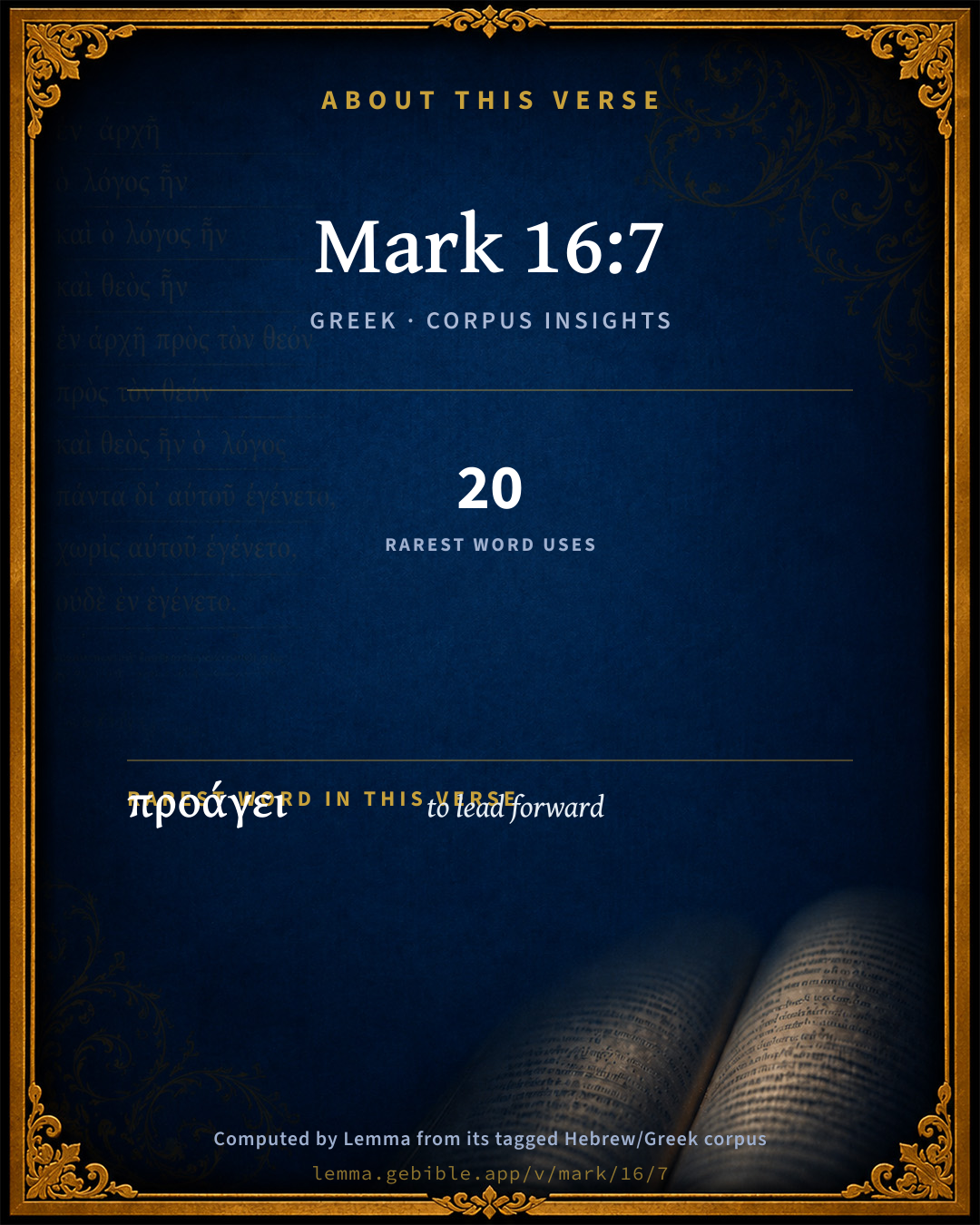
Mark 16:7

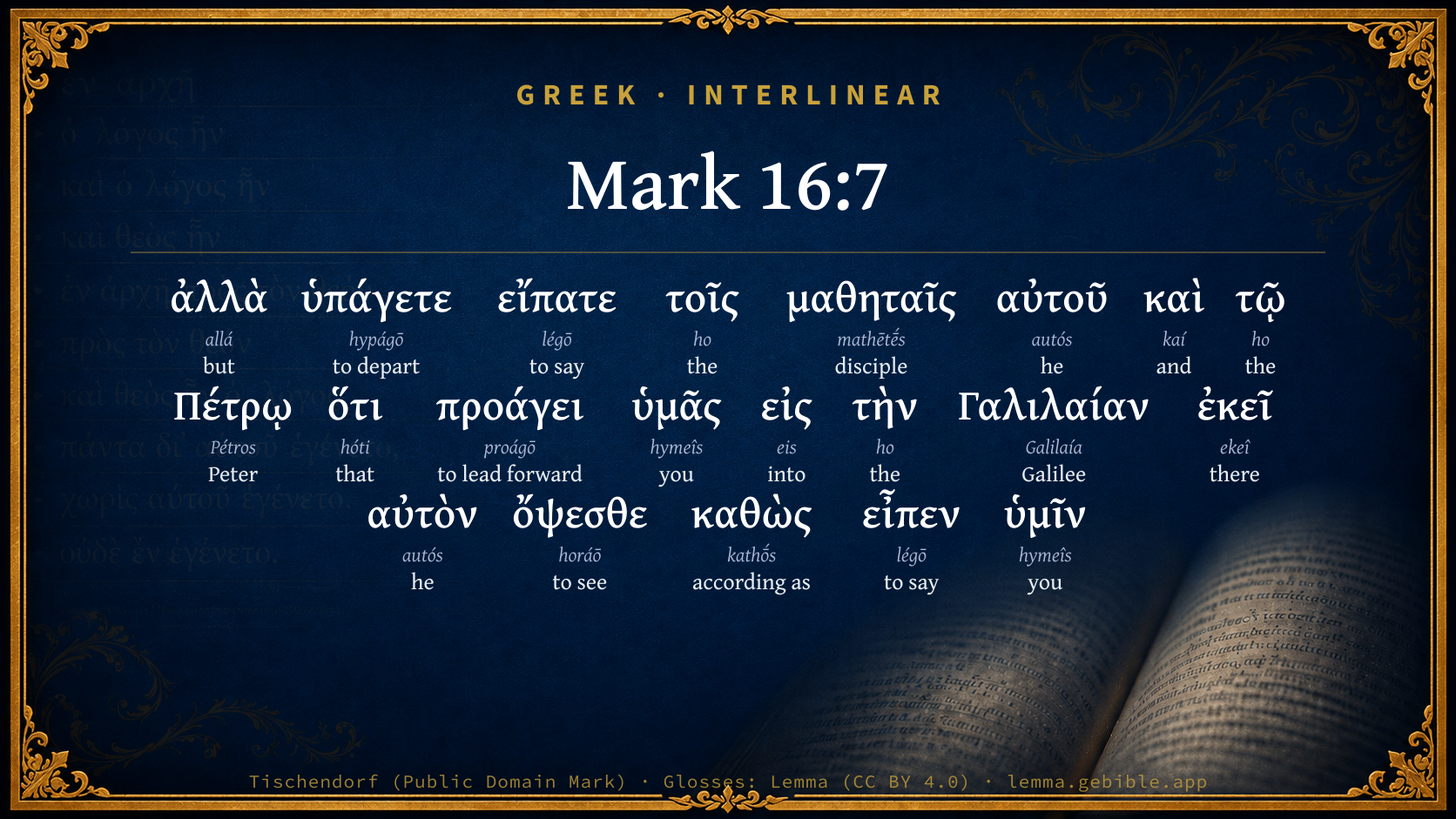
Greek (Tischendorf 8th ed.) Mark 16:7 appears in the Greek New Testament. The text above is from the Tischendorf 8th edition. Each word links to its Strong’s number and a concise gloss. Click any word for its full Thayer’s Greek Lexicon entry.
Download image
Cite this verse

Mark 16:7 (World English Bible). Public Domain. Lemma interlinear Bible study tool, https://lemma.gebible.app/v/mark/16/7.

Show BibTeX & RIS
BibTeX
RIS
English Translation
But go, tell his disciples and Peter, 'He goes before you into Galilee. There you will see him, as he said to you.'"
World English Bible · Public Domain
Download a study sheet

One document with this verse’s original text, its word-by-word gloss line, the meaning frame, cross-references with their text, attributed commentary, and full source and license credits — printable, and it pastes into notes with its structure intact.

This verse Autodidact and up

Study sheet (.html) Plain text (.txt)

A passage Seminary Student

Up to 50 verses in one chapter. A passage sheet keeps up to 6 commentary sources and 12 cross-references per verse, in the order this page ranks them, and says so on the sheet whenever that leaves anything out. Ask for a single verse and you get the Autodidact verse sheet above.

Everything on this page stays free to read, with no account — the sheet is a download of what is already on screen, not access to it.

Want to remove ads? Support Godless Engineer
Compare translations 3

The same verse in 3 English versions, stacked beneath the original-language interlinear above. Click any original word for its lexicon entry.

Each is an independent rendering of the whole verse — the interlinear is not word-aligned to these translations.

Highlighted words mark where these versions differ — a whole-verse word diff, not a word-by-word alignment.

  • World English Bible Public Domain
    But go, tell his disciples and Peter, 'He goes before you into Galilee. There you will see him, as he said to you.'"
  • King James Version Public Domain
    But go your way, tell his disciples and Peter that he goeth before you into Galilee: there shall ye see him, as he said unto you.
  • unfoldingWord Literal Text CC BY-SA 4.0
    But go, say to his disciples and to Peter, ‘He is going before you to Galilee. There you will see him, just as he said to you.’”

unfoldingWord Literal Text — © unfoldingWord, licensed CC BY-SA 4.0. Word-aligned USFM3 via Door43 (git.door43.org/unfoldingWord/en_ult).

Versions to compare (up to 4)

3 of 4 selected

Show all 19 translations

Every available English version of this verse, each an independent rendering of the whole verse.

  • World English Bible Public Domain
    But go, tell his disciples and Peter, 'He goes before you into Galilee. There you will see him, as he said to you.'"
  • Berean Standard Bible Public Domain
    But go, tell His disciples and Peter, ‘He is going ahead of you into Galilee. There you will see Him, just as He told you.’”
  • Majority Standard Bible Public Domain
    But go, tell His disciples and Peter, ‘He is going ahead of you into Galilee. There you will see Him, just as He told you.’”
  • King James Version Public Domain
    But go your way, tell his disciples and Peter that he goeth before you into Galilee: there shall ye see him, as he said unto you.
  • American Standard Version (1901) Public Domain
    But go, tell his disciples and Peter, He goeth before you into Galilee: there shall ye see him, as he said unto you.
  • Revised Version (1885) Public Domain
    But go, tell his disciples and Peter, He goeth before you into Galilee: there shall ye see him, as he said unto you.
  • Geneva Bible (1599) Public Domain
    But goe your way, and tell his disciples, and Peter, that he will goe before you into Galile: there shall ye see him, as he said vnto you.
  • Douay-Rheims (1899) Public Domain
    But go, tell his disciples and Peter that he goeth before you into Galilee; there you shall see him, as he told you.
  • Young's Literal Translation Public Domain
    and go, say to his disciples, and Peter, that he doth go before you to Galilee; there ye shall see him, as he said to you.'
  • Literal Standard Version CC BY-SA 4.0
    And go, say to His disciples and Peter that He goes before you to Galilee; there you will see Him, as He said to you.”
  • Unlocked Literal Bible CC BY-SA 4.0
    But go, tell his disciples and Peter, 'He is going ahead of you to Galilee. There you will see him, just as he told you.'”
  • unfoldingWord Literal Text CC BY-SA 4.0
    But go, say to his disciples and to Peter, ‘He is going before you to Galilee. There you will see him, just as he said to you.’”
  • Darby Bible Public Domain
    But go, tell his disciples and Peter, he goes before you into Galilee; there shall ye see him, as he said to you.
  • World Messianic Bible Public Domain
    But go, tell his disciples and Peter, ‘He goes before you into Galilee. There you will see him, as he said to you.’”
  • Webster's Bible Public Domain
    But go, tell his disciples and Peter, that he goeth before you into Galilee: there shall ye see him, as he said to you.
  • Free Bible Version CC BY-SA 4.0
    Look, this is the place where they laid him to rest. Now go, and tell his disciples and Peter that he's going ahead of you to Galilee. You will see him there just as he told you.”
  • Bible in Basic English Public Domain
    But go, say to his disciples and to Peter, He goes before you into Galilee: there you will see him, as he said to you.
  • Text-Critical English NT CC BY 4.0
    Now go tell his disciples and Peter that he is going ahead of you to Galilee. There you will see him, just as he told you.”
  • Tyndale New Testament (1534) Public Domain
    But go youre waye and tell his disciples and namely Peter: he will goo before you into Galile: there shall ye se him as he sayde vnto you.

Literal Standard Version (2020), Covenant Press — licensed CC BY-SA 4.0. Text via the HelloAO Bible API (eBible.org). Unlocked Literal Bible (unfoldingWord) — licensed CC BY-SA 4.0. Text via the HelloAO Bible API (eBible.org). unfoldingWord Literal Text — © unfoldingWord, licensed CC BY-SA 4.0. Word-aligned USFM3 via Door43 (git.door43.org/unfoldingWord/en_ult). Free Bible Version, Dr. Jonathan Gallagher — licensed CC BY-SA 4.0. Text via the HelloAO Bible API (eBible.org).

Word by word

More ways to search: Search by grammar → Find every occurrence → Compare this word →

Practice this passage: Drill this verse → Learn its vocabulary →

προάγει
proágō
G4254
“to lead forward”
Verb, Present, Active, Indicative, 3rd person, Singular
Part of Speech
Verb
Tense
Present
Voice
Active
Mood
Indicative
Person
3rd person
Number
Singular
Full Thayer's Definition

Origin: from G4253 and G71

TDNT: 03:10,2

1. to lead forward, lead forth a. one from a place in which he has lain hidden from view, as from a prison b. in a forensic sense, to bring one forth to trial 2. to go before a. preceding, prior in time, previous b. to proceed, go forward 1. in a bad sense, to go further than is right. or proper
  1. ἀλλὰ allá G235 “but” Conjunction
  2. ὑπάγετε hypágō G5217 “to depart” Verb, Present, Active, Imperative, 2nd person, Plural
  3. εἴπατε légō G3004 “to say” Verb, Aorist, Active, Imperative, 2nd person, Plural
  4. τοῖς ho G3588 “the” Article, Dative, Plural, Masculine
  5. μαθηταῖς mathētḗs G3101 “disciple” Noun, Dative, Plural, Masculine
  6. αὐτοῦ autós G846 “he” Personal pronoun, Genitive, Singular, Masculine
  7. καὶ kaí G2532 “and” Conjunction
  8. τῷ ho G3588 “the” Article, Dative, Singular, Masculine
  9. Πέτρῳ Pétros G4074 “Peter” Noun, Dative, Singular, Masculine
  10. ὅτι hóti G3754 “that” Conjunction
  11. ὑμᾶς hymeîs G5210 “you” Personal pronoun, 2nd person, Accusative, Plural
  12. εἰς eis G1519 “into” Preposition
  13. τὴν ho G3588 “the” Article, Accusative, Singular, Feminine
  14. Γαλιλαίαν Galilaía G1056 “Galilee” Noun, Accusative, Singular, Feminine
  15. ἐκεῖ ekeî G1563 “there” Adverb
  16. αὐτὸν autós G846 “he” Personal pronoun, Accusative, Singular, Masculine
  17. ὄψεσθε horáō G3708 “to see” Verb, Future, Middle deponent, Indicative, 2nd person, Plural
  18. καθὼς kathṓs G2531 “according as” Adverb
  19. εἶπεν légō G3004 “to say” Verb, Aorist, Active, Indicative, 3rd person, Singular
  20. ὑμῖν hymeîs G5210 “you” Personal pronoun, 2nd person, Dative, Plural

About this verse

These counts appear in no published source. They are computed here, from the morphology-tagged text and Lemma’s own curated glosses. What Lemma adds →

21
words
16
distinct lemmas
Gospels
section

Notable vocabulary

The rarest word here is προάγει to lead forward G4254 — appearing just 20 times in the whole Greek New Testament.

Shared distinctive vocabulary

προάγει to lead forward G4254 occurs in 20 verses of the Greek New Testament. Also found in:

Repetition

Words recur within this verse:

  • εἴπατε to say G3004 ×2
  • τοῖς the G3588 ×3
  • αὐτοῦ he G846 ×2
  • ὑμᾶς you G5210 ×2

Cross-references

11

Topical passages linked to Mark 16:7 in the Treasury of Scripture Knowledge — connected by theme and wording, ordered by reader-vote popularity; previews shown in the World English Bible.

  • Mark 14:28 However, after I am raised up, I will go before you into Galilee."
  • Matthew 26:32 But after I am raised up, I will go before you into Galilee."
  • Matthew 28:7 Go quickly and tell his disciples, 'He has risen from the dead, and behold, he goes before you into Galilee; there you will see him.' Behold, I have told you."
  • Matthew 28:10 Then Jesus said to them, "Don't be afraid. Go tell my brothers that they should go into Galilee, and there they will see me."
  • Matthew 28:16–17 But the eleven disciples went into Galilee, to the mountain where Jesus had sent them.
  • John 21:1 After these things, Jesus revealed himself again to the disciples at the sea of Tiberias. He revealed himself this way.
  • Mark 14:50 They all left him, and fled.
  • Acts 13:31 and he was seen for many days by those who came up with him from Galilee to Jerusalem, who are his witnesses to the people.
  • 1 Corinthians 15:5 and that he appeared to Cephas, then to the twelve.
  • Mark 14:66–72 As Peter was in the courtyard below, one of the maids of the high priest came,
  • 2 Corinthians 2:7 so that on the contrary you should rather forgive him and comfort him, lest by any means such a one should be swallowed up with his excessive sorrow.

Cross-references courtesy of OpenBible.info (CC BY 4.0).

Commentary

Notes on Mark 16:7 from classic Christian and Jewish commentators (each source and its license shown beneath its notes). The classic Christian expositions comment on the surrounding passage and are grouped to its opening verse, so a note may address several verses; the Jewish commentaries on the Tanakh (Rashi and others) are per-verse, so they appear only where the commentator wrote on this verse.

Lemma curates 59 commentaries, every one of them public domain or Creative Commons licensed, each selected and text-cleaned for this edition rather than reprinted as found. About our sources →

The Biblical Illustrator

Joseph S. Exell

Mar_16:7

Tell His disciples and Peter.

Loves triumph over sin

Matthew, who also reports the angels words, has only tell His disciples. Mark (the interpreter of Peter) adds words which must have come like wine and oil to the bruised heart of the denier, and Peter. To the others, it was of less importance that his name should have been named then; to him it was life from the dead that he should have been singled out to receive a word of forgiveness and a summons to meet his Lord; as if He had said through His angel messenger, I would see them all, but whoever may stay behind, let not him be wanting to our glad meeting again.

I. Notice the loving message with which He beckons the wanderer back.

1. A revelation of love stronger than death.

2. A revelation of a love that is not turned away by our sinful changes. Whilst we forget Him, He remembers us. We cannot get away from the sweep of His love, wander we ever so far.

3. A love which sends a special message because of special sin. The depth of our need determines the strength of the restorative power put forth. The more we have sinned, the less can we believe in Christs love; and so, the more we have sinned, the more marvellous and convincing does He make the testimony and operations of His love to us.

4. A love which singles out a sinful man by name. Christ deals with us not in the mass but soul by soul. He has a clear individualizing knowledge of each. He loves every single soul with a distinct love. He calls to thee by thy name-as truly as He singled out Peter here, as truly as when His voice from heaven said, Saul, Saul. To thee forgiveness, help, purity, life eternal are offered.

II. The secret meeting between Christ and Peter (Luk_24:34; 1Co_15:5). This is the second stage in the victorious conflict of Divine love with human sin. What tender consideration there is in meeting Peter alone, before seeing him in the company of others! How painful would have been the rush of the first emotions of shame awakened by Christs presence, if their course had been checked by any eye but His own beholding them! The act of faith is the meeting of the soul with Christ alone. Do you know anything of that personal communion? Have you, your own very self, by your own penitence for your own sin, and your own thankful faith in the love which thereby becomes truly yours, isolated yourself from all companionship, and joined yourself to Christ? Then, through that narrow passage where we can only walk singly, you will come into a large place. The act of faith which separates us from all men, unites us for the first time in real brotherhood, Heb_12:22-24.

III. The gradual cure of the pardoned apostle (Joh_21:15-19). Lovest thou Me? includes everything. Hast thou learned the lesson of My mercy? Hast thou responded to My love? Then thou art fit for My work, and beginning to be perfected. So the third stage in the triumph of Christs love over mans sin is when we, beholding that love flowing towards us, and accepting it by faith, respond to it with our own, and are able to say, Thou knowest that I love Thee. And when we love, we can follow. With love to Christ for motive, and Christ Himself for pattern, and following him for our one duty, all things are possible, and the utter defeat of sin in us is but a question of time. The love of Christ, received into the heart, triumphs gradually but surely over all sin, transforms character, turning even its weakness into strength, and so, from the depths of transgression and very gates of hell, raises men to God. (A. Maclaren, D. D.)

And Peter

I. Tell Peter, although he has sinned so grievously. It was heartless, repeated, public, wilful.

II. Tell Peter, for he has wept. Gods anger against His children ceases with the commencement of their penitence.

III. Tell Peter, for he has suffered. His thoughts were Gods chastening rod.

IV. Tell Peter he is dear to Christ. Sin can grieve Christ, cause Him to withdraw, wound and disfigure us; but it cannot alter His love.

V. Tell Peter, for he is your brother. They had sinned. Have not we denied our Lord? (Stems and Twigs.)

The news of Christs resurrection sent to Peter

No action of Christs life is without importance and significance.

I. To whom was this message particularly sent? To Peter, who was then distinguished from the other disciples, not in merit, but in guilt. He was not thus honoured, however, because of his guilt, but because he was now penitent and sorrowful. It was not his cursing and oaths which brought this mercy to him, but his penitence and tears. There is no comfort here for the hardened or careless sinner, or for the self-righteous, or for the man who, in the midst of his iniquity, feels no self-abhorrence, no deep contrition, for his guilt. But for the broken-hearted sinner, there is the sweetest comfort.

II. The gracious Being who sent this message.

1. Christ had just the same compassionate heart after His resurrection that he had before it. Death changed the nature of His body, but not the nature of His heart or the disposition of His soul. He still looks on those who seek Him, with the same tenderness, sympathy, and love.

2. The risen Jesus looks more on the graces than on the sins of the penitent Christian. He seems to have thought more of Peters sorrow than of his curses, more of his tears than of his oaths. He sees so much of the desperate wickedness of our hearts, as to make Him contemplate with pleasure the least good His grace enables us to bring forth. Who would not value a flower which he should find blooming on a rock, or throwing its fragrance over the sands of a desert? Not that in giving His grace and pardon, He overlooks the sin; to Peters everlasting shame the treachery which he committed is recorded against him in Gods Holy Word. The sin is forgiven, but the remembrance and shame of it still remain.

3. Christ sometimes vouchsafes to the believer, when bowed down with extraordinary sorrow, more than ordinary comfort It is not a light thing that will quiet the conscience of the Christian, after he had been overcome by temptation. The storm which sin occasions in his soul, cannot easily be soothed into a calm. The mourning Christian needs some special interposition of grace and mercy, before he can again cherish in his heart a hope of pardon and acceptance. In the mysterious riches of His goodness, the Lord sometimes vouchsafes to His Saints, in these seasons, peculiar consolations. He recalls their soul, tossed with tempest and not comforted, from the contemplation of its own depravity, and tells it to look again with the eye of faith on the cross of His Son.

4. The contrite sinner may draw much comfort and hope from Christs resurrection. What a ground for rejoicing have we in the fact that Christ is risen! Let us seek to know the power of His resurrection.

III. The messengers employed.

1. An angel. Why?

(1) To do honour to Christ.

(2) To teach us, that the breach between us and the angels is healed. They again regard us as friends and love us as brethren. They are made our ministering servants, and do not disdain the office.

(3) The contrite sinner is peculiarly an object of love to the heavenly hosts. The angel of the Lord has compassion on the weeping Peter, and rejoices to take to him a cup of consolation. What a lesson for ministers, what a lesson for every Christian, is here! It is a heavenly work to comfort the sorrowful.

2. Three poor women receive the message from the lips of this heavenly herald, and carry it to the mourning penitent. Why? They had been first in love, affection, service; it was but right that they should be first in honour and reward. And note the manner in which these women were sent. Go quickly (Mat_28:7). Why such haste? There was nothing sinful in the feelings which a view of their Lords tomb was likely to excite; but they were not suffered to stay there to indulge them, that we might be taught that pious feeling must lead to pious actions. It is good and sweet to think of Christ; but it is better to act for Christ. He is the best servant, not who delights to stand in his masters presence, but who carefully minds and diligently goes about his masters business. (Charles Bradley, M. A.)

Women as ambassadors

The faculties and abilities of the soul appear both in affairs of state and in ecclesiastical affairs; in matters of government and in matters of religion; and in neither of these are we without examples of able women. For, for state affairs, and matters of government, our age hath given us such a queen, as scarce any former king hath equalled. And in the Venetian story, I remember, that certain matrons of that city were sent by commission, in quality of ambassadors, to an empress with whom that state had occasion to treat. And in the stories of the eastern parts of the world, it is said to be in ordinary practice to send women for ambassadors. And then in matters of religion, women have always had a great hand, though sometimes on the left as well as on the right hand. (John Donne, D. D.)

Reasons for the meeting in Galilee

Why was this meeting fixed in Galilee? Why was this long journey to be taken? Why did Jesus go to Galilee at all after His resurrection? Why was it evidently a matter of so much interest and importance to the mind of Jesus to go there? At Jerusalem He was crucified, at Jerusalem He rose, at Jerusalem He ascended; Jerusalem was the place of all honour; why then should He be so careful to go down to that northern province? Many reasons doubtless there were of which I know nothing; but I think we may be permitted to see some of them.

1. One might lie in that very fact of the distance and the difficulty. For it is a universal law that God always requires efforts, and always blesses the efforts He requires. You will not find your best privileges close to your hand. You must be content to go far for them. You must exercise self-denial and labour to get at them.

2. There is no doubt also that Jesus did it partly because Galilee was despised. He had lived in Galilee as a child and youth; He had taken most of His apostles from thence; and now that He was risen and almost glorified, He was not going to pass by the place He loved in humble life. That would not be the Jesus with whom we have to do.

3. Underlying this feeling, there can be little question that there was a great principle upon which Christ acted,-of extending the proofs of His resurrection as widely as possible. Therefore He manifested His risen body in the two extremes of the land to which that dispensation was confined.

4. Christ was true to all the finer sympathies of our nature, and amongst those sympathies is the love of old, and especially early, associations. (James Vaughan, M. A.)

Mary of Magdala

She was-

I. A great sufferer healed by Christ.

II. A grateful ministrant to Christ (Luk_8:2-3; Mar_15:41).

III. A faithful adherent to Christ.

IV. A sincere mourner for Christ (Comp. Mat_27:61; Mar_15:47; Joh_20:1-2; Joh_20:11-18).

V. An honoured messenger of Christ (Joh_20:17-18; ch. 16:10). (T. S. Dickson, M. A.)

The Biblical Illustrator, edited by Joseph S. Exell (c. 1880s–1900s) — public domain. Text from a community e-Sword module.

Joseph Benson's Commentary

Mar 16:7. Go your way, tell his disciples, &c. — The kindness of this message will appear above all praise, if we call to mind the late behaviour of the persons to whom it was sent. They had every one of them forsaken Jesus in his greatest extremity; but he graciously forgave them, and, to assure them of their pardon, called them by the endearing name of his brethren, Joh 20:17. And Peter — Though he so oft denied his Lord. What amazing goodness was this! “Peter is here named, not as prince of the apostles, as the Papists think him, but, as the fathers say, for his consolation, to take off the scruple which might lie upon his spirit, whether, after his three-fold denial of his Master, he had not forfeited his right to be one of his disciples.” — Whitby. See notes on Mat 28:7-10.

Joseph Benson's Commentary on the Old and New Testaments (1811–1818) — public domain. Text from a community e-Sword module.

MacLaren's Expositions of Holy Scripture

Alexander MacLaren

Mark

THE INCREDULOUS DISCIPLES

LOVE’S TRIUMPH OVER SIN

Mar 16:7.

This prevailing tradition of Christian antiquity ascribes this Gospel to John Mark, sister’s son to Barnabas, and affirms that in composing it he was in some sense the ‘interpreter’ of the Apostle Peter. Some confirmation of this alleged connection between the Evangelist and the Apostle may be gathered from the fact that the former is mentioned by the latter as with him when he wrote his First Epistle. And, in the Gospel itself, there are some little peculiarities which seem to look in the same direction. A certain speciality is traceable here and there, both in omissions of incidents in the Apostle’s life recorded by some of the other Evangelists, and in the addition of slight facts concerning him unnoticed by them.

Chief among these is the place which his name holds in this very remarkable message, delivered by the angels to the women who came to Christ’s tomb on the Resurrection morning. Matthew, who also reports the angels’ words, has only ‘tell His disciples.’ Mark adds the words, which must have come like wine and oil to the bruised heart of the denier, ‘tell His disciples and Peter.’ To the others, it was of little importance that his name should have been named then; to him it was life from the dead, that he should have been singled out to receive a word of forgiveness and a summons to meet his Lord; as if He had said through His angel messengers-’I would see them all; but whoever may stay behind, let not him be absent from our glad meeting again.’

We find, too, that the same individualising of the Apostle, which led to his being thus greeted in the first thoughts of his risen Lord, led also to an interview with Him on that same day, about which not a syllable of detail is found in any Gospel, though the fact was known to the whole body of the disciples. For when the two friends who had met Christ at Emmaus came back in the night with their strange tidings, their eagerness to tell their joyful news is anticipated by the eagerness of the brethren to tell their wonderful story: ‘The Lord is risen indeed, and hath appeared to Simon.’ Paul, too, gives that meeting, when the Lord was alone with the penitent, the foremost place in his list of the evidences of Christ’s resurrection, ‘He was seen of Cephas.’ What passed then is hidden from all eyes. The secrets of that hour of deep contrition and healing love Peter kept secretly curtained from sight, in the innermost chamber of his memory. But we may be sure that then forgiveness was sought and granted, and the bond that fastened him to his Lord was welded together again, where it had snapped, and was the stronger because it had been broken, and at the point of fracture.

The man must be first re-united to his Saviour, before the Apostle can be reinstated in his functions. In secrecy, not beheld by any, is the personal act of restoration to love and friendship effected; and then in public, before his brethren, who were concerned in his official position, but not in his personal relation to his Lord, the reappointment of the pardoned disciple to his apostleship takes place. His sin had had a public aspect, and his threefold denial must, in so far as it was an outward act, be effaced by his threefold confession. Then he becomes again ‘Peter’-not merely ‘Simon Bar Jonas’; and, as the Book of the Acts shows, never ceases to hear the divine commissions, ‘Feed My sheep,’ ‘Follow Me’; nor ever forgets the lessons he had learned in these bitter hours of self-loathing, and in the rapturous moments when again he saw his Lord.

Putting all these things together-this message from Christ, the interview which followed it, and the subsequent history of the Apostle-we have a connected series of facts which may illustrate for us, better than many dry words of mine could do, the triumph over sin of the forgiving love of Christ.

I. Notice, then, first, the loving message with which He beckons the wanderer back.

If we try to throw ourselves back into the Apostle’s black thoughts during the interval between his denial and the Resurrection morning, we shall better feel what this love-token from the grave must have been to him. His natural character, as well as his real love for his Master, ensured that his lies could not long content him. They were uttered so vehemently because they were uttered in spite of inward resistance. Overpowered by fear, beaten down from all his vain-glorious self-confidence by a woman-servant’s sharp tongue and mocking eye, he lied-and then came the rebound. The same impulsive vehemence which had hurried him into the fault, would swing him back again to quick penitence when the cock crew, and that Divine Face, turning slowly from before the judgment-seat with the sorrow of wounded love upon it, silently said, ‘Remember.’ We can fancy how that bitter weeping, which began so soon, grew more passionate and more bitter when the end came. We are singularly happy if we do not know the pang of remembering some fault to the loved dead-some hasty word, some momentary petulance, some selfish disregard of their happiness, some sullen refusal of their tenderness. How the thought that it is all irrevocable now embitters the remorse! How passionately we long that we could have one of the moments again, which seemed so trivial while we possessed them, that we might confess and be forgiven, and atone! And this poor, warm-hearted, penitent denier had to think that his very last act to the Lord whom he loved so well had been such an act of cowardly shrinking from acknowledging Him; and that henceforward his memory of that dear face was to be for ever saddened by that last look! That they should have parted so! that that sad gaze was to be the last he should ever have, and that it was to haunt him for the rest of his life! We can understand how heavily the hours passed on that dreary Saturday. If, as seems probable, he was with John in his home, whither the latter had led the mother of our Lord, what a group were gathered there, each with a separate pang from the common sorrow!

Into this sorrow come the tidings that all was not over, that the irrevocable was not irrevocable, that perhaps new days of loyal love might still be granted, in which the doleful failure of the past might be forgotten; and then, whether before or after his hurried rush to the grave we need not here stay to inquire, follows the message of our text, a word of forgiveness and reconciliation, sent by the Lord as the herald and outrider of His own coming, to bring gladness and hope ere He Himself draws near.

Think of this message as a revelation of love that is stronger than death.

The news of Christ’s resurrection must have struck awe, but not necessarily joy, into the disciples’ hearts. The dearest ones suffer so solemn a change to our apprehensions when they pass into the grave, that to many a man it would be maddening terror to meet those whom he loved and still loves. So there must have been a spasm of fear even among Christ’s friends when they heard of Him as risen again, and much confusing doubt as to what would be the amount of resemblance to His old self. They probably dreaded to find Him far removed from their familiar love, forgetful perhaps of much of the old life, with other thoughts than before, with the atmosphere of the other world round about Him, which glorified Him indeed, but separated Him too from those whose grosser lungs could live only in this thick air. These words of our text would go far to scatter all such fears. They link on the future to the past, as if His first thought when He rose had been to gather up again the dropped threads of their intercourse, and to carry on their ancient concord and companionship as though no break had been at all. For all the disciples, and especially for him who is especially named, they confirm the identity of Christ’s whole dispositions towards them now, with those which He had before. Death has not changed Him at all. Much has been done since He left them; the world’s history has been changed, but nothing which has happened has had any effect on the reality of His love, and on the inmost reality of their companionship. In these respects they are where they were, and even Calvary and the tomb are but as a parenthesis. The old bonds are all re-knit, and the junction is all but imperceptible.

This is how we have to think of our Lord now, in His attitude towards us. We, too, may have our share in that message, which came like morning twilight before He shone upon the apostles’ darkness. To them it proclaimed a love which was stronger than death. To us it may declare a love which is stronger than all change of circumstances. He is no more parted from us by the Throne than from them by the Cross. He descended into ‘the lower parts of the earth,’ and His love lived on, and so it does now, when He has ‘ascended up far above all heavens.’ Love knows no difference of place, conditions, or functions. From out of the blazing heart of the Glory the same tender face looks that bent over sick men’s pallets, and that turned on Peter in the judgment-hall. The hand that holds the sceptre of the universe is the hand that was nailed to the Cross, and that was stretched out to that same Peter when he was ready to sink. The breast that is girt with the golden girdle of priestly sovereignty is the same tender home on which John’s happy head rested in placid contentment. All the love that ever flowed from Christ flows from Him still. To Him, ‘whose nature and whose name are Love,’ it matters nothing whether He is in the house at Bethany, or in the upper room, or hanging on the Cross, or lying in the grave, or risen from the dead, or seated on the right hand of God. He is the same everywhere and always. ‘I have loved thee with an everlasting love.’

Again, this message is the revelation of a love that is not turned away by our sinful changes.

Peter may have thought that he had, with his own words, broken the bond between him and his Lord. He had renounced his allegiance; was the renunciation to be accepted? He had said, ‘I am not one of them’; did Christ answer, ‘Be it so; one of them thou shalt no more be’? The message from the women’s lips settled the question, and let him feel that, though his grasp of Christ had relaxed, Christ’s grasp of him had not, He might change, he might cease for a time to prize his Lord’s love, he might cease either to be conscious of it or to wish for it; but that love could not change. It was unaffected by his unfaithfulness, even as it had not been originated by his fidelity. Repelled, it still lingered beside him. Disowned, it still asserted its property in him. Being reviled, it blessed; being persecuted, it endured; being defamed, it entreated; and, patient through all wrongs and changes, it loved on till it had won back the erring heart, and could fill it with the old blessedness again.

And is not that same miracle of long-enduring love presented before every one of us, as in Christ’s heart for us? True, our sin interferes with our sense of it, and modifies the form in which it must deal with us; but, however real and disastrous may be the power of our evil in troubling the communion of love between us and our Lord, and in compelling Him to smite before He binds up, never forget that our sin is utterly impotent to turn away the tide that sets to us from the heart of Christ. Earthborn vapours may hang about the low levels, and turn the gracious sun himself into a blood-red ball of lurid fire; but they reach only a little way up, and high above their region is the pure blue, and the blessed light pours down upon the upper surface of the white mist, and thins away its opaqueness, and dries up its clinging damp, and at last parts it into filmy fragments that float out of sight, and the dwellers on the green earth see the sun, which was always there even when they could not behold it, and which, by shining on, has conquered all the obstructions that veiled its beams. Sin is mighty, but one thing sin cannot do, and that is to make Christ cease to love us. Sin is mighty, but one other thing sin cannot do, and that is to prevent Christ from manifesting His love to us sinners, that we may learn to love and so may cease to sin. Christ’s love is not at the beck and call of our fluctuating affections. It has its source deeper than in the springs in our hearts, namely in the depths of His own nature. It is not the echo or the answer to ours, but ours is the echo to His; and that being so, our changes do not reach to it, any more than earth’s seasons affect the sun. For ever and ever He loves. Whilst we forget Him, He remembers us. Whilst we repay Him with neglect or with hate, He still loves. If we believe not, He still abides faithful to His merciful purpose, and, in spite of all that we can do, will not deny Himself, by ceasing to be the incarnate Patience, the perfect Love. He is Himself the great ensample of that ‘charity’ which His Apostle painted; He is not easily provoked; He is not soon angry; He beareth all things; He hopeth all things. We cannot get away from the sweep of His love, wander we ever so far. The child may struggle in the mother’s arms, and beat the breast that shelters it with its little hand; but it neither hurts nor angers that gentle bosom, nor loosens the firm but loving grasp that holds it fast. He carries, as a nurse does, His wayward children, and, blessed be His name! His arm is too strong for us to shake it off, His love too divine for us to dam it back.

And still further, here we see a love which sends a special message because of special sin.

If one was to be singled out from the little company to receive by name the summons of the Lord to meet Him in Galilee, we might have expected it to have been that faithful friend who stood beneath the Cross, till his Lord’s command sent him to his own home; or that weeping mother whom he then led away with him; or one of the two who had been turned from secret disciples into confessors by the might of their love, and had laid His body with reverent care in the grave in the garden. Strange reward for true love that they should be merged in the general message, and strange recompense for treason and cowardice that Peter’s name should be thus distinguished! Is sin, then, a passport to His deeper love? Is the murmur true after all, ‘Thou never gavest me a kid, but as soon as this thy son is come, which hath devoured thy living with harlots, thou hast killed for him the fatted calf’? Yes, and no. No, inasmuch as the unbroken fellowship hath in it calm and deep joys which the returning prodigal does not know, and all sin lays waste and impoverishes the soul. Yes, inasmuch as He, who knows all our needs, knows that the denier needs a special treatment to bring him back to peace, and that the further a poor heart has strayed from Him, the mightier must be the forthputting of manifested love, if it is to be strong enough to travel across all the dreary wastes, and draw back again, to its orbit among its sister planets, the wandering star. The depth of our need determines the strength of the restorative power put forth. They who had not gone away would come at the call addressed to them all, but he who had sundered himself from them and from the Lord would remain in his sad isolation, unless some special means were used to bring him back. The more we have sinned, the less can we believe in Christ’s love; and so the more we have sinned, the more marvellous and convincing does He make the testimony and operations of His love to us. It is ever to the poor bewildered sheep, lying panting in the wilderness, that He comes. Among His creatures, the race which has sinned is that which receives the most stupendous proof of the seeking divine love. Among men, the publicans and the harlots, the denying Peters and the persecuting Pauls, are they to whom the most persuasive entreaties of His love are sent, and on whom the strongest powers of His grace are brought to bear. Our sin cannot check the flow of His love. More marvellous still, our sin occasions a mightier burst of the manifestation of His love, for eyes blinded by selfishness and carelessness, or by fear and despair, need to see a brightness beyond the noonday sun, ere they can behold the amazing truth of His love to them; and what they need, they get. ‘Go, tell Peter.’

Here, too, is the revelation of a love which singles out a sinful man by name.

Christ does not deal with us in the mass, but soul by soul. Our finite minds have to lose the individual in order to grasp the class. Our eyes see the wood far off on the mountain-side, but not the single trees, nor each fluttering leaf. We think of ‘the race’-the twelve hundred millions that live to-day, and the uncounted crowds that have been, but the units in that inconceivable sum are not separate in our view. But He does not generalise so. He has a clear individualising knowledge of each; each separately has a place in His mind or heart. To each He says, ‘I know thee by name.’ He loves the world, because He loves every single soul with a distinct love. And His messages of blessing are as specific and individualising as the love from which they come. He speaks to each of us as truly as He singled out Peter here, as truly as when His voice from heaven said, ‘Saul, Saul.’ English names are on His lips as really as Jewish ones. He calls to thee by thy name-thou hast a share in His love. To thee the call to trust Him is addressed, and to thee forgiveness, help, purity, life eternal are offered. Thou hast sinned; that only infuses deeper tenderness into His beseeching tones. Thou hast gone further front Him than some of thy fellows; that only makes His recovering energy greater. Thou hast denied His name; that only makes Him speak thine with more persuasive invitation.

Look, then, at this one instance of a love stronger than death, mightier than sin, sending its special greeting to the denier, and learn how deep the source, how powerful the flow, how universal the sweep, of that river of the love of God, which streams to us through the channel of Christ His Son.

II. Notice, secondly, the secret meeting between our Lord and the Apostle.

That is the second stage in the victorious conflict of divine love with man’s sin. As I have said, that interview took place on the day of the Resurrection, apparently before our Lord joined the two sorrowful travellers to Emmaus, and certainly before He appeared to the company gathered by night in the closed chamber. The fact was well known, for it is referred to by Luke and by Paul, but nothing beyond the fact seems to have been known, or at all events is made public by them. All this is very significant and very beautiful.

What tender consideration there is in meeting Peter alone, before seeing him in the companionship of the others! How painful would have been the rush of the first emotions of shame awakened by Christ’s presence, if their course had been checked by any eye but His own beholding them! How impossible it would have then been to have poured out all the penitent confessions with which his heart must have been full, and how hard it would have been to have met for the first time, and not to have poured them out! With most loving insight, then, into the painful embarrassment, and dread of unsympathising standers-by, which must have troubled the contrite Apostle, the Lord is careful to give him the opportunity of weeping his fill on His own bosom, unrestrained by any thought of others, and will let him sob out his contrition to His own ear alone. Then the meeting in the upper chamber will be one of pure joy to Peter, as to all the rest. The emotions which he has in common with them find full play, in that hour when all are reunited to their Lord. The experience which belongs to himself alone has its solitary hour of unrecorded communion. The first to whom He, who is ‘separate from sinners,’ appeared was ‘Mary Magdalene, out of whom He had cast seven devils.’ The next were the women who bore this message of forgiveness; and probably the next was the one among all the company who had sinned most grievously. So wondrous is the order of His preferences, coming ever nearest to those who need Him most.

And may we not regard this secret interview as representing for us what is needed on our part to make Christ’s forgiving love our own? There must be the personal contact of my soul with the loving heart of Christ, the individual act of my own coming to Him, and, as the old Puritans used to say,’ my transacting’ with Him. Like the ocean of the atmosphere, His love encompasses me, and in it I ‘live, and move, and have my being.’ But I must let it flow into my spirit, and stir the dormant music of ray soul. I can shut it out, sealing my heart love-tight against it. I do shut it out, unless by my own conscious, personal act I yield myself to Him, unless by my own faith I come to Him, and meet Him, secretly and really as did the penitent Apostle, whom the message, that proclaimed the love of his Lord, emboldened to meet the Lord who loved, and by His own lips to be assured of forgiveness and friendship. It is possible to stumble at noontide, as in the dark. A man may starve, outside of barns filled with plenty, and his lips may be parched with thirst, though he is within sight of a broad river flowing in the sunshine. So a soul may stiffen into the death of self and sin, even though the voice that wakes the dead to a life of love be calling to it. Christ and His grace are yours if you will, but the invitations and beseechings of His mercy, the constant drawings of His love, the all-embracing offers of His forgiveness, may be all in vain, if you do not grasp them and hold them fast by the hand of faith.

That personal act must be preceded by the message of His mighty love. Ever He sends such messages as heralds of His coming, just as He prepared the way for His own approach to the Apostle, by the words of our text. Our faith must follow His word. Our love can only be called forth by the manifestation of His. But His message must be followed by that personal act, else His word is spoken in vain, and there is no real union between our need and His fulness, nor any cleansing contact of His grace with our foulness.

Mark, too, the intensely individual character of that act of faith by which a man accepts Christ’s grace. Friends and companions may bring the tidings of the risen Lord’s loving heart, but the actual closing with the Lord’s mercy must be done by myself, alone with Him.

As if there were not another soul on earth, I and He must meet, and in solitude deep as that of death, each man for himself must yield to Incarnate Love, and receive eternal life. The flocks and herds, the wives and children, have all to be sent away, and Jacob must be left alone, before the mysterious Wrestler comes whose touch of fire lames the whole nature of sin and death, whose inbreathed power strengthens to hold Him fast till He speaks a blessing, who desires to be overcome, and makes our yielding to Him our prevailing with Him. As one of the old mystics called prayer ‘the flight of the lonely man to the only God,’ so we may call the act of faith the meeting of the soul alone with Christ alone. Do you know anything of that personal communion? Have you, your own very self, by your own penitence for your own sin, and your own thankful faith in the Love which thereby becomes truly yours, isolated yourself from all companionship, and joined yourself to Christ? Then, through that narrow passage where we can only walk singly, you will come into a large place. The act of faith, which separates us from all men, unites us for the first time in real brotherhood, and they who, one by one, come to Jesus and meet Him alone, next find that they ‘are come to the city of God, to an innumerable company, to the festal choirs of angels, to the Church of the First-born, to the spirits of just men made perfect.’

III. Notice, finally, the gradual cure of the pardoned Apostle.

He was restored to his office, as we read in the supplement to John’s Gospel. In that wonderful conversation, full as it is of allusions to Peter’s fall, Christ asks but one question, ‘Lovest thou Me?’ That includes everything. ‘Hast thou learned the lesson of My mercy? hast thou responded to My love? then thou art fit for My work, and beginning to be perfected.’ So the third stage in the triumph of Christ’s love over man’s sin is, when we, beholding that love flowing towards us, and accepting it by faith, respond to it with our own, and are able to say, ‘Thou knowest that I love Thee.’

The all-embracing question is followed by an equally comprehensive command, ‘Follow thou Me,’ a two-worded compendium of all morals, a precept which naturally results from love, and certainly leads to absolute perfectness. With love to Christ for motive, and Christ Himself for pattern, and following Him for our one duty, all things are possible, and the utter defeat of sin in us is but a question of time.

And the certainty, as well as the gradual slowness, of that victory, are well set forth by the future history of the Apostle. We know how his fickleness passed away, and how his vehement character was calmed and consolidated into resolved persistency, and how his love of distinction and self-confidence were turned in a new direction, obeyed a divine impulse, and became powers. We read how he started to the front; how he guided the Church in the first stage of its development; how whenever there was danger he was in the van, and whenever there was work his hand was first on the plough; how he bearded and braved rulers and councils; how-more difficult still for him-he lay quietly in prison sleeping like a child, between his guards, on the night before his execution; how-most difficult of all-he acquiesced in Paul’s superiority; and, if he still needed to be withstood and blamed, could recognise the wisdom of the rebuke, and in his calm old age could speak well of the rebuker as his ‘beloved brother Paul.’ Nor was the cure a change in the great lines of his character. These remain the same, the characteristic excellences possible to them are brought out, the defects are curbed and cast out. The ‘new man’ is the ‘old man’ with a new direction, obeying a new impulse, but retaining its individuality. Weaknesses become strengths; the sanctified character is the old character sanctified; and it is still true that ‘every man hath his proper gift of God, one after this manner, and another after that.’

It is very instructive to observe how deeply the experiences of his fall, and of Christ’s mercy then, had impressed themselves on Peter’s memory, and how constantly they were present with him all through his after-life. His Epistles are full of allusions which show this. For instance, to go a step further back in his life, he remembered that the Lord had said to him, ‘Thou art Peter,’ ‘a stone,’ and that his pride in that name had helped to his rash confidence, and so to his sin. Therefore, when he is cured of these, he takes pleasure in sharing his honour with his brethren, and writes, ‘Ye also, as living stones, are built up.’ He remembered the contempt for others and the trust in himself with which he had said, ‘Though all should forsake Thee, yet will not I’; and, taught what must come of that, he writes, ‘Be clothed with humility, for God resisteth the proud, and giveth grace to the humble.’ He remembered how hastily he had drawn his sword and struck at Malchus, and he writes, ‘If when ye do well and suffer for it, ye take it patiently, this is acceptable with God.’ He remembered how he had been surprised into denial by the questions of a sharp-tongued servant-maid, and he writes, ‘Be ready always to give an answer to every man that asketh you a reason of the hope that is in you, with meekness.’ He remembered how the pardoning love of his Lord had honoured him unworthy, with the charge, ‘Feed My sheep,’ and he writes, ranking himself as one of the class to whom he speaks-’The elders I exhort, who am also an elder . . . feed the flock of God.’ He remembered that last command, which sounded ever in his spirit, ‘Follow thou Me,’ and discerning now, through all the years that lay between, the presumptuous folly and blind inversion of his own work and his Master’s which had lain in his earlier question, ‘Why cannot I follow Thee now? I will lay down my life for Thy sake’-he writes to all, ‘Christ also suffered for us, leaving us an example, that ye should follow His steps,’

So well had he learned the lesson of his own sin, and of that immortal love which had beckoned him back, to peace at its side and purity from its hand. Let us learn how the love of Christ, received into the heart, triumphs gradually but surely over all sin, transforms character, turning even its weakness into strength, and so, from the depths of transgression and very gates of hell, raises men to God.

To us all this divine message speaks. Christ’s love is extended to us; no sin can stay it; no fall of ours can make Him despair. He will not give us up. He waits to be gracious. This same Peter once asked, ‘How oft shall my brother sin against me and I forgive him?’ And the answer, which commanded unwearied brotherly forgiveness, revealed inexhaustible divine pardon-’I say not unto thee until seven times, but until seventy times seven.’ The measure of the divine mercy, which is the pattern of ours, is completeness ten times multiplied by itself; we know not the numbers thereof. ‘Let the wicked forsake his way . . . and let him return unto the Lord, for He will have mercy upon him; and to our God, for He will multiply to pardon.’

Alexander MacLaren, Expositions of Holy Scripture (1904–1910) — public domain. Text from a community e-Sword module.

Tyndale Open Study Notes

Tyndale Open Resources

16:7 The angel’s message for the disciples repeated Jesus’ prediction and promise (14:28). The disciples’ desertion and denial would be forgiven and their apostolic commission restored.

Tyndale Open Study Notes — © Tyndale Open Resources, licensed CC BY-SA 4.0. Text via the HelloAO Bible API.

Bengel's Gnomon

Johann Albrecht Bengel

Mar 16:7. Ἀλλʼ ὑπάγετε, but go your way) in antithesis to [Mar 16:6] He is not here; [Mar 16:7] there shall ye see Him.—καὶ τῷ Πέτρῳ, and Peter) who subsequently proclaimed this testimony in his Acts and Epistles. [How great must have been the refreshment of spirit, as we may suppose, afforded by this to that disciple, overwhelmed as he was by sorrow!—V. g.]

Bengel's Gnomon of the New Testament — English translation (T&T Clark, Edinburgh, 1860) — public domain. Text from a community e-Sword module.

Expositor's Greek Testament

ed. W. Robertson Nicoll

Mar 16:7 . ἀλλὰ , but; change in tone and topic; gazing longer into the empty grave would serve no purpose: there is something to be done go, spread the news! Cf. Joh 14:31 : But … arise, let us go hence! καὶ τῷ Πέτρῳ , and to Peter in particular: why? to the disciple who denied his Master? so the older interpreters to Peter, with all his faults, the most important man in the disciple band? so most recent interpreters: ut dux Apostolici coetus , Grotius. ὅτι , recit., introducing the very message of the angel. The message recalls the words of Jesus before His death (chap. Mar 14:28 ). ἐκεῖ , there, pointing to Galilee as the main scene of the reappearing of Jesus to His disciples, creating expectation of a narrative by the evangelist of an appearance there, which, however, is not forthcoming .

The Expositor's Greek Testament, edited by W. Robertson Nicoll (1897–1910) — public domain. Text from a community e-Sword module.

Adam Clarke's Commentary

Verse 7. Tell his disciples and Peter] Why is not Peter included among the disciples? For this plain reason,-he had forfeited his discipleship, and all right to the honour and privileges of an apostle, by denying his Lord and Master. However, he is now a penitent: - tell him that Jesus is risen from the dead, and is ready to heal his backsliding, and love him freely; so that, after being converted, he may strengthen his brethren.

Adam Clarke's Commentary on the Bible (1810–1826) — public domain. Text from a community e-Sword/MySword module.

The Cambridge Bible for Schools and Colleges

gen. ed. J. J. S. Perowne

7. go your way] Practical action must take the place of vague astonishment. There was a message to be borne.

and Peter] No wonder it is in the Gospel of St Mark we find this wondrous touch. Who afterwards would have been so likely, as the Apostle himself, to treasure up this word, the pledge of possible forgiveness, after the dreadful hours he must have spent during Friday night, Saturday, and Saturday night? What story would he have so often told to his son in the faith either in Eastern Babylon or the capital of the West?

he goeth before you] as a true Shepherd before His sheep. It is the same word which (a) He Himself used on the evening of the Betrayal, “After I am risen again, I will go before you into Galilee” (Mat_26:32; Mar_14:28); which (b) is applied to the star “going before” the Magi at His nativity, and (c) to His own “going before” His Apostles on the road towards Jerusalem, where He was to suffer. See note above, ch. Mar_10:32.

The Cambridge Bible for Schools and Colleges (gen. ed. J. J. S. Perowne; Cambridge University Press, 1878–1918) — public domain. Text from a community e-Sword module.

John Gill's Exposition

And they went out quickly,.... Out of the sepulchre, into which they had been, to see where Christ lay, as invited by the angel, Mar 16:6. The word "quickly", is not read in the Vulgate Latin, Syriac, Arabic, Persic, and Ethiopic versions: "which when they heard"; that is, when they heard the angel's and instructions, immediately they went out:

and fled from the sepulchre; as surprised and affrighted:

for they trembled and were amazed; at what they saw and heard, and yet this dread and fear were mixed with joy at the news of Christ's resurrection, as Matthew relates, Mat 28:8.

Neither said they any thing to any man; they met with by the way, till they came to the disciples; to whom they told all, otherwise they would not have acted according to the angel's orders

for they were afraid; not only affrighted with what they had seen and heard, but the were afraid to tell any but the disciples of these things, for fear of the Jews; lest they should be thought to have stolen the body of Christ, and so be taken up on that account, and punished.

John Gill's Exposition of the Whole Bible (1746–1763) — public domain (CC PDM 1.0). Text via the HelloAO Bible API.

Trapp's Complete Commentary

John Trapp

5 And entering into the sepulchre, they saw a young man sitting on the right side, clothed in a long white garment; and they were affrighted.

6 And he saith unto them, Be not affrighted: Ye seek Jesus of Nazareth, which was crucified: he is risen; he is not here: behold the place where they laid him.

7 But go your way, tell his disciples and Peter that he goeth before you into Galilee: there shall ye see him, as he said unto you.

Ver. 7. Tell his disciples, and Peter] q.d. Tell him howsoever, for he is in great heaviness; and this will be very good news to him. Tell him that Christ is risen again for his justification, Rom 4:25. Or, tell his disciples and Peter, quia ille se prae aliis incredulum ostenderat, as Tolet hath it, because he hath expressed so much unbelief above the rest, and is, therefore, it may be, set here behind all the disciples, as inferior to them.

John Trapp, A Commentary or Exposition upon All the Books of the Old and New Testament (1647–1656) — public domain. Text from a community e-Sword module.

Whedon's Commentary on the Bible

Daniel D. Whedon

7. And Peter — The Greek word for and is by critics interpreted to be equivalent to and especially. Peter is especially mentioned here, as some suppose, because he was the most eminent of the apostles; and others, because of his late denial of his Lord. According to the former view it was a token of respect; according to the latter, of compassion and restoration to favour. Both views may be combined. Without assigning to Peter any official primacy, he was pre-eminent in character. And as he had pre-eminently fallen, so now he is pre-eminently remembered and named by the angel of the Lord.

Daniel D. Whedon (gen. ed.), Commentary on the Old and New Testaments (1874–1909) — public domain. Text from a community e-Sword module.

The Pulpit Commentary

But go, tell his disciples and Peter, He goeth before you into Galilee: there shall ye see him, as he said unto you. St. Gregory ("Hom. in Evan.") says, "If the angel had not named Peter, he would not have dared to come amongst the disciples. Therefore he is specially named, lest he should despair on account of his denial." It was evidently intended as a special message of comfort to Peter. St. Luke (Luk_24:34) records the personal appearance of our Lord first to Peter. Here St. Mark, with characteristic modesty, keeps Peter in the background. In Mar_14:28 our Lord is recorded to have said, "After I am raised up, I will go before you into Galilee." He would go before them as their Shepherd, and lead them to that part of the Holy Land which, as he had honored it before his resurrection, so he would honor it again now.

The Pulpit Commentary (1880–1919), ed. H.D.M. Spence-Jones & Joseph S. Exell — public domain. Text from a community e-Sword module.

John Wesley's Explanatory Notes

And Peter - Though he so oft denied his Lord. What amazing goodness was this!

John Wesley, Explanatory Notes Upon the Whole Bible (1754–1765) — public domain. Text via the GEBible commentary corpus.

The People's New Testament

B. W. Johnson

7. Tell his disciples and Peter. Observe that as Christ's first appearance is to Mary Magdalene (John 20:18), out of whom he had cast seven devils, so his special message is to Peter, who had denied him. A touching commentary on our Savior's saying that he came to save sinners.

B. W. Johnson's The People's New Testament with Notes (1889–1891) — public domain. Electronic text from the Christian Classics Ethereal Library (CCEL) ThML edition.

Cambridge Greek Testament for Schools and Colleges

7. ἀλλὰ ὑπάγετε. Mk only. “Do not linger here wondering, but go to those who greatly need the knowledge of this fact.” We may say that the Apostles needed the glad tidings even more than the women; but it was those who sought that were the first to find. The energy of the women had its reward.

καὶ τῷ Πέτρῳ. “And in particular to Peter.” Here again we seem to have Peter behind the Evangelist. This special encouragement, sent to the chief Apostle, who was still lamenting his threefold denial, would be treasured and repeated by him. Vocatur ex nomine ne desperaret ex negatione. No other Evangelist reports this mention of Peter, but it is in harmony with St Paul’s statement that there was a special manifestation “to Kephas” (1Co 15:5), and with the report quoted by Lk. (Luk 24:34), that Christ had appeared “to Simon.” The three statements mutually confirm one another.

Προάγει ὑμᾶς εἰς τ. Γαλιλαίαν. This seems to look back to Mar 14:28. The predictions that He would rise again had made too little impression on the Apostles; and it was therefore all the more necessary to remind them that He had appointed a meeting-place in Galilee. They might be sure that all would be done even as (καθώς, as in Mar 1:2, Mar 9:13, Mar 11:6, Mar 14:21) He said to them. In Mar 4:33, Mar 14:16, and here, R.V. has simply “as” for καθώς. The appendix (Mar 16:9-20) contains no note of this appearance in Galilee.

Cambridge Greek Testament for Schools and Colleges (Cambridge University Press, 1896; 21 vols, various authors incl. Carr, Maclear, Plummer, Farrar, Lumby, Moule, M. R. James, Simcox) — public domain. Text from a community e-Sword module.

Alford’s Greek Testament

Henry Alford

7.] ἀλλά breaks off the discourse and turns to a new matter—But now rather do ye …

καὶ τῷ Π.] It is hardly perhaps likely that the denial of Peter was the ground of this message, though it is difficult not to connect the two in the mind. The mention of him here is probably merely official—as the ‘primus inter pares.’ We cannot say that others of the Apostles may not have denied their Master besides Peter.

It must not be concluded from this that we have a trace of Peter’s hand in the narrative.

Henry Alford, The Greek Testament (1849–1861) — public domain. Text from a community e-Sword module.

International Critical Commentary

7. ἀλλὰ ὑπάγετε, εἴπατε τοῖς μαθηταῖς αὐτοῦ καὶ τῷ Πέτρῳ—but go, tell his disciples and Peter. Peter’s name is not mentioned separately because his denial puts him out of the group of disciples, but it specifies him among the disciples as the one whose faith, having been most shaken, needs most the restoring effect of this announcement. προάγει ὑμᾶς εἰς τὴν Γαλιλαῖαν—he goes before you into Galilee. This is in accordance with our Lord’s prediction in 14:28. καθὼς εἶπεν ὑμῖν—as he told you. He has not told them directly that they will see him, but that is implied in the rest of the statement, that he will rise and will go before them into Galilee. This does not absolutely rule out the appearances in Jerusalem, which are narrated in v. 9-20, but it makes it probable that they were not included in the scheme of this book. We can scarcely think of a writer recording this language who had in his mind several appearances in Judæa before they went into Galilee. And especially, it is quite improbable that the promise should be of appearances in Galilee, and that the appearances themselves in the same account should be all in Judæa.

International Critical Commentary — older volumes (1896–1929), various authors — public domain. Text from a community e-Sword module.

Lesson kit

Teaching starters — assembled from the data on this page, not authored interpretation. Every prompt links to the verse data it draws on. Edit before teaching.

Mark, in the Gospels, opens this verse with 21 words (16 distinct Greek lemmas). Its most distinctive word is proágō (“to lead forward”). A historical commentator’s framing appears above. Read the whole chapter for the surrounding context.

Discussion questions

  1. The word proágō carries the sense “to lead forward.” How does it shape the verse?
  2. How does Matthew 2:9, which shares the word «to lead forward», read alongside this verse?
  3. What does the repetition of “to say” (2× in this one verse) do in this verse?
  4. These translations render this verse differently. What is at stake in choosing one wording over another?
  5. Compare how The Biblical Illustrator and Joseph Benson's Commentary read this verse. Where do they agree or differ?

Things to notice

Reading settings

Reading text

Shown beneath each verse's original-language words.

Old Testament
Old Testament edition

Read the OT as the Masoretic Hebrew (MT) or the Greek Septuagint (LXX).

English shown for the Greek Septuagint (in the Hebrew ↔ Greek comparison).

Comparing translations? Open the Compare panel on any verse page to stack up to four side by side.