
Mark 8:33

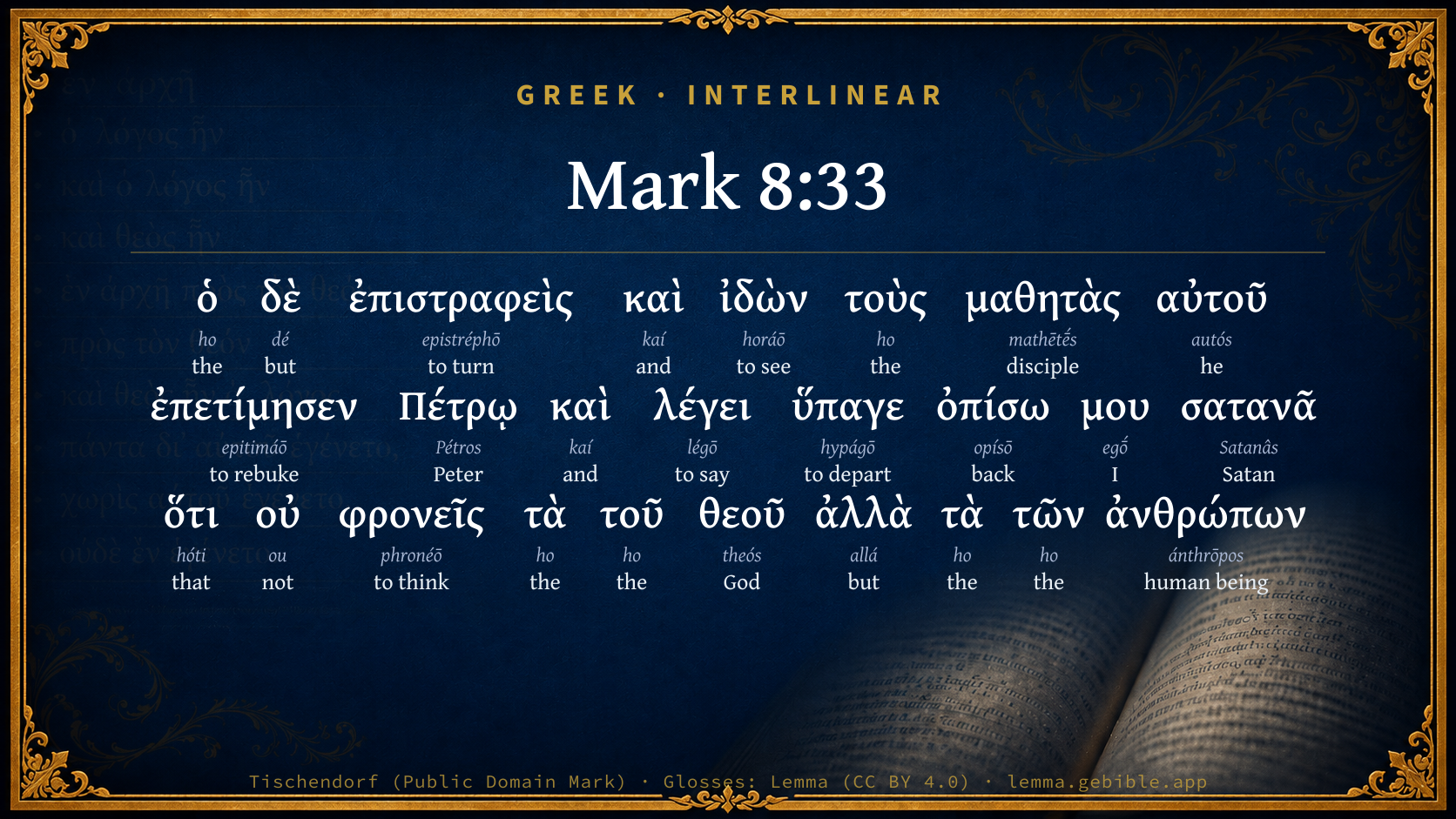
Greek (Tischendorf 8th ed.) Mark 8:33 appears in the Greek New Testament. The text above is from the Tischendorf 8th edition. Each word links to its Strong’s number and a concise gloss. Click any word for its full Thayer’s Greek Lexicon entry.
Download image
Cite this verse

Mark 8:33 (World English Bible). Public Domain. Lemma interlinear Bible study tool, https://lemma.gebible.app/v/mark/8/33.

Show BibTeX & RIS
BibTeX
RIS
English Translation
But he, turning around, and seeing his disciples, rebuked Peter, and said, "Get behind me, Satan! For you have in mind not the things of God, but the things of men."
World English Bible · Public Domain
Download a study sheet

One document with this verse’s original text, its word-by-word gloss line, the meaning frame, cross-references with their text, attributed commentary, and full source and license credits — printable, and it pastes into notes with its structure intact.

This verse Autodidact and up

Study sheet (.html) Plain text (.txt)

A passage Seminary Student

Up to 50 verses in one chapter. A passage sheet keeps up to 6 commentary sources and 12 cross-references per verse, in the order this page ranks them, and says so on the sheet whenever that leaves anything out. Ask for a single verse and you get the Autodidact verse sheet above.

Everything on this page stays free to read, with no account — the sheet is a download of what is already on screen, not access to it.

Want to remove ads? Support Godless Engineer
Compare translations 3

The same verse in 3 English versions, stacked beneath the original-language interlinear above. Click any original word for its lexicon entry.

Each is an independent rendering of the whole verse — the interlinear is not word-aligned to these translations.

Highlighted words mark where these versions differ — a whole-verse word diff, not a word-by-word alignment.

  • World English Bible Public Domain
    But he, turning around, and seeing his disciples, rebuked Peter, and said, "Get behind me, Satan! For you have in mind not the things of God, but the things of men."
  • King James Version Public Domain
    But when he had turned about and looked on his disciples, he rebuked Peter, saying, Get thee behind me, Satan: for thou savourest not the things that be of God, but the things that be of men.
  • unfoldingWord Literal Text CC BY-SA 4.0
    But Jesus, having turned and having looked at his disciples, rebuked Peter and says, “Get behind me, Satan! For you are not considering the things of God, but the things of men.”

unfoldingWord Literal Text — © unfoldingWord, licensed CC BY-SA 4.0. Word-aligned USFM3 via Door43 (git.door43.org/unfoldingWord/en_ult).

Versions to compare (up to 4)

3 of 4 selected

Show all 19 translations

Every available English version of this verse, each an independent rendering of the whole verse.

  • World English Bible Public Domain
    But he, turning around, and seeing his disciples, rebuked Peter, and said, "Get behind me, Satan! For you have in mind not the things of God, but the things of men."
  • Berean Standard Bible Public Domain
    But Jesus, turning and looking at His disciples, rebuked Peter and said, “Get behind Me, Satan! For you do not have in mind the things of God, but the things of men.”
  • Majority Standard Bible Public Domain
    But Jesus, turning and looking at His disciples, rebuked Peter and said, “Get behind Me, Satan! For you do not have in mind the things of God, but the things of men.”
  • King James Version Public Domain
    But when he had turned about and looked on his disciples, he rebuked Peter, saying, Get thee behind me, Satan: for thou savourest not the things that be of God, but the things that be of men.
  • American Standard Version (1901) Public Domain
    But he turning about, and seeing his disciples, rebuked Peter, and saith, Get thee behind me, Satan; for thou mindest not the things of God, but the things of men.
  • Revised Version (1885) Public Domain
    But he turning about, and seeing his disciples, rebuked Peter, and saith, Get thee behind me, Satan: for thou mindest not the things of God, but the things of men.
  • Geneva Bible (1599) Public Domain
    Then he turned backe, and looked on his disciples, and rebuked Peter, saying, Get thee behinde me, Satan: for thou vnderstandest not the things that are of God, but the things that are of men.
  • Douay-Rheims (1899) Public Domain
    Who turning about and seeing his disciples, threatened Peter, saying: Go behind me, Satan, because thou savorest not the things that are of God, but that are of men.
  • Young's Literal Translation Public Domain
    and he, having turned, and having looked on his disciples, rebuked Peter, saying, `Get behind me, Adversary, because thou dost not mind the things of God, but the things of men.'
  • Literal Standard Version CC BY-SA 4.0
    and He, having turned, and having looked on His disciples, rebuked Peter, saying, “Get behind Me, Satan, because you do not mind the things of God, but the things of men.”
  • Unlocked Literal Bible CC BY-SA 4.0
    But Jesus turned and looked at his disciples and then he rebuked Peter and said, “Get behind me, Satan! You are not setting your mind on the things of God, but on the things of people.”
  • unfoldingWord Literal Text CC BY-SA 4.0
    But Jesus, having turned and having looked at his disciples, rebuked Peter and says, “Get behind me, Satan! For you are not considering the things of God, but the things of men.”
  • Darby Bible Public Domain
    But he, turning round and seeing his disciples, rebuked Peter, saying, Get away behind me, Satan, for thy mind is not on the things that are of God, but on the things that are of men.
  • World Messianic Bible Public Domain
    But he, turning around and seeing his disciples, rebuked Peter, and said, “Get behind me, Satan! For you have in mind not the things of God, but the things of men.”
  • Webster's Bible Public Domain
    But when he had turned about, and looked on his disciples, he rebuked Peter, saying, Get thee behind me, Satan: for thou savorest not the things that are of God, but the things that are of men.
  • Free Bible Version CC BY-SA 4.0
    Jesus turned around and looking at his disciples, reprimanded Peter. “Get away from me, Satan,” he said. “You're not thinking as God thinks, but as human beings do.”
  • Bible in Basic English Public Domain
    But he, turning about, and seeing his disciples, said sharply to Peter, Get out of my way, Satan: for your mind is not on the things of God, but on the things of men.
  • Text-Critical English NT CC BY 4.0
    But turning around and looking at his disciples, he rebuked Peter, saying, “Get behind me, Satan! For yoʋ are not thinking about the things of God, but the things of men.”
  • Tyndale New Testament (1534) Public Domain
    Then he tourned aboute and looked on his disciples and rebuked Peter sayinge: Goo after me Satan. For thou saverest not the thinges of God but the thinges of men.

Literal Standard Version (2020), Covenant Press — licensed CC BY-SA 4.0. Text via the HelloAO Bible API (eBible.org). Unlocked Literal Bible (unfoldingWord) — licensed CC BY-SA 4.0. Text via the HelloAO Bible API (eBible.org). unfoldingWord Literal Text — © unfoldingWord, licensed CC BY-SA 4.0. Word-aligned USFM3 via Door43 (git.door43.org/unfoldingWord/en_ult). Free Bible Version, Dr. Jonathan Gallagher — licensed CC BY-SA 4.0. Text via the HelloAO Bible API (eBible.org).

Word by word

More ways to search: Search by grammar → Find every occurrence → Compare this word →

Practice this passage: Drill this verse → Learn its vocabulary →

φρονεῖς
phronéō
G5426
“to think”
Verb, Present, Active, Indicative, 2nd person, Singular
Part of Speech
Verb
Tense
Present
Voice
Active
Mood
Indicative
Person
2nd person
Number
Singular
Full Thayer's Definition

Origin: from G5424

TDNT: 12:40,1

1. to have understanding, be wise 2. to feel, to think a. to have an opinion of one's self, think of one's self, to be modest, not let one's opinion (though just) of himself exceed the bounds of modesty b. to think or judge what one's opinion is c. to be of the same mind i.e. agreed together, cherish the same views, be harmonious 3. to direct one's mind to a thing, to seek, to strive for a. to seek one's interest or advantage b. to be of one's party, side with him (in public affairs)
  1. ὁ ho G3588 “the” Article, Nominative, Singular, Masculine
  2. δὲ dé G1161 “but” Conjunction
  3. ἐπιστραφεὶς epistréphō G1994 “to turn” Verb, Aorist, Passive, Participle, Nominative, Singular, Masculine
  4. καὶ kaí G2532 “and” Conjunction
  5. ἰδὼν horáō G3708 “to see” Verb, Aorist, Active, Participle, Nominative, Singular, Masculine
  6. τοὺς ho G3588 “the” Article, Accusative, Plural, Masculine
  7. μαθητὰς mathētḗs G3101 “disciple” Noun, Accusative, Plural, Masculine
  8. αὐτοῦ autós G846 “he” Personal pronoun, Genitive, Singular, Masculine
  9. ἐπετίμησεν epitimáō G2008 “to rebuke” Verb, Aorist, Active, Indicative, 3rd person, Singular
  10. Πέτρῳ Pétros G4074 “Peter” Noun, Dative, Singular, Masculine
  11. καὶ kaí G2532 “and” Conjunction
  12. λέγει légō G3004 “to say” Verb, Present, Active, Indicative, 3rd person, Singular
  13. ὕπαγε hypágō G5217 “to depart” Verb, Present, Active, Imperative, 2nd person, Singular
  14. ὀπίσω opísō G3694 “back” Adverb
  15. μου egṓ G1473 “I” Personal pronoun, 1st person, Genitive, Singular
  16. σατανᾶ Satanâs G4567 “Satan” Noun, Vocative, Singular, Masculine
  17. ὅτι hóti G3754 “that” Conjunction
  18. οὐ ou G3756 “not” Particle, Negative
  19. τὰ ho G3588 “the” Article, Accusative, Plural, Neuter
  20. τοῦ ho G3588 “the” Article, Genitive, Singular, Masculine
  21. θεοῦ theós G2316 “God” Noun, Genitive, Singular, Masculine
  22. ἀλλὰ allá G235 “but” Conjunction
  23. τὰ ho G3588 “the” Article, Accusative, Plural, Neuter
  24. τῶν ho G3588 “the” Article, Genitive, Plural, Masculine
  25. ἀνθρώπων ánthrōpos G444 “human being” Noun, Genitive, Plural, Masculine

About this verse

These counts appear in no published source. They are computed here, from the morphology-tagged text and Lemma’s own curated glosses. What Lemma adds →

26
words
20
distinct lemmas
Gospels
section

Shared distinctive vocabulary

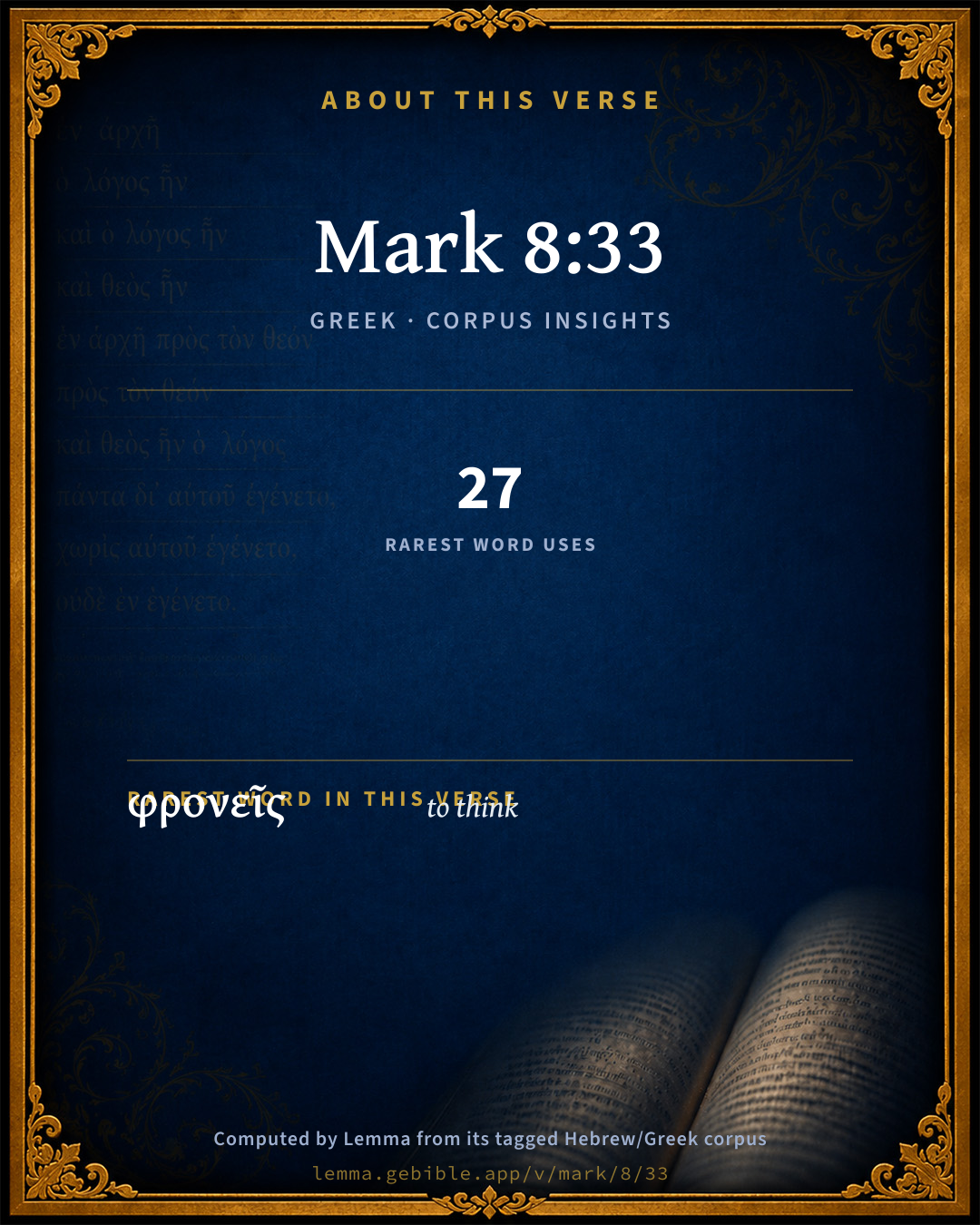
φρονεῖς to think G5426 occurs in 21 verses of the Greek New Testament. Also found in:
Repetition

Words recur within this verse:

Cross-references

23

Topical passages linked to Mark 8:33 in the Treasury of Scripture Knowledge — connected by theme and wording, ordered by reader-vote popularity; previews shown in the World English Bible.

  • Matthew 4:10 Then Jesus said to him, "Get behind me, Satan! For it is written, 'You shall worship the Lord your God, and him only shall you serve.'"
  • Philippians 3:19 whose end is destruction, whose god is the belly, and whose glory is in their shame, who think about earthly things.
  • 1 John 2:15 Don't love the world, neither the things that are in the world. If anyone loves the world, the Father's love isn't in him.
  • James 3:15–18 This wisdom is not that which comes down from above, but is earthly, sensual, and demonic.
  • Genesis 3:4–6 The serpent said to the woman, "You won't surely die,
  • Psalms 141:5 Let the righteous strike me, it is kindness; Let him reprove me, it is like oil on the head; Don't let my head refuse it; Yet my prayer is always against evil deeds.
  • Matthew 6:31–32 "Therefore don't be anxious, saying, 'What will we eat?', 'What will we drink?' or, 'With what will we be clothed?'
  • Mark 3:34 Looking around at those who sat around him, he said, "Behold, my mother and my brothers!
  • Romans 8:5–8 For those who live according to the flesh set their minds on the things of the flesh, but those who live according to the Spirit, the things of the Spirit.
  • Revelation 3:19 As many as I love, I reprove and chasten. Be zealous therefore, and repent.
  • Leviticus 19:17 "'You shall not hate your brother in your heart. You shall surely rebuke your neighbor, and not bear sin because of him.
  • 2 Samuel 19:22 David said, What have I to do with you, you sons of Zeruiah, that you should this day be adversaries to me? shall there any man be put to death this day in Israel? for don't I know that I am this day king over Israel?
  • Proverbs 9:8–9 Don't reprove a scoffer, lest he hate you. Reprove a wise man, and he will love you.
  • Matthew 15:23 But he answered her not a word. His disciples came and begged him, saying, "Send her away; for she cries after us."
  • Mark 3:5 When he had looked around at them with anger, being grieved at the hardening of their hearts, he said to the man, "Stretch out your hand." He stretched it out, and his hand was restored as healthy as the other.
  • Luke 22:61 The Lord turned, and looked at Peter. Then Peter remembered the Lord's word, how he said to him, "Before the rooster crows you will deny me three times."
  • 1 Corinthians 5:5 are to deliver such a one to Satan for the destruction of the flesh, that the spirit may be saved in the day of the Lord Jesus.
  • 1 Timothy 5:20 Those who sin, reprove in the sight of all, that the rest also may be in fear.
  • 1 Peter 4:1 Forasmuch then as Christ suffered for us in the flesh, arm yourselves also with the same mind; for he who has suffered in the flesh has ceased from sin;
  • Job 2:10 But he said to her, "You speak as one of the foolish women would speak. What? Shall we receive good at the hand of God, and shall we not receive evil?" In all this Job didn't sin with his lips.
  • Luke 4:8 Jesus answered him, "Get behind me Satan! For it is written, 'You shall worship the Lord your God, and him only shall you serve.'"
  • Luke 9:55 But he turned and rebuked them, "You don't know of what kind of spirit you are.
  • Titus 1:13 This testimony is true. For this cause, reprove them sharply, that they may be sound in the faith,

Cross-references courtesy of OpenBible.info (CC BY 4.0).

Commentary

Notes on Mark 8:33 from classic Christian and Jewish commentators (each source and its license shown beneath its notes). The classic Christian expositions comment on the surrounding passage and are grouped to its opening verse, so a note may address several verses; the Jewish commentaries on the Tanakh (Rashi and others) are per-verse, so they appear only where the commentator wrote on this verse.

Lemma curates 59 commentaries, every one of them public domain or Creative Commons licensed, each selected and text-cleaned for this edition rather than reprinted as found. About our sources →

The Biblical Illustrator

Joseph S. Exell

Mar_8:31; Mar_8:33

That the Son of Man must suffer many things.

The rebuke of love

Let us not overlook this loving rebuke; for

(1) it cures Peters presumption;

(2) sets him to learn a new lesson on the heavenliness of sacrifice;

(3) prevents the greatness of his faith being spoiled by the earthliness of his hopes.

Faithful are the wounds of a friend: but the wounds which the Saviour inflicts are kindest of all. From Peters weakness let us learn how hard it is to see all truth at once. From Christs rebuke let us learn that the heavenly thing is not to seek for glory, but for usefulness, even if we can reach it only through a cross. (R. Glover.)

Peter rebuked Christ and Christ rebuked Peter-an altercation of more than mere words

It is charged with practical truths.

1. Mans shortsightedness.

2. Mans sentiment exaggerated.

3. Mans audacity to think he can help or save Christ.

On Christs side:

1. He rebukes the oldest.

2. He rebukes the wisest-it was Peter who said, Thou art the Christ.

3. He shows that men are only worthy of Him in proportion as they enter into His spirit. (Dr. Parker.)

Christs intimation of His sufferings

I. What there is to mark the time which our blessed Saviour thus selected, for giving prominence to a new and unwelcome subject of discourse. In the third year of His public ministry. Up to this time our Lord left the great truth of His Godhead to work its way rote the minds of His apostles. Now they had arrived at the conviction that He was none other than the ever-living God. What inducement led to, and what instruction may be gathered from, the recorded fact, that when Jesus had drawn from His disciples the acknowledgment of His Divinity, then, and not before, He began to teach them that the Son of Man must suffer many things, and be rejected of the elders, and of the chief priests, and scribes, and be killed, and after three days rise again. Now the apostles could have had none but the most indistinct apprehensions of the office and mission of our Lord, so long as they were ignorant of the death which He had undertaken to die. This made it appear remarkable, that our Lord should so long have withheld the express mention of His sufferings, As much as to say, It will be of no avail to speak to them of My death till they are convinced of My Deity. So long as they only know Me as the Son of Man, they will not be prepared to hear of the cross; when they shall also know Me as the Son of the living God, then will be the time to tell of ignominy and death. Oh, how strange, you may exclaim, that the moment of discovering a Divine person in the form of a man should be the right moment for the being informed that this person should be crucified! To discover a Divine person is to discover what death cannot touch; and yet Christ waited till this discovery in regard of Himself, that He might then expressly mention His approaching dissolution. But do you not observe, my brethren, what a testimony our Lord hereby gives to the fact, that the truth of His Godhead alone explains-alone gives meaning or worth to-His having died on the cross? He will say nothing of His death whilst only believed to be man; He speaks continually of His death, when once acknowledged as God. Are we not taught by this, that they only who believe Christ Divine, can put the right construction on the mystery of His death, or so survey it as to draw from it what it was intended to teach? Then we perceive, that He must have died as a sacrifice; then we understand that He must have died as an atonement to be the propitiation for our sins, to reconcile the world unto God. He could not have died for such ends had He been only man; but being also God, such ends could be answered and effected by His death, though nothing less, so far as we can tell, could have sufficed. Therefore, again and again, we say, Christs Divinity is the explanation of Christs death. We seem quite justified in gathering from the text, that hence forward our Lord made very frequent mention of His cross. If you examine, you will find so many as nine instances spoken of by the evangelists; though it was a topic which He had not before introduced. And what is very observable is, that it seems to have been upon occasions when the disciples were likely to have been puffed up and exalted, that ever after our Lord took special pains to impress upon them that He must be rejected and killed. Ah! my brethren, ought we not to learn from this keeping the cross out of sight till faith had grown strong and high privilege been imparted, that it is the advanced Christian who has need of persecution; and that grace, in place of exempting us from, is to fit us for trial? The disciples must have well known that if suffering were to be their Masters lot, it would also be theirs. If, then and thence, Jesus spake of afflictions which should befall Himself, He must have been understood as likewise speaking of afflictions which would befall His apostles; and He abstained, you see, from dwelling on the tribulation which would be the path to His kingdom, till He found His followers strong in belief of His actual Divinity. And then take one more lesson from the peculiarity of the occasions on which, as we bays shown you, Christ made a special point of introducing the mention of His sufferings; occasions on which the disciples were in danger of being puffed up and exalted. Learn to expect, and be thankful for, something bitter in the cup, when faith has won the victory, and you have tasted, in no common measure, the powers of the invisible world. You may say, however, that it militates against much that we have advanced, that in point of fact, Christs mentioning His sufferings at the time when He did, produced not on the disciples the effect which our statement supposes. We have but too good proof, that though our Lord deferred so long as He did speaking of His sufferings, the apostles were still unprepared for the saying, and could neither understand it nor receive it. Even St. Peter, who had just made the noble confession which proved him ready and willing to hear tidings from Christ, no sooner hears of his Saviour being rejected and killed, than he begins presumptuously to rebuke Him; saying, Be it far from Thee, Lord; this shall not be unto Thee. Yet let it not be thought that Christ chose an unseasonable time, or tried an unsuitable means. The medicine may be what we want; but we, alas! may reject it, as not being what we like. The ease may be precisely such, that from that time forth, it is wholesome that we be admonished of appointed tribulation. We may only the more prove how the admonition is needed, by treating it with dislike, and trying to disbelieve it. When we find that there was such repugnance in St. Peter and his brethren to the cross, though Christ had waited so patiently for the fittest time to introduce it, we ought to learn the difficulty of taking part with the suffering Saviour, and submitting ourselves meekly, and thankfully, to the scorn and the trial of sharing His afflictions. And this lesson from mans aversion to, and how much more the bearing of, the cross, should bring home to us with great force, our need of being continually disciplined by the Spirit of God. And yet it is not to pure and unmingled sorrow, that Christ would consign the more faithful in His Church. As St. Paul writes to the Corinthians, as the sufferings of Christ abound in us, so our consolation also aboundeth by Christ. How beautiful is it in our text, that if Jesus then began to tell His disciples how He should die, He then began also to tell them how He should rise again from the dead. It is our unbelief, or our impatience, which makes us overlook the one statement in our eagerness to get rid of the other. If God lead you into the wilderness, it is, as He saith by the prophet Hosea, that there He may speak comfortably to you, giving you vineyards from thence, and the valley of Achor for a door of hope. (H. Melvill, B. D.)

The Biblical Illustrator, edited by Joseph S. Exell (c. 1880s–1900s) — public domain. Text from a community e-Sword module.

Tyndale Open Study Notes

Tyndale Open Resources

8:33 Jesus looked at his disciples before he publicly rebuked Peter; he wanted them to understand that Peter was wrong. • Get away from me, Satan does not mean that Peter was demon-possessed. Peter spoke from a human point of view, not from God’s, so he unwittingly spoke for Satan, the god of this world (2 Cor 4:4), and repeated Satan’s temptation (cp. Matt 4:8-10).

Tyndale Open Study Notes — © Tyndale Open Resources, licensed CC BY-SA 4.0. Text via the HelloAO Bible API.

Expositor's Greek Testament

ed. W. Robertson Nicoll

Mar 8:33 . ἐπιστραφεὶς : the compound instead of the simple verb in Mt., which Mk. does not use. ἰδὼν τ . μαθ .: the rebuke is administered for the benefit of all, not merely to put down Peter. This resistance to the cross must be grappled with at once and decisively. What Peter said, all felt . In Mk.’s report of the rebuke the words σκάνδαλον εἶ ἐμοῦ are omitted. On the saying vide in Mt.

The Expositor's Greek Testament, edited by W. Robertson Nicoll (1897–1910) — public domain. Text from a community e-Sword module.

Geneva Bible (1599)

Geneva Bible translators

This is not godly, but worldly wisdom.

Geneva Bible (1599) marginal notes — public domain. Text via Bolls.life.

The Cambridge Bible for Schools and Colleges

gen. ed. J. J. S. Perowne

33. when he had turned about and looked on his disciples] Observe the graphic touches of St Mark. The Apostle who had restrained the Evangelist from preserving the record of that which redounded to his highest honour, suppresses the record neither of his own mistaken zeal, nor of the terrible rebuke it called forth.

Get thee behind me] The very words which He had used to the Tempter in the wilderness (Mat_4:10), for in truth the Apostle was adopting the very argument which the great Enemy had adopted there.

thou savourest not] Thou art thinking of, thy thoughts centre on. This rendering of the Greek word for “to think” is suggested by the Latin sapere, which is found in the Vulgate and retained from Wyclif’s Version. It is derived directly from the substantive savour, Fr. saveur, Lat. sapor, from sapere. Thus Latimer quoting 1Co_13:11 writes, “When I was a child I savoured as a child.” “In confusion of them that so saveren earthely thinges.” Chaucer, Parson’s Tale. “Thy words shew,” our Lord would say to the Apostle, “that in these things thou enterest not into the thoughts and plans of God, but considerest all things only from the ideas of men. This attempt of thine to dissuade Me from My ‘baptism of death’ is a sin against the purposes of God.”

The Cambridge Bible for Schools and Colleges (gen. ed. J. J. S. Perowne; Cambridge University Press, 1878–1918) — public domain. Text from a community e-Sword module.

John Gill's Exposition

But when he had turned about,.... Upon Peter, and showed quick resentment at what he said:

and looked on his disciples; he cast his eye toward, them at the same time, and expressed to them the same displeasure in his countenance, they being of the same mind:

he rebuked Peter, saying, get thee behind me, Satan: for thou savourest not the things that be of God; things which were according to the will of God, as the sufferings of Christ were: they were according to the determinate counsel of his will; what he had determined in his purposes and council should be; and what he had declared in the Scriptures of truth, the revelation of his will, would be; and in which, according to them, he should have a great concern himself, Isa 53:6, and whereby all his divine perfections would be glorified, and therefore may well be said to be the things of God; and which ought to be savoured, minded, and attended to, as things of the greatest moment and importance: and which, though the apostle had often read of in the books of the Old Testament; yet either had not a clear understanding of them, as being the will of God; or however, they were greatly out of his view at this time, his mind being possessed with notions of a temporal kingdom, and of worldly honour and grandeur: wherefore it follows,

but the things that be of men; as were the notions of Christ's being a temporal prince, that would set up a worldly kingdom, and deliver the Jews from the Roman yoke, and make his subjects happy, with an affluence of all worldly things; and particularly his favourites, as the disciples were: these were schemes of men's devising, and were suited to the corrupt nature, and carnal inclinations of men; and these things at present too much possessed Peter's mind: wherefore the Lord rebuked him in a very severe, though just manner; being touched in his most tender part, and dissuaded from that which his heart was set upon, and he came into the world for; whose keen resentment is seen by using a phrase he never did but to the devil himself, Mat 4:10; See Gill on Mat 16:23.

John Gill's Exposition of the Whole Bible (1746–1763) — public domain (CC PDM 1.0). Text via the HelloAO Bible API.

Trapp's Complete Commentary

John Trapp

33 But when he had turned about and looked on his disciples, he rebuked Peter, saying, Get thee behind me, Satan: for thou savourest not the things that be of God, but the things that be of men.

Ver. 33. {See Trapp on "Mat 16:22"} {See Trapp on "Mat 16:23"}

John Trapp, A Commentary or Exposition upon All the Books of the Old and New Testament (1647–1656) — public domain. Text from a community e-Sword module.

The Pulpit Commentary

But he turning about, and seeing his disciples, rebuked Peter. The words indicate a sudden movement (o de epistrafeiv), accompanied by a keen searching look at his disciples. Then he singles out Peter, and addresses to him, in their presence, the severe rebuke, Get thee behind me, Satan: for thou savourest not (ou froneiv) literally, thou mindest notthe things of God, but the things of men. The form of words is the same as that used by our Lord to Satan himself, when he was tempted by him in the wilderness. It reminded him of that great conflict. The visions of worldly glory again floated before him. The crown without the cross was again held out to him. This explains his language. Peter was indeed rebuked; but the rebuke was aimed through him at the arch adversary who was addressing him through Peter. Here is the striking significance of his "turning about." Peter was for the moment doing the tempter"s work, and in "turning about" our Lord was again putting Satan behind him.

The Pulpit Commentary (1880–1919), ed. H.D.M. Spence-Jones & Joseph S. Exell — public domain. Text from a community e-Sword module.

John Wesley's Explanatory Notes

Looking on his disciples - That they might the more observe what he said to Peter.

John Wesley, Explanatory Notes Upon the Whole Bible (1754–1765) — public domain. Text via the GEBible commentary corpus.

Scofield Reference Notes

C. I. Scofield

thou savourest

i.e. thou art thinking man’s thoughts, not the thoughts of God. Contra, Mat 16:17

The Scofield Reference Bible (1917 edition), notes by C. I. Scofield — public domain. Text from a community e-Sword module.

unfoldingWord translationNotes

Door43 World Missions Community

Connecting Statement:

After rebuking Peter for his not wanting Jesus to die and rise, Jesus tells both his disciples and the crowd how to follow him.

Get behind me, Satan! You are not setting

Jesus means that Peter is acting like Satan because Peter is trying to prevent Jesus from accomplishing what God sent him to do. AT: "Get behind me, because you are acting like Satan! You are not setting" (See: Metaphor)

Get behind me

"Get away from me"

follow me

Following Jesus here represents being one of his disciples. AT: "be my disciple" or "be one of my disciples" (See: Metaphor)

must deny himself

"must not give in to his own desires" or "must forsake his own desires"

take up his cross, and follow me

"carry his cross and follow me." The cross represents suffering and death. Taking up the cross represents being willing to suffer and die. AT: "must obey me even to the point of suffering and dying" (See: Metonymy and Metaphor)

follow me

Following Jesus here represents obeying him. AT: "obey me" (See: Metaphor)

translationWords

Jesus

disciple

rebuke

Peter

Satan

God

call

cross

unfoldingWord translationNotes — © Distant Shores Media and the Door43 World Missions Community, licensed CC BY-SA 4.0. Source: git.door43.org/Door43/en_tn.

Bengel's Gnomon

Johann Albrecht Bengel

[33. Τοὺς μαθητὰς αὐτοῦ, His disciples) who might have been very quickly carried away by Peter’s objection, so as to embrace views merely human.—V. g.]

Bengel's Gnomon of the New Testament — English translation (T&T Clark, Edinburgh, 1860) — public domain. Text from a community e-Sword module.

Cambridge Greek Testament for Schools and Colleges

33. καὶ λέγει ([1770][1771][1772][1773][1774]) rather than λέγων ([1775][1776][1777][1778]).

[1770] Codex Sinaiticus. 4th cent. Discovered by Tischendorf in 1859 at the Monastery of St Katharine on Mount Sinai. Now at St Petersburg. The whole Gospel, ending at Mar 16:8. Photographic facsimile, 1911.

[1771] Codex Vaticanus. 4th cent., but perhaps a little later than א. In the Vatican Library almost since its foundation by Pope Nicolas V., and one of its greatest treasures. The whole Gospel, ending at Mar 16:8. Photographic facsimile, 1889.

[1772] Codex Ephraemi. 5th cent. A palimpsest: the original writing has been partially rubbed out, and the works of Ephraem the Syrian have been written over it; but a great deal of the original writing has been recovered; of Mark we have Mar 1:17 to Mar 6:31, Mar 8:5 to Mar 12:29, Mar 13:19 to Mar 16:20. In the National Library at Paris.

[1773] Codex Regius. 8th cent. An important witness. At Paris. Contains Mar 1:1 to Mar 10:15; Mar 10:30 to Mar 15:1; Mar 15:20 to Mar 16:20, but the shorter ending is inserted between Mar 16:8 and Mar 16:9, showing that the scribe preferred it to the longer one.

[1774] Codex Sangallensis. 9th or 10th cent. Contains the Gospels nearly complete, with an interlinear Latin translation. The text of Mark is specially good, agreeing often with CL. At St Gall.

[1775] Codex Alexandrinus. 5th cent. Brought by Cyril Lucar, Patriarch of Constantinople, from Alexandria, and afterwards presented by him to King Charles I. in 1628. In the British Museum. The whole Gospel. Photographic facsimile, 1879.

[1776] Codex Bezae. 6th cent. Has a Latin translation (d) side by side with the Greek text, and the two do not quite always agree. Presented by Beza to the University Library of Cambridge in 1581. Remarkable for its frequent divergences from other texts. Contains Mark, except Mar 16:15-20, which has been added by a later hand. Photographic facsimile, 1899.

[1777] Codex Oxoniensis. 9th cent. Contains Mark, except Mar 3:35 to Mar 6:20.

[1778] Codex Petropolitanus. 9th cent. Gospels almost complete. Mar 16:18-20 is in a later hand.

33. ἐπιστραφείς. Midd. sense, as in Mar 5:30. This graphic touch, freq. in Lk., is in Mt. also. If Peter’s rebuke to Him was given privately, His rebuke to Peter must, for the sake of all, be given openly. It was as He turned that He saw the disciples, from whose company Peter had withdrawn Him. Without ἐπί (Act 9:35; Act 11:21) or πρός (Luk 17:4; Act 9:40) after it, ἐπιστρέφ. means “turn round,” not necessarily “turn towards.” The other Evangelists use στραφείς of Christ’s turning to people. Vulg. spoils the effect of ἐπιτιμᾷν … ἐπετίμησεν by translating increpare … comminatus est. The latter is the usual translation.

Ὕπαγε ὀπίσω μου, Σατανᾶ. At the end of the Temptation Christ dismissed the evil one with Ὕπαγε, Σατανᾶ (Mat 4:10). He recognizes Satan’s influence once more in Peter’s suggestion that the Messiah can accomplish His work without suffering and death, which is a repetition of the suggestions made in the wilderness. Mt. says expressly that Ὕπαγε … Σατανᾶ was addressed to Peter, and ὅτι οὐ φρονεῖς must be addressed to him. For the moment Peter has identified himself with Satan, and he is banished with similar decision and severity.

Bede tries to mitigate Peter’s error, which he thinks sprang de pietatis affectu and could not be attributed to the prompting of the evil one. He admires Peter’s taking the Master aside, ne praesentibus ceteris condiscipulis magistrum videatur arguere. He would give to “Satan” its original meaning of “adversary”; in this matter Peter’s wishes are opposed to Christ’s. Origen and Theophylact go still further from the true meaning when they interpret Ὕπαγε ὀπίσω μου as signifying “Follow Me; conform to My will.”

The severity of the rebuke is explained by the severity of the temptation. Christ’s prayers during the Agony show what it cost Him to resist the suggestion that the triumphant Τετέλεσται could be reached without suffering, and that the Crown might be won without enduring the Cross. The Divine Δεῖ must be accomplished, but Christ’s human soul shrank from the accomplishment, and the thought of escaping it had a dire attractiveness. D.C.G. art. “The Character of Christ.”

οὐ φρονεῖς τὰ τοῦ θεοῦ. It was God’s will that His Son should suffer and die, and Peter was setting his love for his Master in opposition to God’s love for His Son and His sons. The Apostle who should have been a support had become an occasion of falling. It is a low type of human affection that forbids those who are loved to suffer in a righteous cause. Conformity to the mind of God is the only safe rule. Cf. Php 3:19. Excepting this Saying and Act 28:22, φρονεῖν in N.T. is confined to the Pauline Epistles; Rom 8:5; Col 3:2. But the expression φρονεῖν τά is not specially Pauline; cf. 1Ma 10:20, and in Dem. Philippians 3 we have οἱ τὰ Φιλίππου φρονοῦντες.

Cambridge Greek Testament for Schools and Colleges (Cambridge University Press, 1896; 21 vols, various authors incl. Carr, Maclear, Plummer, Farrar, Lumby, Moule, M. R. James, Simcox) — public domain. Text from a community e-Sword module.

International Critical Commentary

33. ἐπιστραφείς—having turned, that is, upon Peter. But as he turned on him, it brought the rest of the disciples to view, and having seen the effect of Peter’s action on them, he was moved to special plainness of speech. ἐπετίμησε Πέτρῳ καὶ λέγει—he rebuked Peter and says. Notice the repetition of the ἐπιτιμᾷν of v. 32. Peter had assumed to rebuke him, and now he rebukes Peter.

καὶ λέγει, instead of λέγων, saying, Tisch. Treg. WH. RV. א BCL Δ two mss. Lat. Vet. Memph. Pesh.

Ὕπαγε ὀπίσω μου—Ὕπαγε denotes withdrawal, get away. And the whole phrase means, Get out of my sight. Σατανᾶ—Satan. Our Lord is not calling names here, but indicating in strong language the part that Peter is playing. He is putting temptation in our Lord’s way, and is so acting the rôle of Satan. Jesus recognizes that it is not Peter in propria persona that is speaking, but the Spirit of evil speaking through him, just as he recognized the invisible Tempter in the wilderness (Mat 4:10). φρονεῖς—thou thinkest not, thou dost not regard. φρονεῖν τά τινος means to side with one.1 Peter did not keep in mind God’s purposes, but men’s. He did not look at things as God looks at them, but as men regard them, and hence he played the part of the Adversary, the Tempter. And it was not a minor and incidental temptation, but the great thing that separates God’s ways and man’s, the temptation to consider himself, instead of imitating God’s self-sacrifice.

JESUS TEACHES THE MULTITUDE THAT THE SELF-SACRIFICE PRACTISED BY HIMSELF IS THE NECESSARY CONDITION OF DISCIPLESHIP

34-9:1. Jesus now calls up the multitude, having closed the purely esoteric part of his teaching, relating to his own fate, and teaches them that the condition of discipleship is self-denial, and following him even to death. He bases this on the general principle that to lose life is to save it, and to save it is to lose it. And there is no profit in gaining the whole world and losing one’s life, because that is an irreparable loss. Nothing will buy it back. These ultimate gains and losses follow a man’s attitude towards Him because the Son of Man is to return in the glory of his Father, and will then be ashamed of the man who is now ashamed of Him.

International Critical Commentary — older volumes (1896–1929), various authors — public domain. Text from a community e-Sword module.

Lesson kit

Teaching starters — assembled from the data on this page, not authored interpretation. Every prompt links to the verse data it draws on. Edit before teaching.

Mark, in the Gospels, opens this verse with 26 words (20 distinct Greek lemmas). Its most distinctive word is phronéō (“to think”). A historical commentator’s framing appears above. Read the whole chapter for the surrounding context.

Discussion questions

  1. How does “to think” (phronéō) shape what this verse is saying?
  2. How does Matthew 16:23, which shares the word «to think», read alongside this verse?
  3. What does the repetition of “the” (6× in this one verse) do in this verse?
  4. These translations render this verse differently; the difference is in the English rendering, not the original. What questions does that raise?
  5. Compare how The Biblical Illustrator and Tyndale Open Study Notes read this verse. Where do they agree or differ?

Things to notice

Reading settings

Reading text

Shown beneath each verse's original-language words.

Old Testament
Old Testament edition

Read the OT as the Masoretic Hebrew (MT) or the Greek Septuagint (LXX).

English shown for the Greek Septuagint (in the Hebrew ↔ Greek comparison).

Comparing translations? Open the Compare panel on any verse page to stack up to four side by side.