
1 Samuel 1:22

Hebrew (Westminster Leningrad Codex) 1 Samuel 1:22 appears in the Hebrew Old Testament. The text above is from the Westminster Leningrad Codex. Each word links to its Strong’s number, a concise gloss, and parsing drawn from the Open Scriptures Hebrew Bible morphology. Click any word for its full Brown-Driver-Briggs (BDB) entry.
Download image
Cite this verse

1 Samuel 1:22 (World English Bible). Public Domain. Lemma interlinear Bible study tool, https://lemma.gebible.app/v/1-samuel/1/22.

Show BibTeX & RIS
BibTeX
RIS
English Translation
But Hannah didn't go up; for she said to her husband, [I will not go up] until the child be weaned; and then I will bring him, that he may appear before Yahweh, and there abide forever.
World English Bible · Public Domain
Download a study sheet

One document with this verse’s original text, its word-by-word gloss line, the meaning frame, cross-references with their text, attributed commentary, and full source and license credits — printable, and it pastes into notes with its structure intact.

This verse Autodidact and up

Study sheet (.html) Plain text (.txt)

A passage Seminary Student

Up to 50 verses in one chapter. A passage sheet keeps up to 6 commentary sources and 12 cross-references per verse, in the order this page ranks them, and says so on the sheet whenever that leaves anything out. Ask for a single verse and you get the Autodidact verse sheet above.

Everything on this page stays free to read, with no account — the sheet is a download of what is already on screen, not access to it.

Want to remove ads? Support Godless Engineer
Compare translations 3

The same verse in 3 English versions, stacked beneath the original-language interlinear above. Click any original word for its lexicon entry.

Each is an independent rendering of the whole verse — the interlinear is not word-aligned to these translations.

Highlighted words mark where these versions differ — a whole-verse word diff, not a word-by-word alignment.

  • World English Bible Public Domain
    But Hannah didn't go up; for she said to her husband, [I will not go up] until the child be weaned; and then I will bring him, that he may appear before Yahweh, and there abide forever.
  • King James Version Public Domain
    But Hannah went not up; for she said unto her husband, I will not go up until the child be weaned, and then I will bring him, that he may appear before the LORD, and there abide for ever.
  • unfoldingWord Literal Text CC BY-SA 4.0
    But Hannah did not go up. For she said to her husband, “Until the boy is weaned, then I will bring him. And he will be seen at the face of Yahweh and dwell there forever.”

unfoldingWord Literal Text — © unfoldingWord, licensed CC BY-SA 4.0. Word-aligned USFM3 via Door43 (git.door43.org/unfoldingWord/en_ult).

Versions to compare (up to 4)

3 of 4 selected

Show all 18 translations

Every available English version of this verse, each an independent rendering of the whole verse.

  • World English Bible Public Domain
    But Hannah didn't go up; for she said to her husband, [I will not go up] until the child be weaned; and then I will bring him, that he may appear before Yahweh, and there abide forever.
  • Berean Standard Bible Public Domain
    but Hannah did not go. “After the boy is weaned,” she said to her husband, “I will take him to appear before the LORD and to stay there permanently.”
  • Majority Standard Bible Public Domain
    but Hannah did not go. “After the boy is weaned,” she said to her husband, “I will take him to appear before the LORD and to stay there permanently.”
  • King James Version Public Domain
    But Hannah went not up; for she said unto her husband, I will not go up until the child be weaned, and then I will bring him, that he may appear before the LORD, and there abide for ever.
  • American Standard Version (1901) Public Domain
    But Hannah went not up; for she said unto her husband, `I will not go up' until the child be weaned; and then I will bring him, that he may appear before Jehovah, and there abide for ever.
  • Revised Version (1885) Public Domain
    But Hannah went not up; for she said unto her husband, I will not go up until the child be weaned, and then I will bring him, that he may appear before the LORD, and there abide for ever.
  • Geneva Bible (1599) Public Domain
    But Hannah went not vp: for she sayd vnto her husband, I will tarie vntill the childe be weined, then I will bring him that hee may appeare before the Lord, and there abide for euer.
  • Douay-Rheims (1899) Public Domain
    But Anna went not up: for she said to her husband: I will not go till the child be weaned, and till I may carry him, that he may appear before the Lord, and may abide always there.
  • Young's Literal Translation Public Domain
    And Hannah hath not gone up, for she said to her husband, `Till the youth is weaned -- then I have brought him in, and he hath appeared before the face of Jehovah, and dwelt there -- unto the age.'
  • Literal Standard Version CC BY-SA 4.0
    And Hannah has not gone up, for she said to her husband, “Until the youth is weaned—then I have brought him in, and he has appeared before the face of YHWH, and dwelt there for all time.”
  • Unlocked Literal Bible CC BY-SA 4.0
    But Hannah did not go; she had said to her husband, “I will not go until the child is weaned; then I will bring him, so that he may appear before Yahweh and live there forever.”
  • unfoldingWord Literal Text CC BY-SA 4.0
    But Hannah did not go up. For she said to her husband, “Until the boy is weaned, then I will bring him. And he will be seen at the face of Yahweh and dwell there forever.”
  • Darby Bible Public Domain
    But Hannah did not go up, for she said to her husband, [I will wait] until the child is weaned; then will I bring him, that he may appear before Jehovah, and there abide for ever.
  • World Messianic Bible Public Domain
    But Hannah didn’t go up, for she said to her husband, “Not until the child is weaned; then I will bring him, that he may appear before the LORD, and stay there forever.”
  • Webster's Bible Public Domain
    But Hannah went not up; for she said to her husband, I will not go up until the child is weaned, and then I will bring him, that he may appear before the LORD, and there abide for ever.
  • Free Bible Version CC BY-SA 4.0
    But Hannah did not go. She told her husband, “Once the boy is weaned I will take him to be presented to the Lord and to remain there forever.”
  • Bible in Basic English Public Domain
    But Hannah did not go, for she said to her husband, I will not go till the child has been taken from the breast, and then I will take him with me and put him before the Lord, where he may be for ever.
  • JPS Tanakh (1917) Public Domain
    But Hannah went not up; for she said unto her husband: 'Until the child be weaned, when I will bring him, that he may appear before the LORD, and there abide for ever.'

Literal Standard Version (2020), Covenant Press — licensed CC BY-SA 4.0. Text via the HelloAO Bible API (eBible.org). Unlocked Literal Bible (unfoldingWord) — licensed CC BY-SA 4.0. Text via the HelloAO Bible API (eBible.org). unfoldingWord Literal Text — © unfoldingWord, licensed CC BY-SA 4.0. Word-aligned USFM3 via Door43 (git.door43.org/unfoldingWord/en_ult). Free Bible Version, Dr. Jonathan Gallagher — licensed CC BY-SA 4.0. Text via the HelloAO Bible API (eBible.org).

Word by word

More ways to search: Search by grammar → Find every occurrence → Compare this word →

Practice this passage: Drill this verse → Learn its vocabulary →

וְחַנָּ֖ה
Channâh
H2584
“and · Hannah”
Conjunction + Noun, Proper
Part of Speech
Conjunction + Noun
Type
Proper
Full BDB Definition

Origin: from H2603

TWOT: None

Hannah = "grace" - the mother of Samuel, one of the wives of Elkanah
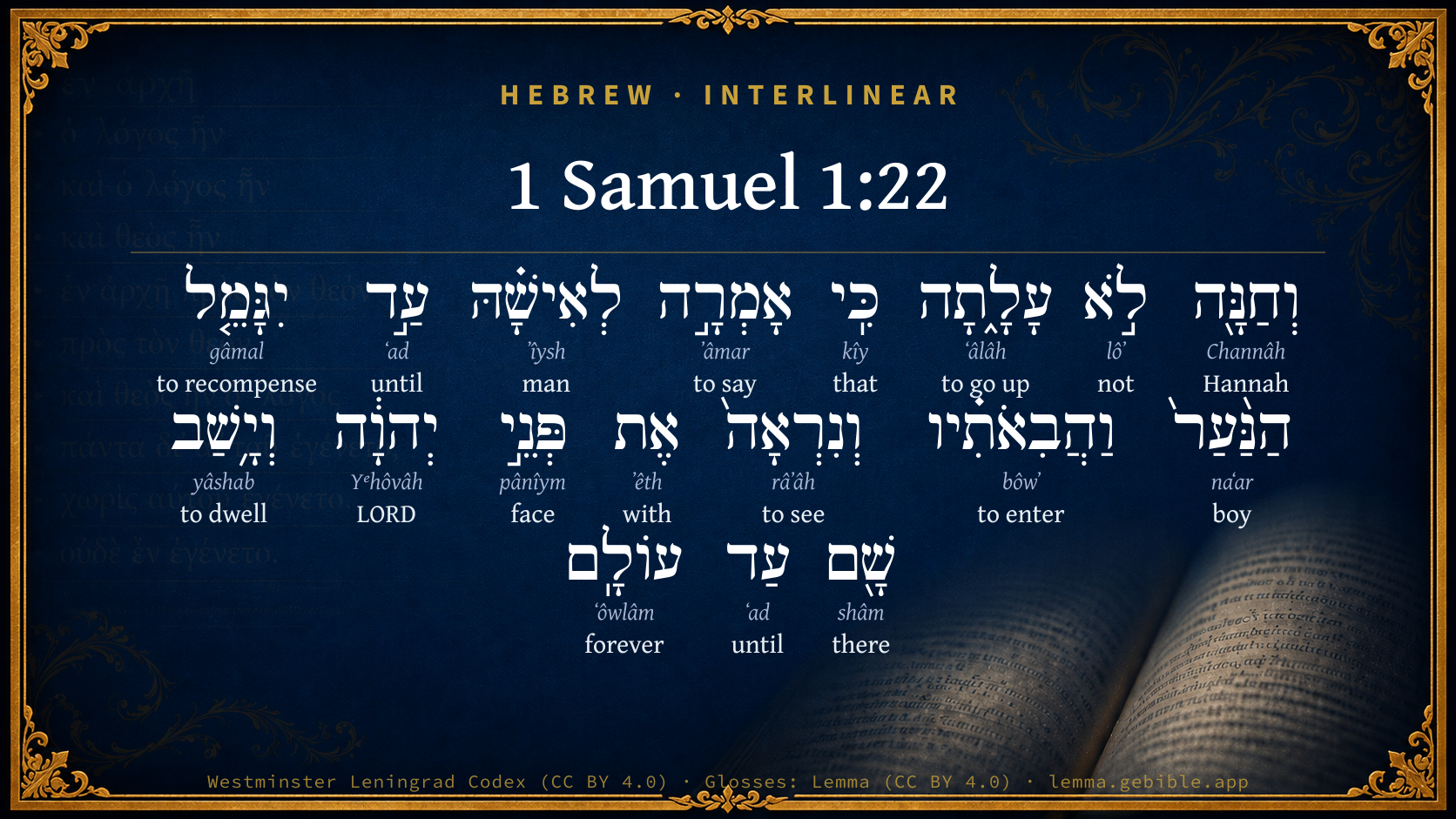
  1. לֹ֣א lôʼ H3808 “not” Particle, Negative
  2. עָלָ֑תָה ʻâlâh H5927 “to go up” Verb, Qal, Perfect, 3rd Person, Feminine, Singular
  3. כִּֽי kîy H3588 “that” Conjunction
  4. אָמְרָ֣ה ʼâmar H559 “to say” Verb, Qal, Perfect, 3rd Person, Feminine, Singular
  5. לְאִישָׁ֗הּ ʼîysh H376 “to/for · man · her” Preposition + Noun, Common, Masculine, Singular, Construct + Suffix, Personal, 3rd Person, Feminine, Singular
  6. עַ֣ד ʻad H5704 “until” Preposition
  7. יִגָּמֵ֤ל gâmal H1580 “to recompense” Verb, Niphal, Imperfect, 3rd Person, Masculine, Singular
  8. הַנַּ֨עַר֙ naʻar H5288 “the · boy” Particle, Definite Article + Noun, Common, Masculine, Singular, Absolute
  9. וַהֲבִאֹתִ֗יו bôwʼ H935 “and · to enter · him” Conjunction + Verb, Hiphil, Sequential Perfect, 1st Person, Common, Singular + Suffix, Personal, 3rd Person, Masculine, Singular
  10. וְנִרְאָה֙ râʼâh H7200 “and · to see” Conjunction + Verb, Niphal, Sequential Perfect, 3rd Person, Masculine, Singular
  11. אֶת ʼêth H854 “with” Preposition
  12. פְּנֵ֣י pânîym H6440 “face(s) of” Noun, Common, Both, Plural, Construct
  13. יְהוָ֔ה Yᵉhôvâh H3068 “LORD” Noun, Proper
  14. וְיָ֥שַׁב yâshab H3427 “and · to dwell” Conjunction + Verb, Qal, Sequential Perfect, 3rd Person, Masculine, Singular
  15. שָׁ֖ם shâm H8033 “there” Adverb
  16. עַד ʻad H5704 “until” Preposition
  17. עוֹלָֽם ʻôwlâm H5769 “forever” Noun, Common, Masculine, Singular, Absolute

About this verse

These counts appear in no published source. They are computed here, from the morphology-tagged text and Lemma’s own curated glosses. What Lemma adds →

18
words
17
distinct lemmas
Historical
section

Notable vocabulary

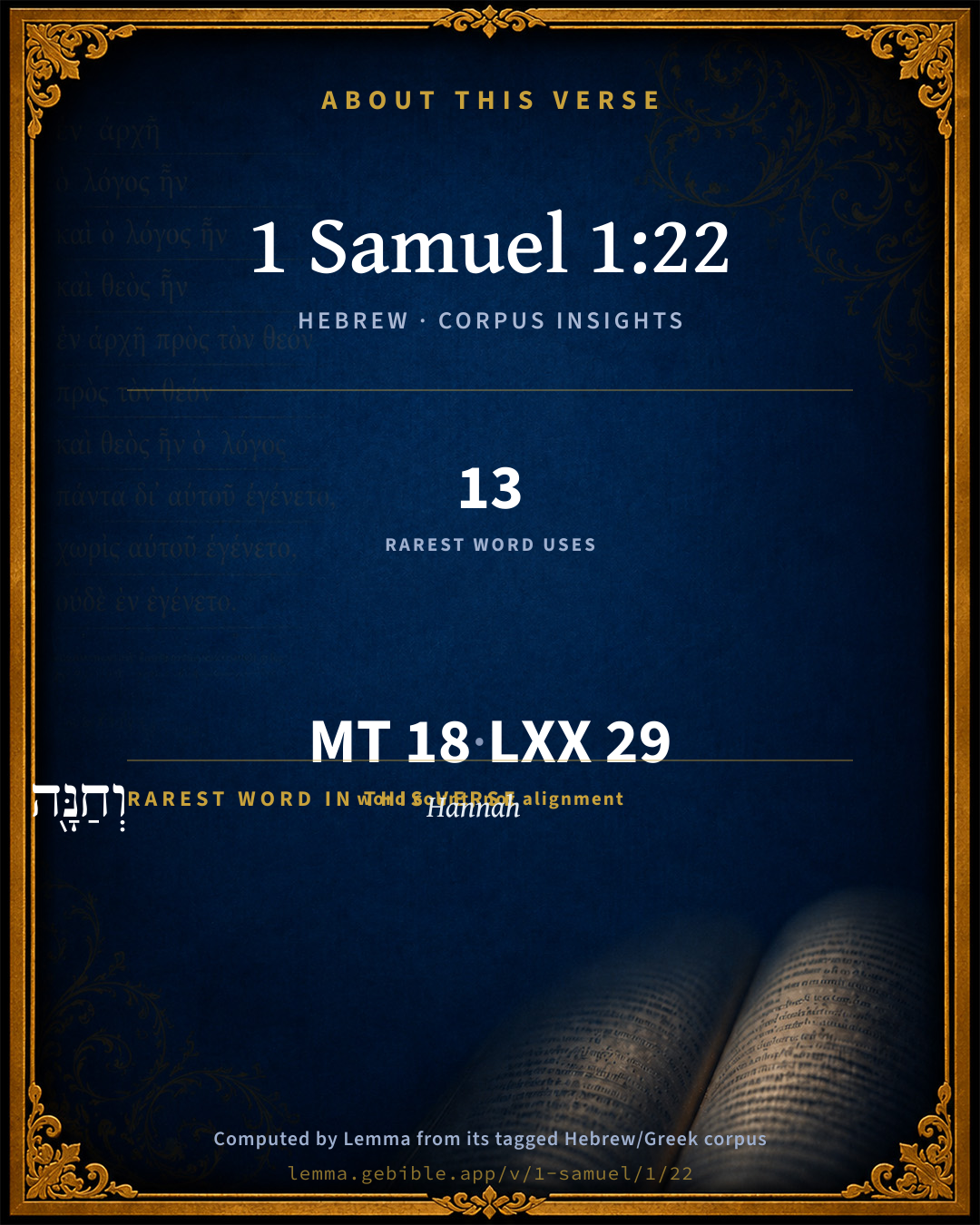
The rarest word here is וְחַנָּ֖ה Hannah H2584 — appearing just 13 times in the whole Hebrew Bible.

Shared distinctive vocabulary

וְחַנָּ֖ה Hannah H2584 occurs in 11 verses of the Hebrew Bible. Also found in:

Grammatical profile

  • 6 verbs
  • 6 nouns
  • 3 prepositions
  • 1 conjunction
  • 1 adverb
  • 1 particle

Verb forms

  • עָלָ֑תָה Qal · Perfect
  • אָמְרָ֣ה Qal · Perfect
  • יִגָּמֵ֤ל Niphal · Imperfect
  • וַהֲבִאֹתִ֗יו Hiphil · Sequential Perfect
  • וְנִרְאָה֙ Niphal · Sequential Perfect
  • וְיָ֥שַׁב Qal · Sequential Perfect

Repetition

A word recurs within this verse — often emphatic in Hebrew:

  • עַ֣ד until H5704 ×2

Hebrew & Septuagint length

In English translation the verse runs 37 words from the Hebrew and 43 from the Septuagint (LXX English) — closely comparable.

A rough comparison of the two English renderings, which tokenize alike — not a word-level alignment.

Word counts can differ between the Hebrew and the Greek without any difference in meaning — e.g. the Hebrew direct-object marker אֵת has no separate Greek word, and Greek often adds the article ὁ.

In the original languages it is 18 Hebrew tokens and 29 Greek tokens — but the two are counted differently (Hebrew bundles its prefixes and suffixes into one token; the Greek is in lemma form), so that isn’t a like-for-like length.

Cross-references

15

Topical passages linked to 1 Samuel 1:22 in the Treasury of Scripture Knowledge — connected by theme and wording, ordered by reader-vote popularity; previews shown in the World English Bible.

  • 1 Samuel 1:11 She vowed a vow, and said, Yahweh of hosts, if you will indeed look on the affliction of your handmaid, and remember me, and not forget your handmaid, but will give to your handmaid a man-child, then I will give him to Yahweh all the days of his life, and there shall no razor come on his head.
  • 1 Samuel 1:28 therefore also I have granted him to Yahweh; as long as he lives he is granted to Yahweh. He worshiped Yahweh there.
  • Luke 2:22 When the days of their purification according to the law of Moses were fulfilled, they brought him up to Jerusalem, to present him to the Lord
  • Leviticus 25:23 "'The land shall not be sold in perpetuity, for the land is mine; for you are strangers and live as foreigners with me.
  • Deuteronomy 16:16 Three times in a year shall all your males appear before Yahweh your God in the place which he shall choose: in the feast of unleavened bread, and in the feast of weeks, and in the feast of tents; and they shall not appear before Yahweh empty:
  • 1 Samuel 2:11 Elkanah went to Ramah to his house. The child did minister to Yahweh before Eli the priest.
  • 1 Samuel 2:18 But Samuel ministered before Yahweh, being a child, girded with a linen ephod.
  • 1 Samuel 3:1 The child Samuel ministered to Yahweh before Eli. The word of Yahweh was precious in those days; there was no frequent vision.
  • Luke 2:41–42 His parents went every year to Jerusalem at the feast of the Passover.
  • Exodus 21:6 then his master shall bring him to God, and shall bring him to the door or to the door-post, and his master shall bore his ear through with an awl, and he shall serve him for ever.
  • Joshua 4:7 then you shall tell them, Because the waters of the Jordan were cut off before the ark of the covenant of Yahweh; when it passed over the Jordan, the waters of the Jordan were cut off: and these stones shall be for a memorial to the children of Israel forever.
  • Psalms 23:6 Surely goodness and loving kindness shall follow me all the days of my life, And I shall dwell in Yahweh's house forever.
  • Psalms 27:4 One thing I have asked of Yahweh, that I will seek after, That I may dwell in the house of Yahweh all the days of my life, To see Yahweh's beauty, And to inquire in his temple.
  • Psalms 110:4 Yahweh has sworn, and will not change his mind: "You are a priest forever in the order of Melchizedek."
  • Isaiah 9:7 Of the increase of his government and of peace there shall be no end, on the throne of David, and on his kingdom, to establish it, and to uphold it with justice and with righteousness from henceforth even forever. The zeal of Yahweh of Hosts will perform this.

Cross-references courtesy of OpenBible.info (CC BY 4.0).

Hebrew and Greek witnesses Masoretic Hebrew ↔ Greek Septuagint

The same verse in the two great witnesses to the Old Testament, shown verse-for-verse.

These are two independent witnesses, not word-aligned to each other, and the Septuagint is shown in lemma (dictionary) form.

Hebrew 1 Samuel 1:22 Masoretic · Westminster Leningrad Codex

וְחַנָּ֖ה לֹ֣א עָלָ֑תָה כִּֽי אָמְרָ֣ה לְאִישָׁ֗הּ עַ֣ד יִגָּמֵ֤ל הַנַּ֨עַר֙ וַהֲבִאֹתִ֗יו וְנִרְאָה֙ אֶת פְּנֵ֣י יְהוָ֔ה וְיָ֥שַׁב שָׁ֖ם עַד עוֹלָֽם

But Hannah didn't go up; for she said to her husband, [I will not go up] until the child be weaned; and then I will bring him, that he may appear before Yahweh, and there abide forever.

World English Bible · Public Domain

Greek LXX 1 Samuel 1:22 Septuagint · lemma form

καί αννα οὐ ἀναβαίνω μετά αὐτός ὅτι εἶπον ὁ ἀνήρ αὐτός ἕως ὁ ἀναβαίνω ὁ παιδάριον ἐάν ἀπογαλακτίζω αὐτός καί ὁράω ὁ πρόσωπον κύριος καί καταἵημι ἐκεῖ ἕως αἰών

But Anna did not go up with him, for she said to her husband, I will not go up until the child goes up, when I have weaned him, and he shall be presented before the Lord, and he shall abide there continually.

LXX2012 (modern English Septuagint) · Public Domain

Hebrew: Westminster Leningrad Codex (CC BY 4.0). Greek: Septuagint (public domain); English from LXX2012 (modern English Septuagint) (Public Domain). How the Septuagint differs from the Hebrew →

Targum (Aramaic paraphrase)

1

The Targum is the ancient Jewish Aramaic paraphrase of the Hebrew Scriptures — an interpretive translation, not the Hebrew text itself. Onkelos (literal) and Pseudo-Jonathan (expansive) render the Torah, and Jonathan the Prophets. Coverage is partial: where no permissively-licensed English translation exists for a verse, only the Aramaic is shown. This is verse-level text, not a word-by-word alignment to the Hebrew.

  1. Targum Jonathan Prophets (Joshua–Malachi)
    וְחַנָה לָא סְלִיקַת אֲרֵי אֲמָרַת לְבַעֲלָהּ עַד דְיִתְחַסֵיל רַבְיָא וְאַיְתִינֵיהּ וְאִתְחֲזֵי קֳדָם יְיָ וִיתֵיב תַּמָן עַד עָלְמָא:

    (no public-domain English translation for this verse)

    Targum Jonathan — Aramaic: “Mikraot Gedolot” (public domain). English: “Sefaria Community Translation” (CC0 1.0 (public-domain dedication)); “London "Chaldee Paraphrase," 1871” (public domain). Text via Sefaria.

Commentary

Notes on 1 Samuel 1:22 from classic Christian and Jewish commentators (each source and its license shown beneath its notes). The classic Christian expositions comment on the surrounding passage and are grouped to its opening verse, so a note may address several verses; the Jewish commentaries on the Tanakh (Rashi and others) are per-verse, so they appear only where the commentator wrote on this verse.

Lemma curates 59 commentaries, every one of them public domain or Creative Commons licensed, each selected and text-cleaned for this edition rather than reprinted as found. About our sources →

Trapp's Complete Commentary

John Trapp

1Sa 1:22 But Hannah went not up; for she said unto her husband, [I will not go up] until the child be weaned, and [then] I will bring him, that he may appear before the LORD, and there abide for ever.

Ver. 22. I will not go up until the child be weaned.] She knew herself not bound to go up, because she was a woman, and her husband a Levite. Now also she was a mother, and had a child to nurse. Nightingales are silent when once they have hatched their eggs, as if then all their care were for their young ones.

John Trapp, A Commentary or Exposition upon All the Books of the Old and New Testament (1647–1656) — public domain. Text from a community e-Sword module.

Joseph Benson's Commentary

1Sa 1:22. I will not go up till the child be weaned — Not only from the breast, but from the mother’s knee and care, and childish food. She was not bound by the law to go up with her husband; and therefore, though she had been wont to go, she resolved, as became a prudent woman, to stay at home, till the child was so far grown up, as not only to be strong enough to accompany her, but capable of being instructed in the service of the tabernacle, and of being useful therein. For, it seems, as soon as he was brought thither he worshipped God, (1Sa 1:28,) and, soon after, ministered to Eli, 1Sa 2:11.

Joseph Benson's Commentary on the Old and New Testaments (1811–1818) — public domain. Text from a community e-Sword module.

Tyndale Open Study Notes

Tyndale Open Resources

1:22 until the boy is weaned: Hannah would have nursed Samuel two to four years.

Tyndale Open Study Notes — © Tyndale Open Resources, licensed CC BY-SA 4.0. Text via the HelloAO Bible API.

Jamieson, Fausset & Brown

Robert Jamieson, A. R. Fausset & David Brown

But Hannah went not up--Men only were obliged to attend the solemn feasts (Exo 23:17). But Hannah, like other pious women, was in the habit of going, only she deemed it more prudent and becoming to defer her next journey till her son's age would enable her to fulfill her vow.

Jamieson, Fausset & Brown — Commentary Critical and Explanatory on the Whole Bible (1871) — public domain (CC PDM 1.0). Text via the HelloAO Bible API.

Ellicott's Commentary for English Readers

(22) Until the child be weaned.—Weaning, we know, took place very late among the Hebrews. From 2Ma_7:27, it appears that Hebrew mothers were in the habit of suckling their children for three years. The mother proposed, when the weaning had taken place, to leave her son as a servant of the sanctuary, there to remain all his life.

On the late period of weaning among the Oriental nations, Kalisch refers to the Persian custom of suckling boys two years and two months, and girls two years.

A Bible Commentary for English Readers, edited by Charles John Ellicott (1878–1897) — public domain. Text from a community e-Sword module.

The Cambridge Bible for Schools and Colleges

gen. ed. J. J. S. Perowne

22. until the child be weaned] He would then be two or three years old. It is still a common practice in the East to suckle children for two years: and in ancient times they were sometimes not weaned till three years old. See 2Ma_7:27, “O my son, have pity upon me that gave thee suck three years and nourished thee.” The weaning was made an occasion of festivity (Gen_21:8). The objection has been made that so young a child would have been troublesome to Eli, but there were women engaged in the tabernacle service (1Sa_2:22), to whose care he might have been committed. It was important that he should be dedicated as soon as possible. The house of God was to be the only home he knew; the earliest impressions of his boyhood were to be those of the sanctuary.

for ever] Equivalent to “as long as he liveth” of 1Sa_1:28.

The Cambridge Bible for Schools and Colleges (gen. ed. J. J. S. Perowne; Cambridge University Press, 1878–1918) — public domain. Text from a community e-Sword module.

John Gill's Exposition

But Hannah went not up,.... For women, though they might go if they pleased to the yearly feasts, yet they were not obliged to it; whether she went up at the time for her purification, and for the presenting and redemption of the firstborn, is not certain; some say the Levites were not obliged by that law, the perquisites of it falling to them, and so did not go up; others that she did, though it is not expressed, the Scriptures not relating all facts that were done; though by what follows it looks as if she did not:

for she said unto her husband, I will not go up until the child be weaned: which, according to Jarchi, was at the end of twenty two months; but others say at the end of twenty four months, or two years, as Kimchi and Ben Melech; and sometimes a child was three years old before it was weaned, and sometimes longer, which very probably was the case here; See Gill on Gen 21:8. Comestor (d) observes, there was a three fold weaning of children in old times; the first from their mother's milk, when three years old; the second from their tender age, and care of a dry nurse, when seven years old; the third from childish manners, when at twelve years of age; and that it is this last and metaphorical weaning which is here meant, when Samuel was twelve years of age, and fit to serve in the temple; but the proper sense is best, since she is said to bring him when weaned: her reason for it seems to be this, because had she went up with her sucking child, she must have brought him back again, since he would not be fit to be left behind, and would be entirely incapable of any kind of service in the sanctuary; and according to the nature of her vow, she could not think of bringing him back again, after she had once entered him there:

and then I will bring him, that he may appear before the Lord; and minister in the service of the sanctuary in what might be suitable to his age; there and then she would present him, and give him up to the Lord, as she had promised she would:

and there abide for ever; that is, as long as he lived; for her vow was that he should be a Nazarite all the days of his life, and be separated to the service of God as long as he had a being in the world.

(d) Apud Weemse's Observ. Nat. c. 18. p. 76.

John Gill's Exposition of the Whole Bible (1746–1763) — public domain (CC PDM 1.0). Text via the HelloAO Bible API.

Albert Barnes' Notes on the Bible

Until the child be weaned - Hebrew mothers, as elsewhere in the East, usually suckled their children until the age of two complete years, sometimes until the age of three.

Albert Barnes' Notes on the Bible (1834–1885) — public domain. Text from a community e-Sword/MySword module.

Haydock's Catholic Bible Commentary

CHAPTER I.

Weaned. The mother of the Machabees weaned her children when they were three years old; (2 Machabees vii. 27.) which Gallien asserts as the proper time, though Avicenna fixes upon two years. See Genesis xxi. 8. Iremellius translates, "till the child be grown up." But we must not allow any long term, since he was very young when he was presented to the Lord, ver. 24.

George Leo Haydock (1774–1849), Haydock's Catholic Family Bible and Commentary, 1859 edition — public domain. Excludes Psalms (Douay-Rheims chapter numbering differs from Protestant) and Deuterocanonical books (Catholic canon only).

Matthew Poole's English Annotations

Hannah went not up, to wit, at that sacred anniversary feast, to which she went up before but now did not, because she could not with satisfaction to her mind and conscience appear before the Lord empty, or without paying her vow; nor bring her child thither to God, and then carry him away from God to her own house. Nor did she sin by not going up; for the women were not obliged go up at the solemn feasts, but the men only, Exo 23:17.

Until the child be weaned; not only from the breast and the milk, which was done within two or three years at most, but also from the mother’s knee and care, and from childish food; till the child be something grown up, and fit to do some service in the tabernacle for it seems, that as soon as he was brought up, he worshipped God, 1Sa 1:28, and presently after ministered to Eli, 1Sa 2:11. And this may further appear from the very nature of the vow, which must needs design a service and an advantage to the tabernacle, and not a burden and encumbrance, as it would have been if a young child had been brought up to it, and left upon it.

That he may appear before the Lord, and there abide forever; that when once he is presented to the Lord, he may continue in his service as long as he liveth, as is said 1Sa 1:28.

Matthew Poole's English Annotations on the Holy Bible (1683–1685) — public domain. Text from a community e-Sword/MySword module.

Whedon's Commentary on the Bible

Daniel D. Whedon

22. Until the child be weaned — Which in some cases was at the age of three years, (2Ma_7:27,) and so quite likely in the case of Samuel.

Abide for ever — That is, as long as he shall live. Compare 1Sa_1:11.

Daniel D. Whedon (gen. ed.), Commentary on the Old and New Testaments (1874–1909) — public domain. Text from a community e-Sword module.

John Wesley's Explanatory Notes

Weaned - Not only from the breast, but also from the mother's knee and care, and from childish food; 'till the child be something grown up, and fit to do some service in the tabernacle: for it seems that as soon as he was brought up he worshipped God, ver. 28, and presently after ministered to Eli, chap. ii, 11.

John Wesley, Explanatory Notes Upon the Whole Bible (1754–1765) — public domain. Text via the GEBible commentary corpus.

Rashi

Rabbi Shlomo Yitzchaki (Rashi)

When [the boy] will be weaned. At the end of twenty-two (other versions, twenty-four) months, for that is the period for a child to nurse.

And shall remain there forever. Forever in the Levitic sense, i.e., fifty years as it is said, "from the age of fifty he shall retire from the work force." Figuring as follows, we determine that Shmuel's lifetime was fifty-two years: Eili judged Yisroel for forty years. On the day of Chana's prayer he was appointed judge. By subtracting the year in which Chana conceived Shmuel, there remain thirty-nine years. Shmuel governed Yisroel from the time of Eili's death for thirteen years, as follows: On the day of Eili's death, the Ark was captured, and it remained in the land of the Philistines for seven months. From there, it was brought to and remained in Kiryas Yearim until Dovid brought it up after he had reigned seven years in Chevron over Yehudah, and all of Yisroel had accepted him as their king. And it is written, "From the day the Ark came to rest in Kiryas Yearim, there ensued many days, and they became twenty years." Subtracting from them seven years which Dovid reigned in Chevron discloses that from the time the Ark was captured until Shaul's death, were thirteen years and seven months; and Shmuel died four months before Shaul.

Rashi on the Tanakh — English translations: “The Judaica Press complete Tanach with Rashi, translated by A. J. Rosenberg” (CC BY 4.0); “Pentateuch with Rashi's commentary by M. Rosenbaum and A.M. Silbermann, 1929-1934” (public domain); “The Metsudah Tanach series, Lakewood, N.J” (CC BY 4.0); and “The Book of Joshua, Metsudah Publications, 1997” (CC BY 4.0). Text via Sefaria.

Radak

Rabbi David Kimhi (Radak)

Until the boy will be weaned: Until the end of his nursing, and that is the twenty-four months that an infant nurses. And even though they were obligated to bring him [to Shiloh] on account of, "every male shall appear" (Exodus 23:17) - our Rabbis, may their memory be blessed, said it was because she saw that he was pampered and weak, so she was concerned lest he fall sick because of the travel.

And he shall abide there forever: As she had vowed about him, "and I will give him to the Lord" (I Samuel 1:11). And the explantion of, "forever," is all the days of his life. And our Rabbis, may their memory be blessed, expounded - the forever of the Levites, since they would serve fifty years, as it is written (Numbers 8:25), "From the age of fifty he shall retire from the work force." And they said that all the days of Shmuel were only fifty-two years: As Channah had already said, "and I will give him to the Lord all the days of his life." And she said, "And he shall abide there forever" - and that is the forever of the Levites, which is fifty years. And from when he came to the House of the Lord until the day of his death was fifty years. And the [other] two years were when he nursed, as it is written, "until the boy will be weaned." And it is the way of a child to nurse twenty-four months. There you have fifty-two years.

Radak on the Tanakh — English translations: “Sefaria Community Translation” (CC0 1.0 (public-domain dedication)); “Eliyahu Munk, HaChut Hameshulash” (CC BY 4.0); “Rabbi Mike Feuer, Jerusalem Anthology” (CC BY 4.0); and “R. David Kimhi on the first book of Psalms, Translated by R.G. Finch, London, 1919” (public domain). Text via Sefaria.

Lesson kit

Teaching starters — assembled from the data on this page, not authored interpretation. Every prompt links to the verse data it draws on. Edit before teaching.

1 Samuel, in the Historical, opens this verse with 18 words (17 distinct Hebrew lemmas). Its most distinctive word is Channâh (“Hannah”). A historical commentator’s framing appears above. Read the whole chapter for the surrounding context.

Discussion questions

  1. How does “Hannah” (Channâh) shape what this verse is saying?
  2. How does 1 Samuel 1:2, which shares the word «Hannah», read alongside this verse?
  3. What does the repetition of “until” (2× in this one verse) do in this verse?
  4. The translations on this page render this verse differently — a whole-verse word diff, not a word-by-word alignment. What might account for the different wordings?
  5. «עָלָ֑תָה» is a Qal Perfect verb. How does that grammatical form shape the action described?
  6. Compare how Trapp's Complete Commentary and Joseph Benson's Commentary read this verse. Where do they agree or differ?

Things to notice

Reading settings

Reading text

Shown beneath each verse's original-language words.

Old Testament
Old Testament edition

Read the OT as the Masoretic Hebrew (MT) or the Greek Septuagint (LXX).

English shown for the Greek Septuagint (in the Hebrew ↔ Greek comparison).

Comparing translations? Open the Compare panel on any verse page to stack up to four side by side.