2 Kings 2:10

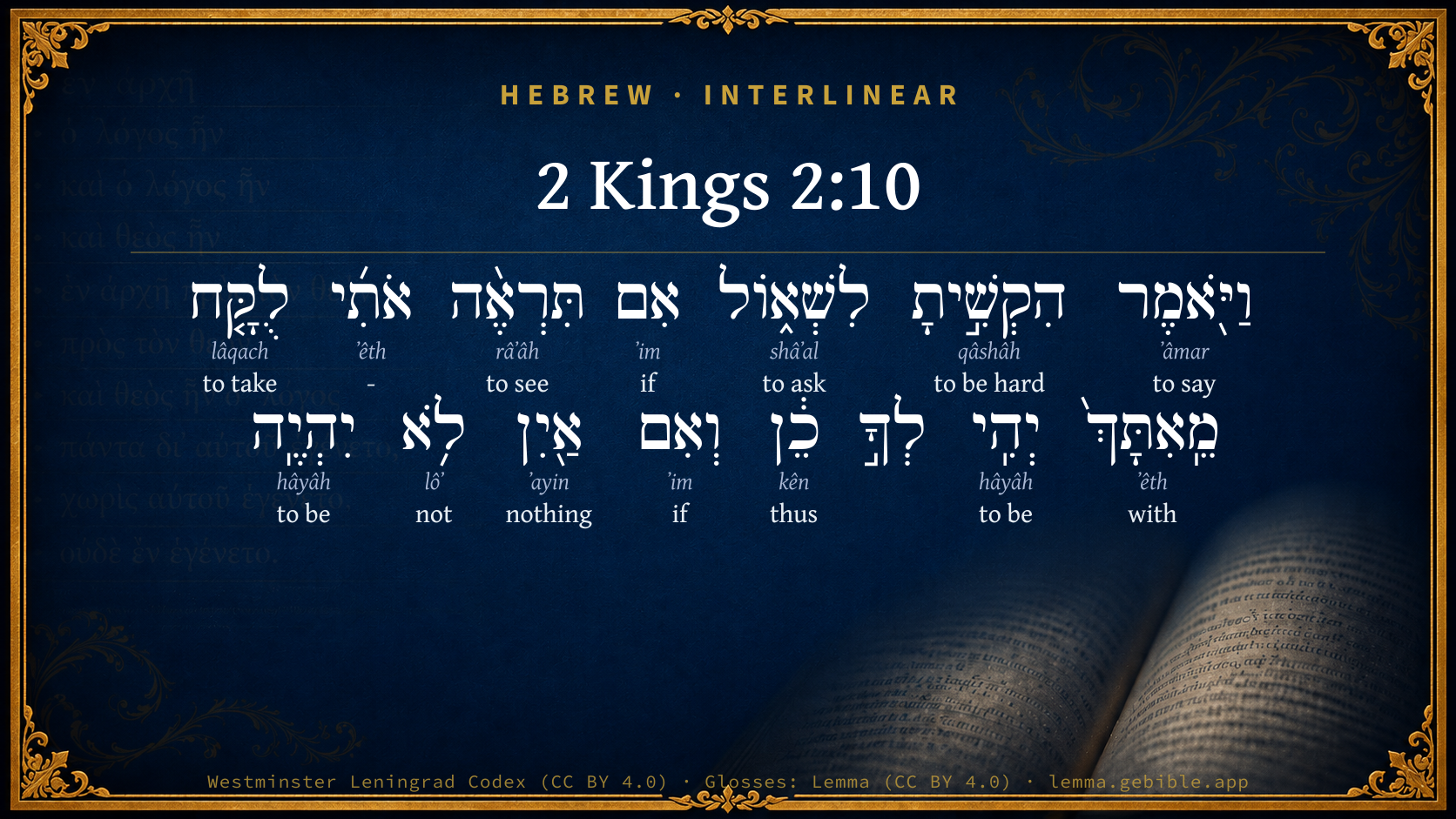
Hebrew (Westminster Leningrad Codex) 2 Kings 2:10 appears in the Hebrew Old Testament. The text above is from the Westminster Leningrad Codex. Each word links to its Strong’s number, a concise gloss, and parsing drawn from the Open Scriptures Hebrew Bible morphology. Click any word for its full Brown-Driver-Briggs (BDB) entry.
Download image
Cite this verse

2 Kings 2:10 (World English Bible). Public Domain. Lemma interlinear Bible study tool, https://lemma.gebible.app/v/2-kings/2/10.

Show BibTeX & RIS
BibTeX
RIS
English Translation
He said, You have asked a hard thing: [nevertheless], if you see me when I am taken from you, it shall be so to you; but if not, it shall not be so.
World English Bible · Public Domain
Download a study sheet

One document with this verse’s original text, its word-by-word gloss line, the meaning frame, cross-references with their text, attributed commentary, and full source and license credits — printable, and it pastes into notes with its structure intact.

This verse Autodidact and up

Study sheet (.html) Plain text (.txt)

A passage Seminary Student

Up to 50 verses in one chapter. A passage sheet keeps up to 6 commentary sources and 12 cross-references per verse, in the order this page ranks them, and says so on the sheet whenever that leaves anything out. Ask for a single verse and you get the Autodidact verse sheet above.

Everything on this page stays free to read, with no account — the sheet is a download of what is already on screen, not access to it.

Want to remove ads? Support Godless Engineer
Compare translations 3

The same verse in 3 English versions, stacked beneath the original-language interlinear above. Click any original word for its lexicon entry.

Each is an independent rendering of the whole verse — the interlinear is not word-aligned to these translations.

Highlighted words mark where these versions differ — a whole-verse word diff, not a word-by-word alignment.

  • World English Bible Public Domain
    He said, You have asked a hard thing: [nevertheless], if you see me when I am taken from you, it shall be so to you; but if not, it shall not be so.
  • King James Version Public Domain
    And he said, Thou hast asked a hard thing: nevertheless, if thou see me when I am taken from thee, it shall be so unto thee; but if not, it shall not be so.
  • unfoldingWord Literal Text CC BY-SA 4.0
    And he said, “In asking, you have made difficult. If you see me being taken from with you, it will be thus for you. But if not, it will not be.”

unfoldingWord Literal Text — © unfoldingWord, licensed CC BY-SA 4.0. Word-aligned USFM3 via Door43 (git.door43.org/unfoldingWord/en_ult).

Versions to compare (up to 4)

3 of 4 selected

Show all 18 translations

Every available English version of this verse, each an independent rendering of the whole verse.

  • World English Bible Public Domain
    He said, You have asked a hard thing: [nevertheless], if you see me when I am taken from you, it shall be so to you; but if not, it shall not be so.
  • Berean Standard Bible Public Domain
    “You have requested a difficult thing,” said Elijah. “Nevertheless, if you see me as I am taken from you, it will be yours. But if not, then it will not be so.”
  • Majority Standard Bible Public Domain
    “You have requested a difficult thing,” said Elijah. “Nevertheless, if you see me as I am taken from you, it will be yours. But if not, then it will not be so.”
  • King James Version Public Domain
    And he said, Thou hast asked a hard thing: nevertheless, if thou see me when I am taken from thee, it shall be so unto thee; but if not, it shall not be so.
  • American Standard Version (1901) Public Domain
    And he said, Thou hast asked a hard thing: `nevertheless', if thou see me when I am taken from thee, it shall be so unto thee; but if not, it shall not be so.
  • Revised Version (1885) Public Domain
    And he said, Thou hast asked a hard thing: nevertheless, if thou see me when I am taken from thee, it shall be so unto thee; but if not, it shall not be so.
  • Geneva Bible (1599) Public Domain
    And he saide, Thou hast asked an hard thing: yet if thou see me when I am taken from thee, thou shalt haue it so: and if not, it shall not be.
  • Douay-Rheims (1899) Public Domain
    And he answered: Thou hast asked a hard thing: nevertheless if thou see me when I am taken from thee, thou shalt have what thou hast asked: but if thou see me not, thou shalt not have it.
  • Young's Literal Translation Public Domain
    and he saith, `Thou hast asked a hard thing; if thou dost see me taken from thee, it is to thee so; and if not, it is not.'
  • Literal Standard Version CC BY-SA 4.0
    and he says, “You have asked a hard thing; if you see me taken from you, it is to you so; and if not, it is not.”
  • Unlocked Literal Bible CC BY-SA 4.0
    Elijah answered, “You have asked for a difficult thing. Nevertheless, if you see me when I am taken from you, this will happen for you, but if not, it will not happen.”
  • unfoldingWord Literal Text CC BY-SA 4.0
    And he said, “In asking, you have made difficult. If you see me being taken from with you, it will be thus for you. But if not, it will not be.”
  • Darby Bible Public Domain
    And he said, Thou hast asked a hard thing: if thou see me when I am taken from thee, it shall be so to thee; but if not, it shall not be [so].
  • World Messianic Bible Public Domain
    He said, “You have asked a hard thing. If you see me when I am taken from you, it will be so for you; but if not, it will not be so.”
  • Webster's Bible Public Domain
    And he said, Thou hast asked a hard thing: nevertheless, if thou shalt see me when I am taken from thee, it shall be so to thee; but if not, it shall not be so.
  • Free Bible Version CC BY-SA 4.0
    “What you have asked for is hard,” Elijah responded. “But if you see me when I am taken from you, you will have it, otherwise not.”
  • Bible in Basic English Public Domain
    And he said, You have made a hard request: still, if you see me when I am taken from you, you will get your desire; but if not, it will not be so.
  • JPS Tanakh (1917) Public Domain
    And he said: 'Thou hast asked a hard thing; nevertheless, if thou see me when I am taken from thee, it shall be so unto thee; but if not, it shall not be so.'

Literal Standard Version (2020), Covenant Press — licensed CC BY-SA 4.0. Text via the HelloAO Bible API (eBible.org). Unlocked Literal Bible (unfoldingWord) — licensed CC BY-SA 4.0. Text via the HelloAO Bible API (eBible.org). unfoldingWord Literal Text — © unfoldingWord, licensed CC BY-SA 4.0. Word-aligned USFM3 via Door43 (git.door43.org/unfoldingWord/en_ult). Free Bible Version, Dr. Jonathan Gallagher — licensed CC BY-SA 4.0. Text via the HelloAO Bible API (eBible.org).

Word by word

More ways to search: Search by grammar → Find every occurrence → Compare this word →

Practice this passage: Drill this verse → Learn its vocabulary →

הִקְשִׁ֣יתָ
qâshâh
H7185
“to be hard”
Verb, Hiphil, Perfect, 2nd Person, Masculine, Singular
Part of Speech
Verb
Stem
Hiphil
Form
Perfect
Person
2nd Person
Gender
Masculine
Number
Singular
Full BDB Definition

Origin: a primitive root

TWOT: 2085

to be hard, be severe, be fierce, be harsh - (Qal) - to be hard, be difficult - to be hard, be severe - (Niphal) - to be ill-treated - to be hard pressed - (Piel) to have severe labour (of women) - (Hiphil) - to make difficult, make difficulty - to make severe, make burdensome - to make hard, make stiff, make stubborn - of obstinacy (figuratively) - to show stubbornness
  1. וַיֹּ֖אמֶר ʼâmar H559 “and · to say” Conjunction + Verb, Qal, Sequential Imperfect, 3rd Person, Masculine, Singular
  2. לִשְׁא֑וֹל shâʼal H7592 “to ask” Preposition + Verb, Qal, Infinitive Construct
  3. אִם ʼim H518 “if” Conjunction
  4. תִּרְאֶ֨ה râʼâh H7200 “to see” Verb, Qal, Imperfect, 2nd Person, Masculine, Singular
  5. אֹתִ֜י ʼêth H853 “- · me” Particle, Direct Object + Suffix, Personal, 1st Person, Common, Singular
  6. לֻקָּ֤ח lâqach H3947 “taken” Verb, Qal Passive, Participle Passive, Masculine, Singular, Absolute
  7. מֵֽאִתָּךְ֙ ʼêth H854 “from · with · you” Preposition + Preposition + Suffix, Personal, 2nd Person, Feminine, Singular
  8. יְהִֽי hâyâh H1961 “to be” Verb, Qal, Jussive, 3rd Person, Masculine, Singular
  9. כֵ֔ן kên H3651 “thus” Adverb
  10. וְאִם ʼim H518 “and · if” Conjunction + Conjunction
  11. אַ֖יִן ʼayin H369 “nothing” Particle, Negative
  12. לֹ֥א lôʼ H3808 “not” Particle, Negative
  13. יִהְיֶֽה hâyâh H1961 “to be” Verb, Qal, Imperfect, 3rd Person, Masculine, Singular

About this verse

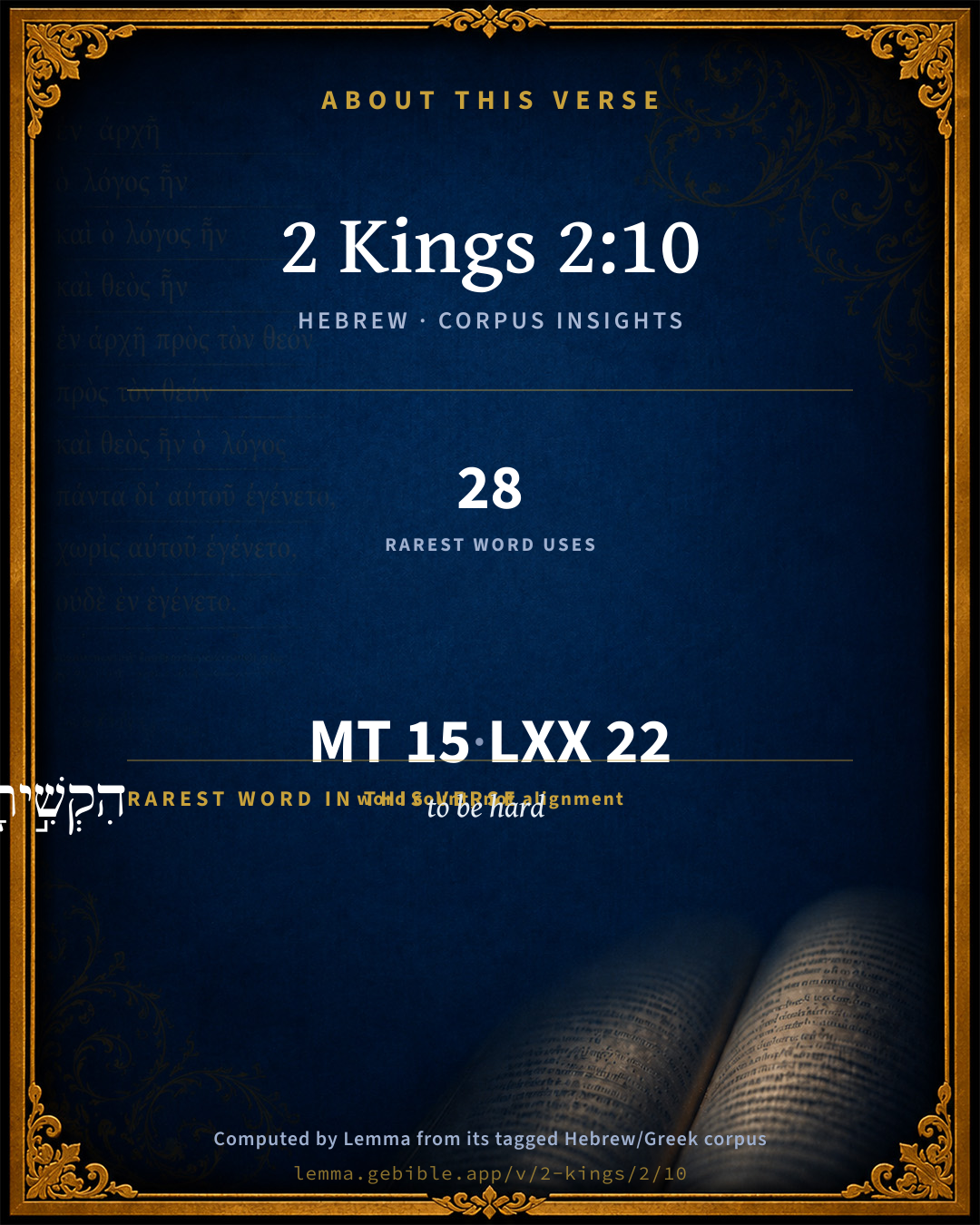
These counts appear in no published source. They are computed here, from the morphology-tagged text and Lemma’s own curated glosses. What Lemma adds →

15
words
12
distinct lemmas
Historical
section

Shared distinctive vocabulary

הִקְשִׁ֣יתָ to be hard H7185 occurs in 28 verses of the Hebrew Bible. Also found in:

Grammatical profile

  • 7 verbs
  • 2 prepositions
  • 2 conjunctions
  • 1 adverb
  • 3 particles

Verb forms

  • וַיֹּ֖אמֶר Qal · Sequential Imperfect
  • הִקְשִׁ֣יתָ Hiphil · Perfect
  • לִשְׁא֑וֹל Qal · Infinitive Construct
  • תִּרְאֶ֨ה Qal · Imperfect
  • לֻקָּ֤ח Qal Passive · Participle Passive
  • יְהִֽי Qal · Jussive
  • יִהְיֶֽה Qal · Imperfect

Repetition

Words recur within this verse — often emphatic in Hebrew:

  • יְהִֽי to be H1961 ×2
  • אִם if H518 ×2

Hebrew & Septuagint length

In English translation the verse runs 33 words from the Hebrew and 36 from the Septuagint (LXX English) — closely comparable.

A rough comparison of the two English renderings, which tokenize alike — not a word-level alignment.

Word counts can differ between the Hebrew and the Greek without any difference in meaning — e.g. the Hebrew direct-object marker אֵת has no separate Greek word, and Greek often adds the article ὁ.

In the original languages it is 15 Hebrew tokens and 22 Greek tokens — but the two are counted differently (Hebrew bundles its prefixes and suffixes into one token; the Greek is in lemma form), so that isn’t a like-for-like length.

Cross-references

4

Topical passages linked to 2 Kings 2:10 in the Treasury of Scripture Knowledge — connected by theme and wording, ordered by reader-vote popularity; previews shown in the World English Bible.

  • 2 Kings 2:12 Elisha saw it, and he cried, My father, my father, the chariots of Israel and the horsemen of it! He saw him no more: and he took hold of his own clothes, and tore them in two pieces.
  • Mark 11:22–24 Jesus answered them, "Have faith in God.
  • John 16:24 Until now, you have asked nothing in my name. Ask, and you will receive, that your joy may be made full.
  • Acts 1:9–10 When he had said these things, as they were looking, he was taken up, and a cloud received him out of their sight.

Cross-references courtesy of OpenBible.info (CC BY 4.0).

Hebrew and Greek witnesses Masoretic Hebrew ↔ Greek Septuagint

The same verse in the two great witnesses to the Old Testament, shown verse-for-verse.

These are two independent witnesses, not word-aligned to each other, and the Septuagint is shown in lemma (dictionary) form.

Hebrew 2 Kings 2:10 Masoretic · Westminster Leningrad Codex

וַיֹּ֖אמֶר הִקְשִׁ֣יתָ לִשְׁא֑וֹל אִם תִּרְאֶ֨ה אֹתִ֜י לֻקָּ֤ח מֵֽאִתָּךְ֙ יְהִֽי לְךָ֣ כֵ֔ן וְאִם אַ֖יִן לֹ֥א יִהְיֶֽה

He said, You have asked a hard thing: [nevertheless], if you see me when I am taken from you, it shall be so to you; but if not, it shall not be so.

World English Bible · Public Domain

Greek LXX 2 Kings 2:10 Septuagint · lemma form

καί εἶπον ηλιου σκληρύνω ὁ αἰτέω ἐάν ὁράω ἐγώ ἀναλαμβάνω ἀπό σύ καί εἰμί σύ οὕτως καί ἐάν μή οὐ μή γίγνομαι

And Eliu said, You have asked a hard thing: if you shall see me when I am taken up from you, then shall it be so to you; and if not, it shall not be so.

LXX2012 (modern English Septuagint) · Public Domain

On this verse, The Pulpit Commentary discusses the Septuagint’s reading. Read the note in Commentary ↓

Hebrew: Westminster Leningrad Codex (CC BY 4.0). Greek: Septuagint (public domain); English from LXX2012 (modern English Septuagint) (Public Domain). How the Septuagint differs from the Hebrew →

Targum (Aramaic paraphrase)

1

The Targum is the ancient Jewish Aramaic paraphrase of the Hebrew Scriptures — an interpretive translation, not the Hebrew text itself. Onkelos (literal) and Pseudo-Jonathan (expansive) render the Torah, and Jonathan the Prophets. Coverage is partial: where no permissively-licensed English translation exists for a verse, only the Aramaic is shown. This is verse-level text, not a word-by-word alignment to the Hebrew.

  1. Targum Jonathan Prophets (Joshua–Malachi)
    וַאֲמַר אַקְשֵׁיתָא לְמִשְׁאַל אִם תֶּחְזֵי יָתִי דַאֲנָא מִידַבֵּר מִלְוָתָךְ יְהֵי לָךְ כֵּן וְאִם לָא לָא יְהֵי:

    (no public-domain English translation for this verse)

    Targum Jonathan — Aramaic: “Mikraot Gedolot” (public domain). English: “Sefaria Community Translation” (CC0 1.0 (public-domain dedication)); “London "Chaldee Paraphrase," 1871” (public domain). Text via Sefaria.

Commentary

Notes on 2 Kings 2:10 from classic Christian and Jewish commentators (each source and its license shown beneath its notes). The classic Christian expositions comment on the surrounding passage and are grouped to its opening verse, so a note may address several verses; the Jewish commentaries on the Tanakh (Rashi and others) are per-verse, so they appear only where the commentator wrote on this verse.

Lemma curates 59 commentaries, every one of them public domain or Creative Commons licensed, each selected and text-cleaned for this edition rather than reprinted as found. About our sources →

Trapp's Complete Commentary

John Trapp

2Ki 2:10 And he said, Thou hast asked a hard thing: [nevertheless], if thou see me [when I am] taken from thee, it shall be so unto thee; but if not, it shall not be [so].

Ver. 10. If thou see me when I am taken from thee.] Vehemence is the way to speed both in earth and in heaven. If but the eyelids of Elisha fall, if his thoughts slacken, his hopes are dashed. {a} There must be fixedness and vigilancy in those that desire double graces.

{a} Bp. Hall’s Contemp.

John Trapp, A Commentary or Exposition upon All the Books of the Old and New Testament (1647–1656) — public domain. Text from a community e-Sword module.

Joseph Benson's Commentary

2Ki 2:10. He said, Thou hast asked a hard thing — A rare and singular blessing, which I cannot promise thee; which God only can give, and which he gives only when and to whom he pleases. Nevertheless, if thou see me, &c. — Mark, this is a sign whether thou shalt obtain what thou desirest or not. This sign he proposed, not without the direction of God’s Spirit, that hereby he might engage him more earnestly to wait, and more fervently to pray for this mercy.

Joseph Benson's Commentary on the Old and New Testaments (1811–1818) — public domain. Text from a community e-Sword module.

Jamieson, Fausset & Brown

Robert Jamieson, A. R. Fausset & David Brown

Thou hast asked a hard thing--an extraordinary blessing which I cannot, and God only, can give. Nevertheless he, doubtless by the secret directions of the Spirit, proposed to Elisha a sign, the observation of which would keep him in the attitude of an anxious waiter, as well as suppliant for the favor.

Jamieson, Fausset & Brown — Commentary Critical and Explanatory on the Whole Bible (1871) — public domain (CC PDM 1.0). Text via the HelloAO Bible API.

Adam Clarke's Commentary

Verse 10. A hard thing] This is what is not in my power, God alone can give this; yet if thou see me taken away from thee, it shall be so. Perhaps this means no more than, "If thou continue with me till I am translated, God will grant this to thee;" for on the mere seeing or not seeing him in the moment in which he was taken away, this Divine gift could not depend.

Adam Clarke's Commentary on the Bible (1810–1826) — public domain. Text from a community e-Sword/MySword module.

Ellicott's Commentary for English Readers

(10) Thou hast asked a hard thing.—Because to grant such a petition was not in Elijah’s own power, but in God’s only. And therefore in the next words the prophet connects the fulfilment of his follower’s wish with a condition depending entirely upon the Divine will: “If thou see me when I am taken from thee, it shall be so unto thee (Keil).” ‘If the Lord think thee worthy to witness my departure, thou wilt be worthy to win thy boon.’ Elijah thus disclaims power to fulfil the request. At the same time, it is implied that his departure will be something exalted above the perception of ordinary men” (Thenius).

When I am taken.—Literally, taken (participle pu’al, shortened form, as in Exo_3:2; Isa_18:2).

A Bible Commentary for English Readers, edited by Charles John Ellicott (1878–1897) — public domain. Text from a community e-Sword module.

The Cambridge Bible for Schools and Colleges

gen. ed. J. J. S. Perowne

10. Thou hast asked a hard thing] Because it was not Elijah’s to bestow. He knew that except for God’s strengthening power and comforting revelations his own heart would often have fainted. He therefore leaves the result to depend on God’s judgement. If He permit Elisha to behold the assumption, then it shall be for a token that the petition is granted, and Elisha counted worthy to be blessed as he desires.

The Cambridge Bible for Schools and Colleges (gen. ed. J. J. S. Perowne; Cambridge University Press, 1878–1918) — public domain. Text from a community e-Sword module.

John Gill's Exposition

And it came to pass, as they still went on and talked,.... About the donation of the gifts of the Spirit requested, about the state of religion in Israel, and about the training up of prophets in the colleges, and about Elisha's succession as a prophet in his room, and his discharge of that office, and such like things, as may be supposed, in which he gave him instruction and advice:

that, behold, there appeared a chariot of fire, and horses of fire; either angels in this form, see Psa 104:4, in which they appeared for the glory and honour of the prophet, and as emblems of his flaming love and zeal for the purity of religion, and that his assumption might be conspicuous to Elisha; and perhaps by this means might be seen by the fifty men on the other side Jordan: this chariot, drawn with these horses, was not seen in the heaven, but as running on the earth, and came between the two prophets, and separated them from each other, taking up Elijah into it by means of a wind whirling about him, and which was no other than the ministry of angels; or these might be a conflux of exhalations or clouds, formed in this likeness by a supernatural power, and, by the solar rays striking on them, might appear fiery or red; and so his assumption was much in such like manner as our Lord was taken up in a cloud, Act 1:9,

and Elijah went up by a whirlwind to heaven; body and soul; such a change passing on him, as he went through the region of the air, which divested him of his mortality and corruption, and fitted him for the invisible world.

John Gill's Exposition of the Whole Bible (1746–1763) — public domain (CC PDM 1.0). Text via the HelloAO Bible API.

Albert Barnes' Notes on the Bible

It would be better to omit the words “when I am,” which are not in the original. The sign was to be Elisha’s seeing the actual translation, which he did 2Ki 2:12.

Albert Barnes' Notes on the Bible (1834–1885) — public domain. Text from a community e-Sword/MySword module.

Haydock's Catholic Bible Commentary

Hard thing. Hebrew literally, "thou art hardened to ask" a thing so difficult, and which I have not the power to grant. But I will pray that thou mayst receive it; (Calmet) and I feel confident that thou wilt, if God shall grant thee the power to see me, at my departure. (Haydock) --- This he did, ver. 12. (Menochius) --- Elias had perhaps imagined that his disciple would have desired some of his clothes, or some advice. (Calmet) --- He left him his mantle, (ver. 13.; Haydock) and by prayer was enabled to communicate his spirit to him; as Moses and the apostles did to their assistants in the ministry. (Calmet)

George Leo Haydock (1774–1849), Haydock's Catholic Family Bible and Commentary, 1859 edition — public domain. Excludes Psalms (Douay-Rheims chapter numbering differs from Protestant) and Deuterocanonical books (Catholic canon only).

Matthew Poole's English Annotations

A hard thing, i. e. a rare and singular blessing, which I cannot promise thee, which only God can give; and he gives it only when and to whom he pleaseth.

If not, it shall not be so: this sign he proposed not without the instinct and direction of God’s Spirit, that hereby he might engage him more earnestly to wait, and more fervently to pray, for this mercy.

Matthew Poole's English Annotations on the Holy Bible (1683–1685) — public domain. Text from a community e-Sword/MySword module.

Whedon's Commentary on the Bible

Daniel D. Whedon

10. A hard thing — It was a request which Elijah had no power to grant; but his own prayer to God might be largely instrumental in procuring it as a Divine gift to Elisha. The fervent prayer (Jas_5:16-17) that brought abundant showers from heaven (1Ki_18:42-45) might also bring gifts of the Spirit. The passage clearly shows that Elijah was to be somehow instrumental in procuring for Elisha his desire, and he may have prayed for Elisha after he had been translated, or even while he was being carried up into heaven. We may make requests of our departing friends before they leave us, and they may remember us, and pray for us in heaven; but after their departure we may not pray to them.

If thou see me… taken from thee — That is, at the moment when I am taken, not after I am gone. Here was no pledge to appear unto Elisha after his departure. The meaning is explained by what follows; Elisha saw the chariot and horses of fire, and Elijah carried up in a whirlwind, and this sight was to be to him a sign that what he had asked should be granted. Elijah was enabled by Divine inspiration to inform Elisha of this sign beforehand.

Daniel D. Whedon (gen. ed.), Commentary on the Old and New Testaments (1874–1909) — public domain. Text from a community e-Sword module.

The Pulpit Commentary

And he said, Thou hast asked a hard thing; literally, thou hast been hard in asking (ejsklhrunav tou aijthsasqai, LXX). Perhaps the "hardness" of the request was in the thing asked, not in the quantity of the thing. Had Elisha asked for anything that Elijah had it directly in his power to give, as for his mantle, or his blessing, or his prayers in the other world, to grant the request would have been easy. But he had asked for something that was not Elijah"s to give, but only God"s. Elijah could not bequeath his spirit, as a man bequeaths his property; he could only pray God that Elisha"s pious request might be granted. Nevertheless, if thou see ms when I am taken from thee, it shall be so unto thee; but if not, it shall not be so. Our translators have thought to clear the sense by inserting "nevertheless" and "when I am." But the inserted words would be better away. As Elijah cannot either grant or refuse a request for a spiritual gift, which it is not in his power to Bestow, he is divinely instructed to give Elisha a sign, by which he shall know whether God grants his prayer or not. The sign of acceptance is to be his actually seeing his master"s translation. Probably the chariot and horses were not visible to the natural human eye, any more than the angelic hosts were who compassed Elisha himself about at Dothan. (2Ki_6:17)

The Pulpit Commentary (1880–1919), ed. H.D.M. Spence-Jones & Joseph S. Exell — public domain. Text from a community e-Sword module.

John Wesley's Explanatory Notes

A hard thing - A rare and singular blessing, which I cannot promise thee, which only God can give; and he gives it only when, and to whom he pleaseth. If thou seest - This sign he proposed, not without the direction of God's Spirit, that hereby he might engage him more earnestly to wait, and more fervently to pray for this mercy.

John Wesley, Explanatory Notes Upon the Whole Bible (1754–1765) — public domain. Text via the GEBible commentary corpus.

Rashi

Rabbi Shlomo Yitzchaki (Rashi)

You have made a difficult request. It is impossible [for me] to give you more than I possess.

If you will witness my departure from you. Then I will be able to do more and more.

It will be so for you, and if not, it will not be. That I am unable [to do so].

Rashi on the Tanakh — English translations: “The Judaica Press complete Tanach with Rashi, translated by A. J. Rosenberg” (CC BY 4.0); “Pentateuch with Rashi's commentary by M. Rosenbaum and A.M. Silbermann, 1929-1934” (public domain); “The Metsudah Tanach series, Lakewood, N.J” (CC BY 4.0); and “The Book of Joshua, Metsudah Publications, 1997” (CC BY 4.0). Text via Sefaria.

Radak

Rabbi David Kimhi (Radak)

You asked something difficult ~ It would have been enough for you if you had asked a just part of my spirit, or even half, but asking for it twice is something difficult, and even though [it is difficult] if you have the spiritual strength to see me as I am taken from you then I will know that from God this will happen, and so you will have what you asked.

Radak on the Tanakh — English translations: “Sefaria Community Translation” (CC0 1.0 (public-domain dedication)); “Eliyahu Munk, HaChut Hameshulash” (CC BY 4.0); “Rabbi Mike Feuer, Jerusalem Anthology” (CC BY 4.0); and “R. David Kimhi on the first book of Psalms, Translated by R.G. Finch, London, 1919” (public domain). Text via Sefaria.

Lesson kit

Teaching starters — assembled from the data on this page, not authored interpretation. Every prompt links to the verse data it draws on. Edit before teaching.

2 Kings, in the Historical, opens this verse with 15 words (12 distinct Hebrew lemmas). Its most distinctive word is qâshâh (“to be hard”). A historical commentator’s framing appears above. Read the whole chapter for the surrounding context.

Discussion questions

  1. The word qâshâh carries the sense “to be hard.” How does it shape the verse?
  2. How does Genesis 35:16, which shares the word «to be hard», read alongside this verse?
  3. What does the repetition of “to be” (2× in this one verse) do in this verse?
  4. These translations render this verse differently. What is at stake in choosing one wording over another?
  5. «וַיֹּ֖אמֶר» is a Qal Sequential Imperfect verb. How does that grammatical form shape the action described?
  6. Compare how Trapp's Complete Commentary and Joseph Benson's Commentary read this verse. Where do they agree or differ?

Things to notice

Reading settings

Reading text

Shown beneath each verse's original-language words.

Old Testament
Old Testament edition

Read the OT as the Masoretic Hebrew (MT) or the Greek Septuagint (LXX).

English shown for the Greek Septuagint (in the Hebrew ↔ Greek comparison).

Comparing translations? Open the Compare panel on any verse page to stack up to four side by side.