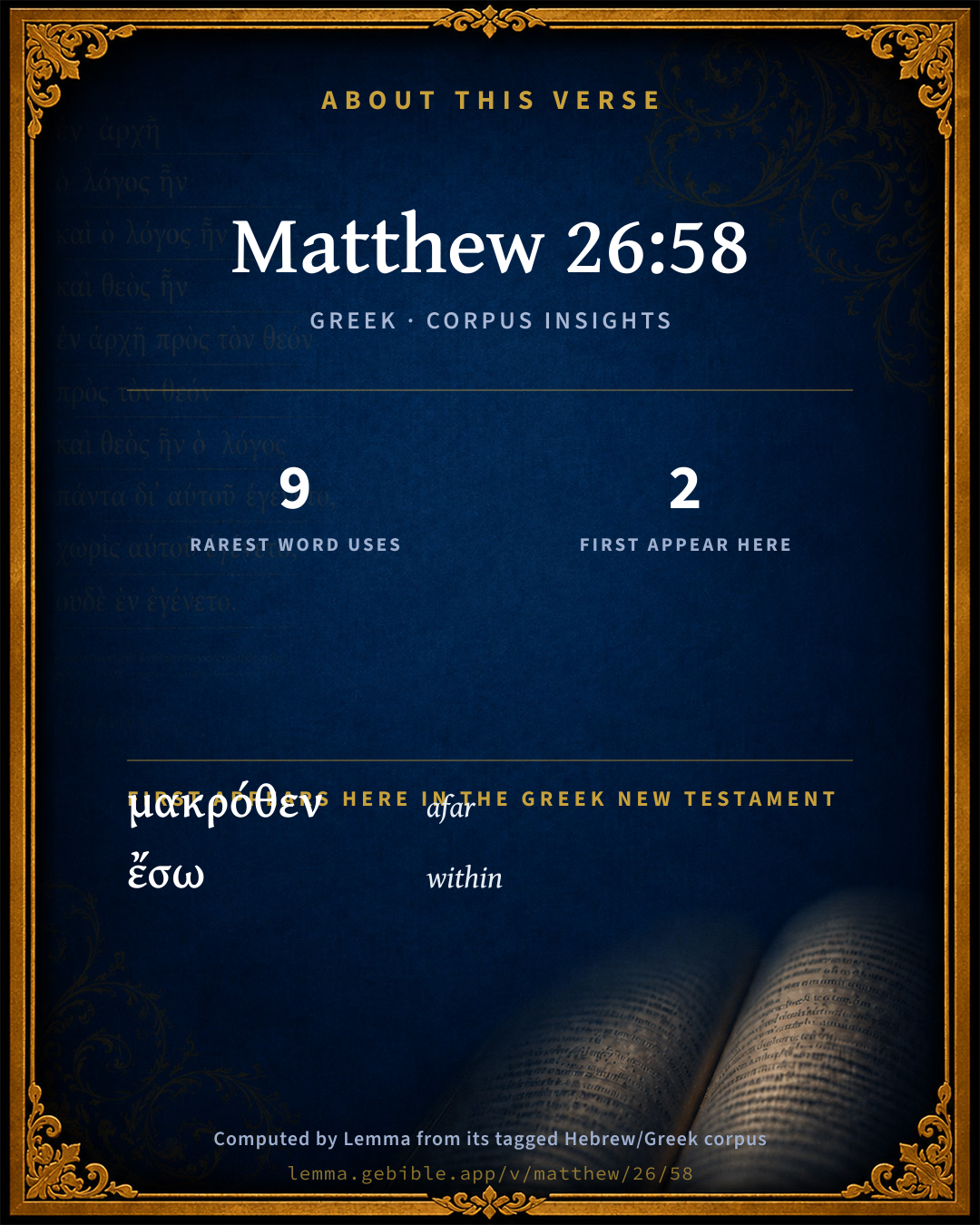
Matthew 26:58

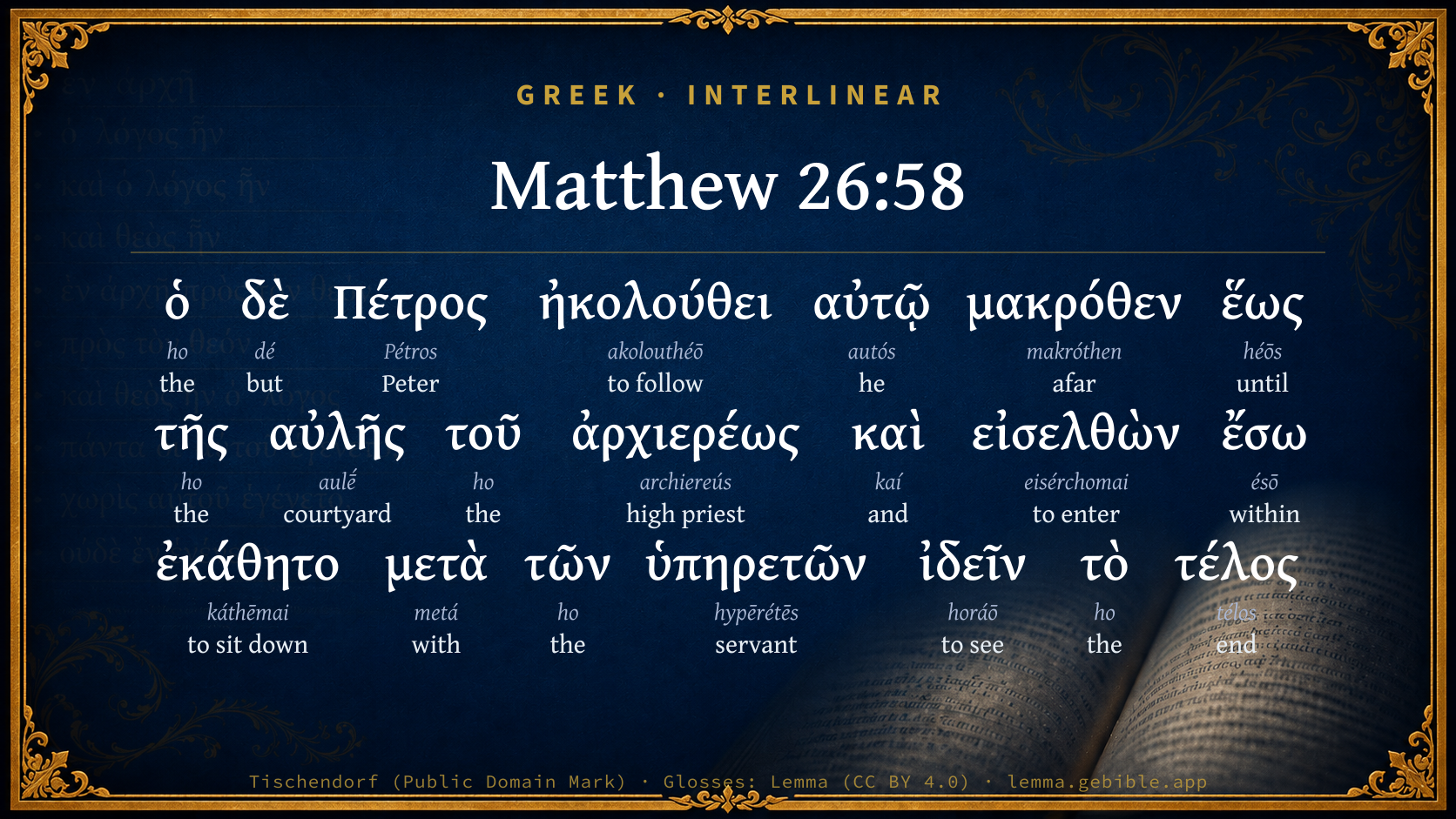
Greek (Tischendorf 8th ed.) Matthew 26:58 appears in the Greek New Testament. The text above is from the Tischendorf 8th edition. Each word links to its Strong’s number and a concise gloss. Click any word for its full Thayer’s Greek Lexicon entry.
Download image
Cite this verse

Matthew 26:58 (World English Bible). Public Domain. Lemma interlinear Bible study tool, https://lemma.gebible.app/v/matthew/26/58.

Show BibTeX & RIS
BibTeX
RIS
English Translation
But Peter followed him from a distance, to the court of the high priest, and entered in and sat with the officers, to see the end.
World English Bible · Public Domain
Highlights
  • 2 first appearances in the Greek New Testament
Full analysis ↓
Download a study sheet

One document with this verse’s original text, its word-by-word gloss line, the meaning frame, cross-references with their text, attributed commentary, and full source and license credits — printable, and it pastes into notes with its structure intact.

This verse Autodidact and up

Study sheet (.html) Plain text (.txt)

A passage Seminary Student

Up to 50 verses in one chapter. A passage sheet keeps up to 6 commentary sources and 12 cross-references per verse, in the order this page ranks them, and says so on the sheet whenever that leaves anything out. Ask for a single verse and you get the Autodidact verse sheet above.

Everything on this page stays free to read, with no account — the sheet is a download of what is already on screen, not access to it.

Want to remove ads? Support Godless Engineer
Compare translations 3

The same verse in 3 English versions, stacked beneath the original-language interlinear above. Click any original word for its lexicon entry.

Each is an independent rendering of the whole verse — the interlinear is not word-aligned to these translations.

Highlighted words mark where these versions differ — a whole-verse word diff, not a word-by-word alignment.

  • World English Bible Public Domain
    But Peter followed him from a distance, to the court of the high priest, and entered in and sat with the officers, to see the end.
  • King James Version Public Domain
    But Peter followed him afar off unto the high priest's palace, and went in, and sat with the servants, to see the end.
  • unfoldingWord Literal Text CC BY-SA 4.0
    But Peter was following him from a distance, as far as the courtyard of the high priest. And having entered inside, he was sitting down with the officers to see the end.

unfoldingWord Literal Text — © unfoldingWord, licensed CC BY-SA 4.0. Word-aligned USFM3 via Door43 (git.door43.org/unfoldingWord/en_ult).

Versions to compare (up to 4)

3 of 4 selected

Show all 19 translations

Every available English version of this verse, each an independent rendering of the whole verse.

  • World English Bible Public Domain
    But Peter followed him from a distance, to the court of the high priest, and entered in and sat with the officers, to see the end.
  • Berean Standard Bible Public Domain
    But Peter followed Him at a distance, right up to the courtyard of the high priest. And he went in and sat down with the guards to see the outcome.
  • Majority Standard Bible Public Domain
    But Peter followed Him at a distance, right up to the courtyard of the high priest. And he went in and sat down with the guards to see the outcome.
  • King James Version Public Domain
    But Peter followed him afar off unto the high priest's palace, and went in, and sat with the servants, to see the end.
  • American Standard Version (1901) Public Domain
    But Peter followed him afar off, unto the court of the high priest, and entered in, and sat with the officers, to see the end.
  • Revised Version (1885) Public Domain
    But Peter followed him afar off, unto the court of the high priest, and entered in, and sat with the officers, to see the end.
  • Geneva Bible (1599) Public Domain
    And Peter followed him a farre off vnto the hie Priestes hall, and went in, and sate with the seruants to see the ende.
  • Douay-Rheims (1899) Public Domain
    And Peter followed him afar off, even to the court of the high priest. And going in, he sat with the servants, that he might see the end.
  • Young's Literal Translation Public Domain
    and Peter was following him afar off, unto the court of the chief priest, and having gone in within, he was sitting with the officers, to see the end.
  • Literal Standard Version CC BY-SA 4.0
    and Peter was following Him far off, to the court of the chief priest, and having gone in within, he was sitting with the officers, to see the end.
  • Unlocked Literal Bible CC BY-SA 4.0
    But Peter followed him from a distance to the courtyard of the high priest. He went inside and sat down with the guards to see the outcome.
  • unfoldingWord Literal Text CC BY-SA 4.0
    But Peter was following him from a distance, as far as the courtyard of the high priest. And having entered inside, he was sitting down with the officers to see the end.
  • Darby Bible Public Domain
    And Peter followed him at a distance, even to the palace of the high priest, and entering in sat with the officers to see the end.
  • World Messianic Bible Public Domain
    But Peter followed him from a distance to the court of the high priest, and entered in and sat with the officers, to see the end.
  • Webster's Bible Public Domain
    But Peter followed him at a distance, to the high priest's palace, and went in, and sat with the servants to see the end.
  • Free Bible Version CC BY-SA 4.0
    Peter followed him at a distance, and went into the high priest's courtyard. He sat there with the guards to see how things would end.
  • Bible in Basic English Public Domain
    But Peter went after him at a distance, to the house of the high priest, and went in and took his seat with the servants, to see the end.
  • Text-Critical English NT CC BY 4.0
    But Peter was following him at a distance, coming as far as the courtyard of the high priest. After going inside, he sat with the officers to see the outcome.
  • Tyndale New Testament (1534) Public Domain
    And Peter folowed him a farre of vnto the hye prestes place: and went in and sate with the servauntes to se the ende.

Literal Standard Version (2020), Covenant Press — licensed CC BY-SA 4.0. Text via the HelloAO Bible API (eBible.org). Unlocked Literal Bible (unfoldingWord) — licensed CC BY-SA 4.0. Text via the HelloAO Bible API (eBible.org). unfoldingWord Literal Text — © unfoldingWord, licensed CC BY-SA 4.0. Word-aligned USFM3 via Door43 (git.door43.org/unfoldingWord/en_ult). Free Bible Version, Dr. Jonathan Gallagher — licensed CC BY-SA 4.0. Text via the HelloAO Bible API (eBible.org).

Word by word

More ways to search: Search by grammar → Find every occurrence → Compare this word →

Practice this passage: Drill this verse → Learn its vocabulary →

ἔσω
ésō
G2080
“within”
Adverb
Part of Speech
Adverb
Full Thayer's Definition

Origin: from G1519

TDNT: 13:38,3

1. to within, into 2. within a. the internal inner man b. the soul, conscience
  1. ὁ ho G3588 “the” Article, Nominative, Singular, Masculine
  2. δὲ dé G1161 “but” Conjunction
  3. Πέτρος Pétros G4074 “Peter” Noun, Nominative, Singular, Masculine
  4. ἠκολούθει akolouthéō G190 “to follow” Verb, Imperfect, Active, Indicative, 3rd person, Singular
  5. αὐτῷ autós G846 “he” Personal pronoun, Dative, Singular, Masculine
  6. μακρόθεν makróthen G3113 “afar” Adverb
  7. ἕως héōs G2193 “until” Adverb
  8. τῆς ho G3588 “the” Article, Genitive, Singular, Feminine
  9. αὐλῆς aulḗ G833 “courtyard” Noun, Genitive, Singular, Feminine
  10. τοῦ ho G3588 “the” Article, Genitive, Singular, Masculine
  11. ἀρχιερέως archiereús G749 “high priest” Noun, Genitive, Singular, Masculine
  12. καὶ kaí G2532 “and” Conjunction
  13. εἰσελθὼν eisérchomai G1525 “to enter” Verb, Aorist, Active, Participle, Nominative, Singular, Masculine
  14. ἐκάθητο káthēmai G2521 “to sit down” Verb, Imperfect, Middle or Passive deponent, Indicative, 3rd person, Singular
  15. μετὰ metá G3326 “with” Preposition
  16. τῶν ho G3588 “the” Article, Genitive, Plural, Masculine
  17. ὑπηρετῶν hypērétēs G5257 “servant” Noun, Genitive, Plural, Masculine
  18. ἰδεῖν horáō G3708 “to see” Verb, Aorist, Active, Infinitive
  19. τὸ ho G3588 “the” Article, Accusative, Singular, Neuter
  20. τέλος télos G5056 “end” Noun, Accusative, Singular, Neuter

About this verse

These counts appear in no published source. They are computed here, from the morphology-tagged text and Lemma’s own curated glosses. What Lemma adds →

21
words
17
distinct lemmas
Gospels
section

Notable vocabulary

The rarest word here is ἔσω within G2080 — appearing just 9 times in the whole Greek New Testament.

First appearance in Scripture

These words make their first canonical appearance in the Greek New Testament here:

Shared distinctive vocabulary

ἔσω within G2080 occurs in 9 verses of the Greek New Testament. Also found in:

Repetition

A word recurs within this verse:

Cross-references

4

Topical passages linked to Matthew 26:58 in the Treasury of Scripture Knowledge — connected by theme and wording, ordered by reader-vote popularity; previews shown in the World English Bible.

  • John 7:32 The Pharisees heard the multitude murmuring these things concerning him, and the chief priests and the Pharisees sent officers to arrest him.
  • John 18:15–16 Simon Peter followed Jesus, as did another disciple. Now that disciple was known to the high priest, and entered in with Jesus into the court of the high priest;
  • John 7:45 The officers therefore came to the chief priests and Pharisees, and they said to them, "Why didn't you bring him?"
  • John 18:25 Now Simon Peter was standing and warming himself. They said therefore to him, "You aren't also one of his disciples, are you?" He denied it, and said, "I am not."

Cross-references courtesy of OpenBible.info (CC BY 4.0).

Commentary

Notes on Matthew 26:58 from classic Christian and Jewish commentators (each source and its license shown beneath its notes). The classic Christian expositions comment on the surrounding passage and are grouped to its opening verse, so a note may address several verses; the Jewish commentaries on the Tanakh (Rashi and others) are per-verse, so they appear only where the commentator wrote on this verse.

Lemma curates 59 commentaries, every one of them public domain or Creative Commons licensed, each selected and text-cleaned for this edition rather than reprinted as found. About our sources →

Tyndale Open Study Notes

Tyndale Open Resources

26:58 the high priest’s courtyard: This location suggests an ad hoc meeting of the Sanhedrin at the palace of the high priest (26:3).

Tyndale Open Study Notes — © Tyndale Open Resources, licensed CC BY-SA 4.0. Text via the HelloAO Bible API.

Bengel's Gnomon

Johann Albrecht Bengel

Mat 26:58. Ἀπὸ μακρόθεν, afar off) With doubtful mind and the sense of danger midway between the spirit, displayed in Mat 26:51, and the fear evinced in Mat 26:70.—ἐκαθήτο, κ.τ.λ., sat, etc.) An unseasonable fellowship.[1158]

[1158] In the original, “communitas non opportuna.” There is an allusion in the word communitas to 1Co 15:33.—(I. B.)

Bengel's Gnomon of the New Testament — English translation (T&T Clark, Edinburgh, 1860) — public domain. Text from a community e-Sword module.

Expositor's Greek Testament

ed. W. Robertson Nicoll

Mat 26:58 is the prelude to the story of Peter’s denial, hich is resumed at Mat 26:69 after the account of the trial. Similarly in Mk. Lk. gives the story without interruption. μακρόθεν , from afar: Peter followed his Master, having after a while recovered from the general panic; more courageous than the rest, yet not courageous enough; just enough of the hero in him to bring him into the region of temptation. ἕως τ . αὐ . Cf. Mk., Mat 26:54 . ἰδεῖν τὸ τέλος , to see the end; a good Greek phrase. Motives: curiosity and honest interest in the fate of his loved Master. Jerome puts these alternatively: “vel amore discipuli vel humana curiositate”.

The Expositor's Greek Testament, edited by W. Robertson Nicoll (1897–1910) — public domain. Text from a community e-Sword module.

Geneva Bible (1599)

Geneva Bible translators

The word here used, signifieth properly an open large room before an house, as we see in Kings’ palaces and noble men’s houses: we call it a court, for it is open to the air, and by a figure Synecdoche is taken for the house itself.

Geneva Bible (1599) marginal notes — public domain. Text via Bolls.life.

Adam Clarke's Commentary

Verse 58. Peter followed him afar off] Poor Peter! this is the beginning of his dreadful fall. His fear kept him from joining the company, and publicly acknowledging his Lord; and his affection obliged him to follow at a distance that he might see the end.

And sat with the servants, to see the end.] When a man is weak in faith, and can as yet only follow Christ at a distance, he should avoid all dangerous places, and the company of those who are most likely to prove a snare to him. Had not Peter got to the high priest's palace, and sat down with the servants, he would not thus have denied his Lord and Master.

Servants-officers, υπηρετων. Such as we term serjeants, constables, &c.

Adam Clarke's Commentary on the Bible (1810–1826) — public domain. Text from a community e-Sword/MySword module.

Ellicott's Commentary for English Readers

(58) Peter followed him afar off.—We find from St. John’s narrative, here much the fullest, that it was through him that Peter found admission. He sat in the “court” “with the servants” (better, officers, as in Joh_18:18) and the slaves, who, in the chill of the early dawn, had lighted a charcoal fire. Female slaves who acted as gate-keepers were passing to and fro. The cold night air had told on the disciple, and he too, weary and chilled, drew near the fire and warmed himself.

To see the end.—There is something singularly suggestive in this account of Peter’s motive. It was, we may believe, more than a vague curiosity. There was something of sorrowful anxiety, of reverential sorrow, but there was no fervent devotion, no prayer for himself or his Master, only the fevered restlessness of uncertain expectation, and so all the natural instability of his character had free play, with nothing to control it.

A Bible Commentary for English Readers, edited by Charles John Ellicott (1878–1897) — public domain. Text from a community e-Sword module.

The Cambridge Bible for Schools and Colleges

gen. ed. J. J. S. Perowne

58. servants] “Attendants,” “retinue.”

The Cambridge Bible for Schools and Colleges (gen. ed. J. J. S. Perowne; Cambridge University Press, 1878–1918) — public domain. Text from a community e-Sword module.

John Gill's Exposition

Now the chief priests and elders, and all the counsel,.... Or sanhedrim, which consisted, as the Jewish writers say (u), of priests, Levites, and Israelites, of both ecclesiastics and laics; the ecclesiastics were the priests and Levites, and the laics the Israelites, or elders of the people; for if priests and Levites could not be found, a sanhedrim might consist of those only; and so those words in Deu 21:2, "thy elders", are thus interpreted (w),

, this is the great sanhedrim; and though a king of Israel might not sit in the sanhedrim, yet an high priest might, if he was a man of wisdom (x), and it seems as if Caiaphas was now at the head of this council, by its being assembled at his palace; which though it was not the usual place where they met, yet might be chose at this time for greater secrecy. Now these thus assembled together,

sought false witness against Jesus, to put him to death; they first take him up, and then seek out for witnesses against him; being determined, right or wrong, to put him to death, if possible; and false witnesses too, even those whose business it was, to examine and detect false witnesses, and to inflict the same punishment upon them, which they by their false testimony intended to have brought on another, Deu 19:18. And besides, it was in the night, when it was forbid by their canons to begin the trial of capital causes, or to receive and admit of witnesses (y). Indeed the Syriac and Persic versions read, only witnesses, or witness, and leave out the word "false"; perhaps imagining, that men could never be so wicked, to seek out for false witnesses: but this need not be wondered at, when these men were bent upon the death of Christ at any rate; and were aware that nothing true could be objected to him, that would legally take away his life; and besides, their manner of procedure in judgment against a false prophet, a deceiver, and one that enticed to idolatry, and such an one they would have Jesus to be, was quite different from what they took with other persons: their canon runs thus (z):

"the judgment of a deceiver, is not as the rest of capital judgments; his witnesses are hid; and he has no need, or ought not to have any premonition, or warning, as the rest of those that are put to death; and if he goes out of the sanhedrim acquitted, and one says I can prove the charge against him, they turn him back; but if he goes out condemned, and one says I can prove him innocent the do not return him.

So in the Misna (a) it is said,

"of all that are condemned to death in the law, none have their witnesses hidden but this (the deceiver, or one that entices to idolatry)--and they hide his witnesses behind a wall, or hedge; and he (whom he endeavoured to seduce) says to him, say what thou hast said to me privately; and if he repeats it to him, he must say, how shall we leave our God that is in heaven, and go and serve stocks and stones! if he repents, it is well; but if he should say, so we are bound to do, and so it becomes us, they that stand behind the wall, or hedge, shall carry him to the sanhedrim and stone him.

In the Gemara it is thus expressed (b),

"they light up a lamp in the innermost house, and set the witnesses in the outermost house, so that they can see him and hear his voice, and he cannot see them.

And then follows what is said before, to which is added, "so they did to Ben Stada"; by whom they mean Jesus of Nazareth. Moreover, this need not seem strange, that they took such a course with Christ, when in the case of Stephen, they suborned and set up false witnesses against him. The sanhedrim cannot be thought to do this in person, but they sent out their officers to seek for such men, as could or would produce anything against him, and no doubt promised them an handsome reward,

(u) Maimon. Hilch. Sanhedrin, c. 2. sect. 1, 2. Abarbinel in Tora, fol. 366. 2. (w) T. Hieros. Sota, fol. 23. 3. (x) Maimon. ib. sect. 4. (y) Maimon. ib. c. 3. sect. 3, 4. (z) lb. c. 11. sect. 5. (a) Sanhedrin, c. 7. sect. 10. (b) T. Bab. Sanhedrin, fol. 67. 1.

John Gill's Exposition of the Whole Bible (1746–1763) — public domain (CC PDM 1.0). Text via the HelloAO Bible API.

Trapp's Complete Commentary

John Trapp

58 But Peter followed him afar off unto the high priest’s palace, and went in, and sat with the servants, to see the end.

Ver. 58. But Peter followed] First, he fled with the rest, and then, remembering his promise, followed afar off; but better he had kept him away, for he sat with the servants, so venturing upon the occasion of sin, which he should have studiously shunned; and merely out of curiosity to see the end and issue of Christ’s captivity. We many times tempt Satan to tempt us by our imprudence. Evil company is contagious, and sin more catching than the plague. Israel going down to Egypt brought a golden calf from thence; Jeroboam brought two. A man may pass through Ethiopia unchanged; but he cannot reside there, and not be discoloured.

John Trapp, A Commentary or Exposition upon All the Books of the Old and New Testament (1647–1656) — public domain. Text from a community e-Sword module.

Albert Barnes' Notes on the Bible

Peter followed afar off - By this he evinced two things:

Real attachment to his Master; a desire to be near him and to witness his trial. Fear respecting his personal safety. He therefore kept so far off as to be out of danger, and yet so near as that he might witness the transactions respecting his Master.

Perhaps he expected to be lost and unobserved in the crowd. Many, in this, imitate Peter. They are afraid to follow the Saviour closely. They fear danger, ridicule, or persecution. They “follow him,” but it is at a great distance - so far that it is difficult to discern that they are in the train, and are his friends at all. Religion requires us to be near to Christ. We may measure our piety by our desire to be with him, to be like him, and by our willingness to follow him always - through trials, contempt, persecution, and death. Compare the notes at Phi 3:10. John says that another disciple went with Peter. By that other disciple it is commonly supposed, as he did not mention his name, that he meant himself. He was acquainted with the high priest, and went immediately into the hall.

Unto the high priest’s palace - The word rendered “palace” means, rather, the hall, or middle court, or “area” of his house. It was situated in the center of the palace, and was commonly uncovered. See the notes and plan of a house in Mat 9:1-8.

And went in - John informs us that he did not go immediately in; but the ether disciple, being known to the high priest, went in first, while Peter remained at the gate or entrance. The other disciple then went out and brought in Peter. Matthew, Mark, and Luke have omitted this circumstance. John recorded it, probably, because they had omitted it, and because he was the “other disciple” concerned in it.

Sat with the servants to see the end - That is, the end of the trial, or to see how it would go with his Master. The other evangelists say that he stood with the servants warming himself. John says, it being cold, they had made a fire of coals and warmed themselves. It was then, probably, not far from midnight. The place where they were was uncovered; and travelers say that, though the “days” are warm in Judea at that season of the year, yet that the nights are often uncomfortably cold. This fire was made “in the hall” (Luke). The fire was not in a “fireplace,” as we commonly suppose, but was probably made of “coals” laid on the pavement. At this place and time was Peter’s first “denial” of his Lord, as is recorded afterward. See Mat 26:69.

Albert Barnes' Notes on the Bible (1834–1885) — public domain. Text from a community e-Sword/MySword module.

Haydock's Catholic Bible Commentary

Peter followed. To wit, to the court of Caiphas, where a great many of the chief priests were met. --- And another disciple. Many think this disciple was St. John himself. (Witham)

George Leo Haydock (1774–1849), Haydock's Catholic Family Bible and Commentary, 1859 edition — public domain. Excludes Psalms (Douay-Rheims chapter numbering differs from Protestant) and Deuterocanonical books (Catholic canon only).

Matthew Poole's English Annotations

Mark adds, Mar 14:51, and warmed himself at the fire. Luke saith, Luk 22:51,55, Then took they him, and led him, and brought him into the high priest’s house. And Peter followed afar off: And when they had kindled a fire in the midst of the hall, and were set down together, Peter sat down among them. John gives us a more particular account how Peter came into the hall, Joh 18:15,16; And Simon Peter followed Jesus, and so did another disciple: that disciple was known unto the high priest, and went in with Jesus into the palace of the high priest. But Peter stood at the door without. Then went out that other disciple, which was known unto the high priest, and spake unto her that kept the door, and brought in Peter. Some think that this other disciple was John himself; but it is not probable that John and the high priest should be so well acquainted: it is more probably judged, that it was none of the twelve, but one who favoured Christ more secretly, some citizen of Jerusalem whom the high priest favoured, or at least knew by face, and had some respect for, and therefore he was admitted in, and he helped Peter in; who being come in, and a fire kindled in the hall, the rest of the company sat down and warmed themselves by the fire, Peter also sat down amongst them, being desirous to see the end.

Matthew Poole's English Annotations on the Holy Bible (1683–1685) — public domain. Text from a community e-Sword/MySword module.

Whedon's Commentary on the Bible

Daniel D. Whedon

58. Followed him afar off — Though, with the rest, Peter had fled, he was by no means contented to leave his Master without knowing his fate; hoping, perhaps, that he would yet by some unknown turn deliver himself. He follows him to the palace of the high priest, to know what will be the result.

Daniel D. Whedon (gen. ed.), Commentary on the Old and New Testaments (1874–1909) — public domain. Text from a community e-Sword module.

The Pulpit Commentary

Afar off. Peter had fled at first with the others; but his affection drew him back to see what befell his beloved Master. He followed the crowd at a safe distance, and, joined afterwards by John, reached the palace of Caiaphas. Went in. St. John appears to have entered the court with the guard that held the Prisoner; but Peter remained without till introduced by his fellow apostle, who was known to the servant who kept the door. (Joh_18:16) With the servants. These were the officers of the Sanhedrin, and the high priest"s servants They retired from the presence chamber to the open court, and sat round a charcoal fire which they made there. Peter at one time sat with them, at another moved restlessly about, endeavouring to show indifference, but really betraying himself. The end. The result of the examination. This verse is parenthetical, interrupting the course of the narrative in order to prepare the way for the account of Peter"s denial (vers. 69-75).

The Pulpit Commentary (1880–1919), ed. H.D.M. Spence-Jones & Joseph S. Exell — public domain. Text from a community e-Sword module.

John Wesley's Explanatory Notes

But Peter followed him afar off - Variously agitated by conflicting passions; love constrained him to follow his Master; fear made him follow afar off. And going in, sat with the servants - Unfit companions as the event showed.

John Wesley, Explanatory Notes Upon the Whole Bible (1754–1765) — public domain. Text via the GEBible commentary corpus.

McGarvey & Pendleton's Commentaries

J. W. McGarvey

J. W. McGarvey's The Fourfold Gospel [CXXVII. Peter Thrice Denies the Lord].

CXXVII. PETER THRICE DENIES THE LORD. (Court of the high priest's residence. Friday before and about dawn.) aMATT. XXVI. 58, 69-75; bMARK XIV. 54, 66-72; cLUKE XXII. 54-62; dJOHN XVIII. 15-18, 25-27.

a58 But d15 And Simon Peter followed Jesus [leaving Jesus in the palace of the high priest, we now turn back to the garden of Gethsemane at the time when Jesus left it under arrest, that we may follow the course of Simon Peter in his threefold denial of the Master], and i so did another disciple. [This other disciple was evidently the apostle John, who thus speaks of himself impersonally.] Now that disciple was known unto the high priest, and entered in with Jesus into the court of the high priest [John's acquaintanceship appears to have been with the household as well as with the high priest personally, for we find that it is used as a permit at the doorway. It is likely that the high priest knew John rather in a business way-- Act_4:13]; b54 And Peter had followed him afar off, aunto the court of the high priest, d16 but Peter was standing at the door without. So the other disciple, who was known unto the high priest, went out and spake unto her that kept the door, and brought in Peter. beven within, into the court of the high priest [For courts of houses see Act_12:13. John would have shown a truer kindness to Peter had he let him stay out]; d17 The maid therefore that kept the door saith unto Peter, Art thou also one of this man's disciples? He saith, I am not. aand [Peter] entered in [The doorkeeper evidently recognized John as a disciple, and was therefore suspicious of Peter. The cowardly "I am not" of Peter is a sad contrast to the strong "I am he" of Jesus], [700] d18 Now the servants and the officers were standing there, having made a fire of coals; for it was cold; and they were warming themselves: and Peter also was with them [they were gathered around a little smokeless charcoal fire], c55 And when they had kindled a fire in the midst of the court, and had sat down together, Peter asat with the officers, cin the midst of them. ato see the end. [Though his faith in Christ was shaken, he still loved him enough to see what would become of him.] band he was sitting with the officers, and warming himself in the light of the fire. c56 And a69 Now bas dSimon Peter awas sitting dstanding awithout bbeneath in the court, there cometh acame unto him, ca certain bone of the maids of the high priest; 67 and seeing Peter cas he sat in the light of the fire, bwarming himself, she looked cand looking stedfastly upon him, said, bsaith, asaying, Thou also wast with Jesus the Galilaean. bthe Nazarene, even Jesus. cThis man also was with him. a70 But he denied before them all, saying, I know not what thou sayest. bI neither know, nor understand what thou sayest: cWoman, I know him not. dThey said therefore unto him, Art thou also one of his disciples? He denied, and said, I am not. band he went out into the porch; and the cock crew. a71 And when he was gone out into the porch, cafter a little while another saw him, and said, Thou also art one of them. But Peter said, Man, I am not. b69 And aanother bthe maid saw him, and began again to say asaith unto them that were there, bthat stood by, This is one of them. aThis man also was with Jesus of Nazareth. b70 But a72 And again he denied bit. awith an oath, I know not the man. [Peter's second denial was of a quadruple nature. He denied to four different parties, but in such quick succession that the event is regarded as one.] 73 And after a little cafter the space of about one hour another confidently affirmed, saying, Of a [701] truth this man also was with him; for he is a Galilaean. 60 But Peter said, Man, I know not what thou sayest. bAgain they that stood by acame and said to Peter, Of a truth thou also art one of them; bfor thou art a Galilaean. afor thy speech maketh thee known. And immediately, while he yet spake, the cock crew. d26 One of the servants of the high priest, being a kinsman of him whose ear Peter cut off, saith, Did not I see thee in the garden with him? b70 But d27 Peter therefore denied again: a74 Then began he to curse and to swear, I know not the bthis aman. bof whom ye speak. 72 And straightway cimmediately, while he yet spake, bthe second time the cock crew. [Exasperated by the repeated accusations, Peter loses his temper and begins to emphasize his denial by profanity. Desire to make good his denial is now supreme in his thoughts and the Lord whom he denies is all but forgotten.] c61 And the Lord turned, and looked upon Peter. And Peter remembered bAnd Peter called to mind the word, cof the Lord, awhich Jesus had said, bhow that he said unto him, aBefore the cock crow, btwice, cthis thou shalt deny me thrice. 62 And he went out, bAnd when he thought thereon, he wept. cbitterly. [When Peter remembered the loving tenderness of Jesus manifested when he foretold Peter's crime it formed a background against which the sin appeared in all its hideous enormity.]

[FFG 700-702]

J. W. McGarvey (with Philip Y. Pendleton), Commentaries on the New Testament (The Fourfold Gospel, 1914; Acts; and the epistles) — public domain. Text from a community e-Sword/MySword module.

The People's New Testament

B. W. Johnson

58. Peter followed … unto the court of the high priest. The enclosed area, open to the sky, around which the palace was constructed, was called the court. The building extended all around this.

B. W. Johnson's The People's New Testament with Notes (1889–1891) — public domain. Electronic text from the Christian Classics Ethereal Library (CCEL) ThML edition.

Cambridge Greek Testament for Schools and Colleges

58. τῶν ὑπηρετῶν. ‘Attendants,’ ‘retinue.

Cambridge Greek Testament for Schools and Colleges (Cambridge University Press, 1896; 21 vols, various authors incl. Carr, Maclear, Plummer, Farrar, Lumby, Moule, M. R. James, Simcox) — public domain. Text from a community e-Sword module.

Alford’s Greek Testament

Henry Alford

58.] “ἀπὸ μακρόθεν is a well-known pleonasm. μακρόθεν itself is a late Greek word. See Lob. on Phryn. p. 93.” Meyer.

We have not here the more complete detail of Joh 18:15-19. The αὐλή is one and the same great building, in which both Annas and Caiaphas lived. This is evident from a comparison of the narratives of Peter’s denial: see below. The circumstance of a fire being lighted and the servants sitting round it, mentioned by the other three Evangelists, is here omitted.

Henry Alford, The Greek Testament (1849–1861) — public domain. Text from a community e-Sword module.

International Critical Commentary

(M) 58. And Peter was following Him from afar unto the court of the high priest, and entered in, and sat with the servants, to see the end.] Mk. has: “And Peter from afar followed Him inside into the court of the high priest, and was sitting with the servants, and warming himself at the blaze.”—ὁ δέ] for Mk.’s καὶ ὁ, as often. ἠκολούθα] Mk. has the aor.; generally the position is reversed.—ἔως τῆς αὐλῆς] abbreviates Mk.’s redundant ἕως ἔσω εἰς τὴν αὐλήν; cf. Introduction, p. 24 f.—ἐκάθητο] (so Lk.) for Mk.’s ἦν συνκαθήμενος.—ἰδεῖν τὸ τέλος] gives a motive for Peter’s action, which is wanting in Mk.’s merely pictorial καὶ θερμαινόμενος πρὸς τὸ φῶς

International Critical Commentary — older volumes (1896–1929), various authors — public domain. Text from a community e-Sword module.

Lesson kit

Teaching starters — assembled from the data on this page, not authored interpretation. Every prompt links to the verse data it draws on. Edit before teaching.

Matthew, in the Gospels, opens this verse with 21 words (17 distinct Greek lemmas). Its most distinctive word is ésō (“within”). A historical commentator’s framing appears above. Read the whole chapter for the surrounding context.

Discussion questions

  1. What does “within” (ésō) contribute to the verse as a whole?
  2. 2 words make their first appearance in Scripture here. What does this debut establish?
  3. How does Mark 14:54, which shares the word «within», read alongside this verse?
  4. What does the repetition of “the” (5× in this one verse) do in this verse?
  5. These translations render this verse differently. What is at stake in choosing one wording over another?
  6. Compare how Tyndale Open Study Notes and Bengel's Gnomon read this verse. Where do they agree or differ?

Things to notice

  • 2 words make their first canonical appearance in Scripture here.
  • These translations choose different wording for 20 words in this verse.
  • “the” occurs 5× in this single verse.
  • 17 distinct Greek lemmas span 21 words in this verse.

Reading settings

Reading text

Shown beneath each verse's original-language words.

Old Testament
Old Testament edition

Read the OT as the Masoretic Hebrew (MT) or the Greek Septuagint (LXX).

English shown for the Greek Septuagint (in the Hebrew ↔ Greek comparison).

Comparing translations? Open the Compare panel on any verse page to stack up to four side by side.