
Matthew 2:10

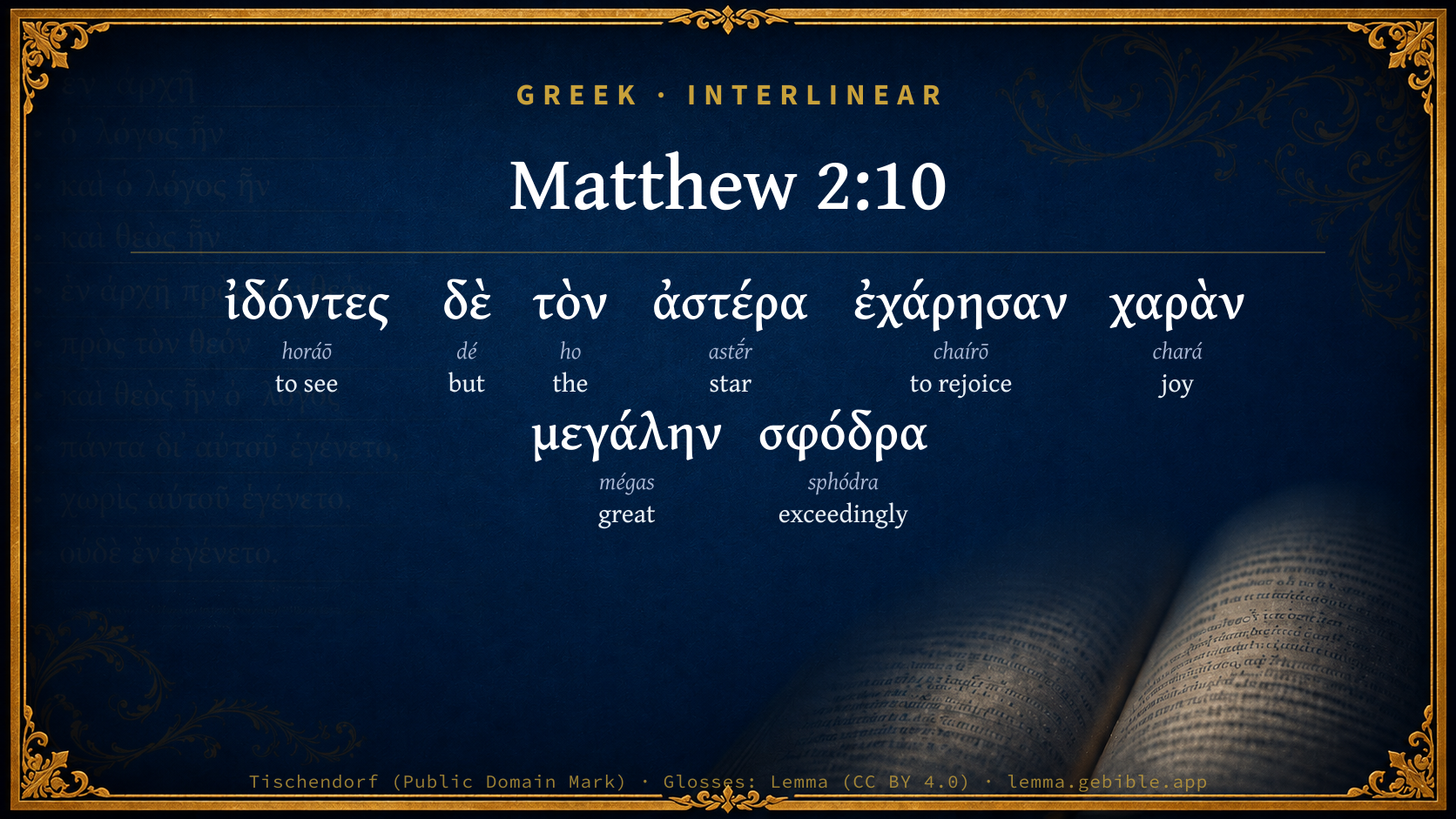
Greek (Tischendorf 8th ed.) Matthew 2:10 appears in the Greek New Testament. The text above is from the Tischendorf 8th edition. Each word links to its Strong’s number and a concise gloss. Click any word for its full Thayer’s Greek Lexicon entry.
Download image
Cite this verse

Matthew 2:10 (World English Bible). Public Domain. Lemma interlinear Bible study tool, https://lemma.gebible.app/v/matthew/2/10.

Show BibTeX & RIS
BibTeX
RIS
English Translation
When they saw the star, they rejoiced with exceedingly great joy.
World English Bible · Public Domain
Highlights
  • 4 first appearances in the Greek New Testament
Full analysis ↓
Download a study sheet

One document with this verse’s original text, its word-by-word gloss line, the meaning frame, cross-references with their text, attributed commentary, and full source and license credits — printable, and it pastes into notes with its structure intact.

This verse Autodidact and up

Study sheet (.html) Plain text (.txt)

A passage Seminary Student

Up to 50 verses in one chapter. A passage sheet keeps up to 6 commentary sources and 12 cross-references per verse, in the order this page ranks them, and says so on the sheet whenever that leaves anything out. Ask for a single verse and you get the Autodidact verse sheet above.

Everything on this page stays free to read, with no account — the sheet is a download of what is already on screen, not access to it.

Want to remove ads? Support Godless Engineer
Compare translations 3

The same verse in 3 English versions, stacked beneath the original-language interlinear above. Click any original word for its lexicon entry.

Each is an independent rendering of the whole verse — the interlinear is not word-aligned to these translations.

Highlighted words mark where these versions differ — a whole-verse word diff, not a word-by-word alignment.

  • World English Bible Public Domain
    When they saw the star, they rejoiced with exceedingly great joy.
  • King James Version Public Domain
    When they saw the star, they rejoiced with exceeding great joy.
  • unfoldingWord Literal Text CC BY-SA 4.0
    And having seen the star, they rejoiced with very great joy.

unfoldingWord Literal Text — © unfoldingWord, licensed CC BY-SA 4.0. Word-aligned USFM3 via Door43 (git.door43.org/unfoldingWord/en_ult).

Versions to compare (up to 4)

3 of 4 selected

Show all 19 translations

Every available English version of this verse, each an independent rendering of the whole verse.

  • World English Bible Public Domain
    When they saw the star, they rejoiced with exceedingly great joy.
  • Berean Standard Bible Public Domain
    When they saw the star, they rejoiced with great delight.
  • Majority Standard Bible Public Domain
    When they saw the star, they rejoiced with great delight.
  • King James Version Public Domain
    When they saw the star, they rejoiced with exceeding great joy.
  • American Standard Version (1901) Public Domain
    And when they saw the star, they rejoiced with exceeding great joy.
  • Revised Version (1885) Public Domain
    And when they saw the star, they rejoiced with exceeding great joy.
  • Geneva Bible (1599) Public Domain
    And when they sawe the starre, they reioyced with an exceeding great ioy,
  • Douay-Rheims (1899) Public Domain
    And seeing the star they rejoiced with exceeding great joy.
  • Young's Literal Translation Public Domain
    And having seen the star, they rejoiced with exceeding great joy,
  • Literal Standard Version CC BY-SA 4.0
    And having seen the star, they rejoiced with exceedingly great joy,
  • Unlocked Literal Bible CC BY-SA 4.0
    When they saw the star, they rejoiced with very great joy.
  • unfoldingWord Literal Text CC BY-SA 4.0
    And having seen the star, they rejoiced with very great joy.
  • Darby Bible Public Domain
    And when they saw the star they rejoiced with exceeding great joy.
  • World Messianic Bible Public Domain
    When they saw the star, they rejoiced with exceedingly great joy.
  • Webster's Bible Public Domain
    When they saw the star, they rejoiced with exceeding great joy.
  • Free Bible Version CC BY-SA 4.0
    When they saw the star they couldn't contain their happiness!
  • Bible in Basic English Public Domain
    And when they saw the star they were full of joy.
  • Text-Critical English NT CC BY 4.0
    When they saw the star, they rejoiced with exceedingly great joy.
  • Tyndale New Testament (1534) Public Domain
    When they sawe the starre they were marvelously glad:

Literal Standard Version (2020), Covenant Press — licensed CC BY-SA 4.0. Text via the HelloAO Bible API (eBible.org). Unlocked Literal Bible (unfoldingWord) — licensed CC BY-SA 4.0. Text via the HelloAO Bible API (eBible.org). unfoldingWord Literal Text — © unfoldingWord, licensed CC BY-SA 4.0. Word-aligned USFM3 via Door43 (git.door43.org/unfoldingWord/en_ult). Free Bible Version, Dr. Jonathan Gallagher — licensed CC BY-SA 4.0. Text via the HelloAO Bible API (eBible.org).

Word by word

More ways to search: Search by grammar → Find every occurrence → Compare this word →

Practice this passage: Drill this verse → Learn its vocabulary →

About this verse

These counts appear in no published source. They are computed here, from the morphology-tagged text and Lemma’s own curated glosses. What Lemma adds →

8
words
8
distinct lemmas
Gospels
section

Notable vocabulary

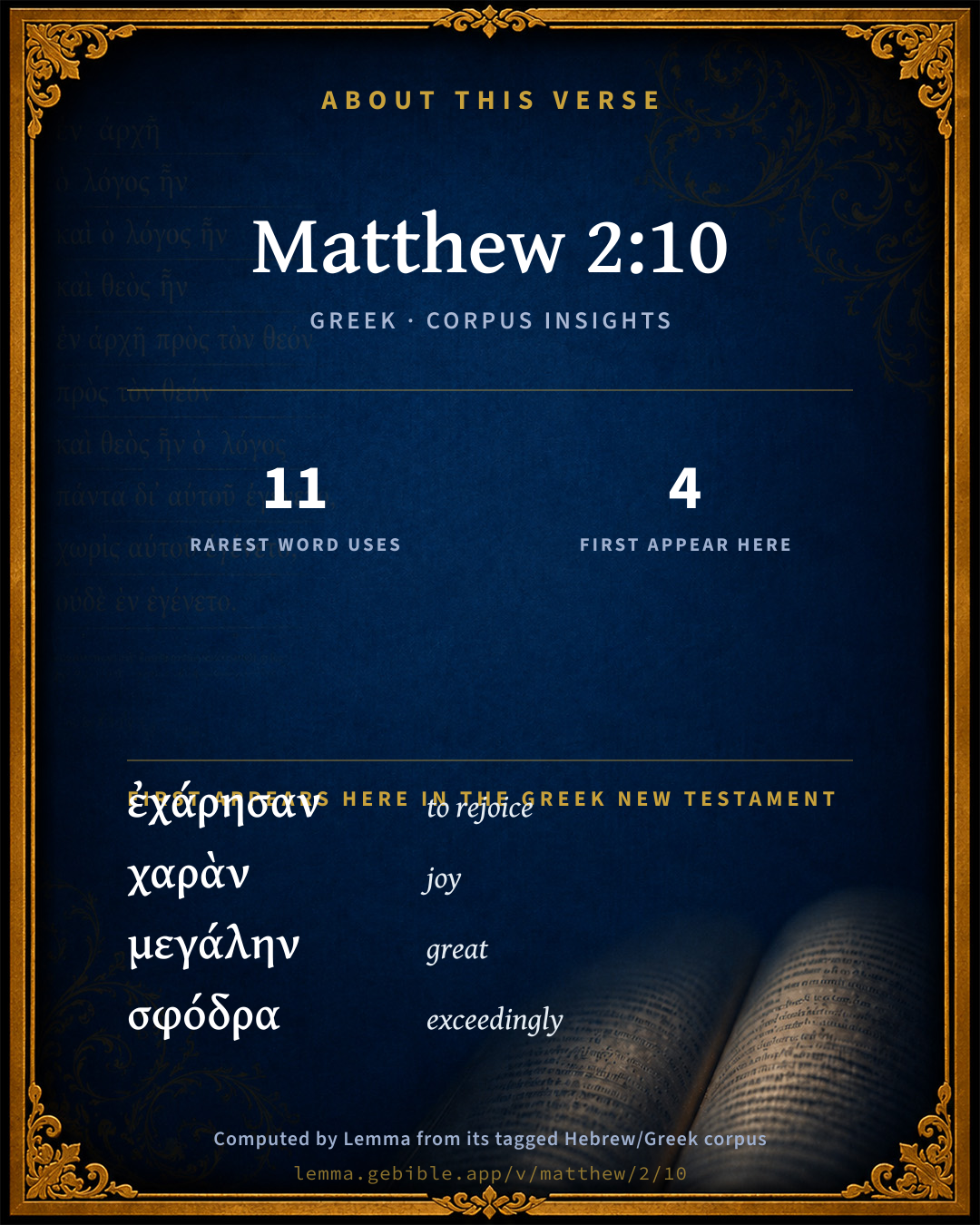
The rarest word here is σφόδρα exceedingly G4970 — appearing just 11 times in the whole Greek New Testament.

First appearance in Scripture

These words make their first canonical appearance in the Greek New Testament here:

  • ἐχάρησαν to rejoice G5463
  • χαρὰν joy G5479
  • μεγάλην great G3173
  • σφόδρα exceedingly G4970

Shared distinctive vocabulary

σφόδρα exceedingly G4970 occurs in 11 verses of the Greek New Testament. Also found in:
Cross-references

7

Topical passages linked to Matthew 2:10 in the Treasury of Scripture Knowledge — connected by theme and wording, ordered by reader-vote popularity; previews shown in the World English Bible.

  • Psalms 105:3 Glory in his holy name. Let the heart of those who seek Yahweh rejoice.
  • Luke 2:10 The angel said to them, "Don't be afraid, for behold, I bring you good news of great joy which will be to all the people.
  • Luke 2:20 The shepherds returned, glorifying and praising God for all the things that they had heard and seen, just as it was told them.
  • Romans 15:9–13 and that the Gentiles might glorify God for his mercy. As it is written, "Therefore will I give praise to you among the Gentiles, And sing to your name."
  • Psalms 67:4 Oh let the nations be glad and sing for joy, For you will judge the peoples with equity, And govern the nations on earth. Selah.
  • Deuteronomy 32:13 He made him ride on the high places of the earth, He ate the increase of the field; He made him to suck honey out of the rock, Oil out of the flinty rock;
  • Acts 13:46–48 Paul and Barnabas spoke out boldly, and said, "It was necessary that God's word should be spoken to you first. Since indeed you thrust it from you, and judge yourselves unworthy of eternal life, behold, we turn to the Gentiles.

Cross-references courtesy of OpenBible.info (CC BY 4.0).

Commentary

Notes on Matthew 2:10 from classic Christian and Jewish commentators (each source and its license shown beneath its notes). The classic Christian expositions comment on the surrounding passage and are grouped to its opening verse, so a note may address several verses; the Jewish commentaries on the Tanakh (Rashi and others) are per-verse, so they appear only where the commentator wrote on this verse.

Lemma curates 59 commentaries, every one of them public domain or Creative Commons licensed, each selected and text-cleaned for this edition rather than reprinted as found. About our sources →

Joseph Benson's Commentary

Mat 2:10-11. When they saw the star — Thus standing over where the child was, they rejoiced with exceeding great joy — The original expression, εχαρησαν χαραν μεγαλην σφοδρα, is remarkably emphatical, and might be rendered, They joyed a great joy, very much, a translation which, though very bad English, as Dr. Doddridge observes, comes near to a literal version. They thus rejoiced because they were now confirmed in the certainty of the child’s being born, and also because they saw themselves in so remarkable a manner under the divine direction, and conducted with such certainty to the glorious person whom they came to seek. And when they were come into the house — Mary, it seems, was now better accommodated than at the time of her delivery: she was now in a house, (though probably a poor one,) and not in a stable. Some think that Joseph had now changed the place of his abode, and taken up his residence at Bethlehem, but this is not clear from the story. They saw the young child with Mary his mother — And how different soever the condition in which they found them might be from what they had expected, they were not offended at its meanness, but, falling down on their faces before him, they worshipped him — That is, they did him honour after the manner of the East, whose inhabitants were wont to prostrate themselves before their kings. They wisely considered, that such miraculous honours as the star gave him were far beyond any external circumstance, and therefore paid him, though a child in a poor cottage, without attendants, or any mark of royal descent, their homage, as readily as if they had found him in the most splendid palace, surrounded with servants and guards. “An amiable example this, of that humble, ingenuous temper, which fits a man for the reception of the gospel!” And when they had opened their treasures — Which they had brought along with them for this purpose, they presented to him gifts — It was customary in those countries for persons to offer some present to any illustrious personage whom they came to visit, as appears from many passages of the Old Testament; and Maundrell, Chardin, and many other modern writers of the best credit assure us, that the custom is yet retained, and that no person of rank is approached without a present. In this instance the gifts, consisting of the most valuable productions of their country, constituted a present very proper to the occasion. Perhaps this was all that these wise men intended by their offerings of gold, frankincense, and myrrh; and that there is no need to have recourse to allegory. “Nevertheless, if we will have it,” says Grotius,

“that the Divine Wisdom intended something mysterious here, it would not displease me to hear it intimated, that those three things, which we now offer to God through Christ, in consequence of the abolition of the ancient sacrifices, may be signified by these gifts, viz., works of mercy, Php 4:18; bodily purity, Rom 12:1; and prayers, Psa 141:2; Rev 5:8. The two texts last quoted manifestly show that prayers may be signified by frankincense; gold is, as it were, the common measure of the good things of this life, wherewith we relieve the wants of others. And, as we learn from Pliny, and St. Joh 19:39, there is hardly any other use of myrrh than to preserve bodies from corruption.” But if we may believe the ancient fathers, the wise men, by these gifts which they offered, showed who he was that was worshipped by them; offering myrrh, says Irenæus, because he was to die for mankind; gold, because he was a king, whose kingdom should have no end; thus, as it were, paying him tribute; and frankincense, because he was God, and God was wont to be honoured with the smoke of incense. To the same purpose speak Tertullian and Origen. Perhaps, however, there is more of fancy than truth in this doctrine. Be this as it may, we cannot but acknowledge the providence of God in sending the holy family such a seasonable supply in their low circumstances, especially as they were to take so long and expensive a journey as that into Egypt; a country where they were entirely strangers, and were to stay for a considerable time.

Joseph Benson's Commentary on the Old and New Testaments (1811–1818) — public domain. Text from a community e-Sword module.

Bengel's Gnomon

Johann Albrecht Bengel

Mat 2:10. Ἰδόντες, κ.τ.λ., when they saw) It must have been night.—τὸν ἀστέρα, the star) Both Scripture and the star show them the time and the place: Scripture, indeed, indicates the time with some latitude, in accordance with the general way in which the expectation of the Messiah’s coming then universally prevailed.

Bengel's Gnomon of the New Testament — English translation (T&T Clark, Edinburgh, 1860) — public domain. Text from a community e-Sword module.

Meyer's Critical & Exegetical Commentary

Heinrich August Wilhelm Meyer

Mat_2:10. Ἐχάρησαν] Euth. Zigabenus correctly says: ὡς εὑρόντες τὸν ἀψευδέστατον ὁδηγόν· ἐπληροφορήθησαν γὰρ λοιπόν, ὅτι καὶ τὸ ζητούμενον εὑρήσουσι.

σφόδρα] Adverbs at the end; comp. Mat_4:8; Schaefer, ad Demosth. V. p. 367; Bornemann, ad Xen. Anab. ii. 6. 9; Mem. iii. 5. 17.

ἐχάρ. χαρ.] Etenim ubi nomen per se ipsum verbi significationem neque circumscribit neque intendit, adminiculo opus est vel adjectivi vel pronominis vel articuli, quo rerum genus certum designatur, Lobeck, Paralip. p. 507. Therefore here χαρὰν μεγάλην σφόδρα. Comp. Mar_5:42 b; Wilke, neutestam. Rhetor. p. 380. The opposite, μεγάλην λύπην λυπεῖσθαι, Joh_4:11; φοβεῖσθαι φόβον μέγαν, Mar_4:41.

Meyer — Critical and Exegetical Commentary on the New Testament — English translation by Peter Christie, edited by Frederick Crombie (T&T Clark, 1880) — public domain. Text from a community e-Sword module.

Expositor's Greek Testament

ed. W. Robertson Nicoll

Mat 2:10 , ἰδάντες δὲ … χαρὰν μεγάλην σφόδρα : seeing the star standing over the sacred spot, they were overjoyed. Their quest was at an end; they had at last reached the goal of their long journey. σφόδρα , a favourite word of our evangelist, and here very appropriate after μεγάλην to express exuberant gladness, ecstatic delight. On the convoy of the star, Fritzsche remarks: “Fuit certe stellae pompa tam gravi tempore digna”. Some connect the seeing of the star in Mat 2:10 with the beginning of the journey from Jerusalem to Bethlehem. They rejoiced, says Euthy. Zig. ὡς εὑρόντες τὸν ἀψευδέστατον ὁδηγόν .

The Expositor's Greek Testament, edited by W. Robertson Nicoll (1897–1910) — public domain. Text from a community e-Sword module.

Jamieson, Fausset & Brown

Robert Jamieson, A. R. Fausset & David Brown

When they saw the star, they rejoiced with exceeding great joy--The language is very strong, expressing exuberant transport.

Jamieson, Fausset & Brown — Commentary Critical and Explanatory on the Whole Bible (1871) — public domain (CC PDM 1.0). Text via the HelloAO Bible API.

John Gill's Exposition

When they saw the star,.... Which by its appearance, size, brightness, &c. they knew to be the same with that which they had seen, when in their own country;

they rejoiced with exceeding great joy; a "pleonasm" or a redundancy of expression frequently used by the Hebrews, see Joh 4:6 and the Septuagint there; setting forth the rapture, the excess of joy they were in upon the sight of the star. Very probably before this, their hearts were sad, their countenances dejected, and they greatly discouraged, having taken so great a journey, and as yet to so little purpose. They had been at Jerusalem, where they expected to have found him that was born king of the Jews; they had been at court, and conversed with men of the greatest figure and intelligence, and could get no tidings of him; people of all ranks and degrees seemed to be troubled at the account they brought; no body cared to go along with them to Bethlehem: all these circumstances no doubt were discouraging to them; but as soon as they saw the star their spirits revived, joy filled their hearts, cheerfulness appeared in their countenances; and they pursued their journey with inexpressible delight, till they came to the place where the illustrious person was they were seeking after.

John Gill's Exposition of the Whole Bible (1746–1763) — public domain (CC PDM 1.0). Text via the HelloAO Bible API.

Trapp's Complete Commentary

John Trapp

10 When they saw the star, they rejoiced with exceeding great joy.

Ver. 10. When they saw the star] The sight whereof they seem to have lost when they turned out of the way; it led them to Jerusalem. But this text is excellently paraphrased and applied by Bishop Hooper, martyr, in a letter of his, written to one Mrs Anne Warcup, in these words (Acts and Mon.): "Such as travelled to find Christ followed only the star, and as long as they saw it, they were assured they were in the right way, and had great mirth in their journey. But when they entered into Jerusalem (whereas the star led them not thither, but unto Bethlehem) and there asked the citizens the thing that the star showed before; as long as they tarried in Jerusalem, and would be instructed where Christ was born, they were not only ignorant of Bethlehem, but also lost the sight of the star that led them before. Whereof we learn in any case, while we are going to seek Christ which is above, to beware we lose not the star of God’s word, that only is the mark that shows us where Christ is, and which way we may come unto him. But as Jerusalem stood in the way, and was an impediment to these wise men; so doth the synagogue of Antichrist (that bears the name of Jerusalem, that is, the vision of peace, and among the people now is called the Catholic Church) stand in the way that pilgrims must go by through this world to Bethlehem, the house of saturity and plentifulness, and is an impediment to all Christian travellers; yea, and except the more grace of God be, will keep the pilgrims still in her, that they shall not come where Christ is adored. And to stay them indeed, they take away the star of light, viz. the word of God, that it cannot be seen, as you may read that other star was hidden from the wise men while they asked of the Pharisees at Jerusalem where Christ was born. You may see what great dangers happened to these wise men while they were a learning of liars, where was Christ; first they were out of their way, and next they lost their guide," &c.

John Trapp, A Commentary or Exposition upon All the Books of the Old and New Testament (1647–1656) — public domain. Text from a community e-Sword module.

Matthew Poole's English Annotations

Joy is but the natural consequence of desire satisfied: they had in their own country seen an extraordinary star, which, according to the rules of their own art, they might guess to be an indication of a great Prince born, or, by a Divine revelation, they might know to be so. This kindled in them a strong desire to go and pay a homage to him; upon this they take a long journey to Jerusalem. When they come there they were more fully confirmed, from the answer of the priests and scribes, that there was a Christ to be born in Bethlehem Judah. Thither they go. In their journey the same star they had before seen appears to them again, confirming both their former apprehensions, and, by its standing over Bethlehem, and a particular house in it, (to their apprehensions), they were fully confirmed that they had right instructions from Herod, and rejoiced in the satisfaction of their desires naturally, and possibly rejoiced spiritually in this matter of joy to all people, if they had (as is probable) a spiritual illumination, and believed that this Christ was also Jesus, one come to save both Jews and Gentiles from their sins.

Matthew Poole's English Annotations on the Holy Bible (1683–1685) — public domain. Text from a community e-Sword/MySword module.

Whedon's Commentary on the Bible

Daniel D. Whedon

10. When they saw the star — Implying that it had before been unseen. Rejoiced with exceeding great joy — The strong terms show how great was the rapture at recovering sight of the lost star.

Daniel D. Whedon (gen. ed.), Commentary on the Old and New Testaments (1874–1909) — public domain. Text from a community e-Sword module.

The Pulpit Commentary

When (and when, Revised Version) they saw the star, they rejoiced with exceeding great joy; " they were marvelously glad" (Tyndale). Its reappearance was the pledge of the full answer to their search, the full reward of their toilsome journey. Contrast the indifference of the chosen people.

The Pulpit Commentary (1880–1919), ed. H.D.M. Spence-Jones & Joseph S. Exell — public domain. Text from a community e-Sword module.

John Wesley's Explanatory Notes

Seeing the star - Standing over where the child was.

John Wesley, Explanatory Notes Upon the Whole Bible (1754–1765) — public domain. Text via the GEBible commentary corpus.

Kretzmann's Popular Commentary

Paul E. Kretzmann

The effect of its appearance upon the Magi;

v. 10. When they saw the star, they rejoiced with exceeding great joy.

They were overjoyed. Their long journey was successful. their arduous quest was ended. The most intense gladness, a fairly ecstatic delight, took possession of them, as the evangelist expresses it. At once they carried out the purpose of their journey:

v. 11.. And when they were come into the house, they saw the young Child with Mary, His mother, and. fell down, and worshiped Him.

So vivid is Matthew’s description that the words fairly gush forth in a joyful stream. The Magi saw with their own eyes Him whom they had longed to behold, the Child, the Messiah, the promised Star of Judah. His mother Mary and His foster-father, who is intentionally omitted, had now found shelter in one of the houses of the village. The Magi worshiped the Child after the Oriental fashion of falling down on the knees and touching the forehead to the earth. in complete surrender.

v. 11.. And when they had opened their treasures, they presented unto Him gifts; gold, and frankincense, and myrrh.

With full hands they come, as befits such as would enter into the presence of royalty. They open their treasure-chests; they bring forth gold, the most precious metal, frankincense and myrrh, costly aromatic gums distilled from trees, much used in religious ceremonies, Psa 72:10; Is, 60:6. Whether there is any special significance, a mystical meaning, in the gifts, is an idle speculation which has engaged many commentators. It was commonly stated: Gold, as to the King; incense, as to God; myrrh, as to one destined to die; or, as a medieval rhyme has it: "The first was gold, as most mighty King; the second was myrrh. as Priest of priests being; the third was incense in tokening of burying. " Luther’s explanation is simple: "Although they [the Magi] enter a poor house, find a poor young woman, with a poor child, and also there is an appearance so unlike a king that their servant is more honorable and reputable, yet they are not troubled, but in great, strong, full faith they put everything out of their eyes and mind which nature with its arrogance might adduce and bring into play; they simply follow the verse of the prophet and the testimony of the star and believe Him to be King, fall down, worship Him, and give presents to Him."

Paul E. Kretzmann, Popular Commentary of the Bible (1921–1924) — public domain. Text from a community e-Sword module.

The People's New Testament

B. W. Johnson

10. And when they saw the star. This language shows that for a time, at least, they had not seen the star until they left Jerusalem for Bethlehem. Its reappearance caused them great rejoicing, because it showed them that their quest was not in vain.

B. W. Johnson's The People's New Testament with Notes (1889–1891) — public domain. Electronic text from the Christian Classics Ethereal Library (CCEL) ThML edition.

Cambridge Greek Testament for Schools and Colleges

10. ἐχάρησαν χαρὰν κ.τ.λ. The cognate noun becomes far more frequent in Hellenistic Greek under the influence of Hebrew expression. Observe the intensity of the joy expressed by the combination of cognate noun, adjective and adverb. To them it was a triumph at once of science and religion.

Cambridge Greek Testament for Schools and Colleges (Cambridge University Press, 1896; 21 vols, various authors incl. Carr, Maclear, Plummer, Farrar, Lumby, Moule, M. R. James, Simcox) — public domain. Text from a community e-Sword module.

International Critical Commentary

10. And when they saw the star, they rejoiced exceedingly with great joy.]—σφόδρα] Mat_7 times, Mar_1, Luk_1.

(P)

10. Something should be said in conclusion as to a recent attempt to show that the story of the Magi was added to the Gospel as late as 119 a.d.2 The alleged evidence is a Syrian documents3 which states that Balaam prophesied the destruction of the Assyrians by the Greeks, and the rise of the star in Israel. This was recorded in a letter written by Balak to the Assyrian monarch. It was laid up in the Assyrian archives, and handed down from king to king. At last, in the reign of Pir Shabour, the star appeared, and the Magi were sent. The colophon at the end states that “in the year 430 (= 118-119 a.d.), in the reign of Hadrianus Cæsar, in the consulship of Severus and Fulgus, and the episcopacy of Xystus, Bishop of Rome … this concern arose in the minds of men who were acquainted with the Holy Books, and through the pains of the great men in various places this history was sought for, and found, and written in the tongue of those who took this care.”

Mr. Conybeare argues that the “Holy Books” are the books of the Old Testament, and seems to imply that “this history” was Mat 2:1-15. He further argues that the story of the Magi thus elaborated was “an echo of the story as told by Dio and Pliny of the visit of the Magi to Nero, and of their worshipping him in Rome.” But there seems to be no reason why we should not rather agree with Zahn (Einl. ii. 266 f.), who sees in the “Holy Books” the New Testament, including Mat_2, which was already, therefore, an integral part of the Gospel in 119 a.d.; and in the question with which men at that time busied themselves, the question as to the year in which the Magi came to Bethlehem, or the problem of the harmonisation of the infancy narratives of Mt. and Lk. The history which they wrote will therefore be not Mat_2, but the legend about the preservation of Balak’s letter, and the coming of the Magi to Bethlehem in the reign of Pir Shabour.

P Palestinian traditions.

LXX. The Septuagint Version.

B. Babylonian Talmud.

Targ. Targum.

Ditt. Dittenberger Sylloge.

S Syriac version: Curetonian.

S Syriac version: Sinaitic MS.

O quotations from the Old Testament borrowed from a collection of Messianic prophecies. See pp.61 f.

Dalm. Dalman.

1 As compared with the formula in 1:23, 2:15. Elsewhere ὅπως occurs 8:17, 13:25.

al i.e. with other uncial MSS.

1 Cf. Harnack, “die Legende von der Jungfrauen-geburt, die Matthäus zuerst für uns bezeugt, auf judenchristlichem, näher jerusalemischem Boden entstanden ist,” Lukas der Arzt, 118, Anm. 1.

1 Cf., however, Gal 4:4, 1Ti 2:15.

1 Interpreter, January 1906, pp. 195 ff.

2 Conybeare, Guardian, April 29, 1903. Cf. also Nestle, Zeitsch. f. Wissensch. Litt. xxxvi. 435-438; Hilgenfeld, ib. xxxviii. 447-451.

3 Published by W. Wright in the Journal of Sacred Literature, New Series, vols. ix. x., April and October 1866.

International Critical Commentary — older volumes (1896–1929), various authors — public domain. Text from a community e-Sword module.

Lesson kit

Teaching starters — assembled from the data on this page, not authored interpretation. Every prompt links to the verse data it draws on. Edit before teaching.

Matthew, in the Gospels, opens this verse with 8 words (8 distinct Greek lemmas). Its most distinctive word is sphódra (“exceedingly”). A historical commentator’s framing appears above. Read the whole chapter for the surrounding context.

Discussion questions

  1. What does “exceedingly” (sphódra) contribute to the verse as a whole?
  2. 4 words make their first appearance in Scripture here. What does this debut establish?
  3. How does Matthew 17:6, which shares the word «exceedingly», read alongside this verse?
  4. These translations render this verse differently; the difference is in the English rendering, not the original. What questions does that raise?
  5. Compare how Joseph Benson's Commentary and Bengel's Gnomon read this verse. Where do they agree or differ?

Things to notice

  • 4 words make their first canonical appearance in Scripture here.
  • These translations choose different wording for 7 words in this verse.
  • 8 distinct Greek lemmas span 8 words in this verse.

Reading settings

Reading text

Shown beneath each verse's original-language words.

Old Testament
Old Testament edition

Read the OT as the Masoretic Hebrew (MT) or the Greek Septuagint (LXX).

English shown for the Greek Septuagint (in the Hebrew ↔ Greek comparison).

Comparing translations? Open the Compare panel on any verse page to stack up to four side by side.