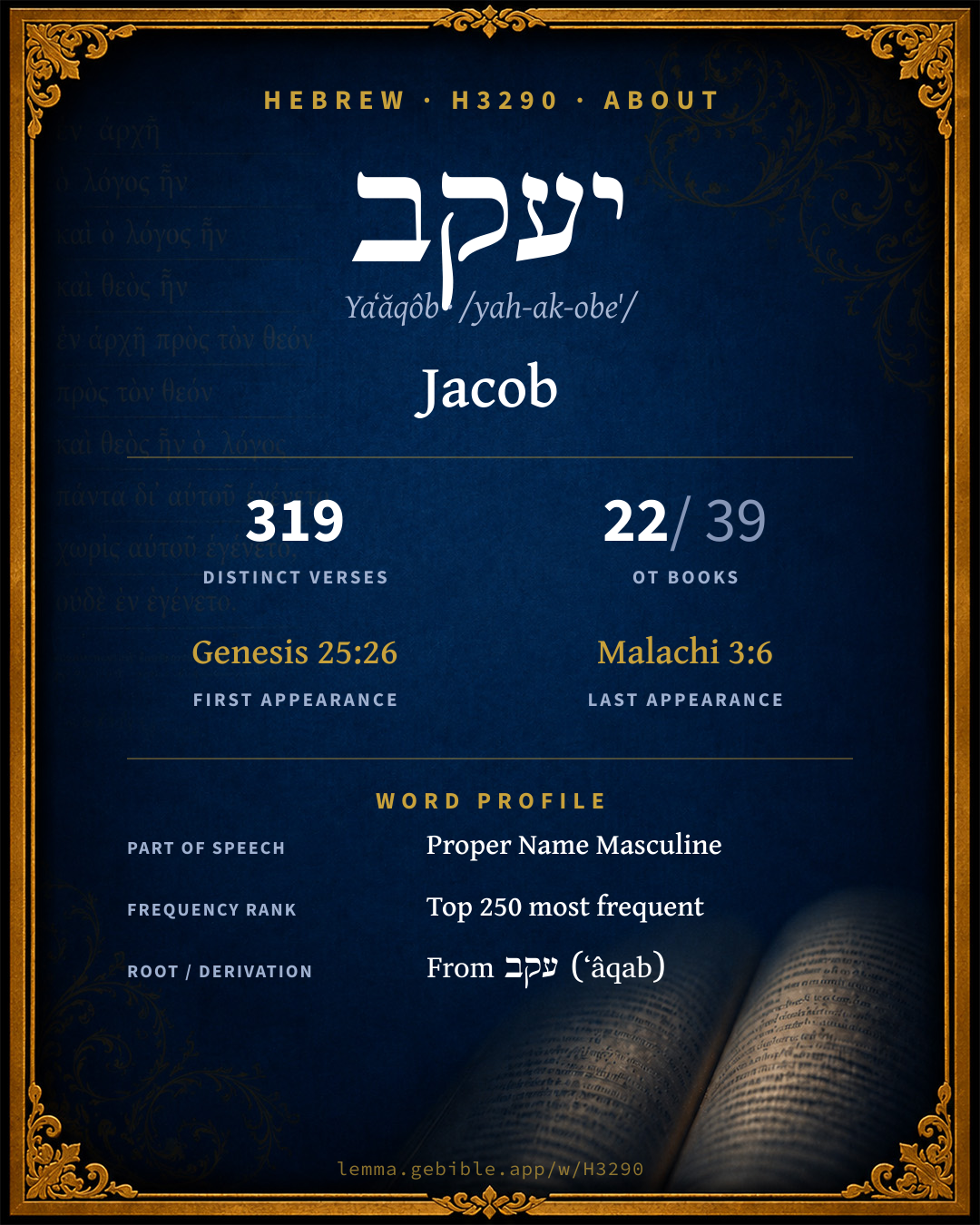
יַעֲקֹב
Jacob
BDB lists 2 entries for ‘Jacob’ fuller range ↓
Full lexicon entry — Brown-Driver-Briggs (BDB)
From Brown-Driver-Briggs (BDB)
Where this word appears
Grammar key — what these labels mean
Part of speech
- Noun
- A naming word — a person, place, thing, or idea.
Noun type
- Proper
- A name of a specific person, place, or people (e.g. Abraham, Zion, Israel).
Page 1 of 2 — showing verses 1–200 of 319 distinct verses where H3290 appears, across 22 books. Click any verse to open its interlinear word-by-word view. Verse text shown in the World English Bible for context — . Each verse’s Hebrew form is shown with its reference; the English is not keyword-highlighted, since the data carries no word-level English alignment. Use “Compare translations” on any verse to read it across multiple English versions. This concordance covers the Hebrew Bible; Septuagint (Greek Old Testament) occurrences are not indexed here.
Genesis 159 verses
- Genesis 25:26 יַעֲקֹ֑ב n Proper After that, his brother came out, and his hand had hold on Esau's heel. He was named Jacob. Isaac was sixty years old when she bore them.
- Genesis 25:27 וְ/יַעֲקֹב֙ conj + n Proper The boys grew. Esau was a skillful hunter, a man of the field. Jacob was a quiet man, living in tents.
- Genesis 25:28 יַעֲקֹֽב n Proper Now Isaac loved Esau, because he ate his venison. Rebekah loved Jacob.
- Genesis 25:29 יַעֲקֹ֖ב n Proper Jacob boiled stew. Esau came in from the field, and he was famished.
- Genesis 25:30 יַעֲקֹ֗ב n Proper Esau said to Jacob, "Please feed me with that same red stew, for I am famished." Therefore his name was called Edom.
- Genesis 25:31 יַעֲקֹ֑ב n Proper Jacob said, "First, sell me your birthright."
- Genesis 25:33 יַעֲקֹ֗ב לְ/יַעֲקֹֽב n Proper prep + n Proper Jacob said, "Swear to me first." He swore to him. He sold his birthright to Jacob.
- Genesis 25:34 וְ/יַעֲקֹ֞ב conj + n Proper Jacob gave Esau bread and stew of lentils. He ate and drank, rose up, and went his way. So Esau despised his birthright.
- Genesis 27:6 יַעֲקֹ֥ב n Proper Rebekah spoke to Jacob her son, saying, "Behold, I heard your father speak to Esau your brother, saying,
- Genesis 27:11 יַעֲקֹ֔ב n Proper Jacob said to Rebekah his mother, "Behold, Esau my brother is a hairy man, and I am a smooth man.
- Genesis 27:15 יַעֲקֹ֖ב n Proper Rebekah took the good clothes of Esau, her elder son, which were with her in the house, and put them on Jacob, her younger son.
- Genesis 27:17 יַעֲקֹ֥ב n Proper She gave the savory food and the bread, which she had prepared, into the hand of her son Jacob.
- Genesis 27:19 יַעֲקֹ֜ב n Proper Jacob said to his father, "I am Esau your firstborn. I have done what you asked me to do. Please arise, sit and eat of my venison, that your soul may bless me."
- Genesis 27:21 יַעֲקֹ֔ב n Proper Isaac said to Jacob, "Please come near, that I may feel you, my son, whether you are really my son Esau or not."
- Genesis 27:22 יַעֲקֹ֛ב יַעֲקֹ֔ב n Proper n Proper Jacob went near to Isaac his father. He felt him, and said, "The voice is Jacob's voice, but the hands are the hands of Esau."
- Genesis 27:30 יַעֲקֹב֒ יַעֲקֹ֔ב n Proper n Proper It happened, as soon as Isaac had made an end of blessing Jacob, and Jacob had just gone out from the presence of Isaac his father, that Esau his brother came in from his hunting.
- Genesis 27:36 יַעֲקֹ֗ב n Proper He said, "Isn't he rightly named Jacob? For he has supplanted me these two times. He took away my birthright. See, now he has taken away my blessing." He said, "Haven't you reserved a blessing for me?"
- Genesis 27:41 יַעֲקֹ֔ב יַעֲקֹ֥ב n Proper n Proper Esau hated Jacob because of the blessing with which his father blessed him. Esau said in his heart, "The days of mourning for my father are at hand. Then I will kill my brother Jacob."
- Genesis 27:42 לְ/יַעֲקֹב֙ prep + n Proper The words of Esau, her elder son, were told to Rebekah. She sent and called Jacob her younger son, and said to him, "Behold, your brother Esau comforts himself about you by planning to kill you.
- Genesis 27:46 יַ֠עֲקֹב n Proper Rebekah said to Isaac, "I am weary of my life because of the daughters of Heth. If Jacob takes a wife of the daughters of Heth, such as these, of the daughters of the land, what good will my life do me?"
- Genesis 28:1 יַעֲקֹ֖ב n Proper Isaac called Jacob, blessed him, and commanded him, "You shall not take a wife of the daughters of Canaan.
- Genesis 28:5 יַעֲקֹ֔ב יַעֲקֹ֖ב n Proper n Proper Isaac sent Jacob away. He went to Paddan Aram to Laban, son of Bethuel the Syrian, Rebekah's brother, Jacob's and Esau's mother.
- Genesis 28:6 יַעֲקֹב֒ n Proper Now Esau saw that Isaac had blessed Jacob and sent him away to Paddan Aram, to take him a wife from there, and that as he blessed him he gave him a charge, saying, "You shall not take a wife of the daughters of Canaan,"
- Genesis 28:7 יַעֲקֹ֔ב n Proper and that Jacob obeyed his father and his mother, and was gone to Paddan Aram.
- Genesis 28:10 יַעֲקֹ֖ב n Proper Jacob went out from Beersheba, and went toward Haran.
- Genesis 28:16 יַעֲקֹב֮ n Proper Jacob awakened out of his sleep, and he said, "Surely Yahweh is in this place, and I didn't know it."
- Genesis 28:18 יַעֲקֹ֜ב n Proper Jacob rose up early in the morning, and took the stone that he had put under his head, and set it up for a pillar, and poured oil on the top of it.
- Genesis 28:20 יַעֲקֹ֖ב n Proper Jacob vowed a vow, saying, "If God will be with me, and will keep me in this way that I go, and will give me bread to eat, and clothing to put on,
- Genesis 29:1 יַעֲקֹ֖ב n Proper Then Jacob went on his journey, and came to the land of the children of the east.
- Genesis 29:4 יַעֲקֹ֔ב n Proper Jacob said to them, "My relatives, where are you from?" They said, "We are from Haran."
- Genesis 29:10 יַעֲקֹ֜ב יַעֲקֹ֗ב n Proper n Proper It happened, when Jacob saw Rachel the daughter of Laban, his mother's brother, and the sheep of Laban, his mother's brother, that Jacob went near, and rolled the stone from the well's mouth, and watered the flock of Laban his mother's brother.
- Genesis 29:11 יַעֲקֹ֖ב n Proper Jacob kissed Rachel, and lifted up his voice, and wept.
- Genesis 29:12 יַעֲקֹ֜ב n Proper Jacob told Rachel that he was her father's brother, and that he was Rebekah's son. She ran and told her father.
- Genesis 29:13 יַעֲקֹ֣ב n Proper It happened, when Laban heard the news of Jacob, his sister's son, that he ran to meet Jacob, and embraced him, and kissed him, and brought him to his house. Jacob told Laban all these things.
- Genesis 29:15 לְ/יַעֲקֹ֔ב prep + n Proper Laban said to Jacob, "Because you are my brother, should you therefore serve me for nothing? Tell me, what will your wages be?"
- Genesis 29:18 יַעֲקֹ֖ב n Proper Jacob loved Rachel. He said, "I will serve you seven years for Rachel, your younger daughter."
- Genesis 29:20 יַעֲקֹ֛ב n Proper Jacob served seven years for Rachel. They seemed to him but a few days, for the love he had for her.
- Genesis 29:21 יַעֲקֹ֤ב n Proper Jacob said to Laban, "Give me my wife, for my days are fulfilled, that I may go in to her."
- Genesis 29:28 יַעֲקֹב֙ n Proper Jacob did so, and fulfilled her week. He gave him Rachel his daughter as wife.
- Genesis 30:1 לְ/יַעֲקֹ֔ב יַעֲקֹב֙ prep + n Proper n Proper When Rachel saw that she bore Jacob no children, Rachel envied her sister. She said to Jacob, "Give me children, or else I will die."
- Genesis 30:2 יַעֲקֹ֖ב n Proper Jacob's anger was kindled against Rachel, and he said, "Am I in God's place, who has withheld from you the fruit of the womb?"
- Genesis 30:4 יַעֲקֹֽב n Proper She gave him Bilhah her handmaid as wife, and Jacob went in to her.
- Genesis 30:5 לְ/יַעֲקֹ֖ב prep + n Proper Bilhah conceived, and bore Jacob a son.
- Genesis 30:7 לְ/יַעֲקֹֽב prep + n Proper Bilhah, Rachel's handmaid, conceived again, and bore Jacob a second son.
- Genesis 30:9 לְ/יַעֲקֹ֖ב prep + n Proper When Leah saw that she had finished bearing, she took Zilpah, her handmaid, and gave her to Jacob as a wife.
- Genesis 30:10 לְ/יַעֲקֹ֥ב prep + n Proper Zilpah, Leah's handmaid, bore Jacob a son.
- Genesis 30:12 לְ/יַעֲקֹֽב prep + n Proper Zilpah, Leah's handmaid, bore Jacob a second son.
- Genesis 30:16 יַעֲקֹ֣ב n Proper Jacob came from the field in the evening, and Leah went out to meet him, and said, "You must come in to me; for I have surely hired you with my son's mandrakes." He lay with her that night.
- Genesis 30:17 לְ/יַעֲקֹ֖ב prep + n Proper God listened to Leah, and she conceived, and bore Jacob a fifth son.
- Genesis 30:19 לְּ/יַעֲקֹֽב prep + n Proper Leah conceived again, and bore a sixth son to Jacob.
- Genesis 30:25 יַעֲקֹב֙ n Proper It happened, when Rachel had borne Joseph, that Jacob said to Laban, "Send me away, that I may go to my own place, and to my country.
- Genesis 30:31 יַעֲקֹב֙ n Proper He said, "What shall I give you?" Jacob said, "You shall not give me anything. If you will do this thing for me, I will again feed your flock and keep it.
- Genesis 30:36 יַעֲקֹ֑ב וְ/יַעֲקֹ֗ב n Proper conj + n Proper He set three days' journey between himself and Jacob, and Jacob fed the rest of Laban's flocks.
- Genesis 30:37 יַעֲקֹ֗ב n Proper Jacob took to himself rods of fresh poplar, almond, plane tree, peeled white streaks in them, and made the white appear which was in the rods.
- Genesis 30:40 יַעֲקֹב֒ n Proper Jacob separated the lambs, and set the faces of the flocks toward the streaked and all the black in the flock of Laban: and he put his own droves apart, and didn't put them into Laban's flock.
- Genesis 30:41 יַעֲקֹ֧ב n Proper It happened, whenever the stronger of the flock conceived, that Jacob laid the rods before the eyes of the flock in the gutters, that they might conceive among the rods;
- Genesis 30:42 לְ/יַעֲקֹֽב prep + n Proper but when the flock were feeble, he didn't put them in. So the feebler were Laban's, and the stronger Jacob's.
- Genesis 31:1 יַעֲקֹ֔ב n Proper He heard the words of Laban's sons, saying, "Jacob has taken away all that was our father's. From that which was our father's, has he gotten all this wealth."
- Genesis 31:2 יַעֲקֹ֖ב n Proper Jacob saw the expression on Laban's face, and, behold, it was not toward him as before.
- Genesis 31:3 יַעֲקֹ֔ב n Proper Yahweh said to Jacob, "Return to the land of your fathers, and to your relatives, and I will be with you."
- Genesis 31:4 יַעֲקֹ֔ב n Proper Jacob sent and called Rachel and Leah to the field to his flock,
- Genesis 31:11 יַֽעֲקֹ֑ב n Proper The angel of God said to me in the dream, 'Jacob,' and I said, 'Here I am.'
- Genesis 31:17 יַעֲקֹ֑ב n Proper Then Jacob rose up, and set his sons and his wives on the camels,
- Genesis 31:20 יַעֲקֹ֔ב n Proper Jacob deceived Laban the Syrian, in that he didn't tell him that he was running away.
- Genesis 31:22 יַעֲקֹֽב n Proper Laban was told on the third day that Jacob had fled.
- Genesis 31:24 יַעֲקֹ֖ב n Proper God came to Laban, the Syrian, in a dream of the night, and said to him, "Take heed to yourself that you don't speak to Jacob either good or bad."
- Genesis 31:25 יַעֲקֹ֑ב וְ/יַעֲקֹ֗ב n Proper conj + n Proper Laban caught up with Jacob. Now Jacob had pitched his tent in the mountain, and Laban with his relatives encamped in the mountain of Gilead.
- Genesis 31:26 לְ/יַעֲקֹ֔ב prep + n Proper Laban said to Jacob, "What have you done, that you have deceived me, and carried away my daughters like captives of the sword?
- Genesis 31:29 יַעֲקֹ֖ב n Proper It is in the power of my hand to hurt you, but the God of your father spoke to me last night, saying, 'Take heed to yourself that you don't speak to Jacob either good or bad.'
- Genesis 31:31 יַעֲקֹ֖ב n Proper Jacob answered Laban, "Because I was afraid, for I said, 'Lest you should take your daughters from me by force.'
- Genesis 31:32 יַעֲקֹ֔ב n Proper With whoever you find your gods, he shall not live. Before our relatives, discern what is yours with me, and take it." For Jacob didn't know that Rachel had stolen them.
- Genesis 31:33 יַעֲקֹ֣ב n Proper Laban went into Jacob's tent, into Leah's tent, and into the tent of the two maid-servants; but he didn't find them. He went out of Leah's tent, and entered into Rachel's tent.
- Genesis 31:36 לְ/יַעֲקֹ֖ב יַעֲקֹב֙ prep + n Proper n Proper Jacob was angry, and argued with Laban. Jacob answered Laban, "What is my trespass? What is my sin, that you have hotly pursued after me?
- Genesis 31:43 יַעֲקֹ֗ב n Proper Laban answered Jacob, "The daughters are my daughters, the children are my children, the flocks are my flocks, and all that you see is mine: and what can I do this day to these my daughters, or to their children whom they have borne?
- Genesis 31:45 יַעֲקֹ֖ב n Proper Jacob took a stone, and set it up for a pillar.
- Genesis 31:46 יַעֲקֹ֤ב n Proper Jacob said to his relatives, "Gather stones." They took stones, and made a heap. They ate there by the heap.
- Genesis 31:47 וְ/יַֽעֲקֹ֔ב conj + n Proper Laban called it Jegar Sahadutha, but Jacob called it Galeed.
- Genesis 31:51 לְ/יַעֲקֹ֑ב prep + n Proper Laban said to Jacob, "See this heap, and see the pillar, which I have set between me and you.
- Genesis 31:53 יַעֲקֹ֔ב n Proper The God of Abraham, and the God of Nahor, the God of their father, judge between us." Then Jacob swore by the fear of his father, Isaac.
- Genesis 31:54 יַעֲקֹ֥ב n Proper Jacob offered a sacrifice in the mountain, and called his relatives to eat bread. They ate bread, and stayed all night in the mountain.
- Genesis 32:1 וְ/יַעֲקֹ֖ב conj + n Proper Jacob went on his way, and the angels of God met him.
- Genesis 32:2 יַעֲקֹב֙ n Proper When he saw them, Jacob said, "This is God's host." He called the name of that place Mahanaim.
- Genesis 32:3 יַעֲקֹ֤ב n Proper Jacob sent messengers in front of him to Esau, his brother, to the land of Seir, the field of Edom.
- Genesis 32:4 יַעֲקֹ֔ב n Proper He commanded them, saying, "This is what you shall tell my lord, Esau: 'This is what your servant, Jacob, says. I have lived as a foreigner with Laban, and stayed until now.
- Genesis 32:6 יַעֲקֹ֖ב n Proper The messengers returned to Jacob, saying, "We came to your brother Esau. Not only that, but he comes to meet you, and four hundred men with him."
- Genesis 32:7 יַעֲקֹ֛ב n Proper Then Jacob was greatly afraid and was distressed: and he divided the people who were with him, and the flocks, and the herds, and the camels, into two companies;
- Genesis 32:9 יַעֲקֹב֒ n Proper Jacob said, "God of my father Abraham, and God of my father Isaac, Yahweh, who said to me, 'Return to your country, and to your relatives, and I will do you good.'
- Genesis 32:18 לְ/יַעֲקֹ֔ב prep + n Proper Then you shall say, 'They are your servant, Jacob's. It is a present sent to my lord, Esau. Behold, he also is behind us.'"
- Genesis 32:20 יַעֲקֹ֖ב n Proper You shall say, 'Not only that, but behold, your servant, Jacob, is behind us.'" For, he said, "I will appease him with the present that goes before me, and afterward I will see his face. Perhaps he will accept me."
- Genesis 32:24 יַעֲקֹ֖ב n Proper Jacob was left alone, and wrestled with a man there until the breaking of the day.
- Genesis 32:25 יַעֲקֹ֔ב n Proper When he saw that he didn't prevail against him, he touched the hollow of his thigh, and the hollow of Jacob's thigh was strained, as he wrestled.
- Genesis 32:27 יַעֲקֹֽב n Proper He said to him, "What is your name?" He said, "Jacob."
- Genesis 32:28 יַעֲקֹב֙ n Proper He said, "Your name will no longer be called 'Jacob,' but, 'Israel,' for you have fought with God and with men, and have prevailed."
- Genesis 32:29 יַעֲקֹ֗ב n Proper Jacob asked him, "Please tell me your name." He said, "Why is it that you ask what my name is?" He blessed him there.
- Genesis 32:30 יַעֲקֹ֛ב n Proper Jacob called the name of the place Peniel: for, he said, "I have seen God face to face, and my life is preserved."
- Genesis 32:32 יַעֲקֹ֔ב n Proper Therefore the children of Israel don't eat the sinew of the hip, which is on the hollow of the thigh, to this day, because he touched the hollow of Jacob's thigh in the sinew of the hip.
- Genesis 33:1 יַעֲקֹ֜ב n Proper Jacob lifted up his eyes, and looked, and, behold, Esau was coming, and with him four hundred men. He divided the children between Leah, Rachel, and to the two handmaids.
- Genesis 33:10 יַעֲקֹ֗ב n Proper Jacob said, "Please, no, if I have now found favor in your sight, then receive my present at my hand, because I have seen your face, as one sees the face of God, and you were pleased with me.
- Genesis 33:17 וְ/יַעֲקֹב֙ conj + n Proper Jacob traveled to Succoth, built himself a house, and made shelters for his cattle. Therefore the name of the place is called Succoth.
- Genesis 33:18 יַעֲקֹ֨ב n Proper Jacob came in peace to the city of Shechem, which is in the land of Canaan, when he came from Paddan Aram; and encamped before the city.
- Genesis 34:1 לְ/יַעֲקֹ֑ב prep + n Proper Dinah, the daughter of Leah, whom she bore to Jacob, went out to see the daughters of the land.
- Genesis 34:3 יַעֲקֹ֑ב n Proper His soul joined to Dinah, the daughter of Jacob, and he loved the young lady, and spoke kindly to the young lady.
- Genesis 34:5 וְ/יַעֲקֹ֣ב יַעֲקֹ֖ב conj + n Proper n Proper Now Jacob heard that he had defiled Dinah, his daughter; and his sons were with his cattle in the field. Jacob held his peace until they came.
- Genesis 34:6 יַעֲקֹ֑ב n Proper Hamor the father of Shechem went out to Jacob to talk with him.
- Genesis 34:7 יַעֲקֹ֜ב יַעֲקֹ֔ב n Proper n Proper The sons of Jacob came in from the field when they heard it. The men were grieved, and they were very angry, because he had done folly in Israel in lying with Jacob's daughter; which thing ought not to be done.
- Genesis 34:13 יַעֲקֹ֜ב n Proper The sons of Jacob answered Shechem and Hamor his father with deceit, and spoke, because he had defiled Dinah their sister,
- Genesis 34:19 יַעֲקֹ֑ב n Proper The young man didn't wait to do this thing, because he had delight in Jacob's daughter, and he was honored above all the house of his father.
- Genesis 34:25 יַ֠עֲקֹב n Proper It happened on the third day, when they were sore, that two of Jacob's sons, Simeon and Levi, Dinah's brothers, each took his sword, came upon the unsuspecting city, and killed all the males.
- Genesis 34:27 יַעֲקֹ֗ב n Proper Jacob's sons came on the dead, and plundered the city, because they had defiled their sister.
- Genesis 34:30 יַעֲקֹ֜ב n Proper Jacob said to Simeon and Levi, "You have troubled me, to make me odious to the inhabitants of the land, among the Canaanites and the Perizzites. I am few in number. They will gather themselves together against me and strike me, and I will be destroyed, I and my house."
- Genesis 35:1 יַעֲקֹ֔ב n Proper God said to Jacob, "Arise, go up to Bethel, and live there. Make there an altar to God, who appeared to you when you fled from the face of Esau your brother."
- Genesis 35:2 יַעֲקֹב֙ n Proper Then Jacob said to his household, and to all who were with him, "Put away the foreign gods that are among you, purify yourselves, change your garments.
- Genesis 35:4 יַעֲקֹ֗ב יַעֲקֹ֔ב n Proper n Proper They gave to Jacob all the foreign gods which were in their hands, and the rings which were in their ears; and Jacob hid them under the oak which was by Shechem.
- Genesis 35:5 יַעֲקֹֽב n Proper They traveled: and a terror of God was on the cities that were round about them, and they didn't pursue the sons of Jacob.
- Genesis 35:6 יַעֲקֹ֜ב n Proper So Jacob came to Luz, which is in the land of Canaan (the same is Bethel), he and all the people who were with him.
- Genesis 35:9 יַעֲקֹב֙ n Proper God appeared to Jacob again, when he came from Paddan Aram, and blessed him.
- Genesis 35:10 יַעֲקֹ֑ב יַעֲקֹ֗ב n Proper n Proper God said to him, "Your name is Jacob. Your name shall not be Jacob any more, but your name will be Israel." He named him Israel.
- Genesis 35:14 יַעֲקֹ֜ב n Proper Jacob set up a pillar in the place where he spoke with him, a pillar of stone. He poured out a drink-offering on it, and poured oil on it.
- Genesis 35:15 יַעֲקֹ֜ב n Proper Jacob called the name of the place where God spoke with him "Bethel."
- Genesis 35:20 יַעֲקֹ֛ב n Proper Jacob set up a pillar on her grave. The same is the Pillar of Rachel's grave to this day.
- Genesis 35:22 יַעֲקֹ֖ב n Proper It happened, while Israel lived in that land, that Reuben went and lay with Bilhah, his father's concubine, and Israel heard of it. Now the sons of Jacob were twelve.
- Genesis 35:23 יַעֲקֹ֖ב n Proper The sons of Leah: Reuben (Jacob's firstborn), Simeon, Levi, Judah, Issachar, and Zebulun.
- Genesis 35:26 יַעֲקֹ֔ב n Proper The sons of Zilpah (Leah's handmaid): Gad and Asher. These are the sons of Jacob, who were born to him in Paddan Aram.
- Genesis 35:27 יַעֲקֹב֙ n Proper Jacob came to Isaac his father, to Mamre, to Kiriath Arba (the same is Hebron), where Abraham and Isaac lived as foreigners.
- Genesis 35:29 וְ/יַעֲקֹ֖ב conj + n Proper Isaac gave up the spirit, and died, and was gathered to his people, old and full of days. Esau and Jacob, his sons, buried him.
- Genesis 36:6 יַעֲקֹ֥ב n Proper Esau took his wives, his sons, his daughters, and all the members of his household, with his cattle, all his animals, and all his possessions, which he had gathered in the land of Canaan, and went into a land away from his brother Jacob.
- Genesis 37:1 יַעֲקֹ֔ב n Proper Jacob lived in the land of his father's travels, in the land of Canaan.
- Genesis 37:2 יַעֲקֹ֗ב n Proper This is the history of the generations of Jacob. Joseph, being seventeen years old, was feeding the flock with his brothers. He was a boy with the sons of Bilhah and Zilpah, his father's wives. Joseph brought an evil report of them to their father.
- Genesis 37:34 יַעֲקֹב֙ n Proper Jacob tore his clothes, and put sackcloth on his loins, and mourned for his son many days.
- Genesis 42:1 יַעֲקֹ֔ב יַעֲקֹב֙ n Proper n Proper Now Jacob saw that there was grain in Egypt, and Jacob said to his sons, "Why do you look at one another?"
- Genesis 42:4 יַעֲקֹ֖ב n Proper But Jacob didn't send Benjamin, Joseph's brother, with his brothers; for he said, "Lest perhaps harm happen to him."
- Genesis 42:29 יַעֲקֹ֥ב n Proper They came to Jacob their father to the land of Canaan, and told him all that had happened to them, saying,
- Genesis 42:36 יַעֲקֹ֣ב n Proper Jacob, their father, said to them, "You have bereaved me of my children! Joseph is no more, Simeon is no more, and you want to take Benjamin away. All these things are against me."
- Genesis 45:25 יַעֲקֹ֖ב n Proper They went up out of Egypt, and came into the land of Canaan, to Jacob their father.
- Genesis 45:27 יַעֲקֹ֥ב n Proper They told him all the words of Joseph, which he had said to them. When he saw the wagons which Joseph had sent to carry him, the spirit of Jacob, their father, revived.
- Genesis 46:2 יַעֲקֹ֣ב יַעֲקֹ֑ב n Proper n Proper God spoke to Israel in the visions of the night, and said, "Jacob, Jacob!" He said, "Here I am."
- Genesis 46:5 יַעֲקֹ֖ב יַעֲקֹ֣ב n Proper n Proper Jacob rose up from Beersheba, and the sons of Israel carried Jacob, their father, their little ones, and their wives, in the wagons which Pharaoh had sent to carry him.
- Genesis 46:6 יַעֲקֹ֖ב n Proper They took their cattle, and their goods, which they had gotten in the land of Canaan, and came into Egypt-- Jacob, and all his seed with him,
- Genesis 46:8 יַעֲקֹ֣ב יַעֲקֹ֖ב n Proper n Proper These are the names of the children of Israel, who came into Egypt, Jacob and his sons: Reuben, Jacob's firstborn.
- Genesis 46:15 לְ/יַעֲקֹב֙ prep + n Proper These are the sons of Leah, whom she bore to Jacob in Paddan Aram, with his daughter Dinah. All the souls of his sons and his daughters were thirty-three.
- Genesis 46:18 לְ/יַעֲקֹ֔ב prep + n Proper These are the sons of Zilpah, whom Laban gave to Leah, his daughter, and these she bore to Jacob, even sixteen souls.
- Genesis 46:19 יַֽעֲקֹ֔ב n Proper The sons of Rachel, Jacob's wife: Joseph and Benjamin.
- Genesis 46:22 לְ/יַעֲקֹ֑ב prep + n Proper These are the sons of Rachel, who were born to Jacob: all the souls were fourteen.
- Genesis 46:25 לְ/יַעֲקֹ֖ב prep + n Proper These are the sons of Bilhah, whom Laban gave to Rachel, his daughter, and these she bore to Jacob: all the souls were seven.
- Genesis 46:26 לְ/יַעֲקֹ֤ב יַעֲקֹ֑ב prep + n Proper n Proper All the souls who came with Jacob into Egypt, who were his direct descendants, besides Jacob's sons' wives, all the souls were sixty-six.
- Genesis 46:27 יַעֲקֹ֛ב n Proper The sons of Joseph, who were born to him in Egypt, were two souls. All the souls of the house of Jacob, who came into Egypt, were seventy.
- Genesis 47:7 יַֽעֲקֹ֣ב יַעֲקֹ֖ב n Proper n Proper Joseph brought in Jacob, his father, and set him before Pharaoh, and Jacob blessed Pharaoh.
- Genesis 47:8 יַעֲקֹ֑ב n Proper Pharaoh said to Jacob, "How many are the days of the years of your life?"
- Genesis 47:9 יַעֲקֹב֙ n Proper Jacob said to Pharaoh, "The days of the years of my pilgrimage are one hundred thirty years. Few and evil have been the days of the years of my life, and they have not attained to the days of the years of the life of my fathers in the days of their pilgrimage."
- Genesis 47:10 יַעֲקֹ֖ב n Proper Jacob blessed Pharaoh, and went out from the presence of Pharaoh.
- Genesis 47:28 יַעֲקֹב֙ יַעֲקֹב֙ n Proper n Proper Jacob lived in the land of Egypt seventeen years. So the days of Jacob, the years of his life, were one hundred forty-seven years.
- Genesis 48:2 לְ/יַעֲקֹ֔ב prep + n Proper Someone told Jacob, and said, "Behold, your son Joseph comes to you," and Israel strengthened himself, and sat on the bed.
- Genesis 48:3 יַעֲקֹב֙ n Proper Jacob said to Joseph, "God Almighty appeared to me at Luz in the land of Canaan, and blessed me,
- Genesis 49:1 יַעֲקֹ֖ב n Proper Jacob called to his sons, and said: "Gather yourselves together, that I may tell you that which will happen to you in the days to come.
- Genesis 49:2 יַעֲקֹ֑ב n Proper Assemble yourselves, and hear, you sons of Jacob; Listen to Israel, your father.
- Genesis 49:7 בְּ/יַעֲקֹ֔ב prep + n Proper Cursed be their anger, for it was fierce; And their wrath, for it was cruel. I will divide them in Jacob, Scatter them in Israel.
- Genesis 49:24 יַעֲקֹ֔ב n Proper But his bow abode in strength, The arms of his hands were made strong, By the hands of the Mighty One of Jacob, (From there is the shepherd, the stone of Israel),
- Genesis 49:33 יַעֲקֹב֙ n Proper When Jacob made an end of charging his sons, he gathered up his feet into the bed, and yielded up the spirit, and was gathered to his people.
- Genesis 50:24 וּֽ/לְ/יַעֲקֹֽב conj + prep + n Proper Joseph said to his brothers, "I am dying, but God will surely visit you, and bring you up out of this land to the land which he swore to Abraham, to Isaac, and to Jacob."
Exodus 11 verses
- Exodus 1:1 יַעֲקֹ֔ב n Proper Now these are the names of the sons of Israel, who came into Egypt (every man and his household came with Jacob):
- Exodus 1:5 יַעֲקֹ֖ב n Proper All the souls who came out of the Jacob's body were seventy souls, and Joseph was in Egypt already.
- Exodus 2:24 יַעֲקֹֽב n Proper God heard their groaning, and God remembered his covenant with Abraham, with Isaac, and with Jacob.
- Exodus 3:6 יַעֲקֹ֑ב n Proper Moreover he said, "I am the God of your father, the God of Abraham, the God of Isaac, and the God of Jacob." Moses hid his face; for he was afraid to look at God.
- Exodus 3:15 יַעֲקֹ֖ב n Proper God said moreover to Moses, "You shall tell the children of Israel this, 'Yahweh, the God of your fathers, the God of Abraham, the God of Isaac, and the God of Jacob, has sent me to you.' This is my name forever, and this is my memorial to all generations.
- Exodus 3:16 וְ/יַעֲקֹ֖ב conj + n Proper Go, and gather the elders of Israel together, and tell them, 'Yahweh, the God of your fathers, the God of Abraham, of Isaac, and of Jacob, has appeared to me, saying, "I have surely visited you, and seen that which is done to you in Egypt;
- Exodus 4:5 יַעֲקֹֽב n Proper "That they may believe that Yahweh, the God of their fathers, the God of Abraham, the God of Isaac, and the God of Jacob, has appeared to you."
- Exodus 6:3 יַעֲקֹ֖ב n Proper and I appeared to Abraham, to Isaac, and to Jacob, as God Almighty; but by my name Yahweh I was not known to them.
- Exodus 6:8 וּֽ/לְ/יַעֲקֹ֑ב conj + prep + n Proper I will bring you into the land which I swore to give to Abraham, to Isaac, and to Jacob; and I will give it to you for a heritage: I am Yahweh.'"
- Exodus 19:3 יַעֲקֹ֔ב n Proper Moses went up to God, and Yahweh called to him out of the mountain, saying, "This is what you shall tell the house of Jacob, and tell the children of Israel:
- Exodus 33:1 וּֽ/לְ/יַעֲקֹב֙ conj + prep + n Proper Yahweh spoke to Moses, "Depart, go up from here, you and the people that you have brought up out of the land of Egypt, to the land of which I swore to Abraham, to Isaac, and to Jacob, saying, 'I will give it to your seed.'
Leviticus 1 verse
Numbers 8 verses
- Numbers 23:7 יַעֲקֹ֔ב n Proper He took up his parable, and said, From Aram has Balak brought me, The king of Moab from the mountains of the East: Come, curse me Jacob, Come, defy Israel.
- Numbers 23:10 יַעֲקֹ֔ב n Proper Who can count the dust of Jacob, Or number the fourth part of Israel? Let me die the death of the righteous, Let my last end be like his!
- Numbers 23:21 בְּ/יַעֲקֹ֔ב prep + n Proper He has not saw iniquity in Jacob; Neither has he seen perverseness in Israel: Yahweh his God is with him, The shout of a king is among them.
- Numbers 23:23 בְּ/יַעֲקֹ֔ב לְ/יַעֲקֹב֙ prep + n Proper prep + n Proper Surely there is no enchantment with Jacob; Neither is there any divination with Israel: Now shall it be said of Jacob and of Israel, What has God done!
- Numbers 24:5 יַעֲקֹ֑ב n Proper How goodly are your tents, Jacob, Your tents, Israel!
- Numbers 24:17 מִֽ/יַּעֲקֹ֗ב prep + n Proper I see him, but not now; I see him, but not near: There shall come forth a star out of Jacob, A scepter shall rise out of Israel, Shall strike through the corners of Moab, Break down all the sons of tumult.
- Numbers 24:19 מִֽ/יַּעֲקֹ֑ב prep + n Proper Out of Jacob shall one have dominion, Shall destroy the remnant from the city.
- Numbers 32:11 וּֽ/לְ/יַעֲקֹ֑ב conj + prep + n Proper Surely none of the men who came up out of Egypt, from twenty years old and upward, shall see the land which I swore to Abraham, to Isaac, and to Jacob; because they have not wholly followed me:
Deuteronomy 11 verses
- Deuteronomy 1:8 וּֽ/לְ/יַעֲקֹב֙ conj + prep + n Proper Behold, I have set the land before you: go in and possess the land which Yahweh swore to your fathers, to Abraham, to Isaac, and to Jacob, to give to them and to their seed after them.
- Deuteronomy 6:10 וּֽ/לְ/יַעֲקֹ֖ב conj + prep + n Proper It shall be, when Yahweh your God shall bring you into the land which he swore to your fathers, to Abraham, to Isaac, and to Jacob, to give you, great and goodly cities, which you didn't build,
- Deuteronomy 9:5 וּֽ/לְ/יַעֲקֹֽב conj + prep + n Proper Not for your righteousness, or for the uprightness of your heart, do you go in to possess their land; but for the wickedness of these nations Yahweh your God does drive them out from before you, and that he may establish the word which Yahweh swore to your fathers, to Abraham, to Isaac, and to Jacob.
- Deuteronomy 9:27 וּֽ/לְ/יַעֲקֹ֑ב conj + prep + n Proper Remember your servants, Abraham, Isaac, and Jacob; don't look to the stubbornness of this people, nor to their wickedness, nor to their sin,
- Deuteronomy 29:13 וּֽ/לְ/יַעֲקֹֽב conj + prep + n Proper that he may establish you this day to himself for a people, and that he may be to you a God, as he spoke to you, and as he swore to your fathers, to Abraham, to Isaac, and to Jacob.
- Deuteronomy 30:20 וּֽ/לְ/יַעֲקֹ֖ב conj + prep + n Proper to love Yahweh your God, to obey his voice, and to cleave to him; for he is your life, and the length of your days; that you may dwell in the land which Yahweh swore to your fathers, to Abraham, to Isaac, and to Jacob, to give them.
- Deuteronomy 32:9 יַעֲקֹ֖ב n Proper For Yahweh's portion is his people; Jacob is the lot of his inheritance.
- Deuteronomy 33:4 יַעֲקֹֽב n Proper Moses commanded us a law, An inheritance for the assembly of Jacob.
- Deuteronomy 33:10 לְ/יַעֲקֹ֔ב prep + n Proper They shall teach Jacob your ordinances, Israel your law: They shall put incense before you, Whole burnt offering on your altar.
- Deuteronomy 33:28 יַעֲקֹ֔ב n Proper Israel dwells in safety, The fountain of Jacob alone, In a land of grain and new wine; Yes, his heavens drop down dew.
- Deuteronomy 34:4 וּֽ/לְ/יַעֲקֹב֙ conj + prep + n Proper Yahweh said to him, This is the land which I swore to Abraham, to Isaac, and to Jacob, saying, I will give it to your seed: I have caused you to see it with your eyes, but you shall not go over there.
Joshua 2 verses
- Joshua 24:4 יַעֲקֹ֖ב וְ/יַעֲקֹ֥ב n Proper conj + n Proper I gave to Isaac Jacob and Esau: and I gave to Esau Mount Seir, to possess it: and Jacob and his children went down into Egypt.
- Joshua 24:32 יַעֲקֹ֛ב n Proper The bones of Joseph, which the children of Israel brought up out of Egypt, buried they in Shechem, in the parcel of ground which Jacob bought of the sons of Hamor the father of Shechem for a hundred pieces of money: and they became the inheritance of the children of Joseph.
1 Samuel 1 verse
2 Samuel 1 verse
1 Kings 1 verse
2 Kings 2 verses
- 2 Kings 13:23 וְ/יַֽעֲקֹ֑ב conj + n Proper But Yahweh was gracious to them, and had compassion on them, and had respect to them, because of his covenant with Abraham, Isaac, and Jacob, and would not destroy them, neither cast he them from his presence as yet.
- 2 Kings 17:34 יַעֲקֹ֔ב n Proper To this day they do after the former manner: they don't fear Yahweh, neither do they after their statutes, or after their ordinances, or after the law or after the commandment which Yahweh commanded the children of Jacob, whom he named Israel;
1 Chronicles 2 verses
Psalms 34 verses
About this entry
At a glance — auto-summarized from this page’s data, not written by a person. Every figure links to its source below. This summary describes the numbers; it doesn’t interpret them.
יעקב — transliterated Yaʻăqôb — is a Hebrew name carrying the sense “Jacob.” Its uses cluster heavily in Genesis (50% of all occurrences). Spanning 319 verses in 22 books, it ranks among the common words of the Hebrew Bible. Scripture first uses it in Genesis 25:26. Dig into 319-verse concordance and the renderings breakdown below.
Gloss history
Strong's 1890 vs modern scholarship
About this word
Strong's H3290 catalogs a Hebrew word from the Hebrew Old Testament.
These counts are not copied from any lexicon or concordance. They are computed here, from the morphology-tagged Hebrew Old Testament. What Lemma adds →
- 319
- distinct verses
- The word appears in 319 distinct verses.
- 22 / 39
- OT books
- The word appears in 22 of 39 Old Testament books.
- #140
- by frequency
- Top 250 most frequent Hebrew words (rank 140 of 8,640 Hebrew words by occurrence).
View all 319 occurrences in the concordance →
By section of the Old Testament
By traditional corpus
Conventional, traditional groupings — biblical authorship is debated, so this is a traditional corpus grouping, not an authorship claim. Each share is this word’s portion of its verses in that division of the Hebrew canon. Each figure is a share of the word’s 319 distinct verses.
- Torah (Pentateuch) 190 verses · 60%
- Prophets (Nevi'im) 90 verses · 28%
- Writings (Ketuvim) 39 verses · 12%
How translations render this word
Counts come from each version’s own published word-to-Strong’s tagging or interlinear alignment — an approximate guide to how each version renders this word, not a word-level alignment the data otherwise carries. Because each total is that version’s own tagged count, the per-version totals vary from one another and need not match the appearance or distinct-verse counts above. These counts may also differ from a printed concordance because Lemma counts each distinctly tagged rendering and does not collapse phrase taggings into a single head-word total. This is a fixed set of word-tagged versions (KJV, ASV, BSB, ULT) and does not change with the reading translation you choose elsewhere. Each version’s license is shown beside its name below (and on Sources).
- King James Version: Jacob 308×, Jacob's 15×, Against jacob 3×
- American Standard Version: Jacob 295×, Now jacob 3×, One of jacob 3×
- Berean Standard Bible: Jacob 283×, Jacob’s 18×, Against jacob 5×
- unfoldingWord Literal Text: Jacob 329×, Against jacob 4×
King James Version Public Domain
Renders H3290 across 349 tagged occurrences — most commonly:
Plus 18 renderings that appear only once — usually multi-word phrases or single function words the recovered tagging swept in, not distinct renderings.
American Standard Version Public Domain
Renders H3290 across 349 tagged occurrences — most commonly:
Plus 32 renderings that appear only once — usually multi-word phrases or single function words the recovered tagging swept in, not distinct renderings.
Berean Standard Bible Public Domain
Renders H3290 across 341 tagged occurrences — most commonly:
Plus 14 renderings that appear only once — usually multi-word phrases or single function words the recovered tagging swept in, not distinct renderings. Not rendered by a distinct English word in 8 further occurrences.
unfoldingWord Literal Text CC BY-SA 4.0
Renders H3290 across 337 tagged occurrences — most commonly:
Plus 4 renderings that appear only once — usually multi-word phrases or single function words the recovered tagging swept in, not distinct renderings.
Senses in BDB
The 2 senses BDB distinguishes for this word, in lexicon order (not ranked by frequency or importance). The full entry — with sub-senses — is in the Lexicon Entry tab.
- Jacob = "heel holder" or " supplanter"
- son of Isaac, grandson of Abraham, and father of the 12 patriarchs of the tribes of Israel
Word origin
Derived from עקב (ʻâqab) (H6117) — to supplant.
Jastrow Dictionary
A second Hebrew/Aramaic lexicon for comparison, covering Aramaic and post-biblical (Talmudic, Targumic, Midrashic) usage that the biblical-Hebrew BDB does not. Matched by lemma rather than by Strong’s number, so a lemma may carry more than one Jastrow headword (shown separately below), and the entries cover usage well beyond the Bible.
יַעֲקֹב
- (b. h.) pr. n. m. Jacob,
- 1. J. the patriarch. Ber. 13ᵃ לא שיעקר י׳ וכ׳ not that the name Jacob should be entirely abandoned, but &c., v. טָפֵל. Gen. R. s. 1; a. v. fr.—2) R. J., name of a Tannai (or of several Tannaim, v. Fr. Darkhe Mish. p. 202). Ab. IV, 16. Pes. 84ᵃ; Snh. 63ᵇ, a. e., v. שֵׁם. Ḥull. 45ᵇ.—Hor. 13ᵇ ר׳ י׳ בן קרשי; Y. Pes. X, beg. 37ᵇ ר׳ י׳ בן קורשיי.—3) R. J., name of many Amoraim, esp. a) R. J. of K’far Nibburaya. Y. Bicc. III, 65ᵈ top, a. fr., v. נִבּוּרַיָּא.—b) R. J. b. Idi. Y. Ber. II, 4ᵇ; Y. Shek. II, 47ᵃ top; Y. M. Kat. III, 83ᶜ bot.; Midr. Sam. ch. XIX; Yeb. 96ᵇ; a. fr.—V. Fr. M’bo p. 104ᵃ, sq.—4) J. the bathing master (?). Y. Ber. II, 4ᶜ top עד י׳ תרמוסרא היה לובשן until he came to the station of J. &c. he kept the T’fillin on; Pesik. R. s. 22 עד יעקר תורמוסא.—5) J. of K’far Sikhnaya, a disciple of Jesus of Nazareth. Ab. Zar. 17ᵃ; a. e.; v. סִכְנַיָּא.
A Dictionary of the Targumim, the Talmud Babli and Yerushalmi, and the Midrashic Literature (Marcus Jastrow; London, Luzac, 1903) — Public Domain. Digitized via Sefaria. Digitized via Sefaria. Full attribution on Sources.
Forms in the corpus
The 63 distinct written forms H3290 takes in the Hebrew Bible, most frequent first — each parse links to that state’s occurrences in the concordance. Hebrew forms include their vowel points and cantillation, so a single lemma takes many written forms.
| Form | Parsing | Example | Uses |
|---|---|---|---|
| יַעֲקֹ֔ב | Noun, Proper | Deuteronomy 33:28 | 45 |
| יַעֲקֹ֖ב | Noun, Proper | Amos 9:8 | 45 |
| יַעֲקֹ֑ב | Noun, Proper | Amos 7:5 | 28 |
| יַעֲקֹֽב | Noun, Proper | Deuteronomy 33:4 | 26 |
| יַעֲקֹ֗ב | Noun, Proper | Genesis 25:30 | 20 |
| יַעֲקֹב֙ | Noun, Proper | Genesis 29:28 | 18 |
| יַעֲקֹ֣ב | Noun, Proper | Genesis 29:13 | 17 |
| יַֽעֲקֹ֔ב | Noun, Proper | Amos 6:8 | 15 |
| יַעֲקֹ֜ב | Noun, Proper | Genesis 27:19 | 12 |
| יַעֲקֹ֛ב | Noun, Proper | Genesis 27:22 | 9 |
| יַעֲקֹ֥ב | Noun, Proper | Genesis 27:6 | 7 |
| לְ/יַעֲקֹ֔ב | Noun, Proper | Deuteronomy 33:10 | 7 |
| לְ/יַעֲקֹ֖ב | Noun, Proper | Genesis 30:5 | 6 |
| לְ/יַעֲקֹֽב | Noun, Proper | Ezekiel 28:25 | 5 |
| יַֽעֲקֹ֑ב | Noun, Proper | Amos 3:13 | 4 |
| יַֽעֲקֹב֙ | Noun, Proper | Isaiah 49:5 | 4 |
| יַעֲקֹ֤ב | Noun, Proper | Genesis 29:21 | 4 |
| יַעֲקֹב֒ | Noun, Proper | Genesis 27:30 | 4 |
| לְ/יַעֲקֹ֑ב | Noun, Proper | Genesis 31:51 | 4 |
| לְ/יַעֲקֹב֙ | Noun, Proper | Genesis 27:42 | 4 |
| בְּ/יַעֲקֹ֔ב | Noun, Proper | Genesis 49:7 | 3 |
| וְ/יַעֲקֹ֖ב | Noun, Proper | Exodus 3:16 | 3 |
| וּֽ/לְ/יַעֲקֹ֑ב | Noun, Proper | Deuteronomy 9:27 | 3 |
| וּֽ/לְ/יַעֲקֹֽב | Noun, Proper | Deuteronomy 9:5 | 3 |
| וּֽ/לְ/יַעֲקֹב֙ | Noun, Proper | Deuteronomy 1:8 | 3 |
| יַ֝עֲקֹ֗ב | Noun, Proper | Psalms 14:7 | 3 |
| לְ/יַֽעֲקֹ֔ב | Noun, Proper | Ezekiel 37:25 | 3 |
| לְ/יַֽעֲקֹב֙ | Noun, Proper | Jeremiah 31:7 | 3 |
| בְּ/יַעֲקֹ֑ב | Noun, Proper | Isaiah 9:8 | 2 |
| וְ/יַעֲקֹ֗ב | Noun, Proper | Genesis 30:36 | 2 |
| וְ/יַעֲקֹב֙ | Noun, Proper | Genesis 25:27 | 2 |
| וּֽ/לְ/יַעֲקֹ֖ב | Noun, Proper | Deuteronomy 6:10 | 2 |
| יַ֠עֲקֹב | Noun, Proper | Genesis 27:46 | 2 |
| יַעֲקֹ֨ב | Noun, Proper | Genesis 33:18 | 2 |
| בְ/יַעֲקֹ֑ב | Noun, Proper | Psalms 78:21 | 1 |
| בְּ/יַֽעֲקֹ֑ב | Noun, Proper | Isaiah 59:20 | 1 |
| בְּ/יַעֲקֹ֣ב | Noun, Proper | Psalms 78:71 | 1 |
| בְּ/יַעֲקֹ֤ב | Noun, Proper | Psalms 99:4 | 1 |
| בְּ/יַעֲקֹב֙ | Noun, Proper | Lamentations 2:3 | 1 |
| בְּֽ/יַעֲקֹ֗ב | Noun, Proper | Psalms 78:5 | 1 |
| וְ/יַֽעֲקֹ֑ב | Noun, Proper | 2 Kings 13:23 | 1 |
| וְ/יַֽעֲקֹ֔ב | Noun, Proper | Genesis 31:47 | 1 |
| וְ/יַעֲקֹ֑ב | Noun, Proper | Jeremiah 33:26 | 1 |
| וְ/יַעֲקֹ֞ב | Noun, Proper | Genesis 25:34 | 1 |
| וְ/יַעֲקֹ֣ב | Noun, Proper | Genesis 34:5 | 1 |
| וְ/יַעֲקֹ֥ב | Noun, Proper | Joshua 24:4 | 1 |
| וְ֝/יַעֲקֹ֗ב | Noun, Proper | Psalms 105:23 | 1 |
| יַֽעֲק֔וֹב | Noun, Proper | Jeremiah 30:18 | 1 |
| יַֽעֲקֹ֣ב | Noun, Proper | Genesis 47:7 | 1 |
| יַעֲק֑וֹב | Noun, Proper | Leviticus 26:42 | 1 |
| יַעֲק֗וֹב | Noun, Proper | Jeremiah 51:19 | 1 |
| יַעֲק֛וֹב | Noun, Proper | Jeremiah 46:27 | 1 |
| יַעֲקֹ֧ב | Noun, Proper | Genesis 30:41 | 1 |
| יַעֲקֹב֮ | Noun, Proper | Genesis 28:16 | 1 |
| יַעֲקוֹב֩ | Noun, Proper | Jeremiah 33:26 | 1 |
| יַֽעֲקֹ֑ב | Noun, Proper | Genesis 31:11 | 1 |
| לְ/יַעֲקֹ֣ב | Noun, Proper | Psalms 105:10 | 1 |
| לְ/יַעֲקֹ֤ב | Noun, Proper | Genesis 46:26 | 1 |
| לְ/יַעֲקֹ֥ב | Noun, Proper | Genesis 30:10 | 1 |
| לְּ/יַעֲקֹֽב | Noun, Proper | Genesis 30:19 | 1 |
The 60 most common forms are shown; 3 rarer forms follow in the full concordance.
Same root — word family
Other BDB entries built from the same root as H3290, grouped by Strong’s listed origin. These share a root / origin per the lexicon — not necessarily a shared meaning. Each links to that word’s own entry.
Derives from
Shares the same root
- עקב ʻêqeb H6118 consequence
- עקב ʻâqêb H6119 heel
- עקב ʻâqêb H6120 supplanter
- עקב ʻâqôb H6121 deceitful
- עקבה ʻoqbâh H6122 craftiness
Proper names from this root
People and places named from this root — a name, not an additional meaning of the word.
Compare all same-root words → Showing 4 of 10 — not the complete family. 3 of the same-root words are proper names (people or places). They share a root, not necessarily a meaning.
Bible dictionary
Public-domain dictionary articles matched to this entry by name (Jacob). A biblical name can be shared by more than one person or place, so an article may treat several.
Easton's Bible Dictionary · M. G. Easton, 1897
One who follows on another's heels; supplanter, (Gen. 25:26; 27:36; Hos. 12:2-4), the second born of the twin sons of Isaac by Rebekah. He was born probably at Lahai-roi, when his father was fifty-nine and Abraham one hundred and fifty-nine years old. Like his father, he was of a quiet and gentle disposition, and when he grew up followed the life of a shepherd, while his brother Esau became an enterprising hunter. His dealing with Esau, however, showed much mean selfishness and cunning (Gen. 25:29-34).
When Isaac was about 160 years of age, Jacob and his mother conspired to deceive the aged patriarch (Gen. 27), with the view of procuring the transfer of the birthright to himself. The birthright secured to him who possessed it (1) superior rank in his family (Gen. 49:3); (2) a double portion of the paternal inheritance (Deut. 21:17); (3) the priestly office in the family (Num. 8:17-19); and (4) the promise of the Seed in which all nations of the earth were to be blessed (Gen. 22:18).
Soon after his acquisition of his father's blessing (Gen. 27), Jacob became conscious of his guilt; and afraid of the anger of Esau, at the suggestion of Rebekah Isaac sent him away to Haran, 400 miles or more, to find a wife among his cousins, the family of Laban, the Syrian (28). There he met with Rachel (29). Laban would not consent to give him his daughter in marriage till he had served seven years; but to Jacob these years "seemed but a few days, for the love he had to her." But when the seven years were expired, Laban craftily deceived Jacob, and gave him his daughter Leah. Other seven years of service had to be completed probably before he obtained the beloved Rachel. But "life-long sorrow, disgrace, and trials, in the retributive providence of God, followed as a consequence of this double union."
At the close of the fourteen years of service, Jacob desired to return to his parents, but at the entreaty of Laban he tarried yet six years with him, tending his flocks (31:41). He then set out with his family and property "to go to Isaac his father in the land of Canaan" (Gen. 31). Laban was angry when he heard that Jacob had set out on his journey, and pursued after him, overtaking him in seven days. The meeting was of a painful kind. After much recrimination and reproach directed against Jacob, Laban is at length pacified, and taking an affectionate farewell of his daughters, returns to his home in Padanaram. And now all connection of the Israelites with Mesopotamia is at an end.
Soon after parting with Laban he is met by a company of angels, as if to greet him on his return and welcome him back to the Land of Promise (32:1, 2). He called the name of the place Mahanaim, i.e., "the double camp," probably his own camp and that of the angels. The vision of angels was the counterpart of that he had formerly seen at Bethel, when, twenty years before, the weary, solitary traveller, on his way to Padan-aram, saw the angels of God ascending and descending on the ladder whose top reached to heaven (28:12).
He now hears with dismay of the approach of his brother Esau with a band of 400 men to meet him. In great agony of mind he prepares for the worst. He feels that he must now depend only on God, and he betakes himself to him in earnest prayer, and sends on before him a munificent present to Esau, "a present to my lord Esau from thy servant Jacob." Jacob's family were then transported across the Jabbok; but he himself remained behind, spending the night in communion with God. While thus engaged, there appeared one in the form of a man who wrestled with him. In this mysterious contest Jacob prevailed, and as a memorial of it his name was changed to Israel (wrestler with God); and the place where this occured he called Peniel, "for", said he, "I have seen God face to face, and my life is preserved" (32:25-31).
After this anxious night, Jacob went on his way, halting, mysteriously weakened by the conflict, but strong in the assurance of the divine favour. Esau came forth and met him; but his spirit of revenge was appeased, and the brothers met as friends, and during the remainder of their lives they maintained friendly relations. After a brief sojourn at Succoth, Jacob moved forward and pitched his tent near Shechem (q.v.), 33:18; but at length, under divine directions, he moved to Bethel, where he made an altar unto God (35:6, 7), and where God appeared to him and renewed the Abrahamic covenant. While journeying from Bethel to Ephrath (the Canaanitish name of Bethlehem), Rachel died in giving birth to her second son Benjamin (35:16-20), fifteen or sixteen years after the birth of Joseph. He then reached the old family residence at Mamre, to wait on the dying bed of his father Isaac. The complete reconciliation between Esau and Jacob was shown by their uniting in the burial of the patriarch (35:27-29).
Jacob was soon after this deeply grieved by the loss of his beloved son Joseph through the jealousy of his brothers (37:33). Then follows the story of the famine, and the successive goings down into Egypt to buy corn (42), which led to the discovery of the long-lost Joseph, and the patriarch's going down with all his household, numbering about seventy souls (Ex. 1:5; Deut. 10:22; Acts 7:14), to sojourn in the land of Goshen. Here Jacob, "after being strangely tossed about on a very rough ocean, found at last a tranquil harbour, where all the best affections of his nature were gently exercised and largely unfolded" (Gen. 48). At length the end of his checkered course draws nigh, and he summons his sons to his bedside that he may bless them. Among his last words he repeats the story of Rachel's death, although forty years had passed away since that event took place, as tenderly as if it had happened only yesterday; and when "he had made an end of charging his sons, he gathered up his feet into the bed, and yielded up the ghost" (49:33). His body was embalmed and carried with great pomp into the land of Canaan, and buried beside his wife Leah in the cave of Machpelah, according to his dying charge. There, probably, his embalmed body remains to this day (50:1-13). (See HEBRON.)
The history of Jacob is referred to by the prophets Hosea (12:3, 4, 12) and Malachi (1:2). In Micah 1:5 the name is a poetic synonym for Israel, the kingdom of the ten tribes. There are, besides the mention of his name along with those of the other patriarchs, distinct references to events of his life in Paul's epistles (Rom. 9:11-13; Heb. 12:16; 11:21). See references to his vision at Bethel and his possession of land at Shechem in John 1:51; 4:5, 12; also to the famine which was the occasion of his going down into Egypt in Acts 7:12 (See LUZ; BETHEL.)
Smith's Bible Dictionary · William Smith, 1863
(supplanter), the second son of Isaac and Rebekah. He was born with Esau, probably at the well of Lahai-roi, about B.C. 1837. His history is related in the latter half of the book of Genesis. He bought the birthright from his brother Esau, and afterward acquired the blessing intended for Esau, by practicing a well-known deceit on Isaac. (Jacob did not obtain the blessing because of his deceit, but in spite of it. That which was promised he would have received in some good way; but Jacob and his mother, distrusting God's promise, sought the promised blessing in a wrong way, and received with it trouble and sorrow.--ED.) Jacob, in his 78th year, was sent from the family home to avoid his brother, and to seek a wife among his kindred in Padan-aram. As he passed through Bethel, God appeared to him. After the lapse of twenty-one years he returned from Padan-aram with two wives, two concubines, eleven sons and a daughter, and large property. He escaped from the angry pursuit of Laban, from a meeting with Esau, and from the vengeance of the Canaanites provoked by the murder of Shechem; and in each of these three emergencies he was aided and strengthened by the interposition of God, and in sign of the grace won by a night of wrestling with God his name was changed at Jabbok into Israel. Deborah and Rachel died before he reached Hebron; Joseph, the favorite son of Jacob, was sold into Egypt eleven years before the death of Isaac; and Jacob had probably exceeded his 130th year when he went tither. He was presented to Pharaoh, and dwelt for seventeen years in Rameses and Goshen, and died in his 147th year. His body was embalmed, carried with great care and pomp into the land of Canaan, and deposited with his fathers, and his wife Leah, in the cave of Machpelah. The example of Jacob is quoted by the first and the last of the minor prophets. Besides the frequent mention of his name in conjunction with the names of the other two patriarchs, there are distinct references to the events in the life of Jacob in four books of the New Testament - (John 1:51; 4:5,12; Acts 7:12,16; Romans 9:11-13; Hebrews 11:21; 12:16)
Hitchcock's Bible Names Dictionary · Roswell D. Hitchcock, 1869
that supplants, undermines; the heel
Classic public-domain reference works; full attribution on Sources.
Septuagint verse parallels
This word appears in 308 verses that also exist in the Greek Old Testament (Septuagint), out of the 319 Hebrew verses it occurs in. You can read those verses in Greek by switching the Old Testament edition to the Septuagint.
Read these verses in the Septuagint
- Genesis 25:26
- Exodus 1:1
- Leviticus 26:42
- Numbers 23:7
- Deuteronomy 1:8
- Joshua 24:4
- 1 Samuel 12:8
- 2 Samuel 23:1
- 1 Kings 18:31
- 2 Kings 13:23
- 1 Chronicles 16:13
- Psalms 20:1
This is a verse-level parallel only — the same verses exist in both the Hebrew and Greek Old Testaments. No word-level Hebrew↔Greek correspondence is claimed: the data carries no such alignment, so no Greek word is shown as this Hebrew word’s translation. Coverage is not total — the Septuagint omits the deuterocanon and renumbers the Psalms, so some Hebrew verses have no direct Greek parallel.