
1 Samuel 12:8

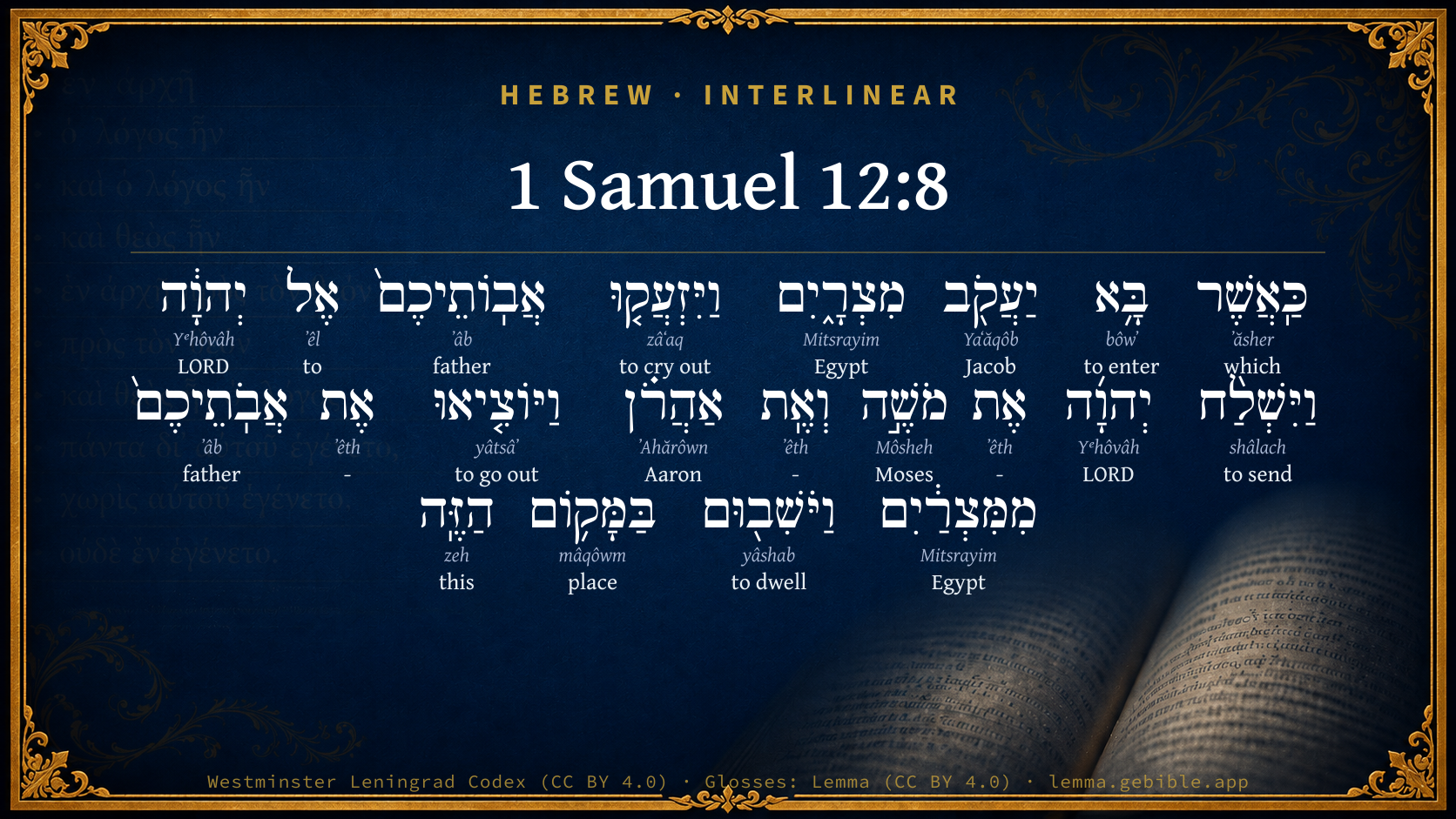
Hebrew (Westminster Leningrad Codex) 1 Samuel 12:8 appears in the Hebrew Old Testament. The text above is from the Westminster Leningrad Codex. Each word links to its Strong’s number, a concise gloss, and parsing drawn from the Open Scriptures Hebrew Bible morphology. Click any word for its full Brown-Driver-Briggs (BDB) entry.
Download image
Cite this verse

1 Samuel 12:8 (World English Bible). Public Domain. Lemma interlinear Bible study tool, https://lemma.gebible.app/v/1-samuel/12/8.

Show BibTeX & RIS
BibTeX
RIS
English Translation
When Jacob was come into Egypt, and your fathers cried to Yahweh, then Yahweh sent Moses and Aaron, who brought forth your fathers out of Egypt, and made them to dwell in this place.
World English Bible · Public Domain
Download a study sheet

One document with this verse’s original text, its word-by-word gloss line, the meaning frame, cross-references with their text, attributed commentary, and full source and license credits — printable, and it pastes into notes with its structure intact.

This verse Autodidact and up

Study sheet (.html) Plain text (.txt)

A passage Seminary Student

Up to 50 verses in one chapter. A passage sheet keeps up to 6 commentary sources and 12 cross-references per verse, in the order this page ranks them, and says so on the sheet whenever that leaves anything out. Ask for a single verse and you get the Autodidact verse sheet above.

Everything on this page stays free to read, with no account — the sheet is a download of what is already on screen, not access to it.

Want to remove ads? Support Godless Engineer
Compare translations 3

The same verse in 3 English versions, stacked beneath the original-language interlinear above. Click any original word for its lexicon entry.

Each is an independent rendering of the whole verse — the interlinear is not word-aligned to these translations.

Highlighted words mark where these versions differ — a whole-verse word diff, not a word-by-word alignment.

  • World English Bible Public Domain
    When Jacob was come into Egypt, and your fathers cried to Yahweh, then Yahweh sent Moses and Aaron, who brought forth your fathers out of Egypt, and made them to dwell in this place.
  • King James Version Public Domain
    When Jacob was come into Egypt, and your fathers cried unto the LORD, then the LORD sent Moses and Aaron, which brought forth your fathers out of Egypt, and made them dwell in this place.
  • unfoldingWord Literal Text CC BY-SA 4.0
    When Jacob had entered Egypt and your fathers cried out to Yahweh, then Yahweh sent Moses and Aaron, and they brought out your fathers from Egypt and they made them dwell in this place.

unfoldingWord Literal Text — © unfoldingWord, licensed CC BY-SA 4.0. Word-aligned USFM3 via Door43 (git.door43.org/unfoldingWord/en_ult).

Versions to compare (up to 4)

3 of 4 selected

Show all 18 translations

Every available English version of this verse, each an independent rendering of the whole verse.

  • World English Bible Public Domain
    When Jacob was come into Egypt, and your fathers cried to Yahweh, then Yahweh sent Moses and Aaron, who brought forth your fathers out of Egypt, and made them to dwell in this place.
  • Berean Standard Bible Public Domain
    When Jacob went to Egypt, your fathers cried out to the LORD, and He sent them Moses and Aaron, who brought your fathers out of Egypt and settled them in this place.
  • Majority Standard Bible Public Domain
    When Jacob went to Egypt, your fathers cried out to the LORD, and He sent them Moses and Aaron, who brought your fathers out of Egypt and settled them in this place.
  • King James Version Public Domain
    When Jacob was come into Egypt, and your fathers cried unto the LORD, then the LORD sent Moses and Aaron, which brought forth your fathers out of Egypt, and made them dwell in this place.
  • American Standard Version (1901) Public Domain
    When Jacob was come into Egypt, and your fathers cried unto Jehovah, then Jehovah sent Moses and Aaron, who brought forth your fathers out of Egypt, and made them to dwell in this place.
  • Revised Version (1885) Public Domain
    When Jacob was come into Egypt, and your fathers cried unto the LORD, then the LORD sent Moses and Aaron, who brought forth your fathers out of Egypt, and made them to dwell in this place.
  • Geneva Bible (1599) Public Domain
    After that Iaakob was come into Egypt, and your fathers cried vnto the Lord, then the Lord sent Moses and Aaron which brought your fathers out of Egypt, and made them dwell in this place.
  • Douay-Rheims (1899) Public Domain
    How Jacob went into Egypt, and your fathers cried to the Lord: and the Lord sent Moses and Aaron, and brought your fathers out of Egypt: and made them dwell in this place.
  • Young's Literal Translation Public Domain
    `When Jacob hath come in to Egypt, and your fathers cry unto Jehovah, then Jehovah sendeth Moses and Aaron, and they bring out your fathers from Egypt, and cause them to dwell in this place,
  • Literal Standard Version CC BY-SA 4.0
    When Jacob has come to Egypt, and your fathers cry to YHWH, then YHWH sends Moses and Aaron, and they bring out your fathers from Egypt, and cause them to dwell in this place,
  • Unlocked Literal Bible CC BY-SA 4.0
    When Jacob came to Egypt, and your ancestors cried out to Yahweh, then Yahweh sent Moses and Aaron, who led your ancestors out of Egypt and they settled in this place.
  • unfoldingWord Literal Text CC BY-SA 4.0
    When Jacob had entered Egypt and your fathers cried out to Yahweh, then Yahweh sent Moses and Aaron, and they brought out your fathers from Egypt and they made them dwell in this place.
  • Darby Bible Public Domain
    When Jacob had come into Egypt, and your fathers cried to Jehovah, then Jehovah sent Moses and Aaron, and they brought your fathers forth out of Egypt, and made them dwell in this place.
  • World Messianic Bible Public Domain
    “When Jacob had come into Egypt, and your fathers cried to the LORD, then the LORD sent Moses and Aaron, who brought your fathers out of Egypt, and made them to dwell in this place.
  • Webster's Bible Public Domain
    When Jacob had come into Egypt, and your fathers cried to the LORD, then the LORD sent Moses and Aaron, who brought forth your fathers from Egypt, and made them dwell in this place.
  • Free Bible Version CC BY-SA 4.0
    After Jacob had gone to Egypt, your fathers cried out to the Lord for help, and he sent Moses and Aaron to lead your forefathers out of Egypt and settle them here.
  • Bible in Basic English Public Domain
    When Jacob and his sons had come into Egypt, and were crushed by the Egyptians, the prayers of your fathers came up to the Lord, and the Lord sent Moses and Aaron, who took your fathers out of Egypt, and he put them into this place.
  • JPS Tanakh (1917) Public Domain
    When Jacob was come into Egypt, then your fathers cried unto the LORD, and the LORD sent Moses and Aaron, who brought forth your fathers out of Egypt, and they were made to dwell in this place.

Literal Standard Version (2020), Covenant Press — licensed CC BY-SA 4.0. Text via the HelloAO Bible API (eBible.org). Unlocked Literal Bible (unfoldingWord) — licensed CC BY-SA 4.0. Text via the HelloAO Bible API (eBible.org). unfoldingWord Literal Text — © unfoldingWord, licensed CC BY-SA 4.0. Word-aligned USFM3 via Door43 (git.door43.org/unfoldingWord/en_ult). Free Bible Version, Dr. Jonathan Gallagher — licensed CC BY-SA 4.0. Text via the HelloAO Bible API (eBible.org).

Word by word

More ways to search: Search by grammar → Find every occurrence → Compare this word →

Practice this passage: Drill this verse → Learn its vocabulary →

וַיִּזְעֲק֤וּ
zâʻaq
H2199
“and · to cry out”
Conjunction + Verb, Qal, Sequential Imperfect, 3rd Person, Masculine, Plural
Part of Speech
Conjunction + Verb
Stem
Qal
Form
Sequential Imperfect
Person
3rd Person
Gender
Masculine
Number
Plural
Full BDB Definition

Origin: a primitive root

TWOT: 570

to cry, cry out, call, call for help - (Qal) - to call (to one's aid) - to cry, cry out (in need) - (Niphal) to be assembled, be called together, be joined together - (Hiphil) - to call, call out, call together, summon - to make a crying, proclaim - to have a proclamation made - to call out to, call out at
  1. כַּֽאֲשֶׁר ʼăsher H834 “like/as · which” Preposition + Particle, Relative
  2. בָּ֥א bôwʼ H935 “to enter” Verb, Qal, Perfect, 3rd Person, Masculine, Singular
  3. יַעֲקֹ֖ב Yaʻăqôb H3290 “Jacob” Noun, Proper
  4. מִצְרָ֑יִם Mitsrayim H4714 “Egypt” Noun, Proper
  5. אֲבֽוֹתֵיכֶם֙ ʼâb H1 “fathers · your” Noun, Common, Masculine, Plural, Construct + Suffix, Personal, 2nd Person, Masculine, Plural
  6. אֶל ʼêl H413 “to” Preposition
  7. יְהוָ֔ה Yᵉhôvâh H3068 “LORD” Noun, Proper
  8. וַיִּשְׁלַ֨ח shâlach H7971 “and · to send” Conjunction + Verb, Qal, Sequential Imperfect, 3rd Person, Masculine, Singular
  9. יְהוָ֜ה Yᵉhôvâh H3068 “LORD” Noun, Proper
  10. אֶת ʼêth H853 “-” Particle, Direct Object
  11. מֹשֶׁ֣ה Môsheh H4872 “Moses” Noun, Proper
  12. וְאֶֽת ʼêth H853 “and · -” Conjunction + Particle, Direct Object
  13. אַהֲרֹ֗ן ʼAhărôwn H175 “Aaron” Noun, Proper
  14. וַיּוֹצִ֤יאוּ yâtsâʼ H3318 “and · to go out” Conjunction + Verb, Hiphil, Sequential Imperfect, 3rd Person, Masculine, Plural
  15. אֶת ʼêth H853 “-” Particle, Direct Object
  16. אֲבֹֽתֵיכֶם֙ ʼâb H1 “fathers · your” Noun, Common, Masculine, Plural, Construct + Suffix, Personal, 2nd Person, Masculine, Plural
  17. מִמִּצְרַ֔יִם Mitsrayim H4714 “from · Egypt” Preposition + Noun, Proper
  18. וַיֹּשִׁב֖וּם yâshab H3427 “and · to dwell · them” Conjunction + Verb, Hiphil, Sequential Imperfect, 3rd Person, Masculine, Plural + Suffix, Personal, 3rd Person, Masculine, Plural
  19. בַּמָּק֥וֹם mâqôwm H4725 “in/at the · place” Preposition, Determined + Noun, Common, Masculine, Singular, Absolute
  20. הַזֶּֽה zeh H2088 “the · this” Particle, Definite Article + Pronoun, Demonstrative, Masculine, Singular

About this verse

These counts appear in no published source. They are computed here, from the morphology-tagged text and Lemma’s own curated glosses. What Lemma adds →

21
words
16
distinct lemmas
Historical
section

Grammatical profile

  • 5 verbs
  • 10 nouns
  • 1 pronoun
  • 1 preposition
  • 4 particles

Verb forms

  • בָּ֥א Qal · Perfect
  • וַיִּזְעֲק֤וּ Qal · Sequential Imperfect
  • וַיִּשְׁלַ֨ח Qal · Sequential Imperfect
  • וַיּוֹצִ֤יאוּ Hiphil · Sequential Imperfect
  • וַיֹּשִׁב֖וּם Hiphil · Sequential Imperfect

Repetition

Words recur within this verse — often emphatic in Hebrew:

  • מִצְרָ֑יִם Egypt H4714 ×2
  • אֲבֽוֹתֵיכֶם֙ father H1 ×2
  • יְהוָ֔ה LORD H3068 ×2

Hebrew & Septuagint length

In English translation the verse runs 34 words from the Hebrew and 43 from the Septuagint (LXX English) — closely comparable.

A rough comparison of the two English renderings, which tokenize alike — not a word-level alignment.

Word counts can differ between the Hebrew and the Greek without any difference in meaning — e.g. the Hebrew direct-object marker אֵת has no separate Greek word, and Greek often adds the article ὁ.

Cross-references

18

Topical passages linked to 1 Samuel 12:8 in the Treasury of Scripture Knowledge — connected by theme and wording, ordered by reader-vote popularity; previews shown in the World English Bible.

  • Exodus 4:14–16 The anger of Yahweh was kindled against Moses, and he said, "What about Aaron, your brother, the Levite? I know that he can speak well. Also, behold, he comes forth to meet you. When he sees you, he will be glad in his heart.
  • Exodus 2:23–24 It happened in the course of those many days, that the king of Egypt died, and the children of Israel sighed because of the bondage, and they cried, and their cry came up to God because of the bondage.
  • Genesis 46:5–7 Jacob rose up from Beersheba, and the sons of Israel carried Jacob, their father, their little ones, and their wives, in the wagons which Pharaoh had sent to carry him.
  • Exodus 3:9–10 Now, behold, the cry of the children of Israel has come to me. Moreover I have seen the oppression with which the Egyptians oppress them.
  • Exodus 4:27–31 Yahweh said to Aaron, "Go into the wilderness to meet Moses." He went, and met him on God's mountain, and kissed him.
  • Exodus 6:26 These are that Aaron and Moses, to whom Yahweh said, "Bring out the children of Israel from the land of Egypt according to their hosts."
  • Exodus 12:51 It happened the same day, that Yahweh brought the children of Israel out of the land of Egypt by their hosts.
  • Exodus 14:30–31 Thus Yahweh saved Israel that day out of the hand of the Egyptians; and Israel saw the Egyptians dead on the seashore.
  • Numbers 20:15 how our fathers went down into Egypt, and we lived in Egypt a long time; and the Egyptians dealt ill with us, and our fathers:
  • Joshua 1:2–4 Moses my servant is dead; now therefore arise, go over this Jordan, you, and all this people, to the land which I do give to them, even to the children of Israel.
  • Joshua 1:6 Be strong and of good courage; for you shall cause this people to inherit the land which I swore to their fathers to give them.
  • Joshua 3:10–13 Joshua said, Hereby you shall know that the living God is among you, and that he will without fail drive out from before you the Canaanite, and the Hittite, and the Hivite, and the Perizzite, and the Girgashite, and the Amorite, and the Jebusite.
  • 1 Samuel 10:18 and he said to the children of Israel, Thus says Yahweh, the God of Israel, I brought up Israel out of Egypt, and I delivered you out of the hand of the Egyptians, and out of the hand of all the kingdoms that oppressed you:
  • 1 Samuel 12:6 Samuel said to the people, It is Yahweh who appointed Moses and Aaron, and that brought your fathers up out of the land of Egypt.
  • Psalms 44:1–3 We have heard with our ears, God; Our fathers have told us, What work you did in their days, In the days of old.
  • Psalms 78:54–55 He brought them to the border of his sanctuary, To this mountain, which his right hand had taken.
  • Psalms 105:44 He gave them the lands of the nations. They took the labor of the peoples in possession,
  • Acts 7:15 Jacob went down into Egypt, and he died, himself and our fathers,

Cross-references courtesy of OpenBible.info (CC BY 4.0).

Hebrew and Greek witnesses Masoretic Hebrew ↔ Greek Septuagint

The same verse in the two great witnesses to the Old Testament, shown verse-for-verse.

These are two independent witnesses, not word-aligned to each other, and the Septuagint is shown in lemma (dictionary) form.

Hebrew 1 Samuel 12:8 Masoretic · Westminster Leningrad Codex

כַּֽאֲשֶׁר בָּ֥א יַעֲקֹ֖ב מִצְרָ֑יִם וַיִּזְעֲק֤וּ אֲבֽוֹתֵיכֶם֙ אֶל יְהוָ֔ה וַיִּשְׁלַ֨ח יְהוָ֜ה אֶת מֹשֶׁ֣ה וְאֶֽת אַהֲרֹ֗ן וַיּוֹצִ֤יאוּ אֶת אֲבֹֽתֵיכֶם֙ מִמִּצְרַ֔יִם וַיֹּשִׁב֖וּם בַּמָּק֥וֹם הַזֶּֽה

When Jacob was come into Egypt, and your fathers cried to Yahweh, then Yahweh sent Moses and Aaron, who brought forth your fathers out of Egypt, and made them to dwell in this place.

World English Bible · Public Domain

Greek LXX 1 Samuel 12:8 Septuagint · lemma form

ὡς εἰςἔρχομαι ἰακώβ καί ὁ υἱός αὐτός εἰς αἴγυπτος καί ταπεινόω αὐτός αἴγυπτος καί βοάω ὁ πατήρ ἐγώ πρός κύριος καί ἀποστέλλω κύριος ὁ μωυσῆς καί ὁ ἀαρών καί ἐκἄγω ὁ πατήρ ἐγώ ἐκ αἴγυπτος καί καταοἰκίζω αὐτός ἐν ὁ τόπος οὗτος

When Jacob and his sons went into Egypt, and Egypt humbled them, then our fathers cried to the Lord, and the Lord sent Moses and Aaron; and they brought our fathers out of Egypt, and he made them to dwell in this place.

LXX2012 (modern English Septuagint) · Public Domain

On this verse, John Gill's Exposition discusses the Septuagint’s reading. Read the note in Commentary ↓

Hebrew: Westminster Leningrad Codex (CC BY 4.0). Greek: Septuagint (public domain); English from LXX2012 (modern English Septuagint) (Public Domain). How the Septuagint differs from the Hebrew →

Targum (Aramaic paraphrase)

1

The Targum is the ancient Jewish Aramaic paraphrase of the Hebrew Scriptures — an interpretive translation, not the Hebrew text itself. Onkelos (literal) and Pseudo-Jonathan (expansive) render the Torah, and Jonathan the Prophets. Coverage is partial: where no permissively-licensed English translation exists for a verse, only the Aramaic is shown. This is verse-level text, not a word-by-word alignment to the Hebrew.

  1. Targum Jonathan Prophets (Joshua–Malachi)
    כַּד עַל יַעֲקֹב לְמִצְרָיִם וּזְעִיקוּ אֲבָהַתְכוֹן קֳדָם יְיָ וּשְׁלַח יְיָ יַת מֹשֶׁה וְיַת אַהֲרֹן וְאַפִּיקוּ יַת אֲבָהַתְכוֹן מִמִצְרַיִם וְאוֹתִיבִינוּן בְּאַתְרָא הָדֵין:

    (no public-domain English translation for this verse)

    Targum Jonathan — Aramaic: “Mikraot Gedolot” (public domain). English: “Sefaria Community Translation” (CC0 1.0 (public-domain dedication)); “London "Chaldee Paraphrase," 1871” (public domain). Text via Sefaria.

Commentary

Notes on 1 Samuel 12:8 from classic Christian and Jewish commentators (each source and its license shown beneath its notes). The classic Christian expositions comment on the surrounding passage and are grouped to its opening verse, so a note may address several verses; the Jewish commentaries on the Tanakh (Rashi and others) are per-verse, so they appear only where the commentator wrote on this verse.

Lemma curates 59 commentaries, every one of them public domain or Creative Commons licensed, each selected and text-cleaned for this edition rather than reprinted as found. About our sources →

Trapp's Complete Commentary

John Trapp

1Sa 12:8 When Jacob was come into Egypt, and your fathers cried unto the LORD, then the LORD sent Moses and Aaron, which brought forth your fathers out of Egypt, and made them dwell in this place.

Ver. 8. Where Jacob was come into Egypt.] When that "Syrian ready to perish went down into Egypt, and sojourned there with a few, and became there a nation, great, mighty, and populous." {Deu 26:5-9}

John Trapp, A Commentary or Exposition upon All the Books of the Old and New Testament (1647–1656) — public domain. Text from a community e-Sword module.

The Biblical Illustrator

Joseph S. Exell

1Sa_12:8

Which brought forth your fathers out of Egypt.

Gods leading

A child might say to a geographer: You talk about the earth being round! Look on this great crag; look on that deep dell; look on yonder great mountain, and the valley at its feet, and yet you talk about the earth being round. The geographers view is comprehensive; he does not look at the surface of the world in mere detail; he does not deal with inches and feet and yards; he sees a larger world than the child has had time to grasp. And so it is with Gods wonderful dealings with us: there are great rocks and barren deserts, deep, dank, dark pits and defiles, and glens and dells, rugged places that we cannot smooth over at all, and yet when He comes to say to us at the end of the journey, Now, look back; there is the way that I have brought you, we shall be enabled to say, Thou hast gone before us, and made our way straight.

The Biblical Illustrator, edited by Joseph S. Exell (c. 1880s–1900s) — public domain. Text from a community e-Sword module.

Joseph Benson's Commentary

1Sa 12:8. Made them dwell in this place — In this land: in which Moses and Aaron are said to settle them; because they brought them into, and seated them in part of it, that without Jordan; because they were, under God, the principal authors of their entering into the land of Canaan; inasmuch as they brought them out of Egypt, conducted them through the wilderness, and there, by their prayers to God, and counsels to them, preserved them from ruin, and gave command from God for the distribution of the land among them, and encouraged them to enter into it. And, lastly, Moses substituted Joshua in his stead, and commanded him to seat them there, which he did.

Joseph Benson's Commentary on the Old and New Testaments (1811–1818) — public domain. Text from a community e-Sword module.

Adam Clarke's Commentary

Verse 8. The Lord sent Moses and Aaron] He shows them that through all their history God had ever raised them up deliverers, when their necessities required such interference.

Adam Clarke's Commentary on the Bible (1810–1826) — public domain. Text from a community e-Sword/MySword module.

Ellicott's Commentary for English Readers

(8) When Jacob was come into Egypt.—Now, in order, Samuel rehearses the deeds of loving-kindness done for Israel by this Eternal King. And first he mentions the wonders of the Exodus, and how, under that Divine guidance, they were guided through so many dangers safe into the land of Canaan, this place.

A Bible Commentary for English Readers, edited by Charles John Ellicott (1878–1897) — public domain. Text from a community e-Sword module.

The Cambridge Bible for Schools and Colleges

gen. ed. J. J. S. Perowne

8. When Jacob, &c.] The additions of the Sept. seem necessary to complete the sense. It reads, “When Jacob and his sons were come into Egypt, and the Egyptians oppressed them, your fathers cried,” &c. Cp. Exo_2:23-25.

The Cambridge Bible for Schools and Colleges (gen. ed. J. J. S. Perowne; Cambridge University Press, 1878–1918) — public domain. Text from a community e-Sword module.

John Gill's Exposition

When Jacob was come into Egypt,.... With his family to see his son Joseph, and dwelt there; or rather the posterity of Jacob are meant, who settled in Egypt, and continued there many years, and at length were oppressed by the Egyptians, and brought into hard bondage:

and your fathers cried unto the Lord; by reason of their bondage, for help and deliverance:

then the Lord sent Moses and Aaron, which brought forth your fathers out of Egypt; after various messages carried by them from the Lord to Pharaoh king of Egypt, and after many signs and wonders wrought by them, by which the heart of that king was at last brought to consent to their dismission:

and made them dwell in this place; the land of Canaan; they conducted them through the Red sea, guided them through the wilderness, and accompanied them, especially Moses, to the borders of the land of Canaan; for neither of them went into it, but died before the people's entrance there. Joshua, the successor of Moses, of whom Samuel makes no mention, introduced Israel into it, conquered the land for them, and settled them in it; though Moses and Aaron, as they were the instruments of bringing them out of Egypt, were the cause, by conducting them through the wilderness, and by their prayers, counsels, and instructions, of their entrance into and settlement in it: besides, Moses appointed Joshua in his stead, and ordered him to lead the people there, and directed to the division of the land among them, yea, two tribes and an half were settled by him on the other side Jordan; the Septuagint, Vulgate Latin, Syriac, and Arabic versions, read in the singular number, "he made them dwell, that is, the Lord".

John Gill's Exposition of the Whole Bible (1746–1763) — public domain (CC PDM 1.0). Text via the HelloAO Bible API.

Matthew Poole's English Annotations

In this land; in which Moses and Aaron are said to settle them; partly, because they brought them into and seated them in part of it, to wit, that without Jordan; partly, because they were, under God, the principal authors of their entering into the land of Canaan; inasmuch as they brought them out of Egypt, conducted them through the wilderness, and there by their prayers to God, and counsel to them, preserved them from utter ruin, and gave command and direction from God for the distribution of the land among them, and encouraged them to enter into it by promises and assurances of success; and lastly, Moses substituted Joshua in his stead, and commanded him to carry them thither, and seat them there, which also he did.

Matthew Poole's English Annotations on the Holy Bible (1683–1685) — public domain. Text from a community e-Sword/MySword module.

The Pulpit Commentary

Vers. 8-12. (GILGAL.)

Doctrine in history.

This is an important chapter in the history of Israel. In it are set forth certain truths of universal import, which are also illustrated, though less distinctly, in the history of other nations. They are such as follows:

1. THE SOVEREIGNTY OF GOD (ver. 8). "It hath pleased the Lord to make you his people" (ver. 22). Of his own free and gracious will, always founded in perfect wisdom, he raises up a people from the lowest condition, confers upon them special blessings and privileges, and exalts them to the most eminent place among the nations of the earth (Deu_32:8; Act_17:26, Act_17:27) As it was with Israel, so has it been with other peoples. His right so to deal with men cannot be questioned, his power therein is manifested, his undeserved goodness should be acknowledged, and the gifts bestowed employed not for selfish ends, but for his glory and the welfare of mankind.

II THE SINFULNESS OF MEN. "They forgat the Lord their God" (ver. 9). So constantly and universally have men departed from God and goodness as to make it evident that there is in human nature an inherited tendency to sin. "It is that tendency to sinful passions or unlawful propensities which is perceived in man whenever objects of desire are placed before him, and laws laid upon him." As often as God in his great goodness has exalted him to honour, so often has he fallen away from his service; and left to himself, without the continual help of Divine grace, his course is downward. "In times past the Divine nature flourished in men, but at length, being mixed with mortal custom, it fell into ruin; hence an inundation of evils in the race" (Plato. See other testimonies quoted by Bushnell in "Nature and the Supernatural"). "There is nothing in the whole earth that does not prove either the misery of man or the compassion of God; either his powerlessness without, or his power with God" (Pascal).

III THE CERTAINTY OF RETRIBUTION. "He sold them into the hand of Sisera," etc. (ver. 9).

The sword of Heaven is not in haste to smite, Nor yet doth linger, save unto his seeming Who, in desire or fear, doth look for it. (Dante, "Par." 22.).

"Morning by morning doth he bring his judgment to light; he faileth not". (Zep_3:5) "History is a voice forever sounding across the centuries the laws of right and wrong. Opinions alter, manners change, creeds rise and fall, but the moral law is written on the tablets of eternity. For every false word or unrighteous deed, for cruelty and oppression, for lust or vanity, the price has to be paid at last; not always by the chief offenders, but paid by some one. Justice and truth alone endure and live. Injustice and falsehood may be long lived, but doomsday comes at last to them in French revolutions and other terrible woes" (Froude, "Short Studies").

IV THE BENEFICENCE OF SUFFERING. "And they cried unto the Lord, and said, We have sinned," etc. (ver. 10). Underneath what is in itself an evil, and a result of the violation of law, physical or moral, there is ever working a Divine power which makes it the means of convincing men of sin, turning them from it, and improving their character and condition. A state of deepest humiliation often precedes one of highest honour. It is only those who refuse to submit to discipline (Job_36:10) and hardenthemselves in iniquity that sink into hopeless ruin.

V THE EFFICACY OF PRAYER. "And the Lord sent and delivered you," etc. (ver. 11). "Then they cried unto the Lord in their trouble, and he delivered them out of their distresses". (Psa_107:6, Psa_107:13, Psa_107:19, Psa_107:28) As it was with Israel throughout their history, so has it been with others, even those who have had but little knowledge of "the Hearer of prayer.

In even savage bosoms There are longings, yearnings strivings For the good they comprehend not, And the feeble hands and helpless, Groping blindly in the darkness, Touch God"s right hand in that darkness, And are lifted up and strengthened ("The Song of Hiawatha").

VI THE PREVALENCE OF MEDIATION. "Then the Lord sent Moses and Aaron" (ver. 8). "And the Lord sent Jerubbaal, and Bedan, and Jephthah, and Samuel" (ver. 11). He sent help by men specially raised up and appointed, and deliverance came through their labours, conflicts, and sufferings. One people also has been often made the medium of blessing to others. And herein we see a shadowing forth of the work of the great Mediator and Deliverer, and (in an inferior manner) of his people on behalf of the world.

VII THE INCREASE OF RESPONSIBILITY on the part of those who have had the experience of former generations to profit by, and who have received higher privileges than they (vers. 12, 19). "Now all these things were written for our admonition," etc.. (1Co_10:11) "Two things we ought to learn from history: one, that we are not in ourselves superior to our fathers; another, that we are shamefully and monstrously inferior to them if we do not advance beyond them" (Froude). D.

The Pulpit Commentary (1880–1919), ed. H.D.M. Spence-Jones & Joseph S. Exell — public domain. Text from a community e-Sword module.

John Wesley's Explanatory Notes

This place - In this land: in which Moses and Aaron are said to settle them; because they brought them into, and seated them in part of it, that without Jordan; because they were, under God, the principal authors of their entering into the land of Canaan; inasmuch as they brought them out of Egypt, conducted them through the wilderness; and thereby their prayers to God, and counsel to them, preserved them from ruin, and gave command from God for the distribution of the land among them, and encouraged them to enter into it. And lastly, Moses substituted Josh. in his stead, and commanded him to seat them there, which he did.

John Wesley, Explanatory Notes Upon the Whole Bible (1754–1765) — public domain. Text via the GEBible commentary corpus.

unfoldingWord translationNotes

Door43 World Missions Community

into the hand of Sisera ... Philistines ... king of Moab

"into the power of Sisera ... Philistines ... king of Moab"

Jacob ... Moses ... Aaron ... Sisera

These are the names of men. (See: How to Translate Names)

Hazor

This is the name of a place. (See: How to Translate Names)

he sold them

This is an expression for God giving them over to their enemies to be their slaves.

translationWords

Jacob

Egypt

Yahweh

God

Philistines

king

Moab

unfoldingWord translationNotes — © Distant Shores Media and the Door43 World Missions Community, licensed CC BY-SA 4.0. Source: git.door43.org/Door43/en_tn.

Lesson kit

Teaching starters — assembled from the data on this page, not authored interpretation. Every prompt links to the verse data it draws on. Edit before teaching.

1 Samuel, in the Historical, opens this verse with 21 words (16 distinct Hebrew lemmas). Its most distinctive word is zâʻaq (“to cry out”). A historical commentator’s framing appears above. Read the whole chapter for the surrounding context.

Discussion questions

  1. The word zâʻaq carries the sense “to cry out.” How does it shape the verse?
  2. How does Exodus 4:14–16, which shares this passage’s theme, read alongside this verse?
  3. What does the repetition of “Egypt” (2× in this one verse) do in this verse?
  4. These translations render this verse differently; the difference is in the English rendering, not the original. What questions does that raise?
  5. «בָּ֥א» is a Qal Perfect verb. How does that grammatical form shape the action described?
  6. Compare how Trapp's Complete Commentary and The Biblical Illustrator read this verse. Where do they agree or differ?

Things to notice

Reading settings

Reading text

Shown beneath each verse's original-language words.

Old Testament
Old Testament edition

Read the OT as the Masoretic Hebrew (MT) or the Greek Septuagint (LXX).

English shown for the Greek Septuagint (in the Hebrew ↔ Greek comparison).

Comparing translations? Open the Compare panel on any verse page to stack up to four side by side.