Deuteronomy 33:28

Hebrew (Westminster Leningrad Codex) Deuteronomy 33:28 appears in the Hebrew Old Testament. The text above is from the Westminster Leningrad Codex. Each word links to its Strong’s number, a concise gloss, and parsing drawn from the Open Scriptures Hebrew Bible morphology. Click any word for its full Brown-Driver-Briggs (BDB) entry.
Download image
Cite this verse

Deuteronomy 33:28 (World English Bible). Public Domain. Lemma interlinear Bible study tool, https://lemma.gebible.app/v/deuteronomy/33/28.

Show BibTeX & RIS
BibTeX
RIS
English Translation
Israel dwells in safety, The fountain of Jacob alone, In a land of grain and new wine; Yes, his heavens drop down dew.
World English Bible · Public Domain
Download a study sheet

One document with this verse’s original text, its word-by-word gloss line, the meaning frame, cross-references with their text, attributed commentary, and full source and license credits — printable, and it pastes into notes with its structure intact.

This verse Autodidact and up

Study sheet (.html) Plain text (.txt)

A passage Seminary Student

Up to 50 verses in one chapter. A passage sheet keeps up to 6 commentary sources and 12 cross-references per verse, in the order this page ranks them, and says so on the sheet whenever that leaves anything out. Ask for a single verse and you get the Autodidact verse sheet above.

Everything on this page stays free to read, with no account — the sheet is a download of what is already on screen, not access to it.

Want to remove ads? Support Godless Engineer
Compare translations 3

The same verse in 3 English versions, stacked beneath the original-language interlinear above. Click any original word for its lexicon entry.

Each is an independent rendering of the whole verse — the interlinear is not word-aligned to these translations.

Highlighted words mark where these versions differ — a whole-verse word diff, not a word-by-word alignment.

  • World English Bible Public Domain
    Israel dwells in safety, The fountain of Jacob alone, In a land of grain and new wine; Yes, his heavens drop down dew.
  • King James Version Public Domain
    Israel then shall dwell in safety alone: the fountain of Jacob shall be upon a land of corn and wine; also his heavens shall drop down dew.
  • unfoldingWord Literal Text CC BY-SA 4.0
    And Israel dwelt safety secure, the spring of Jacob in a land of grain and new wine. Indeed, let his heavens drop dew.

unfoldingWord Literal Text — © unfoldingWord, licensed CC BY-SA 4.0. Word-aligned USFM3 via Door43 (git.door43.org/unfoldingWord/en_ult).

Versions to compare (up to 4)

3 of 4 selected

Show all 18 translations

Every available English version of this verse, each an independent rendering of the whole verse.

  • World English Bible Public Domain
    Israel dwells in safety, The fountain of Jacob alone, In a land of grain and new wine; Yes, his heavens drop down dew.
  • Berean Standard Bible Public Domain
    So Israel dwells securely; the fountain of Jacob lives untroubled in a land of grain and new wine, where even the heavens drip with dew.
  • Majority Standard Bible Public Domain
    So Israel dwells securely; the fountain of Jacob lives untroubled in a land of grain and new wine, where even the heavens drip with dew.
  • King James Version Public Domain
    Israel then shall dwell in safety alone: the fountain of Jacob shall be upon a land of corn and wine; also his heavens shall drop down dew.
  • American Standard Version (1901) Public Domain
    And Israel dwelleth in safety, The fountain of Jacob alone, In a land of grain and new wine; Yea, his heavens drop down dew.
  • Revised Version (1885) Public Domain
    And Israel dwelleth in safety, The fountain of Jacob alone, In a land of corn and wine; Yea, his heavens drop down dew.
  • Geneva Bible (1599) Public Domain
    Then Israel the fountaine of Iaakob shall dwell alone in safetie in a lande of wheat, and wine: also his heauens shall drop the dewe.
  • Douay-Rheims (1899) Public Domain
    Israel shall dwell in safety, and alone. The eye of Jacob in a land of corn and wine, and the heavens shall be misty with dew.
  • Young's Literal Translation Public Domain
    And Israel doth tabernacle `in' confidence alone; The eye of Jacob `is' unto a land of corn and wine; Also His heavens drop down dew.
  • Literal Standard Version CC BY-SA 4.0
    And Israel dwells [in] confidence alone; The eye of Jacob [is] to a land of grain and wine; Also His heavens drop down dew.
  • Unlocked Literal Bible CC BY-SA 4.0
    Israel dwelt in safety. Jacob's spring was secure in a land of grain and new wine; indeed, let his heavens drop dew on him.
  • unfoldingWord Literal Text CC BY-SA 4.0
    And Israel dwelt safety secure, the spring of Jacob in a land of grain and new wine. Indeed, let his heavens drop dew.
  • Darby Bible Public Domain
    And Israel shall dwell in safety alone, The fountain of Jacob, in a land of corn and new wine; Also his heavens shall drop down dew.
  • World Messianic Bible Public Domain
    Israel dwells in safety, the fountain of Jacob alone, In a land of grain and new wine. Yes, his heavens drop down dew.
  • Webster's Bible Public Domain
    Israel then shall dwell in safety alone; the fountain of Jacob shall be upon a land of corn and wine, also his heavens shall drop down dew.
  • Free Bible Version CC BY-SA 4.0
    As a result Israel lives in peace; Jacob has no trouble in a country of grain and new wine, where the heavens drip with dew.
  • Bible in Basic English Public Domain
    And Israel is living in peace, the fountain of Jacob by himself, in a land of grain and wine, with dew dropping from the heavens.
  • JPS Tanakh (1917) Public Domain
    And Israel dwelleth in safety, the fountain of Jacob alone, in a land of corn and wine; yea, his heavens drop down dew.

Literal Standard Version (2020), Covenant Press — licensed CC BY-SA 4.0. Text via the HelloAO Bible API (eBible.org). Unlocked Literal Bible (unfoldingWord) — licensed CC BY-SA 4.0. Text via the HelloAO Bible API (eBible.org). unfoldingWord Literal Text — © unfoldingWord, licensed CC BY-SA 4.0. Word-aligned USFM3 via Door43 (git.door43.org/unfoldingWord/en_ult). Free Bible Version, Dr. Jonathan Gallagher — licensed CC BY-SA 4.0. Text via the HelloAO Bible API (eBible.org).

Word by word

More ways to search: Search by grammar → Find every occurrence → Compare this word →

Practice this passage: Drill this verse → Learn its vocabulary →

יַֽעַרְפוּ
ʻâraph
H6201
“to drop”
Verb, Qal, Imperfect, 3rd Person, Masculine, Plural
Part of Speech
Verb
Stem
Qal
Form
Imperfect
Person
3rd Person
Gender
Masculine
Number
Plural
Full BDB Definition

Origin: a primitive root

TWOT: 1701

to drop, drip - (Qal) to drop, trickle
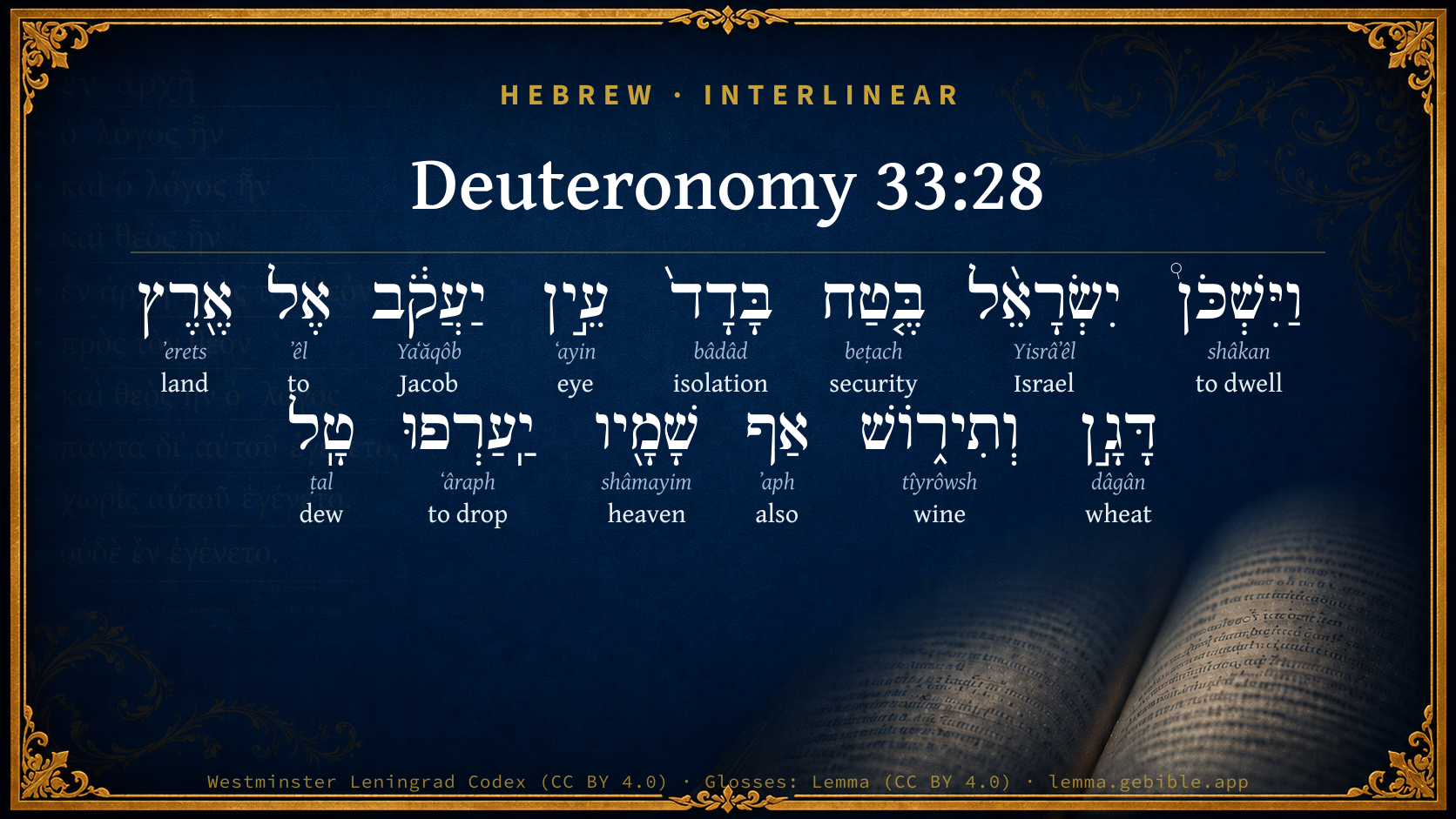
  1. וַיִּשְׁכֹּן֩ shâkan H7931 “and · to dwell” Conjunction + Verb, Qal, Sequential Imperfect, 3rd Person, Masculine, Singular
  2. יִשְׂרָאֵ֨ל Yisrâʼêl H3478 “Israel” Noun, Proper
  3. בֶּ֤טַח beṭach H983 “security” Noun, Common, Masculine, Singular, Absolute
  4. בָּדָד֙ bâdâd H910 “isolation” Noun, Common, Masculine, Singular, Absolute
  5. עֵ֣ין ʻayin H5869 “eye of” Noun, Common, Both, Singular, Construct
  6. יַעֲקֹ֔ב Yaʻăqôb H3290 “Jacob” Noun, Proper
  7. אֶל ʼêl H413 “to” Preposition
  8. אֶ֖רֶץ ʼerets H776 “land of” Noun, Common, Both, Singular, Construct
  9. דָּגָ֣ן dâgân H1715 “wheat” Noun, Common, Masculine, Singular, Absolute
  10. וְתִיר֑וֹשׁ tîyrôwsh H8492 “and · wine” Conjunction + Noun, Common, Masculine, Singular, Absolute
  11. אַף ʼaph H637 “also” Particle, Accusative
  12. שָׁמָ֖יו shâmayim H8064 “heaven(s) · his” Noun, Common, Masculine, Plural, Construct + Suffix, Personal, 3rd Person, Masculine, Singular
  13. טָֽל ṭal H2919 “dew” Noun, Common, Masculine, Singular, Absolute

About this verse

These counts appear in no published source. They are computed here, from the morphology-tagged text and Lemma’s own curated glosses. What Lemma adds →

14
words
14
distinct lemmas
Pentateuch
section

Notable vocabulary

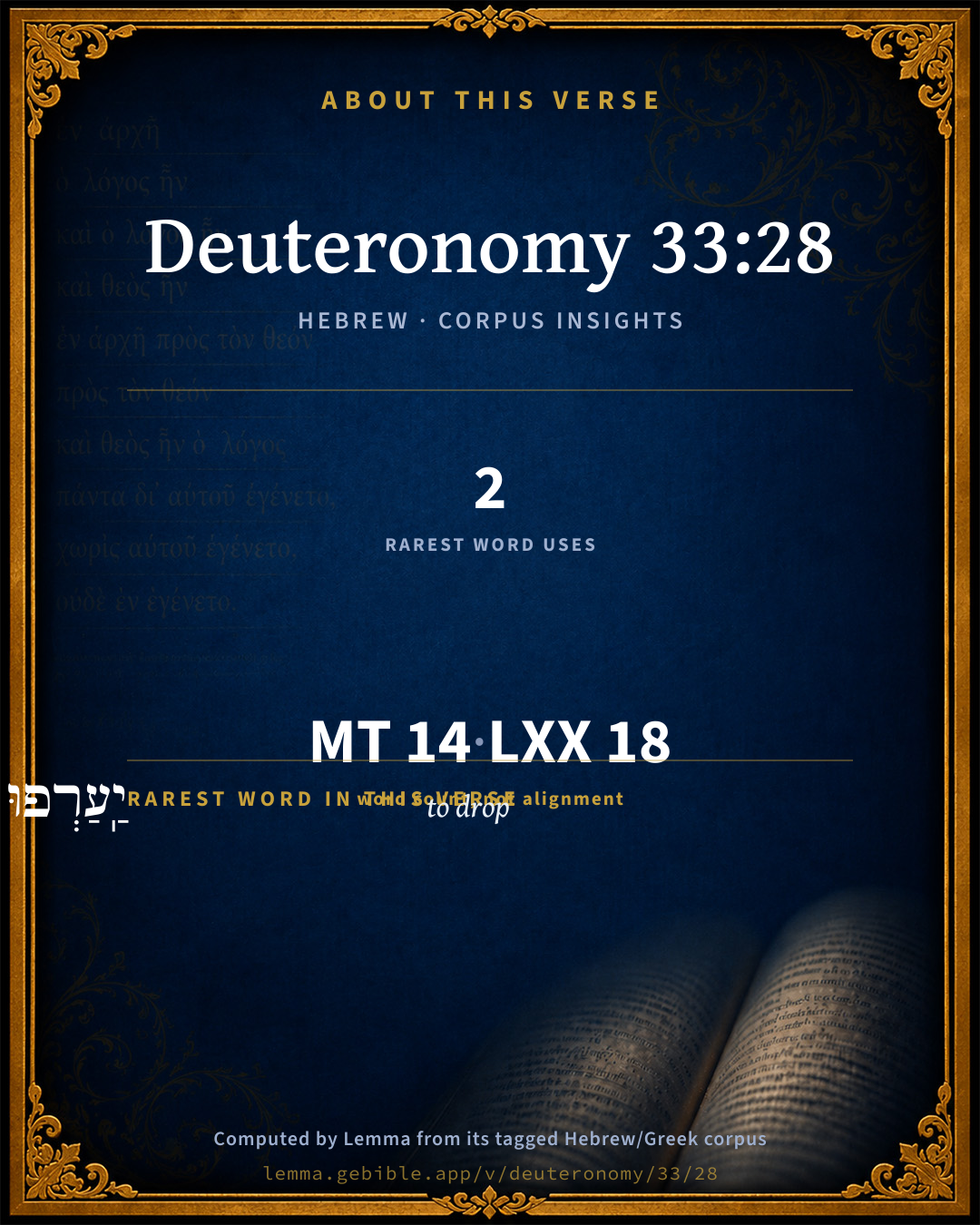
The rarest word here is יַֽעַרְפוּ to drop H6201 — appearing just 2 times in the whole Hebrew Bible.

Shared distinctive vocabulary

יַֽעַרְפוּ to drop H6201 occurs in 2 verses of the Hebrew Bible. Also found in:

Grammatical profile

  • 2 verbs
  • 10 nouns
  • 1 preposition
  • 1 particle

Verb forms

  • וַיִּשְׁכֹּן֩ Qal · Sequential Imperfect
  • יַֽעַרְפוּ Qal · Imperfect

Hebrew & Septuagint length

In English translation the verse runs 23 words from the Hebrew and 26 from the Septuagint (LXX English) — closely comparable.

A rough comparison of the two English renderings, which tokenize alike — not a word-level alignment.

Word counts can differ between the Hebrew and the Greek without any difference in meaning — e.g. the Hebrew direct-object marker אֵת has no separate Greek word, and Greek often adds the article ὁ.

In the original languages it is 14 Hebrew tokens and 18 Greek tokens — but the two are counted differently (Hebrew bundles its prefixes and suffixes into one token; the Greek is in lemma form), so that isn’t a like-for-like length.

Cross-references

15

Topical passages linked to Deuteronomy 33:28 in the Treasury of Scripture Knowledge — connected by theme and wording, ordered by reader-vote popularity; previews shown in the World English Bible.

  • Numbers 23:9 For from the top of the rocks I see him, From the hills I see him: behold, it is a people that dwells alone, And shall not be reckoned among the nations.
  • Genesis 27:28 God give you of the dew of the sky, of the fatness of the earth, and plenty of grain and new wine.
  • Exodus 33:16 For how would people know that I have found favor in your sight, I and your people? Isn't it in that you go with us, so that we are separated, I and your people, from all the people who are on the surface of the earth?"
  • Jeremiah 23:6 In his days Judah shall be saved, and Israel shall dwell safely; and this is his name by which he shall be called: Yahweh our righteousness.
  • Revelation 21:27 There will in no way enter into it anything profane, or one who causes an abomination or a lie, but only those who are written in the Lamb's book of life.
  • Deuteronomy 11:11 but the land, where you go over to possess it, is a land of hills and valleys, [and] drinks water of the rain of the sky,
  • Psalms 68:26 "Bless God in the congregations, Even the Lord in the assembly of Israel!"
  • Jeremiah 33:16 In those days shall Judah be saved, and Jerusalem shall dwell safely; and this is [the name] by which she shall be called: Yahweh our righteousness.
  • Deuteronomy 32:2 My doctrine shall drop as the rain; My speech shall condense as the dew, As the small rain on the tender grass, As the showers on the herb.
  • Deuteronomy 33:13 Of Joseph he said, Blessed of Yahweh be his land, For the precious things of the heavens, for the dew, For the deep that couches beneath,
  • Proverbs 5:15–18 Drink water out of your own cistern, Running water out of your own well.
  • Revelation 22:14–15 Blessed are those who do his commandments, that they may have the right to the tree of life, and may enter in by the gates into the city.
  • Isaiah 48:1 Hear you this, house of Jacob, who are called by the name of Israel, and are come forth out of the waters of Judah; who swear by the name of Yahweh, and make mention of the God of Israel, but not in truth, nor in righteousness
  • Ezekiel 34:25 I will make with them a covenant of peace, and will cause evil animals to cease out of the land; and they shall dwell securely in the wilderness, and sleep in the woods.
  • Deuteronomy 8:7–8 For Yahweh your God brings you into a good land, a land of brooks of water, of springs and springs, flowing forth in valleys and hills;

Cross-references courtesy of OpenBible.info (CC BY 4.0).

Hebrew and Greek witnesses Masoretic Hebrew ↔ Greek Septuagint

The same verse in the two great witnesses to the Old Testament, shown verse-for-verse.

These are two independent witnesses, not word-aligned to each other, and the Septuagint is shown in lemma (dictionary) form.

Hebrew Deuteronomy 33:28 Masoretic · Westminster Leningrad Codex

וַיִּשְׁכֹּן֩ יִשְׂרָאֵ֨ל בֶּ֤טַח בָּדָד֙ עֵ֣ין יַעֲקֹ֔ב אֶל אֶ֖רֶץ דָּגָ֣ן וְתִיר֑וֹשׁ אַף שָׁמָ֖יו יַֽעַרְפוּ טָֽל

Israel dwells in safety, The fountain of Jacob alone, In a land of grain and new wine; Yes, his heavens drop down dew.

World English Bible · Public Domain

Greek LXX Deuteronomy 33:28 Septuagint · lemma form

καί κατασκηνόω ἰσραήλ πείθω μόνος ἐπί γῆ ἰακώβ ἐπί σῖτος καί οἶνος καί ὁ οὐρανός αὐτός συννεφής δρόσος

And Israel shall dwell in confidence alone on the land of Jacob, with corn and wine; and the sky shall be misty with dew upon you.

LXX2012 (modern English Septuagint) · Public Domain

Hebrew: Westminster Leningrad Codex (CC BY 4.0). Greek: Septuagint (public domain); English from LXX2012 (modern English Septuagint) (Public Domain). How the Septuagint differs from the Hebrew →

Targum (Aramaic paraphrase)

2

The Targum is the ancient Jewish Aramaic paraphrase of the Hebrew Scriptures — an interpretive translation, not the Hebrew text itself. Onkelos (literal) and Pseudo-Jonathan (expansive) render the Torah, and Jonathan the Prophets. Coverage is partial: where no permissively-licensed English translation exists for a verse, only the Aramaic is shown. This is verse-level text, not a word-by-word alignment to the Hebrew.

  1. Targum Onkelos Torah (Genesis–Deuteronomy)
    וּשְׁרָא יִשְׂרָאֵל לְרָחְצָן בִּלְחוֹדוֹהִי כְּעֵין בִּרְכְּתָא דְבָרֵכִנוּן יַעֲקֹב אֲבוּהוֹן לְאַרְעָא עָבְדָא עִבוּר וַחֲמָר אַף שְׁמַיָא דְעִלָוֵיהוֹן יְשַׁ מְשֻׁנוּן בְּטַלָא

    (no public-domain English translation for this verse)

    Targum Onkelos — Aramaic: “Onkelos Genesis” (public domain); “Onkelos Exodus” (public domain); “Onkelos Leviticus” (public domain); “Onkelos Numbers” (public domain); “Onkelos Deuteronomy” (public domain). English: “Sefaria Community Translation” (CC0 1.0 (public-domain dedication)); “J.W. Etheridge. The Targums of Onkelos and Jonathan Ben Uzziel on the Pentateuch. London: Longmans, Green, 1862” (public domain). Text via Sefaria.

  2. Targum Pseudo-Jonathan Torah (Genesis–Deuteronomy)
    וּשְׁרוֹן יִשְרָאֵל לְרוֹחֲצָן מִן לְקַדְמִין כְּעֵין בִּרְכָתָא דְבָרְכִינוּן יַעֲקב אֲבוּהוֹן דְבִזְכוּתֵיהּ אַחֲסִין יַתְהוֹן אַרְעָא טַבְתָּא דְעַבְדָא עִבּוּר וַחֲמַר לְחוֹד שְׁמַיָא דְעִלַוֵיהוֹן דְסַיַין לְהוֹן טַלִין דְבִרְכָתָא וּמִטְרִין דְרַעֲוָא

    And Israel shall dwell safely as of old according to the benediction with which Jakob their father did bless them, for whose righteousness sake He will cause them to inherit the good land that yieldeth corn and wine; the heavens also above them will drop with the dews of blessing, and the rains of lovingkindness.

    Targum Pseudo-Jonathan — Aramaic: “Targum Jonathan on Genesis” (public domain); “Targum Jonathan on Exodus” (public domain); “Targum Jonathan on Leviticus” (public domain); “Targum Jonathan on Numbers” (public domain); “Targum Jonathan on Deuteronomy” (public domain). English: “The Targum of Jonathan ben Uzziel, trans. J. W. Etheridge, London, 1862” (public domain). Text via Sefaria.

Commentary

Notes on Deuteronomy 33:28 from classic Christian and Jewish commentators (each source and its license shown beneath its notes). The classic Christian expositions comment on the surrounding passage and are grouped to its opening verse, so a note may address several verses; the Jewish commentaries on the Tanakh (Rashi and others) are per-verse, so they appear only where the commentator wrote on this verse.

Lemma curates 59 commentaries, every one of them public domain or Creative Commons licensed, each selected and text-cleaned for this edition rather than reprinted as found. About our sources →

Trapp's Complete Commentary

John Trapp

Deu 33:28 Israel then shall dwell in safety alone: the fountain of Jacob [shall be] upon a land of corn and wine; also his heavens shall drop down dew.

Ver. 28. Israel then shall dwell, &c.] {See Trapp on "Num 23:9"}

The fountain of Jacob.] Or as some read it, The eye of Jacob. The same word signifies both an eye and a fountain. He that, with Mary Magdalen, can make his eye a fountain to wash Christ’s feet in, shall be sure to have that fountain of Christ’s blood opened to wash his soul in. {Zec 13:1}

John Trapp, A Commentary or Exposition upon All the Books of the Old and New Testament (1647–1656) — public domain. Text from a community e-Sword module.

Joseph Benson's Commentary

Deu 33:28. Israel shall dwell in safety alone — Either, 1st, In safety, although they be alone, and have no confederates to defend them, but have all the world against them, yet my single protection shall be sufficient for them. Or, 2d, Distinct and separated from all other nations, with whom I will not have them to mingle themselves. The fountain — That is, the posterity of Jacob, which flowed from him as waters from a copious fountain, in great abundance. So the expression is used Psa 68:26. The fountain is here put for the river, or streams which flow from it, as Jacob, or Israel, who is the fountain, is often put for the children of Israel. The Hebrew word, however, which we render fountain, often signifies an eye, and the sense here may be, The eye of Jacob shall look upon a land of corn, &c. Also his heavens shall drop down dew — That is, those heavens, or that air which hangs over his land, shall water it with refreshing dews, and render it fruitful in corn, wine, and other products of a most fertile country. Thus Moses confirms to Jacob’s seed the blessing which Isaac gave to Jacob himself, Gen 27:28.

Joseph Benson's Commentary on the Old and New Testaments (1811–1818) — public domain. Text from a community e-Sword module.

Geneva Bible (1599)

Geneva Bible translators

Who was plentiful in issue as a fountain.

Geneva Bible (1599) marginal notes — public domain. Text via Bolls.life.

Jamieson, Fausset & Brown

Robert Jamieson, A. R. Fausset & David Brown

the fountain of Jacob--The posterity of Israel shall dwell in a blessed and favored land.

Next: Deuteronomy Chapter 34

Jamieson, Fausset & Brown — Commentary Critical and Explanatory on the Whole Bible (1871) — public domain (CC PDM 1.0). Text via the HelloAO Bible API.

Adam Clarke's Commentary

Verse 28. Israel then shall dwell - alone] This people shall not be incorporated with any other people under heaven. A prophecy which continues to be fulfilled to the very letter. Every attempt to unite them with any other people has proved absolutely ineffectual.

The fountain of Jacob] His offspring, shall possess a most fertile land; such was Palestine.

Adam Clarke's Commentary on the Bible (1810–1826) — public domain. Text from a community e-Sword/MySword module.

Ellicott's Commentary for English Readers

(28) Israel then shall dwell in safety—i.e., in confidence and security. “In His days (the days of Messiah) Judah shall be saved, and Israel shall dwell safely” (Jer_23:6), but not until they learn to rest upon “the everlasting arms.”

A Bible Commentary for English Readers, edited by Charles John Ellicott (1878–1897) — public domain. Text from a community e-Sword module.

The Cambridge Bible for Schools and Colleges

gen. ed. J. J. S. Perowne

28. fountain … alone] For fountain, ‘ain, some propose ‘am, people. But the figure is emphatic and natural after the previous line: Israel’s life shall flow unmixed, untainted with that of the expelled peoples.

The Cambridge Bible for Schools and Colleges (gen. ed. J. J. S. Perowne; Cambridge University Press, 1878–1918) — public domain. Text from a community e-Sword module.

John Gill's Exposition

Happy art thou, O Israel,.... This is the conclusion of the blessing on Israel summed up in a few words; they having God to be their God, and having so many good things promised them, and in sight of them; being now got through, the wilderness, and on the borders of the land of Canaan; as all such must be happy, whose covenant God is the Lord; since they must be beloved of him, chosen by him, and blessed with all spiritual blessings; and in the faith, hope, and view of eternal happiness:

who is like unto thee? for an interest in the favour of God, for a share in the blessings of goodness, for a good God, a good land, and good laws; for wisdom and knowledge, for riches and honour, for holiness and happiness:

O people saved by the Lord; redeemed by him out of Egypt, preserved in the wilderness, saved from many dangers and enemies, and now brought near to the land of Canaan. The Targum of Jonathan is,"saved or redeemed in the name of the word of the Lord:''by whom the spiritual Israel of God are redeemed from all their sins, from the curses of the law, and out of the hand of all their enemies; and are and will be completely saved in soul and body, with an everlasting salvation:

the shield of thy help; that, is, the Lord, by whom they are saved; he is the shield that protects them; the shield of faith and of salvation, which faith lays hold on and makes use of for its defence, and who is the help of his people in all times of trouble:

and who is the sword of thy excellency; to destroy their enemies, and whereby they would be raised to that excellency and glory they were in the land of Canaan:

and thine enemies shall be found liars unto thee; who threatened what they would do unto them, but were not able: or "shall lie unto thee" (o), be in such dread and fear as to tell lies to save themselves, and pretend to be what they were not, as the Gibeonites did, of whom Jarchi interprets this passage:

and thou shall tread upon their, high places; be possessed of their cities and fortresses, built on an eminence; see Deu 32:13; all the three Targums, and so Jarchi, interpret it of treading on the necks of their kings, which was fulfilled, Jos 10:24.

(o) "mentientur", Montanus, Tigurine version; "mentiuntur", Cocceius.

Next: Deuteronomy Chapter 34

John Gill's Exposition of the Whole Bible (1746–1763) — public domain (CC PDM 1.0). Text via the HelloAO Bible API.

Albert Barnes' Notes on the Bible

The fountain of Jacob shall be upon a land of corn and wine - The King James Version does not preserve the symmetry of the clauses. Render it: “Israel shall dwell in safety; alone shall the fountain of Jacob be” (compare Psa 68:26; Isa 48:1); “in a land,” etc.

Albert Barnes' Notes on the Bible (1834–1885) — public domain. Text from a community e-Sword/MySword module.

Haydock's Catholic Bible Commentary

Alone, without standing in need of the assistance of any other but God. See Numbers xxiii. 9. (Haydock) --- Some of the ancient Germans would have no communication with any other nation; and they depopulated the country around, to keep all at a distance. (Calmet) --- The Chinese seem to be at present nearly of the same disposition, as well as those who inhabit Japan, &c. --- The eye of Jacob. His posterity, by whom he sees the transactions of the world. (Haydock) --- Hebrew the fountain, is taken in the same sense. The country which his descendants enjoyed, was well watered with springs, Numbers xxiv. 7. --- Dew, it will be so abundant. Chaldean, The heavens will drop down dew, chap. xxxii. 2.

George Leo Haydock (1774–1849), Haydock's Catholic Family Bible and Commentary, 1859 edition — public domain. Excludes Psalms (Douay-Rheims chapter numbering differs from Protestant) and Deuterocanonical books (Catholic canon only).

Matthew Poole's English Annotations

Alone; either,

1. Though they be alone, and have no confederates to defend them, but have all the world against them, yet my single protection shall be sufficient for them. Or,

2. Distinct and separated from all other nations, with whom I will not have them to mingle themselves. See Num 23:9; Ezr 9:1,2.

The fountain of Jacob, i.e. the posterity of Jacob, which flowed from him its waters from a fountain, in great abundance. Compare Psa 68:26; Isa 48:1. The fountain is here put for the river or streams which flow from it, as Psa 94:10; as the root is put for the branch, 2Ch 22:10; Isa 11:10; Rev 5:5; and as Jacob or Israel, who is the fountain, is oft put for the children of Israel. Or, the eye (for so the Hebrew word oft signifies)

of Jacob, i.e. of the people of Israel; and so the sense is, They who now only hear of the land of promise shall shortly see it, which I am not suffered to do, and shall enjoy it, which is oft signified by seeing, as Psa 4:6; 27:13; 34:12; Ecc 2:1; 3:13.

His heavens, i.e. those heavens or that air which hangs over his land.

Matthew Poole's English Annotations on the Holy Bible (1683–1685) — public domain. Text from a community e-Sword/MySword module.

Whedon's Commentary on the Bible

Daniel D. Whedon

28. Israel… shall dwell in safety — This verse may be rendered thus:

“And Israel dwells in safety,

The fountain of Jacob apart,

In a land of corn and wine;

Also his heavens drop down dew.”

Alone — Separate from other nations. A peculiar people.

The fountain of Jacob — The patriarch is here referred to as the source from whom all the tribes came. Comp. Psa_68:26.

Daniel D. Whedon (gen. ed.), Commentary on the Old and New Testaments (1874–1909) — public domain. Text from a community e-Sword module.

The Pulpit Commentary

he clauses of this verse are parallel to each other; their symmetry will be seen if we render and arrange thus

And Israel dwelleth securely, Alone, the fountain of Jacob, On a land of corn and new wine; His heavens also drop down dew.

The fountain of Jacob is parallel to Israel. Israel is so designated because they came forth from Jacob as waters from a copious source. (In Ezra; cf. Isa_48:1; Psa_68:26)

The Pulpit Commentary (1880–1919), ed. H.D.M. Spence-Jones & Joseph S. Exell — public domain. Text from a community e-Sword module.

John Wesley's Explanatory Notes

Alone - Either

1. Tho' they be alone, and have no confederates to defend them, but have all the world against them, yet my single protection shall be sufficient for them. Or,

2. Distinct and separated from all other nations, with whom I will not have them mingle themselves. The fountain - That is, the posterity of Jacob, which flowed from him as waters from a fountain, in great abundance. The fountain is here put for the river or streams which flow from it, as Jacob or Israel who is the fountain is often put for the children of Israel. His heavens - That is, those heavens or that air which hangs over his land.

John Wesley, Explanatory Notes Upon the Whole Bible (1754–1765) — public domain. Text via the GEBible commentary corpus.

unfoldingWord translationNotes

Door43 World Missions Community

Israel dwelt ... Jacob's spring was secure

Possible meanings are 1) Moses speaks of the future as if it were the past to emphasize that what he is saying will come true, "Israel will dwell ... Jacob's spring will be secure" or 2) Moses is blessing Israel, "May Israel dwell ... and may Jacob's spring be secure." (See: Predictive Past)

Jacob's spring

Possible meanings are 1) Jacob's home or 2) Jacob's descendants. (See: Metonymy)

let his heavens drop dew

The dew is spoken of as being so much that it is as if it were raining. Possible meanings are 1) Moses is blessing Israel, "may much dew cover the land like rain" or 2) Moses is telling what will happen in the future, "much dew will cover the land like rain." (See: Metaphor)

dew

water that forms on leaves and grass on cool mornings. See how you translated this in Deuteronomy 32:2.

translationWords

Jacob

fountain

grain

wine

heaven

unfoldingWord translationNotes — © Distant Shores Media and the Door43 World Missions Community, licensed CC BY-SA 4.0. Source: git.door43.org/Door43/en_tn.

Rashi

Rabbi Shlomo Yitzchaki (Rashi)

בטח בדד [THEREFORE ISRAEL DWELT] IN SAFETY, ALONE — This means, every individual dwelling “each under his vine and under his fig-treeבטח) ״; cf. 1 Kings 5:5 where the words Rashi quotes are preceded by לבטח), separated one from another (בדד, “alone”), because after the enemy was driven out, as stated in the preceding verse, they had no need to come together and to dwell in company on account of the enemy.

עין יעקב — The word עין has the same meaning here as in (Numbers 11:7) “And its appearance (עינו) was as the appearance (עין) of crystal” (i.e., the word עין is used as a term of comparison, “as”, ”like”). The meaning is: And Israel dwelt alone like the blessing with which Jacob blessed them (cf. Targum); not like the בדד which Jeremiah used, (Jeremiah 15:17), viz., “I sat alone (בדד) [because of thy hand, for thou hast filled me with Thy indignation]”, but like the assurance which Jacob gave them, (Genesis 48:20) “And God shall be with you, and bring you back to the land of your fathers” (cf. Sifrei Devarim 356:6).

יערפו means THEY WILL DRIP.

אף שמיו יערפו טל ALSO HIS HEAVENS SHALL DRIP DEW — Also Isaac’s blessing will be added to Jacob’s blessing: “And God shall give thee of the dew of heaven, etc.” (Genesis 27:28) (cf. Sifrei Devarim 356:7).

Rashi on the Tanakh — English translations: “The Judaica Press complete Tanach with Rashi, translated by A. J. Rosenberg” (CC BY 4.0); “Pentateuch with Rashi's commentary by M. Rosenbaum and A.M. Silbermann, 1929-1934” (public domain); “The Metsudah Tanach series, Lakewood, N.J” (CC BY 4.0); and “The Book of Joshua, Metsudah Publications, 1997” (CC BY 4.0). Text via Sefaria.

Lesson kit

Teaching starters — assembled from the data on this page, not authored interpretation. Every prompt links to the verse data it draws on. Edit before teaching.

Deuteronomy, in the Pentateuch, opens this verse with 14 words (14 distinct Hebrew lemmas). Its most distinctive word is ʻâraph (“to drop”). A historical commentator’s framing appears above. Read the whole chapter for the surrounding context.

Discussion questions

  1. How does “to drop” (ʻâraph) shape what this verse is saying?
  2. How does Deuteronomy 32:2, which shares the word «to drop», read alongside this verse?
  3. These translations render this verse differently. What is at stake in choosing one wording over another?
  4. «וַיִּשְׁכֹּן֩» is a Qal Sequential Imperfect verb. How does that grammatical form shape the action described?
  5. Compare how Trapp's Complete Commentary and Joseph Benson's Commentary read this verse. Where do they agree or differ?

Things to notice

Reading settings

Reading text

Shown beneath each verse's original-language words.

Old Testament
Old Testament edition

Read the OT as the Masoretic Hebrew (MT) or the Greek Septuagint (LXX).

English shown for the Greek Septuagint (in the Hebrew ↔ Greek comparison).

Comparing translations? Open the Compare panel on any verse page to stack up to four side by side.