
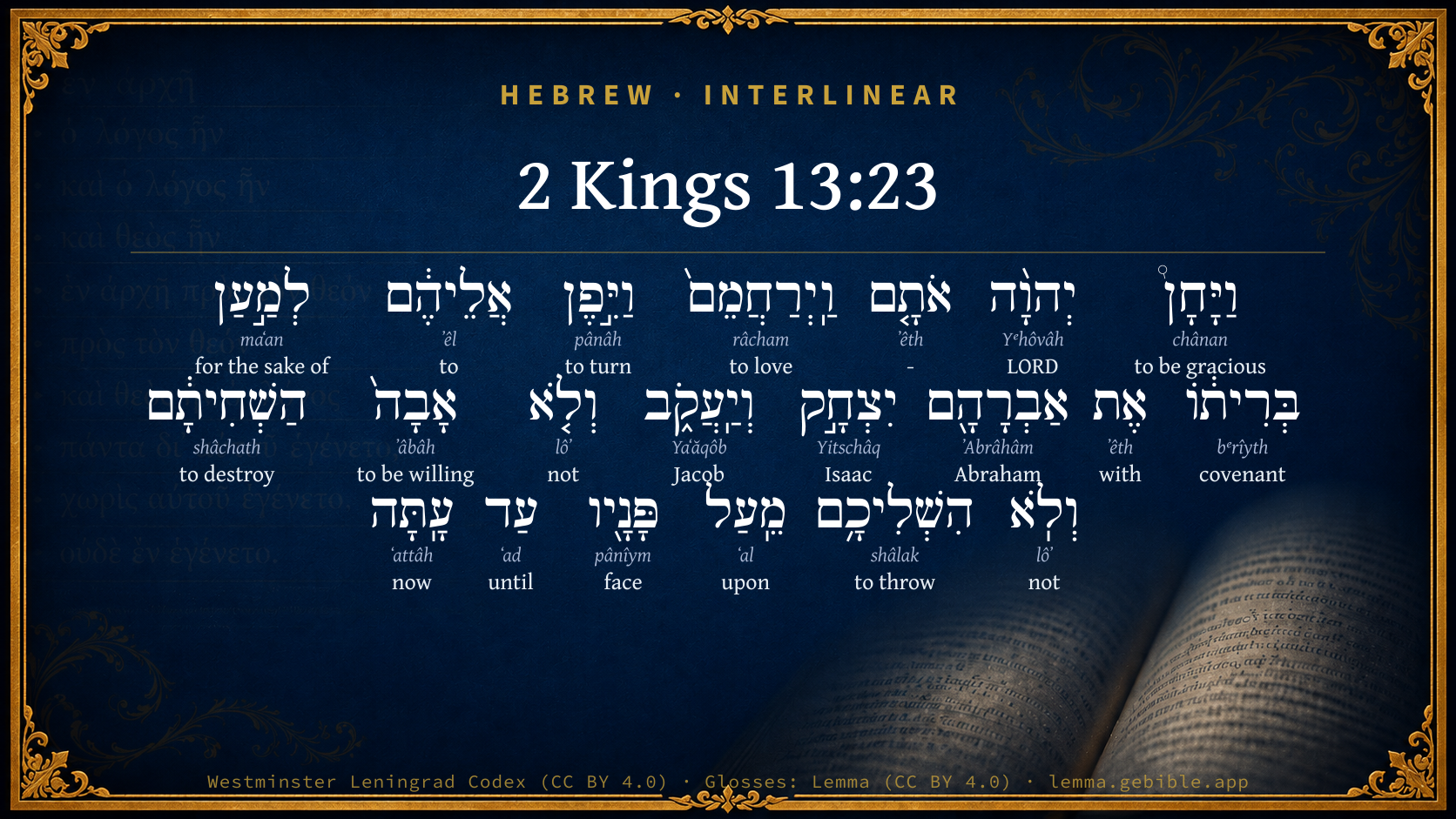
2 Kings 13:23

Hebrew (Westminster Leningrad Codex) 2 Kings 13:23 appears in the Hebrew Old Testament. The text above is from the Westminster Leningrad Codex. Each word links to its Strong’s number, a concise gloss, and parsing drawn from the Open Scriptures Hebrew Bible morphology. Click any word for its full Brown-Driver-Briggs (BDB) entry.
Download image
Cite this verse

2 Kings 13:23 (World English Bible). Public Domain. Lemma interlinear Bible study tool, https://lemma.gebible.app/v/2-kings/13/23.

Show BibTeX & RIS
BibTeX
RIS
English Translation
But Yahweh was gracious to them, and had compassion on them, and had respect to them, because of his covenant with Abraham, Isaac, and Jacob, and would not destroy them, neither cast he them from his presence as yet.
World English Bible · Public Domain
Download a study sheet

One document with this verse’s original text, its word-by-word gloss line, the meaning frame, cross-references with their text, attributed commentary, and full source and license credits — printable, and it pastes into notes with its structure intact.

This verse Autodidact and up

Study sheet (.html) Plain text (.txt)

A passage Seminary Student

Up to 50 verses in one chapter. A passage sheet keeps up to 6 commentary sources and 12 cross-references per verse, in the order this page ranks them, and says so on the sheet whenever that leaves anything out. Ask for a single verse and you get the Autodidact verse sheet above.

Everything on this page stays free to read, with no account — the sheet is a download of what is already on screen, not access to it.

Want to remove ads? Support Godless Engineer
Compare translations 3

The same verse in 3 English versions, stacked beneath the original-language interlinear above. Click any original word for its lexicon entry.

Each is an independent rendering of the whole verse — the interlinear is not word-aligned to these translations.

Highlighted words mark where these versions differ — a whole-verse word diff, not a word-by-word alignment.

  • World English Bible Public Domain
    But Yahweh was gracious to them, and had compassion on them, and had respect to them, because of his covenant with Abraham, Isaac, and Jacob, and would not destroy them, neither cast he them from his presence as yet.
  • King James Version Public Domain
    And the LORD was gracious unto them, and had compassion on them, and had respect unto them, because of his covenant with Abraham, Isaac, and Jacob, and would not destroy them, neither cast he them from his presence as yet.
  • unfoldingWord Literal Text CC BY-SA 4.0
    But Yahweh was gracious to them and had compassion on them, and he turned to them because of his covenant with Abraham, Isaac, and Jacob. And he was not willing to destroy them, and he has not cast them away from his face until now.

unfoldingWord Literal Text — © unfoldingWord, licensed CC BY-SA 4.0. Word-aligned USFM3 via Door43 (git.door43.org/unfoldingWord/en_ult).

Versions to compare (up to 4)

3 of 4 selected

Show all 18 translations

Every available English version of this verse, each an independent rendering of the whole verse.

  • World English Bible Public Domain
    But Yahweh was gracious to them, and had compassion on them, and had respect to them, because of his covenant with Abraham, Isaac, and Jacob, and would not destroy them, neither cast he them from his presence as yet.
  • Berean Standard Bible Public Domain
    But the LORD was gracious to Israel and had compassion on them, and He turned toward them because of His covenant with Abraham, Isaac, and Jacob. And to this day, the LORD has been unwilling to destroy them or cast them from His presence.
  • Majority Standard Bible Public Domain
    But the LORD was gracious to Israel and had compassion on them, and He turned toward them because of His covenant with Abraham, Isaac, and Jacob. And to this day, the LORD has been unwilling to destroy them or cast them from His presence.
  • King James Version Public Domain
    And the LORD was gracious unto them, and had compassion on them, and had respect unto them, because of his covenant with Abraham, Isaac, and Jacob, and would not destroy them, neither cast he them from his presence as yet.
  • American Standard Version (1901) Public Domain
    But Jehovah was gracious unto them, and had compassion on them, and had respect unto them, because of his covenant with Abraham, Isaac, and Jacob, and would not destroy them, neither cast he them from his presence as yet.
  • Revised Version (1885) Public Domain
    But the LORD was gracious unto them, and had compassion on them, and had respect unto them, because of his covenant with Abraham, Isaac, and Jacob, and would not destroy them, neither cast he them from his presence as yet.
  • Geneva Bible (1599) Public Domain
    Therefore the Lord had mercy on them and pitied them, and had respect vnto them because of his couenant with Abraham, Izhak, and Iaakob, and would not destroy them, neither cast he them from him as yet.
  • Douay-Rheims (1899) Public Domain
    And the Lord had mercy on them, and returned to them because of his covenant, which he had made with Abraham and Isaac and Jacob: and he would not destroy them, nor utterly cast them away, unto this present time.
  • Young's Literal Translation Public Domain
    and Jehovah doth favour them, and pity them, and turn unto them, for the sake of His covenant with Abraham, Isaac, and Jacob, and hath not been willing to destroy them, nor to cast them from His presence as yet.
  • Literal Standard Version CC BY-SA 4.0
    and YHWH favors them, and pities them, and turns to them for the sake of His covenant with Abraham, Isaac, and Jacob, and has not been willing to destroy them, nor to cast them from His presence as yet.
  • Unlocked Literal Bible CC BY-SA 4.0
    But Yahweh was gracious to Israel, and had compassion on them and concern for them, because of his covenant with Abraham, Isaac, and Jacob. So Yahweh did not destroy them, and he still has not driven them away from his presence.
  • unfoldingWord Literal Text CC BY-SA 4.0
    But Yahweh was gracious to them and had compassion on them, and he turned to them because of his covenant with Abraham, Isaac, and Jacob. And he was not willing to destroy them, and he has not cast them away from his face until now.
  • Darby Bible Public Domain
    And Jehovah was gracious to them, and had compassion on them, and had respect to them, because of his covenant with Abraham, Isaac, and Jacob; and he would not destroy them, neither did he cast them from his presence up to that time.
  • World Messianic Bible Public Domain
    But the LORD was gracious to them, and had compassion on them, and favored them because of his covenant with Abraham, Isaac, and Jacob, and would not destroy them and he didn’t cast them from his presence as yet.
  • Webster's Bible Public Domain
    And the LORD was gracious to them, and had compassion on them, and had respect to them, because of his covenant with Abraham, Isaac, and Jacob, and would not destroy them, neither did he as yet reject them from his presence.
  • Free Bible Version CC BY-SA 4.0
    But the Lord graciously helped them and was kind to them. He looked after them because of his agreement with Abraham, Isaac, and Jacob. Even to this day he's been unwilling to destroy them or to throw them out of his presence.
  • Bible in Basic English Public Domain
    But the Lord was kind to them and had pity on them, caring for them, because of his agreement with Abraham, Isaac, and Jacob; he would not put them to destruction or send them away from before his face till now.
  • JPS Tanakh (1917) Public Domain
    But the LORD was gracious unto them, and had compassion on them, and had respect unto them, because of His covenant with Abraham, Isaac, and Jacob, and would not destroy them, neither hath He cast them from His presence until now.

Literal Standard Version (2020), Covenant Press — licensed CC BY-SA 4.0. Text via the HelloAO Bible API (eBible.org). Unlocked Literal Bible (unfoldingWord) — licensed CC BY-SA 4.0. Text via the HelloAO Bible API (eBible.org). unfoldingWord Literal Text — © unfoldingWord, licensed CC BY-SA 4.0. Word-aligned USFM3 via Door43 (git.door43.org/unfoldingWord/en_ult). Free Bible Version, Dr. Jonathan Gallagher — licensed CC BY-SA 4.0. Text via the HelloAO Bible API (eBible.org).

Word by word

More ways to search: Search by grammar → Find every occurrence → Compare this word →

Practice this passage: Drill this verse → Learn its vocabulary →

וַֽיְרַחֲמֵם֙
râcham
H7355
“and · to love · them”
Conjunction + Verb, Piel, Sequential Imperfect, 3rd Person, Masculine, Singular + Suffix, Personal, 3rd Person, Masculine, Plural
Part of Speech
Conjunction + Verb
Stem
Piel
Form
Sequential Imperfect
Person
3rd Person
Gender
Masculine
Number
Singular
Full BDB Definition

Origin: a primitive root

TWOT: 2146

to love, love deeply, have mercy, be compassionate, have tender affection, have compassion - (Qal) to love - (Piel) - to have compassion, be compassionate - of God, man - (Pual) to be shown compassion, be compassionate
  1. וַיָּחָן֩ chânan H2603 “and · to be gracious” Conjunction + Verb, Qal, Sequential Imperfect, 3rd Person, Masculine, Singular
  2. יְהוָ֨ה Yᵉhôvâh H3068 “LORD” Noun, Proper
  3. אֹתָ֤ם ʼêth H853 “- · them” Particle, Direct Object + Suffix, Personal, 3rd Person, Masculine, Plural
  4. וַיִּ֣פֶן pânâh H6437 “and · to turn” Conjunction + Verb, Qal, Sequential Imperfect, 3rd Person, Masculine, Singular
  5. אֲלֵיהֶ֔ם ʼêl H413 “to · them” Preposition + Suffix, Personal, 3rd Person, Masculine, Plural
  6. לְמַ֣עַן maʻan H4616 “for the sake of” Preposition
  7. בְּרִית֔וֹ bᵉrîyth H1285 “covenant · his” Noun, Common, Feminine, Singular, Construct + Suffix, Personal, 3rd Person, Masculine, Singular
  8. אֶת ʼêth H854 “with” Preposition
  9. אַבְרָהָ֖ם ʼAbrâhâm H85 “Abraham” Noun, Proper
  10. יִצְחָ֣ק Yitschâq H3327 “Isaac” Noun, Proper
  11. וְיַֽעֲקֹ֑ב Yaʻăqôb H3290 “and · Jacob” Conjunction + Noun, Proper
  12. וְלֹ֤א lôʼ H3808 “and · not” Conjunction + Particle, Negative
  13. אָבָה֙ ʼâbâh H14 “to be willing” Verb, Qal, Perfect, 3rd Person, Masculine, Singular
  14. הַשְׁחִיתָ֔ם shâchath H7843 “to destroy · them” Verb, Hiphil, Infinitive Construct + Suffix, Personal, 3rd Person, Masculine, Plural
  15. וְלֹֽא lôʼ H3808 “and · not” Conjunction + Particle, Negative
  16. הִשְׁלִיכָ֥ם shâlak H7993 “to throw · them” Verb, Hiphil, Perfect, 3rd Person, Masculine, Singular + Suffix, Personal, 3rd Person, Masculine, Plural
  17. מֵֽעַל ʻal H5921 “from · upon” Preposition + Preposition
  18. פָּנָ֖יו pânîym H6440 “face(s) · his” Noun, Common, Both, Plural, Construct + Suffix, Personal, 3rd Person, Masculine, Singular
  19. עַד ʻad H5704 “until” Preposition
  20. עָֽתָּה ʻattâh H6258 “now” Adverb

About this verse

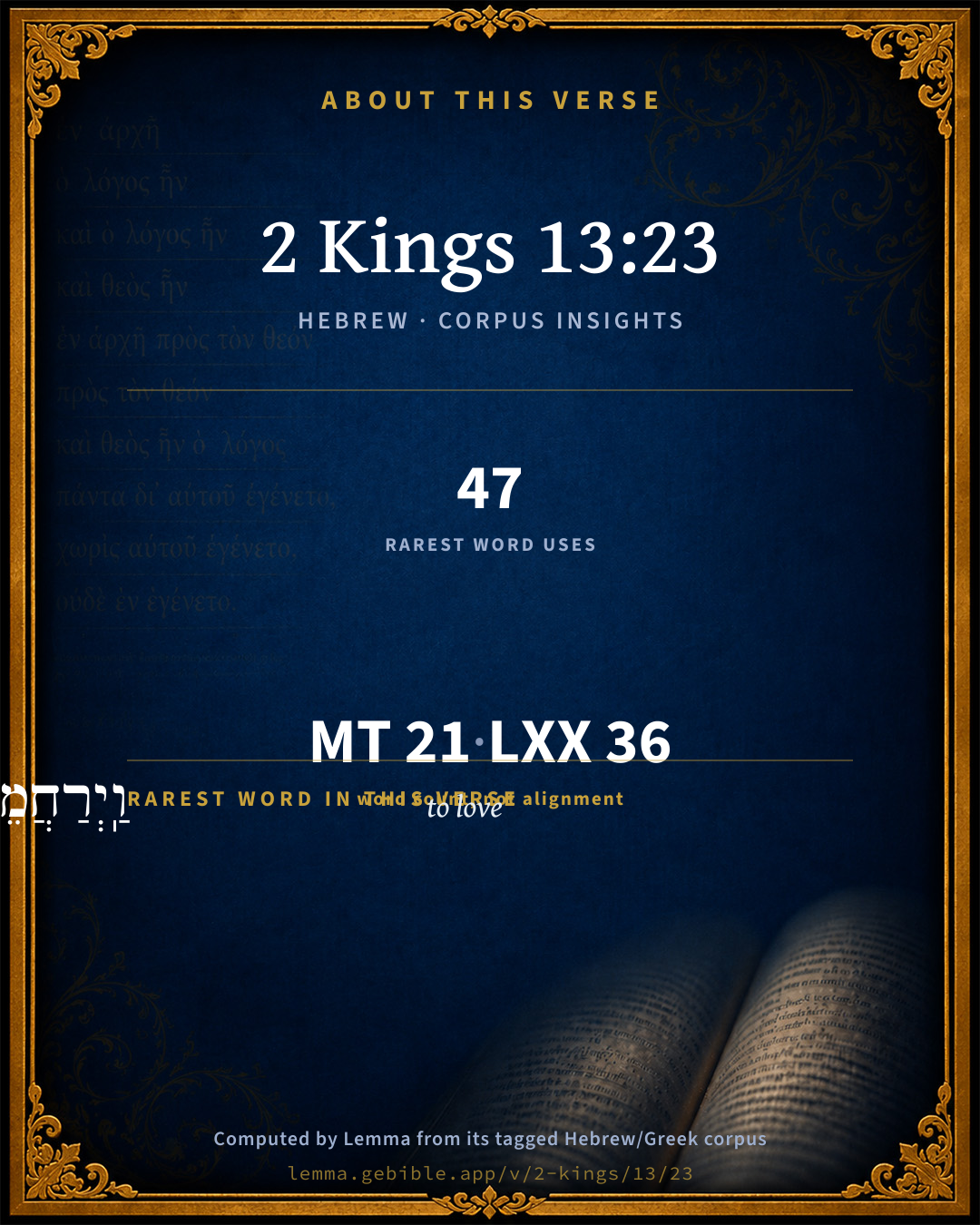
These counts appear in no published source. They are computed here, from the morphology-tagged text and Lemma’s own curated glosses. What Lemma adds →

21
words
20
distinct lemmas
Historical
section

Shared distinctive vocabulary

וַֽיְרַחֲמֵם֙ to love H7355 occurs in 43 verses of the Hebrew Bible. Also found in:

Grammatical profile

  • 6 verbs
  • 6 nouns
  • 5 prepositions
  • 1 adverb
  • 3 particles

Verb forms

  • וַיָּחָן֩ Qal · Sequential Imperfect
  • וַֽיְרַחֲמֵם֙ Piel · Sequential Imperfect
  • וַיִּ֣פֶן Qal · Sequential Imperfect
  • אָבָה֙ Qal · Perfect
  • הַשְׁחִיתָ֔ם Hiphil · Infinitive Construct
  • הִשְׁלִיכָ֥ם Hiphil · Perfect

Repetition

A word recurs within this verse — often emphatic in Hebrew:

  • וְלֹ֤א not H3808 ×2

Hebrew & Septuagint length

In English translation the verse runs 39 words from the Hebrew and 40 from the Septuagint (LXX English) — closely comparable.

A rough comparison of the two English renderings, which tokenize alike — not a word-level alignment.

Word counts can differ between the Hebrew and the Greek without any difference in meaning — e.g. the Hebrew direct-object marker אֵת has no separate Greek word, and Greek often adds the article ὁ.

In the original languages it is 21 Hebrew tokens and 36 Greek tokens — but the two are counted differently (Hebrew bundles its prefixes and suffixes into one token; the Greek is in lemma form), so that isn’t a like-for-like length.

Cross-references

28

Topical passages linked to 2 Kings 13:23 in the Treasury of Scripture Knowledge — connected by theme and wording, ordered by reader-vote popularity; previews shown in the World English Bible.

  • Psalms 105:8 He has remembered his covenant forever, The word which he commanded to a thousand generations,
  • 2 Kings 14:27 Yahweh didn't say that he would blot out the name of Israel from under the sky; but he saved them by the hand of Jeroboam the son of Joash.
  • Micah 7:18–20 Who is a God like you, who pardons iniquity, And passes over the disobedience of the remnant of his heritage? He doesn't retain his anger forever, Because he delights in loving kindness.
  • Exodus 2:24–25 God heard their groaning, and God remembered his covenant with Abraham, with Isaac, and with Jacob.
  • Genesis 13:16–17 I will make your offspring as the dust of the earth, so that if a man can number the dust of the earth, then your seed may also be numbered.
  • Psalms 86:15 But you, Lord, are a merciful and gracious God, Slow to anger, and abundant in loving kindness and truth.
  • Genesis 17:2–5 I will make my covenant between me and you, and will multiply you exceedingly."
  • 1 Kings 8:28 Yet have respect for the prayer of your servant, and for his supplication, Yahweh my God, to listen to the cry and to the prayer which your servant prays before you this day;
  • 2 Kings 17:18 Therefore Yahweh was very angry with Israel, and removed them out of his sight: there was none left but the tribe of Judah only.
  • 2 Kings 24:20 For through the anger of Yahweh did it happen in Jerusalem and Judah, until he had cast them out from his presence. Zedekiah rebelled against the king of Babylon.
  • Genesis 6:3 Yahweh said, "My Spirit will not strive with man forever, because he also is flesh; yet will his days be one hundred twenty years."
  • Genesis 17:7–8 I will establish my covenant between me and you and your seed after you throughout their generations for an everlasting covenant, to be a God to you and to your seed after you.
  • Exodus 3:6–7 Moreover he said, "I am the God of your father, the God of Abraham, the God of Isaac, and the God of Jacob." Moses hid his face; for he was afraid to look at God.
  • Exodus 32:13–14 Remember Abraham, Isaac, and Israel, your servants, to whom you swore by your own self, and said to them, 'I will multiply your seed as the stars of the sky, and all this land that I have spoken of I will give to your seed, and they shall inherit it forever.'"
  • Exodus 33:19 He said, "I will make all my goodness pass before you, and will proclaim the name of Yahweh before you. I will be gracious to whom I will be gracious, and will show mercy on whom I will show mercy."
  • Exodus 34:6–7 Yahweh passed by before him, and proclaimed, "Yahweh! Yahweh, a merciful and gracious God, slow to anger, and abundant in loving kindness and truth,
  • Leviticus 26:42 then I will remember my covenant with Jacob; and also my covenant with Isaac, and also my covenant with Abraham; and I will remember the land.
  • Deuteronomy 32:36 For Yahweh will judge his people, Repent himself for his servants; When he sees that [their] power is gone, There is none [remaining], shut up or left at large.
  • Judges 10:16 They put away the foreign gods from among them, and served Yahweh; and his soul was grieved for the misery of Israel.
  • Nehemiah 9:31–32 Nevertheless in your manifold mercies you did not make a full end of them, nor forsake them; for you are a gracious and merciful God.
  • Psalms 51:11 Don't throw me from your presence, And don't take your holy Spirit from me.
  • Isaiah 30:18–19 Therefore will Yahweh wait, that he may be gracious to you; and therefore will he be exalted, that he may have mercy on you: for Yahweh is a God of justice; blessed are all those who wait for him.
  • Jeremiah 12:15 It shall happen, after that I have plucked them up, I will return and have compassion on them; and I will bring them again, every man to his heritage, and every man to his land.
  • Lamentations 3:32 For though he cause grief, yet will he have compassion according to the multitude of his loving kindnesses.
  • Matthew 25:41 Then he will say also to those on the left hand, 'Depart from me, you cursed, into the eternal fire which is prepared for the devil and his angels;
  • Luke 1:54–55 He has given help to Israel, his servant, that he might remember mercy,
  • Luke 1:72–73 To show mercy towards our fathers, To remember his holy covenant,
  • 2 Thessalonians 1:9 who will pay the penalty: eternal destruction from the face of the Lord and from the glory of his might,

Cross-references courtesy of OpenBible.info (CC BY 4.0).

Hebrew and Greek witnesses Masoretic Hebrew ↔ Greek Septuagint

The same verse in the two great witnesses to the Old Testament, shown verse-for-verse.

These are two independent witnesses, not word-aligned to each other, and the Septuagint is shown in lemma (dictionary) form.

Hebrew 2 Kings 13:23 Masoretic · Westminster Leningrad Codex

וַיָּחָן֩ יְהוָ֨ה אֹתָ֤ם וַֽיְרַחֲמֵם֙ וַיִּ֣פֶן אֲלֵיהֶ֔ם לְמַ֣עַן בְּרִית֔וֹ אֶת אַבְרָהָ֖ם יִצְחָ֣ק וְיַֽעֲקֹ֑ב וְלֹ֤א אָבָה֙ הַשְׁחִיתָ֔ם וְלֹֽא הִשְׁלִיכָ֥ם מֵֽעַל פָּנָ֖יו עַד עָֽתָּה

But Yahweh was gracious to them, and had compassion on them, and had respect to them, because of his covenant with Abraham, Isaac, and Jacob, and would not destroy them, neither cast he them from his presence as yet.

World English Bible · Public Domain

Greek LXX 2 Kings 13:23 Septuagint · lemma form

καί ἐλεέω κύριος αὐτός καί οἰκτείρω αὐτός καί ἐπιβλέπω πρός αὐτός διά ὁ διαθήκη αὐτός ὁ μετά ἀβραάμ καί ισαακ καί ἰακώβ καί οὐ θέλω κύριος διαφθείρω αὐτός καί οὐ ἀποῥίπτω αὐτός ἀπό ὁ πρόσωπον αὐτός

And the Lord had mercy and compassion upon them, and had respect to them because of his covenant with Abraam, and Isaac, and Jacob; and the Lord would not destroy them, and did not cast them out from his presence.

LXX2012 (modern English Septuagint) · Public Domain

Hebrew: Westminster Leningrad Codex (CC BY 4.0). Greek: Septuagint (public domain); English from LXX2012 (modern English Septuagint) (Public Domain). How the Septuagint differs from the Hebrew →

Targum (Aramaic paraphrase)

1

The Targum is the ancient Jewish Aramaic paraphrase of the Hebrew Scriptures — an interpretive translation, not the Hebrew text itself. Onkelos (literal) and Pseudo-Jonathan (expansive) render the Torah, and Jonathan the Prophets. Coverage is partial: where no permissively-licensed English translation exists for a verse, only the Aramaic is shown. This is verse-level text, not a word-by-word alignment to the Hebrew.

  1. Targum Jonathan Prophets (Joshua–Malachi)
    וְחֵס יְיָ עֲלֵיהוֹן וּרְחַם עֲלֵיהוֹן וְאִתְפְּנֵי בְּמֵימְרֵיהּ לְאוֹטָבָא לְהוֹן בְּדִיל קְיָמֵיהּ דְעִם אַבְרָהָם יִצְחָק וְיַעֲקֹב וְלָא אֲבָה לְחַבָּלוּתְהוֹן וְלָא אַגְלִינוּן מֵאֲרַע בֵּית שְׁכִינְתֵּיהּ עַד כְּעַן:

    (no public-domain English translation for this verse)

    Targum Jonathan — Aramaic: “Mikraot Gedolot” (public domain). English: “Sefaria Community Translation” (CC0 1.0 (public-domain dedication)); “London "Chaldee Paraphrase," 1871” (public domain). Text via Sefaria.

Commentary

Notes on 2 Kings 13:23 from classic Christian and Jewish commentators (each source and its license shown beneath its notes). The classic Christian expositions comment on the surrounding passage and are grouped to its opening verse, so a note may address several verses; the Jewish commentaries on the Tanakh (Rashi and others) are per-verse, so they appear only where the commentator wrote on this verse.

Lemma curates 59 commentaries, every one of them public domain or Creative Commons licensed, each selected and text-cleaned for this edition rather than reprinted as found. About our sources →

Trapp's Complete Commentary

John Trapp

2Ki 13:23 And the LORD was gracious unto them, and had compassion on them, and had respect unto them, because of his covenant with Abraham, Isaac, and Jacob, and would not destroy them, neither cast he them from his presence as yet.

Ver. 23. Because of his covenant.] Whereby God had made himself a voluntary debtor to his people. Who might now well say, Non sum dignus, Domine, sed sum indigus, I am no way worthy of thy help, but I am in extreme need of it. And again, Ego admisi unde tu damnare potes me, sed non amisisti unde tu salvare potes me, {a} My destruction is of myself, but of thee is my help.

{a} August.

John Trapp, A Commentary or Exposition upon All the Books of the Old and New Testament (1647–1656) — public domain. Text from a community e-Sword module.

Joseph Benson's Commentary

2Ki 13:23. The Lord had compassion, and would not destroy them as yet — The several expressions, of nearly the same import, used in this verse, call upon us to admire the triumphs of divine goodness in the deliverance of such a provoking people. He foresaw they would destroy themselves at last; but, as yet, he would reprieve them, and give them space to repent. The slowness of God’s processes against sinners must be construed to the advancement of his mercy, not the impeachment of his justice. Neither cast them from his presence as yet — From the land of Canaan, to which the peculiar presence of God, and his public and solemn worship, were now confined.

Joseph Benson's Commentary on the Old and New Testaments (1811–1818) — public domain. Text from a community e-Sword module.

Tyndale Open Study Notes

Tyndale Open Resources

13:23 Despite Israel’s continued infidelity, God remained faithful to his covenant with Abraham (Gen 12:1-3; 13:15-17; 15:18-20; 17:6-8). By listing Abraham, Isaac, and Jacob, the writer emphasizes Israel’s spiritual identity with the Lord and its possession of the land of promise (see Gen 50:24; Exod 3:6, 15-16; 6:3, 6-8; Deut 6:10; 9:5; 34:4).

Tyndale Open Study Notes — © Tyndale Open Resources, licensed CC BY-SA 4.0. Text via the HelloAO Bible API.

Geneva Bible (1599)

Geneva Bible translators

That is, until their sins were come to a full measure, and there was no more hope of amendment.

Geneva Bible (1599) marginal notes — public domain. Text via Bolls.life.

Adam Clarke's Commentary

Verse 23. And the Lord was gracious unto them] ויחן vaiyachon, he had tender affection for them, as a husband has for his wife, or a father for his own children.

And had compassion on them] וירחמם vairachamem, his bowels yearned over them; he felt for them, he sympathized with them in all their distress: Therefore are my bowels troubled; I will surely have mercy upon him, saith the Lord, Jer 31:20.

And had respect unto them] ויפן vaiyiphen, he turned face towards them, he received them again into favour; and this because of his covenant with their fathers: they must not be totally destroyed; the Messiah must come from them, and through them must come that light which is to enlighten the Gentiles, and therefore he would not make an entire end of them.

Neither cast he them from his presence as yet.] But now they are cast out from his presence; they have sinned against the only remedy for their souls. They sit in darkness and the shadow of death; the veil is upon their face; but if they yet turn to the Lord, the veil shall be taken away.

Adam Clarke's Commentary on the Bible (1810–1826) — public domain. Text from a community e-Sword/MySword module.

Ellicott's Commentary for English Readers

(23) And the Lord was gracious.—The verse is a remark of the compiler’s, as is evident from the style, the reference to the Covenant, and the expression “as yet,” or rather, until now—i.e., the day when he was writing, and when the northern kingdom had finally perished.

Had respect.—Turned.

A Bible Commentary for English Readers, edited by Charles John Ellicott (1878–1897) — public domain. Text from a community e-Sword module.

The Cambridge Bible for Schools and Colleges

gen. ed. J. J. S. Perowne

23. And [R.V. But] the Lord was gracious unto them] Cf. for the sentiment, Mal_3:6, ‘I am the Lord, I change not; therefore ye sons of Jacob are not consumed.’

as yet] The writer of Kings was living at the time of the captivity. He therefore knew that the grace and compassion had been shewn in vain, and that the kingdom of Israel had at last been utterly destroyed.

The Cambridge Bible for Schools and Colleges (gen. ed. J. J. S. Perowne; Cambridge University Press, 1878–1918) — public domain. Text from a community e-Sword module.

Albert Barnes' Notes on the Bible

The writer regards the captivity of Israel as God’s “casting them out of His sight” (see 2Ki 17:18, 2Ki 17:20); and notes that this extreme punishment, though deserved, was by God’s mercy not allowed to fall on them as yet.

Albert Barnes' Notes on the Bible (1834–1885) — public domain. Text from a community e-Sword/MySword module.

Haydock's Catholic Bible Commentary

Time. Long before the captivity of Babylon, the Israelites had been led captives, to return no more in a body. Some stragglers mixed with the Jews, and inhabited the country under that appellation. It would seem that this was written before the overturning of the kingdom of Israel. (Haydock)

George Leo Haydock (1774–1849), Haydock's Catholic Family Bible and Commentary, 1859 edition — public domain. Excludes Psalms (Douay-Rheims chapter numbering differs from Protestant) and Deuterocanonical books (Catholic canon only).

Matthew Poole's English Annotations

From his presence, i.e. from the land of Canaan, to which the presence and public and solemn worship of God was confined.

Matthew Poole's English Annotations on the Holy Bible (1683–1685) — public domain. Text from a community e-Sword/MySword module.

Whedon's Commentary on the Bible

Daniel D. Whedon

23. As yet — There was a tender sympathy which bound Jehovah to the covenant people with whose backslidings he had borne so long, and yet he shows compassion.

Daniel D. Whedon (gen. ed.), Commentary on the Old and New Testaments (1874–1909) — public domain. Text from a community e-Sword module.

The Pulpit Commentary

And the Lord was gracious unto them, and had compassion on them. Even in his wrath God, thinketh upon mercy." While he was still punishing Israel by the sword of Hazael, he was yet careful not to make a full end, not to allow the affliction to proceed too far. He still preserved the nation, and kept it in being. And had respect unto themi.e. "considered them kept them in his mind did not permit them to slip out of his recollectionbecause of his covenant with Abraham, Isaac, and Jacob. God"s covenant with Abraham, Isaac, and Jacob was a covenant of mercy. By it he had pledged himself to multiply their seed, to be their God, and the God of their seed after them, and to give to their seed the whole land of Canaan for an everlasting possession. (Gen_17:4-8, etc.) This covenant bound him to extend his protection over the people of Israel so long as they had not utterly and entirely cast off their allegiance. (comp. 2Ki_17:7-18) And would not destroy them. They were "persecuted, but not forsaken; cast down, but not destroyed". (2Co_4:9) The national life might seem to hang by a thread, but the thread had not snapped. Neither east he them from his presence as yet. The writer has it in his mind that ultimately they were cast away, rejected, removed out of God"s sight; (2Ki_17:18, 2Ki_17:20, 2Ki_17:23) but it was not "as yet there was still an interval of a century, or a little more, before the blow fell, and the nation of the ten tribes ceased to exist.

The Pulpit Commentary (1880–1919), ed. H.D.M. Spence-Jones & Joseph S. Exell — public domain. Text from a community e-Sword module.

John Wesley's Explanatory Notes

Had compassion - The slowness of God's process against sinners even when they remain impenitent must be construed to the advantage of his mercy, not the impeachment of his justice.

John Wesley, Explanatory Notes Upon the Whole Bible (1754–1765) — public domain. Text via the GEBible commentary corpus.

Lesson kit

Teaching starters — assembled from the data on this page, not authored interpretation. Every prompt links to the verse data it draws on. Edit before teaching.

2 Kings, in the Historical, opens this verse with 21 words (20 distinct Hebrew lemmas). Its most distinctive word is râcham (“to love”). A historical commentator’s framing appears above. Read the whole chapter for the surrounding context.

Discussion questions

  1. The word râcham carries the sense “to love.” How does it shape the verse?
  2. How does Exodus 33:19, which shares the word «to love», read alongside this verse?
  3. What does the repetition of “not” (2× in this one verse) do in this verse?
  4. These translations render this verse differently. What is at stake in choosing one wording over another?
  5. «וַיָּחָן֩» is a Qal Sequential Imperfect verb. How does that grammatical form shape the action described?
  6. Compare how Trapp's Complete Commentary and Joseph Benson's Commentary read this verse. Where do they agree or differ?

Things to notice

Reading settings

Reading text

Shown beneath each verse's original-language words.

Old Testament
Old Testament edition

Read the OT as the Masoretic Hebrew (MT) or the Greek Septuagint (LXX).

English shown for the Greek Septuagint (in the Hebrew ↔ Greek comparison).

Comparing translations? Open the Compare panel on any verse page to stack up to four side by side.