
Amos 3:13

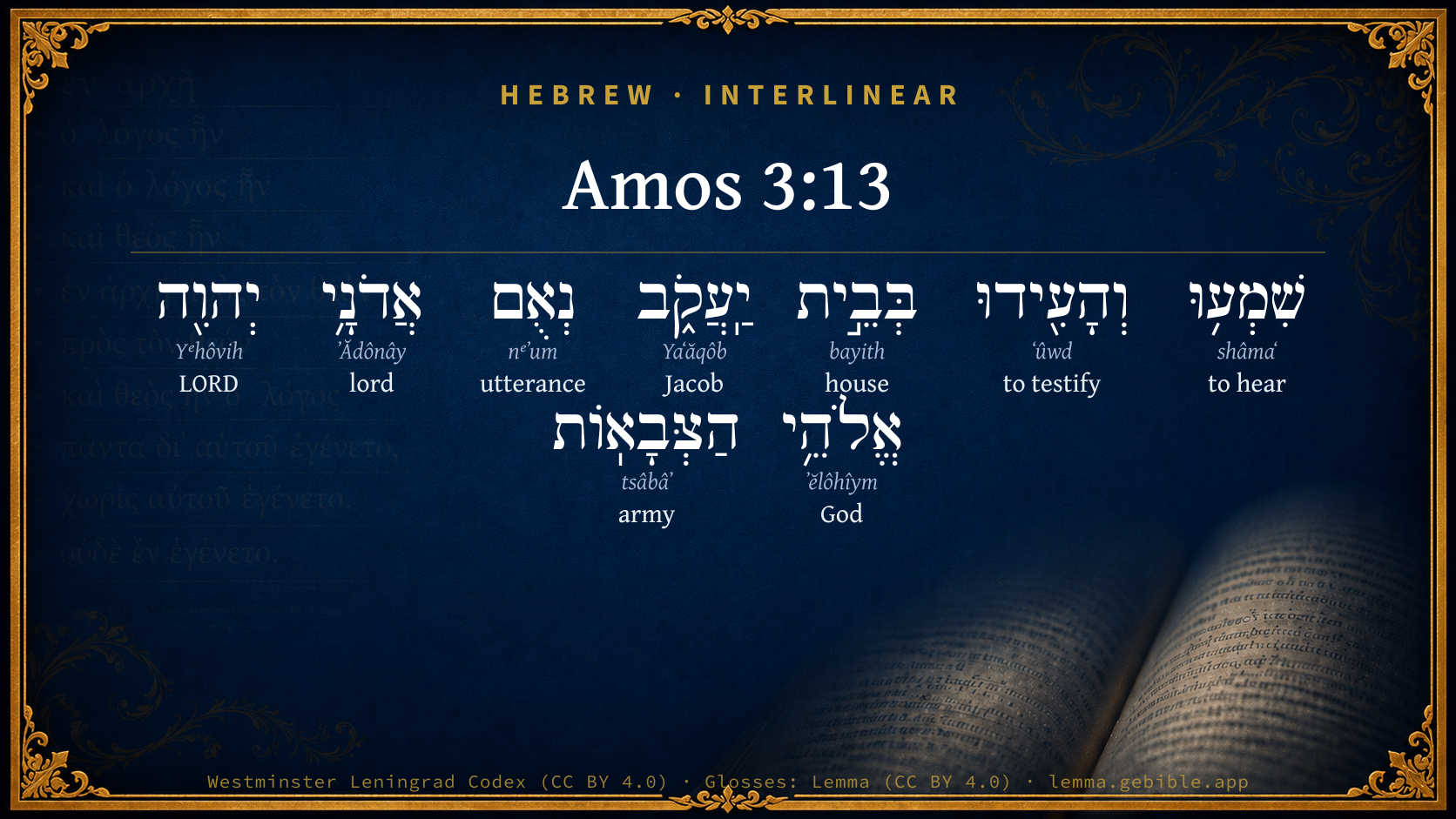
Hebrew (Westminster Leningrad Codex) Amos 3:13 appears in the Hebrew Old Testament. The text above is from the Westminster Leningrad Codex. Each word links to its Strong’s number, a concise gloss, and parsing drawn from the Open Scriptures Hebrew Bible morphology. Click any word for its full Brown-Driver-Briggs (BDB) entry.
Download image
Cite this verse

Amos 3:13 (World English Bible). Public Domain. Lemma interlinear Bible study tool, https://lemma.gebible.app/v/amos/3/13.

Show BibTeX & RIS
BibTeX
RIS
English Translation
"Listen, and testify against the house of Jacob," says the Lord Yahweh, the God of hosts.
World English Bible · Public Domain
Download a study sheet

One document with this verse’s original text, its word-by-word gloss line, the meaning frame, cross-references with their text, attributed commentary, and full source and license credits — printable, and it pastes into notes with its structure intact.

This verse Autodidact and up

Study sheet (.html) Plain text (.txt)

A passage Seminary Student

Up to 50 verses in one chapter. A passage sheet keeps up to 6 commentary sources and 12 cross-references per verse, in the order this page ranks them, and says so on the sheet whenever that leaves anything out. Ask for a single verse and you get the Autodidact verse sheet above.

Everything on this page stays free to read, with no account — the sheet is a download of what is already on screen, not access to it.

Want to remove ads? Support Godless Engineer
Compare translations 3

The same verse in 3 English versions, stacked beneath the original-language interlinear above. Click any original word for its lexicon entry.

Each is an independent rendering of the whole verse — the interlinear is not word-aligned to these translations.

Highlighted words mark where these versions differ — a whole-verse word diff, not a word-by-word alignment.

  • World English Bible Public Domain
    "Listen, and testify against the house of Jacob," says the Lord Yahweh, the God of hosts.
  • King James Version Public Domain
    Hear ye, and testify in the house of Jacob, saith the Lord GOD, the God of hosts,
  • unfoldingWord Literal Text CC BY-SA 4.0
    Hear and testify against the house of Jacob— this is the declaration of the Lord Yahweh, the God of hosts:

unfoldingWord Literal Text — © unfoldingWord, licensed CC BY-SA 4.0. Word-aligned USFM3 via Door43 (git.door43.org/unfoldingWord/en_ult).

Versions to compare (up to 4)

3 of 4 selected

Show all 18 translations

Every available English version of this verse, each an independent rendering of the whole verse.

  • World English Bible Public Domain
    "Listen, and testify against the house of Jacob," says the Lord Yahweh, the God of hosts.
  • Berean Standard Bible Public Domain
    Hear and testify against the house of Jacob, declares the Lord GOD, the God of Hosts.
  • Majority Standard Bible Public Domain
    Hear and testify against the house of Jacob, declares the Lord GOD, the God of Hosts.
  • King James Version Public Domain
    Hear ye, and testify in the house of Jacob, saith the Lord GOD, the God of hosts,
  • American Standard Version (1901) Public Domain
    Hear ye, and testify against the house of Jacob, saith the Lord Jehovah, the God of hosts.
  • Revised Version (1885) Public Domain
    Hear ye, and testify against the house of Jacob, saith the Lord GOD, the God of hosts.
  • Geneva Bible (1599) Public Domain
    Heare, and testifie in the house of Iaakob, saith the Lord God, the God of hostes.
  • Douay-Rheims (1899) Public Domain
    Hear ye, and testify in the house of Jacob, saith the Lord the God of hosts:
  • Young's Literal Translation Public Domain
    Hear ye and testify to the house of Jacob, An affirmation of the Lord Jehovah, God of Hosts.
  • Literal Standard Version CC BY-SA 4.0
    Hear and testify to the house of Jacob,” || A declaration of Lord YHWH, God of Hosts.
  • Unlocked Literal Bible CC BY-SA 4.0
    Hear and testify against the house of Jacob —this is the declaration of the Lord Yahweh, the God of hosts:
  • unfoldingWord Literal Text CC BY-SA 4.0
    Hear and testify against the house of Jacob— this is the declaration of the Lord Yahweh, the God of hosts:
  • Darby Bible Public Domain
    Hear ye, and testify in the house of Jacob, saith the Lord Jehovah, the God of hosts,
  • World Messianic Bible Public Domain
    “Listen, and testify against the house of Jacob,” says the Lord GOD, the God of Hosts.
  • Webster's Bible Public Domain
    Hear ye, and testify in the house of Jacob, saith the Lord GOD, the God of hosts,
  • Free Bible Version CC BY-SA 4.0
    Listen! Warn the house of Jacob, declares the Lord God of power.
  • Bible in Basic English Public Domain
    Give ear now, and give witness against the family of Jacob, says the Lord God, the God of armies;
  • JPS Tanakh (1917) Public Domain
    Hear ye, and testify against the house of Jacob, saith the Lord GOD, the God of hosts.

Literal Standard Version (2020), Covenant Press — licensed CC BY-SA 4.0. Text via the HelloAO Bible API (eBible.org). Unlocked Literal Bible (unfoldingWord) — licensed CC BY-SA 4.0. Text via the HelloAO Bible API (eBible.org). unfoldingWord Literal Text — © unfoldingWord, licensed CC BY-SA 4.0. Word-aligned USFM3 via Door43 (git.door43.org/unfoldingWord/en_ult). Free Bible Version, Dr. Jonathan Gallagher — licensed CC BY-SA 4.0. Text via the HelloAO Bible API (eBible.org).

Word by word

More ways to search: Search by grammar → Find every occurrence → Compare this word →

Practice this passage: Drill this verse → Learn its vocabulary →

וְהָעִ֖ידוּ
ʻûwd
H5749
“and · testify”
Conjunction + Verb, Hiphil, Imperative, 2nd Person, Masculine, Plural
Part of Speech
Conjunction + Verb
Stem
Hiphil
Form
Imperative
Person
2nd Person
Gender
Masculine
Number
Plural
Full BDB Definition

Origin: a primitive root

TWOT: 1576 , 1576d

to return, repeat, go about, do again - (Piel) to surround, go round and round - (Pilel) to restore, relieve - (Hithpalel) to be restored - to bear witness - (Qal) to bear witness, say again and again - (Hiphil) - to testify, bear witness - to cause to testify, take or call as witness, invoke - to protest, affirm solemnly, warn, exhort or enjoin solemnly, admonish, charge - (Hophal) to protest, give warning
  1. שִׁמְע֥וּ shâmaʻ H8085 “hear” Verb, Qal, Imperative, 2nd Person, Masculine, Plural
  2. בְּבֵ֣ית bayith H1004 “in/at · house of” Preposition + Noun, Common, Masculine, Singular, Construct
  3. יַֽעֲקֹ֑ב Yaʻăqôb H3290 “Jacob” Noun, Proper
  4. נְאֻם nᵉʼum H5002 “utterance of” Noun, Common, Masculine, Singular, Construct
  5. אֲדֹנָ֥י ʼĂdônây H136 “Lord · my” Noun, Common, Masculine, Plural, Construct + Suffix, Personal, 1st Person, Common, Singular
  6. יְהוִ֖ה Yᵉhôvih H3069 “LORD” Noun, Proper
  7. אֱלֹהֵ֥י ʼĕlôhîym H430 “God(s) of” Noun, Common, Masculine, Plural, Construct
  8. הַצְּבָאֽוֹת tsâbâʼ H6635 “the · armies” Particle, Definite Article + Noun, Common, Both, Plural, Absolute

About this verse

These counts appear in no published source. They are computed here, from the morphology-tagged text and Lemma’s own curated glosses. What Lemma adds →

9
words
9
distinct lemmas
Prophets
section

Shared distinctive vocabulary

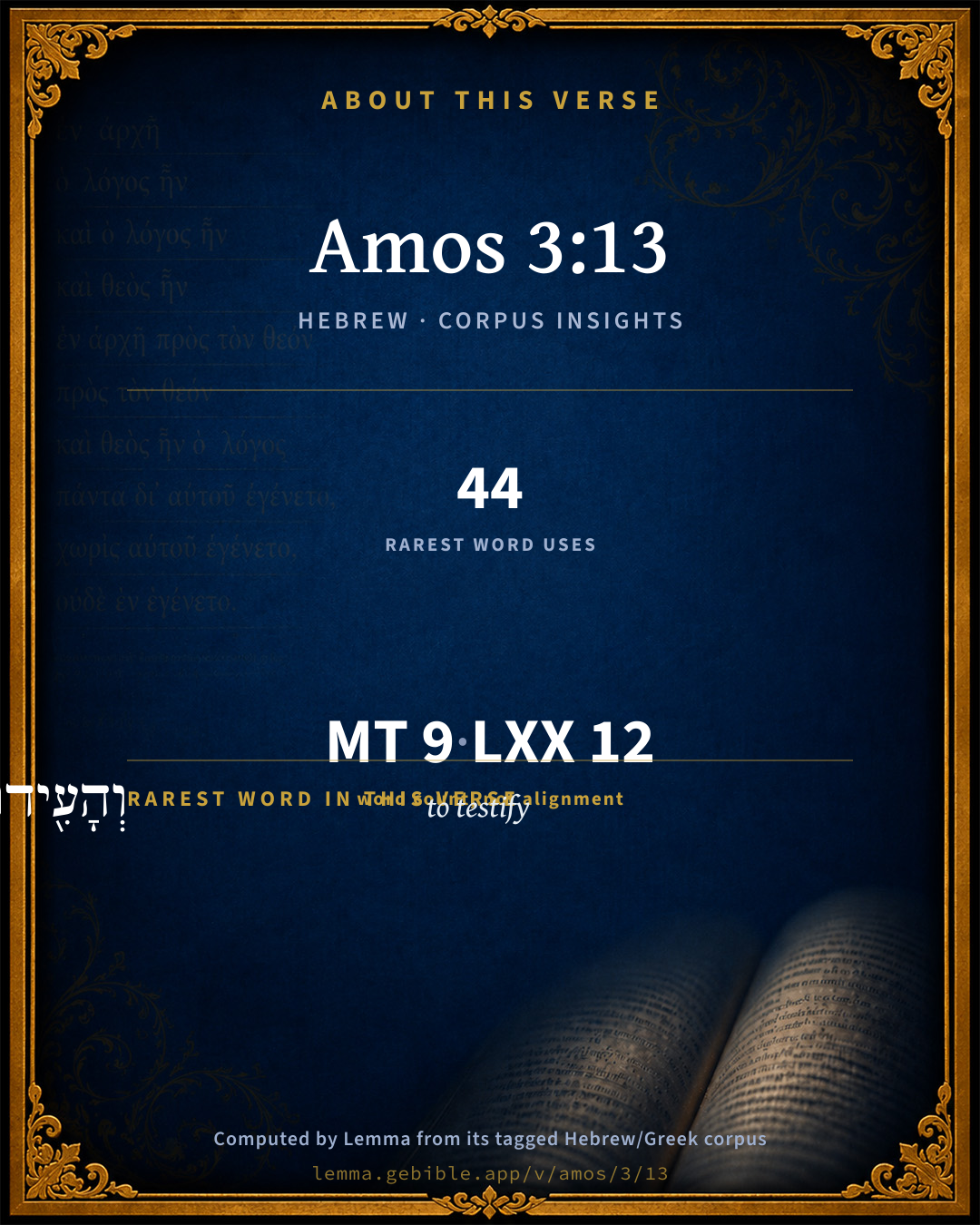
וְהָעִ֖ידוּ to testify H5749 occurs in 40 verses of the Hebrew Bible. Also found in:

Grammatical profile

  • 2 verbs
  • 7 nouns

Verb forms

  • שִׁמְע֥וּ Qal · Imperative
  • וְהָעִ֖ידוּ Hiphil · Imperative

Hebrew & Septuagint length

In English translation the verse runs 16 words from the Hebrew and 16 from the Septuagint (LXX English) — the same length.

A rough comparison of the two English renderings, which tokenize alike — not a word-level alignment.

Word counts can differ between the Hebrew and the Greek without any difference in meaning — e.g. the Hebrew direct-object marker אֵת has no separate Greek word, and Greek often adds the article ὁ.

In the original languages it is 9 Hebrew tokens and 12 Greek tokens — but the two are counted differently (Hebrew bundles its prefixes and suffixes into one token; the Greek is in lemma form), so that isn’t a like-for-like length.

Cross-references

14

Topical passages linked to Amos 3:13 in the Treasury of Scripture Knowledge — connected by theme and wording, ordered by reader-vote popularity; previews shown in the World English Bible.

  • Deuteronomy 8:19 It shall be, if you shall forget Yahweh your God, and walk after other gods, and serve them, and worship them, I testify against you this day that you shall surely perish.
  • Deuteronomy 30:18–19 I denounce to you this day, that you shall surely perish; you shall not prolong your days in the land, where you pass over the Jordan to go in to possess it.
  • Joshua 22:22 The Mighty One, God, Yahweh, the Mighty One, God, Yahweh, he knows; and Israel he shall know: if it be in rebellion, or if in trespass against Yahweh (don't save us this day),
  • 2 Kings 17:13 Yet Yahweh testified to Israel, and to Judah, by every prophet, and every seer, saying, Turn you from your evil ways, and keep my commandments and my statutes, according to all the law which I commanded your fathers, and which I sent to you by my servants the prophets.
  • 2 Kings 17:15 They rejected his statutes, and his covenant that he made with their fathers, and his testimonies which he testified to them; and they followed vanity, and became vain, and [went] after the nations that were round about them, concerning whom Yahweh had charged those who they should not do like them.
  • 2 Chronicles 24:19 Yet he sent prophets to them, to bring them again to Yahweh; and they testified against them: but they would not give ear.
  • Isaiah 1:24 Therefore the Lord, Yahweh of Hosts, The Mighty One of Israel, says: "Ah, I will get relief from my adversaries, And avenge myself of my enemies;
  • Ezekiel 2:7 You shall speak my words to them, whether they will hear, or whether they will forbear; for they are most rebellious.
  • Amos 5:27 Therefore will I cause you to go into captivity beyond Damascus," says Yahweh, whose name is the God of hosts.
  • Acts 2:40 With many other words he testified, and exhorted them, saying, "Save yourselves from this crooked generation!"
  • Acts 18:5–6 But when Silas and Timothy came down from Macedonia, Paul was compelled by the Spirit, testifying to the Jews that Jesus was the Christ.
  • Acts 20:21 testifying both to Jews and to Greeks repentance toward God, and faith toward our Lord Jesus.
  • Ephesians 4:17 This I say therefore, and testify in the Lord, that you no longer walk as the rest of the Gentiles also walk, in the futility of their mind,
  • 1 Thessalonians 4:6 that no one should take advantage of and wrong a brother or sister in this matter; because the Lord is an avenger in all these things, as also we forewarned you and testified.

Cross-references courtesy of OpenBible.info (CC BY 4.0).

Hebrew and Greek witnesses Masoretic Hebrew ↔ Greek Septuagint

The same verse in the two great witnesses to the Old Testament, shown verse-for-verse.

These are two independent witnesses, not word-aligned to each other, and the Septuagint is shown in lemma (dictionary) form.

Hebrew Amos 3:13 Masoretic · Westminster Leningrad Codex

שִׁמְע֥וּ וְהָעִ֖ידוּ בְּבֵ֣ית יַֽעֲקֹ֑ב נְאֻם אֲדֹנָ֥י יְהוִ֖ה אֱלֹהֵ֥י הַצְּבָאֽוֹת

"Listen, and testify against the house of Jacob," says the Lord Yahweh, the God of hosts.

World English Bible · Public Domain

Greek LXX Amos 3:13 Septuagint · lemma form

ἀκούω καί ἐπιμαρτυρέω ὁ οἶκος ἰακώβ λέγω κύριος ὁ θεός ὁ παντοκράτωρ

Hear, O you⌃ priests, and testify to the house of Jacob, says the Lord God Almighty.

LXX2012 (modern English Septuagint) · Public Domain

On this verse, Trapp's Complete Commentary discusses the Septuagint’s reading. Read the note in Commentary ↓

Hebrew: Westminster Leningrad Codex (CC BY 4.0). Greek: Septuagint (public domain); English from LXX2012 (modern English Septuagint) (Public Domain). How the Septuagint differs from the Hebrew →

Targum (Aramaic paraphrase)

1

The Targum is the ancient Jewish Aramaic paraphrase of the Hebrew Scriptures — an interpretive translation, not the Hebrew text itself. Onkelos (literal) and Pseudo-Jonathan (expansive) render the Torah, and Jonathan the Prophets. Coverage is partial: where no permissively-licensed English translation exists for a verse, only the Aramaic is shown. This is verse-level text, not a word-by-word alignment to the Hebrew.

  1. Targum Jonathan Prophets (Joshua–Malachi)
    קַבִּילוּ וְאַסְהִידוּ בְּבֵית יַעֲקֹב אֲמַר יְיָ אֱלֹהִים אֱלֹהֵי צְבָאוֹת:

    (no public-domain English translation for this verse)

    Targum Jonathan — Aramaic: “Mikraot Gedolot” (public domain). English: “Sefaria Community Translation” (CC0 1.0 (public-domain dedication)); “London "Chaldee Paraphrase," 1871” (public domain). Text via Sefaria.

Commentary

Notes on Amos 3:13 from classic Christian and Jewish commentators (each source and its license shown beneath its notes). The classic Christian expositions comment on the surrounding passage and are grouped to its opening verse, so a note may address several verses; the Jewish commentaries on the Tanakh (Rashi and others) are per-verse, so they appear only where the commentator wrote on this verse.

Lemma curates 59 commentaries, every one of them public domain or Creative Commons licensed, each selected and text-cleaned for this edition rather than reprinted as found. About our sources →

Trapp's Complete Commentary

John Trapp

Amo 3:13 Hear ye, and testify in the house of Jacob, saith the Lord GOD, the God of hosts,

Ver. 13. Hear ye and testify, &c.] Ye my prophets and all true believers. The Septuagint add, O ye priests, whose lips were to preserve knowledge, and to present it to the people. All that were thereunto commissioned by the Lord God, the God of hosts, are here straitly charged to hear and to charge, testify, or contest, {2Ti 4:1} and what they have received of the Lord to deliver the same to the whole house of Jacob: not stealing away the word from them, Jer 23:30, or shunning to declare unto them his whole counsel, Act 20:27, but faithfully handling the law, Jer 2:8.

John Trapp, A Commentary or Exposition upon All the Books of the Old and New Testament (1647–1656) — public domain. Text from a community e-Sword module.

Joseph Benson's Commentary

Amo 3:13-15. Hear ye, and testify, &c. — These words are directed to the prophets whom God sends to declare his will. In the day that I shall visit, &c. — In the general destruction of the ten tribes, my judgments will be particularly visible upon the places dedicated to idolatrous worship, especially Beth-el, the principal place of that kind. And the horns of the altar shall be cut off — These were squares placed at the four corners of the altar, and hollow in the middle, into which some of the blood of the sacrifices was poured. And I will smite the winter-house with the summer- house — The kings and great men had different houses and apartments for spending the winter and summer in. These were placed and made suitable to those different seasons. And the houses of ivory shall perish — We read 1Ki 22:49, that King Ahab built himself an ivory house, that is, a house ceiled or wainscoted with ivory: or at least inlaid in some parts of it with ivory; and it is probable that other great men followed his example.

Joseph Benson's Commentary on the Old and New Testaments (1811–1818) — public domain. Text from a community e-Sword module.

The Preacher's Complete Homiletical Commentary

Joseph S. Exell (gen. ed.)

CRITICAL NOTES.]

Amo_3:13. Hear] Addressed to heathen who have now to witness the punishment upon Israel.

Amo_3:14. Altars] Vengeance upon the centre from which spread the evils (1Ki_12:32). Horns] destroyed in utter contempt and desolation (Exo_27:2).

Amo_3:15. Houses] Eastern monarchs have summer and winter residences: the former upon mountains or in forests, the latter in cities and sheltered situations (Jdg_3:20; Jer_36:22). Ivory] Houses and palaces richly ornamented with this material will be entirely ruined. Samaria is threatened with the overthrow of its palaces, and the extermination of its people. Nothing will avail if righteousness be wanting in the day of the Lord (Pro_10:2).

HOMILETICS

DIVINE VISITATION.—Amo_3:13-14

These verses renew and raise the threatening to a higher degree. God will visit the transgressions of Israel upon him, and utter destruction will be the consequence of moral corruption.

I. The seats of idolatry overturned. A people guilty of false worship are incapable of seeing the evil and the danger of it. Sentence must be uttered against the house of Jacob, for they cannot escape Divine judgments.

1. The centres of idolatry destroyed. “The altars of Bethel” were the source of their sins, the fountain-head of their superstitions. A special judgment is pronounced against Bethel the religious, and Samaria the political, seats of corruption.

2. The objects of idolatry destroyed. Destruction is threatened against the horns of the altar, and all attractions to idolatry. These were to “be cut off” with violence and “fall to the ground.”

3. The votaries of idolatry destroyed. The teachers and supporters were to have their punishment according to their prominence. Their support was withheld, and their doctrines proved false. Their religion was not defence, and all their hopes were disappointed. Natural religion can never be a substitute for revealed. Those who trust in the former and reject the latter will sink into ignorance and sin. Every kind of false worship, instead of helping, will become an object of Divine displeasure. “So shall Bethel do unto you because of your great wickedness.”

II. The palaces of grandeur pulled down. “The great houses shall have an end, saith the Lord.” The mansions of the rich, with their pomp and splendour, extravagance and folly, shall be spoiled by the enemy. The capital shall be robbed, and all its magnificent palaces destroyed. Pride is not in keeping with prosperity. Prodigality to ingratitude will only increase misery. Habitations decorated with art and inlaid with ivory, which exclude the presence of God, will have an end and dissolve to dust.

III. The retreats of luxury destroyed. Luxury and pride generally follow idolatry. But we have “the same minute filling up of the picture,” says one, “in the threatenings against the luxurious retreats of the rich. ‘The winter house,’ with its comfortable shelter from the influences of cold; ‘the summer house,’ with all its spacious provision to secure a cool retreat from oppressive heat; ‘the house of ivory,’ which might show the refined taste of its possessor; and ‘the great house,’ which would display his wealth and give room for his revelry—all were marked, like trees in a forest; their end was determined, it would quickly come.” The palace of the prince and the cottage of the poor, the spacious mansion and the fortified castle, will one day come to ruin. Let us “build high,” and secure “that house not made with hands, eternal in the heavens.”

HOMILETIC HINTS AND OUTLINES

Amo_3:13. Divine visitation. I. In relation to the prophets of God. A new charge is given to Amos and the rest of God’s servants, to understand the message themselves and proclaim it to others. “It is of little avail to testify, unless we first hear; nor can man bear witness to what he doth not know; nor will words make an impression, i.e. leave a trace of themselves—be stamped in or on men’s souls—unless the soul which utters them have first hearkened unto them” [Pusey]. II. In relation to others. “In the house of Jacob” the testimony must be given; but Philistines and Egyptians, as Amo_3:9, are called upon to witness. Not only God’s servants, but others have need to be roused from their slumber and quicken attention to the word and authority of God. In the space of six verses the prophet earnestly repeats the words, “saith the Lord.” Men of our time should not question nor limit the message of the gospel. Be imbued with the spirit of Samuel, “Speak, Lord, for thy servant heareth.” III. In relation to their design. The punishment of sin and the correction of God’s people. Sin is the procuring cause of all punishment. God may endure long, but will at length vindicate his holiness and visit “the transgressions” upon those who commit them.

Amo_3:14-15. We are strongly reminded here of what in recent years befell Paris and Rome, which have occupied analogous positions in the Papal world, to those which were then held in Israel by Samaria and Bethel [Preacher’s Lantern, vol. 4].

ILLUSTRATIONS TO CHAPTER 3

Amo_3:14-15. Visit. The sins of a nation draw judgment after them as the moon draws after it the billows that beat upon the shore. Let no nation hope to escape judgment until it gets rid of sin. Judgments are but sins ripened into a harvest, subterranean fires breaking into volcanoes [Dr Thomas].

The Preacher's Complete Homiletical Commentary (gen. ed. Joseph S. Exell; Funk & Wagnalls, c. 1892) — public domain (pre-1929). A full-Bible homiletical/sermon-outline anthology covering 65 of 66 books (2 John is absent from the source module). Text from a community e-Sword module.

Keil & Delitzsch

C. F. Keil & F. Delitzsch

This feature in the threat is brought out into peculiar prominence by a fresh introduction. Amo 3:13. "Hear ye, and testify it to the house of Jacob, is the utterance of the Lord, Jehovah, the God of hosts: Amo 3:14. That in the day when I visit the transgressions of the house of Israel upon it, I shall visit it upon the altars of Bethel; and the horns of the altar will be cut off, and fall to the ground. Amo 3:15. And I smite the winter-house over the summer-house, and the houses of ivory perish, and many houses vanish, is the saying of Jehovah." The words "Hear ye" cannot be addressed to the Israelites, fore they could not bear witness against the house of Israel, but must either refer to the prophets, as in Amo 3:9 ("publish ye"), or to the heathen, in which case they correspond to "assemble yourselves and behold" in Amo 3:9. The latter assumption is the only correct one, for the context does not assign a sufficient motive for an address to the prophets. On the other hand, as the heathen have been summoned to convince themselves by actual observation of the sins that prevail in Samaria, it is perfectly in keeping that they should now hear what is the punishment that God is about to inflict upon Israel in consequence, and that they should bear witness against Israel from what they have heard. העיד ב, to bear witness towards or against (not "in," as Baur supposes). The house of Jacob is the whole of Israel, of the twelve tribes, as in Amo 3:1; for Judah was also to learn a lesson from the destruction of Samaria. As the appeal to the heathen to bear witness against Israel indicates the greatness of the sins of the Israelites, so, on the other hand, does the accumulation of the names of God in Amo 3:13 serve to strengthen the declaration made by the Lord, who possesses as God of hosts the power to execute His threats. כּי introduces the substance of what is to be heard. The punishment of the sins of Israel is to extend even to the altars of Bethel, the seat of the idolatrous image-worship, the hearth and home of the religious and moral corruption of the ten tribes. The smiting off of the horns of the altar is the destruction of the altars themselves, the significance of which culminated in the horns (see at Exo 27:2). The singular hammizbēăch (the altar) preceded by a plural is the singular of species (cf. Ges. 108, 1), and does not refer to any particular one - say, for example, to the principal altar. The destruction of the palaces and houses (Amo 3:15) takes place in the capital. In the reference to the winter-house and summer-house, we have to think primarily of the royal palace (cf. Jer 36:22); at the same time, wealthy noblemen may also have had them. על, lit., over, so that the ruins of one house fall upon the top of another; then "together with," as in Gen 32:12. בּתּי שׁן, ivory houses, houses the rooms of which are decorated by inlaid ivory. Ahab had a palace of this kind (Kg1 22:39, compare Psa 45:9). בּתּים רבּים, not the large houses, but many houses; for the description is rounded off with these words. Along with the palaces, many houses will also fall to the ground. The fulfilment took place when Samaria was taken by Shalmanezer (Kg2 17:5-6).

Keil & Delitzsch — Biblical Commentary on the Old Testament (1861–1891) — public domain (CC PDM 1.0). Text via the HelloAO Bible API. (Old Testament only.)

Tyndale Open Study Notes

Tyndale Open Resources

3:13 The Lord’s message is to go to all Israel (literally the house of Jacob). Jacob was the ancestor of both Israel and Judah. • The witnesses who are told to listen could be the nations summoned in 3:9, the inhabitants of Samaria, or bands of prophets. • Lord God of Heaven’s Armies: This title, traditionally “Lord God of Hosts” (also in 4:13; 5:14-16, 27; 6:8), portrays God as commander of the heavenly armies; this is the true God of the universe, not a local deity (see also Exod 15:3).

Tyndale Open Study Notes — © Tyndale Open Resources, licensed CC BY-SA 4.0. Text via the HelloAO Bible API.

Jamieson, Fausset & Brown

Robert Jamieson, A. R. Fausset & David Brown

testify in the house, &c.--that is, against the house of Jacob. God calls on the same persons as in Amo 3:9, namely, the heathen Philistines and the Egyptians to witness with their own eyes Samaria's corruptions above described, so that none may be able to deny the justice of Samaria's punishment [MAURER].

God of hosts--having all the powers of heaven and earth at His command, and therefore One calculated to strike terror into the hearts of the guilty whom He threatens.

Jamieson, Fausset & Brown — Commentary Critical and Explanatory on the Whole Bible (1871) — public domain (CC PDM 1.0). Text via the HelloAO Bible API.

Adam Clarke's Commentary

Verse 13. Hear ye] This is an address to the prophet.

Adam Clarke's Commentary on the Bible (1810–1826) — public domain. Text from a community e-Sword/MySword module.

Ellicott's Commentary for English Readers

(13) Hear ye.—Addressed to the foreign nations Egypt and Philistia referred to in Amo_3:9.

A Bible Commentary for English Readers, edited by Charles John Ellicott (1878–1897) — public domain. Text from a community e-Sword module.

The Cambridge Bible for Schools and Colleges

gen. ed. J. J. S. Perowne

13. Hear ye, and testify against, &c.] The persons addressed might be the heathen nobles of Philistia and Egypt (Amo_3:9 b). But in view of the fact that they are not to see, but to hear, and that it is the divine sentence in Amo_3:14 which is to be virtually the subject of their testimony, it is probable that, as in Amo_3:9 a, ideal bearers of the divine message are intended by the prophet. Testify, i.e. declare solemnly, as Gen_43:3; Deu_8:19; Psa_50:7; Psa_80:8; and frequently.

the Lord Jehovah, the God of hosts] In Amo_4:13, Amo_5:14-15, Amo_6:8; Amo_6:14, Hos_7:5, “Jehovah, the God of hosts”; in ch. Amo_5:27, “the God of hosts”; in Amo_5:16, “Jehovah, the God of hosts, the Lord”; in Amo_9:5, “The Lord, Jehovah of hosts”; in the prophets generally, simply “Jehovah of hosts.” The finest and most expressive of Jehovah’s titles, used pre-eminently by the prophets, and designating Him, in a word, as the Omnipotent. See the Additional Note, p. 231 f.

The Cambridge Bible for Schools and Colleges (gen. ed. J. J. S. Perowne; Cambridge University Press, 1878–1918) — public domain. Text from a community e-Sword module.

John Gill's Exposition

That in the day that I shall visit the transgressions of Israel upon him,.... The three or four mentioned in the preceding chapter, the great multitude of them, their profaneness, uncleanness, and luxury, their injustice and oppression of the poor; when he should visit and punish for these sins, as he would by the hand of the Assyrian, he would not forget their idolatry; though no notice is taken of this before, in the appeal to the Heathen princes, who were likewise guilty of it:

I will also visit the altars of Bethel; where one of the calves Jeroboam made was set up and worshipped; and where was an altar erected, and sacrifice offered on it, Kg1 12:28; and here the plural number is put for the singular; though it may be, that in process of time more altars might be set up as they increased in idolatry, and as seems from Hos 8:11; and now the Lord would show his resentment at them, and punish those that worshipped and sacrificed there. So the Targum,

"that worship at the altars in Bethel;''

and the horns of the altar shall be cut off, and fall to the ground; for it seems this altar was made after the form of that at Jerusalem, with four horns at the four corners of it; and which were reckoned the more principal parts of it, and the more sacred, where the blood of the sacrifices was poured, and to which persons in distress fled and laid hold of for refuge; but now these should be of no use unto them, since they would be entirely demolished by the enemy, and laid level with the ground.

John Gill's Exposition of the Whole Bible (1746–1763) — public domain (CC PDM 1.0). Text via the HelloAO Bible API.

Albert Barnes' Notes on the Bible

Hear ye and testify ye in - (Rather unto or against ) the house of Israel; first “hear” yourselves, then “testify,” that is, solemnly “protest,” in the Name of God; and “bear witness unto” and “against” them, so that the solemn words may sink into them. It is of little avail to “testfy,” unless we first “hear;” nor can man “bear witness” to what he doth not know; nor will words make an “impression,” that is, leave a trace of themselves, be stamped in or on people’s souls, unless the soul which utters them have first hearkened unto them.

Saith the Lord God of hosts - “So thundereth, as it were, the authority of the Holy Spirit, through the mouth of the shepherd. Foretelling and protesting the destruction of the altar of Bethel, he sets his God against the god whom Israel had chosen as theirs and worshiped there, “the Lord God of hosts,” against “the similitude of a calf that eateth hay” Psa 106:20. Not I, a shepherd, but so speaketh my God against your god.”

Albert Barnes' Notes on the Bible (1834–1885) — public domain. Text from a community e-Sword/MySword module.

Matthew Poole's English Annotations

Hear ye; prophets.

Testify, publicly declare and witness, make what proof you can of this thing, in the house of Jacob; to the ten tribes, as first and most nearly concerned herein, and to the two tribes also, who, as guilty of many and great sins, so are in danger of many and great judgments, and these hastening on them.

Saith the Lord God; assure them the message comes from the Lord God.

The God of hosts, who is Lord of all, and hath all power in his hand; when he commands, all the hosts of creatures attend to execute his commands, so that what he threateneth he will surely execute.

Matthew Poole's English Annotations on the Holy Bible (1683–1685) — public domain. Text from a community e-Sword/MySword module.

The Pulpit Commentary

Hear ye; Septuagint, JIereiv ajkousate, "Hear, O ye priests." The address is to the heathen, already summoned (ver. 9) to witness the sins of Israel, and now called to witness her punishment, In the house; better, against the house of Jacob, the tribes of Israel (ver. 1). God of hosts. God of the powers of heaven and earth, and therefore able to execute his threats. Septuagint, oJ Pantokratwr, "the Almighty.

Vers. 13-15.

The residue of Israel"s woe.

Those who had been called to witness the sin of Israel are now summoned to hear and report her sentence. In connection with this we see that

I. EVEN HEATHENS CAN TESTIFY AGAINST APOSTATE ISRAEL IN THE JUDGMENT. To testify is not merely to convey intelligence; it contains in it the idea of protest, i.e. testifying against.

1. The heathen had a natural sense of right and wrong. Paul says they "show the work of the law written in their hearts," and "are a law unto themselves." A rule of duty is included in the constitution of their nature. They know right from wrong, arid are governed by a sense of obligation. They could, therefore, judge the conduct of Israel. They could see and testify that it did not come up to even their own imperfect standard of right.

2. They had been truer to their standard of right than Israel had. Paul tells us that the heathen had not been true to their light, (Rom_1:21-28) and that the punishment of that was diminished light. But they had been truer, on the whole, than Israel had been to hers. Their morality was not so far below Israel"s as their inferior light would lead us to expect. Hence the assumption that they would be shocked at Israel"s manifold corruptions. Moral deterioration is measured, not so much by the absolute amount and kind of wrong doing as by the extent to which it falls below the known standard of right. Other things being equal, he is relatively the best man who most closely follows his light (Joh_3:19; Rom_2:14)

3. They would learn something for themselves from this bearing.

Discrimination would see that Israel"s sin was not a result, but the contradiction, of the national religion; that it was an evil result of heathen influence, and involving the heathen more or less in its guilt; that Israel"s God was a God that judgeth righteously, and taketh vengeance on evil doers; and that judgment, beginning at God"s chosen people, would not miss his open enemies. The very act of testifying against Israel, moreover, would involve such an exercise of the moral sense, in reference to their sin, as could not fail to be beneficial.

II SIN IS PUNISHED BY BEING RETURNED ON THE SINNER"S HEAD. "When I visit Israel"s transgression upon him." The sin not only leads to the punishment, but as it were re-embodies itself in it.

1. The memory of it haunts him. When sin is done it is not done with. Like the dead bird around the Ancient Mariner"s neck, an avenging Providence ties the memory of it to our soul. Like the crime of Eugene Aram, it becomes an evil haunting memory, to dog our steps forever.

And still no peace for the restless clay Will wave or mould allow; The horrid thing pursues my soul It stands before me now. (Hood. )

1. The permanent evil consequences of it keep it before the memory. The sins of youth are the sowing of which the sufferings of manhood and age are the harvest a harvest too constantly and painfully reaped to allow the harvester to forget. The sins of one man are the fruitful source of the sins and sorrows of many, and find in each of these a mentor who makes it impossible to forget. In addition to tile sinner and the sinned against, wrong doing injures those whose well being depends on either. It is thus a poison tree that forks and branches in the bearing of its deadly fruit. While the evil consequences of his wrong doing are around him, and propagating themselves in ever-widening circles, the sinner apart from conscience cannot get his iniquities out of sight.

2. Not seldom the punishment is a resurrection of the sin itself. Laban"s trick on Jacob was a repetition of Jacob"s trick on Isaac. (Gen_29:25 Gen_27:15-27) The deaths of Haman and Jezebel were similarly adjusted punishments. So with the cutting off the thumbs and great toes of the arch-mutilator Adoni-bezek. (Jud_1:6, 7) In such cases the sin is palpably returned in retribution on the sinner"s head.

III IDOL WORSHIP IS A SIMULATION OF THE WORSHIP OF GOD. "The altars of Bethel, and the horns of the altar." Both in the use of an altar and in the form of the altar used the idol worship set up by Jeroboam was a plagiarism from the worship of Jehovah.

1. Man cannot create in religion, but he can adapt. He can form no idea of spiritual things apart from Divine revelation. (1Co_2:9) At the same time, God"s revelation of spiritual things is too pure for his taste. The result is that he compromises the matter by adopting ready-made ordinances, and loading them with his own corrupt spirit and meaning.

2. Idolatrous worship seems less of an apostasy in proportion as it retains the forms of true worship. The devil lets man down into idolatry as into other sin by easy stages. First he parts with the spirit of true worship, whilst retaining the form. Then he parts with the object of it, corrupting the form. Then he adopts a new object, and adapts to its worship the already corrupted form. And so with all sin, which is spiritual idolatry. Man does not first abandon the forms of godliness, and then the practice of it. He gives up the substance of it as a matter of taste, and tries to salve his conscience for this by adhering to its forms. (2Ti_3:5)

3. This also makes it more plausible and insidious. The worship set up in Dan and Bethel by Jeroboam was not idol worship pure and simple. It was the worship of God by means of idols, and in forms which mimicked the worship at Jerusalem. Heresy at the outset always masquerades in the guise of truth. By adopting the sheep"s clothing the wolf gets easy access to the fold. It is only after he has entered, and the danger of eviction is over, that his true character is assumed.

IV ONE IDOL BREEDS MANY. "The altars of Bethel." There was but one sacrificial altar in connection with the worship of Jehovah, but when many gods were invented, many altars were provided to correspond to them. This multiplication of idols is accounted for by the fact that:

1. Evil naturally spreads. One sin leads to more. Covetousness leads to theft, drunkenness to uncleanness, all three often to murder, and almost every sin to deceit and lying. No man can set up one sinful idol and say he will have no more. It will bring others with it whether he will or no. It is the first swallow of the summer of evil doing, and heralds a coming flock.

2. Idolatry must become polytheism in the attempt to meet the spiritual wants of men. God is an infinite Being, and so can meet our human necessity all round. But an idol is the creation of a finite mind, and so a finite thing. It is to meet one need of our nature, the need that was uppermost in the consciousness of the inventor. But a different need will be uppermost in another worshipper, and a different idol will be wanted to meet his case. Accordingly, in the mythology were many gods, who distributed among them the various functions necessary to complete the circle of human good. It was, in fact, an attempt, by multiplying deities indefinitely, to provide a substitute for the infinite God of revelation.

3. A worship that is all error is more logical than one that is half truth. Everything has its own proper form. You do not find an eagle in the form of a dove, nor an apple in the form of a plum, nor an evil principle in the form of a good one. If such a form is artificially put round it, the result is a palpable misfit. Polytheism is the nearest approach to logical idolatry, and in proportion as it is self-consistent is dangerous, and wins its way.

V THE FIRST THING JUDGMENT DOES AGAINST THE IDOLATER IS TO DEPRIVE HIM OF HIS GODS. "The horns of the altar shall be cut off," etc. This would put an effectual stop to the idol worship. We thus see that:

1. G od wants his judgments to be recognized. He never punishes men incognito. When he puts forth his power he wants men to see that it is his (Exo_7:5; 1Ki_20:28; Eze_6:7) and striking the very seat of sin inflicts a stroke at once significant and effectual, a revelation at once of the Divine hand and power.

2. He wants them to be effective. The moral effect of a judgment depends very much on our knowing whence it comes. If we recognize it as sent by God, it is tenfold more impressive. Now, to exercise the maximum of beneficial influence with the minimum of afflictive visitation is ever God"s. (Lam_3:32, Lam_3:33) He does not strike an aimless or a needless blow. Each stroke is meant to tell, and the medicine of affliction is stopped the moment the patient is cured.

3. Idolatry is at the root of all other sin. It is the complement of atheism, which is radically the heart departing from God. It is a sublimated self-worship, making an idol of our own mental creation. A god dethroned, and a self enthroned, is a state of things which "contains the promise and potency" of all evil. To strike at Israel"s idolatry was to lay the axe to the root of the national evil. The idols abolished, and God restored to the national heart, its life would be again a consecrated one.

VI MAN"S SELF-INDULGENCE, THE DEAREST IDOL HE HAS, WILL BE TAKEN FROM HIM ALONG WITH THE REST. (Ver. 15, "And I will smite," etc.) Luxuries long enjoyed become necessities of life, and no judgment would be thorough that left them untouched. Self-indulgence, if it were left, would soon invent a new idolatry for its own accommodation. It is only by making a clean sweep of the idols already in possession that God can get his place in the sinner"s heart.

Vers. 13-15.

Retribution upon the altar and the palace.

The language of the prophet in this passage is severe in its import and graphic in its style. He foresees the approach of the invaders, the powerlessness of Israel to resist their attack, the completeness with which their work is destined to be done. In two directions especially the blow of vengeance is seen to fall

I IDOLATRY IS PUNISHED BY THE DESTRUCTION OF IDOL TEMPLES AND ALTARS. Departure from Jehovah was the radical offence of Israel. Beside the great altar set up at Bethel by Jeroboam, where the golden calves were worshipped, there seem to have been other sacred places, which were polluted by idol service and idol sacrifice. Heathenism was seen to encroach upon the territory consecrated to Jehovah. Altars were reared to deities, imaginary indeed, but endowed by popular superstition with characters altogether opposed to the pure and perfect character of the Eternal who had revealed himself to the ancestors of the Hebrew nation. It was most appropriate that retribution should fall upon the centres and the symbols of a worship so debasing as that which had been substituted for the service of Jehovah. The powerlessness of the so called "gods" to protect their sanctuaries and their altars was made manifest; the defeat of Baal was the triumph of Jehovah.

II PRIDE AND LUXURY ARE PUNISHED BY THE DESTRUCTION OF THE MANSIONS AND PALACES OF THE GREAT. Whether we regard these "summer houses" as simply the upper apartments, or as country villas erected in rural retreats, the prophetic lesson is the same. Their destruction, and the destruction of the sumptuous residences decorated with ornaments of ivory, was a retribution upon those who esteemed the splendour and luxuriousness of their abodes more dear than the practice of virtue, of benevolence, of piety. No lesson is more frequently repeated in Scripture than the lesson that the Judge of all the earth delights to abase the proud, whilst he exalts the lowly. When the princes of Israel beheld their sumptuous dwellings razed to the ground, and when they themselves passed into exile, how could they fail to recognize the hand of a righteous and indignant God? T.

Vers. 13-15.

National judgments.

ye, and testify in the house of Jacob, saith the Lord God, the God of hosts," etc. The same persons are here addressed who in the ninth verse were summoned from Philistia and Egypt. They were now to testify to the facts of the case, that it might be seen that the punishment inflicted upon the inhabitants was richly deserved. The subject of the words is national judgment, which we are here led to regard in three aspects.

I IN RELATION TO THE TRUE PROPHETS. "Hear ye, and testify in the house of Jacob." We may perhaps regard the words also as spoken to the prophets. Hear, ye prophets.

1. The prophets were to make themselves acquainted with the coming judgments. They were to be watchmen who were to descry afar the coming danger. All true ministers of religion should by earnest study acquaint themselves with the terrible punishment that awaits the guilty world.

2. The prophets were to announce the coming, judgment. "Hear ye, and testify." Their work is to sound the alarm, to blow the trumpet. "So thou, O son of man, I have set thee a watchman unto the house of Israel: therefore thou shall hear the word at my mouth, and warn them from me". (Eze_33:7) One of the chief duties of a true minister is to "warn every man". (Col_1:28)

II IN RELATION TO ITS MORAL CAUSE. What was the cause of these threatened judgments? Here it is. "I shall visit the transgressions of Israel." Judgments do not come on men as a matter of necessity; they do not roll on man like the billows of ocean on the shore, by blind force; nor do they come because the Governor of the universe is malevolent, and has pleasure in the sufferings of his creatures. No; he is love. He "desireth not the death of a sinner." They come because of sin. The sins of a nation draw judgment after them as the moon draws after it the billows that beat upon the shore. Let no nation hope to escape judgments until it gets rid of sin. Judgments are but sins ripened into a harvest, subterranean fires breaking into volcanoes. Eternal love requires for the order and happiness of the universe that sins and sorrows, transgressions and troubles, should be inseparably linked together.

III IS RELATION TO ITS TERRIBLE ISSUES.

1. There is the deprivation of religious institutions. "I will also visit the altars of Bethel: and the horns of the altar shall be cut off, and fall to the ground." "Signal vengeance was to be taken on the place whence all the evils which spread through the ten tribes originated. The "horns" were four projecting points, in the shape of horns, at the corners of ancient altars. They may be seen in the representations of those dug up by Belzoni in Egypt. As they were ornamental, the action here described was designed to express the contempt in which the altar would be held by the Assyrians." Corrupt punishment for a nation"s transgressions would involve the ruin of religious institutions.

2. There is a deprivation of all their conveniences and luxuries. "And I will smite the winter house with the summer house; and the houses of ivory shall perish, and the great houses shall have an end, saith the Lord." Eastern monarchs and princes, we are told, have summer as well as winter houses. The "ivory houses" do not mean houses composed of that material, but richly ornamented dwellings. These were to be destroyed. "The pomp or pleasantness of men"s houses," says Matthew Henry, "will be so far from fortifying them against God"s judgments, that it will make them the more grievous and vexatious, as their extravagance about them will be put to the score of their sins and follies. D.T.

The Pulpit Commentary (1880–1919), ed. H.D.M. Spence-Jones & Joseph S. Exell — public domain. Text from a community e-Sword module.

John Wesley's Explanatory Notes

Hear ye - Prophets. The God of hosts - Who is Lord of all, and hath all power in his hand.

John Wesley, Explanatory Notes Upon the Whole Bible (1754–1765) — public domain. Text via the GEBible commentary corpus.

unfoldingWord translationNotes

Door43 World Missions Community

the house of Jacob

The word "house" is a metonym for the family that lives in the house. In this case it refers to Jacob's descendants. They were the people of Israel. AT: "the descendants of Jacob" (See: Metonymy)

this is the declaration of the Lord Yahweh, the God of hosts

Yahweh speaks of himself by name to express the certainty of what he is declaring. See how you translated the similar phrase "this is Yahweh's declaration" in Amos 2:11. AT: "this is what the Lord Yahweh, the God of hosts, has declared" or "this is what I, the Lord Yahweh, the God of hosts, have declared" (See: First, Second, or Third Person)

in the day that I punish the sins of Israel

"when I punish the sins of Israel"

I will also punish the altars of Bethel

People sinned against God by worshiping false gods at their altars. Here "punish the altars" represents punishing the people by destroying their altars. AT: "I will also destroy the altars at Bethel" (See: Metonymy)

The horns of the altar will be cut off and fall to the ground

This can be stated in active form. AT: "Your enemies will cut off the horns of the altars, and the horns will fall to the ground" (See: Active or Passive)

horns of the altar

People worshiped false gods at their altars. At the top corners of the altars there were pieces of metal shaped like bull horns. These horns were a symbol of the strength of their gods.

translationWords

testimony

house

Jacob

Lord Yahweh

Yahweh of hosts

punish

sin

altar

Bethel

cut off

unfoldingWord translationNotes — © Distant Shores Media and the Door43 World Missions Community, licensed CC BY-SA 4.0. Source: git.door43.org/Door43/en_tn.

Lesson kit

Teaching starters — assembled from the data on this page, not authored interpretation. Every prompt links to the verse data it draws on. Edit before teaching.

Amos, in the Prophets, opens this verse with 9 words (9 distinct Hebrew lemmas). Its most distinctive word is ʻûwd (“to testify”). A historical commentator’s framing appears above. Read the whole chapter for the surrounding context.

Discussion questions

  1. The word ʻûwd carries the sense “to testify.” How does it shape the verse?
  2. How does Genesis 43:3, which shares the word «to testify», read alongside this verse?
  3. These translations render this verse differently. What is at stake in choosing one wording over another?
  4. «שִׁמְע֥וּ» is a Qal Imperative verb. How does that grammatical form shape the action described?
  5. Compare how Trapp's Complete Commentary and Joseph Benson's Commentary read this verse. Where do they agree or differ?

Things to notice

Reading settings

Reading text

Shown beneath each verse's original-language words.

Old Testament
Old Testament edition

Read the OT as the Masoretic Hebrew (MT) or the Greek Septuagint (LXX).

English shown for the Greek Septuagint (in the Hebrew ↔ Greek comparison).

Comparing translations? Open the Compare panel on any verse page to stack up to four side by side.