Deuteronomy 33:10

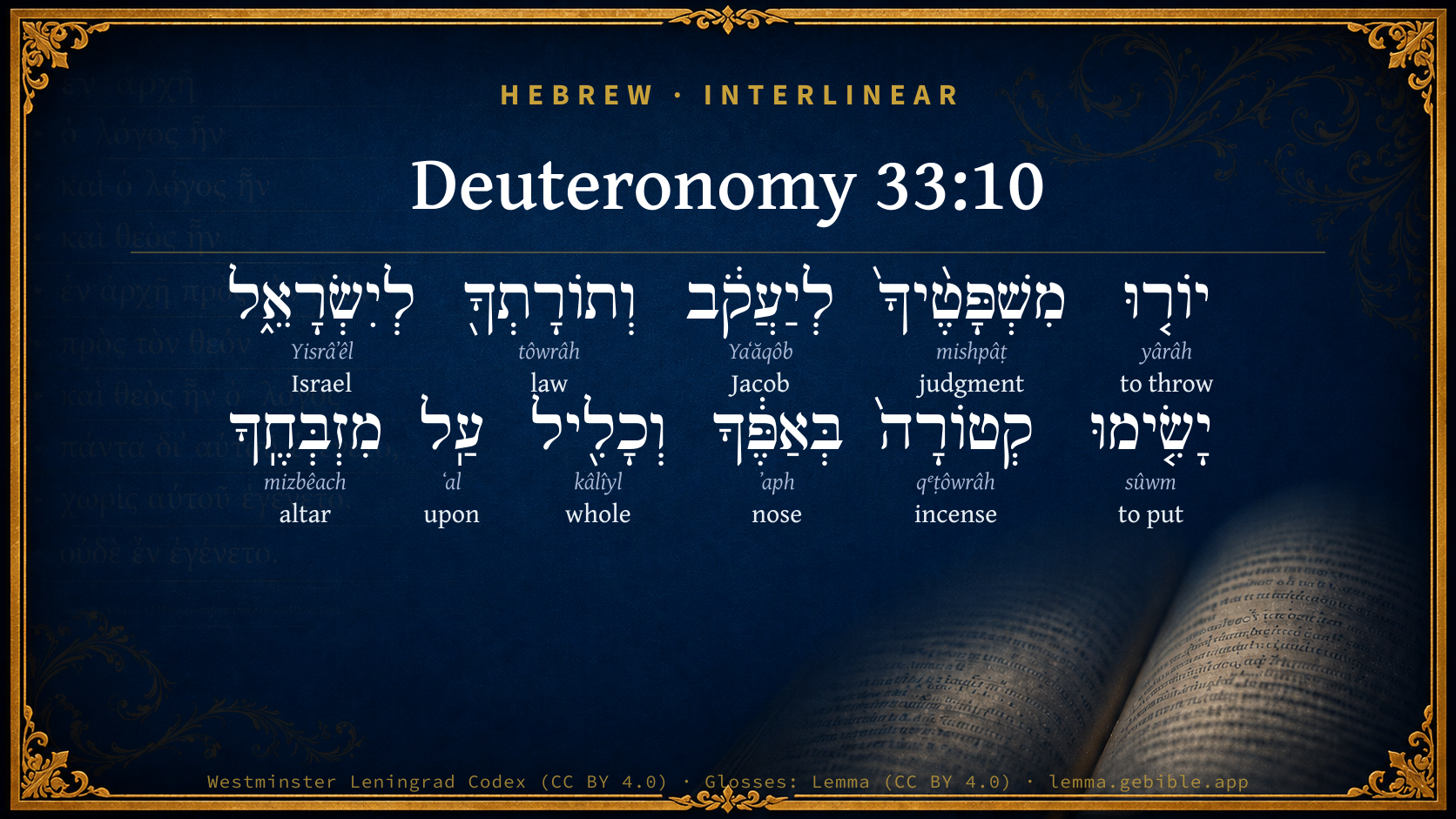
Hebrew (Westminster Leningrad Codex) Deuteronomy 33:10 appears in the Hebrew Old Testament. The text above is from the Westminster Leningrad Codex. Each word links to its Strong’s number, a concise gloss, and parsing drawn from the Open Scriptures Hebrew Bible morphology. Click any word for its full Brown-Driver-Briggs (BDB) entry.
Download image
Cite this verse

Deuteronomy 33:10 (World English Bible). Public Domain. Lemma interlinear Bible study tool, https://lemma.gebible.app/v/deuteronomy/33/10.

Show BibTeX & RIS
BibTeX
RIS
English Translation
They shall teach Jacob your ordinances, Israel your law: They shall put incense before you, Whole burnt offering on your altar.
World English Bible · Public Domain
Highlights
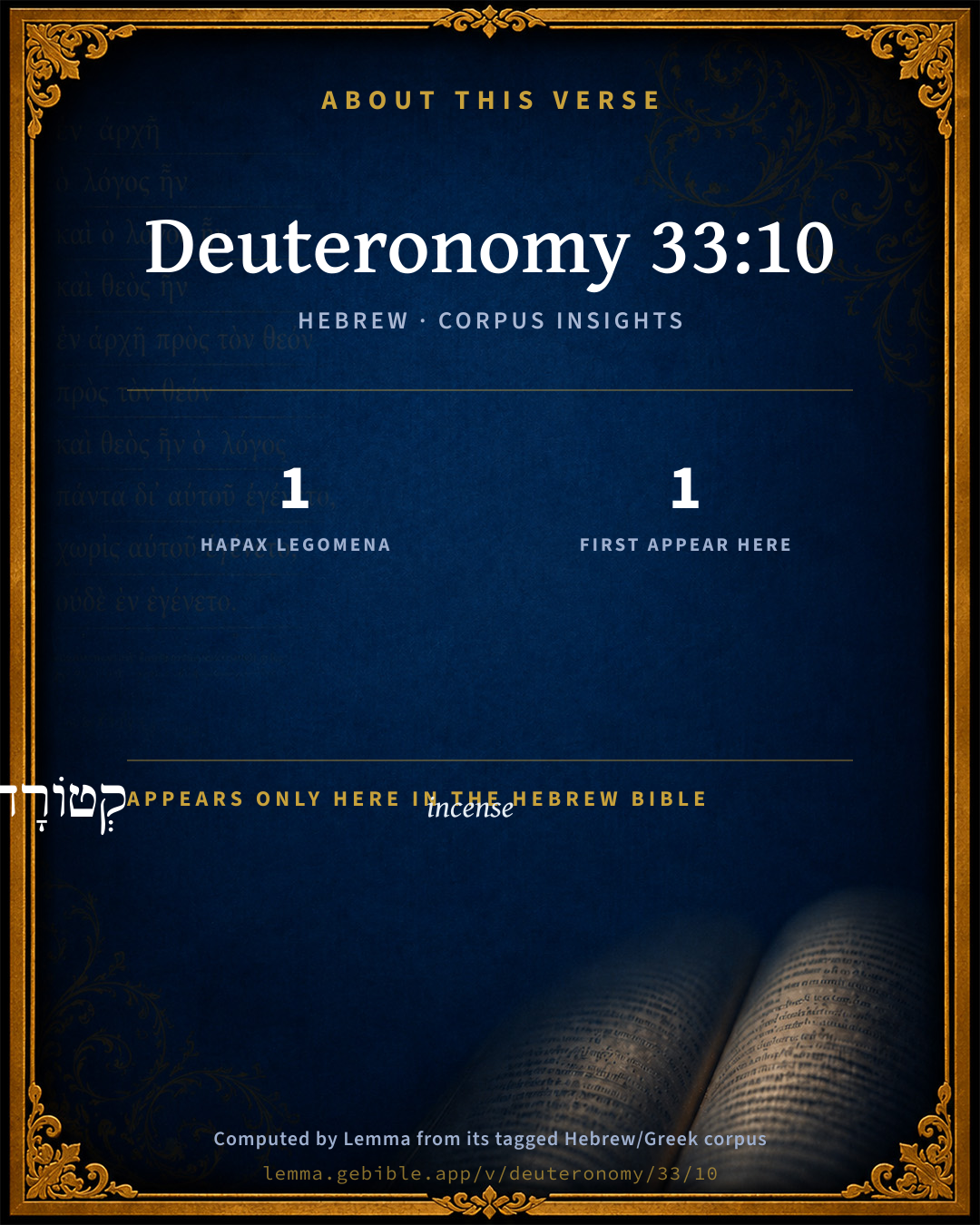
  • 1 hapax legomenon — only here in the Hebrew Bible
  • 1 first appearance in the Hebrew Bible
Full analysis ↓
Download a study sheet

One document with this verse’s original text, its word-by-word gloss line, the meaning frame, cross-references with their text, attributed commentary, and full source and license credits — printable, and it pastes into notes with its structure intact.

This verse Autodidact and up

Study sheet (.html) Plain text (.txt)

A passage Seminary Student

Up to 50 verses in one chapter. A passage sheet keeps up to 6 commentary sources and 12 cross-references per verse, in the order this page ranks them, and says so on the sheet whenever that leaves anything out. Ask for a single verse and you get the Autodidact verse sheet above.

Everything on this page stays free to read, with no account — the sheet is a download of what is already on screen, not access to it.

Want to remove ads? Support Godless Engineer
Compare translations 3

The same verse in 3 English versions, stacked beneath the original-language interlinear above. Click any original word for its lexicon entry.

Each is an independent rendering of the whole verse — the interlinear is not word-aligned to these translations.

Highlighted words mark where these versions differ — a whole-verse word diff, not a word-by-word alignment.

  • World English Bible Public Domain
    They shall teach Jacob your ordinances, Israel your law: They shall put incense before you, Whole burnt offering on your altar.
  • King James Version Public Domain
    They shall teach Jacob thy judgments, and Israel thy law: they shall put incense before thee, and whole burnt sacrifice upon thine altar.
  • unfoldingWord Literal Text CC BY-SA 4.0
    They teach your ordinances to Jacob, and your law to Israel. They will put incense before your nose, and whole offerings on your altar.

unfoldingWord Literal Text — © unfoldingWord, licensed CC BY-SA 4.0. Word-aligned USFM3 via Door43 (git.door43.org/unfoldingWord/en_ult).

Versions to compare (up to 4)

3 of 4 selected

Show all 18 translations

Every available English version of this verse, each an independent rendering of the whole verse.

  • World English Bible Public Domain
    They shall teach Jacob your ordinances, Israel your law: They shall put incense before you, Whole burnt offering on your altar.
  • Berean Standard Bible Public Domain
    He will teach Your ordinances to Jacob and Your law to Israel; he will set incense before You and whole burnt offerings on Your altar.
  • Majority Standard Bible Public Domain
    He will teach Your ordinances to Jacob and Your law to Israel; he will set incense before You and whole burnt offerings on Your altar.
  • King James Version Public Domain
    They shall teach Jacob thy judgments, and Israel thy law: they shall put incense before thee, and whole burnt sacrifice upon thine altar.
  • American Standard Version (1901) Public Domain
    They shall teach Jacob thine ordinances, And Israel thy law: They shall put incense before thee, And whole burnt-offering upon thine altar.
  • Revised Version (1885) Public Domain
    They shall teach Jacob thy judgments, And Israel thy law: They shall put incense before thee, And whole burnt offering upon thine altar.
  • Geneva Bible (1599) Public Domain
    They shall teach Iaakob thy iudgements, and Israel thy Lawe: they shall put incense before thy face, and the burnt offring vpon thine altar.
  • Douay-Rheims (1899) Public Domain
    Thy judgments, O Jacob, and thy law, O Israel: they shall put incense in thy wrath and holocaust upon thy altar.
  • Young's Literal Translation Public Domain
    They teach Thy judgments to Jacob, And Thy law to Israel; They put perfume in Thy nose, And whole burnt-offering on Thine altar.
  • Literal Standard Version CC BY-SA 4.0
    They teach Your judgments to Jacob, || And Your law to Israel; They put incense in Your nose, || And whole burnt-offering on Your altar.
  • Unlocked Literal Bible CC BY-SA 4.0
    He teaches Jacob your decrees and Israel your law. He will put incense before you and whole burnt offerings on your altar.
  • unfoldingWord Literal Text CC BY-SA 4.0
    They teach your ordinances to Jacob, and your law to Israel. They will put incense before your nose, and whole offerings on your altar.
  • Darby Bible Public Domain
    They shall teach Jacob thine ordinances, And Israel thy law: They shall put incense before thy nostrils, And whole burnt-offering upon thine altar.
  • World Messianic Bible Public Domain
    They shall teach Jacob your ordinances, and Israel your law. They shall put incense before you, and whole burnt offering on your altar.
  • Webster's Bible Public Domain
    They shall teach Jacob thy judgments, and Israel thy law; they shall put incense before thee, and whole burnt sacrifice upon thy altar.
  • Free Bible Version CC BY-SA 4.0
    They will teach your regulations to Jacob and your law to Israel. They will place incense before you, and sacrifice whole burnt offerings on your altar.
  • Bible in Basic English Public Domain
    They will be the teachers of your decisions to Jacob and of your law to Israel: the burning of perfumes before you will be their right, and the ordering of burned offerings on your altar.
  • JPS Tanakh (1917) Public Domain
    They shall teach Jacob Thine ordinances, and Israel Thy law; they shall put incense before Thee, and whole burnt-offering upon Thine altar.

Literal Standard Version (2020), Covenant Press — licensed CC BY-SA 4.0. Text via the HelloAO Bible API (eBible.org). Unlocked Literal Bible (unfoldingWord) — licensed CC BY-SA 4.0. Text via the HelloAO Bible API (eBible.org). unfoldingWord Literal Text — © unfoldingWord, licensed CC BY-SA 4.0. Word-aligned USFM3 via Door43 (git.door43.org/unfoldingWord/en_ult). Free Bible Version, Dr. Jonathan Gallagher — licensed CC BY-SA 4.0. Text via the HelloAO Bible API (eBible.org).

Word by word

More ways to search: Search by grammar → Find every occurrence → Compare this word →

Practice this passage: Drill this verse → Learn its vocabulary →

קְטוֹרָה֙
qᵉṭôwrâh
H6988
“incense”
Noun, Common, Feminine, Singular, Absolute
Part of Speech
Noun
Type
Common
Gender
Feminine
Number
Singular
State
Absolute
Full BDB Definition

Origin: from H6999

TWOT: 2011a

smoke of sacrifice, incense
  1. יוֹר֤וּ yârâh H3384 “to throw” Verb, Hiphil, Imperfect, 3rd Person, Masculine, Plural
  2. מִשְׁפָּטֶ֨יךָ֙ mishpâṭ H4941 “judgments · your” Noun, Common, Masculine, Plural, Construct + Suffix, Personal, 2nd Person, Masculine, Singular
  3. לְיַעֲקֹ֔ב Yaʻăqôb H3290 “to/for · Jacob” Preposition + Noun, Proper
  4. וְתוֹרָתְךָ֖ tôwrâh H8451 “and · law · your” Conjunction + Noun, Common, Feminine, Singular, Construct + Suffix, Personal, 2nd Person, Masculine, Singular
  5. לְיִשְׂרָאֵ֑ל Yisrâʼêl H3478 “to/for · Israel” Preposition + Noun, Proper
  6. יָשִׂ֤ימוּ sûwm H7760 “to put” Verb, Qal, Imperfect, 3rd Person, Masculine, Plural
  7. בְּאַפֶּ֔ךָ ʼaph H639 “in/at · nose · your” Preposition + Noun, Common, Masculine, Singular, Construct + Suffix, Personal, 2nd Person, Masculine, Singular
  8. וְכָלִ֖יל kâlîyl H3632 “and · whole” Conjunction + Adjective, Adjective, Masculine, Singular, Absolute
  9. עַֽל ʻal H5921 “upon” Preposition
  10. מִזְבְּחֶֽךָ mizbêach H4196 “altar · your” Noun, Common, Masculine, Singular, Construct + Suffix, Personal, 2nd Person, Masculine, Singular

About this verse

These counts appear in no published source. They are computed here, from the morphology-tagged text and Lemma’s own curated glosses. What Lemma adds →

11
words
11
distinct lemmas
Pentateuch
section

Notable vocabulary

1 hapax legomenon — a word that appears only here in the entire Hebrew Bible:

  • קְטוֹרָה֙ incense H6988

First appearance in Scripture

This word makes its first canonical appearance in the Hebrew Bible here:

  • קְטוֹרָה֙ incense H6988

Shared distinctive vocabulary

וְכָלִ֖יל whole H3632 occurs in 15 verses of the Hebrew Bible. Also found in:

Grammatical profile

  • 2 verbs
  • 7 nouns
  • 1 adjective
  • 1 preposition

Verb forms

  • יוֹר֤וּ Hiphil · Imperfect
  • יָשִׂ֤ימוּ Qal · Imperfect

Hebrew & Septuagint length

In English translation the verse runs 21 words from the Hebrew and 26 from the Septuagint (LXX English) — closely comparable.

A rough comparison of the two English renderings, which tokenize alike — not a word-level alignment.

Word counts can differ between the Hebrew and the Greek without any difference in meaning — e.g. the Hebrew direct-object marker אֵת has no separate Greek word, and Greek often adds the article ὁ.

Cross-references

29

Topical passages linked to Deuteronomy 33:10 in the Treasury of Scripture Knowledge — connected by theme and wording, ordered by reader-vote popularity; previews shown in the World English Bible.

  • Leviticus 10:11 and that you are to teach the children of Israel all the statutes which Yahweh has spoken to them by Moses."
  • Psalms 51:19 Then you will delight in the sacrifices of righteousness, In burnt offerings and in whole burnt offerings. Then they will offer bulls on your altar.
  • Exodus 30:7–8 Aaron shall burn incense of sweet spices on it every morning. When he tends the lamps, he shall burn it.
  • Deuteronomy 17:9–11 and you shall come to the priests the Levites, and to the judge who shall be in those days: and you shall inquire; and they shall show you the sentence of judgment.
  • 1 Samuel 2:28 and did I choose him out of all the tribes of Israel to be my priest, to go up to my altar, to burn incense, to wear an ephod before me? and did I give to the house of your father all the offerings of the children of Israel made by fire?
  • Ezekiel 43:27 When they have accomplished the days, it shall be that on the eighth day, and forward, the priests shall make your burnt offerings on the altar, and your peace-offerings; and I will accept you, says the Lord Yahweh.
  • Leviticus 1:9 but its innards and its legs he shall wash with water. The priest shall burn the whole on the altar, for a burnt offering, an offering made by fire, of a sweet savor to Yahweh.
  • Leviticus 1:13 but the innards and the legs he shall wash with water. The priest shall offer the whole, and burn it on the altar. It is a burnt offering, an offering made by fire, of a sweet savor to Yahweh.
  • Leviticus 1:17 He shall tear it by its wings, but shall not divide it apart. The priest shall burn it on the altar, on the wood that is on the fire. It is a burnt offering, an offering made by fire, of a sweet savor to Yahweh.
  • Leviticus 9:12–13 He killed the burnt offering; and Aaron's sons delivered the blood to him, and he sprinkled it on the altar round about.
  • Numbers 16:40 to be a memorial to the children of Israel, to the end that no stranger, who isn't of the seed of Aaron, comes near to burn incense before Yahweh; that he not be as Korah, and as his company: as Yahweh spoke to him by Moses.
  • Numbers 16:46 Moses said to Aaron, Take your censer, and put fire therein from off the altar, and lay incense thereon, and carry it quickly to the congregation, and make atonement for them: for there is wrath gone out from Yahweh; the plague is begun.
  • Deuteronomy 24:8 Take heed in the plague of leprosy, that you observe diligently, and do according to all that the priests the Levites shall teach you: as I commanded them, so you shall observe to do.
  • Deuteronomy 31:9–13 Moses wrote this law, and delivered it to the priests the sons of Levi, who bore the ark of the covenant of Yahweh, and to all the elders of Israel.
  • 2 Chronicles 17:8–10 and with them the Levites, even Shemaiah, and Nethaniah, and Zebadiah, and Asahel, and Shemiramoth, and Jehonathan, and Adonijah, and Tobijah, and Tob-adonijah, the Levites; and with them Elishama and Jehoram, the priests.
  • 2 Chronicles 26:18 and they withstood Uzziah the king, and said to him, It pertains not to you, Uzziah, to burn incense to Yahweh, but to the priests the sons of Aaron, who are consecrated to burn incense: go out of the sanctuary; for you have trespassed; neither shall it be for your honor from Yahweh God.
  • 2 Chronicles 30:22 Hezekiah spoke comfortably to all the Levites who had good understanding [in the service] of Yahweh. So they ate throughout the feast for the seven days, offering sacrifices of peace-offerings, and making confession to Yahweh, the God of their fathers.
  • Nehemiah 8:1–9 All the people gathered themselves together as one man into the broad place that was before the water gate; and they spoke to Ezra the scribe to bring the book of the law of Moses, which Yahweh had commanded to Israel.
  • Nehemiah 8:13–15 On the second day were gathered together the heads of fathers' [houses] of all the people, the priests, and the Levites, to Ezra the scribe, even to give attention to the words of the law.
  • Nehemiah 8:18 Also day by day, from the first day to the last day, he read in the book of the law of God. They kept the feast seven days; and on the eighth day was a solemn assembly, according to the ordinance.
  • Ezekiel 44:23–24 They shall teach my people the difference between the holy and the common, and cause them to discern between the unclean and the clean.
  • Hosea 4:6 My people are destroyed for lack of knowledge. Because you have rejected knowledge, I will also reject you, That you may be no priest to me. Because you have your God's law, I will also forget your children.
  • Malachi 2:6–8 The law of truth was in his mouth, and unrighteousness was not found in his lips. He walked with me in peace and uprightness, and turned many away from iniquity.
  • Matthew 23:2–3 saying, "The scribes and the Pharisees sat on Moses' seat.
  • Luke 1:9–10 according to the custom of the priest's office, his lot was to enter into the temple of the Lord and burn incense.
  • John 21:15–16 So when they had eaten their breakfast, Jesus said to Simon Peter, "Simon, son of Jonah, do you love me more than these?" He said to him, "Yes, Lord; you know that I have affection for you." He said to him, "Feed my lambs."
  • Hebrews 7:25 Therefore he is also able to save to the uttermost those who draw near to God through him, seeing he ever lives to make intercession for them.
  • Hebrews 9:24 For Christ hasn't entered into holy places made with hands, which are representations of the true, but into heaven itself, now to appear in the presence of God for us;
  • Revelation 8:3–5 Another angel came and stood over the altar, having a golden censer. Much incense was given to him, that he should add it to the prayers of all the saints on the golden altar which was before the throne.

Cross-references courtesy of OpenBible.info (CC BY 4.0).

Hebrew and Greek witnesses Masoretic Hebrew ↔ Greek Septuagint

The same verse in the two great witnesses to the Old Testament, shown verse-for-verse.

These are two independent witnesses, not word-aligned to each other, and the Septuagint is shown in lemma (dictionary) form.

Hebrew Deuteronomy 33:10 Masoretic · Westminster Leningrad Codex

יוֹר֤וּ מִשְׁפָּטֶ֨יךָ֙ לְיַעֲקֹ֔ב וְתוֹרָתְךָ֖ לְיִשְׂרָאֵ֑ל יָשִׂ֤ימוּ קְטוֹרָה֙ בְּאַפֶּ֔ךָ וְכָלִ֖יל עַֽל מִזְבְּחֶֽךָ

They shall teach Jacob your ordinances, Israel your law: They shall put incense before you, Whole burnt offering on your altar.

World English Bible · Public Domain

Greek LXX Deuteronomy 33:10 Septuagint · lemma form

δηλόω ὁ δικαίωμα σύ ὁ ἰακώβ καί ὁ νόμος σύ ὁ ἰσραήλ ἐπιτίθημι θυμίαμα ἐν ὀργή σύ διά πᾶς ἐπί ὁ θυσιαστήριον σύ

They shall declare your ordinances to Jacob, and your law to Israel: they shall place incense in the time of your wrath continually upon your altar.

LXX2012 (modern English Septuagint) · Public Domain

On this verse, The Cambridge Bible for Schools and Colleges discusses the Septuagint’s reading. Read the note in Commentary ↓

Hebrew: Westminster Leningrad Codex (CC BY 4.0). Greek: Septuagint (public domain); English from LXX2012 (modern English Septuagint) (Public Domain). How the Septuagint differs from the Hebrew →

Targum (Aramaic paraphrase)

2

The Targum is the ancient Jewish Aramaic paraphrase of the Hebrew Scriptures — an interpretive translation, not the Hebrew text itself. Onkelos (literal) and Pseudo-Jonathan (expansive) render the Torah, and Jonathan the Prophets. Coverage is partial: where no permissively-licensed English translation exists for a verse, only the Aramaic is shown. This is verse-level text, not a word-by-word alignment to the Hebrew.

  1. Targum Onkelos Torah (Genesis–Deuteronomy)
    כָּשְׁרִין אִלֵין דְיַלְפוּן דִינָיךְ לְיַעֲקֹב וְאוֹרַיְתָךְ לְיִשְׂרָאֵל יְשַׁוּוּן קְטוֹרֶת בּוּסְמִין קֳדָמָךְ וּגְמִיר לְרַעֲוָא עַל מַדְבְּחָךְ

    (no public-domain English translation for this verse)

    Targum Onkelos — Aramaic: “Onkelos Genesis” (public domain); “Onkelos Exodus” (public domain); “Onkelos Leviticus” (public domain); “Onkelos Numbers” (public domain); “Onkelos Deuteronomy” (public domain). English: “Sefaria Community Translation” (CC0 1.0 (public-domain dedication)); “J.W. Etheridge. The Targums of Onkelos and Jonathan Ben Uzziel on the Pentateuch. London: Longmans, Green, 1862” (public domain). Text via Sefaria.

  2. Targum Pseudo-Jonathan Torah (Genesis–Deuteronomy)
    כַּשְׁרִין אִינוּן לְמַלְפָא סִידְרֵי דִינָךְ לִדְבֵית יַעֲקב וְאוֹרַיְיתָךְ לִדְבֵית יִשְרָאֵל יְשַׁווּן אֲחוּהוֹן כַּהֲנַיָא קְטוֹרֶת בּוּסְמִין עַל מַחְתַּיָא וְיֵיכְלוּן מִיתָנָא בְּיוֹם רוּגְזָךְ וְקָרְבַּן גְמִיר לְרַעֲוָא עַל גַּבֵּי מַדְבְּחָךְ

    Apt are they in teaching the orders of Thy judgments to them of Beth Jakob, and Thy law to them of Beth Israel. Their brethren the priests put incense on the censers to restrain the plague in the day of Thy wrath, and offer up the burnt sacrifice with acceptance at Thy altar.

    Targum Pseudo-Jonathan — Aramaic: “Targum Jonathan on Genesis” (public domain); “Targum Jonathan on Exodus” (public domain); “Targum Jonathan on Leviticus” (public domain); “Targum Jonathan on Numbers” (public domain); “Targum Jonathan on Deuteronomy” (public domain). English: “The Targum of Jonathan ben Uzziel, trans. J. W. Etheridge, London, 1862” (public domain). Text via Sefaria.

Commentary

Notes on Deuteronomy 33:10 from classic Christian and Jewish commentators (each source and its license shown beneath its notes). The classic Christian expositions comment on the surrounding passage and are grouped to its opening verse, so a note may address several verses; the Jewish commentaries on the Tanakh (Rashi and others) are per-verse, so they appear only where the commentator wrote on this verse.

Lemma curates 59 commentaries, every one of them public domain or Creative Commons licensed, each selected and text-cleaned for this edition rather than reprinted as found. About our sources →

Trapp's Complete Commentary

John Trapp

Deu 33:10 They shall teach Jacob thy judgments, and Israel thy law: they shall put incense before thee, and whole burnt sacrifice upon thine altar.

Ver. 10. They shall teach Jacob.] Apt and able to teach must all ministers be, as Paul. {Act 20:18-35} Praedicationis officium suscipit, quisquis ad sacerdotium accedit, saith Gregory: He is no minister that is no teacher. Aidanus, the first bishop of Durham, A.D. 636, neglected no duty of a good pastor, travelling up and down the country, even on foot, to preach the gospel, giving whatsoever he could get unto the poor, and by the example of his own virtues instructing, as well as by word and doctrine. {a} Amongst the Greeks, tragedians and comedians were said, εις διδαχην ων προσηκεν εργαζομενοι, to labour in teaching the people. What should ministers then do?

They shall put incense before thee,] i.e., Pray for the people, as well as preach to them. So Act 6:4. Augustine’s wish was, that Christ, when he came, might find him aut precantem aut praedicantem, praying or preaching. Bene orasse est bene studuisse, saith Luther.

{a} Godwin’s Catalog.

John Trapp, A Commentary or Exposition upon All the Books of the Old and New Testament (1647–1656) — public domain. Text from a community e-Sword module.

Joseph Benson's Commentary

Deu 33:10. They shall teach Jacob thy judgments, and Israel thy law — And that both as preachers in their religious assemblies, reading and expounding the law, (Neh 7:7-8,) and as judges determining doubtful and difficult cases that should be brought before them, 2Ch 17:8-9. The priests’ lips were to keep this knowledge for the use of the people, who were to ask the law at their mouths, Mal 2:7. Even Haggai, a prophet, consulted the priests in a case of conscience, Hag 2:12. They shall put incense before thee — They shall be the sole ministers at the altar.

Joseph Benson's Commentary on the Old and New Testaments (1811–1818) — public domain. Text from a community e-Sword module.

Tyndale Open Study Notes

Tyndale Open Resources

33:10 They teach your regulations . . . instructions: In addition to carrying out priestly duties such as sacrifices and otherwise assisting at the Tabernacle and the Temple, the Levites had the task of teaching the Torah (31:9-13). • present incense: This ministry was limited to Levitical priests (Num 16:39-40). Later, when King Uzziah entered the Temple to offer incense, he was roundly condemned for his arrogant breach of the priests’ privilege and was afflicted by a skin disease for the rest of his life (2 Chr 26:16-21).

Tyndale Open Study Notes — © Tyndale Open Resources, licensed CC BY-SA 4.0. Text via the HelloAO Bible API.

Adam Clarke's Commentary

Verse 10. They shall teach Jacob, c.] This was the office of the Levites, to teach, by their significant service and typical ceremonies, the way of righteousness and truth to the children of Israel. And of their faithfulness in this respect God bears testimony by the prophet, "My covenant was with him of life and peace," Mal 2:5 and, "The law of truth was in his mouth, and iniquity was not found in his lips: he walked with me in peace and equity, and did turn many away from iniquity;" Mal 2:6. These words are a sufficient comment on the words of the text.

Adam Clarke's Commentary on the Bible (1810–1826) — public domain. Text from a community e-Sword/MySword module.

The Cambridge Bible for Schools and Colleges

gen. ed. J. J. S. Perowne

10. among you] Lit. in thee.

which chanceth him by night] See Lev_15:16; and above on Deu_20:7.

10. judgements … law] Heb. Mishpaṭim … Torah cp. Deu_17:9 ff. The earlier priest was a teacher and judge (Hos_4:6, Mic_3:11); and of his functions these also come first here, and are followed by his offices in the ritual of expiation.

incense] Rather smoke of sacrifice; for in the earlier Heb. literature, Isa_1:13, 1Sa_2:16, Amo_4:5, Hos_4:13; Hos_11:2, the noun ḳeṭôreth (here ḳeṭôrah) and the vb ḳiṭṭer refer always to such smoke and not to incense.

Of the use of incense in Israel’s worship there is no evidence before the 7th cent. b.c.; Jer_6:20 appears to regard frankincense as an innovation. At Ta‘anach Sellin unearthed an incense altar which he dates about 700 b.c. (Tell Ta‘annek, 75 ff., 109 f.) and at Gezer Macalister found another in rubbish of 1000–600 b.c. (PEFQ, 1908, 211). See further Jerusalem i. 333, ii. 63 n. 2, 307 f., etc. The smoke from the altar conveyed to the Deity in an ethereal form the portion of the sacrificial feast reserved for Him. This seems to have been the primitive idea of the process, and a trace of it survives here in the anthropomorphic phrase in thy nostrils (R.V. marg.), cp. Gen_8:21, 1Sa_26:19, etc. But later the burnt-offering came more and more to have a piacular force; and its smoke symbolised to Israel the confession of their sin and their surrender of the lives He was pleased to accept in place of their guilty and forfeit selves. No sacrament could be more adequate than this, which proved at once the death deserved by the guilty, the blackness and bitterness of their sin, and its disappearance in the infinite purity of the skies, the unfathomable mercy of Heaven. It is this piacular meaning which is behind the LXX rendering ἐν ὀργῇ σον, ‘in thy wrath,’ for in thy nostrils.

whole burnt offering] See Deu_13:16 (17).

The Cambridge Bible for Schools and Colleges (gen. ed. J. J. S. Perowne; Cambridge University Press, 1878–1918) — public domain. Text from a community e-Sword module.

John Gill's Exposition

Bless, Lord, his substance,.... Which lay in tithes, firstfruits, &c. for the priests and Levites had no share in the division of the land; unless this can be understood of the cities and suburbs which were given them, or of houses and fields devoted, which fell unto them, or rather of their cattle, for the use of which they had suburbs appointed them; for otherwise in husbandry and merchandise they were not employed: some render it "an host" or army (l), their service being a militia, or warfare, Num 4:3; Jarchi refers this to the Hasmonaeans or Maccabees, which were of this tribe:

and accept the work of his hands; in offering incense and sacrifices, and all other administrations of the office of priests and Levites; thus the righteousness and sacrifice of Christ are of a sweet smelling savour, and very acceptable to God; and all the spiritual sacrifices of the saints who are priests unto God, as of prayer and praise, are acceptable to him through Jesus Christ:

smite through the loins of them that rise against him; such as were the companies of Korah, Dathan, and Abiram; and in all ages faithful ministers of the word meet with many enemies, whom they would not be, able to withstand were not the Lord to appear for them, and protect them from them, and smite them thoroughly:

and of them that hate them, that they rise not again; destroying them with an utter destruction, so that they are not able to make any other efforts upon them; for such who are enemies to the priests of the Lord are enemies to him, and to true religion, enemies to God and Christ, to the law and to the Gospel, to the word of God and to the ordinances of it, and therefore to be severely handled and thoroughly punished: Christ's enemies shall all be subdued under him; see Psa 110:1.

(l) "copiis ejus", Junius & Tremellius; "vel exercitibus ejus", Piscator.

John Gill's Exposition of the Whole Bible (1746–1763) — public domain (CC PDM 1.0). Text via the HelloAO Bible API.

Haydock's Catholic Bible Commentary

Wrath. He seems to allude to the action of Aaron, Numbers xvi. 46. (Calmet) --- Hebrew has, "incense before thee," (Haydock) as it is explained by the Chaldean, Septuagint, &c. --- Holocaust, of flour, &c., calil; that of beasts was styled aule. See chap. xiii. 16. (Calmet)

George Leo Haydock (1774–1849), Haydock's Catholic Family Bible and Commentary, 1859 edition — public domain. Excludes Psalms (Douay-Rheims chapter numbering differs from Protestant) and Deuterocanonical books (Catholic canon only).

Matthew Poole's English Annotations

They, i.e. the priests and Levites.

Before thee, i.e. upon thine altar of incense, which stood before the ark, the place of God’s special presence.

Matthew Poole's English Annotations on the Holy Bible (1683–1685) — public domain. Text from a community e-Sword/MySword module.

Whedon's Commentary on the Bible

Daniel D. Whedon

10. They shall teach Jacob thy judgments — The priests are to be of the tribe of Levi, the divinely appointed teachers.

Daniel D. Whedon (gen. ed.), Commentary on the Old and New Testaments (1874–1909) — public domain. Text from a community e-Sword module.

unfoldingWord translationNotes

Door43 World Missions Community

General Information:

Moses continues to bless the tribes of Israel; the blessings are short poems. He continues to describe the tribe of Levi, which he began to do in Deuteronomy 33:8. (See: Parallelism)

your ... your ... you ... your

Moses is speaking to Yahweh, so all these words are singular.

translationWords

Jacob

decree

law

incense

burnt offering

altar

unfoldingWord translationNotes — © Distant Shores Media and the Door43 World Missions Community, licensed CC BY-SA 4.0. Source: git.door43.org/Door43/en_tn.

Rashi

Rabbi Shlomo Yitzchaki (Rashi)

יורו משפטיך THEY MAY TEACH THY JUDGMENTS (the emphasis is to be placed on “they”) — they alone are worthy of doing this (cf. Onkelos).

וכליל — means burnt-offering (which was entirely (כליל) burnt on the altar) (Sifrei Devarim 351:3).

Rashi on the Tanakh — English translations: “The Judaica Press complete Tanach with Rashi, translated by A. J. Rosenberg” (CC BY 4.0); “Pentateuch with Rashi's commentary by M. Rosenbaum and A.M. Silbermann, 1929-1934” (public domain); “The Metsudah Tanach series, Lakewood, N.J” (CC BY 4.0); and “The Book of Joshua, Metsudah Publications, 1997” (CC BY 4.0). Text via Sefaria.

Sforno

Rabbi Ovadia Sforno

They shall teach Your law to Yaakov. Since they are the most upright tribe, give give them the grace and wisdom to teach Your laws, as our Sages have said, “If the teacher appears to you as an angel of Hashem seek Torah from his mouth.

Sforno on the Tanakh — English translation: “Yalkut, Sifsei Chachomim Chumash, Metsudah Publications, 2009” (CC BY 4.0). Text via Sefaria.

Lesson kit

Teaching starters — assembled from the data on this page, not authored interpretation. Every prompt links to the verse data it draws on. Edit before teaching.

Deuteronomy, in the Pentateuch, opens this verse with 11 words (11 distinct Hebrew lemmas). Its most distinctive word is qᵉṭôwrâh (“incense”). A historical commentator’s framing appears above. Read the whole chapter for the surrounding context.

Discussion questions

  1. The word qᵉṭôwrâh carries the sense “incense.” How does it shape the verse?
  2. This verse holds 1 word here found nowhere else in the Hebrew Bible. What might the rare word draw attention to?
  3. The word “incense” first appears here in Scripture. What is being introduced at this debut?
  4. Exodus 28:31 shares the word «whole» with this verse. How do the two illuminate each other?
  5. The translations on this page render this verse differently — a whole-verse word diff, not a word-by-word alignment. What might account for the different wordings?
  6. The verb «יוֹר֤וּ» is Hiphil Imperfect. How does its form color the action?
  7. Reading how Trapp's Complete Commentary and Joseph Benson's Commentary read this verse, where do the two commentators agree and where do they part?

Things to notice

  • 1 word in this verse appears nowhere else in the Hebrew Bible.
  • 1 word makes its first canonical appearance in Scripture here.
  • These translations choose different wording for 11 words in this verse.
  • 11 distinct Hebrew lemmas span 11 words in this verse.

Reading settings

Reading text

Shown beneath each verse's original-language words.

Old Testament
Old Testament edition

Read the OT as the Masoretic Hebrew (MT) or the Greek Septuagint (LXX).

English shown for the Greek Septuagint (in the Hebrew ↔ Greek comparison).

Comparing translations? Open the Compare panel on any verse page to stack up to four side by side.