Genesis 27:15

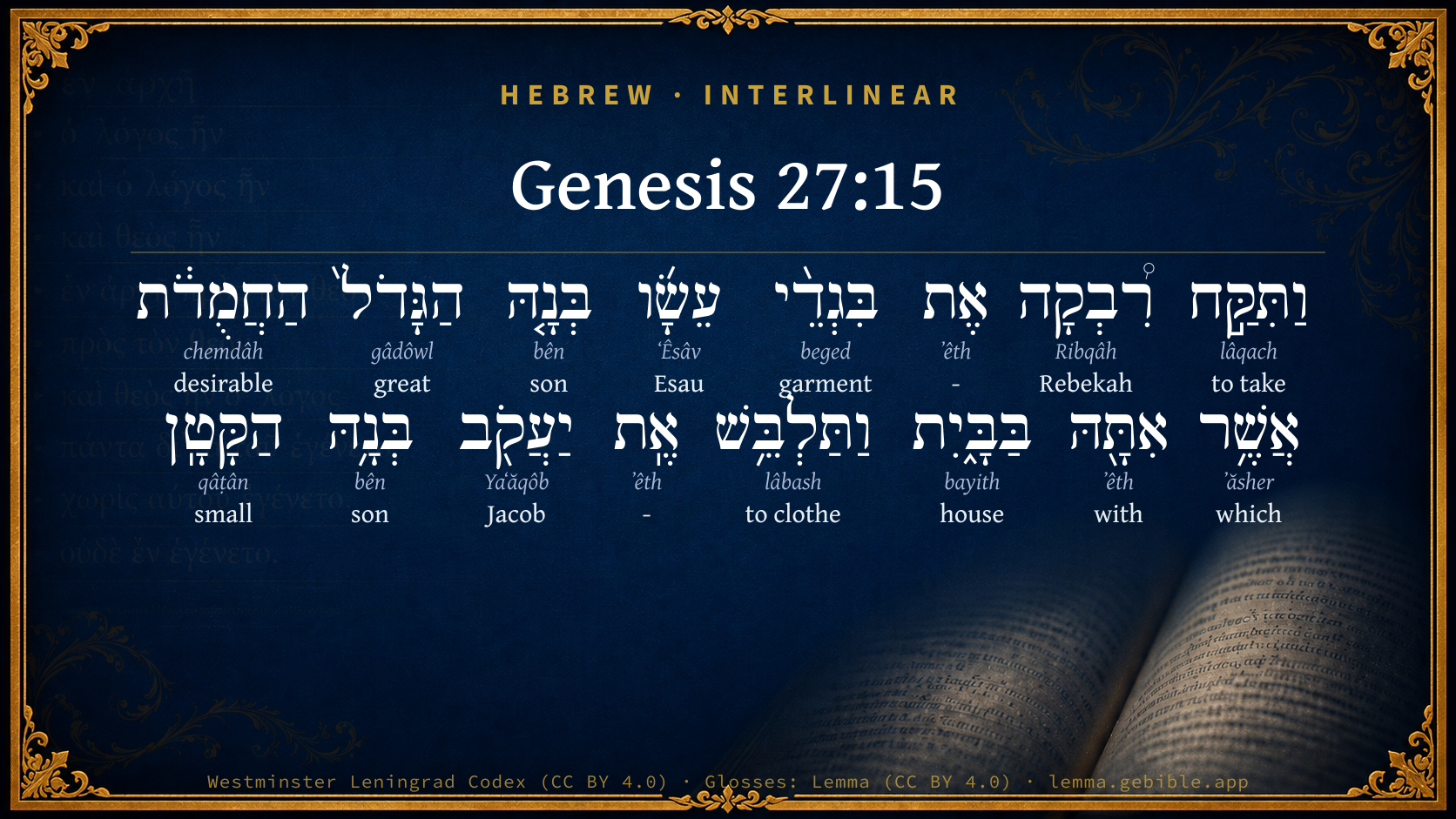
Hebrew (Westminster Leningrad Codex) Genesis 27:15 appears in the Hebrew Old Testament. The text above is from the Westminster Leningrad Codex. Each word links to its Strong’s number, a concise gloss, and parsing drawn from the Open Scriptures Hebrew Bible morphology. Click any word for its full Brown-Driver-Briggs (BDB) entry.
Download image
Cite this verse

Genesis 27:15 (World English Bible). Public Domain. Lemma interlinear Bible study tool, https://lemma.gebible.app/v/genesis/27/15.

Show BibTeX & RIS
BibTeX
RIS
English Translation
Rebekah took the good clothes of Esau, her elder son, which were with her in the house, and put them on Jacob, her younger son.
World English Bible · Public Domain
Highlights
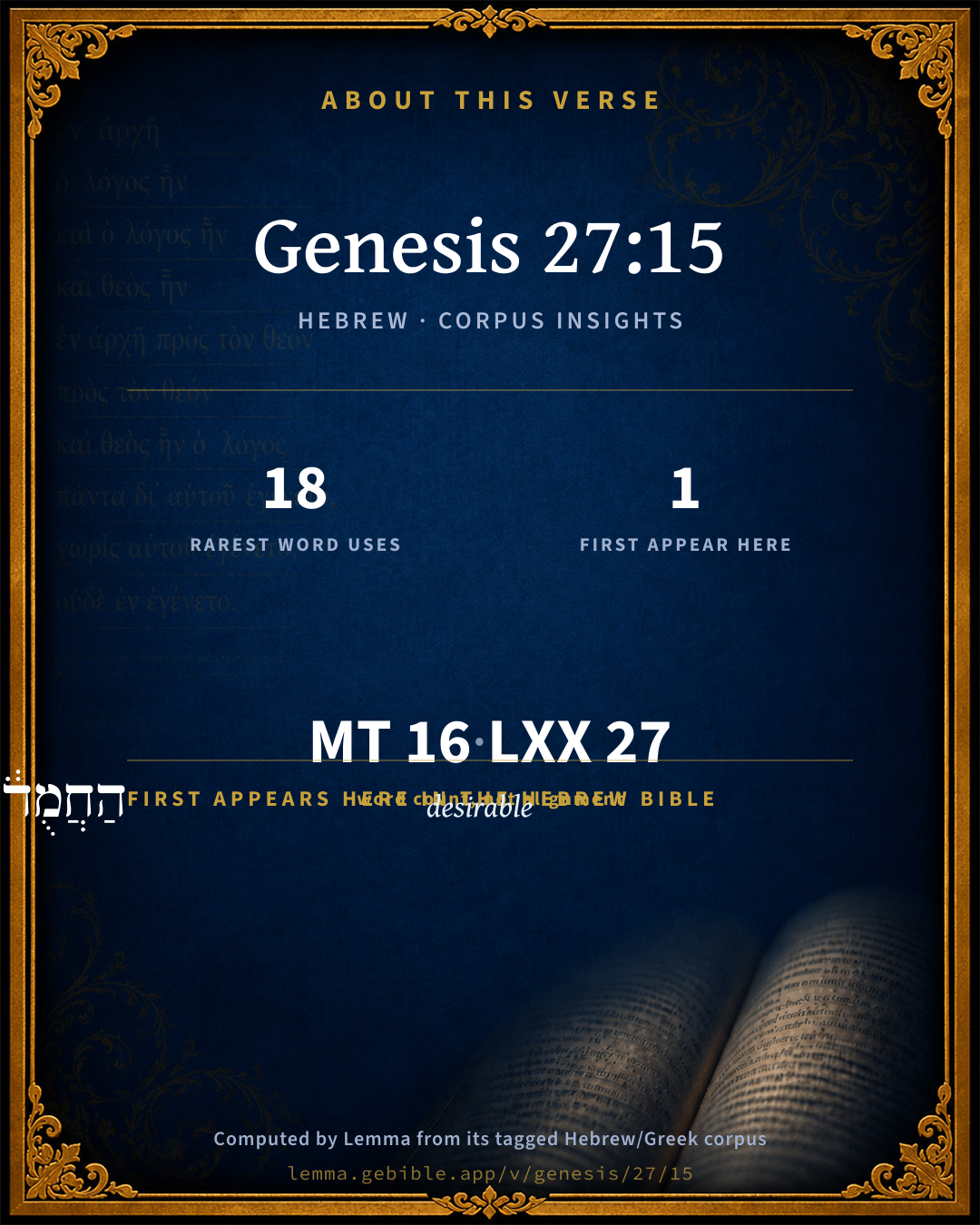
  • 1 first appearance in the Hebrew Bible
Full analysis ↓
Download a study sheet

One document with this verse’s original text, its word-by-word gloss line, the meaning frame, cross-references with their text, attributed commentary, and full source and license credits — printable, and it pastes into notes with its structure intact.

This verse Autodidact and up

Study sheet (.html) Plain text (.txt)

A passage Seminary Student

Up to 50 verses in one chapter. A passage sheet keeps up to 6 commentary sources and 12 cross-references per verse, in the order this page ranks them, and says so on the sheet whenever that leaves anything out. Ask for a single verse and you get the Autodidact verse sheet above.

Everything on this page stays free to read, with no account — the sheet is a download of what is already on screen, not access to it.

Want to remove ads? Support Godless Engineer
Compare translations 3

The same verse in 3 English versions, stacked beneath the original-language interlinear above. Click any original word for its lexicon entry.

Each is an independent rendering of the whole verse — the interlinear is not word-aligned to these translations.

Highlighted words mark where these versions differ — a whole-verse word diff, not a word-by-word alignment.

  • World English Bible Public Domain
    Rebekah took the good clothes of Esau, her elder son, which were with her in the house, and put them on Jacob, her younger son.
  • King James Version Public Domain
    And Rebekah took goodly raiment of her eldest son Esau, which were with her in the house, and put them upon Jacob her younger son:
  • unfoldingWord Literal Text CC BY-SA 4.0
    Then Rebekah took the best clothes of Esau her older son that with her in the house and put them on Jacob her younger son.

unfoldingWord Literal Text — © unfoldingWord, licensed CC BY-SA 4.0. Word-aligned USFM3 via Door43 (git.door43.org/unfoldingWord/en_ult).

Versions to compare (up to 4)

3 of 4 selected

Show all 18 translations

Every available English version of this verse, each an independent rendering of the whole verse.

  • World English Bible Public Domain
    Rebekah took the good clothes of Esau, her elder son, which were with her in the house, and put them on Jacob, her younger son.
  • Berean Standard Bible Public Domain
    And Rebekah took the finest clothes in the house that belonged to her older son Esau, and she put them on her younger son Jacob.
  • Majority Standard Bible Public Domain
    And Rebekah took the finest clothes in the house that belonged to her older son Esau, and she put them on her younger son Jacob.
  • King James Version Public Domain
    And Rebekah took goodly raiment of her eldest son Esau, which were with her in the house, and put them upon Jacob her younger son:
  • American Standard Version (1901) Public Domain
    And Rebekah took the goodly garments of Esau her elder son, which were with her in the house, and put them upon Jacob her younger son.
  • Revised Version (1885) Public Domain
    And Rebekah took the goodly raiment of Esau her elder son, which were with her in the house, and put them upon Jacob her younger son:
  • Geneva Bible (1599) Public Domain
    And Rebekah tooke faire clothes of her elder sonne Esau, which were in her house, and clothed Iaakob her yonger sonne:
  • Douay-Rheims (1899) Public Domain
    And she put on him very good garments of Esau, which she had at home with her:
  • Young's Literal Translation Public Domain
    and Rebekah taketh the desirable garments of Esau her elder son, which `are' with her in the house, and doth put on Jacob her younger son;
  • Literal Standard Version CC BY-SA 4.0
    and Rebekah takes the desirable garments of Esau her older son, which [are] with her in the house, and puts them on Jacob her younger son;
  • Unlocked Literal Bible CC BY-SA 4.0
    Rebekah took the best clothes of Esau, her older son, which were with her in the house, and put them on Jacob, her younger son.
  • unfoldingWord Literal Text CC BY-SA 4.0
    Then Rebekah took the best clothes of Esau her older son that with her in the house and put them on Jacob her younger son.
  • Darby Bible Public Domain
    And Rebecca took the clothes of her elder son Esau, the costly ones which were with her in the house, and put them on Jacob her younger son;
  • World Messianic Bible Public Domain
    Rebekah took the good clothes of Esau, her elder son, which were with her in the house, and put them on Jacob, her younger son.
  • Webster's Bible Public Domain
    And Rebekah took goodly raiment of her eldest son Esau, which was with her in the house, and put it upon Jacob her younger son:
  • Free Bible Version CC BY-SA 4.0
    Then Rebekah went and got her older son Esau's best clothes that she had at home and put them on Jacob her younger son.
  • Bible in Basic English Public Domain
    And Rebekah took the fair robes of her oldest son, which were with her in the house, and put them on Jacob, her younger son:
  • JPS Tanakh (1917) Public Domain
    And Rebekah took the choicest garments of Esau her elder son, which were with her in the house, and put them upon Jacob her younger son.

Literal Standard Version (2020), Covenant Press — licensed CC BY-SA 4.0. Text via the HelloAO Bible API (eBible.org). Unlocked Literal Bible (unfoldingWord) — licensed CC BY-SA 4.0. Text via the HelloAO Bible API (eBible.org). unfoldingWord Literal Text — © unfoldingWord, licensed CC BY-SA 4.0. Word-aligned USFM3 via Door43 (git.door43.org/unfoldingWord/en_ult). Free Bible Version, Dr. Jonathan Gallagher — licensed CC BY-SA 4.0. Text via the HelloAO Bible API (eBible.org).

Word by word

More ways to search: Search by grammar → Find every occurrence → Compare this word →

Practice this passage: Drill this verse → Learn its vocabulary →

הַחֲמֻדֹ֔ת
chemdâh
H2532
“the · desirable things”
Particle, Definite Article + Noun, Common, Feminine, Plural, Absolute
Part of Speech
Particle + Noun
Type
Common
Gender
Feminine
Number
Plural
State
Absolute
Full BDB Definition

Origin: from H2531

TWOT: 673b

desire, that which is desirable (noun feminine) - pleasant, precious (adjective)
  1. וַתִּקַּ֣ח lâqach H3947 “and · to take” Conjunction + Verb, Qal, Sequential Imperfect, 3rd Person, Feminine, Singular
  2. רִ֠בְקָה Ribqâh H7259 “Rebekah” Noun, Proper
  3. אֶת ʼêth H853 “-” Particle, Direct Object
  4. בִּגְדֵ֨י beged H899 “garments of” Noun, Common, Masculine, Plural, Construct
  5. עֵשָׂ֜ו ʻÊsâv H6215 “Esau” Noun, Proper
  6. בְּנָ֤הּ bên H1121 “son · her” Noun, Common, Masculine, Singular, Construct + Suffix, Personal, 3rd Person, Feminine, Singular
  7. הַגָּדֹל֙ gâdôwl H1419 “the · great” Particle, Definite Article + Adjective, Adjective, Masculine, Singular, Absolute
  8. אֲשֶׁ֥ר ʼăsher H834 “which” Particle, Relative
  9. אִתָּ֖הּ ʼêth H854 “with · her” Preposition + Suffix, Personal, 3rd Person, Feminine, Singular
  10. בַּבָּ֑יִת bayith H1004 “in/at the · house” Preposition, Determined + Noun, Common, Masculine, Singular, Absolute
  11. וַתַּלְבֵּ֥שׁ lâbash H3847 “and · to clothe” Conjunction + Verb, Hiphil, Sequential Imperfect, 3rd Person, Feminine, Singular
  12. אֶֽת ʼêth H853 “-” Particle, Direct Object
  13. יַעֲקֹ֖ב Yaʻăqôb H3290 “Jacob” Noun, Proper
  14. בְּנָ֥הּ bên H1121 “son · her” Noun, Common, Masculine, Singular, Construct + Suffix, Personal, 3rd Person, Feminine, Singular
  15. הַקָּטָֽן qâṭân H6996 “the · small” Particle, Definite Article + Adjective, Adjective, Masculine, Singular, Absolute

About this verse

These counts appear in no published source. They are computed here, from the morphology-tagged text and Lemma’s own curated glosses. What Lemma adds →

16
words
14
distinct lemmas
Pentateuch
section

Notable vocabulary

The rarest word here is הַחֲמֻדֹ֔ת desirable H2532 — appearing just 18 times in the whole Hebrew Bible.

First appearance in Scripture

This word makes its first canonical appearance in the Hebrew Bible here:

  • הַחֲמֻדֹ֔ת desirable H2532

Shared distinctive vocabulary

הַחֲמֻדֹ֔ת desirable H2532 occurs in 18 verses of the Hebrew Bible. Also found in:

Grammatical profile

  • 2 verbs
  • 8 nouns
  • 2 adjectives
  • 1 preposition
  • 3 particles

Verb forms

  • וַתִּקַּ֣ח Qal · Sequential Imperfect
  • וַתַּלְבֵּ֥שׁ Hiphil · Sequential Imperfect

Repetition

A word recurs within this verse — often emphatic in Hebrew:

  • בְּנָ֤הּ son H1121 ×2

Hebrew & Septuagint length

In English translation the verse runs 25 words from the Hebrew and 26 from the Septuagint (LXX English) — closely comparable.

A rough comparison of the two English renderings, which tokenize alike — not a word-level alignment.

Word counts can differ between the Hebrew and the Greek without any difference in meaning — e.g. the Hebrew direct-object marker אֵת has no separate Greek word, and Greek often adds the article ὁ.

In the original languages it is 16 Hebrew tokens and 27 Greek tokens — but the two are counted differently (Hebrew bundles its prefixes and suffixes into one token; the Greek is in lemma form), so that isn’t a like-for-like length.

Cross-references

3

Topical passages linked to Genesis 27:15 in the Treasury of Scripture Knowledge — connected by theme and wording, ordered by reader-vote popularity; previews shown in the World English Bible.

  • Genesis 27:27 He came near, and kissed him. He smelled the smell of his clothing, and blessed him, and said, "Behold, the smell of my son Is as the smell of a field which Yahweh has blessed.
  • Luke 20:46 "Beware of the scribes, who like to walk in long robes, and love greetings in the marketplaces, the best seats in the synagogues, and the best places at feasts;
  • Luke 15:22 "But the father said to his servants, 'Bring out the best robe, and put it on him. Put a ring on his hand, and shoes on his feet.

Cross-references courtesy of OpenBible.info (CC BY 4.0).

Hebrew and Greek witnesses Masoretic Hebrew ↔ Greek Septuagint

The same verse in the two great witnesses to the Old Testament, shown verse-for-verse.

These are two independent witnesses, not word-aligned to each other, and the Septuagint is shown in lemma (dictionary) form.

Hebrew Genesis 27:15 Masoretic · Westminster Leningrad Codex

וַתִּקַּ֣ח רִ֠בְקָה אֶת בִּגְדֵ֨י עֵשָׂ֜ו בְּנָ֤הּ הַגָּדֹל֙ הַחֲמֻדֹ֔ת אֲשֶׁ֥ר אִתָּ֖הּ בַּבָּ֑יִת וַתַּלְבֵּ֥שׁ אֶֽת יַעֲקֹ֖ב בְּנָ֥הּ הַקָּטָֽן

Rebekah took the good clothes of Esau, her elder son, which were with her in the house, and put them on Jacob, her younger son.

World English Bible · Public Domain

Greek LXX Genesis 27:15 Septuagint · lemma form

καί λαμβάνω ρεβεκκα ὁ στολή ησαυ ὁ υἱός αὐτός ὁ πρεσβύτερος ὁ καλός ὅς εἰμί παρά αὐτός ἐν ὁ οἶκος ἐνδύω ἰακώβ ὁ υἱός αὐτός ὁ νέος

And Rebecca having taken the fine raiment of her elder son Esau which was with her in the house, put it on Jacob her younger son.

LXX2012 (modern English Septuagint) · Public Domain

On this verse, The Pulpit Commentary discusses the Septuagint’s reading. Read the note in Commentary ↓

Hebrew: Westminster Leningrad Codex (CC BY 4.0). Greek: Septuagint (public domain); English from LXX2012 (modern English Septuagint) (Public Domain). How the Septuagint differs from the Hebrew →

Targum (Aramaic paraphrase)

2

The Targum is the ancient Jewish Aramaic paraphrase of the Hebrew Scriptures — an interpretive translation, not the Hebrew text itself. Onkelos (literal) and Pseudo-Jonathan (expansive) render the Torah, and Jonathan the Prophets. Coverage is partial: where no permissively-licensed English translation exists for a verse, only the Aramaic is shown. This is verse-level text, not a word-by-word alignment to the Hebrew.

  1. Targum Onkelos Torah (Genesis–Deuteronomy)
    וּנְסִיבַת רִבְקָה יָת לְבוּשֵׁי עֵשָׂו בְּרַהּ רַבָּא דָּכְיָתָא דִּי עִמַּהּ בְּבֵיתָא וְאַלְבִּישַׁת יָת יַעֲקֹב בְּרַהּ זְעֵירָא

    (no public-domain English translation for this verse)

    Targum Onkelos — Aramaic: “Onkelos Genesis” (public domain); “Onkelos Exodus” (public domain); “Onkelos Leviticus” (public domain); “Onkelos Numbers” (public domain); “Onkelos Deuteronomy” (public domain). English: “Sefaria Community Translation” (CC0 1.0 (public-domain dedication)); “J.W. Etheridge. The Targums of Onkelos and Jonathan Ben Uzziel on the Pentateuch. London: Longmans, Green, 1862” (public domain). Text via Sefaria.

  2. Targum Pseudo-Jonathan Torah (Genesis–Deuteronomy)
    וּנְסֵיבַת רִבְקָה יַת לְבוּשֵׁי עֵשָו בְּרָהּ רַבָּא מְרַגְנָן דַהֲוָה מִן אָדָם קַדְמָאֵי וְהַהוּא יוֹמָא לָא אַלְבִּשִׁינוּן עֵשָו וְאִשְׁתָּאֲרוּ גַבָּהּ בְּבֵיתָא וְאַלְבִּישַׁת יַת יַעֲקב בְּרָהּ זְעֵירָא

    And Rivekah took the pleasant vestments of Esau her elder son which had formerly been Adam's; but which that day Esau had not worn, but they remained with her in the house, and (with them) she dressed Jakob her younger son.

    Targum Pseudo-Jonathan — Aramaic: “Targum Jonathan on Genesis” (public domain); “Targum Jonathan on Exodus” (public domain); “Targum Jonathan on Leviticus” (public domain); “Targum Jonathan on Numbers” (public domain); “Targum Jonathan on Deuteronomy” (public domain). English: “The Targum of Jonathan ben Uzziel, trans. J. W. Etheridge, London, 1862” (public domain). Text via Sefaria.

Commentary

Notes on Genesis 27:15 from classic Christian and Jewish commentators (each source and its license shown beneath its notes). The classic Christian expositions comment on the surrounding passage and are grouped to its opening verse, so a note may address several verses; the Jewish commentaries on the Tanakh (Rashi and others) are per-verse, so they appear only where the commentator wrote on this verse.

Lemma curates 59 commentaries, every one of them public domain or Creative Commons licensed, each selected and text-cleaned for this edition rather than reprinted as found. About our sources →

Trapp's Complete Commentary

John Trapp

Gen 27:15 And Rebekah took goodly raiment of her eldest son Esau, which [were] with her in the house, and put them upon Jacob her younger son:

Ver. 15. And Rebekah took goodly raiment.] The priestly garments, some think, proper to Esau had he kept his birthright; but kept, not by Esau or his wives, but by the mother of the family. The Hebrew calleth them Vestes desiderabiles, garments of desires; goodly, sweet, precious; yet far inferior to that rich and royal robe of Christ’s righteousness, that garment of our Older Brother, wherewith arrayed we obtain the blessing. We read of Solomen’s bravery; of Herod’s cloth of silver; of Alcisthenes the Sybarite’s cloak, sold to the Carthaginians by Dionysius for one hundred and twenty talents; of Demetrius’s robe of estate, which, for the exceeding costliness of it, no prince that came after him would ever put on. {a} But all these were but rags to the robe of righteousness, that fine white linen, and shining. {Rev 19:14}

{a} Propter invidiosam impendii magnificentiam . - Athenaeus.

John Trapp, A Commentary or Exposition upon All the Books of the Old and New Testament (1647–1656) — public domain. Text from a community e-Sword module.

The Pulpit Commentary

CHAPTER 27:15-29

And Rebekah took goodly raiment of her eldest son Esau, literally, the robes of Esau her son the elder the desirable, i.e. the handsome ones. The Dg,b, was an outer garment worn by the Oriental, (Gen_39:12, Gen_39:13, 15 41:42) stolh, LXX, and was often made of beautiful and costly materials (cf. 1Ki_22:10) That the clothes mentioned as belonging to Esau were sacerdotal robes possessed by him as heir of the patriarchal priesthood (Jewish Rabbis), though regarded by many as a probable conjecture (Ainsworth, Bush, Candlish, Clarke, Wordsworth, "Speaker"s Commentary," Inglis), is devoid of proof, and may be pronounced unlikely, since the firstborn did not serve in the priesthood while his father lived (Willet, Alford). They were probably festive garments of the princely hunter (Kalisch)which were with her in the house, not because Esau saw that his wives were displeasing to his parents (Mercerus, Willet), or because they were sacred garments (Ainsworth, Poole), but probably because Esau, though married, had not yet quitted the patriarchal household (Kalisch)and put them upon Jacob her younger son. The verb, being in the hiphil, conveys the sense of causing Jacob to clothe himself, which entirely removes the impression that Jacob was a purely involuntary agent in this deceitful and deeply dishonorable affair.

HOMILETICS.

Vers. 15-29.

The stolen blessing: a domestic drama. 2. Isaac and Jacob, or the successful stratagem.

I JACOB"S DECEPTION OF ISAAC. Jacob"s impersonation of Esau was

1. Deftly prepared. The ingenious Rebekah, having dressed him in the fragrant festal robes of the princely hunter, covered his smooth skin with the soft, silky hide of the camel-goat, and put into his hand the simulated dainty dish which she had cooked. It is a melancholy thing when either woman"s wit or man"s sagacity is prostituted to unholy ends.

2. Boldly avowed. Entering his father"s tent, and approaching within easy reach of the invalid"s couch, at the same time imitating Esau"s intonations, the heartless impostor calls upon his aged parent to arise and eat of his son"s venison, in response to his father"s inquiry also openly declaring himself to be Esau; in which was a fourfold offence against his venerable father, against his absent brother, against himself, and against God. Never is a lie, and seldom is a sin of any kind, single or simple in its criminality. That scheme cannot be a good one of which the first act is a lie.

3. Persistently maintained. In the face of his father"s searching interrogation, careful examination, and manifest trepidation, Jacob brazens out the imposture he had begun, covering his first falsehood by a second, and his second by a third, in which he Verges on the limits of blasphemy, allowing himself to be handled by his aged parent without betraying by a word or sign the base deception he was practicing, and at length capping his extraordinary wickedness by a solemn asseveration of his identity with Esau that carried with it in the hearing of Isaac much of the impressiveness and weight of an oath, am thy very son Esau!" It is amazing to what depths of criminality those may fall who once step aside from the straight paths of virtue.

4. Completely successful. Critical as the ordeal was through which he passed, he was not detected So God sometimes allows wicked schemes to prosper, accomplishing his own designs thereby, though neither approving of the schemes nor holding the schemers guiltless.

II ISAAC"S BENEDICTION Or JACOB. The patriarchal blessing which Isaac uttered was

1. Divinely inspired as to its origin. It was not within the power of Isaac to either conceive or express it in any arbitrarily selected moment, or in any particular way or place that he might determine. Least of all was it the production of -Isaac"s ordinary faculties under the physical or mental impulse of delicious viands or paternal affection. It was the outcome of an unseen afflatus of the Divine Spirit upon the venerable patriarch"s soul. (Heb_11:20)

2. Providentially directed as to its destination. Intended for the firstborn, it was pronounced upon the younger of his sons. Had Rebekah and Jacob not interposed with their miserable trick, there is reason to suppose that God would have discovered means of defeating the misguided patriarch"s design; perhaps by laying an embargo upon his lips, as he did on Balaam; (Num_22:38) perhaps by miraculously guiding his speech, as afterwards he guided Jacob"s hands. (Gen_48:14) But nonetheless is the Divine finger discernible in carrying the heavenly blessing to its predestined recipient, that he does not interfere with Rebekah"s craft, but allows it, beneath the guidance of his ordinary providence, to work out its appropriate result.

3. Richly laden as to its contents embraced

(1) Material enrichment, represented by the dew, corn, and wine, which may also be regarded as symbolic of spiritual treasures;

(2) personal advancement in the world and the Church, foreshadowing both the political supremacy and ecclesiastical importance to which Israel should afterwards attain;

(3) spiritual influence, emblematic of the religious priesthood enjoyed first by the Hebrew people as a nation, and latterly by Christ, the true Seed of Abraham, and Isaac, and Jacob.

4. Absolutely permanent as to its duration. Though Isaac subsequently learnt of the deception which had been practiced towards him, he felt that the words he had spoken were beyond recall This was proof decisive that Isaac spake not of himself, but as he was moved by the Holy Ghost. His own benediction, uttered purely by and from himself, might, and, in the circumstances, probably would, have been revoked; the blessing of Jehovah transmitted through his undesigned act he had no power to cancel.

Learn

1. That those who attempt to deceive others are not infrequently themselves deceived.

2. That those who enter on a sinful course may speedily sink deeper into sin than they intended.

3. That deception practiced by a son against a father, at a mother"s instigation, is a monstrous and unnatural display of wickedness.

4. That God can accomplish his own designs by means of man"s crimes, without either relieving them of guilt or himself being the author of sin.

5. That the blessing of God maketh rich and addeth no sorrow therewith.

6. That the gifts and calling of God are without repentance.

The Pulpit Commentary (1880–1919), ed. H.D.M. Spence-Jones & Joseph S. Exell — public domain. Text from a community e-Sword module.

Adam Clarke's Commentary

Verse 15. Goodly raiment] Mr. Ainsworth has a sensible note on this place. "The priest in the law had holy garments to minister in, Ex 28:2-4, which the Septuagint there and in this place term την στολην, THE robe, and στολην αγιαν, the holy robe. Whether the first-born, before the law, had such to minister in is not certain, but it is probable by this example; for had they been common garments, why did not Esau himself, or his wives, keep them? But being, in all likelihood, holy robes, received from their ancestors, the mother of the family kept them in sweet chests from moths and the like, whereupon it is said, Ge 27:27, Isaac smelled the smell of his garments." The opinion of Ainsworth is followed by many critics.

Adam Clarke's Commentary on the Bible (1810–1826) — public domain. Text from a community e-Sword/MySword module.

Ellicott's Commentary for English Readers

(15) Goodly raiment.—It has been supposed that the elder son held a sort of priestly office in the household, and as Isaac’s sight was growing dim, that Esau ministered for him at sacrifices. Evidently the clothing was something special, and such as was peculiar to Esau: for ordinary raiment, however handsome, would not have been kept in the mother’s tent, but in that of Esau or of one of his wives.

A Bible Commentary for English Readers, edited by Charles John Ellicott (1878–1897) — public domain. Text from a community e-Sword module.

The Cambridge Bible for Schools and Colleges

gen. ed. J. J. S. Perowne

15. the goodly raiment] “Goodly,” lit. “choice,” “desirable.” By this is meant the clothes worn by Esau on festivals and solemn occasions. Their odour was familiar, Gen_27:27. It was the ancient Jewish idea that priestly garments were meant.

with her in the house] We are to infer from this expression that in this narrative of J (E) there is no knowledge of Esau’s marriage with the Hittite women as recorded by P in Gen_26:34. Esau as a married man would have had a separate establishment. His festal attire would not have been in his mother’s keeping.

The Cambridge Bible for Schools and Colleges (gen. ed. J. J. S. Perowne; Cambridge University Press, 1878–1918) — public domain. Text from a community e-Sword module.

John Gill's Exposition

And Rebekah took goodly garments of her eldest son Esau,.... Or "desirable" (q) ones, exceeding good ones:

which were with her in the house; which she had the care and keeping of, and were wore only on particular occasions: some think these were priestly garments, which belonged to him as the firstborn, and were not in the keeping of his wives, being idolaters, but in his mother's keeping; which is not very probable, yet more likely than that they were, as some Jewish writers (r) say, the garments of Adam the first man, which Esau seeing on Nimrod, greatly desired them, and slew him for them, see Gen 10:10; and hence called desirable garments:

and put them upon Jacob her younger son; that be might be took for Esau, should Isaac examine him and feel his garments, or smell them.

(q) "desideratissimis", Junius & Tremellius, Piscator. (r) Targum Jon. in loc. Bereshit Rabba, sect. 65. fol. 58. 1. Pirke Eliezer, c. 24. Shalshalet Hakabala, fol. 3. 1.

John Gill's Exposition of the Whole Bible (1746–1763) — public domain (CC PDM 1.0). Text via the HelloAO Bible API.

Haydock's Catholic Bible Commentary

Very good. Hebrew desirable, kept among perfumes, ver. 27. Such, the Hebrews say, were used by the first-born, when they offered sacrifice. (St. Jerome, q. Hebrews.)

George Leo Haydock (1774–1849), Haydock's Catholic Family Bible and Commentary, 1859 edition — public domain. Excludes Psalms (Douay-Rheims chapter numbering differs from Protestant) and Deuterocanonical books (Catholic canon only).

Matthew Poole's English Annotations

Either the sacerdotal garments which the eldest son wore in the administration of that office which belonged to him; or rather some other suit better than ordinary.

Matthew Poole's English Annotations on the Holy Bible (1683–1685) — public domain. Text from a community e-Sword/MySword module.

Whedon's Commentary on the Bible

Daniel D. Whedon

15. Goodly raiment — The costly festive robes of Esau. According to a rabbinical tradition the eldest son, in patriarchal times, had a priestly garment which he always put on when offering sacrifice, and this robe the rabbins suppose to have been the priestly robe.

Daniel D. Whedon (gen. ed.), Commentary on the Old and New Testaments (1874–1909) — public domain. Text from a community e-Sword module.

unfoldingWord translationNotes

Door43 World Missions Community

She put the skins of the young goats on his hands

The goat skins still had the hair on them.

She put the delicious food and the bread that she had prepared into the hand of her son Jacob

"She gave to her son Jacob the delicious food and bread which she had prepared"

translationWords

Rebekah

Esau

Jacob

goat

bread

unfoldingWord translationNotes — © Distant Shores Media and the Door43 World Missions Community, licensed CC BY-SA 4.0. Source: git.door43.org/Door43/en_tn.

Rashi

Rabbi Shlomo Yitzchaki (Rashi)

החמדות THE COSTLY GARMENTS — the clean ones, as the Targum has it, דכיתא (clean); (cf. Rashbam). Another explanation: They are called חמדות literally, coveted ones, because he had coveted them from Nimrod (who also was a hunter; cf. Genesis 10:9) (Genesis Rabbah 65:16)

אשר אתה בבית WHICH WERE WITH HER IN THE HOUSE — But he had several wives and yet he stored them with his mother! But the reason for this was that he was acquainted with their practices and was suspicious of them (Genesis 10:9) (he feared that they might steal his clothes) (Genesis Rabbah 65:16).

Rashi on the Tanakh — English translations: “The Judaica Press complete Tanach with Rashi, translated by A. J. Rosenberg” (CC BY 4.0); “Pentateuch with Rashi's commentary by M. Rosenbaum and A.M. Silbermann, 1929-1934” (public domain); “The Metsudah Tanach series, Lakewood, N.J” (CC BY 4.0); and “The Book of Joshua, Metsudah Publications, 1997” (CC BY 4.0). Text via Sefaria.

Ramban (Nachmanides)

Rabbi Moshe ben Nachman (Ramban / Nachmanides)

ESAU HER ELDER SON, JACOB HER YOUNGER SON. The reason why Scripture mentions this is to accentuate the unusual action of the righteous one, for parents customarily give recognition to the firstborn in blessing, honor, and gift, but she, knowing of the righteousness of the younger and the wickedness of the elder, went to all this trouble to transfer the blessing and the honor from the elder to the younger. Similarly, it says further on, And the words of Esau her elder son were told to Rebekah, and she sent and called Jacob her younger son.

Ramban (Nachmanides) on the Tanakh — English translation: “Commentary on the Torah by Ramban (Nachmanides). Translated and annotated by Charles B. Chavel. New York, Shilo Pub. House, 1971-1976” (CC BY 4.0). Text via Sefaria.

Radak

Rabbi David Kimhi (Radak)

וילך..ותקח...החמודות, costly garments which he would wear on special occasions, especially when taking his places among the leading personalities of his time. He would keep these clothes wrapped in fragrant flowers from the field so that they would exude such a fragrance when worn. This is why Yitzchok reacted to Yaakov’s appearing before him dressed in these garments by saying: “the fragrance of my son is like the fragrance of the field.”

Radak on the Tanakh — English translations: “Sefaria Community Translation” (CC0 1.0 (public-domain dedication)); “Eliyahu Munk, HaChut Hameshulash” (CC BY 4.0); “Rabbi Mike Feuer, Jerusalem Anthology” (CC BY 4.0); and “R. David Kimhi on the first book of Psalms, Translated by R.G. Finch, London, 1919” (public domain). Text via Sefaria.

Lesson kit

Teaching starters — assembled from the data on this page, not authored interpretation. Every prompt links to the verse data it draws on. Edit before teaching.

Genesis, in the Pentateuch, opens this verse with 16 words (14 distinct Hebrew lemmas). Its most distinctive word is chemdâh (“desirable”). A historical commentator’s framing appears above. Read the whole chapter for the surrounding context.

Discussion questions

  1. What does “desirable” (chemdâh) contribute to the verse as a whole?
  2. This is the first place “desirable” appears in Scripture (first appears here). What does its debut here establish?
  3. How does 1 Samuel 9:20, which shares the word «desirable», read alongside this verse?
  4. What does the repetition of “son” (2× in this one verse) do in this verse?
  5. The translations on this page render this verse differently — a whole-verse word diff, not a word-by-word alignment. What might account for the different wordings?
  6. «וַתִּקַּ֣ח» is a Qal Sequential Imperfect verb. How does that grammatical form shape the action described?
  7. Compare how Trapp's Complete Commentary and The Pulpit Commentary read this verse. Where do they agree or differ?

Things to notice

Reading settings

Reading text

Shown beneath each verse's original-language words.

Old Testament
Old Testament edition

Read the OT as the Masoretic Hebrew (MT) or the Greek Septuagint (LXX).

English shown for the Greek Septuagint (in the Hebrew ↔ Greek comparison).

Comparing translations? Open the Compare panel on any verse page to stack up to four side by side.