Genesis 42:4

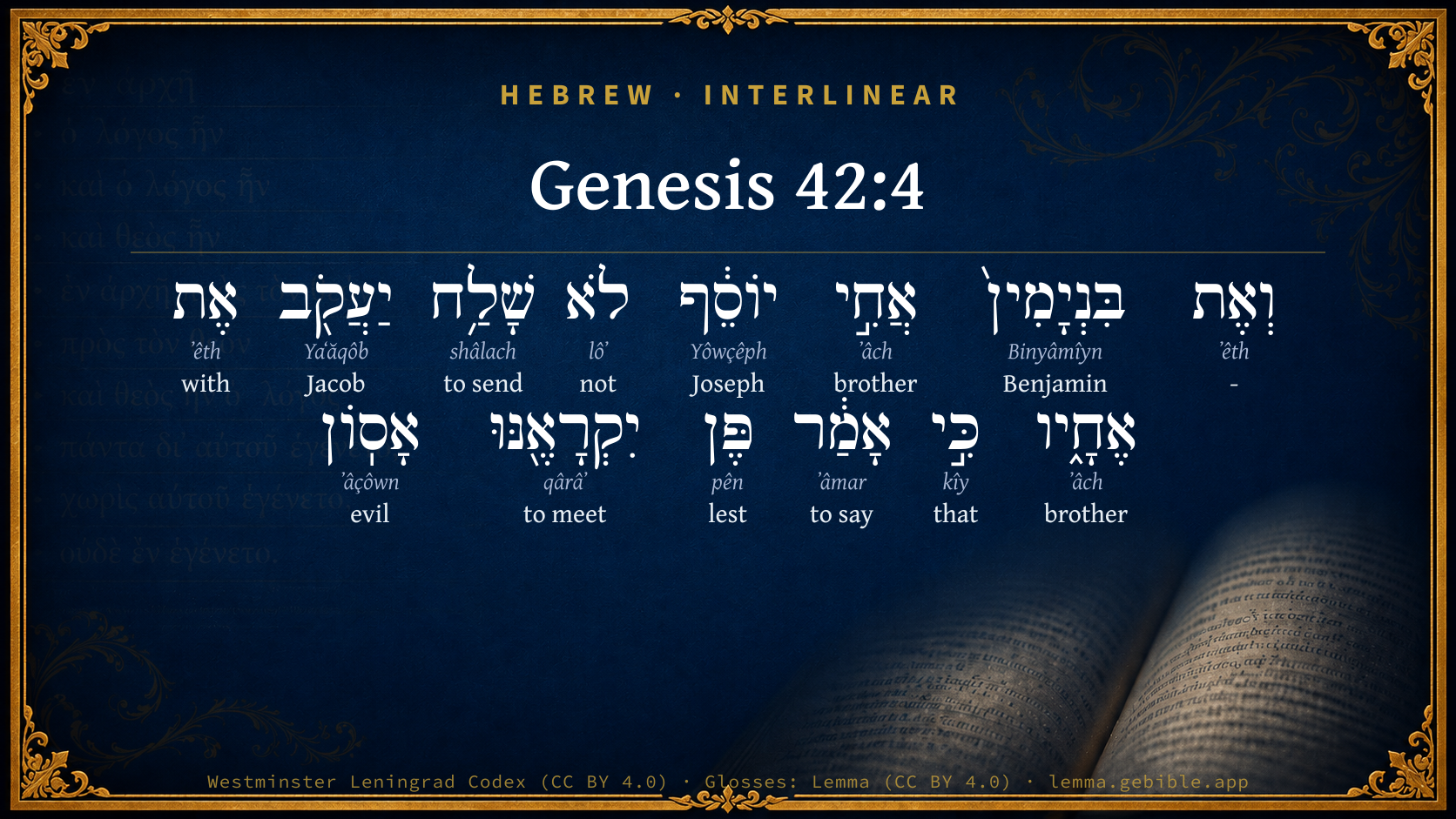
Hebrew (Westminster Leningrad Codex) Genesis 42:4 appears in the Hebrew Old Testament. The text above is from the Westminster Leningrad Codex. Each word links to its Strong’s number, a concise gloss, and parsing drawn from the Open Scriptures Hebrew Bible morphology. Click any word for its full Brown-Driver-Briggs (BDB) entry.
Download image
Cite this verse

Genesis 42:4 (World English Bible). Public Domain. Lemma interlinear Bible study tool, https://lemma.gebible.app/v/genesis/42/4.

Show BibTeX & RIS
BibTeX
RIS
English Translation
But Jacob didn't send Benjamin, Joseph's brother, with his brothers; for he said, "Lest perhaps harm happen to him."
World English Bible · Public Domain
Highlights
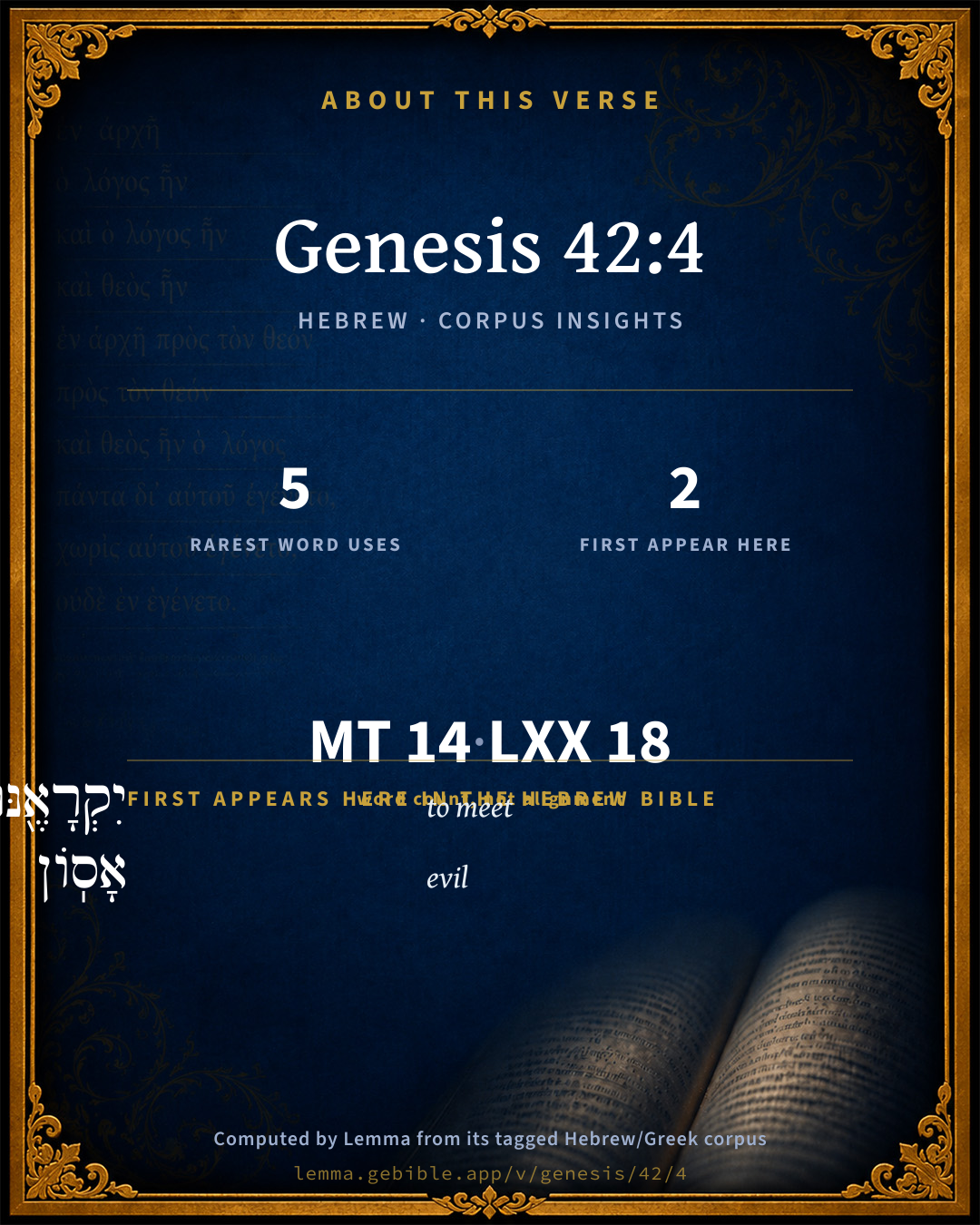
  • 2 first appearances in the Hebrew Bible
Full analysis ↓
Download a study sheet

One document with this verse’s original text, its word-by-word gloss line, the meaning frame, cross-references with their text, attributed commentary, and full source and license credits — printable, and it pastes into notes with its structure intact.

This verse Autodidact and up

Study sheet (.html) Plain text (.txt)

A passage Seminary Student

Up to 50 verses in one chapter. A passage sheet keeps up to 6 commentary sources and 12 cross-references per verse, in the order this page ranks them, and says so on the sheet whenever that leaves anything out. Ask for a single verse and you get the Autodidact verse sheet above.

Everything on this page stays free to read, with no account — the sheet is a download of what is already on screen, not access to it.

Want to remove ads? Support Godless Engineer
Compare translations 3

The same verse in 3 English versions, stacked beneath the original-language interlinear above. Click any original word for its lexicon entry.

Each is an independent rendering of the whole verse — the interlinear is not word-aligned to these translations.

Highlighted words mark where these versions differ — a whole-verse word diff, not a word-by-word alignment.

  • World English Bible Public Domain
    But Jacob didn't send Benjamin, Joseph's brother, with his brothers; for he said, "Lest perhaps harm happen to him."
  • King James Version Public Domain
    But Benjamin, Joseph's brother, Jacob sent not with his brethren; for he said, Lest peradventure mischief befall him.
  • unfoldingWord Literal Text CC BY-SA 4.0
    But Jacob did not send Benjamin, the brother of Joseph, with his brothers, because he said, “So that harm does not meet him!”

unfoldingWord Literal Text — © unfoldingWord, licensed CC BY-SA 4.0. Word-aligned USFM3 via Door43 (git.door43.org/unfoldingWord/en_ult).

Versions to compare (up to 4)

3 of 4 selected

Show all 18 translations

Every available English version of this verse, each an independent rendering of the whole verse.

  • World English Bible Public Domain
    But Jacob didn't send Benjamin, Joseph's brother, with his brothers; for he said, "Lest perhaps harm happen to him."
  • Berean Standard Bible Public Domain
    But Jacob did not send Joseph’s brother Benjamin with his brothers, for he said, “I am afraid that harm might befall him.”
  • Majority Standard Bible Public Domain
    But Jacob did not send Joseph’s brother Benjamin with his brothers, for he said, “I am afraid that harm might befall him.”
  • King James Version Public Domain
    But Benjamin, Joseph's brother, Jacob sent not with his brethren; for he said, Lest peradventure mischief befall him.
  • American Standard Version (1901) Public Domain
    But Benjamin, Joseph's brother, Jacob sent not with his brethren; for he said, Lest Peradventure harm befall him.
  • Revised Version (1885) Public Domain
    But Benjamin, Joseph’s brother, Jacob sent not with his brethren; for he said, Lest peradventure mischief befall him.
  • Geneva Bible (1599) Public Domain
    But Beniamin Iosephs brother woulde not Iaakob send with his brethren: for he saide, Least death should befall him.
  • Douay-Rheims (1899) Public Domain
    Whilst Benjamin was kept at home by Jacob, who said to his brethren: Lest perhaps he take any harm in the journey.
  • Young's Literal Translation Public Domain
    and Benjamin, Joseph's brother, Jacob hath not sent with his brethren, for he said, `Lest mischief meet him.'
  • Literal Standard Version CC BY-SA 4.0
    and Benjamin, Joseph’s brother, Jacob has not sent with his brothers, for he said, “Lest harm meet him.”
  • Unlocked Literal Bible CC BY-SA 4.0
    But Benjamin, Joseph's brother, Jacob did not send with his brothers, for he feared that harm might come to him.
  • unfoldingWord Literal Text CC BY-SA 4.0
    But Jacob did not send Benjamin, the brother of Joseph, with his brothers, because he said, “So that harm does not meet him!”
  • Darby Bible Public Domain
    But Benjamin, Joseph's brother, Jacob sent not with his brethren; for he said, Lest mischief may befall him.
  • World Messianic Bible Public Domain
    But Jacob didn’t send Benjamin, Joseph’s brother, with his brothers; for he said, “Lest perhaps harm happen to him.”
  • Webster's Bible Public Domain
    But Benjamin, Joseph's brother, Jacob sent not with his brethren: for he said, Lest perhaps mischief shall befall him.
  • Free Bible Version CC BY-SA 4.0
    But Jacob did not send Joseph's brother Benjamin with his other brothers, for he said, “I'm afraid something bad might happen to him.”
  • Bible in Basic English Public Domain
    But Jacob did not send Benjamin, Joseph's brother, with them, for fear, as he said, that some evil might come to him.
  • JPS Tanakh (1917) Public Domain
    But Benjamin, Joseph's brother, Jacob sent not with his brethren; for he said: 'Lest peradventure harm befall him.'

Literal Standard Version (2020), Covenant Press — licensed CC BY-SA 4.0. Text via the HelloAO Bible API (eBible.org). Unlocked Literal Bible (unfoldingWord) — licensed CC BY-SA 4.0. Text via the HelloAO Bible API (eBible.org). unfoldingWord Literal Text — © unfoldingWord, licensed CC BY-SA 4.0. Word-aligned USFM3 via Door43 (git.door43.org/unfoldingWord/en_ult). Free Bible Version, Dr. Jonathan Gallagher — licensed CC BY-SA 4.0. Text via the HelloAO Bible API (eBible.org).

Word by word

More ways to search: Search by grammar → Find every occurrence → Compare this word →

Practice this passage: Drill this verse → Learn its vocabulary →

אָסֽוֹן
ʼâçôwn
H611
“evil”
Noun, Common, Masculine, Singular, Absolute
Part of Speech
Noun
Type
Common
Gender
Masculine
Number
Singular
State
Absolute
Full BDB Definition

Origin: of uncertain derivation

TWOT: 138a

evil, mischief, harm, hurt
  1. וְאֶת ʼêth H853 “and · -” Conjunction + Particle, Direct Object
  2. בִּנְיָמִין֙ Binyâmîyn H1144 “Benjamin” Noun, Proper
  3. אֲחִ֣י ʼâch H251 “brother of” Noun, Common, Masculine, Singular, Construct
  4. יוֹסֵ֔ף Yôwçêph H3130 “Joseph” Noun, Proper
  5. לֹא lôʼ H3808 “not” Particle, Negative
  6. שָׁלַ֥ח shâlach H7971 “to send” Verb, Qal, Perfect, 3rd Person, Masculine, Singular
  7. יַעֲקֹ֖ב Yaʻăqôb H3290 “Jacob” Noun, Proper
  8. אֶת ʼêth H854 “with” Preposition
  9. אֶחָ֑יו ʼâch H251 “brothers · his” Noun, Common, Masculine, Plural, Construct + Suffix, Personal, 3rd Person, Masculine, Singular
  10. כִּ֣י kîy H3588 “that” Conjunction
  11. אָמַ֔ר ʼâmar H559 “to say” Verb, Qal, Perfect, 3rd Person, Masculine, Singular
  12. פֶּן pên H6435 “lest” Conjunction
  13. יִקְרָאֶ֖נּוּ qârâʼ H7122 “to meet · him” Verb, Qal, Imperfect, 3rd Person, Masculine, Singular + Suffix, Personal, 3rd Person, Masculine, Singular

About this verse

These counts appear in no published source. They are computed here, from the morphology-tagged text and Lemma’s own curated glosses. What Lemma adds →

14
words
13
distinct lemmas
Pentateuch
section

Notable vocabulary

The rarest word here is אָסֽוֹן evil H611 — appearing just 5 times in the whole Hebrew Bible.

First appearance in Scripture

These words make their first canonical appearance in the Hebrew Bible here:

  • יִקְרָאֶ֖נּוּ to meet H7122
  • אָסֽוֹן evil H611

Shared distinctive vocabulary

אָסֽוֹן evil H611 occurs in 5 verses of the Hebrew Bible. Also found in:

Grammatical profile

  • 3 verbs
  • 6 nouns
  • 1 preposition
  • 2 conjunctions
  • 2 particles

Verb forms

  • שָׁלַ֥ח Qal · Perfect
  • אָמַ֔ר Qal · Perfect
  • יִקְרָאֶ֖נּוּ Qal · Imperfect

Repetition

A word recurs within this verse — often emphatic in Hebrew:

  • אֲחִ֣י brother H251 ×2

Hebrew & Septuagint length

In English translation the verse runs 19 words from the Hebrew and 20 from the Septuagint (LXX English) — closely comparable.

A rough comparison of the two English renderings, which tokenize alike — not a word-level alignment.

Word counts can differ between the Hebrew and the Greek without any difference in meaning — e.g. the Hebrew direct-object marker אֵת has no separate Greek word, and Greek often adds the article ὁ.

In the original languages it is 14 Hebrew tokens and 18 Greek tokens — but the two are counted differently (Hebrew bundles its prefixes and suffixes into one token; the Greek is in lemma form), so that isn’t a like-for-like length.

Cross-references

9

Topical passages linked to Genesis 42:4 in the Treasury of Scripture Knowledge — connected by theme and wording, ordered by reader-vote popularity; previews shown in the World English Bible.

  • Genesis 42:38 He said, "My son shall not go down with you; for his brother is dead, and he only is left. If harm happens to him by the way in which you go, then you will bring down my gray hairs with sorrow to Sheol."
  • Genesis 3:22 Yahweh God said, "Behold, the man has become like one of us, knowing good and evil. Now, lest he put forth his hand, and also take of the tree of life, and eat, and live forever..."
  • Genesis 11:4 They said, "Come, let's build us a city, and a tower, whose top reaches to the sky, and let's make us a name; lest we be scattered abroad on the surface of the whole earth."
  • Genesis 33:1–2 Jacob lifted up his eyes, and looked, and, behold, Esau was coming, and with him four hundred men. He divided the children between Leah, Rachel, and to the two handmaids.
  • Genesis 35:16–19 They traveled from Bethel. There was still some distance to come to Ephrath, and Rachel travailed. She had hard labor.
  • Genesis 43:14 May God Almighty give you mercy before the man, that he may release to you your other brother and Benjamin. If I am bereaved of my children, I am bereaved."
  • Genesis 43:29 He lifted up his eyes, and saw Benjamin, his brother, his mother's son, and said, "Is this your youngest brother, of whom you spoke to me?" He said, "God be gracious to you, my son."
  • Genesis 44:20–22 We said to my lord, 'We have a father, an old man, and a child of his old age, a little one; and his brother is dead, and he alone is left of his mother; and his father loves him.'
  • Genesis 44:27–34 Your servant, my father, said to us, 'You know that my wife bore me two sons:

Cross-references courtesy of OpenBible.info (CC BY 4.0).

Hebrew and Greek witnesses Masoretic Hebrew ↔ Greek Septuagint

The same verse in the two great witnesses to the Old Testament, shown verse-for-verse.

These are two independent witnesses, not word-aligned to each other, and the Septuagint is shown in lemma (dictionary) form.

Hebrew Genesis 42:4 Masoretic · Westminster Leningrad Codex

וְאֶת בִּנְיָמִין֙ אֲחִ֣י יוֹסֵ֔ף לֹא שָׁלַ֥ח יַעֲקֹ֖ב אֶת אֶחָ֑יו כִּ֣י אָמַ֔ר פֶּן יִקְרָאֶ֖נּוּ אָסֽוֹן

But Jacob didn't send Benjamin, Joseph's brother, with his brothers; for he said, "Lest perhaps harm happen to him."

World English Bible · Public Domain

Greek LXX Genesis 42:4 Septuagint · lemma form

ὁ δέ βενιαμίν ὁ ἀδελφός ιωσηφ οὐ ἀποστέλλω μετά ὁ ἀδελφός αὐτός εἶπον γάρ μήποτε συνβαίνω αὐτός μαλακία

But Jacob sent not Benjamin, the brother of Joseph, with his brethren; for he said, Lest, haply, disease befall him.

LXX2012 (modern English Septuagint) · Public Domain

Hebrew: Westminster Leningrad Codex (CC BY 4.0). Greek: Septuagint (public domain); English from LXX2012 (modern English Septuagint) (Public Domain). How the Septuagint differs from the Hebrew →

Targum (Aramaic paraphrase)

2

The Targum is the ancient Jewish Aramaic paraphrase of the Hebrew Scriptures — an interpretive translation, not the Hebrew text itself. Onkelos (literal) and Pseudo-Jonathan (expansive) render the Torah, and Jonathan the Prophets. Coverage is partial: where no permissively-licensed English translation exists for a verse, only the Aramaic is shown. This is verse-level text, not a word-by-word alignment to the Hebrew.

  1. Targum Onkelos Torah (Genesis–Deuteronomy)
    וְיָת בִּנְיָמִין אֲחוּהִי דְיוֹסֵף לָא שְׁלַח יַעֲקֹב עִם אֲחוֹהִי אֲרֵי אֲמַר דִּלְמָא יְעַרְעִנֵּהּ מוֹתָא

    (no public-domain English translation for this verse)

    Targum Onkelos — Aramaic: “Onkelos Genesis” (public domain); “Onkelos Exodus” (public domain); “Onkelos Leviticus” (public domain); “Onkelos Numbers” (public domain); “Onkelos Deuteronomy” (public domain). English: “Sefaria Community Translation” (CC0 1.0 (public-domain dedication)); “J.W. Etheridge. The Targums of Onkelos and Jonathan Ben Uzziel on the Pentateuch. London: Longmans, Green, 1862” (public domain). Text via Sefaria.

  2. Targum Pseudo-Jonathan Torah (Genesis–Deuteronomy)
    וְיַת בִּנְיָמִין אָחוֹי דְיוֹסֵף לָא שָׁדַר יַעֲקב עִם אָחוֹי אֲרוּם אָמַר הָא הוּא טַלְיָא וּמִסְתָּפִינָא דִלְמָא יְאַרְעִינֵיהּ מוֹתָא

    But Benjamin, Joseph's brother, Jakob sent not down with his brethren; for he said, Behold, he is a youth, and I fear lest death should befall him.

    Targum Pseudo-Jonathan — Aramaic: “Targum Jonathan on Genesis” (public domain); “Targum Jonathan on Exodus” (public domain); “Targum Jonathan on Leviticus” (public domain); “Targum Jonathan on Numbers” (public domain); “Targum Jonathan on Deuteronomy” (public domain). English: “The Targum of Jonathan ben Uzziel, trans. J. W. Etheridge, London, 1862” (public domain). Text via Sefaria.

Commentary

Notes on Genesis 42:4 from classic Christian and Jewish commentators (each source and its license shown beneath its notes). The classic Christian expositions comment on the surrounding passage and are grouped to its opening verse, so a note may address several verses; the Jewish commentaries on the Tanakh (Rashi and others) are per-verse, so they appear only where the commentator wrote on this verse.

Lemma curates 59 commentaries, every one of them public domain or Creative Commons licensed, each selected and text-cleaned for this edition rather than reprinted as found. About our sources →

Trapp's Complete Commentary

John Trapp

Gen 42:4 But Benjamin, Joseph’s brother, Jacob sent not with his brethren; for he said, Lest peradventure mischief befall him.

Ver. 4. But Benjamin Jacob sent not.] Because best beloved; as last born, and likeliest to live longest; and the least, and least able to shift for himself; and all that was left of his dearest Rachel; his only darling that had been always at hand, and in the father’s eye.

John Trapp, A Commentary or Exposition upon All the Books of the Old and New Testament (1647–1656) — public domain. Text from a community e-Sword module.

Tyndale Open Study Notes

Tyndale Open Resources

42:4 Jacob may have believed that Benjamin would not be safe with his brothers.

Tyndale Open Study Notes — © Tyndale Open Resources, licensed CC BY-SA 4.0. Text via the HelloAO Bible API.

Geneva Bible (1599)

Geneva Bible translators

Hebrew, should meet him.

Geneva Bible (1599) marginal notes — public domain. Text via Bolls.life.

The Cambridge Bible for Schools and Colleges

gen. ed. J. J. S. Perowne

4. mischief] See Gen_42:38. Jacob dares not part with Benjamin, for whom, both as his youngest child and as the surviving son of Rachel, he has special affection. On this trait the whole narrative turns, cf. Gen_42:38, Gen_44:20; Gen_44:30-31.

5 (? J). And the sons of Israel, &c.] “Sons of Israel,” cf. Gen_45:21, Gen_46:5. The verse reads like the commencement of a new section; while the words “for the famine, &c.” are not necessary after Gen_42:1-4. The change from the name of “Jacob” (Gen_42:1-4) to that of “Israel” is another indication that this verse is drawn from a different source of narrative from Gen_42:1-4.

The Cambridge Bible for Schools and Colleges (gen. ed. J. J. S. Perowne; Cambridge University Press, 1878–1918) — public domain. Text from a community e-Sword module.

John Gill's Exposition

And the sons of Israel came to buy corn among those that came,.... Either among the Egyptians that came to buy, or among those who came from different countries, or rather particularly among the Canaanites, as the Targum of Jonathan; with these they might join upon the road, and go together in a body where the market for corn was:

for the famine was in the land of Canaan: which obliged the inhabitants of it as well as Jacob's family to seek for corn elsewhere, and confirms the sense of the preceding clause: this, though a very fruitful land, yet when God withheld a blessing from it, it became barren, as it had been before, Gen 12:10, and was to try the faith of those good men to whom God had given it, and to wean their hearts from being set upon it, and to put them upon seeking a better country, as they did.

John Gill's Exposition of the Whole Bible (1746–1763) — public domain (CC PDM 1.0). Text via the HelloAO Bible API.

Matthew Poole's English Annotations

Because he was very young, and now his best beloved son.

Matthew Poole's English Annotations on the Holy Bible (1683–1685) — public domain. Text from a community e-Sword/MySword module.

Whedon's Commentary on the Bible

Daniel D. Whedon

4. Benjamin… Jacob sent not — His partiality for Joseph has now become transferred to Benjamin. And Jacob seems to have entertained a suspicion that his elder sons had had something to do with Joseph’s strange disappearance. Comp. Gen_42:36.

Daniel D. Whedon (gen. ed.), Commentary on the Old and New Testaments (1874–1909) — public domain. Text from a community e-Sword module.

The Pulpit Commentary

But (literally, and) Benjamin, Joseph"s brother, (vide Gen_35:18) Jacob sent not with his brethren. Not because of his youth (Patrick, Lange), since he was now upwards of twenty years of age, but because he was Joseph"s brother, and had taken Joseph"s place in his father"s affections (Lawson, Lange, Murphy, &c.), causing the old man to cherish him with tender solicitude. ;For he said (to, or within, himself, perhaps recalling the fate of Joseph), Lest peradventure mischief befall him. wOsa; from hsa; to hurt (Gesenius, Furst), and occurring only elsewhere in ver. 38, Gen_44:29, and Exo_21:22, Exo_21:23, denotes any sort of personal injury in general, and in particular here such mischance as might happen to a traveler.

The Pulpit Commentary (1880–1919), ed. H.D.M. Spence-Jones & Joseph S. Exell — public domain. Text from a community e-Sword module.

Rashi

Rabbi Shlomo Yitzchaki (Rashi)

פן יקראנו אסון LEST MISCHIEF BEFALL HIM — And at home could not mischief befall him?! Rabbi Eliezer the son of Jacob said: We may infer from this that Satan accuses a man at the time of danger (Midrash Tanchuma, Vayigash 1).

Rashi on the Tanakh — English translations: “The Judaica Press complete Tanach with Rashi, translated by A. J. Rosenberg” (CC BY 4.0); “Pentateuch with Rashi's commentary by M. Rosenbaum and A.M. Silbermann, 1929-1934” (public domain); “The Metsudah Tanach series, Lakewood, N.J” (CC BY 4.0); and “The Book of Joshua, Metsudah Publications, 1997” (CC BY 4.0). Text via Sefaria.

Radak

Rabbi David Kimhi (Radak)

ואת בנימין... אחי יוסף, he is mentioned once more as “Joseph’s brother” as he was the only full brother Joseph had, being a brother both from the same father and the same mother.

אסון, a mishap brought about either by man or by direct heavenly intervention, a natural disaster, for instance. Yaakov’s fear was based on a mishap having befallen Joseph at the time (as he had been led to believe). The Talmud in Ketuvot 30 describes mishaps caused by “man” as thorns and thistles, and the like. [based on Proverbs 22,5. The assumption appears to be that such “mishaps” are preventable by man being careful.] We may well ask why Yaakov was afraid of a mishap that might befall Binyamin while he was on the way more than he was afraid of a mishap which might befall him at home? The answer is that mishaps which befall people on a journey are statistically far more frequent than those that befall a person while he is at home. Wild animals, bandits, etc., are usually roaming on much traveled routes. Due to the likelihood of encountering such hazards while traveling, even righteous people who have no reason to fear G’d’s retribution for any wrongs they may have committed, need to be especially careful in any situation which is known to be especially hazardous, and they must not ignore such dangers by relying on G’d to keep them safe. Even if they would be saved from some danger through a miracle G’d would perform for them, their accumulated merits would be diminished thereby. Our sages have found an allusion to all this in Deuteronomy 6,15 לא תנסו את ה' אלוקיכם, “do not cause the Lord your G’d to have to perform a miracle for you.” We find proof that even an outstanding man such as the prophet Samuel when sent to anoint a successor to King Sha-ul and setting out on the way to Chevron to anoint one of Yishai’s sons, was afraid and said so to G’d. G’d Himself told him what precautions to take. (Samuel I 16,2) In view of the above it is not surprising therefore that Yaakov was especially concerned about Binyamin’s safety during the journey.

Radak on the Tanakh — English translations: “Sefaria Community Translation” (CC0 1.0 (public-domain dedication)); “Eliyahu Munk, HaChut Hameshulash” (CC BY 4.0); “Rabbi Mike Feuer, Jerusalem Anthology” (CC BY 4.0); and “R. David Kimhi on the first book of Psalms, Translated by R.G. Finch, London, 1919” (public domain). Text via Sefaria.

Lesson kit

Teaching starters — assembled from the data on this page, not authored interpretation. Every prompt links to the verse data it draws on. Edit before teaching.

Genesis, in the Pentateuch, opens this verse with 14 words (13 distinct Hebrew lemmas). Its most distinctive word is ʼâçôwn (“evil”). A historical commentator’s framing appears above. Read the whole chapter for the surrounding context.

Discussion questions

  1. How does “evil” (ʼâçôwn) shape what this verse is saying?
  2. 2 words here appear for the first time in Scripture. What is being introduced at this debut?
  3. Genesis 42:38 shares the word «evil» with this verse. How do the two illuminate each other?
  4. “brother” occurs 2× in this one verse. What is the effect of the repetition?
  5. These translations render this verse differently; the difference is in the English rendering, not the original. What questions does that raise?
  6. The verb «שָׁלַ֥ח» is Qal Perfect. How does its form color the action?
  7. Reading how Trapp's Complete Commentary and Tyndale Open Study Notes read this verse, where do the two commentators agree and where do they part?

Things to notice

Reading settings

Reading text

Shown beneath each verse's original-language words.

Old Testament
Old Testament edition

Read the OT as the Masoretic Hebrew (MT) or the Greek Septuagint (LXX).

English shown for the Greek Septuagint (in the Hebrew ↔ Greek comparison).

Comparing translations? Open the Compare panel on any verse page to stack up to four side by side.