
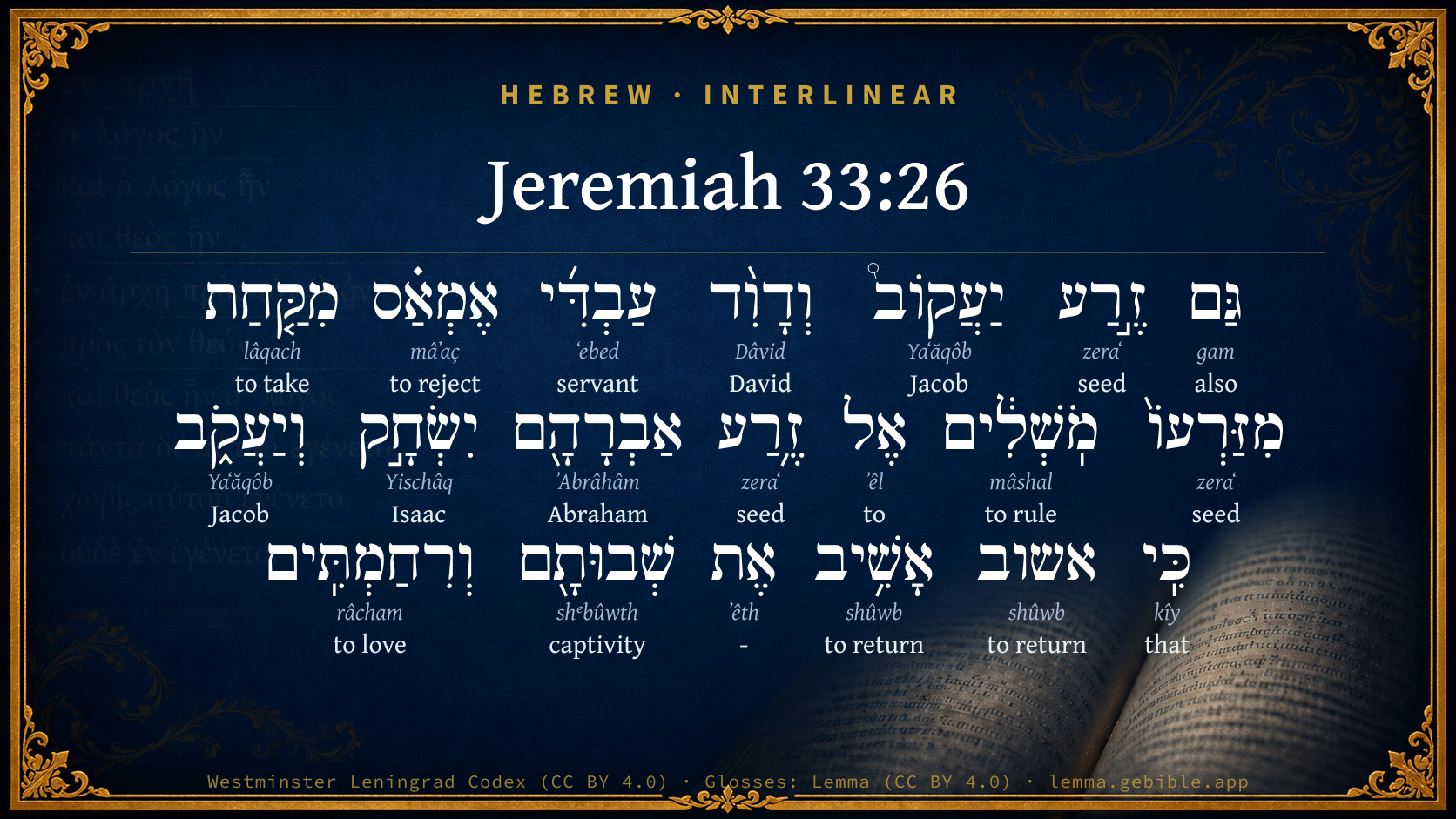
Jeremiah 33:26

Hebrew (Westminster Leningrad Codex) Jeremiah 33:26 appears in the Hebrew Old Testament. The text above is from the Westminster Leningrad Codex. Each word links to its Strong’s number, a concise gloss, and parsing drawn from the Open Scriptures Hebrew Bible morphology. Click any word for its full Brown-Driver-Briggs (BDB) entry.
Download image
Cite this verse

Jeremiah 33:26 (World English Bible). Public Domain. Lemma interlinear Bible study tool, https://lemma.gebible.app/v/jeremiah/33/26.

Show BibTeX & RIS
BibTeX
RIS
English Translation
then will I also cast away the seed of Jacob, and of David my servant, so that I will not take of his seed to be rulers over the seed of Abraham, Isaac, and Jacob: for I will cause their captivity to return, and will have mercy on them.
World English Bible · Public Domain
Download a study sheet

One document with this verse’s original text, its word-by-word gloss line, the meaning frame, cross-references with their text, attributed commentary, and full source and license credits — printable, and it pastes into notes with its structure intact.

This verse Autodidact and up

Study sheet (.html) Plain text (.txt)

A passage Seminary Student

Up to 50 verses in one chapter. A passage sheet keeps up to 6 commentary sources and 12 cross-references per verse, in the order this page ranks them, and says so on the sheet whenever that leaves anything out. Ask for a single verse and you get the Autodidact verse sheet above.

Everything on this page stays free to read, with no account — the sheet is a download of what is already on screen, not access to it.

Want to remove ads? Support Godless Engineer
Compare translations 3

The same verse in 3 English versions, stacked beneath the original-language interlinear above. Click any original word for its lexicon entry.

Each is an independent rendering of the whole verse — the interlinear is not word-aligned to these translations.

Highlighted words mark where these versions differ — a whole-verse word diff, not a word-by-word alignment.

  • World English Bible Public Domain
    then will I also cast away the seed of Jacob, and of David my servant, so that I will not take of his seed to be rulers over the seed of Abraham, Isaac, and Jacob: for I will cause their captivity to return, and will have mercy on them.
  • King James Version Public Domain
    Then will I cast away the seed of Jacob and David my servant, so that I will not take any of his seed to be rulers over the seed of Abraham, Isaac, and Jacob: for I will cause their captivity to return, and have mercy on them.
  • unfoldingWord Literal Text CC BY-SA 4.0
    then I will reject the descendants of Jacob and David my servant, and not bring from them a person to rule over the descendants of Abraham, Isaac, and Jacob. For I will restore their fortunes and show mercy to them.’”

unfoldingWord Literal Text — © unfoldingWord, licensed CC BY-SA 4.0. Word-aligned USFM3 via Door43 (git.door43.org/unfoldingWord/en_ult).

Versions to compare (up to 4)

3 of 4 selected

Show all 18 translations

Every available English version of this verse, each an independent rendering of the whole verse.

  • World English Bible Public Domain
    then will I also cast away the seed of Jacob, and of David my servant, so that I will not take of his seed to be rulers over the seed of Abraham, Isaac, and Jacob: for I will cause their captivity to return, and will have mercy on them.
  • Berean Standard Bible Public Domain
    then I would also reject the descendants of Jacob and of My servant David, so as not to take from his descendants rulers over the descendants of Abraham, Isaac, and Jacob. For I will restore them from captivity and will have compassion on them.”
  • Majority Standard Bible Public Domain
    then I would also reject the descendants of Jacob and of My servant David, so as not to take from his descendants rulers over the descendants of Abraham, Isaac, and Jacob. For I will restore them from captivity and will have compassion on them.”
  • King James Version Public Domain
    Then will I cast away the seed of Jacob and David my servant, so that I will not take any of his seed to be rulers over the seed of Abraham, Isaac, and Jacob: for I will cause their captivity to return, and have mercy on them.
  • American Standard Version (1901) Public Domain
    then will I also cast away the seed of Jacob, and of David my servant, so that I will not take of his seed to be rulers over the seed of Abraham, Isaac, and Jacob: for I will cause their captivity to return, and will have mercy on them.
  • Revised Version (1885) Public Domain
    then will I also cast away the seed of Jacob, and of David my servant, so that I will not take of his seed to be rulers over the seed of Abraham, Isaac, and Jacob: for I will cause their captivity to return, and will have mercy on them.
  • Geneva Bible (1599) Public Domain
    Then will I cast away the seede of Iaakob and Dauid my seruant, and not take of his seede to be rulers ouer the seede of Abraham, Izhak, and Iaakob: for I wil cause their captiuitie to returne, and haue compassion on them.
  • Douay-Rheims (1899) Public Domain
    Surely I will also cast; off the seed of Jacob, and of David my servant, so as not to take any of his seed to be rulers of the seed of Abraham, Isaac, and Jacob: for I will bring back their captivity, and will have mercy on them.
  • Young's Literal Translation Public Domain
    Also the seed of Jacob, and David My servant, I reject, Against taking from his seed rulers For the seed of Abraham, Isaac, and Jacob, For I turn back `to' their captivity, and have pitied them.'
  • Literal Standard Version CC BY-SA 4.0
    I also reject the seed of Jacob, and My servant David, || From taking rulers from his seed || For the seed of Abraham, Isaac, and Jacob, || For I return their captivity, and have pitied them.”
  • Unlocked Literal Bible CC BY-SA 4.0
    then I will reject the descendants of Jacob and David my servant, and not bring from them a person to rule over the descendants of Abraham, Isaac, and Jacob. For I will restore their fortunes and show mercy to them.'”
  • unfoldingWord Literal Text CC BY-SA 4.0
    then I will reject the descendants of Jacob and David my servant, and not bring from them a person to rule over the descendants of Abraham, Isaac, and Jacob. For I will restore their fortunes and show mercy to them.’”
  • Darby Bible Public Domain
    [then] will I also cast away the seed of Jacob, and of David my servant, so as not to take of his seed to be rulers over the seed of Abraham, Isaac, and Jacob: for I will turn their captivity, and will have mercy on them.
  • World Messianic Bible Public Domain
    then I will also cast away the offspring of Jacob, and of David my servant, so that I will not take of his offspring to be rulers over the offspring of Abraham, Isaac, and Jacob; for I will cause their captivity to be reversed and will have mercy on them.”
  • Webster's Bible Public Domain
    Then will I cast away the seed of Jacob, and David my servant, so that I will not take any of his seed to be rulers over the seed of Abraham, Isaac, and Jacob; for I will cause their captivity to return, and have mercy on them.
  • Free Bible Version CC BY-SA 4.0
    so I can't reject the descendants of Jacob and of my servant David, and I can't fail to make his descendants rulers over the descendants of Abraham, Isaac, and Jacob. I will bring them back from exile and I will be kind to them.
  • Bible in Basic English Public Domain
    Then I will give up caring for the seed of Jacob and of David my servant, so that I will not take of his seed to be rulers over the seed of Abraham, Isaac, and Jacob: for I will let their fate be changed and will have mercy on them.
  • JPS Tanakh (1917) Public Domain
    then will I also cast away the seed of Jacob, and of David My servant, so that I will not take of his seed to be rulers over the seed of Abraham, Isaac, and Jacob; for I will cause their captivity to return, and will have compassion on them.'

Literal Standard Version (2020), Covenant Press — licensed CC BY-SA 4.0. Text via the HelloAO Bible API (eBible.org). Unlocked Literal Bible (unfoldingWord) — licensed CC BY-SA 4.0. Text via the HelloAO Bible API (eBible.org). unfoldingWord Literal Text — © unfoldingWord, licensed CC BY-SA 4.0. Word-aligned USFM3 via Door43 (git.door43.org/unfoldingWord/en_ult). Free Bible Version, Dr. Jonathan Gallagher — licensed CC BY-SA 4.0. Text via the HelloAO Bible API (eBible.org).

Word by word

More ways to search: Search by grammar → Find every occurrence → Compare this word →

Practice this passage: Drill this verse → Learn its vocabulary →

יִשְׂחָ֣ק
Yischâq
H3446
“Isaac”
Noun, Proper
Part of Speech
Noun
Type
Proper
Full BDB Definition

Origin: from H7831

TWOT: 1905b

Isaac = "he laughs" - son of Abraham by Sarah his wife and father of Jacob and Esau
  1. גַּם gam H1571 “also” Particle, Accusative
  2. זֶ֣רַע zeraʻ H2233 “seed of” Noun, Common, Masculine, Singular, Construct
  3. יַעֲקוֹב֩ Yaʻăqôb H3290 “Jacob” Noun, Proper
  4. וְדָוִ֨ד Dâvid H1732 “and · David” Conjunction + Noun, Proper
  5. עַבְדִּ֜י ʻebed H5650 “servant · my” Noun, Common, Masculine, Singular, Construct + Suffix, Personal, 1st Person, Common, Singular
  6. אֶמְאַ֗ס mâʼaç H3988 “to reject” Verb, Qal, Imperfect, 1st Person, Common, Singular
  7. מִקַּ֤חַת lâqach H3947 “from · to take” Preposition + Verb, Qal, Infinitive Construct
  8. מִזַּרְעוֹ֙ zeraʻ H2233 “from · seed · his” Preposition + Noun, Common, Masculine, Singular, Construct + Suffix, Personal, 3rd Person, Masculine, Singular
  9. מֹֽשְׁלִ֔ים mâshal H4910 “ruling” Verb, Qal, Participle Active, Masculine, Plural, Absolute
  10. אֶל ʼêl H413 “to” Preposition
  11. זֶ֥רַע zeraʻ H2233 “seed of” Noun, Common, Masculine, Singular, Construct
  12. אַבְרָהָ֖ם ʼAbrâhâm H85 “Abraham” Noun, Proper
  13. וְיַעֲקֹ֑ב Yaʻăqôb H3290 “and · Jacob” Conjunction + Noun, Proper
  14. כִּֽי kîy H3588 “that” Conjunction
  15. אשוב shûwb H7725 “to return” Verb, Qal, Imperfect, 1st Person, Common, Singular
  16. אָשִׁ֥יב shûwb H7725 “to return” Verb, Hiphil, Imperfect, 1st Person, Common, Singular
  17. אֶת ʼêth H853 “-” Particle, Direct Object
  18. שְׁבוּתָ֖ם shᵉbûwth H7622 “captivity · their” Noun, Common, Feminine, Singular, Construct + Suffix, Personal, 3rd Person, Masculine, Plural
  19. וְרִחַמְתִּֽים râcham H7355 “and · to love · them” Conjunction + Verb, Piel, Sequential Perfect, 1st Person, Common, Singular + Suffix, Personal, 3rd Person, Masculine, Plural

About this verse

These counts appear in no published source. They are computed here, from the morphology-tagged text and Lemma’s own curated glosses. What Lemma adds →

20
words
16
distinct lemmas
Prophets
section

Notable vocabulary

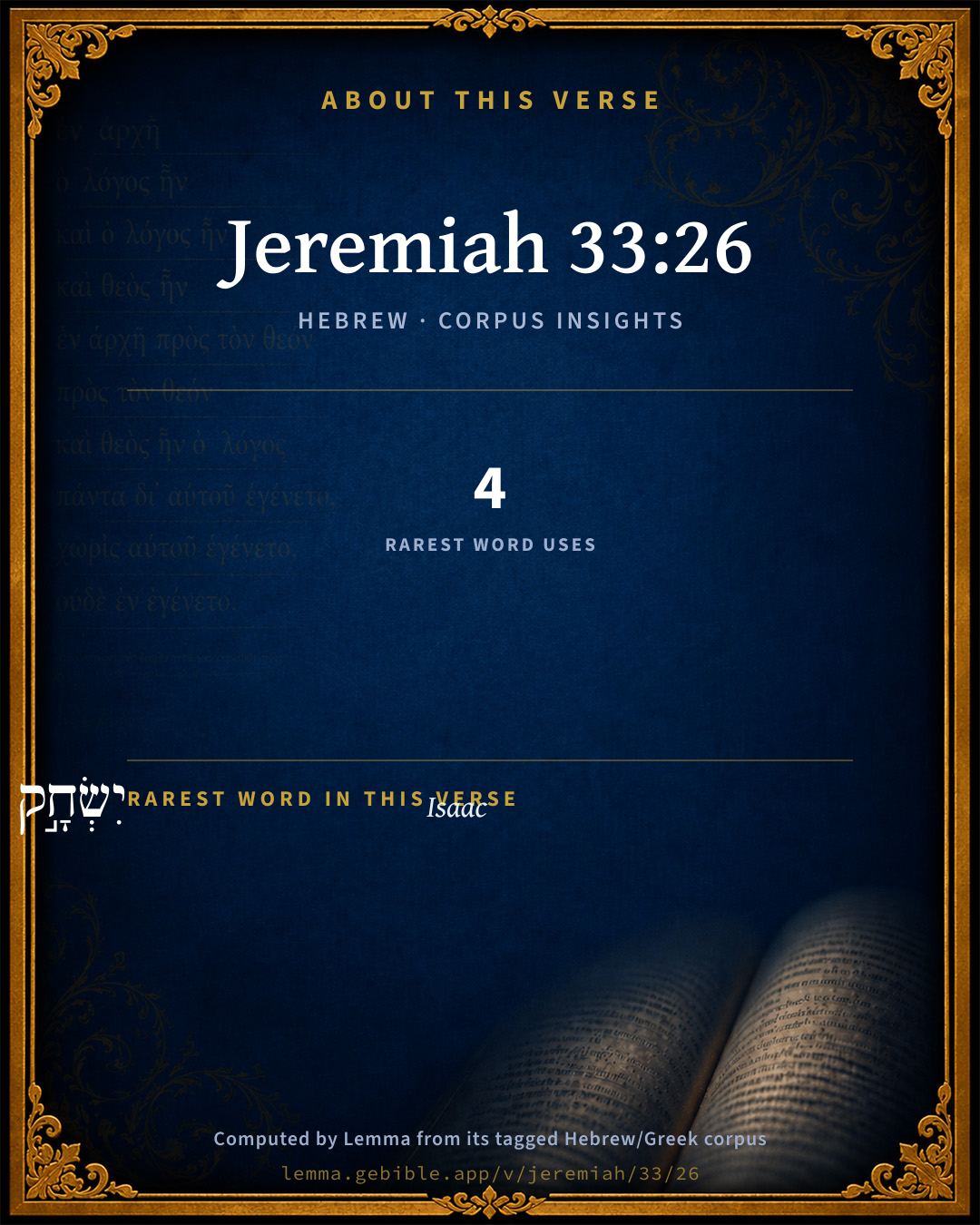
The rarest word here is יִשְׂחָ֣ק Isaac H3446 — appearing just 4 times in the whole Hebrew Bible.

Shared distinctive vocabulary

יִשְׂחָ֣ק Isaac H3446 occurs in 4 verses of the Hebrew Bible. Also found in:

Grammatical profile

  • 6 verbs
  • 10 nouns
  • 1 preposition
  • 1 conjunction
  • 2 particles

Verb forms

  • אֶמְאַ֗ס Qal · Imperfect
  • מִקַּ֤חַת Qal · Infinitive Construct
  • מֹֽשְׁלִ֔ים Qal · Participle Active
  • אשוב Qal · Imperfect
  • אָשִׁ֥יב Hiphil · Imperfect
  • וְרִחַמְתִּֽים Piel · Sequential Perfect

Repetition

Words recur within this verse — often emphatic in Hebrew:

  • זֶ֣רַע seed H2233 ×3
  • יַעֲקוֹב֩ Jacob H3290 ×2
  • אשוב to return H7725 ×2

Cross-references

13

Topical passages linked to Jeremiah 33:26 in the Treasury of Scripture Knowledge — connected by theme and wording, ordered by reader-vote popularity; previews shown in the World English Bible.

  • Jeremiah 31:37 Thus says Yahweh: If heaven above can be measured, and the foundations of the earth searched out beneath, then will I also cast off all the seed of Israel for all that they have done, says Yahweh.
  • Isaiah 14:1 For Yahweh will have compassion on Jacob, and will yet choose Israel, and set them in their own land: and the foreigner shall join himself with them, and they shall cleave to the house of Jacob.
  • Hosea 2:23 I will sow her to me in the earth; And I will have mercy on her who had not obtained mercy; And I will tell those who were not my people, 'You are my people;' And they will say, 'My God!'"
  • Isaiah 54:8 In overflowing wrath I hid my face from you for a moment; but with everlasting loving kindness will I have mercy on you, says Yahweh your Redeemer.
  • Jeremiah 31:20 Is Ephraim my dear son? is he a darling child? for as often as I speak against him, I do earnestly remember him still: therefore my heart yearns for him; I will surely have mercy on him, says Yahweh.
  • Ezekiel 39:25 Therefore thus says the Lord Yahweh: Now will I bring back the captivity of Jacob, and have mercy on the whole house of Israel; and I will be jealous for my holy name.
  • Hosea 1:7 But I will have mercy on the house of Judah, and will save them by Yahweh their God, and will not save them by bow, nor by sword, nor by battle, by horses, nor by horsemen."
  • Genesis 49:10 The scepter will not depart from Judah, Nor the ruler's staff from between his feet, Until he comes to whom it belongs. To him will the obedience of the peoples be.
  • Romans 11:32 For God has shut up all to disobedience, that he might have mercy on all.
  • Ezra 2:1 Now these are the children of the province, who went up out of the captivity of those who had been carried away, whom Nebuchadnezzar the king of Babylon had carried away to Babylon, and who returned to Jerusalem and Judah, everyone to his city;
  • Ezra 2:70 So the priests, and the Levites, and some of the people, and the singers, and the porters, and the Nethinim, lived in their cities, and all Israel in their cities.
  • Jeremiah 33:7–11 I will cause the captivity of Judah and the captivity of Israel to return, and will build them, as at the first.
  • Zechariah 10:6 "I will strengthen the house of Judah, And I will save the house of Joseph, And I will bring them back; For I have mercy on them; And they will be as though I had not cast them off: For I am Yahweh their God, and I will hear them.

Cross-references courtesy of OpenBible.info (CC BY 4.0).

Hebrew and Greek witnesses Masoretic Hebrew ↔ Greek Septuagint

The same verse in the two great witnesses to the Old Testament, shown verse-for-verse.

These are two independent witnesses, not word-aligned to each other, and the Septuagint is shown in lemma (dictionary) form.

Hebrew Jeremiah 33:26 Masoretic · Westminster Leningrad Codex

גַּם זֶ֣רַע יַעֲקוֹב֩ וְדָוִ֨ד עַבְדִּ֜י אֶמְאַ֗ס מִקַּ֤חַת מִזַּרְעוֹ֙ מֹֽשְׁלִ֔ים אֶל זֶ֥רַע אַבְרָהָ֖ם יִשְׂחָ֣ק וְיַעֲקֹ֑ב כִּֽי אשוב אָשִׁ֥יב אֶת שְׁבוּתָ֖ם וְרִחַמְתִּֽים

then will I also cast away the seed of Jacob, and of David my servant, so that I will not take of his seed to be rulers over the seed of Abraham, Isaac, and Jacob: for I will cause their captivity to return, and will have mercy on them.

World English Bible · Public Domain

Greek LXX Structure differs

In the Septuagint, Jeremiah is about an eighth shorter than the Hebrew and arranges its material differently — the Oracles Against the Nations (Hebrew chapters 46–51) appear in the middle of the Greek book, after 25:13. Because the chapter and verse boundaries do not line up, a verse-for-verse comparison with the Hebrew is not shown.

A verse-for-verse comparison isn’t shown here because the chapters and verses don’t line up. Switch to the LXX edition with the MT / LXX toggle above to read the Greek directly.

Hebrew: Westminster Leningrad Codex (CC BY 4.0). Greek: Septuagint (public domain); English from a public-domain English Septuagint. How the Septuagint differs from the Hebrew →

Targum (Aramaic paraphrase)

1

The Targum is the ancient Jewish Aramaic paraphrase of the Hebrew Scriptures — an interpretive translation, not the Hebrew text itself. Onkelos (literal) and Pseudo-Jonathan (expansive) render the Torah, and Jonathan the Prophets. Coverage is partial: where no permissively-licensed English translation exists for a verse, only the Aramaic is shown. This is verse-level text, not a word-by-word alignment to the Hebrew.

  1. Targum Jonathan Prophets (Joshua–Malachi)
    אַף זַרְעָא דְיַעֲקֹב וְדָוִד עַבְדִי לָא אַרְחִיק מִלְקָרָבָא מִבָּנֵיהוֹן עָבְדִין שׁוּלְטַן עַל זַרְעֵיהּ דְאַבְרָהָם יִצְחָק וְיַעֲקֹב אֲרֵי אֲתֵיב יַת גָלוּתְהוֹן וְאֶרְחַם עֲלֵיהוֹן:

    (no public-domain English translation for this verse)

    Targum Jonathan — Aramaic: “Mikraot Gedolot” (public domain). English: “Sefaria Community Translation” (CC0 1.0 (public-domain dedication)); “London "Chaldee Paraphrase," 1871” (public domain). Text via Sefaria.

Commentary

Notes on Jeremiah 33:26 from classic Christian and Jewish commentators (each source and its license shown beneath its notes). The classic Christian expositions comment on the surrounding passage and are grouped to its opening verse, so a note may address several verses; the Jewish commentaries on the Tanakh (Rashi and others) are per-verse, so they appear only where the commentator wrote on this verse.

Lemma curates 59 commentaries, every one of them public domain or Creative Commons licensed, each selected and text-cleaned for this edition rather than reprinted as found. About our sources →

Trapp's Complete Commentary

John Trapp

Jer 33:26 Then will I cast away the seed of Jacob, and David my servant, [so] that I will not take [any] of his seed [to be] rulers over the seed of Abraham, Isaac, and Jacob: for I will cause their captivity to return, and have mercy on them.

Ver. 26. Then will I cast away the seed of Jacob.] The body of the faithful, whom he ruleth by his Word and Spirit. {Psa 105:1; Psa 105:6 Rom 9:6 Gal 3:16-17; Gal 6:16}

And will have mercy on them.] This is a complexive promise, and better than money, answereth all things.

John Trapp, A Commentary or Exposition upon All the Books of the Old and New Testament (1647–1656) — public domain. Text from a community e-Sword module.

Jamieson, Fausset & Brown

Robert Jamieson, A. R. Fausset & David Brown

Isaac-- (Psa 105:9; Amo 7:9, Amo 7:16).

The prophecy (Jer 34:1-7) as to Zedekiah is an amplification of that in Jer 32:1-5, in consequence of which Jeremiah was then shut up in the court of the prison. The prophecy (Jer 34:8-22) refers to the Jews, who, afraid of the capture of the city, had, in obedience to the law, granted freedom to their servants at the end of seven years, but on the intermission of the siege forced them back into bondage.

Next: Jeremiah Chapter 34

Jamieson, Fausset & Brown — Commentary Critical and Explanatory on the Whole Bible (1871) — public domain (CC PDM 1.0). Text via the HelloAO Bible API.

John Calvin's Commentaries

He mentions the seed of Jacob first, because it had been said to Abraham, For thy seed, and the same promise was repeated to Jacob. (Genesis 26:4; Genesis 28:14) He afterwards adds the seed of David, because an especial promise was afterwards given to David, (2 Samuel 7:12, 13:) Then also the seed of David, he says, will I reject, that I should not take of his seed to rule over the seed of Abraham, Isaac, and Jacob: he now fitly joins together what might have seemed unconnected; for he says, that there would be always some of David’s posterity to rule over all the tribes. God, therefore, thus preserved his Church when he set a king over his Church; or a kingdom, as we have said, is inseparable from the safety of the people.

He lastly adds, For I will restore their captivity This obviated the diffidence of the people: for an objection was ready at hand, “What can this mean? for the ten tribes have been already led away into distant regions, and are scattered; a part also of the kingdom of Judah has been cut off; and what remains is not far from entire ruin.” Hence God calls their attention to the hope of deliverance, as though he had said, that they were acting foolishly, because they were thus hasty, for their expectation ought to have remained in suspense until the time prescribed, that is, till the end of the seventy years, according to what we have before seen, when the Prophet spoke against impostors who boasted of a quick return. He therefore tells them that they ought patiently to bear their exile, until the full time of their deliverance came. And he points out the fountain or cause of their deliverance when he says, I will have mercy on them, as though he had said, that the very salvation whieh he promised to the people depended on his gratuitous mercy.

John Calvin's Commentaries (1540-1563) — public domain. Text from the Calvin Translation Society English edition (1840s-50s) via the Christian Classics Ethereal Library (ccel.org). Calvin's coverage is partial (roughly two-thirds of the Bible); uncommented books and verses are honest gaps, never fabricated. The 19th-century editor's footnotes and remarks are omitted so the notes are faithfully Calvin's own voice.

John Gill's Exposition

Then will I cast away the seed of Jacob, and David my servant,.... R. Jonah thinks that Jacob is put instead of Aaron, because of the two families of David and Aaron before mentioned; but in this latter part of the chapter no mention is made of priests at all; and by the "seed" is meant one and the same, the spiritual seed of Christ, the antitypical David, and servant of the Lord; and which are no other than the seed of Jacob, over whom the Messiah reigns; or the spiritual Israel of God, whether Jews or Gentiles, and whom the Lord never casts away, so as to perish; but they shall all be saved in the Lord with an everlasting salvation: See Gill on Jer 31:37; and even the seed of Jacob, and of David, who was of Jacob, in the line of Judah, shall not be in such sense rejected:

so that I will not take any of his seed to be rulers over the seed of Abraham, Isaac, and Jacob; that is, any of the seed of David taken literally; from whom the Lord has taken one, or raised up one of his seed, even the Messiah, to be a ruler over all the spiritual seed of Abraham, Isaac, and Jacob; or of all that tread in their steps: but inasmuch as by the seed of Jacob and David may be meant the spiritual seed of Christ, by rulers taken from them may be intended spiritual rulers and governors of the church, or ministers of the Gospel:

for I will cause their captivity to return, and have mercy on them; not only their captivity from Babylon, and so the family of David restored and continued till the Messiah should spring out of it; but the spiritual captivity of the Israel of God, of which the other was a type, and would be brought about by the Messiah; who in his love and pity should redeem them, as he has, from sin, Satan, law, hell, and death.

Next: Jeremiah Chapter 34

John Gill's Exposition of the Whole Bible (1746–1763) — public domain (CC PDM 1.0). Text via the HelloAO Bible API.

Matthew Poole's English Annotations

By

the seed of Jacob, and of Abraham and Isaac, are meant the body of the Jews, to whom these three patriarchs were common heads; by the seed of David, persons lineally descended from David, who should rule over the Israel of God. The sum of these two verses is plainly no more than God had said before, that a restoration of them to their own land should as certainly succeed their captivity as the night succeedeth the day, or the day succeedeth the night. God had as certainly established and ordained the one as the other, though not as yet so established, the one in the order of natural causes as the other. God would certainly have mercy on them, and in showing his mercy would take care that one of the seed of David should be their ruler, which was fulfilled in the Messiah.

Matthew Poole's English Annotations on the Holy Bible (1683–1685) — public domain. Text from a community e-Sword/MySword module.

Lesson kit

Teaching starters — assembled from the data on this page, not authored interpretation. Every prompt links to the verse data it draws on. Edit before teaching.

Jeremiah, in the Prophets, opens this verse with 20 words (16 distinct Hebrew lemmas). Its most distinctive word is Yischâq (“Isaac”). A historical commentator’s framing appears above. Read the whole chapter for the surrounding context.

Discussion questions

  1. The word Yischâq carries the sense “Isaac.” How does it shape the verse?
  2. How does Psalms 105:9, which shares the word «Isaac», read alongside this verse?
  3. What does the repetition of “seed” (3× in this one verse) do in this verse?
  4. These translations render this verse differently. What is at stake in choosing one wording over another?
  5. «אֶמְאַ֗ס» is a Qal Imperfect verb. How does that grammatical form shape the action described?
  6. Compare how Trapp's Complete Commentary and Jamieson, Fausset & Brown read this verse. Where do they agree or differ?

Things to notice

Reading settings

Reading text

Shown beneath each verse's original-language words.

Old Testament
Old Testament edition

Read the OT as the Masoretic Hebrew (MT) or the Greek Septuagint (LXX).

English shown for the Greek Septuagint (in the Hebrew ↔ Greek comparison).

Comparing translations? Open the Compare panel on any verse page to stack up to four side by side.