
Psalms 105:10

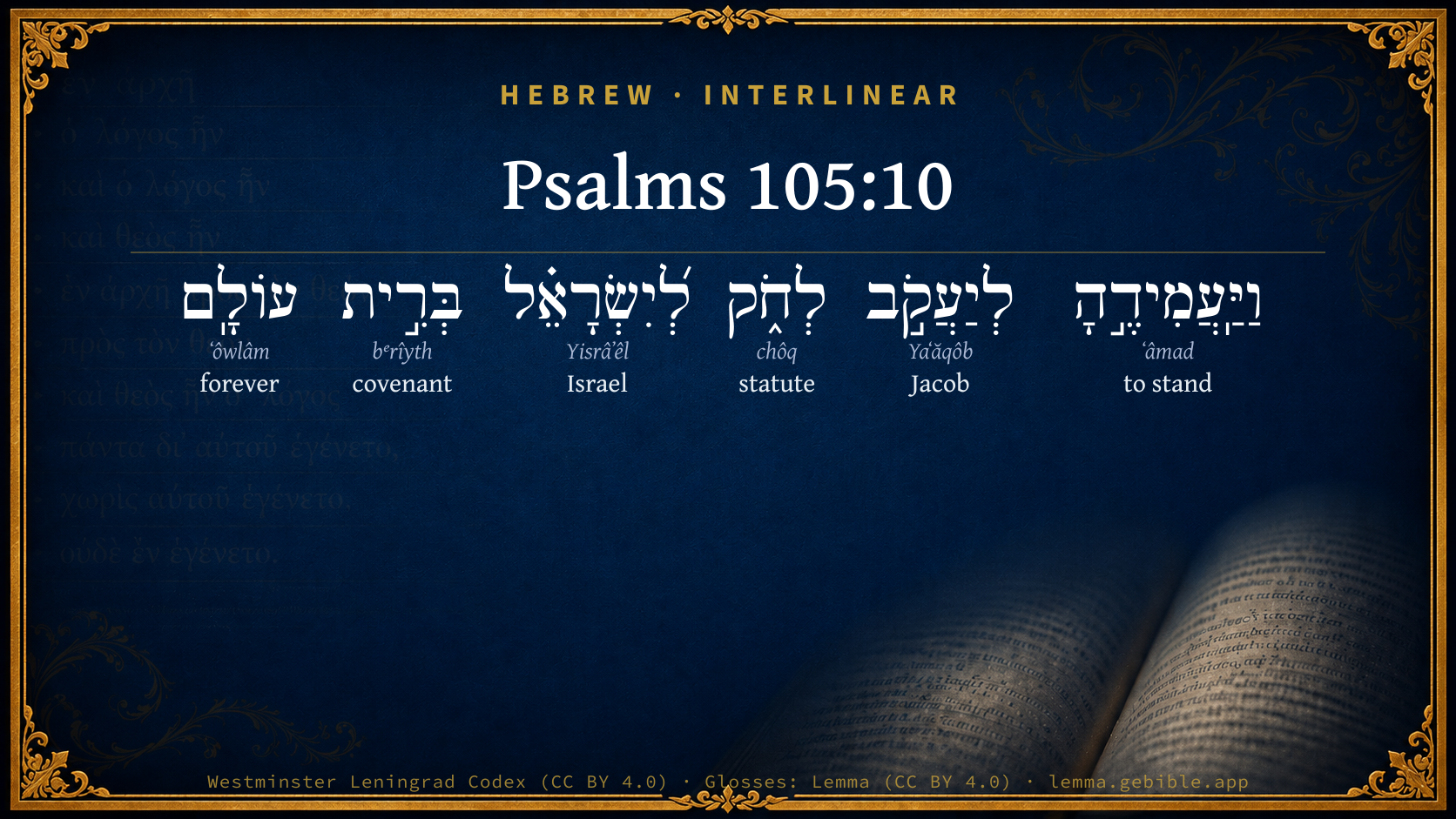
Hebrew (Westminster Leningrad Codex) Psalms 105:10 appears in the Hebrew Old Testament. The text above is from the Westminster Leningrad Codex. Each word links to its Strong’s number, a concise gloss, and parsing drawn from the Open Scriptures Hebrew Bible morphology. Click any word for its full Brown-Driver-Briggs (BDB) entry.
Download image
Cite this verse

Psalms 105:10 (World English Bible). Public Domain. Lemma interlinear Bible study tool, https://lemma.gebible.app/v/psalms/105/10.

Show BibTeX & RIS
BibTeX
RIS
English Translation
And confirmed the same to Jacob for a statute; To Israel for an everlasting covenant,
World English Bible · Public Domain
Download a study sheet

One document with this verse’s original text, its word-by-word gloss line, the meaning frame, cross-references with their text, attributed commentary, and full source and license credits — printable, and it pastes into notes with its structure intact.

This verse Autodidact and up

Study sheet (.html) Plain text (.txt)

A passage Seminary Student

Up to 50 verses in one chapter. A passage sheet keeps up to 6 commentary sources and 12 cross-references per verse, in the order this page ranks them, and says so on the sheet whenever that leaves anything out. Ask for a single verse and you get the Autodidact verse sheet above.

Everything on this page stays free to read, with no account — the sheet is a download of what is already on screen, not access to it.

Want to remove ads? Support Godless Engineer
Compare translations 3

The same verse in 3 English versions, stacked beneath the original-language interlinear above. Click any original word for its lexicon entry.

Each is an independent rendering of the whole verse — the interlinear is not word-aligned to these translations.

Highlighted words mark where these versions differ — a whole-verse word diff, not a word-by-word alignment.

  • World English Bible Public Domain
    And confirmed the same to Jacob for a statute; To Israel for an everlasting covenant,
  • King James Version Public Domain
    And confirmed the same unto Jacob for a law, and to Israel for an everlasting covenant:
  • unfoldingWord Literal Text CC BY-SA 4.0
    He confirmed it to Jacob as a statute; to Israel, an everlasting covenant,

unfoldingWord Literal Text — © unfoldingWord, licensed CC BY-SA 4.0. Word-aligned USFM3 via Door43 (git.door43.org/unfoldingWord/en_ult).

Versions to compare (up to 4)

3 of 4 selected

Show all 18 translations

Every available English version of this verse, each an independent rendering of the whole verse.

  • World English Bible Public Domain
    And confirmed the same to Jacob for a statute; To Israel for an everlasting covenant,
  • Berean Standard Bible Public Domain
    He confirmed it to Jacob as a decree, to Israel as an everlasting covenant:
  • Majority Standard Bible Public Domain
    He confirmed it to Jacob as a decree, to Israel as an everlasting covenant:
  • King James Version Public Domain
    And confirmed the same unto Jacob for a law, and to Israel for an everlasting covenant:
  • American Standard Version (1901) Public Domain
    And confirmed the same unto Jacob for a statute, To Israel for an everlasting covenant,
  • Revised Version (1885) Public Domain
    And confirmed the same unto Jacob for a statute, to Israel for an everlasting covenant:
  • Geneva Bible (1599) Public Domain
    And since hath confirmed it to Iaakob for a lawe, and to Israel for an euerlasting couenant,
  • Douay-Rheims (1899) Public Domain
    And he appointed the same to Jacob for a law, and to Israel for an everlasting testament:
  • Young's Literal Translation Public Domain
    And doth establish it to Jacob for a statute, To Israel -- a covenant age-during,
  • Literal Standard Version CC BY-SA 4.0
    And establishes it to Jacob for a statute, || To Israel—a perpetual covenant,
  • Unlocked Literal Bible CC BY-SA 4.0
    This is what he confirmed to Jacob as a statute and to Israel as an everlasting covenant.
  • unfoldingWord Literal Text CC BY-SA 4.0
    He confirmed it to Jacob as a statute; to Israel, an everlasting covenant,
  • Darby Bible Public Domain
    And he confirmed it unto Jacob for a statute, unto Israel for an everlasting covenant,
  • World Messianic Bible Public Domain
    and confirmed it to Jacob for a statute; to Israel for an everlasting covenant,
  • Webster's Bible Public Domain
    And confirmed the same to Jacob for a law, and to Israel for an everlasting covenant:
  • Free Bible Version CC BY-SA 4.0
    The Lord legally confirmed it with Jacob, he made this binding agreement with Israel:
  • Bible in Basic English Public Domain
    And he gave it to Jacob for a law, and to Israel for an eternal agreement;
  • JPS Tanakh (1917) Public Domain
    And He established it unto Jacob for a statute, to Israel for an everlasting covenant;

Literal Standard Version (2020), Covenant Press — licensed CC BY-SA 4.0. Text via the HelloAO Bible API (eBible.org). Unlocked Literal Bible (unfoldingWord) — licensed CC BY-SA 4.0. Text via the HelloAO Bible API (eBible.org). unfoldingWord Literal Text — © unfoldingWord, licensed CC BY-SA 4.0. Word-aligned USFM3 via Door43 (git.door43.org/unfoldingWord/en_ult). Free Bible Version, Dr. Jonathan Gallagher — licensed CC BY-SA 4.0. Text via the HelloAO Bible API (eBible.org).

Word by word

More ways to search: Search by grammar → Find every occurrence → Compare this word →

Practice this passage: Drill this verse → Learn its vocabulary →

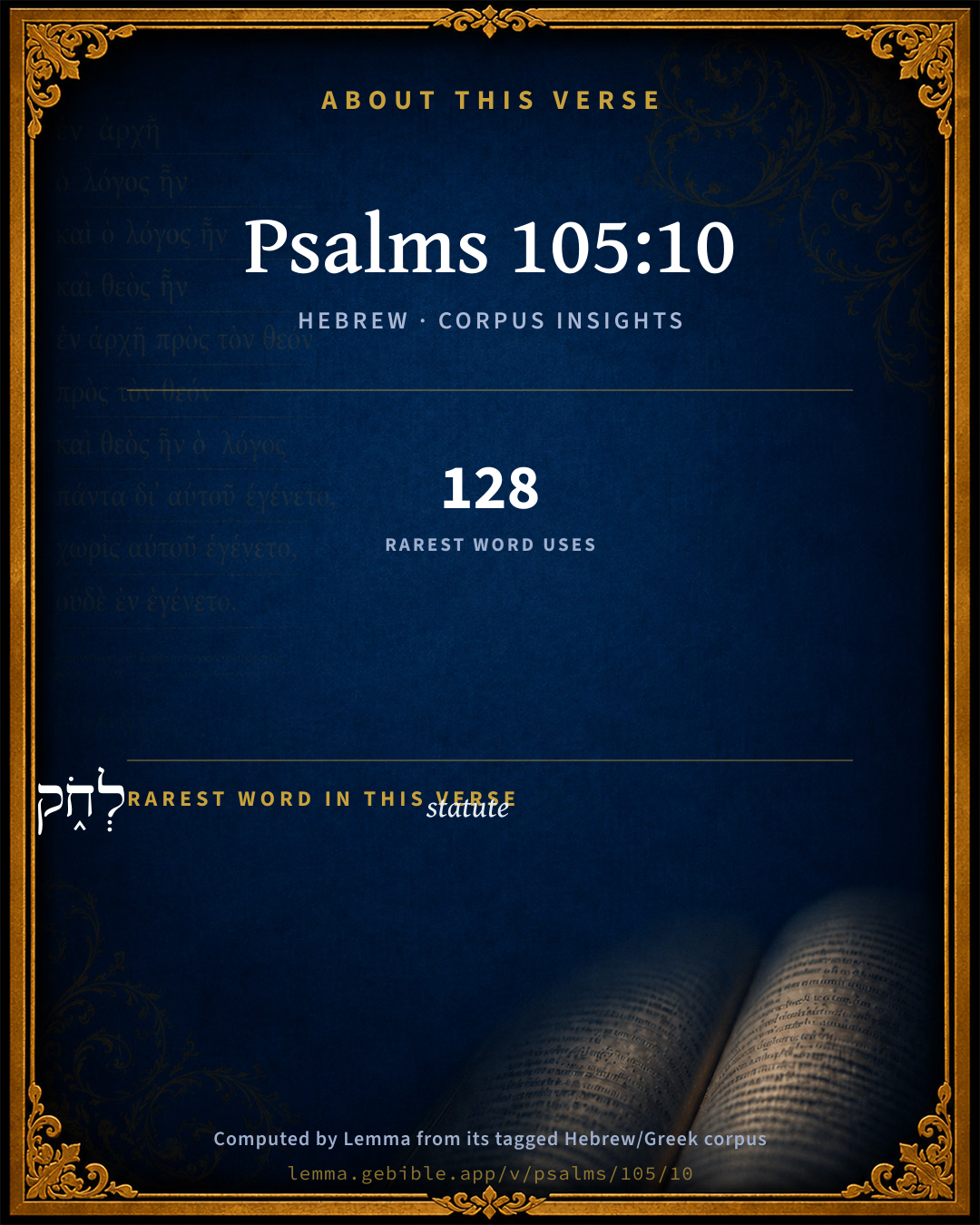
לְחֹ֑ק
chôq
H2706
“to/for · statute”
Preposition + Noun, Common, Masculine, Singular, Absolute
Part of Speech
Preposition + Noun
Type
Common
Gender
Masculine
Number
Singular
State
Absolute
Full BDB Definition

Origin: from H2710

TWOT: 728a

statute, ordinance, limit, something prescribed, due - prescribed task - prescribed portion - action prescribed (for oneself), resolve - prescribed due - prescribed limit, boundary - enactment, decree, ordinance - specific decree - law in general - enactments, statutes - conditions - enactments - decrees - civil enactments prescribed by God
  1. וַיַּֽעֲמִידֶ֣הָ ʻâmad H5975 “and · to stand · her” Conjunction + Verb, Hiphil, Sequential Imperfect, 3rd Person, Masculine, Singular + Suffix, Personal, 3rd Person, Feminine, Singular
  2. לְיַעֲקֹ֣ב Yaʻăqôb H3290 “to/for · Jacob” Preposition + Noun, Proper
  3. לְ֝יִשְׂרָאֵ֗ל Yisrâʼêl H3478 “to/for · Israel” Preposition + Noun, Proper
  4. בְּרִ֣ית bᵉrîyth H1285 “covenant of” Noun, Common, Feminine, Singular, Construct
  5. עוֹלָֽם ʻôwlâm H5769 “forever” Noun, Common, Masculine, Singular, Absolute

About this verse

These counts appear in no published source. They are computed here, from the morphology-tagged text and Lemma’s own curated glosses. What Lemma adds →

6
words
6
distinct lemmas
Wisdom
section

Grammatical profile

  • 1 verb
  • 5 nouns

Verb forms

  • וַיַּֽעֲמִידֶ֣הָ Hiphil · Sequential Imperfect

Hebrew & Septuagint length

In English translation the verse runs 15 words from the Hebrew and 16 from the Septuagint (LXX English) — closely comparable.

A rough comparison of the two English renderings, which tokenize alike — not a word-level alignment.

Word counts can differ between the Hebrew and the Greek without any difference in meaning — e.g. the Hebrew direct-object marker אֵת has no separate Greek word, and Greek often adds the article ὁ.

Cross-references

4

Topical passages linked to Psalms 105:10 in the Treasury of Scripture Knowledge — connected by theme and wording, ordered by reader-vote popularity; previews shown in the World English Bible.

  • Genesis 17:7–8 I will establish my covenant between me and you and your seed after you throughout their generations for an everlasting covenant, to be a God to you and to your seed after you.
  • 2 Samuel 23:5 Most assuredly my house is not so with God; Yet he has made with me an everlasting covenant, Ordered in all things, and sure: For it is all my salvation, and all [my] desire, Although he doesn't make it grow.
  • Genesis 28:13–15 Behold, Yahweh stood above it, and said, "I am Yahweh, the God of Abraham your father, and the God of Isaac. The land whereon you lie, to you will I give it, and to your seed.
  • Hebrews 13:20 Now may the God of peace, who brought again from the dead the great shepherd of the sheep with the blood of an eternal covenant, our Lord Jesus,

Cross-references courtesy of OpenBible.info (CC BY 4.0).

Hebrew and Greek witnesses Masoretic Hebrew ↔ Greek Septuagint

The same verse in the two great witnesses to the Old Testament, shown verse-for-verse.

You’re reading Greek Psalm 104 (Hebrew Psalm 105). The Septuagint counts the superscription, so verse numbers can differ from the Hebrew — chapter-level alignment, not verse-by-verse. Numbering follows Rahlfs.

These are two independent witnesses, not word-aligned to each other, and the Septuagint is shown in lemma (dictionary) form.

Hebrew Psalms 105:10 Masoretic · Westminster Leningrad Codex

וַיַּֽעֲמִידֶ֣הָ לְיַעֲקֹ֣ב לְחֹ֑ק לְ֝יִשְׂרָאֵ֗ל בְּרִ֣ית עוֹלָֽם

And confirmed the same to Jacob for a statute; To Israel for an everlasting covenant,

World English Bible · Public Domain

Greek LXX Greek Psalm 104:10 Septuagint · lemma form

καί ἵστημι αὐτός ὁ ἰακώβ εἰς πρόσταγμα καί ὁ ἰσραήλ διαθήκη αἰώνιος

And he established it to Jacob for an ordinance, and to Israel for an everlasting covenant;

LXX2012 (modern English Septuagint) · Public Domain

Hebrew: Westminster Leningrad Codex (CC BY 4.0). Greek: Septuagint (public domain); English from LXX2012 (modern English Septuagint) (Public Domain). How the Septuagint differs from the Hebrew →

Commentary

Notes on Psalms 105:10 from classic Christian and Jewish commentators (each source and its license shown beneath its notes). The classic Christian expositions comment on the surrounding passage and are grouped to its opening verse, so a note may address several verses; the Jewish commentaries on the Tanakh (Rashi and others) are per-verse, so they appear only where the commentator wrote on this verse.

Lemma curates 59 commentaries, every one of them public domain or Creative Commons licensed, each selected and text-cleaned for this edition rather than reprinted as found. About our sources →

Trapp's Complete Commentary

John Trapp

Psa 105:10 And confirmed the same unto Jacob for a law, [and] to Israel [for] an everlasting covenant:

Ver. 10. And confirmed the same, &c.] So God sealeth and sweareth to us again and again, in every sacrament, that all doubts of his love may be taken away, and our hearts lifted up (as Jehoshaphat’s, 2Ch 17:6) in the way of the Lord.

John Trapp, A Commentary or Exposition upon All the Books of the Old and New Testament (1647–1656) — public domain. Text from a community e-Sword module.

J. A. Alexander on Psalms

Joseph Addison Alexander

10. (Psa 105:10) And confirmed it to Jacob for a statute, to Israel (for) an everlasting covenant. Confirmed it, literally made (or let) it stand, instead of suffering it to expire with the person to whom it was originally given. A statute, in the wide sense of a permanent arrangement, a perpetual constitution, or as it is called in the last clause, a compact of eternity, an everlasting covenant. See Gen 28:13; Gen 35:12.

Joseph Addison Alexander, The Psalms Translated and Explained (1850) — public domain. Text from a community e-Sword module.

Ellicott's Commentary for English Readers

(10) Law . . . covenant.—In Hebrew, chok and herîth, which here seem to be used as synonyms. (Comp. the use of the former word in Psa_2:7.)

A Bible Commentary for English Readers, edited by Charles John Ellicott (1878–1897) — public domain. Text from a community e-Sword module.

John Gill's Exposition

And confirmed the same unto Jacob for a law,.... The son of Isaac, and the grandson of Abraham, to whom it was renewed and confirmed, Gen 28:13. It is true of his posterity that go by his name, and even of all the spiritual Israel of God, to whom this covenant is confirmed and made sure: or "caused to stand" (b), as the word is; by the faithfulness of God by his oath annexed to his word, and by the death of his Son: when this is said to be "for a law", the meaning is, not as if this covenant had the nature of a law, as the covenant of works had; indeed one of the articles of it is, that the law of God should be put into the inward part, and written on the heart; but this refers here not to men, but to God; and the sense is, that this covenant has the force of a law with respect to God, who of his condescending grace and goodness has hereby laid himself under obligation to do such and such things; which is marvellous grace indeed.

And to Israel for an everlasting covenant: for being remembered, commanded, repeated, and confirmed by the Lord, it can never be broken; and being well ordered, remains sure, and is as immovable as rocks and mountains, and more so: as it was made with Christ from everlasting, it will continue to be made good to his people to everlasting; and is a just reason for praise; it being the basis of faith and hope; the ground of joy, peace, and comfort here, and of eternal happiness hereafter.

(b) "stare fecit", Vatablus.

John Gill's Exposition of the Whole Bible (1746–1763) — public domain (CC PDM 1.0). Text via the HelloAO Bible API.

Albert Barnes' Notes on the Bible

And confirmed the same unto Jacob - literally, “caused it to stand;” that is, he made it fast or secure. He renewed it, commanding the same things; making the same promises; and pledging himself for its fulfillment in the same manner. Gen 28:10-15.

For a law - For an established or settled ordinance, for a rule by which future things were to be regulated: that is, they would occur according to that promise, and be conformed to it. It was, as it were, a rule which God prescribed for himself in regard to his own future conduct.

And to Israel ... - Another name for Jacob, Gen 32:28.

Albert Barnes' Notes on the Bible (1834–1885) — public domain. Text from a community e-Sword/MySword module.

Matthew Poole's English Annotations

For a law; either that it might be as firm and irrevocable, as a law; or that it might have the use and force of a law towards God, because God did hereby put himself under an obligation of making it good in regard of his own truth and righteousness.

Matthew Poole's English Annotations on the Holy Bible (1683–1685) — public domain. Text from a community e-Sword/MySword module.

The Treasury of David

Charles H. Spurgeon

Ver. 10. And confirmed the same unto Jacob for a law. Jacob in his wondrous dream (Ge 28:10-15) received a pledge that the Lord's mode of procedure with him would be in accordance with covenant relations: for said Jehovah, "I will not leave thee till I have done that which I have spoken to thee of." Thus, if we may so speak with all reverence, the covenant became a law unto the Lord himself by which he bound himself to act. O matchless condescension, that the most free and sovereign Lord should put himself under covenant bonds to Iris chosen, and make a law for himself, though he is above all law.

And to Israel for an everlasting covenant. When he changed Jacob's name he did not change his covenant, but it is written, "he blessed him there" (Ge 32:29), and it was with the old blessing, according to the unchangeable word of abiding grace.

Psalms 105:11*

Charles H. Spurgeon's The Treasury of David (1869–1885) — public domain. Psalms only. Text from a community e-Sword/MySword module.

Whedon's Commentary on the Bible

Daniel D. Whedon

10. For a law—The covenant of Abraham was the fundamental law, or charter, of the Hebrew Church and commonwealth, as it is of the gospel. See Luk_1:68-75.

Everlasting covenant—Literally so, as the nature of the subject requires us to understand it, for it contained the germ of gospel promise and doctrine. Gal_3:8; Rom_4:13

Daniel D. Whedon (gen. ed.), Commentary on the Old and New Testaments (1874–1909) — public domain. Text from a community e-Sword module.

The Pulpit Commentary

And confirmed the same unto Jacob for a law. (see Gen_28:13) And to Israel; i.e. to Jacob, after he had given him the name of Israel. (see Gen_35:12)

The Pulpit Commentary (1880–1919), ed. H.D.M. Spence-Jones & Joseph S. Exell — public domain. Text from a community e-Sword module.

John Wesley's Explanatory Notes

A law - That it might be as firm and irrevocable as a law.

John Wesley, Explanatory Notes Upon the Whole Bible (1754–1765) — public domain. Text via the GEBible commentary corpus.

Lesson kit

Teaching starters — assembled from the data on this page, not authored interpretation. Every prompt links to the verse data it draws on. Edit before teaching.

Psalms, in the Wisdom, opens this verse with 6 words (6 distinct Hebrew lemmas). Its most distinctive word is chôq (“statute”). A historical commentator’s framing appears above. Read the whole chapter for the surrounding context.

Discussion questions

  1. The word chôq carries the sense “statute.” How does it shape the verse?
  2. How does Genesis 17:7–8, which shares this passage’s theme, read alongside this verse?
  3. These translations render this verse differently. What is at stake in choosing one wording over another?
  4. «וַיַּֽעֲמִידֶ֣הָ» is a Hiphil Sequential Imperfect verb. How does that grammatical form shape the action described?
  5. Compare how Trapp's Complete Commentary and J. A. Alexander on Psalms read this verse. Where do they agree or differ?

Things to notice

Reading settings

Reading text

Shown beneath each verse's original-language words.

Old Testament
Old Testament edition

Read the OT as the Masoretic Hebrew (MT) or the Greek Septuagint (LXX).

English shown for the Greek Septuagint (in the Hebrew ↔ Greek comparison).

Comparing translations? Open the Compare panel on any verse page to stack up to four side by side.