Genesis 49:33

Hebrew (Westminster Leningrad Codex) Genesis 49:33 appears in the Hebrew Old Testament. The text above is from the Westminster Leningrad Codex. Each word links to its Strong’s number, a concise gloss, and parsing drawn from the Open Scriptures Hebrew Bible morphology. Click any word for its full Brown-Driver-Briggs (BDB) entry.
Download image
Cite this verse

Genesis 49:33 (World English Bible). Public Domain. Lemma interlinear Bible study tool, https://lemma.gebible.app/v/genesis/49/33.

Show BibTeX & RIS
BibTeX
RIS
English Translation
When Jacob made an end of charging his sons, he gathered up his feet into the bed, and yielded up the spirit, and was gathered to his people.
World English Bible · Public Domain
Download a study sheet

One document with this verse’s original text, its word-by-word gloss line, the meaning frame, cross-references with their text, attributed commentary, and full source and license credits — printable, and it pastes into notes with its structure intact.

This verse Autodidact and up

Study sheet (.html) Plain text (.txt)

A passage Seminary Student

Up to 50 verses in one chapter. A passage sheet keeps up to 6 commentary sources and 12 cross-references per verse, in the order this page ranks them, and says so on the sheet whenever that leaves anything out. Ask for a single verse and you get the Autodidact verse sheet above.

Everything on this page stays free to read, with no account — the sheet is a download of what is already on screen, not access to it.

Want to remove ads? Support Godless Engineer
Compare translations 3

The same verse in 3 English versions, stacked beneath the original-language interlinear above. Click any original word for its lexicon entry.

Each is an independent rendering of the whole verse — the interlinear is not word-aligned to these translations.

Highlighted words mark where these versions differ — a whole-verse word diff, not a word-by-word alignment.

  • World English Bible Public Domain
    When Jacob made an end of charging his sons, he gathered up his feet into the bed, and yielded up the spirit, and was gathered to his people.
  • King James Version Public Domain
    And when Jacob had made an end of commanding his sons, he gathered up his feet into the bed, and yielded up the ghost, and was gathered unto his people.
  • unfoldingWord Literal Text CC BY-SA 4.0
    Then Jacob finished commanding his sons, and he drew his feet into the bed and exhaled and was gathered to his people.

unfoldingWord Literal Text — © unfoldingWord, licensed CC BY-SA 4.0. Word-aligned USFM3 via Door43 (git.door43.org/unfoldingWord/en_ult).

Versions to compare (up to 4)

3 of 4 selected

Show all 18 translations

Every available English version of this verse, each an independent rendering of the whole verse.

  • World English Bible Public Domain
    When Jacob made an end of charging his sons, he gathered up his feet into the bed, and yielded up the spirit, and was gathered to his people.
  • Berean Standard Bible Public Domain
    When Jacob had finished instructing his sons, he pulled his feet into the bed and breathed his last, and he was gathered to his people.
  • Majority Standard Bible Public Domain
    When Jacob had finished instructing his sons, he pulled his feet into the bed and breathed his last, and he was gathered to his people.
  • King James Version Public Domain
    And when Jacob had made an end of commanding his sons, he gathered up his feet into the bed, and yielded up the ghost, and was gathered unto his people.
  • American Standard Version (1901) Public Domain
    And when Jacob made an end of charging his sons, he gathered up his feet into the bed, and yielded up the ghost, and was gathered unto his people.
  • Revised Version (1885) Public Domain
    And when Jacob made an end of charging his sons, he gathered up his feet into the bed, and yielded up the ghost, and was gathered unto his people.
  • Geneva Bible (1599) Public Domain
    Thus Iaakob made an end of giuing charge to his sonnes, and plucked vp his feete into the bed and gaue vp the ghost, and was gathered to his people.
  • Douay-Rheims (1899) Public Domain
    And he charged them, saying: I am now going to be gathered to my people: bury me with my fathers in the double cave, which is in the field of Ephron the Hethite,
  • Young's Literal Translation Public Domain
    And Jacob finisheth commanding his sons, and gathereth up his feet unto the bed, and expireth, and is gathered unto his people.
  • Literal Standard Version CC BY-SA 4.0
    And Jacob finishes commanding his sons, and gathers up his feet to the bed, and expires, and is gathered to his people.
  • Unlocked Literal Bible CC BY-SA 4.0
    When Jacob finished these instructions to his sons, he pulled his feet into the bed, breathed his last, and went to his people.
  • unfoldingWord Literal Text CC BY-SA 4.0
    Then Jacob finished commanding his sons, and he drew his feet into the bed and exhaled and was gathered to his people.
  • Darby Bible Public Domain
    And when Jacob had made an end of commanding his sons, he gathered his feet into the bed, and expired, and was gathered to his peoples.
  • World Messianic Bible Public Domain
    When Jacob finished charging his sons, he gathered up his feet into the bed, breathed his last breath, and was gathered to his people.
  • Webster's Bible Public Domain
    And when Jacob had made an end of commanding his sons, he drew his feet into the bed, and expired, and was gathered to his people.
  • Free Bible Version CC BY-SA 4.0
    When Jacob finished giving these instructions he pulled up his feet into the bed, breathed his last, and joined his forefathers in death.
  • Bible in Basic English Public Domain
    And when Jacob had come to the end of these words to his sons, stretching himself on his bed, he gave up his spirit, and went the way of his people.
  • JPS Tanakh (1917) Public Domain
    And when Jacob made an end of charging his sons, he gathered up his feet into the bed, and expired, and was gathered unto his people.

Literal Standard Version (2020), Covenant Press — licensed CC BY-SA 4.0. Text via the HelloAO Bible API (eBible.org). Unlocked Literal Bible (unfoldingWord) — licensed CC BY-SA 4.0. Text via the HelloAO Bible API (eBible.org). unfoldingWord Literal Text — © unfoldingWord, licensed CC BY-SA 4.0. Word-aligned USFM3 via Door43 (git.door43.org/unfoldingWord/en_ult). Free Bible Version, Dr. Jonathan Gallagher — licensed CC BY-SA 4.0. Text via the HelloAO Bible API (eBible.org).

Word by word

More ways to search: Search by grammar → Find every occurrence → Compare this word →

Practice this passage: Drill this verse → Learn its vocabulary →

וַיִּגְוַ֖ע
gâvaʻ
H1478
“and · to die”
Conjunction + Verb, Qal, Sequential Imperfect, 3rd Person, Masculine, Singular
Part of Speech
Conjunction + Verb
Stem
Qal
Form
Sequential Imperfect
Person
3rd Person
Gender
Masculine
Number
Singular
Full BDB Definition

Origin: a primitive root

TWOT: 328

to expire, die, perish, give up the ghost, yield up the ghost, be dead, be ready to die - (Qal) to expire, die, be about to die
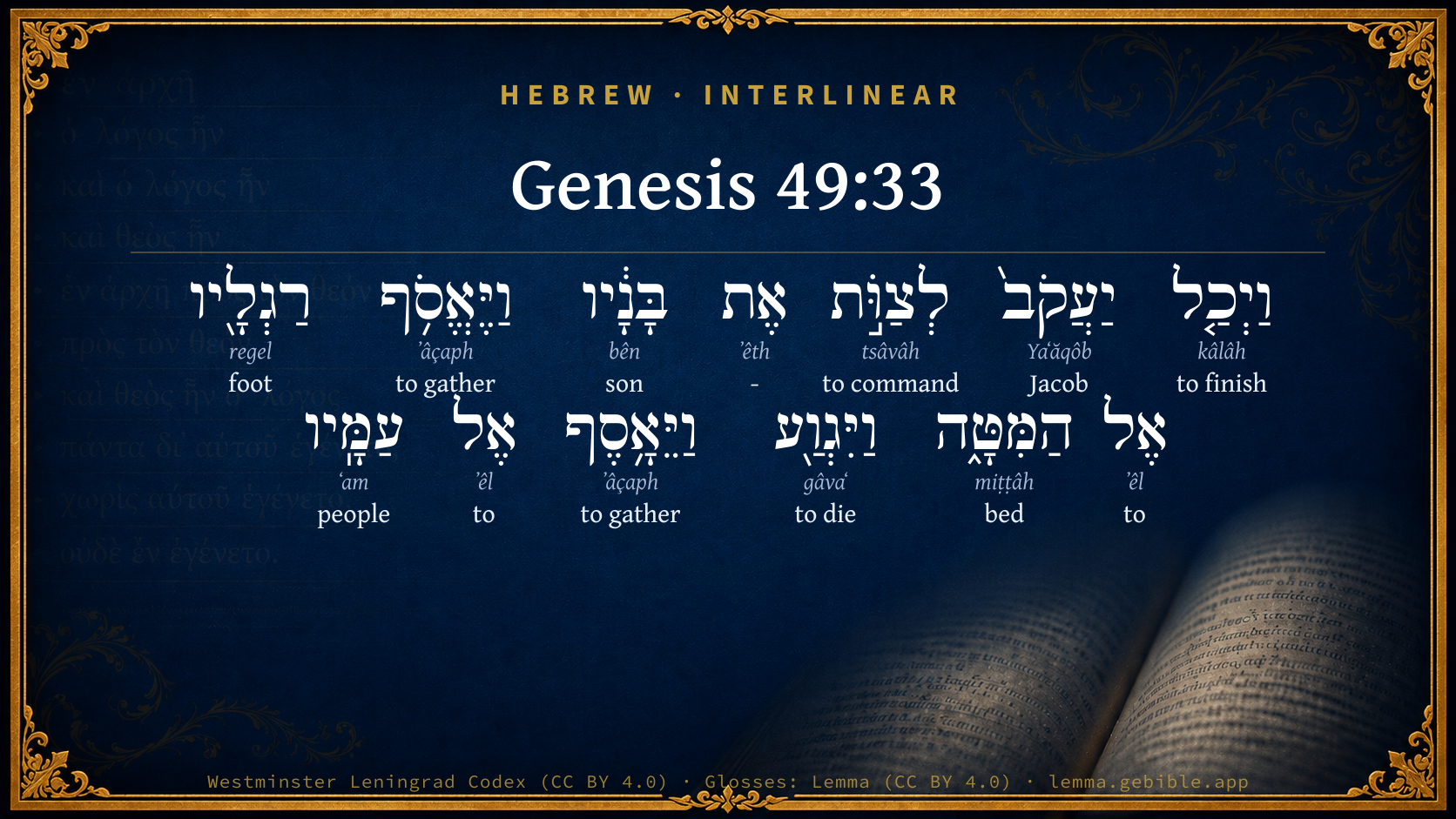
  1. וַיְכַ֤ל kâlâh H3615 “and · to finish” Conjunction + Verb, Piel, Sequential Imperfect, 3rd Person, Masculine, Singular
  2. יַעֲקֹב֙ Yaʻăqôb H3290 “Jacob” Noun, Proper
  3. לְצַוֺּ֣ת tsâvâh H6680 “to command” Preposition + Verb, Piel, Infinitive Construct
  4. אֶת ʼêth H853 “-” Particle, Direct Object
  5. בָּנָ֔יו bên H1121 “sons · his” Noun, Common, Masculine, Plural, Construct + Suffix, Personal, 3rd Person, Masculine, Singular
  6. וַיֶּאֱסֹ֥ף ʼâçaph H622 “and · to gather” Conjunction + Verb, Qal, Sequential Imperfect, 3rd Person, Masculine, Singular
  7. רַגְלָ֖יו regel H7272 “feet · his” Noun, Common, Feminine, Dual, Construct + Suffix, Personal, 3rd Person, Masculine, Singular
  8. אֶל ʼêl H413 “to” Preposition
  9. הַמִּטָּ֑ה miṭṭâh H4296 “the · bed” Particle, Definite Article + Noun, Common, Feminine, Singular, Absolute
  10. וַיֵּאָ֥סֶף ʼâçaph H622 “and · to gather” Conjunction + Verb, Niphal, Sequential Imperfect, 3rd Person, Masculine, Singular
  11. אֶל ʼêl H413 “to” Preposition
  12. עַמָּֽיו ʻam H5971 “peoples · his” Noun, Common, Masculine, Plural, Construct + Suffix, Personal, 3rd Person, Masculine, Singular

About this verse

These counts appear in no published source. They are computed here, from the morphology-tagged text and Lemma’s own curated glosses. What Lemma adds →

13
words
11
distinct lemmas
Pentateuch
section

Notable vocabulary

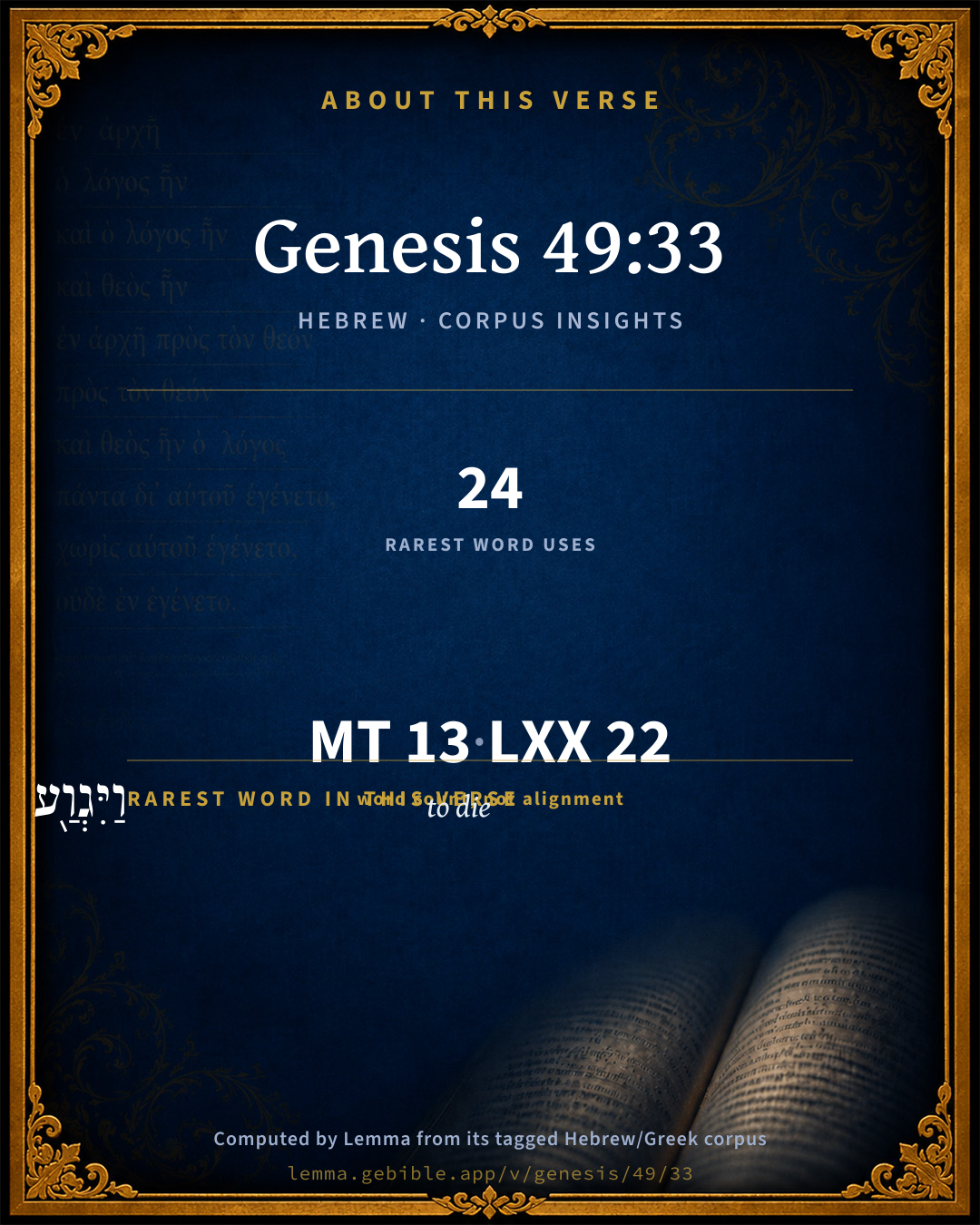
The rarest word here is וַיִּגְוַ֖ע to die H1478 — appearing just 24 times in the whole Hebrew Bible.

Shared distinctive vocabulary

וַיִּגְוַ֖ע to die H1478 occurs in 23 verses of the Hebrew Bible. Also found in:

Grammatical profile

  • 5 verbs
  • 5 nouns
  • 2 prepositions
  • 1 particle

Verb forms

  • וַיְכַ֤ל Piel · Sequential Imperfect
  • לְצַוֺּ֣ת Piel · Infinitive Construct
  • וַיֶּאֱסֹ֥ף Qal · Sequential Imperfect
  • וַיִּגְוַ֖ע Qal · Sequential Imperfect
  • וַיֵּאָ֥סֶף Niphal · Sequential Imperfect

Repetition

Words recur within this verse — often emphatic in Hebrew:

  • וַיֶּאֱסֹ֥ף to gather H622 ×2
  • אֶל to H413 ×2

Hebrew & Septuagint length

In English translation the verse runs 28 words from the Hebrew and 25 from the Septuagint (LXX English) — closely comparable.

A rough comparison of the two English renderings, which tokenize alike — not a word-level alignment.

Word counts can differ between the Hebrew and the Greek without any difference in meaning — e.g. the Hebrew direct-object marker אֵת has no separate Greek word, and Greek often adds the article ὁ.

In the original languages it is 13 Hebrew tokens and 22 Greek tokens — but the two are counted differently (Hebrew bundles its prefixes and suffixes into one token; the Greek is in lemma form), so that isn’t a like-for-like length.

Cross-references

18

Topical passages linked to Genesis 49:33 in the Treasury of Scripture Knowledge — connected by theme and wording, ordered by reader-vote popularity; previews shown in the World English Bible.

  • Genesis 49:29 He charged them, and said to them, "I am to be gathered to my people. Bury me with my fathers in the cave that is in the field of Ephron the Hittite,
  • Genesis 25:8 Abraham gave up the spirit, and died in a good old age, an old man, and full of years, and was gathered to his people.
  • Genesis 35:29 Isaac gave up the spirit, and died, and was gathered to his people, old and full of days. Esau and Jacob, his sons, buried him.
  • Genesis 15:5 Yahweh brought him outside, and said, "Look now toward the sky, and count the stars, if you are able to count them." He said to Abram, "So shall your seed be."
  • Genesis 25:17 These are the years of the life of Ishmael: one hundred thirty-seven years. He gave up the spirit and died, and was gathered to his people.
  • Genesis 49:1 Jacob called to his sons, and said: "Gather yourselves together, that I may tell you that which will happen to you in the days to come.
  • Genesis 49:24–26 But his bow abode in strength, The arms of his hands were made strong, By the hands of the Mighty One of Jacob, (From there is the shepherd, the stone of Israel),
  • Joshua 24:27–29 Joshua said to all the people, Behold, this stone shall be a witness against us; for it has heard all the words of Yahweh which he spoke to us: it shall be therefore a witness against you, lest you deny your God.
  • Job 5:26 You shall come to your grave in a full age, Like a shock of grain comes in its season.
  • Job 14:10 But man dies, and is laid low. Yes, man gives up the spirit, and where is he?
  • Job 30:23 For I know that you will bring me to death, To the house appointed for all living.
  • Ecclesiastes 12:7 And the dust returns to the earth as it was, And the spirit returns to God who gave it.
  • Isaiah 57:1–2 The righteous perishes, and no man lays it to heart; and merciful men are taken away, none considering that the righteous is taken away from the evil [to come].
  • Luke 2:29 "Now you are releasing your servant, Master, According to your word, in peace;
  • Acts 7:15 Jacob went down into Egypt, and he died, himself and our fathers,
  • Hebrews 11:13–16 These all died in faith, not having received the promises, but having seen them and embraced them from afar, and having confessed that they were strangers and pilgrims on the earth.
  • Hebrews 11:22 By faith, Joseph, when his end was near, made mention of the departure of the children of Israel; and gave instructions concerning his bones.
  • Hebrews 12:23 to the general assembly and assembly of the firstborn who are enrolled in heaven, to God the Judge of all, to the spirits of just men made perfect,

Cross-references courtesy of OpenBible.info (CC BY 4.0).

Hebrew and Greek witnesses Masoretic Hebrew ↔ Greek Septuagint

The same verse in the two great witnesses to the Old Testament, shown verse-for-verse.

These are two independent witnesses, not word-aligned to each other, and the Septuagint is shown in lemma (dictionary) form.

Hebrew Genesis 49:33 Masoretic · Westminster Leningrad Codex

וַיְכַ֤ל יַעֲקֹב֙ לְצַוֺּ֣ת אֶת בָּנָ֔יו וַיֶּאֱסֹ֥ף רַגְלָ֖יו אֶל הַמִּטָּ֑ה וַיִּגְוַ֖ע וַיֵּאָ֥סֶף אֶל עַמָּֽיו

When Jacob made an end of charging his sons, he gathered up his feet into the bed, and yielded up the spirit, and was gathered to his people.

World English Bible · Public Domain

Greek LXX Genesis 49:33 Septuagint · lemma form

καί καταπαύω ἰακώβ ἐπιτάσσω ὁ υἱός αὐτός καί ἐκαἴρω ὁ πούς αὐτός ἐπί ὁ κλίνη ἐκλείπω καί προςτίθημι πρός ὁ λαός αὐτός

And Jacob ceased giving charges to his sons; and having lifted up his feet on the bed, he died, and was gathered to his people.

LXX2012 (modern English Septuagint) · Public Domain

On this verse, The Cambridge Bible for Schools and Colleges discusses the Septuagint’s reading. Read the note in Commentary ↓

Hebrew: Westminster Leningrad Codex (CC BY 4.0). Greek: Septuagint (public domain); English from LXX2012 (modern English Septuagint) (Public Domain). How the Septuagint differs from the Hebrew →

Targum (Aramaic paraphrase)

2

The Targum is the ancient Jewish Aramaic paraphrase of the Hebrew Scriptures — an interpretive translation, not the Hebrew text itself. Onkelos (literal) and Pseudo-Jonathan (expansive) render the Torah, and Jonathan the Prophets. Coverage is partial: where no permissively-licensed English translation exists for a verse, only the Aramaic is shown. This is verse-level text, not a word-by-word alignment to the Hebrew.

  1. Targum Onkelos Torah (Genesis–Deuteronomy)
    וְשֵׁיצֵי יַעֲקֹב לְפַקָּדָא יָת בְּנוֹהִי וּכְנַשׁ רַגְלוֹהִי לְעַרְסָא וְאִתְנְגִיד וְאִתְכְּנִישׁ לְעַמֵּהּ

    (no public-domain English translation for this verse)

    Targum Onkelos — Aramaic: “Onkelos Genesis” (public domain); “Onkelos Exodus” (public domain); “Onkelos Leviticus” (public domain); “Onkelos Numbers” (public domain); “Onkelos Deuteronomy” (public domain). English: “Sefaria Community Translation” (CC0 1.0 (public-domain dedication)); “J.W. Etheridge. The Targums of Onkelos and Jonathan Ben Uzziel on the Pentateuch. London: Longmans, Green, 1862” (public domain). Text via Sefaria.

  2. Targum Pseudo-Jonathan Torah (Genesis–Deuteronomy)
    וּפְסַק יַעֲקב לְפַקְדָא יַת בְּנוֹי וּכְנֵישׁ רִגְלוֹי לְגוֹ דַרְגְשָׁא וְאִתְנְגִיד וְאִתְכְּנֵישׁ לְעַמֵיהּ

    And Jakob ceased to command his sons. And he gathered up his feet into the midst of the bed, and expired, and was gathered unto his people

    Targum Pseudo-Jonathan — Aramaic: “Targum Jonathan on Genesis” (public domain); “Targum Jonathan on Exodus” (public domain); “Targum Jonathan on Leviticus” (public domain); “Targum Jonathan on Numbers” (public domain); “Targum Jonathan on Deuteronomy” (public domain). English: “The Targum of Jonathan ben Uzziel, trans. J. W. Etheridge, London, 1862” (public domain). Text via Sefaria.

Commentary

Notes on Genesis 49:33 from classic Christian and Jewish commentators (each source and its license shown beneath its notes). The classic Christian expositions comment on the surrounding passage and are grouped to its opening verse, so a note may address several verses; the Jewish commentaries on the Tanakh (Rashi and others) are per-verse, so they appear only where the commentator wrote on this verse.

Lemma curates 59 commentaries, every one of them public domain or Creative Commons licensed, each selected and text-cleaned for this edition rather than reprinted as found. About our sources →

Trapp's Complete Commentary

John Trapp

Gen 49:33 And when Jacob had made an end of commanding his sons, he gathered up his feet into the bed, and yielded up the ghost, and was gathered unto his people.

Ver. 33. He gathered up his feet.] He quietly composed himself, as it were, to sleep in Jesus. He had stretched out himself before, saith Musculus, as well as he could, for reverence to the word of God, which he delivered, &c.

And was gathered unto his people.] To "the general assembly and Church of the firstborn, whose names are written in heaven." {Heb 12:23} In Jerusalem, records were kept of the names of all the citizens. {Psa 87:5} So is it in heaven, where Jacob is now a denizen.

John Trapp, A Commentary or Exposition upon All the Books of the Old and New Testament (1647–1656) — public domain. Text from a community e-Sword module.

The Biblical Illustrator

Joseph S. Exell

Gen_49:33

When Jacob had made an end . . . he gathered up his feet into the bed, and yielded up the ghost

Jacobs death-bed:

I.

HIS AFFECTION FOR THE LIVING.

1. His affection was impartial.

2. His affection was religious.

II. SYMPATHY WITH THE DEAD,

III. HIS MAGNANIMITY IN ALL. No perturbation. Two things alone can explain his calmness.

1. Faith in his future existence.

2. Faith in the happiness of his future existence. (Homilist.)

Jacobs death and funeral:

I. THE PATRIARCH DEPARTURE.

1. A hint of immortality. Amid the shadows of the past there were beams of light that spoke of a future state (life and immortality brought to life by the gospel). Jacob was gathered to his people (Gen_49:33). Jehovah was known as the God of Abraham, and Isaac, and Jacob. He is not the God of the dead, but of the living. The patriarchs were therefore living. To them Jacob was gathered.

2. An illustration of natural sorrow. Joseph fell on his fathers face, and wept upon him, and kissed him. Picture this affecting sight. Wealth and power had not hardened Josephs heart. We sorrow not, as they that have no hope.

3. An illustration of filial obedience. Joseph remembering his promise to his father (Gen_47:29-31), had him embalmed, &c. Do we remember dying parents wishes, not to carry him to the promised land, but to meet him there?

II. THE MAGNIFICENT FUNERAL.

1. There was the usual ceremonious mourning of many days.

2. Joseph seeks permission of the king to bury his father.

3. At the head of a great retinue he passes up once more to Canaan. How great the difference between his leaving and entering Canaan. Thirty-nine years have elapsed. The youth of seventeen has become a man of fifty-six. The slave has become a prince. Both were occasions of grief. Then he was leaving his father through the treachery of his brothers; now he is burying his father with his brethren around him.

4. Such a funeral never before seen in Canaan. The Canaanites find that the old shepherd who went away seventeen years before is a great man. So sometimes men are brought back to be buried among the people who thought little of them while they lived. (Ill. the funeral of Cobden in the Sussex village, &c.)

. (J. G. Gray.)

Sermons from saintly death-beds:

Jacob did not yield up the ghost until he had delivered the last sentence of admonition and benediction to his twelve sons. He was immortal till his work was done. So long as God had another sentence to speak by him, death could not paralyse his tongue.

Yet, after all, the strong man was bowed down, and he who had journeyed with unwearied foot full many a mile, was now obliged to gather up his feet into the bed to die. From the wording of the text, it appears very clearly that Israel did not dispute the irrevocable decree, nor did his soul murmur against it. He had long before learned that few and evil were his days, and now that they came to an end, he joyfully accepted their conclusion. It is remarkable that the Holy Spirit has given us very few death-bed scenes in the Book of God. We have very few in the Old Testament, fewer still in the New, and I take it that the reason may be because the Holy Ghost would have us take more account of how we live than how we die, for life is the main business. He who learns to die daily while he lives, will find it no difficulty to breathe out his soul for the last time into the hands of his faithful Creator. If we fight well the battle, we may rest assured of the victory.

I. First, THE DEPARTURES OF GODS SAINTS, AND ESPECIALLY OF HIS MINISTERS--WHAT ARE THEIR LESSONS?

1. The first that lies upon the surface, is this, Be ye also ready: for in such an hour as ye think not the Son of Man cometh. When in the forest there is heard the crash of a falling oak, it is a sign that the woodman is abroad, and every tree in the whole company may tremble lest soon the sharp edge of the axe should find it out.

2. Secondly, the deaths of righteous men should teach us their value. According to the old saying, we never know the value of things till we lose them. I am sure it is so with holy men. Let me urge young people here to prize their aged godly parents, to treat them kindly, to make their last days happy, because they cannot expect to have them long on earth to receive their tokens of affectionate gratitude.

3. Furthermore, I think the departures of great saints and those who have been eminent, teach us to pray earnestly to God to send us more of such--a lesson which, I am quite certain, needs to be inculcated often. There is sadly little prayer in the church for the rising ministry.

4. Yet there is a valuable truth on the other side. We desire always to look at both sides of a question. The taking away of eminent saints from among us should teach us to depend more upon God, and less upon human instrumentality. I was reading, yesterday, the dying prayer of Oliver Cromwell, and one sentence in that man of Gods last breathings pleased me exceedingly. It was to this effect, Teach those who look too much upon Thy instruments to depend more upon Thyself. The Lord would have all the glory given unto His own name.

5. Coming back, however, to the old thought, do you not think that the departure of eminent saints should teach each one of us to work with more earnestness and perseverance while we are spared? One soldier the less in the battle, my brethren; then you must fill up the vacancy; you who stand next in the ranks must close up, shoulder to shoulder, that there be no gap. Here is one servant the less in the house: the other servants must do the more work. It is but natural for us so to argue, because we wish the Masters work to be done, and it will not be done without hands.

II. Come with me to the second part of my discourse. Much may be learned from the MODE OF DEPARTURE of Gods servants.

1. To some of Gods own children the dying bed is a Bochim, a place of weeping. It is melancholy when such is the case, and yet it is often so with those who have been negligent servants: they are saved, but so as by fire; they struggle into the port of peace, but their entrance is like that of a weather-beaten vessel which has barely escaped the storm, and enters into harbour so terribly leaking as to be ready to founder, without her cargo, for she has thrown that overboard to escape the waves, sails rent to ribands, masts gone by the board, barely able to keep afloat. Many a dying pillow has been wet with the penitential tears of saints, who have then fully seen their formerly unobserved shortcomings and failures and laxities in the family, in the business, in the church, and in the world. Brethren, it is beautiful to see the repentance of a dying saint; travel far as you may, you will not readily behold a more comely spectacle. Yet at the sight; of such instances it has struck me that the fruit though precious was scarcely seasonable; it must be acceptable to God, for He never rejects repentance anywhere, but yet a brighter state of soul would have glorified Him more in dying moments. We regret to see mourning of soul as the most conspicuous feature in a departing brother, we desire to see joy and confidence clearly manifested at the last.

2. It has not unfrequently occurred that the dying scene has been to the Lords departing champions a battle, not perhaps by reason of any slips or shortcomings--far from it, for in some cases the conflict appeared to arise by very reason of their valour in the Lords service. Who among us would assert that Martin Luther failed to live up to the light and knowledge which he had received? So far as he knew the truth, I believe he most diligently followed it; beyond most men he was true to conscience, he knew comparatively little of the truth, but what he did know he maintained with all his heart, and soul, and strength; and yet it is exceedingly painful to read the record of Luthers last few days. Darkness was round about him, thick clouds and tempest enveloped his soul. At the last the sky cleared, but it is very evident that, among all the grim battles in which that mighty German fought and conquered, probably the most tremendous conflict of his life was at its close. Can we not guess the reason? Was it not because the devil knew him to be his worst enemy then upon the earth, and therefore hating him with the utmost power of infernal hate, and feeling that this was his last opportunity for assaulting him, he gathered up all his diabolical powers, and came in against him like a flood, thinking that mayhap he might at the last overcome the stout heart, and cow the valiant spirit! Only by Divine assistance did Luther win the victory, but win it he did. Is this form of departure to be altogether deprecated? I think not. Is it to be dreaded in some aspects, though not in others, for is it not a noble thing for the knight of the Cross to die in harness? a blessed thing for the Christian soldier to proceed at once from the battle fold to his eternal rest?

3. To many saints their departure has been a peaceful entrance into the fair haven of repose. The very weakest of Gods servants have frequently been happiest in their departing moments. John Bunyan, who had observed this fact, in the description of Mr. Feebleminds passage of the river, Here also I took notice of what was very remarkable; the water of that river was lower at this time than ever I saw it all my life. So he went over at last not much above wet-shod. Heavens mercy tempers the wind to the shorn lamb, and gives to babes no battle, because they have no strength for it: the lambs calmly rest on the bosom of Jesus, and breathe out their lives in the Shepherds arms. What encouragement this ought to be to you who are the tender ones among us I what cheering tidings for you who are weak in faith 1

4. Many of the saints have gone farther than this, for their death-beds have been pulpits. When Mr. Matthew Henry was dying, Mr. Illidge came to him, and he said, You have been used to take notice of the sayings of dying men; this is mine, A life spent in the service of God and in communion with Him, is the most pleasant life that any one can bye in the world. Well spoken! Our pulpits often lack force and power; men suppose that we speak but out of form and custom, but they do not suspect dying men of hypocrisy, nor think that they are driving a trade and following a profession. Hence the witness of dying saints has often become powerful to those who have stood around their couch; careless hearts have been impressed, slumbering consciences have been awakened, and children of God quickened to greater diligence by what they have heard.

5. And, brethren, we have known not unfrequent cases (nay, commonly this is the case) when the dying bed has become a Pisgah, from the top of which the saint has viewed his inheritance, while anon his couch has glowed on a sudden into the chariot--a flaming chariot such as that in which Elias was borne away to dwell with God. Saints have frequently been in such triumphant conditions of mind, that rapture and ecstacy are the only fit words in which to describe their state. If this be dying, said one, it is worth while living for the mere sake of dying. (C. H.Spurgeon.)

Jacobs debit and credit account

The struggle is over. Lifes record is completed. The sorrows of a hundred and forty-seven years, like the sufferings of the dying babe, come to an end. And now that the balance is struck, how stands the account? Debit: infirmities many; sins not a few; wrongs done to Esau; polygamy with its legacy of bickerings; partiality in the family; murmurings under the succession of distresses which his own conduct brought upon him. Credit: The early choice of Jehovah; habitual reliance upon Divine guidance; deep and abiding impressions of piety; an unquenchable faith in God; the approval of a conscience, which though not greatly enlightened was evidently sincere; a life marred by transgressions of deep moral turpitude, but remarkably exemplary for the rude age in which he lived. (J. S. Van Dyke.)

.

The Biblical Illustrator, edited by Joseph S. Exell (c. 1880s–1900s) — public domain. Text from a community e-Sword module.

Joseph Benson's Commentary

Gen 49:33. And when Jacob had made an end of commanding of his sons — He put himself in a posture for dying; having sat upon the bed-side to bless his sons, the spirit of prophecy bringing fresh oil to his expiring lamp, when that work was done, he gathered up his feet into the bed — That he might lie along, not only as one patiently submitting to the stroke, but as one cheerfully composing himself to rest. He then freely resigned his spirit into the hand of God, the Father of spirits; he yielded up the ghost — And his separated soul went to the assembly of the souls of the faithful, who, after they are delivered from the burden of the flesh, are in joy and felicity; he was gathered to his people.

Joseph Benson's Commentary on the Old and New Testaments (1811–1818) — public domain. Text from a community e-Sword module.

Tyndale Open Study Notes

Tyndale Open Resources

49:33 Jacob died at the age of 147 (47:28), bringing his life of struggle and sorrow to an end. Jacob had always had an unquenchable desire for God’s blessing. He had a deep piety that habitually relied on God despite all else. In the end, he died a man of genuine faith. He learned where real blessings come from, and through his faith would be able to hand these on to his sons (Heb 11:21).

Tyndale Open Study Notes — © Tyndale Open Resources, licensed CC BY-SA 4.0. Text via the HelloAO Bible API.

Geneva Bible (1599)

Geneva Bible translators

Whereby is signified how quietly he died.

Geneva Bible (1599) marginal notes — public domain. Text via Bolls.life.

Jamieson, Fausset & Brown

Robert Jamieson, A. R. Fausset & David Brown

when Jacob had made an end of commanding his sons--It is probable that he was supernaturally strengthened for this last momentous office of the patriarch, and that when the divine afflatus ceased, his exhausted powers giving way, he yielded up the ghost, and was gathered unto his people.

Next: Genesis Chapter 50

Jamieson, Fausset & Brown — Commentary Critical and Explanatory on the Whole Bible (1871) — public domain (CC PDM 1.0). Text via the HelloAO Bible API.

Adam Clarke's Commentary

Verse 33. He gathered up his feet into the bed] It is very probable that while delivering these prophetic blessings Jacob sat upon the side of his bed, leaning upon his staff; and having finished, he lifted up his feet into the bed, stretched himself upon it, and expired!

And was gathered unto his people.] The testimony that this place bears to the immortality of the soul, and to its existence separate from the body, should not be lightly regarded. In the same moment in which Jacob is said to have gathered up his feet into the bed, and to have expired, it is added, and was gathered unto his people. It is certain that his body was not then gathered to his people, nor till seven weeks after; and it is not likely that a circumstance, so distant in point both of time and place, would have been thus anticipated, and associated with facts that took place in that moment. I cannot help therefore considering this an additional evidence for the immateriality of the soul, and that it was intended by the Holy Spirit to convey this grand and consolatory sentiment, that when a holy man ceases to live among his fellows, his soul becomes an inhabitant of another world, and is joined to the spirits of just men made perfect.

1. IT has been conjectured (See Clarke on Ge 37:9) that the eleven stars that bowed down to Joseph might probably refer to the signs of the Zodiac, which were very anciently known in Egypt, and are supposed to have had their origin in Chaldea. On this supposition Joseph's eleven brethren answered to eleven of these signs, and himself to the twelfth. General Vallancy has endeavoured, in his Collectanea de Rebus Hibernicis, vol. vi., part. ii., p. 343, to trace out the analogy between the twelve sons of Jacob and the twelve signs of the Zodiac, which Dr. Hales (Analysis, vol. ii., p. 165) has altered a little, and placed in a form in which it becomes more generally applicable. As this scheme is curious, many readers who may not have the opportunity of consulting the above works will be pleased to find it here. That there is an allusion to the twelve signs of the Zodiac, and probably to their ancient asterisms, may be readily credited; but how far the peculiar characteristics of the sons of Jacob were expressed by the animals in the Zodiac, is a widely different question.

1. RUBEN - "Unstable (rather pouring out) as waters" - the sign AQUARIUS, represented as a man pouring out waters from an urn.

2. SIMEON and LEVI - "The united brethren" the sign GEMINI or the Twins.

3. JUDAH - "The strong lion" - the sign LEO.

4. ASHER - "His bread shall be fat" - the sign VIRGO or the Virgin, generally represented as holding a full ear of corn.

5. ISSACHAR - "A strong ass" or ox, both used in husbandry - the sign TAURUS or the Bull.

6. and 7. DAN - "A serpent biting the horse's heels" - Scorpio, the Scorpion. On the celestial sphere the Scorpion is actually represented as biting the heel of the horse of the archer Sagittarius; and Chelae, "his claws," originally occupied the space of Libra.

8. JOSEPH - "His bow remained in strength" - the sign SAGITTARIUS, the archer or bowman; commonly represented, even on the Asiatic Zodiacs, with his bow bent, and the arrow drawn up to the head - the bow in full strength.

9. NAPHTALI - by a play on his name, taleh, the ram - the sign ARIES, according to the rabbins.

10. ZEBULUN - "A haven for ships" - denoted by CANCER, the crab.

11. GAD - "A troop or army" - reversed, dag, a fish - the sign PISCES.

12. BENJAMIN - "A ravening wolf" - CAPRICORN, which on the Egyptian sphere was represented by a goat led by Pan, with a wolf's head.

What likelihood the reader may see in all this, I cannot pretend to say; but that the twelve signs were at that time known in Egypt and Chaldea, there can be little doubt.

2. We have now seen the life of Jacob brought to a close; and have carefully traced it through all its various fortunes, as the facts presented themselves in the preceding chapters. Isaac his father was what might properly be called a good man; but in strength of mind he appears to have fallen far short of his father Abraham, and his son Jacob. Having left the management of his domestic concerns to Rebekah his wife, who was an artful and comparatively irreligious woman, the education of his sons was either neglected or perverted. The unhappy influence which the precepts and example of his mother had on the mind of her son we have seen and deplored. Through the mercy of God Jacob outlived the shady part of his own character, and his last days were his brightest and his best. He had many troubles and difficulties in life, under which an inferior mind must have necessarily sunk; but being a worker together with the providence of God, his difficulties only served in general to whet his invention, and draw out the immense resources of his own mind. He had to do with an avaricious, procrastinating relative, as destitute of humanity as he was of justice. Let this plead something in his excuse. He certainly did outwit his father-in-law; and yet, probably, had no more than the just recompense of his faithful services in the successful issue of all his devices. From the time in which God favoured him with that wonderful manifestation of grace at Peniel, Ge 32:24-30, he became a new man. He had frequent discoveries of God before, to encourage him in journeys, secular affairs, c. but none in which the heart-changing power of Divine grace was so abundantly revealed. Happy he whose last days are his best! We can scarcely conceive a scene more noble or dignified than that exhibited at the deathbed of Jacob. This great man was now one hundred and forty-seven years of age; though his body, by the waste of time, was greatly enfeebled, yet with a mind in perfect vigour, and a hope full of immortality, he calls his numerous family together, all of them in their utmost state of prosperity, and gives them his last counsels, and his dying blessing. His declarations show that the secret of the Lord was with him, and that his candle shone bright upon his tabernacle. Having finished his work, with perfect possession of all his faculties, and being determined that while he was able to help himself none should be called in to assist, (which was one of the grand characteristics of his life,) he, with that dignity which became a great man and a man of God stretched himself upon his bed, and rather appears to have conquered death than to have suffered it. Who, seeing the end of this illustrious patriarch, can help exclaiming, There is none like the God of Jeshurun! Let Jacob's God be my God! Let me die the death of the righteous, and let my last end be like his! Reader, God is still the same: and though he may not make thee as great as was Jacob, yet he is ready to make thee as good; and, whatever thy past life may have been, to crown thee with loving-kindness and tender mercies, that thy end also may be peace.

Adam Clarke's Commentary on the Bible (1810–1826) — public domain. Text from a community e-Sword/MySword module.

John Calvin's Commentaries

33. He gathered up his feet. The expression is not superfluous: because Moses wished thereby to describe the placid death of the holy man: as if he had said, that the aged saint gave directions respecting the disposal of his body, as easily as healthy and vigorous men are wont to compose themselves to sleep. And truly a wonderful vigor and presence of mind was necessary for him, when, while death was in his countenance, he thus courageously fulfilled the prophetic office enjoined upon him. And it is not to be doubted that such efficacy of the Holy Spirit manifested itself in him, as served to produce, in his sons, confidence in, and reverence for his prophecies. At the same time, however, it is proper to observe, that it is the effect of a good conscience, to be able to depart out of the world without terror. For since death is by nature formidable, wonderful torments agitate the wicked, when they perceive that they are summoned to the tribunal of God. Moreover, in order that a good conscience may lead us peacefully and quietly to the grave, it is necessary to rely upon the resurrection of Christ; for we then go willingly to God, when we have confidence respecting a better life. We shall not deem it grievous to leave this failing tabernacle, when we reflect on the everlasting abode which is prepared for us.

John Calvin's Commentaries (1540-1563) — public domain. Text from the Calvin Translation Society English edition (1840s-50s) via the Christian Classics Ethereal Library (ccel.org). Calvin's coverage is partial (roughly two-thirds of the Bible); uncommented books and verses are honest gaps, never fabricated. The 19th-century editor's footnotes and remarks are omitted so the notes are faithfully Calvin's own voice.

Ellicott's Commentary for English Readers

(33) He gathered up his feet into the bed.—This seems to indicate that the events recorded in Genesis 48, 49 all took place at the same time. In Gen_48:2 we read that Jacob strengthened himself for this great final effort, seating himself upon the bed and placing his feet upon the ground. (See Gen_49:12.) And now that all was over, wearied with what must have sorely exercised both his feelings and his physical powers, he gathered himself together upon the bed, and probably soon afterwards peaceably passed away to his eternal rest.

A Bible Commentary for English Readers, edited by Charles John Ellicott (1878–1897) — public domain. Text from a community e-Sword module.

The Cambridge Bible for Schools and Colleges

gen. ed. J. J. S. Perowne

33. gathered up his feet] Jacob now lay down; he had been sitting. See Gen_48:2 (E).

yielded up the ghost] Cf. Gen_25:8 (P). The phrase is an English one. The Hebrew has simply “and expired.” LXX ἐξέλιπε; Lat. obiit.

unto his people] See note on Gen_25:8. The present passage shews clearly that “to be gathered unto one’s people” is not burial in the ancestral place of sepulture (for the account of Jacob’s burial seventy days later comes in the next chapter); but the soul’s departure to the gathering-place of the deceased members of the family, i.e. Sheôl.

The Cambridge Bible for Schools and Colleges (gen. ed. J. J. S. Perowne; Cambridge University Press, 1878–1918) — public domain. Text from a community e-Sword module.

Matthew Poole's English Annotations

Commanding his sons, to wit, concerning the place of his burial. Whilst he was employed in that most solemn and religious work of blessing his children in the name and by the Spirit of God, he used as reverent a posture as his infirm body would permit, and therefore is supposed to sit upon his bedside with his feet hanging downwards. And when he had finished that great work, and wearied himself with so long speech delivered with a most raised and affected mind, he composed himself to rest, and waited for the comfortable approach of his death, which speedily followed it.

Matthew Poole's English Annotations on the Holy Bible (1683–1685) — public domain. Text from a community e-Sword/MySword module.

Whedon's Commentary on the Bible

Daniel D. Whedon

33. Gathered up his feet into the bed — While uttering his prophecy he had strengthened himself and sat upon his bed, (comp. Gen_48:2;) now he replaces his feet on the bed, and calmly breathes out his life.

Daniel D. Whedon (gen. ed.), Commentary on the Old and New Testaments (1874–1909) — public domain. Text from a community e-Sword module.

The Pulpit Commentary

And when Jacob had made an end of commanding his sons, he gathered up his feet into the bed (having on the arrival of Joseph strengthened himself and sat up upon the bed, probably with his feet overhanging its edge), and yielded up the ghost, and was gathered unto his people. (vide on Gen_25:8 Gen_35:29)

The Pulpit Commentary (1880–1919), ed. H.D.M. Spence-Jones & Joseph S. Exell — public domain. Text from a community e-Sword module.

John Wesley's Explanatory Notes

And when Jacob had made an end of commanding of his sons - He addressed himself to his dying work. He put himself into a posture for dying; having sat upon the bed-side to bless his sons, the spirit of prophecy bringing fresh oil to his expiring lamp, when that work was done, he gathered up his feet into the bed, that he might lie along, not only as one patiently submitting to the stroke, but as one cheerfully composing himself to rest. He then freely resigned his spirits into the hand of God, the father of spirit; he yielded up the ghost; and his separated soul went to the assembly of the souls of the faithful, who after they are delivered from the burden of the flesh are in joy and felicity; he was gathered to his people.

John Wesley, Explanatory Notes Upon the Whole Bible (1754–1765) — public domain. Text via the GEBible commentary corpus.

Rashi

Rabbi Shlomo Yitzchaki (Rashi)

ויאסף רגליו means HE BROUGHT HIS FEET into the bed. (Rashi tells us that ויאסף signifies הכניס, he brought in).

ויגוע AND HE EXPIRED — but the word death is not mentioned in his case, and our Teachers therefore said: (Taanit 5b) “Jacob, our father, is not dead”.

Rashi on the Tanakh — English translations: “The Judaica Press complete Tanach with Rashi, translated by A. J. Rosenberg” (CC BY 4.0); “Pentateuch with Rashi's commentary by M. Rosenbaum and A.M. Silbermann, 1929-1934” (public domain); “The Metsudah Tanach series, Lakewood, N.J” (CC BY 4.0); and “The Book of Joshua, Metsudah Publications, 1997” (CC BY 4.0). Text via Sefaria.

Ramban (Nachmanides)

Rabbi Moshe ben Nachman (Ramban / Nachmanides)

AND HE EXPIRED, AND WAS GATHERED TO HIS PEOPLE. But the word “death” is not mentioned in his case. Our Rabbis therefore said, “Jacob, our father, did not die.” This is the language of Rashi.Now according to this opinion of our Rabbis, the difficulty arises: Now Jacob applied the term “death” to himself, as it is written, Behold, I die, but G-d shall be with you! Now perhaps he did not know it himself, or it may be that he did not wish to pay honor to himself. Similarly, with respect to the verse, And when Joseph’s brethren saw that their father was dead, we must say that to them he was dead, or it may be that they did not at all know of this. Now the purport of this Midrash [which states that “Jacob, our father, did not die],” is that the souls of the righteous are bound in the bind of life with the Eternal, and his soul covereth him all the day, “wearing a scarlet garment” so that she not be stripped naked, as Jacob’s [soul was privileged to do continually], or which she dons at certain occasions [as do the souls of lesser righteous individuals]. This matter will be understood in the light of what is told in Tractate Shabbath and Tractate Kethuboth..

Thus concludes the book Bereshith, containing the story of the accounts of the patriarchs. It tells of what has occurred and of new things that will occur even before they spring up in the hearts of people.And to the Creator of all beginnings,Him that rideth the skies, Many praises and myriads of thanksgivings.By Him actions and causes are weighed; He uncovereth deep things and lofty opinions,And brings the thoughts to light.It is He Who leadeth me in the path of righteousness,In the midst of the path of justice, Who vouchsafest benefits unto the undeserving.”

Ramban (Nachmanides) on the Tanakh — English translation: “Commentary on the Torah by Ramban (Nachmanides). Translated and annotated by Charles B. Chavel. New York, Shilo Pub. House, 1971-1976” (CC BY 4.0). Text via Sefaria.

Radak

Rabbi David Kimhi (Radak)

ויאסוף את רגליו. As long as he had still been speaking to his sons he felt strong enough to carry on sitting on the bed with his feet on the floor. As soon as he had finished, he pulled up his feet to the bed and lay down.

ויגוע, an expression used with the righteous, describing a painless death. Some (Taanit 5) explain the fact that the Torah did not add the word וימת, “he died,” which is customary, as a hint that Yaakov did not actually die in the accepted sense of the word. Although the Torah specifically mentioned that Moses died, i.e. וימת משה, (Deut. 34,5) the fact is that he did not die. (Sotah 13). The fact is that the righteous do not die in the accepted sense of the word.

ויאסף אל עמיו, I have explained the meaning of this expression on 25,8.

Radak on the Tanakh — English translations: “Sefaria Community Translation” (CC0 1.0 (public-domain dedication)); “Eliyahu Munk, HaChut Hameshulash” (CC BY 4.0); “Rabbi Mike Feuer, Jerusalem Anthology” (CC BY 4.0); and “R. David Kimhi on the first book of Psalms, Translated by R.G. Finch, London, 1919” (public domain). Text via Sefaria.

Lesson kit

Teaching starters — assembled from the data on this page, not authored interpretation. Every prompt links to the verse data it draws on. Edit before teaching.

Genesis, in the Pentateuch, opens this verse with 13 words (11 distinct Hebrew lemmas). Its most distinctive word is gâvaʻ (“to die”). A historical commentator’s framing appears above. Read the whole chapter for the surrounding context.

Discussion questions

  1. How does “to die” (gâvaʻ) shape what this verse is saying?
  2. How does Genesis 6:17, which shares the word «to die», read alongside this verse?
  3. What does the repetition of “to gather” (2× in this one verse) do in this verse?
  4. These translations render this verse differently; the difference is in the English rendering, not the original. What questions does that raise?
  5. «וַיְכַ֤ל» is a Piel Sequential Imperfect verb. How does that grammatical form shape the action described?
  6. Compare how Trapp's Complete Commentary and The Biblical Illustrator read this verse. Where do they agree or differ?

Things to notice

Reading settings

Reading text

Shown beneath each verse's original-language words.

Old Testament
Old Testament edition

Read the OT as the Masoretic Hebrew (MT) or the Greek Septuagint (LXX).

English shown for the Greek Septuagint (in the Hebrew ↔ Greek comparison).

Comparing translations? Open the Compare panel on any verse page to stack up to four side by side.