Genesis 49:24

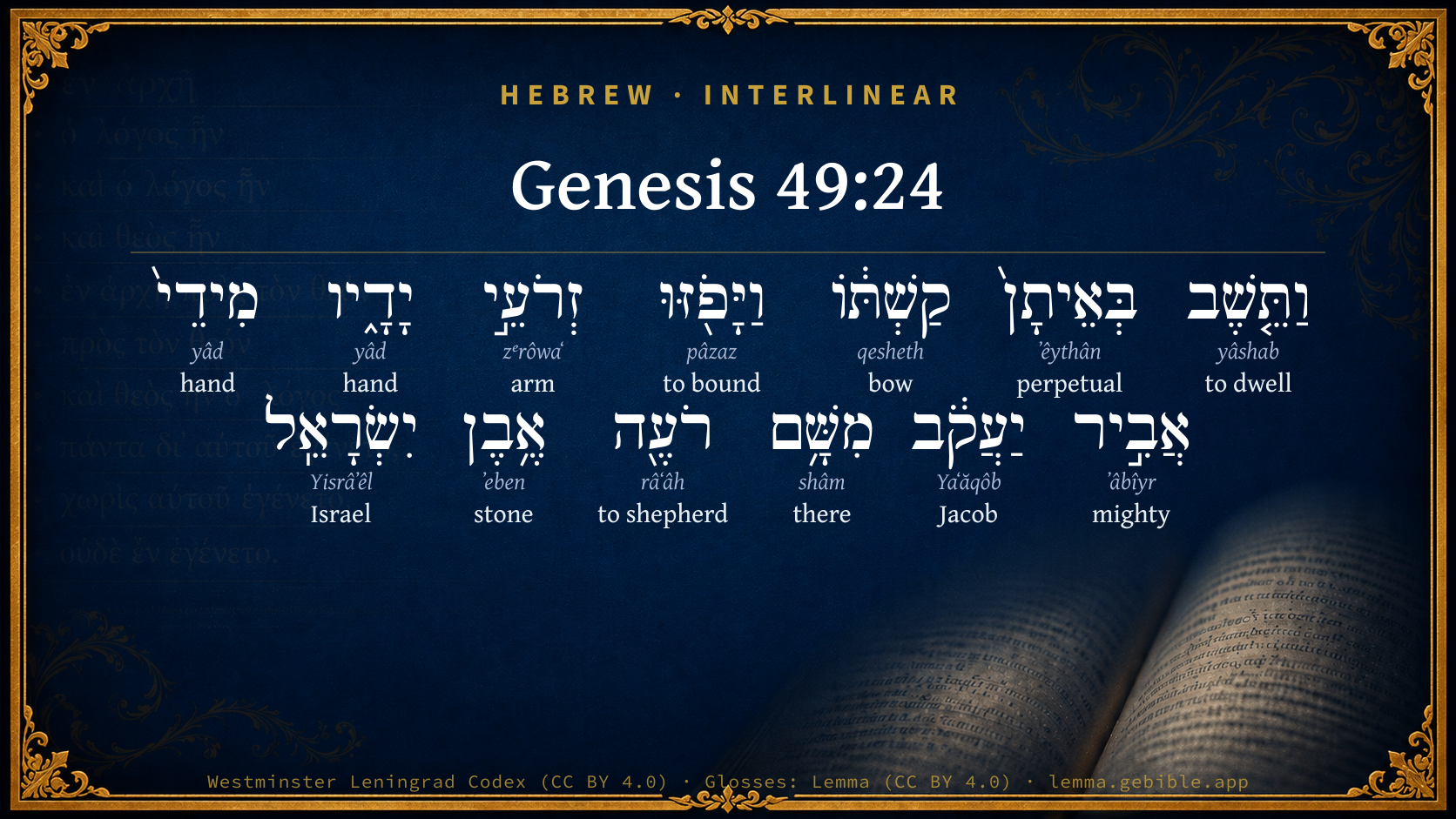
Hebrew (Westminster Leningrad Codex) Genesis 49:24 appears in the Hebrew Old Testament. The text above is from the Westminster Leningrad Codex. Each word links to its Strong’s number, a concise gloss, and parsing drawn from the Open Scriptures Hebrew Bible morphology. Click any word for its full Brown-Driver-Briggs (BDB) entry.
Download image
Cite this verse

Genesis 49:24 (World English Bible). Public Domain. Lemma interlinear Bible study tool, https://lemma.gebible.app/v/genesis/49/24.

Show BibTeX & RIS
BibTeX
RIS
English Translation
But his bow abode in strength, The arms of his hands were made strong, By the hands of the Mighty One of Jacob, (From there is the shepherd, the stone of Israel),
World English Bible · Public Domain
Highlights
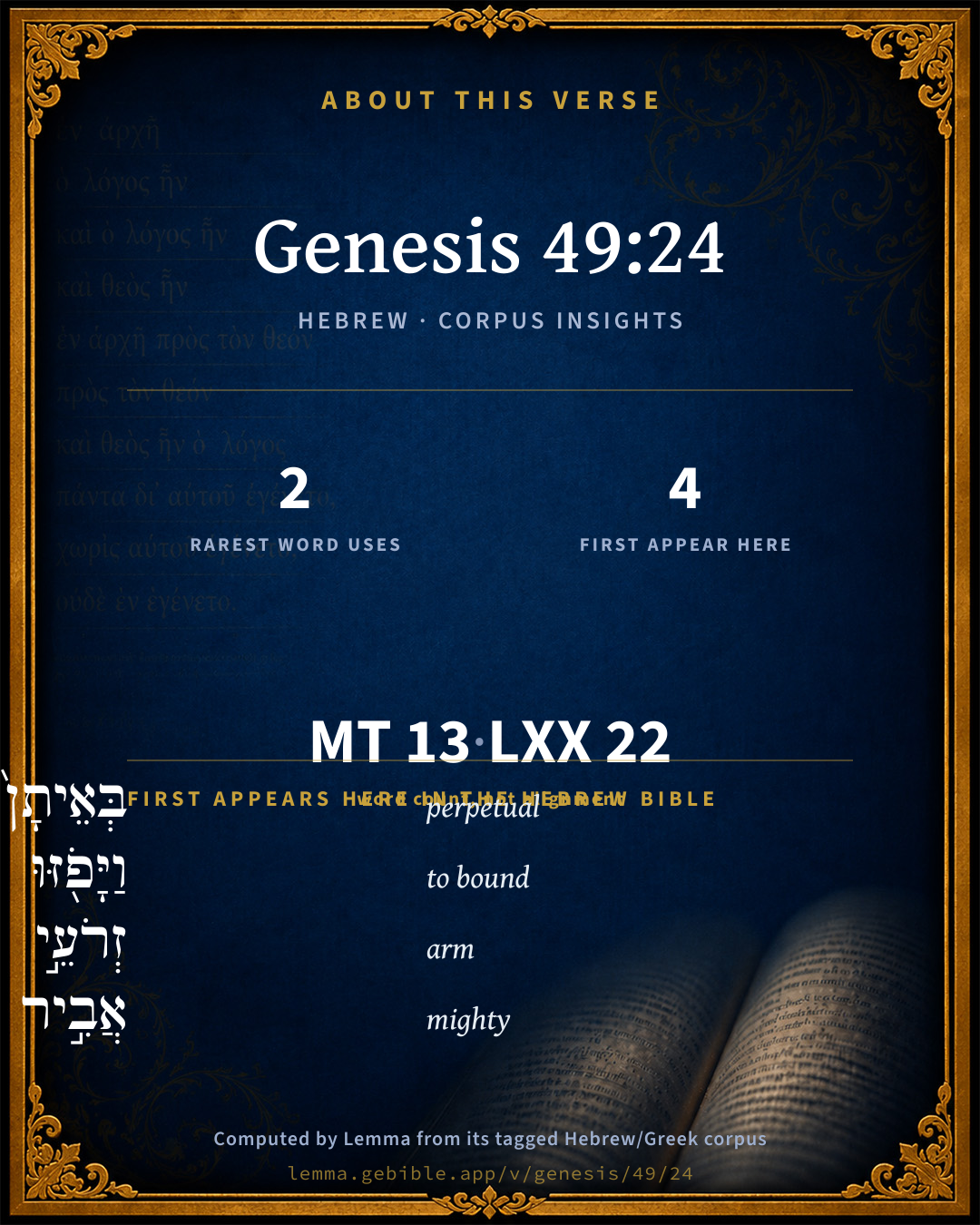
  • 4 first appearances in the Hebrew Bible
Full analysis ↓
Download a study sheet

One document with this verse’s original text, its word-by-word gloss line, the meaning frame, cross-references with their text, attributed commentary, and full source and license credits — printable, and it pastes into notes with its structure intact.

This verse Autodidact and up

Study sheet (.html) Plain text (.txt)

A passage Seminary Student

Up to 50 verses in one chapter. A passage sheet keeps up to 6 commentary sources and 12 cross-references per verse, in the order this page ranks them, and says so on the sheet whenever that leaves anything out. Ask for a single verse and you get the Autodidact verse sheet above.

Everything on this page stays free to read, with no account — the sheet is a download of what is already on screen, not access to it.

Want to remove ads? Support Godless Engineer
Compare translations 3

The same verse in 3 English versions, stacked beneath the original-language interlinear above. Click any original word for its lexicon entry.

Each is an independent rendering of the whole verse — the interlinear is not word-aligned to these translations.

Highlighted words mark where these versions differ — a whole-verse word diff, not a word-by-word alignment.

  • World English Bible Public Domain
    But his bow abode in strength, The arms of his hands were made strong, By the hands of the Mighty One of Jacob, (From there is the shepherd, the stone of Israel),
  • King James Version Public Domain
    But his bow abode in strength, and the arms of his hands were made strong by the hands of the mighty God of Jacob; (from thence is the shepherd, the stone of Israel:)
  • unfoldingWord Literal Text CC BY-SA 4.0
    But his bow will remain in strength and the arms of his hands will be made limber by the hands of the Mighty of Jacob, by the name of the Shepherd, the Rock of Israel,

unfoldingWord Literal Text — © unfoldingWord, licensed CC BY-SA 4.0. Word-aligned USFM3 via Door43 (git.door43.org/unfoldingWord/en_ult).

Versions to compare (up to 4)

3 of 4 selected

Show all 18 translations

Every available English version of this verse, each an independent rendering of the whole verse.

  • World English Bible Public Domain
    But his bow abode in strength, The arms of his hands were made strong, By the hands of the Mighty One of Jacob, (From there is the shepherd, the stone of Israel),
  • Berean Standard Bible Public Domain
    Yet he steadied his bow, and his strong arms were tempered by the hands of the Mighty One of Jacob, in the name of the Shepherd, the Rock of Israel,
  • Majority Standard Bible Public Domain
    Yet he steadied his bow, and his strong arms were tempered by the hands of the Mighty One of Jacob, in the name of the Shepherd, the Rock of Israel,
  • King James Version Public Domain
    But his bow abode in strength, and the arms of his hands were made strong by the hands of the mighty God of Jacob; (from thence is the shepherd, the stone of Israel:)
  • American Standard Version (1901) Public Domain
    But his bow abode in strength, And the arms of his hands were made strong, By the hands of the Mighty One of Jacob, (From thence is the shepherd, the stone of Israel),
  • Revised Version (1885) Public Domain
    But his bow abode in strength, And the arms of his hands were made strong, By the hands of the Mighty One of Jacob, (From thence is the shepherd, the stone of Israel,)
  • Geneva Bible (1599) Public Domain
    But his bowe abode strong, and the hands of his armes were strengthened, by the handes of the mighty God of Iaakob, of whom was the feeder appointed, by the stone of Israel,
  • Douay-Rheims (1899) Public Domain
    Joseph is a growing son, a growing son and comely to behold; the daughters run to and fro upon the wall.
  • Young's Literal Translation Public Domain
    And his bow abideth in strength, And strengthened are the arms of his hands By the hands of the Mighty One of Jacob, Whence is a shepherd, a son of Israel.
  • Literal Standard Version CC BY-SA 4.0
    And his bow abides in strength, || And strengthened are the arms of his hands || By the hands of the Mighty One of Jacob, || From where is a shepherd, a son of Israel.
  • Unlocked Literal Bible CC BY-SA 4.0
    But his bow will remain steady, and his hands will be skillful because of the hands of the Mighty One of Jacob, because of the name of the Shepherd, the Rock of Israel.
  • unfoldingWord Literal Text CC BY-SA 4.0
    But his bow will remain in strength and the arms of his hands will be made limber by the hands of the Mighty of Jacob, by the name of the Shepherd, the Rock of Israel,
  • Darby Bible Public Domain
    But his bow abideth firm, And the arms of his hands are supple By the hands of the Mighty One of Jacob. From thence is the shepherd, the stone of Israel:
  • World Messianic Bible Public Domain
    But his bow remained strong. The arms of his hands were made strong, by the hands of the Mighty One of Jacob, (from there is the shepherd, the stone of Israel),
  • Webster's Bible Public Domain
    But his bow abode in strength, and the arms of his hands were made strong by the hands of the mighty God of Jacob: from thence is the shepherd the stone of Israel:
  • Free Bible Version CC BY-SA 4.0
    But he held his bow steady, and his arms and hands moved quickly in the strength of the Mighty One of Jacob, who is called the Shepherd, the Rock of Israel.
  • Bible in Basic English Public Domain
    But their bows were broken by a strong one, and the cords of their arms were cut by the Strength of Jacob, by the name of the Stone of Israel:
  • JPS Tanakh (1917) Public Domain
    But his bow abode firm, and the arms of his hands were made supple, by the hands of the Mighty One of Jacob, from thence, from the Shepherd, the Stone of Israel,

Literal Standard Version (2020), Covenant Press — licensed CC BY-SA 4.0. Text via the HelloAO Bible API (eBible.org). Unlocked Literal Bible (unfoldingWord) — licensed CC BY-SA 4.0. Text via the HelloAO Bible API (eBible.org). unfoldingWord Literal Text — © unfoldingWord, licensed CC BY-SA 4.0. Word-aligned USFM3 via Door43 (git.door43.org/unfoldingWord/en_ult). Free Bible Version, Dr. Jonathan Gallagher — licensed CC BY-SA 4.0. Text via the HelloAO Bible API (eBible.org).

Word by word

More ways to search: Search by grammar → Find every occurrence → Compare this word →

Practice this passage: Drill this verse → Learn its vocabulary →

וַיָּפֹ֖זּוּ
pâzaz
H6339
“and · to bound”
Conjunction + Verb, Qal, Sequential Imperfect, 3rd Person, Masculine, Plural
Part of Speech
Conjunction + Verb
Stem
Qal
Form
Sequential Imperfect
Person
3rd Person
Gender
Masculine
Number
Plural
Full BDB Definition

Origin: a primitive root [identical with H6338 ]

TWOT: 1754

to bound, be agile, be supple - (Qal) to be nimble - (Piel) to leap, show agility
  1. וַתֵּ֤שֶׁב yâshab H3427 “and · to dwell” Conjunction + Verb, Qal, Sequential Imperfect, 3rd Person, Feminine, Singular
  2. בְּאֵיתָן֙ ʼêythân H386 “in/at · perpetual” Preposition + Adjective, Adjective, Masculine, Singular, Absolute
  3. קַשְׁתּ֔וֹ qesheth H7198 “bow · his” Noun, Common, Feminine, Singular, Construct + Suffix, Personal, 3rd Person, Masculine, Singular
  4. זְרֹעֵ֣י zᵉrôwaʻ H2220 “arms of” Noun, Common, Both, Plural, Construct
  5. יָדָ֑יו yâd H3027 “hands · his” Noun, Common, Both, Dual, Construct + Suffix, Personal, 3rd Person, Masculine, Singular
  6. מִידֵי֙ yâd H3027 “from · hands of” Preposition + Noun, Common, Both, Dual, Construct
  7. אֲבִ֣יר ʼâbîyr H46 “mighty of” Adjective, Adjective, Masculine, Singular, Construct
  8. יַעֲקֹ֔ב Yaʻăqôb H3290 “Jacob” Noun, Proper
  9. מִשָּׁ֥ם shâm H8033 “from · there” Preposition + Adverb
  10. רֹעֶ֖ה râʻâh H7462 “shepherding” Verb, Qal, Participle Active, Masculine, Singular, Absolute
  11. אֶ֥בֶן ʼeben H68 “stone of” Noun, Common, Feminine, Singular, Construct
  12. יִשְׂרָאֵֽל Yisrâʼêl H3478 “Israel” Noun, Proper

About this verse

These counts appear in no published source. They are computed here, from the morphology-tagged text and Lemma’s own curated glosses. What Lemma adds →

13
words
12
distinct lemmas
Pentateuch
section

Notable vocabulary

The rarest word here is וַיָּפֹ֖זּוּ to bound H6339 — appearing just 2 times in the whole Hebrew Bible.

First appearance in Scripture

These words make their first canonical appearance in the Hebrew Bible here:

  • בְּאֵיתָן֙ perpetual H386
  • וַיָּפֹ֖זּוּ to bound H6339
  • זְרֹעֵ֣י arm H2220
  • אֲבִ֣יר mighty H46

Shared distinctive vocabulary

וַיָּפֹ֖זּוּ to bound H6339 occurs in 2 verses of the Hebrew Bible. Also found in:

Grammatical profile

  • 3 verbs
  • 7 nouns
  • 2 adjectives
  • 1 adverb

Verb forms

  • וַתֵּ֤שֶׁב Qal · Sequential Imperfect
  • וַיָּפֹ֖זּוּ Qal · Sequential Imperfect
  • רֹעֶ֖ה Qal · Participle Active

Repetition

A word recurs within this verse — often emphatic in Hebrew:

  • יָדָ֑יו hand H3027 ×2

Hebrew & Septuagint length

In English translation the verse runs 32 words from the Hebrew and 37 from the Septuagint (LXX English) — closely comparable.

A rough comparison of the two English renderings, which tokenize alike — not a word-level alignment.

Word counts can differ between the Hebrew and the Greek without any difference in meaning — e.g. the Hebrew direct-object marker אֵת has no separate Greek word, and Greek often adds the article ὁ.

In the original languages it is 13 Hebrew tokens and 22 Greek tokens — but the two are counted differently (Hebrew bundles its prefixes and suffixes into one token; the Greek is in lemma form), so that isn’t a like-for-like length.

Cross-references

43

Topical passages linked to Genesis 49:24 in the Treasury of Scripture Knowledge — connected by theme and wording, ordered by reader-vote popularity; previews shown in the World English Bible.

  • Psalms 132:2 How he swore to Yahweh, And vowed to the Mighty One of Jacob:
  • Psalms 132:5 Until I find out a place for Yahweh, A dwelling for the Mighty One of Jacob."
  • Isaiah 28:16 therefore thus says the Lord Yahweh, Behold, I lay in Zion for a foundation a stone, a tried stone, a precious corner -[stone] of sure foundation: he who believes shall not be in haste.
  • Job 29:20 My glory is fresh in me, My bow is renewed in my hand.'
  • Psalms 80:1 Hear us, Shepherd of Israel, You who lead Joseph like a flock, You who sit above the cherubim, shine forth.
  • Psalms 18:30 As for God, his way is perfect. The word of Yahweh is tried. He is a shield to all those who take refuge in him.
  • 2 Timothy 4:17 But the Lord stood by me, and strengthened me, that through me the message might be fully proclaimed, and that all the Gentiles might hear; and I was delivered out of the mouth of the lion.
  • Genesis 35:10–11 God said to him, "Your name is Jacob. Your name shall not be Jacob any more, but your name will be Israel." He named him Israel.
  • Genesis 45:5 Now don't be grieved, nor angry with yourselves, that you sold me here, for God sent me before you to preserve life.
  • Genesis 45:11 There I will nourish you; for there are yet five years of famine; lest you come to poverty, you, and your household, and all that you have."'
  • Genesis 47:12 Joseph nourished his father, his brothers, and all of his father's household, with bread, according to their families.
  • Deuteronomy 32:4 The Rock, his work is perfect; For all his ways are justice: A God of faithfulness and without iniquity, Just and right is he.
  • Psalms 37:14–15 The wicked have drawn out the sword, and have bent their bow, To cast down the poor and needy, To kill those who are upright in the way.
  • Psalms 44:7 But you have saved us from our adversaries, And have shamed those who hate us.
  • Psalms 118:22 The stone which the builders rejected has become the head of the corner.
  • Isaiah 1:24 Therefore the Lord, Yahweh of Hosts, The Mighty One of Israel, says: "Ah, I will get relief from my adversaries, And avenge myself of my enemies;
  • Isaiah 41:10 Don't you be afraid, for I am with you; don't be dismayed, for I am your God; I will strengthen you; yes, I will help you; yes, I will uphold you with the right hand of my righteousness.
  • Romans 14:4 Who are you who judge another's servant? To his own lord he stands or falls. Yes, he will be made to stand, for God has power to make him stand.
  • Ephesians 2:20 being built on the foundation of the apostles and prophets, Christ Jesus himself being the chief cornerstone;
  • 1 Peter 2:4–8 coming to him, a living stone, rejected indeed by men, but chosen by God, precious.
  • Genesis 45:7 God sent me before you to preserve you a remnant in the earth, and to save you alive by a great deliverance.
  • Genesis 50:21 Now therefore don't be afraid. I will nourish you and your little ones." He comforted them, and spoke kindly to them.
  • Exodus 3:6 Moreover he said, "I am the God of your father, the God of Abraham, the God of Isaac, and the God of Jacob." Moses hid his face; for he was afraid to look at God.
  • Numbers 27:16–18 Let Yahweh, the God of the spirits of all flesh, appoint a man over the congregation,
  • Deuteronomy 34:9 Joshua the son of Nun was full of the spirit of wisdom; for Moses had laid his hands on him: and the children of Israel listened to him, and did as Yahweh commanded Moses.
  • Joshua 1:1–9 Now it happened after the death of Moses the servant of Yahweh, that Yahweh spoke to Joshua the son of Nun, Moses' minister, saying,
  • Joshua 24:1–33 Joshua gathered all the tribes of Israel to Shechem, and called for the elders of Israel, and for their heads, and for their judges, and for their officers; and they presented themselves before God.
  • Nehemiah 6:9 For they all would have made us afraid, saying, Their hands shall be weakened from the work, that it not be done. But now, [God], strengthen you my hands.
  • Psalms 18:1 I love you, Yahweh, my strength.
  • Psalms 18:32–35 The God who arms me with strength, and makes my way perfect?
  • Psalms 23:1 Yahweh is my shepherd: I shall lack nothing.
  • Psalms 27:14 Wait for Yahweh. Be strong, and let your heart take courage. Yes, wait for Yahweh.
  • Psalms 28:8 Yahweh is their strength. He is a stronghold of salvation to his anointed.
  • Psalms 89:1 I will sing of the loving kindness of Yahweh forever. With my mouth, I will make known your faithfulness to all generations.
  • Isaiah 29:24 They also who err in spirit shall come to understanding, and those who murmur shall receive instruction.
  • Isaiah 60:16 You shall also suck the milk of the nations, and shall suck the breast of kings; and you shall know that I, Yahweh, am your Savior, and your Redeemer, the Mighty One of Jacob.
  • Zechariah 3:9 For, behold, the stone that I have set before Joshua; on one stone are seven eyes: behold, I will engrave the engraving of it,' says Yahweh of Hosts, 'and I will remove the iniquity of that land in one day.
  • Zechariah 10:12 I will strengthen them in Yahweh; And they will walk up and down in his name," says Yahweh.
  • Matthew 21:42 Jesus said to them, "Did you never read in the Scriptures, 'The stone which the builders rejected, The same was made the head of the corner. This was from the Lord. It is marvelous in our eyes?'
  • Mark 12:10 Haven't you even read this Scripture: 'The stone which the builders rejected, The same was made the head of the corner.
  • Luke 20:17 But he looked at them, and said, "Then what is this that is written, 'The stone which the builders rejected, The same was made the chief cornerstone?'
  • Acts 4:11 He is 'the stone which was regarded as worthless by you, the builders, which has become the head of the corner.'
  • Colossians 1:11 strengthened with all power, according to the might of his glory, for all endurance and perseverance with joy;

Cross-references courtesy of OpenBible.info (CC BY 4.0).

Hebrew and Greek witnesses Masoretic Hebrew ↔ Greek Septuagint

The same verse in the two great witnesses to the Old Testament, shown verse-for-verse.

These are two independent witnesses, not word-aligned to each other, and the Septuagint is shown in lemma (dictionary) form.

Hebrew Genesis 49:24 Masoretic · Westminster Leningrad Codex

וַתֵּ֤שֶׁב בְּאֵיתָן֙ קַשְׁתּ֔וֹ וַיָּפֹ֖זּוּ זְרֹעֵ֣י יָדָ֑יו מִידֵי֙ אֲבִ֣יר יַעֲקֹ֔ב מִשָּׁ֥ם רֹעֶ֖ה אֶ֥בֶן יִשְׂרָאֵֽל

But his bow abode in strength, The arms of his hands were made strong, By the hands of the Mighty One of Jacob, (From there is the shepherd, the stone of Israel),

World English Bible · Public Domain

Greek LXX Genesis 49:24 Septuagint · lemma form

καί συντρίβω μετά κράτος ὁ τόξον αὐτός καί ἐκλύω ὁ νεῦρον βραχίων χείρ αὐτός διά χείρ δυνάστης ἰακώβ ἐκεῖθεν ὁ καταἰσχύω ἰσραήλ

But their bow and arrows were mightily consumed, and the sinews of their arms were slackened by the hand of the mighty one of Jacob; thence is he that strengthened Israel from the God of your father;

LXX2012 (modern English Septuagint) · Public Domain

On this verse, The Cambridge Bible for Schools and Colleges discusses the Septuagint’s reading. Read the note in Commentary ↓

Hebrew: Westminster Leningrad Codex (CC BY 4.0). Greek: Septuagint (public domain); English from LXX2012 (modern English Septuagint) (Public Domain). How the Septuagint differs from the Hebrew →

Targum (Aramaic paraphrase)

2

The Targum is the ancient Jewish Aramaic paraphrase of the Hebrew Scriptures — an interpretive translation, not the Hebrew text itself. Onkelos (literal) and Pseudo-Jonathan (expansive) render the Torah, and Jonathan the Prophets. Coverage is partial: where no permissively-licensed English translation exists for a verse, only the Aramaic is shown. This is verse-level text, not a word-by-word alignment to the Hebrew.

  1. Targum Onkelos Torah (Genesis–Deuteronomy)
    וְתָבַת בְּהוֹן נְבִיאוּתֵהּ עַל דְּקַיֵּם אוֹרַיְתָא בְּסִתְרָא וְשַׁוִּי בְתוּקְפָא רוֹחֲצָנֵהּ בְּכֵן יִתְרְמָא דְהַב עַל דְּרָעוֹהִי וְאַחֲסִין מַלְכוּתָא וּתְקֵיף דָּא הֲוַת לֵהּ מִן קֳדָם אֵל תַּקִיפָא דְיַעֲקֹב דִּי בְמֵימְרֵהּ זַן אֲבָהָן וּבְנִין זַרְעָא דְיִשְׂרָאֵל

    (no public-domain English translation for this verse)

    Targum Onkelos — Aramaic: “Onkelos Genesis” (public domain); “Onkelos Exodus” (public domain); “Onkelos Leviticus” (public domain); “Onkelos Numbers” (public domain); “Onkelos Deuteronomy” (public domain). English: “Sefaria Community Translation” (CC0 1.0 (public-domain dedication)); “J.W. Etheridge. The Targums of Onkelos and Jonathan Ben Uzziel on the Pentateuch. London: Longmans, Green, 1862” (public domain). Text via Sefaria.

  2. Targum Pseudo-Jonathan Torah (Genesis–Deuteronomy)
    וְהַדְרַת לִמְתַב לְקַדְמוּתָא תְּקוֹף אֵיבָרֵיהּ דְלָא לִמְשַׁמְשָׁא עִם רִבּוֹנְתֵּיהּ וְאִתְבַּדְרוּ יְדוֹי מִן הִרְהוּרָא זַרְעָא וּכְבַשׁ יִצְרֵיהּ מִן אוּלְפַן תְּקֵיף דְקִבֵּיל מִן יַעֲקב וּמִתַּמָן זַכָּא לְמֶהֱוֵי פַּרְנָסָא וּלְאִיתְחַבְּרָא בִּגְלוֹף שְׁמָהָן עַל אַבְנַיָא דְיִשְרָאֵל

    But he returned to abide in his early strength, and would not yield himself unto sin, and subdued his inclinations by the strong discipline he had received from Jakob, and thence became worthy of being a ruler, and of being joined in the engraving of the names upon the stones of Israel.

    Targum Pseudo-Jonathan — Aramaic: “Targum Jonathan on Genesis” (public domain); “Targum Jonathan on Exodus” (public domain); “Targum Jonathan on Leviticus” (public domain); “Targum Jonathan on Numbers” (public domain); “Targum Jonathan on Deuteronomy” (public domain). English: “The Targum of Jonathan ben Uzziel, trans. J. W. Etheridge, London, 1862” (public domain). Text via Sefaria.

Commentary

Notes on Genesis 49:24 from classic Christian and Jewish commentators (each source and its license shown beneath its notes). The classic Christian expositions comment on the surrounding passage and are grouped to its opening verse, so a note may address several verses; the Jewish commentaries on the Tanakh (Rashi and others) are per-verse, so they appear only where the commentator wrote on this verse.

Lemma curates 59 commentaries, every one of them public domain or Creative Commons licensed, each selected and text-cleaned for this edition rather than reprinted as found. About our sources →

Trapp's Complete Commentary

John Trapp

Gen 49:24 But his bow abode in strength, and the arms of his hands were made strong by the hands of the mighty [God] of Jacob; (from thence [is] the shepherd, the stone of Israel:)

Ver. 24. But his bow abode in strength.] He "gave not place to them by subjection, no, not for an hour." {Gal 2:5} "If thou faint in adversity, thy strength is small," saith Solomon. {Pro 24:10} Joseph did not; but, as it was said of old Rome, Roma cladibus animosior; and as of Mithridates, {a} he never wanted courage or counsel, when he was at the worst; so neither did Joseph. Virtus lecythos habet in malis. The sound heart stands firm under greatest pressures. {2Co 1:9; 2Co 1:12} Whereas, if a bone be broke, or but the skin rubbed up and raw, the lighest load will be troublesome. Hang heavy weights upon rotten boughs, they presently break. But Joseph’s were green, and had sap.

By the hands of the mighty God of Jacob.] It was said of Achilles, that he was Styge armatus; but Joseph was Deo forti armatus, and thence his safety. He used lfis bow against his adversaries, as David did his sling against Goliath. He slung, saith Bucholcer, perinde ac si fundae suae tunicis non lapillum, sed Deum ipsum induisset ac implicuisset, as if he had wrapped up God in his sling.

{a} το φρονημα ην αυτω δει, καν ταις ρυμφοραις. - Plut.

John Trapp, A Commentary or Exposition upon All the Books of the Old and New Testament (1647–1656) — public domain. Text from a community e-Sword module.

The Biblical Illustrator

Joseph S. Exell

Gen_49:24

The mighty God of Jacob.

Prom thence is the Shepherd, the Stone of Israel

Three names:

These three names which we find here are striking and beautiful in themselves; in their juxtaposition; in their use on Jacobs lips. Look at them as they stand.

I. THE MIGHTY GOD OF JACOB. The meaning of such a name is clear enough. It is He who has shown Himself mighty and mine by His deeds for me all through my life. The very vital centre of a mans religion is his conviction that God is his. The dying patriarch left to his descendants the legacy of this great Name.

II. THE SHEPHERD. That name sums up the lessons that Jacob had learned from the work of himself and of his sons. His own sleepless vigilance and patient endurance were but shadows of the loving care, the watchful protection, the strong defence, which the God who has been my Shepherd all my life long had extended to him and his.

III. THE STONE OF ISRAEL. Here, again, we have a name that after-ages have caught up and cherished, used for the first time. The Stone of Israel means much the same thing as the Rock. The general idea of this symbol is firmness, solidity. God is a Rock--

1. for a foundation;

2. for a fortress;

3. for shade and refreshment.

None that ever built on that Rock have been confounded. We clasp hands with all that have gone before us. At one end of the long chain this dim figure of the dying Jacob stretches out his withered hands to God, the Stone of Israel; at the other end we lift up ours to Jesus and cry--

Rock of Ages, cleft for me, Let me hide myself in Thee.

(A. Maclaren, D. D.)

The Biblical Illustrator, edited by Joseph S. Exell (c. 1880s–1900s) — public domain. Text from a community e-Sword module.

Joseph Benson's Commentary

Gen 49:24. But his bow abode in strength — His faith did not fail; he kept his ground, and came off conqueror. The arms of his hands were made strong — That is, his other graces did their part, his wisdom, courage, patience, which are better than weapons of war: by the hands of the mighty God — Who was therefore able to strengthen him; and the God of Jacob, a God in covenant with him. From thence — From this strange method of Providence, he became the shepherd and stone — The feeder and supporter of Israel, Jacob, and his family. Herein Joseph was a type of Christ; who was shot at and hated, but borne up under his sufferings, and was afterward advanced to be the shepherd and stone: and of the church in general; hell shoots its arrows against her, but heaven protects and strengthens her. But perhaps by the shepherd and stone, Joshua, a descendant of Joseph, by Ephraim, may be here primarily intended. He, as a good shepherd, brought into the pastures of Canaan that flock of the Lord which Moses had indeed led forth from Egypt, but which he had left in a barren wilderness. Thus by Joshua also was Christ typified, whose name he bears, who is the foundation-stone laid in Zion, and the good shepherd, that leads his sheep into the heavenly Canaan, and gives them eternal life.

Joseph Benson's Commentary on the Old and New Testaments (1811–1818) — public domain. Text from a community e-Sword module.

MacLaren's Expositions of Holy Scripture

Alexander MacLaren

Genesis

‘THE HANDS OF THE MIGHTY GOD OF JACOB’

THE SHEPHERD, THE STONE OF ISRAEL

Gen 49:24.

A slight alteration in the rendering will probably bring out the meaning of these words more correctly. The last two clauses should perhaps not be read as a separate sentence. Striking out the supplement ‘is,’ and letting the previous sentence run on to the end of the verse, we get a series of names of God, in apposition with each other, as the sources of the strength promised to the arms of the hands of the warlike sons of Joseph. From the hands of the mighty God of Jacob-from thence, from the Shepherd, the stone of Israel-the power will come for conflict and for conquest. This exuberant heaping together of names of God is the mark of the flash of rapturous confidence which lit up the dying man’s thoughts when they turned to God. When he begins to think of Him he cannot stay his tongue. So many aspects of His character, so many remembrances of His deeds, come crowding into his mind; so familiar and so dear are they, that he must linger over the words, and strive by this triple repetition to express the manifold preciousness of Him whom no name, nor crowd of names, can rightly praise. So earthly love ever does with its earthly objects, inventing and reiterating epithets which are caresses. Such repetitions are not tautologies, for each utters some new aspect of the one subject, and comes from a new gush of heart’s love towards it. And something of the same rapture and unwearied recurrence to the Name that is above every name should mark the communion of devout souls with their heavenly Love. What a wonderful burst of such praise flowed out from David’s thankful heart, in his day of deliverance, like some strong current, with its sevenfold wave, each crested with the Name-’The Lord is my rock, and my fortress, and my deliverer; my God, my strength, in whom I will trust; my buckler, and the horn of my salvation, and my high tower.’

Those three names which we find here are striking and beautiful in themselves; in their juxtaposition; in their use on Jacob’s lips. They seem to have been all coined by him, for, if we accept this song as a true prophecy uttered by him, we have here the earliest instance of their occurrence. They all have a history, and appear again expanded and deepened in the subsequent revelation. Let us look at them as they stand.

1. The Mighty God of Jacob.-The meaning of such a name is clear enough. It is He who has shown Himself mighty and mine by His deeds for me all through my life. The dying man’s thoughts are busy with all that past from the day when he went forth from the tent of Isaac, and took of the stones of the field for his pillow when the sun went down. A perplexed history it had been, with many a bitter sorrow, and many a yet bitterer sin. Passionate grief and despairing murmurs he had felt and flung out, while it slowly unfolded itself. When the Pharaoh had asked, ‘How old art thou?’ he had answered in words which owe their sombreness partly to obsequious assumption of insignificance in such a presence, but have a strong tinge of genuine sadness in them too: ‘Few and evil have the days of the years of my life been.’ But lying dying there, with it all well behind him, he has become wiser; and now it all looks to him as one long showing forth of the might of his God, who had been with him all his life long, and had redeemed him from all evil. He has got far enough away to see the lie of the land, as he could not do while he was toiling along the road. The barren rocks and white snow glow with purple as the setting sun touches them. The struggles with Laban; the fear of Esau; the weary work of toilsome years; the sad day when Rachel died, and left to him the ‘son of her sorrow’; the heart sickness of the long years of Joseph’s loss-all have faded away, or been changed into thankful wonder at God’s guidance. The one thought which the dying man carries out of life with him is: God has shown Himself mighty, and He has shown Himself mine.

For each of us, our own experience should be a revelation of God. The things about Him which we read in the Bible are never living and real to us till we have verified them in the facts of our own history. Many a word lies on the page, or in our memories, fully believed and utterly shadowy, until in some soul’s conflict we have had to grasp it, and found it true. Only so much of our creed as we have proved in life is really ours. If we will only open our eyes and reflect upon our history as it passes before us, we shall find every corner of it filled with the manifestations to our hearts and to our minds of a present God. But our folly, our stupidity, our impatience, our absorption with the mere outsides of things, our self-will, blind us to the Angel with the drawn sword who resists us, as well as to the Angel with the lily who would lead us. So we waste our days; are deaf to His voice speaking through all the clatter of tongues, and blind to His bright presence shining through all the dimness of earth; and, for far too many of us, we never can see God in the present, but only discern Him when He has passed by, like Moses from his cleft. Like this same Jacob, we have to say: ‘Surely God was in this place, and I knew it not.’ Hence we miss the educational worth of our lives, are tortured with needless cares, are beaten by the poorest adversaries, and grope amidst what seems to us a chaos of pathless perplexities, when we might be marching on assured and strong, with God for our guide, and the hands of the Mighty One of Jacob for our defence.

Notice, too, how distinctly the thought comes out in this name-that the very vital centre of a man’s religion is his conviction that God is his. Jacob will not be content with thinking of God as the God of his fathers; he will not even be content with associating himself with them in the common possession; but he must feel the full force of the intensely personal bond that knits him to God, and God to him. Of course such a feeling does not ignore the blessed fellowship and family who also are held in this bond. The God of Jacob is to the patriarch also the God of Abraham, and of Isaac, and of Jacob. But that comes second, and this comes first. Each man for himself must put forth the hand of his own faith, and grasp that great hand for his own guide. ‘My Lord and my God’ is the true form of the confession. ‘He loved me and gave Himself for me,’ is the shape in which the Gospel of Christ melts the soul. God is mine because His love individualises me, and I have a distinct place in His heart, His purposes, and His deeds. God is mine, because by my own individual act-the most personal which I can perform-I cast myself on Him, by my faith appropriate the common salvation, and open my being to the inflow of His power. God is mine, and I am His, in that wonderful mutual possession, with perpetual interchange of giving and receiving not only gifts but selves, which makes the very life of love, whether it be love on earth or love in heaven.

Remember, too, the profound use which our Lord made of this name, wherein Jacob claims to possess God. Because Moses at the bush called God, the God of Abraham, and of Isaac, and of Jacob, they cannot have ceased to be. The personal relations, which subsist between God and the soul that clasps Him for its own, demand an immortal life for their adequate expression, and make it impossible that Death’s skeleton fingers should have power to untie such a bond. Anything is conceivable, rather than that the soul which can say ‘God is mine’ should perish. And that continued existence demands, too, a state of being which shall correspond to itself, in which its powers shall all be exercised, its desires fulfilled, its possibilities made facts. Therefore there must be the resurrection. ‘God is not ashamed to be called their God, for He hath prepared for them a city.’

The dying patriarch left to his descendants the legacy of this great name, and often, in later times, it was used to quicken faith by the remembrance of the great deeds of God in the past. One instance may serve as a sample of the whole. ‘The Lord of Hosts is with us, the God of Jacob is our refuge.’ The first of these two names lays the foundation of our confidence in the thought of the boundless power of Him whom all the forces of the universe, personal and impersonal, angels and stars, in their marshalled order, obey and serve. The second bids later generations claim as theirs all that the old history reveals as having belonged to the ‘world’s grey fathers.’ They had no special prerogative of nearness or of possession. The arm that guided them is unwearied, and all the past is true still, and will for evermore be true for all who love God. So the venerable name is full of promise and of hope for us: ‘The God of Jacob is our refuge.’

2. The Shepherd.-How that name sums up the lessons that Jacob had learned from the work of himself and of his sons! ‘Thy servants are shepherds’ they said to Pharaoh; ‘both we, and also our sons.’ For fourteen long, weary years he had toiled at that task. ‘In the day the drought consumed me, and the frost by night; and my sleep departed from mine eyes,’ and his own sleepless vigilance and patient endurance seem to him to be but shadows of the loving care, the watchful protection, the strong defence, which ‘the God, who has been my Shepherd all my life long,’ had extended to him and his. Long before the shepherd king, who had been taken from the sheepcotes to rule over Israel, sang his immortal psalm, the same occupation had suggested the same thought to the shepherd patriarch. Happy they whose daily work may picture for them some aspect of God’s care-or rather, happy they whose eyes are open to see the dim likeness of God’s care which every man’s earthly relations, and some part of his work, most certainly present.

There can be no need to draw out at length the thoughts which that sweet and familiar emblem has conveyed to so many generations. Loving care, wise guidance, fitting food, are promised by it; and docile submission, close following at the Shepherd’s heels, patience, innocence, meekness, trust, are required. But I may put emphasis for a moment on the connection between the thought of ‘the mighty God of Jacob’ and that of ‘the Shepherd.’ The occupation, as we see it, does not call for a strong arm, or much courage, except now and then to wade through snowdrifts, and dig out the buried and half-dead creatures. But the shepherds whom Jacob knew, had to be hardy, bold fighters. There were marauders lurking ready to sweep away a weakly guarded flock. There were wild beasts in the gorges of the hills. There was danger in the sun by day on these burning plains, and in the night the wolves prowled round the flock. We remember how David’s earliest exploits were against the lion and the bear, and how he felt that even his duel with the Philistine bully was not more formidable than these had been. If we will read into our English notions of a shepherd this element of danger and of daring, we shall feel that these two clauses are not to be taken as giving the contrasted ideas of strength and gentleness, but the connected ones of strength, and therefore protection and security. We have the same connection in later echoes of this name. ‘Behold, the Lord God shall come with strong hand; He shall feed His flock like a shepherd.’ And our Lord’s use of the figure brings into all but exclusive prominence the good shepherd’s conflict with the ravening wolves-a conflict in which he must not hesitate even ‘to lay down his life for the sheep.’ As long as the flock are here, amidst dangers and foes, and wild weather, the arm that guides must be an arm that can guard; and none less mighty than the Mighty One of Jacob can be the Shepherd of men. But a higher fulfilment yet awaits this venerable emblem, when in other pastures, where no lion nor any ravening beast shall come, the ‘Lamb, which is in the midst of the throne,’ and is Shepherd as well as Lamb, ‘shall feed them, and lead them by living fountains of waters.’

3. The Stone of Israel.-Here, again, we have a name, that after-ages have caught up and cherished, used for the first time. I suppose the Stone of Israel means much the same thing as the Rock. If so, that symbol, too, which is full of such large meanings, was coined by Jacob. It is, perhaps, not fanciful to suppose that it owes its origin to the scenery of Palestine. The wild cliffs of the eastern region where Peniel lay, or the savage fastnesses in the southern wilderness, a day’s march from Hebron, where he lived so long, came back to his memory amid the flat, clay land of Egypt; and their towering height, their immovable firmness, their cool shade, their safe shelter, spoke to him of the unalterable might and impregnable defence which he had found in God. So there is in this name the same devout, reflective laying-hold upon experience which we have observed in the preceding.

There is also the same individualising grasp of God as his very own; for ‘Israel’ here is, of course, to be taken not as the name of the nation but as his own name, and the intention of the phrase is evidently to express what God had been to him personally.

The general idea of this symbol is perhaps firmness, solidity. And that general idea may be followed out in various details. God is a rock for a foundation. Build your lives, your thoughts, your efforts, your hopes there. The house founded on the rock will stand though wind and rain from above smite it, and floods from beneath beat on it like battering rams. God is a rock for a fortress. Flee to Him to hide, and your defence shall be the ‘munitions of rocks,’ which shall laugh to scorn all assault, and never be stormed by any foe. God is a rock for shade and refreshment. Come close to Him from out of the scorching heat, and you will find coolness and verdure and moisture in the clefts, when all outside that grateful shadow is parched and dry.

The word of the dying Jacob was caught up by the great law-giver in his dying song. ‘Ascribe ye greatness to our God. He is the Rock.’ It reappears in the last words of the shepherd king, whose grand prophetic picture of the true King is heralded by ‘The Book of Israel spake to me.’ It is heard once more from the lips of the greatest of the prophets in his glowing prophecy of the song of the final days: ‘Trust ye in the Lord for ever; for in the Lord Jehovah is the Rock of Ages,’ as well as in his solemn prophecy of the Stone which God would lay in Zion. We hear it again from the lips that cannot lie: ‘Did ye never read in the Scriptures, The Stone which the builders rejected, the same is become the headstone of the corner?’ And for the last time the venerable metaphor which has cheered so many ages appears in the words of that Apostle who was ‘surnamed Cephas, which is by interpretation a stone’: ‘To whom coming as unto a living Stone, yea also as living stones are built up.’ As on some rocky site in Palestine, where a hundred generations in succession have made their fortresses, one may see stones with the bevel that tells of early Jewish masonry, and above them Roman work, and higher still masonry of crusading times, and above it the building of to-day; so we, each age in our turn, build on this great rock foundation, dwell safe there for our little lives, and are laid to peaceful rest in a sepulchre in the rock. On Christ we may build. In Him we may dwell and rest secure. We may die in Jesus, and be gathered to our own people, who, having died, live in Him. And though so many generations have reared their dwellings on that great rock, there is ample room for us too to build. We have not to content ourselves with an uncertain foundation among the shifting rubbish of perished dwellings, but can get down to the firm virgin rock for ourselves. None that ever builded there have been confounded. We clasp hands with all who have gone before us. At one end of the long chain this dim figure of the dying Jacob, amid the strange vanished life of Egypt, stretches out his withered hands to God the Stone of Israel; at the other end, we lift up ours to Jesus, and cry:-

‘Rock of Ages! cleft for me,

Let me hide myself in Thee.’

The faith is one. One will be the answer and the reward. May it be yours and mine!

Alexander MacLaren, Expositions of Holy Scripture (1904–1910) — public domain. Text from a community e-Sword module.

Tyndale Open Study Notes

Tyndale Open Resources

49:24-26 Five names for God introduce five blessings; God is the giver of all good things.

Tyndale Open Study Notes — © Tyndale Open Resources, licensed CC BY-SA 4.0. Text via the HelloAO Bible API.

Geneva Bible (1599)

Geneva Bible translators

That is God.

Geneva Bible (1599) marginal notes — public domain. Text via Bolls.life.

Adam Clarke's Commentary

Verse 24. But his bow remained in strength] The more he was persecuted, either by his brethren or in Egypt, the more resplendent his uprightness and virtues shone: and the arms his extended power and influence, of his hands plans, designs, and particular operations of his prudence, judgment, discretion, c., were all rendered successful by the hand - the powerful succour and protection, of the Mighty One of Jacob that God who blessed and protected all the counsels and plans of Jacob, and protected and increased him also when he was in a strange land, and often under the power of those who sought opportunities to oppress and defraud him.

By the name of the Shepherd the Rock of Israel] Jehovah, and El-Elohey Israel; see Ge 33:20. This appears to me to refer to the subject of the thirty-second chapter, where Jacob wrestled with God, had God's name revealed to him, and his own name changed from Jacob to Israel, in consequence of which he built an altar, and dedicated it to God, who had appeared to him under the name of Elohey-Israel, the strong God of Israel; which circumstance led him to use the term Rock, which, as an emblem of power, is frequently given to God in the sacred writings, and may here refer to the stone which Jacob set up. It is very probable that the word shepherd is intended to apply to our blessed Lord, who is the Shepherd of Israel, the good Shepherd, Joh 10:11-17; and who, beyond all controversy, was the person with whom Jacob wrestled. See Clarke on Ge 16:7 and "Ge 32:24".

Adam Clarke's Commentary on the Bible (1810–1826) — public domain. Text from a community e-Sword/MySword module.

Ellicott's Commentary for English Readers

(24) His bow abode in strength.—The word for strength is highly poetical. It means that which goes on for ever, like the flowing streams or the eternal hills. In spite of all the machinations of his enemies, the bow of Joseph remained constant and enduring in its might.

Were made strong.—The Hebrew word is difficult, but more probably means, were pliant, supple, such as the arms of an archer ought to be.

From thence is the shepherd, the stone of Israel.—The Jewish commentators understand “from thence” of Joseph, who had become the ruler and protector of Israel. But “from thence” answers in the parallelism to from the hands of. Fully it would be, from thence where dwells the Shepherd, &c, that is,—Joseph’s triumph came from God, who is the Shepherd (or Ruler) and the Rock of Israel.

A Bible Commentary for English Readers, edited by Charles John Ellicott (1878–1897) — public domain. Text from a community e-Sword module.

The Cambridge Bible for Schools and Colleges

gen. ed. J. J. S. Perowne

24. his bow abode in strength] Cf. Job_29:20, “my bow is renewed in my hand.” Joseph was able by God’s help to resist. He overthrew his assailants. His strength was unshaken. LXX καὶ συνετρίβη μετὰ κράτους τὰ τόξα αὐτῶν = “and their bows with might were broken,” follows a variety of reading.

the arms of his hands] Probably meaning “the strength of his hands,” which held and drew the bow.

were made strong] Better, as R.V. marg., active. The idea is nimbleness rather than strength.

By the hands] More lit. “from the hands.” The source of the deliverance of Joseph, rather than the instrumentality of it, is expressed.

the Mighty One of Jacob] A Divine title, ’âbîr = “the Strong One,” which appears elsewhere, Psa_132:2; Psa_132:5; Isa_1:24; Isa_49:26; Isa_60:16.

From thence] No rendering gives an entirely satisfactory sense. The text is probably corrupt. (1) According to the R.V. text, the clause is a parenthesis; “from thence” means “from the Mighty One of Jacob.” “The shepherd,” and “the stone of Israel,” are appellations of Joseph. (2) According to the R.V. marg. “from thence from the shepherd,” the clause continues the thought of the previous words, and expands “by the hands of.” “The shepherd,” and “the stone of Israel,” are then Divine titles, in apposition to “the Mighty One of Jacob.” (3) “By the name of the shepherd.” This is a variety of the last ‘rendering, with the reading shêm = “name,” instead of shâm = “there.”

The rendering (1) seems to be improbable, since it applies to Joseph the titles of “shepherd” and “stone of Israel,” which certainly we should not expect to see applied to the son of Jacob. Between (2) and (3) it is difficult to make a selection, and the text cannot be relied on. But the word mis-shâm (= “from thence”) seems more prosaic and less impressive than mis-shêm (= “from the Name”); and on the whole (3) seems more probable. For the “Shepherd,” as a Divine title, cf. Gen_48:15; Psa_23:1; Psa_80:1.

Prof. G. F. Moore conjectures “By the arms of the stone of Israel,” which would supply a parallel to “By the hands of the Mighty One of Jacob,” and would expand the thought of the previous clause (“the arms of his hands”). Encycl. Bibl. iii. 2977, n. 14.

the stone of Israel] If used as a Divine title, the “stone” (’eben) is here substituted for the more usual “rock” (ṣûr). Cf. Deu_32:4; 1Sa_2:2; 2Sa_22:2; Psa_18:2; Psa_18:31. It is very possible that the allusion may be to the stone (’eben) of Bethel (Gen_28:18), or even to the great stone of Shechem (Jos_24:26-27), the sanctuary of the tribe and the burial-place of Joseph.

“The Name of the Shepherd of the Stone of Israel” is thus a possible, though a cumbrous title with a reference to the stone of Bethel (Gen_31:13).

The Cambridge Bible for Schools and Colleges (gen. ed. J. J. S. Perowne; Cambridge University Press, 1878–1918) — public domain. Text from a community e-Sword module.

John Gill's Exposition

Benjamin shall ravin as a wolf,.... All the three Targums apply this prophecy to the priests offering the daily sacrifice, morning and evening, in the temple, which stood in the lot of Benjamin, and dividing what was left, and eating it. But it respects the tribe itself, compared to a wolf for its fortitude, courage, and valour, as well as for its rapaciousness, it being a warlike tribe; and the Jewish writers (q) say, that it is compared to a wolf, because of its strength. Wolves, said to be devoted to Mars, are called "martial" wolves by Virgil (r) and Horace (s); and we have an early instance of the valour and success of this tribe in a war waged with all the other tribes, and in two pitched battles, in one with 26,000 men it beat 400,000, Jdg 20:15, and if this tribe is compared to a wolf for rapaciousness, this may be illustrated by the remainder of those, after the loss of a third battle, catching and carrying away the daughters of Shiloh, and making them their wives, Jdg 21:23. Some apply this to particular persons of this tribe, as to Saul the first king of Israel, who was of Benjamin; and who as soon as he took the kingdom of Israel, in the morning, in the beginning of that state, fought against all his enemies on every side, against Moab, Ammon, Edom, the kings of Zobah, and the Philistines, and the Amalekites, Sa1 14:47 and to Mordecai and Esther, who were of the same tribe, who after the captivity, and in the evening of that state, divided the spoil of Haman, Est 8:1 this is observed by Jarchi, Aben Ezra, and Ben Gersom. Some of the Christian fathers have applied the prophecy to the Apostle Paul, who was of the tribe of Benjamin; who in the morning of his youth was a fierce and ravenous persecutor, and made havoc of the church of God: and in the evening, or latter part of his life, spent his days in dividing the spoil of Satan among the Gentiles, taking the prey out of his hands, turning men from the power of Satan unto God, and distributed food to the souls of men. In a spiritual sense he was a warlike man, a good soldier of Christ, and accoutred as such, had a warfare to accomplish, and enemies to fight with; and did fight the good fight of faith, conquered, and was more than a conqueror through Christ, and is now crowned: and why may it not be applied to Christ himself, seeing the blessing of Benjamin by Moses, Deu 33:12 seems to belong to him? he is God's Benjamin, the son and man of his right hand, as dear to him as his right hand, in whom his power has been displayed, and who is exalted at his right hand; and may as well be compared to a wolf as to a lion, as he is the lion of the tribe of Judah, and as God himself is compared to a lion and bear, Hos 13:7 and who is expressly said to divide the spoil with the strong, Isa 53:12 spoiled principalities and powers, delivered his people as a prey out of the hands of the mighty, and will make an utter destruction of all his and their enemies. Some of these things were done in the morning of the Gospel dispensation, and others will be done in the evening of it, Col 2:15.

(q) Targum Jon. Aben Ezra & Gersom, in loc. (r) Virgil. Aeneid. 9. (s) Horat. Carmin. l. 1. Ode. 17.

John Gill's Exposition of the Whole Bible (1746–1763) — public domain (CC PDM 1.0). Text via the HelloAO Bible API.

Haydock's Catholic Bible Commentary

His bow rested upon the strong, &c. That is, upon God, who was his strength: who also loosed his bands, and brought him out of prison to be the pastor, that is, the feeder and ruler of Egypt; and the stone, that is, the rock and support of Israel.

George Leo Haydock (1774–1849), Haydock's Catholic Family Bible and Commentary, 1859 edition — public domain. Excludes Psalms (Douay-Rheims chapter numbering differs from Protestant) and Deuterocanonical books (Catholic canon only).

Matthew Poole's English Annotations

His bow, wherewith he opposed his enemies; which was no military bow, but that which he opposed to all their injuries, to wit, his own virtue, his innocence, his patience, his temperance, his faith and hope in God, whereby he resisted and vanquished all the temptations and difficulties which he met with, so that all his enemies could neither defile nor destroy him.

The mighty God of Jacob, i.e. my God; the noun for the pronoun, which is frequent. When men forsook and persecuted him, my God and his God stood by him. He showed that it was not Joseph’s wisdom or courage, but God’s gracious assistance, that made him conqueror.

From thence is the shepherd, the stone of Israel; either,

1. From that great deliverance vouchsafed by God to Joseph it is that Israel or Jacob hath a shepherd to feed him, a stone to lay his head upon, as once he did, Gen 28:11, or a rock of refuge to fly to in his great distresses, or a foundation-stone, or corner-stone, or pillar, to sustain or preserve Jacob’s house. Or rather,

2. From the hands of the mighty God of Jacob, last mentioned. Or from the God of his father, as it follows Gen 49:25. So the sense is this, Though Joseph was a blessed instrument in this wonderful work, yet the God of Jacob was the chief author of it, by whose wise and merciful providence it was so ordered that Joseph should be first sold, and afterwards advanced, and all in order to this end, that his Israel, with whom he hath been pleased to make a gracious and everlasting covenant, should have a shepherd to feed him in the time of famine, and a stone or rock to support him.

Here he explains and determines that doubtful expression from thence, by adding, even by (or rather from, as this particle mem properly signifies, and was just now used) the God of thy father, i.e. who hath chosen and loved thy father, and made a league with him, and blessed him with all manner of blessings.

Blessings of heaven above, i.e. the sweet and powerful influences of the heavenly bodies, and the dews and rains which fall from heaven, whereby the fruits of the earth are produced in great plenty. See Lev 26:4; Deu 28:12; 33:14.

Blessings of the deep, i.e. of that great sea of waters both about the earth, and in the earth, whence come those springs and rivers by which the earth is moistened and made fruitful. See Gen 1:2; 7:11; Deu 8:7.

Blessings of the breasts, and of the womb, whereby both men and beasts shall be greatly multiplied, and abundantly supplied with all necessaries.

Matthew Poole's English Annotations on the Holy Bible (1683–1685) — public domain. Text from a community e-Sword/MySword module.

Whedon's Commentary on the Bible

Daniel D. Whedon

24. His bow — He turned archer in another way, and was empowered by a supernatural energy, against which all lords of the bow found it folly to contend. He proved an unconquerable hero. This part of the prophecy, based also on Joseph’s personal experience, was further illustrated and confirmed, but not entirely fulfilled, in Joshua, who sprang from Ephraim, and led all Israel to the conquest of the land of promise. The description throughout is true to the general character of the tribe of Joseph.

The arms of his hands — The expression is peculiarly significant when speaking of an archer, whose pliant hand must be supported by a firm arm in order to be effective. The designation of God as the Mighty One, or the Might of Jacob; the Shepherd, (compare Gen_48:15,) and Stone (compare Deu_32:4; 2Sa_22:3; 2Sa_23:3,) is peculiarly appropriate and suggestive. משׁם is rendered from thence in the common version, and this is sustained by the Masoretic punctuation, the Sept., Vulg., and most expositors. But it is in more perfect analogy with the word מידי, of the previous line, and the harmony of parallelism, to translate as we have done from the name; perhaps an allusion to Gen_32:29. So the Syriac, Dathe, Turner, and others. In this way, the strength, triumphs, and blessings of Joseph are attributed to God as the Shepherd and Stone of Israel. The attempt to make Joseph and Joshua the shepherd and stone, or to render Shepherd of the stone of Israel, and understand it of God watching the stone on which Jacob slept at Bethel, seems far fetched and unnatural.

Daniel D. Whedon (gen. ed.), Commentary on the Old and New Testaments (1874–1909) — public domain. Text from a community e-Sword module.

John Wesley's Explanatory Notes

But his bow abode in strength - His faith did not fail; he kept his ground, and came off conqueror. The arms of his hands were made strong - That is, his other graces did their part, his wisdom, courage, patience, which are better than weapons of war: By the hands of the mighty God - Who was therefore able to strengthen him; and the God of Jacob, a God in covenant with him. From thence, from this strange method of Providence, he became the shepherd and stone, the feeder and supporter of Israel, Jacob and his family. Herein Joseph was a type of Christ: He was shot at and hated, but born up under his sufferings, and was afterwards advanced to be the shepherd and stone: and of the church in general, hell shoots its arrows against her, but heaven protects and strengthens her.

John Wesley, Explanatory Notes Upon the Whole Bible (1754–1765) — public domain. Text via the GEBible commentary corpus.

unfoldingWord translationNotes

Door43 World Missions Community

General Information:

Jacob continues to bless Joseph and his descendants.

his bow will remain steady

The person holding the bow steady is spoken of as if the bow itself will remain steady. It is implied he is holding it steady as he aims at his enemy. AT: "he will hold his bow steady as he aims at his enemy" (See: Metonymy and Assumed Knowledge and Implicit Information)

his bow ... his hands

Here "his" refers to Joseph who stands for his descendants. AT: "their bow ... their hands" (See: Metonymy)

his hands will be skillful

Here the whole person is represented by the "hands" since they are used to hold the bow. AT: "his arms will remain strong as he aims his bow" (See: Synecdoche)

the hands of the Mighty One

The "hands" are expressing the power of Yahweh. AT: "the power of the Mighty One" (See: Metonymy)

because of the name of the Shepherd

Here "name" refers to the entire person. AT: "because of the Shepherd" (See: Metonymy)

the Shepherd

Jacob speak of Yahweh as if he were a "Shepherd." This emphasizes that Yahweh guides and protects his people. (See: Metaphor)

the Rock

Jacob speaks of Yahweh as if he were a "Rock" that people can climb upon to find safety from enemies. This emphasizes that Yahweh protects his people. (See: Metaphor)

translationWords

bow and arrow

hand

might

Jacob

name

shepherd

Israel

unfoldingWord translationNotes — © Distant Shores Media and the Door43 World Missions Community, licensed CC BY-SA 4.0. Source: git.door43.org/Door43/en_tn.

Rashi

Rabbi Shlomo Yitzchaki (Rashi)

ותשב באיתן קשתו means his power (i.e. his rule as viceroy) was strongly (באיתן) established.

קשתו means his power.

ויפזו זרעי ידיו — This refers to the placing of the king’s signet-ring on his hand, יפזו being connected in meaning with the expression (1 Kings 10:18) זהב מופז “the finest gold”, so that the translation would be “his hands were made golden”. This happened to him from the hands of (i.e. through the instrumentality of) the Holy One, blessed be He, who is the Mighty One (אביר) of Jacob. From here (from his position as Viceroy) he rose to become the Feeder of the Foundation Stone of the Israelites, i.e. of the Originator of the tribes of Israel (Jacob). The word אבן, stone, has here the same sense as in (Zechariah 4:7) אבן הראשה, “the chief stone”, where it denotes high position. Onkelos also translates it in this manner: His translation of the verse is as follows: ותשב he translates by “and the prophecy returned upon (was fulfilled in) them (the brethren) i.e. the prophecy contained in the dreams which he dreamed regarding them was fulfilled, “because he observed the Law in secret” — this is an addition made by Onkelos, having no words in the Hebrew text to correspond to it. “And he put in “The Might his trust” is the translation of the Hebrew words באיתן קשתו. The following is how the wording of the Targum fits in with the Hebrew text: “His prophecy was fulfilled (וַתָּשָׁב) because the might (איתן) of the Holy One, blessed be He, served him as his bow (קשתו) and trusty weapon; therefore gold was placed on his arms” — the last words being the Targum of לכך] ויפזו זרועי ידיו], taking ויפזו as connected in meaning with פז, fine gold.

אבן ישראל Onkelos takes אבן as an abbreviation of אב ובן and therefore renders it by אבהן ובנין the fathers and children meaning Jacob and his sons. And our rabbis expounded, AND HE BROUGHT BACK HIS BOW WITH STRENGTH, as being about the suppressing of his impulse with the wife of his master. And it calls it a bow, because the seed shoots out like an arrow.

ויפזו זרעי ידיו AND HIS FOREARMS WERE GILDED (VAYAFOZU) — (is read) like, 'and they were spread' (vayafotsu), since his seed went out from between the fingers of his hands.

מידי אביר יעקב FROM THE HANDS OF THE STRENGTH OF JACOB — As an image of the replica of his father was shown to him, etc., as it is found in Sotah 36b.

Rashi on the Tanakh — English translations: “The Judaica Press complete Tanach with Rashi, translated by A. J. Rosenberg” (CC BY 4.0); “Pentateuch with Rashi's commentary by M. Rosenbaum and A.M. Silbermann, 1929-1934” (public domain); “The Metsudah Tanach series, Lakewood, N.J” (CC BY 4.0); and “The Book of Joshua, Metsudah Publications, 1997” (CC BY 4.0). Text via Sefaria.

Ramban (Nachmanides)

Rabbi Moshe ben Nachman (Ramban / Nachmanides)

BY THE HANDS OF THE MIGHTY ONE OF JACOB. This befell him from the Holy One, blessed be He, Who is the Mighty One of Jacob. And from there [from his position as viceroy], he became worthy to be the feeder of the foundation stone of Israel, that is, the source of the tribes of Israel. The word “even” (stone) has the same meaning here as the word “even” in the expression, the chief stone, [where it means high position]. This is the language of Rashi. “From the G-d of thy father did this befall you, and He will help you. [And with the Almighty, i.e.,] and your heart was with the Holy One, blessed be He, when you did not hearken to the words of your mistress, and He will bless you.” This is also the language of Rashi.Rabbi Abraham ibn Ezra said that the letter mem in the expression, mei’e-il avicha (‘from’ the G-d of thy father), is also to apply to the expression, ve’eith Sha-dai, [as if it read, umei’eith Sha-dai (and ‘from’ the Almighty)], and He will bless thee.…

Ramban (Nachmanides) on the Tanakh — English translation: “Commentary on the Torah by Ramban (Nachmanides). Translated and annotated by Charles B. Chavel. New York, Shilo Pub. House, 1971-1976” (CC BY 4.0). Text via Sefaria.

Radak

Rabbi David Kimhi (Radak)

ותשב באיתן קשתו, the bow from which they aimed their arrows at him broke, whereas the supposed victim, Joseph, remained unhurt, not only that, but advanced to ever higher positions.

ויפוזו זרעי ידיו, his hands and arms kept getting stronger, i.e. he acquired the means to punish those who had slandered him. We encounter the expression מפזז in Samuel II 6,16 as a description of strength. It appears there next to the word מכרכר, a variation of the root פזז having a similar meaning, when applied to the legs. What was the source of Joseph’s strength?

מידי אביר יעקב, the G’d Who had manifested Himself many times as the Power that stood by his father and lent him strength, not allowing him to collapse in spite of all the troubles that had dogged him for many years.

משם רועה אבן ישראל, Joseph’s great honour originated from there, משם, from the Shepherd of Israel. Seeing that a stone represents something solid, unshakable, permanent, all of Israel is compared to a stone, אבן. Alternately, seeing that Yaakov/Israel was the founding father of the nation, Yaakov refers to himself in that manner, i.e. the corner stone of the nation. Rabbeinu Saadyah gaon translates it into Arabic as עצם, the essence. This conforms to what we said.

Radak on the Tanakh — English translations: “Sefaria Community Translation” (CC0 1.0 (public-domain dedication)); “Eliyahu Munk, HaChut Hameshulash” (CC BY 4.0); “Rabbi Mike Feuer, Jerusalem Anthology” (CC BY 4.0); and “R. David Kimhi on the first book of Psalms, Translated by R.G. Finch, London, 1919” (public domain). Text via Sefaria.

Lesson kit

Teaching starters — assembled from the data on this page, not authored interpretation. Every prompt links to the verse data it draws on. Edit before teaching.

Genesis, in the Pentateuch, opens this verse with 13 words (12 distinct Hebrew lemmas). Its most distinctive word is pâzaz (“to bound”). A historical commentator’s framing appears above. Read the whole chapter for the surrounding context.

Discussion questions

  1. The word pâzaz carries the sense “to bound.” How does it shape the verse?
  2. 4 words make their first appearance in Scripture here. What does this debut establish?
  3. How does 2 Samuel 6:16, which shares the word «to bound», read alongside this verse?
  4. What does the repetition of “hand” (2× in this one verse) do in this verse?
  5. The translations on this page render this verse differently — a whole-verse word diff, not a word-by-word alignment. What might account for the different wordings?
  6. «וַתֵּ֤שֶׁב» is a Qal Sequential Imperfect verb. How does that grammatical form shape the action described?
  7. Compare how Trapp's Complete Commentary and The Biblical Illustrator read this verse. Where do they agree or differ?

Things to notice

Reading settings

Reading text

Shown beneath each verse's original-language words.

Old Testament
Old Testament edition

Read the OT as the Masoretic Hebrew (MT) or the Greek Septuagint (LXX).

English shown for the Greek Septuagint (in the Hebrew ↔ Greek comparison).

Comparing translations? Open the Compare panel on any verse page to stack up to four side by side.