
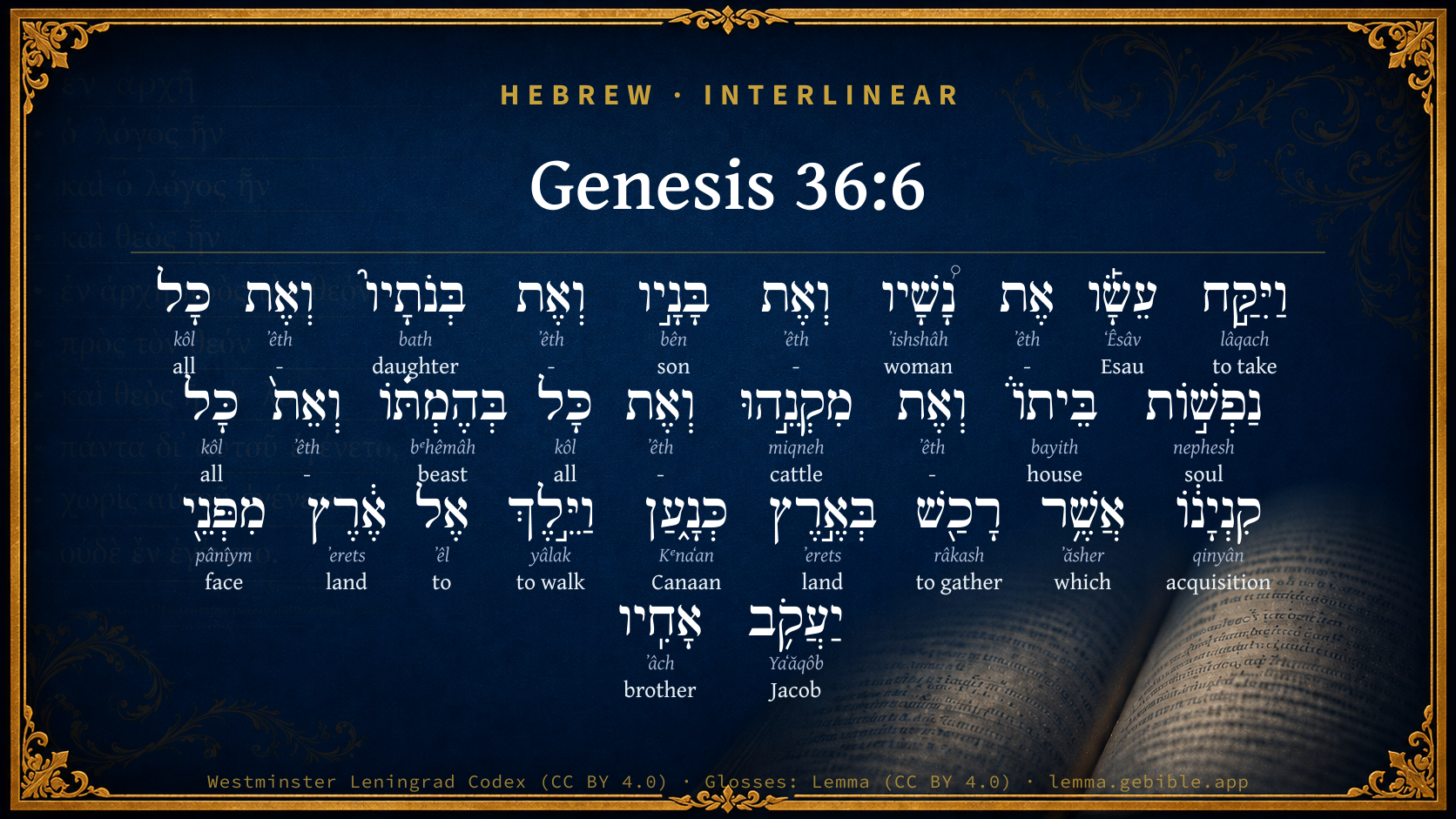
Genesis 36:6

Hebrew (Westminster Leningrad Codex) Genesis 36:6 appears in the Hebrew Old Testament. The text above is from the Westminster Leningrad Codex. Each word links to its Strong’s number, a concise gloss, and parsing drawn from the Open Scriptures Hebrew Bible morphology. Click any word for its full Brown-Driver-Briggs (BDB) entry.
Download image
Cite this verse

Genesis 36:6 (World English Bible). Public Domain. Lemma interlinear Bible study tool, https://lemma.gebible.app/v/genesis/36/6.

Show BibTeX & RIS
BibTeX
RIS
English Translation
Esau took his wives, his sons, his daughters, and all the members of his household, with his cattle, all his animals, and all his possessions, which he had gathered in the land of Canaan, and went into a land away from his brother Jacob.
World English Bible · Public Domain
Download a study sheet

One document with this verse’s original text, its word-by-word gloss line, the meaning frame, cross-references with their text, attributed commentary, and full source and license credits — printable, and it pastes into notes with its structure intact.

This verse Autodidact and up

Study sheet (.html) Plain text (.txt)

A passage Seminary Student

Up to 50 verses in one chapter. A passage sheet keeps up to 6 commentary sources and 12 cross-references per verse, in the order this page ranks them, and says so on the sheet whenever that leaves anything out. Ask for a single verse and you get the Autodidact verse sheet above.

Everything on this page stays free to read, with no account — the sheet is a download of what is already on screen, not access to it.

Want to remove ads? Support Godless Engineer
Compare translations 3

The same verse in 3 English versions, stacked beneath the original-language interlinear above. Click any original word for its lexicon entry.

Each is an independent rendering of the whole verse — the interlinear is not word-aligned to these translations.

Highlighted words mark where these versions differ — a whole-verse word diff, not a word-by-word alignment.

  • World English Bible Public Domain
    Esau took his wives, his sons, his daughters, and all the members of his household, with his cattle, all his animals, and all his possessions, which he had gathered in the land of Canaan, and went into a land away from his brother Jacob.
  • King James Version Public Domain
    And Esau took his wives, and his sons, and his daughters, and all the persons of his house, and his cattle, and all his beasts, and all his substance, which he had got in the land of Canaan; and went into the country from the face of his brother Jacob.
  • unfoldingWord Literal Text CC BY-SA 4.0
    Then Esau took his wives and his sons and his daughters and all the people of his house, and his livestock and all his animal and all his possession that he had acquired in the land of Canaan, and he went to a land from the presence of Jacob his brother,

unfoldingWord Literal Text — © unfoldingWord, licensed CC BY-SA 4.0. Word-aligned USFM3 via Door43 (git.door43.org/unfoldingWord/en_ult).

Versions to compare (up to 4)

3 of 4 selected

Show all 18 translations

Every available English version of this verse, each an independent rendering of the whole verse.

  • World English Bible Public Domain
    Esau took his wives, his sons, his daughters, and all the members of his household, with his cattle, all his animals, and all his possessions, which he had gathered in the land of Canaan, and went into a land away from his brother Jacob.
  • Berean Standard Bible Public Domain
    Later, Esau took his wives and sons and daughters and all the people of his household, along with his livestock, all his other animals, and all the property he had acquired in Canaan, and he moved to a land far away from his brother Jacob.
  • Majority Standard Bible Public Domain
    Later, Esau took his wives and sons and daughters and all the people of his household, along with his livestock, all his other animals, and all the property he had acquired in Canaan, and he moved to a land far away from his brother Jacob.
  • King James Version Public Domain
    And Esau took his wives, and his sons, and his daughters, and all the persons of his house, and his cattle, and all his beasts, and all his substance, which he had got in the land of Canaan; and went into the country from the face of his brother Jacob.
  • American Standard Version (1901) Public Domain
    And Esau took his wives, and his sons, and his daughters, and all the souls of his house, and his cattle, and all his beasts, and all his possessions, which he had gather in the land of Canaan; and went into a land away from his brother Jacob.
  • Revised Version (1885) Public Domain
    And Esau took his wives, and his sons, and his daughters, and all the souls of his house, and his cattle, and all his beasts, and all his possessions, which he had gathered in the land of Canaan; and went into a land away from his brother Jacob.
  • Geneva Bible (1599) Public Domain
    So Esau tooke his wiues and his sonnes, and his daughters, and all the soules of his house, and his flocks, and all his cattell, and all his substance, which he had gotten in the land of Canaan, and went into an other countrey from his brother Iaakob.
  • Douay-Rheims (1899) Public Domain
    And Esau took his wives and his sons and daughters, and every soul of his house, and his substance, and cattle, and all that he was able to acquire in the land of Chanaan: and went into another country, and departed from his brother Jacob.
  • Young's Literal Translation Public Domain
    And Esau taketh his wives, and his sons, and his daughters, and all the persons of his house, and his cattle, and all his beasts, and all his substance which he hath acquired in the land of Canaan, and goeth into the country from the face of Jacob his brother;
  • Literal Standard Version CC BY-SA 4.0
    And Esau takes his wives, and his sons, and his daughters, and all the persons of his house, and his livestock, and all his beasts, and all his substance which he has acquired in the land of Canaan, and goes into the country from the face of his brother Jacob;
  • Unlocked Literal Bible CC BY-SA 4.0
    Esau took his wives, his sons, his daughters, and all the members of his household, his livestock—all his animals, and all his possessions, which he had gathered in the land of Canaan, and went into a land away from his brother Jacob.
  • unfoldingWord Literal Text CC BY-SA 4.0
    Then Esau took his wives and his sons and his daughters and all the people of his house, and his livestock and all his animal and all his possession that he had acquired in the land of Canaan, and he went to a land from the presence of Jacob his brother,
  • Darby Bible Public Domain
    And Esau took his wives, and his sons, and his daughters, and all the souls of his house, and his cattle, and all his beasts, and all his possessions, that he had acquired in the land of Canaan, and went into a country away from his brother Jacob.
  • World Messianic Bible Public Domain
    Esau took his wives, his sons, his daughters, and all the members of his household, with his livestock, all his animals, and all his possessions, which he had gathered in the land of Canaan, and went into a land away from his brother Jacob.
  • Webster's Bible Public Domain
    And Esau took his wives, and his sons, and his daughters, and all the persons of his house, and his cattle, and all his beasts, and all his substance which he had acquired in the land of Canaan; and went into the country from the face of his brother Jacob.
  • Free Bible Version CC BY-SA 4.0
    Esau took his wives, sons and daughters, and everyone in his household, together with his livestock, all his other animals, and all the possessions he had gained while in Canaan, and went to live in a country far away from his brother Jacob.
  • Bible in Basic English Public Domain
    Esau took his wives and his sons and his daughters, and all the people of his house, and his beasts and his cattle and all his goods which he had got together in the land of Canaan, and went into the land of Seir, away from his brother Jacob.
  • JPS Tanakh (1917) Public Domain
    And Esau took his wives, and his sons, and his daughters, and all the souls of his house, and his cattle, and all his beasts, and all his possessions, which he had gathered in the land of Canaan; and went into a land away from his brother Jacob.

Literal Standard Version (2020), Covenant Press — licensed CC BY-SA 4.0. Text via the HelloAO Bible API (eBible.org). Unlocked Literal Bible (unfoldingWord) — licensed CC BY-SA 4.0. Text via the HelloAO Bible API (eBible.org). unfoldingWord Literal Text — © unfoldingWord, licensed CC BY-SA 4.0. Word-aligned USFM3 via Door43 (git.door43.org/unfoldingWord/en_ult). Free Bible Version, Dr. Jonathan Gallagher — licensed CC BY-SA 4.0. Text via the HelloAO Bible API (eBible.org).

Word by word

More ways to search: Search by grammar → Find every occurrence → Compare this word →

Practice this passage: Drill this verse → Learn its vocabulary →

רָכַ֖שׁ
râkash
H7408
“to gather”
Verb, Qal, Perfect, 3rd Person, Masculine, Singular
Part of Speech
Verb
Stem
Qal
Form
Perfect
Person
3rd Person
Gender
Masculine
Number
Singular
Full BDB Definition

Origin: a primitive root

TWOT: 2167

(Qal) to collect or gather property
  1. וַיִּקַּ֣ח lâqach H3947 “and · to take” Conjunction + Verb, Qal, Sequential Imperfect, 3rd Person, Masculine, Singular
  2. עֵשָׂ֡ו ʻÊsâv H6215 “Esau” Noun, Proper
  3. אֶת ʼêth H853 “-” Particle, Direct Object
  4. נָ֠שָׁיו ʼishshâh H802 “women · his” Noun, Common, Feminine, Plural, Construct + Suffix, Personal, 3rd Person, Masculine, Singular
  5. וְאֶת ʼêth H853 “and · -” Conjunction + Particle, Direct Object
  6. בָּנָ֣יו bên H1121 “sons · his” Noun, Common, Masculine, Plural, Construct + Suffix, Personal, 3rd Person, Masculine, Singular
  7. וְאֶת ʼêth H853 “and · -” Conjunction + Particle, Direct Object
  8. בְּנֹתָיו֮ bath H1323 “daughters · his” Noun, Common, Feminine, Plural, Construct + Suffix, Personal, 3rd Person, Masculine, Singular
  9. וְאֶת ʼêth H853 “and · -” Conjunction + Particle, Direct Object
  10. כָּל kôl H3605 “all of” Noun, Common, Masculine, Singular, Construct
  11. נַפְשׁ֣וֹת nephesh H5315 “souls of” Noun, Common, Both, Plural, Construct
  12. בֵּיתוֹ֒ bayith H1004 “house · his” Noun, Common, Masculine, Singular, Construct + Suffix, Personal, 3rd Person, Masculine, Singular
  13. וְאֶת ʼêth H853 “and · -” Conjunction + Particle, Direct Object
  14. מִקְנֵ֣הוּ miqneh H4735 “cattle · his” Noun, Common, Masculine, Singular, Construct + Suffix, Personal, 3rd Person, Masculine, Singular
  15. וְאֶת ʼêth H853 “and · -” Conjunction + Particle, Direct Object
  16. כָּל kôl H3605 “all of” Noun, Common, Masculine, Singular, Construct
  17. בְּהֶמְתּ֗וֹ bᵉhêmâh H929 “beast · his” Noun, Common, Feminine, Singular, Construct + Suffix, Personal, 3rd Person, Masculine, Singular
  18. וְאֵת֙ ʼêth H853 “and · -” Conjunction + Particle, Direct Object
  19. כָּל kôl H3605 “all of” Noun, Common, Masculine, Singular, Construct
  20. קִנְיָנ֔וֹ qinyân H7075 “acquisition · his” Noun, Common, Masculine, Singular, Construct + Suffix, Personal, 3rd Person, Masculine, Singular
  21. אֲשֶׁ֥ר ʼăsher H834 “which” Particle, Relative
  22. בְּאֶ֣רֶץ ʼerets H776 “in/at · land of” Preposition + Noun, Common, Both, Singular, Construct
  23. כְּנָ֑עַן Kᵉnaʻan H3667 “Canaan” Noun, Proper
  24. וַיֵּ֣לֶךְ yâlak H3212 “and · to walk” Conjunction + Verb, Qal, Sequential Imperfect, 3rd Person, Masculine, Singular
  25. אֶל ʼêl H413 “to” Preposition
  26. אֶ֔רֶץ ʼerets H776 “land” Noun, Common, Both, Singular, Absolute
  27. מִפְּנֵ֖י pânîym H6440 “from · face(s) of” Preposition + Noun, Common, Both, Plural, Construct
  28. יַעֲקֹ֥ב Yaʻăqôb H3290 “Jacob” Noun, Proper
  29. אָחִֽיו ʼâch H251 “brother · his” Noun, Common, Masculine, Singular, Construct + Suffix, Personal, 3rd Person, Masculine, Singular

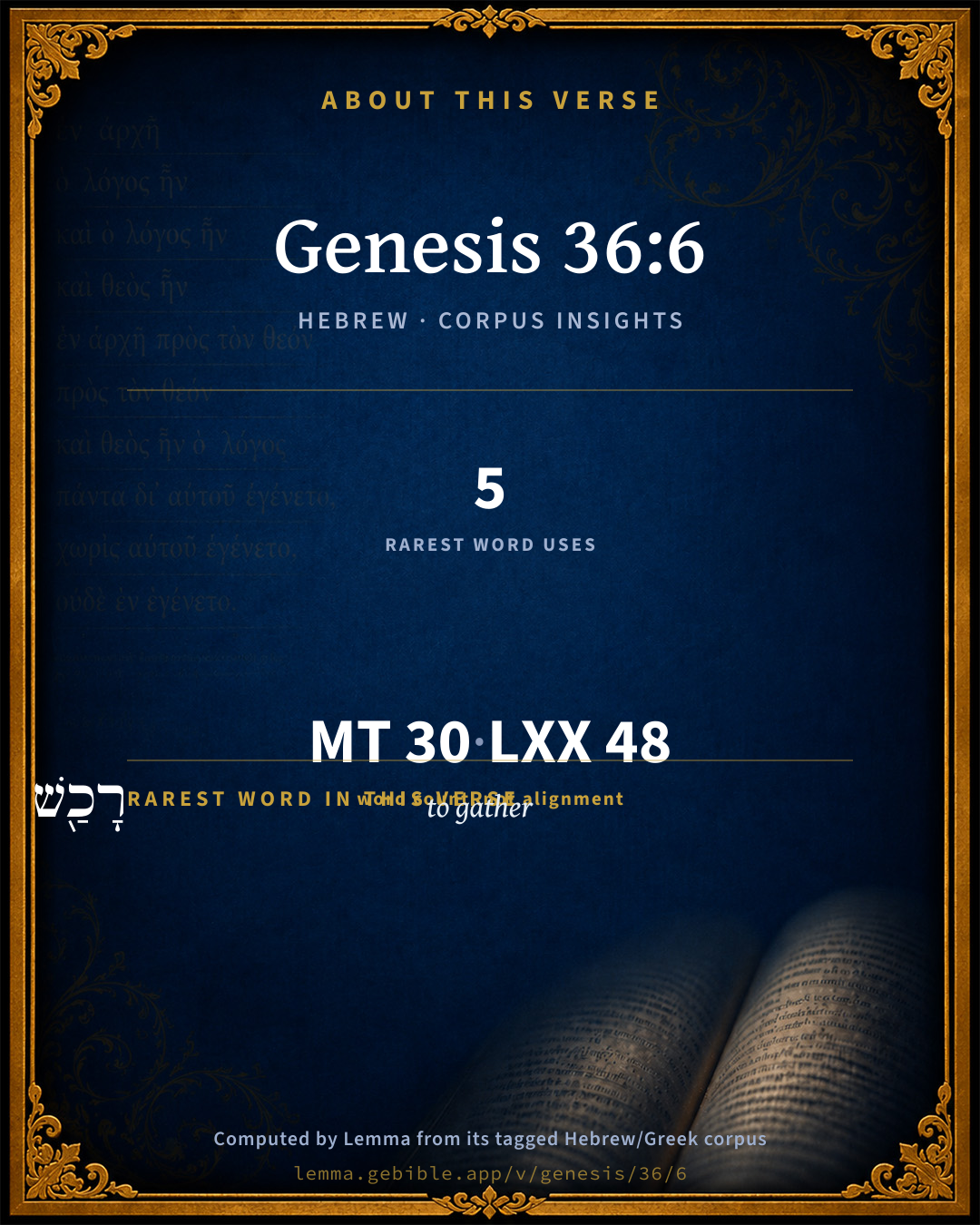
About this verse

These counts appear in no published source. They are computed here, from the morphology-tagged text and Lemma’s own curated glosses. What Lemma adds →

30
words
21
distinct lemmas
Pentateuch
section

Notable vocabulary

The rarest word here is רָכַ֖שׁ to gather H7408 — appearing just 5 times in the whole Hebrew Bible.

Shared distinctive vocabulary

רָכַ֖שׁ to gather H7408 occurs in 4 verses of the Hebrew Bible. Also found in:

Grammatical profile

  • 3 verbs
  • 18 nouns
  • 1 preposition
  • 8 particles

Verb forms

  • וַיִּקַּ֣ח Qal · Sequential Imperfect
  • רָכַ֖שׁ Qal · Perfect
  • וַיֵּ֣לֶךְ Qal · Sequential Imperfect

Repetition

Words recur within this verse — often emphatic in Hebrew:

  • כָּל all H3605 ×3
  • בְּאֶ֣רֶץ land H776 ×2

Hebrew & Septuagint length

In English translation the verse runs 44 words from the Hebrew and 60 from the Septuagint (LXX English) — closely comparable.

A rough comparison of the two English renderings, which tokenize alike — not a word-level alignment.

Word counts can differ between the Hebrew and the Greek without any difference in meaning — e.g. the Hebrew direct-object marker אֵת has no separate Greek word, and Greek often adds the article ὁ.

In the original languages it is 30 Hebrew tokens and 48 Greek tokens — but the two are counted differently (Hebrew bundles its prefixes and suffixes into one token; the Greek is in lemma form), so that isn’t a like-for-like length.

Cross-references

9

Topical passages linked to Genesis 36:6 in the Treasury of Scripture Knowledge — connected by theme and wording, ordered by reader-vote popularity; previews shown in the World English Bible.

  • Genesis 32:3 Jacob sent messengers in front of him to Esau, his brother, to the land of Seir, the field of Edom.
  • Genesis 12:5 Abram took Sarai his wife, Lot his brother's son, all their substance that they had gathered, and the souls who they had gotten in Haran; and they went forth to go into the land of Canaan. Into the land of Canaan they came.
  • Genesis 13:6 The land was not able to bear them, that they might live together: for their substance was great, so that they could not live together.
  • Genesis 13:11 So Lot chose the Plain of the Jordan for himself. Lot traveled east, and they separated themselves the one from the other.
  • Genesis 17:8 I will give to you, and to your seed after you, the land where you are traveling, all the land of Canaan, for an everlasting possession. I will be their God."
  • Genesis 25:23 Yahweh said to her, Two nations are in your womb, Two peoples will be separated from your body. The one people will be stronger than the other people. The elder will serve the younger.
  • Genesis 28:4 and give you the blessing of Abraham, to you, and to your seed with you, that you may inherit the land where you travel, which God gave to Abraham."
  • Revelation 18:13 and cinnamon, incense, perfume, frankincense, wine, olive oil, fine flour, wheat, sheep, horses, chariots, bodies, and people's souls.
  • Ezekiel 27:13 Javan, Tubal, and Meshech, they were your traffickers; they traded the persons of men and vessels of brass for your merchandise.

Cross-references courtesy of OpenBible.info (CC BY 4.0).

Hebrew and Greek witnesses Masoretic Hebrew ↔ Greek Septuagint

The same verse in the two great witnesses to the Old Testament, shown verse-for-verse.

These are two independent witnesses, not word-aligned to each other, and the Septuagint is shown in lemma (dictionary) form.

Hebrew Genesis 36:6 Masoretic · Westminster Leningrad Codex

וַיִּקַּ֣ח עֵשָׂ֡ו אֶת נָ֠שָׁיו וְאֶת בָּנָ֣יו וְאֶת בְּנֹתָיו֮ וְאֶת כָּל נַפְשׁ֣וֹת בֵּיתוֹ֒ וְאֶת מִקְנֵ֣הוּ וְאֶת כָּל בְּהֶמְתּ֗וֹ וְאֵת֙ כָּל קִנְיָנ֔וֹ אֲשֶׁ֥ר רָכַ֖שׁ בְּאֶ֣רֶץ כְּנָ֑עַן וַיֵּ֣לֶךְ אֶל אֶ֔רֶץ מִפְּנֵ֖י יַעֲקֹ֥ב אָחִֽיו

Esau took his wives, his sons, his daughters, and all the members of his household, with his cattle, all his animals, and all his possessions, which he had gathered in the land of Canaan, and went into a land away from his brother Jacob.

World English Bible · Public Domain

Greek LXX Genesis 36:6 Septuagint · lemma form

λαμβάνω δέ ησαυ ὁ γυνή αὐτός καί ὁ υἱός καί ὁ θυγάτηρ καί πᾶς ὁ σῶμα ὁ οἶκος αὐτός καί πᾶς ὁ ὑποἄρχω καί πᾶς ὁ κτῆνος καί πᾶς ὅσος κτάομαι καί ὅσος περιποιέω ἐν γῆ χανααν καί πορεύομαι ἐκ γῆ χανααν ἀπό πρόσωπον ἰακώβ ὁ ἀδελφός αὐτός

And Esau took his wives, and his sons, and his daughters, and all the persons of his house, and all his possessions, and all his cattle, and all that he had got, and all things whatever he had acquired in the land of Chanaan; and Esau went forth from the land of Chanaan, from the face of his brother Jacob.

LXX2012 (modern English Septuagint) · Public Domain

On this verse, The Pulpit Commentary discusses the Septuagint’s reading. Read the note in Commentary ↓

Hebrew: Westminster Leningrad Codex (CC BY 4.0). Greek: Septuagint (public domain); English from LXX2012 (modern English Septuagint) (Public Domain). How the Septuagint differs from the Hebrew →

Targum (Aramaic paraphrase)

2

The Targum is the ancient Jewish Aramaic paraphrase of the Hebrew Scriptures — an interpretive translation, not the Hebrew text itself. Onkelos (literal) and Pseudo-Jonathan (expansive) render the Torah, and Jonathan the Prophets. Coverage is partial: where no permissively-licensed English translation exists for a verse, only the Aramaic is shown. This is verse-level text, not a word-by-word alignment to the Hebrew.

  1. Targum Onkelos Torah (Genesis–Deuteronomy)
    וּדְבַר עֵשָׂו יָת נְשׁוֹהִי וְיָת בְּנוֹהִי וְיָת בְּנָתֵהּ וְיָת כָּל נַפְשַׁת בֵּיתֵהּ וְיָת גֵּיתוֹהִי וְיָת כָּל בְּעִירֵהּ וְיָת כָּל קִנְיָנֵהּ דִי קְנָא בְּאַרְעָא דִכְנָעַן וַאֲזַל לְאַרְעָא אוֹחֲרִי מִן קֳדָם יַעֲקֹב אָחוּהִי

    (no public-domain English translation for this verse)

    Targum Onkelos — Aramaic: “Onkelos Genesis” (public domain); “Onkelos Exodus” (public domain); “Onkelos Leviticus” (public domain); “Onkelos Numbers” (public domain); “Onkelos Deuteronomy” (public domain). English: “Sefaria Community Translation” (CC0 1.0 (public-domain dedication)); “J.W. Etheridge. The Targums of Onkelos and Jonathan Ben Uzziel on the Pentateuch. London: Longmans, Green, 1862” (public domain). Text via Sefaria.

  2. Targum Pseudo-Jonathan Torah (Genesis–Deuteronomy)
    וּדְבַר עֵשָו יַת נְשׁוֹי וְיַת בְּנוֹי וְיַת בְּנָתוֹי וְיַת כָּל נַפְשַׁת בֵּיתֵיהּ וְיַת גֵיתוֹי וְיַת בְּעִירוֹי וְיַת כָּל נִכְסוֹי דִי קָנָה בְּאַרְעָא דִכְנָעַן וְטַיָיל לְאַרַע אוֹחֲרִי דַהֲוָה רַמְיָא עֲלוֹי אֵימָתָא דְיַעֲקב אָחוּהִי

    And Esau had taken his wives and his sons and his daughters, and all the souls of his house, and his flocks and his cattle, and all the substance which he had gotten in the land of Kenaan, and had gone into another land; for there fell upon him a fear of Jakob his brother:

    Targum Pseudo-Jonathan — Aramaic: “Targum Jonathan on Genesis” (public domain); “Targum Jonathan on Exodus” (public domain); “Targum Jonathan on Leviticus” (public domain); “Targum Jonathan on Numbers” (public domain); “Targum Jonathan on Deuteronomy” (public domain). English: “The Targum of Jonathan ben Uzziel, trans. J. W. Etheridge, London, 1862” (public domain). Text via Sefaria.

Commentary

Notes on Genesis 36:6 from classic Christian and Jewish commentators (each source and its license shown beneath its notes). The classic Christian expositions comment on the surrounding passage and are grouped to its opening verse, so a note may address several verses; the Jewish commentaries on the Tanakh (Rashi and others) are per-verse, so they appear only where the commentator wrote on this verse.

Lemma curates 59 commentaries, every one of them public domain or Creative Commons licensed, each selected and text-cleaned for this edition rather than reprinted as found. About our sources →

Trapp's Complete Commentary

John Trapp

Gen 36:6 And Esau took his wives, and his sons, and his daughters, and all the persons of his house, and his cattle, and all his beasts, and all his substance, which he had got in the land of Canaan; and went into the country from the face of his brother Jacob.

Ver. 6. From the face of his brother Jacob.] Or, Before the coming of his brother Jacob; by a special providence of God, to make room for the right heir. It is he that "determineth the bounds of our habitations." {Act 17:26} It was he that espied out this land for his peculiar people; and that kept the room empty all the time of the Babylonish captivity, till the return of the natives; though it were a pleasant country, left destitute of inhabitants, and surrounded with many warlike nations. Piscator renders this text, propter Iacobum, and expounds it, Because he knew that the land of Canaan should be Jacob’s, according to God’s promise made to him in his father’s blessing of him. But I doubt whether Esau would yield to him for any such reason.

John Trapp, A Commentary or Exposition upon All the Books of the Old and New Testament (1647–1656) — public domain. Text from a community e-Sword module.

Joseph Benson's Commentary

Gen 36:6. Esau took his wives and all his substance, &c. — Although he had begun to settle among his wives’ relations in Seir, before Jacob came from Padan-aram, Gen 32:3; yet, it is probable, that during the life of Isaac, he had still some effects remaining in Canaan; but after his death, he wholly withdrew to mount Seir, took with him what came to his share of his father’s personal estate, and left Canaan to Jacob, not only because Jacob had the promise of it, but because he saw, if they should both continue to thrive, as they had begun, there would not be room for both.

Joseph Benson's Commentary on the Old and New Testaments (1811–1818) — public domain. Text from a community e-Sword module.

Geneva Bible (1599)

Geneva Bible translators

Herein appeareth God’s providence, which causeth the wicked to give place to the godly, that Jacob might enjoy Canaan according to God’s promise.

Geneva Bible (1599) marginal notes — public domain. Text via Bolls.life.

Jamieson, Fausset & Brown

Robert Jamieson, A. R. Fausset & David Brown

Esau . . . went into the country from the face of his brother Jacob--literally, "a country," without any certain prospect of a settlement. The design of this historical sketch of Esau and his family is to show how the promise (Gen 27:39-40) was fulfilled. In temporal prosperity he far exceeds his brother; and it is remarkable that, in the overruling providence of God, the vast increase of his worldly substance was the occasion of his leaving Canaan and thus making way for the return of Jacob.

Jamieson, Fausset & Brown — Commentary Critical and Explanatory on the Whole Bible (1871) — public domain (CC PDM 1.0). Text via the HelloAO Bible API.

Adam Clarke's Commentary

Verse 6. Esau took his wives, c.] So it appears that Esau and Jacob dwelt together in Canaan, whither the former removed from Seir, probably soon after the return of Jacob. That they were on the most friendly footing this sufficiently proves and Esau shows the same dignified conduct as on other occasions, in leaving Canaan to Jacob, and returning again to Mount Seir; certainly a much less fruitful region than that which he now in behalf of his brother voluntarily abandoned.

Adam Clarke's Commentary on the Bible (1810–1826) — public domain. Text from a community e-Sword/MySword module.

John Calvin's Commentaries

6. And went into the country from the face of his brother Jacob. Moses does not mean that Esau departed purposely to give place to his brother; for he was so proud and ferocious, that he never would have allowed himself to seem his brother’s inferior. But Moses, without regard to Esau’s design, commends the secret providence of God, by which he was driven into exile, that the possession of the land might remain free for Jacob alone. Esau removed to Mount Seir, through the desire of present advantage, as is elsewhere stated. Nothing was less in his mind than to provide for his brother’s welfare; but God directed the blind man by his own hand, that he might not occupy that place in the land which he had appointed for his own servant. Thus it often happens that the wicked do good to the elect children of God, contrary to their own intention; and while their hasty cupidity pants for present advantages, they promote the eternal salvation of those whose destruction they have sometimes desired. Let us, then, learn from the passage before us, to see, by the eyes of faith, both in accidental circumstances (as they are called) and in the evil desires of men, that secret providence of God, which directs all events to a result predetermined by himself. For when Esau went forth, that he might live more commodiously apart from his father’s family, he is said to have departed from the face of his brother, because the Lord had so determined it. It is stated indefinitely, that he departed “into the country;” because, being in uncertainty respecting his plan, he sought a home in various places, until Mount Seir presented itself; and as we say, he went out at a venture.

John Calvin's Commentaries (1540-1563) — public domain. Text from the Calvin Translation Society English edition (1840s-50s) via the Christian Classics Ethereal Library (ccel.org). Calvin's coverage is partial (roughly two-thirds of the Bible); uncommented books and verses are honest gaps, never fabricated. The 19th-century editor's footnotes and remarks are omitted so the notes are faithfully Calvin's own voice.

Ellicott's Commentary for English Readers

(6) Into the country from the face.—Heb. into a land away from the face, &c.

A Bible Commentary for English Readers, edited by Charles John Ellicott (1878–1897) — public domain. Text from a community e-Sword module.

The Cambridge Bible for Schools and Colleges

gen. ed. J. J. S. Perowne

6–8. Esau in Mount Seir

6. a land away from his brother Jacob] The Syr. reads “the land of Seir,” which is possibly the original reading. The Lat. abiit in alteram regionem. The present passage ignores the previous mention of Esau’s residence in “the land of Seir, the field of Edom,” Gen_32:3. Seir was the mountainous country between the Dead Sea and the Elamitic Gulf.

The Cambridge Bible for Schools and Colleges (gen. ed. J. J. S. Perowne; Cambridge University Press, 1878–1918) — public domain. Text from a community e-Sword module.

John Gill's Exposition

For their riches were more than that they might dwell together,.... And therefore it was proper to part, as Abraham and Lot had done before, Gen 13:6,

and the land wherein they were strangers could not bear them, because of their cattle; their cattle were so numerous that they could not get pasturage for them, there not being enough left them by the inhabitants of it for them to occupy; nor could they hire land of them sufficient for them both; they being not possessors but sojourners in it, and therefore could have no more of it than the inhabitants thought fit to let unto them.

John Gill's Exposition of the Whole Bible (1746–1763) — public domain (CC PDM 1.0). Text via the HelloAO Bible API.

Haydock's Catholic Bible Commentary

Jacob, by the divine Providence, as Chanaan was to be his inheritance. (Menochius) --- He had returned from Seir about the same time as Jacob came home. (St. Augustine, q. 119.)

George Leo Haydock (1774–1849), Haydock's Catholic Family Bible and Commentary, 1859 edition — public domain. Excludes Psalms (Douay-Rheims chapter numbering differs from Protestant) and Deuterocanonical books (Catholic canon only).

Matthew Poole's English Annotations

1740

Quest.

1. Why went he thither?

Answ. Partly by his own choice, that wild and mountainous country being very commodious for hunting, to which he wholly addicted himself; partly by his wives’ persuasions, who were both utterly averse from cohabitation with Isaac or Jacob, and strongly inclined to their own country; but principally from the secret conduct of Divine Providence, thus accomplishing his promises. See Jos 24:4; Mal 1:3.

Quest.

2. When went he thither?

Answ. He went thither before this time in discontent at his parents, and dwelt in Seir before Jacob’s return to Canaan, as appears from Gen 32:3; 33:14,16; yet so as he came sometimes to Canaan, and to his father’s house, and did not quit his interest in his father’s estate. But when his father was dead, and Jacob and he agreed about the partition of the estate, he did totally and finally forsake Canaan, partly, for the reason here following; partly, for the other reasons now alleged; and partly, to avoid all occasion both of communication and contention with his brother.

Matthew Poole's English Annotations on the Holy Bible (1683–1685) — public domain. Text from a community e-Sword/MySword module.

The Pulpit Commentary

And Esau took his wives, and his sons, and his daughters, and all the persons (literally, souls) of his house, and his cattle (mikneh), and all his beasts (behe-mah), and all his substance (literally, all his acquisitions), which he had got in the land of Canaan; and went into the country literally, into a land; not ejk thv ghv (LXX), or in alteram regionem (Vulgate), but either into the land, so. of Seir (Keil), or, taking the next as a qualifying clause, into a land apart (Murphy, Lange)from the face of or, on account of (Rosenm Kalisch) his brother Jacob.

The Pulpit Commentary (1880–1919), ed. H.D.M. Spence-Jones & Joseph S. Exell — public domain. Text from a community e-Sword module.

John Wesley's Explanatory Notes

Esau had begun to settle among his wife's relations in Seir, before Jacob came from Padan-aram, chap. xxxii, 3. Isaac it is likely, had sent him thither, that Jacob might have the clearer way to the possession of the promised land: yet probably during the life of Isaac, Esau had still some effects remaining in Canaan; but after his death, he wholly withdrew to mount Seir, took with him what came to his share of his father's personal estate, and left Canaan to Jacob, not only because he had the promise of it, but because he saw, if they should both continue to thrive, as they had begun, there would not be room for both.

John Wesley, Explanatory Notes Upon the Whole Bible (1754–1765) — public domain. Text via the GEBible commentary corpus.

unfoldingWord translationNotes

Door43 World Missions Community

which he had gathered in the land of Canaan

This refers to all of the things that he had accumulated while living in the land of Canaan. AT: "which he had accumulated while living in the land of Canaan" (See: Assumed Knowledge and Implicit Information)

went into a land

This means to moved to another place and live there. AT: "went to live in another land" (See: Idiom)

their possessions

"Esau's and Jacob's possessions"

could not support them because of their livestock

The land was not large enough to support all of the livestock that Jacob and Esau owned. AT: "was not big enough to support all of their livestock" or "was not big enough for both Esau's flocks and Jacob's flocks" (See: Assumed Knowledge and Implicit Information)

where they had settled

The word "settled" means to move somewhere and live there. AT: "where they had moved to" (See: Idiom)

translationWords

Esau

household

Canaan

Jacob

Edom

unfoldingWord translationNotes — © Distant Shores Media and the Door43 World Missions Community, licensed CC BY-SA 4.0. Source: git.door43.org/Door43/en_tn.

Rashi

Rabbi Shlomo Yitzchaki (Rashi)

i.e. no particular country, but into any country), to stay where-ever he could find room.

Rashi on the Tanakh — English translations: “The Judaica Press complete Tanach with Rashi, translated by A. J. Rosenberg” (CC BY 4.0); “Pentateuch with Rashi's commentary by M. Rosenbaum and A.M. Silbermann, 1929-1934” (public domain); “The Metsudah Tanach series, Lakewood, N.J” (CC BY 4.0); and “The Book of Joshua, Metsudah Publications, 1997” (CC BY 4.0). Text via Sefaria.

Ramban (Nachmanides)

Rabbi Moshe ben Nachman (Ramban / Nachmanides)

AND ESAU TOOK HIS WIVES, AND HIS SONS, AND HIS DAUGHTERS. This journey took place after his brother had returned from Haran and established himself in the land of Canaan, as it says here, and he went into a land away from his brother Jacob. It is possible that this was also after the death of their father. Now when his brother Jacob was still in Haran, Esau was already in Se’ir, as is written above! But the explanation of the matter is that Esau went to Se’ir in the days of the chieftains of the Horites, the inhabitants of the land, and he became a lord with a following of four hundred men while his children and family remained in the land of Canaan. It is possible that Esau had some land there in another location, in the plain, not on mount Se’ir. Therefore Scripture speaks of him as living in the land of Se’ir, the field of Edom. And after his brother returned to the land of Canaan he vacated before his coming for he knew that the land of Canaan was the inheritance of his brother which his father had given him in his blessing. So he took his sons… and all the souls of his house — a multitude of people — and went to Se’ir to settle there. He then fought with the sons of Se’ir the Horite, the inhabitants of the land, for perhaps they feared him, and they did not permit him to enter their territory into mount Se’ir, where the fortifications were. However, he settled in the field of Edom, in his original location, and the Eternal destroyed them from before them, and they succeeded them, and dwelt in their stead, as it said in Mishneh Torah. It therefore says there, Because I have given mount Se’ir unto Esau for a possession., 2:5.

AND HE WENT INTO A LAND. According to Onkelos, the meaning of this expression is “into another land.” But Rashi explained, “He went to stay wherever he could find room” for he went to no particular country but sought a country where he would find room to settle, until he came to mount Se’ir and settled there. In my opinion, the correct interpretation is that Scripture is saying: “And he went to the land of Se’ir,” the name of the place being omitted from the verse as it is self-understood since it has already been mentioned that he dwelled in the land of Se’ir, and it is understood that he led his family there, and right nearby, it is mentioned, And Esau dwelled in mount Se’ir. A similar case is found in this verse: He went into the castle of the king’s house, and burnt the king’s house over him with fire, which means that house of the king in which he was. Similarly, And he burned the high place and stamped it small to powder, and burned the Asherah, which means the high place which belonged to Jeroboam, who was mentioned in the beginning of the verse. So also: And Joab said to the Cushite: Go tell the king… And Cushite bowed down to Joab, [which means “the Cushite” mentioned]; And an ass and the lion, [which means “the ass” mentioned above in Verse 24]. So also: For ships were broken at Etzion-geber, 22:49. which means “the ships” [mentioned in the beginning of that verse]; and there are many similar verses. Here also the expression, And he went into a land, is as if it said, “into the land,” i.e., the land of Se’ir which was mentioned.

Ramban (Nachmanides) on the Tanakh — English translation: “Commentary on the Torah by Ramban (Nachmanides). Translated and annotated by Charles B. Chavel. New York, Shilo Pub. House, 1971-1976” (CC BY 4.0). Text via Sefaria.

Radak

Rabbi David Kimhi (Radak)

ואת כל בהמתו, a generic term including all of his livestock.

וילך אל ארץ, to a land where previously he had been living on an ad hoc basis before Yaakov had returned from Lavan. Now, after Yaakov’s return, he decided to move there permanently. כי היה רכושם רב, the reason that Esau moved now was 1) because the combined herds of Yaakov and Esau were extensive, and Esau feared he would ultimately be forced to leave the land of Canaan as G’d had promised it to Yaakov’s children as their inheritance. After all, his father Yitzchok had said to him in 27,39 that whereas his inheritance would be משמני הארץ, “of the fat places of the earth,” nothing had been said to him indicating that he would own part of the land of Canaan. Perhaps his father had even told him that Mount Seir would be his. The Torah refers to this land as being Esau’s by right in Deuteronomy 2,5 as well as in Joshua 24,4. His claim to this region was therefore not only that of a conqueror, but one which had Divine approval.

Radak on the Tanakh — English translations: “Sefaria Community Translation” (CC0 1.0 (public-domain dedication)); “Eliyahu Munk, HaChut Hameshulash” (CC BY 4.0); “Rabbi Mike Feuer, Jerusalem Anthology” (CC BY 4.0); and “R. David Kimhi on the first book of Psalms, Translated by R.G. Finch, London, 1919” (public domain). Text via Sefaria.

Lesson kit

Teaching starters — assembled from the data on this page, not authored interpretation. Every prompt links to the verse data it draws on. Edit before teaching.

Genesis, in the Pentateuch, opens this verse with 30 words (21 distinct Hebrew lemmas). Its most distinctive word is râkash (“to gather”). A historical commentator’s framing appears above. Read the whole chapter for the surrounding context.

Discussion questions

  1. How does “to gather” (râkash) shape what this verse is saying?
  2. How does Genesis 12:5, which shares the word «to gather», read alongside this verse?
  3. What does the repetition of “all” (3× in this one verse) do in this verse?
  4. These translations render this verse differently; the difference is in the English rendering, not the original. What questions does that raise?
  5. «וַיִּקַּ֣ח» is a Qal Sequential Imperfect verb. How does that grammatical form shape the action described?
  6. Compare how Trapp's Complete Commentary and Joseph Benson's Commentary read this verse. Where do they agree or differ?

Things to notice

Reading settings

Reading text

Shown beneath each verse's original-language words.

Old Testament
Old Testament edition

Read the OT as the Masoretic Hebrew (MT) or the Greek Septuagint (LXX).

English shown for the Greek Septuagint (in the Hebrew ↔ Greek comparison).

Comparing translations? Open the Compare panel on any verse page to stack up to four side by side.