Genesis 31:36

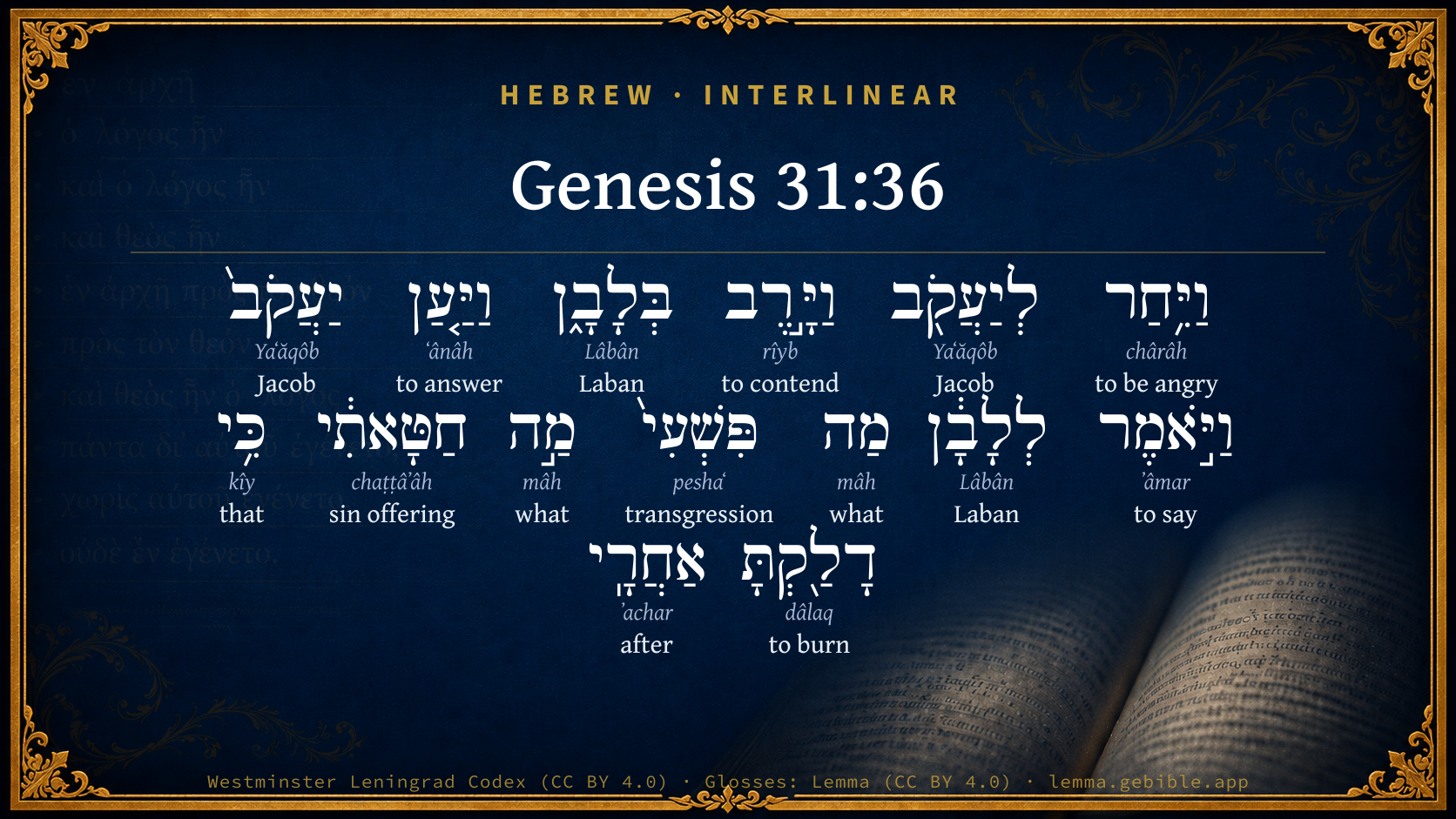
Hebrew (Westminster Leningrad Codex) Genesis 31:36 appears in the Hebrew Old Testament. The text above is from the Westminster Leningrad Codex. Each word links to its Strong’s number, a concise gloss, and parsing drawn from the Open Scriptures Hebrew Bible morphology. Click any word for its full Brown-Driver-Briggs (BDB) entry.
Download image
Cite this verse

Genesis 31:36 (World English Bible). Public Domain. Lemma interlinear Bible study tool, https://lemma.gebible.app/v/genesis/31/36.

Show BibTeX & RIS
BibTeX
RIS
English Translation
Jacob was angry, and argued with Laban. Jacob answered Laban, "What is my trespass? What is my sin, that you have hotly pursued after me?
World English Bible · Public Domain
Highlights
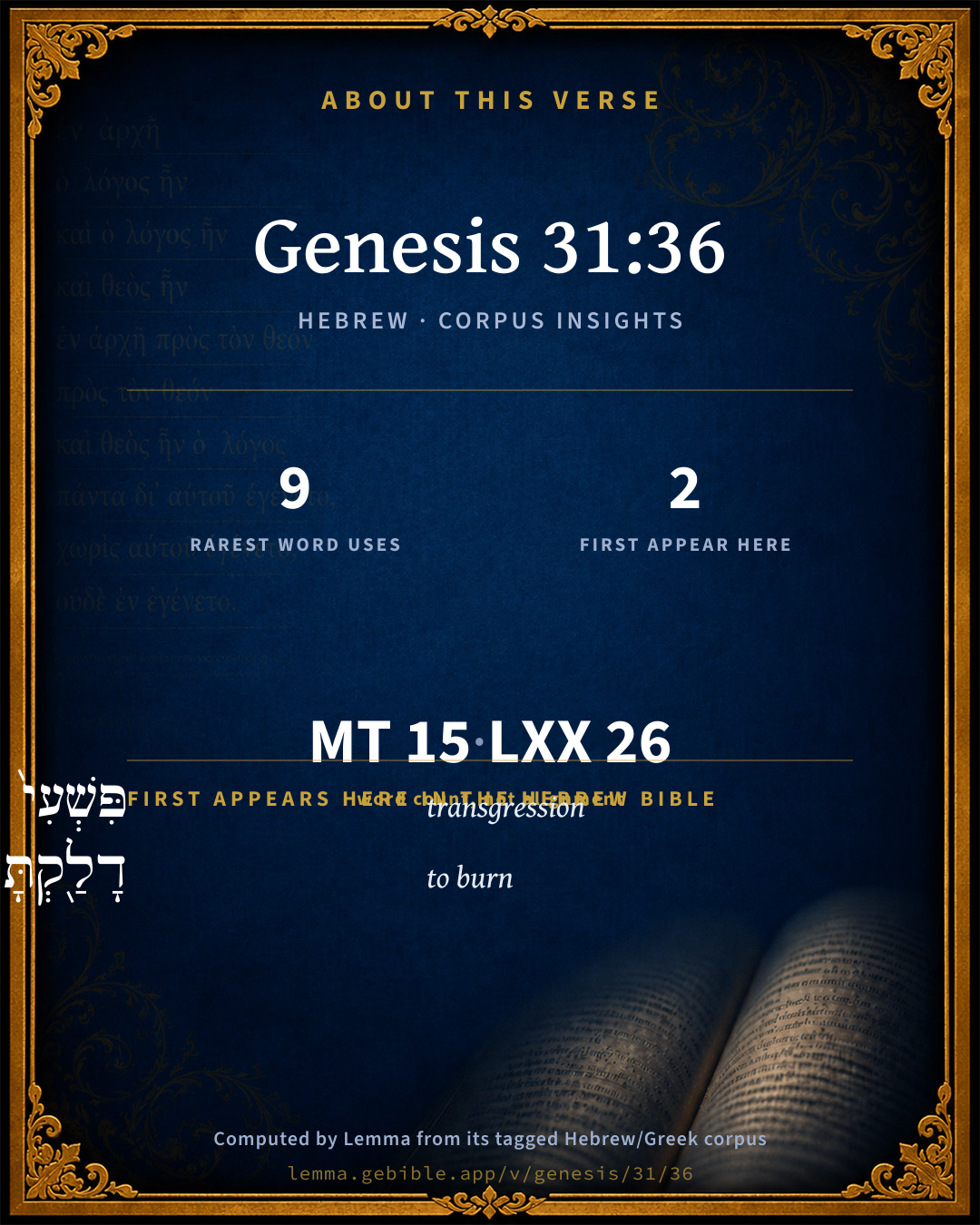
  • 2 first appearances in the Hebrew Bible
Full analysis ↓
Download a study sheet

One document with this verse’s original text, its word-by-word gloss line, the meaning frame, cross-references with their text, attributed commentary, and full source and license credits — printable, and it pastes into notes with its structure intact.

This verse Autodidact and up

Study sheet (.html) Plain text (.txt)

A passage Seminary Student

Up to 50 verses in one chapter. A passage sheet keeps up to 6 commentary sources and 12 cross-references per verse, in the order this page ranks them, and says so on the sheet whenever that leaves anything out. Ask for a single verse and you get the Autodidact verse sheet above.

Everything on this page stays free to read, with no account — the sheet is a download of what is already on screen, not access to it.

Want to remove ads? Support Godless Engineer
Compare translations 3

The same verse in 3 English versions, stacked beneath the original-language interlinear above. Click any original word for its lexicon entry.

Each is an independent rendering of the whole verse — the interlinear is not word-aligned to these translations.

Highlighted words mark where these versions differ — a whole-verse word diff, not a word-by-word alignment.

  • World English Bible Public Domain
    Jacob was angry, and argued with Laban. Jacob answered Laban, "What is my trespass? What is my sin, that you have hotly pursued after me?
  • King James Version Public Domain
    And Jacob was wroth, and chode with Laban: and Jacob answered and said to Laban, What is my trespass? what is my sin, that thou hast so hotly pursued after me?
  • unfoldingWord Literal Text CC BY-SA 4.0
    Then it burned within Jacob, and he disputed with Laban, and Jacob responded and said to Laban, “What my crime? What my sin, that you have hotly pursued after me?

unfoldingWord Literal Text — © unfoldingWord, licensed CC BY-SA 4.0. Word-aligned USFM3 via Door43 (git.door43.org/unfoldingWord/en_ult).

Versions to compare (up to 4)

3 of 4 selected

Show all 18 translations

Every available English version of this verse, each an independent rendering of the whole verse.

  • World English Bible Public Domain
    Jacob was angry, and argued with Laban. Jacob answered Laban, "What is my trespass? What is my sin, that you have hotly pursued after me?
  • Berean Standard Bible Public Domain
    Then Jacob became incensed and challenged Laban. “What is my crime?” he said. “For what sin of mine have you so hotly pursued me?
  • Majority Standard Bible Public Domain
    Then Jacob became incensed and challenged Laban. “What is my crime?” he said. “For what sin of mine have you so hotly pursued me?
  • King James Version Public Domain
    And Jacob was wroth, and chode with Laban: and Jacob answered and said to Laban, What is my trespass? what is my sin, that thou hast so hotly pursued after me?
  • American Standard Version (1901) Public Domain
    And Jacob was wroth, and chode with Laban: and Jacob answered and said to Laban, What is my trespass? what is my sin, that thou hast hotly pursued after me?
  • Revised Version (1885) Public Domain
    And Jacob was wroth, and chode with Laban: and Jacob answered and said to Laban, What is my trespass? what is my sin, that thou hast hotly pursued after me?
  • Geneva Bible (1599) Public Domain
    The Iaakob was wroth, and chode with Laban: Iaakob also answered and sayd to Laban, What haue I trespassed? what haue I offended, that thou hast pursued after me?
  • Douay-Rheims (1899) Public Domain
    And jacob being angry, said in a chiding manner: For what fault of mine, and for what offense on my part hast thou so hotly pursued me,
  • Young's Literal Translation Public Domain
    And it is displeasing to Jacob, and he striveth with Laban; and Jacob answereth and saith to Laban, `What `is' my transgression? what my sin, that thou hast burned after me?
  • Literal Standard Version CC BY-SA 4.0
    And it is displeasing to Jacob, and he strives with Laban; and Jacob answers and says to Laban, “What [is] my transgression? What my sin, that you have burned after me?
  • Unlocked Literal Bible CC BY-SA 4.0
    Jacob was angry and argued with Laban. He said to him, “What is my offense? What is my sin, that you have hotly pursued after me?
  • unfoldingWord Literal Text CC BY-SA 4.0
    Then it burned within Jacob, and he disputed with Laban, and Jacob responded and said to Laban, “What my crime? What my sin, that you have hotly pursued after me?
  • Darby Bible Public Domain
    And Jacob was angry, and he disputed with Laban. And Jacob answered and said to Laban, What is my fault, what my sin, that thou hast so hotly pursued after me?
  • World Messianic Bible Public Domain
    Jacob was angry, and argued with Laban. Jacob answered Laban, “What is my trespass? What is my sin, that you have hotly pursued me?
  • Webster's Bible Public Domain
    And Jacob was wroth, and chid with Laban: and Jacob answered, and said to Laban, What is my trespass? what is my sin, that thou hast so eagerly pursued after me?
  • Free Bible Version CC BY-SA 4.0
    Jacob got angry with Laban and confronted him, saying, “What crime am I guilty of? What wrong have I done to you that you've come hunting me down?
  • Bible in Basic English Public Domain
    Then Jacob was angry with Laban, and said, What crime or sin have I done that you have come after me with such passion?
  • JPS Tanakh (1917) Public Domain
    And Jacob was wroth, and strove with Laban. And Jacob answered and said to Laban: 'What is my trespass? what is my sin, that thou hast hotly pursued after me?

Literal Standard Version (2020), Covenant Press — licensed CC BY-SA 4.0. Text via the HelloAO Bible API (eBible.org). Unlocked Literal Bible (unfoldingWord) — licensed CC BY-SA 4.0. Text via the HelloAO Bible API (eBible.org). unfoldingWord Literal Text — © unfoldingWord, licensed CC BY-SA 4.0. Word-aligned USFM3 via Door43 (git.door43.org/unfoldingWord/en_ult). Free Bible Version, Dr. Jonathan Gallagher — licensed CC BY-SA 4.0. Text via the HelloAO Bible API (eBible.org).

Word by word

More ways to search: Search by grammar → Find every occurrence → Compare this word →

Practice this passage: Drill this verse → Learn its vocabulary →

דָלַ֖קְתָּ
dâlaq
H1814
“to burn”
Verb, Qal, Perfect, 2nd Person, Masculine, Singular
Part of Speech
Verb
Stem
Qal
Form
Perfect
Person
2nd Person
Gender
Masculine
Number
Singular
Full BDB Definition

Origin: a primitive root

TWOT: 435

to burn, hotly pursue - (Qal) - to burn - to hotly pursue - (Hiphil) - to kindle - to inflame
  1. וַיִּ֥חַר chârâh H2734 “and · to be angry” Conjunction + Verb, Qal, Sequential Imperfect, 3rd Person, Masculine, Singular
  2. לְיַעֲקֹ֖ב Yaʻăqôb H3290 “to/for · Jacob” Preposition + Noun, Proper
  3. וַיָּ֣רֶב rîyb H7378 “and · to contend” Conjunction + Verb, Qal, Sequential Imperfect, 3rd Person, Masculine, Singular
  4. בְּלָבָ֑ן Lâbân H3837 “in/at · Laban” Preposition + Noun, Proper
  5. וַיַּ֤עַן ʻânâh H6030 “and · to answer” Conjunction + Verb, Qal, Sequential Imperfect, 3rd Person, Masculine, Singular
  6. יַעֲקֹב֙ Yaʻăqôb H3290 “Jacob” Noun, Proper
  7. וַיֹּ֣אמֶר ʼâmar H559 “and · to say” Conjunction + Verb, Qal, Sequential Imperfect, 3rd Person, Masculine, Singular
  8. לְלָבָ֔ן Lâbân H3837 “to/for · Laban” Preposition + Noun, Proper
  9. מַה mâh H4100 “what” Particle, Interrogative
  10. פִּשְׁעִי֙ peshaʻ H6588 “transgression · my” Noun, Common, Masculine, Singular, Construct + Suffix, Personal, 1st Person, Common, Singular
  11. מַ֣ה mâh H4100 “what” Particle, Interrogative
  12. חַטָּאתִ֔י chaṭṭâʼâh H2403 “sin offering · my” Noun, Common, Feminine, Singular, Construct + Suffix, Personal, 1st Person, Common, Singular
  13. כִּ֥י kîy H3588 “that” Conjunction
  14. אַחֲרָֽי ʼachar H310 “after · me” Preposition + Suffix, Personal, 1st Person, Common, Singular

About this verse

These counts appear in no published source. They are computed here, from the morphology-tagged text and Lemma’s own curated glosses. What Lemma adds →

15
words
12
distinct lemmas
Pentateuch
section

Notable vocabulary

The rarest word here is דָלַ֖קְתָּ to burn H1814 — appearing just 9 times in the whole Hebrew Bible.

First appearance in Scripture

These words make their first canonical appearance in the Hebrew Bible here:

  • פִּשְׁעִי֙ transgression H6588
  • דָלַ֖קְתָּ to burn H1814

Shared distinctive vocabulary

דָלַ֖קְתָּ to burn H1814 occurs in 9 verses of the Hebrew Bible. Also found in:

Grammatical profile

  • 5 verbs
  • 6 nouns
  • 1 preposition
  • 1 conjunction
  • 2 particles

Verb forms

  • וַיִּ֥חַר Qal · Sequential Imperfect
  • וַיָּ֣רֶב Qal · Sequential Imperfect
  • וַיַּ֤עַן Qal · Sequential Imperfect
  • וַיֹּ֣אמֶר Qal · Sequential Imperfect
  • דָלַ֖קְתָּ Qal · Perfect

Repetition

Words recur within this verse — often emphatic in Hebrew:

  • לְיַעֲקֹ֖ב Jacob H3290 ×2
  • בְּלָבָ֑ן Laban H3837 ×2
  • מַה what H4100 ×2

Hebrew & Septuagint length

In English translation the verse runs 25 words from the Hebrew and 29 from the Septuagint (LXX English) — closely comparable.

A rough comparison of the two English renderings, which tokenize alike — not a word-level alignment.

Word counts can differ between the Hebrew and the Greek without any difference in meaning — e.g. the Hebrew direct-object marker אֵת has no separate Greek word, and Greek often adds the article ὁ.

In the original languages it is 15 Hebrew tokens and 26 Greek tokens — but the two are counted differently (Hebrew bundles its prefixes and suffixes into one token; the Greek is in lemma form), so that isn’t a like-for-like length.

Cross-references

10

Topical passages linked to Genesis 31:36 in the Treasury of Scripture Knowledge — connected by theme and wording, ordered by reader-vote popularity; previews shown in the World English Bible.

  • Ephesians 4:26 "Be angry, and don't sin." Don't let the sun go down on your wrath,
  • Genesis 30:2 Jacob's anger was kindled against Rachel, and he said, "Am I in God's place, who has withheld from you the fruit of the womb?"
  • Genesis 34:7 The sons of Jacob came in from the field when they heard it. The men were grieved, and they were very angry, because he had done folly in Israel in lying with Jacob's daughter; which thing ought not to be done.
  • Genesis 49:7 Cursed be their anger, for it was fierce; And their wrath, for it was cruel. I will divide them in Jacob, Scatter them in Israel.
  • Numbers 16:15 Moses was very angry, and said to Yahweh, "Don't respect their offering: I have not taken one donkey from them, neither have I hurt one of them."
  • 2 Kings 5:11 But Naaman was angry, and went away, and said, Behold, I thought, He will surely come out to me, and stand, and call on the name of Yahweh his God, and wave his hand over the place, and recover the leper.
  • 2 Kings 13:19 The man of God was angry with him, and said, You should have struck five or six times: then had you struck Syria until you had consumed it, whereas now you shall strike Syria but thrice.
  • Proverbs 28:1 The wicked flee when no one pursues; But the righteous are as bold as a lion.
  • Mark 3:5 When he had looked around at them with anger, being grieved at the hardening of their hearts, he said to the man, "Stretch out your hand." He stretched it out, and his hand was restored as healthy as the other.
  • James 1:19–20 So, then, my beloved brothers, let every man be swift to hear, slow to speak, and slow to anger;

Cross-references courtesy of OpenBible.info (CC BY 4.0).

Hebrew and Greek witnesses Masoretic Hebrew ↔ Greek Septuagint

The same verse in the two great witnesses to the Old Testament, shown verse-for-verse.

These are two independent witnesses, not word-aligned to each other, and the Septuagint is shown in lemma (dictionary) form.

Hebrew Genesis 31:36 Masoretic · Westminster Leningrad Codex

וַיִּ֥חַר לְיַעֲקֹ֖ב וַיָּ֣רֶב בְּלָבָ֑ן וַיַּ֤עַן יַעֲקֹב֙ וַיֹּ֣אמֶר לְלָבָ֔ן מַה פִּשְׁעִי֙ מַ֣ה חַטָּאתִ֔י כִּ֥י דָלַ֖קְתָּ אַחֲרָֽי

Jacob was angry, and argued with Laban. Jacob answered Laban, "What is my trespass? What is my sin, that you have hotly pursued after me?

World English Bible · Public Domain

Greek LXX Genesis 31:36 Septuagint · lemma form

ὀργίζω δέ ἰακώβ καί μάχομαι ὁ λαβαν ἀποκρίνω δέ ἰακώβ εἶπον ὁ λαβαν τίς ὁ ἀδίκημα ἐγώ καί τίς ὁ ἁμάρτημα ἐγώ ὅτι καταδιώκω ὀπίσω ἐγώ

And Jacob was angry, and strove with Laban; and Jacob answered and said to Laban, What is my injustice, and what my sin, that you have pursued after me,

LXX2012 (modern English Septuagint) · Public Domain

On this verse, The Pulpit Commentary discusses the Septuagint’s reading. Read the note in Commentary ↓

Hebrew: Westminster Leningrad Codex (CC BY 4.0). Greek: Septuagint (public domain); English from LXX2012 (modern English Septuagint) (Public Domain). How the Septuagint differs from the Hebrew →

Targum (Aramaic paraphrase)

2

The Targum is the ancient Jewish Aramaic paraphrase of the Hebrew Scriptures — an interpretive translation, not the Hebrew text itself. Onkelos (literal) and Pseudo-Jonathan (expansive) render the Torah, and Jonathan the Prophets. Coverage is partial: where no permissively-licensed English translation exists for a verse, only the Aramaic is shown. This is verse-level text, not a word-by-word alignment to the Hebrew.

  1. Targum Onkelos Torah (Genesis–Deuteronomy)
    וּתְקֵיף לְיַעֲקֹב וּנְצָא עִם לָבָן וַאֲתֵיב יַעֲקֹב וַאֲמַר לְלָבָן מַה חוֹבִי מַה סוּרְחָנִי אֲרֵי רְדַפְתָּא בַּתְרָי

    (no public-domain English translation for this verse)

    Targum Onkelos — Aramaic: “Onkelos Genesis” (public domain); “Onkelos Exodus” (public domain); “Onkelos Leviticus” (public domain); “Onkelos Numbers” (public domain); “Onkelos Deuteronomy” (public domain). English: “Sefaria Community Translation” (CC0 1.0 (public-domain dedication)); “J.W. Etheridge. The Targums of Onkelos and Jonathan Ben Uzziel on the Pentateuch. London: Longmans, Green, 1862” (public domain). Text via Sefaria.

  2. Targum Pseudo-Jonathan Torah (Genesis–Deuteronomy)
    וּתְקֵיף רוּגְזָא דְיַעֲקב וְאִדַיָין עִם לָבָן וְאָתֵיב יַעֲקב וְאֵימַר לְלָבָן מַה חוֹבָתִי וּמַה סוּרְחָנִי אֲרוּם אוֹחֵיתָ לְמֵיתֵי בַּתְרָי

    And the anger of Jakob took fire, and he contended with Laban. And Jakob answered and said to Laban, What is my sin, and what my transgression, that thou hast so eagerly come after me?

    Targum Pseudo-Jonathan — Aramaic: “Targum Jonathan on Genesis” (public domain); “Targum Jonathan on Exodus” (public domain); “Targum Jonathan on Leviticus” (public domain); “Targum Jonathan on Numbers” (public domain); “Targum Jonathan on Deuteronomy” (public domain). English: “The Targum of Jonathan ben Uzziel, trans. J. W. Etheridge, London, 1862” (public domain). Text via Sefaria.

Commentary

Notes on Genesis 31:36 from classic Christian and Jewish commentators (each source and its license shown beneath its notes). The classic Christian expositions comment on the surrounding passage and are grouped to its opening verse, so a note may address several verses; the Jewish commentaries on the Tanakh (Rashi and others) are per-verse, so they appear only where the commentator wrote on this verse.

Lemma curates 59 commentaries, every one of them public domain or Creative Commons licensed, each selected and text-cleaned for this edition rather than reprinted as found. About our sources →

Matthew Henry's Commentary

See in these verses,

I. The power of provocation. Jacob's natural temper was mild and calm, and grace had improved it; he was a smooth man, and a plain man; and yet Laban's unreasonable carriage towards him put him into a heat that transported him into a heat that transported him into some vehemence, Gen 31:36, Gen 31:37. His chiding with Laban, though it may admit of some excuse, was not justifiable, nor is it written for our imitation. Grievous words stir up anger, and commonly do but make bad worse. It is a very great affront to one that bears an honest mind to be charged with dishonesty, and yet even this we must learn to bear with patience, committing our cause to God.

II. The comfort of a good conscience. This was Jacob's rejoicing, that when Laban accused him his own conscience acquitted him, and witnessed for him that he had been in all things willing and careful to live honestly, Heb 13:18. Note, Those that in any employment have dealt faithfully, if they cannot obtain the credit of it with men, yet shall have the comfort of it in their own bosoms.

III. The character of a good servant, and particularly of a faithful shepherd. Jacob had approved himself such a one, Gen 31:38-40. 1. He was very careful, so that, through his oversight or neglect, the ewes did not cast their young. His piety also procured a blessing upon his master's effects that were under his hands. Note, Servants should take no less care of what they are entrusted with for their masters than if they were entitled to it as their own. 2. He was very honest, and took none of that for his own eating which was not allowed him. He contented himself with mean fare, and coveted not to feast upon the rams of the flock. Note, Servants must not be dainty in their food, nor covet what is forbidden them, but in that, and other instances, show all good fidelity. 3. He was very laborious, Gen 31:40. He stuck to his business, all weathers; and bore both heat and cold with invincible patience. Note, Men of business, that intend to make something of it, must resolve to endure hardness. Jacob is here an example to ministers; they also are shepherds, of whom it is required that hey be true to their trust and willing to take pains.

IV. The character of a hard master. Laban had been such a one to Jacob. Those are bad masters, 1. Who exact from their servants that which is unjust, by obliging them to make good that which is not damaged by any default of theirs. This Laban did, Gen 31:39. Nay, if there has been a neglect, yet it is unjust to punish above the proportion of the fault. That may be an inconsiderable damage to the master which would go near to ruin a poor servant. 2. Those also are bad masters who deny to their servants that which is just and equal. This Laban did, Gen 31:41. It was unreasonable for him to make Jacob serve fro his daughters, when he had in reversion so great an estate secured to him by the promise of God himself; as it was also to give him his daughters without portions, when it was in the power of his hands to do well for them. Thus he robbed the poor because he was poor, as he did also by changing his wages.

V. The care of providence for the protection of injured innocence, Gen 31:42. God took cognizance of the wrong done to Jacob, and repaid him whom Laban would otherwise have sent empty away, and rebuked Laban, who otherwise would have swallowed him up. Note, God is the patron of the oppressed; and those who are wronged and yet not ruined, cast down and yet not destroyed, must acknowledge him in their preservation and give him the glory of it. Observe, 1. Jacob speaks of god as the God of his father, intimating that he thought himself unworthy to be thus regarded, but was beloved for the father's sake. 2. He calls him the God of Abraham, and the fear of Isaac; for Abraham was dead, and had gone to that world where perfect love casts out fear; but Isaac was yet alive, sanctifying the Lord in his heart, as his fear and his dread

Matthew Henry's Commentary on the Whole Bible (1708–1710) — public domain (CC PDM 1.0). Text via the HelloAO Bible API.

Trapp's Complete Commentary

John Trapp

Gen 31:36 And Jacob was wroth, and chode with Laban: and Jacob answered and said to Laban, What [is] my trespass? what [is] my sin, that thou hast so hotly pursued after me?

Ver. 36. And Jacob was wroth, and chode.] An angry expostulation; but not without some error, in the heat of altercation. "Be angry, and sin not," {Eph 4:26} is, saith one, the easiest charge, under the hardest condition, that can be. It is difficult to kindle and keep quick the fire of zeal, which is the best kind of anger, without all smoke of sin.

John Trapp, A Commentary or Exposition upon All the Books of the Old and New Testament (1647–1656) — public domain. Text from a community e-Sword module.

Whedon's Commentary on the Bible

Daniel D. Whedon

36. Chode with Laban — Contended with him in wordy war. Jacob’s speech (Gen_31:36-42) is still more pointed and vigorous than Laban’s. Render as follows:

What my trespass, What my sin, That thou hast been burning after me?

For thou hast been feeling all my vessels, What hast thou found of all the vessels of thy house? Place here — Before my brethren and thy brethren, And let them decide between us two. This twenty year I with thee, Thy ewes and thy goats have not been bereft, And the rams of thy flock have I not eaten. The torn I brought not to thee; I atoned for it. Of my hand didst thou demand it, Stolen by day, And stolen by night. I have been — In the day heat devoured me, And cold in the night, And sleep fled from my eyes, This to me twenty year in thy house, I served thee fourteen years for two of thy daughters And six years for thy flock, And thou hast changed my wages ten parts. Unless the God of my father, The God of Abraham and the Fear of Isaac were for me, — That now empty thou hadst sent me away.

My affliction and the labour of my hands God has seen; And he judged yesternight.

Daniel D. Whedon (gen. ed.), Commentary on the Old and New Testaments (1874–1909) — public domain. Text from a community e-Sword module.

Tyndale Open Study Notes

Tyndale Open Resources

31:36-42 Jacob retaliated by accusing Laban of false charges and humiliation. Laban now became the defendant, for his charges were demeaning and apparently groundless.

Tyndale Open Study Notes — © Tyndale Open Resources, licensed CC BY-SA 4.0. Text via the HelloAO Bible API.

Jamieson, Fausset & Brown

Robert Jamieson, A. R. Fausset & David Brown

Jacob was wroth--Recrimination on his part was natural in the circumstances, and, as usual, when passion is high, the charges took a wide range. He rapidly enumerated his grievances for twenty years and in a tone of unrestrained severity described the niggard character and vexatious exactions of his uncle, together with the hardships of various kinds he had patiently endured.

Jamieson, Fausset & Brown — Commentary Critical and Explanatory on the Whole Bible (1871) — public domain (CC PDM 1.0). Text via the HelloAO Bible API.

Adam Clarke's Commentary

Verse 36. And Jacob was wroth, and chode with Laban] The expostulation of Jacob with Laban, and their consequent agreement, are told in this place with great spirit and dignity. Jacob was conscious that though he had made use of cunning to increase his flocks, yet Laban had been on the whole a great gainer by his services. He had served him at least twenty years, fourteen for Rachel and Leah, and six for the cattle; and some suppose he had served him twenty years besides the above, which is not unlikely: see the remarks at the conclusion of this chapter. See Clarke on Ge 31:55 Forty or even twenty years of a man's life, devoted to incessant labour and constantly exposed to all the inclemencies of the weather, (see Ge 31:40,) deserve more than an ordinary reward. Laban's constitutional sin was covetousness, and it was an easily besetting sin; for it appears to have governed all his conduct, and to have rendered him regardless of the interests of his children, so long as he could secure his own. That he had frequently falsified his agreement with Jacob, though the particulars are not specified, we have already had reason to conjecture from Ge 31:7, and with this Jacob charges his father-in-law, in the most positive manner, Ge 31:41. Perhaps some previous unfair transactions of this kind were the cause why Jacob was led to adopt the expedient of outwitting Laban in the case of the spotted, spangled, ring-streaked, and grisled cattle. This if it did take place, though it cannot justify the measure, is some palliation of it; and almost the whole of Jacob's conduct, as far as relates to Laban, can be better excused than his injuring Laban's breed, by leaving him none but the weak, unhealthy, and degenerated cattle.

Adam Clarke's Commentary on the Bible (1810–1826) — public domain. Text from a community e-Sword/MySword module.

John Calvin's Commentaries

36. And Jacob was wroth, and chode with Laban. Jacob again acts amiss, in contending with Laban about a matter not sufficiently known, and in wrongfully fastening on him the charge of calumny. For although he supposed all his family to be free from blame, yet he was deceived by his own negligence. He acts, indeed, with moderation, because in expostulating with Laban he does not use reproaches; but in this he is not to be excused, that he undertakes the cause of his whole family, when they were not exempt from blame. If any one should make the objection to this statement, that Jacob was constrained by fear, because Laban had brought with him a great band of companions: the circumstances themselves show, that his mind was thus influenced by moderation rather than by fear. For he boldly resists, and shows no sign of fear; only he abstains from the insolence of evil speaking. He then adds that he had just cause of accusation against Laban; not because he wished to rise in a spirit of recrimination against his father-in-law; but because it was right that the kindred and associates of Laban should be made witnesses of all that had passed, in order that, by the protracted patient endurance of Jacob, his integrity might be the more manifest. Jacob also calls to mind, not only that he had been a faithful keeper of the flock, but also that his labor had been rendered prosperous by the blessing of God; he adds, besides, that he had been held accountable for all losses. In this he insinuates against Laban the charge of great injustice: for it was not the duty of Jacob voluntarily to inflame the avarice and rapacity of his father-in-law, by attempting to soothe him; but he yielded, by constraint, to his injuries. When he says that sleep departed from his eyes, he not only intimates that he passed sleepless nights, but that he had so contended against nature itself, as to defraud himself of necessary repose.

John Calvin's Commentaries (1540-1563) — public domain. Text from the Calvin Translation Society English edition (1840s-50s) via the Christian Classics Ethereal Library (ccel.org). Calvin's coverage is partial (roughly two-thirds of the Bible); uncommented books and verses are honest gaps, never fabricated. The 19th-century editor's footnotes and remarks are omitted so the notes are faithfully Calvin's own voice.

Ellicott's Commentary for English Readers

(36) Jacob was wroth.—Naturally he regarded the accusation about the teraphim as a mere device for searching his goods, and when nothing was found gave free vent to his indignation.

A Bible Commentary for English Readers, edited by Charles John Ellicott (1878–1897) — public domain. Text from a community e-Sword module.

The Cambridge Bible for Schools and Colleges

gen. ed. J. J. S. Perowne

36. trespass … sin] i.e. (a) the particular outrage against the rights of kinship, and (b) moral offence generally. Jacob regards the charge of the theft of the teraphim as a mere pretext, devised by Laban in order to ransack his goods. For the word rendered “trespass,” “transgression,” “rebellion,” cf. Gen_50:17; 1Sa_24:12; 1Ki_12:19; 2Ki_8:20.

The Cambridge Bible for Schools and Colleges (gen. ed. J. J. S. Perowne; Cambridge University Press, 1878–1918) — public domain. Text from a community e-Sword module.

John Gill's Exposition

This twenty years have I been with thee,.... So that he now must have been ninety seven years of age:

thy ewes and thy she goats have not cast their young: or very few of them: it was a rare case for any to be abortive, if ever: this, though owing to the blessing of God, was for Jacob's sake, and, under God, to be ascribed to his care and diligence in watching and keeping the flock, and doing everything needful for them:

and the rams of the flock have I not eaten: being content with meaner food, as lentil pottage and the like; see the contrary of this in shepherds, Eze 34:3.

John Gill's Exposition of the Whole Bible (1746–1763) — public domain (CC PDM 1.0). Text via the HelloAO Bible API.

Haydock's Catholic Bible Commentary

Angry. He was extremely quiet. But patience abused, turns to fury. (Menochius)

George Leo Haydock (1774–1849), Haydock's Catholic Family Bible and Commentary, 1859 edition — public domain. Excludes Psalms (Douay-Rheims chapter numbering differs from Protestant) and Deuterocanonical books (Catholic canon only).

Matthew Poole's English Annotations

With so much fury and violence.

Matthew Poole's English Annotations on the Holy Bible (1683–1685) — public domain. Text from a community e-Sword/MySword module.

The Pulpit Commentary

Vers. 36-42. And Jacob was wroth, literally, and it burned, sc. with indignation (same word as used by Rachel, ver. 35), to Jacob, i.e. he was infuriated at what he believed to be Laban"s unjustifiable insinuation about his lost teraphimand chode or contended; the fundamental signification of the root, bWr or byri, being to seize or tear, e.g. the hair, hence to strive with the bands, (Deu_33:7) or with words. (Psa_103:9) The two verbs, rjTiw and brYw, give a vivid representation of the exasperation which Jacob feltwith Laban: and Jacob answered and said to Laban, in words characterized by "verbosity and self-glorification" (Kalisch), or "acute, sensibility and elevated self-consciousness (Delitzsch, Keil), according as one inclines to an unfavorable or favorable view of Jacob"s characterWhat is my trespass? what is my sin, that thou hast so hotly pursued after me?

The intensity of Jacob s feeling imparts to his language a rythmical movement, and leads to the selection of poetical forms of expression, such as yrej qlD to burn after, in the sense of fiercely persecuting, which occurs again only in 1Sa_17:53 (vide Gesenius and Furst, sub voce; and cf. Keil, in lose) causing the reader at times to catch "the dance and music of actual verse" (Ewald). Whereas thou hast searched all my stuff, literally (so. What is my sin) that thou hast felt all my articles (LXX, Kalisch)? the clause being co-ordinate with the preceding; though by others yKi is taken as equivalent to rva quando quidem, since (A.V, Ainsworth), or quando, when (Calvin, Murphy)what hast thou found of all thy household stuff? set it here Before my brethren and thy brethren (i.e. Laban"s kinsmen who accompanied him, who were also of necessity kinsmen to Jacob), that they may judge betwixt us both which of us has injured the other. This twenty years have I been with thee (vide infra, vet. 41); thy ewes (ljer an ewe, whence Rachel) and thy she goats e a she-goat; cf. Sanscrit, adsha, a he-goat; adsha, a she-goat; Goth., gaitsa; Anglo-Saxon, gat; German, geis; Greek, aix; Turkish, gieik (Gesenius, sub voce) have not cast their young, and the rams of thy flock have I not eaten. Roberts says that the people of the East do not eat female sheep except when sterile, and that it would be considered folly and prodigality in the extreme to eat that which has the power of producing more (vide "Oriental Illustrations," p. 37). That which was torn of beasts (hpref, a coll. fem., from prf to tear in pieces, meaning that which is torn in pieces, hence cattle destroyed by wild beasts) I brought not unto thee; I bare the loss of it; hNFja literally, I made expiation for it, the piel of af; j; signifying to make atonement for a thing by sacrifice, (Lev_9:15) or by compensation, as here; hence "I bare the loss it" (Rashi, equivalent to cf. Furst), or ejgwnnoun (LXX), or, perhaps, "I will be at the loss of it, or pay it back" (Kalisch)of my hand didst thou require it, otherwise, "of my hand require it" (Kalisch)whether stolen by day, or stolen by night. Without adhering literally to the text, the LXX give the sense of this and the preceding clause as being, "From my own I paid back the stolen by day and the stolen by night." Thus I was; (i.e. I was in this condition that) in the day the drought consumed me, and the frost by night jrq, ice, so called from its smoothness, hence cold. The alternation of heat and cold in many eastern countries is very great and severely felt by shepherds, travelers, and watchmen, who require to pass the night in the open air, and who in consequence are often obliged to wear clothes lined with skins. (of Psa_121:6; Jer_36:30) "The thermometer at 24 Fahr. at night, a lump of solid ice in our basins in the morning, and then the scorching heat of the day drawing up the moisture, made the neighborhood, convenient as it was, rather a fever-trap, and premonitory symptoms warned us to move" (Tristram, "The Land of Moab," p. 217). "The night air at Joaiza was keen and cold; indeed there was a sharp frost, and ice appeared on all the little pools about the camp" (Thomson, "The Land and the Book," p. 364). "Does a master reprove his servant for being idle; he will ask, "What can I do? the heat eats me up by day, and the cold eats me up by night (Roberts "Oriental Illustrations," p. 37; cf. Paxton"s "Illustrations," vol. 1. p. 30). And my sleep departed from mine eyes. Syrian shepherds were compelled to watch their flocks often both night and day, and for a whole month together, and repair into long plains and deserts without any shelter; and when reduced to this incessant labor, they were besides chilled by the piercing cold of the morning, and scorched by the succeeding heats of a flaming sun, the opposite action of which often swells and chafes their lips and face" (Paxton"s "Illustrations of Scripture," vol. 1. p. 30). Thus have I been literally, this to me (or for myself, vide infra) twenty years in thy house; I served thee fourteen years for thy two daughters, and six years for thy cattle. The majority of expositors understand the twenty years referred to in ver. 38 to be the same as the twenty spoken of here as consisting of fourteen and six. Dr. Kennicott, regarding the twenty years of ver. 38 as having intervened between the fourteen and the six of ver. 41, makes the entire period of Jacob"s sojourn in Padan-aram to have been forty years. In support of this he contends

(1) that the particle hz, twice repeated (in ver. 38 and in ver. 41), may be legitimately rendered, "This (one) twenty years I was with thee" (ver. 38), i.e. taking care of thy flocks; and "this for myself (another) twenty years inthy house," i.e. serving for thy daughters and thy cattle (cf. Job_21:23, Job_21:25; Ecc_6:5)

(2) that on this hypothesis more time is afforded for the birth of Jacob"s family, viz. twenty-seven years instead of seven; and

(3) that it relieves the narrative of certain grave chronological difficulties in connection with Judah and his family, which, on the supposition of the shorter period, subsequently emerge, such as that Judah and his sons must have been quite children when they married. (vide Gen_38:1-11) But, on the other hand, in favor of the accepted chronology it may be urged

(1) that the interposition of a second twenty years in the middle of the first is unnatural;

(2) that, though legitimate, the proposed rendering of hz, does not at first sight suggest itself as that which Jacob intended;

(3) that it is not impossible for Jacob"s family to have been born in the short space of seven years; (vide Gen_27:1 Gen_30:35)

(4) that in reality the difficulties connected with Judah and his sons are not removed by the hypothesis of a forty years" sojourn in Padan-aram any more than by a sojourn of only twenty years, since Judah must have married either after the sale of Joseph, in which case only twenty-two years remain for the birth and marriage of Er and Onan, for Pharez and Zarah, Judah"s children by Tamar, to grow to manhood, and for Pharez to have two sons, Hezron and Hamul, before descending to Egypt, unless indeed, as Kurtz supposes, Judah"s grandchildren were born in Egypt; or before the sale of Joseph indeed, if Hezron and Hamul were born in Canaan, before the birth of Joseph, i.e. while Judah was yet in Padan-aram, which is contrary to the narrative. (vide Gen_38:1, Gen_38:2) For these reasons, though adopted by some excellent authorities (Bishop Horsley, Adam Clarke, "Speaker"s Commentary," Inglis), the computation of Dr. Kennicott does not appear of sufficient weight to set aside the ordinary reckoning, which is followed by interpreters of equal credit (Keil, Kalisch, Kurtz, Lange, Murphy, Wordsworth). And thou hast changed my wages ten times (vide ver. 7). Except (yleWl, if not, i.e. unless, introducing the protasis of the sentence) the God of my father, the God of Abraham, and the fear of Isaac,i.e. the object of Isaac"s fear, not "terror" (Oort and Kuenen, vide "The Bible for Young People," vol. 1. p. 243), viz. God; djP being used metonymically of that which inspires reverence or fear, like sebav and sebasma. The entire clause is a periphrasis for Jehovah of ver. 3, which is usually ascribed to the Jehovist, while the present verse belongs, it is alleged, to the fundamental documenthad been with or, for (cf. Psa_124:1, Psa_124:2) me (during the whole period of my sojurn in Padan-aram, but especially during the last six years), surely (yKi, then, commencing the apodosis) thou hadst sent me away now empty (as by thy stratagem in changing my wages thou didst design; but) God hath seen mine affliction (cf. Gen_29:32; Exo_3:7) and the labor especially that which is wearisome, from a root signifying to toil with effort so as to become fatiguing (cf. Job_39:11) of my hands, and rebukedi.e . reproved, sc. thee, as in Gen_21:25; (LXX, Vulgate, A.V, Calvin, Ainsworth, Lange, Kalisch, and others) or judged, sc. it, i.e. mine affliction, in the sense of pronouncing an opinion or verdict on it, as in 1Ch_12:17 (Keil, Murphy) or proved, sc. it, viz. that he had seen my affliction (Dathius, Peele); or decided, sc. betwixt us, as in ver. 37 (Furst, Gesenius) thee yester-night.

The Pulpit Commentary (1880–1919), ed. H.D.M. Spence-Jones & Joseph S. Exell — public domain. Text from a community e-Sword module.

Keil & Delitzsch

C. F. Keil & F. Delitzsch

As Laban found nothing, Jacob grew angry, and pointed out the injustice of his hot pursuit and his search among all his things, but more especially the harsh treatment he had received from him in return for the unselfish and self-denying services that he had rendered him for twenty years. Acute sensibility and elevated self-consciousness give to Jacob's words a rhythmical movement and a poetical form. Hence such expressions as אחרי דּלק "hotly pursued," which is only met with in Sa1 17:53; אחטּנּה for אחטּאנּה "I had to atone for it," i.e., to bear the loss; "the Fear of Isaac," used as a name for God, פּחד, σέβας = σέβασμα, the object of Isaac's fear or sacred awe.

Keil & Delitzsch — Biblical Commentary on the Old Testament (1861–1891) — public domain (CC PDM 1.0). Text via the HelloAO Bible API. (Old Testament only.)

Kretzmann's Popular Commentary

Paul E. Kretzmann

Jacob Rebukes Laban

v. 30. And Jacob was wroth, and chode with Laban; and Jacob answered and said to Laban, What is my trespass? What is my sin that thou hast so hotly pursued after me? The advantage was now entirely on Jacob’s side, and he lost no time in making use of it, but called Laban to account for his attitude as well as for all his misdeeds, also in coming after him in such a high-handed way.

v. 37. Whereas thou hast searched all my stuff, what hast thou found of all thy household stuff? Set it here before my brethren and thy brethren that they may judge betwixt us both. That the search, undertaken upon suspicion which amounted to a certainty, had yielded absolutely no results made Laban, appear foolish in the eyes of both parties.

v. 38. This twenty years have I been with thee; thy ewes and thy she-goats have not cast their young, and the rams of thy flock have I not eaten.

v. 39. That which was torn of beasts I brought not unto thee; I bare the loss of it; of my hand didst thou require it, whether stolen by day, or stolen by night. Rather than go to Laban with a detailed report concerning every loss in the flocks, Jacob voluntarily filled all gaps.

v. 40. Thus I was; in the day the drought consumed me, and the frost by night; and my sleep departed from mine eyes. In the Orient, the intense cold of the night corresponds to the burning heat of the day, just as in the Southwest of our country.

v. 41. Thus have I been twenty years in thy house; I served thee fourteen years for thy two daughters and six years for thy cattle; and thou hast changed my wages ten times. As one commentator says: The strong feeling and the lofty self-consciousness which utter themselves in his speech impart to it a rhythmical movement and poetic forms. "

v. 42. Except the God of my father, the God of Abraham, and the fear of Isaac, that is, the God whom Isaac feared, the object of his reverence or veneration, had been with me, surely thou hadst sent me away now empty. God hath seen mine affliction and the labor of my hands, and rebuked thee yesternight. The service of Jacob in the house of Laban is an example of true faithfulness, which is here throughout contrasted with the selfishness of the older man. A true believer will be diligent, faithful, conscientious, careful not to neglect or to waste aught of the goods entrusted to him, anxious to serve God and his neighbor with the work of his hands.

Paul E. Kretzmann, Popular Commentary of the Bible (1921–1924) — public domain. Text from a community e-Sword module.

unfoldingWord translationNotes

Door43 World Missions Community

He said to him

"Jacob said to Laban"

What is my offense? What is my sin, that you have hotly pursued after me?

The phrases "What is my offense" and "What is my sin" mean basically the same thing. Jacob is asking Laban to tell him what he did wrong. AT: "What have I done wrong that you should pursue me like this?" (See: Parallelism)

hotly pursued after me

Here the word "hotly" means Laban urgently chased Jacob intending to capture him. (See: Idiom)

What have you found of all your household goods?

"What have you found that belongs to you?"

Set them here before our relatives

Here the word "our" refers to Jacob's relatives and includes Laban's relatives. AT: "Lay anything you have found in front of our relatives" (See: Inclusive "We")

they may judge between us two

Here "two of us" refers to Jacob and Laban. The phrase "to judge between" means to decide which person is right in a dispute. AT: "they may judge between the two of us" (See: Inclusive "We")

translationWords

Jacob

anger

Laban

sin

possess

household

judge

unfoldingWord translationNotes — © Distant Shores Media and the Door43 World Missions Community, licensed CC BY-SA 4.0. Source: git.door43.org/Door43/en_tn.

Rashi

Rabbi Shlomo Yitzchaki (Rashi)

דלקת means THOU HAST PURSUED — as in (Lamentations 4:19) “They chased us (דלקנו) upon the mountains”, and (1 Samuel 17:53) ‘‘from chasing (מדלק) after the Philistines”.

Rashi on the Tanakh — English translations: “The Judaica Press complete Tanach with Rashi, translated by A. J. Rosenberg” (CC BY 4.0); “Pentateuch with Rashi's commentary by M. Rosenbaum and A.M. Silbermann, 1929-1934” (public domain); “The Metsudah Tanach series, Lakewood, N.J” (CC BY 4.0); and “The Book of Joshua, Metsudah Publications, 1997” (CC BY 4.0). Text via Sefaria.

Ramban (Nachmanides)

Rabbi Moshe ben Nachman (Ramban / Nachmanides)

AND JACOB WAS WROTH, AND QUARRELLED WITH LABAN. Jacob had originally given him permission to search the tents, for he said, With whomsoever thou findest thy gods, and he further said, before our brethren recognize what is thine with me, and how could Laban find it if not by searching and handling? At first, however, Jacob feared lest one of the wives or servants had stolen Laban’s gods, and now that he saw that they were not with them his anger was aroused, for he said, “He did not lose his gods, only he is seeking a quarrel with me.” So he said, “Why have you hotly pursued after me as one pursues a thief? You have not found in my possession anything of all thy household stuff though I was entitled to take from you all I could for you have changed my hire ten times, and you demanded of me recompense for the animals that were torn by beasts, and I paid you, though not legally by law required to do so.”

Ramban (Nachmanides) on the Tanakh — English translation: “Commentary on the Torah by Ramban (Nachmanides). Translated and annotated by Charles B. Chavel. New York, Shilo Pub. House, 1971-1976” (CC BY 4.0). Text via Sefaria.

Radak

Rabbi David Kimhi (Radak)

ויחר ליעקב, Yaakov was angry at the fact that Lavan did not believe him and personally searched all his belongings, even though he himself had challenged him to do so by saying הכר נא, “please try and find!” If Lavan had possessed the slightest bit of common courtesy that should have been enough for him to desist from an insulting and degrading search.

Radak on the Tanakh — English translations: “Sefaria Community Translation” (CC0 1.0 (public-domain dedication)); “Eliyahu Munk, HaChut Hameshulash” (CC BY 4.0); “Rabbi Mike Feuer, Jerusalem Anthology” (CC BY 4.0); and “R. David Kimhi on the first book of Psalms, Translated by R.G. Finch, London, 1919” (public domain). Text via Sefaria.

Lesson kit

Teaching starters — assembled from the data on this page, not authored interpretation. Every prompt links to the verse data it draws on. Edit before teaching.

Genesis, in the Pentateuch, opens this verse with 15 words (12 distinct Hebrew lemmas). Its most distinctive word is dâlaq (“to burn”). A historical commentator’s framing appears above. Read the whole chapter for the surrounding context.

Discussion questions

  1. The word dâlaq carries the sense “to burn.” How does it shape the verse?
  2. 2 words make their first appearance in Scripture here. What does this debut establish?
  3. How does 1 Samuel 17:53, which shares the word «to burn», read alongside this verse?
  4. What does the repetition of “Jacob” (2× in this one verse) do in this verse?
  5. These translations render this verse differently; the difference is in the English rendering, not the original. What questions does that raise?
  6. «וַיִּ֥חַר» is a Qal Sequential Imperfect verb. How does that grammatical form shape the action described?
  7. Compare how Matthew Henry's Commentary and Trapp's Complete Commentary read this verse. Where do they agree or differ?

Things to notice

Reading settings

Reading text

Shown beneath each verse's original-language words.

Old Testament
Old Testament edition

Read the OT as the Masoretic Hebrew (MT) or the Greek Septuagint (LXX).

English shown for the Greek Septuagint (in the Hebrew ↔ Greek comparison).

Comparing translations? Open the Compare panel on any verse page to stack up to four side by side.