
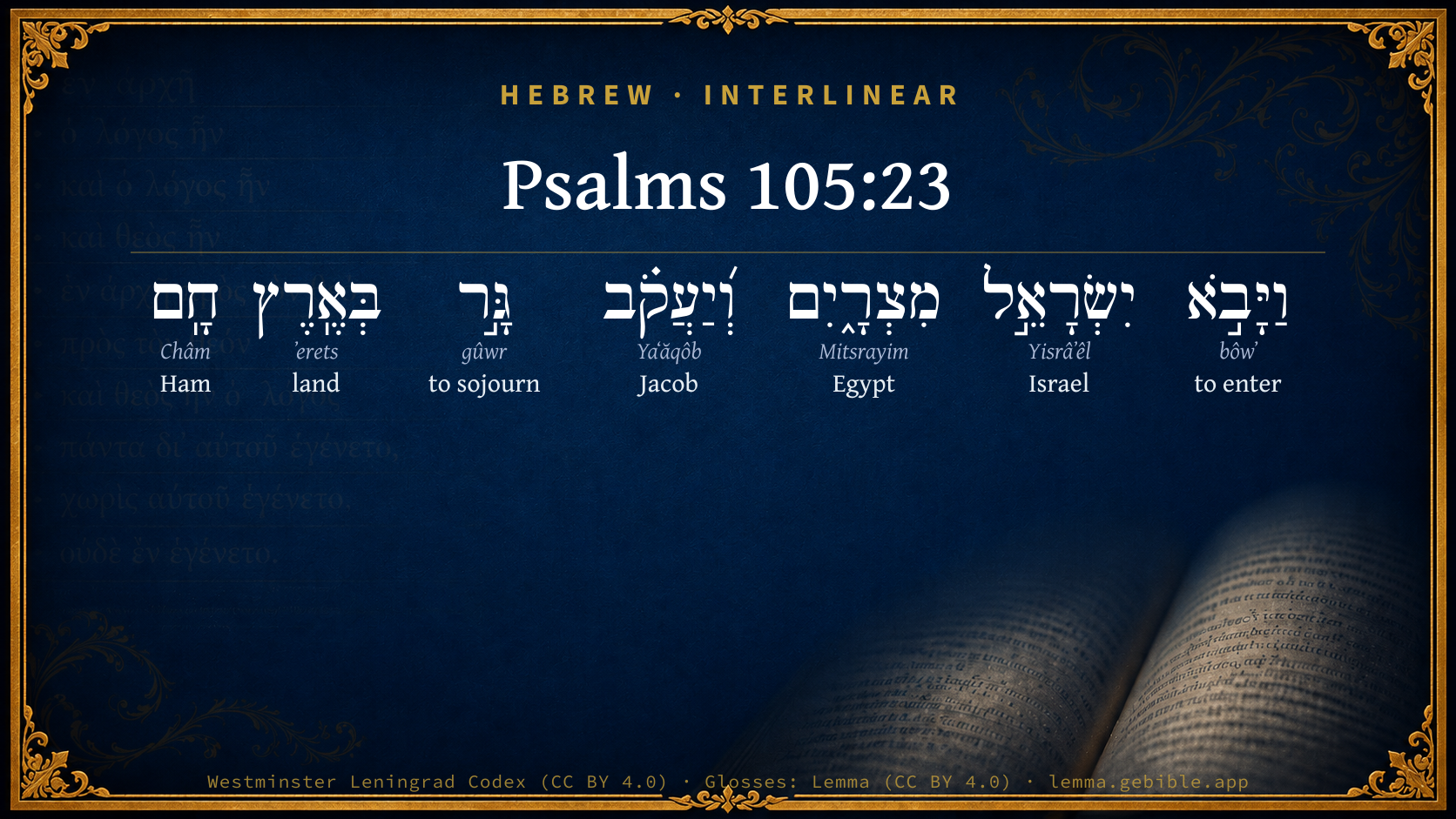
Psalms 105:23

Hebrew (Westminster Leningrad Codex) Psalms 105:23 appears in the Hebrew Old Testament. The text above is from the Westminster Leningrad Codex. Each word links to its Strong’s number, a concise gloss, and parsing drawn from the Open Scriptures Hebrew Bible morphology. Click any word for its full Brown-Driver-Briggs (BDB) entry.
Download image
Cite this verse

Psalms 105:23 (World English Bible). Public Domain. Lemma interlinear Bible study tool, https://lemma.gebible.app/v/psalms/105/23.

Show BibTeX & RIS
BibTeX
RIS
English Translation
Israel also came into Egypt. Jacob sojourned in the land of Ham.
World English Bible · Public Domain
Download a study sheet

One document with this verse’s original text, its word-by-word gloss line, the meaning frame, cross-references with their text, attributed commentary, and full source and license credits — printable, and it pastes into notes with its structure intact.

This verse Autodidact and up

Study sheet (.html) Plain text (.txt)

A passage Seminary Student

Up to 50 verses in one chapter. A passage sheet keeps up to 6 commentary sources and 12 cross-references per verse, in the order this page ranks them, and says so on the sheet whenever that leaves anything out. Ask for a single verse and you get the Autodidact verse sheet above.

Everything on this page stays free to read, with no account — the sheet is a download of what is already on screen, not access to it.

Want to remove ads? Support Godless Engineer
Compare translations 3

The same verse in 3 English versions, stacked beneath the original-language interlinear above. Click any original word for its lexicon entry.

Each is an independent rendering of the whole verse — the interlinear is not word-aligned to these translations.

Highlighted words mark where these versions differ — a whole-verse word diff, not a word-by-word alignment.

  • World English Bible Public Domain
    Israel also came into Egypt. Jacob sojourned in the land of Ham.
  • King James Version Public Domain
    Israel also came into Egypt; and Jacob sojourned in the land of Ham.
  • unfoldingWord Literal Text CC BY-SA 4.0
    Then Israel came into Egypt, and Jacob sojourned in the land of Ham.

unfoldingWord Literal Text — © unfoldingWord, licensed CC BY-SA 4.0. Word-aligned USFM3 via Door43 (git.door43.org/unfoldingWord/en_ult).

Versions to compare (up to 4)

3 of 4 selected

Show all 18 translations

Every available English version of this verse, each an independent rendering of the whole verse.

  • World English Bible Public Domain
    Israel also came into Egypt. Jacob sojourned in the land of Ham.
  • Berean Standard Bible Public Domain
    Then Israel entered Egypt; Jacob dwelt in the land of Ham.
  • Majority Standard Bible Public Domain
    Then Israel entered Egypt; Jacob dwelt in the land of Ham.
  • King James Version Public Domain
    Israel also came into Egypt; and Jacob sojourned in the land of Ham.
  • American Standard Version (1901) Public Domain
    Israel also came into Egypt; And Jacob sojourned in the land of Ham.
  • Revised Version (1885) Public Domain
    Israel also came into Egypt; and Jacob sojourned in the land of Ham.
  • Geneva Bible (1599) Public Domain
    Then Israel came to Egypt, and Iaakob was a stranger in the land of Ham.
  • Douay-Rheims (1899) Public Domain
    And Israel went into Egypt: and Jacob was a sojourner in the land of Cham.
  • Young's Literal Translation Public Domain
    And Israel cometh in to Egypt, And Jacob hath sojourned in the land of Ham.
  • Literal Standard Version CC BY-SA 4.0
    And Israel comes into Egypt, || And Jacob has sojourned in the land of Ham.
  • Unlocked Literal Bible CC BY-SA 4.0
    Then Israel came into Egypt, and Jacob lived for a time in the land of Ham.
  • unfoldingWord Literal Text CC BY-SA 4.0
    Then Israel came into Egypt, and Jacob sojourned in the land of Ham.
  • Darby Bible Public Domain
    And Israel came into Egypt, and Jacob sojourned in the land of Ham.
  • World Messianic Bible Public Domain
    Israel also came into Egypt. Jacob lived in the land of Ham.
  • Webster's Bible Public Domain
    Israel also came into Egypt; and Jacob sojourned in the land of Ham.
  • Free Bible Version CC BY-SA 4.0
    Then Israel entered Egypt—Jacob settled as a foreigner in the land of Ham.
  • Bible in Basic English Public Domain
    Then Israel came into Egypt, and Jacob was living in the land of Ham.
  • JPS Tanakh (1917) Public Domain
    Israel also came into Egypt; and Jacob sojourned in the land of Ham.

Literal Standard Version (2020), Covenant Press — licensed CC BY-SA 4.0. Text via the HelloAO Bible API (eBible.org). Unlocked Literal Bible (unfoldingWord) — licensed CC BY-SA 4.0. Text via the HelloAO Bible API (eBible.org). unfoldingWord Literal Text — © unfoldingWord, licensed CC BY-SA 4.0. Word-aligned USFM3 via Door43 (git.door43.org/unfoldingWord/en_ult). Free Bible Version, Dr. Jonathan Gallagher — licensed CC BY-SA 4.0. Text via the HelloAO Bible API (eBible.org).

Word by word

More ways to search: Search by grammar → Find every occurrence → Compare this word →

Practice this passage: Drill this verse → Learn its vocabulary →

About this verse

These counts appear in no published source. They are computed here, from the morphology-tagged text and Lemma’s own curated glosses. What Lemma adds →

7
words
7
distinct lemmas
Wisdom
section

Notable vocabulary

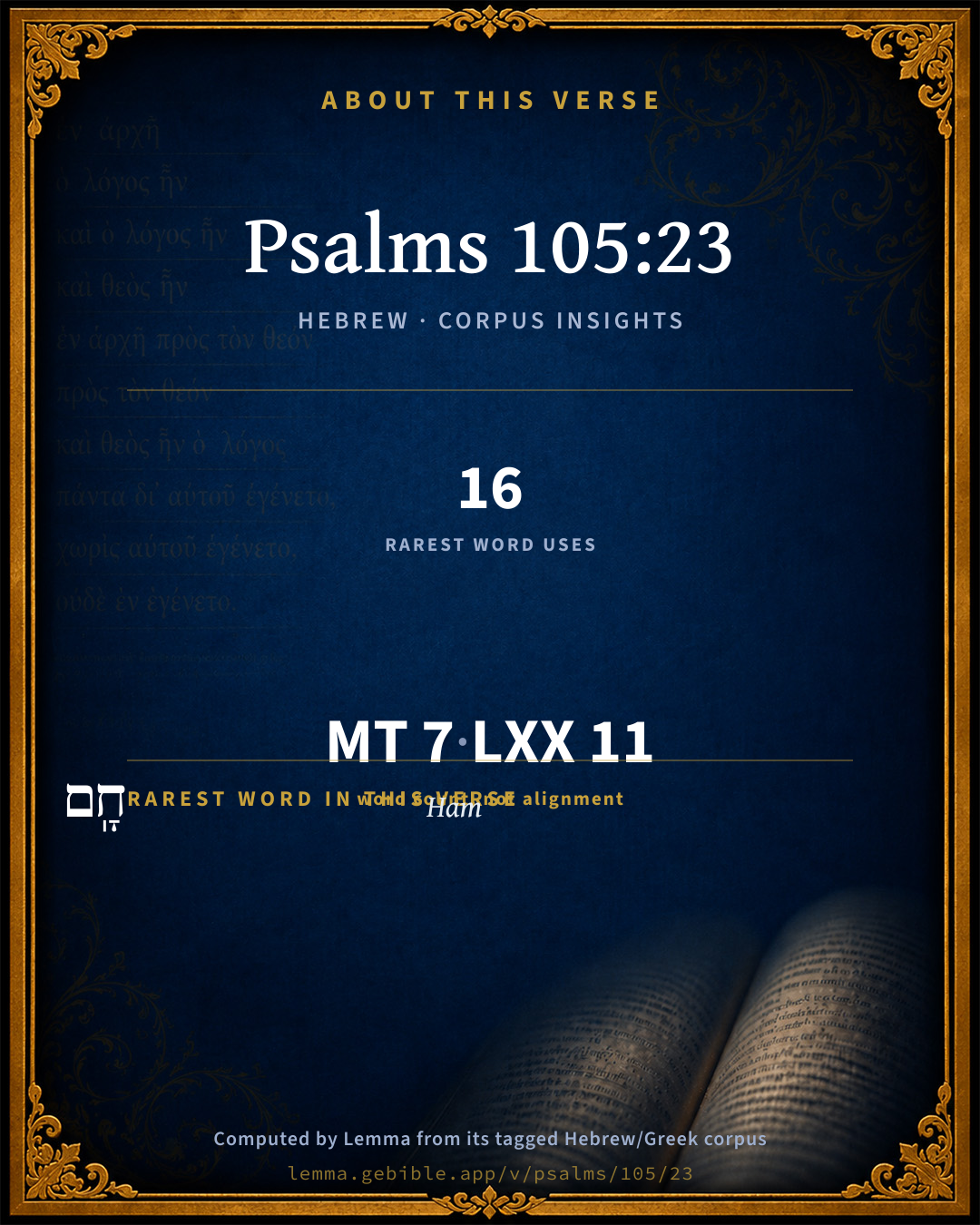
The rarest word here is חָֽם Ham H2526 — appearing just 16 times in the whole Hebrew Bible.

Shared distinctive vocabulary

חָֽם Ham H2526 occurs in 15 verses of the Hebrew Bible. Also found in:

Grammatical profile

  • 2 verbs
  • 5 nouns

Verb forms

  • וַיָּבֹ֣א Qal · Sequential Imperfect
  • גָּ֣ר Qal · Perfect

Hebrew & Septuagint length

In English translation the verse runs 12 words from the Hebrew and 13 from the Septuagint (LXX English) — closely comparable.

A rough comparison of the two English renderings, which tokenize alike — not a word-level alignment.

Word counts can differ between the Hebrew and the Greek without any difference in meaning — e.g. the Hebrew direct-object marker אֵת has no separate Greek word, and Greek often adds the article ὁ.

In the original languages it is 7 Hebrew tokens and 11 Greek tokens — but the two are counted differently (Hebrew bundles its prefixes and suffixes into one token; the Greek is in lemma form), so that isn’t a like-for-like length.

Cross-references

11

Topical passages linked to Psalms 105:23 in the Treasury of Scripture Knowledge — connected by theme and wording, ordered by reader-vote popularity; previews shown in the World English Bible.

  • Acts 7:11–15 Now a famine came over all the land of Egypt and Canaan, and great affliction. Our fathers found no food.
  • Acts 13:17 The God of this people chose our fathers, and exalted the people when they stayed as aliens in the land of Egypt, and with an uplifted arm, he led them out of it.
  • Psalms 78:51 And struck all the firstborn in Egypt, The chief of their strength in the tents of Ham.
  • Psalms 106:22 Wondrous works in the land of Ham, And awesome things by the Red Sea.
  • Genesis 45:9–11 Hurry, and go up to my father, and tell him, 'This is what your son Joseph says, "God has made me lord of all Egypt. Come down to me. Don't wait.
  • Genesis 46:2–7 God spoke to Israel in the visions of the night, and said, "Jacob, Jacob!" He said, "Here I am."
  • Genesis 47:6–9 The land of Egypt is before you. Make your father and your brothers dwell in the best of the land. Let them dwell in the land of Goshen. If you know any able men among them, then put them in charge of my cattle."
  • Genesis 10:6 The sons of Ham: Cush, Mizraim, Put, and Canaan.
  • Genesis 47:28 Jacob lived in the land of Egypt seventeen years. So the days of Jacob, the years of his life, were one hundred forty-seven years.
  • Joshua 24:4 I gave to Isaac Jacob and Esau: and I gave to Esau Mount Seir, to possess it: and Jacob and his children went down into Egypt.
  • Psalms 105:27 They performed miracles among them, And wonders in the land of Ham.

Cross-references courtesy of OpenBible.info (CC BY 4.0).

Hebrew and Greek witnesses Masoretic Hebrew ↔ Greek Septuagint

The same verse in the two great witnesses to the Old Testament, shown verse-for-verse.

You’re reading Greek Psalm 104 (Hebrew Psalm 105). The Septuagint counts the superscription, so verse numbers can differ from the Hebrew — chapter-level alignment, not verse-by-verse. Numbering follows Rahlfs.

These are two independent witnesses, not word-aligned to each other, and the Septuagint is shown in lemma (dictionary) form.

Hebrew Psalms 105:23 Masoretic · Westminster Leningrad Codex

וַיָּבֹ֣א יִשְׂרָאֵ֣ל מִצְרָ֑יִם וְ֝יַעֲקֹ֗ב גָּ֣ר בְּאֶֽרֶץ חָֽם

Israel also came into Egypt. Jacob sojourned in the land of Ham.

World English Bible · Public Domain

Greek LXX Greek Psalm 104:23 Septuagint · lemma form

καί εἰςἔρχομαι ἰσραήλ εἰς αἴγυπτος καί ἰακώβ παραοἰκέω ἐν γῆ χαμ

Israel also came into Egypt, and Jacob sojourned in the land of Cham.

LXX2012 (modern English Septuagint) · Public Domain

Hebrew: Westminster Leningrad Codex (CC BY 4.0). Greek: Septuagint (public domain); English from LXX2012 (modern English Septuagint) (Public Domain). How the Septuagint differs from the Hebrew →

Commentary

Notes on Psalms 105:23 from classic Christian and Jewish commentators (each source and its license shown beneath its notes). The classic Christian expositions comment on the surrounding passage and are grouped to its opening verse, so a note may address several verses; the Jewish commentaries on the Tanakh (Rashi and others) are per-verse, so they appear only where the commentator wrote on this verse.

Lemma curates 59 commentaries, every one of them public domain or Creative Commons licensed, each selected and text-cleaned for this edition rather than reprinted as found. About our sources →

Trapp's Complete Commentary

John Trapp

Psa 105:23 Israel also came into Egypt; and Jacob sojourned in the land of Ham.

Ver. 23. Israel also came into Egypt] Whither he feared to go, till God promised him his presence and protection, Gen 46:3-4. God saith the same in effect to us, when to descend into the grave, Fear not to go down, I will go down with thee, and be better to thee than thy fears. Jacob’s best and happiest days were those he spent in Egypt.

John Trapp, A Commentary or Exposition upon All the Books of the Old and New Testament (1647–1656) — public domain. Text from a community e-Sword module.

Joseph Benson's Commentary

Psa 105:23-24. Israel also — Jacob in person, with his children; came into Egypt — Where he and all his were very comfortably and honourably provided for many years. Thus the New Testament church has a place provided for her, even in the wilderness, where she is nourished for a time, times, and half a time, Rev 12:14. Jacob sojourned in the land of Ham — Ham was the father of Mizraim, or the Egyptians, Gen 10:6. And he, God, increased the people greatly — According to the promise made to Abraham, that his seed should be as the sand of the sea for multitude; and made them stronger than their enemies — More and mightier, according to Pharaoh’s confession, Exo 1:9, than the Egyptians, who, of friends, were now become their enemies.

Joseph Benson's Commentary on the Old and New Testaments (1811–1818) — public domain. Text from a community e-Sword module.

J. A. Alexander on Psalms

Joseph Addison Alexander

23. (Psa 105:23) And (so) Israel entered Egypt, and Jacob sojourned in the land of Ham. This was the main event, to which those just recited were preparatory. Israel and Jacob are the names both of the individual patriarch and of his descendants as a nation. In this case both the applications are admissible, or rather requisite, in order to exhaust the writer's meaning. The patriarch himself came into Egypt, but his sons literally came with him, and all his descendants figuratively in him. The land of Ham, from whom Mizraim was descended. See above, on Psa 78:51.

Joseph Addison Alexander, The Psalms Translated and Explained (1850) — public domain. Text from a community e-Sword module.

Tyndale Open Study Notes

Tyndale Open Resources

105:23-25 These verses tell the story of Israel’s affliction in Egypt (see Exod 1:1-14).

105:23 Egypt (Hebrew mitsrayim) is called the land of Ham.

Tyndale Open Study Notes — © Tyndale Open Resources, licensed CC BY-SA 4.0. Text via the HelloAO Bible API.

John Calvin's Commentaries

23. And Israel came into Egypt The prophet does not rehearse the whole history, nor was this necessary. He only presents to our view how divine providence was concerned in it, which very few consider in reading the narrative of Moses. He accordingly declares, that after Joseph had been sent before into Egypt, to be the means of supporting his father and the whole family, Jacob then came into Egypt, that is, he did so when all things were admirably arranged, that he might find abundance of bread among a people, the proudest of the whole world, when all others were perishing for want of food. From this it appears, that what is accounted to be slowness in God, tends to no other end than to accomplish his work on the best possible occasion.

John Calvin's Commentaries (1540-1563) — public domain. Text from the Calvin Translation Society English edition (1840s-50s) via the Christian Classics Ethereal Library (ccel.org). Calvin's coverage is partial (roughly two-thirds of the Bible); uncommented books and verses are honest gaps, never fabricated. The 19th-century editor's footnotes and remarks are omitted so the notes are faithfully Calvin's own voice.

The Cambridge Bible for Schools and Colleges

gen. ed. J. J. S. Perowne

23. Israel also] So Israel; the great ancestor of the nation is still meant.

the land of Ham] Cp. Psa_105:27; Psa_78:51.

The Cambridge Bible for Schools and Colleges (gen. ed. J. J. S. Perowne; Cambridge University Press, 1878–1918) — public domain. Text from a community e-Sword module.

John Gill's Exposition

Israel also came into Egypt,.... That is, Jacob, as afterwards expressed, who had the name of Israel, from his wrestling with God and prevailing. He came into Egypt, being invited by Pharaoh, and having heard of his son Joseph being alive, and of his exaltation.

And Jacob sojourned in the land of Ham: the same with Egypt; Mizraim, from whence Egypt has its name, being the son of Ham, Gen 10:6. Hence Egypt is called by Plutarch (k) Chemia; and Diodorus Siculus (l) speaks of a city in Thebais, or Upper Egypt, which was called by the inhabitants Chemmis, interpreted by them the city of Pan; and Plutarch (m) mentions a place called Chennis, inhabited by Pans and Satyrs. The same is mentioned by Herodotus (n), which he calls a large city of the Thebaic nome; a city of the same name is observed by Heliodorus (o); and both Herodotus (p) and Mela (q) speak of an island called Chemmis, which the Egyptians represent as floating. In all which there are plain traces of the name of Ham, the same with Jupiter Ammon; or Amun, as Plutarch; worshipped in Egypt; and from whom all Africa was sometimes called Ammonia (r), the country of Ammon or Ham. And Herodotus (s) speaks of a people called Ammonii, about ten days' journey from Thebes in Upper Egypt; who, according to him (t), had their name from Jupiter Ammon, or Ham. And Pliny (u) makes mention of the oracle of Hammon, as twelve days' journey from Memphis, and of the Hammoniac nome; and the Egyptian priests are called Ammmonean (w). Here Jacob was a sojourner, as all the Lord's people are in this world; they are sojourners, as all their fathers were; and their time here is a time of sojourning, Ch1 29:15. They are not natives of the place where they are; they are indeed so by their first birth, but not by their new birth; being born from above, they belong to another place, are citizens of another city; their house, estate, and inheritance, are in heaven: neither their settlement nor satisfaction are here; they do not reckon themselves at home while they are in this world; they are indeed in an enemy's country, in a cursed land; or that is nigh unto cursing, and its end to be burned. Such the land of Ham was, where Jacob sojourned.

(k) De Iside. (l) Biblioth. l. 1. p. 16. (m) Ut supra. (De Iside.) (n) Euterpe sive, l. 2. c. 91. (o) Ethiopic. l. 5. c. 9. & l. 6. c. 4. (p) Ut supra, (Euterpe sive, l. 2.) c. 156. (q) De Situ Orbis, l. 1. c. 9. (r) Stephanus de Urb. (s) Melpomene sive, l. 4. c. 181. (t) Euterpe sive, l. 2. c. 32, 42. (u) Nat. Hist. l. 5. c. 9. (w) Sanchoniatho apud Euseb. Praepar. Evangel. l. 1. p. 32.

John Gill's Exposition of the Whole Bible (1746–1763) — public domain (CC PDM 1.0). Text via the HelloAO Bible API.

Albert Barnes' Notes on the Bible

Israel also came into Egypt - Another name for Jacob; see Psa 105:10.

And Jacob sojourned in the land of Ham - Not as a permanent abode, but as a temporary arrangement, until the time should come for the people to be removed to the land of promise. See Gen 46:6. The more literal rendering would be, “Jacob was a stranger - a foreigner - in the land of Ham.” On the meaning of the word “Ham,” see the notes at Psa 78:51.

Albert Barnes' Notes on the Bible (1834–1885) — public domain. Text from a community e-Sword/MySword module.

Matthew Poole's English Annotations

Israel; Jacob in his person, and with his children. Of Ham, i.e. Egypt, so called here, also Psa 78:5; 106:22; from that cursed Ham, Gen 9:22, who was the father of Mizraim, or the Egyptians, Gen 10:6. And the psalmist seems to call it by this name, to intimate that they were the people of God’s curse, and thereby to caution the Israelites against returning to that land, which they were particularly forbidden to do, Deu 17:16.

Matthew Poole's English Annotations on the Holy Bible (1683–1685) — public domain. Text from a community e-Sword/MySword module.

The Treasury of David

Charles H. Spurgeon

Ver. 23. Israel also came into Egypt. The aged patriarch came, and with him that increasing company which bore his name. He was hard to bring there. Perhaps nothing short of the hope of seeing Joseph could have drawn him to take so long a journey from the tombs of his forefathers; but the divine will was accomplished and the church of God was removed into an enemy's country, where for a while it was nourished.

And Jacob sojourned in the land of Ham. Shem the blessed came to lodge awhile with Ham the accursed: the dove was in the vulture's nest. God so willed it for a time, and therefore it was safe and right: still it was only a sojourn, not a settlement. The fairest Goshen in Egypt was not the covenant blessing, neither did the Lord mean his people to think it so; even so to us "earth is our lodge" but only our lodge, for heaven is our home. When we are best housed we ought still to remember that here we have no continuing city. It were ill news for us if we were doomed to reside in Egypt for ever, for all its riches are not worthy to be compared with the reproach of Christ.

Thus the song rehearsed the removals of the Lord's people, and was a most fit accompaniment to the bearing up of the ark, as the priest carried it into the city of David, where the Lord had appointed it a resting place.

Ver. 23. Egypt...the land of Ham. The Egyptians were a branch of the race of Ham. They came from Asia through the desert of Syria to settle in the valley of the Nile. This is a fact clearly established by science, and entirely confirms the statements of the book of Genesis. F. Lenormant and E. Chevalier, in "A Manual of Ancient History, "1869.

Psalms 105:24*

Charles H. Spurgeon's The Treasury of David (1869–1885) — public domain. Psalms only. Text from a community e-Sword/MySword module.

Whedon's Commentary on the Bible

Daniel D. Whedon

23. Israel… came into Egypt—This, with its results, explains the wonderful story of Joseph, or of divine providence concerning him.

Land of Ham—So called from Ham, the father of Mizraim, which latter settled Egypt. Gen_10:6. Egypt is everywhere called “Mizraim” in the Hebrew Scriptures. Egypt is its Greek name.

Daniel D. Whedon (gen. ed.), Commentary on the Old and New Testaments (1874–1909) — public domain. Text from a community e-Sword module.

The Pulpit Commentary

Israel also came into Egypt; and Jacob. (For the conjunction of both names of the patriarch, see ver. 10. For the journey of the Patriarch from Canaan into Egypt, see Gen_46:1-7) Sojourned in the land of Ham; or, was a sojourner. As a "stranger" and a "sojourner," Jacob charged his sons not to bury him in Egypt, but in the land of Canaan, with his fathers. (Gen_49:29 Gen_50:5) (For the use of the periphrasis, "land of Ham," instead of Egypt, see below, ver. 27; and comp. Psa_106:22)

Vers. 23-25. Disciplinary experience.

It is singular that in ver. 25 God should be spoken of as the agent in turning the hearts of the Egyptians to hate his people. Some would soften the expression, and make it mean only that God suffered the hostility arising from the increase of the people. But there is no difficulty when once we see that God"s dealings with us are disciplinary; that he uses the ordinary events of life for his disciplinary purposes, and that in a poem he may be said to arrange and control the events which he uses for his moral ends.

I ALL HUMAN LIFE IS DISCIPLINARY. It is precisely this that ennobles human life, and distinguishes it from the life of the brute. The events and relations of life do nothing for the animal save complete its animal nature. The events and relations of life mould and train man. He is the better or the worse, morally, for every incident of his career, and for every person with whom he comes in contact. To say that a thing is testing, or trying, is to say that it has a culturing force in it; it has a moral aim. Self-mastery can only be won through discipline.

II DISCIPLINE COMES THROUGH THINGS THAT ARE GOOD. Here, in the case of Israel, our attention is directed to that swift increase of population which is the best idea of national good (ver. 24). It is representative of the successes which God often gives men. But the disciplinary feature of world success is not sufficiently recognized. No severer strain is put on men"s characters than that which comes by letting them succeed. Gaining wealth or fame has overstrained many a man. Moral character failed under the strain.

III DISCIPLINE COMES THROUGH THINGS THAT ARE MYSTERIOUS. The sphere of the mysterious enlarges as we grow in knowledge and experience. The young student can explain everything. The grey-haired professor can explain nothing. Discipline comes by finding that we cannot know. It tests whether we can believe, and let faith give its tone to life. Science boasts that it knows, but science can do nothing without the scientific imagination; and that brings in the element of uncertainty.

IV DISCIPLINE COMES THROUGH THINGS THAT ARE EVIL. This is true in both senses of the word "evil," which may mean "wicked" or "calamitous." Israel was disciplined through the hatred of Pharaoh, and also through the sufferings of their lot. The sanctifying power of affliction for Christians is often dwelt on; the disciplinary power of hard and trying circumstances, for every one, needs fuller and wiser treatment. R.T.

The Pulpit Commentary (1880–1919), ed. H.D.M. Spence-Jones & Joseph S. Exell — public domain. Text from a community e-Sword module.

John Wesley's Explanatory Notes

Ham - Ham was the father of Mizraim, or the Egyptians, Gen. x, 6.

John Wesley, Explanatory Notes Upon the Whole Bible (1754–1765) — public domain. Text via the GEBible commentary corpus.

Lesson kit

Teaching starters — assembled from the data on this page, not authored interpretation. Every prompt links to the verse data it draws on. Edit before teaching.

Psalms, in the Wisdom, opens this verse with 7 words (7 distinct Hebrew lemmas). Its most distinctive word is Châm (“Ham”). A historical commentator’s framing appears above. Read the whole chapter for the surrounding context.

Discussion questions

  1. What does “Ham” (Châm) contribute to the verse as a whole?
  2. How does Genesis 5:32, which shares the word «Ham», read alongside this verse?
  3. These translations render this verse differently. What is at stake in choosing one wording over another?
  4. «וַיָּבֹ֣א» is a Qal Sequential Imperfect verb. How does that grammatical form shape the action described?
  5. Compare how Trapp's Complete Commentary and Joseph Benson's Commentary read this verse. Where do they agree or differ?

Things to notice

Reading settings

Reading text

Shown beneath each verse's original-language words.

Old Testament
Old Testament edition

Read the OT as the Masoretic Hebrew (MT) or the Greek Septuagint (LXX).

English shown for the Greek Septuagint (in the Hebrew ↔ Greek comparison).

Comparing translations? Open the Compare panel on any verse page to stack up to four side by side.