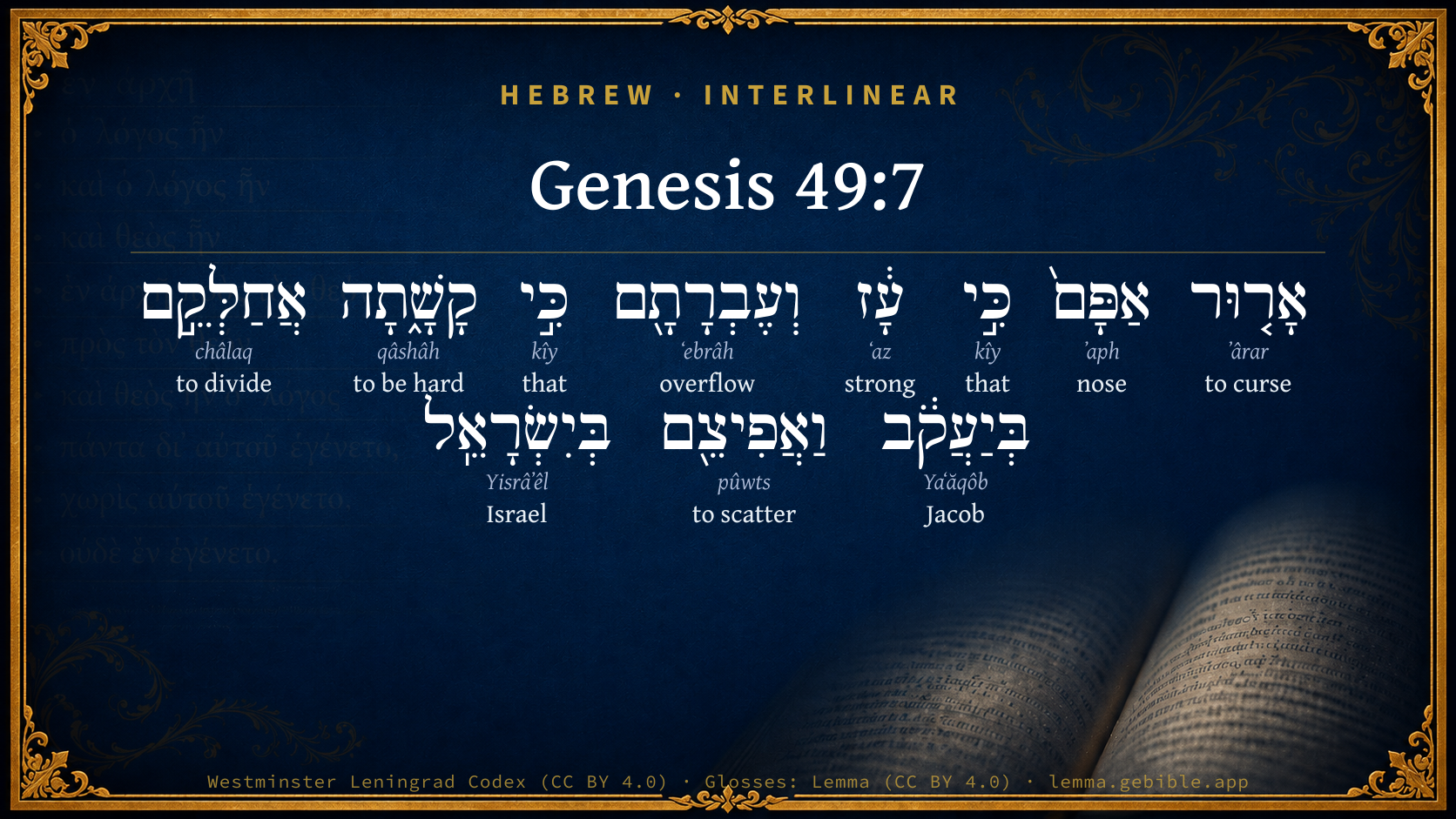
Genesis 49:7

Hebrew (Westminster Leningrad Codex) Genesis 49:7 appears in the Hebrew Old Testament. The text above is from the Westminster Leningrad Codex. Each word links to its Strong’s number, a concise gloss, and parsing drawn from the Open Scriptures Hebrew Bible morphology. Click any word for its full Brown-Driver-Briggs (BDB) entry.
Download image
Cite this verse

Genesis 49:7 (World English Bible). Public Domain. Lemma interlinear Bible study tool, https://lemma.gebible.app/v/genesis/49/7.

Show BibTeX & RIS
BibTeX
RIS
English Translation
Cursed be their anger, for it was fierce; And their wrath, for it was cruel. I will divide them in Jacob, Scatter them in Israel.
World English Bible · Public Domain
Highlights
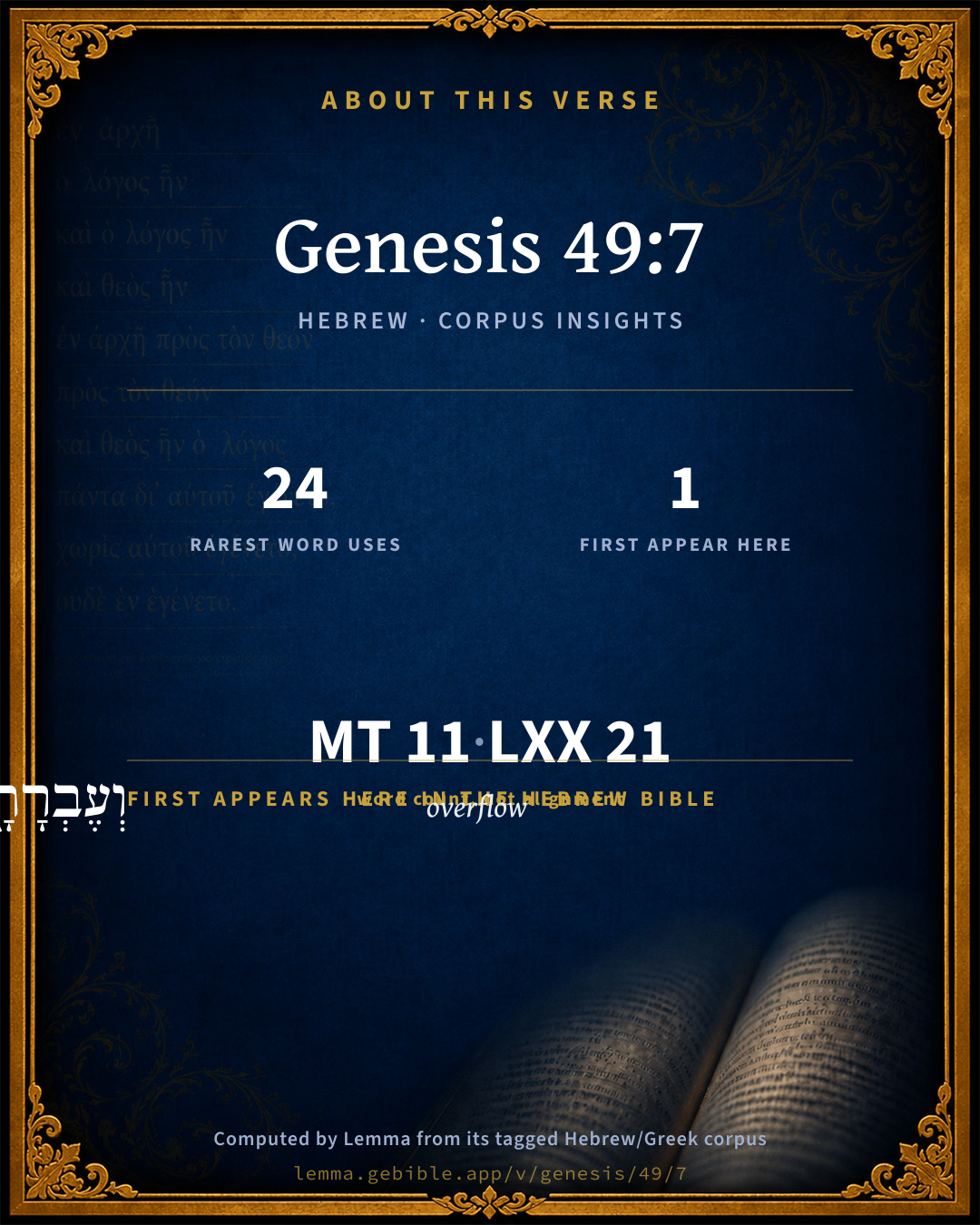
  • 1 first appearance in the Hebrew Bible
Full analysis ↓
Download a study sheet

One document with this verse’s original text, its word-by-word gloss line, the meaning frame, cross-references with their text, attributed commentary, and full source and license credits — printable, and it pastes into notes with its structure intact.

This verse Autodidact and up

Study sheet (.html) Plain text (.txt)

A passage Seminary Student

Up to 50 verses in one chapter. A passage sheet keeps up to 6 commentary sources and 12 cross-references per verse, in the order this page ranks them, and says so on the sheet whenever that leaves anything out. Ask for a single verse and you get the Autodidact verse sheet above.

Everything on this page stays free to read, with no account — the sheet is a download of what is already on screen, not access to it.

Want to remove ads? Support Godless Engineer
Compare translations 3

The same verse in 3 English versions, stacked beneath the original-language interlinear above. Click any original word for its lexicon entry.

Each is an independent rendering of the whole verse — the interlinear is not word-aligned to these translations.

Highlighted words mark where these versions differ — a whole-verse word diff, not a word-by-word alignment.

  • World English Bible Public Domain
    Cursed be their anger, for it was fierce; And their wrath, for it was cruel. I will divide them in Jacob, Scatter them in Israel.
  • King James Version Public Domain
    Cursed be their anger, for it was fierce; and their wrath, for it was cruel: I will divide them in Jacob, and scatter them in Israel.
  • unfoldingWord Literal Text CC BY-SA 4.0
    Cursed their anger because strong, and their fury because cruel! I will divide them in Jacob, and I will scatter them in Israel. ts\*

unfoldingWord Literal Text — © unfoldingWord, licensed CC BY-SA 4.0. Word-aligned USFM3 via Door43 (git.door43.org/unfoldingWord/en_ult).

Versions to compare (up to 4)

3 of 4 selected

Show all 18 translations

Every available English version of this verse, each an independent rendering of the whole verse.

  • World English Bible Public Domain
    Cursed be their anger, for it was fierce; And their wrath, for it was cruel. I will divide them in Jacob, Scatter them in Israel.
  • Berean Standard Bible Public Domain
    Cursed be their anger, for it is strong, and their wrath, for it is cruel! I will disperse them in Jacob and scatter them in Israel.
  • Majority Standard Bible Public Domain
    Cursed be their anger, for it is strong, and their wrath, for it is cruel! I will disperse them in Jacob and scatter them in Israel.
  • King James Version Public Domain
    Cursed be their anger, for it was fierce; and their wrath, for it was cruel: I will divide them in Jacob, and scatter them in Israel.
  • American Standard Version (1901) Public Domain
    Cursed be their anger, for it was fierce; And their wrath, for it was cruel: I will divide them in Jacob, And scatter them in Israel.
  • Revised Version (1885) Public Domain
    Cursed be their anger, for it was fierce; And their wrath, for it was cruel: I will divide them in Jacob, And scatter them in Israel.
  • Geneva Bible (1599) Public Domain
    Cursed be their wrath, for it was fierce, and their rage, for it was cruell: I will deuide them in Iaakob, and scatter them in Israel.
  • Douay-Rheims (1899) Public Domain
    Cursed be their fury, because it was stubborn: and their wrath because it was cruel: I Will divide them in Jacob, and will scatter them in Israel.
  • Young's Literal Translation Public Domain
    Cursed `is' their anger, for `it is' fierce, And their wrath, for `it is' sharp; I divide them in Jacob, And I scatter them in Israel.
  • Literal Standard Version CC BY-SA 4.0
    Cursed [is] their anger, for [it is] fierce, || And their wrath, for [it is] sharp; I divide them in Jacob, || And I scatter them in Israel.
  • Unlocked Literal Bible CC BY-SA 4.0
    May their anger be cursed, for it was fierce—and their fury, for it was cruel. I will divide them in Jacob and scatter them in Israel.
  • unfoldingWord Literal Text CC BY-SA 4.0
    Cursed their anger because strong, and their fury because cruel! I will divide them in Jacob, and I will scatter them in Israel. ts\*
  • Darby Bible Public Domain
    Cursed be their anger, for it [was] violent; And their rage, for it [was] cruel! I will divide them in Jacob, And scatter them in Israel.
  • World Messianic Bible Public Domain
    Cursed be their anger, for it was fierce; and their wrath, for it was cruel. I will divide them in Jacob, and scatter them in Israel.
  • Webster's Bible Public Domain
    Cursed be their anger, for it was fierce: and their wrath, for it was cruel: I will divide them in Jacob, and scatter them in Israel.
  • Free Bible Version CC BY-SA 4.0
    I curse their anger because it is too harsh; I curse their fury because it is too cruel! I will separate their descendants throughout Jacob; I will scatter them throughout Israel.
  • Bible in Basic English Public Domain
    A curse on their passion for it was bitter; and on their wrath for it was cruel. I will let their heritage in Jacob be broken up, driving them from their places in Israel.
  • JPS Tanakh (1917) Public Domain
    Cursed be their anger, for it was fierce, and their wrath, for it was cruel; I will divide them in Jacob, and scatter them in Israel.

Literal Standard Version (2020), Covenant Press — licensed CC BY-SA 4.0. Text via the HelloAO Bible API (eBible.org). Unlocked Literal Bible (unfoldingWord) — licensed CC BY-SA 4.0. Text via the HelloAO Bible API (eBible.org). unfoldingWord Literal Text — © unfoldingWord, licensed CC BY-SA 4.0. Word-aligned USFM3 via Door43 (git.door43.org/unfoldingWord/en_ult). Free Bible Version, Dr. Jonathan Gallagher — licensed CC BY-SA 4.0. Text via the HelloAO Bible API (eBible.org).

Word by word

More ways to search: Search by grammar → Find every occurrence → Compare this word →

Practice this passage: Drill this verse → Learn its vocabulary →

עָ֔ז
ʻaz
H5794
“strong”
Adjective, Adjective, Masculine, Singular, Absolute
Part of Speech
Adjective
Type
Adjective
Gender
Masculine
Number
Singular
State
Absolute
Full BDB Definition

Origin: from H5810

TWOT: 1596a

strong, mighty, fierce
  1. אָר֤וּר ʼârar H779 “cursed” Verb, Qal, Participle Passive, Masculine, Singular, Absolute
  2. אַפָּם֙ ʼaph H639 “nose · their” Noun, Common, Masculine, Singular, Construct + Suffix, Personal, 3rd Person, Masculine, Plural
  3. כִּ֣י kîy H3588 “that” Conjunction
  4. וְעֶבְרָתָ֖ם ʻebrâh H5678 “and · overflow · their” Conjunction + Noun, Common, Feminine, Singular, Construct + Suffix, Personal, 3rd Person, Masculine, Plural
  5. כִּ֣י kîy H3588 “that” Conjunction
  6. קָשָׁ֑תָה qâshâh H7185 “to be hard” Verb, Qal, Perfect, 3rd Person, Feminine, Singular
  7. אֲחַלְּקֵ֣ם châlaq H2505 “to divide · them” Verb, Piel, Imperfect, 1st Person, Common, Singular + Suffix, Personal, 3rd Person, Masculine, Plural
  8. בְּיַעֲקֹ֔ב Yaʻăqôb H3290 “in/at · Jacob” Preposition + Noun, Proper
  9. וַאֲפִיצֵ֖ם pûwts H6327 “and · to scatter · them” Conjunction + Verb, Hiphil, Imperfect, 1st Person, Common, Singular + Suffix, Personal, 3rd Person, Masculine, Plural
  10. בְּיִשְׂרָאֵֽל Yisrâʼêl H3478 “in/at · Israel” Preposition + Noun, Proper

About this verse

These counts appear in no published source. They are computed here, from the morphology-tagged text and Lemma’s own curated glosses. What Lemma adds →

11
words
10
distinct lemmas
Pentateuch
section

Notable vocabulary

The rarest word here is עָ֔ז strong H5794 — appearing just 24 times in the whole Hebrew Bible.

First appearance in Scripture

This word makes its first canonical appearance in the Hebrew Bible here:

  • וְעֶבְרָתָ֖ם overflow H5678

Shared distinctive vocabulary

עָ֔ז strong H5794 occurs in 24 verses of the Hebrew Bible. Also found in:

Grammatical profile

  • 4 verbs
  • 4 nouns
  • 1 adjective
  • 2 conjunctions

Verb forms

  • אָר֤וּר Qal · Participle Passive
  • קָשָׁ֑תָה Qal · Perfect
  • אֲחַלְּקֵ֣ם Piel · Imperfect
  • וַאֲפִיצֵ֖ם Hiphil · Imperfect

Repetition

A word recurs within this verse — often emphatic in Hebrew:

  • כִּ֣י that H3588 ×2

Hebrew & Septuagint length

In English translation the verse runs 25 words from the Hebrew and 26 from the Septuagint (LXX English) — closely comparable.

A rough comparison of the two English renderings, which tokenize alike — not a word-level alignment.

Word counts can differ between the Hebrew and the Greek without any difference in meaning — e.g. the Hebrew direct-object marker אֵת has no separate Greek word, and Greek often adds the article ὁ.

In the original languages it is 11 Hebrew tokens and 21 Greek tokens — but the two are counted differently (Hebrew bundles its prefixes and suffixes into one token; the Greek is in lemma form), so that isn’t a like-for-like length.

Cross-references

9

Topical passages linked to Genesis 49:7 in the Treasury of Scripture Knowledge — connected by theme and wording, ordered by reader-vote popularity; previews shown in the World English Bible.

  • Joshua 19:1–9 The second lot came out for Simeon, even for the tribe of the children of Simeon according to their families: and their inheritance was in the midst of the inheritance of the children of Judah.
  • 1 Chronicles 4:24–31 The sons of Simeon: Nemuel, and Jamin, Jarib, Zerah, Shaul;
  • 1 Chronicles 6:65 They gave by lot out of the tribe of the children of Judah, and out of the tribe of the children of Simeon, and out of the tribe of the children of Benjamin, these cities which are mentioned by name.
  • Joshua 21:1–45 Then came near the heads of fathers' [houses] of the Levites to Eleazar the priest, and to Joshua the son of Nun, and to the heads of fathers' [houses] of the tribes of the children of Israel;
  • 2 Samuel 13:15 Then Amnon hated her with exceeding great hatred; for the hatred with which he hated her was greater than the love with which he had loved her. Amnon said to her, Arise, be gone.
  • 2 Samuel 13:22–28 Absalom spoke to Amnon neither good nor bad; for Absalom hated Amnon, because he had forced his sister Tamar.
  • 1 Chronicles 4:39–40 They went to the entrance of Gedor, even to the east side of the valley, to seek pasture for their flocks.
  • Proverbs 26:24–25 A malicious man disguises himself with his lips, But he harbors evil in his heart.
  • Proverbs 27:3 A stone is heavy, And sand is a burden; But a fool's provocation is heavier than both.

Cross-references courtesy of OpenBible.info (CC BY 4.0).

Hebrew and Greek witnesses Masoretic Hebrew ↔ Greek Septuagint

The same verse in the two great witnesses to the Old Testament, shown verse-for-verse.

These are two independent witnesses, not word-aligned to each other, and the Septuagint is shown in lemma (dictionary) form.

Hebrew Genesis 49:7 Masoretic · Westminster Leningrad Codex

אָר֤וּר אַפָּם֙ כִּ֣י עָ֔ז וְעֶבְרָתָ֖ם כִּ֣י קָשָׁ֑תָה אֲחַלְּקֵ֣ם בְּיַעֲקֹ֔ב וַאֲפִיצֵ֖ם בְּיִשְׂרָאֵֽל

Cursed be their anger, for it was fierce; And their wrath, for it was cruel. I will divide them in Jacob, Scatter them in Israel.

World English Bible · Public Domain

Greek LXX Genesis 49:7 Septuagint · lemma form

ἐπικατάρατος ὁ θυμός αὐτός ὅτι αὐθάδης καί ὁ μῆνις αὐτός ὅτι σκληρύνω διαμερίζω αὐτός ἐν ἰακώβ καί διασπείρω αὐτός ἐν ἰσραήλ

Cursed be their wrath, for it was willful, and their anger, for it was cruel: I will divide them in Jacob, and scatter them in Israel.

LXX2012 (modern English Septuagint) · Public Domain

Hebrew: Westminster Leningrad Codex (CC BY 4.0). Greek: Septuagint (public domain); English from LXX2012 (modern English Septuagint) (Public Domain). How the Septuagint differs from the Hebrew →

Targum (Aramaic paraphrase)

2

The Targum is the ancient Jewish Aramaic paraphrase of the Hebrew Scriptures — an interpretive translation, not the Hebrew text itself. Onkelos (literal) and Pseudo-Jonathan (expansive) render the Torah, and Jonathan the Prophets. Coverage is partial: where no permissively-licensed English translation exists for a verse, only the Aramaic is shown. This is verse-level text, not a word-by-word alignment to the Hebrew.

  1. Targum Onkelos Torah (Genesis–Deuteronomy)
    לִיט רָגְזְהוֹן אֲרֵי תַקִיף וְחֵמַתְהוֹן אֲרֵי קַשְׁיָא אֲפַלְגִנוּן בְּיַעֲקֹב וְאֵבַדָרִנוּן בְּיִשְׂרָאֵל

    (no public-domain English translation for this verse)

    Targum Onkelos — Aramaic: “Onkelos Genesis” (public domain); “Onkelos Exodus” (public domain); “Onkelos Leviticus” (public domain); “Onkelos Numbers” (public domain); “Onkelos Deuteronomy” (public domain). English: “Sefaria Community Translation” (CC0 1.0 (public-domain dedication)); “J.W. Etheridge. The Targums of Onkelos and Jonathan Ben Uzziel on the Pentateuch. London: Longmans, Green, 1862” (public domain). Text via Sefaria.

  2. Targum Pseudo-Jonathan Torah (Genesis–Deuteronomy)
    אֲמַר יַעֲקב לוּט הֲוָה כְּרַכָּא דִשְׁכֶם כַּד עָלוּן לְגַוָהּ לִמְחַרְבָהּ בְּרוּגְזֵיהוֹן דְתַּקִיף וְחֵמַתְהוֹן עַל יוֹסֵף אֲרוּם קַשְׁיָא אָמַר יַעֲקב אִין שַׁרְיַין הִינוּן תְּרֵיהוֹן כַּחֲדָא לֵית מְלִיךְ וְשׁוּלְטַן דִיקוּם קָדָמֵיהוֹן אַפְלִיג אַחְסָנַת בְּנוֹי דְשִׁמְעוֹן לִתְּרֵין חוּלְקִין חוּלַק חַד יִפּוֹק לֵיהּ מִגוֹ אַחְסָנַת בְּנֵי יְהוּדָה וְחוּלַק חַד בֵּינֵי שְׁאַר שִׁבְטַיָא דְיַעֲקב וַאֲבַדַר שִׁבְטָא דְלֵוִי בְּגוֹ כֻלְהוֹן שִׁבְטַיָא דְיִשְרָאֵל

    And Jakob said, Accursed was the town of Shekem, when they entered within it to destroy it in their violent wrath; and their hatred against Joseph, for it was relentless. If, said Jakob, they dwell together, no king nor ruler may stand before them. Therefore will I divide the inheritance of the sons of Shimeon into two portions; one part shall come to them out of the inheritance of the sons of Jehuda, and one part from among the rest of the tribes of Jakob; and the tribe of Levi I will disperse among all the tribes of Israel.

    Targum Pseudo-Jonathan — Aramaic: “Targum Jonathan on Genesis” (public domain); “Targum Jonathan on Exodus” (public domain); “Targum Jonathan on Leviticus” (public domain); “Targum Jonathan on Numbers” (public domain); “Targum Jonathan on Deuteronomy” (public domain). English: “The Targum of Jonathan ben Uzziel, trans. J. W. Etheridge, London, 1862” (public domain). Text via Sefaria.

Commentary

Notes on Genesis 49:7 from classic Christian and Jewish commentators (each source and its license shown beneath its notes). The classic Christian expositions comment on the surrounding passage and are grouped to its opening verse, so a note may address several verses; the Jewish commentaries on the Tanakh (Rashi and others) are per-verse, so they appear only where the commentator wrote on this verse.

Lemma curates 59 commentaries, every one of them public domain or Creative Commons licensed, each selected and text-cleaned for this edition rather than reprinted as found. About our sources →

Trapp's Complete Commentary

John Trapp

Gen 49:7 Cursed [be] their anger, for [it was] fierce; and their wrath, for it was cruel: I will divide them in Jacob, and scatter them in Israel.

Ver. 7. Cursed be their anger.] Of the mischief of rash anger, and means to repress it. {See Trapp on "Gen 34:7"} See my "Commonplace of Anger."

I will divide them in Jacob.] A punishment suitable to their sin: they conspired to do mischief, and are therefore divided in Jacob. Of Simeon, Judas Iscariot is said to have come; who tumbled as a stone till he came to his place. Levi had his habitation among the other tribes; and this curse was afterwards turned to a blessing, when they were consecrated as priests, to preserve and present knowledge to their brethren, to "teach Jacob God’s judgments, and Israel his laws." {Deu 33:9-10}

John Trapp, A Commentary or Exposition upon All the Books of the Old and New Testament (1647–1656) — public domain. Text from a community e-Sword module.

Joseph Benson's Commentary

Gen 49:7. Cursed be their anger — Not their persons. We ought always, in the expressions of our zeal, carefully to distinguish between the sinner and the sin, so as not to love or bless the sin for the sake of the person, nor to hate or curse the person for the sake of the sin. I will divide them — The Levites were scattered throughout all the tribes, and Simeon’s lot lay not together, and was so strait that many of that tribe were forced to disperse themselves in quest of settlements and subsistence. This curse was afterward turned into a blessing to the Levites; but the Simeonites, for Zimri’s sin, Numbers 25., had it bound on.

Joseph Benson's Commentary on the Old and New Testaments (1811–1818) — public domain. Text from a community e-Sword module.

Geneva Bible (1599)

Geneva Bible translators

For Levi had no part, and Simeon was under Judah, Josh. 19:1, till God gave them the place of the Amalekites, 1 Chron. 4:43.

Geneva Bible (1599) marginal notes — public domain. Text via Bolls.life.

Adam Clarke's Commentary

Verse 7. Cursed was their anger] The first motions of their violence were savage; and their excessive or overflowing wrath, עברה ebrah, for it was inflexible - neither the supplications of the males, nor the entreaties, tears, cries, and shrieks of the helpless females, could deter them from their murderous purpose; for this, Ge 49:5, they are said to have accomplished.

I will divide them out, אחלקם achallekem, I will make them into lots, giving a portion of them to one tribe, and a portion to another; but they shall never attain to any political consequence. This appears to have been literally fulfilled. Levi had no inheritance except forty-eight cities, scattered through different parts of the land of Canaan: and as to the tribe of Simeon, it is generally believed among the Jews that they became schoolmasters to the other tribes; and when they entered Canaan they had only a small portion, a few towns and villages in the worst part of Judah's lot, Jos 19:1, which afterwards finding too little, they formed different colonies in districts which they conquered from the Idumeans and Amalekites, 1Ch 4:39, &c. Thus these two tribes were not only separated from each other, but even divided from themselves, according to this prediction of Jacob.

Adam Clarke's Commentary on the Bible (1810–1826) — public domain. Text from a community e-Sword/MySword module.

John Calvin's Commentaries

7. Cursed be their anger. What I have said must be kept in mind; namely, that we are divinely admonished by the mouth of the holy prophet, to keep at a distance from all wicked counsels. Jacob pronounces a woe upon their fury. Why is this, unless that others may learn to put a restraint upon themselves, and to be on their guard against such cruelty? However, (as I have already observed,) it will not suffice to preserve our hands pure, unless we are far removed from all association with crime. For though it may not always be in our power to repress unjust violence; yet that concealment of it is culpable, which approaches to the appearance of consent. Here even the ties of kindred, and whatever else would bias a sound judgment, must be dismissed from the mind: since we see a holy father, at the command of God, so severely thundering against his own sons. He pronounces the anger of Simon and Levi to be so much the more hateful, because, in its commencement, it was violent, and even to the end, it was implacable.

I will divide them in Jacob. It may seem a strange method of proceeding, that Jacob, while designating his sons patriarchs of the Church, and calling them heirs of the divine covenant, should pronounce a malediction upon them instead of a blessing. Nevertheless it was necessary for him to begin with the chastisement, which should prepare the way for the manifestation of God’s grace, as will be made to appear at the close of the chapter: but God mitigates the punishment, by giving them an honorable name in the Church, and leaving them their right unimpaired: yea, his incredible goodness unexpectedly shone forth, when that which was the punishment of Levi, became changed into the reward of the priesthood. The dispersion of the Levitical tribe had its origin in the crime of their father, lest he should congratulate himself on account of his perverse and lawless spirit of revenge. But God, who in the beginning had produced light out of darkness, found another reason why the Levites should be dispersed abroad among the people, — a reason not only free from disgrace, but highly honorable, — namely, that no corner of the land might be destitute of competent instructors. Lastly, he constituted them overseers and governors, in his name, over every part of the land, as if he would scatter everywhere the seed of eternal salvation, or would send forth ministers of his grace. Whence we conclude, how much better it was for Levi to be chastised at the time, for his own good, than to be left to perish, in consequence of present impunity in sin. And it is not to be deemed strange, that, when the land was distributed, and cities were given to the Levites, far apart from each other, this reason was suppressed, and one entirely different was adduced; namely, that the Lord was their inheritance. For this, as I have lately said, is one of the miracles of God, to brine light out of darkness. Had Levi been sentenced to distant exile, he would have been most worthy of the punishment: but now, God in a measure spares him, by assigning him a wandering life in his paternal inheritance. Afterwards, the mark of infamy being removed, God sends his posterity into different parts, under the title of a distinguished embassy. In Simon there remained a certain, though obscure trace of the curse: because a distinct territory did not fall to his sons by lot; but they were mixed with the tribe of Judah, as is stated in Joshua 19:1. Afterwards they went to Mount Seir, having expelled the Amalekites and taken possession of their land, as it is written, (1 Chronicles 4:40-43.) Here, also, we perceive the manly fortitude of holy Jacob’s breast, who, though a decrepit old man and an exile, lying on his private and lowly couch, nevertheless assigns provinces to his sons, as from the lofty throne of a great king. He also does this in his own right, knowing that the covenant of God was deposited with him, by which he had been called the heir and lord of the land: and at the same time he claims for himself authority as sustaining the character of a prophet of God. For it greatly concerns us, when the word of God sounds in our ears, to apprehend by faith the thing proclaimed, as if his ministers had been commanded to carry into effect what they pronounce. Therefore it was said to Jeremiah,

“See I have this day set thee over the nations and over the kingdoms, to root out, and to pull down, and to destroy, and to throw down, and to build, and to plant.” (Jeremiah 1:10.)

And the prophets are generally commanded to set their faces against the countries which they threaten, as if they were furnished with a large army to make the attack.

John Calvin's Commentaries (1540-1563) — public domain. Text from the Calvin Translation Society English edition (1840s-50s) via the Christian Classics Ethereal Library (ccel.org). Calvin's coverage is partial (roughly two-thirds of the Bible); uncommented books and verses are honest gaps, never fabricated. The 19th-century editor's footnotes and remarks are omitted so the notes are faithfully Calvin's own voice.

Ellicott's Commentary for English Readers

(7) Cursed . . . —Jacob condemns Simeon and Levi not because they were angry, but because they vented their anger in a perfidious and violent manner. The next sentence literally is, And their rage, for it was hard. The indignation at Joseph’s dreams, told them by him innocently, led them to an act harsh and in human (see Gen_42:21).

I will divide them . . . —This prediction was equally fulfilled in the fact that neither of the tribes of Simeon and Levi possessed any political importance in Israel. The brothers had banded together to oppress their kindred; their descendants were powerless. But in every other respect the fulfilment was utterly diverse. In the wilderness the Simeonites dwindled from 59,300 to 22,200 men (Num_1:23; Num_26:14); and after the conquest of Canaan, were so feeble as to have only fifteen towns assigned them, scattered about in the territory of Judah. And there they melted away, being either absorbed into the tribe among whom they dwelt, crwithdrawing to wander as nomads in the wilderness of Paran. In Levi’s case the curse was changed into a blessing by the faithfulness of the tribe upon a very trying occasion (Exo_32:26-28); and we learn from it the great lesson that the Divine rewards and punishments, even when specified in prophecy, are nevertheless conditional upon human conduct. Of this diversity of fulfilment there is not the slightest indication in Jacob’s blessing, while in that of Moses the lot of Levi is described in terms of the highest praise, and that of Simeon is passed over in inglorious silence.

A Bible Commentary for English Readers, edited by Charles John Ellicott (1878–1897) — public domain. Text from a community e-Sword module.

The Cambridge Bible for Schools and Colleges

gen. ed. J. J. S. Perowne

7. In the curse here pronounced upon Simeon and Levi, no mention is made of the Levitical priesthood. Nevertheless, the patriarch’s curse is evidently assumed to have produced its effect upon the two tribes. One (Levi) was scattered up and down Palestine without territorial possession; and the other (Simeon) occupied territory in a limited area, enclosed within the tribe of Judah. Cf. Jos_19:1-9; 1Ch_4:24-39. In the Song of Moses, Simeon is not even mentioned. Levi, on the other hand, is blessed, as the tribe of the priesthood, Deu_33:8-11.

in Jacob … Israel] See note on Gen_49:2.

The Cambridge Bible for Schools and Colleges (gen. ed. J. J. S. Perowne; Cambridge University Press, 1878–1918) — public domain. Text from a community e-Sword module.

John Gill's Exposition

Cursed be their anger, for it was fierce,.... It was sinful anger in the nature of it, and so criminal and detestable; it was strong, fierce, and furious in its operation and effects, and so justly cursed; not their persons, but their passions:

and their wrath, for it was cruel; it issued in the cruel and barbarous slaughter of the inhabitants of Shechem; the same thing as before in other words repeated, to express his great abhorrence of their wrath and rage. Aben Ezra thinks that the words may be considered either as a prophecy or a prayer, that their anger might cease: what follows is certainly a prophecy:

I will divide them in Jacob, and scatter them in Israel; which he is said to do, because he foretold it would be done; as Jeremiah is said to root out and pull down kingdoms, because he prophesied thereof, Jer 1:10 and this was fulfilled in the tribes of Simeon and Levi; as for the tribe of Simeon, that had not a distinct part by itself in the land of Canaan, but had their inheritance out of the portion, and within the inheritance of the tribe of Judah, Jos 19:1 and their cities did not join to one another, as Aben Ezra observes, but lay scattered up and down in the tribe of Judah; and when they were increased and straitened for room, many of them went without the land, to the entrance of Gedor, where they of Ham, or the Egyptians, had dwelt, and others to Mount Seir in Edom, Ch1 4:39 and it is a notion which prevails with the Jews, and which Jarchi takes notice of, that a great many of this tribe were scribes and teachers of the law, and even teachers of children, and by which they lived among the several tribes; and so the Jerusalem Targum,"I will divide the tribe of Simeon, that they may be scribes and teachers of the law in the congregation of Jacob.''And as for the tribe of Levi, it is well known that they had no inheritance in the land of Canaan, but had forty eight cities assigned them in the several tribes here and there; and thus Jacob's prophecy had an exact accomplishment.

John Gill's Exposition of the Whole Bible (1746–1763) — public domain (CC PDM 1.0). Text via the HelloAO Bible API.

Haydock's Catholic Bible Commentary

Scatter them. Levi had no division allotted to him, but only some cities among the other tribes; and Simeon had only a part of Juda’s lot, which was so small, that his descendants were forced to seek for a fresh establishment; some in Gader, others in Mount Seir. (1 Paralipomenon iv. 39; Josue xix. 2.) Simeon alone was not blessed by Moses, Deuteronomy xxxiii. (Du Hamel) --- The Levites obtained a blessing, on account of their distinguished zeal; (Numbers xxv.) while Zambri rivets, as it were, the curse upon the family of Simeon. (Menochius)

George Leo Haydock (1774–1849), Haydock's Catholic Family Bible and Commentary, 1859 edition — public domain. Excludes Psalms (Douay-Rheims chapter numbering differs from Protestant) and Deuterocanonical books (Catholic canon only).

Matthew Poole's English Annotations

Cursed be their anger, or, cursed was. It was execrable and abominable both before God and men; such as deserved and brought the curse of God upon themselves, which I, as God’s instrument, am now to pronounce against them.

I do here declare, in the name of God, that they shall be divided and dispersed

in Jacob, & c.; that is, among the children or tribes of Jacob or Israel. Prophets are said to do what they foretell that God will do, as Jeremiah is said to root out and pull down kingdoms, Jer 1:10, and Ezekiel to destroy the city, Eze 43:3. Add Hos 6:5. Note here how suitable their punishment was to their crime. They sinned by conspiracy and confederation in the counsel and action, and they are punished with division or separation, not only of the two brethren and their tribes, but of the children and families of the several tribes, one from another. This was eminently fulfilled in the tribe of Levi, which had no proper portion or inheritance, but was scattered among all the tribes, Jos 18:7, though afterwards God turned this curse into a blessing. And for Simeon, he had no part of his own in the division of the land; but the portion of Judah being too large for that tribe, he was taken into that lot, and was as an inmate to them, Jos 19:1,2,9, and afterwards part of them were forced to seek new seats, and so were divided from the rest of their brethren, 1Ch 4:27,39,42. And moreover, the Jewish doctors write, that that tribe was so straitened in their habitations and conveniences, that a very great number of them were forced to scatter themselves amongst the other tribes to get a subsistence by teaching their children.

Matthew Poole's English Annotations on the Holy Bible (1683–1685) — public domain. Text from a community e-Sword/MySword module.

Whedon's Commentary on the Bible

Daniel D. Whedon

7. I will divide… scatter — He speaks as one conscious of divine authority. Their guilty uniting in conspiracy and cruelty is to be punished by dividing and scattering them in Israel. In the census of Numbers xxvi, the Simeonites number only 22,200 — less than any other tribe; in Moses’s blessing (Deuteronomy 33,) they are not mentioned at all; and in the allotment of Canaan their inheritance consisted of scattered cities within the territory previously assigned to Judah. Jos_19:1-9.

The Jews have a tradition that the Simeonites became largely the scribes and teachers among the other tribes, and so were scattered in Israel. In 1Ch_4:27, it is said they did not increase like the children of Judah, and in Gen 49:39-43, of the same chapter, it appears that they were scattered beyond the limits of Judah southward. The Levites, as is well-known, obtained no separate territory as a tribe, but were scattered about in various cities of the other tribes. See Joshua 21. But this curse of the patriarch did not hinder these tribes from sharing in the blessings of the covenant. Though divided and scattered, they were made a means of blessing to the whole house of Israel. Compare Moses’s words on Levi, Deu_33:8-11, where their character as priests and teachers is made prominent.

The words used of Simeon and Levi in Jacob’s prophecy have been a great trouble to the critics who would explain it as the production of a later time. So far from being an accurate detail of facts, some writers have pronounced it inconsistent with the history of those tribes, for, according to Jos_19:1-9, Simeon did have a definite tribe-territory allotted him, and to the Levites were assigned several of the most important cities in the land, with their suburbs, and they were made the priests and ministers of the sanctuary instead of the firstborn. These facts are hard to reconcile with the theory that the song was written after the conquest of Canaan; but, in the mouth of Jacob, the language may be naturally explained.

Daniel D. Whedon (gen. ed.), Commentary on the Old and New Testaments (1874–1909) — public domain. Text from a community e-Sword module.

John Wesley's Explanatory Notes

Cursed be their anger - Not their persons. We ought always in the expressions of our zeal carefully to distinguish between the sinner and the sin, so as not to love or bless the sin for the sake of the person, nor to hate or curse the person for the sake of the sin. I will divide them - The Levites were scattered throughout all the tribes, and Simeon's lot lay not together, and was so strait that many of that tribe were forced to disperse themselves in quest of settlements and subsistence. This curse was afterwards turned into a blessing to the Levites; but the Simeonites, for Zimri's sin, Num. xxv, 6-14, had it bound on.

John Wesley, Explanatory Notes Upon the Whole Bible (1754–1765) — public domain. Text via the GEBible commentary corpus.

unfoldingWord translationNotes

Door43 World Missions Community

May their anger be cursed, for it was fierce—and their fury, for it was cruel

God cursing Simeon and Levi is spoken of as if God were cursing their anger and fury. This can be stated in active form. AT: "The Lord says, 'I will curse them because of their fierce anger and their cruel fury" or "I, the Lord, will curse them because of their fierce anger and their cruel fury" (See: Metaphor and Active or Passive)

May their anger be cursed

In prophecy, the prophet will often speak the words of God as if God himself were speaking. This emphasizes how closely united the prophet and God are.

their fury, for it was cruel

The words "I will curse" are understood. AT: "I will curse their fury, for it was cruel" (See: Ellipsis)

I will divide them in Jacob and scatter them in Israel

The word "I" refers to God. The word "them" refers to Simeon and Levi but they are a metonym standing for their descendants. The words "Jacob" and "Israel" are a metonym standing for all people of Israel. AT: "I will divide their descendants and scatter them among all the people of Israel" (See: Metonymy and Parallelism)

translationWords

curse

anger

Israel

unfoldingWord translationNotes — © Distant Shores Media and the Door43 World Missions Community, licensed CC BY-SA 4.0. Source: git.door43.org/Door43/en_tn.

Rashi

Rabbi Shlomo Yitzchaki (Rashi)

ארור אפם כי עז CURSED BE TIIEIR WRATH, FOR IT IS POWERFUL — Even when he was reproving them he did not curse them but their anger. That is what Balaam said: (Numbers 23:8) “How can I curse them since אל hath not cursed them?” (Genesis Rabbah 99:6)

אחלקם ביעקב I WILL DIVIDE THEM IN JACOB — I shall separate them from each other inasmuch as Levi shall not be numbered among the tribes (cf. Numbers 26:62) and thus they (Simeon and Levi) will be divided (cf. Genesis Rabbah 98:5). Another interpretation is: both of these tribes will be dispersed in Israel, and this happened, for you will find that the very poor — the Scribes and elementary teachers — were all of the tribe of Simeon, and this was so in order that this tribe should be dispersed, since such poor people must wander from city to city to eke out a livelihood. As for the tribe of Levi, He made them travel round from one threshing floor to another to collect their heave offerings and tithes; thus He caused them also to be “scattered” but in a more respectable manner (Genesis Rabbah 99:6).

Rashi on the Tanakh — English translations: “The Judaica Press complete Tanach with Rashi, translated by A. J. Rosenberg” (CC BY 4.0); “Pentateuch with Rashi's commentary by M. Rosenbaum and A.M. Silbermann, 1929-1934” (public domain); “The Metsudah Tanach series, Lakewood, N.J” (CC BY 4.0); and “The Book of Joshua, Metsudah Publications, 1997” (CC BY 4.0). Text via Sefaria.

Radak

Rabbi David Kimhi (Radak)

ארור אפם, whenever we encounter the expression ארור it involves denial of some blessing or something good and welcome to the party subject to the curse. For instance, we read in Maleachi 2,2 וארותי את ברכותיהם, “I will turn their blessings into a curse.” The words ארור אפם must be understood as a type of prayer by Yaakov, who wishes that Shimon and Levi be denied at least a part of their willfulness of character, as something that has become too strong to endure. Yaakov repeated the same thought in different words to make his point more insistently. This is why he added the words ועברתם כי קשתה.

אחלקם ביעקב, so that they will not constantly be next to one another. Shimon’s ancestral territory in the land of Israel actually became an enclave within the boundaries of the land allocated to the tribe of Yehudah. Shimon and Levi (who had no territorial claims after being granted the status formerly occupied by the firstborn after the golden calf episode) had no common territorial boundaries, so that the danger of their joint cooperation resulting in a repeat of what happened at Shechem was drastically reduced. In Bereshit Rabbah 99,7 the words אחלקם ביעקב, are understood as referring to the 24 thousand members of the tribe of Shimon who were killed as a result of Zimri’s brazen act of sexual union with a Midianite princess. This resulted in 24 thousand wives of these men becoming widows, These widows were distributed to the other tribes, 2000 to each tribe, so that anyone having to go begging was from the tribe of Shimon. As a result, G’d said that the Levites were to be similarly distributed among all the tribes seeing he did not deserve a better fate than that of his partner in crime Shimon. Seeing that the Levites became dependent on the tithes, etc, voluntarily given to them by the farmers of the other tribes, their basic livelihood was no less precarious than that of the widows and orphans of the members of the tribe of Shimon who had been killed by a plague by G’d at Shittim.( Numbers 25,9) It is a historical fact then that Yaakov’s prediction came true. Seeing what had happened, G’d elevated the Levites by granting them 10% of the combined harvests of all the other tribes. However, the Levites, just as the members of the tribe of Shimon, had to visit all the threshing floors and request from the local farmers to give the tithe tithes they were obliged to give to a Levite to them. [The Midrash endeavours to justify Yaakov saying both אחלקם ביעקב, and אפיצם בישראל, meaning that each of these tribes will be busy looking for handouts and not have spare time for aggressive ventures such as those hatched by their respective founding fathers. Ed.]

Radak on the Tanakh — English translations: “Sefaria Community Translation” (CC0 1.0 (public-domain dedication)); “Eliyahu Munk, HaChut Hameshulash” (CC BY 4.0); “Rabbi Mike Feuer, Jerusalem Anthology” (CC BY 4.0); and “R. David Kimhi on the first book of Psalms, Translated by R.G. Finch, London, 1919” (public domain). Text via Sefaria.

Ibn Ezra

Rabbi Abraham ibn Ezra

Cursed be their anger. He prophesied — or prayed — that their fiery tempers would cool down.

I will disperse them. Both Shimon and Leivi received scattered cities rather than a contiguous portion.

Ibn Ezra on the Tanakh — English translations: “Sefaria Community Translation” (CC0 1.0 (public-domain dedication)); “Yalkut, Sifsei Chachomim Chumash, Metsudah Publications, 2009” (CC BY 4.0); and “Commentary of Ibn Ezra on Isaiah - trans. by M. Friedlander, 1873” (public domain). Text via Sefaria.

Lesson kit

Teaching starters — assembled from the data on this page, not authored interpretation. Every prompt links to the verse data it draws on. Edit before teaching.

Genesis, in the Pentateuch, opens this verse with 11 words (10 distinct Hebrew lemmas). Its most distinctive word is ʻaz (“strong”). A historical commentator’s framing appears above. Read the whole chapter for the surrounding context.

Discussion questions

  1. What does “strong” (ʻaz) contribute to the verse as a whole?
  2. The word “overflow” first appears here in Scripture. What is being introduced at this debut?
  3. Genesis 49:3 shares the word «strong» with this verse. How do the two illuminate each other?
  4. “that” occurs 2× in this one verse. What is the effect of the repetition?
  5. These translations render this verse differently; the difference is in the English rendering, not the original. What questions does that raise?
  6. The verb «אָר֤וּר» is Qal Participle Passive. How does its form color the action?
  7. Reading how Trapp's Complete Commentary and Joseph Benson's Commentary read this verse, where do the two commentators agree and where do they part?

Things to notice

Reading settings

Reading text

Shown beneath each verse's original-language words.

Old Testament
Old Testament edition

Read the OT as the Masoretic Hebrew (MT) or the Greek Septuagint (LXX).

English shown for the Greek Septuagint (in the Hebrew ↔ Greek comparison).

Comparing translations? Open the Compare panel on any verse page to stack up to four side by side.