Psalms 14:7

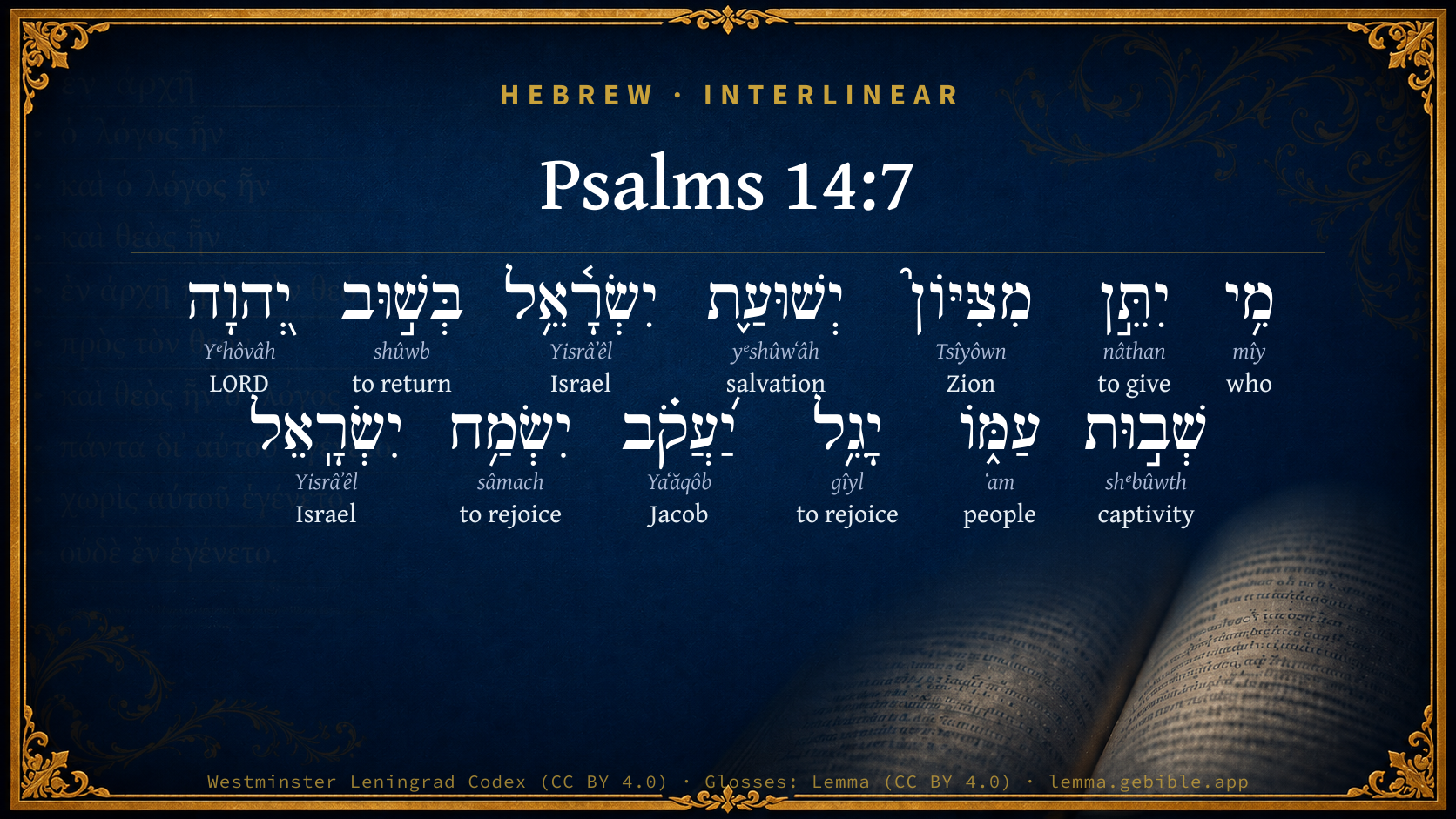
Hebrew (Westminster Leningrad Codex) Psalms 14:7 appears in the Hebrew Old Testament. The text above is from the Westminster Leningrad Codex. Each word links to its Strong’s number, a concise gloss, and parsing drawn from the Open Scriptures Hebrew Bible morphology. Click any word for its full Brown-Driver-Briggs (BDB) entry.
Download image
Cite this verse

Psalms 14:7 (World English Bible). Public Domain. Lemma interlinear Bible study tool, https://lemma.gebible.app/v/psalms/14/7.

Show BibTeX & RIS
BibTeX
RIS
English Translation
Oh that the salvation of Israel would come out of Zion! When Yahweh restores the fortunes of his people, Then Jacob shall rejoice, and Israel shall be glad.
World English Bible · Public Domain
Download a study sheet

One document with this verse’s original text, its word-by-word gloss line, the meaning frame, cross-references with their text, attributed commentary, and full source and license credits — printable, and it pastes into notes with its structure intact.

This verse Autodidact and up

Study sheet (.html) Plain text (.txt)

A passage Seminary Student

Up to 50 verses in one chapter. A passage sheet keeps up to 6 commentary sources and 12 cross-references per verse, in the order this page ranks them, and says so on the sheet whenever that leaves anything out. Ask for a single verse and you get the Autodidact verse sheet above.

Everything on this page stays free to read, with no account — the sheet is a download of what is already on screen, not access to it.

Want to remove ads? Support Godless Engineer
Compare translations 3

The same verse in 3 English versions, stacked beneath the original-language interlinear above. Click any original word for its lexicon entry.

Each is an independent rendering of the whole verse — the interlinear is not word-aligned to these translations.

Highlighted words mark where these versions differ — a whole-verse word diff, not a word-by-word alignment.

  • World English Bible Public Domain
    Oh that the salvation of Israel would come out of Zion! When Yahweh restores the fortunes of his people, Then Jacob shall rejoice, and Israel shall be glad.
  • King James Version Public Domain
    Oh that the salvation of Israel were come out of Zion! when the LORD bringeth back the captivity of his people, Jacob shall rejoice, and Israel shall be glad.
  • unfoldingWord Literal Text CC BY-SA 4.0
    Who will give the salvation of Israel from Zion? When Yahweh restores the prosperity of his people, Jacob will be glad, Israel will rejoice.

unfoldingWord Literal Text — © unfoldingWord, licensed CC BY-SA 4.0. Word-aligned USFM3 via Door43 (git.door43.org/unfoldingWord/en_ult).

Versions to compare (up to 4)

3 of 4 selected

Show all 18 translations

Every available English version of this verse, each an independent rendering of the whole verse.

  • World English Bible Public Domain
    Oh that the salvation of Israel would come out of Zion! When Yahweh restores the fortunes of his people, Then Jacob shall rejoice, and Israel shall be glad.
  • Berean Standard Bible Public Domain
    Oh, that the salvation of Israel would come from Zion! When the LORD restores His captive people, let Jacob rejoice, let Israel be glad!
  • Majority Standard Bible Public Domain
    Oh, that the salvation of Israel would come from Zion! When the LORD restores His captive people, let Jacob rejoice, let Israel be glad!
  • King James Version Public Domain
    Oh that the salvation of Israel were come out of Zion! when the LORD bringeth back the captivity of his people, Jacob shall rejoice, and Israel shall be glad.
  • American Standard Version (1901) Public Domain
    Oh that the salvation of Israel were come out of Zion! When Jehovah bringeth back the captivity of his people, Then shall Jacob rejoice, `and' Israel shall be glad. Psalm 15 A Psalm of David.
  • Revised Version (1885) Public Domain
    Oh that the salvation of Israel were come out of Zion! when the LORD bringeth back the captivity of his people, then shall Jacob rejoice, and Israel shall be glad.
  • Geneva Bible (1599) Public Domain
    Oh giue saluation vnto Israel out of Zion: when the Lord turneth the captiuitie of his people, then Iaakob shall reioyce, and Israel shall be glad.
  • Douay-Rheims (1899) Public Domain
    Who shall give out of Sion the salvation of Israel? when the Lord shall have turned away the captivity of his people, Jacob shall rejoice and Israel shall be glad.
  • Young's Literal Translation Public Domain
    `Who doth give from Zion the salvation of Israel? When Jehovah doth turn back `To' a captivity of His people, Jacob doth rejoice -- Israel is glad!
  • Literal Standard Version CC BY-SA 4.0
    “Who gives the salvation of Israel from Zion?” When YHWH turns back || [To] a captivity of His people, || Jacob rejoices—Israel is glad!
  • Unlocked Literal Bible CC BY-SA 4.0
    Oh, that the salvation of Israel would come from Zion! When Yahweh brings back his people from the captivity, then Jacob will rejoice and Israel will be glad!
  • unfoldingWord Literal Text CC BY-SA 4.0
    Who will give the salvation of Israel from Zion? When Yahweh restores the prosperity of his people, Jacob will be glad, Israel will rejoice.
  • Darby Bible Public Domain
    Oh that the salvation of Israel were come out of Zion! When Jehovah turneth again the captivity of his people, Jacob shall be glad, Israel shall rejoice.
  • World Messianic Bible Public Domain
    Oh that the salvation [yeshuat] of Israel would come out of Zion! When the LORD restores the fortunes of his people, then Jacob shall rejoice, and Israel shall be glad.
  • Webster's Bible Public Domain
    Oh that the salvation of Israel were come out of Zion! when the LORD bringeth back the captivity of his people, Jacob shall rejoice, and Israel shall be glad.
  • Free Bible Version CC BY-SA 4.0
    If only the Lord's salvation would come from Zion! When the Lord restores his people, the people of Jacob will celebrate, and the people of Israel will be glad.
  • Bible in Basic English Public Domain
    May the salvation of Israel come out of Zion! when the fate of his people is changed by the Lord, Jacob will have joy and Israel will be glad.
  • JPS Tanakh (1917) Public Domain
    Oh that the salvation of Israel were come out of Zion! When the LORD turneth the captivity of His people, let Jacob rejoice, let Israel be glad.

Literal Standard Version (2020), Covenant Press — licensed CC BY-SA 4.0. Text via the HelloAO Bible API (eBible.org). Unlocked Literal Bible (unfoldingWord) — licensed CC BY-SA 4.0. Text via the HelloAO Bible API (eBible.org). unfoldingWord Literal Text — © unfoldingWord, licensed CC BY-SA 4.0. Word-aligned USFM3 via Door43 (git.door43.org/unfoldingWord/en_ult). Free Bible Version, Dr. Jonathan Gallagher — licensed CC BY-SA 4.0. Text via the HelloAO Bible API (eBible.org).

Word by word

More ways to search: Search by grammar → Find every occurrence → Compare this word →

Practice this passage: Drill this verse → Learn its vocabulary →

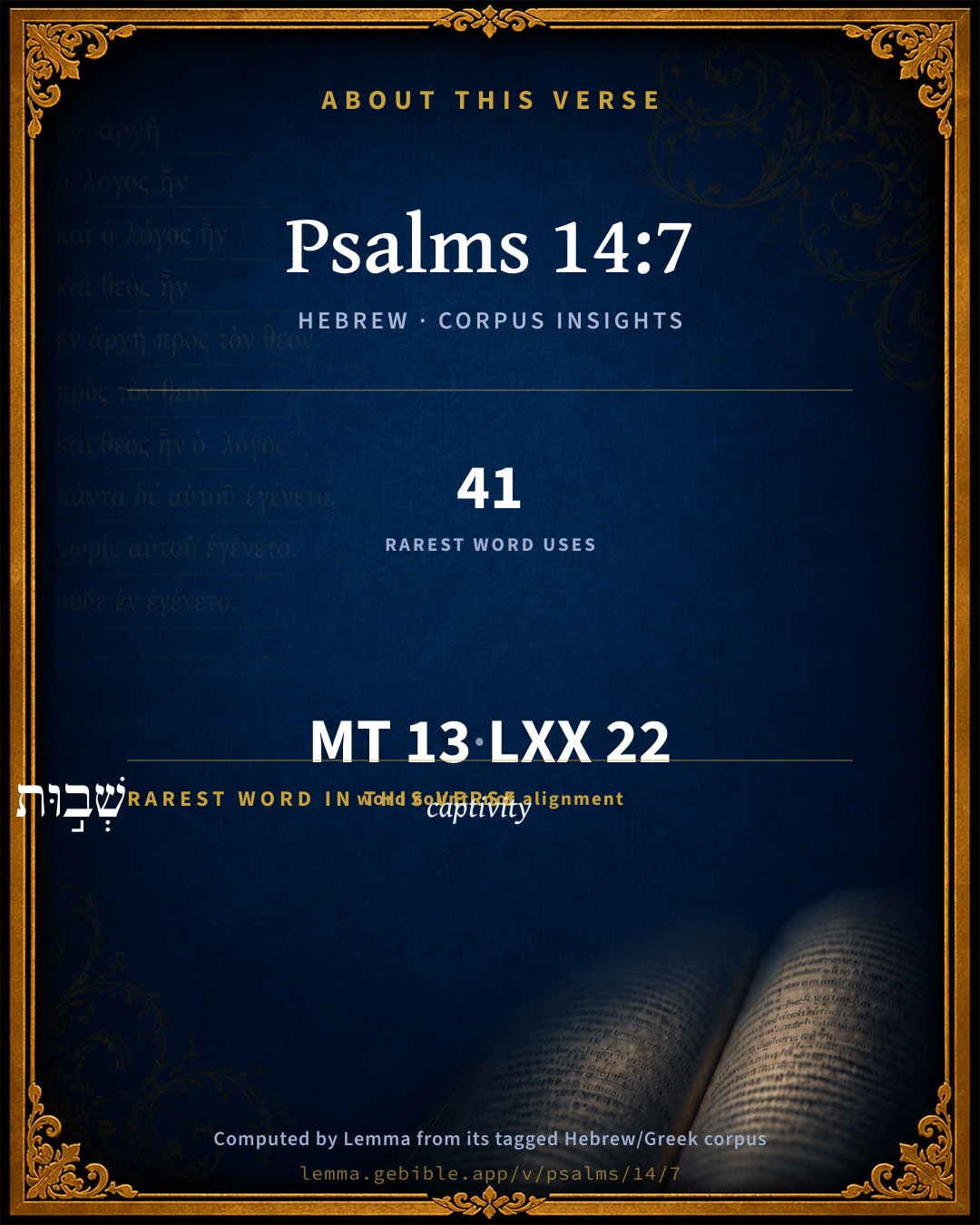
שְׁב֣וּת
shᵉbûwth
H7622
“captivity of”
Noun, Common, Feminine, Singular, Construct
Part of Speech
Noun
Type
Common
Gender
Feminine
Number
Singular
State
Construct
Full BDB Definition

Origin: from H7617

TWOT: 2311d

captivity, captives
  1. מִ֥י mîy H4310 “who” Particle, Interrogative
  2. יִתֵּ֣ן nâthan H5414 “to give” Verb, Qal, Imperfect, 3rd Person, Masculine, Singular
  3. מִצִּיּוֹן֮ Tsîyôwn H6726 “from · Zion” Preposition + Noun, Proper
  4. יְשׁוּעַ֪ת yᵉshûwʻâh H3444 “salvation of” Noun, Common, Feminine, Singular, Construct
  5. יִשְׂרָ֫אֵ֥ל Yisrâʼêl H3478 “Israel” Noun, Proper
  6. בְּשׁ֣וּב shûwb H7725 “in/at · to return” Preposition + Verb, Qal, Infinitive Construct
  7. יְ֭הוָה Yᵉhôvâh H3068 “LORD” Noun, Proper
  8. עַמּ֑וֹ ʻam H5971 “people · his” Noun, Common, Masculine, Singular, Construct + Suffix, Personal, 3rd Person, Masculine, Singular
  9. יָגֵ֥ל gîyl H1523 “to rejoice” Verb, Qal, Imperfect, 3rd Person, Masculine, Singular
  10. יַ֝עֲקֹ֗ב Yaʻăqôb H3290 “Jacob” Noun, Proper
  11. יִשְׂמַ֥ח sâmach H8055 “to rejoice” Verb, Qal, Imperfect, 3rd Person, Masculine, Singular
  12. יִשְׂרָֽאֵל Yisrâʼêl H3478 “Israel” Noun, Proper

About this verse

These counts appear in no published source. They are computed here, from the morphology-tagged text and Lemma’s own curated glosses. What Lemma adds →

13
words
12
distinct lemmas
Wisdom
section

Shared distinctive vocabulary

שְׁב֣וּת captivity H7622 occurs in 26 verses of the Hebrew Bible. Also found in:

Grammatical profile

  • 4 verbs
  • 8 nouns
  • 1 particle

Verb forms

  • יִתֵּ֣ן Qal · Imperfect
  • בְּשׁ֣וּב Qal · Infinitive Construct
  • יָגֵ֥ל Qal · Imperfect
  • יִשְׂמַ֥ח Qal · Imperfect

Repetition

A word recurs within this verse — often emphatic in Hebrew:

  • יִשְׂרָ֫אֵ֥ל Israel H3478 ×2

Hebrew & Septuagint length

In English translation the verse runs 28 words from the Hebrew and 27 from the Septuagint (LXX English) — closely comparable.

A rough comparison of the two English renderings, which tokenize alike — not a word-level alignment.

Word counts can differ between the Hebrew and the Greek without any difference in meaning — e.g. the Hebrew direct-object marker אֵת has no separate Greek word, and Greek often adds the article ὁ.

In the original languages it is 13 Hebrew tokens and 22 Greek tokens — but the two are counted differently (Hebrew bundles its prefixes and suffixes into one token; the Greek is in lemma form), so that isn’t a like-for-like length.

Cross-references

2

Topical passages linked to Psalms 14:7 in the Treasury of Scripture Knowledge — connected by theme and wording, ordered by reader-vote popularity; previews shown in the World English Bible.

  • Psalms 53:6 Oh that the salvation of Israel would come out of Zion! When God brings back the captivity of his people, Then Jacob shall rejoice. Israel shall be glad.
  • Psalms 85:1 Yahweh, you have been favorable to your land. You have restored the fortunes of Jacob.

Cross-references courtesy of OpenBible.info (CC BY 4.0).

Hebrew and Greek witnesses Masoretic Hebrew ↔ Greek Septuagint

The same verse in the two great witnesses to the Old Testament, shown verse-for-verse.

You’re reading Greek Psalm 13 (Hebrew Psalm 14). The Septuagint counts the superscription, so verse numbers can differ from the Hebrew — chapter-level alignment, not verse-by-verse. Numbering follows Rahlfs.

These are two independent witnesses, not word-aligned to each other, and the Septuagint is shown in lemma (dictionary) form.

Hebrew Psalms 14:7 Masoretic · Westminster Leningrad Codex

מִ֥י יִתֵּ֣ן מִצִּיּוֹן֮ יְשׁוּעַ֪ת יִשְׂרָ֫אֵ֥ל בְּשׁ֣וּב יְ֭הוָה שְׁב֣וּת עַמּ֑וֹ יָגֵ֥ל יַ֝עֲקֹ֗ב יִשְׂמַ֥ח יִשְׂרָֽאֵל

Oh that the salvation of Israel would come out of Zion! When Yahweh restores the fortunes of his people, Then Jacob shall rejoice, and Israel shall be glad.

World English Bible · Public Domain

Greek LXX Greek Psalm 13:7 Septuagint · lemma form

τίς δίδωμι ἐκ σιων ὁ σωτήριον ὁ ἰσραήλ ἐν ὁ ἐπιστρέφω κύριος ὁ αἰχμαλωσία ὁ λαός αὐτός ἀγαλλιάομαι ἰακώβ καί εὐφραίνω ἰσραήλ

Who will bring the salvation of Israel out of Sion? when the Lord brings back the captivity of his people, let Jacob exult, and Israel be glad.

LXX2012 (modern English Septuagint) · Public Domain

On this verse, Adam Clarke's Commentary discusses the Septuagint’s reading. Read the note in Commentary ↓

Hebrew: Westminster Leningrad Codex (CC BY 4.0). Greek: Septuagint (public domain); English from LXX2012 (modern English Septuagint) (Public Domain). How the Septuagint differs from the Hebrew →

Commentary

Notes on Psalms 14:7 from classic Christian and Jewish commentators (each source and its license shown beneath its notes). The classic Christian expositions comment on the surrounding passage and are grouped to its opening verse, so a note may address several verses; the Jewish commentaries on the Tanakh (Rashi and others) are per-verse, so they appear only where the commentator wrote on this verse.

Lemma curates 59 commentaries, every one of them public domain or Creative Commons licensed, each selected and text-cleaned for this edition rather than reprinted as found. About our sources →

Adam Clarke's Commentary

Verse 7. O that the salvation] Or, more literally, Who will give from Zion salvation to Israel? From Zion the deliverance must come; for God alone can deliver them; but whom will he make his instruments?

When the Lord bringeth back] For it is Jehovah alone who can do it. Jacob shall rejoice, and Israel shall be glad. That is, according to Calmet, the remains of the kingdom of Israel, and those of Judah, shall be rejoined, to their mutual satisfaction, and become one people, worshipping the same God; and he has endeavoured to prove, in a dissertation on the subject, that this actually took place after the return from the Babylonish captivity.

Many of the fathers have understood this verse as referring to the salvation of mankind by Jesus Christ; and so it is understood by my old MS. Psalter, as the following paraphrase will show: Qwa sal gyf of Syon hele til Israel? qwen Lord has turned a way the captyfte of his folk, glad sal Jacob, and fayne be Israel. Qwa bot Crist that ge despyse, qwen ge wit nout do his counsaile of Syon fra heven, sal gyf hele til Israel? that es, sal saf al trew cristen men, noght als ge er that lufs noght God. And qwen our Lord has turned o way the captyfte of his folk: that es, qwen he has dampned the devel, and al his Servaundes, the qwilk tourmentes gude men, and makes tham captyfs in pyne. Then glade sal Jacob; that es, al that wirstils o gayns vices and actyf: and fayne sal be Israel: that es, al that with the clene egh of thair hert, sees God in contemplatyf lyf. For Jacob es als mikil at say als, Wrestler, or suplanter of Syn. Israel es, man seand God.

Of the two chief opinions relative to the design of this Psalm:

1. That it refers to Absalom's rebellion.

2. That it is a complaint of the captives in Babylon; I incline to the latter, as by far the most probable.

I have referred, in the note on Ps 14:3, to that remarkable addition of no less than six verses, which is found here in the Vulgate, the Vatican copy of the Septuagint, the AEthiopic, and the Arabic, and also in St. Paul's Epistle to the Romans, Ro 3:13-18, which he is supposed to have quoted from this Psalm as it then stood in the Hebrew text; or in the version of the Seventy, from which it has been generally thought he borrowed them. That they are not interpolations in the New Testament is evident from this, that they are not wanting in any MS. yet discovered; and they exist in all the ancient versions, the Vulgate, Syriac, AEthiopic, and Arabic. Yet it has been contended, particularly by St. Jerome, that St. Paul did not quote them from this Psalm; but, being intent on showing the corruption and misery of man, he collected from different parts several passages that bore upon the subject, and united them here, with his quotation from Ps 14:3, as if they had all belonged to that place: and that succeeding copyists, finding them in Romans, as quoted from that Psalm, inserted them into the Septuagint, from which it was presumed they had been lost. It does not appear that they made a part of this Psalm in Origen's Hexapla. In the portions that still exist of this Psalm there is not a word of these additional verses referred to in that collection, neither here nor in the parallel Psalm liii.

The places from which Jerome and others say St. Paul borrowed them are the following: -

Ro 3:13: "Their mouth is an open sepulchre; with their tongues they have used deceit." Borrowed from Ps 5:10.

"The poison of asps is under their lips." From Ps 140:3.

Ro 3:14: "Whose mouth is full of cursing and bitterness." From Ps 10:7.

Ro 3:15: "Their feet are swift to shed blood." From Pr 1:16, or Isa 59:7.

Ro 3:16-18: "Destruction and misery are in their ways, the way of peace they have not known, and there is no fear of God before their eyes." From Ps 59:7; Ps 59:8.

When the reader has collated all these passages in the original, he will probably feel little satisfaction relative to the probability of the hypothesis they are summoned to support.

These verses are not found in the best copies of the Vulgate, though it appears they were in the old Itala or Antehieronymain version. They are not in the Codex Alexandrinus of the Septuagint; nor are they in either the Greek or Latin text of the Complutensian Polyglot. They are wanting also in the Antwerp and Parisian Polyglots. They are neither in the Chaldee nor Syriac versions. They are not acknowledged as a part of this Psalm by Theodoret, Chrysostom, Euthymius, Arnobius, Apollinaris, the Greek Catena, Eusebius, of Caesarea, nor Jerome. The latter, however, acknowledges that they were in his time read in the churches. I have seen no Latin MS. without them; and they are quoted by Justin Martyr and Augustine. They are also in the Editio Princeps of the Vulgate, and in all the ancient Psalters known. They are in that Psalter which I have frequently quoted, both in the Latino-Scotico-English version and paraphrase.

Of this version the following is a faithful copy, beginning with the third verse of the fourteenth Psalm: -

Al tha helddid togyher; thai er made unprofytable:

Thar es none that dos gude; thar es none til one.

A grave opynnand, es the throte of tham.

With thaire tunges trycherusly thai wroght

Venym of snakes undir the lippis of tham.

Qwhas mouth es ful of werying and bitternes:

Swyft thaire fete to spil blode.

Brekyng and wikednes in thair waies:

And the way of pees thai knew noght:

The drede of God es noght byfore the eghen of thaim.

There is a good deal of difference between this, and that version attributed to Wiclif, as it stands in my large MS. Bible, quoted in different parts of the New Testament, particularly in Ps 14:1; Ps 13:1, c. I shall give it here line for line with the above. Alle boweden aweye to gydre: thei ben maad unprofitable: There is not that doith good thing, ther is not to oon. A Sepulcre opnyng is the throote of hem: With her tungis thei diden gylinly or trecherously: The venym of eddris, that is clepid Aspis, under her lippis: The mouth of whom is ful of cursing, or worrying and bittrenesse: The feet of hem ben swift to schede out blood: Contricion or defouling to God, and infelicite or cursidnesse,

the wayes of hem; And thei knewen not the weyes of pees; The dreed of God is not bifore her ygen.

The words underlined in the above are added by the translator as explanatory of the preceding terms. It is worthy of remark that Coverdale inserts the whole of the addition in this Psalm, and Cardmarden has inserted it in his Bible, but in a letter different from the text.

It is now time to state what has been deemed of considerable importance to the authenticity of these verses; viz., that they are found in a Hebrew MS., numbered by Kennicott in his catalogue 649. It is in the public library at Leyden; contains the Psalms with a Latin version and Scholia; and appears to have been written about the end of the fourteenth century, and probably by some Christian. I shall give the text with a literal translation, as it stands in this MS., line for line with the preceding: -

קבר פתוח גרונם

An open sepulchre is their throat;

לשׁונם יחליקון

With their tongues they flatter;

חמת עכשוב תחת לשונם

The venom of the asp is under their tongue;

אשר פיהם אלה ומרמה מלא

Whose mouth of cursing and bitterness is full;

קלו רגליהם לשפוך דם

Swift are their feet to shed blood;

מזל רע ופגע רע בדרכיהם

An evil aspect, and an evil event, in their ways:

ודרך שלום לא ידעו

And the way of peace they know not.

אי פחד אלהים לנגר עיניהם

No fear of God before their eyes.

It would be easy to criticise upon the Hebrew in this long quotation. I shall content myself with what Calmet, who received his information from others that had inspected the Leyden MS., says of this addition: "Les seavans, qui ont examine ce manuscrit, y ont remarque un Hebreu barbare en cet endroit; et des facons de parler, qui ne sentent point les siecles ou la langue Hebraique etoit en usage." "Learned men, who have examined this MS., have remarked a barbarous Hebraism in this place, and modes of speech which savour not of those ages in which the Hebrew language was in use."

If this be an interpolation in the Psalm, it is very ancient; as we have the testimony of Jerome, who was prejudiced against it, that it was read in all the churches in his time, and how long before we cannot tell. And that these verses are a valuable portion of Divine revelation, as they stand in Ro 3:13-18, none can successfully deny. See Rosenmuller, Kennicott, and De Rossi.

ANALYSIS OF THE FOURTEENTH PSALM

This Psalm is the practical atheist's character, and has TWO parts: -

I. The description of the practical atheist, Ps 14:1-7.

II. A petition for the Church, Ps 14:7.

I. 1. The atheist is here noted to us by different characters: -

1. From his name, נבל nabal, a fool, or rather a churl; no natural fool, but a sinful: a fool in that in which he should be wise.

2. His hypocrisy or cunning; he saith, but he will not have it known, it is to himself, "He saith in his heart." He is a close, politic fool.

3. His saying, or his chief and prime principle: "There is no God."

4. From his practice; confessing God in his words for some political advantages, yet in his works denying him. For, 1. His heart is wicked and unregenerate: "They are corrupt." 2. He is a sinner in a high practical degree: "They have done abominable works." 3. He performs no duty: "There is none that doeth good." He commits sin; he omits duty.

2. The psalmist demonstrates what he said three ways; and convinces them: -

1. By the testimony of God himself; he is a witness against them. He is, 1. An eyewitness: he looks on. 2. He is in heaven, and they are continually under his notice: "He looked down from heaven." 3. He sees the children of men, their hearts and their works. 4. And the object of his looking is to inquire after their religion: "To see if there were any that did understand and seek God."

2. And then he gives his testimony in these general terms: "They are all gone aside, they are all together become filthy: there is none that doeth good, no, not one."

3. Next he accuses them of two sins of which they were especially guilty. 1. Injustice: "They eat up my people as bread." 2. Impiety: "They call not upon the Lord."

4. And that his testimony is true, he convinces them, 1. By the light of their own conscience: "Have all the workers of iniquity no knowledge?" Does not their own conscience tell them that all this is true? Do they not know this? 2. By fear and terror, the effects of an evil conscience: "There were they in great fear." They said, There is no God; but their conscience told them that God was in the congregation of the righteous, and that they should grievously answer for their injustice and impiety. 3. By the hardness of their heart, and contempt of the good counsels of the godly. If he reproved, they mocked. If he said God was his refuge, they laughed him to scorn. "Ye have shamed the counsel of the poor, because the Lord is his refuge."

II. The second part of the Psalm contains a petition for the Church: -

1. He prays that God would send salvation to his people.

2. That it might be out of Zion; because Christ was anointed and set a King upon the holy hill of Zion: "O that the salvation of Israel were come out of Zion!"

3. For then the consequence would be the great joy and happiness of all his people for their deliverance from captivity, spiritual and temporal: "When the Lord bringeth back the captivity of his people, Jacob shall rejoice, and Israel shall be glad."

Adam Clarke's Commentary on the Bible (1810–1826) — public domain. Text from a community e-Sword/MySword module.

The Cambridge Bible for Schools and Colleges

gen. ed. J. J. S. Perowne

7. Concluding prayer for the deliverance of Israel.

out of Zion] The dwelling-place of Jehovah. See note on Psa_3:4.

When the Lord bringeth back &c.] Or, as R.V. marg., when the Lord returneth to the captivity of his people. At first sight these words appear to fix the date of the Psalm in the period of the Exile (Psa_126:1). Nor does the first line of the verse exclude such a view. For the exiled turned to Zion even in her desolation (Dan_6:10; 1Ki_8:44), and from thence Jehovah might be expected to restore His people. But (1) it is very probable that the phrase rendered bring back the captivity means rather restore the fortunes. This meaning suits all the passages in which it occurs, while turn the captivity does not, except in the figurative sense of restoring prosperity. See e.g. Job_42:10; Eze_16:53; Zep_2:7. And (2) even if turn the captivity is the true meaning, the phrase is used by Amos (Amo_9:14) and Hosea (Hos_6:11) long before the Babylonish Captivity.

Psa_14:7 is frequently regarded as a later liturgical addition; and certainly it does not cohere very closely with the rest of the Psalm. But some conclusion is needed. The Psalm can hardly have ended abruptly with Psa_14:6.

Jacob shall rejoice, &c.] Properly a wish or prayer (cp. Psa_13:5-6): let Jacob rejoice, and Israel be glad.

The Cambridge Bible for Schools and Colleges (gen. ed. J. J. S. Perowne; Cambridge University Press, 1878–1918) — public domain. Text from a community e-Sword module.

Trapp's Complete Commentary

John Trapp

Psa 14:7 Oh that the salvation of Israel [were come] out of Zion! when the LORD bringeth back the captivity of his people, Jacob shall rejoice, [and] Israel shall be glad.

Ver. 7. Oh that the salvation of Israel, &c.] This is the second part of the psalm, wherein David prayeth to God to deliver his Israel out of the hands of those atheists and oppressors. The whole Church must be remembered in our prayers, and that ancient people of God, the Jews, not forgotten (Sanhed. c. 11). Many of their Rabbis make this whole psalm a prophecy of their dispersion among the Gentiles, their oppressors; and this a prayer for their restoration. For our sins, say they, which are many, the coming of the Messiah (that salvation of Israel) is deferred, the time of his coming is sealed up, Dan 12:4. Verum enimvero Dens nos dignabitur clarissima visione cum reducer Zionem; tunc intelligemus res ipsas prout sunt, saith Jachiades on that text; but God shall give us a clear sight of all things when he shall bring back Zion, &c. This is truth, and we must hasten that time by our heartiest wishes for that obdurate people, that a redeemer would come to them out of Zion, Rom 11:26, that the covering cast over that people might be destroyed, Isa 25:7, and a general joy conceived throughout all the Churches for their happy readmission.

Out of Zion] i.e. Out of the Church, whence all good cometh; and such blessings as are better than all else that heaven or earth affordeth, Psa 134:3.

John Trapp, A Commentary or Exposition upon All the Books of the Old and New Testament (1647–1656) — public domain. Text from a community e-Sword module.

Joseph Benson's Commentary

Psa 14:7. O that the salvation of Israel were come out of Zion — These words, considered in connection with the context, do not appear to be intended of any mere temporal salvation of Israel, whether from the rebellion of Absalom, or any other calamity brought upon them as a punishment of their sins. They rather seem directly and immediately to refer to the deliverance of that people from those corrupt principles and practices which the psalmist describes and laments in the preceding part of the Psalm. This is evidently the salvation which he has first in his view, and which he prays might come out of Zion, where the ark then was, where God was wont, in an especial manner, to manifest his presence, and whence he was supposed to hear and answer his people’s prayers. The words, however, have certainly a further design: they ultimately and principally respect the spiritual redemption and salvation of all God’s Israel by the Messiah. Thus the ancient Jews understood them, as appears from Jonathan’s Targum, or paraphrase, which expounds the passage in this manner, with which agrees the Targum of Jerusalem. We know the ancient patriarchs and prophets in general, and David in particular, well understood, and firmly believed, the doctrine of Israel’s redemption and salvation by the Messiah; and ardently expected, nay, and comforted themselves under their troubles, with the expectation of this great event, which they termed the consolation of Israel. And thus David seems to have comforted himself now in this dark time of ignorance and vice, of infidelity and sin, which he here deplores. To this also agrees the mention of Zion, because the prophets knew and foretold that the Messiah, or Deliverer, should first come to Zion, and should set up his throne there, and from thence send forth his laws and edicts to the Gentile world; as is positively affirmed, Psa 2:6; Psa 110:2; Isa 2:3; Isa 59:20, compared with Rom 11:26, and in many other places. To this may be added, that the following words agree only to this event, in which he speaks of bringing back the captivity of the Lord’s people, with the universal joy of Jacob and Israel; which cannot agree to David’s time, wherein there was no such captivity of the people, but only a civil war and mutual slaughter, which is quite another thing, nor to the time of the Jews’ return from Babylon, when there was no such return of all Israel, but only of a part of the tribes of Judah and Benjamin, and some few of the other tribes; and the joy which the returning Jews then had was but low, and mixed with many fears, and dangers, and reproaches, as we see in the books of Ezra and Nehemiah. And therefore these words of the psalmist must belong to the times of the Messiah, by whom this promise was fulfilled to the true Israel of God, who were delivered from that most dreadful of all captivities, the captivity of sin and Satan, as is declared Luk 1:68-75; Luk 4:18; Eph 4:8. And they shall be literally accomplished to the natural seed of Jacob, or Israel, according to the expectation and belief of all the Jews in their several ages, and of most Christian writers. The Redeemer shall come to Zion by his Word and Spirit, by his gospel and his grace, as he before came in the flesh, and shall turn away all ungodliness from Jacob. For this time of universal reformation the psalmist longs and prays now in the time of universal corruption; as if he had said, Those will be glorious times, as the present are melancholy ones; for then Jacob, that is, the seed of Jacob, shall rejoice, and Israel shall be glad. The triumphs of the king of Zion will be the joy of Zion’s children. And at the second coming of Christ, finally to extinguish the dominion of sin and Satan, this salvation will be completed, which, as it is the hope, so will it be the joy, of every true Israelite.

Joseph Benson's Commentary on the Old and New Testaments (1811–1818) — public domain. Text from a community e-Sword module.

J. A. Alexander on Psalms

Joseph Addison Alexander

7. (Psa 14:7) Who will give out of Zion salvation to Israel, in Jehovah's returning the captivity of his people? Let Jacob exult, let Israel joy! The phrase who will give is an idiomatic optative in Hebrew, equivalent to Oh that with a verb, and Oh for with a noun in English. Oh for the salvation of Israel! Or, Oh that the salvation of Israel (might come) out of Zion, as the earthly residence of God and seat of the theocracy. The same local designation is connected with the prayer or promise of divine help, in Psa 3:5 (4), Psa 20:3 (2), Psa 128:5, Psa 134:3. (Compare Psa 28:2). This shows that the psalm does not belong to the period of the Babylonish exile, and that the captivity referred to is not literal, but a metaphorical description of distress, as in the case of Job (Job 42:10). The same idea is elsewhere expressed by the figure of confinement and incarceration (Ps. 142:8, Isa 42:7; Isa 49:9). The sense remains essentially the same in this case, whether the verb return be transitive or intransitive. Most interpreters prefer the former sense, and understand the clause to mean, "in Jehovah's bringing back the captivity of his people." But as the Hebrews means in every other combination to come back, and, like other verbs of motion, often governs a noun of place directly (Exo 4:19-20, Num 10:36), it is better to understand the words as meaning that the salvation wished for would consist in God's revisiting his captive or afflicted people. The sense is also admissible, if not necessary, in such places as Deu 30:3, Psa 85:5 (4), Isa 52:8, Hos 6:11, Nah 2:3 (2). Let Jacob shout (for joy)! This is both an exhortation and a wish, but the latter is the prominent idea, as the parallelism of the clauses shews. Oh that the salvation of Israel were come! corresponds exactly to, May Jacob exult, may Israel be glad! The common version is forbidden by the optative form of the Hebrew verb, and by the masoretic interpunction, which connects in the Lord's returning, etc., not with what follows as a specification of time, but with what goes before as an explanatory clause. The whole may be paraphrased as follows: "Oh that Jehovah, from his throne in Zion, would grant salvation to his people, by revisiting them in their captive and forsaken state, and that occasion of rejoicing might be thus afforded to the church! " Or more closely thus: "Oh may Israel's salvation (soon) come forth from Zion, in Jehovah's return to the captivity of his people! (In such a restoration) may Jacob (soon have reason to) exult and Israel (to) triumph!"

Joseph Addison Alexander, The Psalms Translated and Explained (1850) — public domain. Text from a community e-Sword module.

Tyndale Open Study Notes

Tyndale Open Resources

14:7 The psalmist prays for the renewal of God’s relationship with his people. • Jacob is a synonym for Israel (see Gen 35:9-10).

Tyndale Open Study Notes — © Tyndale Open Resources, licensed CC BY-SA 4.0. Text via the HelloAO Bible API.

Geneva Bible (1599)

Geneva Bible translators

He prayeth for the whole Church whom he is assured God will deliver: for none but he only can do it.

Geneva Bible (1599) marginal notes — public domain. Text via Bolls.life.

Jamieson, Fausset & Brown

Robert Jamieson, A. R. Fausset & David Brown

captivity--denotes any great evil.

Zion--God's abode, from which He revealed His purposes of mercy, as He now does by the Church (compare Psa 3:4; Psa 20:2), and which He rules and in which He does all other things for the good of His people (Eph 1:22).

Next: Psalms Chapter 15

Jamieson, Fausset & Brown — Commentary Critical and Explanatory on the Whole Bible (1871) — public domain (CC PDM 1.0). Text via the HelloAO Bible API.

John Calvin's Commentaries

David, after having laid down the doctrine of consolation, again returns to prayers and groanings. By this he teaches us, that although God may leave us for a long time to languish, yet we ought not to weary, or lose courage, but should always glory in him; and, again, that while our troubles continue, the most effectual solace we can have is often to return to the exercise of prayer. When he asks the question, Who shall give salvation? this does not imply, that he was looking either to the right hand or to the left, or that he turned away his eyes from God in search of another deliverer; he intends only to express the ardor of his desire, as if he had said, When will the time at length come when God will display his salvation, and make it fully manifest? By the word Sion, which he adds, he testifies that his hope is fixed on God; for Sion was the holy place from which God had promised to hear the prayers of his servants; and it was the dwelling-place of the ark of the covenant, which was an external pledge and symbol of the presence of God. He does not, therefore, doubt who would be the author of his salvation; but he asks, with a sorrowful heart, when at length that salvation will come forth which is to be expected from no other source than from God alone. The question may, however, be put, if this prayer refers to the time of Saul, how can Sion, with propriety, be named as being already the sanctuary of God? I will not deny that the Psalmist, by the spirit of prophecy, may have predicted what had not yet actually taken place; but I think it highly probable, that this psalm was not composed until the ark of the covenant had been placed on mount Sion. David, as we know, employed his leisure hours in committing to writing, for the benefit of posterity, events which had happened long before. Besides, by expressing his desire for the deliverance of Israel, we are taught that he was chiefly anxious about the welfare of the whole body of the Church, and that his thoughts were more occupied about this than about himself individually. This is worthy of being the more carefully marked when we consider, that, while our attention is engrossed with our own particular sorrows, we are in danger of almost entirely neglecting the welfare of our brethren. And yet the particular afflictions with which God visits each of us are intended to admonish us to direct our attention and care to the whole body of the Church, and to think of its necessities, just as we see David here including Israel with himself.

When the Lord shall have brought back the captivity of his people, In these words, David concludes, that God will not suffer the faithful to languish under continual sorrow, according as it is said in another psalm, (Psalm 126:5) “They that sow in tears shall reap in joy.” He doubtless aims at confirming and encouraging himself and all the godly to hope for the promised deliverance. He therefore says, in the first place, that although God may delay, or at least may not make so much haste as we would wish, he will, nevertheless, show himself to be the defender of his people, by redeeming them from captivity. And, in the next place, he assuages their sorrow, by setting forth that the issue of it will be joyful, seeing it will at length be turned into gladness. The captivity, of which he makes mention, is not the Babylonish, or the dispersion of his people among the heathen nations; it rather refers to an oppression at home, when the wicked exercise dominion like tyrants in the Church. We are, therefore, taught by these words, that when such furious enemies waste and destroy the flock of God, or proudly tread it under foot, we ought to have recourse to God, whose peculiar office it is to gather together his Israel from all places whither they have been dispersed. And the term captivity, which he employs, implies, that when the wicked overthrow at their pleasure all good and lawful order in the midst of the Church, it is converted into a Babylon or Egypt. Farther, although David defers the joy of the holy people, to the time of their deliverance, yet the consolatory prospect of this should serve not only to moderate our grief, but also to mix and season it with joy.

John Calvin's Commentaries (1540-1563) — public domain. Text from the Calvin Translation Society English edition (1840s-50s) via the Christian Classics Ethereal Library (ccel.org). Calvin's coverage is partial (roughly two-thirds of the Bible); uncommented books and verses are honest gaps, never fabricated. The 19th-century editor's footnotes and remarks are omitted so the notes are faithfully Calvin's own voice.

Ellicott's Commentary for English Readers

(7) Oh that.—The thoughts of the exiles turn to the Holy City as the one source of deliverance, as if Jehovah’s power would only manifest itself from His hallowed abode. So Daniel looked towards Jerusalem in his prayer. (Comp. the same feeling in Isa_40:9-10.) For the expression “turn the captivity,” or, to keep the Heb. idiom, “turn the turning,” comp. Psa_85:1; Psa_126:1; Hos_6:2; Joe_3:1. It appears, however, besides its literal reference to the exile, to have been applied proverbially to the removal of any misfortune (Job_42:10).

A Bible Commentary for English Readers, edited by Charles John Ellicott (1878–1897) — public domain. Text from a community e-Sword module.

John Gill's Exposition

O that the salvation of Israel were come out of Zion!.... By whom is meant the Messiah, the Saviour of Israel, of all the elect of God, whether Jews or Gentiles; and who is so called, because the salvation of them was put into his hands, and he undertook it; and because he is the Captain and Author of it, and it is in him, and in no other. He was to come out of Zion, out of Judea, from among the Jews; Zion being, as Kimchi observes, the head of the kingdom of Israel; see Rom 11:26. Accordingly Christ did come of the Jews, and salvation was of them, Rom 9:4; and for his coming from hence, or for his incarnation, the psalmist most earnestly wishes: he was one of those kings, prophets, and righteous men, that desired to see the days of the Messiah, Mat 13:17. And what might move him so vehemently to wish for it, at this time, might be the sad corruption and depravity of mankind he had been describing, and the afflicted and distressed state of the saints;

when the Lord bringeth back the captivity of his people. The people of God are, in their unregeneracy, in a state of captivity to sin, Satan, and the law; the work of the Messiah, when he came, was to proclaim liberty to the captives, to set them free, to deliver them from their spiritual bondage: and this Christ has done; he has redeemed his people from all their sins, and from the curse of the law, and from the power of Satan, and has led captivity captive; and which has justly occasioned great joy in the redeemed ones, according to this prophecy:

Jacob shall rejoice, and Israel shall be glad; that is, the posterity of Jacob and Israel; not his natural, but spiritual seed, such who are the true sons of Jacob, Israelites indeed; these having faith and hope in the plenteous redemption of Christ, rejoice in the view of their interest in it; they the song of redeeming love now, and these ransomed ones will hereafter come to Zion with joy, and everlasting joy upon their heads. The Jews refer this to the times of the Messiah (c).

(c) Baal Hatturim in Numb. xxv. 12. & Midrash Tillim in loc.

Next: Psalms Chapter 15

John Gill's Exposition of the Whole Bible (1746–1763) — public domain (CC PDM 1.0). Text via the HelloAO Bible API.

Albert Barnes' Notes on the Bible

Oh that the salvation of Israel - Margin, “Who will give,” etc. The Hebrew literally is, “Who will give out of Zion salvation to Israel?” The word “Israel” refers primarily to the Hebrew people, and then it is used generally to denote the people of God. The wish here expressed is in view of the facts referred to in the previous verses - the general prevalence of iniquity and of practical atheism, and the sufferings of the people of God on that account. This state of things suggests the earnest desire that from all such evils the people of God might be delivered. The expression in the original, as in the margin, “Who will give,” is a common expression in Hebrew, and means the same as in our translation, “Oh that.” It is expressive of an earnest desire, as if the thing were in the hand of another, that he would impart that blessing or favor.

Out of Zion - On the word “Zion,” see the note at Isa 1:8. It is referred to here, as it is often, as the seat or dwelling-place of God; the place from where he issued his commands, and from where he put forth his power. Thus in Psa 3:4, “He heard me out of his holy hill.” Psa 20:2, “the Lord ... strengthen thee out of Zion.” Psa 128:5, “the Lord shall bless thee out of Zion.” Here the phrase expresses a wish that God, who had his dwelling in Zion, would put forth his power in granting complete deliverance to his people.

When the Lord bringeth back - literally, “In Yahweh’s bringing back the captivity of his people.” That is, the particular salvation which the psalmist prayed for was that Yahweh would return the captivity of his people, or restore them from captivity.

The captivity of his people - This is “language” taken from a captivity in a foreign land. It is not necessary, however, to suppose that any such literal captivity is here referred to, nor would it be necessary to infer from this that the psalm was written in the Babylonian captivity, or in any other particular exile of the Hebrew people. The truth was, that the Hebrews were often in this state (see the Book of Judges, “passim”), and this language came to be the common method of expressing any condition of oppression and trouble, or of a low state of religion in the land. Compare Job 42:10.

Jacob shall rejoice - Another name for the Hebrew people, as descended from Jacob, Isa 2:3; Isa 41:21; Isa 10:21; Isa 14:1; Amo 7:2; et soepe. Prof. Alexander renders this, “Let Jacob exult; let Israel joy.” The idea seems to be, that such a restoration would give great joy to the people of God, and the language expresses a desire that this might soon occur - perhaps expressing the idea also that in the certainty of such an ultimate restoration, such a complete salvation, the people of God might now rejoice. Thus, too, it will not only be true that the redeemed will be happy in heaven, but they may exult even now in the prospect, the certainty, that they will obtain complete salvation.

Albert Barnes' Notes on the Bible (1834–1885) — public domain. Text from a community e-Sword/MySword module.

Matthew Poole's English Annotations

Oh that the salvation of Israel were come out of Zion! These words directly and immediately concern the deliverance of the people of Israel out of that sinful and deplorable estate in which they now were; which having described in the body of the Psalm, he concludes, after his manner, with a prayer to God to hear and help them out of Zion, where the ark then was, whence God used to hear and answer his people’s prayers. But ultimately and principally they design a further, even the spiritual, redemption and salvation of all God’s Israel by the Messias, as may appear by divers considerations:

1. That the ancient Jews did thus understand it, and among others Jonathan’s Targum or Paraphrase on the Bible expound it thus; I do not expect Gideon’s salvation, which was but corporeal, nor that of Samson—but the salvation of the Messias. With whom agrees the Targum of Jerusalem.

2. That the doctrine of Israel’s redemption or salvation by Christ was very well known, as to other ancient patriarchs, Joh 8:56; 1Pe 1:10-12, so particularly to David, of whom it is expressly said that he knew and foresaw this mystery, Act 2:30,31, in whose Book of Psalms there are divers and very distinct and clear prophecies of it, as we have in part seen upon Psa 2; Psa 8, and shall see more fully and evidently hereafter.

3. That David and other holy prophets, in the midst of their sad thoughts, and fears, and troubles, did usually comfort themselves with the promise and expectation of the Messias, by whom, and by whom alone, they should receive that plenary salvation for which they groaned; of which it is thought we have one instance, Gen 49:18; but we have many unquestionable instances in the prophecy of Isaiah, as Isa 7:14; 9:6, &c. And this course might be the more seasonable for David, because he speaks here of his troubles after he was settled in his kingdom, (as may be gathered from the mention of Zion, where the ark was not till that time,) and possibly of the sad and sinful state of his kingdom during Absalom’s rebellion; and therefore finding himself so strangely disappointed of that peace and happiness which he confidently expected when once he came to the kingdom, and wisely and justly presaging that his children and the following generations of Israelites for the same causes were likely to meet with the same or greater calamities than this, he wearieth himself with the expression of his belief and desire of the coming of the Messias to save his people.

4. To this also suits the mention of Zion, because the prophets knew and foretold that the Messias or Deliverer should first come to Zion, and should set up his throne there, and from thence send forth his laws and edicts to the Gentile world; as is positively affirmed, Psa 2:6; 110:2; Isa 2:3; 59:20, compared with Rom 11:26, and in many other places.

5. The following words agree only to this time, wherein he speaks of bringing back the captivity of his people with the universal joy of all Jacob and Israel; which cannot agree to David’s time, wherein there was no such captivity of the people, but only a civil war and mutual slaughter, which is quite another thing; nor to the time of Israel’s return from Babylon, when there was no such return of all Israel, but only of Judah and Benjamin, and some few of the other tribes, and the joy which the returning Israelites then had was but low, and mixed with many fears, and dangers, and reproaches, as we see in the books of Ezra and Nehemiah. And therefore they must belong to the times of the Messias, by whom this promise was fulfilled to the true Israel of God, who were brought back from that most real and dreadful, though spiritual, captivity of sin and Satan, as is declared, Luk 4:18; Eph 4:8, and shall be literally accomplished to the natural seed of Jacob or Israel according to the expectation and belief of all the Jews in their several ages, and of most Christian writers.

The captivity of his people, i.e. his captive people; captivity being oft put for captives, as Deu 21:10; 30:3; Psa 126:1,4. Or, his people from captivity, of which see the former note. Jacob, i.e. the seed or children of Jacob, as Aaron is named for his sons, 1Ch 12:27; 27:17, and David for his sons, and the like.

Matthew Poole's English Annotations on the Holy Bible (1683–1685) — public domain. Text from a community e-Sword/MySword module.

The Treasury of David

Charles H. Spurgeon

Ver. 7. O that salvation, etc. Like as when we be in quiet, we do pray either nothing at all, or very coldly unto God; so in adversity and trouble, our spirit is stirred up and enkindled to prayer, whereof we do find examples everywhere in the Psalms of David; so that affliction is as it were the sauce of prayer, as hunger is unto meat. Truly their prayer is usually unsavoury who are without afflictions, and many of them do not pray truly, but do rather counterfeit a prayer, or pray for custom. Wolfgang Musculus, 1497-1563.

Ver. 7. Out of Zion. Zion, the church is no Saviour, neither dare we trust in her ministers or ordinances, and yet salvation comes to men through her. The hungry multitudes are fed by the hands of the disciples, who delight to act as the servitors of the gospel feast. Zion becomes the site of the fountain of healing waters which shall flow east and west till all nations drink thereat. What a reason for maintaining in the utmost purity and energy all the works of the church of the living God! C.H.S.

Ver. 7. When the Lord turneth the captivity of his people: then shall Jacob rejoice, and Israel shall be glad. Notice that by Israel we are to understand those other sheep which the Lord has that are not of this fold, but which he must also bring, that they may hear his voice. For it is Israel, not Judah; Sion, not Jerusalem. When the Lord turneth the captivity of his people. Then, as it is in the parallel passage, were we like unto them that dream. A glorious dream indeed, in which, fancy what we may, the half of the beauty, the half of the splendour, will not be reached by our imagination. The captivity of our souls to the law of concupiscence, of our bodies to the law of death; the captivity of our senses to fear; the captivity, the conclusion of which is so beautifully expressed by one of our greatest poets: namely, Giles Fletcher (1588-1623), in his "Christ's Triumph over Death."

"No sorrow now hangs clouding on their brow; No bloodless malady impales their face;

No age drops on their hairs his silver snow; No nakedness their bodies doth embase; No poverty themselves and theirs disgrace; No fear of death the joy of life devours; No unchaste sleep their precious time deflower; No loss, no grief, no change, wait on their winged hours."

John Mason Neale, in loc.

Ver. 7. Longings for the advent.

Ver. 7. Out of Zion. The church, the channel of blessings to men.

Ver. 7. Discourse to promote revival.

1. Frequent condition of the church, captivity.

2. Means of revivalthe Lord's coming in grace.

3. Consequences, rejoice, be glad.

Ver. 7. Captivity of soul. What it is. How provided for. How accomplished. With what results.

Charles H. Spurgeon's The Treasury of David (1869–1885) — public domain. Psalms only. Text from a community e-Sword/MySword module.

Whedon's Commentary on the Bible

Daniel D. Whedon

7. Oh that the salvation of Israel—Or, who will give the salvation of Israel. It is a form of ardent wish that by some one deliverance might be given, as Psa_55:6.

Out of Zion—Here meaning the Jewish Church, as the depositary of God’s truth. The true Hebrew looked for national blessings only from this source, as the New Testament saint expects all public prosperity through the Church. Even during the exile, when Jerusalem, of which Zion was a part, was in ruins, prayer was made with the face thitherward, (1Ki_8:44; 1Ki_8:48; Dan_6:10,) and all hope of the nation was associated with its restoration. Psa_102:13; Psa_102:16; Psa_129:5. The books of Ezra and Nehemiah abundantly show this. The passage in question has also been considered Messianic, a reference to the salvation of spiritual Israel by Christ. See Isa_59:20; Rom_11:26.

When the Lord bringeth back the captivity of his people—To bring back the captivity is to return the captives to their own country and national rights, and is the standing formula for the returning of the Babylonian exiles, as in Psa_126:1; Jer_30:3; Joe_3:1; Zep_3:20. It is a political, implying a moral, restitution. The force and transitive form of the verb, with שׁבות, (shebooth,) captivity, admits no other sense.

Jacob shall rejoice—See Psalms 126 and Hos_6:11.So shall the Church of Christ rejoice in the gathering of her converts and her full restoration. Isaiah 12; Isa_35:8-10.

Daniel D. Whedon (gen. ed.), Commentary on the Old and New Testaments (1874–1909) — public domain. Text from a community e-Sword module.

The Pulpit Commentary

Oh that the salvation of Israel were come out of Zion! The salvation of the "righteous generation" (ver. 5), the "true Israel," is sure to come. Oh that it were come already! It will proceed "out of Zion," since God"s Name is set there. The ark of the covenant had been already set up in the place which it was thenceforth to occupy. (see 2Sa_6:12-17) David"s reign in Jerusalem is begun. When the Lord bringeth back the captivity of his people; either, when the Lord turneth the ill fortune of his people, or, when the Lord returneth to the captivity of his people; i.e. when he no longer turns away from their sufferings and afflictions, but turns towards them, and lifts up the light of his countenance upon them, then Jacob shall rejoice, and Israel shall be glad. (For the union of these two names, see Psa_78:21, 71 105:23 135:4, etc.) God"s people shall celebrate their deliverance with a psalm of thanksgiving.

The Pulpit Commentary (1880–1919), ed. H.D.M. Spence-Jones & Joseph S. Exell — public domain. Text from a community e-Sword module.

John Wesley's Explanatory Notes

O that - These words immediately concern the deliverance of Israel out of that sinful state, in which they now were; which having described, he concludes, with a prayer to God to help them out of Zion, where the ark then was, but principally they design the spiritual redemption and salvation of all God's Israel by the Messiah. The captivity - His captive people. The children of Jacob, as Aaron is named for his sons, 1 Chron. xii, 27.

John Wesley, Explanatory Notes Upon the Whole Bible (1754–1765) — public domain. Text via the GEBible commentary corpus.

Keil & Delitzsch

C. F. Keil & F. Delitzsch

This tristich sounds like a liturgical addition belonging to the time of the Exile, unless one is disposed to assign the whole Psalm to this period on account of it. For elsewhere in a similar connection, as e.g., in Psa 126:1-6, שׁוּב שׁבוּת means to turn the captivity, or to bring back the captives. שׁוּב has here, - as in Psa 126:4; Psa 2:3 (followed by את), cf. Eze 47:7, the Kal being preferred to the Hiph. השׁיב (Jer 32:44; Jer 33:11) in favour of the alliteration with שׁבוּת (from שׁבה to make any one a prisoner of war), - a transitive signification, which Hengstenberg (who interprets it: to turn back, to turn to the captivity, of God's merciful visitation), vainly hesitates to admit. But Isa 66:6, for instance, shows that the exiles also never looked for redemption anywhere but from Zion. Not as though they had thought, that Jahve still dwelt among the ruins of His habitation, which indeed on the contrary was become a ruin because He had forsaken it (as we read in Ezekiel); but the moment of His return to His people is also the moment when He entered again upon the occupation of His sanctuary, and His sanctuary, again appropriated by Jahve even before it was actually reared, is the spot whence issues the kindling of the divine judgment on the enemies of Israel, as well as the spot whence issues the brightness of the reverse side of this judgment, viz., the final deliverance, hence even during the Exile, Jerusalem is the point (the kibla) whither the eye of the praying captive was directed, Dan 6:11. There would therefore be nothing strange if a psalm-writer belonging to the Exile should express his longing for deliverance in these words: who gives = oh that one would give = oh that the salvation of Israel were come out of Zion! But since שׁוב שׁבות also signifies metaphorically to turn misfortune, as in Job 42:10; Eze 16:53 (perhaps also in Psa 85:2, cf. Psa 14:5), inasmuch as the idea of שׁבוּת has been generalised exactly like the German "Elend," exile (Old High German elilenti = sojourn in another country, banishment, homelessness), therefore the inscribed לדוד cannot be called in question from this quarter. Even Hitzig renders: "if Jahve would but turn the misfortune of His people," regarding this Psalm as composed by Jeremiah during the time the Scythians were in the land. If this rendering is possible, and that it is is undeniable, then we retain the inscription לדוד. And we do so the more readily, as Jeremiah's supposed authorship rests upon a non-recognition of his reproductive character, and the history of the prophet's times make no allusion to any incursion by the Scythians.

The condition of the true people of God in the time of Absolom was really a שׁבוּת in more than a figurative sense. But we require no such comparison with contemporary history, since in these closing words we have only the gathering up into a brief form of the view which prevails in other parts of the Psalm, viz., that the "righteous generation" in the midst of the world, and even of the so-called Israel, finds itself in a state of oppression, imprisonment, and bondage. If God will turn this condition of His people, who are His people indeed and of a truth, then shall Jacob rejoice and Israel be glad. It is the grateful duty of the redeemed to rejoice. - And how could they do otherwise!

Keil & Delitzsch — Biblical Commentary on the Old Testament (1861–1891) — public domain (CC PDM 1.0). Text via the HelloAO Bible API. (Old Testament only.)

unfoldingWord translationNotes

Door43 World Missions Community

Oh, that the salvation of Israel would come from Zion!

This is an exclamation. The writer is saying what he wishes or longs for God to do. AT: "I wish so much that the salvation of Israel would come from Zion!" (See: Exclamations)

Oh, that the salvation of Israel would come from Zion!

Here "the salvation of Israel" is a metonym for Yahweh, the one who saves Israel. AT: "Oh, that Yahweh would come from Zion and save Israel!" or "I wish that Yahweh would come from Zion and rescue his people Israel!" (See: Metonymy)

then Jacob will rejoice and Israel will be glad

These two phrases mean the same thing. Here both "Jacob" and "Israel" represent the people of Israel. The two phrases can be combined in the translation. AT: "then all the people of Israel will rejoice greatly" (See: Parallelism and Synecdoche)

translationWords

save

Israel

Zion

people of God

captive

Jacob

joy

unfoldingWord translationNotes — © Distant Shores Media and the Door43 World Missions Community, licensed CC BY-SA 4.0. Source: git.door43.org/Door43/en_tn.

Rashi

Rabbi Shlomo Yitzchaki (Rashi)

O that Then the day will arrive when He will give out of Zion the salvation of Israel in the future; then Jacob shall rejoice; Israel shall be glad.

Rashi on the Tanakh — English translations: “The Judaica Press complete Tanach with Rashi, translated by A. J. Rosenberg” (CC BY 4.0); “Pentateuch with Rashi's commentary by M. Rosenbaum and A.M. Silbermann, 1929-1934” (public domain); “The Metsudah Tanach series, Lakewood, N.J” (CC BY 4.0); and “The Book of Joshua, Metsudah Publications, 1997” (CC BY 4.0). Text via Sefaria.

Lesson kit

Teaching starters — assembled from the data on this page, not authored interpretation. Every prompt links to the verse data it draws on. Edit before teaching.

Psalms, in the Wisdom, opens this verse with 13 words (12 distinct Hebrew lemmas). Its most distinctive word is shᵉbûwth (“captivity”). A historical commentator’s framing appears above. Read the whole chapter for the surrounding context.

Discussion questions

  1. How does “captivity” (shᵉbûwth) shape what this verse is saying?
  2. Deuteronomy 30:3 shares the word «captivity» with this verse. How do the two illuminate each other?
  3. “Israel” occurs 2× in this one verse. What is the effect of the repetition?
  4. The translations on this page render this verse differently — a whole-verse word diff, not a word-by-word alignment. What might account for the different wordings?
  5. The verb «יִתֵּ֣ן» is Qal Imperfect. How does its form color the action?
  6. Reading how Adam Clarke's Commentary and The Cambridge Bible for Schools and Colleges read this verse, where do the two commentators agree and where do they part?

Things to notice

Reading settings

Reading text

Shown beneath each verse's original-language words.

Old Testament
Old Testament edition

Read the OT as the Masoretic Hebrew (MT) or the Greek Septuagint (LXX).

English shown for the Greek Septuagint (in the Hebrew ↔ Greek comparison).

Comparing translations? Open the Compare panel on any verse page to stack up to four side by side.