
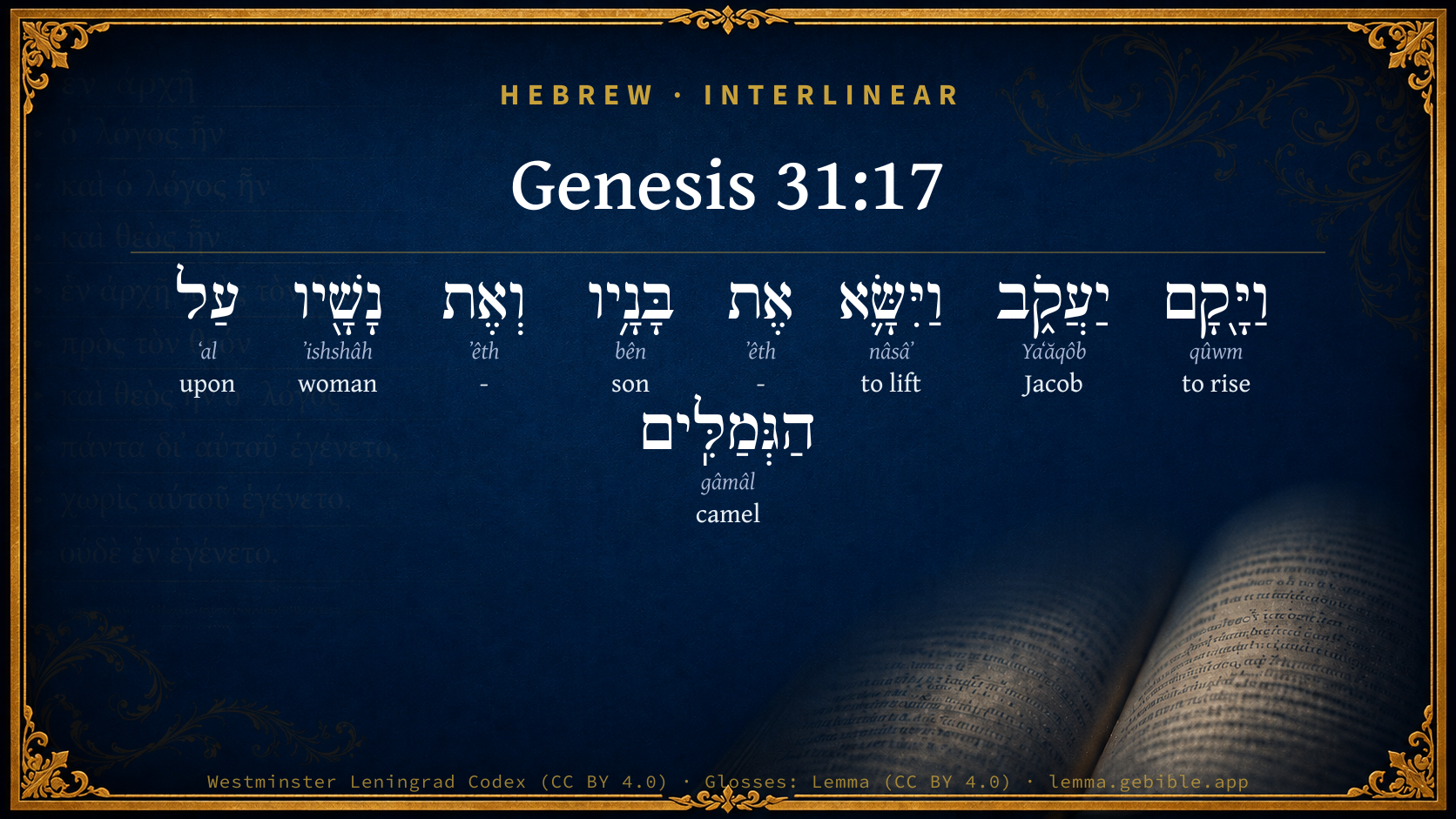
Genesis 31:17

Hebrew (Westminster Leningrad Codex) Genesis 31:17 appears in the Hebrew Old Testament. The text above is from the Westminster Leningrad Codex. Each word links to its Strong’s number, a concise gloss, and parsing drawn from the Open Scriptures Hebrew Bible morphology. Click any word for its full Brown-Driver-Briggs (BDB) entry.
Download image
Cite this verse

Genesis 31:17 (World English Bible). Public Domain. Lemma interlinear Bible study tool, https://lemma.gebible.app/v/genesis/31/17.

Show BibTeX & RIS
BibTeX
RIS
English Translation
Then Jacob rose up, and set his sons and his wives on the camels,
World English Bible · Public Domain
Download a study sheet

One document with this verse’s original text, its word-by-word gloss line, the meaning frame, cross-references with their text, attributed commentary, and full source and license credits — printable, and it pastes into notes with its structure intact.

This verse Autodidact and up

Study sheet (.html) Plain text (.txt)

A passage Seminary Student

Up to 50 verses in one chapter. A passage sheet keeps up to 6 commentary sources and 12 cross-references per verse, in the order this page ranks them, and says so on the sheet whenever that leaves anything out. Ask for a single verse and you get the Autodidact verse sheet above.

Everything on this page stays free to read, with no account — the sheet is a download of what is already on screen, not access to it.

Want to remove ads? Support Godless Engineer
Compare translations 3

The same verse in 3 English versions, stacked beneath the original-language interlinear above. Click any original word for its lexicon entry.

Each is an independent rendering of the whole verse — the interlinear is not word-aligned to these translations.

Highlighted words mark where these versions differ — a whole-verse word diff, not a word-by-word alignment.

  • World English Bible Public Domain
    Then Jacob rose up, and set his sons and his wives on the camels,
  • King James Version Public Domain
    Then Jacob rose up, and set his sons and his wives upon camels;
  • unfoldingWord Literal Text CC BY-SA 4.0
    So Jacob got up and put his sons and his wives on the camels.

unfoldingWord Literal Text — © unfoldingWord, licensed CC BY-SA 4.0. Word-aligned USFM3 via Door43 (git.door43.org/unfoldingWord/en_ult).

Versions to compare (up to 4)

3 of 4 selected

Show all 18 translations

Every available English version of this verse, each an independent rendering of the whole verse.

  • World English Bible Public Domain
    Then Jacob rose up, and set his sons and his wives on the camels,
  • Berean Standard Bible Public Domain
    Then Jacob got up and put his children and his wives on camels,
  • Majority Standard Bible Public Domain
    Then Jacob got up and put his children and his wives on camels,
  • King James Version Public Domain
    Then Jacob rose up, and set his sons and his wives upon camels;
  • American Standard Version (1901) Public Domain
    Then Jacob rose up, and set his sons and his wives upon the camels;
  • Revised Version (1885) Public Domain
    Then Jacob rose up, and set his sons and his wives upon the camels;
  • Geneva Bible (1599) Public Domain
    Then Iaakob rose vp, and set his sonnes and his wiues vpon camels.
  • Douay-Rheims (1899) Public Domain
    Then Jacob rose up, and having set his children and wives upon camels, went his way.
  • Young's Literal Translation Public Domain
    And Jacob riseth, and lifteth up his sons and his wives on the camels,
  • Literal Standard Version CC BY-SA 4.0
    And Jacob rises, and lifts up his sons and his wives on the camels,
  • Unlocked Literal Bible CC BY-SA 4.0
    Then Jacob arose and placed his sons and his wives upon the camels.
  • unfoldingWord Literal Text CC BY-SA 4.0
    So Jacob got up and put his sons and his wives on the camels.
  • Darby Bible Public Domain
    And Jacob rose up, and set his sons and his wives upon camels,
  • World Messianic Bible Public Domain
    Then Jacob rose up, and set his sons and his wives on the camels,
  • Webster's Bible Public Domain
    Then Jacob arose, and set his sons and his wives upon camels;
  • Free Bible Version CC BY-SA 4.0
    So Jacob got ready. He helped his children and his wives onto the camels,
  • Bible in Basic English Public Domain
    Then Jacob put his wives and his sons on camels;
  • JPS Tanakh (1917) Public Domain
    Then Jacob rose up, and set his sons and his wives upon the camels;

Literal Standard Version (2020), Covenant Press — licensed CC BY-SA 4.0. Text via the HelloAO Bible API (eBible.org). Unlocked Literal Bible (unfoldingWord) — licensed CC BY-SA 4.0. Text via the HelloAO Bible API (eBible.org). unfoldingWord Literal Text — © unfoldingWord, licensed CC BY-SA 4.0. Word-aligned USFM3 via Door43 (git.door43.org/unfoldingWord/en_ult). Free Bible Version, Dr. Jonathan Gallagher — licensed CC BY-SA 4.0. Text via the HelloAO Bible API (eBible.org).

Word by word

More ways to search: Search by grammar → Find every occurrence → Compare this word →

Practice this passage: Drill this verse → Learn its vocabulary →

הַגְּמַלִּֽים
gâmâl
H1581
“the · camels”
Particle, Definite Article + Noun, Common, Masculine, Plural, Absolute
Part of Speech
Particle + Noun
Type
Common
Gender
Masculine
Number
Plural
State
Absolute
Full BDB Definition

Origin: apparently from H1580

TWOT: 360d

camel - as property, as beast of burden, for riding, forbidden for food
  1. וַיָּ֖קָם qûwm H6965 “and · to rise” Conjunction + Verb, Qal, Sequential Imperfect, 3rd Person, Masculine, Singular
  2. יַעֲקֹ֑ב Yaʻăqôb H3290 “Jacob” Noun, Proper
  3. וַיִּשָּׂ֛א nâsâʼ H5375 “and · to lift” Conjunction + Verb, Qal, Sequential Imperfect, 3rd Person, Masculine, Singular
  4. אֶת ʼêth H853 “-” Particle, Direct Object
  5. בָּנָ֥יו bên H1121 “sons · his” Noun, Common, Masculine, Plural, Construct + Suffix, Personal, 3rd Person, Masculine, Singular
  6. וְאֶת ʼêth H853 “and · -” Conjunction + Particle, Direct Object
  7. נָשָׁ֖יו ʼishshâh H802 “women · his” Noun, Common, Feminine, Plural, Construct + Suffix, Personal, 3rd Person, Masculine, Singular
  8. עַל ʻal H5921 “upon” Preposition

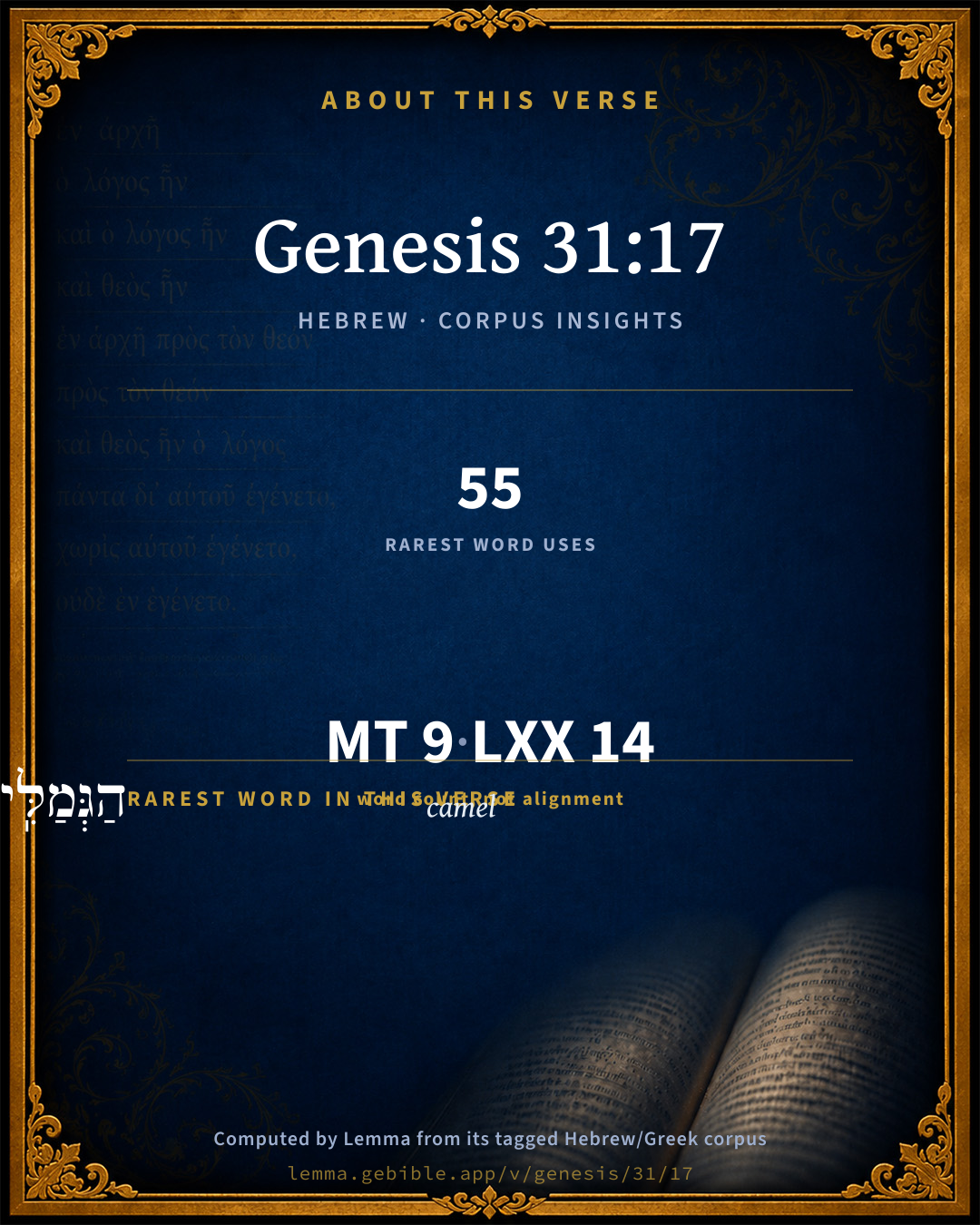
About this verse

These counts appear in no published source. They are computed here, from the morphology-tagged text and Lemma’s own curated glosses. What Lemma adds →

9
words
8
distinct lemmas
Pentateuch
section

Shared distinctive vocabulary

הַגְּמַלִּֽים camel H1581 occurs in 52 verses of the Hebrew Bible. Also found in:

Grammatical profile

  • 2 verbs
  • 4 nouns
  • 1 preposition
  • 2 particles

Verb forms

  • וַיָּ֖קָם Qal · Sequential Imperfect
  • וַיִּשָּׂ֛א Qal · Sequential Imperfect

Hebrew & Septuagint length

In English translation the verse runs 14 words from the Hebrew and 14 from the Septuagint (LXX English) — the same length.

A rough comparison of the two English renderings, which tokenize alike — not a word-level alignment.

Word counts can differ between the Hebrew and the Greek without any difference in meaning — e.g. the Hebrew direct-object marker אֵת has no separate Greek word, and Greek often adds the article ὁ.

In the original languages it is 9 Hebrew tokens and 14 Greek tokens — but the two are counted differently (Hebrew bundles its prefixes and suffixes into one token; the Greek is in lemma form), so that isn’t a like-for-like length.

Cross-references

3

Topical passages linked to Genesis 31:17 in the Treasury of Scripture Knowledge — connected by theme and wording, ordered by reader-vote popularity; previews shown in the World English Bible.

  • Genesis 24:10 The servant took ten camels, of his master's camels, and departed, having all goodly things of his master's in his hand. He arose, and went to Mesopotamia, to the city of Nahor.
  • Genesis 24:61 Rebekah arose with her ladies. They rode on the camels, and followed the man. The servant took Rebekah, and went his way.
  • 1 Samuel 30:17 David struck them from the twilight even to the evening of the next day: and there not a man of them escaped, except four hundred young men, who rode on camels and fled.

Cross-references courtesy of OpenBible.info (CC BY 4.0).

Hebrew and Greek witnesses Masoretic Hebrew ↔ Greek Septuagint

The same verse in the two great witnesses to the Old Testament, shown verse-for-verse.

These are two independent witnesses, not word-aligned to each other, and the Septuagint is shown in lemma (dictionary) form.

Hebrew Genesis 31:17 Masoretic · Westminster Leningrad Codex

וַיָּ֖קָם יַעֲקֹ֑ב וַיִּשָּׂ֛א אֶת בָּנָ֥יו וְאֶת נָשָׁ֖יו עַל הַגְּמַלִּֽים

Then Jacob rose up, and set his sons and his wives on the camels,

World English Bible · Public Domain

Greek LXX Genesis 31:17 Septuagint · lemma form

ἀναἵστημι δέ ἰακώβ λαμβάνω ὁ γυνή αὐτός καί ὁ παιδίον αὐτός ἐπί ὁ κάμηλος

And Jacob arose and took his wives and his children up on the camels;

LXX2012 (modern English Septuagint) · Public Domain

Hebrew: Westminster Leningrad Codex (CC BY 4.0). Greek: Septuagint (public domain); English from LXX2012 (modern English Septuagint) (Public Domain). How the Septuagint differs from the Hebrew →

Targum (Aramaic paraphrase)

2

The Targum is the ancient Jewish Aramaic paraphrase of the Hebrew Scriptures — an interpretive translation, not the Hebrew text itself. Onkelos (literal) and Pseudo-Jonathan (expansive) render the Torah, and Jonathan the Prophets. Coverage is partial: where no permissively-licensed English translation exists for a verse, only the Aramaic is shown. This is verse-level text, not a word-by-word alignment to the Hebrew.

  1. Targum Onkelos Torah (Genesis–Deuteronomy)
    וְקָם יַעֲקֹב וּנְטַל יָת בְּנוֹהִי וְיָת נְשׁוֹהִי עַל גַּמְלַיָּא

    (no public-domain English translation for this verse)

    Targum Onkelos — Aramaic: “Onkelos Genesis” (public domain); “Onkelos Exodus” (public domain); “Onkelos Leviticus” (public domain); “Onkelos Numbers” (public domain); “Onkelos Deuteronomy” (public domain). English: “Sefaria Community Translation” (CC0 1.0 (public-domain dedication)); “J.W. Etheridge. The Targums of Onkelos and Jonathan Ben Uzziel on the Pentateuch. London: Longmans, Green, 1862” (public domain). Text via Sefaria.

  2. Targum Pseudo-Jonathan Torah (Genesis–Deuteronomy)
    וְקָם יַעֲקב וְסוֹבַר יַת בְּנוֹי וְיַת נְשׁוֹי עַל גַמְלַיָא

    And Jakob arose, and set his children and his wives upon camels.

    Targum Pseudo-Jonathan — Aramaic: “Targum Jonathan on Genesis” (public domain); “Targum Jonathan on Exodus” (public domain); “Targum Jonathan on Leviticus” (public domain); “Targum Jonathan on Numbers” (public domain); “Targum Jonathan on Deuteronomy” (public domain). English: “The Targum of Jonathan ben Uzziel, trans. J. W. Etheridge, London, 1862” (public domain). Text via Sefaria.

Commentary

Notes on Genesis 31:17 from classic Christian and Jewish commentators (each source and its license shown beneath its notes). The classic Christian expositions comment on the surrounding passage and are grouped to its opening verse, so a note may address several verses; the Jewish commentaries on the Tanakh (Rashi and others) are per-verse, so they appear only where the commentator wrote on this verse.

Lemma curates 59 commentaries, every one of them public domain or Creative Commons licensed, each selected and text-cleaned for this edition rather than reprinted as found. About our sources →

Trapp's Complete Commentary

John Trapp

Gen 31:17 Then Jacob rose up, and set his sons and his wives upon camels;

Ver. 17. Then Jacob rose up.] Taking his time, when Laban was from home, shearing his sheep.

John Trapp, A Commentary or Exposition upon All the Books of the Old and New Testament (1647–1656) — public domain. Text from a community e-Sword module.

The Biblical Illustrator

Joseph S. Exell

Gen_31:17-21

Then Jacob rose up.

Lessons

1. Concurrence of all things with the call of God points out the time of mans obedience to him.

2. He that hath Gods call for himself and others to any undertaking should prepare first for it.

3. It concerns husbands and fathers to provide for convenient motions of wives and children upon Gods call (Gen_31:17).

4. Prudence teacheth men to order all their substance as motions rightly upon Gods call.

5. Justice will suffer no man to take anything but that which is his own.

6. Courage becometh Gods servants to break through all difficulties to follow God (Gen_31:18) and go where He calleth them. (G. Hughes, B. D.)

Lessons

1. Providence finds work to call off such as would hinder obedience to His work from His servants.

2. Hard it is for souls bred up in superstition to be wholly taken off from it.

3. There may be a temptation upon children to rob parents, but it is grievous wickedness.

4. Hearts not purged will have their superstitions and means of will-worship, though they steal them.

5. God suffers such irregular practices in good families sometimes for the trial of His own (Gen_31:19). (G. Hughes, B. D.)

Lessons

1. Providence directs Gods servants to prudence for escaping the hands of wicked men at His call.

2. It is no iniquity, not to declare Gods call and way to such as would oppose them (Gen_31:20).

3. Flight is not unbeseeming saints from under the hands of oppressors when God calleth to 2:4. Difficult passages Gods servants find sometimes in following Gods call.

5. No difficulties should discourage where God appears to warrant mans motions.

6. Mans face should be set to that mark which God points him out in his pilgrimage (Gen_2:21). (G. Hughes, B. D.)

Lessons

1. Providence ordereth tidings of His delivering His servants, to come to their enemies when they are not to be hindered by them (Job_5:12; Job_5:10).

2. Tidings of mercy to saints may come to the wicked soon enough to try them (Gen_31:22). (G. Hughes, B. D. )

The Teraphim

Rachel stole the Teraphim, either, as has been advanced, because she wished to prevent Labans consulting them on the direction of their flight, or to secure their guardianship for a journey apparently fraught with difficulties and dangers. The value of the precious metal of which the idol might have been made was certainly a temptation subordinate to the superstitious motive. The example given by Jacob with regard to the worship of God, had manifestly exercised a greater influence upon Leah than upon Rachel; though both, therefore, acknowledged, in Jacobs blessing, the will and favour of God, and urged him to follow the Divine directions (Gen_31:16), Rachel continued to attach a high value to dumb images, and regarded herself safe only under the guardianship of her own gods. Our knowledge concerning the shape of the Teraphim is very limited. They resembled the form of man (1Sa_19:13), either consisting of the entire human body, or only of head and breast. They were made of various materials, and not unfrequently of silver, two hundred shekels of which were employed for one statue (Jdg_17:4). Our information is more accurate respecting the use and nature of the Teraphim. But we must distinguish between the earlier and later history of the Hebrews. The origin of the Teraphim seems to have been in Mesopotamia or Chaldea, a supposition probable from our passage, and from a later allusion in which the Babylonian king is related to have consulted them (Eze_21:26). Although no doubt comprised amongst the idols which Jacob is recorded to have removed in Shechem (Gen_35:4), they long remained in favour among his descendants; and while the Hebrews were always conscious of their crime whenever they worshipped other gods, they do not seem to have regarded the adoration of the Teraphim as equally reproachful. On this point, the history of Micah is highly instructive (Jdg_18:1-31.). It shows clearly, that the Teraphim were considered as tutelar deities, fully compatible with the homage solely due to the Lord; that they were used, by many, as oracles, like the Urim and Thummim, or like the Ark of the Covenant; and that they were deemed sacred and lawful, if but a descendant of Aaron performed the ministerial functions: they implied a transgression of the second, not of the first commandment. Thus we account for the fact, otherwise most strange, that the prophet Hosed enumerates the Teraphim among the boons of which the disobedient Israelites would be deprived (3:4); he threatens them with the dissolution of national and of family life; he predicts, that princes and sacrifices will disappear, and together with them their own domestic gods, the Teraphim, who, therefore, have there a political and social rather than a religious import. The prophet does not hesitate to mention them, because they were evidently in his time still considered as the mildest and most harmless form of idolatry. But gradually, when the pure doctrines of Mosaism began to be enforced with greater rigour, the Teraphim were naturally included among the objects of religious aversion; even the author of the Book of Judges, who wrote in the latest times of the monarchy (Jdg_18:30), inserted in his truthful narrative a remark of disapproval: in those days there was no king in Israel, every one did what was right in his own eyes (17:6); when king Josiah established the strict worship of monotheism, he destroyed among the other idols, the Teraphim also (2Ki_8:24); and, perhaps, exactly because they were considered as almost innocent images, the later writers were extremely severe in denouncing them: the crime of obstinacy against the Divine will is compared to the idolatry of the Teraphim (1Sa_15:23); they are classed among the detestations and abominations (2Ki_13:24); their oracles are described not only as falsehood, but as wickedness; they lead astray those who consult them like sheep which have no shepherd (Zec_10:2); and they are attributed to the Babylonian monarch together with his other absurd modes of divination, as the auguries taken from looking in the liver (Eze_21:26; Eze_21:28). (M. M. Kalisch, Ph. D.)

The Biblical Illustrator, edited by Joseph S. Exell (c. 1880s–1900s) — public domain. Text from a community e-Sword module.

Tyndale Open Study Notes

Tyndale Open Resources

31:17-21 Jacob left Laban secretly out of fear of reprisal (31:31).

Tyndale Open Study Notes — © Tyndale Open Resources, licensed CC BY-SA 4.0. Text via the HelloAO Bible API.

Matthew Henry's Commentary

Here is, I. Jacob's flight from Laban. We may suppose he had been long considering of it, and casting about in his mind respecting it; but when now, at last, God had given him positive orders to go, he made no delay, nor was he disobedient to the heavenly vision. The first opportunity that offered itself he laid hold of, when Laban was shearing his sheep (Gen 31:19), that part of his flock which was in the hands of his sons three days' journey off. Now, 1. It is certain that it was lawful for Jacob to leave his service suddenly, without giving a quarter's warning. It was not only justified by the particular instructions God gave him, but warranted by the fundamental law of self-preservation, which directs us, when we are in danger, to shift for our own safety, as far as we can do it without wronging our consciences. 2. It was his prudence to steal away unawares to Laban, lest, if Laban had known, he should have hindered him or plundered him. 3. It was honestly done to take no more than his own with him, the cattle of his getting, Gen 31:18. He took what Providence gave him, and was content with that, and would not take the repair of his damages into his own hands. Yet Rachel was not so honest as her husband; she stole her father's images (Gen 31:19) and carried them away with her. The Hebrew calls them teraphiam. Some think they were only little representations of the ancestors of the family, in statues or pictures, which Rachel had a particular fondness for, and was desirous to have with her, now that she was going into another country. It should rather seem that they were images for a religious use, penates, household-gods, either worshipped or consulted as oracles; and we are willing to hope (with bishop Patrick) that she took them away not out of covetousness of the rich metal they were made of, much less for her own use, or out of any superstitious fear lest Laban, by consulting his teraphim, might know which way they had gone (Jacob, no doubt, dwelt with his wives as a man of knowledge, and they were better taught than so), but out of a design hereby to convince her father of the folly of his regard to those as gods which could not secure themselves, Isa 46:1, Isa 46:2.

II. Laban's pursuit of Jacob. Tidings were brought him, on the third day, that Jacob had fled; he immediately raises the whole clan, takes his brethren, that is, the relations of his family, that were all in his interests, and pursues Jacob (as Pharaoh and his Egyptians afterwards pursued the seed of Jacob), to bring him back into bondage again, or with design to strip him of what he had. Seven days' journey he marched in pursuit of him, Gen 31:23. He would not have taken half the pains to have visited his best friends. But the truth is bad men will do more to serve their sinful passions than good men will to serve their just affections, and are more vehement in their anger than in their love. Well, at length Laban, overtook him, and the very night before he came up with him God interposed in the quarrel, rebuked Laban and sheltered Jacob, charging Laban not to speak unto him either good or bad (Gen 31:24), that is, to say nothing against his going on with his journey, for that it proceeded from the Lord. The same Hebraism we have, Gen 24:50. Laban, during his seven day's march, had been full of rage against Jacob, and was now full of hopes that his lust should be satisfied upon him (Exo 15:9); but God comes to him, and with one word ties his hands, though he does not turn his heart. Note, 1. In a dream, and in slumberings upon the bed, God has ways of opening the ears of men, and sealing their instruction, Job 33:15, Job 33:16. Thus he admonishes men by their consciences, in secret whispers, which the man of wisdom will hear and heed. 2. The safety of good men is very much owing to the hold God has of the consciences of bad men and the access he has to them. 3. God sometimes appears wonderfully for the deliverance of his people when they are upon the very brink of ruin. The Jews were saved from Haman's plot when the king's decree drew hear to be put in execution, Est 9:1.

Matthew Henry's Commentary on the Whole Bible (1708–1710) — public domain (CC PDM 1.0). Text via the HelloAO Bible API.

Jamieson, Fausset & Brown

Robert Jamieson, A. R. Fausset & David Brown

Then Jacob rose up--Little time is spent by pastoral people in removing. The striking down the tents and poles and stowing them among their other baggage; the putting their wives and children in houdas like cradles, on the backs of camels, or in panniers on asses; and the ranging of the various parts of the flock under the respective shepherds; all this is a short process. A plain that is covered in the morning with a long array of tents and with browsing flocks, may, in a few hours, appear so desolate that not a vestige of the encampment remains, except the holes in which the tent poles had been fixed.

Jamieson, Fausset & Brown — Commentary Critical and Explanatory on the Whole Bible (1871) — public domain (CC PDM 1.0). Text via the HelloAO Bible API.

John Calvin's Commentaries

17. Then Jacob rose up. The departure of Jacob Moses afterwards more fully relates, he now only briefly says that “he rose up;” by which he means, that as soon as he could obtain the consent of his wives to go with him, he yielded to no other obstacles. Herein appears the manly strength and constancy of his mind. For Moses leaves many things to be reflected upon by his readers; and especially that intermediate period, during which the holy man was doubtless agitated with a multiplicity of cares. He had believed that his exile from home would be only for a short time: but, deprived of the sight of his parents and of his native soil during twenty years, he suffered many things so severe and bitter, that the endurance of them might have rendered him callous, or, at least, might have so oppressed him as to have consumed the remnant of his life. He was now verging towards old age, and the coldness of old age produces tardiness. Yet the flight for which he was preparing was not free from danger. Therefore it was necessary that he should be armed with the spirit of fortitude, in order that the vigor and alacrity of which Moses speaks, might cause him to hasten his steps. And since we read that the departure of the holy man was effected by stealth, and was attended with discredit; let us learn, whenever God abases us, to turn our minds to such examples as this.

John Calvin's Commentaries (1540-1563) — public domain. Text from the Calvin Translation Society English edition (1840s-50s) via the Christian Classics Ethereal Library (ccel.org). Calvin's coverage is partial (roughly two-thirds of the Bible); uncommented books and verses are honest gaps, never fabricated. The 19th-century editor's footnotes and remarks are omitted so the notes are faithfully Calvin's own voice.

Ellicott's Commentary for English Readers

(17, 18) Jacob rose up.—This was the final result of Jacob’s deliberation with his wives, but it did not take place till the time of sheep-shearing. Jacob must have prepared his plans very carefully to be able to leave none of his wealth behind; but he would be greatly helped in this by the fact that his own head-quarters were thirty or forty miles distant from Haran (Gen_30:36).

A Bible Commentary for English Readers, edited by Charles John Ellicott (1878–1897) — public domain. Text from a community e-Sword module.

John Gill's Exposition

And he carried away all his cattle,.... His sheep, camels, and asses: the Jews say (y) he had 5,500 head of cattle:

and all the goods which he had gotten: all the rest besides his cattle; his menservants, and maidservants, and all his gold and his silver, and whatsoever else he had:

the cattle of his getting, which he had gotten in Padanaram: or Mesopotamia: this seems to be purposely observed, to show that he took nothing but what was his own getting, not anything that belonged to Laban:

for to go to Isaac his father in the land of Canaan; but it was some years before he got to his father's house, staying at several places by the way. No mention is made of his mother Rebekah, she perhaps being now dead.

(y) Pirke Eliezer, c. 37. fol. 41.

John Gill's Exposition of the Whole Bible (1746–1763) — public domain (CC PDM 1.0). Text via the HelloAO Bible API.

Whedon's Commentary on the Bible

Daniel D. Whedon

17. Upon camels — Hebrews, upon the camels, that is, the camels provided for the purpose. No mention of camels as a part of Laban’s or Jacob’s possessions has as yet been made. But there has been no occasion; and even if there were no camels among Laban’s property, Jacob might readily have purchased these at the time for his purpose. Gen_32:5; Gen_32:15, shows that Jacob’s possessions of cattle included many camels, oxen, kine, bulls, and asses, of which we have no other mention. But his secret departure showed how he yet leaned more to his own devices than upon the providence of God.

Daniel D. Whedon (gen. ed.), Commentary on the Old and New Testaments (1874–1909) — public domain. Text from a community e-Sword module.

The Pulpit Commentary

Vers. 17, 18. Then (literally, and) Jacob rose up (expressive of the vigor and alacrity with which, having obtained the concurrence of his wives, Jacob set about fulfilling the Divine instructions), and set his sons his children, as in Gen_31:1 Gen_32:12, including Dinah, if by this time she had been born (vide Gen_30:21) and his wives upon camels. Since neither were able to undertake a journey to Canaan on foot, his oldest son being not more than thirteen years of age and his youngest not more than six. One camel, vide, Gen_12:16. And he carried away the verb ghen; to pant, which is specially used of those who are exhausted by running (Gesenins, sub voce) may perhaps indicate the haste with which Jacob actedall his cattle, Mikneh, literally, possession, from kanah, to procure, always used of cattle, the chief wealth of a nomad (Gen_13:2 Gen_26:14) and all his goods which he had gotten, Recush, literally, acquisition, hence substance, wealth in general, from racash, to acquire, (vide Gen_14:11, Gen_14:16, 21 15:14) which, however, is more specifically described as the cattle of his getting, which he had gotten (both of the above verbs, kanah and racash, being now employed) in (i.e. during his stay in) Padan-aram, for to go to Issac his father in the land of Canaan.

The Pulpit Commentary (1880–1919), ed. H.D.M. Spence-Jones & Joseph S. Exell — public domain. Text from a community e-Sword module.

Keil & Delitzsch

C. F. Keil & F. Delitzsch

Then Jacob rose up, and set his sons and his wives upon camels; Jacob then set out with his children and wives, and all the property that he had acquired in Padan-Aram, to return to his father in Canaan; whilst Laban had gone to the sheep-shearing, which kept him some time from his home on account of the size of his flock. Rachel took advantage of her father's absence to rob him of his teraphim (penates), probably small images of household gods in human form, which were worshipped as givers of earthly prosperity, and also consulted as oracles (see my Archologie, 90).

Keil & Delitzsch — Biblical Commentary on the Old Testament (1861–1891) — public domain (CC PDM 1.0). Text via the HelloAO Bible API. (Old Testament only.)

Kretzmann's Popular Commentary

Paul E. Kretzmann

Jacob Flees and is Pursued by Laban

v. 17. Then Jacob rose up, and set his sons and his wives upon camels;

v. 18. and he carried away all his cattle, and all his goods which he had gotten, the cattle of his getting, which he had gotten in Padanaram, for to go to Isaac, his father, in the land of Canaan. Jacob’s plans had evidently been laid and all arrangements made with great care even before he summoned his wives for the conference which decided in favor of immediate flight. The text repeatedly emphasizes the fact that all the wealth in cattle and goods which Jacob had collected and took along with him on his flight was such as he had honestly gotten.

v. 19. And Laban went to shear his sheep; and Rachel had stolen the images that were her father’s. The fact that Laban, with his sons, was keeping the feast of sheep-shearing, which lasted several days, gave Jacob the opportunity which he had sought, for Laban would never have permitted him to go in peace. There is no wrong in fleeing from a tyrant and seeking a place where one may live in peace and security and tend to the works of his calling without interference. That Rachel, although a believer in the true God, stole the images, the small household gods of her father, probably because she feared that Laban might consult them as oracles, shows that she was not yet entirely free from heathen superstition.

v. 20. And Jacob stole away unawares to Laban, the Syrian, in that he told him not that he fled. Jacob took the opportunity to remove himself and his goods without the knowledge of Laban, 2Sa 15:6, neither was the fact told to the older man.

v. 21. So he fled with all that he had; and he rose up, and passed over the river, and set his face toward the Mount Gilead. He forded the Euphrates, and then turned directly southwest toward Mount Gilead, on the farther side of the Jarmuk River, southeast of the Sea of Galilee.

v. 22. And it was told Laban on the third day that Jacob was fled.

v. 23. And he took his brethren with him, and pursued after him seven days’ journey; and they overtook him in the Mount Gilead. Jacob had a start of three days, but he was hampered by his large herds, whereas Laban, with his tribesmen, could travel very rapidly. Still Jacob had made excellent time in the ten days of his journey.

v. 24. And God came to Laban, the Syrian, a name used to distinguish him from the members of God’s own people, in a dream by night, and said unto him, Take heed that thou speak not to Jacob either good or bad. Literally, Laban should, in speaking to Jacob, not pass from good to bad, from a hasty greeting of his daughters and their children to reproaches and other indications of anger. The power of the enemies of God, so far as His children are concerned, is limited by God’s permission.

Paul E. Kretzmann, Popular Commentary of the Bible (1921–1924) — public domain. Text from a community e-Sword module.

unfoldingWord translationNotes

Door43 World Missions Community

his sons

Jacob took all of his children. It only mentions the sons because they are important as his heirs. AT: "his children" (See: Assumed Knowledge and Implicit Information)

He drove all his livestock

"He drove all his cattle." Here "livestock" is referring to all his domesticate animals.

including the livestock he had acquired in Paddan Aram

"and the other herd of cattle which he took ownership of when he was in Paddan Aram"

Then he set out to go to his father Isaac in the land of Canaan

"He went to the land of Canaan, where his father Isaac lived"

translationWords

Jacob

camel

livestock

Paddan Aram

Isaac

Canaan

unfoldingWord translationNotes — © Distant Shores Media and the Door43 World Missions Community, licensed CC BY-SA 4.0. Source: git.door43.org/Door43/en_tn.

Rashi

Rabbi Shlomo Yitzchaki (Rashi)

את בניו ואת נשיו HIS SONS AND HIS WIVES — He took the males before the females whereas Esau took the females before the males, as it is said (Genesis 36:6) “And Esau took his wives and his sons etc.” (Genesis Rabbah 74:5)

Rashi on the Tanakh — English translations: “The Judaica Press complete Tanach with Rashi, translated by A. J. Rosenberg” (CC BY 4.0); “Pentateuch with Rashi's commentary by M. Rosenbaum and A.M. Silbermann, 1929-1934” (public domain); “The Metsudah Tanach series, Lakewood, N.J” (CC BY 4.0); and “The Book of Joshua, Metsudah Publications, 1997” (CC BY 4.0). Text via Sefaria.

Radak

Rabbi David Kimhi (Radak)

ויקם יעקב וישא, he lifted his wives on to the camels so that they could ride.

Radak on the Tanakh — English translations: “Sefaria Community Translation” (CC0 1.0 (public-domain dedication)); “Eliyahu Munk, HaChut Hameshulash” (CC BY 4.0); “Rabbi Mike Feuer, Jerusalem Anthology” (CC BY 4.0); and “R. David Kimhi on the first book of Psalms, Translated by R.G. Finch, London, 1919” (public domain). Text via Sefaria.

Lesson kit

Teaching starters — assembled from the data on this page, not authored interpretation. Every prompt links to the verse data it draws on. Edit before teaching.

Genesis, in the Pentateuch, opens this verse with 9 words (8 distinct Hebrew lemmas). Its most distinctive word is gâmâl (“camel”). A historical commentator’s framing appears above. Read the whole chapter for the surrounding context.

Discussion questions

  1. The word gâmâl carries the sense “camel.” How does it shape the verse?
  2. Genesis 12:16 shares the word «camel» with this verse. How do the two illuminate each other?
  3. The translations on this page render this verse differently — a whole-verse word diff, not a word-by-word alignment. What might account for the different wordings?
  4. The verb «וַיָּ֖קָם» is Qal Sequential Imperfect. How does its form color the action?
  5. Reading how Trapp's Complete Commentary and The Biblical Illustrator read this verse, where do the two commentators agree and where do they part?

Things to notice

Reading settings

Reading text

Shown beneath each verse's original-language words.

Old Testament
Old Testament edition

Read the OT as the Masoretic Hebrew (MT) or the Greek Septuagint (LXX).

English shown for the Greek Septuagint (in the Hebrew ↔ Greek comparison).

Comparing translations? Open the Compare panel on any verse page to stack up to four side by side.