Leviticus 26:42

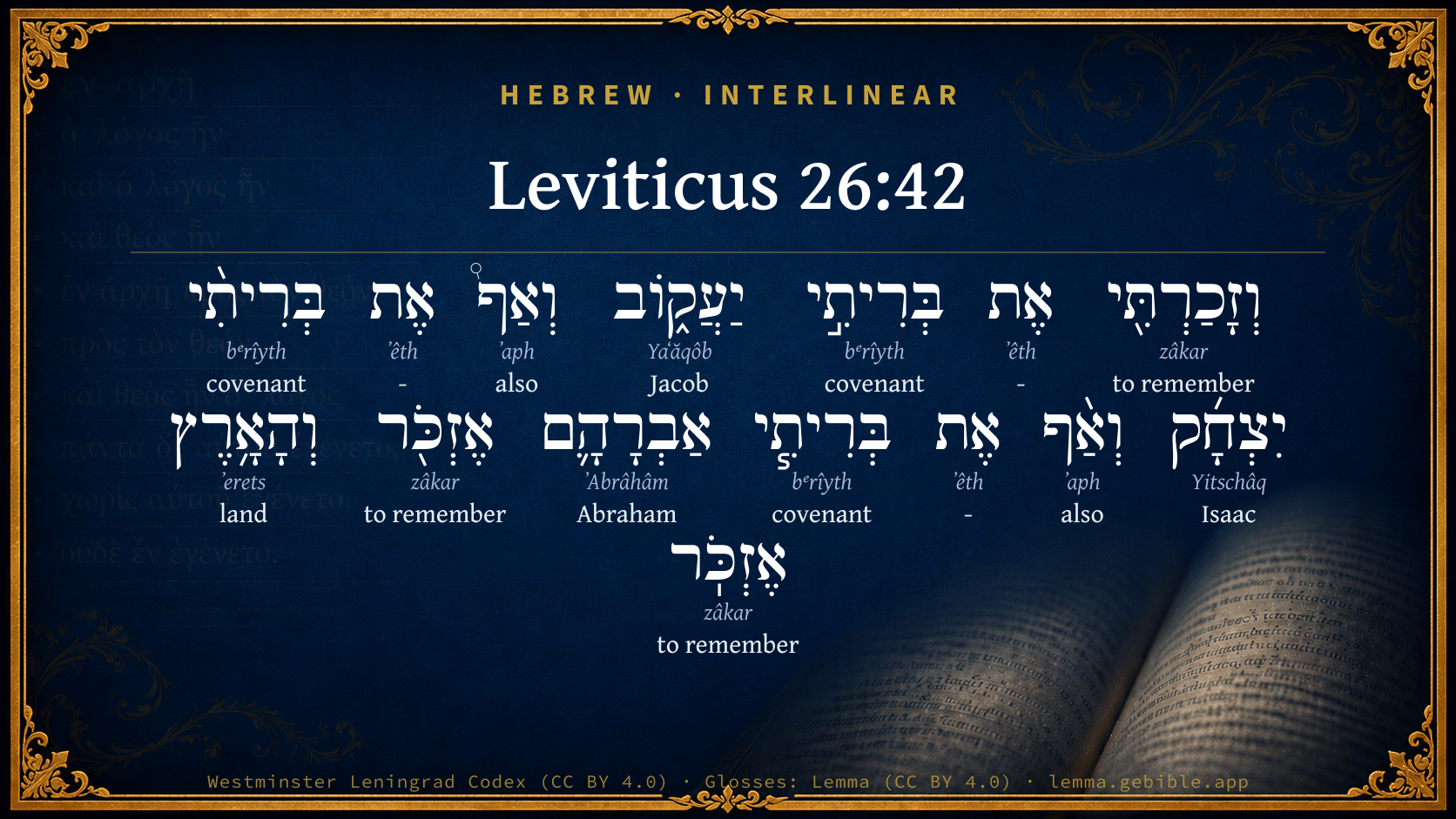
Hebrew (Westminster Leningrad Codex) Leviticus 26:42 appears in the Hebrew Old Testament. The text above is from the Westminster Leningrad Codex. Each word links to its Strong’s number, a concise gloss, and parsing drawn from the Open Scriptures Hebrew Bible morphology. Click any word for its full Brown-Driver-Briggs (BDB) entry.
Download image
Cite this verse

Leviticus 26:42 (World English Bible). Public Domain. Lemma interlinear Bible study tool, https://lemma.gebible.app/v/leviticus/26/42.

Show BibTeX & RIS
BibTeX
RIS
English Translation
then I will remember my covenant with Jacob; and also my covenant with Isaac, and also my covenant with Abraham; and I will remember the land.
World English Bible · Public Domain
Download a study sheet

One document with this verse’s original text, its word-by-word gloss line, the meaning frame, cross-references with their text, attributed commentary, and full source and license credits — printable, and it pastes into notes with its structure intact.

This verse Autodidact and up

Study sheet (.html) Plain text (.txt)

A passage Seminary Student

Up to 50 verses in one chapter. A passage sheet keeps up to 6 commentary sources and 12 cross-references per verse, in the order this page ranks them, and says so on the sheet whenever that leaves anything out. Ask for a single verse and you get the Autodidact verse sheet above.

Everything on this page stays free to read, with no account — the sheet is a download of what is already on screen, not access to it.

Want to remove ads? Support Godless Engineer
Compare translations 3

The same verse in 3 English versions, stacked beneath the original-language interlinear above. Click any original word for its lexicon entry.

Each is an independent rendering of the whole verse — the interlinear is not word-aligned to these translations.

Highlighted words mark where these versions differ — a whole-verse word diff, not a word-by-word alignment.

  • World English Bible Public Domain
    then I will remember my covenant with Jacob; and also my covenant with Isaac, and also my covenant with Abraham; and I will remember the land.
  • King James Version Public Domain
    Then will I remember my covenant with Jacob, and also my covenant with Isaac, and also my covenant with Abraham will I remember; and I will remember the land.
  • unfoldingWord Literal Text CC BY-SA 4.0
    then I will remember my covenant with Jacob, and also my covenant with Isaac, and also my covenant with Abraham I will remember, and the land I will remember.

unfoldingWord Literal Text — © unfoldingWord, licensed CC BY-SA 4.0. Word-aligned USFM3 via Door43 (git.door43.org/unfoldingWord/en_ult).

Versions to compare (up to 4)

3 of 4 selected

Show all 18 translations

Every available English version of this verse, each an independent rendering of the whole verse.

  • World English Bible Public Domain
    then I will remember my covenant with Jacob; and also my covenant with Isaac, and also my covenant with Abraham; and I will remember the land.
  • Berean Standard Bible Public Domain
    then I will remember My covenant with Jacob and My covenant with Isaac and My covenant with Abraham, and I will remember the land.
  • Majority Standard Bible Public Domain
    then I will remember My covenant with Jacob and My covenant with Isaac and My covenant with Abraham, and I will remember the land.
  • King James Version Public Domain
    Then will I remember my covenant with Jacob, and also my covenant with Isaac, and also my covenant with Abraham will I remember; and I will remember the land.
  • American Standard Version (1901) Public Domain
    then will I remember my covenant with Jacob; and also my covenant with Isaac, and also my covenant with Abraham will I remember; and I will remember the land.
  • Revised Version (1885) Public Domain
    then will I remember my covenant with Jacob; and also my covenant with Isaac, and also my covenant with Abraham will I remember; and I will remember the land.
  • Geneva Bible (1599) Public Domain
    Then I will remember my couenant with Iaakob, and my couenant also with Izhak, and also my couenant with Abraham will I remember, and will remember the land.
  • Douay-Rheims (1899) Public Domain
    And I will remember my covenant, that I made with Jacob, and Isaac, and Abraham. I will remember also the land:
  • Young's Literal Translation Public Domain
    then I have remembered My covenant `with' Jacob, and also My covenant `with' Isaac, and also My covenant `with' Abraham I remember, and the land I remember.
  • Literal Standard Version CC BY-SA 4.0
    then I have remembered My covenant [with] Jacob, and also My covenant [with] Isaac, and also My covenant [with] Abraham I remember, and I remember the land.
  • Unlocked Literal Bible CC BY-SA 4.0
    then will I call to mind my covenant with Jacob, my covenant with Isaac, and my covenant with Abraham; also, I will call the land to mind.
  • unfoldingWord Literal Text CC BY-SA 4.0
    then I will remember my covenant with Jacob, and also my covenant with Isaac, and also my covenant with Abraham I will remember, and the land I will remember.
  • Darby Bible Public Domain
    I will remember my covenant with Jacob, and also my covenant with Isaac, and also my covenant with Abraham will I remember; and I will remember the land.
  • World Messianic Bible Public Domain
    then I will remember my covenant with Jacob, my covenant with Isaac, and also my covenant with Abraham; and I will remember the land.
  • Webster's Bible Public Domain
    Then will I remember my covenant with Jacob, and also my covenant with Isaac, and also my covenant with Abraham will I remember; and I will remember the land.
  • Free Bible Version CC BY-SA 4.0
    then I will fulfill the agreement I made with Jacob, Isaac, and Abraham, and I will not forget my promise about the land.
  • Bible in Basic English Public Domain
    Then I will keep in mind the agreement which I made with Jacob and with Isaac and with Abraham, and I will keep in mind the land.
  • JPS Tanakh (1917) Public Domain
    then will I remember My covenant with Jacob, and also My covenant with Isaac, and also My covenant with Abraham will I remember; and I will remember the land.

Literal Standard Version (2020), Covenant Press — licensed CC BY-SA 4.0. Text via the HelloAO Bible API (eBible.org). Unlocked Literal Bible (unfoldingWord) — licensed CC BY-SA 4.0. Text via the HelloAO Bible API (eBible.org). unfoldingWord Literal Text — © unfoldingWord, licensed CC BY-SA 4.0. Word-aligned USFM3 via Door43 (git.door43.org/unfoldingWord/en_ult). Free Bible Version, Dr. Jonathan Gallagher — licensed CC BY-SA 4.0. Text via the HelloAO Bible API (eBible.org).

Word by word

More ways to search: Search by grammar → Find every occurrence → Compare this word →

Practice this passage: Drill this verse → Learn its vocabulary →

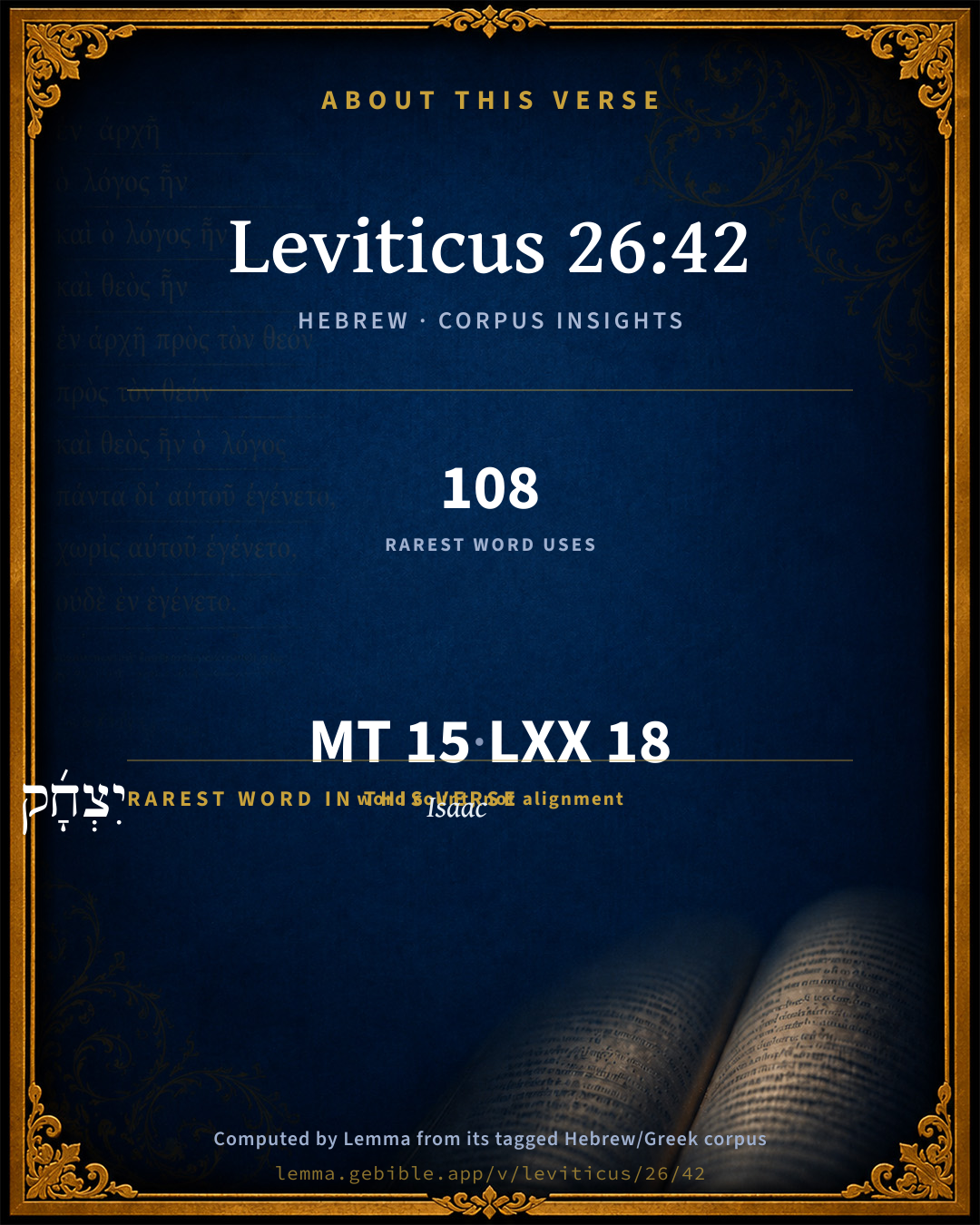
יִצְחָ֜ק
Yitschâq
H3327
“Isaac”
Noun, Proper
Part of Speech
Noun
Type
Proper
Full BDB Definition

Origin: from H6711

TWOT: 1905b

Isaac = "he laughs" - son of Abraham by Sarah his wife and father of Jacob and Esau
  1. וְזָכַרְתִּ֖י zâkar H2142 “and · to remember” Conjunction + Verb, Qal, Sequential Perfect, 1st Person, Common, Singular
  2. אֶת ʼêth H853 “-” Particle, Direct Object
  3. בְּרִיתִ֣י bᵉrîyth H1285 “covenant · my” Noun, Common, Feminine, Singular, Construct + Suffix, Personal, 1st Person, Common, Singular
  4. יַעֲק֑וֹב Yaʻăqôb H3290 “Jacob” Noun, Proper
  5. וְאַף֩ ʼaph H637 “and · also” Conjunction + Adverb
  6. אֶת ʼêth H853 “-” Particle, Direct Object
  7. בְּרִיתִ֨י bᵉrîyth H1285 “covenant · my” Noun, Common, Feminine, Singular, Construct + Suffix, Personal, 1st Person, Common, Singular
  8. וְאַ֨ף ʼaph H637 “and · also” Conjunction + Adverb
  9. אֶת ʼêth H853 “-” Particle, Direct Object
  10. בְּרִיתִ֧י bᵉrîyth H1285 “covenant · my” Noun, Common, Feminine, Singular, Construct + Suffix, Personal, 1st Person, Common, Singular
  11. אַבְרָהָ֛ם ʼAbrâhâm H85 “Abraham” Noun, Proper
  12. אֶזְכֹּ֖ר zâkar H2142 “to remember” Verb, Qal, Imperfect, 1st Person, Common, Singular
  13. וְהָאָ֥רֶץ ʼerets H776 “and · the · land” Conjunction + Particle, Definite Article + Noun, Common, Both, Singular, Absolute
  14. אֶזְכֹּֽר zâkar H2142 “to remember” Verb, Qal, Imperfect, 1st Person, Common, Singular

About this verse

These counts appear in no published source. They are computed here, from the morphology-tagged text and Lemma’s own curated glosses. What Lemma adds →

15
words
8
distinct lemmas
Pentateuch
section

Grammatical profile

  • 3 verbs
  • 7 nouns
  • 2 adverbs
  • 3 particles

Verb forms

  • וְזָכַרְתִּ֖י Qal · Sequential Perfect
  • אֶזְכֹּ֖ר Qal · Imperfect
  • אֶזְכֹּֽר Qal · Imperfect

Repetition

Words recur within this verse — often emphatic in Hebrew:

  • וְזָכַרְתִּ֖י to remember H2142 ×3
  • בְּרִיתִ֣י covenant H1285 ×3
  • וְאַף֩ also H637 ×2

Hebrew & Septuagint length

In English translation the verse runs 26 words from the Hebrew and 21 from the Septuagint (LXX English) — closely comparable.

A rough comparison of the two English renderings, which tokenize alike — not a word-level alignment.

Word counts can differ between the Hebrew and the Greek without any difference in meaning — e.g. the Hebrew direct-object marker אֵת has no separate Greek word, and Greek often adds the article ὁ.

In the original languages it is 15 Hebrew tokens and 18 Greek tokens — but the two are counted differently (Hebrew bundles its prefixes and suffixes into one token; the Greek is in lemma form), so that isn’t a like-for-like length.

Cross-references

15

Topical passages linked to Leviticus 26:42 in the Treasury of Scripture Knowledge — connected by theme and wording, ordered by reader-vote popularity; previews shown in the World English Bible.

  • Exodus 2:24 God heard their groaning, and God remembered his covenant with Abraham, with Isaac, and with Jacob.
  • Exodus 6:5 Moreover I have heard the groaning of the children of Israel, whom the Egyptians keep in bondage, and I have remembered my covenant.
  • Psalms 106:45 He remembered for them his covenant, And repented according to the multitude of his loving kindnesses.
  • Ezekiel 16:60 Nevertheless I will remember my covenant with you in the days of your youth, and I will establish to you an everlasting covenant.
  • Genesis 9:16 The rainbow will be in the cloud. I will look at it, that I may remember the everlasting covenant between God and every living creature of all flesh that is on the earth."
  • Genesis 22:15–18 The angel of Yahweh called to Abraham a second time out of the sky,
  • Genesis 26:5 because Abraham obeyed my voice, and kept my charge, my commandments, my statutes, and my laws."
  • Genesis 28:15 Behold, I am with you, and will keep you, wherever you go, and will bring you again into this land. For I will not leave you, until I have done that which I have spoken of to you."
  • Deuteronomy 4:31 for Yahweh your God is a merciful God; he will not fail you, neither destroy you, nor forget the covenant of your fathers which he swore to them.
  • Psalms 85:1–2 Yahweh, you have been favorable to your land. You have restored the fortunes of Jacob.
  • Psalms 136:23 Who remembered us in our low estate; For his loving kindness endures forever;
  • Ezekiel 36:1–15 You, son of man, prophesy to the mountains of Israel, and say, You mountains of Israel, hear the word of Yahweh.
  • Ezekiel 36:33–34 Thus says the Lord Yahweh: In the day that I cleanse you from all your iniquities, I will cause the cities to be inhabited, and the waste places shall be built.
  • Joel 2:18 Then Yahweh was jealous for his land, And had pity on his people.
  • Luke 1:72 To show mercy towards our fathers, To remember his holy covenant,

Cross-references courtesy of OpenBible.info (CC BY 4.0).

Hebrew and Greek witnesses Masoretic Hebrew ↔ Greek Septuagint

The same verse in the two great witnesses to the Old Testament, shown verse-for-verse.

These are two independent witnesses, not word-aligned to each other, and the Septuagint is shown in lemma (dictionary) form.

Hebrew Leviticus 26:42 Masoretic · Westminster Leningrad Codex

וְזָכַרְתִּ֖י אֶת בְּרִיתִ֣י יַעֲק֑וֹב וְאַף֩ אֶת בְּרִיתִ֨י יִצְחָ֜ק וְאַ֨ף אֶת בְּרִיתִ֧י אַבְרָהָ֛ם אֶזְכֹּ֖ר וְהָאָ֥רֶץ אֶזְכֹּֽר

then I will remember my covenant with Jacob; and also my covenant with Isaac, and also my covenant with Abraham; and I will remember the land.

World English Bible · Public Domain

Greek LXX Leviticus 26:42 Septuagint · lemma form

καί μιμνήσκω ὁ διαθήκη ἰακώβ καί ὁ διαθήκη ισαακ καί ὁ διαθήκη ἀβραάμ μιμνήσκω καί ὁ γῆ μιμνήσκω

And I will remember the covenant of Jacob, and the covenant of Isaac, and the covenant of Abraam will I remember.

LXX2012 (modern English Septuagint) · Public Domain

Hebrew: Westminster Leningrad Codex (CC BY 4.0). Greek: Septuagint (public domain); English from LXX2012 (modern English Septuagint) (Public Domain). How the Septuagint differs from the Hebrew →

Targum (Aramaic paraphrase)

2

The Targum is the ancient Jewish Aramaic paraphrase of the Hebrew Scriptures — an interpretive translation, not the Hebrew text itself. Onkelos (literal) and Pseudo-Jonathan (expansive) render the Torah, and Jonathan the Prophets. Coverage is partial: where no permissively-licensed English translation exists for a verse, only the Aramaic is shown. This is verse-level text, not a word-by-word alignment to the Hebrew.

  1. Targum Onkelos Torah (Genesis–Deuteronomy)
    וְדָכִירְנָא יָת קְיָמִי דְעִם יַעֲקוֹב וְאַף יָת קְיָמִי דְעִם יִצְחָק וְאַף יָת קְיָמִי דְעִם אַבְרָהָם אֲנָא דָכִיר וְאַרְעָא אֲנָא דָכִיר

    (no public-domain English translation for this verse)

    Targum Onkelos — Aramaic: “Onkelos Genesis” (public domain); “Onkelos Exodus” (public domain); “Onkelos Leviticus” (public domain); “Onkelos Numbers” (public domain); “Onkelos Deuteronomy” (public domain). English: “Sefaria Community Translation” (CC0 1.0 (public-domain dedication)); “J.W. Etheridge. The Targums of Onkelos and Jonathan Ben Uzziel on the Pentateuch. London: Longmans, Green, 1862” (public domain). Text via Sefaria.

  2. Targum Pseudo-Jonathan Torah (Genesis–Deuteronomy)
    וְאִדְכַּר בְּרַחֲמִין יַת קְיָימָא דְקַיֵימִית עִם יַעֲקב בְּבֵית אֵל וְאוּף יַת קְיָימָא דְקַיֵימִית עִם יִצְחָק בְּטַוָור מוֹרִיָה וְאוּף יַת קְיָימָא דְקַיֵימִית עִם אַבְרָהָם בֵּינֵי פִּיסוּגַיָא אֶדְכּוֹר וְאַרְעָא דְיִשְרָאֵל אֶדְכּוֹר בְּרַחֲמִין

    and I will remember in mercy the covenant which I confirmed with Jakob at Bethel, and the covenant which I covenanted with Izhak at Mount Moriah, and the covenant which I covenanted with Abraham, between the divided portions, I will remember, and the land of Israel will I remember in mercy.

    Targum Pseudo-Jonathan — Aramaic: “Targum Jonathan on Genesis” (public domain); “Targum Jonathan on Exodus” (public domain); “Targum Jonathan on Leviticus” (public domain); “Targum Jonathan on Numbers” (public domain); “Targum Jonathan on Deuteronomy” (public domain). English: “The Targum of Jonathan ben Uzziel, trans. J. W. Etheridge, London, 1862” (public domain). Text via Sefaria.

Commentary

Notes on Leviticus 26:42 from classic Christian and Jewish commentators (each source and its license shown beneath its notes). The classic Christian expositions comment on the surrounding passage and are grouped to its opening verse, so a note may address several verses; the Jewish commentaries on the Tanakh (Rashi and others) are per-verse, so they appear only where the commentator wrote on this verse.

Lemma curates 59 commentaries, every one of them public domain or Creative Commons licensed, each selected and text-cleaned for this edition rather than reprinted as found. About our sources →

Joseph Benson's Commentary

Lev 26:42. I will remember my covenant — So as to make good all that I have promised in it. For words of knowledge or remembrance, in Scripture, commonly denote affection and kindness. I will remember the land — Which now seems to be forgotten and despised, as if I had never chosen it to be the peculiar place of my presence and blessing.

Joseph Benson's Commentary on the Old and New Testaments (1811–1818) — public domain. Text from a community e-Sword module.

Tyndale Open Study Notes

Tyndale Open Resources

26:42 God had begun his covenant with Abraham (then called Abram, Gen 15:18) and continued it with Isaac (Gen 17:19) and Jacob (Exod 2:24). Jacob’s twelve sons were the ancestors of Israel’s twelve tribes. Israel’s liberation from Egypt and settlement in Canaan were based on God’s promises to their ancestors, not on the Israelites’ own virtues (Deut 9:4-5).

Tyndale Open Study Notes — © Tyndale Open Resources, licensed CC BY-SA 4.0. Text via the HelloAO Bible API.

Ellicott's Commentary for English Readers

(42) Then will I remember.—That is, perform the covenant God made. The expression “remember” frequently denotes “to be mindful,” “to perform,” especially when used with regard to God; as, for instance, “I have remembered my covenant,” &c. (Exo_6:5-6); “He remembered for them his covenant” (Psa_106:45).

My covenant with Jacob, and also my covenant with Isaac, and also my covenant with Abraham.—When thus brought to repentance, the Lord will perform towards them the covenant which He made with their ancestors, and in which He not only promised that the Israelites are to be a numerous people, but that they are to possess the land for ever (Exo_32:13). From the fact that the expression “covenant” is here exceptionally repeated before the name of each patriarch, the authorities during the second Temple rightly concluded that it refers to three distinct covenants made respectively with the patriarchs. Hence the Chaldee Versions render it, “And I will remember in mercy the covenant which I covenanted with Jacob at Bethel [Gen_35:9-15], and also the covenant which I covenanted with Isaac at Mount Moriah [Genesis 22], and the covenant which I covenanted with Abraham between the divided pieces [of the sacrifices (Gen_15:18-21)].” The ancients also call attention to the fact that whilst in all other passages where the three patriarchs are mentioned together, the order is according to their seniority, viz., Abraham, Isaac, and Jacob (Gen_1:24; Exo_2:24; Exo_6:8; Exo_32:13; Deu_29:13; Deu_34:4; 2Ki_13:23; Psa_105:8-10; 1Ch_16:16-17), this is the solitary instance where the regular order is inverted.

A Bible Commentary for English Readers, edited by Charles John Ellicott (1878–1897) — public domain. Text from a community e-Sword module.

John Gill's Exposition

The land also shall be left of them,.... This seems to refer to a second time, when this should be the case of the land of Judea again, as it was when subdued by the Romans, and the Jews were carried captive from it, and so it was left by them, as it has been ever since:

and shall enjoy her sabbaths, while lieth desolate without them; shall be as in the sabbatical years, uncultivated, neither ploughed nor sown, nor reaped; and thus the land of Canaan, though once so very fruitful, is now desolate and barren, being without its former inhabitants, and so it is like to be until it is restored to them again:

and they shall accept of the punishment of their iniquity; that is, when made sensible of their sins, and particularly of their iniquity of rejecting the Messiah; they will not think it hard that they have been punished in so severe a manner, but own the righteous hand of God in it, and be humble under it; and confessing their sins with true sorrow and repentance for them, looking at him whom they have pierced, and mourn, shall have the free and full remission of their sins applied unto them:

because, even, because they despised my judgments, and because their soul abhorred my statutes; despised and abhorred Christ, his doctrines and ordinances, which was the reason of their being carried captive out of their land, when it was forsaken by them, and lay desolate as to this day, especially with respect to any benefit of it enjoyed by them; and which, when they are sensible of, will be a reason of their accepting the punishment of their iniquity so readily, and not murmur at the hand of God upon them, or reflect on his dealings with them, but freely and fully confess their sins, that he may be justified in all that he has done.

John Gill's Exposition of the Whole Bible (1746–1763) — public domain (CC PDM 1.0). Text via the HelloAO Bible API.

Haydock's Catholic Bible Commentary

Jacob is placed first because he was the father of no other nation; as Abraham and Isaac were. (Worthington)

George Leo Haydock (1774–1849), Haydock's Catholic Family Bible and Commentary, 1859 edition — public domain. Excludes Psalms (Douay-Rheims chapter numbering differs from Protestant) and Deuterocanonical books (Catholic canon only).

Matthew Poole's English Annotations

I will remember my covenant, to wit, so as to perform it, and make good all that I have promised in it. For words of knowledge or remembrance in Scripture do most commonly connote affection and kindness; of which there are many instances, some given before, and more hereafter.

I will remember the land, which now seems to be forgotten, and neglected, and despised, as if I had never chosen it to be the peculiar place of my presence and blessing.

Matthew Poole's English Annotations on the Holy Bible (1683–1685) — public domain. Text from a community e-Sword/MySword module.

Whedon's Commentary on the Bible

Daniel D. Whedon

42. Will I remember — Memory cannot be properly predicated of the Omniscient — one with whom there is no succession of thoughts and no past nor future. He will surely bring to pass that which he has promised in the covenant with the patriarchs. Strictly speaking, God’s covenant with Abraham respecting the greatness of his seed was quite unconditional, except circumcision, and it amounts to a promise or an act of mere favour. See Gal_3:15-16, where επαγγελια, promise, and διαθηκη, covenant, are used as synonymes.

Daniel D. Whedon (gen. ed.), Commentary on the Old and New Testaments (1874–1909) — public domain. Text from a community e-Sword module.

John Wesley's Explanatory Notes

I will remember my covenant - So as to make good all that I have promised in it. For words of knowledge or remembrance in scripture, commonly denote affection and kindness. I will remember the land - Which now seems to be forgotten and despised, as if I had never chosen it to be the peculiar place of my presence and blessing.

John Wesley, Explanatory Notes Upon the Whole Bible (1754–1765) — public domain. Text via the GEBible commentary corpus.

Rashi

Rabbi Shlomo Yitzchaki (Rashi)

וזכרתי את בריתי יעקוב THEN I WILL REMEMBER MY COVENANT WITH JACOB — In five places in Scripture it (the name יעקב) is written plene (יעקוב) and the name אליהו is written defectively in five places, to intimate that Jacob — as it were — took one letter of his (Elijah’s) name as a pledge that at some future time he should come and proclaim the good tidings of his descendants’ redemption (cf. Midrash ‎חסירות ויתירות).

‎ וזכרתי את בריתי יעקוב‎ THEN I WILL REMEMBER MY COVENANT WITH JACOB [AND ALSO MY COVENANT WITH ISAAC, AND ALSO MY COVENANT WITH ABRAHAM WILL I REMEMBER] — Why are they (the patriarchs) enumerated here in a reverse order (in contrast to e. g., Exodus 32:13, where it states: ‎'לאברהם ליצחק ולישראל וכו‎‎‎זכור ‏)? It is to say: Jacob the youngest among the patriarchs is worthy of this that, through his merits, his children should be redeemed; if he be not sufficiently worthy, behold, the merit of Isaac is with him; if that does not suffice, behold, then there is Abraham with him who is surely worthy enough! And why does Scripture not use the word “remember” in connection with Isaac’s name? Because this is unnecessary, for — says God, as it were — the ashes of Isaac (who according to My command to Abraham was to become a burnt offering) are ever visible before Me as though they were heaped up lying upon the altar (Sifra, Bechukotai, Chapter 8 6-7).

Rashi on the Tanakh — English translations: “The Judaica Press complete Tanach with Rashi, translated by A. J. Rosenberg” (CC BY 4.0); “Pentateuch with Rashi's commentary by M. Rosenbaum and A.M. Silbermann, 1929-1934” (public domain); “The Metsudah Tanach series, Lakewood, N.J” (CC BY 4.0); and “The Book of Joshua, Metsudah Publications, 1997” (CC BY 4.0). Text via Sefaria.

Ramban (Nachmanides)

Rabbi Moshe ben Nachman (Ramban / Nachmanides)

THEN WILL I REMEMBER MY COVENANT WITH JACOB. Rabbi Abraham ibn Ezra commented that this [is a case where a word] draws along with itself another [similar] word, thus meaning: “Then will I remember My covenant, the covenant with Jacob. (My covenant) is grammatically equivalent to saying habrith sheli (the covenant of Mine). Now since a noun that is preceded by the definite article cannot be in the construct state, it follows that there is a word implied here, which makes it: eth brithi ‘brith’ Ya’akov (My covenant, the covenant of Jacob). A similar explanation applies to the following two verses which Ramban mentions. Similarly: the prophecy of Oded the prophet; (and the prophecy — a prophecy of Oded the prophet). your heads of your tribes. (your heads — heads of your tribes). And the Land I will remember. The meaning thereof is that I will remember the Land, and that it was paid its Sabbaths and lay forsaken without them, and I will remember that they have atoned for their iniquity.”It is possible according to the way of Truth, [the mystic doctrines of the Cabala], that He is saying: “And I will remember Jacob and Isaac and Abraham, who are the men of the covenant,” for all attributes are so called when they are in the covenant; “v’ha’aretz (and the earth),. which is composed of them all, I will remember among them.” Our Rabbis have so alluded. Thus they said: “And why does He mention the merit of ha’aretz with them? Said Rabbi Shimon ben Lakish: This is like the case of a master who had three daughters, and one maidservant who raised them. Whenever the master asked about the welfare of his daughters, he would say: ‘Ask on my behalf about the welfare of she who raises them.’”

Ramban (Nachmanides) on the Tanakh — English translation: “Commentary on the Torah by Ramban (Nachmanides). Translated and annotated by Charles B. Chavel. New York, Shilo Pub. House, 1971-1976” (CC BY 4.0). Text via Sefaria.

Lesson kit

Teaching starters — assembled from the data on this page, not authored interpretation. Every prompt links to the verse data it draws on. Edit before teaching.

Leviticus, in the Pentateuch, opens this verse with 15 words (8 distinct Hebrew lemmas). Its most distinctive word is Yitschâq (“Isaac”). A historical commentator’s framing appears above. Read the whole chapter for the surrounding context.

Discussion questions

  1. The word Yitschâq carries the sense “Isaac.” How does it shape the verse?
  2. Exodus 2:24 shares this passage’s theme. How do the two illuminate each other?
  3. “to remember” occurs 3× in this one verse. What is the effect of the repetition?
  4. The verb «וְזָכַרְתִּ֖י» is Qal Sequential Perfect. How does its form color the action?
  5. Reading how Joseph Benson's Commentary and Tyndale Open Study Notes read this verse, where do the two commentators agree and where do they part?

Things to notice

Reading settings

Reading text

Shown beneath each verse's original-language words.

Old Testament
Old Testament edition

Read the OT as the Masoretic Hebrew (MT) or the Greek Septuagint (LXX).

English shown for the Greek Septuagint (in the Hebrew ↔ Greek comparison).

Comparing translations? Open the Compare panel on any verse page to stack up to four side by side.