
Isaiah 49:5

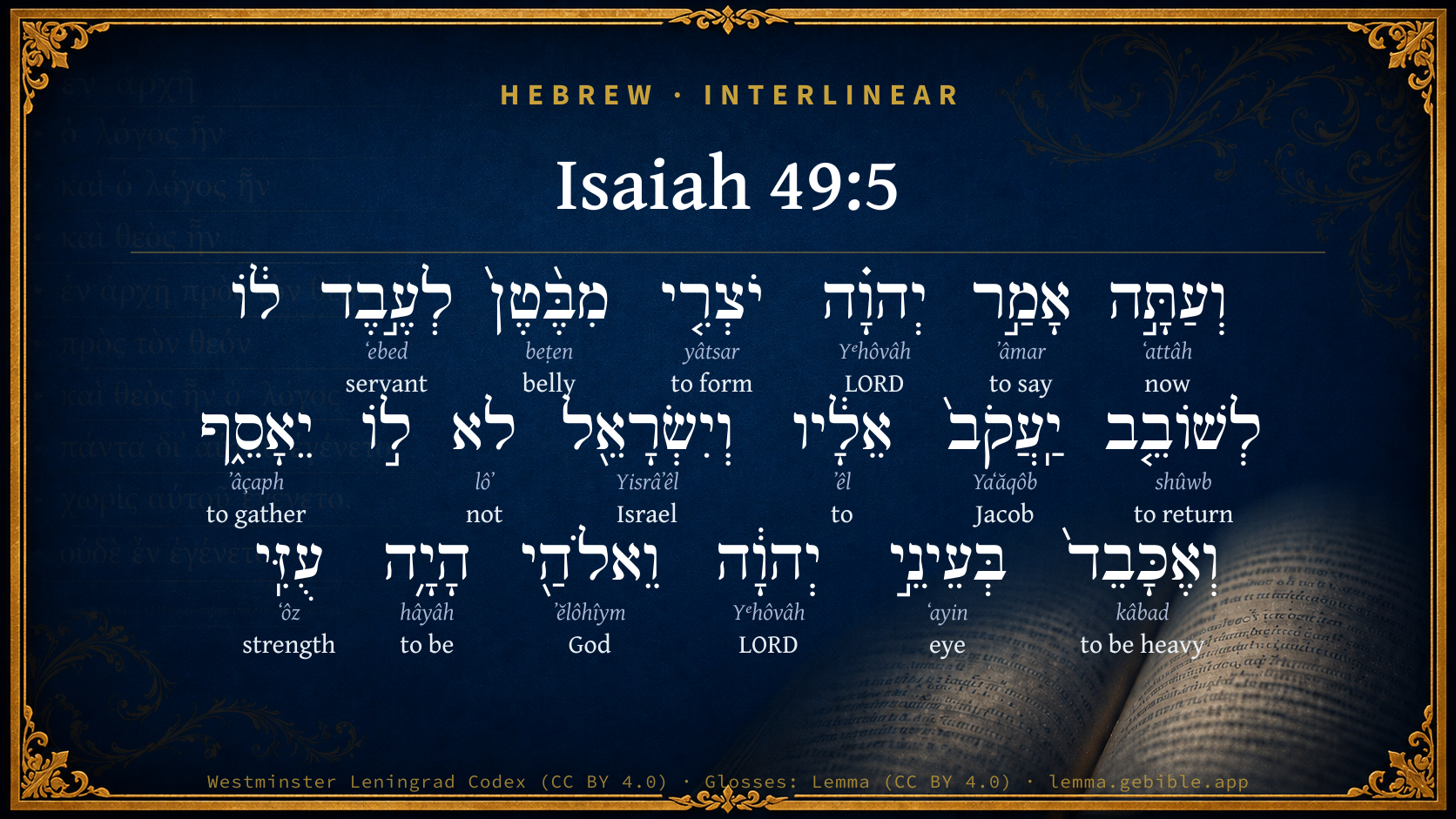
Hebrew (Westminster Leningrad Codex) Isaiah 49:5 appears in the Hebrew Old Testament. The text above is from the Westminster Leningrad Codex. Each word links to its Strong’s number, a concise gloss, and parsing drawn from the Open Scriptures Hebrew Bible morphology. Click any word for its full Brown-Driver-Briggs (BDB) entry.
Download image
Cite this verse

Isaiah 49:5 (World English Bible). Public Domain. Lemma interlinear Bible study tool, https://lemma.gebible.app/v/isaiah/49/5.

Show BibTeX & RIS
BibTeX
RIS
English Translation
Now says Yahweh who formed me from the womb to be his servant, to bring Jacob again to him, and that Israel be gathered to him (for I am honorable in the eyes of Yahweh, and my God is become my strength);
World English Bible · Public Domain
Download a study sheet

One document with this verse’s original text, its word-by-word gloss line, the meaning frame, cross-references with their text, attributed commentary, and full source and license credits — printable, and it pastes into notes with its structure intact.

This verse Autodidact and up

Study sheet (.html) Plain text (.txt)

A passage Seminary Student

Up to 50 verses in one chapter. A passage sheet keeps up to 6 commentary sources and 12 cross-references per verse, in the order this page ranks them, and says so on the sheet whenever that leaves anything out. Ask for a single verse and you get the Autodidact verse sheet above.

Everything on this page stays free to read, with no account — the sheet is a download of what is already on screen, not access to it.

Want to remove ads? Support Godless Engineer
Compare translations 3

The same verse in 3 English versions, stacked beneath the original-language interlinear above. Click any original word for its lexicon entry.

Each is an independent rendering of the whole verse — the interlinear is not word-aligned to these translations.

Highlighted words mark where these versions differ — a whole-verse word diff, not a word-by-word alignment.

  • World English Bible Public Domain
    Now says Yahweh who formed me from the womb to be his servant, to bring Jacob again to him, and that Israel be gathered to him (for I am honorable in the eyes of Yahweh, and my God is become my strength);
  • King James Version Public Domain
    And now, saith the LORD that formed me from the womb to be his servant, to bring Jacob again to him, Though Israel be not gathered, yet shall I be glorious in the eyes of the LORD, and my God shall be my strength.
  • unfoldingWord Literal Text CC BY-SA 4.0
    And now Yahweh has said, the one having formed me from the womb as a servant for him, to return Jacob to him and Israel would be assembled to him —and I am honored in the eyes of Yahweh, and my God has become my strength—

unfoldingWord Literal Text — © unfoldingWord, licensed CC BY-SA 4.0. Word-aligned USFM3 via Door43 (git.door43.org/unfoldingWord/en_ult).

Versions to compare (up to 4)

3 of 4 selected

Show all 18 translations

Every available English version of this verse, each an independent rendering of the whole verse.

  • World English Bible Public Domain
    Now says Yahweh who formed me from the womb to be his servant, to bring Jacob again to him, and that Israel be gathered to him (for I am honorable in the eyes of Yahweh, and my God is become my strength);
  • Berean Standard Bible Public Domain
    And now says the LORD, who formed Me from the womb to be His Servant, to bring Jacob back to Him, that Israel might be gathered to Him—for I am honored in the sight of the LORD, and My God is My strength—
  • Majority Standard Bible Public Domain
    And now says the LORD, who formed Me from the womb to be His Servant, to bring Jacob back to Him, that Israel might be gathered to Him—for I am honored in the sight of the LORD, and My God is My strength—
  • King James Version Public Domain
    And now, saith the LORD that formed me from the womb to be his servant, to bring Jacob again to him, Though Israel be not gathered, yet shall I be glorious in the eyes of the LORD, and my God shall be my strength.
  • American Standard Version (1901) Public Domain
    And now saith Jehovah that formed me from the womb to be his servant, to bring Jacob again to him, and that Israel be gathered unto him (for I am honorable in the eyes of Jehovah, and my God is become my strength);
  • Revised Version (1885) Public Domain
    And now saith the LORD that formed me from the womb to be his servant, to bring Jacob again to him, and that Israel be gathered unto him: (for I am honourable in the eyes of the LORD, and my God is become my strength:)
  • Geneva Bible (1599) Public Domain
    And now sayeth the Lord, that formed me from the wombe to be his seruaunt, that I may bring Iaakob againe to him (though Israel be not gathered, yet shall I bee glorious in the eyes of the Lord: and my God shall be my strength)
  • Douay-Rheims (1899) Public Domain
    And now saith the Lord, that formed me from the womb to be his servant, that I may bring back Jacob unto him, and Israel will not be gathered together: and I am glorified in the eyes of the Lord, and my God is made my strength.
  • Young's Literal Translation Public Domain
    And now, said Jehovah, who is forming me from the belly for a servant to Him, To bring back Jacob unto Him, (Though Israel is not gathered, Yet I am honoured in the eyes of Jehovah, And my God hath been my strength.)
  • Literal Standard Version CC BY-SA 4.0
    “And now,” said YHWH, who is forming Me from the belly—His Servant, || To bring Jacob back to Him || (Though Israel is not gathered, || Yet I am honored in the eyes of YHWH, || And My God has been My strength).
  • Unlocked Literal Bible CC BY-SA 4.0
    Now Yahweh has spoken—he who formed me from birth to be his servant, to restore Jacob again to himself, so that Israel would be gathered to him, for I am honored in the eyes of Yahweh, and my God has become my strength—
  • unfoldingWord Literal Text CC BY-SA 4.0
    And now Yahweh has said, the one having formed me from the womb as a servant for him, to return Jacob to him and Israel would be assembled to him —and I am honored in the eyes of Yahweh, and my God has become my strength—
  • Darby Bible Public Domain
    And now, saith Jehovah, that formed me from the womb to be his servant, that I should bring Jacob again to him; (though Israel be not gathered, yet shall I be glorified in the eyes of Jehovah, and my God shall be my strength;)
  • World Messianic Bible Public Domain
    Now the LORD, he who formed me from the womb to be his servant, says to bring Jacob again to him, and to gather Israel to him, for I am honorable in the LORD’s eyes, and my God has become my strength.
  • Webster's Bible Public Domain
    And now, saith the LORD that formed me from the womb to be his servant, to bring Jacob again to him, Though Israel be not gathered, yet shall I be glorious in the eyes of the LORD, and my God shall be my strength.
  • Free Bible Version CC BY-SA 4.0
    Now my Lord is going to speak, the one who formed me in the womb as his servant to bring Jacob back to him, to gather Israel to himself. I am honored in the Lord's sight, and my God has given me strength.
  • Bible in Basic English Public Domain
    And now, says the Lord, who made me his servant when I was still in my mother's body, so that I might make Jacob come back to him, and so that Israel might come together to him: and I was honoured in the eyes of the Lord, and my God became my strength.
  • JPS Tanakh (1917) Public Domain
    And now saith the LORD that formed me from the womb to be His servant, to bring Jacob back to Him, and that Israel be gathered unto Him — for I am honourable in the eyes of the LORD, and my God is become my strength —

Literal Standard Version (2020), Covenant Press — licensed CC BY-SA 4.0. Text via the HelloAO Bible API (eBible.org). Unlocked Literal Bible (unfoldingWord) — licensed CC BY-SA 4.0. Text via the HelloAO Bible API (eBible.org). unfoldingWord Literal Text — © unfoldingWord, licensed CC BY-SA 4.0. Word-aligned USFM3 via Door43 (git.door43.org/unfoldingWord/en_ult). Free Bible Version, Dr. Jonathan Gallagher — licensed CC BY-SA 4.0. Text via the HelloAO Bible API (eBible.org).

Word by word

More ways to search: Search by grammar → Find every occurrence → Compare this word →

Practice this passage: Drill this verse → Learn its vocabulary →

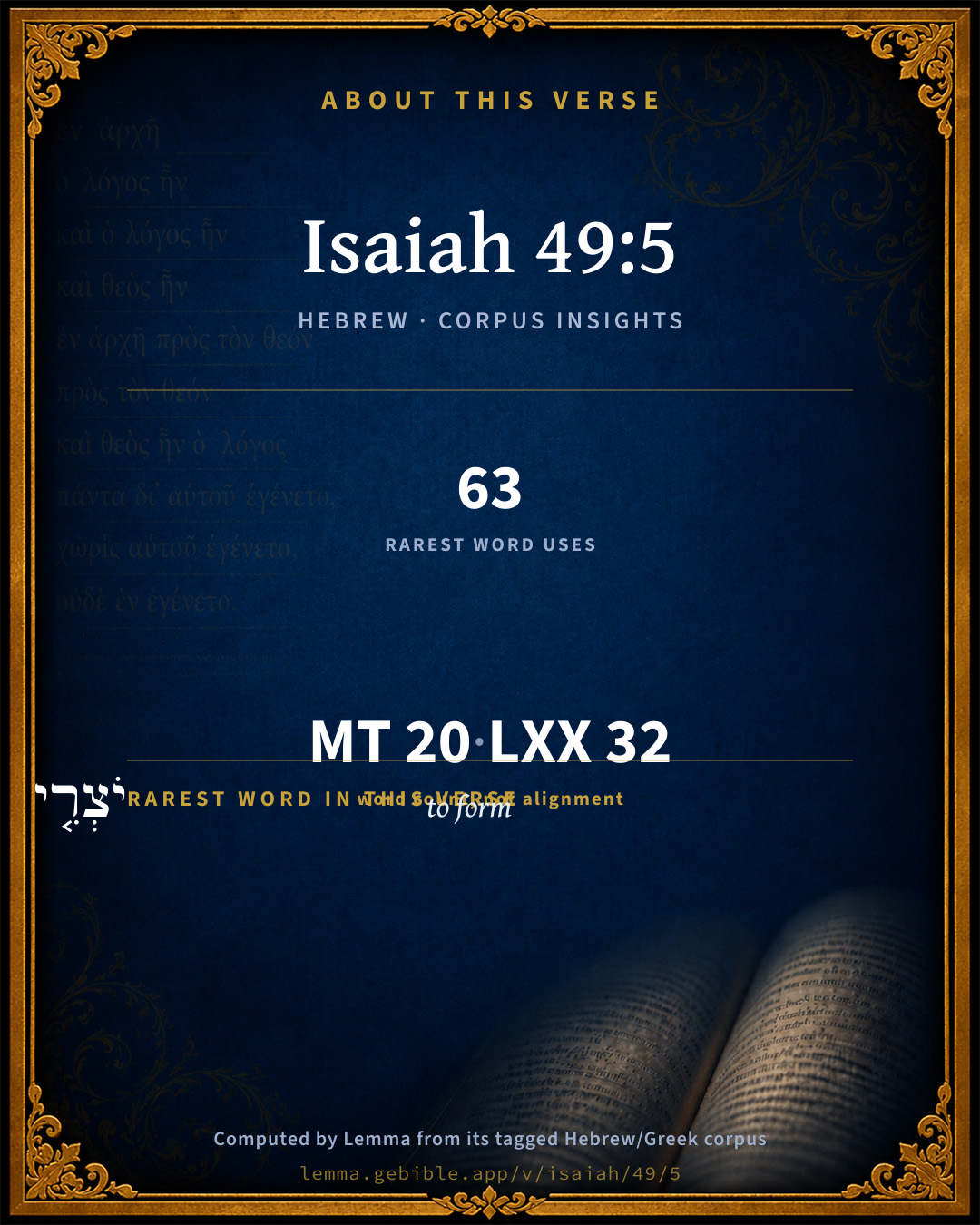
יֹצְרִ֤י
yâtsar
H3335
“forming · me”
Verb, Qal, Participle Active, Masculine, Singular, Construct + Suffix, Personal, 1st Person, Common, Singular
Part of Speech
Verb
Stem
Qal
Form
Participle Active
Gender
Masculine
Number
Singular
State
Construct
Full BDB Definition

Origin: probably identical with H3334 (through the squeezing into shape), ([compare H3331 ])

TWOT: 898

to form, fashion, frame - (Qal) to form, fashion - of human activity - of divine activity - of creation - of original creation - of individuals at conception - of Israel as a people - to frame, pre-ordain, plan (figuratively of divine) purpose of a situation) - (Niphal) to be formed, be created - (Pual) to be predetermined, be pre-ordained - (Hophal) to be formed
  1. וְעַתָּ֣ה ʻattâh H6258 “and · now” Conjunction + Adverb
  2. אָמַ֣ר ʼâmar H559 “to say” Verb, Qal, Perfect, 3rd Person, Masculine, Singular
  3. יְהוָ֗ה Yᵉhôvâh H3068 “LORD” Noun, Proper
  4. מִבֶּ֨טֶן֙ beṭen H990 “from · belly” Preposition + Noun, Common, Feminine, Singular, Absolute
  5. לְעֶ֣בֶד ʻebed H5650 “to/for · servant” Preposition + Noun, Common, Masculine, Singular, Absolute
  6. לְשׁוֹבֵ֤ב shûwb H7725 “to return” Preposition + Verb, Polel, Infinitive Construct
  7. יַֽעֲקֹב֙ Yaʻăqôb H3290 “Jacob” Noun, Proper
  8. אֵלָ֔יו ʼêl H413 “to · him” Preposition + Suffix, Personal, 3rd Person, Masculine, Singular
  9. וְיִשְׂרָאֵ֖ל Yisrâʼêl H3478 “and · Israel” Conjunction + Noun, Proper
  10. לא lôʼ H3808 “not” Particle, Negative
  11. יֵאָסֵ֑ף ʼâçaph H622 “to gather” Verb, Niphal, Imperfect, 3rd Person, Masculine, Singular
  12. וְאֶכָּבֵד֙ kâbad H3513 “and · to be heavy” Conjunction + Verb, Niphal, Imperfect, 1st Person, Common, Singular
  13. בְּעֵינֵ֣י ʻayin H5869 “in/at · eyes of” Preposition + Noun, Common, Both, Dual, Construct
  14. יְהוָ֔ה Yᵉhôvâh H3068 “LORD” Noun, Proper
  15. וֵאלֹהַ֖י ʼĕlôhîym H430 “and · God(s) · my” Conjunction + Noun, Common, Masculine, Plural, Construct + Suffix, Personal, 1st Person, Common, Singular
  16. הָיָ֥ה hâyâh H1961 “to be” Verb, Qal, Perfect, 3rd Person, Masculine, Singular
  17. עֻזִּֽי ʻôz H5797 “strength · my” Noun, Common, Masculine, Singular, Construct + Suffix, Personal, 1st Person, Common, Singular

About this verse

These counts appear in no published source. They are computed here, from the morphology-tagged text and Lemma’s own curated glosses. What Lemma adds →

20
words
17
distinct lemmas
Prophets
section

Grammatical profile

  • 6 verbs
  • 9 nouns
  • 3 prepositions
  • 1 adverb
  • 1 particle

Verb forms

  • אָמַ֣ר Qal · Perfect
  • יֹצְרִ֤י Qal · Participle Active
  • לְשׁוֹבֵ֤ב Polel · Infinitive Construct
  • יֵאָסֵ֑ף Niphal · Imperfect
  • וְאֶכָּבֵד֙ Niphal · Imperfect
  • הָיָ֥ה Qal · Perfect

Repetition

A word recurs within this verse — often emphatic in Hebrew:

  • יְהוָ֗ה LORD H3068 ×2

Hebrew & Septuagint length

In English translation the verse runs 42 words from the Hebrew and 40 from the Septuagint (LXX English) — closely comparable.

A rough comparison of the two English renderings, which tokenize alike — not a word-level alignment.

Word counts can differ between the Hebrew and the Greek without any difference in meaning — e.g. the Hebrew direct-object marker אֵת has no separate Greek word, and Greek often adds the article ὁ.

In the original languages it is 20 Hebrew tokens and 32 Greek tokens — but the two are counted differently (Hebrew bundles its prefixes and suffixes into one token; the Greek is in lemma form), so that isn’t a like-for-like length.

Cross-references

23

Topical passages linked to Isaiah 49:5 in the Treasury of Scripture Knowledge — connected by theme and wording, ordered by reader-vote popularity; previews shown in the World English Bible.

  • Matthew 17:5 While he was still speaking, behold, a bright cloud overshadowed them. Behold, a voice came out of the cloud, saying, "This is my beloved Son, in whom I am well pleased. Listen to him."
  • John 3:35 The Father loves the Son, and has given all things into his hand.
  • Matthew 28:18 Jesus came to them and spoke to them, saying, "All authority has been given to me in heaven and on earth.
  • Romans 15:8 Now I say that Christ has been made a minister of the circumcision for the truth of God, that he might confirm the promises given to the fathers,
  • 1 Peter 3:22 who is at the right hand of God, having gone into heaven, angels and authorities and powers being made subject to him.
  • Psalms 110:1–3 Yahweh says to my Lord, "Sit at my right hand, Until I make your enemies your footstool for your feet."
  • Isaiah 11:12 He will set up an ensign for the nations, and will assemble the outcasts of Israel, and gather together the dispersed of Judah from the four corners of the earth.
  • Isaiah 12:2 Behold, God is my salvation. I will trust, and will not be afraid; for Yah, Yahweh, is my strength and song; and he has become my salvation."
  • Isaiah 43:4 Since you have been precious in my sight, [and] honorable, and I have loved you; therefore will I give men in your place, and peoples instead of your life.
  • Isaiah 49:1 Listen, isles, to me; and listen, you peoples, from far: Yahweh has called me from the womb; from the bowels of my mother has he made mention of my name:
  • Isaiah 50:4 The Lord Yahweh has given me the tongue of those who are taught, that I may know how to sustain with words him who is weary: he wakens morning by morning, he wakens my ear to hear as those who are taught.
  • Isaiah 52:13 Behold, my servant shall deal wisely, he shall be exalted and lifted up, and shall be very high.
  • Isaiah 56:8 The Lord Yahweh, who gathers the outcasts of Israel, says, Yet will I gather [others] to him, besides his own who are gathered.
  • Matthew 3:17 Behold, a voice out of the heavens said, "This is my beloved Son, with whom I am well pleased."
  • Matthew 11:27 All things have been delivered to me by my Father. No one knows the Son, except the Father; neither does anyone know the Father, except the Son, and he to whom the Son desires to reveal him.
  • Matthew 15:24 But he answered, "I wasn't sent to anyone but the lost sheep of the house of Israel."
  • Matthew 21:37–41 But afterward he sent to them his son, saying, 'They will respect my son.'
  • Matthew 23:37 "Jerusalem, Jerusalem, who kills the prophets, and stones those who are sent to her! How often would I have gathered your children together, even as a hen gathers her chickens under her wings, and you would not!
  • Luke 19:42 saying, "If you, even you, had known today the things which belong to your peace! But now, they are hidden from your eyes.
  • John 5:20–27 For the Father has affection for the Son, and shows him all things that he himself does. He will show him greater works than these, that you may marvel.
  • Ephesians 1:20–22 which he worked in Christ, when he raised him from the dead, and made him to sit at his right hand in the heavenly places,
  • 1 Thessalonians 2:15–16 who killed both the Lord Jesus and their own prophets, and drove us out, and didn't please God, and are contrary to all men;
  • Acts 10:36 The word which he sent to the children of Israel, preaching good news of peace by Jesus Christ--he is Lord of all--

Cross-references courtesy of OpenBible.info (CC BY 4.0).

Hebrew and Greek witnesses Masoretic Hebrew ↔ Greek Septuagint

The same verse in the two great witnesses to the Old Testament, shown verse-for-verse.

These are two independent witnesses, not word-aligned to each other, and the Septuagint is shown in lemma (dictionary) form.

Hebrew Isaiah 49:5 Masoretic · Westminster Leningrad Codex

וְעַתָּ֣ה אָמַ֣ר יְהוָ֗ה יֹצְרִ֤י מִבֶּ֨טֶן֙ לְעֶ֣בֶד ל֔וֹ לְשׁוֹבֵ֤ב יַֽעֲקֹב֙ אֵלָ֔יו וְיִשְׂרָאֵ֖ל לא ל֣וֹ יֵאָסֵ֑ף וְאֶכָּבֵד֙ בְּעֵינֵ֣י יְהוָ֔ה וֵאלֹהַ֖י הָיָ֥ה עֻזִּֽי

Now says Yahweh who formed me from the womb to be his servant, to bring Jacob again to him, and that Israel be gathered to him (for I am honorable in the eyes of Yahweh, and my God is become my strength);

World English Bible · Public Domain

Greek LXX Isaiah 49:5 Septuagint · lemma form

καί νῦν οὕτως λέγω κύριος ὁ πλάσσω ἐγώ ἐκ κοιλία δοῦλος ἑαυτοῦ ὁ συνἄγω ὁ ἰακώβ καί ἰσραήλ πρός αὐτός συνἄγω καί δοξάζω ἐναντίον κύριος καί ὁ θεός ἐγώ εἰμί ἐγώ ἰσχύς

And now, thus says the Lord that formed me from the womb to be his own servant, to gather Jacob to him and Israel. I shall be gathered and glorified before the Lord, and my God shall be my strength.

LXX2012 (modern English Septuagint) · Public Domain

On this verse, Adam Clarke's Commentary discusses the Septuagint’s reading. Read the note in Commentary ↓

Hebrew: Westminster Leningrad Codex (CC BY 4.0). Greek: Septuagint (public domain); English from LXX2012 (modern English Septuagint) (Public Domain). How the Septuagint differs from the Hebrew →

Targum (Aramaic paraphrase)

1

The Targum is the ancient Jewish Aramaic paraphrase of the Hebrew Scriptures — an interpretive translation, not the Hebrew text itself. Onkelos (literal) and Pseudo-Jonathan (expansive) render the Torah, and Jonathan the Prophets. Coverage is partial: where no permissively-licensed English translation exists for a verse, only the Aramaic is shown. This is verse-level text, not a word-by-word alignment to the Hebrew.

  1. Targum Jonathan Prophets (Joshua–Malachi)
    וּכְעַן אֲמַר יְיָ דְאַתְקְנַנִי מִמְעַיִן לְמֶהֱוֵי עָבֵיד פַלָח קָדָמוֹהִי לַאֲתָבָא דְבֵית יַעֲקֹב לְפוּלְחָנֵהּ וְיִשְׂרָאֵל לִדְחַלְתֵּהּ יִתְקְרַב וְיַקִירְנָא קֳדָם יְיָ וּמֵימַר אֱלָהִי הֲוָה בְסַעֲדִי:

    And now, saith the Lord, that formed me from the womb to be a perfect servant before Him, to make the house of Jacob to return to His service, and Israel shall be brought to fear Him and we shall be glorious before the Lord; and the WORD of my God shall be my support.

    Targum Jonathan — Aramaic: “Mikraot Gedolot” (public domain). English: “Sefaria Community Translation” (CC0 1.0 (public-domain dedication)); “London "Chaldee Paraphrase," 1871” (public domain). Text via Sefaria.

Commentary

Notes on Isaiah 49:5 from classic Christian and Jewish commentators (each source and its license shown beneath its notes). The classic Christian expositions comment on the surrounding passage and are grouped to its opening verse, so a note may address several verses; the Jewish commentaries on the Tanakh (Rashi and others) are per-verse, so they appear only where the commentator wrote on this verse.

Lemma curates 59 commentaries, every one of them public domain or Creative Commons licensed, each selected and text-cleaned for this edition rather than reprinted as found. About our sources →

Jamieson, Fausset & Brown

Robert Jamieson, A. R. Fausset & David Brown

The reason why He was confident that His work would be accepted and rewarded, namely, because He is "glorious in the eyes of Jehovah," &c.

to bring Jacob again to him-- (Mat 15:24; Act 3:26).

Though Israel be not gathered--metaphor from a scattered flock which the shepherd gathers together again; or a hen and her chickens (Mat 23:37). Instead of the text "not," the Keri has the similar Hebrew word, "to Him," which the parallelism favors: "And that Israel may be gathered to Him."

yet--rather, parenthetically. "For I am glorious, &c., and My God is My strength." Then (Isa 49:6) resuming the words from the beginning of Isa 49:5, "He saith" (I repeat), &c. HORSLEY explains, "Notwithstanding the incredulity of the Jews, Messiah shall be glorified in the conversion of the Gentiles," reading as English Version: but if the Keri be read, "Israel shall at one time or other be gathered, notwithstanding their incredulity during Messiah's sojourn on earth."

Jamieson, Fausset & Brown — Commentary Critical and Explanatory on the Whole Bible (1871) — public domain (CC PDM 1.0). Text via the HelloAO Bible API.

Trapp's Complete Commentary

John Trapp

Isa 49:5 And now, saith the LORD that formed me from the womb [to be] his servant, to bring Jacob again to him, Though Israel be not gathered, yet shall I be glorious in the eyes of the LORD, and my God shall be my strength.

Ver. 5. To bring Jacob again to him.] To convert and reduce him to the fold: this is the proper work of the arch-shepherd. {1Pe 2:25; 1Pe 3:18; 1Pe 5:4} Men may speak persuasively, but Christ alone can persuade the heart. Meum est docere, saith Cyril, rostrum auseultare, Dei vero perficere.

Though Israel be not gathered,] viz., By God’s Word, which is his "arm"; {Isa 53:1} or, will not be gathered. {as Mat 23:37}

Yet I shall be glorious in the eyes of the Lord.] Who will reward me κατα τον κοπον και ου κατα τον καρπον, according to my pains, and not according to my success; {a} yea, it is more than probable that such as patiently persist in the work of the ministry, though few or none be converted thereby, shall have a greater measure of glory than those that see much fruit of their labours, and so have their honeycomb here to feed on.

{a} Secundum laborem, non secundum proventum. - Bern.

John Trapp, A Commentary or Exposition upon All the Books of the Old and New Testament (1647–1656) — public domain. Text from a community e-Sword module.

The Biblical Illustrator

Joseph S. Exell

Isa_49:5-7

And now, saith the Lord

Paradoxes of prophecy

I would weigh with you two of those larger, and at the same time intense paradoxes of prophecy, which run throughout the prophetic word, and which Isaiah, in these wonderful words concentrates in one.

1. That He, who was foretold should Himself be the light and salvation of those who knew not God unto earths utmost bound, yet should fail as to those to whom He should first come, the prophets own nation, the people among whom alone, before He came, He was looked for, hoped for, believed in.

2. That He, whom to adore should be the glory of kings, before whose presence they should arise from their thrones and bow down before Him, should be first despised of man, abhorred by the Jewish people, be in the power of the rulers of this world, as a slave is in the power of his masters. (E. B. Pusey, D. D.)

The Biblical Illustrator, edited by Joseph S. Exell (c. 1880s–1900s) — public domain. Text from a community e-Sword module.

Joseph Benson's Commentary

Isa 49:5-6. And now, saith the Lord — These are the words of the Father, addressing his Son, now become incarnate for the redemption of mankind; that formed me from the womb — This refers to the human nature of Christ formed in the womb of the Virgin by the Holy Ghost; to bring Jacob again to him — To convert the wicked and apostate Israelites. Though Israel be not gathered — Be not brought to God by my ministry: or, according to the reading of the margin, that Israel may be gathered to him, and I may be glorious, &c. The word יאסŠ, be gathered, implies that the Israelites were scattered from God, and divided among themselves, as they were, in a high degree, when Christ came into the world, having, as is said Isa 53:6, turned every one to his own way, and therefore they needed to be gathered. It seems to be a metaphor taken from wandering sheep, which the good shepherd diligently seeks and brings home to the fold. Yet shall I be glorious in the eyes of the Lord — According to this reading, preferred by our translators, the sense is, Though Israel, God’s own, and, at present, his only people, reject me, which will be a cause of great wonder and scandal, yet God will not despise me for the unsuccessfulness of my labours among them, but will honour and glorify me, both with himself and in the face of the world, in crowning my endeavours with glorious success among other people. And my God shall be my strength — To support me under this and all other discouragements and difficulties in the discharge of my office. And he — The Lord; said, It is a light thing — A small matter in comparison of what follows; that thou shouldest raise up the tribes of Jacob — That remnant of them which shall survive all their calamities and desolations. I will also give thee for a light to the Gentiles — I will make thy labour effectual for the illumination, conversion, and salvation of the Gentiles in all parts of the world. This could not be said of Isaiah with any colour of truth, and therefore must be understood of Christ, by whom it was literally and fully accomplished. The words, That thou mayest be my salvation, mean, that the Messiah should be the revealer, procurer, and giver of eternal salvation to the believing Gentiles.

Joseph Benson's Commentary on the Old and New Testaments (1811–1818) — public domain. Text from a community e-Sword module.

Geneva Bible (1599)

Geneva Bible translators

Though the Jews refuse my doctrine, yet God will approve my ministry.

Geneva Bible (1599) marginal notes — public domain. Text via Bolls.life.

Adam Clarke's Commentary

Verse 5. And now, saith the Lord - "And now, thus saith JEHOVAH"] The word כה coh, before אמר amar, is dropped out of the text: it is supplied by eight MSS. (two ancient) of Dr. Kennicott's, two of De Rossi's, and the Septuagint, Syriac, and Vulgate.

Though Israel be not gathered - "And that Israel unto him might be gathered"] Five MSS. (two ancient) confirm the Keri, or marginal correction of the Masoretes, לו lo, unto him, instead of לא lo, not, in the text; and so read Aquila; and the Chaldee, Septuagint, and Arabic omit the negative. But the Septuagint, MSS. Pachom, and I. D. II. express also the Keri לו lo by προς αυτον, to him.

Adam Clarke's Commentary on the Bible (1810–1826) — public domain. Text from a community e-Sword/MySword module.

Ellicott's Commentary for English Readers

(5) Though Israel be not gathered.—Better, and that Israel be gathered to Him. The negative, as in Isa_9:3, comes from an error of transcription; for “yet” read and. The Servant falls back upon the greatness of the work committed to him, that of restoring Israel, and is certain that sooner or later it will be accomplished. Comp. the argument of Romans 9-11

A Bible Commentary for English Readers, edited by Charles John Ellicott (1878–1897) — public domain. Text from a community e-Sword module.

The Cambridge Bible for Schools and Colleges

gen. ed. J. J. S. Perowne

5, 6. The Servant’s faith is rewarded by the revelation of a loftier mission than he had heretofore been conscious of.

though Israel be not gathered] R.V. “and that Israel be gathered unto him.” We have here the same confusion between lô’ (not) and lô (to him) as in ch. Isa_9:3. The verb for “gather,” however, is used in two senses, either “to gather in” or “to take away,” “gather off” (e.g. Eze_34:29, R.V. marg.); by adopting the latter we might retain the negative particle as in the consonantal text: and that Israel be not swept away. The clause, at all events, being parallel to the preceding, must express a similar idea; the rendering of A.V. proceeds on a wrong view of the construction.

yet shall I be glorious] Rather: and I shall be (or am) honourable (a different root from that used in Isa_49:3). This second half of the verse seems somewhat out of place in its present context (hence it is marked by R.V. as a parenthesis). Its original position may have been (as Duhm thinks) at the end of Isa_49:3, reading: “and so I was honourable in the eyes of Jehovah, and my God was my strength.”

The Cambridge Bible for Schools and Colleges (gen. ed. J. J. S. Perowne; Cambridge University Press, 1878–1918) — public domain. Text from a community e-Sword module.

John Gill's Exposition

And now, saith the Lord,.... Jehovah the Father, in confirmation of the call, office, and work of Christ, which he hath declared, Isa 49:1,

that formed me from the womb to be his servant; who preordained him to this service before the world began, and prepared him for it from the womb of his mother Mary, by filling him with grace and wisdom and with the Spirit without measure; anointing him with the oil of gladness above his fellows, and so fitting him as man and Mediator for the preaching of the Gospel, and every other service he called him:

to bring Jacob again, to him; the lost sheep of the house of Israel, God's elect among the Jews, which were as straying sheep; or all his chosen people, whether Jews or Gentiles, which were scattered abroad, and were afar off from God, whom Christ was to bring back again, and bring nigh unto God, and did:

though Israel be not gathered: in general, only a remnant, according to the election of grace, the greater part refusing to be gathered ministerially by him; and the rulers not suffering the common people to attend on his ministry. Mat 23:37. It may be observed that there is a marginal reading of the Hebrew, different from the written text; instead of "not" it is "to him"; and may be rendered thus, "and Israel shall be gathered unto him"; and then the sense entirely agrees with the preceding clause, with which the words are connected, and not with the following, as the accent "athnach" shows, thus; the Lord appointed and formed me to be his servant to bring back Jacob, and that Israel might be gathered to him; as all the Israel of God, all the elect of God were by the sufferings and death of Christ; see Eph 1:10. The marginal reading, and the writing, may be both retained, as in some other places, thus, "and shall not Israel be gathered to him?" since he has formed me to bring back Jacob to him? verily he shall. The marginal reading is followed by the Targum, and the passage paraphrased thus,

"to return the house of Jacob to his service, and Israel shall be brought nigh, to his fear.''

And so it is by Jarchi, Aben Ezra, and Kimchi, and by the Septuagint, Syriac, and Arabic versions, and by Aquila: "yet shall I be glorious" in the eyes of the Lord; or "I shall be glorious", &c.; as he was at his baptism and transfiguration on the mount; by the wonderful things done in heaven and on earth at the time of his death, at his resurrection from the dead, his ascension to heaven, and exaltation at the right hand of God, far above all principalities and powers, angels, authorities, and powers, being subject to him; and by the ministration of the Gospel in the Gentile world, and particularly when he shall reign gloriously in the latter day, and in the New Jerusalem church state:

and my God shall be my strength; to keep up his spirits under all discouragements; to protect him from his enemies; to support him in his work as man; to carry him through it, and enable him completely to perform it, as he promised he would, and as he did, Isa 49:8.

John Gill's Exposition of the Whole Bible (1746–1763) — public domain (CC PDM 1.0). Text via the HelloAO Bible API.

Albert Barnes' Notes on the Bible

And now, saith the Lord that formed me - This verse contains the reason why he cherished the hope that his work would not be unaccepted. The reason is, that Yahweh had said to him that he should be glorious in his eyes, and that he would be his strength. He stood so high in his favor, and he had such assurances of that favor, that he could confidently commit himself to his care.

That formed thee from the womb - Who appointed me before I was born to the office of a servant to accomplish important purposes (see the notes at Isa 49:1).

To bring Jacob again to him - To recover the Jewish people again to the pure worship of Yahweh. To them the Messiah was first to be sent, and when they rejected him, he was to proffer the same salvation to the Gentiles (see Isa 49:6; compare Mat 21:33-43). Accordingly the Saviour spent his life in preaching to the Jews, and in endeavoring to bring them back to God, and for this purpose he regarded himself as sent (Mat 15:24; see Act 3:26).

Though Israel be not gathered - This metaphor is taken from a scattered flock which a shepherd endeavors to gather, or collect to himself. There is great variety in the interpretation of this expression. The margin reads it, ‘That Israel may be gathered to him, and I may’ be glorious. So Lowth, ‘That Israel unto him may be gathered.’ So Noyes, ‘To gather Israel to him.’ Jerome renders it, ‘Israel shall not be gathered.’ The Septuagint renders it, ‘To gather Jacob unto him, and Israel.’ The Syriac, ‘That I may gather Jacob unto him, and assemble Israel.’ This variety has arisen front the different readings in the Hebrew text. The reading in the text is לא lo' (“not”); but instead of this the marginal reading, or the Qere’ of the Masoretes is, לו lô, “to him.” ‘Five manuscripts (two ancient),’ says Lowth, ‘confirm the Qere’, or marginal construction of the Masoretes; and so read Aquila, and the Chaldee, Septuagint, and Arabic.’ Gesenius and Rosenmuller adopt this, and suppose that לא lo' is only a different form of writing לו lô. Grotius and Hengstenberg render it as it is in our version. It is impossible to determine the true reading; and the only guide is the context, and the views which shall be entertained of the design of the passage. To me it seems that the parallelism demands that we should adopt the reading of the Keri, the Septuagint, the Chaldee, and the Syriac, and which has been adopted by Lowth. According to this, it means that he had been appointed to gather in the lost sheep of the house of Israel, and gave his life to it. Other parts of this statement Isa 49:4-6 show, that by them he was rejected, and that then salvation was sent to other parts of the world. Luther renders it, ‘That Israel be not carried away.’

Yet shall I be - Or, “and” (ו ve) I shall be glorious. The sense is, that as the result of this appointment he would be in some way glorious in the sight of Yahweh. Though he would be rejected by the nation, yet he would be honored by God. He would not only approve his character and work, but would secure his being honored among people by making him the light of the Gentiles (compare Isa 43:4).

And my God shall be my strength - He might be rejected by the people, but in God he would find an unfailing source of support and consolation. It is not needful to say, that this applies most accurately to the cbaracter of the Redeemer as exhibited in the New Testament.

Albert Barnes' Notes on the Bible (1834–1885) — public domain. Text from a community e-Sword/MySword module.

Haydock's Catholic Bible Commentary

Will not. Hebrew, Septuagint, &c., "to be gathered." (Haydock) --- The original text, independent of the Masorets, may have the sense of the Vulgate. Yet there are other proofs of the synagogue’s rejection. (Calmet) --- Protestants, "though Israel be not gathered, yet," &c. Marginal note, or "that Israel may be gathered, and I may," &c. (Haydock)

George Leo Haydock (1774–1849), Haydock's Catholic Family Bible and Commentary, 1859 edition — public domain. Excludes Psalms (Douay-Rheims chapter numbering differs from Protestant) and Deuterocanonical books (Catholic canon only).

Matthew Poole's English Annotations

To bring Jacob again to him; to convert the wicked and apostate Israelites unto God.

Though Israel be not gathered; not brought home to God by my ministry. This word implies that the Israelites were divided and scattered from God, and divided among themselves, as they were in a high degree when Christ came into the world, and turned every one to his own way, as is said, Isa 53:6, and therefore needed to be gathered. Either it is a metaphor from wandering sheep, Which the good shepherd diligently seeketh, and bringeth home to the fold; or it is an allusion to the state of the Israelites, who either now were, or shortly were to be, dispersed into several parts of the world, from whence God had promised to gather them, and bring them into their own land, and unto his temple, Isa 43:5,6, and elsewhere. The sense is, Though Israel, God’s own and only people, reject me, which will be an occasion of great wonder and scandal.

Yet shall I be glorious in the eyes of the Lord; God will not despise me for the unsuccessfulness of my labours, but will honour and glorify me, both with himself and in the face of the world, in crowning my endeavours with glorious success among other people.

My God shall be my strength, to support and strengthen me under this and all other discouragements and difficulties in the discharge of mine office.

Matthew Poole's English Annotations on the Holy Bible (1683–1685) — public domain. Text from a community e-Sword/MySword module.

Whedon's Commentary on the Bible

Daniel D. Whedon

5. And now, saith the Lord — What he says is in the next verse. The words which follow are parenthetical, and explanatory of Jehovah, who now speaks.

That formed me from the womb — Who appointed me Messiah before my incarnation.

To bring Jacob — Not Jews, as such only, back to the worship of Jehovah. To these he was first to appear; yet, though they still reject Messiah, he is to be glorious in meeting with better success among the Gentiles. This is the import of what he was to say.

Daniel D. Whedon (gen. ed.), Commentary on the Old and New Testaments (1874–1909) — public domain. Text from a community e-Sword module.

The Pulpit Commentary

And now, saith the Lord, etc.; rather, and now the Lord hath said he that formed me from the womb to be a Servant to him, that I might bring back Jacob to him, and that Israel might be gathered to him; for I shall be glorious in the eyes of the Lord, and my God is become my Strength he hath said It is a light thing, etc. The whole of ver. 5, after the words, "and now the Lord hath said," is parenthetic. (On the service which our Lord continually rendered, while on earth, to the Father, Luk_2:49 Luk_4:43Jo Luk_4:34 Luk_6:38 Luk_17:4) The Revelation of St. John shows that in heaven he is still engaged in carrying out his Father"s behests. Though Israel be not gathered. This reading, as Mr. Cheyne remarks, "entirely spoils the symmetry of the verse." The practice of writing fresh copies of the Scripture from dictation is answerable for the double reading of alo and wOl both here and in other places. Yet shall I be glorious . The "Servant" would receive glory even by such a partial conversion of the Jews as took place through his ministry. It is never to be forgotten that all the original twelve apostles were Jews, that Matthias was a Jew, that Paul and Barnabas were Jews, and that the original Church was a Church of Jews. (Act_2:41-47) All that was truly spiritual in Judaism flowed into the Church of Christ, as into its natural home, and the Jewish element in the Church, if not numerically great, was yet the predominant and formative element.

Vers. 5-12. The lowest humiliation and the highest glory meet in Christ.

The Messiah was to be "glorious in the eyes of the Lord" (ver. 5); God was to be "his Strength;" "kings" were to "see him and arise;" "princes also" were to "worship" (ver. 7); he was to "raise up the earth;" to "cause to inherit the desolate heritages" (ver. 8); he was to loose the prisoners (ver. 9), to "restore Israel" (ver. 6), and to carry salvation to the ends of the world (ver. 6); yet, at the same time, he was to be "despised of men, an object of abhorrence to the nations, a servant or, "slave of rulers" (ver. 7). That such opposites should meet in one person must have seemed, anterior to the event, most improbable; yet the prophet utters no "uncertain sound." He proclaims alike, with the greatest distinctness, both the glory (Isa_9:6, 7 42:1-8 49:1-6) and the humiliation, (Isa_49:7 Isa_53:2-12) both the exaltation and the depression, of the Redeemer. And the event justified him, in both respects alike.

I CHRIST"S EXTREME HUMILIATION. Christ "made himself of no reputation, and took upon him the form of a servant, and was made in the likeness of men: and being found in fashion as a man, he humbled himself, and became obedient unto death, even the death of the cross". (Php_2:7, 8) Note the chief points of the humiliation. Being "in the form of God" and "equal with God," he consented

(1) to be born on earth as a man;

(2) in a humble station;

(3) to be laid in a manger;

(4) to be "subject" to earthly parents;

(5) to be cast out of his native city by his fellow-townsmen;

(6) to have not where to lay his head;

(7) to have his teaching rejected by the mass of his countrymen;

(8) to be betrayed;

(9) bound;

(10) smitten;

(11) derided;

(12) spit upon;

(13) scourged;

(14) crucified;

(15) buried.

The steps of the humiliation were progressive. First it was negative rather than positive, while he worked as a "carpenter" in his reputed father"s shop. Then it received aggravation, when he became a homeless wanderer, was "rejected of men," bidden to "depart out of their coasts," threatened with stoning, declared to "have a devil," "hated," plotted against. Finally, it culminated in that night and day of agony when one disciple betrayed him, and the rest forsook him and fled, and he was led before three tribunals, mocked, buffeted, crowned with thorns, smitten with a reed, scourged judicially, nailed to the cross, flouted, railed on, finally buried out of men"s sight, as though all was indeed "finished" with him, and the earth would hear no more of One who had lived an outcast"s life, and died the death of a malefactor!

II CHRIST"S EXALTATION AND GLORY. "Wherefore God also hath highly exalted him, and given him a Name which is above every name: that at the Name of Jesus every knee should bow, of things in heaven, and things in earth, and things under the earth; and that every tongue should confess that Jesus Christ is Lord, to the glory of God the Father". (Php_2:9-12) Note the chief points of the exaltation. No sooner is he dead than he descends to Hades, "preaches to the spirits in prison," and deprives hell of its prey; then rises, "loosens the bonds of death, because it was not possible that he should be holden of it," cheers his "little flock" with his presence for forty days, ascends to heaven, and sits at God"s right hand, King of kings and Lord of lords for evermore. On earth he has "a Name above every name." The Roman empire bows down to him; the barbarians are in great part converted; more and more nations flow into his kingdom; and at the present day three hundred millions of men, more than a fourth part of the world"s inhabitants, nominally at any rate, confess him for their Master and Lord. In heaven the angels worship him; he sits upon the great white throne, and before him are the four and twenty elders, and the host of angels, and the ten thousand thousand saints, and the song is sung, "Salvation unto our Gad which sitteth upon the throne, and unto the Lamb;" and all the angels stand about the throne, and about the elders and the four beasts, and fall on their face before the throne, and worship him, saying, "Blessing, and glory, and wisdom, and thanksgiving, and honour, and power, and might, be unto our God for ever and ever. Amen". (Rev_7:9-12)

Vers. 5-7. The greater mission.

The main point of this passage is that far greater triumphs should await the Redeemer of Israel than any recovery of the scattered tribes; he was to be a Light to the whole Gentile world to be "for salvation to the uttermost part of the earth." The fact that a true but small mission opens out into one that is very much larger, widening and deepening as it proceeds, is one that has many illustrations

I IN THE WORK OF THE LORD HIMSELF. As he "grew in wisdom," he found that "his Father"s business" involved more than appeared to him when he was twelve years old. There was a time when he instructed his disciples to "go not into any way of the Gentiles:" and when he said, "I am not sent but unto the lost sheep of the house of Israel". (Mat_10:6 Mat_15:24) But later on, he not only recognized for himself that his work was to be wide as humanity and to embrace those furthest away from truth and from God, but he commanded his disciples to "baptize all nations," to "go unto all the world," etc. Under his holy hand his great mission grew, and it became that one which, for the vastness of its proportions and the beneficence of its aim, leaves every human enterprise immeasurably behind.

II IN THE WORK OF THE APOSTLES OF OUR LORD. James and John, when they were asked by their Master whether they could drink of his cup, answered with sure confidence, "We can;" but they little knew what were the contents of that cup; they little imagined how great, how stupendous, was the task which their Lord would leave in their hands.

III IN THE WORK OF INDIVIDUAL REFORMERS. At different times men have addressed themselves to some work of necessary reformation. They supposed that they could measure the extent of their task; but they found that as they proceeded it enlarged, and what they first attempted proved to be "a light thing" in comparison with all that they ultimately accomplished. Witness the work of Luther, Knox, Cranmer, Wesley, etc.

IV IN THE WORK OF EACH CHRISTIAN CHURCH. A Christian Church, when first planted, is most anxious to establish and consolidate itself to grow in numbers and in reputation and in strength. But before long it awakes to the truth that it has a greater mission to effect than this; it is called into being to exert a powerful influence for good on all the surrounding neighbourhood to communicate spiritual health and eternal life to all human souls that can be reached and blessed. To establish itself is "a light thing" in comparison with this high and holy function.

1. The entrance on this greater mission should be in the spirit of pure devotion. We should feel that we are God"s servants (ver. 5), called to do his work.

2. It should be carried on and completed in God"s strength. "My God shallbe my Strength. C.

The Pulpit Commentary (1880–1919), ed. H.D.M. Spence-Jones & Joseph S. Exell — public domain. Text from a community e-Sword module.

John Wesley's Explanatory Notes

To bring - To convert the apostate Israelites to God. Not gathered - Not brought home to God by my ministry. Yet - God will not despise me for the unsuccessfulness of my labours, but will honour and glorify me. My strength - To support and strengthen me under this and all other discouragements.

John Wesley, Explanatory Notes Upon the Whole Bible (1754–1765) — public domain. Text via the GEBible commentary corpus.

Keil & Delitzsch

C. F. Keil & F. Delitzsch

The expression "and now" (ועתּה), which follows, evidently indicates a fresh turn in the official life of the person speaking here. At the same time, it is evident that it is the failure of his labours within his own people, which has forced out the lamentation in Isa 49:4. For his reason for addressing his summons in Isa 49:1 to the world of nations, is that Jehovah has not guaranteed to him, the undaunted one, success to his labours among his own people, but has assigned him a mission extending far beyond and reaching to all mankind. "And now, saith Jehovah, that formed me from the womb to be His servant, to bring back Jacob to Him, and that Israel may be gathered together to Him; and I am honoured in the eyes of Jehovah, and my God has become my strength. He saith, It is only a small thing that thou becomest my servant, to set up the tribes of Jacob, and to bring back the preserved of Israel. I have set thee for the light of the Gentiles, to become my salvation to the end of the earth." Both shōbhēbh and hâshı̄bh unite within themselves the meanings reducere (Jer 50:19) and restituere. On לא = לו generally, see at Isa 9:2; Isa 63:9. Jerome is wrong in his rendering, et Israel qui non congregabitur (what could a prophecy of the rejection of the Jews do here?); so also is Hitzig's rendering, "since Israel is not swept away;" and Hofmann's, "Israel, which is not swept away." In the present instance, where the restoration of Israel is the event referred to, אצף must signify "the gathering together of Israel," as in Isa 11:12. לו (parallel אליו) points to Jehovah as the author of the gathering, and as the object of it also. The transition from the infinitive of design to the finite verb of desire, is the same as in Isa 13:9; Isa 14:25. The attributive clause, added to the name Jehovah, expresses the lofty mission of the servant of God with regard to Israel. The parenthesis, "I have honour in the eyes of Jehovah, and my God has become my strength, i.e., has become mighty in me, the apparently weak one," looks beyond to the still loftier mission, by which the former lofty one is far surpassed. On account of this parenthetically inserted praise of Jehovah, the אמר is resumed in ויּאמר. Instead of נקל היותך (compare Kg1 16:31), i.e., it is a small thing that thou shouldst be, we have it here, as in Eze 8:17, with a comparative min, which must not, however, be logically pressed: "It is smaller than that," i.e., it is too small a thing that thou shouldst be. The netsı̄rē (Keri, netsūrē) of Israel are those who have been preserved in exile (Eze 6:12); in other cases, we find שׁאר, שׁארית, or פּלטה. Not only is the restoration of the remnant of Israel the work of the servant of Jehovah; but Jehovah has appointed him for something higher than this. He has given or set him for the light of the heathen ("a light to lighten the Gentiles," Luk 2:32), to become His salvation to the end of the earth (lxx: τοῦ εἶναι σε εἰς σωτηρίαν ἕως ἐσχάτου τῆς γῆς). Those who regard Israel as a nation as speaking here (e.g., Hitzig, Ewald, Umbreit, etc.) go right away from this, which is the most natural sense of the words, and explain them as meaning, "that my salvation may be, reach, or penetrate to the end of the earth." But inasmuch as the servant of Jehovah is the light of the world, he is through that very fact the salvation of the world; and he is both of these through Jehovah, whose counsels of ישׁוּעה are brought by him into historical realization and visible manifestation.

Keil & Delitzsch — Biblical Commentary on the Old Testament (1861–1891) — public domain (CC PDM 1.0). Text via the HelloAO Bible API. (Old Testament only.)

J. A. Alexander on Isaiah

Joseph Addison Alexander

“And now, saith Jehovah, my maker (or who formed me) from the womb, for a servant to Himself” (i.e., to be His servant in the sense before explained). The ‘now’ may be here taken either in its temporal or logical sense. “To convert (or bring back) Jacob to Him.” This cannot mean to restore from exile; for how could this work be ascribed directly either to the Prophet or the Prophets, or to the Messiah, or to Israel himself? It might indeed apply to Cyrus, but the whole context is at war with such an explanation. All that is left, then, is to give the verb the sense of bringing back to a state of allegiance from one of alienation and revolt. But how could Jacob or Israel be said to bring himself back? This is the grand objection to the assumption that the servant of Jehovah was Israel himself. This is one of the cases where the idea of the head predominates above that of the body, because they are related to each other as the subject and object of one and the same action. The vocation of Israel was to reclaim the nations; that of the Messiah was first to reclaim Israel himself and then the nations. Some read the next clause as an interrogation, ‘shall not Israel be gathered?’ Others as a concession, ‘although Israel be not gathered.’ Others as a simple affirmation in the present tense, ‘and (yet) Israel is not gathered.’ All that is needed to give this last the preference is the substitution of the future for the present, after which the whole verse may be paraphrased as follows: ‘Thus saith Jehovah, Who formed me from the womb as a servant for Himself, to restore Jacob to Him — and (yet) Israel will not be gathered-and (yet) I shall be honored in the eyes of Jehovah, and my God has (already) been my strength.” The first ‘yet’ introduced to show the true connection is equivalent to saying, ‘though I was called and raised up for this purpose’; the other is equivalent to saying, ‘although Israel will not be gathered’. This last phrase may be taken as a simple prediction that they should not be gathered, or a declaration that they would not (consent to) be gathered. This last, if not expressed, is implied. The general meaning of the verse is that Messiah and His people should be honored in the sight of God, although the proximate design of their mission, the salvation of the literal Israel, might seem to fail.

Joseph Addison Alexander, The Prophecies of Isaiah (1846–1847; New York: Scribner, 1870–1878) — public domain. Text from a community e-Sword module.

unfoldingWord translationNotes

Door43 World Missions Community

General Information:

Yahweh's servant continues speaking.

that Israel would be gathered to him

This part of the sentence means the same as the part before it. This can be stated in active form. AT: "to bring the people of Israel back to himself" (See: Active or Passive and Parallelism)

I am honored in the eyes of Yahweh

The eyes represent seeing, and seeing represents thoughts or judgment. This can be stated in active form. AT: "Yahweh has honored me" (See: Metaphor and Active or Passive)

my God has become my strength

God giving the servant strength is spoken of as if God himself were his strength. AT: "my God has given me strength" or "my God has strengthened me" (See: Metaphor)

I will make you a light to the Gentiles

The servant bringing Yahweh's message to the Gentiles and helping them to understand it is spoken of as if Yahweh made the servant a light that shines among the Gentiles. See how you translated a similar phrase in Isaiah 42:6. (See: Metaphor)

to the ends of the earth

The places on the earth that are very far away are spoken of as if they were the places where the earth ends. This phrase also forms a merism and refers to everywhere in between the ends. AT "to all the farthest places of the earth" or "to the entire earth" (See: Metaphor and Merism)

translationWords

Yahweh

servant

restore

Jacob

Israel

honor

God

tribe

light

Gentile

save

earth

unfoldingWord translationNotes — © Distant Shores Media and the Door43 World Missions Community, licensed CC BY-SA 4.0. Source: git.door43.org/Door43/en_tn.

Rashi

Rabbi Shlomo Yitzchaki (Rashi)

shall be gathered to Him To Him they shall return in repentance.

Rashi on the Tanakh — English translations: “The Judaica Press complete Tanach with Rashi, translated by A. J. Rosenberg” (CC BY 4.0); “Pentateuch with Rashi's commentary by M. Rosenbaum and A.M. Silbermann, 1929-1934” (public domain); “The Metsudah Tanach series, Lakewood, N.J” (CC BY 4.0); and “The Book of Joshua, Metsudah Publications, 1997” (CC BY 4.0). Text via Sefaria.

Ibn Ezra

Rabbi Abraham ibn Ezra

That formed me, etc. God formed me, that I should rebuke Israel, till they returned to Him.

לא Unto him. The original reading is לו unto him, as the Masorah recommends; comp. Ps. 100:5; there are some more instances of the same kind. According to the Gaon, the meaning of לא יאסף is: Will not die; he generally explains both the Keri and the Ketib; but what I said, is nevertheless right, and לא of the text is the same as לו, as the Grammarian R. Jehudah explained.

Ibn Ezra on the Tanakh — English translations: “Sefaria Community Translation” (CC0 1.0 (public-domain dedication)); “Yalkut, Sifsei Chachomim Chumash, Metsudah Publications, 2009” (CC BY 4.0); and “Commentary of Ibn Ezra on Isaiah - trans. by M. Friedlander, 1873” (public domain). Text via Sefaria.

Lesson kit

Teaching starters — assembled from the data on this page, not authored interpretation. Every prompt links to the verse data it draws on. Edit before teaching.

Isaiah, in the Prophets, opens this verse with 20 words (17 distinct Hebrew lemmas). Its most distinctive word is yâtsar (“to form”). A historical commentator’s framing appears above. Read the whole chapter for the surrounding context.

Discussion questions

  1. How does “to form” (yâtsar) shape what this verse is saying?
  2. How does Matthew 17:5, which shares this passage’s theme, read alongside this verse?
  3. What does the repetition of “LORD” (2× in this one verse) do in this verse?
  4. These translations render this verse differently; the difference is in the English rendering, not the original. What questions does that raise?
  5. «אָמַ֣ר» is a Qal Perfect verb. How does that grammatical form shape the action described?
  6. Compare how Jamieson, Fausset & Brown and Trapp's Complete Commentary read this verse. Where do they agree or differ?

Things to notice

Reading settings

Reading text

Shown beneath each verse's original-language words.

Old Testament
Old Testament edition

Read the OT as the Masoretic Hebrew (MT) or the Greek Septuagint (LXX).

English shown for the Greek Septuagint (in the Hebrew ↔ Greek comparison).

Comparing translations? Open the Compare panel on any verse page to stack up to four side by side.