
Genesis 27:42

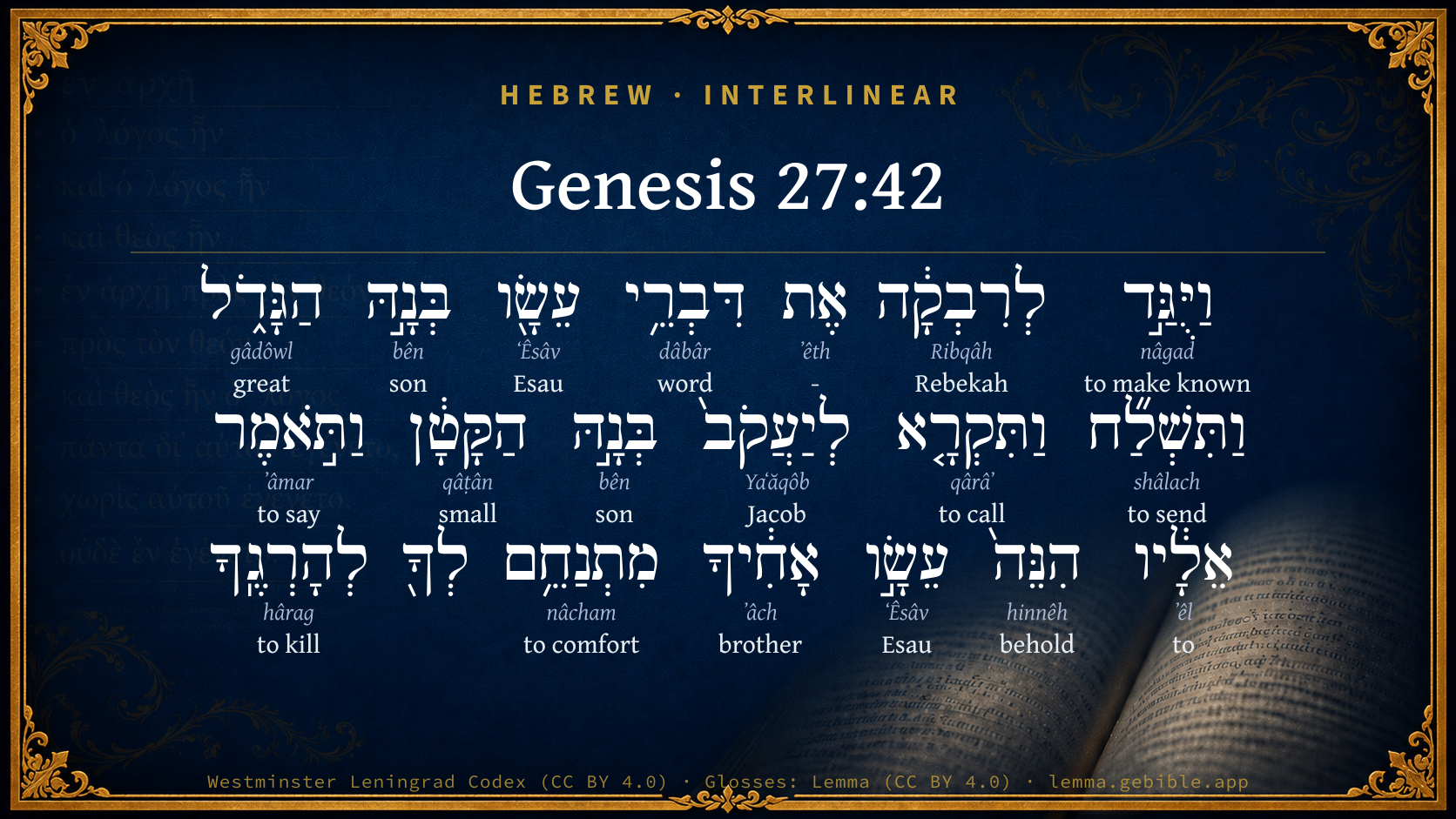
Hebrew (Westminster Leningrad Codex) Genesis 27:42 appears in the Hebrew Old Testament. The text above is from the Westminster Leningrad Codex. Each word links to its Strong’s number, a concise gloss, and parsing drawn from the Open Scriptures Hebrew Bible morphology. Click any word for its full Brown-Driver-Briggs (BDB) entry.
Download image
Cite this verse

Genesis 27:42 (World English Bible). Public Domain. Lemma interlinear Bible study tool, https://lemma.gebible.app/v/genesis/27/42.

Show BibTeX & RIS
BibTeX
RIS
English Translation
The words of Esau, her elder son, were told to Rebekah. She sent and called Jacob her younger son, and said to him, "Behold, your brother Esau comforts himself about you by planning to kill you.
World English Bible · Public Domain
Download a study sheet

One document with this verse’s original text, its word-by-word gloss line, the meaning frame, cross-references with their text, attributed commentary, and full source and license credits — printable, and it pastes into notes with its structure intact.

This verse Autodidact and up

Study sheet (.html) Plain text (.txt)

A passage Seminary Student

Up to 50 verses in one chapter. A passage sheet keeps up to 6 commentary sources and 12 cross-references per verse, in the order this page ranks them, and says so on the sheet whenever that leaves anything out. Ask for a single verse and you get the Autodidact verse sheet above.

Everything on this page stays free to read, with no account — the sheet is a download of what is already on screen, not access to it.

Want to remove ads? Support Godless Engineer
Compare translations 3

The same verse in 3 English versions, stacked beneath the original-language interlinear above. Click any original word for its lexicon entry.

Each is an independent rendering of the whole verse — the interlinear is not word-aligned to these translations.

Highlighted words mark where these versions differ — a whole-verse word diff, not a word-by-word alignment.

  • World English Bible Public Domain
    The words of Esau, her elder son, were told to Rebekah. She sent and called Jacob her younger son, and said to him, "Behold, your brother Esau comforts himself about you by planning to kill you.
  • King James Version Public Domain
    And these words of Esau her elder son were told to Rebekah: and she sent and called Jacob her younger son, and said unto him, Behold, thy brother Esau, as touching thee, doth comfort himself, purposing to kill thee.
  • unfoldingWord Literal Text CC BY-SA 4.0
    But the words of Esau her older son were told to Rebekah, so she sent and called for Jacob her younger son and said to him, “Behold, Esau your brother is consoling himself about you, planning to kill you.

unfoldingWord Literal Text — © unfoldingWord, licensed CC BY-SA 4.0. Word-aligned USFM3 via Door43 (git.door43.org/unfoldingWord/en_ult).

Versions to compare (up to 4)

3 of 4 selected

Show all 18 translations

Every available English version of this verse, each an independent rendering of the whole verse.

  • World English Bible Public Domain
    The words of Esau, her elder son, were told to Rebekah. She sent and called Jacob her younger son, and said to him, "Behold, your brother Esau comforts himself about you by planning to kill you.
  • Berean Standard Bible Public Domain
    When the words of her older son Esau were relayed to Rebekah, she sent for her younger son Jacob and told him, “Look, your brother Esau is consoling himself by plotting to kill you.
  • Majority Standard Bible Public Domain
    When the words of her older son Esau were relayed to Rebekah, she sent for her younger son Jacob and told him, “Look, your brother Esau is consoling himself by plotting to kill you.
  • King James Version Public Domain
    And these words of Esau her elder son were told to Rebekah: and she sent and called Jacob her younger son, and said unto him, Behold, thy brother Esau, as touching thee, doth comfort himself, purposing to kill thee.
  • American Standard Version (1901) Public Domain
    And the words of Esau her elder son were told to Rebekah. And she sent and called Jacob her younger son, and said unto him, Behold, thy brother Esau, as touching thee, doth comfort himself, `purposing' to kill thee.
  • Revised Version (1885) Public Domain
    And the words of Esau her elder son were told to Rebekah; and she sent and called Jacob her younger son, and said unto him, Behold, thy brother Esau, as touching thee, doth comfort himself, purposing to kill thee.
  • Geneva Bible (1599) Public Domain
    And it was told to Rebekah of the wordes of Esau her elder sonne, and shee sent and called Iaakob her yonger sonne, and sayd vnto him, Beholde, thy brother Esau is comforted against thee, meaning to kill thee:
  • Douay-Rheims (1899) Public Domain
    These things were told to Rebecca: and she sent and called Jacob her son, and said to him: Behold Esau thy brother threateneth to kill thee.
  • Young's Literal Translation Public Domain
    And the words of Esau her elder son are declared to Rebekah, and she sendeth and calleth for Jacob her younger son, and saith unto him, `Lo, Esau thy brother is comforting himself in regard to thee -- to slay thee;
  • Literal Standard Version CC BY-SA 4.0
    And the words of Esau her older son are declared to Rebekah, and she sends and calls for Jacob her younger son, and says to him, “Behold, your brother Esau is comforting himself in regard to you—to slay you;
  • Unlocked Literal Bible CC BY-SA 4.0
    The words of Esau her older son were told to Rebekah. So she sent and called Jacob her younger son and said to him, “See, your brother Esau is consoling himself about you by planning to kill you.
  • unfoldingWord Literal Text CC BY-SA 4.0
    But the words of Esau her older son were told to Rebekah, so she sent and called for Jacob her younger son and said to him, “Behold, Esau your brother is consoling himself about you, planning to kill you.
  • Darby Bible Public Domain
    And the words of Esau her elder son were told to Rebecca. And she sent and called Jacob her younger son, and said to him, Behold, thy brother Esau, as touching thee, comforts himself that he will kill thee.
  • World Messianic Bible Public Domain
    The words of Esau, her elder son, were told to Rebekah. She sent and called Jacob, her younger son, and said to him, “Behold, your brother Esau comforts himself about you by planning to kill you.
  • Webster's Bible Public Domain
    And these words of Esau her elder son were told to Rebekah: and she sent and called Jacob her younger son, and said to him, Behold, thy brother Esau, as concerning thee, doth comfort himself, purposing to kill thee.
  • Free Bible Version CC BY-SA 4.0
    However, Rebekah found out what Esau was saying, so she sent for Jacob. “Look,” she told him, “your brother Esau is making himself feel better by making plans to kill you.
  • Bible in Basic English Public Domain
    Then Rebekah, hearing what Esau had said, sent for Jacob, her younger son, and said to him, It seems that your brother Esau is purposing to put you to death.
  • JPS Tanakh (1917) Public Domain
    And the words of Esau her elder son were told to Rebekah; and she sent and called Jacob her younger son, and said unto him: 'Behold, thy brother Esau, as touching thee, doth comfort himself, purposing to kill thee.

Literal Standard Version (2020), Covenant Press — licensed CC BY-SA 4.0. Text via the HelloAO Bible API (eBible.org). Unlocked Literal Bible (unfoldingWord) — licensed CC BY-SA 4.0. Text via the HelloAO Bible API (eBible.org). unfoldingWord Literal Text — © unfoldingWord, licensed CC BY-SA 4.0. Word-aligned USFM3 via Door43 (git.door43.org/unfoldingWord/en_ult). Free Bible Version, Dr. Jonathan Gallagher — licensed CC BY-SA 4.0. Text via the HelloAO Bible API (eBible.org).

Word by word

More ways to search: Search by grammar → Find every occurrence → Compare this word →

Practice this passage: Drill this verse → Learn its vocabulary →

לְרִבְקָ֔ה
Ribqâh
H7259
“to/for · Rebekah”
Preposition + Noun, Proper
Part of Speech
Preposition + Noun
Type
Proper
Full BDB Definition

Origin: from an unused root probably meaning to clog by tying up the fetlock

TWOT: None

Rebekah = "ensnarer" - daughter of Bethuel, sister of Laban, wife of Isaac, and mother of Esau and Jacob
  1. וַיֻּגַּ֣ד nâgad H5046 “and · to make known” Conjunction + Verb, Hophal, Sequential Imperfect, 3rd Person, Masculine, Singular
  2. אֶת ʼêth H853 “-” Particle, Direct Object
  3. דִּבְרֵ֥י dâbâr H1697 “words of” Noun, Common, Masculine, Plural, Construct
  4. עֵשָׂ֖ו ʻÊsâv H6215 “Esau” Noun, Proper
  5. בְּנָ֣הּ bên H1121 “son · her” Noun, Common, Masculine, Singular, Construct + Suffix, Personal, 3rd Person, Feminine, Singular
  6. הַגָּדֹ֑ל gâdôwl H1419 “the · great” Particle, Definite Article + Adjective, Adjective, Masculine, Singular, Absolute
  7. וַתִּשְׁלַ֞ח shâlach H7971 “and · to send” Conjunction + Verb, Qal, Sequential Imperfect, 3rd Person, Feminine, Singular
  8. וַתִּקְרָ֤א qârâʼ H7121 “and · to call” Conjunction + Verb, Qal, Sequential Imperfect, 3rd Person, Feminine, Singular
  9. לְיַעֲקֹב֙ Yaʻăqôb H3290 “to/for · Jacob” Preposition + Noun, Proper
  10. בְּנָ֣הּ bên H1121 “son · her” Noun, Common, Masculine, Singular, Construct + Suffix, Personal, 3rd Person, Feminine, Singular
  11. הַקָּטָ֔ן qâṭân H6996 “the · small” Particle, Definite Article + Adjective, Adjective, Masculine, Singular, Absolute
  12. וַתֹּ֣אמֶר ʼâmar H559 “and · to say” Conjunction + Verb, Qal, Sequential Imperfect, 3rd Person, Feminine, Singular
  13. אֵלָ֔יו ʼêl H413 “to · him” Preposition + Suffix, Personal, 3rd Person, Masculine, Singular
  14. הִנֵּה֙ hinnêh H2009 “behold” Particle, Demonstrative
  15. עֵשָׂ֣ו ʻÊsâv H6215 “Esau” Noun, Proper
  16. אָחִ֔יךָ ʼâch H251 “brother · your” Noun, Common, Masculine, Singular, Construct + Suffix, Personal, 2nd Person, Masculine, Singular
  17. מִתְנַחֵ֥ם nâcham H5162 “comforting” Verb, Hithpael, Participle Active, Masculine, Singular, Absolute
  18. לְהָרְגֶֽךָ hârag H2026 “to kill · you” Preposition + Verb, Qal, Infinitive Construct + Suffix, Personal, 2nd Person, Masculine, Singular

About this verse

These counts appear in no published source. They are computed here, from the morphology-tagged text and Lemma’s own curated glosses. What Lemma adds →

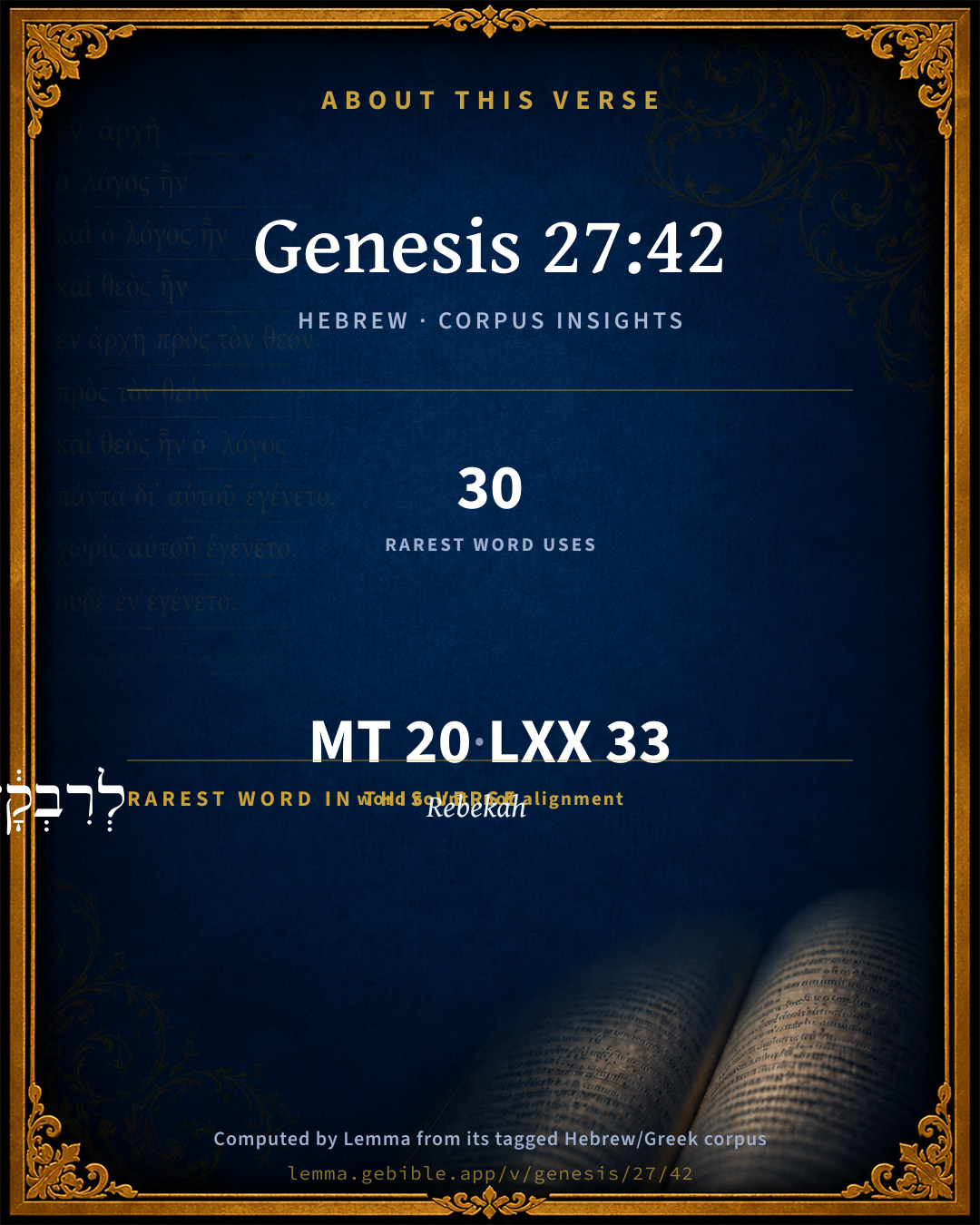
20
words
17
distinct lemmas
Pentateuch
section

Shared distinctive vocabulary

לְרִבְקָ֔ה Rebekah H7259 occurs in 29 verses of the Hebrew Bible. Also found in:

Grammatical profile

  • 6 verbs
  • 8 nouns
  • 2 adjectives
  • 2 prepositions
  • 2 particles

Verb forms

  • וַיֻּגַּ֣ד Hophal · Sequential Imperfect
  • וַתִּשְׁלַ֞ח Qal · Sequential Imperfect
  • וַתִּקְרָ֤א Qal · Sequential Imperfect
  • וַתֹּ֣אמֶר Qal · Sequential Imperfect
  • מִתְנַחֵ֥ם Hithpael · Participle Active
  • לְהָרְגֶֽךָ Qal · Infinitive Construct

Repetition

Words recur within this verse — often emphatic in Hebrew:

  • עֵשָׂ֖ו Esau H6215 ×2
  • בְּנָ֣הּ son H1121 ×2

Hebrew & Septuagint length

In English translation the verse runs 36 words from the Hebrew and 34 from the Septuagint (LXX English) — closely comparable.

A rough comparison of the two English renderings, which tokenize alike — not a word-level alignment.

Word counts can differ between the Hebrew and the Greek without any difference in meaning — e.g. the Hebrew direct-object marker אֵת has no separate Greek word, and Greek often adds the article ὁ.

In the original languages it is 20 Hebrew tokens and 33 Greek tokens — but the two are counted differently (Hebrew bundles its prefixes and suffixes into one token; the Greek is in lemma form), so that isn’t a like-for-like length.

Cross-references

7

Topical passages linked to Genesis 27:42 in the Treasury of Scripture Knowledge — connected by theme and wording, ordered by reader-vote popularity; previews shown in the World English Bible.

  • Genesis 37:18–20 They saw him afar off, and before he came near to them, they conspired against him to kill him.
  • Genesis 42:21–22 They said one to another, "We are most assuredly guilty concerning our brother, in that we saw the distress of his soul, when he begged us, and we wouldn't listen. Therefore this distress has come on us."
  • 1 Samuel 30:5 David's two wives were taken captive, Ahinoam the Jezreelitess, and Abigail the wife of Nabal the Carmelite.
  • Job 20:12–14 "Though wickedness is sweet in his mouth, Though he hide it under his tongue,
  • Psalms 64:5 They encourage themselves in evil plans. They talk about laying snares secretly. They say, "Who will see them?"
  • Proverbs 2:14 Who rejoice to do evil, And delight in the perverseness of evil;
  • Proverbs 4:16–17 For they don't sleep, unless they do evil. Their sleep is taken away, unless they make someone fall.

Cross-references courtesy of OpenBible.info (CC BY 4.0).

Hebrew and Greek witnesses Masoretic Hebrew ↔ Greek Septuagint

The same verse in the two great witnesses to the Old Testament, shown verse-for-verse.

These are two independent witnesses, not word-aligned to each other, and the Septuagint is shown in lemma (dictionary) form.

Hebrew Genesis 27:42 Masoretic · Westminster Leningrad Codex

וַיֻּגַּ֣ד לְרִבְקָ֔ה אֶת דִּבְרֵ֥י עֵשָׂ֖ו בְּנָ֣הּ הַגָּדֹ֑ל וַתִּשְׁלַ֞ח וַתִּקְרָ֤א לְיַעֲקֹב֙ בְּנָ֣הּ הַקָּטָ֔ן וַתֹּ֣אמֶר אֵלָ֔יו הִנֵּה֙ עֵשָׂ֣ו אָחִ֔יךָ מִתְנַחֵ֥ם לְךָ֖ לְהָרְגֶֽךָ

The words of Esau, her elder son, were told to Rebekah. She sent and called Jacob her younger son, and said to him, "Behold, your brother Esau comforts himself about you by planning to kill you.

World English Bible · Public Domain

Greek LXX Genesis 27:42 Septuagint · lemma form

ἀποἀγγέλλω δέ ρεβεκκα ὁ ῥῆμα ησαυ ὁ υἱός αὐτός ὁ πρεσβύτερος καί πέμπω καλέω ἰακώβ ὁ υἱός αὐτός ὁ νέος καί εἶπον αὐτός ἰδού ησαυ ὁ ἀδελφός σύ ἀποεἰλέω σύ ὁ ἀποκτείνω σύ

And the words of Esau her elder son were reported to Rebecca, and she sent and called Jacob her younger son, and said to him, Behold, Esau your brother threatens you to kill you.

LXX2012 (modern English Septuagint) · Public Domain

On this verse, The Cambridge Bible for Schools and Colleges discusses the Septuagint’s reading. Read the note in Commentary ↓

Hebrew: Westminster Leningrad Codex (CC BY 4.0). Greek: Septuagint (public domain); English from LXX2012 (modern English Septuagint) (Public Domain). How the Septuagint differs from the Hebrew →

Targum (Aramaic paraphrase)

2

The Targum is the ancient Jewish Aramaic paraphrase of the Hebrew Scriptures — an interpretive translation, not the Hebrew text itself. Onkelos (literal) and Pseudo-Jonathan (expansive) render the Torah, and Jonathan the Prophets. Coverage is partial: where no permissively-licensed English translation exists for a verse, only the Aramaic is shown. This is verse-level text, not a word-by-word alignment to the Hebrew.

  1. Targum Onkelos Torah (Genesis–Deuteronomy)
    וְאִתְחַוָּה לְרִבְקָה יָת פִּתְגָּמֵי עֵשָׂו בְּרַהּ רַבָּא וּשְׁלָחַת וּקְרַת לְיַעֲקֹב בְּרַהּ זְעֵירָא וַאֲמֶרֶת לֵהּ הָא עֵשָׂו אָחוּךְ כָּמִן לָךְ לְמִקְטְלָךְ

    (no public-domain English translation for this verse)

    Targum Onkelos — Aramaic: “Onkelos Genesis” (public domain); “Onkelos Exodus” (public domain); “Onkelos Leviticus” (public domain); “Onkelos Numbers” (public domain); “Onkelos Deuteronomy” (public domain). English: “Sefaria Community Translation” (CC0 1.0 (public-domain dedication)); “J.W. Etheridge. The Targums of Onkelos and Jonathan Ben Uzziel on the Pentateuch. London: Longmans, Green, 1862” (public domain). Text via Sefaria.

  2. Targum Pseudo-Jonathan Torah (Genesis–Deuteronomy)
    וְאִתְחַוָה לְרִבְקָה בְּרוּחַ קוֹדֶש יַת פִּתְגָמֵי עֵשָו בְּרָהּ רַבָּה דְחָשִׁיב בְּלִבֵּיהּ לְמִקְטוֹל לְיַעֲקב וְשָׁדְרַת וְקָרְאַת לְיַעֲקב בְּרָהּ זְעֵירָא וַאֲמַרַת לֵיהּ הָא עֵשָו אָחוּךְ כָּמִין לָךְ כָּמָן וּמִתְיַעֵט עֲלָךְ לְמִקְטְלָךְ

    And the words of Esau her elder son, who thought in his heart to kill Jakob, were shown by the Holy Spirit to Rivekah, and she sent, and called Jakob her younger son, and said to him, Behold, Esau thy brother lieth in wait for thee, and plotteth against thee to kill thee.

    Targum Pseudo-Jonathan — Aramaic: “Targum Jonathan on Genesis” (public domain); “Targum Jonathan on Exodus” (public domain); “Targum Jonathan on Leviticus” (public domain); “Targum Jonathan on Numbers” (public domain); “Targum Jonathan on Deuteronomy” (public domain). English: “The Targum of Jonathan ben Uzziel, trans. J. W. Etheridge, London, 1862” (public domain). Text via Sefaria.

Commentary

Notes on Genesis 27:42 from classic Christian and Jewish commentators (each source and its license shown beneath its notes). The classic Christian expositions comment on the surrounding passage and are grouped to its opening verse, so a note may address several verses; the Jewish commentaries on the Tanakh (Rashi and others) are per-verse, so they appear only where the commentator wrote on this verse.

Lemma curates 59 commentaries, every one of them public domain or Creative Commons licensed, each selected and text-cleaned for this edition rather than reprinted as found. About our sources →

Trapp's Complete Commentary

John Trapp

Gen 27:42 And these words of Esau her elder son were told to Rebekah: and she sent and called Jacob her younger son, and said unto him, Behold, thy brother Esau, as touching thee, doth comfort himself, [purposing] to kill thee.

Ver. 42. And these words of Esau, &c.] For he could not hold, as Absalom did, who, intending to murder Amnon, spake neither good nor evil to him. These still revenges are most dangerous, as a dog that barks not. That Esau vented himself in words, was a great mercy of God to Jacob. He thought nothing, good man, but followed his calling, not knowing his danger. But his provident mother heard about it, and took course to prevent it. So doth the sweet fatherly providence of God take care and course for the safety of his servants, when they are either ignorant or secure. Masses were said in Rome for the good success of the Powder Plot; but no prayers in England for our deliverance: and yet we were delivered. A sevenfold psalmody they had framed here, which secretly passed from hand to hand, with tunes set, to be sung for the cheering up of their wicked hearts, with an expectation, as they called it, of their day of Jubilee. {a} The matter consisteth of railing upon King Edward, Queen Elizabeth, and King James; of petition, imprecation, prophecy, and praise. This Psalter is hard to be had: for they are taken up by the Papists as other books are, that discover their shame. But Mendoza, that liar ( conveniunt rebus nomina saepe suis), sounded the triumph before the victory. That blind letter of theirs brought all to light, by the mere mercy of "the Father of lights," who was pleased to put a divine sentence into the mouth of the king. Sorex suo perit indicio. Hunc tibi pugionem mittit Senatus, dixit ille: detexit facinus fatuus, et non implevit. So here. See the like, 1Sa 19:2 Act 9:24; Act 23:16.

And she sent and called Jacob.] Why did she not call both her sons together, and make them friends, by causing the younger to resign up his blessing to the elder? Because she preferred heaven before earth, and eternity before any the world’s amity or felicity whatsoever. The devil would fain compound with us when he cannot conquer us; as Pharaoh would let some go, not all; or if all, yet not far. Religiosum oportet esse, sed non religantem. He cannot abide this strictness, &c. But we must be resolute for God and heaven. Better flee with Jacob, yea, die a thousand deaths, than, with the loss of God’s blessing, to accord with Esau.

{a} Spec. Bell. Sacri.

John Trapp, A Commentary or Exposition upon All the Books of the Old and New Testament (1647–1656) — public domain. Text from a community e-Sword module.

Tyndale Open Study Notes

Tyndale Open Resources

27:42–33:17 Jacob met the Lord on a route that Abraham had taken 125 years earlier. The story recounted in 27:42–33:17 follows a chiastic structure that centers on Jacob’s exile: A: Jacob flees Esau (27:42–28:9) B: Angels of God meet Jacob at Bethel (28:10-22) C: Jacob is exiled in Paddan-aram (29:1–31:55) B’: Angels of God meet Jacob at Mahanaim (32:1-2) A’: Jacob is reconciled to Esau (32:3–33:17).

Tyndale Open Study Notes — © Tyndale Open Resources, licensed CC BY-SA 4.0. Text via the HelloAO Bible API.

Geneva Bible (1599)

Geneva Bible translators

He hath good hope to recover his birthright by killing thee.

Geneva Bible (1599) marginal notes — public domain. Text via Bolls.life.

Jamieson, Fausset & Brown

Robert Jamieson, A. R. Fausset & David Brown

these words of Esau were told Rebekah--Poor woman! she now early begins to reap the bitter fruits of her fraudulent device; she is obliged to part with her son, for whom she planned it, never, probably, seeing him again; and he felt the retributive justice of heaven fall upon him heavily in his own future family.

Jamieson, Fausset & Brown — Commentary Critical and Explanatory on the Whole Bible (1871) — public domain (CC PDM 1.0). Text via the HelloAO Bible API.

Adam Clarke's Commentary

Verse 42. Doth comfort himself, purposing to kill thee.] מתנחם לך mithnachem lecha, which Houbigant renders cogitat super te, he thinks or meditates to kill thee. This sense is natural enough here, but it does not appear to be the meaning of the original; nor does Houbigant himself give it this sense, in his Racines Hebraiques. There is no doubt that Esau, in his hatred to his brother, felt himself pleased with the thought that he should soon have the opportunity of avenging his wrongs.

Adam Clarke's Commentary on the Bible (1810–1826) — public domain. Text from a community e-Sword/MySword module.

John Calvin's Commentaries

42. And these words of Esau... were told to Rebekah. Moses now makes a transition to a new subject of history, showing how Jacob, as a wanderer from his father’s house, went into Mesopotamia. Without doubt, it was an exceedingly troublesome and severe temptation to the holy matron, to see that, by her own deed, her son was placed in imminent danger of death. But by faith she wrestled to retain the possession of the grace once received. For, if she had been impelled by a merely womanly attachment to her younger son, it certainly would have been her best and shortest method, to cause the birthright to be restored to Esau: for thus the cause of emulation would have been removed; and he who was burning with grief at the loss of his right, would have had his fury appeased. It is therefore an evidence of extraordinary faith, that Rebekah does not come to any agreement, but persuades her son to become a voluntary exile, and chooses rather to be deprived of his presence, than that he should give up the blessing he had once received. The benediction of the father might now seem illusory; so as to make it appear wonderful that so much should be made of it by Rebekah and Jacob: nevertheless, they were so far from repenting of what they had done, that they do not refuse the bitter punishment of exile, if only Jacob may carry with him the benediction uttered by his father. Moreover, we are taught by this example, that we must bear it patiently, if the cross attends the hope of a better life, as its companion; or even if the Lord adopts us into his family, with this condition, that we should wander as pilgrims without any certain dwelling-place in the world. For, on this account, Jacob is thrust out from his paternal home, where he might quietly have passed his life, and is compelled to migrate to a strange land; because the blessing of God is promised unto him. And as he did not attempt to purchase temporal peace with his brother by the loss of the grace received; so must we beware lest any carnal advantage or any allurements of the world should draw us aside from the course of our vocation: let us rather bear with magnanimity losses of all kinds, so that the anchor of our hope nay remain fixed in heaven. When Rebekah says that Esau consoled himself with the thought, that he would slay his brother; the meaning is, that he could not be pacified by any other means, than by this wicked murder

John Calvin's Commentaries (1540-1563) — public domain. Text from the Calvin Translation Society English edition (1840s-50s) via the Christian Classics Ethereal Library (ccel.org). Calvin's coverage is partial (roughly two-thirds of the Bible); uncommented books and verses are honest gaps, never fabricated. The 19th-century editor's footnotes and remarks are omitted so the notes are faithfully Calvin's own voice.

Ellicott's Commentary for English Readers

(42) These words of Esau.—Though spoken “in his heart,” Esau had evidently made no secret of his evil purpose, and Rebekah therefore determines to send Jacob to her father’s house, not merely for safety, but that he might take a wife from among his own kindred. He was now formally acknowledged as the heir of the birthright and of the promises made to Abraham, and must therefore conform to the principle laid down in his own father’s case, and marry into the family of Nahor. “She sends, therefore, and calls him” to her tent, and takes secret counsel with him; and Jacob consents to take this distant journey. Thus the separation of mother and son, and long and painful travel, are the immediate result of their scheming.

A Bible Commentary for English Readers, edited by Charles John Ellicott (1878–1897) — public domain. Text from a community e-Sword module.

The Cambridge Bible for Schools and Colleges

gen. ed. J. J. S. Perowne

42. the words of Esau] Esau’s threat in the previous verse was “said in his heart”; but his was not a nature to keep a secret. His intention was soon the subject of talk.

doth comfort himself] A strange, but expressive phrase, lit. “is comforting himself with regard to thee, in order to kill thee”: as we should say, “hugs himself,” or “takes satisfaction,” in the thought that he will shortly kill thee. The versions LXX ἀπειλεῖ “threatens,” Lat. minatur translate erroneously.

The Cambridge Bible for Schools and Colleges (gen. ed. J. J. S. Perowne; Cambridge University Press, 1878–1918) — public domain. Text from a community e-Sword module.

John Gill's Exposition

And these words of Esau her eldest son were told to Rebekah,.... Jarchi and Jonathan say, by the Holy Ghost; but Aben Ezra thinks, by one of Esau's friends and confidants, to whom out of the abundance of his heart he had revealed this secret, which is not at all unlikely:

and she sent and called Jacob her younger son; who might be in another tent or apartment, or with the flocks in the field:

and said unto him, behold, thy brother Esau, as touching thee, doth comfort himself, purposing to kill thee; he has determined on it, and has laid a scheme for it, and comforts himself with the thought of it, that he shall be able to accomplish it, and so be the heir of the promise, and get the blessing; and even such is his nature, that thy death will be a comfort to him under the loss of his blessing, though he gets nothing by it, so sweet is revenge unto him.

John Gill's Exposition of the Whole Bible (1746–1763) — public domain (CC PDM 1.0). Text via the HelloAO Bible API.

The Pulpit Commentary

And these (literally, the) words of Esau her elder son were told to Rebekah: not likely by revelation (Augustine), but by some one to whom he had made known his secret purpose (Pro_29:11) and she sent and called Jacob her younger son (to advise him of his danger, being apprehensive lest the passionate soul of the enraged hunter should find it difficult to delay till Isaac"s death), and said unto him, Behold, thy brother Esau, as touching thee, doth comfort himself, purposing to kill thee. Literally, behold thy brother Esau taking vengeance upon thee (the hithpael of meaning properly to comfort oneself, hence to satisfy one"s feeling of revenge) by killing thee. The translations ajpeilei (LXX) and mina-fur (Vulgate), besides being inaccurate, are too feeble to express the fratricidal purpose of Esau.

The Pulpit Commentary (1880–1919), ed. H.D.M. Spence-Jones & Joseph S. Exell — public domain. Text from a community e-Sword module.

Rashi

Rabbi Shlomo Yitzchaki (Rashi)

ויגד לרבקה WERE TOLD TO REBEKAH — It was told her by the Holy Spirit what Esau was thinking in his heart (Genesis Rabbah 67:9).

מתנחם לך DOTH COMFORT HIMSELF CONCERNING THEE — He regrets the brotherly relationship existing between you, harbouring thoughts other than those of brotherhood, to estrange himself from you and to kill you. The Midrashic explanation (Genesis Rabbah 67:9) is: In his eyes you are already regarded as dead and he has drunk for you (i. e. because he regards you as dead) the cup of consolation (which it was customary for near relatives of the deceased to drink). But according to the real meaning the word signifies “comforting” — he will comfort himself for the loss of the blessings by killing you.

Rashi on the Tanakh — English translations: “The Judaica Press complete Tanach with Rashi, translated by A. J. Rosenberg” (CC BY 4.0); “Pentateuch with Rashi's commentary by M. Rosenbaum and A.M. Silbermann, 1929-1934” (public domain); “The Metsudah Tanach series, Lakewood, N.J” (CC BY 4.0); and “The Book of Joshua, Metsudah Publications, 1997” (CC BY 4.0). Text via Sefaria.

Ramban (Nachmanides)

Rabbi Moshe ben Nachman (Ramban / Nachmanides)

AND SHE SENT AND CALLED JACOB. The meaning thereof is that Jacob was in another place, not in the tent of his father and mother, since he was hiding from his brother Esau who was complaining about him, and he was ashamed or afraid of him.

HE DOTH COMFORT HIMSELF (‘LECHA’) TO SLAY THEE. “He comforts himself for the loss of the blessings by killing you.” Thus the language of Rashi.But the simple interpretation is that “he comforts himself with you.” (to you) is as if it were written becha (with you), and the thought of the verse is that “his comfort with you is to kill you.” Similar cases [of the letter lamed having the meaning of a beth] are found in the verses, Thou hast chosen the son of Jesse, (to the son of Jesse). The verse thus means that “your choice lies with the son of Jesse.” And he took hold of him, here means vehechezik bo. and many similar cases.Perhaps the interpretation is that “he is comforting himself concerning you,” just as in the verses: And the men of the place asked him of his wife; in this verse does not mean “to his wife,” but “concerning his wife.” And he fell on his face; in this verse does not mean “to his face,” but “on his face.” For the king had so commanded concerning him. (to him) here means alav (concerning him). Onkelos, however, translates it as kemin lecha, meaning, “he lies in wait for you.” It would appear from his opinion that the meaning of the Hebrew expression, mithnachem lecha, is that “Esau effects the appearance of having been consoled about the matter of the blessings as if he no longer cares for them, but in truth he lies in wait for you and acts this way so that you should not be on guard.” Now Onkelos translated according to the intent of the verse but not according to the language.

Ramban (Nachmanides) on the Tanakh — English translation: “Commentary on the Torah by Ramban (Nachmanides). Translated and annotated by Charles B. Chavel. New York, Shilo Pub. House, 1971-1976” (CC BY 4.0). Text via Sefaria.

Radak

Rabbi David Kimhi (Radak)

ויגד לרבקה, how did she get to know about Esau’s intentions which he had not articulated? It is possible that she experienced a prophetic revelation, seeing that she was a prophetess. (compare Rashi) It is also possible that what Esau had thought about doing, he inadvertently mentioned to someone so that the one who had heard him reported it to Rivkah.

מתנחם לך להרגך, he acts as if he is already consoling himself over the death of Yaakov. Or, the meaning of this phrase could be that Esau has made peace with his own death because he knows that at least he had first killed you. Once he has accomplished

Radak on the Tanakh — English translations: “Sefaria Community Translation” (CC0 1.0 (public-domain dedication)); “Eliyahu Munk, HaChut Hameshulash” (CC BY 4.0); “Rabbi Mike Feuer, Jerusalem Anthology” (CC BY 4.0); and “R. David Kimhi on the first book of Psalms, Translated by R.G. Finch, London, 1919” (public domain). Text via Sefaria.

Lesson kit

Teaching starters — assembled from the data on this page, not authored interpretation. Every prompt links to the verse data it draws on. Edit before teaching.

Genesis, in the Pentateuch, opens this verse with 20 words (17 distinct Hebrew lemmas). Its most distinctive word is Ribqâh (“Rebekah”). A historical commentator’s framing appears above. Read the whole chapter for the surrounding context.

Discussion questions

  1. How does “Rebekah” (Ribqâh) shape what this verse is saying?
  2. How does Genesis 22:23, which shares the word «Rebekah», read alongside this verse?
  3. What does the repetition of “Esau” (2× in this one verse) do in this verse?
  4. These translations render this verse differently; the difference is in the English rendering, not the original. What questions does that raise?
  5. «וַיֻּגַּ֣ד» is a Hophal Sequential Imperfect verb. How does that grammatical form shape the action described?
  6. Compare how Trapp's Complete Commentary and Tyndale Open Study Notes read this verse. Where do they agree or differ?

Things to notice

Reading settings

Reading text

Shown beneath each verse's original-language words.

Old Testament
Old Testament edition

Read the OT as the Masoretic Hebrew (MT) or the Greek Septuagint (LXX).

English shown for the Greek Septuagint (in the Hebrew ↔ Greek comparison).

Comparing translations? Open the Compare panel on any verse page to stack up to four side by side.