
Isaiah 59:20

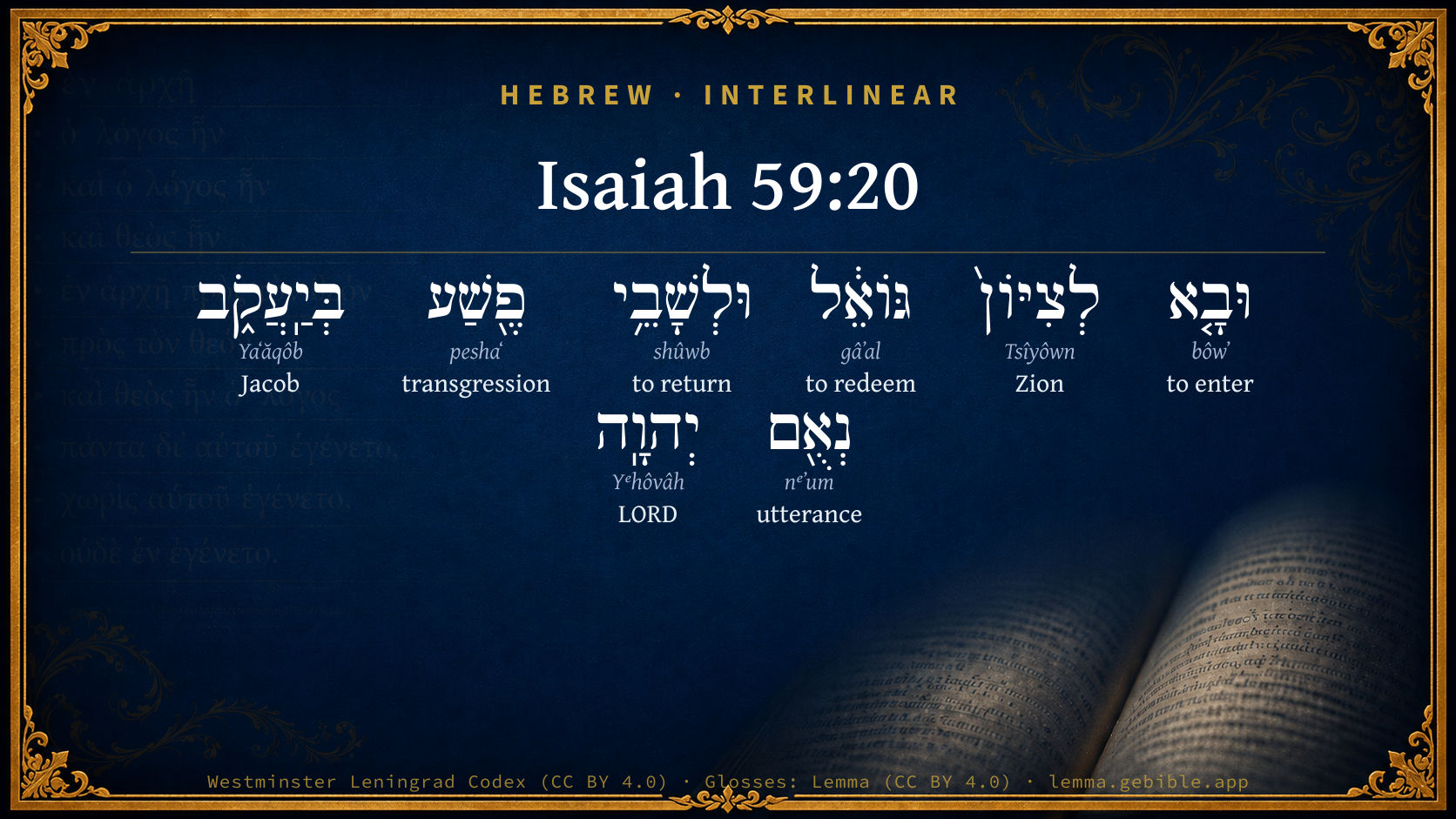
Hebrew (Westminster Leningrad Codex) Isaiah 59:20 appears in the Hebrew Old Testament. The text above is from the Westminster Leningrad Codex. Each word links to its Strong’s number, a concise gloss, and parsing drawn from the Open Scriptures Hebrew Bible morphology. Click any word for its full Brown-Driver-Briggs (BDB) entry.
Download image
Cite this verse

Isaiah 59:20 (World English Bible). Public Domain. Lemma interlinear Bible study tool, https://lemma.gebible.app/v/isaiah/59/20.

Show BibTeX & RIS
BibTeX
RIS
English Translation
A Redeemer will come to Zion, and to those who turn from disobedience in Jacob, says Yahweh.
World English Bible · Public Domain
Download a study sheet

One document with this verse’s original text, its word-by-word gloss line, the meaning frame, cross-references with their text, attributed commentary, and full source and license credits — printable, and it pastes into notes with its structure intact.

This verse Autodidact and up

Study sheet (.html) Plain text (.txt)

A passage Seminary Student

Up to 50 verses in one chapter. A passage sheet keeps up to 6 commentary sources and 12 cross-references per verse, in the order this page ranks them, and says so on the sheet whenever that leaves anything out. Ask for a single verse and you get the Autodidact verse sheet above.

Everything on this page stays free to read, with no account — the sheet is a download of what is already on screen, not access to it.

Want to remove ads? Support Godless Engineer
Compare translations 3

The same verse in 3 English versions, stacked beneath the original-language interlinear above. Click any original word for its lexicon entry.

Each is an independent rendering of the whole verse — the interlinear is not word-aligned to these translations.

Highlighted words mark where these versions differ — a whole-verse word diff, not a word-by-word alignment.

  • World English Bible Public Domain
    A Redeemer will come to Zion, and to those who turn from disobedience in Jacob, says Yahweh.
  • King James Version Public Domain
    And the Redeemer shall come to Zion, and unto them that turn from transgression in Jacob, saith the LORD.
  • unfoldingWord Literal Text CC BY-SA 4.0
    “And a redeemer will come to Zion and to the ones turning from transgression in Jacob” —the declaration of Yahweh.

unfoldingWord Literal Text — © unfoldingWord, licensed CC BY-SA 4.0. Word-aligned USFM3 via Door43 (git.door43.org/unfoldingWord/en_ult).

Versions to compare (up to 4)

3 of 4 selected

Show all 18 translations

Every available English version of this verse, each an independent rendering of the whole verse.

  • World English Bible Public Domain
    A Redeemer will come to Zion, and to those who turn from disobedience in Jacob, says Yahweh.
  • Berean Standard Bible Public Domain
    “The Redeemer will come to Zion, to those in Jacob who turn from transgression,” declares the LORD.
  • Majority Standard Bible Public Domain
    “The Redeemer will come to Zion, to those in Jacob who turn from transgression,” declares the LORD.
  • King James Version Public Domain
    And the Redeemer shall come to Zion, and unto them that turn from transgression in Jacob, saith the LORD.
  • American Standard Version (1901) Public Domain
    And a Redeemer will come to Zion, and unto them that turn from transgression in Jacob, saith Jehovah.
  • Revised Version (1885) Public Domain
    And a redeemer shall come to Zion, and unto them that turn from transgression in Jacob, saith the LORD.
  • Geneva Bible (1599) Public Domain
    And the Redeemer shall come vnto Zion, and vnto them that turne from iniquitie in Iaakob, saith the Lord.
  • Douay-Rheims (1899) Public Domain
    And there shall come a, redeemer to Sion, and to them that return from iniquity in Jacob, saith the Lord.
  • Young's Literal Translation Public Domain
    And come to Zion hath a redeemer, Even to captives of transgression in Jacob, An affirmation of Jehovah.
  • Literal Standard Version CC BY-SA 4.0
    “And the Redeemer has come to Zion, || Even to captives of transgression in Jacob,” || A declaration of YHWH.
  • Unlocked Literal Bible CC BY-SA 4.0
    “A redeemer will come to Zion and to those who turn from their rebellious deeds in Jacob—this is Yahweh's declaration.
  • unfoldingWord Literal Text CC BY-SA 4.0
    “And a redeemer will come to Zion and to the ones turning from transgression in Jacob” —the declaration of Yahweh.
  • Darby Bible Public Domain
    And the Redeemer will come to Zion, and unto them that turn from transgression in Jacob, saith Jehovah.
  • World Messianic Bible Public Domain
    “A Redeemer will come to Zion, and to those who turn from disobedience in Jacob,” says the LORD.
  • Webster's Bible Public Domain
    And the Redeemer will come to Zion, and to them that turn from transgression in Jacob, saith the LORD.
  • Free Bible Version CC BY-SA 4.0
    The Redeemer will come to Zion, to Jacob's descendants who turn from their sins, declares the Lord.
  • Bible in Basic English Public Domain
    And as a saviour he will come to Zion, turning away sin from Jacob, says the Lord.
  • JPS Tanakh (1917) Public Domain
    And a redeemer will come to Zion, and unto them that turn from transgression in Jacob, saith the LORD.

Literal Standard Version (2020), Covenant Press — licensed CC BY-SA 4.0. Text via the HelloAO Bible API (eBible.org). Unlocked Literal Bible (unfoldingWord) — licensed CC BY-SA 4.0. Text via the HelloAO Bible API (eBible.org). unfoldingWord Literal Text — © unfoldingWord, licensed CC BY-SA 4.0. Word-aligned USFM3 via Door43 (git.door43.org/unfoldingWord/en_ult). Free Bible Version, Dr. Jonathan Gallagher — licensed CC BY-SA 4.0. Text via the HelloAO Bible API (eBible.org).

Word by word

More ways to search: Search by grammar → Find every occurrence → Compare this word →

Practice this passage: Drill this verse → Learn its vocabulary →

פֶ֖שַׁע
peshaʻ
H6588
“transgression”
Noun, Common, Masculine, Singular, Absolute
Part of Speech
Noun
Type
Common
Gender
Masculine
Number
Singular
State
Absolute
Full BDB Definition

Origin: from H6586

TWOT: 1846a

transgression, rebellion - transgression (against individuals) - transgression (nation against nation) - transgression (against God) - in general - as recognised by sinner - as God deals with it - as God forgives - guilt of transgression - punishment for transgression - offering for transgression
  1. וּבָ֤א bôwʼ H935 “and · to enter” Conjunction + Verb, Qal, Sequential Perfect, 3rd Person, Masculine, Singular
  2. לְצִיּוֹן֙ Tsîyôwn H6726 “to/for · Zion” Preposition + Noun, Proper
  3. גּוֹאֵ֔ל gâʼal H1350 “redeeming” Verb, Qal, Participle Active, Masculine, Singular, Absolute
  4. וּלְשָׁבֵ֥י shûwb H7725 “and · to/for · returning” Conjunction + Preposition + Verb, Qal, Participle Active, Masculine, Plural, Construct
  5. בְּיַֽעֲקֹ֑ב Yaʻăqôb H3290 “in/at · Jacob” Preposition + Noun, Proper
  6. נְאֻ֖ם nᵉʼum H5002 “utterance of” Noun, Common, Masculine, Singular, Construct
  7. יְהוָֽה Yᵉhôvâh H3068 “LORD” Noun, Proper

About this verse

These counts appear in no published source. They are computed here, from the morphology-tagged text and Lemma’s own curated glosses. What Lemma adds →

8
words
8
distinct lemmas
Prophets
section

Grammatical profile

  • 3 verbs
  • 5 nouns

Verb forms

  • וּבָ֤א Qal · Sequential Perfect
  • גּוֹאֵ֔ל Qal · Participle Active
  • וּלְשָׁבֵ֥י Qal · Participle Active

Hebrew & Septuagint length

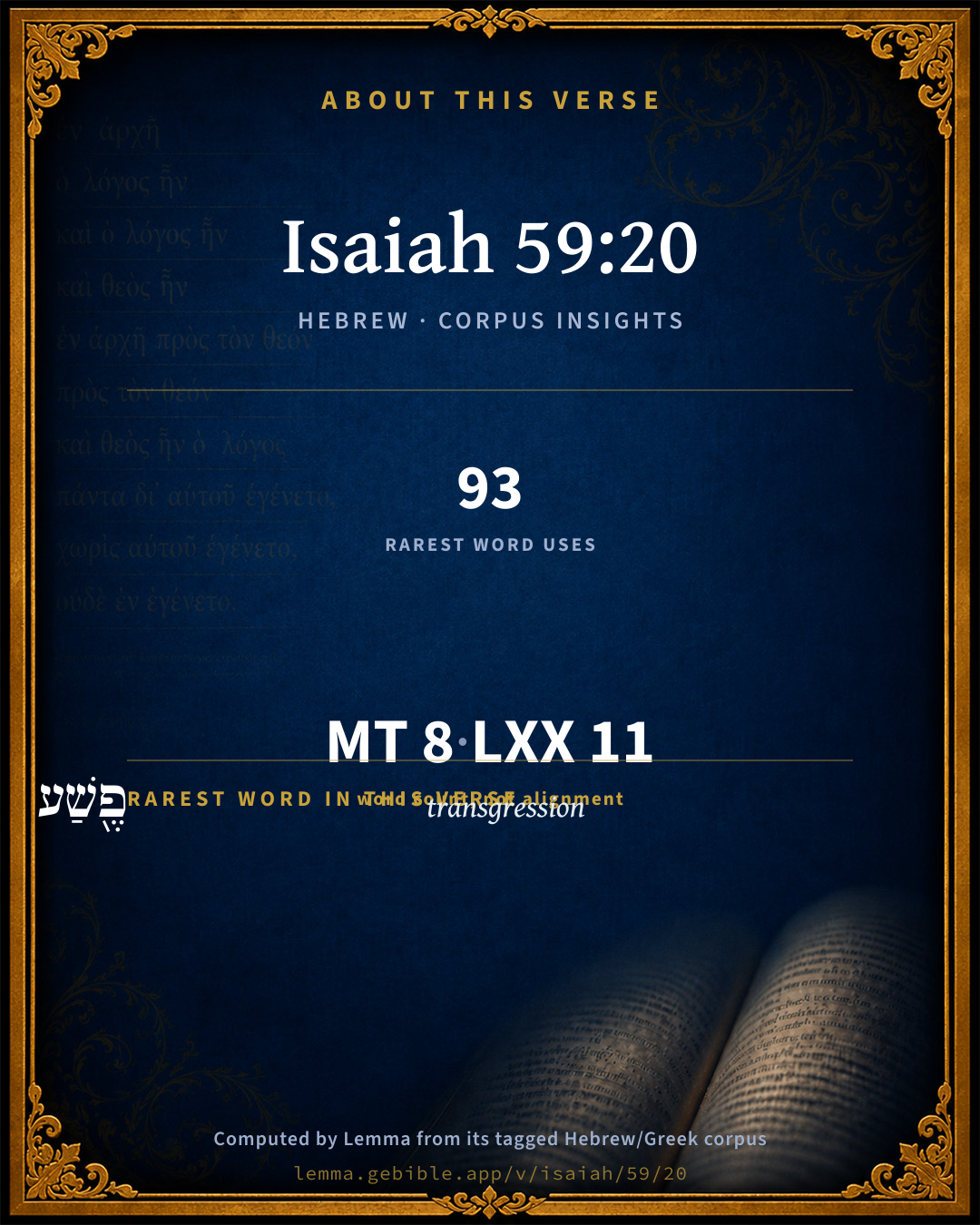
In English translation the verse runs 17 words from the Hebrew and 15 from the Septuagint (LXX English) — closely comparable.

A rough comparison of the two English renderings, which tokenize alike — not a word-level alignment.

Word counts can differ between the Hebrew and the Greek without any difference in meaning — e.g. the Hebrew direct-object marker אֵת has no separate Greek word, and Greek often adds the article ὁ.

In the original languages it is 8 Hebrew tokens and 11 Greek tokens — but the two are counted differently (Hebrew bundles its prefixes and suffixes into one token; the Greek is in lemma form), so that isn’t a like-for-like length.

Cross-references

13

Topical passages linked to Isaiah 59:20 in the Treasury of Scripture Knowledge — connected by theme and wording, ordered by reader-vote popularity; previews shown in the World English Bible.

  • Romans 11:26–27 and so all Israel will be saved. Even as it is written, "There will come out of Zion the Deliverer, And he will turn away ungodliness from Jacob.
  • Titus 2:11–14 For the grace of God has appeared, bringing salvation to all men,
  • Ezekiel 18:30–31 Therefore I will judge you, house of Israel, everyone according to his ways, says the Lord Yahweh. Return you, and turn yourselves from all your transgressions; so iniquity shall not be your ruin.
  • Acts 3:19 "Repent therefore, and turn again, that your sins may be blotted out, so that there may come times of refreshing from the presence of the Lord,
  • Hebrews 12:14 Follow after peace with all men, and the sanctification without which no man will see the Lord,
  • Joel 2:32 It will happen that whoever will call on the name of Yahweh shall be saved; For in Mount Zion and in Jerusalem there will be those who escape, As Yahweh has said, And among the remnant, those whom Yahweh calls.
  • Obadiah 1:17–21 But in Mount Zion, there will be those who escape, and it will be holy. The house of Jacob will possess their possessions.
  • Deuteronomy 30:1–10 It shall happen, when all these things are come on you, the blessing and the curse, which I have set before you, and you shall call them to mind among all the nations, where Yahweh your God has driven you,
  • Isaiah 40:9 You who tell good news to Zion, go up on a high mountain; you who tell good news to Jerusalem, lift up your voice with strength; lift it up, don't be afraid; say to the cities of Judah, Behold, your God!
  • Daniel 9:13 As it is written in the law of Moses, all this evil is come on us: yet have we not entreated the favor of Yahweh our God, that we should turn from our iniquities, and have discernment in your truth.
  • Acts 3:26 God, having raised up his servant, Jesus, sent him to you first, to bless you, in turning away everyone of you from your wickedness."
  • Acts 26:20 but declared first to them of Damascus, at Jerusalem, and throughout all the country of Judea, and also to the Gentiles, that they should repent and turn to God, doing works worthy of repentance.
  • Acts 2:36–39 "Let all the house of Israel therefore know assuredly that God has made him both Lord and Christ, this Jesus whom you crucified."

Cross-references courtesy of OpenBible.info (CC BY 4.0).

Hebrew and Greek witnesses Masoretic Hebrew ↔ Greek Septuagint

The same verse in the two great witnesses to the Old Testament, shown verse-for-verse.

These are two independent witnesses, not word-aligned to each other, and the Septuagint is shown in lemma (dictionary) form.

Hebrew Isaiah 59:20 Masoretic · Westminster Leningrad Codex

וּבָ֤א לְצִיּוֹן֙ גּוֹאֵ֔ל וּלְשָׁבֵ֥י פֶ֖שַׁע בְּיַֽעֲקֹ֑ב נְאֻ֖ם יְהוָֽה

A Redeemer will come to Zion, and to those who turn from disobedience in Jacob, says Yahweh.

World English Bible · Public Domain

Greek LXX Isaiah 59:20 Septuagint · lemma form

καί ἥκω ἕνεκεν σιων ὁ ῥύομαι καί ἀποστρέφω ἀσέβεια ἀπό ἰακώβ

And the deliverer shall come for Sion's sake, and shall turn away ungodliness from Jacob.

LXX2012 (modern English Septuagint) · Public Domain

On this verse, The Biblical Illustrator discusses the Septuagint’s reading. Read the note in Commentary ↓

Hebrew: Westminster Leningrad Codex (CC BY 4.0). Greek: Septuagint (public domain); English from LXX2012 (modern English Septuagint) (Public Domain). How the Septuagint differs from the Hebrew →

Targum (Aramaic paraphrase)

1

The Targum is the ancient Jewish Aramaic paraphrase of the Hebrew Scriptures — an interpretive translation, not the Hebrew text itself. Onkelos (literal) and Pseudo-Jonathan (expansive) render the Torah, and Jonathan the Prophets. Coverage is partial: where no permissively-licensed English translation exists for a verse, only the Aramaic is shown. This is verse-level text, not a word-by-word alignment to the Hebrew.

  1. Targum Jonathan Prophets (Joshua–Malachi)
    וְיֵיתֵי לְצִיוֹן פְרִיק וְלַאֲתָבָא מְרוֹדַיָא דְבֵית יַעֲקֹב לְאוֹרַיְתָא אֲמַר יְיָ:

    And the redeemer shall come to Zion, and turn the transgressors of the house of Jacob to the law, saith the Lord.

    Targum Jonathan — Aramaic: “Mikraot Gedolot” (public domain). English: “Sefaria Community Translation” (CC0 1.0 (public-domain dedication)); “London "Chaldee Paraphrase," 1871” (public domain). Text via Sefaria.

Commentary

Notes on Isaiah 59:20 from classic Christian and Jewish commentators (each source and its license shown beneath its notes). The classic Christian expositions comment on the surrounding passage and are grouped to its opening verse, so a note may address several verses; the Jewish commentaries on the Tanakh (Rashi and others) are per-verse, so they appear only where the commentator wrote on this verse.

Lemma curates 59 commentaries, every one of them public domain or Creative Commons licensed, each selected and text-cleaned for this edition rather than reprinted as found. About our sources →

Trapp's Complete Commentary

John Trapp

Isa 59:20 And the Redeemer shall come to Zion, and unto them that turn from transgression in Jacob, saith the LORD.

Ver. 20. And the Redeemer.] Shall come to the Israel of God.

That turn from transgression.] See Rom 11:26. {See Trapp on "Rom 11:26"}

John Trapp, A Commentary or Exposition upon All the Books of the Old and New Testament (1647–1656) — public domain. Text from a community e-Sword module.

The Biblical Illustrator

Joseph S. Exell

Isa_59:20-21

And the Redeemer shall come to Zion

The Redeemer coming to His Church

I.

THE PERSON OF WHOM THE FATHER SPEAKS, AND HIS COMING.

1. The Redeemer, the kinsman, who, by assuming our nature, is nearly related to us (Heb_2:11; Heb_2:17). To Him, as our kinsman, the right of redemption belongs.

2. Shall come to Zion, and unto them that turn from transgression in Jacob. The coming which is here spoken of is for the above purposes, and not chiefly His coming in the flesh, which does not so well suit the context. It is His spiritual coming which is meant; His coming in His kingdom. To the Jews, as a people, to turn away ungodliness from Jacob, as the LXX read it, and St. Paul in Rom_11:26. To His Church in general, often called Zion, Jacob, and Israel; to introduce the millennium, and spread religion through all the world (Rev_19:11-16). To the hearts of His people (Joh_14:18-19; Joh_14:23; Rev_3:20). Then have we Christ in us the hope of glory; Christ dwelling in our hearts by faith Eph_3:14; Eph_3:17; Gal_2:20-21).

II. THE BLESSINGS CONSEQUENT ON HIS COMING IN THESE SENSES, My Spirit that is upon Thee, and My words which I have put in Thy mouth, shall not depart out of Thy mouth, etc. These are the words of the Father to the Redeemer.

III. THE PERSONS TO WHOM THESE BLESSINGS ARE PROMISED; THE WAY IN

WHICH THEY ARE OBTAINED; AND THE CERTAINTY OF OBTAINING THEM IN THAT WAY. They are promised to those that are in Jacob, members of Christs Church. To those that turn from transgression. To those who are the seed of Christ by faith (Gal_3:9; Gal_3:26). The certainty of obtaining them may be found in Gods Covenant. (J. Benson. D. D.)

The Biblical Illustrator, edited by Joseph S. Exell (c. 1880s–1900s) — public domain. Text from a community e-Sword module.

Joseph Benson's Commentary

Isa 59:20-21. And, or, moreover, the Redeemer shall come to Zion — To Jerusalem, or to his church, often signified by Zion, namely, Christ shall come, of whom the apostle expounds it, Rom 11:26; the prophets usually concluding their promises of temporal deliverances with the promises of spiritual, especially such, of which the temporal were evident types. And unto them that turn from transgression, &c. — As he will come in the flesh, and tabernacle among his people; so he will come, by his Spirit, to those of them who turn from their sins unto God, (see Joh 14:15-23,) and will dwell in their hearts, (Eph 3:17,) so that they shall have Christ in them, the hope of glory, Col 1:27; Christ living in them, Gal 2:20. This is my covenant with them — What I have promised to them that turn from their iniquities. My Spirit that is upon thee — Namely, upon Christ: see Isa 11:1-3. The Spirit promised to the church was first upon him, and from him, the head, that precious ointment descends to the skirts of his garments. And my word that I have put into thy mouth — Which thou hast uttered by virtue of my Spirit; shall not depart out of thy mouth — But thou shalt continue to be the Word made flesh, the wisdom of God incarnate, the great teacher of thy people, and the light of the world, till the consummation of all things. Nor out of the mouth of thy seed, &c. — But it shall dwell richly in them in all wisdom, capacitating them to teach, admonish, reprove, rebuke, exhort, and comfort one another, speaking with grace in their hearts: from henceforth and for ever — Always, even unto the end of the world; for the world being permitted to stand for the sake of the church, we may be sure that as long as it doth stand, Christ will have a church in it. Upon the whole, the meaning of this promise is, that God will give and continue his word and Spirit to his people, throughout all generations. 1st, There shall be some in every age, in whose hearts he will work, and in whom he will dwell, and thus the Comforter shall abide with the church for ever, Joh 14:16. 2d, The word of Christ shall always continue in the mouths of the faithful, that is, there shall be some in every age who, believing with the heart unto righteousness, shall, with the tongue, make confession unto salvation: and there shall still be a seed to speak Christ’s holy language, and profess his holy religion. Observe well, reader, the Spirit and the word go together, and by them the church is upheld. The word in the mouths of our ministers, nay, in our own mouths, will not profit us, unless the Spirit work with the word, and give it efficacy to enlighten, quicken, renew, and comfort us. The Spirit, however, doth his work by the word, and in concurrence with it; and whatever is pretended to be a dictate of the Spirit must be tried by the Scriptures. On this foundation the church is built, stands firm, and shall stand for ever; Christ himself being the chief corner- stone.

Joseph Benson's Commentary on the Old and New Testaments (1811–1818) — public domain. Text from a community e-Sword module.

Geneva Bible (1599)

Geneva Bible translators

Whereby he declareth that the true deliverance from sin and Satan belongeth to none, but to the children of God, whom he justifieth.

Geneva Bible (1599) marginal notes — public domain. Text via Bolls.life.

Jamieson, Fausset & Brown

Robert Jamieson, A. R. Fausset & David Brown

to Zion-- Rom 11:26 quotes it, "out of Zion." Thus Paul, by inspiration, supplements the sense from Psa 14:7 : He was, and is come to Zion, first with redemption, being sprung as man out of Zion. The Septuagint translates "for the sake of Zion." Paul applies this verse to the coming restoration of Israel spiritually.

them that turn from-- (Rom 11:26). "shall turn away ungodliness from Jacob"; so the Septuagint, Paul herein gives the full sense under inspiration. They turn from transgression, because He first turns them from it, and it from them (Psa 130:4; Lam 5:21).

Jamieson, Fausset & Brown — Commentary Critical and Explanatory on the Whole Bible (1871) — public domain (CC PDM 1.0). Text via the HelloAO Bible API.

Adam Clarke's Commentary

Verse 20. Unto them that turn from transgression in Jacob - "And shall turn away iniquity from Jacob"] So the Septuagint and St. Paul, Ro 11:26, reading instead of לשבי leshabey and ביעקב beyaacob, והשיב veheshib and מיעקב meyaacob. The Syriac likewise reads והשיב veheshib; and the Chaldee, to the same sense, ולהשיב ulehashib. Our translators have expressed the sense of the present reading of the Hebrew text: "And unto them that turn from transgression in Jacob."

Adam Clarke's Commentary on the Bible (1810–1826) — public domain. Text from a community e-Sword/MySword module.

Ellicott's Commentary for English Readers

(20) And the Redeemer shall come . . .—The picture of the Theophany is continued—Jehovah comes as a Redeemer (Goel, as in Isa_41:14; Isa_43:1, Job_19:25) to the true Zion, to those who have turned from their transgression. The verse is noticeable as being quoted, with variations, by St. Paul in Rom_11:26.

A Bible Commentary for English Readers, edited by Charles John Ellicott (1878–1897) — public domain. Text from a community e-Sword module.

The Cambridge Bible for Schools and Colleges

gen. ed. J. J. S. Perowne

20. The consequences for Israel.

And the redeemer shall come] Rather And he shall come as a redeemer (ch. Isa_41:14).

and unto them that turn from transgression in Jacob] LXX. has “and shall turn away ungodliness from Jacob,”—a different and more expressive text. So also in the quotation, Rom_11:26, where the words are applied in a Messianic sense.

The Cambridge Bible for Schools and Colleges (gen. ed. J. J. S. Perowne; Cambridge University Press, 1878–1918) — public domain. Text from a community e-Sword module.

John Gill's Exposition

And the Redeemer shall come to Zion,.... Not Cyrus, as some; but the Messiah, as it is applied in the Talmud (m) and in other Jewish writers (n), and as Aben Ezra rightly interprets it; and so Kimchi, who also understands by the enemy, in the preceding verse, Gog and Magog; and this must be understood not of the first coming of Christ to redeem his people by his blood from sin, Satan, and the law; but of his spiritual coming to Zion to the church of God in the latter day, at the time of the conversion of the Jews, as appears from the quotation, and application of it by the apostle, Rom 11:25 and with it compare Rev 14:1,

and unto them that turn from transgression in Jacob, saith the Lord; that is, to such among the Jews, the posterity of Jacob, who repent of their sins, and turn from them; and particularly their sin of the rejection of the Messiah, and the disbelief of him, and turn to him, and believe in him as their Saviour and King. The Targum is,

"and the Redeemer shall come to Zion, and to turn the transgressors of the house of Jacob to the law;''

but rather the turn will be to the Gospel of Christ.

(m) T. Bab. Sanhedrin, fol. 98. l. & Yoma, fol. 86. 2. (n) Echa Rabbati, fol. 47. 2.

John Gill's Exposition of the Whole Bible (1746–1763) — public domain (CC PDM 1.0). Text via the HelloAO Bible API.

Albert Barnes' Notes on the Bible

And the Redeemer shall come - On the meaning of the word rendered here ‘Redeemer,’ see the notes at Isa 43:1. This passage is applied by the apostle Paul to the Messiah Rom 11:26; and Aben Ezra and Kimchi, among the Jews, and Christians generally, suppose that it refers to him.

To Zion - On the word ‘Zion,’ see the notes at Isa 1:8. The Septuagint renders this, Ἔνεκεν Σιὼν Heneken Siōn - ‘On account of Zion.’ The apostle Paul Rom 11:26, renders this, ‘There shall come out of Zion (ἐκ Σιὼν ek Siōn) the Deliverer,’ meaning that he would arise among that people, or would not be a foreigner. The idea in Isaiah, though substantially the same, is rather that he would come as a deliverer from abroad; that is, he would come from heaven, or be commissioned by God. When it is said that he would come to Zion, it is not meant that he would come exclusively to the Jews, but that his mission would be primarily to them.

And unto them that turn from transgression in Jacob - There is much variety in the interpretation of this passage. Paul Rom 11:26 quotes it thus, ‘and shall turn away ungodliness from Jacob;’ and in this he has literally followed the Septuagint. The Vulgate renders it as in our translation. The Chaldee, ‘And shall turn transgressors of the house of Jacob to the law.’ The Syriac, ‘To those who turn iniquity from Jacob.’ Lowth has adopted the rendering of the Septuagint, and supposes that an error has crept into the Hebrew text. But there is no good authority for this supposition. The Septuagint and the apostle Paul have retained substantially, as Vitringa has remarked, the sense of the text. The main idea of the prophet is, that the effect of the coming of the Messiah would be to turn people from their sins. He would enter into covenant only with those who forsook their transgressions, and the only benefit to be derived from his coming would be that many would be thus turned from their iniquities.

Albert Barnes' Notes on the Bible (1834–1885) — public domain. Text from a community e-Sword/MySword module.

Haydock's Catholic Bible Commentary

To Sion. Septuagint, "from Sion, and will turn away iniquity from Jacob. (21.) And this," &c. (Haydock) --- St. Paul hence proves that the Jews will at last be converted, Romans xi. 26. The return of the captives prefigured this event. (Calmet)

George Leo Haydock (1774–1849), Haydock's Catholic Family Bible and Commentary, 1859 edition — public domain. Excludes Psalms (Douay-Rheims chapter numbering differs from Protestant) and Deuterocanonical books (Catholic canon only).

Matthew Poole's English Annotations

And, moreover, or to wit; and being here not so much copulative as expositive.

The Redeemer: the word notes a redemption with power, viz.

1. Cyrus, the instrument for the efficient, viz. God the Redeemer, Isa 43:14; 45:13. Or,

2. Christ, of whom the apostle expounds it, Rom 11:26; the prophets usually concluding their promises of temporal deliverances with the promises of spiritual, especially such of which the temporal were evident types.

To Zion, viz. Jerusalem, to which though Cyrus came not in person, yet his favours, and the good effects of his conquest over Babylon, reached it, setting free the citizens of Zion, as Christ also his church, which is often called by the name of Zion, and Jacob, and Israel, &c. In Jacob, viz. among the Jews, who were the children of Jacob; and he describes to whom of these, namely, to them, and none else, that

turn from transgression; such only whose hearts God touched, and turned to righteousness; and so to come to Zion here by the prophet, and out of Zion by the apostle, is one and the same thing; See Poole "Deu 33:2"; for the Hebrew lamed is not only an article of the dative case, but put often for mim, of or from, so that letsion is out of Zion; and for Christ to be given a Redeemer to Zion is the same thing as his coming to take iniquity from Jacob. And so the apostle doth by this expound that, taking an apostolical liberty not only to quote, but to expound this text; and so by laying them together, and making them one, would teach us that God must do for us what he requireth of us, Act 3:26; or else, which is the opinion of some, he takes the last clause from some other text, or texts, as Isa 4:4. I incline to the former, partly because there is no need of searching for any other text, and partly because, as the apostle quoteth it, it is agreeable to the LXX., which he frequently makes use of; and this the apostle improves as an allegory to prove that the Jews toward the end of the world shall he converted and saved, when the fulness of the Gentiles shall be brought in: q.d. As this people of old were delivered out of a dark and dolesome estate, when they seemed as it were extinct; so toward the end of the world the remnant of the Jews, that seem to be rejected, God will again bring home unto himself. Saith the Lord; or, thus it is decreed and determined by the Lord: the prophets are wont to set down these words as a sacred seal of certainty, security, or confirmation of such signal promises as this is of the Redeemer, like to that of the apostle, 1Ti 1:15.

Matthew Poole's English Annotations on the Holy Bible (1683–1685) — public domain. Text from a community e-Sword/MySword module.

Whedon's Commentary on the Bible

Daniel D. Whedon

20. Redeemer… to Zion — The apostle Paul refers to this text as proof that when the Gentiles throughout the world shall have come into acceptance of the Christian religion, then apostate Israel shall also be converted thereto. Rom_11:25.

Daniel D. Whedon (gen. ed.), Commentary on the Old and New Testaments (1874–1909) — public domain. Text from a community e-Sword module.

The Pulpit Commentary

And the Redeemer shall come to Zion; rather, and there shall come a Redeemer for Zion, and for those who turn, etc. When the "adversaries and the "enemies" shall have been punished, repentant Israel shall be saved by the coming of Messiah. As usual, the prophet does not note, or perhaps see, intervals of time, but blends events of various periods into one glorious vision of triumphant deliverance, redemption, and prolonged spiritual life in the Redeemer"s kingdom.

Vers. 20, 21. The Church indefectible.

The Church of God, being a body of men and women, each one of whom is weak, fallible, and liable to fall from the truth, ay, even to apostasy, must, by the nature of things, be of itself and in itself detectible. A weakness which attaches to all the individuals of a body must attach to the body which those individuals make up. The Church, therefore, is not, per se, indefectible. If indefectible in fact, it can only be so by the will of God, and can only be by us known to be so if God had declared to us his will. But this has been done

I GOD DECLARED BY THE PSALMISTS AND THE PROPHETS THAT HE WOULD SET UP ON EARTH AN IMPERISHABLE KINGDOM, CITY, OR COMMUNITY OF MEN. A promise to this effect was first given to David. God said to him, by the mouth Of:nathan, "I will set up thy seed after thee, which shall proceed out of thy bowels, and I will establish his kingdom. He shall build a house for my Name, and I will establish the throne of his kingdom for ever"; (2Sa_7:12, 2Sa_7:13) and again, "Thine house and thy kingdom shall be established for ever before thee: thy throne shall be established for ever". (2Sa_7:16) Hence David himself spake of "the city of the Lord of hosts, which God would establish for ever". (Psa_48:8) And Ethan the Ezrahite spoke of the promise as a "covenant" to which God had "sworn:" "His seed shall endure for ever, and his throne as the sun before me. It shall be established for ever as the moon, and as a faithful witness in heaven". (Psa_89:34-37) Isaiah"s declarations as to a coming kingdom are to the same effect. "Unto us a Child is born, unto us a Son is given: and the government shall be upon his shoulder of the increase of his government and peace there shall be no end, upon the throne of David, and upon his kingdom, to order it, and to establish it with judgment and with justice from henceforth even for ever". (Isa_9:6, Isa_9:7) And the declaration of the present chapter: "My Spirit that is upon thee, and my words that I have put in thy mouth, shall not depart out of thy mouth, nor out of the mouth of thy seed, nor out of the mouth of thy seed"s seed... from henceforth and for ever.

II God ATTACHED THESE PROMISES, THROUGH THE DECLARATIONS OF HIS SON, TO THE PARTICULAR COMMUNITY WHICH HE CALLED HIS CHURCH. "Thou art Peter," said our blessed Lord, "and upon this rock I will build my Church; and the gates of hell shall not prevail against it"; (Mat_16:18) "Go,... teach all nations," our Lord said again, "and, lo, I am with you alway, even unto the end of the world". (Mat_28:19, Mat_28:20) The apostles are confident, therefore, that the Church will always continue. St. Paul, in his directions concerning the Eucharist, declares that, through their partaking of it, Christians do show the Lord"s death till he come". (1Co_11:26) And he speaks of the members of the Church who are living at the last day as "caught up in the clouds, to meet the Lord in the air". (1Th_4:17) St. John traces the fortunes of the Church from his own time to the consummation of all things, and finds a remnant of faithful ones upon the earth to the last, who give testimony for Jesus. (Rev_2:21) Christians are therefore justified in believing that the Church of Christ is practically, if not ideally, indefectible that in point of fact, it will never fail, but will continue to the end of the world Christ"s great witness upon earth, testifying to his Godhead, to his redeeming love, and to the sufficiency of his one sacrifice.

The Pulpit Commentary (1880–1919), ed. H.D.M. Spence-Jones & Joseph S. Exell — public domain. Text from a community e-Sword module.

John Wesley's Explanatory Notes

The Redeemer - Christ, of whom the apostle expounds it, Rom. xi, 26, the prophets usually concluding their promises of temporal deliverances with the promises of spiritual, especially such, of which the temporal were evident types.

John Wesley, Explanatory Notes Upon the Whole Bible (1754–1765) — public domain. Text via the GEBible commentary corpus.

J. A. Alexander on Isaiah

Joseph Addison Alexander

“Then shall come for Zion a Redeemer, and for the converts of apostasy in Jacob, saith Jehovah.” The expression ‘converts of transgression or apostasy’ is perfectly intelligible, though unusual and perhaps without example; since according to analogy the phrase would seem to mean those relapsing into apostasy, the impossibility of which conspires with the context to determine as the true sense that which every reader spontaneously attaches to it.

Joseph Addison Alexander, The Prophecies of Isaiah (1846–1847; New York: Scribner, 1870–1878) — public domain. Text from a community e-Sword module.

Scofield Reference Notes

C. I. Scofield

Redeemer

Redemption: Kinsman type, summary. The goel, or Kinsman-Redeemer, is a beautiful type of Christ.

(1) The kinsman redemption was of persons, and an inheritance Lev 25:48; Lev 25:25; Gal 4:5; Eph 1:7; Eph 1:11; Eph 1:14

(2) The Redeemer must be a kinsman Lev 25:48; Lev 25:49; Rth 3:12; Rth 3:13; Gal 4:4; Heb 2:14; Heb 2:15.

(3) The Redeemer must be able to redeem Rth 4:4-6; Jer 50:34; Joh 10:11; Joh 10:18

(4) Redemption is effected by the goel paying the just demand in full Lev 25:27; 1Pe 1:18; 1Pe 1:19; Gal 3:13. (See Scofield "Exo 14:30") See Scofield "Rom 3:24"

come to Zion

The time when the "Redeemer shall come to Zion" is fixed, relatively, by Rom 11:23-29 as following the completion of the Gentile Church. That is also the order of the great dispensational passage, Act 15:14-17.

In both, the return of the Lord to Zion follows the outcalling of the Church.

The Scofield Reference Bible (1917 edition), notes by C. I. Scofield — public domain. Text from a community e-Sword module.

Rashi

Rabbi Shlomo Yitzchaki (Rashi)

And a redeemer shall come to Zion As long as Zion is in ruins, the redeemer has not yet come.

Rashi on the Tanakh — English translations: “The Judaica Press complete Tanach with Rashi, translated by A. J. Rosenberg” (CC BY 4.0); “Pentateuch with Rashi's commentary by M. Rosenbaum and A.M. Silbermann, 1929-1934” (public domain); “The Metsudah Tanach series, Lakewood, N.J” (CC BY 4.0); and “The Book of Joshua, Metsudah Publications, 1997” (CC BY 4.0). Text via Sefaria.

Ibn Ezra

Rabbi Abraham ibn Ezra

גואל Redeemer, that is, Messiah.

Unto them that turn from transgression. Comp. Every one that shall be found written in the book (Dan. 12:1)

Ibn Ezra on the Tanakh — English translations: “Sefaria Community Translation” (CC0 1.0 (public-domain dedication)); “Yalkut, Sifsei Chachomim Chumash, Metsudah Publications, 2009” (CC BY 4.0); and “Commentary of Ibn Ezra on Isaiah - trans. by M. Friedlander, 1873” (public domain). Text via Sefaria.

Lesson kit

Teaching starters — assembled from the data on this page, not authored interpretation. Every prompt links to the verse data it draws on. Edit before teaching.

Isaiah, in the Prophets, opens this verse with 8 words (8 distinct Hebrew lemmas). Its most distinctive word is peshaʻ (“transgression”). A historical commentator’s framing appears above. Read the whole chapter for the surrounding context.

Discussion questions

  1. How does “transgression” (peshaʻ) shape what this verse is saying?
  2. How does Romans 11:26–27, which shares this passage’s theme, read alongside this verse?
  3. These translations render this verse differently; the difference is in the English rendering, not the original. What questions does that raise?
  4. «וּבָ֤א» is a Qal Sequential Perfect verb. How does that grammatical form shape the action described?
  5. Compare how Trapp's Complete Commentary and The Biblical Illustrator read this verse. Where do they agree or differ?

Things to notice

Reading settings

Reading text

Shown beneath each verse's original-language words.

Old Testament
Old Testament edition

Read the OT as the Masoretic Hebrew (MT) or the Greek Septuagint (LXX).

English shown for the Greek Septuagint (in the Hebrew ↔ Greek comparison).

Comparing translations? Open the Compare panel on any verse page to stack up to four side by side.