Exodus 2:24

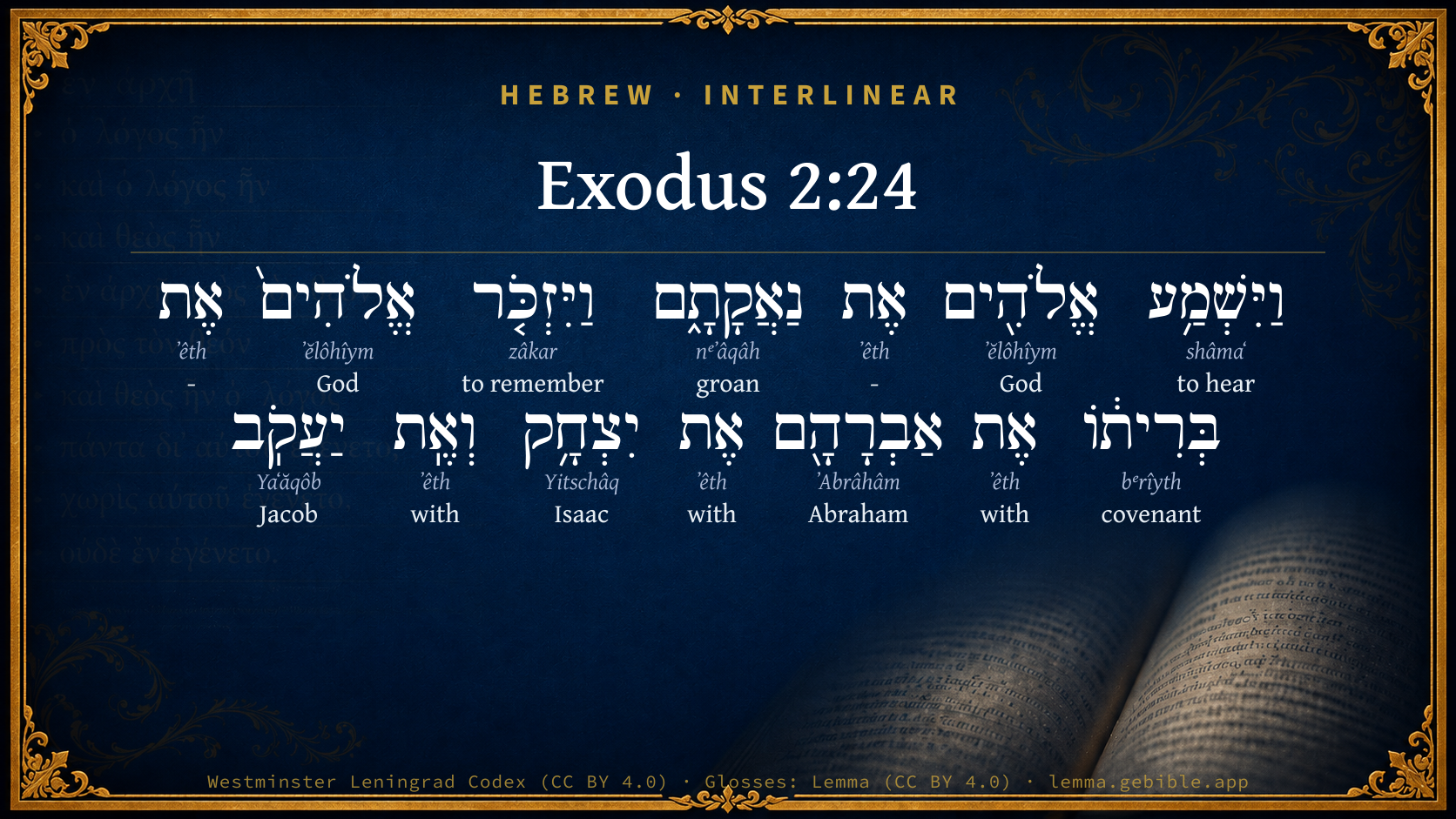
Hebrew (Westminster Leningrad Codex) Exodus 2:24 appears in the Hebrew Old Testament. The text above is from the Westminster Leningrad Codex. Each word links to its Strong’s number, a concise gloss, and parsing drawn from the Open Scriptures Hebrew Bible morphology. Click any word for its full Brown-Driver-Briggs (BDB) entry.
Download image
Cite this verse

Exodus 2:24 (World English Bible). Public Domain. Lemma interlinear Bible study tool, https://lemma.gebible.app/v/exodus/2/24.

Show BibTeX & RIS
BibTeX
RIS
English Translation
God heard their groaning, and God remembered his covenant with Abraham, with Isaac, and with Jacob.
World English Bible · Public Domain
Highlights
  • 1 first appearance in the Hebrew Bible
Full analysis ↓
Download a study sheet

One document with this verse’s original text, its word-by-word gloss line, the meaning frame, cross-references with their text, attributed commentary, and full source and license credits — printable, and it pastes into notes with its structure intact.

This verse Autodidact and up

Study sheet (.html) Plain text (.txt)

A passage Seminary Student

Up to 50 verses in one chapter. A passage sheet keeps up to 6 commentary sources and 12 cross-references per verse, in the order this page ranks them, and says so on the sheet whenever that leaves anything out. Ask for a single verse and you get the Autodidact verse sheet above.

Everything on this page stays free to read, with no account — the sheet is a download of what is already on screen, not access to it.

Want to remove ads? Support Godless Engineer
Compare translations 3

The same verse in 3 English versions, stacked beneath the original-language interlinear above. Click any original word for its lexicon entry.

Each is an independent rendering of the whole verse — the interlinear is not word-aligned to these translations.

Highlighted words mark where these versions differ — a whole-verse word diff, not a word-by-word alignment.

  • World English Bible Public Domain
    God heard their groaning, and God remembered his covenant with Abraham, with Isaac, and with Jacob.
  • King James Version Public Domain
    And God heard their groaning, and God remembered his covenant with Abraham, with Isaac, and with Jacob.
  • unfoldingWord Literal Text CC BY-SA 4.0
    And God heard their groaning, and God remembered his covenant with Abraham, with Isaac, and with Jacob.

unfoldingWord Literal Text — © unfoldingWord, licensed CC BY-SA 4.0. Word-aligned USFM3 via Door43 (git.door43.org/unfoldingWord/en_ult).

Versions to compare (up to 4)

3 of 4 selected

Show all 18 translations

Every available English version of this verse, each an independent rendering of the whole verse.

  • World English Bible Public Domain
    God heard their groaning, and God remembered his covenant with Abraham, with Isaac, and with Jacob.
  • Berean Standard Bible Public Domain
    So God heard their groaning, and He remembered His covenant with Abraham, Isaac, and Jacob.
  • Majority Standard Bible Public Domain
    So God heard their groaning, and He remembered His covenant with Abraham, Isaac, and Jacob.
  • King James Version Public Domain
    And God heard their groaning, and God remembered his covenant with Abraham, with Isaac, and with Jacob.
  • American Standard Version (1901) Public Domain
    And God heard their groaning, and God remembered his covenant with Abraham, with Isaac, and with Jacob.
  • Revised Version (1885) Public Domain
    And God heard their groaning, and God remembered his covenant with Abraham, with Isaac, and with Jacob.
  • Geneva Bible (1599) Public Domain
    Then God heard their mone, and God remembred his couenant with Abraham, Izhak, and Iaakob.
  • Douay-Rheims (1899) Public Domain
    And he heard their groaning, and remembered the covenant which he made with Abraham, Isaac, and Jacob.
  • Young's Literal Translation Public Domain
    and God heareth their groaning, and God remembereth His covenant with Abraham, with Isaac, and with Jacob;
  • Literal Standard Version CC BY-SA 4.0
    and God hears their groaning, and God remembers His covenant with Abraham, with Isaac, and with Jacob;
  • Unlocked Literal Bible CC BY-SA 4.0
    When God heard their groaning, God called to mind his covenant with Abraham, with Isaac, and with Jacob.
  • unfoldingWord Literal Text CC BY-SA 4.0
    And God heard their groaning, and God remembered his covenant with Abraham, with Isaac, and with Jacob.
  • Darby Bible Public Domain
    and God heard their groaning, and God remembered his covenant with Abraham, with Isaac, and with Jacob;
  • World Messianic Bible Public Domain
    God heard their groaning, and God remembered his covenant with Abraham, with Isaac, and with Jacob.
  • Webster's Bible Public Domain
    And God heard their groaning, and God remembered his covenant with Abraham, with Isaac, and with Jacob.
  • Free Bible Version CC BY-SA 4.0
    God heard their groans, and recalled his agreement with Abraham, Isaac, and Jacob.
  • Bible in Basic English Public Domain
    And at the sound of their weeping the agreement which God had made with Abraham and Isaac and Jacob came to his mind.
  • JPS Tanakh (1917) Public Domain
    And God heard their groaning, and God remembered His covenant with Abraham, with Isaac, and with Jacob.

Literal Standard Version (2020), Covenant Press — licensed CC BY-SA 4.0. Text via the HelloAO Bible API (eBible.org). Unlocked Literal Bible (unfoldingWord) — licensed CC BY-SA 4.0. Text via the HelloAO Bible API (eBible.org). unfoldingWord Literal Text — © unfoldingWord, licensed CC BY-SA 4.0. Word-aligned USFM3 via Door43 (git.door43.org/unfoldingWord/en_ult). Free Bible Version, Dr. Jonathan Gallagher — licensed CC BY-SA 4.0. Text via the HelloAO Bible API (eBible.org).

Word by word

More ways to search: Search by grammar → Find every occurrence → Compare this word →

Practice this passage: Drill this verse → Learn its vocabulary →

נַאֲקָתָ֑ם
nᵉʼâqâh
H5009
“groan · their”
Noun, Common, Feminine, Singular, Construct + Suffix, Personal, 3rd Person, Masculine, Plural
Part of Speech
Noun
Type
Common
Gender
Feminine
Number
Singular
State
Construct
Full BDB Definition

Origin: from H5008 ;

TWOT: 1275a

groan, groaning
  1. וַיִּשְׁמַ֥ע shâmaʻ H8085 “and · to hear” Conjunction + Verb, Qal, Sequential Imperfect, 3rd Person, Masculine, Singular
  2. אֱלֹהִ֖ים ʼĕlôhîym H430 “God(s)” Noun, Common, Masculine, Plural, Absolute
  3. אֶת ʼêth H853 “-” Particle, Direct Object
  4. וַיִּזְכֹּ֤ר zâkar H2142 “and · to remember” Conjunction + Verb, Qal, Sequential Imperfect, 3rd Person, Masculine, Singular
  5. אֱלֹהִים֙ ʼĕlôhîym H430 “God(s)” Noun, Common, Masculine, Plural, Absolute
  6. אֶת ʼêth H853 “-” Particle, Direct Object
  7. בְּרִית֔וֹ bᵉrîyth H1285 “covenant · his” Noun, Common, Feminine, Singular, Construct + Suffix, Personal, 3rd Person, Masculine, Singular
  8. אֶת ʼêth H854 “with” Preposition
  9. אַבְרָהָ֖ם ʼAbrâhâm H85 “Abraham” Noun, Proper
  10. אֶת ʼêth H854 “with” Preposition
  11. יִצְחָ֥ק Yitschâq H3327 “Isaac” Noun, Proper
  12. וְאֶֽת ʼêth H854 “and · with” Conjunction + Preposition
  13. יַעֲקֹֽב Yaʻăqôb H3290 “Jacob” Noun, Proper

About this verse

These counts appear in no published source. They are computed here, from the morphology-tagged text and Lemma’s own curated glosses. What Lemma adds →

14
words
10
distinct lemmas
Pentateuch
section

Notable vocabulary

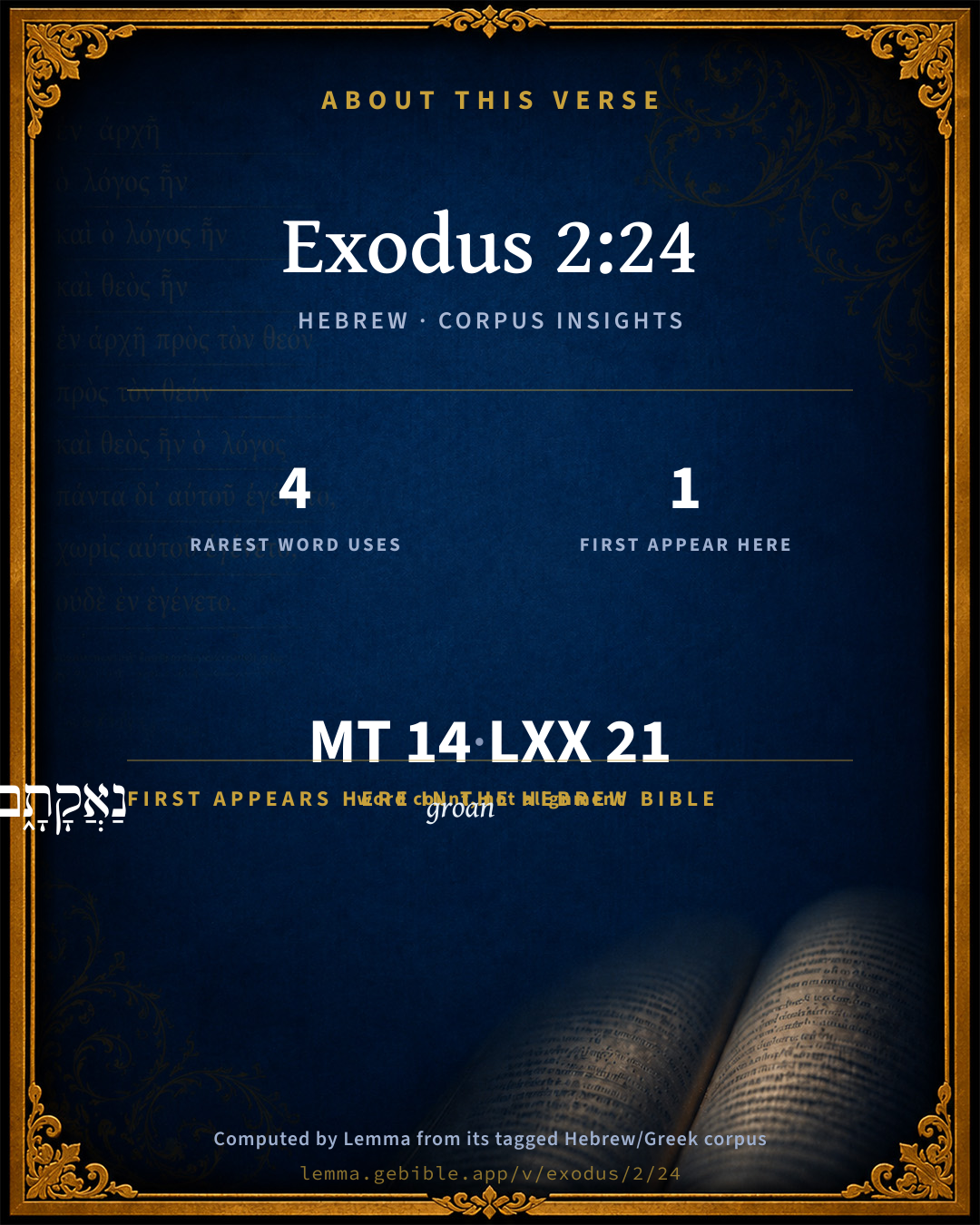
The rarest word here is נַאֲקָתָ֑ם groan H5009 — appearing just 4 times in the whole Hebrew Bible.

First appearance in Scripture

This word makes its first canonical appearance in the Hebrew Bible here:

  • נַאֲקָתָ֑ם groan H5009

Shared distinctive vocabulary

נַאֲקָתָ֑ם groan H5009 occurs in 4 verses of the Hebrew Bible. Also found in:

Grammatical profile

  • 2 verbs
  • 7 nouns
  • 3 prepositions
  • 2 particles

Verb forms

  • וַיִּשְׁמַ֥ע Qal · Sequential Imperfect
  • וַיִּזְכֹּ֤ר Qal · Sequential Imperfect

Repetition

Words recur within this verse — often emphatic in Hebrew:

  • אֱלֹהִ֖ים God H430 ×2
  • אֶת with H854 ×3

Hebrew & Septuagint length

In English translation the verse runs 16 words from the Hebrew and 17 from the Septuagint (LXX English) — closely comparable.

A rough comparison of the two English renderings, which tokenize alike — not a word-level alignment.

Word counts can differ between the Hebrew and the Greek without any difference in meaning — e.g. the Hebrew direct-object marker אֵת has no separate Greek word, and Greek often adds the article ὁ.

In the original languages it is 14 Hebrew tokens and 21 Greek tokens — but the two are counted differently (Hebrew bundles its prefixes and suffixes into one token; the Greek is in lemma form), so that isn’t a like-for-like length.

Cross-references

21

Topical passages linked to Exodus 2:24 in the Treasury of Scripture Knowledge — connected by theme and wording, ordered by reader-vote popularity; previews shown in the World English Bible.

  • Genesis 26:3 Sojourn in this land, and I will be with you, and will bless you. For to you, and to your seed, I will give all these lands, and I will establish the oath which I swore to Abraham your father.
  • Psalms 105:42 For he remembered his holy word, And Abraham, his servant.
  • Exodus 6:5 Moreover I have heard the groaning of the children of Israel, whom the Egyptians keep in bondage, and I have remembered my covenant.
  • Genesis 15:14–18 I will also judge that nation, whom they will serve. Afterward they will come out with great substance.
  • Psalms 22:24 For he has not despised nor abhorred the affliction of the afflicted, Neither has he hidden his face from him; But when he cried to him, he heard.
  • Genesis 26:24 Yahweh appeared to him the same night, and said, "I am the God of Abraham your father. Don't be afraid, for I am with you, and will bless you, and multiply your seed for my servant Abraham's sake."
  • Psalms 106:45 He remembered for them his covenant, And repented according to the multitude of his loving kindnesses.
  • Psalms 138:3 In the day that I called, you answered me. You encouraged me with strength in my soul.
  • Luke 1:72–73 To show mercy towards our fathers, To remember his holy covenant,
  • Genesis 46:2–4 God spoke to Israel in the visions of the night, and said, "Jacob, Jacob!" He said, "Here I am."
  • Judges 2:18 When Yahweh raised them up judges, then Yahweh was with the judge, and saved them out of the hand of their enemies all the days of the judge: for it repented Yahweh because of their groaning by reason of those who oppressed them and vexed them.
  • Psalms 102:20 To hear the groans of the prisoner; To free those who are condemned to death;
  • Psalms 105:6–13 You seed of Abraham, his servant, You children of Jacob, his chosen ones.
  • Genesis 17:7 I will establish my covenant between me and you and your seed after you throughout their generations for an everlasting covenant, to be a God to you and to your seed after you.
  • Genesis 18:18 seeing that Abraham has surely become a great and mighty nation, and all the nations of the earth will be blessed in him?
  • Genesis 28:12–14 He dreamed. Behold, a stairway set up on the earth, and the top of it reached to heaven. Behold, the angels of God ascending and descending on it.
  • Nehemiah 9:27–28 Therefore you delivered them into the hand of their adversaries, who distressed them: and in the time of their trouble, when they cried to you, you heard from heaven; and according to your manifold mercies you gave them saviors who saved them out of the hand of their adversaries.
  • Psalms 22:5 They cried to you, and were delivered. They trusted in you, and were not disappointed.
  • Psalms 79:11 Let the sighing of the prisoner come before you. According to the greatness of your power, preserve those who are sentenced to death;
  • Nehemiah 9:8–9 and found his heart faithful before you, and made a covenant with him to give the land of the Canaanite, the Hittite, the Amorite, and the Perizzite, and the Jebusite, and the Girgashite, to give it to his seed, and have performed your words; for you are righteous.
  • Genesis 32:28 He said, "Your name will no longer be called 'Jacob,' but, 'Israel,' for you have fought with God and with men, and have prevailed."

Cross-references courtesy of OpenBible.info (CC BY 4.0).

Hebrew and Greek witnesses Masoretic Hebrew ↔ Greek Septuagint

The same verse in the two great witnesses to the Old Testament, shown verse-for-verse.

These are two independent witnesses, not word-aligned to each other, and the Septuagint is shown in lemma (dictionary) form.

Hebrew Exodus 2:24 Masoretic · Westminster Leningrad Codex

וַיִּשְׁמַ֥ע אֱלֹהִ֖ים אֶת נַאֲקָתָ֑ם וַיִּזְכֹּ֤ר אֱלֹהִים֙ אֶת בְּרִית֔וֹ אֶת אַבְרָהָ֖ם אֶת יִצְחָ֥ק וְאֶֽת יַעֲקֹֽב

God heard their groaning, and God remembered his covenant with Abraham, with Isaac, and with Jacob.

World English Bible · Public Domain

Greek LXX Exodus 2:24 Septuagint · lemma form

καί εἰςἀκούω ὁ θεός ὁ στεναγμός αὐτός καί μιμνήσκω ὁ θεός ὁ διαθήκη αὐτός ὁ πρός αβρααμ καί ισαακ καί ἰακώβ

And God heard their groanings, and God remembered his covenant made with Abraam and Isaac and Jacob.

LXX2012 (modern English Septuagint) · Public Domain

Hebrew: Westminster Leningrad Codex (CC BY 4.0). Greek: Septuagint (public domain); English from LXX2012 (modern English Septuagint) (Public Domain). How the Septuagint differs from the Hebrew →

Targum (Aramaic paraphrase)

2

The Targum is the ancient Jewish Aramaic paraphrase of the Hebrew Scriptures — an interpretive translation, not the Hebrew text itself. Onkelos (literal) and Pseudo-Jonathan (expansive) render the Torah, and Jonathan the Prophets. Coverage is partial: where no permissively-licensed English translation exists for a verse, only the Aramaic is shown. This is verse-level text, not a word-by-word alignment to the Hebrew.

  1. Targum Onkelos Torah (Genesis–Deuteronomy)
    וּשְׁמִיעַ קֳדָם יְיָ יָת קְבֶלְתְּהוֹן וּדְכִיר יְיָ יָת קַיָמֵהּ דְעִם אַבְרָהָם דְעִם יִצְחָק וּדְעִם יַעֲקֹב:

    (no public-domain English translation for this verse)

    Targum Onkelos — Aramaic: “Onkelos Genesis” (public domain); “Onkelos Exodus” (public domain); “Onkelos Leviticus” (public domain); “Onkelos Numbers” (public domain); “Onkelos Deuteronomy” (public domain). English: “Sefaria Community Translation” (CC0 1.0 (public-domain dedication)); “J.W. Etheridge. The Targums of Onkelos and Jonathan Ben Uzziel on the Pentateuch. London: Longmans, Green, 1862” (public domain). Text via Sefaria.

  2. Targum Pseudo-Jonathan Torah (Genesis–Deuteronomy)
    וּשְׁמִיעַ קֳדָם יְיָ קְבֵילְתְּהוֹן וּדְכִיר קֳדָם יְיָ יַת קְיָימֵיהּ דְקַיֵים עִם אַבְרָהָם וְעִם יִצְחָק וְעִם יַעֲקב

    And their cry was heard before the Lord, and before the Lord was the covenant remembered which He had covenanted with Abraham, with Izhak, and with Jakob.

    Targum Pseudo-Jonathan — Aramaic: “Targum Jonathan on Genesis” (public domain); “Targum Jonathan on Exodus” (public domain); “Targum Jonathan on Leviticus” (public domain); “Targum Jonathan on Numbers” (public domain); “Targum Jonathan on Deuteronomy” (public domain). English: “The Targum of Jonathan ben Uzziel, trans. J. W. Etheridge, London, 1862” (public domain). Text via Sefaria.

Commentary

Notes on Exodus 2:24 from classic Christian and Jewish commentators (each source and its license shown beneath its notes). The classic Christian expositions comment on the surrounding passage and are grouped to its opening verse, so a note may address several verses; the Jewish commentaries on the Tanakh (Rashi and others) are per-verse, so they appear only where the commentator wrote on this verse.

Lemma curates 59 commentaries, every one of them public domain or Creative Commons licensed, each selected and text-cleaned for this edition rather than reprinted as found. About our sources →

Trapp's Complete Commentary

John Trapp

Exo 2:24 And God heard their groaning, and God remembered his covenant with Abraham, with Isaac, and with Jacob.

Ver. 24. God heard their groaning.] Yea, their breathing. {Lam 3:56} Men’s very misery cries to God, as Hagar’s did.

John Trapp, A Commentary or Exposition upon All the Books of the Old and New Testament (1647–1656) — public domain. Text from a community e-Sword module.

Joseph Benson's Commentary

Exo 2:24-25. And God heard their groaning — That is, he made it to appear that he took notice of their complaints. The groans of the oppressed cry loud in the ears of the righteous God, to whom vengeance belongs; especially the groans of God’s children, the burdens they groan under, and the blessings they groan after. And God remembered his covenant —

Which he seemed to have forgotten, but really is ever mindful of. This God had an eye to, and not to any merit of theirs, in what he did for them. And God looked upon the children of Israel — Moses looked upon them and pitied them, but now God looked upon them and helped them. And God had respect unto them — A favourable respect to them as his own. The frequent repetition of the name of God intimates that now we are to expect something great. His eyes, which run to and fro through the earth, are now fixed on Israel, to show himself strong, to show himself a God in their behalf.

Joseph Benson's Commentary on the Old and New Testaments (1811–1818) — public domain. Text from a community e-Sword module.

Tyndale Open Study Notes

Tyndale Open Resources

2:24-25 The verbs here speak of a God who is sensitive to his people’s needs (heard . . . looked down), who is faithful and reliable (remembered his covenant promise), and who accepts his obligations in a relationship (knew it was time to act).

Tyndale Open Study Notes — © Tyndale Open Resources, licensed CC BY-SA 4.0. Text via the HelloAO Bible API.

Adam Clarke's Commentary

Verse 24. God remembered his covenant] God's covenant is God's engagement; he had promised to Abraham, to Isaac, and to Jacob, to give their posterity a land flowing with milk and honey, &c. They are now under the most oppressive bondage, and this was the most proper time for God to show them his mercy and power in fulfilling his promise. This is all that is meant by God's remembering his covenant, for it was now that he began to give it its effect.

Adam Clarke's Commentary on the Bible (1810–1826) — public domain. Text from a community e-Sword/MySword module.

The Cambridge Bible for Schools and Colleges

gen. ed. J. J. S. Perowne

24. their groaning] Exo_6:5 a (P).

and God … remembered] cf. Exo_6:5 b; also Gen_8:1; Gen_19:29 (all P).

his covenant with Abraham, &c.] The covenant concluded with Abraham and Isaac (Gen_17:7-8; Gen_17:19 P), and implicitly with Jacob (Gen_35:12 P), which in Exo_6:4-5 b also is represented by P as the motive for the deliverance of Israel from Egypt: cf. p. 176.

The Cambridge Bible for Schools and Colleges (gen. ed. J. J. S. Perowne; Cambridge University Press, 1878–1918) — public domain. Text from a community e-Sword module.

John Gill's Exposition

And God heard their groaning,.... The petitions they put up to him with groans and cries:

and God remembered his covenant with Abraham, with Isaac, and with Jacob; that he would bring their seed out of a land not theirs, in which they were strangers, and were afflicted, into the land of Canaan, for an everlasting possession.

John Gill's Exposition of the Whole Bible (1746–1763) — public domain (CC PDM 1.0). Text via the HelloAO Bible API.

Albert Barnes' Notes on the Bible

Remembered - This means that God was moved by their prayers to give effect to the covenant, of which an essential condition was the faith and contrition involved in the act of supplication. The whole history of Israel is foreshadowed in these words: God heard, remembered, looked upon, and knew them. It evidently indicates the beginning of a crisis marked by a personal intervention of God.

Albert Barnes' Notes on the Bible (1834–1885) — public domain. Text from a community e-Sword/MySword module.

Whedon's Commentary on the Bible

Daniel D. Whedon

24, 25. God heard… remembered… looked… had respect — Through all those generations of heart-break, to the eye and ear of flesh God had seemed deaf, dumb, dead; yet all the while he remembered his covenant, saw each tear, heard each groan, knew his children with all the energy of love. In this graphic and emphatic way does the sacred writer picture our Father, and help every sufferer everywhere to get within the everlasting arms.

Daniel D. Whedon (gen. ed.), Commentary on the Old and New Testaments (1874–1909) — public domain. Text from a community e-Sword module.

The Pulpit Commentary

Vers. 24, 25. God heard their groaning. God is said to "hear" the prayers which he accepts and grants; to "be deaf" to those which he does not grant, but rejects. He now "heard" (i.e. accepted) the supplications of oppressed Israel; and on account of the covenant which he had made with Abraham, Isaac, and Jacob a covenant always remembered by him he looked upon his people, made them the objects of his special regard, and entered on a course, which was abnormal, irregular, miraculous, in order to carry out his purposes of mercy towards them It is observed that anthropomorphic expressions are here accumulated; but this is always the case when the love and tenderness of God towards man are spoken of, since they form the only possible phraseology in which ideas of love and tenderness can be expressed so as to be intelligible to bureau beings. And God regarded them. Literally, "and God knew." God kept the whole in his thoughts bore in mind the sufferings, the wrongs, the hopes, the fears, the groans, the despair, the appeal to him, the fervent supplications and prayers knew all, remembered all-counted every word and sigh gathered the tears into his bottle noted all things in his book and for the present endured, kept silence but was preparing for his foes a terrible vengeance for his people a marvellous deliverance

Vers. 24, 25. God is never deaf to earnest prayer for deliverance.

It was eighty years since the cruel edict went forth, "Every son that is born ye shall cast into the river (Exo_1:22) ninety, or perhaps a hundred, since the severe oppression began (ib. 11-14). Israel had sighed and groaned during the whole of this long period, and no doubt addressed many a prayer to God, which seemed unheard. But no earnest faithful prayer during the whole of the long space was unheard. God treasured them all up in his memory. He was "not slack, as men count slackness" He had to wean his people from their attachment to Egypt he had to discipline them, to form their character to prepare them to endure the hardships of the desert, and to face the fierce tribes of Canaan. When this was done when they were fit-he gave effect to their prayers their groaning and just as they were on the point of despairing, delivered them. The lesson to us here is, that we never despair, never grow weary and listless, never cease our prayers, strive to make them more and more fervent. We can never know how near we are to the time when God will show forth his power grant and accomplish our prayers.

The Pulpit Commentary (1880–1919), ed. H.D.M. Spence-Jones & Joseph S. Exell — public domain. Text from a community e-Sword module.

John Wesley's Explanatory Notes

And God heard their groaning - That is, he made it to appear that he took notice of their complaints. The groans of the oppressed cry loud in the ears of the righteous God, to whom vengeance belongs; especially the groans of God's children, the burdens they groan under, and the blessings they groan after. And God remembered his covenant - Which he seemed to have forgotten, but really is ever mindful of. This God had an eye to, and not to any merit of theirs in what he did for them. And God looked upon the children of Israel - Moses looked upon them and pitied them, but now God looked upon them and helped them. And God had respect unto them - A favourable respect to them as his own. The frequent repetition of the name of God intimates, that now we are to expect something great. His eyes which run to and fro through the earth, are now fixed on Israel, to shew himself strong, to shew himself a God in their behalf.

John Wesley, Explanatory Notes Upon the Whole Bible (1754–1765) — public domain. Text via the GEBible commentary corpus.

Rashi

Rabbi Shlomo Yitzchaki (Rashi)

נאקתם means THEIR CRY. Similar is, (Job 24:12) “from out of the populous city men groan (ינאקו)”.

‎ את בריתו את אברהם — The words את אברהם, are the same as עם אברהם, with Abraham (i. e. the word את means “with”, whilst in the preceding phrase, את בריתו, it is the sign of the accusative).

Rashi on the Tanakh — English translations: “The Judaica Press complete Tanach with Rashi, translated by A. J. Rosenberg” (CC BY 4.0); “Pentateuch with Rashi's commentary by M. Rosenbaum and A.M. Silbermann, 1929-1934” (public domain); “The Metsudah Tanach series, Lakewood, N.J” (CC BY 4.0); and “The Book of Joshua, Metsudah Publications, 1997” (CC BY 4.0). Text via Sefaria.

Lesson kit

Teaching starters — assembled from the data on this page, not authored interpretation. Every prompt links to the verse data it draws on. Edit before teaching.

Exodus, in the Pentateuch, opens this verse with 14 words (10 distinct Hebrew lemmas). Its most distinctive word is nᵉʼâqâh (“groan”). A historical commentator’s framing appears above. Read the whole chapter for the surrounding context.

Discussion questions

  1. The word nᵉʼâqâh carries the sense “groan.” How does it shape the verse?
  2. The word “groan” first appears here in Scripture. What is being introduced at this debut?
  3. Exodus 6:5 shares the word «groan» with this verse. How do the two illuminate each other?
  4. “God” occurs 2× in this one verse. What is the effect of the repetition?
  5. The verb «וַיִּשְׁמַ֥ע» is Qal Sequential Imperfect. How does its form color the action?
  6. Reading how Trapp's Complete Commentary and Joseph Benson's Commentary read this verse, where do the two commentators agree and where do they part?

Things to notice

Reading settings

Reading text

Shown beneath each verse's original-language words.

Old Testament
Old Testament edition

Read the OT as the Masoretic Hebrew (MT) or the Greek Septuagint (LXX).

English shown for the Greek Septuagint (in the Hebrew ↔ Greek comparison).

Comparing translations? Open the Compare panel on any verse page to stack up to four side by side.