
Genesis 28:18

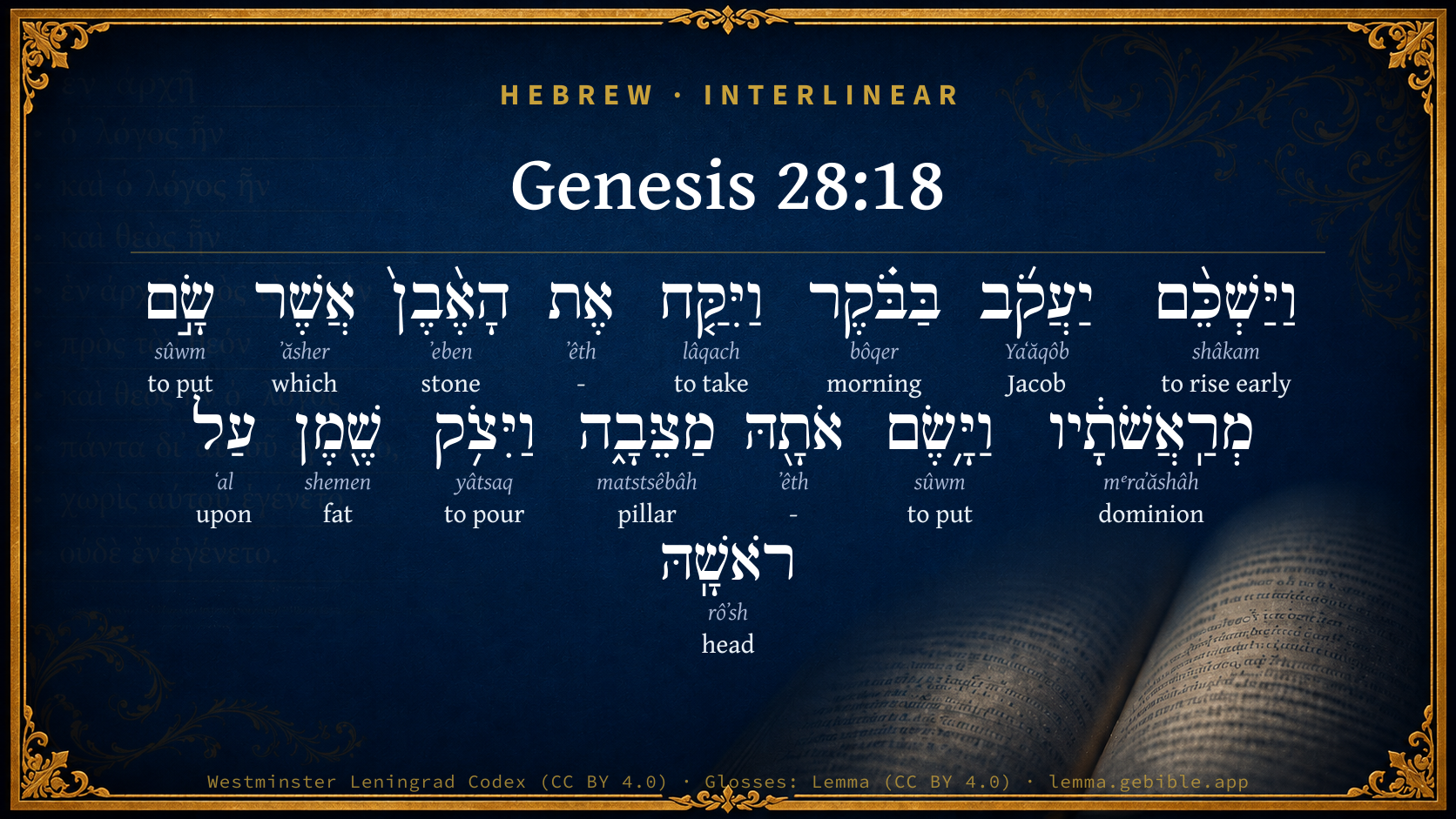
Hebrew (Westminster Leningrad Codex) Genesis 28:18 appears in the Hebrew Old Testament. The text above is from the Westminster Leningrad Codex. Each word links to its Strong’s number, a concise gloss, and parsing drawn from the Open Scriptures Hebrew Bible morphology. Click any word for its full Brown-Driver-Briggs (BDB) entry.
Download image
Cite this verse

Genesis 28:18 (World English Bible). Public Domain. Lemma interlinear Bible study tool, https://lemma.gebible.app/v/genesis/28/18.

Show BibTeX & RIS
BibTeX
RIS
English Translation
Jacob rose up early in the morning, and took the stone that he had put under his head, and set it up for a pillar, and poured oil on the top of it.
World English Bible · Public Domain
Highlights
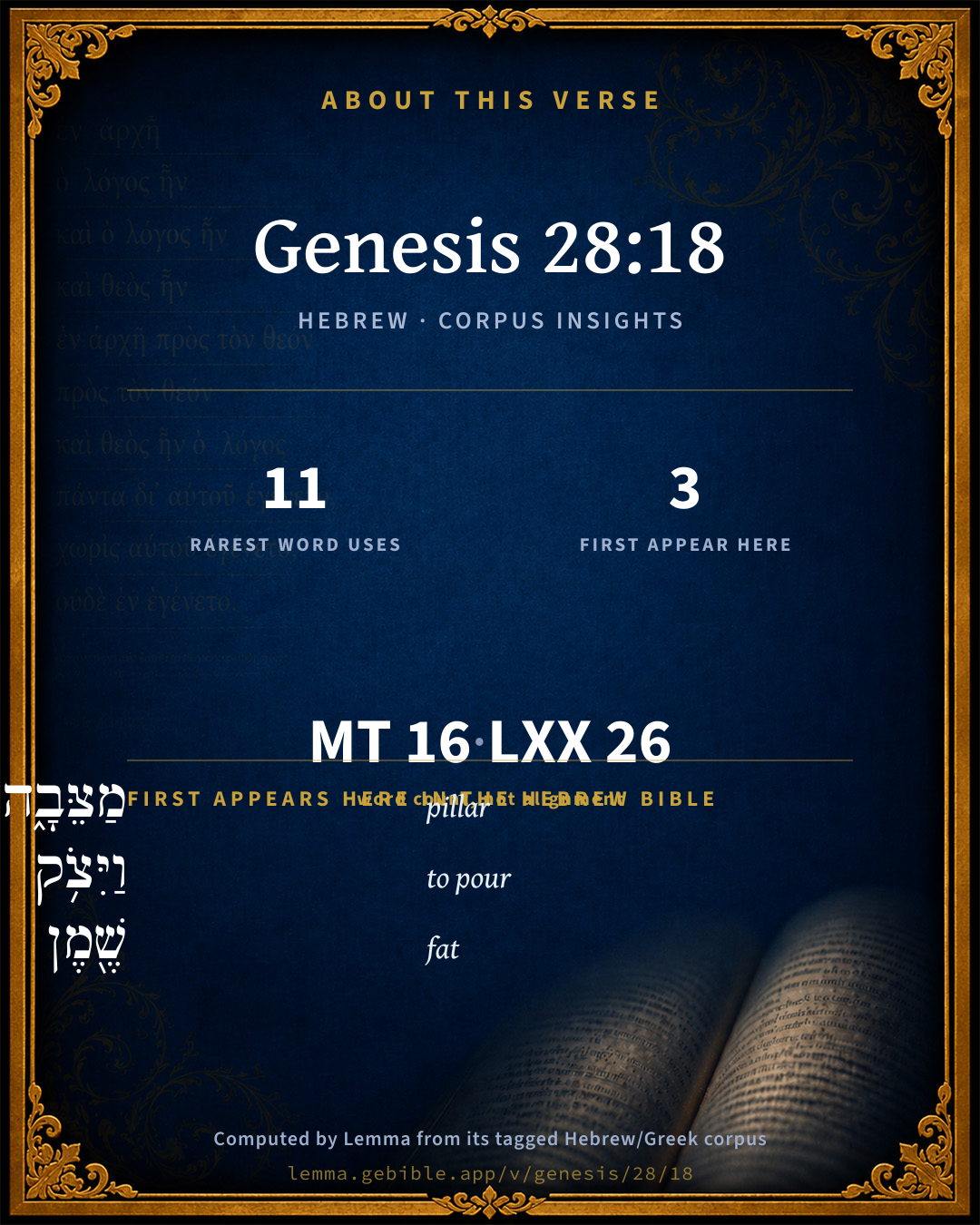
  • 3 first appearances in the Hebrew Bible
Full analysis ↓
Download a study sheet

One document with this verse’s original text, its word-by-word gloss line, the meaning frame, cross-references with their text, attributed commentary, and full source and license credits — printable, and it pastes into notes with its structure intact.

This verse Autodidact and up

Study sheet (.html) Plain text (.txt)

A passage Seminary Student

Up to 50 verses in one chapter. A passage sheet keeps up to 6 commentary sources and 12 cross-references per verse, in the order this page ranks them, and says so on the sheet whenever that leaves anything out. Ask for a single verse and you get the Autodidact verse sheet above.

Everything on this page stays free to read, with no account — the sheet is a download of what is already on screen, not access to it.

Want to remove ads? Support Godless Engineer
Compare translations 3

The same verse in 3 English versions, stacked beneath the original-language interlinear above. Click any original word for its lexicon entry.

Each is an independent rendering of the whole verse — the interlinear is not word-aligned to these translations.

Highlighted words mark where these versions differ — a whole-verse word diff, not a word-by-word alignment.

  • World English Bible Public Domain
    Jacob rose up early in the morning, and took the stone that he had put under his head, and set it up for a pillar, and poured oil on the top of it.
  • King James Version Public Domain
    And Jacob rose up early in the morning, and took the stone that he had put for his pillows, and set it up for a pillar, and poured oil upon the top of it.
  • unfoldingWord Literal Text CC BY-SA 4.0
    Then in the morning Jacob got up early, and he took the stone that he had put under his head and stood it up a pillar, and he poured oil on its top.

unfoldingWord Literal Text — © unfoldingWord, licensed CC BY-SA 4.0. Word-aligned USFM3 via Door43 (git.door43.org/unfoldingWord/en_ult).

Versions to compare (up to 4)

3 of 4 selected

Show all 18 translations

Every available English version of this verse, each an independent rendering of the whole verse.

  • World English Bible Public Domain
    Jacob rose up early in the morning, and took the stone that he had put under his head, and set it up for a pillar, and poured oil on the top of it.
  • Berean Standard Bible Public Domain
    Early the next morning, Jacob took the stone that he had placed under his head, and he set it up as a pillar. He poured oil on top of it,
  • Majority Standard Bible Public Domain
    Early the next morning, Jacob took the stone that he had placed under his head, and he set it up as a pillar. He poured oil on top of it,
  • King James Version Public Domain
    And Jacob rose up early in the morning, and took the stone that he had put for his pillows, and set it up for a pillar, and poured oil upon the top of it.
  • American Standard Version (1901) Public Domain
    And Jacob rose up early in the morning, and took the stone that he had put under his head, and set it up for a pillar, and poured oil upon the top of it.
  • Revised Version (1885) Public Domain
    And Jacob rose up early in the morning, and took the stone that he had put under his head, and set it up for a pillar, and poured oil upon the top of it.
  • Geneva Bible (1599) Public Domain
    Then Iaakob rose vp early in the morning, and tooke the stone that hee had layde vnder his head, and set it vp as a pillar, and powred oyle vpon the top of it.
  • Douay-Rheims (1899) Public Domain
    And Jacob, arising in the morning, took the stone, which he had laid under his head, and set it up for a title, pouring oil upon the top of it.
  • Young's Literal Translation Public Domain
    And Jacob riseth early in the morning, and taketh the stone which he hath made his pillows, and maketh it a standing pillar, and poureth oil upon its top,
  • Literal Standard Version CC BY-SA 4.0
    And Jacob rises early in the morning, and takes the stone which he has made his pillows, and makes it a standing pillar, and pours oil on its top,
  • Unlocked Literal Bible CC BY-SA 4.0
    Jacob arose early in the morning and took the stone that he had put under his head. He set it up as a pillar and poured oil upon the top of it.
  • unfoldingWord Literal Text CC BY-SA 4.0
    Then in the morning Jacob got up early, and he took the stone that he had put under his head and stood it up a pillar, and he poured oil on its top.
  • Darby Bible Public Domain
    And Jacob rose early in the morning, and took the stone that he had made his pillow, and set it up [for] a pillar, and poured oil on the top of it.
  • World Messianic Bible Public Domain
    Jacob rose up early in the morning, and took the stone that he had put under his head, and set it up for a pillar, and poured oil on its top.
  • Webster's Bible Public Domain
    And Jacob rose early in the morning, and took the stone that he had put for his pillows, and set it up for a pillar, and poured oil on the top of it.
  • Free Bible Version CC BY-SA 4.0
    When Jacob got up in the morning he took the stone he'd put under his head and set it upright as a stone pillar and poured some olive oil on it.
  • Bible in Basic English Public Domain
    And early in the morning Jacob took the stone which had been under his head, and put it up as a pillar and put oil on it.
  • JPS Tanakh (1917) Public Domain
    And Jacob rose up early in the morning, and took the stone that he had put under his head, and set it up for a pillar, and poured oil upon the top of it.

Literal Standard Version (2020), Covenant Press — licensed CC BY-SA 4.0. Text via the HelloAO Bible API (eBible.org). Unlocked Literal Bible (unfoldingWord) — licensed CC BY-SA 4.0. Text via the HelloAO Bible API (eBible.org). unfoldingWord Literal Text — © unfoldingWord, licensed CC BY-SA 4.0. Word-aligned USFM3 via Door43 (git.door43.org/unfoldingWord/en_ult). Free Bible Version, Dr. Jonathan Gallagher — licensed CC BY-SA 4.0. Text via the HelloAO Bible API (eBible.org).

Word by word

More ways to search: Search by grammar → Find every occurrence → Compare this word →

Practice this passage: Drill this verse → Learn its vocabulary →

מְרַֽאֲשֹׁתָ֔יו
mᵉraʼăshâh
H4763
“head place · his”
Noun, Common, Feminine, Plural, Construct + Suffix, Personal, 3rd Person, Masculine, Singular
Part of Speech
Noun
Type
Common
Gender
Feminine
Number
Plural
State
Construct
Full BDB Definition

Origin: formed like H4761

TWOT: 2097f

place at the head, dominion, head place (noun feminine) - at head place (adverb)
  1. וַיַּשְׁכֵּ֨ם shâkam H7925 “and · to rise early” Conjunction + Verb, Hiphil, Sequential Imperfect, 3rd Person, Masculine, Singular
  2. יַעֲקֹ֜ב Yaʻăqôb H3290 “Jacob” Noun, Proper
  3. בַּבֹּ֗קֶר bôqer H1242 “in/at the · morning” Preposition, Determined + Noun, Common, Masculine, Singular, Absolute
  4. וַיִּקַּ֤ח lâqach H3947 “and · to take” Conjunction + Verb, Qal, Sequential Imperfect, 3rd Person, Masculine, Singular
  5. אֶת ʼêth H853 “-” Particle, Direct Object
  6. הָאֶ֨בֶן֙ ʼeben H68 “the · stone” Particle, Definite Article + Noun, Common, Feminine, Singular, Absolute
  7. אֲשֶׁר ʼăsher H834 “which” Particle, Relative
  8. שָׂ֣ם sûwm H7760 “to put” Verb, Qal, Perfect, 3rd Person, Masculine, Singular
  9. וַיָּ֥שֶׂם sûwm H7760 “and · to put” Conjunction + Verb, Qal, Sequential Imperfect, 3rd Person, Masculine, Singular
  10. אֹתָ֖הּ ʼêth H853 “- · her” Particle, Direct Object + Suffix, Personal, 3rd Person, Feminine, Singular
  11. מַצֵּבָ֑ה matstsêbâh H4676 “pillar” Noun, Common, Feminine, Singular, Absolute
  12. וַיִּצֹ֥ק yâtsaq H3332 “and · to pour” Conjunction + Verb, Qal, Sequential Imperfect, 3rd Person, Masculine, Singular
  13. שֶׁ֖מֶן shemen H8081 “fat” Noun, Common, Masculine, Singular, Absolute
  14. עַל ʻal H5921 “upon” Preposition
  15. רֹאשָֽׁהּ rôʼsh H7218 “head · her” Noun, Common, Masculine, Singular, Construct + Suffix, Personal, 3rd Person, Feminine, Singular

About this verse

These counts appear in no published source. They are computed here, from the morphology-tagged text and Lemma’s own curated glosses. What Lemma adds →

16
words
14
distinct lemmas
Pentateuch
section

Notable vocabulary

The rarest word here is מְרַֽאֲשֹׁתָ֔יו dominion H4763 — appearing just 11 times in the whole Hebrew Bible.

First appearance in Scripture

These words make their first canonical appearance in the Hebrew Bible here:

  • מַצֵּבָ֑ה pillar H4676
  • וַיִּצֹ֥ק to pour H3332
  • שֶׁ֖מֶן fat H8081

Shared distinctive vocabulary

מְרַֽאֲשֹׁתָ֔יו dominion H4763 occurs in 8 verses of the Hebrew Bible. Also found in:

Grammatical profile

  • 5 verbs
  • 7 nouns
  • 1 preposition
  • 3 particles

Verb forms

  • וַיַּשְׁכֵּ֨ם Hiphil · Sequential Imperfect
  • וַיִּקַּ֤ח Qal · Sequential Imperfect
  • שָׂ֣ם Qal · Perfect
  • וַיָּ֥שֶׂם Qal · Sequential Imperfect
  • וַיִּצֹ֥ק Qal · Sequential Imperfect

Repetition

A word recurs within this verse — often emphatic in Hebrew:

  • שָׂ֣ם to put H7760 ×2

Hebrew & Septuagint length

In English translation the verse runs 33 words from the Hebrew and 34 from the Septuagint (LXX English) — closely comparable.

A rough comparison of the two English renderings, which tokenize alike — not a word-level alignment.

Word counts can differ between the Hebrew and the Greek without any difference in meaning — e.g. the Hebrew direct-object marker אֵת has no separate Greek word, and Greek often adds the article ὁ.

In the original languages it is 16 Hebrew tokens and 26 Greek tokens — but the two are counted differently (Hebrew bundles its prefixes and suffixes into one token; the Greek is in lemma form), so that isn’t a like-for-like length.

Cross-references

13

Topical passages linked to Genesis 28:18 in the Treasury of Scripture Knowledge — connected by theme and wording, ordered by reader-vote popularity; previews shown in the World English Bible.

  • Genesis 35:14 Jacob set up a pillar in the place where he spoke with him, a pillar of stone. He poured out a drink-offering on it, and poured oil on it.
  • Genesis 31:13 I am the God of Bethel, where you anointed a pillar, where you vowed a vow to me. Now arise, get out from this land, and return to the land of your birth."
  • Genesis 31:45 Jacob took a stone, and set it up for a pillar.
  • Leviticus 8:10–12 Moses took the anointing oil, and anointed the tabernacle and all that was in it, and sanctified them.
  • Genesis 22:3 Abraham rose early in the morning, and saddled his donkey, and took two of his young men with him, and Isaac his son. He split the wood for the burnt offering, and rose up, and went to the place of which God had told him.
  • Genesis 35:20 Jacob set up a pillar on her grave. The same is the Pillar of Rachel's grave to this day.
  • Numbers 7:1 It happened on the day that Moses had finished setting up the tabernacle, and had anointed it and sanctified it, with all its furniture, and the altar with all its vessels, and had anointed and sanctified them;
  • Joshua 24:26–27 Joshua wrote these words in the book of the law of God; and he took a great stone, and set it up there under the oak that was by the sanctuary of Yahweh.
  • 1 Samuel 7:12 Then Samuel took a stone, and set it between Mizpah and Shen, and called the name of it Ebenezer, saying, Hitherto has Yahweh helped us.
  • 2 Samuel 18:18 Now Absalom in his lifetime had taken and reared up for himself the pillar, which is in the king's dale; for he said, I have no son to keep my name in memory: and he called the pillar after his own name; and it is called Absalom's monument, to this day.
  • Psalms 119:60 I will hurry, and not delay, To obey your commandments.
  • Ecclesiastes 9:10 Whatever your hand finds to do, do it with your might; for there is no work, nor device, nor knowledge, nor wisdom, in Sheol, where you are going.
  • Isaiah 19:19 In that day shall there be an altar to Yahweh in the midst of the land of Egypt, and a pillar at the border of it to Yahweh.

Cross-references courtesy of OpenBible.info (CC BY 4.0).

Hebrew and Greek witnesses Masoretic Hebrew ↔ Greek Septuagint

The same verse in the two great witnesses to the Old Testament, shown verse-for-verse.

These are two independent witnesses, not word-aligned to each other, and the Septuagint is shown in lemma (dictionary) form.

Hebrew Genesis 28:18 Masoretic · Westminster Leningrad Codex

וַיַּשְׁכֵּ֨ם יַעֲקֹ֜ב בַּבֹּ֗קֶר וַיִּקַּ֤ח אֶת הָאֶ֨בֶן֙ אֲשֶׁר שָׂ֣ם מְרַֽאֲשֹׁתָ֔יו וַיָּ֥שֶׂם אֹתָ֖הּ מַצֵּבָ֑ה וַיִּצֹ֥ק שֶׁ֖מֶן עַל רֹאשָֽׁהּ

Jacob rose up early in the morning, and took the stone that he had put under his head, and set it up for a pillar, and poured oil on the top of it.

World English Bible · Public Domain

Greek LXX Genesis 28:18 Septuagint · lemma form

καί ἀναἵστημι ἰακώβ ὁ πρωΐ καί λαμβάνω ὁ λίθος ὅς ὑποτίθημι ἐκεῖ πρός κεφαλή αὐτός καί ἵστημι αὐτός στήλη καί ἐπιχέω ἔλαιον ἐπί ὁ ἄκρος αὐτός

And Jacob rose up in the morning, and took the stone he had laid there by his head, and he set it up as a pillar, and poured oil on the top of it.

LXX2012 (modern English Septuagint) · Public Domain

Hebrew: Westminster Leningrad Codex (CC BY 4.0). Greek: Septuagint (public domain); English from LXX2012 (modern English Septuagint) (Public Domain). How the Septuagint differs from the Hebrew →

Targum (Aramaic paraphrase)

2

The Targum is the ancient Jewish Aramaic paraphrase of the Hebrew Scriptures — an interpretive translation, not the Hebrew text itself. Onkelos (literal) and Pseudo-Jonathan (expansive) render the Torah, and Jonathan the Prophets. Coverage is partial: where no permissively-licensed English translation exists for a verse, only the Aramaic is shown. This is verse-level text, not a word-by-word alignment to the Hebrew.

  1. Targum Onkelos Torah (Genesis–Deuteronomy)
    וְאַקְדֵים יַעֲקֹב בְּצַפְרָא וּנְסִיב יָת אַבְנָא דִי שַׁוִּי אִסָדוֹהִי וְשַׁוִּי יָתַהּ קָמָא וַאֲרִיק מִשְׁחָא עַל רֵישֵׁהּ

    (no public-domain English translation for this verse)

    Targum Onkelos — Aramaic: “Onkelos Genesis” (public domain); “Onkelos Exodus” (public domain); “Onkelos Leviticus” (public domain); “Onkelos Numbers” (public domain); “Onkelos Deuteronomy” (public domain). English: “Sefaria Community Translation” (CC0 1.0 (public-domain dedication)); “J.W. Etheridge. The Targums of Onkelos and Jonathan Ben Uzziel on the Pentateuch. London: Longmans, Green, 1862” (public domain). Text via Sefaria.

  2. Targum Pseudo-Jonathan Torah (Genesis–Deuteronomy)
    וְאַקְדִים יַעֲקב בְּצַפְרָא וּנְסֵיב יַת אַבְנָא מִן דִשַׁוֵי אִיסָדוֹי וְשַׁוִי יָתָהּ קָמָא וְאָרִיק מִשְׁחָא עַל רֵישָׁהּ

    And Jakob arose in the morning, and took the stone which he had placed for his pillow, and set it standing, and poured oil on the top of it.

    Targum Pseudo-Jonathan — Aramaic: “Targum Jonathan on Genesis” (public domain); “Targum Jonathan on Exodus” (public domain); “Targum Jonathan on Leviticus” (public domain); “Targum Jonathan on Numbers” (public domain); “Targum Jonathan on Deuteronomy” (public domain). English: “The Targum of Jonathan ben Uzziel, trans. J. W. Etheridge, London, 1862” (public domain). Text via Sefaria.

Commentary

Notes on Genesis 28:18 from classic Christian and Jewish commentators (each source and its license shown beneath its notes). The classic Christian expositions comment on the surrounding passage and are grouped to its opening verse, so a note may address several verses; the Jewish commentaries on the Tanakh (Rashi and others) are per-verse, so they appear only where the commentator wrote on this verse.

Lemma curates 59 commentaries, every one of them public domain or Creative Commons licensed, each selected and text-cleaned for this edition rather than reprinted as found. About our sources →

Trapp's Complete Commentary

John Trapp

Gen 28:18 And Jacob rose up early in the morning, and took the stone that he had put [for] his pillows, and set it up [for] a pillar, and poured oil upon the top of it.

Ver. 18. And set it up for a pillar.] The better to perpetuate the memory of that mercy he had there received; and that it might be a witness against him, if hereafter he failed of fulfilling his vow. It is not amiss, in making holy vows, to take some friend to witness, that, in case we be not careful to fulfil them, may mind us, and admonish us of our duty in that behalf. Jacob, that was here so free, when the matter was fresh, to promise God a chapel at Bethel, was afterwards backward enough; and stood in need that God should pull him by the ear, once and again, with a "Go up to Bethel," and punish him for his delays, in the rape of his daughter, cruelty of his sons, &c. {Gen 35:1}

John Trapp, A Commentary or Exposition upon All the Books of the Old and New Testament (1647–1656) — public domain. Text from a community e-Sword module.

The Biblical Illustrator

Joseph S. Exell

Gen_28:18-19

And Jacob rose up early in the morning, and took the stone that he had put for his pillows, and set it up for a pillar, and poured oil upon the top of it.

And he called the name of that place Bethel

Memorials of blessing

I. First of all, we are told that Jacob erected a material monument, and planted it as a fixed landmark on the spot. Concerning which, remark these three things: he did it immediately, he did it symbolically, he did it religiously. There is instruction in each.

1. He rose up early in the morning. He took the moment when the memory of his bright vision was the clearest, and the emotion it aroused was at its height. He caught the fitful experience when it had most force, as if he knew it might grow less before long. When Divine grace invites, and kindles, and stands ready to help, no time must be lost.

2. Remark, again, Jacob took the stone that he had put for his pillow, and set it up for a pillar. That is to say, he made his affliction the monument of His mercy. Plenty of stones besides that there were lying about in that bleak plain. But he chose that one, so as to identify the history, when he saw the spot. Herein was the very spirit of splendid symbolism. Nothing could be finer. No emblem could be more pathetically accurate, as a picture of the utter desolation which he, as a homeless fugitive, had felt the evening before, than the fragment of rock he had been obliged to lay his head upon to sleep. Now to make that, the reminder of his friendlessness, the monument also of his disclosure of Divine adoption, was matchless in ingenuity. When he should see that pillar in the future, he would say, Behold the outcast, and the prince! behold mans necessity, and Gods opportunity I behold earthly weakness, and heavenly help I see where I was, and where I am!

3. But observe, once more, Jacob, having set up his pillar, poured oil upon the top of it. You are quite familiar with Old Testament uses of oil in religious service. These were established by direct order. The command given early to Moses was, Thou shalt take the anointing off, and anoint the tabernacle, and all that is therein, and shalt hallow it, and all the vessels thereof, and it shall be holy. This direction was extended so as to cover the altar and the laver, and even the priests, Aaron and his sons. The spirit of inspiration laid hold of what was an earlier custom, and so consecrated it. If Jacob had said, concerning this great incident of his life, It is the turning-point in my history, and I will not forget it, he would have done no unimportant thing by itself. But by anointing the pillar he made it a definitely religious memorial. It recognized not only his extraordinary blessing, but recorded for ever the fact that God had bestowed it upon him. It was an act of devotion. There was worship in it. There was self-consecration in it.

II. The lessons thus far learned, however, will become clearer and more impressive when we pass on to consider the second form of perpetuation this patriarch adopted. He proceeded to invoke the help of his fellow-men. He called the name of that place Bethel, but the name of the city was called Luz at the first. Conclusion:

1. Count up your mercies for rehearsal and record.

2. Confess Christ openly before men.

3. Set up memorials of blessing.

4. Expect to understand your own biography by and by. When Jacob next visited Bethel, he could read the meaning of the Divine promise. (C. S. Robinson, D. D.)

Bethel

I. BETHEL TELLS OF AN EXILE AWAY FROM HIS FATHERS HOUSE.

II. BETHEL TELLS OF A GLORIOUS VISION.

III. BETHEL TELLS OF A HOLY VOW.

IV. BETHEL TELLS OF A SACRED MEMORIAL. (W. M. Taylor, D. D.)

The memorial impulse in religion

I. THE TIME, PLACE, AND CIRCUMSTANCES OF A MANS DISCOVERY OF GOD IN HIS LIFE ARE THE MOST MEMORABLE IN PERSONAL EXPERIENCE.

II. WITH SUCH A DISCOVERY, THERE ALWAYS RISES AN IMPULSE TO SET UP SOME LANDMARK FOR MEMORY.

III. THE BEST MEMORIALS ARE THOSE WHICH RISE UP IN A MANS HABITS AND CHARACTER. (The Preachers Monthly.)

Jacob at Bethel

I. We must observe, first, that in the action of the patriarch there was COMMEMORATION. It was clearly his design in erecting this pillar to commemorate the events which had recently transpired in his history, and, as far as possible, to give permanence to their remembrance. Before the invention, or the general use, of the art of writing, the commemoration of remarkable events by monumental pillars appeared the most apt and the most effectual that could be designed; and this mode, therefore, of giving permanence to great events, is a custom also very generally practised among the nations of antiquity. Although now we erect no monumental pillars, and although now we chisel not on those pillars any hieroglyphical symbols, yet we ought to cherish in our hearts the sacred recollection of the goodness we have received. That our past career has in every ease been a career of mercy, and that we have all received the bounty of our common Father, is a fact which it is impossible not to admit; and of which in our remembrance no time and no change should exhaust the tenderness and the mercy; but it should continue supreme and paramount, until we are permitted to unite in the higher commemorations of that world where mercy will be consummated in salvation. But let us advert more distinctly to the nature of those mercies which it was the object of the patriarch to commemorate, and which permits a direct application to ourselves.

1. You will observe, in the first instance, that here was clearly a commemoration of providential favour.

2. Here was also the commemoration of spiritual blessings.

II. We now require your attention to observe, secondly, that in the action of the patriarch there was DEDICATION. It will be observed he took the stone that he had put for his pillows, and set it up for a pillar, and poured oil upon the top of it --the oil being the sign, not merely that he dedicated the pillar for the purpose of commemoration, but that he also dedicated himself to the service and glory of that God from whom his marries had been received. This act of the patriarch, my brethren, very clearly and beautifully sets forth the duty of the children of men in the review and retrospect of mercies which they have received from God--even the duty of dedicating themselves wholly to His praise and to His glory. Let me request you now, under this part of the subject, with greater distinctnesss, to observe in what this dedication consists, and under what circumstances this dedication is especially appropriate.

1. Observe in what this dedication consists. It must be regarded, of course, as founded upon a recognition by men of the right of God, the Author of all their mercies, to the entire possession of whatever they possess, and of whatever they are; and comprehends within it certain resolutions which are intended to constitute a permanent state of heart and life. For, example, it comprehends a resolution that there shall be firm and unbending adherence to the truths which God has revealed; and whatever principles He is found to have announced for your cordial acceptance and belief, will be cordially embraced and adhered to. Again, it involves a resolution that there shall be anxious and diligent cultivation of the holiness which God has commanded; and whatever are the requirements of His law for governing the deportment and the affections of men, so as to conform them to His own image--these will be sincerely and cheerfully obeyed. Again, it comprehends the resolution that there shall be public and solemn union with the people whom He has redeemed; and whatever external ordinances and public professions have been appointed by Divine authority, as the pledge and the sign of that union, will be at once and readily performed; so that it may be seen by those around that the decision pronounced by Ruth has been taken in the highest and most spiritual sense with regard to those who constitute the Church of the living God: Intreat me not to leave thee, or to return from following after thee: for whither thou goest, I will go; and where thou lodges, I will lodge: thy people shall be my people, and thy God my God: where thou diest, will I die, and there will I be buried: the Lord do so to me, and more also, if aught but death part thee and me. And then it involves a resolution that there shall be zealous and persevering activity for the cause which God has established; and whatever objects God has determined upon and announced for the purpose of extending His authority and restoring His glory in this apostate and long-disordered world--these will be studiously and diligently pursued. There will be the rendering of time, there will be the rendering of talent, and the rendering (which is often the hardest of all) of property, for the purpose of carrying on those designs of mercy, which are not to terminate till the whole world shall be brought back to its allegiance to the Almighty. These, my brethren, is man called upon to give, and in the spirit in which the disciples remembered the saying and applied it to the Redeemer: The zeal of the Lords house hath eaten me up.

2. There is a second inquiry, which must be regarded as intimately connected with this, namely, under what circumstances this dedication is peculiarly appropriate. The spirit of dedication, as the result of the mercies with which God has been pleased to surround us, must properly be considered as furnishing and constituting what ought to be the habitual condition of man. There is not a pulse that beats, nor is there a throb that palpitates in the hand or in the heart, but what ought to remind every one amongst us that we should write upon ourselves Corban--a gift upon the altar of God. There are circumstances which sometimes peculiarly occur in the course of life, when it seems especially appropriate that the dedication should be undertaken, or, if already undertaken, that it should be renovated and renewed. We may, for example, mention seasons when new and extraordinary mercies have been received from God. We may mention, again, the seasons when new and extraordinary manifestations have occurred in the course of human existence. Here, for example, are the seasons when we constitute and enter into new domestic or social connections; the seasons when we commemorate the days of our birth, or the seasons when we mark the lapse of time by passing from one closing year to the commencement of another.

III. In the action of the patriarch there was ANTICIPATION. The whole of the passage which is before us distinctly announces that, in connection with the retrospect of the past, there was, in the memorial of the patriarch, the anticipation of the future. Nor can we look upon the monumental pillar which he had erected, without finding that it was not merely a commemoration, but a prophecy; and that from the past he hurried his thoughts onward and still onward into the dark and almost impalpable future, showing him the destinies of his temporal prosperity in distant ages, especially exhibiting to him the day of Him whom Abraham rejoiced to see and was glad; and raising his thoughts above the scenes of this sublunary state to the enjoyment of that better country, that is, a heavenly, into which he knew his spiritual seed would be exalted, through the boundless mercy of God. And, my brethren, those of us who have performed the act of dedication to our God, and are desirous of preserving the spirit of dedication as long as life shall last, are called on to connect our commemoration and our dedication with a spirit of anticipation, from which we shall find our highest and purest emotions to be derived. Observe that our expectation must involve future good in time. Having rendered yourselves to the service of that Jehovah who has conjured us by His past mercies, we have nothing before us, my brethren, in the prospect of the future, but calmness and peace. It is so in Providence. Affliction, poverty, bereavement, disease, the rich mans scorn, the proud mans contumely, the worst storms and buffetings of outrageous fortune--these, separately or accumulated, form no drawback or hindrance to the enjoyment of the blessings we have announced. No, my brethren, these very things themselves, in consequence of our covenant connection with our God, are transformed, possess a new aspect; not rising before us like demons and fiends of terror, but like ministering angels, only to bring us nearer and nearer to our God, and to bring us nearer and nearer to His reward. Nor is there one who, in reviewing past mercies, which his God has rendered him, and who has been able to dedicate himself to the service of that God in return, who cannot rest in the prospect of the future, on that one stupendous, glorious announcement of the apostle, All things shall work together for good to them that love God. And then, in the sphere of grace, what can we anticipate with regard to the future in the present life, but those enjoyments which make rich, and can add no sorrow? We anticipate that we shall be kept; that we shall receive larger communications of knowledge, of holiness, of love, and of zeal; that we shall receive additional and nearer visions of Jehovah in spiritual intercourse and fellowship with Him; and that we shall be made more and more like unto Him who was given that He might be the First-born among many brethren; becoming etherealized in our own nature, and made thus to partake of the beginning of heaven below. Nor can we anticipate but that when the end of our pilgrimage is come, we shall go and stand by the side of the rolling stream of Jordan; not terrified nor shrinking back, as we behold it bear upon its flood the wrecks of departed beauty and departed power; for we shall find the ark of the covenant there, and the glory of the Shekinah there; and no sooner shall the foot touch the stream than the waters, as by magic power, shall cleave asunder, and will permit us to pass dry-shod through the deep, exclaiming, in triumphant language, O death, where is thy sting? O grave, where is thy victory? The sting of death is sin, and the strength of sin is the law; but thanks be to God, who giveth us the victory through our Lord Jesus Christ. And so, to use the language of Bunyan, we may anticipate that all the trumpets shall sound for us from the other side. And my brethren, the future good which we may anticipate in time, must be also connected with the fact that we must anticipate future good throughout immortality. My brethren, there is not a blessing in Providence or in grace received by one who, as the result of an enlightened retrospective, has dedicated himself to the service of God, but what must be considered as a pledge and foretaste, a decisive promise of higher and more holy and extactic blessings which are reserved beyond the grave. And now, my brethren, in closing this address, let me present two calls to those who, perhaps, constitute a large proportion of this assembly. The first call is one to immediate repentance. In connection with our call to immediate repentance, we must also present a call to immediate dedication and devotedness to God, by which alone repentance can be testified and can be confirmed. (J. Parsons, M. A.)

The Biblical Illustrator, edited by Joseph S. Exell (c. 1880s–1900s) — public domain. Text from a community e-Sword module.

Joseph Benson's Commentary

Gen 28:18. He set up the stone for a pillar — To mark the place against he came back, and erect a lasting monument of God’s favour to him: and because he had not time now to build an altar here, as Abraham did in the places where God appeared to him, Gen 12:7, he therefore “poured oil on the top of this stone,” which probably was the ceremony then used in dedicating their altars, as an earnest of his building an altar when he should have conveniencies for it, as afterward he did, in gratitude to God, Gen 35:7. Grants of mercy call for our returns of duty; and the sweet communion we have with God ought ever to be remembered.

Joseph Benson's Commentary on the Old and New Testaments (1811–1818) — public domain. Text from a community e-Sword module.

Tyndale Open Study Notes

Tyndale Open Resources

28:18 Anointing with oil became a way of setting something apart for divine use in Israel’s worship (Exod 29:1-7; 40:9; Lev 2:1; 1 Sam 10:1).

Tyndale Open Study Notes — © Tyndale Open Resources, licensed CC BY-SA 4.0. Text via the HelloAO Bible API.

Geneva Bible (1599)

Geneva Bible translators

To be a remembrance only of the vision showed unto him.

Geneva Bible (1599) marginal notes — public domain. Text via Bolls.life.

Jamieson, Fausset & Brown

Robert Jamieson, A. R. Fausset & David Brown

Jacob set up a stone, etc.--The mere setting up of the stone might have been as a future memorial to mark the spot; and this practice is still common in the East, in memory of a religious vow or engagement. But the pouring oil upon it was a consecration. Accordingly he gave it a new name, Beth-el, "the house of God" (Hos 12:4); and it will not appear a thing forced or unnatural to call a stone a house, when one considers the common practice in warm countries of sitting in the open air by or on a stone, as are those of this place, "broad sheets of bare rock, some of them standing like the cromlechs of Druidical monuments" [STANLEY].

Jamieson, Fausset & Brown — Commentary Critical and Explanatory on the Whole Bible (1871) — public domain (CC PDM 1.0). Text via the HelloAO Bible API.

Adam Clarke's Commentary

Verse 18. And Jacob-took the stone - and set it up for a pillar] He placed the stone in an erect posture, that it might stand as a monument of the extraordinary vision which he had in this place; and he poured oil upon it, thereby consecrating it to God, so that it might be considered an altar on which libations might be poured, and sacrifices offered unto God. See Ge 35:14.

The Brahmins anoint their stone images with oil before bathing; and some anoint them with sweet-scented oil. This is a practice which arises more from the customs of the Hindoos than from their idolatry. Anointing persons as an act of homage has been transferred to their idols.

There is a foolish tradition that the stone set up by Jacob was afterwards brought to Jerusalem, from which, after a long lapse of time, it was brought to Spain, from Spain to Ireland, from Ireland to Scotland, and on it the kings of Scotland sat to be crowned; and concerning which the following leonine verses were made: -

Ni fallat fatum, - Scoti quocunque locatum

Invenient lapidem, - regnare tenentur ibidem.

Or fate is blind - or Scots shall find

Where'er this stone - the royal throne.

Camden's Perthshire.

Edward I. had it brought to Westminster; and there this stone, called Jacob's pillar, and Jacob's pillow, is now placed under the chair on which the king sits when crowned! It would be as ridiculous to attempt to disprove the truth of this tradition, as to prove that the stone under the old chair in Westminster was the identical stone which served the patriarch for a bolster.

And poured oil upon the top of it.] Stones, images, and altars, dedicated to Divine worship, were always anointed with oil. This appears to have been considered as a consecration of them to the object of the worship, and a means of inducing the god or goddess to take up their residence there, and answer the petitions of their votaries. Anointing stones, images, c., is used in idolatrous countries to the present day, and the whole idol is generally smeared over with oil. Sometimes, besides the anointing, a crown or garland was placed on the stone or altar to honour the divinity, who was supposed, in consequence of the anointing, to have set up his residence in that place. It appears to have been on this ground that the seats of polished stone, on which the kings sat in the front of their palaces to administer justice, were anointed, merely to invite the deity to reside there, that true judgment might be given, and a righteous sentence always be pronounced. Of this we have an instance in HOMER, Odyss. lib. v., ver. 406-410: -

Εκ δ' ελθων, κατ' αρ' ἑζετ' επι ξεστοισι λιθοσιν,

Οἱ οἱ εσαν προπαροιθε θυραων ὑψηλαων,

Δευκοι, αποστιλβοντες αλειφατος· οἱς επι μεν πριν

Νηλευς ἱζεσκεν, θεοφιν μηστωρ αταλαντος.

The old man early rose, walk'd forth, and sate

On polish'd stone before his palace gate

With unguent smooth the lucid marble shone,

Where ancient Neleus sate, a rustic throne.

POPE.

This gives a part of the sense of the passage; but the last line, on which much stress should be laid, is very inadequately rendered by the English poet. It should be translated, -

Where Neleus sat, equal in counsel to the gods;

because inspired by their wisdom, and which inspiration he and his successor took pains to secure by consecrating with the anointing oil the seat of judgment on which they were accustomed to sit. Some of the ancient commentators on Homer mistook the meaning of this place by not understanding the nature of the custom; and these Cowper unfortunately follows, translating "resplendent as with oil;" which as destroys the whole sense, and obliterates the allusion. This sort of anointing was a common custom in all antiquity, and was probably derived from this circumstance. Arnobius tells us that it was customary with himself while a heathen, "when he saw a smooth polished stone that had been smeared with oils, to kiss and adore it, as if possessing a Divine virtue."

Si quando conspexeram lubricatum lapidem, et ex olivi unguine sordidatum (ordinatum?) tanquam inesset vis prasens, adulabar, affabar.

And Theodoret, in his eighty-fourth question on Genesis, asserts that many pious women in his time were accustomed to anoint the coffins of the martyrs, &c. And in Catholic countries when a church is consecrated they anoint the door-posts, pillars, altars, &c. So under the law there was a holy anointing oil to sanctify the tabernacle, laver, and all other things used in GOD'S service, Ex 40:9, &c.

Adam Clarke's Commentary on the Bible (1810–1826) — public domain. Text from a community e-Sword/MySword module.

John Calvin's Commentaries

18. And Jacob rose up early. Moses relates that the holy father was not satisfied with merely giving thanks at the time, but would also transmit a memorial of his gratitude to posterity. Therefore he raised a monument, and gave a name to the place, which implied that he thought such a signal benefit of God worthy to be celebrated in all ages. For this reason, the Scripture not only commands the faithful to sing the praises of God among their brethren; but also enjoins them to train their children to religious duties, and to propagate the worship of God among their descendants.

And set it up for a pillar. Moses does not mean that the stone was made an idol, but that it should be a special memorial. God indeed uses this word מצבה (matsbah,) when he forbids statues to be erected to himself, (Leviticus 26:1,) because almost all statues were objects of veneration, as if they were likenesses of God. But the design of Jacob was different; namely, that he might leave a testimony of the vision which had appeared unto him, not that he might represent God by that symbol or figure. Therefore the stone was not there placed by him, for the purpose of depressing the minds of men into any gross superstition, but rather of raising them upward. He used oil as a sign of consecration, and not without reason; for as, in the world, everything is profane which is destitute of the Spirit of God, so there is no pure religion except that which the heavenly unction sanctifies. And to this point the solemn right of consecration, which God commanded in his law, tends, in order that the faithful may learn to bring in nothing of their own, lest they should pollute the temple and worship of God. And though, in the times of Jacob, no teaching had yet been committed to writing; it is, nevertheless, certain that he had been imbued with that principle of piety which God from the beginning had infused into the hearts of the devout: wherefore, it is not to be ascribed to superstition that he poured oil upon the stone; but he rather testified, as I have said, that no worship can be acceptable to God, or pure, without the sanctification of the Spirit. Other commentators argue, with more subtlety, that the stone was a symbol of Christ, on whom all the graces of the Spirit were poured out, that all might draw out of his fullness; but I do not know that any such thing entered the mind of Moses or of Jacob. I am satisfied with what I have before stated, that a stone was erected to be a witness or a memorial (so to speak) of a vision, the benefit of which reaches to all ages. It may be asked, Whence did the holy man obtain oil in the desert? They who answer that it had been brought from a neighboring city are, in my opinion, greatly deceived; for this place was then void of inhabitants, as I shall soon show. I therefore rather conjecture, that on account of the necessity of the times, seeing that suitable accommodations could not always be had, he had taken some portion of food for his journey along with him; and as we know that great use was made of oil in those parts, it is no wonder if he carried a flagon of oil with his bread.

John Calvin's Commentaries (1540-1563) — public domain. Text from the Calvin Translation Society English edition (1840s-50s) via the Christian Classics Ethereal Library (ccel.org). Calvin's coverage is partial (roughly two-thirds of the Bible); uncommented books and verses are honest gaps, never fabricated. The 19th-century editor's footnotes and remarks are omitted so the notes are faithfully Calvin's own voice.

Ellicott's Commentary for English Readers

(18) Jacob . . . took the stone . . . and set it up for a pillar.—In so doing, Jacob’s object was to mark the spot where so important a communication had been made to him. But besides its use as a memorial, it would enable him to identify the place upon his return, and pay there his vows. And as oil was the symbol of the dedication of a thing to holy uses, he pours oil upon the top of it.

A Bible Commentary for English Readers, edited by Charles John Ellicott (1878–1897) — public domain. Text from a community e-Sword module.

The Cambridge Bible for Schools and Colleges

gen. ed. J. J. S. Perowne

18. for a pillar] Heb. maṣṣêbah. This word is used in the O.T. for the sacred upright stone which stood by the altar, and was one of the usual features of worship and sacrifice at a “high place” (bâmah). Its use is condemned in Deu_16:22. But in Hos_3:4 it is associated with other forms of Israelite worship.

Here the erection and consecration of a stone as the memorial of the Divine manifestation, correspond with the religious use of such upright stones for purposes of ceremonial and symbolical offerings. Cf. Gen_31:45; Exo_24:4; Jos_4:3; Jos_24:26-27; 1Sa_7:12.

At the excavations in Gezer, eleven maṣṣêbahs were found standing close to the altar of the Canaanite “high place,” cf. Driver’s Schweich Lectures.

poured oil] Oil was used as the symbol of an offering made to the Divine Being, whose presence or abode is connected with the consecrated stone. For the use of oil in consecration, cf. Exo_30:25-30; Lev_8:10; Num_7:1. There are many instances in ancient literature of sacred stones which were anointed with oil (λίθοι λιπαροί). Compare Tylor’s Primitive Culture3, ii. 160–167.

The Cambridge Bible for Schools and Colleges (gen. ed. J. J. S. Perowne; Cambridge University Press, 1878–1918) — public domain. Text from a community e-Sword module.

John Gill's Exposition

And Jacob rose up early in the morning,.... In order to proceed on his journey, being comfortably refreshed both in body and mind: but first he

took the stone that he had put for his pillows, and set it up for a pillar; not for a statue or an idol to be worshipped, but for a memorial of the mercy and goodness of God unto him, see Jos 4:3; indeed, among the Heathens, stones, even rude and unpolished ones, were worshipped as gods; and this was the ancient custom among the Greeks, and which, as Pausanias (l) says, universally obtained among them:

and poured oil upon the top of it; which he had brought with him for necessary uses in his journey, or fetched from the neighbouring city; the former is most likely: and this he did, that he might know it again when he returned, as Aben Ezra remarks, and not for the consecration of it for religious use; though it is thought, by some learned men (m), that the Phoenicians worshipped this stone which Jacob anointed; and that from this anointed stone at Bethel came the Boetylia, which were anointed stones consecrated to Saturn and Jupiter, and others, and were worshipped as gods; the original of which Sanchoniatho (n) ascribes to Uranus, who, he says, devised the Boetylia, forming animated stones, which Bochart renders anointed stones; and so Apuleius (o), Minutius Felix (p), Arnobius (q), and others, speak of anointed stones, worshipped as deities; and hence it may be through the early and ancient abuse of such pillars it was, that they were forbidden by the law of Moses, and such as the Heathens had erected were to be pulled down, Lev 26:1.

(l) Achaiaca sive, l. 7. p. 441. (m) Bochart. Canaan. l. 2. c. 2. col. 707, 708. Marsham. Chronicon, p. 56. & alii. (n) Apud Euseb. Praepar. Evangel. l. 1. p. 37. (o) Florida, c. 1. (p) Octav. p. 2. (q) Adv. Gentes, l. 1. p. 2.

John Gill's Exposition of the Whole Bible (1746–1763) — public domain (CC PDM 1.0). Text via the HelloAO Bible API.

Haydock's Catholic Bible Commentary

A title. That is a pillar or monument. (Challoner) --- Or an altar, consecrated by that rite to the service of the true God. This he did without any superstition; as the Catholic Church still pours oil or chrism upon her altars, in imitation of Jacob. (Raban. Instit. i. 45.) If pagans did the like, this is no reason why we should condemn the practice. They were blamable for designing thus to worship false gods. (Clement of Alexandria, strom. vii; Apul. Florid. i; &c.) If Protestants pull down altars, under the plea of their being superstitious, we cannot but pity their ignorance or malice. (Worthington)

George Leo Haydock (1774–1849), Haydock's Catholic Family Bible and Commentary, 1859 edition — public domain. Excludes Psalms (Douay-Rheims chapter numbering differs from Protestant) and Deuterocanonical books (Catholic canon only).

Matthew Poole's English Annotations

As a monument of God’s great kindness and gracious manifestation of himself to him, which might bring this mercy to his remembrance in his return, Gen 31:13. This was an ancient practice among the patriarchs, Gen 35:14; but afterwards, upon the growing abuse of it among the heathens, it was forbidden by God, Lev 26:1; Deu 7:5; 12:3. The

oil he brought with him either for food or medicine, or for the anointing of himself, as need required;

and poured it upon the top of the stone, as a token of his consecration thereof to this use to be a memorial of God’s favour to him. Oil was used in sacrifices, and in the consecration of persons and places, Exo 30:25,26; 40:9.

Matthew Poole's English Annotations on the Holy Bible (1683–1685) — public domain. Text from a community e-Sword/MySword module.

Whedon's Commentary on the Bible

Daniel D. Whedon

18. Took the stone… a pillar — He turns the pillow into a pillar. Well might he take that stone, and consecrate it as a memorial of the mercies of that night, and a witness of his vow. Comp. Gen_31:45. He also poured oil upon the top of it, as if to make it holy unto the Lord. Comp. Exo_30:22-33. “It has been thought by many that this act of Jacob, in setting up a stone to mark a sacred spot, was the origin of cromlechs and all sacred stones. Certainly we find in later ages the custom of having stones, and those, too, anointed with oil, as objects of idolatrous worship. Clement of Alexandria (Strom. vii) speaks of ‘worshipping every oily stone,’ and Arnobius, (Ad. Genres, 1:39,) in like manner, refers to the worshipping of ‘a stone smeared with oil, as though there were in it a present power.’ It has been conjectured, further, that the name Boetulia, given to stones called animated stones by the Phoenicians, (Euseb. Praep. Evang., 1:10,) was derived from this name of Bethel. These Boetulia, however, were meteoric stones, and derived their sanctity from the belief that they had fallen from heaven; and the name has probably but a fancied likeness to the name Bethel. Still the connexion of the subsequent worship of stones with the primitive and pious use of them to mark places of worship is most probably a real connexion. The erection of all such stones for worship was strictly forbidden in later times. Lev_26:1; Deu_16:22.” — Speaker’s Commentary.

Daniel D. Whedon (gen. ed.), Commentary on the Old and New Testaments (1874–1909) — public domain. Text from a community e-Sword module.

The Pulpit Commentary

And Jacob rose up early in the morning, (cf. Gen_19:27 Gen_22:3) and took the stone that he had put for his pillows (vide supra), and set it up for a pillar literally, set it up, a pillar (or something set upright, hence a statue or monument); not as an object of worship, a sort of fetish, but as a memorial of the vision (Calvin, Keil, Murphy; cf. Gen_31:45 Gen_35:14; Jos_4:9, 20 14:2-6; 1Sa_7:12) and poured oil upon the top of it. Quasi signum consecrationis (Calvin), and not because he regarded it as in itself invested with any degree of sanctity. The worship of sacred stones (Baetylia), afterwards prevalent among the Greeks, Romans, Hindoos, Arabs, and Germans, though by some (Kuenen, Oort; vide "The Bible for Young People," vol. 1. p. 231) regarded as one of the primeval forms of worship among the Hebrews, was expressly interdicted by the law of Moses (cf. Exo_22:24 Exo_34:13; Lev_26:1; Deu_12:3 Deu_16:22) It was probably a heathen imitation of the rite here recorded, though by some authorities (Keil, Knobel, Lange) the Baetylian worship is said to have been connected chiefly with meteoric stones which were supposed to have descended from some divinity; as, e. g., the stone in Delphi sacred to Apollo; that in Emesa, on the Orontes, consecrated to the sun; the angular rock at Pessinus in Phrygia worshipped as hallowed by Cybele; the black stone in the Kaaba at Mecca believed to have been brought from heaven by the angel Gabriel (vide Kalisch in Gen). That the present narrative was a late invention, "called into existence by a desire" on the part of the priests and prophets of Yahweh (Jehovah) to proclaim the high antiquity of the sanctuary at Bethel, and to make a sacred stone harmless" ("The Bible for Young People," vol. 1. p. 231), is pure assumption. The circumstance that the usage here mentioned is nowhere else in Scripture countenanced (except in Gen_35:14, with reference to this same pillar) forms a sufficient pledge of the high antiquity of the narrative (vied Havernick"s "Introd.,"

HOMILIES BY R.A. REDFORD

Vers. 18-22.

The grateful retrospect and the consecrated prospect.

I THE TRUE LIFE is that which starts from the place of fellowship with God and commits the future to him. We can always find a pillar of blessed memorial and consecration. The Bethel.

1. Providential care.

2. Religious privilege.

3. Special communications of the Spirit.

God with us as a fact. Our pilgrimage a Bethel all through.

II THE TRUE TESTIMONY that which erects a stone of witness, a Bethel, where others can find God.

1. Personal. The pillow of rest the pillar of praise.

2. Practical. The testimony which speaks of the journey and the traveler.

III THE TRUE COVENANT.

1. Coming out of fellowship.

2. Pledging the future at the house of God, and in sight of Divine revelation.

3. Blessed exchange of gifts, confirmation of love. Jehovah keeping and guiding and feeding; his servant serving him and giving him a tenth of all he received. The patriarch"s vow was the result of a distinct advance in his religious life. The hope of blessing became the covenant of engagement, service, worship, sacrifice. The highest form of religious life is that which rests on a solemn vow of grateful dedication at Bethel. The end before us is "our Father"s house in peace. R.

The Pulpit Commentary (1880–1919), ed. H.D.M. Spence-Jones & Joseph S. Exell — public domain. Text from a community e-Sword module.

John Wesley's Explanatory Notes

He set up the stone for a pillar - To mark the place again, if he came back, and erect a lasting monument of God's favour to him: and because he had not time now to build an altar here, as Abraham did in the places where God appeared to him, chap. xii, 7, he therefore poured oil on the top of this stone, which probably was the ceremony then used in dedicating their altars, as an earnest of his building an altar when he should have conveniencies for it, as afterwards he did, in gratitude to God, chap. xxxv, 7. Grants of mercy call for our returns of duty and the sweet communion we have with God ought ever to be remembered.

John Wesley, Explanatory Notes Upon the Whole Bible (1754–1765) — public domain. Text via the GEBible commentary corpus.

Keil & Delitzsch

C. F. Keil & F. Delitzsch

In the morning Jacob set up the stone at his head, as a monument (מצּבה) to commemorate the revelation he had received from God; and poured oil upon the top, to consecrate it as a memorial of the mercy that had been shown him there (visionis insigne μνημόσυνον, Calvin), not as an idol or an object or divine worship (vid., Exo 30:26.). - He then gave the place the name of Bethel, i.e., House of God, whereas (ואוּלם) the town had been called Luz before. This antithesis shows that Jacob gave the name, not to the place where the pillar was set up, but to the town, in the neighbourhood of which he had received the divine revelation. He renewed it on his return from Mesopotamia (Gen 35:15). This is confirmed by Gen 48:3, where Jacob, like the historian in Gen 35:6-7, speaks of Luz as the place of this revelation. There is nothing at variance with this in Jos 16:2; Jos 18:13; for it is not Bethel as a city, but the mountains of Bethel, that are there distinguished from Luz (see my Commentary on Jos 16:2).

(Note: The fact mentioned here has often been cited as the origin of the anointed stones (βαίτυλοι) of the heathen, and this heathen custom has been regarded as a degeneration of the patriarchal. But apart from this essential difference, that the Baetulian worship was chiefly connected with meteoric stones (cf. F. von Dalberg, @fcb. d. Meteor-cultus d. Alten), which were supposed to have come down from some god, and were looked upon as deified, this opinion is at variance with the circumstance, that Jacob himself, in consecrating the stone by pouring oil upon it, only followed a custom already established, and still more with the fact, that the name βαίτυλοι, Βαιτόλια, notwithstanding its sounding like Bethel, can hardly have arisen from the name Beth-El, Gr. Βαιθήλ, since the τ for θ would be perfectly inexplicable. Dietrich derives βαιτύλιον from בּטּל, to render inoperative, and interprets it amulet.)

Keil & Delitzsch — Biblical Commentary on the Old Testament (1861–1891) — public domain (CC PDM 1.0). Text via the HelloAO Bible API. (Old Testament only.)

unfoldingWord translationNotes

Door43 World Missions Community

pillar

This is a memorial pillar, that is, simply a large stone or boulder set up on its end.

poured oil upon the top of it

This action symbolizes that Jacob is dedicating the pillar to God. The full meaning of this statement can be made explicit. AT: "poured oil on the top of it in order to dedicate the pillar to God" (See: Symbolic Action and Assumed Knowledge and Implicit Information)

Bethel

Translators may also add a footnote that says "The name Bethel means 'house of God.'"

Luz

This is the name of a city. (See: How to Translate Names)

translationWords

column

oil

Bethel

unfoldingWord translationNotes — © Distant Shores Media and the Door43 World Missions Community, licensed CC BY-SA 4.0. Source: git.door43.org/Door43/en_tn.

Ramban (Nachmanides)

Rabbi Moshe ben Nachman (Ramban / Nachmanides)

AND HE SET IT UP FOR A PILLAR. Our Rabbis have explained the difference between a pillar and an altar by saying that a pillar consists of one stone while an altar is composed of many stones. It further appears that a pillar is made for pouring libations of wine upon it and for the pouring of oil upon it, but not for sacrifices and not for offerings, whereas an altar is for bringing Burnt-offerings and Peace-offerings thereon. When Israel entered the Land, the pillar was prohibited to them because the Canaanites had established it as an ordinance of an idolatrous character to a greater extent than the altars. Even though it is written concerning the altars, Ye shall break down their altars, [since the altars were not as prevalent as pillars among the Canaanites, He did not prohibit the Israelites from making their own altars]. It may be that He did not want to prohibit all sacrifices, and so He retained the altar as fit for libations and sacrifices.

Ramban (Nachmanides) on the Tanakh — English translation: “Commentary on the Torah by Ramban (Nachmanides). Translated and annotated by Charles B. Chavel. New York, Shilo Pub. House, 1971-1976” (CC BY 4.0). Text via Sefaria.

Radak

Rabbi David Kimhi (Radak)

וישכם יעקב....וישם מצבה, he erected the stone to its full height.

ויצק שמן על ראשה, so that he would recognise this stone on his return from Charan. Oil stains on a stone remain for many years and do not disappear. He planned to erect an altar at this site when he would return from Charan. It is also possible that the pouring of oil on that stone was equivalent to pouring a libation of wine on the altar. In fact, when he did return to this site he is reported as doing exactly this (Genesis 35,14) All of this was to be a visible reminder that the Jewish people would take possession, inherit the land promised to them by G’d. Just as Avraham and Yitzchok during their time had treated the land as if it already belonged to them, Yaakov now did the same, albeit it in a miniscule, symbolical way. Once Yaakov had made a monument out of this stone no one had the right to use this stone for his private needs. The fact that some 34 years later he built an altar there using this stone as its foundation, shows that no one in the interval had disputed what this stone had represented. The Torah would not bother to mention that Yaakov had called this site Bet El unless the local people had been informed of this and had not objected to the name change. Clearly, just as the local population had to go along with the wells dug by Avraham and Yitzchok and the names given to these wells because G’d made them respect these patriarchs, so now G’d inspired the local residents to go along with what Yaakov had done there. The attitude G’d inspired in the local population is best described by David in Psalms 105 15 אל תגעו במשיחי ולנביאי אל תרעו, “do not dare touch My anointed, nor do harm to My prophets.”

Radak on the Tanakh — English translations: “Sefaria Community Translation” (CC0 1.0 (public-domain dedication)); “Eliyahu Munk, HaChut Hameshulash” (CC BY 4.0); “Rabbi Mike Feuer, Jerusalem Anthology” (CC BY 4.0); and “R. David Kimhi on the first book of Psalms, Translated by R.G. Finch, London, 1919” (public domain). Text via Sefaria.

Lesson kit

Teaching starters — assembled from the data on this page, not authored interpretation. Every prompt links to the verse data it draws on. Edit before teaching.

Genesis, in the Pentateuch, opens this verse with 16 words (14 distinct Hebrew lemmas). Its most distinctive word is mᵉraʼăshâh (“dominion”). A historical commentator’s framing appears above. Read the whole chapter for the surrounding context.

Discussion questions

  1. How does “dominion” (mᵉraʼăshâh) shape what this verse is saying?
  2. 3 words make their first appearance in Scripture here. What does this debut establish?
  3. How does Genesis 28:11, which shares the word «dominion», read alongside this verse?
  4. What does the repetition of “to put” (2× in this one verse) do in this verse?
  5. The translations on this page render this verse differently — a whole-verse word diff, not a word-by-word alignment. What might account for the different wordings?
  6. «וַיַּשְׁכֵּ֨ם» is a Hiphil Sequential Imperfect verb. How does that grammatical form shape the action described?
  7. Compare how Trapp's Complete Commentary and The Biblical Illustrator read this verse. Where do they agree or differ?

Things to notice

Reading settings

Reading text

Shown beneath each verse's original-language words.

Old Testament
Old Testament edition

Read the OT as the Masoretic Hebrew (MT) or the Greek Septuagint (LXX).

English shown for the Greek Septuagint (in the Hebrew ↔ Greek comparison).

Comparing translations? Open the Compare panel on any verse page to stack up to four side by side.