Genesis 32:30

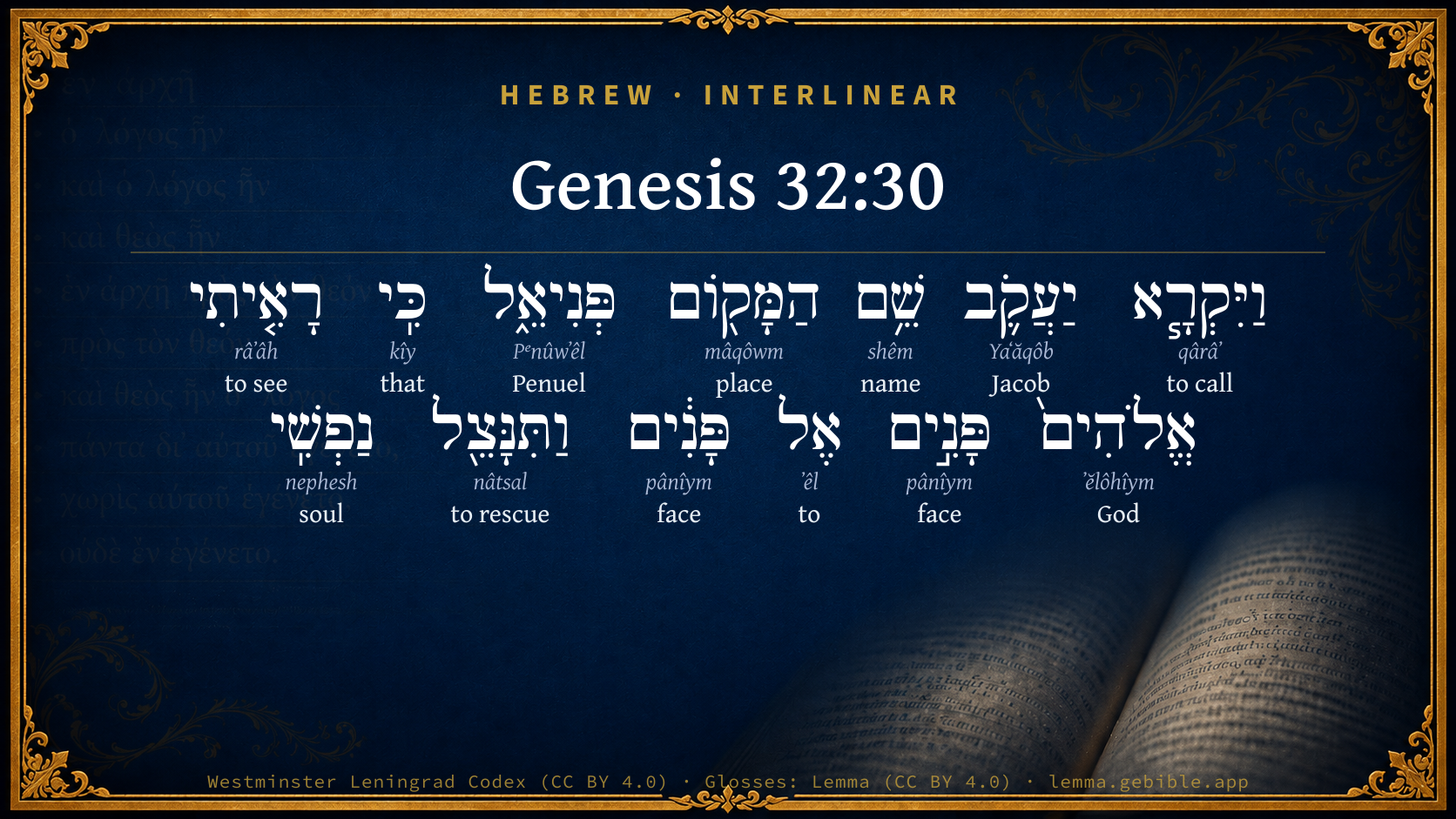
Hebrew (Westminster Leningrad Codex) Genesis 32:30 appears in the Hebrew Old Testament. The text above is from the Westminster Leningrad Codex. Each word links to its Strong’s number, a concise gloss, and parsing drawn from the Open Scriptures Hebrew Bible morphology. Click any word for its full Brown-Driver-Briggs (BDB) entry.
Download image
Cite this verse

Genesis 32:30 (World English Bible). Public Domain. Lemma interlinear Bible study tool, https://lemma.gebible.app/v/genesis/32/30.

Show BibTeX & RIS
BibTeX
RIS
English Translation
Jacob called the name of the place Peniel: for, he said, "I have seen God face to face, and my life is preserved."
World English Bible · Public Domain
Highlights
  • 1 first appearance in the Hebrew Bible
Full analysis ↓
Download a study sheet

One document with this verse’s original text, its word-by-word gloss line, the meaning frame, cross-references with their text, attributed commentary, and full source and license credits — printable, and it pastes into notes with its structure intact.

This verse Autodidact and up

Study sheet (.html) Plain text (.txt)

A passage Seminary Student

Up to 50 verses in one chapter. A passage sheet keeps up to 6 commentary sources and 12 cross-references per verse, in the order this page ranks them, and says so on the sheet whenever that leaves anything out. Ask for a single verse and you get the Autodidact verse sheet above.

Everything on this page stays free to read, with no account — the sheet is a download of what is already on screen, not access to it.

Want to remove ads? Support Godless Engineer
Compare translations 3

The same verse in 3 English versions, stacked beneath the original-language interlinear above. Click any original word for its lexicon entry.

Each is an independent rendering of the whole verse — the interlinear is not word-aligned to these translations.

Highlighted words mark where these versions differ — a whole-verse word diff, not a word-by-word alignment.

  • World English Bible Public Domain
    Jacob called the name of the place Peniel: for, he said, "I have seen God face to face, and my life is preserved."
  • King James Version Public Domain
    And Jacob called the name of the place Peniel: for I have seen God face to face, and my life is preserved.
  • unfoldingWord Literal Text CC BY-SA 4.0
    So Jacob called the name of the place Peniel, because, “I saw God face to face, but my life was preserved!”

unfoldingWord Literal Text — © unfoldingWord, licensed CC BY-SA 4.0. Word-aligned USFM3 via Door43 (git.door43.org/unfoldingWord/en_ult).

Versions to compare (up to 4)

3 of 4 selected

Show all 18 translations

Every available English version of this verse, each an independent rendering of the whole verse.

  • World English Bible Public Domain
    Jacob called the name of the place Peniel: for, he said, "I have seen God face to face, and my life is preserved."
  • Berean Standard Bible Public Domain
    So Jacob named the place Peniel, saying, “Indeed, I have seen God face to face, and yet my life was spared.”
  • Majority Standard Bible Public Domain
    So Jacob named the place Peniel, saying, “Indeed, I have seen God face to face, and yet my life was spared.”
  • King James Version Public Domain
    And Jacob called the name of the place Peniel: for I have seen God face to face, and my life is preserved.
  • American Standard Version (1901) Public Domain
    And Jacob called the name of the place Peniel: for, `said he', I have seen God face to face, and my life is preserved.
  • Revised Version (1885) Public Domain
    And Jacob called the name of the place Peniel: for, said he, I have seen God face to face, and my life is preserved.
  • Geneva Bible (1599) Public Domain
    And Iaakob called the name of the place, Peniel: for, saide he, I haue seene God face to face, and my life is preserued.
  • Douay-Rheims (1899) Public Domain
    And Jacob called the name of the place Phanuel, saying: I have seen God face to face, and my soul has been saved.
  • Young's Literal Translation Public Domain
    And Jacob calleth the name of the place Peniel: for `I have seen God face unto face, and my life is delivered;'
  • Literal Standard Version CC BY-SA 4.0
    And Jacob calls the name of the place Peniel: “For I have seen God face to face, and my life is delivered”;
  • Unlocked Literal Bible CC BY-SA 4.0
    Jacob called the name of the place Peniel for he said, “I have seen God face to face, and my life is delivered.”
  • unfoldingWord Literal Text CC BY-SA 4.0
    So Jacob called the name of the place Peniel, because, “I saw God face to face, but my life was preserved!”
  • Darby Bible Public Domain
    And Jacob called the name of the place Peniel -- For I have seen God face to face, and my life has been preserved.
  • World Messianic Bible Public Domain
    Jacob called the name of the place Peniel; for he said, “I have seen God face to face, and my life is preserved.”
  • Webster's Bible Public Domain
    And Jacob called the name of the place Peniel: for I have seen God face to face, and my life is preserved.
  • Free Bible Version CC BY-SA 4.0
    Jacob named the place Peniel, saying, “I saw God face to face and I'm still alive!”
  • Bible in Basic English Public Domain
    And Jacob gave that place the name of Peniel, saying, I have seen God face to face, and still I am living.
  • JPS Tanakh (1917) Public Domain
    (32-31) And Jacob called the name of the place Peniel: 'for I have seen God face to face, and my life is preserved.'

Literal Standard Version (2020), Covenant Press — licensed CC BY-SA 4.0. Text via the HelloAO Bible API (eBible.org). Unlocked Literal Bible (unfoldingWord) — licensed CC BY-SA 4.0. Text via the HelloAO Bible API (eBible.org). unfoldingWord Literal Text — © unfoldingWord, licensed CC BY-SA 4.0. Word-aligned USFM3 via Door43 (git.door43.org/unfoldingWord/en_ult). Free Bible Version, Dr. Jonathan Gallagher — licensed CC BY-SA 4.0. Text via the HelloAO Bible API (eBible.org).

Word by word

More ways to search: Search by grammar → Find every occurrence → Compare this word →

Practice this passage: Drill this verse → Learn its vocabulary →

פְּנִיאֵ֑ל
Pᵉnûwʼêl
H6439
“Penuel”
Noun, Proper
Part of Speech
Noun
Type
Proper
Full BDB Definition

Origin: from H6437 and H410

TWOT: None

Penuel or Peniel = "facing God" - a Benjamite, son of Shashak, brother of Iphedeiah of the family of Saul (noun proper masculine) - son of Hur, father of Gedor, and a descendant of Judah (noun proper masculine) - the place named by Jacob when he wrestled with God and located on the north bank of the Jabbok close to the Jordan (noun proper locative)
  1. וַיִּקְרָ֧א qârâʼ H7121 “and · to call” Conjunction + Verb, Qal, Sequential Imperfect, 3rd Person, Masculine, Singular
  2. יַעֲקֹ֛ב Yaʻăqôb H3290 “Jacob” Noun, Proper
  3. שֵׁ֥ם shêm H8034 “name of” Noun, Common, Masculine, Singular, Construct
  4. הַמָּק֖וֹם mâqôwm H4725 “the · place” Particle, Definite Article + Noun, Common, Masculine, Singular, Absolute
  5. כִּֽי kîy H3588 “that” Conjunction
  6. רָאִ֤יתִי râʼâh H7200 “to see” Verb, Qal, Perfect, 1st Person, Common, Singular
  7. אֱלֹהִים֙ ʼĕlôhîym H430 “God(s)” Noun, Common, Masculine, Plural, Absolute
  8. פָּנִ֣ים pânîym H6440 “face(s)” Noun, Common, Both, Plural, Absolute
  9. אֶל ʼêl H413 “to” Preposition
  10. פָּנִ֔ים pânîym H6440 “face(s)” Noun, Common, Both, Plural, Absolute
  11. וַתִּנָּצֵ֖ל nâtsal H5337 “and · to rescue” Conjunction + Verb, Niphal, Sequential Imperfect, 3rd Person, Feminine, Singular
  12. נַפְשִֽׁי nephesh H5315 “soul · my” Noun, Common, Both, Singular, Construct + Suffix, Personal, 1st Person, Common, Singular

About this verse

These counts appear in no published source. They are computed here, from the morphology-tagged text and Lemma’s own curated glosses. What Lemma adds →

13
words
12
distinct lemmas
Pentateuch
section

Notable vocabulary

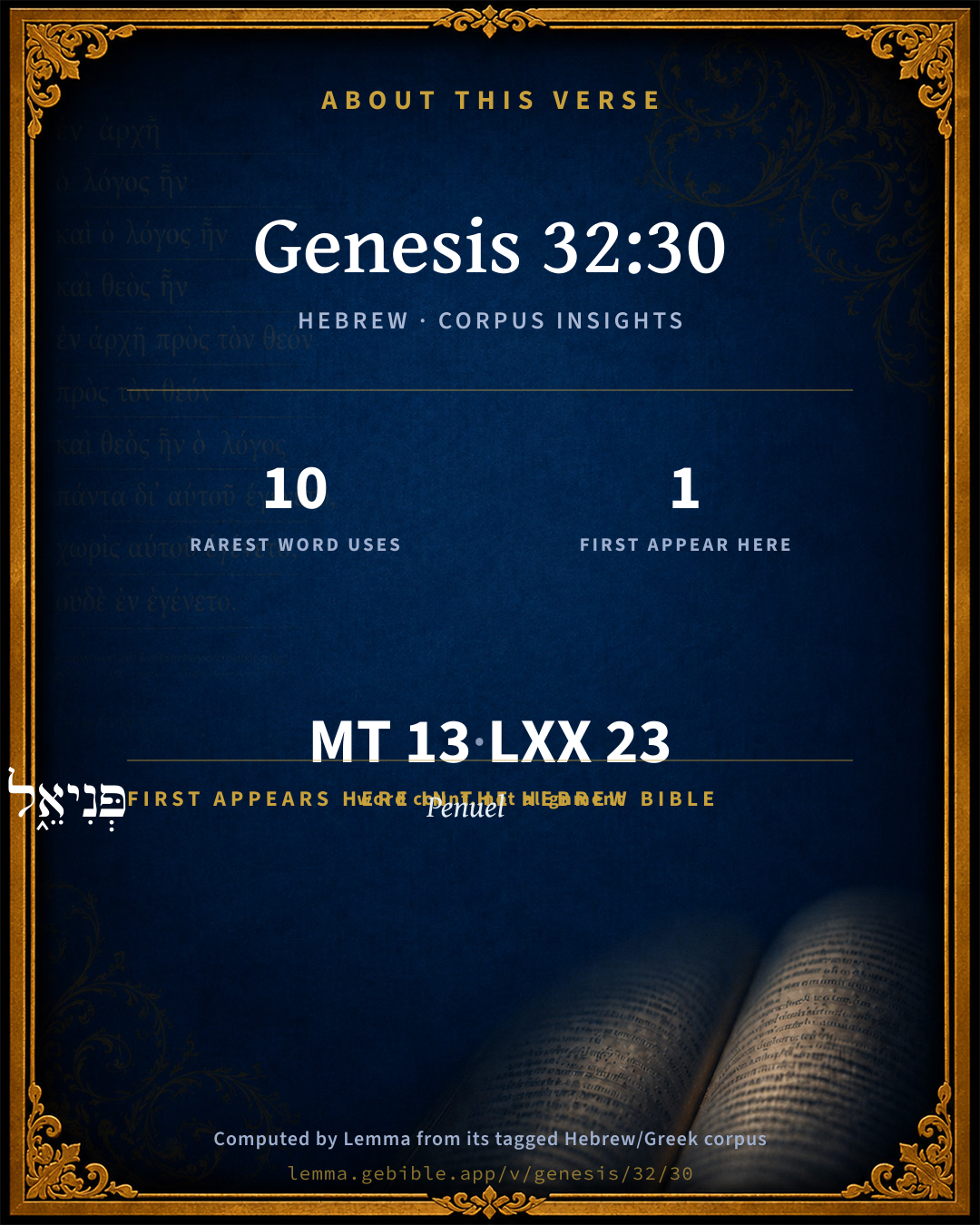
The rarest word here is פְּנִיאֵ֑ל Penuel H6439 — appearing just 10 times in the whole Hebrew Bible.

First appearance in Scripture

This word makes its first canonical appearance in the Hebrew Bible here:

  • פְּנִיאֵ֑ל Penuel H6439

Shared distinctive vocabulary

פְּנִיאֵ֑ל Penuel H6439 occurs in 8 verses of the Hebrew Bible. Also found in:

Grammatical profile

  • 3 verbs
  • 8 nouns
  • 1 preposition
  • 1 conjunction

Verb forms

  • וַיִּקְרָ֧א Qal · Sequential Imperfect
  • רָאִ֤יתִי Qal · Perfect
  • וַתִּנָּצֵ֖ל Niphal · Sequential Imperfect

Repetition

A word recurs within this verse — often emphatic in Hebrew:

  • פָּנִ֣ים face H6440 ×2

Hebrew & Septuagint length

In English translation the verse runs 23 words from the Hebrew and 27 from the Septuagint (LXX English) — closely comparable.

A rough comparison of the two English renderings, which tokenize alike — not a word-level alignment.

Word counts can differ between the Hebrew and the Greek without any difference in meaning — e.g. the Hebrew direct-object marker אֵת has no separate Greek word, and Greek often adds the article ὁ.

In the original languages it is 13 Hebrew tokens and 23 Greek tokens — but the two are counted differently (Hebrew bundles its prefixes and suffixes into one token; the Greek is in lemma form), so that isn’t a like-for-like length.

Cross-references

22

Topical passages linked to Genesis 32:30 in the Treasury of Scripture Knowledge — connected by theme and wording, ordered by reader-vote popularity; previews shown in the World English Bible.

  • Exodus 24:10–11 They saw the God of Israel. Under his feet was like a paved work of sapphire stone, like the skies for clearness.
  • Numbers 12:8 with him will I speak mouth to mouth, even manifestly, and not in dark speeches; and the form of Yahweh shall he see: why then were you not afraid to speak against my servant, against Moses?
  • Isaiah 6:5 Then I said, "Woe is me! For I am undone, because I am a man of unclean lips, and I dwell in the midst of a people of unclean lips: for my eyes have seen the King, Yahweh of Hosts!"
  • Genesis 16:13 She called the name of Yahweh who spoke to her, "You are a God who sees," for she said, "Have I even stayed alive after seeing him?"
  • Deuteronomy 5:24 and you said, Behold, Yahweh our God has shown us his glory and his greatness, and we have heard his voice out of the midst of the fire: we have seen this day that God does speak with man, and he lives.
  • Exodus 33:19–23 He said, "I will make all my goodness pass before you, and will proclaim the name of Yahweh before you. I will be gracious to whom I will be gracious, and will show mercy on whom I will show mercy."
  • John 1:18 No one has seen God at any time. The one and only Son, who is in the bosom of the Father, he has declared him.
  • Exodus 33:14 He said, "My presence will go with you, and I will give you rest."
  • Ephesians 1:17 that the God of our Lord Jesus Christ, the Father of glory, may give to you a spirit of wisdom and revelation in the knowledge of him;
  • 2 Timothy 1:10 but has now been revealed by the appearing of our Savior, Christ Jesus, who abolished death, and brought life and immortality to light through the Gospel.
  • Hebrews 11:27 By faith, he left Egypt, not fearing the wrath of the king; for he endured, as seeing him who is invisible.
  • Genesis 28:19 He called the name of that place Bethel, but the name of the city was Luz at the first.
  • Deuteronomy 34:10 There has not arisen a prophet since in Israel like Moses, whom Yahweh knew face to face,
  • Judges 6:22–23 Gideon saw that he was the angel of Yahweh; and Gideon said, Alas, Lord Yahweh! because I have seen the angel of Yahweh face to face.
  • Judges 8:8 He went up there to Penuel, and spoke to them in like manner; and the men of Penuel answered him as the men of Succoth had answered.
  • Judges 8:17 He broke down the tower of Penuel, and killed the men of the city.
  • Judges 13:21–22 But the angel of Yahweh did no more appear to Manoah or to his wife. Then Manoah knew that he was the angel of Yahweh.
  • 1 Kings 12:25 Then Jeroboam built Shechem in the hill-country of Ephraim, and lived therein; and he went out from there, and built Penuel.
  • 2 Corinthians 3:18 But we all, with unveiled face beholding as in a mirror the glory of the Lord, are transformed into the same image from glory to glory, even as from the Lord, the Spirit.
  • 2 Corinthians 4:6 seeing it is God who said, "Light will shine out of darkness," who has shone in our hearts, to give the light of the knowledge of the glory of God in the face of Jesus Christ.
  • Galatians 1:6 I marvel that you are so quickly deserting him who called you in the grace of Christ to a different gospel;
  • Colossians 1:15 who is the image of the invisible God, the firstborn of all creation.

Cross-references courtesy of OpenBible.info (CC BY 4.0).

Hebrew and Greek witnesses Masoretic Hebrew ↔ Greek Septuagint

The same verse in the two great witnesses to the Old Testament, shown verse-for-verse.

These are two independent witnesses, not word-aligned to each other, and the Septuagint is shown in lemma (dictionary) form.

Hebrew Genesis 32:30 Masoretic · Westminster Leningrad Codex

וַיִּקְרָ֧א יַעֲקֹ֛ב שֵׁ֥ם הַמָּק֖וֹם פְּנִיאֵ֑ל כִּֽי רָאִ֤יתִי אֱלֹהִים֙ פָּנִ֣ים אֶל פָּנִ֔ים וַתִּנָּצֵ֖ל נַפְשִֽׁי

Jacob called the name of the place Peniel: for, he said, "I have seen God face to face, and my life is preserved."

World English Bible · Public Domain

Greek LXX Genesis 32:30 Septuagint · lemma form

ἐρωτάω δέ ἰακώβ καί εἶπον ἀναἀγγέλλω ἐγώ ὁ ὄνομα σύ καί εἶπον ἵνα τίς οὗτος ἐρωτάω ὁ ὄνομα ἐγώ καί εὐλογέω αὐτός ἐκεῖ

And Jacob called the name of that place, the Face of God; for, said he, I have seen God face to face, and my life was preserved.

LXX2012 (modern English Septuagint) · Public Domain

Hebrew: Westminster Leningrad Codex (CC BY 4.0). Greek: Septuagint (public domain); English from LXX2012 (modern English Septuagint) (Public Domain). How the Septuagint differs from the Hebrew →

Targum (Aramaic paraphrase)

2

The Targum is the ancient Jewish Aramaic paraphrase of the Hebrew Scriptures — an interpretive translation, not the Hebrew text itself. Onkelos (literal) and Pseudo-Jonathan (expansive) render the Torah, and Jonathan the Prophets. Coverage is partial: where no permissively-licensed English translation exists for a verse, only the Aramaic is shown. This is verse-level text, not a word-by-word alignment to the Hebrew.

  1. Targum Onkelos Torah (Genesis–Deuteronomy)
    וּשְׁאֵל יַעֲקֹב וַאֲמַר חַוִּי כְעַן שְׁמָךְ וַאֲמַר לְמָה דְנַן אַתְּ שָׁאֵל לִשְׁמִי וּבָרִיךְ יָתֵהּ תַּמָּן

    (no public-domain English translation for this verse)

    Targum Onkelos — Aramaic: “Onkelos Genesis” (public domain); “Onkelos Exodus” (public domain); “Onkelos Leviticus” (public domain); “Onkelos Numbers” (public domain); “Onkelos Deuteronomy” (public domain). English: “Sefaria Community Translation” (CC0 1.0 (public-domain dedication)); “J.W. Etheridge. The Targums of Onkelos and Jonathan Ben Uzziel on the Pentateuch. London: Longmans, Green, 1862” (public domain). Text via Sefaria.

  2. Targum Pseudo-Jonathan Torah (Genesis–Deuteronomy)
    וּשְׁאֵיל יַעֲקב וַאֲמַר חַוִי כְדוּן שְׁמָךְ וַאֲמַר לָמָה דְנַן אַנְתְּ שְׁאַל לִשְׁמִי וּבְרִיךְ יָתֵיהּ יַעֲקב תַּמָן

    And Jakob asked and said, Show me now thy name. And he said, Why dost thou ask for my name? And he blessed Jakob there.

    Targum Pseudo-Jonathan — Aramaic: “Targum Jonathan on Genesis” (public domain); “Targum Jonathan on Exodus” (public domain); “Targum Jonathan on Leviticus” (public domain); “Targum Jonathan on Numbers” (public domain); “Targum Jonathan on Deuteronomy” (public domain). English: “The Targum of Jonathan ben Uzziel, trans. J. W. Etheridge, London, 1862” (public domain). Text via Sefaria.

Commentary

Notes on Genesis 32:30 from classic Christian and Jewish commentators (each source and its license shown beneath its notes). The classic Christian expositions comment on the surrounding passage and are grouped to its opening verse, so a note may address several verses; the Jewish commentaries on the Tanakh (Rashi and others) are per-verse, so they appear only where the commentator wrote on this verse.

Lemma curates 59 commentaries, every one of them public domain or Creative Commons licensed, each selected and text-cleaned for this edition rather than reprinted as found. About our sources →

Trapp's Complete Commentary

John Trapp

Gen 32:30 And Jacob called the name of the place Peniel: for I have seen God face to face, and my life is preserved.

Ver. 30. I have seen God face to face.] Christ would not tell Jacob his name, to lift up his mind above what he saw of him, and to insinuate that his name was "Wonderful," his essence incomprehensible. {Jdg 13:17-18} And whereas Jacob said here, he had "seen God face to face": he means only, praesens praesentem, as Moses spake with God "mouth to mouth". {Num 12:8} He saw not God’s majesty and essence; for he is a God "that hides himself," {Isa 8:17} and "dwells in the light unapproachable". {1Ti 6:16} But he saw him more apparently and manifestly than ever he had done before. We can see but his "back parts" {Exo 33:23} and live; we need see no more, that we may live. God that fills all, saith Nazianzen, though he lighten the mind, yet flies before the beams thereof; still leaving it, as it is able, in sight to follow him; draws it by degrees to higher things; but ever interposeth between it and his incomparable essence, as many vails as were over the tabernacle. Some created shape, some glimpse of glory, Jacob saw; whereby God was pleased, for the present, to testify his more immediate presence; but not himself.

John Trapp, A Commentary or Exposition upon All the Books of the Old and New Testament (1647–1656) — public domain. Text from a community e-Sword module.

Tyndale Open Study Notes

Tyndale Open Resources

32:30 Peniel (which means “face of God”): The name shows that Jacob recognized the man as a manifestation of God (a theophany). • yet my life has been spared (or and I have been rescued): The saying probably meant that Jacob realized that his prayer to be rescued from Esau (32:11) had been answered, for if he could meet God like this and walk away, he had nothing to fear from Esau. The saying may also reflect an ancient understanding that no one could see God and live (see Exod 33:20).

Tyndale Open Study Notes — © Tyndale Open Resources, licensed CC BY-SA 4.0. Text via the HelloAO Bible API.

Geneva Bible (1599)

Geneva Bible translators

Or, my soul is delivered.

Geneva Bible (1599) marginal notes — public domain. Text via Bolls.life.

John Calvin's Commentaries

30. And Jacob called the name of the place The gratitude of our father Jacob is again commended, because he took diligent care that the memory of God’s grace should never perish. He therefore leaves a monument to posterity, from which they might know that God had appeared there; for this was not a private vision, but had reference to the whole Church. Moreover, Jacob not only declares that he has seen the face of God, but also gives thanks that he has been snatched from death. This language frequently occurs in the Scriptures, and was common among the ancient people; and not without reason; for, if the earth trembles at the presence of God, if the mountains melt, if darkness overspreads the heavens, what must happen to miserable men! Nay, since the immense majesty of God cannot be comprehended even by angels, but rather absorbs them; were his glory to shine on us it would destroy us, and reduce us to nothing, unless he sustained and protected us. So long as we do not perceive God to be present, we proudly please ourselves; and this is the imaginary life which the flesh foolishly arrogates to itself when it inclines towards the earth. But the faithful, when God reveals himself to them, feel themselves to be more evanescent than any smoke. Finally; would we bring down the pride of the flesh, we must draw near to God. So Jacob confesses that, by the special indulgence of God, he had been rescued from destruction when he saw God. It may however be asked, “Why, when he had obtained so slight a taste only of God’s glory, he should boast that he had seen him, face to face?” I answer, it is in no way absurd that Jacob highly celebrates this vision above all others, in which the Lord had not so plainly appeared unto him; and yet, if it be compared with the splendor of the gospel, or even of the law, it will appear like sparks, or obscure rays. The simple meaning then is, that he saw God in an unwonted and extraordinary manner. Now, if Jacob so greatly exults and congratulates himself in that slender measure of knowledge; what ought we to do at this day, to whom Christ, the living image of God, is evidently set before our eyes in the mirror of the gospel! Let us therefore learn to open our eyes, lest we be blind at noonday, as Paul exhorts us in 2 Corinthians 3:1-4:1.

John Calvin's Commentaries (1540-1563) — public domain. Text from the Calvin Translation Society English edition (1840s-50s) via the Christian Classics Ethereal Library (ccel.org). Calvin's coverage is partial (roughly two-thirds of the Bible); uncommented books and verses are honest gaps, never fabricated. The 19th-century editor's footnotes and remarks are omitted so the notes are faithfully Calvin's own voice.

Ellicott's Commentary for English Readers

(30) Peniel.—Elsewhere Penuel, and so probably it should be read here. It means, “the face of God.” For the rest of the verse see Note on Gen_16:13.

A Bible Commentary for English Readers, edited by Charles John Ellicott (1878–1897) — public domain. Text from a community e-Sword module.

The Cambridge Bible for Schools and Colleges

gen. ed. J. J. S. Perowne

30. Peniel] R.V. marg. The face of God. In the Sam. version, Syr., and Lat., it is called “Penuel,” as in Gen_32:32. Popular tradition explained the etymology of the name of the place by the story of Jacob.

The face of God was to be seen in the Angel: he that looked on the Angel saw the Presence of Jehovah.

I have seen God … preserved] The belief that to see God was to die prevailed amongst the Israelites; see Gen_16:13; Exo_19:21; Exo_24:10-11; Exo_33:20; Deu_5:24; Jdg_6:22; Jdg_13:22. Jacob has seen the Divine Being, Elohim, and lives.

Jacob, on his deathbed, refers to this event (Gen_48:16): “The Angel which redeemed me from all evil, bless the lads.”

face to face] See Exo_33:11; Deu_34:10

The Cambridge Bible for Schools and Colleges (gen. ed. J. J. S. Perowne; Cambridge University Press, 1878–1918) — public domain. Text from a community e-Sword module.

John Gill's Exposition

And Jacob called the name of the place Peniel,.... In Gen 32:31; Penuel, which signifies the face of God, or God hath looked upon me, or hath had respect to me: there was afterwards a city built here, called by the same name; see Jdg 8:8; it is said (k) to be four miles from Mahanaim; the reason of it follows:

for I have seen God face to face: it may be observed, that in wrestling men are face to face, and in this position were Jacob and the man that wrestled with him; which he seems to have respect unto, as well as to the familiarity and intimate communion he was admitted to:

and my life is preserved: though he had wrestled with one so vastly superior to himself, who could have easily crushed this worm Jacob to pieces, as he is sometimes called; and though he had had such a sight of God as face to faces referring, as is thought, to a notion that obtained early, even among good men, that upon sight of God a man instantly died; though we have no example of that kind: but perhaps he observed this for his encouragement; that whereas he had met with God himself, and wrestled with him in the form of a man, and yet was preserved, he doubted not that, when he should meet with his brother and debate matters with him, he should be safe and unhurt.

(k) Bunting's Travels, p. 72. 74.

John Gill's Exposition of the Whole Bible (1746–1763) — public domain (CC PDM 1.0). Text via the HelloAO Bible API.

Haydock's Catholic Bible Commentary

Phanuel. This word signifies the face of God, or the sight, or seeing of God. (Challoner) --- Hebrew reads here Peni-el, though it has Phanuel in the next verse. Jacob thus returns thanks to God for the preservation of his life, after having seen God or his angel in a corporeal form, and not in a dream only. (Calmet)

George Leo Haydock (1774–1849), Haydock's Catholic Family Bible and Commentary, 1859 edition — public domain. Excludes Psalms (Douay-Rheims chapter numbering differs from Protestant) and Deuterocanonical books (Catholic canon only).

Matthew Poole's English Annotations

I have seen God face to face; not in his essence, for so no man ever saw God, Joh 1:18, nor yet in a dream or vision, but in a most evident, sensible, familiar, and friendly manifestation of himself.

My life is preserved; I am now well assured of my safety from Esau, whose approach threatened my life. Or he speaks of it with wonder, as others did, that he should see God, and not be struck dead by the glory of his presence. Compare Gen 16:13; Exo 20:19; Jdg 6:22,23; 13:22.

Matthew Poole's English Annotations on the Holy Bible (1683–1685) — public domain. Text from a community e-Sword/MySword module.

Whedon's Commentary on the Bible

Daniel D. Whedon

30, 31.

Peniel… Penuel — The two words mean the same thing, and differ only by the changing of the vowel-letter יinto ו. Elsewhere it is always written Penuel, and possibly the form Peniel is a corruption that has here crept into the text. The name means face or presence of God, and the deep and lasting impression made on Jacob, as having struggled face to face with God, made this a fitting name of the place. He had there a vision of God such as he had not before, and though now he halted upon his thigh, he was thankful for the preservation of his life.

Daniel D. Whedon (gen. ed.), Commentary on the Old and New Testaments (1874–1909) — public domain. Text from a community e-Sword module.

The Pulpit Commentary

And Jacob called the name of the place Peniel (i.e. "the face of God." Its situation must have been close to the Jabbok. The reason given for its designation follows): for I have seen God (Elohim) face to face, and my life is preserved (cf. Gen_16:13; Exo_14:11; Jud_1:6:22 13:22; Isa_6:5)

The Pulpit Commentary (1880–1919), ed. H.D.M. Spence-Jones & Joseph S. Exell — public domain. Text from a community e-Sword module.

John Wesley's Explanatory Notes

Peniel - That is, the face of God, because there he had seen the appearance of God, and obtained the favour of God.

John Wesley, Explanatory Notes Upon the Whole Bible (1754–1765) — public domain. Text via the GEBible commentary corpus.

Rashi

Rabbi Shlomo Yitzchaki (Rashi)

למה זה תשאל WHEREFORE IS IT THAT THOU DOST ASK [AFTER MY NAME]? — We have no fixed names; our names change, all depending upon the service we are commanded to carry out as the errand with which we are charged (Genesis Rabbah 78:4).

Rashi on the Tanakh — English translations: “The Judaica Press complete Tanach with Rashi, translated by A. J. Rosenberg” (CC BY 4.0); “Pentateuch with Rashi's commentary by M. Rosenbaum and A.M. Silbermann, 1929-1934” (public domain); “The Metsudah Tanach series, Lakewood, N.J” (CC BY 4.0); and “The Book of Joshua, Metsudah Publications, 1997” (CC BY 4.0). Text via Sefaria.

Ramban (Nachmanides)

Rabbi Moshe ben Nachman (Ramban / Nachmanides)

WHY IS IT THAT THOU DOST ASK AFTER MY NAME? The angel said: “There is no advantage to you in knowing my name for no one possesses the power and the capability other than G-d alone. If you will call upon me I will not answer you, nor will I save you from your trouble. However, I will now bless you, for so I am commanded.” But Scripture does not explain the contents of the blessing. That which our Rabbis have said is most probable, namely that the angel, despite himself, conceded to him at that place the legitimacy of his father’s blessings, as Jacob did not wish to wait for him until he arrived at Beth-el.

Ramban (Nachmanides) on the Tanakh — English translation: “Commentary on the Torah by Ramban (Nachmanides). Translated and annotated by Charles B. Chavel. New York, Shilo Pub. House, 1971-1976” (CC BY 4.0). Text via Sefaria.

Radak

Rabbi David Kimhi (Radak)

וישאל...הגידה נא שמך, for each angel has a name appropriate to his mission. This is what Isaiah meant when he said (Isaiah 40,26) לכולם בשם יקרא, “Who calls them each by name. ”We find names of angels spelled out in Daniel 9,21 והאיש גבריאל, as well as chapter 10,12 in Daniel כי אם מיכאל שרכם. Seeing that the angel had changed his name, Yaakov wanted to know the angel’s name in order to find out what this angel’s primary task was.

?למה זה תשאל לשמי; a polite way of saying: “you do not need to know my name.” The same happened to Manoach in Judges 13,18 when he wanted to know the name of the angel who had announced that his wife would give birth to Shimshon. However, the difference there was that at the time Manoach asked he was still unaware that he was addressing an angel, thinking that he was dealing with a prophet, a human being. We do not really know why the angels keep their names secret. According to Bereshit Rabbah 78,4 the angel’s question meant that seeing each angel has a name assigned to him for each specific assignment he carries out on earth, there was no point in knowing his name as it would change before he would be given a new assignment. Rabbi Ami, quoting Abba Yossi, draws attention to two verses, one in Psalms 147,4 saying לכולם שמות יקרא, “He will call all of them by names,” and Isaiah 2,26 לכולם בשם קרא, “He calls all of them by name.” This appears to state that whereas the stars do not undergo name changes, angels names do. He uses the angel’s question to Manoach as proof that this is so. The angel answered Manoach that he did not know what his name would be on his next mission.

ויברך אותו שם, apart from the fact that he had told him about his impending name change to Yisrael, explaining the reason for this, he gave him an additional blessing. The reason the verse ends with the word שם is that it is a reference to Bet El where G’d would confirm the name change.

Radak on the Tanakh — English translations: “Sefaria Community Translation” (CC0 1.0 (public-domain dedication)); “Eliyahu Munk, HaChut Hameshulash” (CC BY 4.0); “Rabbi Mike Feuer, Jerusalem Anthology” (CC BY 4.0); and “R. David Kimhi on the first book of Psalms, Translated by R.G. Finch, London, 1919” (public domain). Text via Sefaria.

Lesson kit

Teaching starters — assembled from the data on this page, not authored interpretation. Every prompt links to the verse data it draws on. Edit before teaching.

Genesis, in the Pentateuch, opens this verse with 13 words (12 distinct Hebrew lemmas). Its most distinctive word is Pᵉnûwʼêl (“Penuel”). A historical commentator’s framing appears above. Read the whole chapter for the surrounding context.

Discussion questions

  1. The word Pᵉnûwʼêl carries the sense “Penuel.” How does it shape the verse?
  2. The word “Penuel” first appears here in Scripture. What is being introduced at this debut?
  3. Genesis 32:31 shares the word «Penuel» with this verse. How do the two illuminate each other?
  4. “face” occurs 2× in this one verse. What is the effect of the repetition?
  5. The translations on this page render this verse differently — a whole-verse word diff, not a word-by-word alignment. What might account for the different wordings?
  6. The verb «וַיִּקְרָ֧א» is Qal Sequential Imperfect. How does its form color the action?
  7. Reading how Trapp's Complete Commentary and Tyndale Open Study Notes read this verse, where do the two commentators agree and where do they part?

Things to notice

Reading settings

Reading text

Shown beneath each verse's original-language words.

Old Testament
Old Testament edition

Read the OT as the Masoretic Hebrew (MT) or the Greek Septuagint (LXX).

English shown for the Greek Septuagint (in the Hebrew ↔ Greek comparison).

Comparing translations? Open the Compare panel on any verse page to stack up to four side by side.