
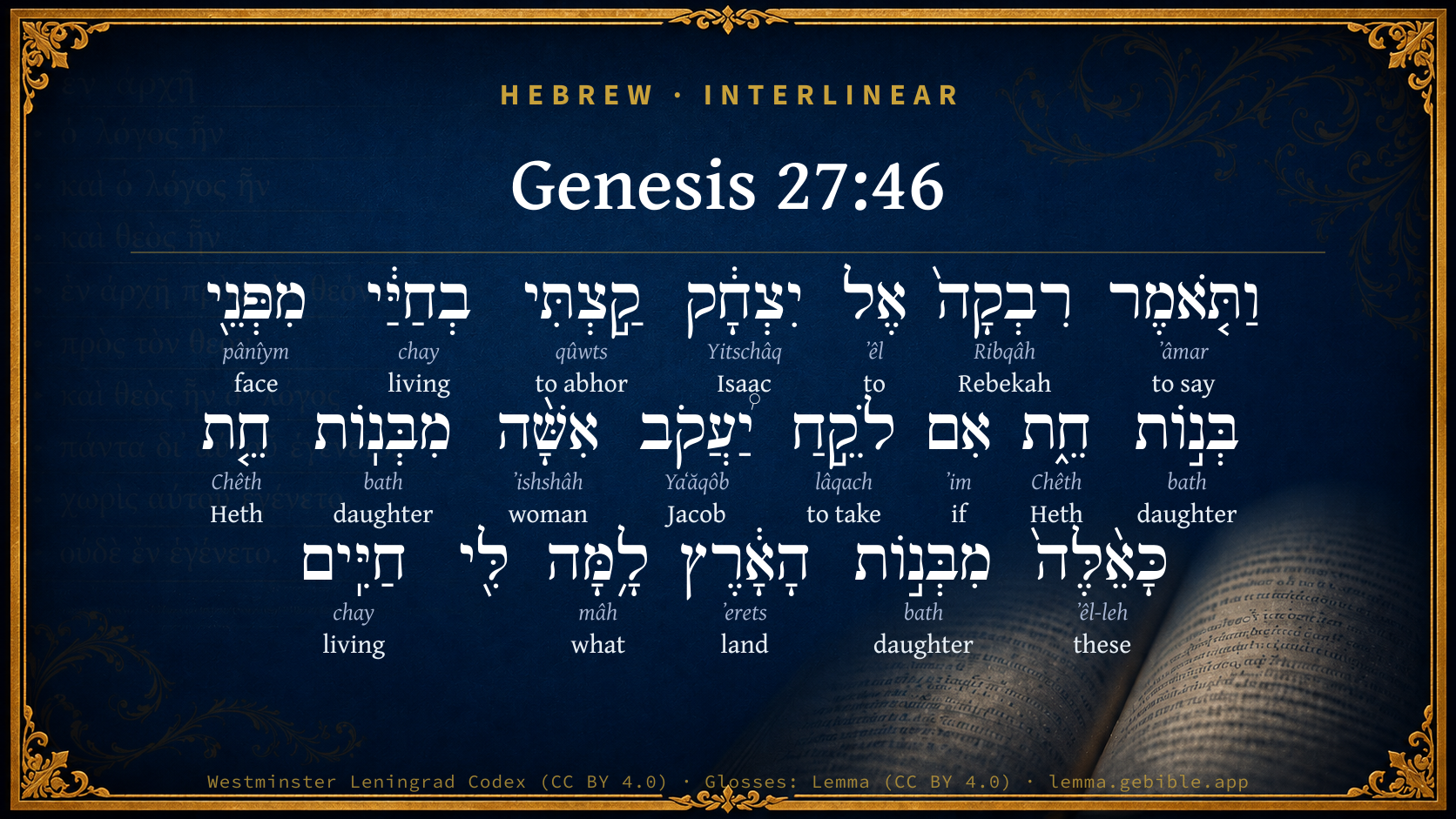
Genesis 27:46

Hebrew (Westminster Leningrad Codex) Genesis 27:46 appears in the Hebrew Old Testament. The text above is from the Westminster Leningrad Codex. Each word links to its Strong’s number, a concise gloss, and parsing drawn from the Open Scriptures Hebrew Bible morphology. Click any word for its full Brown-Driver-Briggs (BDB) entry.
Download image
Cite this verse

Genesis 27:46 (World English Bible). Public Domain. Lemma interlinear Bible study tool, https://lemma.gebible.app/v/genesis/27/46.

Show BibTeX & RIS
BibTeX
RIS
English Translation
Rebekah said to Isaac, "I am weary of my life because of the daughters of Heth. If Jacob takes a wife of the daughters of Heth, such as these, of the daughters of the land, what good will my life do me?"
World English Bible · Public Domain
Highlights
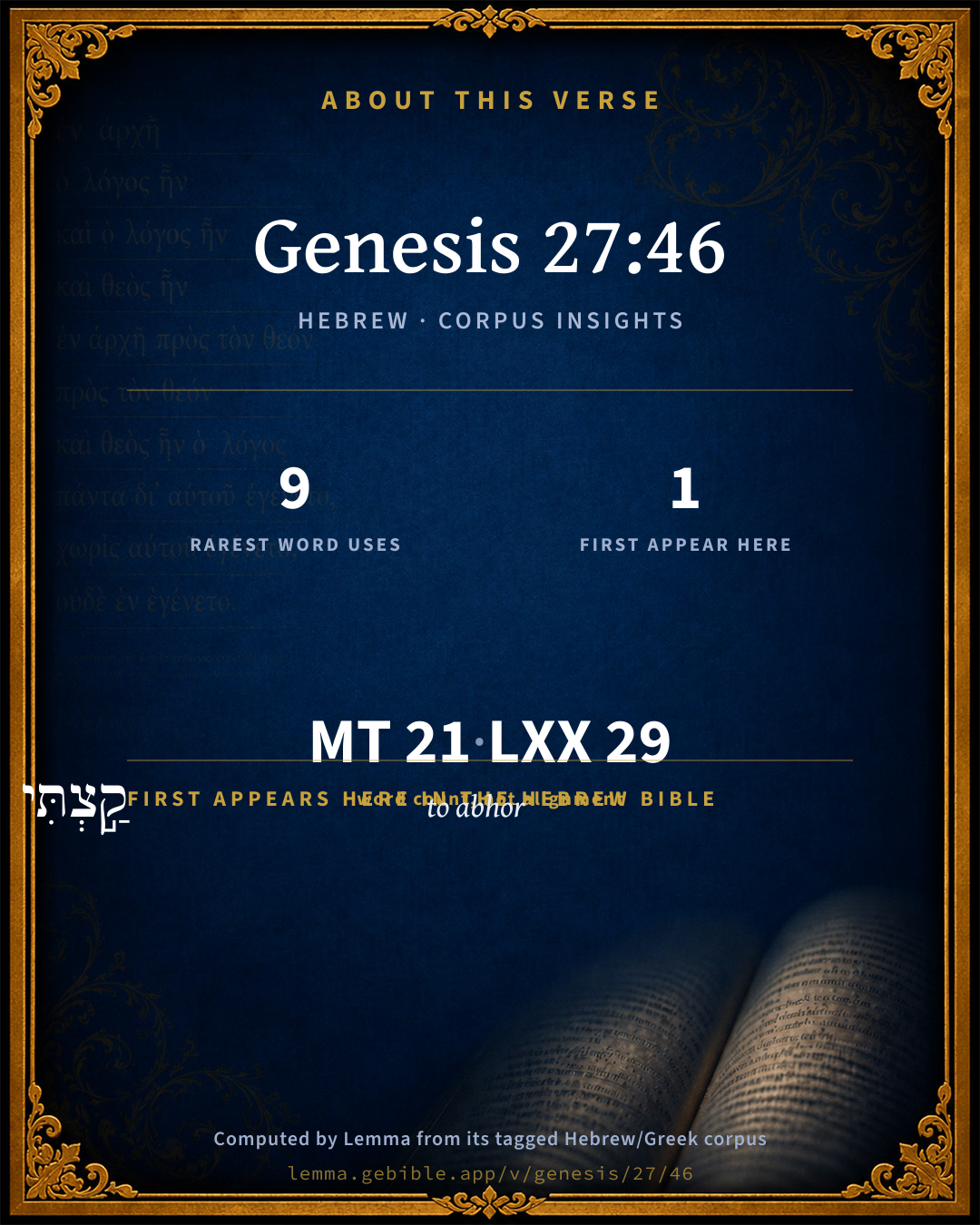
  • 1 first appearance in the Hebrew Bible
Full analysis ↓
Download a study sheet

One document with this verse’s original text, its word-by-word gloss line, the meaning frame, cross-references with their text, attributed commentary, and full source and license credits — printable, and it pastes into notes with its structure intact.

This verse Autodidact and up

Study sheet (.html) Plain text (.txt)

A passage Seminary Student

Up to 50 verses in one chapter. A passage sheet keeps up to 6 commentary sources and 12 cross-references per verse, in the order this page ranks them, and says so on the sheet whenever that leaves anything out. Ask for a single verse and you get the Autodidact verse sheet above.

Everything on this page stays free to read, with no account — the sheet is a download of what is already on screen, not access to it.

Want to remove ads? Support Godless Engineer
Compare translations 3

The same verse in 3 English versions, stacked beneath the original-language interlinear above. Click any original word for its lexicon entry.

Each is an independent rendering of the whole verse — the interlinear is not word-aligned to these translations.

Highlighted words mark where these versions differ — a whole-verse word diff, not a word-by-word alignment.

  • World English Bible Public Domain
    Rebekah said to Isaac, "I am weary of my life because of the daughters of Heth. If Jacob takes a wife of the daughters of Heth, such as these, of the daughters of the land, what good will my life do me?"
  • King James Version Public Domain
    And Rebekah said to Isaac, I am weary of my life because of the daughters of Heth: if Jacob take a wife of the daughters of Heth, such as these which are of the daughters of the land, what good shall my life do me?
  • unfoldingWord Literal Text CC BY-SA 4.0
    Then Rebekah said to Isaac, “I am disgusted with my life because of the daughters of Heth! If Jacob takes a wife from the daughters of Heth like these, from daughters of the land, what life to me?”

unfoldingWord Literal Text — © unfoldingWord, licensed CC BY-SA 4.0. Word-aligned USFM3 via Door43 (git.door43.org/unfoldingWord/en_ult).

Versions to compare (up to 4)

3 of 4 selected

Show all 18 translations

Every available English version of this verse, each an independent rendering of the whole verse.

  • World English Bible Public Domain
    Rebekah said to Isaac, "I am weary of my life because of the daughters of Heth. If Jacob takes a wife of the daughters of Heth, such as these, of the daughters of the land, what good will my life do me?"
  • Berean Standard Bible Public Domain
    Then Rebekah said to Isaac, “I am weary of my life because of these Hittite women. If Jacob takes a Hittite wife from among them, what good is my life?”
  • Majority Standard Bible Public Domain
    Then Rebekah said to Isaac, “I am weary of my life because of these Hittite women. If Jacob takes a Hittite wife from among them, what good is my life?”
  • King James Version Public Domain
    And Rebekah said to Isaac, I am weary of my life because of the daughters of Heth: if Jacob take a wife of the daughters of Heth, such as these which are of the daughters of the land, what good shall my life do me?
  • American Standard Version (1901) Public Domain
    And Rebekah said to Isaac, I am weary of my life because of the daughters of Heth. If Jacob take a wife of the daughters of Heth, such as these, of the daughters of the land, what good shall my life do me?
  • Revised Version (1885) Public Domain
    And Rebekah said to Isaac, I am weary of my life because of the daughters of Heth: if Jacob take a wife of the daughters of Heth, such as these, of the daughters of the land, what good shall my life do me?
  • Geneva Bible (1599) Public Domain
    Also Rebekah said to Izhak, I am weary of my life, for the daughters of Heth. If Iaakob take a wife of the daughters of Heth like these of the daughters of the lande, what auaileth it me to liue?
  • Douay-Rheims (1899) Public Domain
    And Rebecca said to Isaac: I am weary of my life because of the daughters of Heth: if Jacob take a wife of the stock of this land, I choose not to live.
  • Young's Literal Translation Public Domain
    And Rebekah saith unto Isaac, `I have been disgusted with my life because of the presence of the daughters of Heth; if Jacob take a wife of the daughters of Heth, like these -- from the daughters of the land -- why do I live?'
  • Literal Standard Version CC BY-SA 4.0
    And Rebekah says to Isaac, “I have been disgusted with my life because of the presence of the daughters of Heth; if Jacob takes a wife of the daughters of Heth, like these—from the daughters of the land—why do I live?”
  • Unlocked Literal Bible CC BY-SA 4.0
    Rebekah said to Isaac, “I am weary of life because of the daughters of Heth. If Jacob takes one of the daughters of Heth as a wife, like these women, some of the daughters of the land, what good will my life be to me?”
  • unfoldingWord Literal Text CC BY-SA 4.0
    Then Rebekah said to Isaac, “I am disgusted with my life because of the daughters of Heth! If Jacob takes a wife from the daughters of Heth like these, from daughters of the land, what life to me?”
  • Darby Bible Public Domain
    And Rebecca said to Isaac, I am weary of my life because of the daughters of Heth. If Jacob take a wife of the daughters of Heth, such as these, of the daughters of the land, what good should my life do me?
  • World Messianic Bible Public Domain
    Rebekah said to Isaac, “I am weary of my life because of the daughters of Heth. If Jacob takes a wife of the daughters of Heth, such as these, of the daughters of the land, what good will my life do me?”
  • Webster's Bible Public Domain
    And Rebekah said to Isaac, I am weary of my life, because of the daughters of Heth: if Jacob shall take a wife of the daughters of Heth, such as these who are of the daughters of the land, what good will my life do me?
  • Free Bible Version CC BY-SA 4.0
    Then Rebekah went and told Isaac, “I'm so sick of these Hittite women—they're ruining my life! If Jacob also marries a Hittite woman like them, one of the local people, I'd rather die!”
  • Bible in Basic English Public Domain
    Then Rebekah said to Isaac, My life is a weariness to me because of the daughters of Heth: if Jacob takes a wife from among the daughters of Heth, such as these, the women of this land, of what use will my life be to me?
  • JPS Tanakh (1917) Public Domain
    And Rebekah said to Isaac: 'I am weary of my life because of the daughters of Heth. If Jacob take a wife of the daughters of Heth, such as these, of the daughters of the land, what good shall my life do me?'

Literal Standard Version (2020), Covenant Press — licensed CC BY-SA 4.0. Text via the HelloAO Bible API (eBible.org). Unlocked Literal Bible (unfoldingWord) — licensed CC BY-SA 4.0. Text via the HelloAO Bible API (eBible.org). unfoldingWord Literal Text — © unfoldingWord, licensed CC BY-SA 4.0. Word-aligned USFM3 via Door43 (git.door43.org/unfoldingWord/en_ult). Free Bible Version, Dr. Jonathan Gallagher — licensed CC BY-SA 4.0. Text via the HelloAO Bible API (eBible.org).

Word by word

More ways to search: Search by grammar → Find every occurrence → Compare this word →

Practice this passage: Drill this verse → Learn its vocabulary →

קַ֣צְתִּי
qûwts
H6973
“to abhor”
Verb, Qal, Perfect, 1st Person, Common, Singular
Part of Speech
Verb
Stem
Qal
Form
Perfect
Person
1st Person
Gender
Common
Number
Singular
Full BDB Definition

Origin: a primitive root [identical with H6972 through the idea of severing oneself from (compare H6962 )]

TWOT: 2002

to be grieved, loathe, abhor, feel a loathing or abhorrence or sickening dread - (Qal) - to feel a loathing at, abhor - to feel a sickening dread - (Hiphil) - to cause sickening dread - to cause loathing
  1. וַתֹּ֤אמֶר ʼâmar H559 “and · to say” Conjunction + Verb, Qal, Sequential Imperfect, 3rd Person, Feminine, Singular
  2. רִבְקָה֙ Ribqâh H7259 “Rebekah” Noun, Proper
  3. אֶל ʼêl H413 “to” Preposition
  4. יִצְחָ֔ק Yitschâq H3327 “Isaac” Noun, Proper
  5. בְחַיַּ֔י chay H2416 “in/at · living things · my” Preposition + Noun, Common, Masculine, Plural, Construct + Suffix, Personal, 1st Person, Common, Singular
  6. מִפְּנֵ֖י pânîym H6440 “from · face(s) of” Preposition + Noun, Common, Both, Plural, Construct
  7. בְּנ֣וֹת bath H1323 “daughters of” Noun, Common, Feminine, Plural, Construct
  8. חֵ֑ת Chêth H2845 “Heth” Noun, Proper
  9. אִם ʼim H518 “if” Conjunction
  10. לֹקֵ֣חַ lâqach H3947 “taking” Verb, Qal, Participle Active, Masculine, Singular, Absolute
  11. יַ֠עֲקֹב Yaʻăqôb H3290 “Jacob” Noun, Proper
  12. אִשָּׁ֨ה ʼishshâh H802 “woman” Noun, Common, Feminine, Singular, Absolute
  13. מִבְּנֽוֹת bath H1323 “from · daughters of” Preposition + Noun, Common, Feminine, Plural, Construct
  14. חֵ֤ת Chêth H2845 “Heth” Noun, Proper
  15. כָּאֵ֨לֶּה֙ ʼêl-leh H428 “like/as · these” Preposition + Pronoun, Demonstrative, Common, Plural
  16. מִבְּנ֣וֹת bath H1323 “from · daughters of” Preposition + Noun, Common, Feminine, Plural, Construct
  17. הָאָ֔רֶץ ʼerets H776 “the · land” Particle, Definite Article + Noun, Common, Both, Singular, Absolute
  18. לָ֥מָּה mâh H4100 “to/for · what” Preposition + Particle, Interrogative
  19. חַיִּֽים chay H2416 “living things” Noun, Common, Masculine, Plural, Absolute

About this verse

These counts appear in no published source. They are computed here, from the morphology-tagged text and Lemma’s own curated glosses. What Lemma adds →

21
words
16
distinct lemmas
Pentateuch
section

Notable vocabulary

The rarest word here is קַ֣צְתִּי to abhor H6973 — appearing just 9 times in the whole Hebrew Bible.

First appearance in Scripture

This word makes its first canonical appearance in the Hebrew Bible here:

  • קַ֣צְתִּי to abhor H6973

Shared distinctive vocabulary

קַ֣צְתִּי to abhor H6973 occurs in 9 verses of the Hebrew Bible. Also found in:

Grammatical profile

  • 3 verbs
  • 13 nouns
  • 1 pronoun
  • 2 prepositions
  • 1 conjunction
  • 1 particle

Verb forms

  • וַתֹּ֤אמֶר Qal · Sequential Imperfect
  • קַ֣צְתִּי Qal · Perfect
  • לֹקֵ֣חַ Qal · Participle Active

Repetition

Words recur within this verse — often emphatic in Hebrew:

  • בְּנ֣וֹת daughter H1323 ×3
  • בְחַיַּ֔י living H2416 ×2
  • חֵ֑ת Heth H2845 ×2

Hebrew & Septuagint length

In English translation the verse runs 42 words from the Hebrew and 36 from the Septuagint (LXX English) — closely comparable.

A rough comparison of the two English renderings, which tokenize alike — not a word-level alignment.

Word counts can differ between the Hebrew and the Greek without any difference in meaning — e.g. the Hebrew direct-object marker אֵת has no separate Greek word, and Greek often adds the article ὁ.

In the original languages it is 21 Hebrew tokens and 29 Greek tokens — but the two are counted differently (Hebrew bundles its prefixes and suffixes into one token; the Greek is in lemma form), so that isn’t a like-for-like length.

Cross-references

11

Topical passages linked to Genesis 27:46 in the Treasury of Scripture Knowledge — connected by theme and wording, ordered by reader-vote popularity; previews shown in the World English Bible.

  • Genesis 24:3 I will make you swear by Yahweh, the God of heaven and the God of the earth, that you shall not take a wife for my son of the daughters of the Canaanites, among whom I live.
  • Genesis 26:34–35 When Esau was forty years old, he took as wife Judith, the daughter of Beeri the Hittite, and Basemath, the daughter of Elon the Hittite.
  • Genesis 28:8 Esau saw that the daughters of Canaan didn't please Isaac, his father.
  • Genesis 34:1–2 Dinah, the daughter of Leah, whom she bore to Jacob, went out to see the daughters of the land.
  • Numbers 11:15 If you deal thus with me, please kill me out of hand, if I have found favor in your sight; and let me not see my wretchedness.
  • 1 Kings 19:4 But he himself went a day's journey into the wilderness, and came and sat down under a juniper tree: and he requested for himself that he might die, and said, It is enough; now, O Yahweh, take away my life; for I am not better than my fathers.
  • Job 3:20–22 "Why is light given to him who is in misery, Life to the bitter in soul,
  • Job 7:16 I loathe my life. I don't want to live forever. Leave me alone; for my days are but a breath.
  • Job 14:13 "Oh that you would hide me in Sheol, That you would keep me secret, until your wrath is past, That you would appoint me a set time, and remember me!
  • Jonah 4:3 Therefore now, Yahweh, take, I beg you, my life from me; for it is better for me to die than to live."
  • Jonah 4:9 God said to Jonah, "Is it right for you to be angry about the vine?" He said, "I am right to be angry, even to death."

Cross-references courtesy of OpenBible.info (CC BY 4.0).

Hebrew and Greek witnesses Masoretic Hebrew ↔ Greek Septuagint

The same verse in the two great witnesses to the Old Testament, shown verse-for-verse.

These are two independent witnesses, not word-aligned to each other, and the Septuagint is shown in lemma (dictionary) form.

Hebrew Genesis 27:46 Masoretic · Westminster Leningrad Codex

וַתֹּ֤אמֶר רִבְקָה֙ אֶל יִצְחָ֔ק קַ֣צְתִּי בְחַיַּ֔י מִפְּנֵ֖י בְּנ֣וֹת חֵ֑ת אִם לֹקֵ֣חַ יַ֠עֲקֹב אִשָּׁ֨ה מִבְּנֽוֹת חֵ֤ת כָּאֵ֨לֶּה֙ מִבְּנ֣וֹת הָאָ֔רֶץ לָ֥מָּה לִּ֖י חַיִּֽים

Rebekah said to Isaac, "I am weary of my life because of the daughters of Heth. If Jacob takes a wife of the daughters of Heth, such as these, of the daughters of the land, what good will my life do me?"

World English Bible · Public Domain

Greek LXX Genesis 27:46 Septuagint · lemma form

εἶπον δέ ρεβεκκα πρός ισαακ προςὀχθίζω ὁ ζωή ἐγώ διά ὁ θυγάτηρ ὁ υἱός χετ εἰ λαμβάνω ἰακώβ γυνή ἀπό ὁ θυγάτηρ ὁ γῆ οὗτος ἵνα τίς ἐγώ ζάω

And Rebecca said to Isaac, I am weary of my life, because of the daughters of the sons of Chet; if Jacob shall take a wife of the daughters of this land, therefore should I live?

LXX2012 (modern English Septuagint) · Public Domain

Hebrew: Westminster Leningrad Codex (CC BY 4.0). Greek: Septuagint (public domain); English from LXX2012 (modern English Septuagint) (Public Domain). How the Septuagint differs from the Hebrew →

Targum (Aramaic paraphrase)

2

The Targum is the ancient Jewish Aramaic paraphrase of the Hebrew Scriptures — an interpretive translation, not the Hebrew text itself. Onkelos (literal) and Pseudo-Jonathan (expansive) render the Torah, and Jonathan the Prophets. Coverage is partial: where no permissively-licensed English translation exists for a verse, only the Aramaic is shown. This is verse-level text, not a word-by-word alignment to the Hebrew.

  1. Targum Onkelos Torah (Genesis–Deuteronomy)
    וַאֲמֶרֶת רִבְקָה לְיִצְחָק עָקִית בְּחַיַּי מִן קֳדָם בְּנַת חִתָּאָה אִם נְסִיב יַעֲקֹב אִתְּתָא מִבְּנַת חִתָּאָה כְאִלֵּין מִבְּנַת אַרְעָא לְמָה לִי חַיִּים

    (no public-domain English translation for this verse)

    Targum Onkelos — Aramaic: “Onkelos Genesis” (public domain); “Onkelos Exodus” (public domain); “Onkelos Leviticus” (public domain); “Onkelos Numbers” (public domain); “Onkelos Deuteronomy” (public domain). English: “Sefaria Community Translation” (CC0 1.0 (public-domain dedication)); “J.W. Etheridge. The Targums of Onkelos and Jonathan Ben Uzziel on the Pentateuch. London: Longmans, Green, 1862” (public domain). Text via Sefaria.

  2. Targum Pseudo-Jonathan Torah (Genesis–Deuteronomy)
    וַאֲמָרַת רִבְקָה לְיִצְחָק אִיתְעָקִית בְּחַיַי מִן קֳדָם רְגוּז בְּנַת חֵת אִין נְסִיב יַעֲקב אִיתָא רְשִׁיעֲתָא מִבְּנַת חֵת כְּאִלֵין מִבְּנַתְהוֹן דְעַמָא דְאַרְעָא לָמָה לִי חַיִין

    And Rivekah said to Izhak, I am afflicted in my life on account of the indignity of the daughters of Heth. If Jakob take a wicked wife from the daughters of Heth, such as these of the daughters of the people of the land, what will life be to me?

    Targum Pseudo-Jonathan — Aramaic: “Targum Jonathan on Genesis” (public domain); “Targum Jonathan on Exodus” (public domain); “Targum Jonathan on Leviticus” (public domain); “Targum Jonathan on Numbers” (public domain); “Targum Jonathan on Deuteronomy” (public domain). English: “The Targum of Jonathan ben Uzziel, trans. J. W. Etheridge, London, 1862” (public domain). Text via Sefaria.

Commentary

Notes on Genesis 27:46 from classic Christian and Jewish commentators (each source and its license shown beneath its notes). The classic Christian expositions comment on the surrounding passage and are grouped to its opening verse, so a note may address several verses; the Jewish commentaries on the Tanakh (Rashi and others) are per-verse, so they appear only where the commentator wrote on this verse.

Lemma curates 59 commentaries, every one of them public domain or Creative Commons licensed, each selected and text-cleaned for this edition rather than reprinted as found. About our sources →

Trapp's Complete Commentary

John Trapp

Gen 27:46 And Rebekah said to Isaac, I am weary of my life because of the daughters of Heth: if Jacob take a wife of the daughters of Heth, such as these [which are] of the daughters of the land, what good shall my life do me?

Ver. 46. I am weary of my life, &c.] A wise woman, saith an interpreter, not willing to grieve her husband, she conceals from him Esau’s malicious hatred of Jacob, and pretends another cause of sending him away, to take him a fit wife. Let women learn not to exasperate their husbands with quick words or froward deeds; but study their quiet. Livia, wife to Augustus, {a} being asked how she could so absolutely rule her husband, answered, By not prying into his actions, and dissembling his affections, &c.

{a} Dio in Aug.

John Trapp, A Commentary or Exposition upon All the Books of the Old and New Testament (1647–1656) — public domain. Text from a community e-Sword module.

The Biblical Illustrator

Joseph S. Exell

Gen_27:46

I am weary of my life.

--Throughout the whole of mans marvellous pilgrimage on earth, or at least from the time that he became truly intelligent, the same haunting mysteries hover around him; the same unappeasable hunger, the same quenchless thirst, and the same abiding restlessness characterize all human life. One blood circulates throughout the whole family of man. And so, in these words of our text, Rebekah speaks for us all. She anticipates the inquiry of Mr. Mallock. Is life worth living? She discloses a difficulty which we still feel, a difficulty which all the mighty discoveries of modern science are powerless to remove, or even to alieviate. We are still as far as Rebekah was from finding on earth any real and abiding object for our lives. Illusion spreads itself over our whole life. Our present is for ever discrediting our past, to be itself also discredited in its turn. Our different moods of mind have not the smallest faith in each other. Youth finds out the illusions of childhood; manhood finds out those of youth; and old age finds them both out, and too often sheds all further belief or hope, as trees shed their leaves in autumn. It often seems as if nature took a kind of pleasure in deceiving us, or sporting with us. In the realm of nature nothing is, but all things are becoming. Nature is a sort of embodied illusion. She tempts us to take refuge in utter sceptism. We no sooner get accustomed to some of her ways, than forthwith she proceeds to alter them. As soon as we find out one of her illusions, she immediately presents us with another. She makes us laugh and cry almost in the same moment. Nature mocks at the staid seriousness of the human soul. But not in nature is our chief or strongest hope of finding a settled home for our spirits. Man is far dearer to us than nature can ever be. A man would indeed be to us a hiding-place, if only we could find a real and genuine man. Rebekah is not much troubled by the spiteful duplicity of nature, so long as she has the heart of Jacob her son entirely for her own. Sublime and full of prophetic glory are the grand illusions of the human heart. What tender, fervent soul has not at some time thoroughly believed in them? Every deep human affection has its strange mystic transfiguration on the high mountains of exalted nobleness. Earth appears the very vestibule of heaven; and we gratefully exclaim with St. Peter, Lord, it is good for us to be here. Here we seek to make tabernacles, in which to entertain for ever the celestial visitants. But by and by the vision vanishes. The voice of the prophets is heard no more. The sterile bleakness of the mountain discloses itself; and affection such as we had dreamed of appears a romantic impossibility. Down we come from our mountain of transfiguration, to tread with perplexity and weariness the old dusty road that seems to lead to no particular goal. Our silver is become dross, our wine mixed with water. Our sacramental elements are common bread and common wine. Jacob is sent away from his mother; and the very soul of Rebekah becomes inert and objectless. And so we learn how essentially solitary the human soul is here on earth. We learn that no one human being is adequate to the complete and permanent satisfaction of any other human being. We learn that Rebekah was not wise to seek the true centre of her life in the unstable heart of Jacob her son. We learn that souls, like atoms, never really meet or coalesce, that every human spirit is in truth an island surrounded by the dark waters of innavigable seas. It is only on certain rare, sacred days that divine miraculous ships of the Lord affords a means of communication to these lonely islands. We pilgrims must learn to live on such divine mana of human affection as God may send us from day to day. We may not store it up in great strong barns of our own devising; for it will not keep. Earthly friendships are only brooks in the way, of which we may drink freely now and then during our long dusty pilgrimage, and so lift up our heads, and walk with freshened energy towards the far-off land of changeless realities. The friendships of earth are but transient foregleams of deep, unchanging, mystic glories in the world to come. Failing, then, to find an anchor for the soul, or a real centre in the hearts of our brethren, can we find it in work, in some great aim which shall occupy all our energies, and lift us up above the fret and worry and the vain longings of life? Without religion I think that we cannot; and even with this aid we can only do so to a certain extent. The pilgrim must still remain a pilgrim. The simple fact that we ourselves are always changing, always growing, never continuing in one stay, obviously renders it impossible for us to find permanent satisfaction in any one pursuit. Of each successive object of mans devotion and attachment we may truly say, in the sad language of the Psalmist, In the morning it is green, and groweth up; but in the evening it is cut down, dried up, and withered. An ever-tantalizing, ever baffling limitation mars and spoils all human objects of pursuit. We need Gods dew from heaven to revive and water even our fading and languishing ideals. (A. Craufurd, M. A.)

Lessons

1. Good wives are ready in straits to unbosom themselves to good husbands.

2. Good mothers are in great trouble for the good and safety of their children.

3. Gracious women are burdened with the impieties of rebellious and wicked allies in their families.

4. Wicked matches are burdens to the very life of gracious parents.

5. God sometimes makes gracious mothers more solicitous to stir up fathers for right disposing of their children (Gen_27:46). (G. Hughes, B. D.)

.

The Biblical Illustrator, edited by Joseph S. Exell (c. 1880s–1900s) — public domain. Text from a community e-Sword module.

Joseph Benson's Commentary

Gen 27:46. If Jacob take a wife of the daughters of Heth — As Esau has done. More artifice still. This was not the thing she was afraid of. But if we use guile once, we shall be very ready to use it again. It should be carefully observed, that, although a blessing came on Jacob’s posterity by his vile lying and dissimulation, yet it brought heavy affliction upon himself, and that for a long term of years. So severely did God punish him personally, for “doing evil that good might come.”

Joseph Benson's Commentary on the Old and New Testaments (1811–1818) — public domain. Text from a community e-Sword module.

Tyndale Open Study Notes

Tyndale Open Resources

27:46 Rebekah manipulated Isaac into sending Jacob away. Like Isaac, Jacob took a wife from among his relatives in the east.

Tyndale Open Study Notes — © Tyndale Open Resources, licensed CC BY-SA 4.0. Text via the HelloAO Bible API.

Geneva Bible (1599)

Geneva Bible translators

Which were Esau’s wives.

Hereby she persuaded Isaac to agree to Jacob’s departing.

Geneva Bible (1599) marginal notes — public domain. Text via Bolls.life.

Jamieson, Fausset & Brown

Robert Jamieson, A. R. Fausset & David Brown

Rebekah said to Isaac--Another pretext Rebekah's cunning had to devise to obtain her husband's consent to Jacob's journey to Mesopotamia; and she succeeded by touching the aged patriarch in a tender point, afflicting to his pious heart--the proper marriage of their younger son.

Next: Genesis Chapter 28

Jamieson, Fausset & Brown — Commentary Critical and Explanatory on the Whole Bible (1871) — public domain (CC PDM 1.0). Text via the HelloAO Bible API.

Adam Clarke's Commentary

Verse 46. I am weary of my life] It is very likely that Rebekah kept many of the circumstances related above from the knowledge of Isaac; but as Jacob could not go to Padan-aram without his knowledge, she appears here quite in her own character, framing an excuse for his departure, and concealing the true cause. Abraham had been solicitous to get a wife for his son Isaac from a branch of his own family; hence she was brought from Syria. She is now afraid, or pretends to be afraid, that her son Jacob will marry among the Hittites, as Esau had done; and therefore makes this to Isaac the ostensible reason why Jacob should immediately go to Padan-aram, that he might get a wife there. Isaac, not knowing the true cause of sending him away, readily falls in with Rebekah's proposal, and immediately calls Jacob, gives him suitable directions and his blessing, and sends him away. This view of the subject makes all consistent and natural; and we see at once the reason of the abrupt speech contained in this verse, which should be placed at the beginning of the following chapter.

1. IN the preceding notes I have endeavoured to represent things simply as they were. I have not copied the manner of many commentators, who have laboured to vindicate the character of Jacob and his mother in the transactions here recorded. As I fear God, and wish to follow him, I dare not bless what he hath not blessed, nor curse what he hath not cursed. I consider the whole of the conduct both of Rebekah and Jacob in some respects deeply criminal, and in all highly exceptionable. And the impartial relation of the facts contained in this and the xxvth chapter, gives me the fullest evidence of the truth and authenticity of the sacred original. How impartial is the history that God writes! We may see, from several commentators, what man would have done, had he had the same facts to relate. The history given by God details as well the vices as the virtues of those who are its subjects. How widely different from that in the Bible is the biography of the present day! Virtuous acts that were never performed, voluntary privations which were never borne, piety which was never felt, and in a word lives which were never lived, are the principal subjects of our biographical relations. These may be well termed the Lives of the Saints, for to these are attributed all the virtues which can adorn the human character, with scarcely a failing or a blemish; while on the other hand, those in general mentioned in the sacred writings stand marked with deep shades. What is the inference which a reflecting mind, acquainted with human nature, draws from a comparison of the biography of the Scriptures with that of uninspired writers? The inference is this - the Scripture history is natural, is probable, bears all the characteristics of veracity, narrates circumstances which seem to make against its own honour, yet dwells on them, and often seeks occasion to REPEAT them. It is true! infallibly true! In this conclusion common sense, reason, and criticism join. On the other hand, of biography in general we must say that it is often unnatural, improbable; is destitute of many of the essential characteristics of truth; studiously avoids mentioning those circumstances which are dishonourable to its subject; ardently endeavours either to cast those which it cannot wholly hide into deep shades, or sublime them into virtues. This is notorious, and we need not go far for numerous examples. From these facts a reflecting mind will draw this general conclusion - an impartial history, in every respect true, can be expected only from God himself.

2. These should be only preliminary observations to an extended examination of the characters and conduct of Rebekah and her two sons; but this in detail would be an ungracious task, and I wish only to draw the reader's attention to what may, under the blessing of God, promote his moral good. No pious man can read the chapter before him without emotions of grief and pain. A mother teaches her favourite son to cheat and defraud his brother, deceive his father, and tell the most execrable lies! And God, the just, the impartial God relates all the circumstances in the most ample and minute detail! I have already hinted that this is a strong proof of the authenticity of the sacred book. Had the Bible been the work of an impostor, a single trait of this history had never appeared. God, it is true, had purposed that the elder should serve the younger; but never designed that the supremacy should be brought about in this way. Had Jacob's unprincipled mother left the matter in the bands of God's providence, her favourite son would have had the precedency in such a way as would not only have manifested the justice and holiness of God, but would have been both honourable and lasting to HIMSELF. He got the birthright, and he got the blessing; and how little benefit did he personally derive from either! What was his life from this time till his return from Padan-aram? A mere tissue of vexations, disappointments, and calamities. Men may endeavour to palliate the iniquity of these transactions; but this must proceed either from weakness or mistaken zeal. God has sufficiently marked the whole with his disapprobation.

3. The enmity which Esau felt against his brother Jacob seems to have been transmitted to all his posterity; and doubtless the matters of the birthright and the blessing were the grounds on which that perpetual enmity was kept up between the descendants of both families, the Edomites and the Israelites. So unfortunate is an ancient family grudge, founded on the opinion that an injury has been done by one of the branches of the family, in a period no matter how remote, provided its operation still continues, and certain secular privations to one side be the result. How possible it is to keep feuds of this kind alive to any assignable period, the state of a neighbouring island sufficiently proves; and on the subject in question, the bloody contentions of the two houses of YORK and LANCASTER in this nation are no contemptible comment. The facts, however, relative to this point, may be summed up in a few words. 1. The descendants of Jacob were peculiarly favoured by God. 2. They generally had the dominion, and were ever reputed superior in every respect to the Edomites. 3. The Edomites were generally tributary to the Israelites. 4. They often revolted, and sometimes succeeded so far in their revolts as to become an independent people. 5. The Jews were never subjected to the Edomites. 6. As in the case between Esau and Jacob, who after long enmity were reconciled, so were the Edomites and the Jews, and at length they became one people. 7. The Edomites, as a nation, are now totally extinct; and the Jews still continue as a distinct people from all the inhabitants of the earth! So exactly have all the words of God, which he has spoken by his prophets, been fulfilled!

4. On the blessings pronounced on Jacob and Esau, these questions may naturally be asked. 1. Was there any thing in these blessings of such a spiritual nature as to affect the eternal interests of either? Certainly there was not, at least as far as might absolutely involve the salvation of the one, or the perdition of the other 2. Was not the blessing pronounced on Esau as good as that pronounced on Jacob, the mere temporary lordship, and being the progenitor of the Messiah, excepted? So it evidently appears. 3. If the blessings had referred to their eternal states, had not Esau as fair a prospect for endless glory as his unfeeling brother? Justice and mercy both say - Yes. The truth is, it was their posterity, and not themselves, that were the objects of these blessings. Jacob, personally, gained no benefit; Esau, personally, sustained no loss.

Adam Clarke's Commentary on the Bible (1810–1826) — public domain. Text from a community e-Sword/MySword module.

John Calvin's Commentaries

46. And Rebekah said to Isaac. When Jacob might have fled secretly, his mother, nevertheless, obtains leave for his departure from his father; for so a well-ordered domestic government and discipline required. In giving another cause than the true one to her husband, she may be excused from the charge of falsehood; inasmuch as she neither said the whole truth nor left the whole unsaid. No doubt, she truly affirms that she was tormented, even to weariness of life, on account of her Hittite daughters-in-law: but she prudently conceals the more inward evil, lest she should inflict a mortal wound on her husband: and also, lest she should the more influence the rage of Esau; for the wicked, often, when their crime is detected, are the more carried away with desperation. Now, although in consequence of the evil manners of her daughters-in-law, affinity with the whole race became hateful to Rebekah, yet in this again the wonderful providence of God is conspicuous, that Jacob neither blended, nor entangled himself, with the future enemies of the Church.

John Calvin's Commentaries (1540-1563) — public domain. Text from the Calvin Translation Society English edition (1840s-50s) via the Christian Classics Ethereal Library (ccel.org). Calvin's coverage is partial (roughly two-thirds of the Bible); uncommented books and verses are honest gaps, never fabricated. The 19th-century editor's footnotes and remarks are omitted so the notes are faithfully Calvin's own voice.

Ellicott's Commentary for English Readers

(46) Rebekah said to Isaac.—With this begins a new act. In the previous five verses we had the general results of Rebekah’s guile: we have now the special consequence of Jacob’s departure for Haran. Upon Rebekah’s communication to Isaac follows his decision in the next chapter. In the Hebrew there is no break from the beginning of Genesis 27 to the end of Gen_27:9 of Genesis 28.

A Bible Commentary for English Readers, edited by Charles John Ellicott (1878–1897) — public domain. Text from a community e-Sword module.

The Cambridge Bible for Schools and Colleges

gen. ed. J. J. S. Perowne

46. and ch. Gen_28:1-9. This passage is from P, as is shewn by the characteristic language and phraseology. It supplies a different motive for Jacob’s journey. He is to go to Paddan-aram, Gen_28:2, not to Haran as in Gen_27:43. Jacob’s deception is ignored; his departure is on a journey for a visit, and on a mission for a wife, not in flight from fear of assassination. Esau, in Gen_28:6, makes no reference to the events recorded in chap. 27. The passage interrupts the story of Jacob in J, which is resumed in Gen_28:10; it gives a parallel and distinct treatment of Jacob’s journey into the Aramaean region: it refers back to a previous passage from P, which records how Esau had married two “Hittite” wives (Gen_26:34-35). Rebekah fears Jacob may do the same; Jacob is sent away with Isaac’s blessing (Gen_28:3-4), and without reference to the great deception.

46. I am weary of my life] See note on Gen_26:34-35. The “daughters of Heth” clearly mean Esau’s two wives. This passage resumes the P narrative of Gen_26:35.

what good, &c.] Cf. Rebekah’s words, Gen_25:22, “if it be so, wherefore do I live?”

The Cambridge Bible for Schools and Colleges (gen. ed. J. J. S. Perowne; Cambridge University Press, 1878–1918) — public domain. Text from a community e-Sword module.

John Gill's Exposition

And Rebekah said to Isaac,.... Not what she had told Jacob concerning the enmity of Esau to Jacob, and his intention to kill him, lest it should grieve him, and bring his gray hairs with sorrow to the grave; but what follows, as an excuse to get Isaac's leave for Jacob's departure, concealing the true reason of it:

I am weary of my life because of the daughters of Heth; whom Esau had married, Gen 26:34; who were continually vexing and teasing her by their impiety and idolatry, their irreligion and profaneness, their disobedience and contradiction, their froward temper and behaviour:

if Jacob take a wife of the daughters of Heth; as his brother has done, and after his example, as the best are too apt to be led by bad examples:

such as these which are of the daughters of the land: like those Esau had married, of the same tribe, or of other of the tribes of the Canaanites, which were in religion and manners like unto them:

what good shall my life do me? I shall have no comfort in it; death would be more eligible than such a life: this she said with great vehemence and affection, to move and work upon Isaac to lay him commands on Jacob, and give him orders and directions to go to her family and friends, and there take him a wife; and the succeeded according to her wishes, as the following chapter shows.

Next: Genesis Chapter 28

John Gill's Exposition of the Whole Bible (1746–1763) — public domain (CC PDM 1.0). Text via the HelloAO Bible API.

Haydock's Catholic Bible Commentary

To live. Life will be a burden to me. (Menochius) --- She does not mention the principal reason of her desiring Jacob to go to Haran, for fear of grieving the tender heart of her husband; who, it seems, knew not the temper of Esau so well as she did. (Calmet)

George Leo Haydock (1774–1849), Haydock's Catholic Family Bible and Commentary, 1859 edition — public domain. Excludes Psalms (Douay-Rheims chapter numbering differs from Protestant) and Deuterocanonical books (Catholic canon only).

Matthew Poole's English Annotations

The daughters of Heth, Esau’s wives, who were Hittites, Gen 26:34. Therefore let us, after the example of Abraham, send him to fetch a wife from his own kindred. This indeed was one reason, but the other she conceals from Isaac; thus prudently alleging several reasons, one to Jacob, and another, as it is probable, to Esau, and each most suitable to the person to whom she speaks.

Matthew Poole's English Annotations on the Holy Bible (1683–1685) — public domain. Text from a community e-Sword/MySword module.

Whedon's Commentary on the Bible

Daniel D. Whedon

46. Rebekah said to Isaac — Her words show the emotionality of her temperament, (comp. Gen_25:22,) and also the artfulness and tact by which she brings her husband to further the plans and desires of her heart.

Daniel D. Whedon (gen. ed.), Commentary on the Old and New Testaments (1874–1909) — public domain. Text from a community e-Sword module.

The Pulpit Commentary

And Rebekah said to Isaac (perhaps already discerning in the contemplated flight to Haran the prospect of a suitable matrimonial alliance for the heir of the promise, and secretly desiring to suggest such a thought to her aged husband), I am weary of my life because of the daughters of Heth: referring doubtless to Esau"s wives (cf. Gen_26:35) if Jacob take a wife of the daughters of Heth, such as these which are of the daughters of the land, what good shall my life do me? Literally, for what to me life, i.e. what happiness can I have in living? It is impossible to exonerate Rebekah altogether from a charge of duplicity even in this. Unquestionably Esau s wives may have vexed her, and her faith may have perceived that Jacob"s wife must be sought for amongst their own kindred; but her secret reason for sending Jacob to Haran was not to seek a wife, as she seems to have desired Isaac to believe, but to elude the fury of his incensed brother.

HOMILIES BY F. HASTINGS Ver. 46.

Rebekah, the disappointed.

good shall my life do me?" Rebekah as a mother doubtless promised herself much joy in her children. They grew up. Esau becomes wayward,

Jacob becomes a wanderer. Rebekah yielded to favoritism (ver. 13), and schemed to carry her point. She cherished a treacherous spirit, and led Jacob to sin. She was ambitious not for herself, but for Jacob. This is like woman; she lives in others. She was reckless as to results, but when they came she found them bitter. "She loved Jacob more than truth, more than God." This was idolatry. No wonder she utters the exclamation, "What good shall my life do me?" She was a disappointed woman. Her favorite son was in hiding from the wrath of a wronged brother, and Esau was indifferent towards her and angry. If life is not to be a disappointment we must beware of

I UNSCRUPULOUS SCHEMING.

II AFFECTIONS THAT CARE MORE FOR HAPPINESS THAN HONOR

III OF IDOLATRY, COVETOUSNESS, AND NEGLECT OF GOD"S CLAIMS.

IV OF IGNORING THE RIGHTS OF OTHERS.

V OF IGNORANCE AS TO THE TRUE ELEMENTS OF SUCCESS.

Rebekah began well. Her advent unto the encampment was a "comfort" to Isaac. She seems to have been "weary of life," and asks "what good it shall do her." Some who ask at this day "whether life is worth living" may find a suggestion in Rebekah"s conduct as to the reason wherefore they ask the question. M.P

The Pulpit Commentary (1880–1919), ed. H.D.M. Spence-Jones & Joseph S. Exell — public domain. Text from a community e-Sword module.

John Wesley's Explanatory Notes

If Jacob take a wife of the daughters of Heth - As Esau has done. More artifice still. This was not the thing she was afraid of. But if we use guile once, we shall be very ready to use it again. It should be carefully observed, That altho' a blessing came on his posterity by Jacob's vile lying and dissimulation, yet it brought heavy affliction upon himself, and that for a long term of years. So severely did God punish him personally, for doing evil that good might come.

John Wesley, Explanatory Notes Upon the Whole Bible (1754–1765) — public domain. Text via the GEBible commentary corpus.

Scofield Reference Notes

C. I. Scofield

life Gen 26:34; Gen 26:35.

Heth was ancestor of the Hittites.

The Scofield Reference Bible (1917 edition), notes by C. I. Scofield — public domain. Text from a community e-Sword module.

unfoldingWord translationNotes

Door43 World Missions Community

I am weary of life

Rebekah is exaggerating to emphasize how upset she is about the Hittite women that Esau married. AT: "I am terribly upset" (See: Hyperbole and Generalization)

the daughters of Heth

"these Hittite women" or "descendants of Heth"

like these women, some of the daughters of the land

The phrase "daughters of the land" means the local females. AT: "like these women who live in this land" (See: Idiom)

what good will my life be to me?

Rebekah uses a question to emphasize how upset she would be if Jacob marries a Hittite woman. AT: "My life will be awful!" (See: Rhetorical Question)

translationWords

Isaac

Jacob

unfoldingWord translationNotes — © Distant Shores Media and the Door43 World Missions Community, licensed CC BY-SA 4.0. Source: git.door43.org/Door43/en_tn.

Rashi

Rabbi Shlomo Yitzchaki (Rashi)

קצתי בחיי means I AM DISGUSTED WITH MY LIFE.

Rashi on the Tanakh — English translations: “The Judaica Press complete Tanach with Rashi, translated by A. J. Rosenberg” (CC BY 4.0); “Pentateuch with Rashi's commentary by M. Rosenbaum and A.M. Silbermann, 1929-1934” (public domain); “The Metsudah Tanach series, Lakewood, N.J” (CC BY 4.0); and “The Book of Joshua, Metsudah Publications, 1997” (CC BY 4.0). Text via Sefaria.

Radak

Rabbi David Kimhi (Radak)

ותאמר...מפני בנות חת, the ones referred to were only those whom Esau had married. Rivkah says that if Yaakov were to marry someone similar, it would be better that she would die now. She considered Yaakov as already single for too many years so that she asked Yitzchok to order him to go to her brother Lavan, thereby saving him both from the avenging sword of his brother and from the daughters of the Canaanites one of whom might want to marry him Once in the house of Lavan, Yaakov would either marry one of Lavan’s daughters or some other woman related to Rivkah.

Radak on the Tanakh — English translations: “Sefaria Community Translation” (CC0 1.0 (public-domain dedication)); “Eliyahu Munk, HaChut Hameshulash” (CC BY 4.0); “Rabbi Mike Feuer, Jerusalem Anthology” (CC BY 4.0); and “R. David Kimhi on the first book of Psalms, Translated by R.G. Finch, London, 1919” (public domain). Text via Sefaria.

Lesson kit

Teaching starters — assembled from the data on this page, not authored interpretation. Every prompt links to the verse data it draws on. Edit before teaching.

Genesis, in the Pentateuch, opens this verse with 21 words (16 distinct Hebrew lemmas). Its most distinctive word is qûwts (“to abhor”). A historical commentator’s framing appears above. Read the whole chapter for the surrounding context.

Discussion questions

  1. How does “to abhor” (qûwts) shape what this verse is saying?
  2. This is the first place “to abhor” appears in Scripture (first appears here). What does its debut here establish?
  3. How does Exodus 1:12, which shares the word «to abhor», read alongside this verse?
  4. What does the repetition of “daughter” (3× in this one verse) do in this verse?
  5. These translations render this verse differently. What is at stake in choosing one wording over another?
  6. «וַתֹּ֤אמֶר» is a Qal Sequential Imperfect verb. How does that grammatical form shape the action described?
  7. Compare how Trapp's Complete Commentary and The Biblical Illustrator read this verse. Where do they agree or differ?

Things to notice

Reading settings

Reading text

Shown beneath each verse's original-language words.

Old Testament
Old Testament edition

Read the OT as the Masoretic Hebrew (MT) or the Greek Septuagint (LXX).

English shown for the Greek Septuagint (in the Hebrew ↔ Greek comparison).

Comparing translations? Open the Compare panel on any verse page to stack up to four side by side.