
Genesis 30:37

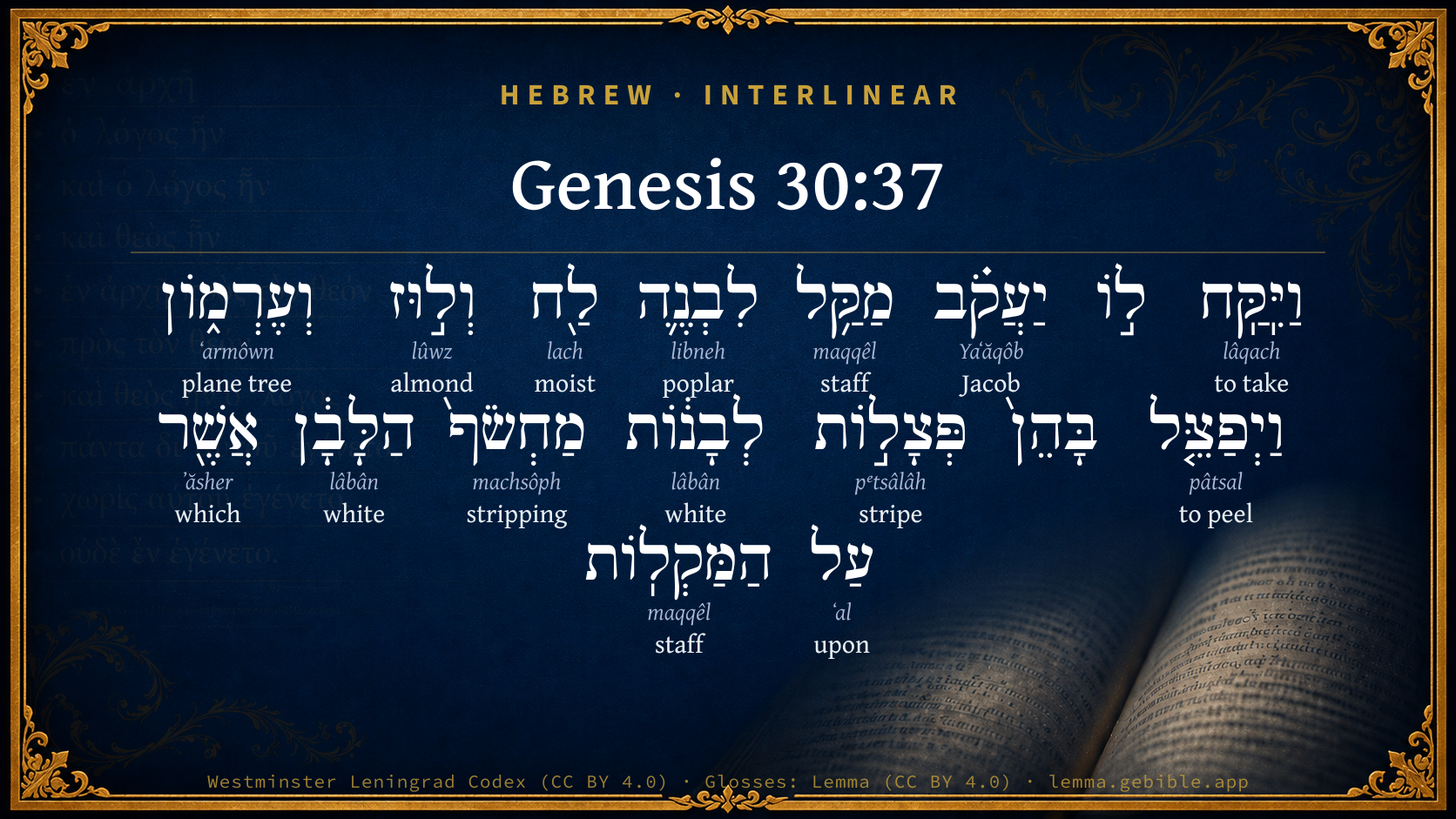
Hebrew (Westminster Leningrad Codex) Genesis 30:37 appears in the Hebrew Old Testament. The text above is from the Westminster Leningrad Codex. Each word links to its Strong’s number, a concise gloss, and parsing drawn from the Open Scriptures Hebrew Bible morphology. Click any word for its full Brown-Driver-Briggs (BDB) entry.
Download image
Cite this verse

Genesis 30:37 (World English Bible). Public Domain. Lemma interlinear Bible study tool, https://lemma.gebible.app/v/genesis/30/37.

Show BibTeX & RIS
BibTeX
RIS
English Translation
Jacob took to himself rods of fresh poplar, almond, plane tree, peeled white streaks in them, and made the white appear which was in the rods.
World English Bible · Public Domain
Highlights Full analysis ↓
Download a study sheet

One document with this verse’s original text, its word-by-word gloss line, the meaning frame, cross-references with their text, attributed commentary, and full source and license credits — printable, and it pastes into notes with its structure intact.

This verse Autodidact and up

Study sheet (.html) Plain text (.txt)

A passage Seminary Student

Up to 50 verses in one chapter. A passage sheet keeps up to 6 commentary sources and 12 cross-references per verse, in the order this page ranks them, and says so on the sheet whenever that leaves anything out. Ask for a single verse and you get the Autodidact verse sheet above.

Everything on this page stays free to read, with no account — the sheet is a download of what is already on screen, not access to it.

Want to remove ads? Support Godless Engineer
Compare translations 3

The same verse in 3 English versions, stacked beneath the original-language interlinear above. Click any original word for its lexicon entry.

Each is an independent rendering of the whole verse — the interlinear is not word-aligned to these translations.

Highlighted words mark where these versions differ — a whole-verse word diff, not a word-by-word alignment.

  • World English Bible Public Domain
    Jacob took to himself rods of fresh poplar, almond, plane tree, peeled white streaks in them, and made the white appear which was in the rods.
  • King James Version Public Domain
    And Jacob took him rods of green poplar, and of the hazel and chestnut tree; and pilled white streaks in them, and made the white appear which was in the rods.
  • unfoldingWord Literal Text CC BY-SA 4.0
    Then Jacob took for himself fresh-cut branches of poplar and almond and plane trees, and peeled white stripes in them, exposing the white that inside the branches.

unfoldingWord Literal Text — © unfoldingWord, licensed CC BY-SA 4.0. Word-aligned USFM3 via Door43 (git.door43.org/unfoldingWord/en_ult).

Versions to compare (up to 4)

3 of 4 selected

Show all 18 translations

Every available English version of this verse, each an independent rendering of the whole verse.

  • World English Bible Public Domain
    Jacob took to himself rods of fresh poplar, almond, plane tree, peeled white streaks in them, and made the white appear which was in the rods.
  • Berean Standard Bible Public Domain
    Jacob, however, took fresh branches of poplar, almond, and plane trees, and peeled the bark, exposing the white inner wood of the branches.
  • Majority Standard Bible Public Domain
    Jacob, however, took fresh branches of poplar, almond, and plane trees, and peeled the bark, exposing the white inner wood of the branches.
  • King James Version Public Domain
    And Jacob took him rods of green poplar, and of the hazel and chestnut tree; and pilled white streaks in them, and made the white appear which was in the rods.
  • American Standard Version (1901) Public Domain
    And Jacob took him rods of fresh poplar, and of the almond and of the plane-tree. And peeled white streaks in them, and made the white appear which was in the rods.
  • Revised Version (1885) Public Domain
    And Jacob took him rods of fresh poplar, and of the almond and of the plane tree; and peeled white strakes in them, and made the white appear which was in the rods.
  • Geneva Bible (1599) Public Domain
    Then Iaakob tooke rods of greene popular, and of hasell, and of the chesnut tree, and pilled white strakes in them, and made the white appeare in the rods.
  • Douay-Rheims (1899) Public Domain
    And Jacob took green robs of poplar, and of almond, and of place trees, and pilled them in part: so when the bark was taken off, in the parts that were pilled, there appeared whiteness: but the parts that were whole remained green: and by this means the colour was divers.
  • Young's Literal Translation Public Domain
    And Jacob taketh to himself a rod of fresh poplar, and of the hazel and chesnut, and doth peel in them white peelings, making bare the white that `is' on the rods,
  • Literal Standard Version CC BY-SA 4.0
    And Jacob takes to himself a rod of fresh poplar and almond and plane-tree, and peels in them white peelings, making bare the white that [is] on the rods,
  • Unlocked Literal Bible CC BY-SA 4.0
    Jacob took fresh cut branches of fresh poplar, and of the almond and of the plane tree, and peeled white streaks in them, and made the white inner wood appear that was in the sticks.
  • unfoldingWord Literal Text CC BY-SA 4.0
    Then Jacob took for himself fresh-cut branches of poplar and almond and plane trees, and peeled white stripes in them, exposing the white that inside the branches.
  • Darby Bible Public Domain
    And Jacob took fresh rods of white poplar, almond-tree, and maple; and peeled off white stripes in them, uncovering the white which was on the rods.
  • World Messianic Bible Public Domain
    Jacob took to himself rods of fresh poplar, almond, and plane tree, peeled white streaks in them, and made the white appear which was in the rods.
  • Webster's Bible Public Domain
    And Jacob took to him rods of green poplar, and of the hazel and chesnut-tree; and peeled white streaks in them, and made the white appear which was in the rods.
  • Free Bible Version CC BY-SA 4.0
    Then Jacob cut some sticks from poplar, almond, and plane trees that had white wood under the bark. He peeled off some of the bark, making the sticks look streaked with white.
  • Bible in Basic English Public Domain
    Then Jacob took young branches of trees, cutting off the skin so that the white wood was seen in bands.
  • JPS Tanakh (1917) Public Domain
    And Jacob took him rods of fresh poplar, and of the almond and of the plane-tree; and peeled white streaks in them, making the white appear which was in the rods.

Literal Standard Version (2020), Covenant Press — licensed CC BY-SA 4.0. Text via the HelloAO Bible API (eBible.org). Unlocked Literal Bible (unfoldingWord) — licensed CC BY-SA 4.0. Text via the HelloAO Bible API (eBible.org). unfoldingWord Literal Text — © unfoldingWord, licensed CC BY-SA 4.0. Word-aligned USFM3 via Door43 (git.door43.org/unfoldingWord/en_ult). Free Bible Version, Dr. Jonathan Gallagher — licensed CC BY-SA 4.0. Text via the HelloAO Bible API (eBible.org).

Word by word

More ways to search: Search by grammar → Find every occurrence → Compare this word →

Practice this passage: Drill this verse → Learn its vocabulary →

וְל֣וּז
lûwz
H3869
“and · almond”
Conjunction + Noun, Common, Masculine, Singular, Absolute
Part of Speech
Conjunction + Noun
Type
Common
Gender
Masculine
Number
Singular
State
Absolute
Full BDB Definition

Origin: probably of foreign origin

TWOT: 1090b

almond tree, almond wood
  1. וַיִּֽקַּֽח lâqach H3947 “and · to take” Conjunction + Verb, Qal, Sequential Imperfect, 3rd Person, Masculine, Singular
  2. יַעֲקֹ֗ב Yaʻăqôb H3290 “Jacob” Noun, Proper
  3. מַקַּ֥ל maqqêl H4731 “staff of” Noun, Common, Masculine, Singular, Construct
  4. לִבְנֶ֛ה libneh H3839 “poplar” Noun, Common, Masculine, Singular, Absolute
  5. לַ֖ח lach H3892 “moist” Adjective, Adjective, Masculine, Singular, Absolute
  6. וְעֶרְמ֑וֹן ʻarmôwn H6196 “and · plane tree” Conjunction + Noun, Common, Masculine, Singular, Absolute
  7. וַיְפַצֵּ֤ל pâtsal H6478 “and · to peel” Conjunction + Verb, Piel, Sequential Imperfect, 3rd Person, Masculine, Singular
  8. פְּצָל֣וֹת pᵉtsâlâh H6479 “stripes” Noun, Common, Feminine, Plural, Absolute
  9. לְבָנ֔וֹת lâbân H3836 “white” Adjective, Adjective, Feminine, Plural, Absolute
  10. מַחְשֹׂף֙ machsôph H4286 “stripping of” Noun, Common, Masculine, Singular, Construct
  11. הַלָּבָ֔ן lâbân H3836 “the · white” Particle, Definite Article + Adjective, Adjective, Masculine, Singular, Absolute
  12. אֲשֶׁ֖ר ʼăsher H834 “which” Particle, Relative
  13. עַל ʻal H5921 “upon” Preposition
  14. הַמַּקְלֽוֹת maqqêl H4731 “the · staves” Particle, Definite Article + Noun, Common, Masculine, Plural, Absolute

About this verse

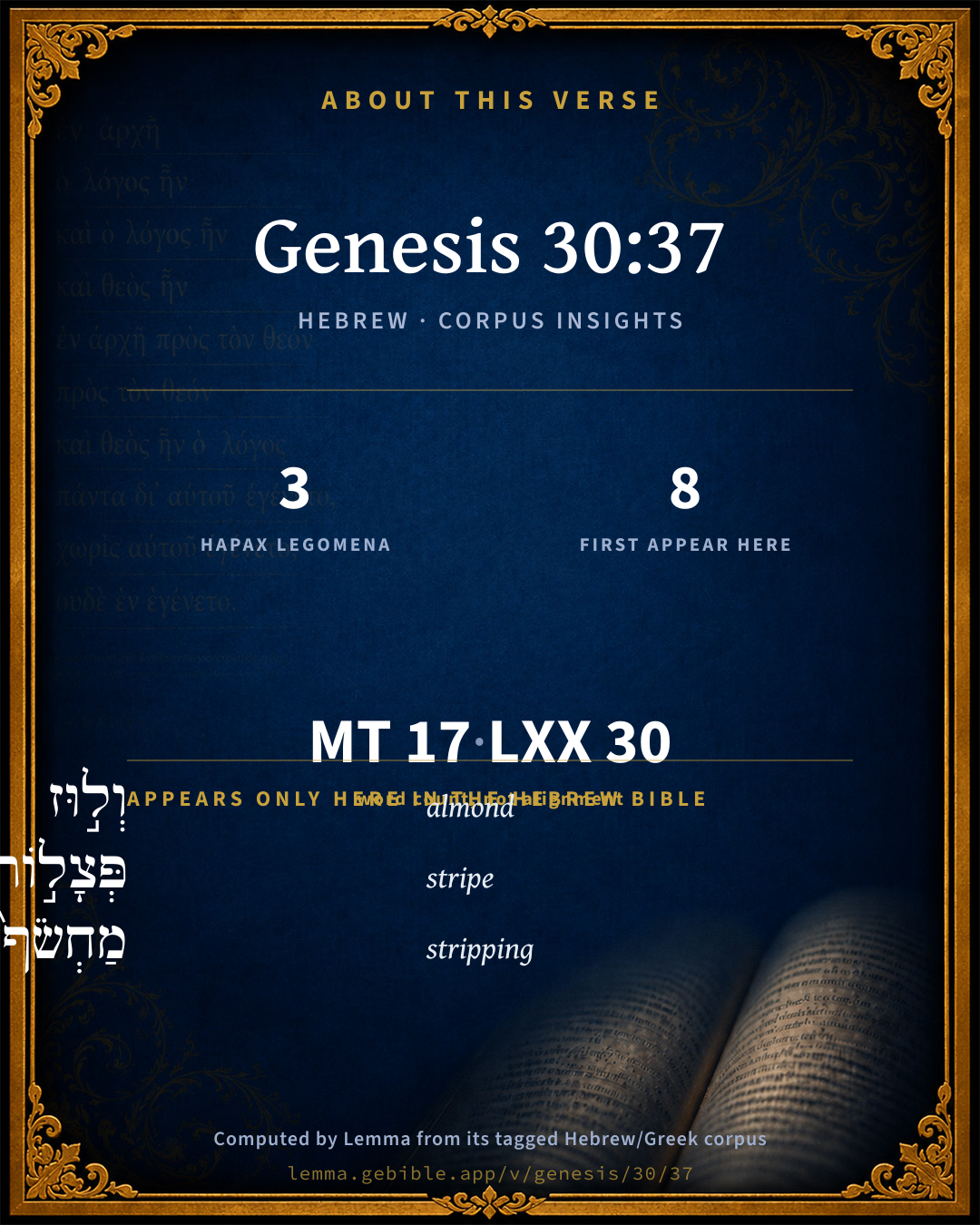
These counts appear in no published source. They are computed here, from the morphology-tagged text and Lemma’s own curated glosses. What Lemma adds →

17
words
13
distinct lemmas
Pentateuch
section

Notable vocabulary

3 hapax legomena — words that appear only here in the entire Hebrew Bible:

  • וְל֣וּז almond H3869
  • פְּצָל֣וֹת stripe H6479
  • מַחְשֹׂף֙ stripping H4286

First appearance in Scripture

These words make their first canonical appearance in the Hebrew Bible here:

  • מַקַּ֥ל staff H4731
  • לִבְנֶ֛ה poplar H3839
  • לַ֖ח moist H3892
  • וְל֣וּז almond H3869
  • וְעֶרְמ֑וֹן plane tree H6196
  • וַיְפַצֵּ֤ל to peel H6478
  • פְּצָל֣וֹת stripe H6479
  • מַחְשֹׂף֙ stripping H4286

Shared distinctive vocabulary

לִבְנֶ֛ה poplar H3839 occurs in 2 verses of the Hebrew Bible. Also found in:

Grammatical profile

  • 2 verbs
  • 8 nouns
  • 3 adjectives
  • 3 prepositions
  • 1 particle

Verb forms

  • וַיִּֽקַּֽח Qal · Sequential Imperfect
  • וַיְפַצֵּ֤ל Piel · Sequential Imperfect

Repetition

Words recur within this verse — often emphatic in Hebrew:

  • מַקַּ֥ל staff H4731 ×2
  • לְבָנ֔וֹת white H3836 ×2

Hebrew & Septuagint length

In English translation the verse runs 26 words from the Hebrew and 41 from the Septuagint (LXX English) — the Septuagint runs noticeably longer here. See the side-by-side →

A rough comparison of the two English renderings, which tokenize alike — not a word-level alignment.

Word counts can differ between the Hebrew and the Greek without any difference in meaning — e.g. the Hebrew direct-object marker אֵת has no separate Greek word, and Greek often adds the article ὁ.

In the original languages it is 17 Hebrew tokens and 30 Greek tokens — but the two are counted differently (Hebrew bundles its prefixes and suffixes into one token; the Greek is in lemma form), so that isn’t a like-for-like length.

Cross-references

2

Topical passages linked to Genesis 30:37 in the Treasury of Scripture Knowledge — connected by theme and wording, ordered by reader-vote popularity; previews shown in the World English Bible.

  • Genesis 31:9–13 Thus God has taken away the cattle of your father, and given them to me.
  • Ezekiel 31:8 The cedars in the garden of God could not hide it; the fir trees were not like its boughs, and the plane trees were not as its branches; nor was any tree in the garden of God like it in its beauty.

Cross-references courtesy of OpenBible.info (CC BY 4.0).

Hebrew and Greek witnesses Masoretic Hebrew ↔ Greek Septuagint

The same verse in the two great witnesses to the Old Testament, shown verse-for-verse.

Here the Septuagint runs noticeably longer than the Hebrew — LXX2012 (modern English Septuagint) 41 words vs World English Bible 26. A rough length comparison of the two English translations, not a word-level alignment — read both below.

These are two independent witnesses, not word-aligned to each other, and the Septuagint is shown in lemma (dictionary) form.

Hebrew Genesis 30:37 Masoretic · Westminster Leningrad Codex

וַיִּֽקַּֽח ל֣וֹ יַעֲקֹ֗ב מַקַּ֥ל לִבְנֶ֛ה לַ֖ח וְל֣וּז וְעֶרְמ֑וֹן וַיְפַצֵּ֤ל בָּהֵן֙ פְּצָל֣וֹת לְבָנ֔וֹת מַחְשֹׂף֙ הַלָּבָ֔ן אֲשֶׁ֖ר עַל הַמַּקְלֽוֹת

Jacob took to himself rods of fresh poplar, almond, plane tree, peeled white streaks in them, and made the white appear which was in the rods.

World English Bible · Public Domain

Greek LXX Genesis 30:37 Septuagint · lemma form

λαμβάνω δέ ἑαυτοῦ ἰακώβ ῥάβδος στυράκινος χλωρός καί καρύινος καί πλάτανος καί λεπίζω αὐτός ἰακώβ λέπισμα λευκός περισύρω ὁ χλωρός φαίνω δέ ἐπί ὁ ῥάβδος ὁ λευκός ὅς λεπίζω ποικίλος

And Jacob took to himself green rods of storax tree and walnut and plane tree; and Jacob peeled in them white stripes; and as he drew off the green, the white stripe which he had made appeared alternate on the rods.

LXX2012 (modern English Septuagint) · Public Domain

On this verse, Adam Clarke's Commentary discusses the Septuagint’s reading. Read the note in Commentary ↓

Hebrew: Westminster Leningrad Codex (CC BY 4.0). Greek: Septuagint (public domain); English from LXX2012 (modern English Septuagint) (Public Domain). How the Septuagint differs from the Hebrew →

Targum (Aramaic paraphrase)

2

The Targum is the ancient Jewish Aramaic paraphrase of the Hebrew Scriptures — an interpretive translation, not the Hebrew text itself. Onkelos (literal) and Pseudo-Jonathan (expansive) render the Torah, and Jonathan the Prophets. Coverage is partial: where no permissively-licensed English translation exists for a verse, only the Aramaic is shown. This is verse-level text, not a word-by-word alignment to the Hebrew.

  1. Targum Onkelos Torah (Genesis–Deuteronomy)
    וּנְסִיב לֵהּ יַעֲקֹב חוּטְרִין דִּלְבָן רַטִּיבִין וִּדְלוּז וְדִדְלוּף וְקַלִּיף בְּהוֹן קִלְפִין חִוָּרִין קִלּוּף חִוָּר דִּי עַל חוּטְרַיָּא

    (no public-domain English translation for this verse)

    Targum Onkelos — Aramaic: “Onkelos Genesis” (public domain); “Onkelos Exodus” (public domain); “Onkelos Leviticus” (public domain); “Onkelos Numbers” (public domain); “Onkelos Deuteronomy” (public domain). English: “Sefaria Community Translation” (CC0 1.0 (public-domain dedication)); “J.W. Etheridge. The Targums of Onkelos and Jonathan Ben Uzziel on the Pentateuch. London: Longmans, Green, 1862” (public domain). Text via Sefaria.

  2. Targum Pseudo-Jonathan Torah (Genesis–Deuteronomy)
    וּנְסֵיב לֵיהּ יַעֲקב חוֹטֶר דְפָרַח לָבָן וְדִילוֹז וְאַרְדְפוֹי וּקְלַף בְּהוֹן קְלִיפִין חִיוְורִין לְגַלָאָה חִיוְורָא דְעַל חוּטְרַיָא

    And Jakob took to him a rod of flowering poplar, and of almond, and of the plane tree, and peeled in them white peelings to disclose the white which was in the rods.

    Targum Pseudo-Jonathan — Aramaic: “Targum Jonathan on Genesis” (public domain); “Targum Jonathan on Exodus” (public domain); “Targum Jonathan on Leviticus” (public domain); “Targum Jonathan on Numbers” (public domain); “Targum Jonathan on Deuteronomy” (public domain). English: “The Targum of Jonathan ben Uzziel, trans. J. W. Etheridge, London, 1862” (public domain). Text via Sefaria.

Commentary

Notes on Genesis 30:37 from classic Christian and Jewish commentators (each source and its license shown beneath its notes). The classic Christian expositions comment on the surrounding passage and are grouped to its opening verse, so a note may address several verses; the Jewish commentaries on the Tanakh (Rashi and others) are per-verse, so they appear only where the commentator wrote on this verse.

Lemma curates 59 commentaries, every one of them public domain or Creative Commons licensed, each selected and text-cleaned for this edition rather than reprinted as found. About our sources →

Matthew Henry's Commentary

Here is Jacob's honest policy to make his bargain more advantageous to himself than it was likely to be. If he had not taken some course to help himself, it would have been a bad bargain indeed, which he knew Laban would never consider, or rather would be well pleased to see him a loser by, so little did Laban consult any one's interest but his own. Now Jacob's contrivances were, 1. To set peeled sticks before the cattle where they were watered, that, looking much at those unusual party-coloured sticks, by the power of imagination they might bring forth young ones in like manner party-coloured, Gen 30:37-39. Probably this custom was commonly used by the shepherds of Canaan, who coveted to have their cattle of this motley colour. Note, It becomes a man to be master of his trade, whatever it is, and to be not only industrious, but ingenious in it, and to be versed in all its lawful arts and mysteries; for what is a man but his trade? There is a discretion which God teaches the husbandman (as plain a trade as that is), and which he ought to learn, Isa 28:26. 2. When he began to have a stock of ringstraked and brown, he contrived to set them first, and to put the faces of the rest towards them, with the same design as in the former contrivance; but would not let his own, that were of one colour, Gen 30:40. Strong impressions, it seems, are made by the eye, with which therefore we have need to make a covenant. 3. When he found that his project succeeded, through the special blessing of God upon it, he contrived, by using it only with the stronger cattle, to secure to himself those that were most valuable, leaving the feebler to Laban, Gen 30:41, Gen 30:42. Thus Jacob increased exceedingly (Gen 30:43), and grew very rich in a little time. This success of his policy, it is true, was not sufficient to justify it, if there had been any thing fraudulent or unjust in it, which we are sure there was not, for he did it by divine direction (Gen 31:12); nor was there any thing in the thing itself but the honest improvement of a fair bargain, which the divine providence wonderfully prospered, both in justice to Jacob whom Laban had wronged and dealt hardly with and in pursuance of the particular promises made to him of the tokens of the divine favour, Note, Those who, while their beginning is small, are humble and honest, contented and industrious, are in a likely way to see their latter end greatly increasing. He that is faithful in a little shall be entrusted with more. He that is faithful in that which is another man's shall be entrusted with something of his own. Jacob, who had been a just servant, became a rich master.

Matthew Henry's Commentary on the Whole Bible (1708–1710) — public domain (CC PDM 1.0). Text via the HelloAO Bible API.

Trapp's Complete Commentary

John Trapp

Gen 30:37 And Jacob took him rods of green poplar, and of the hazel and chesnut tree; and pilled white strakes in them, and made the white appear which [was] in the rods.

Ver. 37. And of the hazel.] Or nut tree, Heb. Luz, which was the ancient name of the city of Bethel; {Gen 28:19} so called, as it seemeth, of nut trees growing there.

John Trapp, A Commentary or Exposition upon All the Books of the Old and New Testament (1647–1656) — public domain. Text from a community e-Sword module.

Joseph Benson's Commentary

Gen 30:37-38. And pilled white streaks in them — Pilled off the bark from the rods, at certain distances, till the white appeared between the bark. He set the rods in the gutters — Or channels of water, at the time when the cattle were wont to couple, that their fancies might be painted with such divers colours as they saw in the rods. As it appears from Gen 31:10, that God, to reward Jacob’s fidelity, and punish Laban’s injustice, determined that the cattle should generally be speckled and spotted; so it is probable he directed him to take this method to attain that end; not as though it were sufficient of itself to produce such an effect, which any person that will make the trial will find it is not; but as a means which God would bless in order to it, and which Jacob was required to use in testimony of his dependance on God, as Naaman was required to wash in the river Jordan, in order to his being cured of his leprosy. Much being said by authors concerning the surprising effects which impressions made upon the imaginations of pregnant animals will have upon the form, shape, and colour of the young, Dr. Shuckford observes, “1st, That it cannot be proved that the method which Jacob used is a natural and effectual way to produce variegated cattle; the ancient naturalists having carried their thoughts upon these subjects much further than they will bear; that the effect of impressions upon the imagination must be very accidental, because the objects that should cause them may or may not be taken notice of. But, 2d, Granting that they might naturally produce the effect here mentioned; yet if, as is probable, Jacob used the rods in obedience to a special divine direction, without knowing any thing of their natural virtue, the effect must still be ascribed immediately to God himself; just as in the case of Hezekiah, though the figs which were applied for his recovery might be a natural remedy for his distemper; yet, since the application of them was not made by any rules of physic then known, but by a divine direction, the cure is justly ascribed to the immediate hand of God.”

Joseph Benson's Commentary on the Old and New Testaments (1811–1818) — public domain. Text from a community e-Sword module.

Whedon's Commentary on the Bible

Daniel D. Whedon

JACOB’S ARTIFICE, Gen_30:37-43.

37. Took him rods — At sight of such imperious attempt at overreaching him, Jacob is not slow to devise means to counteract the wrong. The artifice he adopted was in well-known accord with the fact that any impressive colours fixed in the attention of a female at the time of conception are almost sure to mark the offspring.

Poplar… hazel… chestnut — Some render storax, almond, and plane-tree; others render maple instead of hazel, and walnut instead of chestnut. The wood was doubtless such as had a white wood under a dark bark.

Daniel D. Whedon (gen. ed.), Commentary on the Old and New Testaments (1874–1909) — public domain. Text from a community e-Sword module.

Tyndale Open Study Notes

Tyndale Open Resources

30:37-43 God blessed Jacob despite Laban’s duplicity. Not to be outwitted, Jacob used selective breeding to acquire a flock, following the traditional belief that peeled sticks influenced the kind of animal that would be born. The peeled branches seemingly made his animals produce streaked and spotted young; Jacob later acknowledged that God had prospered him (31:7-12). Jacob gained stronger animals for himself and weaker ones for Laban (30:41-42).

30:37 making white streaks: A clever wordplay captures the meaning of this whole section. When Jacob exposed the white (Hebrew laban) streaks of wood underneath, he played the “white” game (the Laban game) and won. As he outwitted Laban (“Whitey”), Jacob’s flocks flourished and Jacob prospered.

Tyndale Open Study Notes — © Tyndale Open Resources, licensed CC BY-SA 4.0. Text via the HelloAO Bible API.

Geneva Bible (1599)

Geneva Bible translators

Jacob herein used no deceit: for it was God’s commandment as he declareth in Gen. 31:9, 11.

Geneva Bible (1599) marginal notes — public domain. Text via Bolls.life.

Jamieson, Fausset & Brown

Robert Jamieson, A. R. Fausset & David Brown

Jacob took rods, &c.--There are many varieties of the hazel, some of which are more erect than the common hazel, and it was probably one of these varieties Jacob employed. The styles are of a bright red color, when peeled; and along with them he took wands of other shrubs, which, when stripped of the bark, had white streaks. These, kept constantly before the eyes of the female at the time of gestation, his observation had taught him would have an influence, through the imagination, on the future offspring.

Jamieson, Fausset & Brown — Commentary Critical and Explanatory on the Whole Bible (1871) — public domain (CC PDM 1.0). Text via the HelloAO Bible API.

Adam Clarke's Commentary

Verse 37. Rods of green poplar] לבנה לח libneh lach. The libneh is generally understood to mean the white poplar; and the word lach, which is here joined to it, does not so much imply greenness of colour as being fresh, in opposition to witheredness. Had they not been fresh - just cut off, he could not have pilled the bark from them.

And of the hazel] לוז luz, the nut or filbert tree, translated by others the almond tree; which of the two is here intended is not known.

And chestnut tree] ערמון armon, the plane tree, from ערם aram, he was naked. The plane tree is properly called by this name, because of the outer bark naturally peeling off, and leaving the tree bare in various places, having smooth places where it has fallen off. A portion of this bark the plane tree loses every year. The Septuagint translate it in the same way, πλατανος and its name is supposed to be derived from πλατυς, broad, on account of its broad spreading branches, for which the plane tree is remarkable. So we find the Grecian army in Homer, Il. ii., ver. 307, sacrificing καλη υπο πλατανιστω, under a beautiful plane tree.

VIRGIL, Geor. iv. 146, mentions,

- ministrantem platanum potantibus umbras.

The plane tree yielding the convivial shade.

And PETRONIUS ARBITER in Satyr.: -

Nobilis aestivas platanus diffuderat umbras. "The noble plane had spread its summer shade."

See more in Parkhurst. Such a tree would be peculiarly acceptable in hot countries, because of its shade.

Pilled white streaks in them] Probably cutting the bark through in a spiral line, and taking it off in a certain breadth all round the rods, so that the rods would appear party-coloured, the white of the wood showing itself where the bark was stripped off.

Adam Clarke's Commentary on the Bible (1810–1826) — public domain. Text from a community e-Sword/MySword module.

John Calvin's Commentaries

37. And Jacob took him rods of green poplar. The narration of Moses, at first sight, may seem absurd: for he either intends to censure holy Jacob as guilty of fraud, or to praise his industry. But from the context it will appear that this adroitness was not culpable. Let us then see how it is to be excused. Should any one contend that he was impelled to act as he did, by the numerous injuries of his father-in-law, and that he sought nothing but the reparation of former losses; the defense would perhaps be plausible: yet in the sight of God it is neither firm nor probable; for although we may be unjustly treated, we must not enter the contest with equal injustice. And were it permitted to avenge our own injuries, or to repair our own wrongs, there would be no place for legal judgments, and thence would arise horrible confusion. Therefore Jacob ought not to have resorted to this stratagem, for the purpose of producing degenerate cattle, but rather to have followed the rule which the Lord delivers by the mouth of Paul, that the faithful should study to overcome evil with good, (Romans 12:21.) This simplicity, I confess, ought to have been cultivated by Jacob, unless the Lord from heaven had commanded otherwise. But in this narrative there is a hysteron proteron, (a putting of the last first,) for Moses first relates the fact, and then subjoins that Jacob had attempted nothing but by the command of God. Wherefore, it is not for those persons to claim him as their advocate, who oppose malignant and fraudulent men with fallacies like their own; because Jacob did not, of his own will, take license craftily to circumvent his father-in-law, by whom he had been unworthily deceived; but, pursuing the course prescribed to him by the Lord, kept himself within due bounds. In vain, also, according to my judgment, do some dispute whence Jacob learnt this; whether by long practice or by the teaching of his fathers; for it is possible, that he had been suddenly instructed respecting a matter previously unknown. If any one object, the absurdity of supposing, that this act of deceit was suggested by God; the answer is easy, that God is the author of no fraud, when he stretches out his hand to protect his servant. Nothing is more appropriate to him, and more in accordance with his justice, than that he should interpose as an avenger, when any injury is inflicted. But it is not our part to prescribe to him his method of acting. He suffered Laban to retain what he unjustly possessed; but in six years he withdrew his blessing from Laban, and transferred it to his servant Jacob. If an earthly judge condemns a thief to restore twofold or fourfold, no one complains: and why should we concede less to God, than to a mortal and perishing man? He had other methods in his power; but he purposed to connect his grace with the labor and diligence of Jacob, that he might openly repay to him those wages of which he had been long defrauded. For Laban was constrained to open his eyes, which being before shut, he had been accustomed to consume the sweat and even the blood of another. Moreover, as it respects physical causes, it is well known, that the sight of objects by the female has great effect on the form of the foetus. When this happens with women, takes it at least place with animals, where is no reason, but where reigns an enormous rush of carnal lusts. Now Jacob did three things. For first, he stripped the bark from twigs that he might make bare some white places by the incisions in the bark, and thus a varying and manifold color was produced. Secondly, he chose the times when the males and females were assembled. Thirdly, he put the twigs in the waters, for like the drinking feeds the animal parts, it also urges on the sexual drive. By the stronger cattle Moses may be understood to speak of those who bore in spring — by the feeble, those who bore in autumn.

John Calvin's Commentaries (1540-1563) — public domain. Text from the Calvin Translation Society English edition (1840s-50s) via the Christian Classics Ethereal Library (ccel.org). Calvin's coverage is partial (roughly two-thirds of the Bible); uncommented books and verses are honest gaps, never fabricated. The 19th-century editor's footnotes and remarks are omitted so the notes are faithfully Calvin's own voice.

Ellicott's Commentary for English Readers

(37) And Jacob took him rods . . . —Jacob’s plan was to place before the ewes and she-goats at breeding time objects of a speckled colour, and as he put them at their watering-place, where everything was familiar to them, they would, with the usual curiosity of these animals, gaze upon them intently, with the result, physically certain to follow, that many of them would bear speckled young.

Poplar.—Really, the storax-tree (styrax officinalis). “This,” says Canon Tristram, “is a very beautiful perfumed shrub, which grows abundantly on the lower hills of Palestine.” The word occurs elsewhere only in Hos_4:13, and the idea that it was the poplar arises solely from the name signifying white; but this epithet is even more deserved by the storax, “which in March is covered with a sheet of white blossom, and is the predominant shrub through the dells of Carmel and Galilee” (Natural History of the Bible, pp. 395, 396).

Hazel.—Heb., luz (Gen_28:19), the almond-tree (amygdalus communis). Dr. Tristram (Natural History of the Bible, p. 358) says that he never observed the true hazel wild in Southern or Central Pales tine, nor was it likely to occur in Mesopotamia. The almond is one of the most common trees in Palestine.

Chesnut tree.—Heb., armon, the plane-tree (platanus orientalis). “We never,” says Dr. Tristram (p. 345), “saw the chesnut in Palestine, excepting planted in orchards in Lebanon; while the plane-tree, though local, is frequent by the sides of streams and in plains.” The tree is mentioned again in Eze_31:8.

A Bible Commentary for English Readers, edited by Charles John Ellicott (1878–1897) — public domain. Text from a community e-Sword module.

The Cambridge Bible for Schools and Colleges

gen. ed. J. J. S. Perowne

37. poplar] R.V. marg. storax tree. The Hebrew name is libneh, and is probably connected with the word laban, meaning “white.” By some it is identified with the styrax officinalis.

plane tree] In the Hebrew ‘armon, i.e. “naked,” a name derived from the annual scaling of the bark of the tree. The platanus orientalis was held in high veneration in the East. Cf. Eze_31:8.

white strakes] Jacob’s trick turns upon the whiteness of the rods; and this supplies a play upon the name “Laban” (= “white”), who is outwitted by Jacob. The device is said to be well known to shepherds. “Strake” is Old English for “streak”; cf. Lev_14:37.

The Cambridge Bible for Schools and Colleges (gen. ed. J. J. S. Perowne; Cambridge University Press, 1878–1918) — public domain. Text from a community e-Sword module.

John Gill's Exposition

And it came to pass, whensoever the stronger cattle did conceive,.... Whose limbs were well compact, and were strong and healthy:

that Jacob laid the rods before the eyes of the cattle in the gutters,

that they might conceive among the rods; and bring forth party coloured ones, and such as were robust and strong like themselves; and this was another device of Jacob's to get the best of the flock. Aben Ezra thinks this refers to the two seasons of the year, when the flocks conceived; the one was in Nisan, in the spring, and such as were brought on that conception were strong, and therefore Jacob chose to lay the rods in the gutters at that time, that he might have the best cattle; and so the Targum of Jonathan calls these here the forward ones, as it does those in Gen 30:42 we render feeble, the latter ones; which, according to Aben Ezra, conceived in Tisri or September, and what they brought were weak and feeble. (Based on the laws of genetics, Jacob's breeding of the best of the flock would produce higher quality offspring. Ed.)

John Gill's Exposition of the Whole Bible (1746–1763) — public domain (CC PDM 1.0). Text via the HelloAO Bible API.

Matthew Poole's English Annotations

Jacob took rods: this he did by Divine appointment, as will appear in the sequel, which is sufficient for Jacob’s justification.

Took rods of green popular, and of the hazel and chesnut tree; either because these trees were next at hand, or because he saw these in the Divine vision afterwards mentioned, and would exactly follow his pattern. He

made the white appear, by pilling off the rind which covered it.

Matthew Poole's English Annotations on the Holy Bible (1683–1685) — public domain. Text from a community e-Sword/MySword module.

The Pulpit Commentary

And Jacob took him rods of green poplar literally, a rod (the singular being used collectively for rods) of hnbli, (from bl; to be white, meaning either the) poplar (LXX, in Hos_4:13; Vulgate, Kalisch) or the storax (LXX in loco, Keil; cf. Michaelis, "Suppl.," p. 1404) fresh greenand of the hazel zWl, the hazel tree (Raschi, Kimchi, Arabic, Luther, Furst, Kalisch) or the almond tree (Vulgate, Saadias, Calvin, Gesenius, "Speaker s Commentary")and chestnut tree; wOmr, the plane tree (LXX, Vulgate, et alii), so called from its heightand pilled white strakes in them (literally, peeled off in them peeled places white), and made the white appear (literally, making naked the white) which was in the rods.

The Pulpit Commentary (1880–1919), ed. H.D.M. Spence-Jones & Joseph S. Exell — public domain. Text from a community e-Sword module.

John Wesley's Explanatory Notes

Here is Jacob's policy to make his bargain more advantageous to himself than it was likely to be: and if he had not taken some course to help himself, it would have been an ill bargain indeed; which he knew Laban would never have considered, who did not consult any one's interest but his own.

1. Now Jacob's contrivances were, He set pilled sticks before the cattle where they were watered, that looking much at those unusual party-coloured sticks, by the power of imagination, they might bring forth young ones in like manner party-coloured. Probably this custom was commonly used by the shepherds of Canaan, who coveted to have their cattle of this motly colour.

2. When he began to have a flock of ring-straked and brown, he contrived to set them first, and to put the faces of the rest towards them, with the same design as he did the former. Whether this was honest policy, or no, may admit of a question. Read chap. xxxi, 7- 16, and the question is resolved.

John Wesley, Explanatory Notes Upon the Whole Bible (1754–1765) — public domain. Text via the GEBible commentary corpus.

Kretzmann's Popular Commentary

Paul E. Kretzmann

Jacob’s Great Wealth

v. 37. And Jacob took him rods of green poplar, and of the hazel-and chestnut-tree; and pilled white strakes in them, and made the white appear which was in the rods. Since the bark of the Oriental gum, the almond or walnut, and the maple is dark, while all of them have a white, dazzling wood, they lent themselves very well for this purpose.

v. 38. And he set the rods which he had pilled before the flocks in the gutters in the watering-troughs when the flocks came to drink, that they should conceive when they came to drink. The impression which the animals at the time of conception were thus to receive was to be so sudden, deep, and lasting that it would affect the color of their offspring.

v. 39. And the flocks conceived before the rods, while they had their picture before them, and brought forth cattle ring-straked (banded), speckled, and spotted. Jacob’s scheme worked beautifully, causing his flocks to increase very rapidly.

v. 40. And Jacob did separate the lambs, and set the faces of the flocks toward the ring-straked and all the brown in the flock of Laban; and he put his own flocks by themselves, and put them not unto Laban’s cattle. By this second device the black goats and the white sheep were always kept by themselves, nothing in their own herd exciting their attention, whereas the herds of spotted and speckled animals in plain view were bound to make an impression upon the animals at the time of breeding.

v. 41. And it came to pass, whensoever the stronger cattle did conceive, that Jacob laid the rods before the eyes of the cattle in the gutters, that they might conceive among the rods, in the very midst of the pilled staves. This was in the spring, for the lambs and kids born in the fall were considered the stronger and better.

v. 42. But when the cattle were feeble, in the late fall, when the pasturage was no longer so good, he put them not in; so the feebler were Laban’s, and the stronger Jacob’s. Thus Jacob, with the blessing of God, Gen 31:12, succeeded in obtaining some of the wages which were so richly due him for his many years of faithful service. He used all his business sagacity in beating his covetous uncle at his own game, but incidentally kept his word not to appropriate so much as one animal that did not belong to him.

v. 43. And the man increased exceedingly, and had much cattle, and maid-servants, and men-servants, and camels, and asses. All this he acquired, with the blessing of God, in the next six years. Without the blessing of God all wealth is a curse.

Paul E. Kretzmann, Popular Commentary of the Bible (1921–1924) — public domain. Text from a community e-Sword module.

unfoldingWord translationNotes

Door43 World Missions Community

fresh poplar ... almond ... plane tree

These are all trees with white wood. (See: Translate Unknowns)

peeled white streaks in them, and made the white inner wood appear that was in the sticks

"peeled off pieces of bark so that the white wood underneath would show"

the watering troughs

long open containers for holding water for animals to drink

translationWords

conceive

unfoldingWord translationNotes — © Distant Shores Media and the Door43 World Missions Community, licensed CC BY-SA 4.0. Source: git.door43.org/Door43/en_tn.

Rashi

Rabbi Shlomo Yitzchaki (Rashi)

מקל לבנה STICKS OF לבנה — a tree that is called לבנה — just as you say (Hosea 4:13) “Under oaks and poplars (ולבנה)” I think it is what is called in old French tremble; English trembling-poplar, which is white.

לח FRESH — He took it when it was moist.

לוז ALMOND — He also took rods of לוז, a tree upon which small nuts growold French coudre; English hazel.

וערמון is old French chastenier, English chestnut.

פצלות STREAKS — many peelings so that he gave it the appearence of being striped.

מחשוף הלבן MAKING BARE THE WHITE — there was thus an uncovering of the white part of the rod: when he peeled it the white in it became uncovered and visible in the places where it was peeled.

Rashi on the Tanakh — English translations: “The Judaica Press complete Tanach with Rashi, translated by A. J. Rosenberg” (CC BY 4.0); “Pentateuch with Rashi's commentary by M. Rosenbaum and A.M. Silbermann, 1929-1934” (public domain); “The Metsudah Tanach series, Lakewood, N.J” (CC BY 4.0); and “The Book of Joshua, Metsudah Publications, 1997” (CC BY 4.0). Text via Sefaria.

Ramban (Nachmanides)

Rabbi Moshe ben Nachman (Ramban / Nachmanides)

AND JACOB TOOK HIM STICKS OF POPLAR. As soon as they agreed that his hire would be these colors it was permissible for Jacob to do whatever he could to cause them to give birth in this manner. Perhaps Jacob had made a condition that he may do with them whatever he wants since Laban did not know of the ramifications of this measure, nor did Laban’s shepherds sense anything when they saw the sticks in the gutters once a year during the days of Nisan. For When the flocks were feeble in the days of Tishri, he did not put them in, otherwise not a hoof would have remained for Laban.Now some commentators say that the first year [Jacob did not make use of these sticks, but] there were born to him many speckled and spotted ones by virtue of G-d’s blessing which the angel showed him. And then he put the sticks in front of those which were his so that they should give birth in their form. This would prevent Laban from saying that their offspring was stolen by Jacob, [as he would have claimed had they given birth to other colored offspring].This is the meaning of whensoever the stronger flocks became heated, referring to those that had been born to Jacob by way of G-d’s blessing; but when the flocks of Laban were feeble, he put them not in; so that the feebler were Laban’s, for they did not give birth to speckled ones, and the stronger were all Jacob’s, including their offspring, for they gave birth to speckled ones.

Ramban (Nachmanides) on the Tanakh — English translation: “Commentary on the Torah by Ramban (Nachmanides). Translated and annotated by Charles B. Chavel. New York, Shilo Pub. House, 1971-1976” (CC BY 4.0). Text via Sefaria.

Radak

Rabbi David Kimhi (Radak)

ויקח, Yaakov did not do this in the first year, but only from the second year on. He did not place the sticks in front of the animals belonging to Lavan, but only in front of those animals which were now his as a result of the young ones born with the agreed upon skin patterns during that year. When he placed the sticks in front of those animals which were his, he did not intend for them to have young ones of a different skin pattern from the one they already had, but only to ensure that all his animals would give birth to young ones bearing the same skin patterns as did their mothers. In other words, he did not deprive Lavan of anything, either directly or indirectly. He acted in a manner which would not allow Lavan even to suspect him of stealing from him. This is the way my father of blessed memory explained these verses in light of the fact that numerous people, reading the story superficially, had expressed surprise that our patriarch Yaakov had been as devious as a superficial reading of the text makes it appear.

לבנה, a tree (poplar) with a white trunk. (before peeling off its bark) He used such a tree in order to produce the desired colour contrasts after peeling the bark partially into the respective shapes to resemble עקוד ונקוד. This could be done only while the saplings were still moist. He also took branches, or sticks that were moist, fresh, as when peeled they would look more whitish. The trees called here לוז and ערמון respectively, are both well known, (plane-tree ad almond tree.)

Radak on the Tanakh — English translations: “Sefaria Community Translation” (CC0 1.0 (public-domain dedication)); “Eliyahu Munk, HaChut Hameshulash” (CC BY 4.0); “Rabbi Mike Feuer, Jerusalem Anthology” (CC BY 4.0); and “R. David Kimhi on the first book of Psalms, Translated by R.G. Finch, London, 1919” (public domain). Text via Sefaria.

Lesson kit

Teaching starters — assembled from the data on this page, not authored interpretation. Every prompt links to the verse data it draws on. Edit before teaching.

Genesis, in the Pentateuch, opens this verse with 17 words (13 distinct Hebrew lemmas). Its most distinctive word is lûwz (“almond”). The Greek Septuagint runs longer here. A historical commentator’s framing appears above. Read the whole chapter for the surrounding context.

Discussion questions

  1. What does “almond” (lûwz) contribute to the verse as a whole?
  2. 3 words here appear nowhere else in the Hebrew Bible. Why might the author reach for such rare wording?
  3. 8 words make their first appearance in Scripture here. What does this debut establish?
  4. How does Hosea 4:13, which shares the word «poplar», read alongside this verse?
  5. What does the repetition of “staff” (2× in this one verse) do in this verse?
  6. The Septuagint runs longer here than the Hebrew. What might account for the difference?
  7. These translations render this verse differently. What is at stake in choosing one wording over another?
  8. «וַיִּֽקַּֽח» is a Qal Sequential Imperfect verb. How does that grammatical form shape the action described?

Things to notice

  • 3 words in this verse appear nowhere else in the Hebrew Bible.
  • 8 words make their first canonical appearance in Scripture here.
  • This verse counts 17 Hebrew ↔ 30 Greek words.
  • These translations choose different wording for 22 words in this verse.
  • “staff” occurs 2× in this single verse.

Reading settings

Reading text

Shown beneath each verse's original-language words.

Old Testament
Old Testament edition

Read the OT as the Masoretic Hebrew (MT) or the Greek Septuagint (LXX).

English shown for the Greek Septuagint (in the Hebrew ↔ Greek comparison).

Comparing translations? Open the Compare panel on any verse page to stack up to four side by side.