Genesis 32:18

Hebrew (Westminster Leningrad Codex) Genesis 32:18 appears in the Hebrew Old Testament. The text above is from the Westminster Leningrad Codex. Each word links to its Strong’s number, a concise gloss, and parsing drawn from the Open Scriptures Hebrew Bible morphology. Click any word for its full Brown-Driver-Briggs (BDB) entry.
Download image
Cite this verse

Genesis 32:18 (World English Bible). Public Domain. Lemma interlinear Bible study tool, https://lemma.gebible.app/v/genesis/32/18.

Show BibTeX & RIS
BibTeX
RIS
English Translation
Then you shall say, 'They are your servant, Jacob's. It is a present sent to my lord, Esau. Behold, he also is behind us.'"
World English Bible · Public Domain
Download a study sheet

One document with this verse’s original text, its word-by-word gloss line, the meaning frame, cross-references with their text, attributed commentary, and full source and license credits — printable, and it pastes into notes with its structure intact.

This verse Autodidact and up

Study sheet (.html) Plain text (.txt)

A passage Seminary Student

Up to 50 verses in one chapter. A passage sheet keeps up to 6 commentary sources and 12 cross-references per verse, in the order this page ranks them, and says so on the sheet whenever that leaves anything out. Ask for a single verse and you get the Autodidact verse sheet above.

Everything on this page stays free to read, with no account — the sheet is a download of what is already on screen, not access to it.

Want to remove ads? Support Godless Engineer
Compare translations 3

The same verse in 3 English versions, stacked beneath the original-language interlinear above. Click any original word for its lexicon entry.

Each is an independent rendering of the whole verse — the interlinear is not word-aligned to these translations.

Highlighted words mark where these versions differ — a whole-verse word diff, not a word-by-word alignment.

  • World English Bible Public Domain
    Then you shall say, 'They are your servant, Jacob's. It is a present sent to my lord, Esau. Behold, he also is behind us.'"
  • King James Version Public Domain
    Then thou shalt say, They be thy servant Jacob's; it is a present sent unto my lord Esau: and, behold, also he is behind us.
  • unfoldingWord Literal Text CC BY-SA 4.0
    then you say, ‘ to your servant, to Jacob. They a gift sent to my lord, to Esau. And behold, he also behind us.’”

unfoldingWord Literal Text — © unfoldingWord, licensed CC BY-SA 4.0. Word-aligned USFM3 via Door43 (git.door43.org/unfoldingWord/en_ult).

Versions to compare (up to 4)

3 of 4 selected

Show all 18 translations

Every available English version of this verse, each an independent rendering of the whole verse.

  • World English Bible Public Domain
    Then you shall say, 'They are your servant, Jacob's. It is a present sent to my lord, Esau. Behold, he also is behind us.'"
  • Berean Standard Bible Public Domain
    then you are to say, ‘They belong to your servant Jacob. They are a gift, sent to my lord Esau. And behold, Jacob is behind us.’”
  • Majority Standard Bible Public Domain
    then you are to say, ‘They belong to your servant Jacob. They are a gift, sent to my lord Esau. And behold, Jacob is behind us.’”
  • King James Version Public Domain
    Then thou shalt say, They be thy servant Jacob's; it is a present sent unto my lord Esau: and, behold, also he is behind us.
  • American Standard Version (1901) Public Domain
    then thou shalt say `They are' thy servant Jacob's; it is a present sent unto my lord Esau: and, behold, he also is behind us.
  • Revised Version (1885) Public Domain
    then thou shalt say, They be thy servant Jacob’s; it is a present sent unto my lord Esau: and, behold, he also is behind us.
  • Geneva Bible (1599) Public Domain
    Then thou shalt say, They be thy seruant Iaakobs: it is a present sent vnto my lord Esau: and beholde, he him selfe also is behinde vs.
  • Douay-Rheims (1899) Public Domain
    Thou shalt answer: Thy servant Jacob's: he hath sent them as a present to my lord Esau: and he cometh after us.
  • Young's Literal Translation Public Domain
    then thou hast said, Thy servant Jacob's: it `is' a present sent to my lord, to Esau; and lo, he also `is' behind us.'
  • Literal Standard Version CC BY-SA 4.0
    Then you have said, Your servant Jacob’s: it [is] a present sent to my lord, to Esau; and behold, he also [is] behind us.”
  • Unlocked Literal Bible CC BY-SA 4.0
    Then you will say, 'They are your servant Jacob's. They are a gift sent to my master Esau. See, he is also coming after us.'”
  • unfoldingWord Literal Text CC BY-SA 4.0
    then you say, ‘ to your servant, to Jacob. They a gift sent to my lord, to Esau. And behold, he also behind us.’”
  • Darby Bible Public Domain
    -- then thou shalt say, Thy servant Jacob's: it is a gift sent to my lord, to Esau. And behold, he also is behind us.
  • World Messianic Bible Public Domain
    Then you shall say, ‘They are your servant, Jacob’s. It is a present sent to my lord, Esau. Behold, he also is behind us.’”
  • Webster's Bible Public Domain
    Then thou shalt say, They are thy servant Jacob's: it is a present sent to my lord Esau: and behold also he is behind us.
  • Free Bible Version CC BY-SA 4.0
    you are to say to him, ‘Your servant Jacob sends these as a gift to my lord Esau, and he's following us.’”
  • Bible in Basic English Public Domain
    Then say to him, These are your servant Jacob's; they are an offering for my lord, for Esau; and he himself is coming after us.
  • JPS Tanakh (1917) Public Domain
    (32-19) then thou shalt say: They are thy servant Jacob's; it is a present sent unto my lord, even unto Esau; and, behold, he also is behind us.'

Literal Standard Version (2020), Covenant Press — licensed CC BY-SA 4.0. Text via the HelloAO Bible API (eBible.org). Unlocked Literal Bible (unfoldingWord) — licensed CC BY-SA 4.0. Text via the HelloAO Bible API (eBible.org). unfoldingWord Literal Text — © unfoldingWord, licensed CC BY-SA 4.0. Word-aligned USFM3 via Door43 (git.door43.org/unfoldingWord/en_ult). Free Bible Version, Dr. Jonathan Gallagher — licensed CC BY-SA 4.0. Text via the HelloAO Bible API (eBible.org).

Word by word

More ways to search: Search by grammar → Find every occurrence → Compare this word →

Practice this passage: Drill this verse → Learn its vocabulary →

לְעֵשָׂ֑ו
ʻÊsâv
H6215
“to/for · Esau”
Preposition + Noun, Proper
Part of Speech
Preposition + Noun
Type
Proper
Full BDB Definition

Origin: apparently a form of the pass. part. of H6213 in the original sense of handling

TWOT: None

Esau = "hairy" - eldest son of Isaac and Rebecca and twin brother of Jacob; sold the birthright for food when he was hungry and the divine blessing went to Jacob; progenitor of the Arab peoples
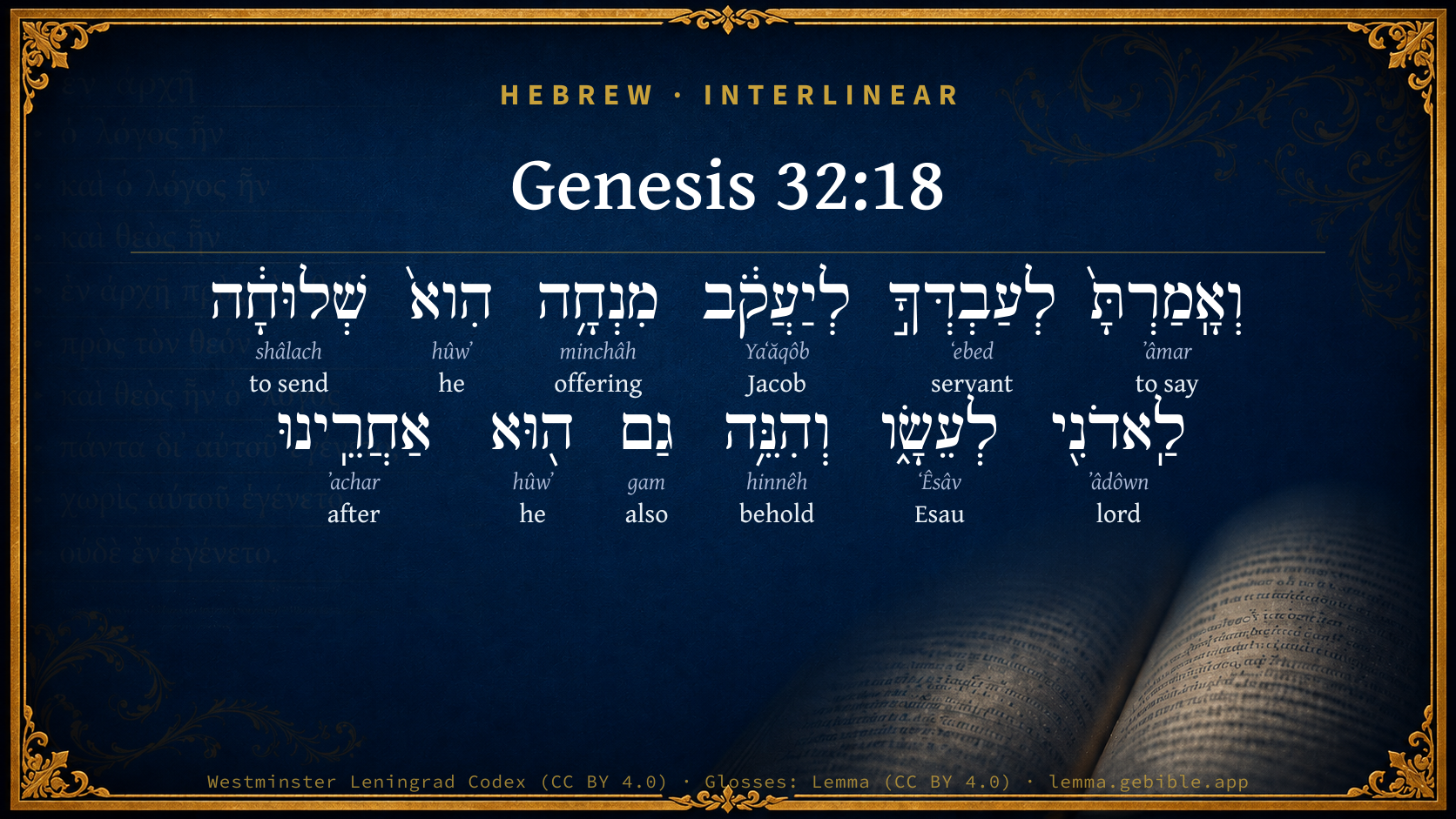
  1. וְאָֽמַרְתָּ֙ ʼâmar H559 “and · to say” Conjunction + Verb, Qal, Sequential Perfect, 2nd Person, Masculine, Singular
  2. לְעַבְדְּךָ֣ ʻebed H5650 “to/for · servant · your” Preposition + Noun, Common, Masculine, Singular, Construct + Suffix, Personal, 2nd Person, Masculine, Singular
  3. לְיַעֲקֹ֔ב Yaʻăqôb H3290 “to/for · Jacob” Preposition + Noun, Proper
  4. מִנְחָ֥ה minchâh H4503 “offering” Noun, Common, Feminine, Singular, Absolute
  5. הִוא֙ hûwʼ H1931 “he” Pronoun, Personal, 3rd Person, Feminine, Singular
  6. שְׁלוּחָ֔ה shâlach H7971 “sent” Verb, Qal, Participle Passive, Feminine, Singular, Absolute
  7. לַֽאדֹנִ֖י ʼâdôwn H113 “to/for · lord · my” Preposition + Noun, Common, Masculine, Singular, Construct + Suffix, Personal, 1st Person, Common, Singular
  8. וְהִנֵּ֥ה hinnêh H2009 “and · behold” Conjunction + Particle, Demonstrative
  9. גַם gam H1571 “also” Adverb
  10. ה֖וּא hûwʼ H1931 “he” Pronoun, Personal, 3rd Person, Masculine, Singular
  11. אַחֲרֵֽינוּ ʼachar H310 “after · us” Preposition + Suffix, Personal, 1st Person, Common, Plural

About this verse

These counts appear in no published source. They are computed here, from the morphology-tagged text and Lemma’s own curated glosses. What Lemma adds →

12
words
11
distinct lemmas
Pentateuch
section

Grammatical profile

  • 2 verbs
  • 5 nouns
  • 2 pronouns
  • 1 preposition
  • 1 adverb
  • 1 particle

Verb forms

  • וְאָֽמַרְתָּ֙ Qal · Sequential Perfect
  • שְׁלוּחָ֔ה Qal · Participle Passive

Repetition

A word recurs within this verse — often emphatic in Hebrew:

  • הִוא֙ he H1931 ×2

Hebrew & Septuagint length

In English translation the verse runs 24 words from the Hebrew and 20 from the Septuagint (LXX English) — closely comparable.

A rough comparison of the two English renderings, which tokenize alike — not a word-level alignment.

Word counts can differ between the Hebrew and the Greek without any difference in meaning — e.g. the Hebrew direct-object marker אֵת has no separate Greek word, and Greek often adds the article ὁ.

Cross-references

1

Topical passages linked to Genesis 32:18 in the Treasury of Scripture Knowledge — connected by theme and wording, ordered by reader-vote popularity; previews shown in the World English Bible.

  • Genesis 32:4–5 He commanded them, saying, "This is what you shall tell my lord, Esau: 'This is what your servant, Jacob, says. I have lived as a foreigner with Laban, and stayed until now.

Cross-references courtesy of OpenBible.info (CC BY 4.0).

Hebrew and Greek witnesses Masoretic Hebrew ↔ Greek Septuagint

The same verse in the two great witnesses to the Old Testament, shown verse-for-verse.

These are two independent witnesses, not word-aligned to each other, and the Septuagint is shown in lemma (dictionary) form.

Hebrew Genesis 32:18 Masoretic · Westminster Leningrad Codex

וְאָֽמַרְתָּ֙ לְעַבְדְּךָ֣ לְיַעֲקֹ֔ב מִנְחָ֥ה הִוא֙ שְׁלוּחָ֔ה לַֽאדֹנִ֖י לְעֵשָׂ֑ו וְהִנֵּ֥ה גַם ה֖וּא אַחֲרֵֽינוּ

Then you shall say, 'They are your servant, Jacob's. It is a present sent to my lord, Esau. Behold, he also is behind us.'"

World English Bible · Public Domain

Greek LXX Genesis 32:18 Septuagint · lemma form

καί ἐντέλλομαι ὁ πρῶτος λέγω ἐάν σύ συνἀντάω ησαυ ὁ ἀδελφός ἐγώ καί ἐρωτάω σύ λέγω τίς εἰμί καί ποῦ πορεύομαι καί τίς οὗτος ὁ προπορεύομαι σύ

You shall say, Your servant Jacob's; he has sent gifts to my lord Esau, and behold! he is behind us.

LXX2012 (modern English Septuagint) · Public Domain

Hebrew: Westminster Leningrad Codex (CC BY 4.0). Greek: Septuagint (public domain); English from LXX2012 (modern English Septuagint) (Public Domain). How the Septuagint differs from the Hebrew →

Targum (Aramaic paraphrase)

2

The Targum is the ancient Jewish Aramaic paraphrase of the Hebrew Scriptures — an interpretive translation, not the Hebrew text itself. Onkelos (literal) and Pseudo-Jonathan (expansive) render the Torah, and Jonathan the Prophets. Coverage is partial: where no permissively-licensed English translation exists for a verse, only the Aramaic is shown. This is verse-level text, not a word-by-word alignment to the Hebrew.

  1. Targum Onkelos Torah (Genesis–Deuteronomy)
    וּפַקִד יָת קַדְמָאָה לְמֵימָר אֲרֵי יְעַרְעִנָּךְ עֵשָׂו אָחִי וּשְׁאֵלִנָּךְ לְמֵימָר לְמָן אַתְּ וּלְאָן אַתְּ אָזֵל וּלְמָן אִלֵּין דִּקֳדָמָךְ

    (no public-domain English translation for this verse)

    Targum Onkelos — Aramaic: “Onkelos Genesis” (public domain); “Onkelos Exodus” (public domain); “Onkelos Leviticus” (public domain); “Onkelos Numbers” (public domain); “Onkelos Deuteronomy” (public domain). English: “Sefaria Community Translation” (CC0 1.0 (public-domain dedication)); “J.W. Etheridge. The Targums of Onkelos and Jonathan Ben Uzziel on the Pentateuch. London: Longmans, Green, 1862” (public domain). Text via Sefaria.

  2. Targum Pseudo-Jonathan Torah (Genesis–Deuteronomy)
    וּפַקֵיד יַת קַמָא לְמֵימַר אֲרוּם יְעַרְעִינָךְ עֵשָו אָחִי וְיִבְעִי מִינָךְ לְמֵימַר דְמַאן אַנְתְּ וּלְאָן אַנְתְּ מְטַיֵיל וּלְמָאן אִילֵין דְקֳדָמָךְ

    And he instructed the first, Saying, When Esau my brother shall meet thee, and ask of thee, saying, Whose art thou, and whither art thou journeying and whose are these before thee?

    Targum Pseudo-Jonathan — Aramaic: “Targum Jonathan on Genesis” (public domain); “Targum Jonathan on Exodus” (public domain); “Targum Jonathan on Leviticus” (public domain); “Targum Jonathan on Numbers” (public domain); “Targum Jonathan on Deuteronomy” (public domain). English: “The Targum of Jonathan ben Uzziel, trans. J. W. Etheridge, London, 1862” (public domain). Text via Sefaria.

Commentary

Notes on Genesis 32:18 from classic Christian and Jewish commentators (each source and its license shown beneath its notes). The classic Christian expositions comment on the surrounding passage and are grouped to its opening verse, so a note may address several verses; the Jewish commentaries on the Tanakh (Rashi and others) are per-verse, so they appear only where the commentator wrote on this verse.

Lemma curates 59 commentaries, every one of them public domain or Creative Commons licensed, each selected and text-cleaned for this edition rather than reprinted as found. About our sources →

Trapp's Complete Commentary

John Trapp

Gen 32:18 Then thou shalt say, [They be] thy servant Jacob’s; it [is] a present sent unto my lord Esau: and, behold, also he [is] behind us.

Ver. 18. They be thy servant Jacob’s.] "A soft answer turneth away wrath": {Pro 15:1} {a} "but grievous words stir up anger." And it is easier to stir strife than stint it. Still, rain softens the hard earth: and though nothing be more violent than the winds, Iidem tamen imbribus sopiuntur, saith Pliny.

“Lenis alit flammas, grandior aura necat.”

How daintily did Gideon disarm the angry Ephraimites {Jdg 8:1} by a mild answer!

It is a present sent, &c.] For, "a gift in secret pacifieth anger". {Pro 21:14} This proverb, in an abbreviature, after that manner, the Jews wrote upon their alms box. {b}

And, behold, also he is behind us.] He sends not only, but comes after us himself, to salute thee, and offer his service unto thee. Thus, by all means, he seeks to assuage the wrath of that rough man.

{a} Frangitur ira gravis, quando est responsio suavis.

{b} Godw., Heb. Antiq. ex Buxtorf.

John Trapp, A Commentary or Exposition upon All the Books of the Old and New Testament (1647–1656) — public domain. Text from a community e-Sword module.

John Gill's Exposition

Then thou shall say, they be thy servant Jacob's,.... Both the goats before them, and they themselves that had the care of them, belonged to Jacob, who directed them to speak of him to Esau as his "servant":

it is a present sent unto my lord Esau; which is the answer to the second question:

and behold also he is behind us: that is, Jacob: this they were bid to tell, lest he should think that Jacob was afraid of him, and was gone another way; but that he was coming to pay a visit to him, and might expect shortly to see him, which would prepare his mind how to behave towards him.

John Gill's Exposition of the Whole Bible (1746–1763) — public domain (CC PDM 1.0). Text via the HelloAO Bible API.

Matthew Poole's English Annotations

Coming to see thy face, and beg thy favour.

Matthew Poole's English Annotations on the Holy Bible (1683–1685) — public domain. Text from a community e-Sword/MySword module.

Rashi

Rabbi Shlomo Yitzchaki (Rashi)

למי אתה means TO WHOM DO YOU BELONG, implying who has sent thee? The Targum should be דמאן את “of whom are you” and not למאן את as some editions have.

ולמי אלה לפניך means and these which are before you whose are they; i.e. to whom is this present being sent? The letter ל is used as a prefix in place of של “belonging to”; e.g., (31:43) “and all that thou seest is mine (לי)” i.e. belongs to me; (Psalms 24:1) “The earth is the Lord’s (לה') and the fullness thereof” i.e. belongs to the Lord.

Rashi on the Tanakh — English translations: “The Judaica Press complete Tanach with Rashi, translated by A. J. Rosenberg” (CC BY 4.0); “Pentateuch with Rashi's commentary by M. Rosenbaum and A.M. Silbermann, 1929-1934” (public domain); “The Metsudah Tanach series, Lakewood, N.J” (CC BY 4.0); and “The Book of Joshua, Metsudah Publications, 1997” (CC BY 4.0). Text via Sefaria.

Radak

Rabbi David Kimhi (Radak)

ויצו, for each species of animal formed a herd by itself supervised by a separate servant. Yaakov instructed the one walking with the first herd to reply to Esau’s enquiry in the manner a servant answers his master.

יפגשך, the letter ג with the vowel kametz is a long drawn out vowel and is weak, does not have a dagesh.

אלה לפניך, as if it said אלה אשר לפניך, “these which preceded you?”

Radak on the Tanakh — English translations: “Sefaria Community Translation” (CC0 1.0 (public-domain dedication)); “Eliyahu Munk, HaChut Hameshulash” (CC BY 4.0); “Rabbi Mike Feuer, Jerusalem Anthology” (CC BY 4.0); and “R. David Kimhi on the first book of Psalms, Translated by R.G. Finch, London, 1919” (public domain). Text via Sefaria.

Lesson kit

Teaching starters — assembled from the data on this page, not authored interpretation. Every prompt links to the verse data it draws on. Edit before teaching.

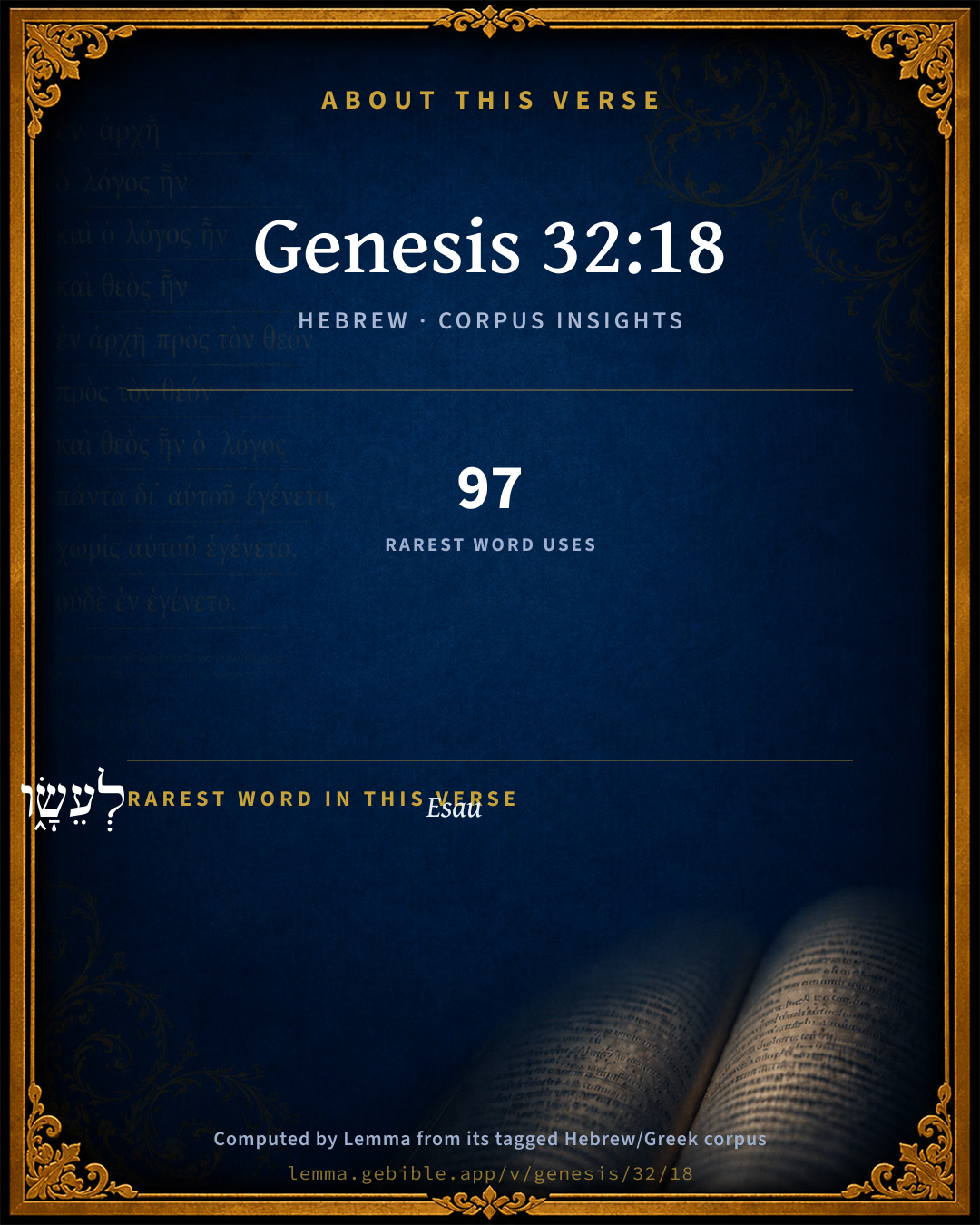
Genesis, in the Pentateuch, opens this verse with 12 words (11 distinct Hebrew lemmas). Its most distinctive word is ʻÊsâv (“Esau”). A historical commentator’s framing appears above. Read the whole chapter for the surrounding context.

Discussion questions

  1. How does “Esau” (ʻÊsâv) shape what this verse is saying?
  2. Genesis 32:4–5 shares this passage’s theme. How do the two illuminate each other?
  3. “he” occurs 2× in this one verse. What is the effect of the repetition?
  4. These translations render this verse differently. What is at stake in choosing one wording over another?
  5. The verb «וְאָֽמַרְתָּ֙» is Qal Sequential Perfect. How does its form color the action?
  6. Reading how Trapp's Complete Commentary and John Gill's Exposition read this verse, where do the two commentators agree and where do they part?

Things to notice

Reading settings

Reading text

Shown beneath each verse's original-language words.

Old Testament
Old Testament edition

Read the OT as the Masoretic Hebrew (MT) or the Greek Septuagint (LXX).

English shown for the Greek Septuagint (in the Hebrew ↔ Greek comparison).

Comparing translations? Open the Compare panel on any verse page to stack up to four side by side.