
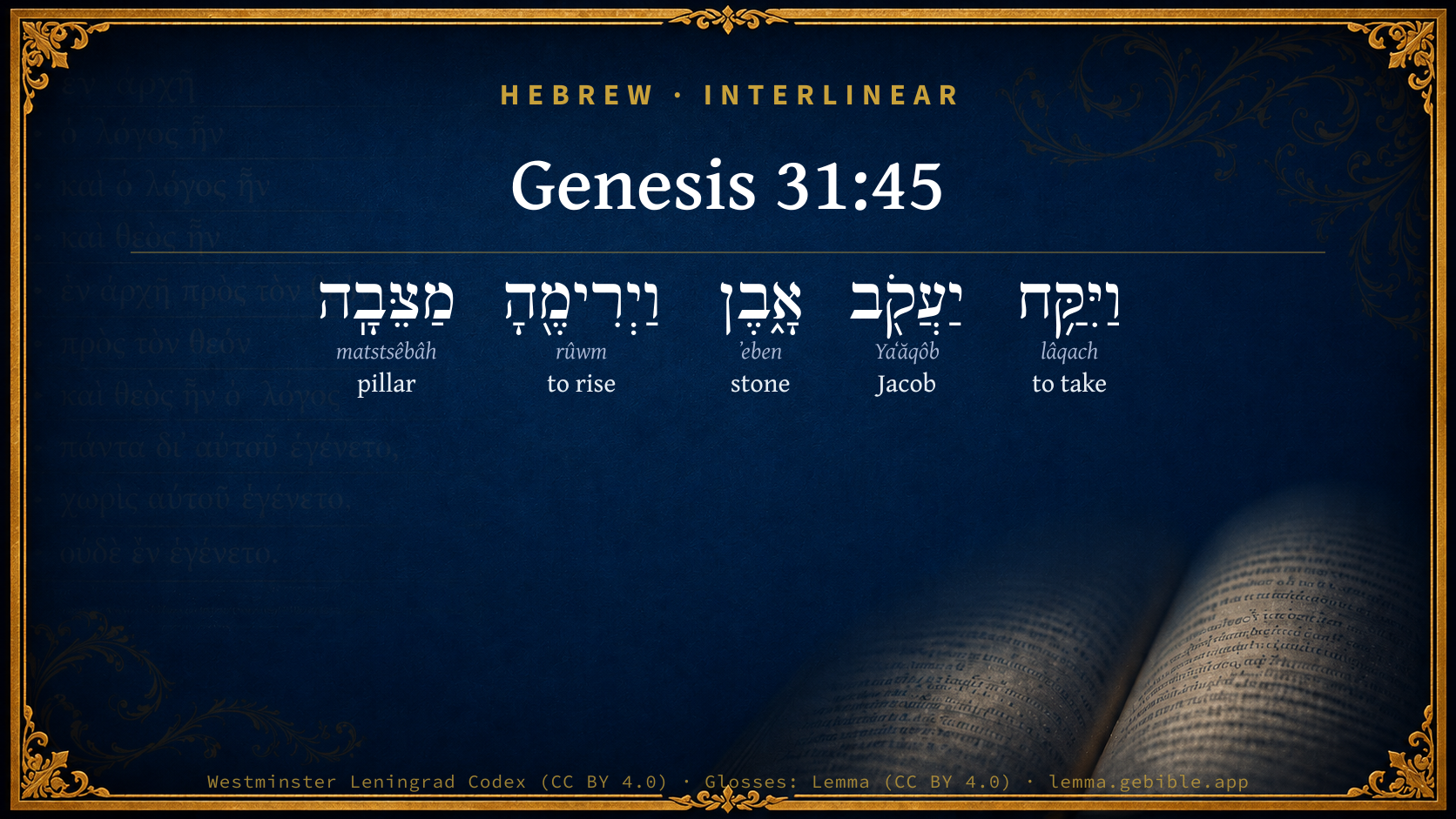
Genesis 31:45

Hebrew (Westminster Leningrad Codex) Genesis 31:45 appears in the Hebrew Old Testament. The text above is from the Westminster Leningrad Codex. Each word links to its Strong’s number, a concise gloss, and parsing drawn from the Open Scriptures Hebrew Bible morphology. Click any word for its full Brown-Driver-Briggs (BDB) entry.
Download image
Cite this verse

Genesis 31:45 (World English Bible). Public Domain. Lemma interlinear Bible study tool, https://lemma.gebible.app/v/genesis/31/45.

Show BibTeX & RIS
BibTeX
RIS
English Translation
Jacob took a stone, and set it up for a pillar.
World English Bible · Public Domain
Download a study sheet

One document with this verse’s original text, its word-by-word gloss line, the meaning frame, cross-references with their text, attributed commentary, and full source and license credits — printable, and it pastes into notes with its structure intact.

This verse Autodidact and up

Study sheet (.html) Plain text (.txt)

A passage Seminary Student

Up to 50 verses in one chapter. A passage sheet keeps up to 6 commentary sources and 12 cross-references per verse, in the order this page ranks them, and says so on the sheet whenever that leaves anything out. Ask for a single verse and you get the Autodidact verse sheet above.

Everything on this page stays free to read, with no account — the sheet is a download of what is already on screen, not access to it.

Want to remove ads? Support Godless Engineer
Compare translations 3

The same verse in 3 English versions, stacked beneath the original-language interlinear above. Click any original word for its lexicon entry.

Each is an independent rendering of the whole verse — the interlinear is not word-aligned to these translations.

Highlighted words mark where these versions differ — a whole-verse word diff, not a word-by-word alignment.

  • World English Bible Public Domain
    Jacob took a stone, and set it up for a pillar.
  • King James Version Public Domain
    And Jacob took a stone, and set it up for a pillar.
  • unfoldingWord Literal Text CC BY-SA 4.0
    So Jacob took a stone and set it up a pillar.

unfoldingWord Literal Text — © unfoldingWord, licensed CC BY-SA 4.0. Word-aligned USFM3 via Door43 (git.door43.org/unfoldingWord/en_ult).

Versions to compare (up to 4)

3 of 4 selected

Show all 18 translations

Every available English version of this verse, each an independent rendering of the whole verse.

  • World English Bible Public Domain
    Jacob took a stone, and set it up for a pillar.
  • Berean Standard Bible Public Domain
    So Jacob picked out a stone and set it up as a pillar,
  • Majority Standard Bible Public Domain
    So Jacob picked out a stone and set it up as a pillar,
  • King James Version Public Domain
    And Jacob took a stone, and set it up for a pillar.
  • American Standard Version (1901) Public Domain
    And Jacob took a stone, and set it up for a pillar.
  • Revised Version (1885) Public Domain
    And Jacob took a stone, and set it up for a pillar.
  • Geneva Bible (1599) Public Domain
    Then tooke Iaakob a stone, and set it vp as a pillar:
  • Douay-Rheims (1899) Public Domain
    And Jacob took a stone, and set it up for a title:
  • Young's Literal Translation Public Domain
    And Jacob taketh a stone, and lifteth it up `for' a standing pillar;
  • Literal Standard Version CC BY-SA 4.0
    And Jacob takes a stone, and lifts it up [for] a standing pillar;
  • Unlocked Literal Bible CC BY-SA 4.0
    So Jacob took a stone and set it up as a pillar.
  • unfoldingWord Literal Text CC BY-SA 4.0
    So Jacob took a stone and set it up a pillar.
  • Darby Bible Public Domain
    And Jacob took a stone, and set it up [for] a pillar.
  • World Messianic Bible Public Domain
    Jacob took a stone, and set it up for a pillar.
  • Webster's Bible Public Domain
    And Jacob took a stone, and set it up for a pillar.
  • Free Bible Version CC BY-SA 4.0
    Jacob took a stone and set it upright as a pillar.
  • Bible in Basic English Public Domain
    Then Jacob took a stone and put it up as a pillar.
  • JPS Tanakh (1917) Public Domain
    And Jacob took a stone, and set it up for a pillar.

Literal Standard Version (2020), Covenant Press — licensed CC BY-SA 4.0. Text via the HelloAO Bible API (eBible.org). Unlocked Literal Bible (unfoldingWord) — licensed CC BY-SA 4.0. Text via the HelloAO Bible API (eBible.org). unfoldingWord Literal Text — © unfoldingWord, licensed CC BY-SA 4.0. Word-aligned USFM3 via Door43 (git.door43.org/unfoldingWord/en_ult). Free Bible Version, Dr. Jonathan Gallagher — licensed CC BY-SA 4.0. Text via the HelloAO Bible API (eBible.org).

Word by word

More ways to search: Search by grammar → Find every occurrence → Compare this word →

Practice this passage: Drill this verse → Learn its vocabulary →

About this verse

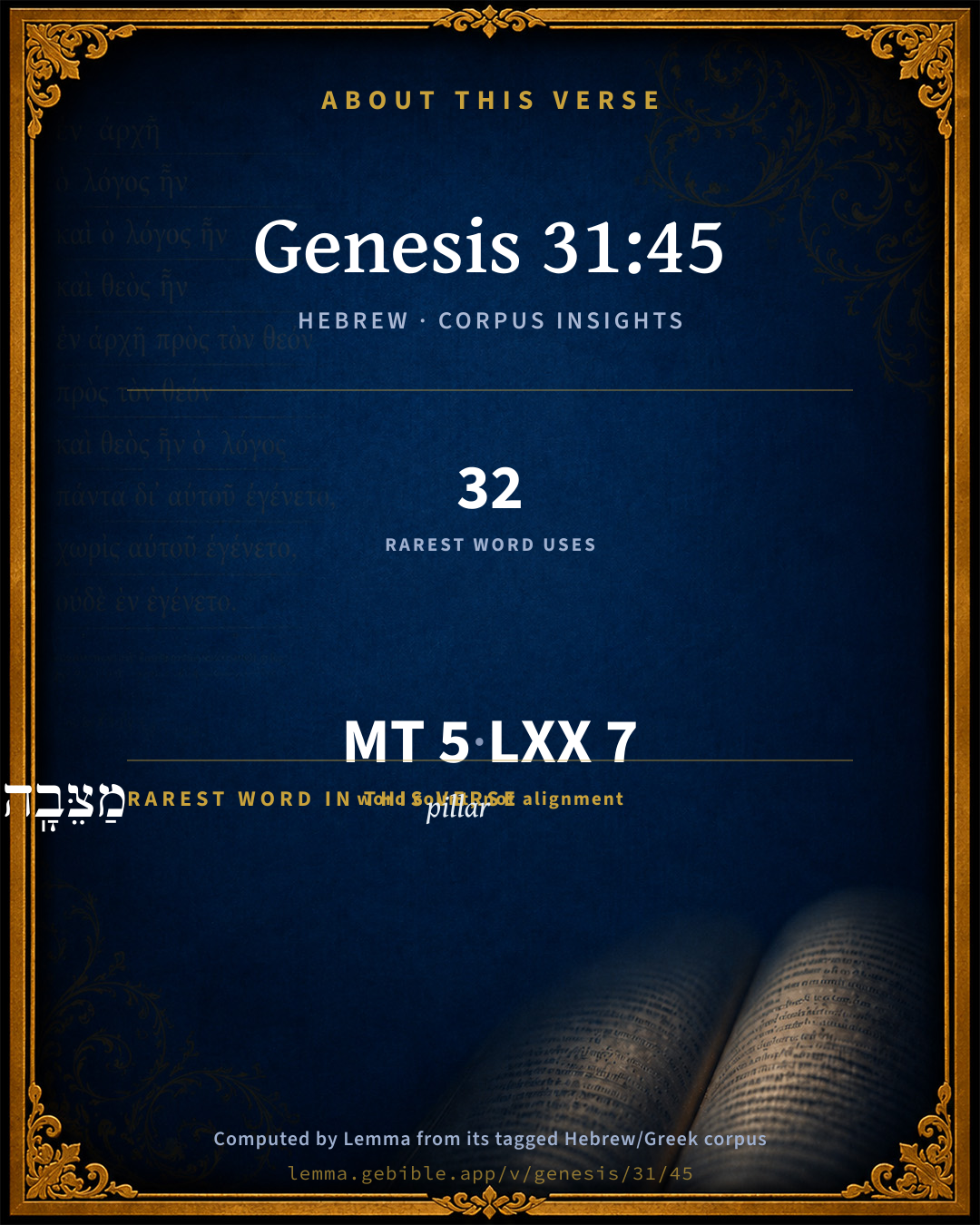
These counts appear in no published source. They are computed here, from the morphology-tagged text and Lemma’s own curated glosses. What Lemma adds →

5
words
5
distinct lemmas
Pentateuch
section

Shared distinctive vocabulary

מַצֵּבָֽה pillar H4676 occurs in 31 verses of the Hebrew Bible. Also found in:

Grammatical profile

  • 2 verbs
  • 3 nouns

Verb forms

  • וַיִּקַּ֥ח Qal · Sequential Imperfect
  • וַיְרִימֶ֖הָ Hiphil · Sequential Imperfect

Hebrew & Septuagint length

In English translation the verse runs 11 words from the Hebrew and 12 from the Septuagint (LXX English) — closely comparable.

A rough comparison of the two English renderings, which tokenize alike — not a word-level alignment.

Word counts can differ between the Hebrew and the Greek without any difference in meaning — e.g. the Hebrew direct-object marker אֵת has no separate Greek word, and Greek often adds the article ὁ.

In the original languages it is 5 Hebrew tokens and 7 Greek tokens — but the two are counted differently (Hebrew bundles its prefixes and suffixes into one token; the Greek is in lemma form), so that isn’t a like-for-like length.

Cross-references

1

Topical passages linked to Genesis 31:45 in the Treasury of Scripture Knowledge — connected by theme and wording, ordered by reader-vote popularity; previews shown in the World English Bible.

  • Genesis 28:18–22 Jacob rose up early in the morning, and took the stone that he had put under his head, and set it up for a pillar, and poured oil on the top of it.

Cross-references courtesy of OpenBible.info (CC BY 4.0).

Hebrew and Greek witnesses Masoretic Hebrew ↔ Greek Septuagint

The same verse in the two great witnesses to the Old Testament, shown verse-for-verse.

These are two independent witnesses, not word-aligned to each other, and the Septuagint is shown in lemma (dictionary) form.

Hebrew Genesis 31:45 Masoretic · Westminster Leningrad Codex

וַיִּקַּ֥ח יַעֲקֹ֖ב אָ֑בֶן וַיְרִימֶ֖הָ מַצֵּבָֽה

Jacob took a stone, and set it up for a pillar.

World English Bible · Public Domain

Greek LXX Genesis 31:45 Septuagint · lemma form

λαμβάνω δέ ἰακώβ λίθος ἵστημι αὐτός στήλη

And Jacob having taken a stone, set it up for a pillar.

LXX2012 (modern English Septuagint) · Public Domain

Hebrew: Westminster Leningrad Codex (CC BY 4.0). Greek: Septuagint (public domain); English from LXX2012 (modern English Septuagint) (Public Domain). How the Septuagint differs from the Hebrew →

Targum (Aramaic paraphrase)

2

The Targum is the ancient Jewish Aramaic paraphrase of the Hebrew Scriptures — an interpretive translation, not the Hebrew text itself. Onkelos (literal) and Pseudo-Jonathan (expansive) render the Torah, and Jonathan the Prophets. Coverage is partial: where no permissively-licensed English translation exists for a verse, only the Aramaic is shown. This is verse-level text, not a word-by-word alignment to the Hebrew.

  1. Targum Onkelos Torah (Genesis–Deuteronomy)
    וּנְסִיב יַעֲקֹב אַבְנָא וּזְקָפַהּ קָמָא

    (no public-domain English translation for this verse)

    Targum Onkelos — Aramaic: “Onkelos Genesis” (public domain); “Onkelos Exodus” (public domain); “Onkelos Leviticus” (public domain); “Onkelos Numbers” (public domain); “Onkelos Deuteronomy” (public domain). English: “Sefaria Community Translation” (CC0 1.0 (public-domain dedication)); “J.W. Etheridge. The Targums of Onkelos and Jonathan Ben Uzziel on the Pentateuch. London: Longmans, Green, 1862” (public domain). Text via Sefaria.

  2. Targum Pseudo-Jonathan Torah (Genesis–Deuteronomy)
    וּנְסֵיב יַעֲקב אַבְנָא וְזָקְפָא לְקָמָא

    And Jakob took a stone and set it up for a pillar.

    Targum Pseudo-Jonathan — Aramaic: “Targum Jonathan on Genesis” (public domain); “Targum Jonathan on Exodus” (public domain); “Targum Jonathan on Leviticus” (public domain); “Targum Jonathan on Numbers” (public domain); “Targum Jonathan on Deuteronomy” (public domain). English: “The Targum of Jonathan ben Uzziel, trans. J. W. Etheridge, London, 1862” (public domain). Text via Sefaria.

Commentary

Notes on Genesis 31:45 from classic Christian and Jewish commentators (each source and its license shown beneath its notes). The classic Christian expositions comment on the surrounding passage and are grouped to its opening verse, so a note may address several verses; the Jewish commentaries on the Tanakh (Rashi and others) are per-verse, so they appear only where the commentator wrote on this verse.

Lemma curates 59 commentaries, every one of them public domain or Creative Commons licensed, each selected and text-cleaned for this edition rather than reprinted as found. About our sources →

Trapp's Complete Commentary

John Trapp

Gen 31:45 And Jacob took a stone, and set it up [for] a pillar.

Ver. 45. A stone.] Or stones, as Gen 31:46.

John Trapp, A Commentary or Exposition upon All the Books of the Old and New Testament (1647–1656) — public domain. Text from a community e-Sword module.

The Pulpit Commentary

CHAPTER 31:45-55

And Jacob took a stone, and set it up for a pillar or Matzebah, as a memorial or witness of the covenant about to be formed (ver. 52); a different transaction from the piling of the stone-heap next referred to. (of Gen_28:18; Jos_14:2-7)

HOMILETICS.

Vers. 45-55.

Galeed and Mizpah, or the covenant of peace.

I THE COVENANT MEMORIALS.

1. The pillar of remembrance. The erection of the stone slab appears to have been the act of Jacob alone, and to have been designed to commemorate the important transaction about to be entered into with Laban. It is well to keep note of those engagements we make with our fellow-men in order to their punctual fulfillment; much more of those we make with God. It does not appear that any name was given to the column, and this may have been because it was intended chiefly for himself.

2. The pile of witness. This was the work both of Laban and Jacob, which they conjointly performed through the instrumentality of their brethren; and being of the nature of a public monument, it was further characterized by a name Laban calling it Jegar-sahadutha, and Jacob styling it Galeed, both expressions signifying heap of witness, and perhaps both of them naming it Mizpah, or watchtower, from the nature of the oath which they both took on the occasion. Men who are truly sincere in their covenant engagements are never afraid to bind themselves by public attestations of their good faith, though it is certain that of all men these least require to be so bound.

II THE COVENANT WORDS.

1. The solemn engagements. On the one hand Laban undertakes never to pass the stone heap on Gilead to do injury to Jacob not mentioning the pillar, which was purely of Jacob"s construction, and therefore supposed to have a religious significance solely for Jacob; and on the other hand Jacob records his vow never to cross the pillar and the pile to inflict wrong on Laban, and in addition, as Laban might be injured in his daughters without crossing the forbidden line, never to afflict Rachel and Leah by taking other wives besides them; The engagement on both sides is to abstain from doing injury of any sort to each other; and to this all men are bound by both natural and revealed religion without the formality of an oath; and much more than other men, are Christians taken bound by God"s grace and Christ"s blood to live peaceably with all men and be at peace amongst themselves.

2. The impressive oaths. If it is dubious whether Laban appealed to God or only to the stone-heap to witness his sincerity in promising not to harm Jacob, it is certain that he appealed to God to keep a strict eye on Jacob (ver. 49), and in a semi-superstitious way united the God of Abraham and the God of Nahor, the God of their fathers, to judge between them. Jacob does not mention either pile or pillar, but swears by the fear of his father Isaac.

III THE COVENANT ACTIONS.

1. The sacrifice. The offering of sacrifice was essential to the formation of a covenant. As between God and man, it virtually proclaimed that God could enter into amicable relations with sinful man only on the basis of an atonement. As between man and man, it was equivalent to an acknowledgment by the covenanting parties that both required to be covered with the blood of propitiation. That Jacob, and not Laban, offered sacrifice intimates that these truths were already in some degree appreciated by Jacob, though possibly they were not understood by Laban.

2. The feast. In making this feast Jacob may only have been following the example of his father Isaac, who similarly entertained Abimelech and his statesmen at Beersheba on the occasion" of the treaty which was there formed between them; but the sacrificial feast afterwards became an important element in the Mosaic cultus, and was designed to express the idea of house and table fellowship between the covenanting parties.

IV THE COVENANT RESULTS.

1. The kiss of reconciliation. It is not certain that Laban kissed Jacob when he prepared for his departure in the morning; perhaps that was too much to expect; but he kissed Rachel and Leah and their children. It was a sign of forgiveness not alone to them, but through them also to Jacob.

2. The paternal benediction. Laban, whose better nature appears to have returned as the result of the covenant, or of the feast, or of the contemplated parting with his daughters, poured out his feelings in a farewell blessing on their heads. It is the last we hear or see of Laban in the Scripture narrative. Let us hope it was the revival of early kindness and piety in the old man"s heart.

The Pulpit Commentary (1880–1919), ed. H.D.M. Spence-Jones & Joseph S. Exell — public domain. Text from a community e-Sword module.

Tyndale Open Study Notes

Tyndale Open Resources

31:45-48 The stone and the heap of stones were a monument to the border treaty between the two men, as a witness to future generations. Each man named the monument witness pile in his native language. It remained the perpetual border between Israel and the kingdom of Aram (Syria), two nations often at war.

Tyndale Open Study Notes — © Tyndale Open Resources, licensed CC BY-SA 4.0. Text via the HelloAO Bible API.

The Cambridge Bible for Schools and Colleges

gen. ed. J. J. S. Perowne

45. Jacob] The name “Jacob” is here almost certainly a gloss. We should read either “and he took a stone,” or “and Laban took a stone.” In Gen_31:51 Laban says that he set up the pillar or maṣṣêbah. Laban erects the pillar; Jacob makes the heap of stones.

a pillar] Heb. maṣṣêbah. As Jacob had done at Bethel, Gen_28:18.

The Cambridge Bible for Schools and Colleges (gen. ed. J. J. S. Perowne; Cambridge University Press, 1878–1918) — public domain. Text from a community e-Sword module.

John Gill's Exposition

And Laban said, this heap is a witness between me and thee this day. A witness of the covenant now about to be made between them that day, and a witness against them should they break it:

therefore was the name of it called Galeed; by Jacob, as before observed; See Gill on Gen 31:47.

John Gill's Exposition of the Whole Bible (1746–1763) — public domain (CC PDM 1.0). Text via the HelloAO Bible API.

Matthew Poole's English Annotations

In testimony of his compliance with Laban’s proposal, and his entering into this covenant. See Exo 24:4.

Matthew Poole's English Annotations on the Holy Bible (1683–1685) — public domain. Text from a community e-Sword/MySword module.

unfoldingWord translationNotes

Door43 World Missions Community

pillar

This means that a large stone was simply set up on its end to mark the place where this important event happened.

made a pile

"stacked them on top of each other"

Then they ate there by the pile

Eating a meal together was a part of making the covenant with one another. The full meaning of this may be made explicit. (See: Assumed Knowledge and Implicit Information)

Jegar Saha Dutha

Translators may add a footnote that says: "The name Jegar Saha Dutha means 'heap of witness' in Laban's language." (See: How to Translate Names)

Galeed

Translators may add a footnote that says: "The name Galeed means 'heap of witness' in Jacob's language. (See: How to Translate Names)

translationWords

column

unfoldingWord translationNotes — © Distant Shores Media and the Door43 World Missions Community, licensed CC BY-SA 4.0. Source: git.door43.org/Door43/en_tn.

Radak

Rabbi David Kimhi (Radak)

ויקח...וירימה מצבה. He tilted the stone to be upright and placed it on an elevation in the neighbourhood so that it would be visible from a distance. This is the meaning of the word וירימה, as distinct from simply וישם, as for instance in Genesis 28,18. This is also why he called it מצפה, “a lookout point.”

Radak on the Tanakh — English translations: “Sefaria Community Translation” (CC0 1.0 (public-domain dedication)); “Eliyahu Munk, HaChut Hameshulash” (CC BY 4.0); “Rabbi Mike Feuer, Jerusalem Anthology” (CC BY 4.0); and “R. David Kimhi on the first book of Psalms, Translated by R.G. Finch, London, 1919” (public domain). Text via Sefaria.

Lesson kit

Teaching starters — assembled from the data on this page, not authored interpretation. Every prompt links to the verse data it draws on. Edit before teaching.

Genesis, in the Pentateuch, opens this verse with 5 words (5 distinct Hebrew lemmas). Its most distinctive word is matstsêbâh (“pillar”). A historical commentator’s framing appears above. Read the whole chapter for the surrounding context.

Discussion questions

  1. How does “pillar” (matstsêbâh) shape what this verse is saying?
  2. How does Genesis 28:18, which shares the word «pillar», read alongside this verse?
  3. «וַיִּקַּ֥ח» is a Qal Sequential Imperfect verb. How does that grammatical form shape the action described?
  4. Compare how Trapp's Complete Commentary and The Pulpit Commentary read this verse. Where do they agree or differ?

Things to notice

Reading settings

Reading text

Shown beneath each verse's original-language words.

Old Testament
Old Testament edition

Read the OT as the Masoretic Hebrew (MT) or the Greek Septuagint (LXX).

English shown for the Greek Septuagint (in the Hebrew ↔ Greek comparison).

Comparing translations? Open the Compare panel on any verse page to stack up to four side by side.