
1 Kings 18:31

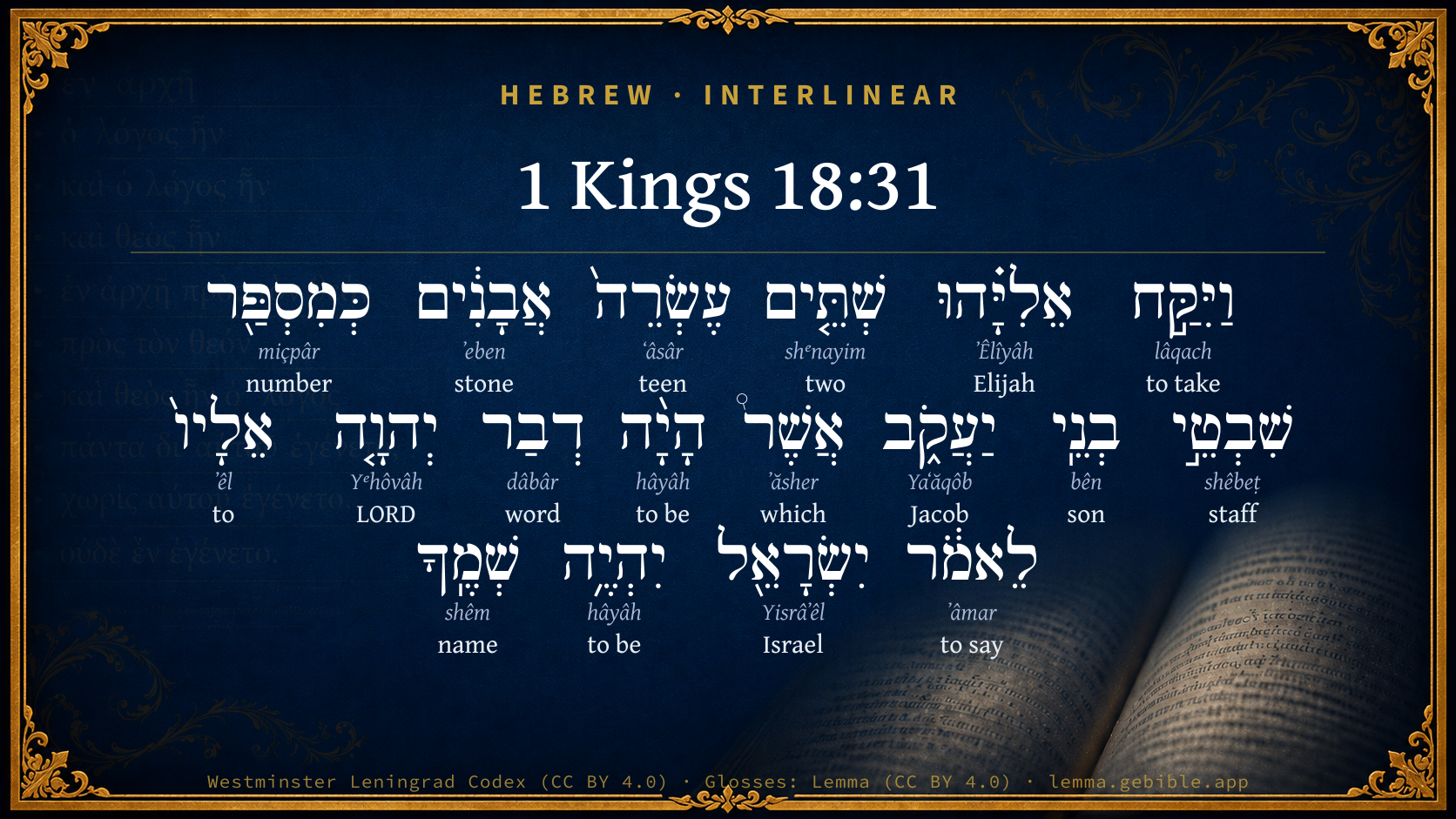
Hebrew (Westminster Leningrad Codex) 1 Kings 18:31 appears in the Hebrew Old Testament. The text above is from the Westminster Leningrad Codex. Each word links to its Strong’s number, a concise gloss, and parsing drawn from the Open Scriptures Hebrew Bible morphology. Click any word for its full Brown-Driver-Briggs (BDB) entry.
Download image
Cite this verse

1 Kings 18:31 (World English Bible). Public Domain. Lemma interlinear Bible study tool, https://lemma.gebible.app/v/1-kings/18/31.

Show BibTeX & RIS
BibTeX
RIS
English Translation
Elijah took twelve stones, according to the number of the tribes of the sons of Jacob, to whom the word of Yahweh came, saying, Israel shall be your name.
World English Bible · Public Domain
Download a study sheet

One document with this verse’s original text, its word-by-word gloss line, the meaning frame, cross-references with their text, attributed commentary, and full source and license credits — printable, and it pastes into notes with its structure intact.

This verse Autodidact and up

Study sheet (.html) Plain text (.txt)

A passage Seminary Student

Up to 50 verses in one chapter. A passage sheet keeps up to 6 commentary sources and 12 cross-references per verse, in the order this page ranks them, and says so on the sheet whenever that leaves anything out. Ask for a single verse and you get the Autodidact verse sheet above.

Everything on this page stays free to read, with no account — the sheet is a download of what is already on screen, not access to it.

Want to remove ads? Support Godless Engineer
Compare translations 3

The same verse in 3 English versions, stacked beneath the original-language interlinear above. Click any original word for its lexicon entry.

Each is an independent rendering of the whole verse — the interlinear is not word-aligned to these translations.

Highlighted words mark where these versions differ — a whole-verse word diff, not a word-by-word alignment.

  • World English Bible Public Domain
    Elijah took twelve stones, according to the number of the tribes of the sons of Jacob, to whom the word of Yahweh came, saying, Israel shall be your name.
  • King James Version Public Domain
    And Elijah took twelve stones, according to the number of the tribes of the sons of Jacob, unto whom the word of the LORD came, saying, Israel shall be thy name:
  • unfoldingWord Literal Text CC BY-SA 4.0
    And Elijah took 12 stones, according to the number of the tribes of the sons of Jacob, to whom the word of Yahweh had been, saying, “Israel shall be your name.”

unfoldingWord Literal Text — © unfoldingWord, licensed CC BY-SA 4.0. Word-aligned USFM3 via Door43 (git.door43.org/unfoldingWord/en_ult).

Versions to compare (up to 4)

3 of 4 selected

Show all 18 translations

Every available English version of this verse, each an independent rendering of the whole verse.

  • World English Bible Public Domain
    Elijah took twelve stones, according to the number of the tribes of the sons of Jacob, to whom the word of Yahweh came, saying, Israel shall be your name.
  • Berean Standard Bible Public Domain
    And Elijah took twelve stones, one for each tribe of the sons of Jacob, to whom the word of the LORD had come and said, “Israel shall be your name.”
  • Majority Standard Bible Public Domain
    And Elijah took twelve stones, one for each tribe of the sons of Jacob, to whom the word of the LORD had come and said, “Israel shall be your name.”
  • King James Version Public Domain
    And Elijah took twelve stones, according to the number of the tribes of the sons of Jacob, unto whom the word of the LORD came, saying, Israel shall be thy name:
  • American Standard Version (1901) Public Domain
    And Elijah took twelve stones, according to the number of the tribes of the sons of Jacob, unto whom the word of Jehovah came, saying, Israel shall be thy name.
  • Revised Version (1885) Public Domain
    And Elijah took twelve stones, according to the number of the tribes of the sons of Jacob, unto whom the word of the LORD came, saying, Israel shall be thy name.
  • Geneva Bible (1599) Public Domain
    And Eliiah tooke twelue stones, according to the nomber of the tribes of the sonnes of Iaakob, (vnto whome the worde of the Lord came, saying, Israel shalbe thy name)
  • Douay-Rheims (1899) Public Domain
    And he took twelve stones according to the number of the tribes of the sons of Jacob, to whom the word of the Lord came, saying: Israel shall be thy name.
  • Young's Literal Translation Public Domain
    and Elijah taketh twelve stones, according to the number of the tribes of the sons of Jacob, unto whom the word of Jehovah was, saying, `Israel is thy name;'
  • Literal Standard Version CC BY-SA 4.0
    and Elijah takes twelve stones, according to the number of the tribes of the sons of Jacob, to whom the word of YHWH was, saying, “Israel is your name”;
  • Unlocked Literal Bible CC BY-SA 4.0
    Elijah took twelve stones, each stone representing one of the tribes of the sons of Jacob—it was Jacob to whom the word of Yahweh came, saying, “Israel will be your name.”
  • unfoldingWord Literal Text CC BY-SA 4.0
    And Elijah took 12 stones, according to the number of the tribes of the sons of Jacob, to whom the word of Yahweh had been, saying, “Israel shall be your name.”
  • Darby Bible Public Domain
    And Elijah took twelve stones, according to the number of the tribes of the sons of Jacob, to whom the word of Jehovah came saying, Israel shall be thy name;
  • World Messianic Bible Public Domain
    Elijah took twelve stones, according to the number of the tribes of the sons of Jacob, to whom the LORD’s word came, saying, “Israel shall be your name.”
  • Webster's Bible Public Domain
    And Elijah took twelve stones, according to the number of the tribes of the sons of Jacob, to whom the word of the LORD came, saying, Israel shall be thy name:
  • Free Bible Version CC BY-SA 4.0
    Elijah took twelve stones to represent the tribes of the sons of Jacob. (Jacob was the one who received the Lord's message that said, “Israel shall be your name.”)
  • Bible in Basic English Public Domain
    And Elijah took twelve stones, the number of the tribes of the sons of Jacob, to whom the Lord had said, Israel will be your name:
  • JPS Tanakh (1917) Public Domain
    And Elijah took twelve stones, according to the number of the tribes of the sons of Jacob, unto whom the word of the LORD came, saying: 'Israel shall be thy name.'

Literal Standard Version (2020), Covenant Press — licensed CC BY-SA 4.0. Text via the HelloAO Bible API (eBible.org). Unlocked Literal Bible (unfoldingWord) — licensed CC BY-SA 4.0. Text via the HelloAO Bible API (eBible.org). unfoldingWord Literal Text — © unfoldingWord, licensed CC BY-SA 4.0. Word-aligned USFM3 via Door43 (git.door43.org/unfoldingWord/en_ult). Free Bible Version, Dr. Jonathan Gallagher — licensed CC BY-SA 4.0. Text via the HelloAO Bible API (eBible.org).

Word by word

More ways to search: Search by grammar → Find every occurrence → Compare this word →

Practice this passage: Drill this verse → Learn its vocabulary →

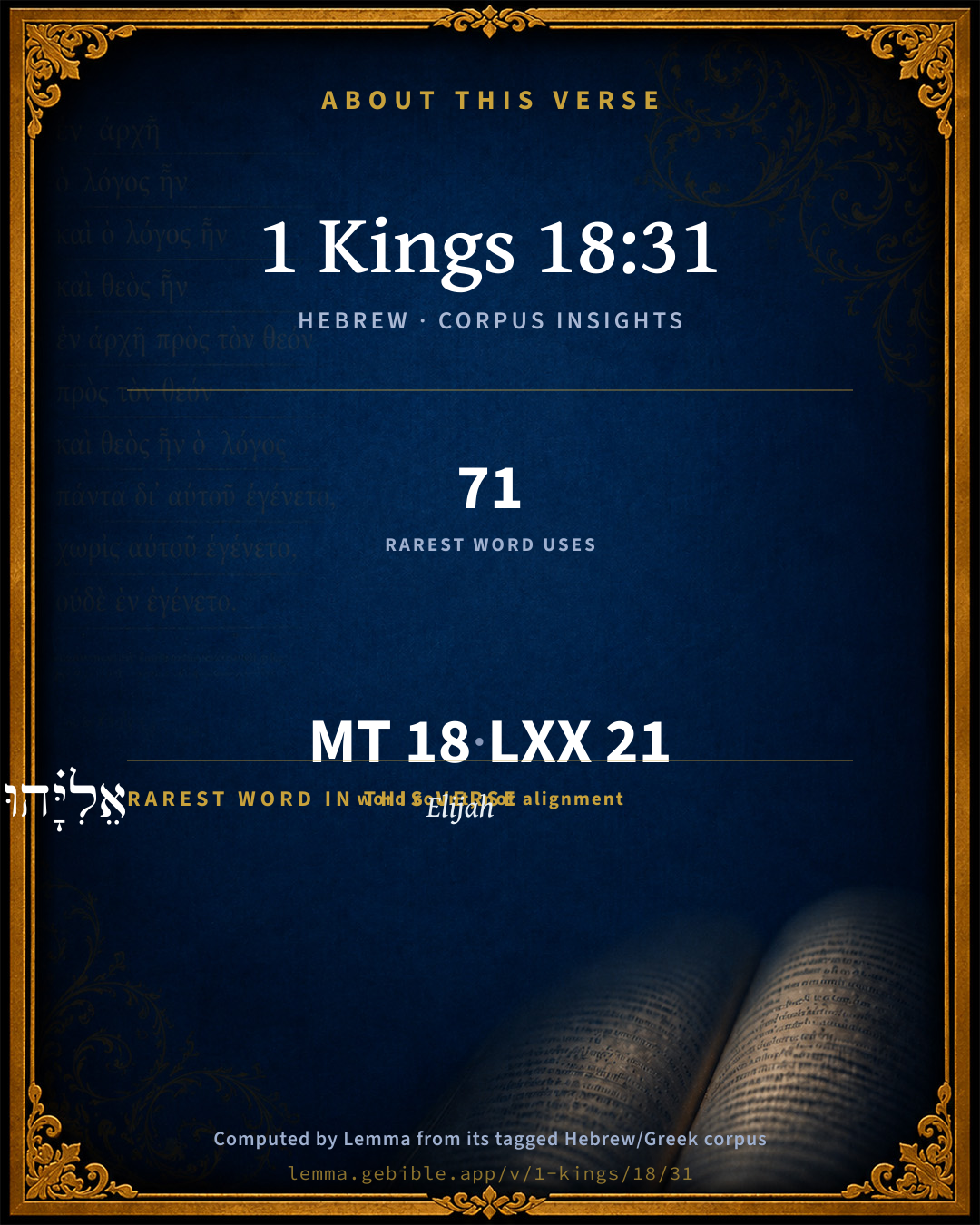
אֵלִיָּ֗הוּ
ʼÊlîyâh
H452
“Elijah”
Noun, Proper
Part of Speech
Noun
Type
Proper
Full BDB Definition

Origin: from H410 and H3050

TWOT: None

Elijah or Eliah = "my God is Jehovah" or " Yah(u) is God" - the great prophet of the reign of Ahab - Benjamite son of Jeroham - a son of Elam with foreign wife during exile - a son of Harim, and priest, with foreign wife during exile
  1. וַיִּקַּ֣ח lâqach H3947 “and · to take” Conjunction + Verb, Qal, Sequential Imperfect, 3rd Person, Masculine, Singular
  2. שְׁתֵּ֤ים shᵉnayim H8147 “two” Adjective, Cardinal number, Feminine, Dual, Absolute
  3. עֶשְׂרֵה֙ ʻâsâr H6240 “teen” Adjective, Cardinal number, Feminine, Singular, Absolute
  4. אֲבָנִ֔ים ʼeben H68 “stones” Noun, Common, Feminine, Plural, Absolute
  5. כְּמִסְפַּ֖ר miçpâr H4557 “like/as · number of” Preposition + Noun, Common, Masculine, Singular, Construct
  6. שִׁבְטֵ֣י shêbeṭ H7626 “staffs of” Noun, Common, Masculine, Plural, Construct
  7. בְנֵֽי bên H1121 “sons of” Noun, Common, Masculine, Plural, Construct
  8. יַעֲקֹ֑ב Yaʻăqôb H3290 “Jacob” Noun, Proper
  9. אֲשֶׁר֩ ʼăsher H834 “which” Particle, Relative
  10. הָיָ֨ה hâyâh H1961 “to be” Verb, Qal, Perfect, 3rd Person, Masculine, Singular
  11. דְבַר dâbâr H1697 “word of” Noun, Common, Masculine, Singular, Construct
  12. יְהוָ֤ה Yᵉhôvâh H3068 “LORD” Noun, Proper
  13. אֵלָיו֙ ʼêl H413 “to · him” Preposition + Suffix, Personal, 3rd Person, Masculine, Singular
  14. לֵאמֹ֔ר ʼâmar H559 “to say” Preposition + Verb, Qal, Infinitive Construct
  15. יִשְׂרָאֵ֖ל Yisrâʼêl H3478 “Israel” Noun, Proper
  16. יִהְיֶ֥ה hâyâh H1961 “to be” Verb, Qal, Imperfect, 3rd Person, Masculine, Singular
  17. שְׁמֶֽךָ shêm H8034 “name · your” Noun, Common, Masculine, Singular, Construct + Suffix, Personal, 2nd Person, Masculine, Singular

About this verse

These counts appear in no published source. They are computed here, from the morphology-tagged text and Lemma’s own curated glosses. What Lemma adds →

18
words
17
distinct lemmas
Historical
section

Grammatical profile

  • 4 verbs
  • 10 nouns
  • 2 adjectives
  • 1 preposition
  • 1 particle

Verb forms

  • וַיִּקַּ֣ח Qal · Sequential Imperfect
  • הָיָ֨ה Qal · Perfect
  • לֵאמֹ֔ר Qal · Infinitive Construct
  • יִהְיֶ֥ה Qal · Imperfect

Repetition

A word recurs within this verse — often emphatic in Hebrew:

  • הָיָ֨ה to be H1961 ×2

Hebrew & Septuagint length

In English translation the verse runs 29 words from the Hebrew and 26 from the Septuagint (LXX English) — closely comparable.

A rough comparison of the two English renderings, which tokenize alike — not a word-level alignment.

Word counts can differ between the Hebrew and the Greek without any difference in meaning — e.g. the Hebrew direct-object marker אֵת has no separate Greek word, and Greek often adds the article ὁ.

In the original languages it is 18 Hebrew tokens and 21 Greek tokens — but the two are counted differently (Hebrew bundles its prefixes and suffixes into one token; the Greek is in lemma form), so that isn’t a like-for-like length.

Cross-references

16

Topical passages linked to 1 Kings 18:31 in the Treasury of Scripture Knowledge — connected by theme and wording, ordered by reader-vote popularity; previews shown in the World English Bible.

  • 2 Kings 17:34 To this day they do after the former manner: they don't fear Yahweh, neither do they after their statutes, or after their ordinances, or after the law or after the commandment which Yahweh commanded the children of Jacob, whom he named Israel;
  • Genesis 32:28 He said, "Your name will no longer be called 'Jacob,' but, 'Israel,' for you have fought with God and with men, and have prevailed."
  • Genesis 35:10 God said to him, "Your name is Jacob. Your name shall not be Jacob any more, but your name will be Israel." He named him Israel.
  • Joshua 4:3–4 and command you them, saying, Take hence out of the midst of the Jordan, out of the place where the priests' feet stood firm, twelve stones, and carry them over with you, and lay them down in the lodging-place, where you shall lodge this night.
  • Joshua 4:20 Those twelve stones, which they took out of the Jordan, did Joshua set up in Gilgal.
  • Genesis 33:20 He erected an altar there, and called it El Elohe Israel.
  • Exodus 24:4 Moses wrote all the words of Yahweh, and rose up early in the morning, and built an altar under the mountain, and twelve pillars for the twelve tribes of Israel.
  • Ezra 6:17 They offered at the dedication of this house of God one hundred bulls, two hundred rams, four hundred lambs; and for a sin-offering for all Israel, twelve male goats, according to the number of the tribes of Israel.
  • Isaiah 48:1 Hear you this, house of Jacob, who are called by the name of Israel, and are come forth out of the waters of Judah; who swear by the name of Yahweh, and make mention of the God of Israel, but not in truth, nor in righteousness
  • Jeremiah 31:1 At that time, says Yahweh, will I be the God of all the families of Israel, and they shall be my people.
  • Ezekiel 37:16–22 You, son of man, take one stick, and write on it, For Judah, and for the children of Israel his companions: then take another stick, and write on it, For Joseph, the stick of Ephraim, and [for] all the house of Israel his companions:
  • Ezekiel 47:13 Thus says the Lord Yahweh: This shall be the border, by which you shall divide the land for inheritance according to the twelve tribes of Israel: Joseph [shall have two] portions.
  • Ephesians 2:20 being built on the foundation of the apostles and prophets, Christ Jesus himself being the chief cornerstone;
  • Ephesians 4:4–6 There is one body, and one Spirit, even as you also were called in one hope of your calling;
  • Revelation 7:4–8 I heard the number of those who were sealed, one hundred forty-four thousand, sealed out of every tribe of the children of Israel:
  • Revelation 21:12 having a great and high wall; having twelve gates, and at the gates twelve angels; and names written on them, which are the names of the twelve tribes of the children of Israel.

Cross-references courtesy of OpenBible.info (CC BY 4.0).

Hebrew and Greek witnesses Masoretic Hebrew ↔ Greek Septuagint

The same verse in the two great witnesses to the Old Testament, shown verse-for-verse.

These are two independent witnesses, not word-aligned to each other, and the Septuagint is shown in lemma (dictionary) form.

Hebrew 1 Kings 18:31 Masoretic · Westminster Leningrad Codex

וַיִּקַּ֣ח אֵלִיָּ֗הוּ שְׁתֵּ֤ים עֶשְׂרֵה֙ אֲבָנִ֔ים כְּמִסְפַּ֖ר שִׁבְטֵ֣י בְנֵֽי יַעֲקֹ֑ב אֲשֶׁר֩ הָיָ֨ה דְבַר יְהוָ֤ה אֵלָיו֙ לֵאמֹ֔ר יִשְׂרָאֵ֖ל יִהְיֶ֥ה שְׁמֶֽךָ

Elijah took twelve stones, according to the number of the tribes of the sons of Jacob, to whom the word of Yahweh came, saying, Israel shall be your name.

World English Bible · Public Domain

Greek LXX 1 Kings 18:31 Septuagint · lemma form

καί λαμβάνω ηλιου δώδεκα λίθος κατά ἀριθμός φυλή ὁ ἰσραήλ ὡς λαλέω κύριος πρός αὐτός λέγω ἰσραήλ εἰμί ὁ ὄνομα σύ

And Eliu took twelve stones, according to the number of the tribes of Israel, as the Lord spoke to him, saying, Israel shall be your name.

LXX2012 (modern English Septuagint) · Public Domain

On this verse, The Cambridge Bible for Schools and Colleges discusses the Septuagint’s reading. Read the note in Commentary ↓

Hebrew: Westminster Leningrad Codex (CC BY 4.0). Greek: Septuagint (public domain); English from LXX2012 (modern English Septuagint) (Public Domain). How the Septuagint differs from the Hebrew →

Targum (Aramaic paraphrase)

1

The Targum is the ancient Jewish Aramaic paraphrase of the Hebrew Scriptures — an interpretive translation, not the Hebrew text itself. Onkelos (literal) and Pseudo-Jonathan (expansive) render the Torah, and Jonathan the Prophets. Coverage is partial: where no permissively-licensed English translation exists for a verse, only the Aramaic is shown. This is verse-level text, not a word-by-word alignment to the Hebrew.

  1. Targum Jonathan Prophets (Joshua–Malachi)
    וּנְסִיב אֵלִיָהוּ תַּרְתָּא עַסְרֵי אַבְנַיָא לְמִנְיַן שִׁבְטֵי בְנֵי יַעֲקֹב דִי הֲוָה פִתְגָמָא דַייָ עִמֵיהּ לְמֵימַר יִשְׂרָאֵל יְהֵי שְׁמָךְ:

    (no public-domain English translation for this verse)

    Targum Jonathan — Aramaic: “Mikraot Gedolot” (public domain). English: “Sefaria Community Translation” (CC0 1.0 (public-domain dedication)); “London "Chaldee Paraphrase," 1871” (public domain). Text via Sefaria.

Commentary

Notes on 1 Kings 18:31 from classic Christian and Jewish commentators (each source and its license shown beneath its notes). The classic Christian expositions comment on the surrounding passage and are grouped to its opening verse, so a note may address several verses; the Jewish commentaries on the Tanakh (Rashi and others) are per-verse, so they appear only where the commentator wrote on this verse.

Lemma curates 59 commentaries, every one of them public domain or Creative Commons licensed, each selected and text-cleaned for this edition rather than reprinted as found. About our sources →

Trapp's Complete Commentary

John Trapp

1Ki 18:31 And Elijah took twelve stones, according to the number of the tribes of the sons of Jacob, unto whom the word of the LORD came, saying, Israel shall be thy name:

Ver. 31. According to the number of the tribes of the sons of Jacob.] To immind them that there ought to have been a common consent of the twelve tribes in the true service of God, and what a shame it was that it should be otherwise.

John Trapp, A Commentary or Exposition upon All the Books of the Old and New Testament (1647–1656) — public domain. Text from a community e-Sword module.

Joseph Benson's Commentary

1Ki 18:31. Elijah took twelve stones — This he did, with a view to renew the covenant between God and all the tribes, as Moses did, Exo 24:4; to show, that he prayed and acted in the name and for the service of the God of all the patriarchs, and of all the tribes of Israel, and for their good: and to teach the people, that though the tribes were divided as to their civil government, they ought all to be united in the worship of the same God, and in the same religion. Israel shall be thy name — Jacob was graciously answered by God when he prayed to him, and was honoured with the glorious title of Israel, which noted his prevalency with God and men. And I, calling upon the same God, doubt not of a gracious answer; and if ever you mean to have your prayers granted, you must seek to the God of Jacob. And if you would recover the honour which was once conferred on Jacob, and continued a long time to his posterity, you must return to that God from whom you are revolted.

Joseph Benson's Commentary on the Old and New Testaments (1811–1818) — public domain. Text from a community e-Sword module.

Tyndale Open Study Notes

Tyndale Open Resources

18:31-32 The twelve stones that Elijah used to rebuild the altar in the name of the Lord should have reminded the people that God had a prior claim as the redeemer of all Israel (cp. Josh 4:1-11; see Isa 41:14; 49:26).

Tyndale Open Study Notes — © Tyndale Open Resources, licensed CC BY-SA 4.0. Text via the HelloAO Bible API.

Adam Clarke's Commentary

Verse 31. Took twelve stones] He did this to show that all the twelve tribes of Israel should be joined in the worship of Jehovah.

Adam Clarke's Commentary on the Bible (1810–1826) — public domain. Text from a community e-Sword/MySword module.

Ellicott's Commentary for English Readers

(31) Twelve stones.—The emphatic notice of these, as emblematic of the twelve tribes, is significant. In spite of political division, and even religious separation, the tribes were still united in the covenant of God.

A Bible Commentary for English Readers, edited by Charles John Ellicott (1878–1897) — public domain. Text from a community e-Sword module.

The Cambridge Bible for Schools and Colleges

gen. ed. J. J. S. Perowne

31. Elijah took twelve stones] On a similar preparation for an altar, compare the command of Joshua (Jos_4:5) where the stones are also taken ‘according to the number of the tribes of the children of Israel.’ In this way the unity of worship of the same one God was signified. Elijah’s prayer also recalls the still earlier memories of Abraham, Isaac and Israel.

of the sons of Jacob] The LXX. reads τοῦ Ἰσραήλ, thus making the expression more nearly to accord with the passage of Joshua just quoted. Also instead of ‘he built an altar’ the LXX. has ‘he built the stones,’ in the next verse.

The Cambridge Bible for Schools and Colleges (gen. ed. J. J. S. Perowne; Cambridge University Press, 1878–1918) — public domain. Text from a community e-Sword module.

John Gill's Exposition

And he put the wood in order, and cut the bullock in pieces, and laid him on the wood,.... Just in such manner as sacrifices usually were:

and said, fill four barrels with water; either from the brook Kishon, or, if that was dried up, from the sea; for both were near this mountain, and so to be had, though a time of drought:

and pour it on the burnt sacrifice; that which was intended to be one:

and upon the wood: wherewith it was to be burnt, and so made unfit for it; and which would make the miracle appear the greater, when fire came down and consumed it.

John Gill's Exposition of the Whole Bible (1746–1763) — public domain (CC PDM 1.0). Text via the HelloAO Bible API.

Haydock's Catholic Bible Commentary

Twelve stones, (as [in] Exodus xxiv., &c.) intimating that he acted in the name of all; (Menochius) and in order that all Israel might return with one heart to the service of God. (Haydock) --- The prophet did not follow his own spirit in erecting this altar. (Calmet)

George Leo Haydock (1774–1849), Haydock's Catholic Family Bible and Commentary, 1859 edition — public domain. Excludes Psalms (Douay-Rheims chapter numbering differs from Protestant) and Deuterocanonical books (Catholic canon only).

Matthew Poole's English Annotations

This he did, partly, to renew the covenant between God and all the tribes, as Moses did, Exo 24:4; partly, to show that he prayed and acted in the name and for the service of the God of all the patriarchs, and of all the tribes of Israel, and for their good; and partly, to teach the people, that though the tribes were divided as to their civil government, they ought all to be united in the worship of the same God, and in the same religion.

Unto whom the word of the Lord came; which Jacob was graciously answered by God when he prayed to him, and was honoured with the glorious title of Israel, which noted his prevalency with God and men. And I, calling upon the same God, doubt not of a like gracious answer; and if ever you mean to have your prayers granted, you must not seek to Baal for it, who, as you now see, neither hears nor regards his most devout worshippers; but unto the God of Jacob; and if you would recover the honour which was once conferred upon Jacob, and continued a long time to his posterity, you must return to that God from whom you are revolted.

Matthew Poole's English Annotations on the Holy Bible (1683–1685) — public domain. Text from a community e-Sword/MySword module.

Whedon's Commentary on the Bible

Daniel D. Whedon

31. Twelve stones — Indicative of the twelve tribes; and like those which were taken out of the midst of Jordan and set up at Gilgal, (Jos_4:3; Jos_4:20,) a memorial of the national unity and Divine election of Israel.

Israel shall be thy name — Perhaps Elijah, while building the altar, audibly repeated these words in the ears of all the people, and would thus teach by word as well as symbol that the whole twelve tribes, not ten merely, were named Israel. The division of Israel into two kingdoms was the result of sin.

Daniel D. Whedon (gen. ed.), Commentary on the Old and New Testaments (1874–1909) — public domain. Text from a community e-Sword module.

The Pulpit Commentary

And Elijah took twelve stones This number, too, was full of significance. Not only would it carry back their thoughts to the giving of the law, (Exo_24:4 Exo_28:21) and to their fathers" entrance into the promised land, (Jos_4:3, Jos_4:9) but it would remind them of the essential unity of the people, notwithstanding the division of the kingdom. The act was thus a protest against the schism. We cannot hold with Keil, Wordsworth, al. that it was "a practical declaration on the part of the prophet that the division of the nation into two kingdoms was at variance with the will of God," because we are distinctly told that that division was "from the Lord". (1Ki_12:15) But it was certainly a witness against a divided Church, and a reminder of the unity of the race, according to the number of the tribes of the sons of Jacob, unto whom the word of the Lord came, (Gen_32:28) saying, Israel shall be thy name. He thus protests against the exclusive assumption of the name of Israel, and the exception of the southern kingdom from the glorious heritage and calling of Israel, by the ten tribes. But we cannot follow Bahr in the belief that Jacob received "from Jehovah the name of Israel," i.e., the "soldier of God," because he commanded his house to "put away the strange gods", (Gen_35:2, 10 sqq.) or that Elijah would teach that "only those who did as Jacob did had a claim to his name." The great idea is that the people are one, and are the Lord"s.

The Pulpit Commentary (1880–1919), ed. H.D.M. Spence-Jones & Joseph S. Exell — public domain. Text from a community e-Sword module.

John Wesley's Explanatory Notes

Twelve stones - This he did, to renew the covenant between God and all the tribes, as Moses did, Exod. xxiv, 4, to shew, that he prayed and acted in the name, and for the service of the God of all the Patriarchs, and of all the tribes of Israel, and for their good: and, to teach the people, that though the tribes were divided as to their civil government, they ought all to be united in the worship of the same God. Israel - Jacob was graciously answered by God when he prayed to him, and was honoured with the glorious title of Israel, which noted his prevalency with God and men. And I, calling upon the same God, doubt not of a like gracious answer; and if ever you mean to have your prayers granted, you must seek to the God of Jacob.

John Wesley, Explanatory Notes Upon the Whole Bible (1754–1765) — public domain. Text via the GEBible commentary corpus.

Rashi

Rabbi Shlomo Yitzchaki (Rashi)

To whom the word of Adonoy had come, saying, “Yisroel will be your name.” Why is this stated here? Because on the day that the Divine Presence was revealed to Yaakov in Beis Eil and named him Yisroel, on that day He said to him, “A nation and a community of nations will come from you,” i.e., your children are destined to congregate like other nations and build an altar upon which to burn sacrifices during the period of the prohibition [of offering sacrifices on] the high places. Nevertheless, I will consent to it. [Thus is stated] in Bereishis Rabboh.

Rashi on the Tanakh — English translations: “The Judaica Press complete Tanach with Rashi, translated by A. J. Rosenberg” (CC BY 4.0); “Pentateuch with Rashi's commentary by M. Rosenbaum and A.M. Silbermann, 1929-1934” (public domain); “The Metsudah Tanach series, Lakewood, N.J” (CC BY 4.0); and “The Book of Joshua, Metsudah Publications, 1997” (CC BY 4.0). Text via Sefaria.

Lesson kit

Teaching starters — assembled from the data on this page, not authored interpretation. Every prompt links to the verse data it draws on. Edit before teaching.

1 Kings, in the Historical, opens this verse with 18 words (17 distinct Hebrew lemmas). Its most distinctive word is ʼÊlîyâh (“Elijah”). A historical commentator’s framing appears above. Read the whole chapter for the surrounding context.

Discussion questions

  1. What does “Elijah” (ʼÊlîyâh) contribute to the verse as a whole?
  2. 2 Kings 17:34 shares this passage’s theme. How do the two illuminate each other?
  3. “to be” occurs 2× in this one verse. What is the effect of the repetition?
  4. These translations render this verse differently; the difference is in the English rendering, not the original. What questions does that raise?
  5. The verb «וַיִּקַּ֣ח» is Qal Sequential Imperfect. How does its form color the action?
  6. Reading how Trapp's Complete Commentary and Joseph Benson's Commentary read this verse, where do the two commentators agree and where do they part?

Things to notice

Reading settings

Reading text

Shown beneath each verse's original-language words.

Old Testament
Old Testament edition

Read the OT as the Masoretic Hebrew (MT) or the Greek Septuagint (LXX).

English shown for the Greek Septuagint (in the Hebrew ↔ Greek comparison).

Comparing translations? Open the Compare panel on any verse page to stack up to four side by side.