
Genesis 32:20

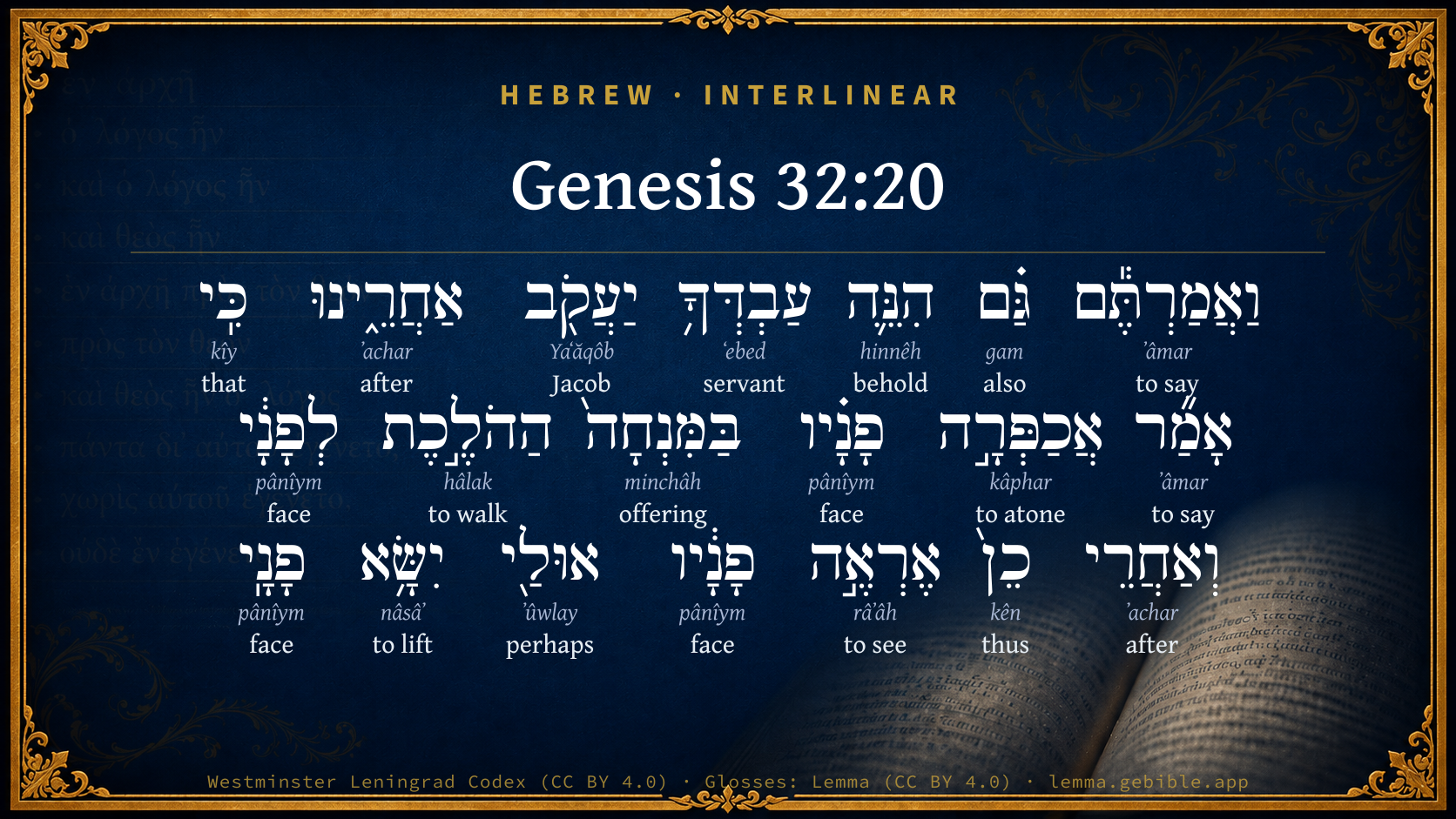
Hebrew (Westminster Leningrad Codex) Genesis 32:20 appears in the Hebrew Old Testament. The text above is from the Westminster Leningrad Codex. Each word links to its Strong’s number, a concise gloss, and parsing drawn from the Open Scriptures Hebrew Bible morphology. Click any word for its full Brown-Driver-Briggs (BDB) entry.
Download image
Cite this verse

Genesis 32:20 (World English Bible). Public Domain. Lemma interlinear Bible study tool, https://lemma.gebible.app/v/genesis/32/20.

Show BibTeX & RIS
BibTeX
RIS
English Translation
You shall say, 'Not only that, but behold, your servant, Jacob, is behind us.'" For, he said, "I will appease him with the present that goes before me, and afterward I will see his face. Perhaps he will accept me."
World English Bible · Public Domain
Download a study sheet

One document with this verse’s original text, its word-by-word gloss line, the meaning frame, cross-references with their text, attributed commentary, and full source and license credits — printable, and it pastes into notes with its structure intact.

This verse Autodidact and up

Study sheet (.html) Plain text (.txt)

A passage Seminary Student

Up to 50 verses in one chapter. A passage sheet keeps up to 6 commentary sources and 12 cross-references per verse, in the order this page ranks them, and says so on the sheet whenever that leaves anything out. Ask for a single verse and you get the Autodidact verse sheet above.

Everything on this page stays free to read, with no account — the sheet is a download of what is already on screen, not access to it.

Want to remove ads? Support Godless Engineer
Compare translations 3

The same verse in 3 English versions, stacked beneath the original-language interlinear above. Click any original word for its lexicon entry.

Each is an independent rendering of the whole verse — the interlinear is not word-aligned to these translations.

Highlighted words mark where these versions differ — a whole-verse word diff, not a word-by-word alignment.

  • World English Bible Public Domain
    You shall say, 'Not only that, but behold, your servant, Jacob, is behind us.'" For, he said, "I will appease him with the present that goes before me, and afterward I will see his face. Perhaps he will accept me."
  • King James Version Public Domain
    And say ye moreover, Behold, thy servant Jacob is behind us. For he said, I will appease him with the present that goeth before me, and afterward I will see his face; peradventure he will accept of me.
  • unfoldingWord Literal Text CC BY-SA 4.0
    And also say, ‘Behold, your servant Jacob behind us.’” For he said, “I will cover his face with the gift that is going before me, and after that, when I see his face, perhaps he will receive my face.”

unfoldingWord Literal Text — © unfoldingWord, licensed CC BY-SA 4.0. Word-aligned USFM3 via Door43 (git.door43.org/unfoldingWord/en_ult).

Versions to compare (up to 4)

3 of 4 selected

Show all 18 translations

Every available English version of this verse, each an independent rendering of the whole verse.

  • World English Bible Public Domain
    You shall say, 'Not only that, but behold, your servant, Jacob, is behind us.'" For, he said, "I will appease him with the present that goes before me, and afterward I will see his face. Perhaps he will accept me."
  • Berean Standard Bible Public Domain
    You are also to say, ‘Look, your servant Jacob is right behind us.’” For he thought, “I will appease Esau with the gift that is going before me. After that I can face him, and perhaps he will accept me.”
  • Majority Standard Bible Public Domain
    You are also to say, ‘Look, your servant Jacob is right behind us.’” For he thought, “I will appease Esau with the gift that is going before me. After that I can face him, and perhaps he will accept me.”
  • King James Version Public Domain
    And say ye moreover, Behold, thy servant Jacob is behind us. For he said, I will appease him with the present that goeth before me, and afterward I will see his face; peradventure he will accept of me.
  • American Standard Version (1901) Public Domain
    and ye shall say, Moreover, behold, thy servant Jacob is behind us. For he said, I will appease him with the present that goeth before me, and afterward I will see his face; peradventure he will accept me.
  • Revised Version (1885) Public Domain
    and ye shall say, Moreover, behold, thy servant Jacob is behind us. For he said, I will appease him with the present that goeth before me, and afterward I will see his face; peradventure he will accept me.
  • Geneva Bible (1599) Public Domain
    And ye shall say moreouer, Beholde, thy seruant Iaakob commeth after vs (for he thought, I will appease his wrath with the present that goeth before me, and afterwarde I will see his face: it may be that he will accept me.)
  • Douay-Rheims (1899) Public Domain
    And ye shall add: thy servant Jacob himself also followeth after us: for he said: I will appease him with the presents that go before, and afterwards I will see him, perhaps he will be gracious to me.
  • Young's Literal Translation Public Domain
    and ye have said also, Lo, thy servant Jacob `is' behind us;' for he said, `I pacify his face with the present which is going before me, and afterwards I see his face; it may be he lifteth up my face;'
  • Literal Standard Version CC BY-SA 4.0
    and you have also said, Behold, your servant Jacob [is] behind us”; for he said, “I pacify his face with the present which is going before me, and afterward I see his face; it may be he lifts up my face”;
  • Unlocked Literal Bible CC BY-SA 4.0
    You must also say, 'Your servant Jacob is coming after us.'” For he thought, “I will appease him with the gifts that I am sending ahead of me. Then later, when I will see him, perhaps he will receive me.”
  • unfoldingWord Literal Text CC BY-SA 4.0
    And also say, ‘Behold, your servant Jacob behind us.’” For he said, “I will cover his face with the gift that is going before me, and after that, when I see his face, perhaps he will receive my face.”
  • Darby Bible Public Domain
    And, moreover, ye shall say, Behold, thy servant Jacob is behind us. For he said, I will propitiate him with the gift that goes before me, and afterwards I will see his face: perhaps he will accept me.
  • World Messianic Bible Public Domain
    You shall say, ‘Not only that, but behold, your servant, Jacob, is behind us.’” For, he said, “I will appease him with the present that goes before me, and afterward I will see his face. Perhaps he will accept me.”
  • Webster's Bible Public Domain
    And say ye moreover, Behold, thy servant Jacob is behind us. For he said, I will appease him with the present that goeth before me, and afterward I will see his face; peradventure he will accept of me.
  • Free Bible Version CC BY-SA 4.0
    You must also tell him, ‘Your servant Jacob is right behind us.’” Jacob said to himself, “Maybe by sending these gifts on ahead Esau won't be angry with me and when I meet him he'll be kind to me.”
  • Bible in Basic English Public Domain
    And you are to say further, Jacob, your servant, is coming after us. For he said to himself, I will take away his wrath by the offering which I have sent on, and then I will come before him: it may be that I will have grace in his eyes.
  • JPS Tanakh (1917) Public Domain
    (32-21) and ye shall say: Moreover, behold, thy servant Jacob is behind us.' For he said: 'I will appease him with the present that goeth before me, and afterward I will see his face; peradventure he will accept me.'

Literal Standard Version (2020), Covenant Press — licensed CC BY-SA 4.0. Text via the HelloAO Bible API (eBible.org). Unlocked Literal Bible (unfoldingWord) — licensed CC BY-SA 4.0. Text via the HelloAO Bible API (eBible.org). unfoldingWord Literal Text — © unfoldingWord, licensed CC BY-SA 4.0. Word-aligned USFM3 via Door43 (git.door43.org/unfoldingWord/en_ult). Free Bible Version, Dr. Jonathan Gallagher — licensed CC BY-SA 4.0. Text via the HelloAO Bible API (eBible.org).

Word by word

More ways to search: Search by grammar → Find every occurrence → Compare this word →

Practice this passage: Drill this verse → Learn its vocabulary →

אוּלַ֖י
ʼûwlay
H194
“perhaps”
Adverb
Part of Speech
Adverb
Full BDB Definition

Origin: from H176

TWOT: 46

perhaps, peradventure - if peradventure - unless - suppose
  1. וַאֲמַרְתֶּ֕ם ʼâmar H559 “and · to say” Conjunction + Verb, Qal, Sequential Perfect, 2nd Person, Masculine, Plural
  2. גַּ֗ם gam H1571 “also” Particle, Accusative
  3. הִנֵּ֛ה hinnêh H2009 “behold” Particle, Demonstrative
  4. עַבְדְּךָ֥ ʻebed H5650 “servant · your” Noun, Common, Masculine, Singular, Construct + Suffix, Personal, 2nd Person, Masculine, Singular
  5. יַעֲקֹ֖ב Yaʻăqôb H3290 “Jacob” Noun, Proper
  6. אַחֲרֵ֑ינוּ ʼachar H310 “after · us” Preposition + Suffix, Personal, 1st Person, Common, Plural
  7. כִּֽי kîy H3588 “that” Conjunction
  8. אָמַ֞ר ʼâmar H559 “to say” Verb, Qal, Perfect, 3rd Person, Masculine, Singular
  9. אֲכַפְּרָ֣ה kâphar H3722 “to atone” Verb, Piel, Cohortative, 1st Person, Common, Singular
  10. פָנָ֗יו pânîym H6440 “face(s) · his” Noun, Common, Both, Plural, Construct + Suffix, Personal, 3rd Person, Masculine, Singular
  11. בַּמִּנְחָה֙ minchâh H4503 “in/at the · offering” Preposition, Determined + Noun, Common, Feminine, Singular, Absolute
  12. הַהֹלֶ֣כֶת hâlak H1980 “the · walking” Particle, Definite Article + Verb, Qal, Participle Active, Feminine, Singular, Absolute
  13. לְפָנָ֔י pânîym H6440 “to/for · face(s) · my” Preposition + Noun, Common, Both, Plural, Construct + Suffix, Personal, 1st Person, Common, Singular
  14. וְאַחֲרֵי ʼachar H310 “and · after” Conjunction + Preposition
  15. כֵן֙ kên H3651 “thus” Adverb
  16. אֶרְאֶ֣ה râʼâh H7200 “to see” Verb, Qal, Imperfect, 1st Person, Common, Singular
  17. פָנָ֔יו pânîym H6440 “face(s) · his” Noun, Common, Both, Plural, Construct + Suffix, Personal, 3rd Person, Masculine, Singular
  18. יִשָּׂ֥א nâsâʼ H5375 “to lift” Verb, Qal, Imperfect, 3rd Person, Masculine, Singular
  19. פָנָֽי pânîym H6440 “face(s) · my” Noun, Common, Both, Plural, Construct + Suffix, Personal, 1st Person, Common, Singular

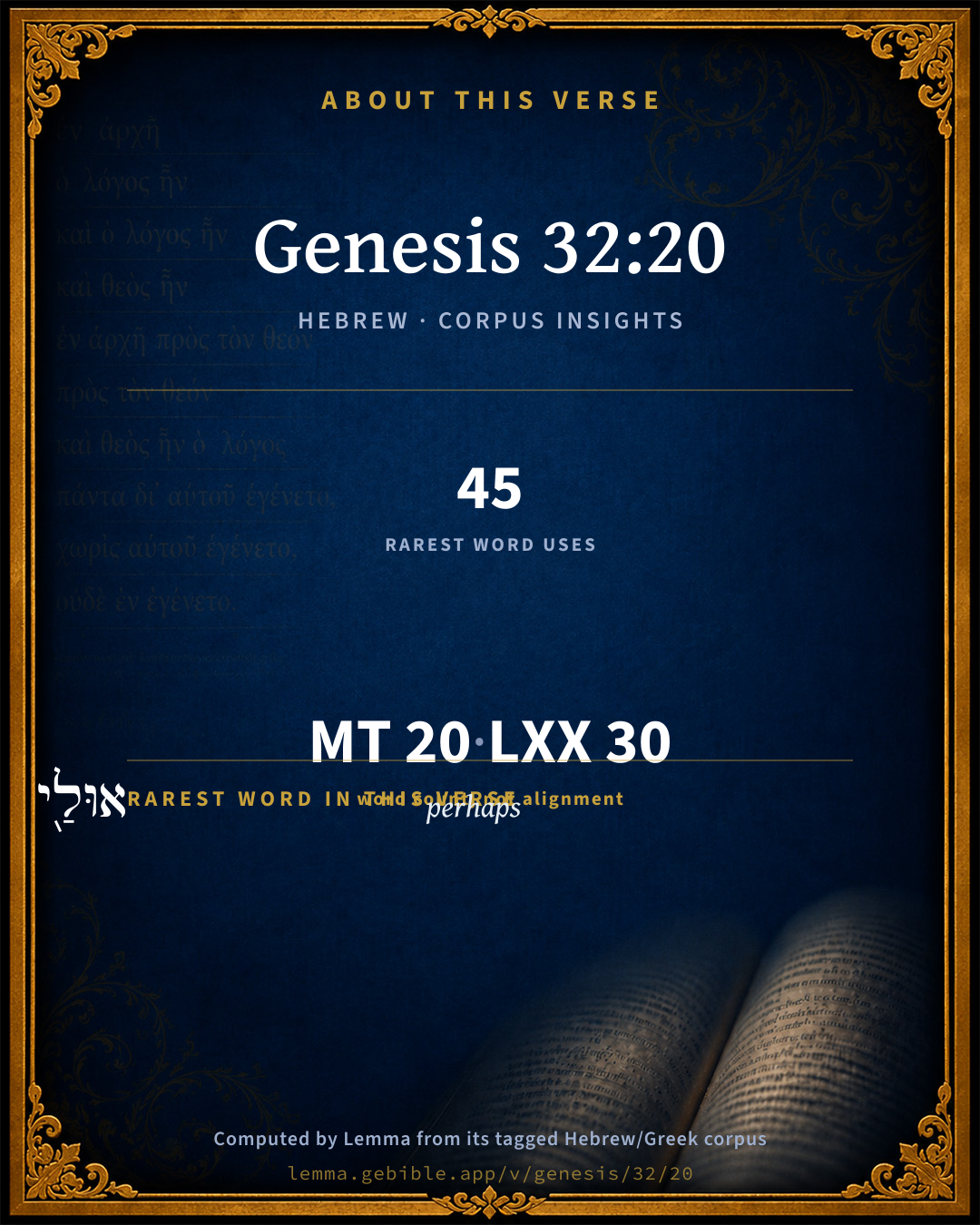
About this verse

These counts appear in no published source. They are computed here, from the morphology-tagged text and Lemma’s own curated glosses. What Lemma adds →

20
words
15
distinct lemmas
Pentateuch
section

Shared distinctive vocabulary

אוּלַ֖י perhaps H194 occurs in 44 verses of the Hebrew Bible. Also found in:

Grammatical profile

  • 6 verbs
  • 7 nouns
  • 2 prepositions
  • 1 conjunction
  • 2 adverbs
  • 2 particles

Verb forms

  • וַאֲמַרְתֶּ֕ם Qal · Sequential Perfect
  • אָמַ֞ר Qal · Perfect
  • אֲכַפְּרָ֣ה Piel · Cohortative
  • הַהֹלֶ֣כֶת Qal · Participle Active
  • אֶרְאֶ֣ה Qal · Imperfect
  • יִשָּׂ֥א Qal · Imperfect

Repetition

Words recur within this verse — often emphatic in Hebrew:

  • פָנָ֗יו face H6440 ×4
  • וַאֲמַרְתֶּ֕ם to say H559 ×2
  • אַחֲרֵ֑ינוּ after H310 ×2

Hebrew & Septuagint length

In English translation the verse runs 40 words from the Hebrew and 39 from the Septuagint (LXX English) — closely comparable.

A rough comparison of the two English renderings, which tokenize alike — not a word-level alignment.

Word counts can differ between the Hebrew and the Greek without any difference in meaning — e.g. the Hebrew direct-object marker אֵת has no separate Greek word, and Greek often adds the article ὁ.

In the original languages it is 20 Hebrew tokens and 30 Greek tokens — but the two are counted differently (Hebrew bundles its prefixes and suffixes into one token; the Greek is in lemma form), so that isn’t a like-for-like length.

Cross-references

11

Topical passages linked to Genesis 32:20 in the Treasury of Scripture Knowledge — connected by theme and wording, ordered by reader-vote popularity; previews shown in the World English Bible.

  • Job 42:8–9 Now therefore, take to yourselves seven bulls and seven rams, and go to my servant Job, and offer up for yourselves a burnt offering; and my servant Job shall pray for you, for I will accept him, that I not deal with you according to your folly. For you have not spoken of me the thing that is right, as my servant Job has."
  • Proverbs 21:14 A gift in secret pacifies anger; And a bribe in the cloak, strong wrath.
  • Genesis 43:11 Their father, Israel, said to them, "If it be so now, do this. Take from the choice fruits of the land in your bags, and carry down a present for the man, a little balm, a little honey, spices and myrrh, nuts, and almonds;
  • 1 Samuel 6:5 Therefore you shall make images of your tumors, and images of your mice that mar the land; and you shall give glory to the God of Israel: peradventure he will lighten his hand from off you, and from off your gods, and from off your land.
  • 1 Samuel 25:17–35 Now therefore know and consider what you will do; for evil is determined against our master, and against all his house: for he is such a worthless fellow that one can't speak to him.
  • 1 Kings 20:31 His servants said to him, See now, we have heard that the kings of the house of Israel are merciful kings: let us, we pray you, put sackcloth on our loins, and ropes on our heads, and go out to the king of Israel: peradventure he will save your life.
  • Proverbs 6:35 He won't regard any ransom, Neither will he rest content, though you give many gifts.
  • Proverbs 15:18 A wrathful man stirs up contention, But one who is slow to anger appeases strife.
  • Proverbs 16:14 The king's wrath is a messenger of death, But a wise man will pacify it.
  • Jonah 3:9 Who knows whether God will not turn and repent, and turn away from his fierce anger, so that we might not perish?"
  • 2 Timothy 2:25 in gentleness correcting those who oppose him: perhaps God may give them repentance leading to a full knowledge of the truth,

Cross-references courtesy of OpenBible.info (CC BY 4.0).

Hebrew and Greek witnesses Masoretic Hebrew ↔ Greek Septuagint

The same verse in the two great witnesses to the Old Testament, shown verse-for-verse.

These are two independent witnesses, not word-aligned to each other, and the Septuagint is shown in lemma (dictionary) form.

Hebrew Genesis 32:20 Masoretic · Westminster Leningrad Codex

וַאֲמַרְתֶּ֕ם גַּ֗ם הִנֵּ֛ה עַבְדְּךָ֥ יַעֲקֹ֖ב אַחֲרֵ֑ינוּ כִּֽי אָמַ֞ר אֲכַפְּרָ֣ה פָנָ֗יו בַּמִּנְחָה֙ הַהֹלֶ֣כֶת לְפָנָ֔י וְאַחֲרֵי כֵן֙ אֶרְאֶ֣ה פָנָ֔יו אוּלַ֖י יִשָּׂ֥א פָנָֽי

You shall say, 'Not only that, but behold, your servant, Jacob, is behind us.'" For, he said, "I will appease him with the present that goes before me, and afterward I will see his face. Perhaps he will accept me."

World English Bible · Public Domain

Greek LXX Genesis 32:20 Septuagint · lemma form

καί ἐντέλλομαι ὁ πρῶτος καί ὁ δεύτερος καί ὁ τρίτος καί πᾶς ὁ προπορεύομαι ὀπίσω ὁ ποίμνιον οὗτος λέγω κατά ὁ ῥῆμα οὗτος λαλέω ησαυ ἐν ὁ εὑρίσκω σύ αὐτός

and you⌃ shall say, Behold your servant Jacob comes after us. For he said, I will propitiate his countenance with the gifts going before his presence, and afterwards I will behold his face, for perhaps he will accept me.

LXX2012 (modern English Septuagint) · Public Domain

On this verse, The Cambridge Bible for Schools and Colleges discusses the Septuagint’s reading. Read the note in Commentary ↓

Hebrew: Westminster Leningrad Codex (CC BY 4.0). Greek: Septuagint (public domain); English from LXX2012 (modern English Septuagint) (Public Domain). How the Septuagint differs from the Hebrew →

Targum (Aramaic paraphrase)

2

The Targum is the ancient Jewish Aramaic paraphrase of the Hebrew Scriptures — an interpretive translation, not the Hebrew text itself. Onkelos (literal) and Pseudo-Jonathan (expansive) render the Torah, and Jonathan the Prophets. Coverage is partial: where no permissively-licensed English translation exists for a verse, only the Aramaic is shown. This is verse-level text, not a word-by-word alignment to the Hebrew.

  1. Targum Onkelos Torah (Genesis–Deuteronomy)
    וּפַקִּיד אַף יָת תִּנְיָנָא אַף יָת תְּלִיתָאָה אַף יָת כָּל דְּאָזְלִין בָּתַר עֲדָרַיָּא לְמֵימָר כְּפִתְגָּמָא הָדֵין תְּמַלְּלוּן עִם עֵשָׂו כַּד תַּשְׁכְּחוּן יָתֵהּ

    (no public-domain English translation for this verse)

    Targum Onkelos — Aramaic: “Onkelos Genesis” (public domain); “Onkelos Exodus” (public domain); “Onkelos Leviticus” (public domain); “Onkelos Numbers” (public domain); “Onkelos Deuteronomy” (public domain). English: “Sefaria Community Translation” (CC0 1.0 (public-domain dedication)); “J.W. Etheridge. The Targums of Onkelos and Jonathan Ben Uzziel on the Pentateuch. London: Longmans, Green, 1862” (public domain). Text via Sefaria.

  2. Targum Pseudo-Jonathan Torah (Genesis–Deuteronomy)
    וּפְקִיד אוּף יַת תִּנְיַן אוּף יַת תְּלִיתָאֵי אוּף יַת כָּל דְאָזְלִין בָּתַר עֶדְרַיָא לְמֵימַר כְּפִיתְגָמָא הָדֵין תְּמַלְלוּן עִם עֵשָו כַּד תִּשְׁכְּחוּן יָתֵיהּ

    And so he instructed the second, and the third, and all them who followed the flock, saying According to these words You must speak with Esau when you find him,

    Targum Pseudo-Jonathan — Aramaic: “Targum Jonathan on Genesis” (public domain); “Targum Jonathan on Exodus” (public domain); “Targum Jonathan on Leviticus” (public domain); “Targum Jonathan on Numbers” (public domain); “Targum Jonathan on Deuteronomy” (public domain). English: “The Targum of Jonathan ben Uzziel, trans. J. W. Etheridge, London, 1862” (public domain). Text via Sefaria.

Commentary

Notes on Genesis 32:20 from classic Christian and Jewish commentators (each source and its license shown beneath its notes). The classic Christian expositions comment on the surrounding passage and are grouped to its opening verse, so a note may address several verses; the Jewish commentaries on the Tanakh (Rashi and others) are per-verse, so they appear only where the commentator wrote on this verse.

Lemma curates 59 commentaries, every one of them public domain or Creative Commons licensed, each selected and text-cleaned for this edition rather than reprinted as found. About our sources →

Trapp's Complete Commentary

John Trapp

Gen 32:20 And say ye moreover, Behold, thy servant Jacob [is] behind us. For he said, I will appease him with the present that goeth before me, and afterward I will see his face; peradventure he will accept of me.

Ver. 20. Behold, thy servant Jacob is behind us.] This he requires them all to insist on, lest Esau should think he meant, meanwhile, to escape some other way.

John Trapp, A Commentary or Exposition upon All the Books of the Old and New Testament (1647–1656) — public domain. Text from a community e-Sword module.

Geneva Bible (1599)

Geneva Bible translators

He thought it no loss to depart with these goods, to the intent he might follow the vocation whereunto God called him.

Hebrew, receive my face.

Geneva Bible (1599) marginal notes — public domain. Text via Bolls.life.

Ellicott's Commentary for English Readers

(20) I will appease him.—The Heb. literally is, he said I will cover his face with the offering that goeth before my face, and afterwards I will see his face; peradventure he will lift up my face. The covering of the face of the offended person, so that he could no longer see the offence, became the usual legal word for making an atonement (Lev_9:7, &c). For the “offering” (Heb., minchah) see Gen_4:3; and for “the lifting up of the face,” Gen_4:7.

A Bible Commentary for English Readers, edited by Charles John Ellicott (1878–1897) — public domain. Text from a community e-Sword module.

The Cambridge Bible for Schools and Colleges

gen. ed. J. J. S. Perowne

20. I will appease him] Lit. “I will cover his face,” in the sense of “I will propitiate.” The present will so “cover his face,” that Esau cannot look upon Jacob’s offence; cf. Gen_20:16. LXX renders ἐξιλάσομαι τὸ πρόσωπον αὐτοῦ. Cf. Pro_16:14 (the pacifying of a king’s wrath with a gift).

accept me] Lit. “lift up my face.” Cf. Gen_4:7, Gen_19:21; Mal_1:8.

The Cambridge Bible for Schools and Colleges (gen. ed. J. J. S. Perowne; Cambridge University Press, 1878–1918) — public domain. Text from a community e-Sword module.

John Gill's Exposition

And say ye moreover, behold, thy servant Jacob is behind us,.... This is repeated to impress it upon their minds, that they might be careful of all things, not to forget that, it being a point of great importance; for the present would have signified nothing, if Jacob had not appeared in person; Esau would have thought himself, at best, but slighted; as if he was unworthy of a visit from him, and of conversation with him:

for he said: that is, Jacob, or "had said" (a), in his heart, within himself, as might be supposed from the whole of his conduct; for what follows are the words of Moses the historian, as Aben Ezra observes, and not of Jacob to his servants, nor of them to Esau:

I will appease him with the present that goeth before me, and afterwards I will see his face: he hoped the present would produce the desired effect; that it would turn away his wrath from him, and pacify him; and then he should be able to appear before him, and see his face with pleasure: or, "I will expiate his face" (b), as some render the words, or make him propitious and favourable; or cover his face, as Aben Ezra interprets it, that is, cause him to hide his wrath and resentment, that it shall not appear; or cause his fury to cease, as Jarchi; or remove his anger, wrath, and displeasure, as Ben Melech; all which our version takes in, by rendering it, "appease him"; and then:

peradventure he will accept of me: receive him with marks of tenderness and affection, and in a very honourable and respectable manner.

(a) "dicebat enim", Vatablus, Junius & Tremellius, Drusius. (b) "expiabo faciem ejus", Montanus; "propitium reddam", Drusius, Munster.

John Gill's Exposition of the Whole Bible (1746–1763) — public domain (CC PDM 1.0). Text via the HelloAO Bible API.

Haydock's Catholic Bible Commentary

He said, &c. These words were not to be related to Esau; they are the words of the sacred historian. There were probably five droves of goats, sheep, camels, kine and asses; by the successive presenting of which, Esau might be appeased.

George Leo Haydock (1774–1849), Haydock's Catholic Family Bible and Commentary, 1859 edition — public domain. Excludes Psalms (Douay-Rheims chapter numbering differs from Protestant) and Deuterocanonical books (Catholic canon only).

Matthew Poole's English Annotations

I will appease him; Heb. appease or allay his anger; for the Hebrew word panim signifies both anger, as Psa 21:9; 34:16, and face, as every where, because a man’s anger is most discernible in his face or countenance, Pro 21:14.

He will accept of me; Heb. will lift up my face or countenance, which now is dejected with the sense of his displeasure; compare Gen 4:6; or, will accept of my person, as this phrase is oft used.

Matthew Poole's English Annotations on the Holy Bible (1683–1685) — public domain. Text from a community e-Sword/MySword module.

Whedon's Commentary on the Bible

Daniel D. Whedon

20. I will appease him — Here is a notable instance of metaphorical language. Literally, he says: “I will cover his face with the present which goes before me, and afterwards I will see his face; perhaps he will lift up my face. The word cover (כפר) is that so often used afterwards in connexion with expiation and atonement for sin. He would cover Esau’s face, so that he whom he had sinned against might cease to see the transgressions of the past. Those past offences hidden, he hopes himself to look on Esau’s face, as on one so far appeased as not to turn away from him, and refuse to see him. Then he hopes that there will come the further favour of Esau condescending to lift up his (Jacob’s) face — the downcast face of one prostrate in humility and contrition before him.

Daniel D. Whedon (gen. ed.), Commentary on the Old and New Testaments (1874–1909) — public domain. Text from a community e-Sword module.

Radak

Rabbi David Kimhi (Radak)

ויצו...במצאכם, the letter מ has the vowel cholem, and the letter צ has the vowel patach in order to lengthen the letter א. If not for this consideration the letter מ would have required the vowel chataf kametz (short) and the letter צ would have required a semi vowel sheva, as in Joshua 8,8 בתפשכם את העיר, “when you seize the city.”

Radak on the Tanakh — English translations: “Sefaria Community Translation” (CC0 1.0 (public-domain dedication)); “Eliyahu Munk, HaChut Hameshulash” (CC BY 4.0); “Rabbi Mike Feuer, Jerusalem Anthology” (CC BY 4.0); and “R. David Kimhi on the first book of Psalms, Translated by R.G. Finch, London, 1919” (public domain). Text via Sefaria.

Lesson kit

Teaching starters — assembled from the data on this page, not authored interpretation. Every prompt links to the verse data it draws on. Edit before teaching.

Genesis, in the Pentateuch, opens this verse with 20 words (15 distinct Hebrew lemmas). Its most distinctive word is ʼûwlay (“perhaps”). A historical commentator’s framing appears above. Read the whole chapter for the surrounding context.

Discussion questions

  1. How does “perhaps” (ʼûwlay) shape what this verse is saying?
  2. How does Genesis 16:2, which shares the word «perhaps», read alongside this verse?
  3. What does the repetition of “face” (4× in this one verse) do in this verse?
  4. The translations on this page render this verse differently — a whole-verse word diff, not a word-by-word alignment. What might account for the different wordings?
  5. «וַאֲמַרְתֶּ֕ם» is a Qal Sequential Perfect verb. How does that grammatical form shape the action described?
  6. Compare how Trapp's Complete Commentary and Geneva Bible (1599) read this verse. Where do they agree or differ?

Things to notice

Reading settings

Reading text

Shown beneath each verse's original-language words.

Old Testament
Old Testament edition

Read the OT as the Masoretic Hebrew (MT) or the Greek Septuagint (LXX).

English shown for the Greek Septuagint (in the Hebrew ↔ Greek comparison).

Comparing translations? Open the Compare panel on any verse page to stack up to four side by side.