Genesis 32:2

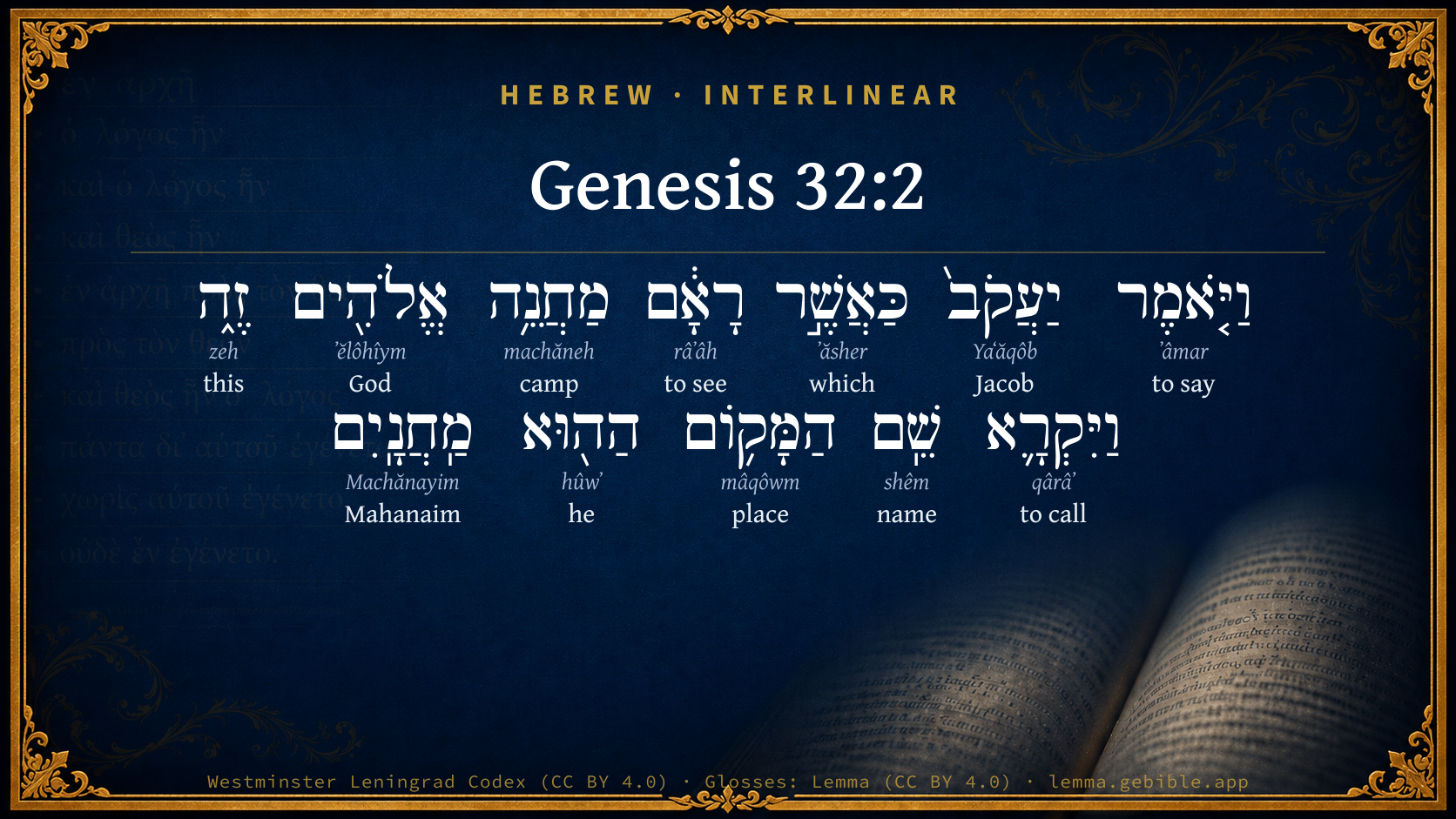
Hebrew (Westminster Leningrad Codex) Genesis 32:2 appears in the Hebrew Old Testament. The text above is from the Westminster Leningrad Codex. Each word links to its Strong’s number, a concise gloss, and parsing drawn from the Open Scriptures Hebrew Bible morphology. Click any word for its full Brown-Driver-Briggs (BDB) entry.
Download image
Cite this verse

Genesis 32:2 (World English Bible). Public Domain. Lemma interlinear Bible study tool, https://lemma.gebible.app/v/genesis/32/2.

Show BibTeX & RIS
BibTeX
RIS
English Translation
When he saw them, Jacob said, "This is God's host." He called the name of that place Mahanaim.
World English Bible · Public Domain
Highlights
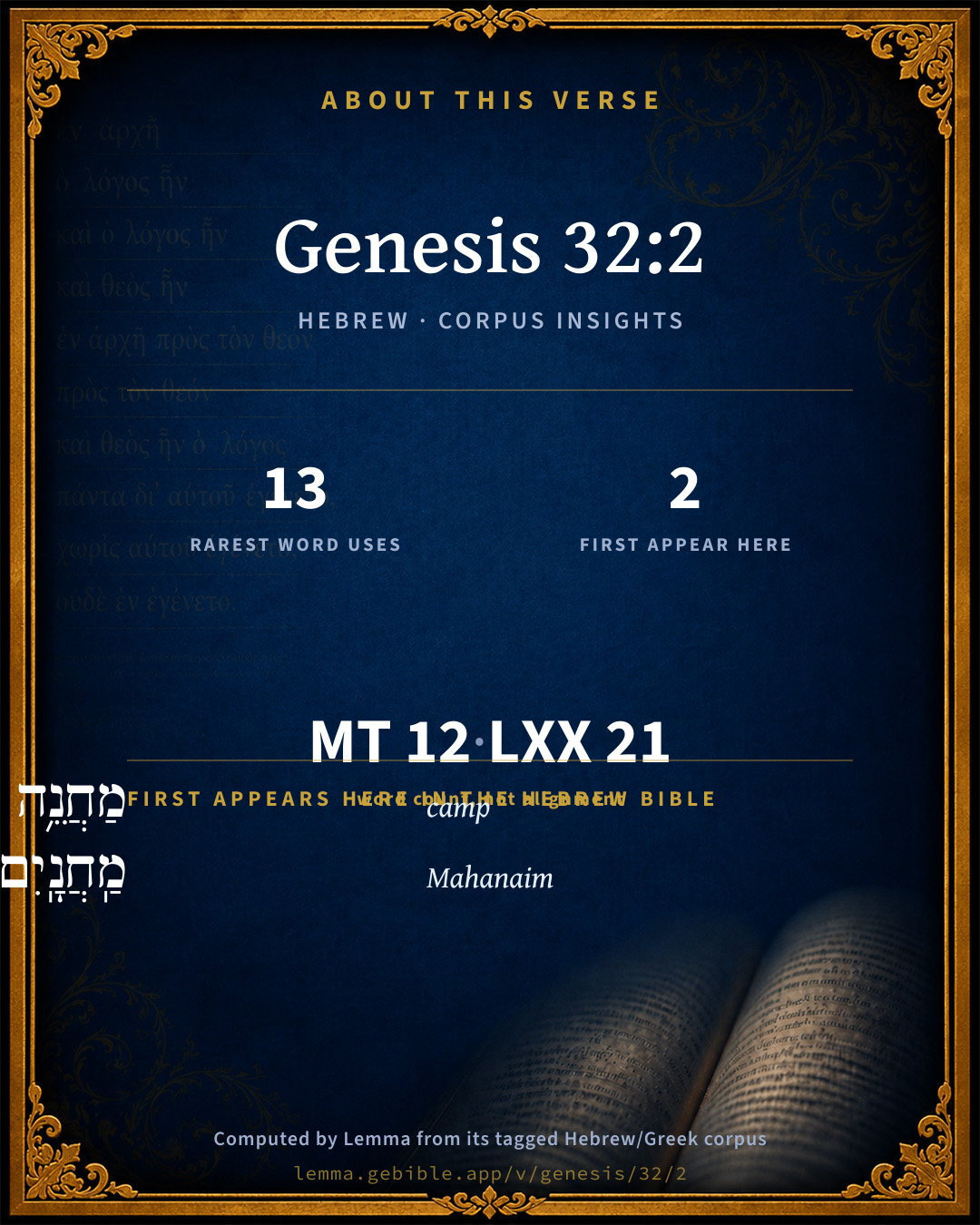
  • 2 first appearances in the Hebrew Bible
Full analysis ↓
Download a study sheet

One document with this verse’s original text, its word-by-word gloss line, the meaning frame, cross-references with their text, attributed commentary, and full source and license credits — printable, and it pastes into notes with its structure intact.

This verse Autodidact and up

Study sheet (.html) Plain text (.txt)

A passage Seminary Student

Up to 50 verses in one chapter. A passage sheet keeps up to 6 commentary sources and 12 cross-references per verse, in the order this page ranks them, and says so on the sheet whenever that leaves anything out. Ask for a single verse and you get the Autodidact verse sheet above.

Everything on this page stays free to read, with no account — the sheet is a download of what is already on screen, not access to it.

Want to remove ads? Support Godless Engineer
Compare translations 3

The same verse in 3 English versions, stacked beneath the original-language interlinear above. Click any original word for its lexicon entry.

Each is an independent rendering of the whole verse — the interlinear is not word-aligned to these translations.

Highlighted words mark where these versions differ — a whole-verse word diff, not a word-by-word alignment.

  • World English Bible Public Domain
    When he saw them, Jacob said, "This is God's host." He called the name of that place Mahanaim.
  • King James Version Public Domain
    And when Jacob saw them, he said, This is God's host: and he called the name of that place Mahanaim.
  • unfoldingWord Literal Text CC BY-SA 4.0
    And when he saw them, Jacob said, “This God’s camp!” So he called the name of that place Mahanaim.

unfoldingWord Literal Text — © unfoldingWord, licensed CC BY-SA 4.0. Word-aligned USFM3 via Door43 (git.door43.org/unfoldingWord/en_ult).

Versions to compare (up to 4)

3 of 4 selected

Show all 18 translations

Every available English version of this verse, each an independent rendering of the whole verse.

  • World English Bible Public Domain
    When he saw them, Jacob said, "This is God's host." He called the name of that place Mahanaim.
  • Berean Standard Bible Public Domain
    When Jacob saw them, he said, “This is the camp of God.” So he named that place Mahanaim.
  • Majority Standard Bible Public Domain
    When Jacob saw them, he said, “This is the camp of God.” So he named that place Mahanaim.
  • King James Version Public Domain
    And when Jacob saw them, he said, This is God's host: and he called the name of that place Mahanaim.
  • American Standard Version (1901) Public Domain
    And Jacob said when he saw them, This is God's host: and he called the name of that place Mahanaim.
  • Revised Version (1885) Public Domain
    And Jacob said when he saw them, This is God’s host: and he called the name of that place Mahanaim.
  • Geneva Bible (1599) Public Domain
    And when Iaakob saw them, he said, This is Gods hoste, and called the name of the same place Mahanaim.
  • Douay-Rheims (1899) Public Domain
    And when he saw them, he said: These are the camps of God, and he called the name of that place Mahanaim, that is, Camps.
  • Young's Literal Translation Public Domain
    and Jacob saith, when he hath seen them, `This `is' the camp of God;' and he calleth the name of that place `Two Camps.'
  • Literal Standard Version CC BY-SA 4.0
    and Jacob says, when he has seen them, “This [is] the camp of God”; and he calls the name of that place “Two Camps.”
  • Unlocked Literal Bible CC BY-SA 4.0
    When Jacob saw them, he said, “This is God's camp,” so he called the name of that place Mahanaim.
  • unfoldingWord Literal Text CC BY-SA 4.0
    And when he saw them, Jacob said, “This God’s camp!” So he called the name of that place Mahanaim.
  • Darby Bible Public Domain
    And when Jacob saw them he said, This is the camp of God. And he called the name of that place Mahanaim.
  • World Messianic Bible Public Domain
    When he saw them, Jacob said, “This is God’s army.” He called the name of that place Mahanaim.
  • Webster's Bible Public Domain
    And when Jacob saw them, he said, This is God's host: and he called the name of that place Mahanaim.
  • Free Bible Version CC BY-SA 4.0
    When he saw them he said, “This must be God's camp!” He named the place “Two Camps.”
  • Bible in Basic English Public Domain
    And when he saw them he said, This is the army of God: so he gave that place the name of Mahanaim.
  • JPS Tanakh (1917) Public Domain
    (32-3) And Jacob said when he saw them: 'This is God's camp.' And he called the name of that place Mahanaim.

Literal Standard Version (2020), Covenant Press — licensed CC BY-SA 4.0. Text via the HelloAO Bible API (eBible.org). Unlocked Literal Bible (unfoldingWord) — licensed CC BY-SA 4.0. Text via the HelloAO Bible API (eBible.org). unfoldingWord Literal Text — © unfoldingWord, licensed CC BY-SA 4.0. Word-aligned USFM3 via Door43 (git.door43.org/unfoldingWord/en_ult). Free Bible Version, Dr. Jonathan Gallagher — licensed CC BY-SA 4.0. Text via the HelloAO Bible API (eBible.org).

Word by word

More ways to search: Search by grammar → Find every occurrence → Compare this word →

Practice this passage: Drill this verse → Learn its vocabulary →

מַֽחֲנָֽיִם
Machănayim
H4266
“Mahanaim”
Noun, Proper
Part of Speech
Noun
Type
Proper
Full BDB Definition

Origin: dual of H4264

TWOT: None

Mahanaim = "two camps" - a place east of the Jordan, named from Jacob's encounter with angels - a Levitical city in Gad
  1. וַיֹּ֤אמֶר ʼâmar H559 “and · to say” Conjunction + Verb, Qal, Sequential Imperfect, 3rd Person, Masculine, Singular
  2. יַעֲקֹב֙ Yaʻăqôb H3290 “Jacob” Noun, Proper
  3. כַּאֲשֶׁ֣ר ʼăsher H834 “like/as · which” Preposition + Particle, Relative
  4. רָאָ֔ם râʼâh H7200 “to see · them” Verb, Qal, Perfect, 3rd Person, Masculine, Singular + Suffix, Personal, 3rd Person, Masculine, Plural
  5. מַחֲנֵ֥ה machăneh H4264 “camp of” Noun, Common, Both, Singular, Construct
  6. אֱלֹהִ֖ים ʼĕlôhîym H430 “God(s)” Noun, Common, Masculine, Plural, Absolute
  7. זֶ֑ה zeh H2088 “this” Pronoun, Demonstrative, Masculine, Singular
  8. וַיִּקְרָ֛א qârâʼ H7121 “and · to call” Conjunction + Verb, Qal, Sequential Imperfect, 3rd Person, Masculine, Singular
  9. שֵֽׁם shêm H8034 “name of” Noun, Common, Masculine, Singular, Construct
  10. הַמָּק֥וֹם mâqôwm H4725 “the · place” Particle, Definite Article + Noun, Common, Masculine, Singular, Absolute
  11. הַה֖וּא hûwʼ H1931 “the · he” Particle, Definite Article + Pronoun, Personal, 3rd Person, Masculine, Singular

About this verse

These counts appear in no published source. They are computed here, from the morphology-tagged text and Lemma’s own curated glosses. What Lemma adds →

12
words
12
distinct lemmas
Pentateuch
section

Notable vocabulary

The rarest word here is מַֽחֲנָֽיִם Mahanaim H4266 — appearing just 13 times in the whole Hebrew Bible.

First appearance in Scripture

These words make their first canonical appearance in the Hebrew Bible here:

  • מַחֲנֵ֥ה camp H4264
  • מַֽחֲנָֽיִם Mahanaim H4266

Shared distinctive vocabulary

מַֽחֲנָֽיִם Mahanaim H4266 occurs in 13 verses of the Hebrew Bible. Also found in:

Grammatical profile

  • 3 verbs
  • 6 nouns
  • 2 pronouns
  • 1 particle

Verb forms

  • וַיֹּ֤אמֶר Qal · Sequential Imperfect
  • רָאָ֔ם Qal · Perfect
  • וַיִּקְרָ֛א Qal · Sequential Imperfect

Hebrew & Septuagint length

In English translation the verse runs 18 words from the Hebrew and 22 from the Septuagint (LXX English) — closely comparable.

A rough comparison of the two English renderings, which tokenize alike — not a word-level alignment.

Word counts can differ between the Hebrew and the Greek without any difference in meaning — e.g. the Hebrew direct-object marker אֵת has no separate Greek word, and Greek often adds the article ὁ.

In the original languages it is 12 Hebrew tokens and 21 Greek tokens — but the two are counted differently (Hebrew bundles its prefixes and suffixes into one token; the Greek is in lemma form), so that isn’t a like-for-like length.

Cross-references

15

Topical passages linked to Genesis 32:2 in the Treasury of Scripture Knowledge — connected by theme and wording, ordered by reader-vote popularity; previews shown in the World English Bible.

  • 2 Samuel 2:8 Now Abner the son of Ner, captain of Saul's host, had taken Ish-bosheth the son of Saul, and brought him over to Mahanaim;
  • Joshua 5:14 He said, No; but [as] prince of the host of Yahweh am I now come. Joshua fell on his face to the earth, and did worship, and said to him, What says my lord to his servant?
  • Joshua 21:38 Out of the tribe of Gad, Ramoth in Gilead with its suburbs, the city of refuge for the manslayer, and Mahanaim with its suburbs,
  • 2 Samuel 17:24 Then David came to Mahanaim. Absalom passed over the Jordan, he and all the men of Israel with him.
  • 1 Kings 2:8 Behold, there is with you Shimei the son of Gera, the Benjamite, of Bahurim, who cursed me with a grievous curse in the day when I went to Mahanaim; but he came down to meet me at the Jordan, and I swore to him by Yahweh, saying, I will not put you to death with the sword.
  • Psalms 34:7 The angel of Yahweh encamps round about those who fear him, And delivers them.
  • Psalms 148:2 Praise him, all his angels! Praise him, all his host!
  • Luke 2:13 Suddenly, there was with the angel a multitude of the heavenly host praising God, and saying,
  • 2 Samuel 2:12 Abner the son of Ner, and the servants of Ish-bosheth the son of Saul, went out from Mahanaim to Gibeon.
  • 2 Samuel 17:26–27 Israel and Absalom encamped in the land of Gilead.
  • 1 Kings 4:14 Ahinadab the son of Iddo, in Mahanaim;
  • 2 Kings 6:17 Elisha prayed, and said, Yahweh, Please open his eyes, that he may see. Yahweh opened the eyes of the young man; and he saw: and, behold, the mountain was full of horses and chariots of fire round about Elisha.
  • Psalms 103:21 Praise Yahweh, all you hosts of his, You servants of his, who do his pleasure.
  • Song of Solomon 6:13 Return, return, Shulammite! Return, return, that we may gaze at you. Lover Why do you desire to gaze at the Shulammite, As at the dance of Mahanaim?
  • Daniel 10:20 Then he said, "Do you know why I have come to you? Now I will return to fight with the prince of Persia. When I go forth, behold, the prince of Greece shall come.

Cross-references courtesy of OpenBible.info (CC BY 4.0).

Hebrew and Greek witnesses Masoretic Hebrew ↔ Greek Septuagint

The same verse in the two great witnesses to the Old Testament, shown verse-for-verse.

These are two independent witnesses, not word-aligned to each other, and the Septuagint is shown in lemma (dictionary) form.

Hebrew Genesis 32:2 Masoretic · Westminster Leningrad Codex

וַיֹּ֤אמֶר יַעֲקֹב֙ כַּאֲשֶׁ֣ר רָאָ֔ם מַחֲנֵ֥ה אֱלֹהִ֖ים זֶ֑ה וַיִּקְרָ֛א שֵֽׁם הַמָּק֥וֹם הַה֖וּא מַֽחֲנָֽיִם

When he saw them, Jacob said, "This is God's host." He called the name of that place Mahanaim.

World English Bible · Public Domain

Greek LXX Genesis 32:2 Septuagint · lemma form

καί ἰακώβ ἀποἔρχομαι εἰς ὁ ἑαυτοῦ ὁδός καί ἀναβλέπω ὁράω παρεμβολή θεός παρα ἐνβάλλω καί συνἀντάω αὐτός ὁ ἄγγελος ὁ θεός

And Jacob said, when he saw them, This is the Camp of God; and he called the name of that place, Encampments.

LXX2012 (modern English Septuagint) · Public Domain

On this verse, The Cambridge Bible for Schools and Colleges discusses the Septuagint’s reading. Read the note in Commentary ↓

Hebrew: Westminster Leningrad Codex (CC BY 4.0). Greek: Septuagint (public domain); English from LXX2012 (modern English Septuagint) (Public Domain). How the Septuagint differs from the Hebrew →

Targum (Aramaic paraphrase)

2

The Targum is the ancient Jewish Aramaic paraphrase of the Hebrew Scriptures — an interpretive translation, not the Hebrew text itself. Onkelos (literal) and Pseudo-Jonathan (expansive) render the Torah, and Jonathan the Prophets. Coverage is partial: where no permissively-licensed English translation exists for a verse, only the Aramaic is shown. This is verse-level text, not a word-by-word alignment to the Hebrew.

  1. Targum Onkelos Torah (Genesis–Deuteronomy)
    וְיַעֲקֹב אֲזָל לְאָרְחֵהּ וַעֲרָעוּ בֵהּ מַלְאָכַיָּא דַּיְיָ

    (no public-domain English translation for this verse)

    Targum Onkelos — Aramaic: “Onkelos Genesis” (public domain); “Onkelos Exodus” (public domain); “Onkelos Leviticus” (public domain); “Onkelos Numbers” (public domain); “Onkelos Deuteronomy” (public domain). English: “Sefaria Community Translation” (CC0 1.0 (public-domain dedication)); “J.W. Etheridge. The Targums of Onkelos and Jonathan Ben Uzziel on the Pentateuch. London: Longmans, Green, 1862” (public domain). Text via Sefaria.

  2. Targum Pseudo-Jonathan Torah (Genesis–Deuteronomy)
    וְיַעֲקב אָזַל לְאָרְחֵיהּ וְאַרְעוּ בֵּיהּ מַלְאָכַיָא דַיְיָ

    And Jakob went on his way, and the angels of the Lord met him.

    Targum Pseudo-Jonathan — Aramaic: “Targum Jonathan on Genesis” (public domain); “Targum Jonathan on Exodus” (public domain); “Targum Jonathan on Leviticus” (public domain); “Targum Jonathan on Numbers” (public domain); “Targum Jonathan on Deuteronomy” (public domain). English: “The Targum of Jonathan ben Uzziel, trans. J. W. Etheridge, London, 1862” (public domain). Text via Sefaria.

Commentary

Notes on Genesis 32:2 from classic Christian and Jewish commentators (each source and its license shown beneath its notes). The classic Christian expositions comment on the surrounding passage and are grouped to its opening verse, so a note may address several verses; the Jewish commentaries on the Tanakh (Rashi and others) are per-verse, so they appear only where the commentator wrote on this verse.

Lemma curates 59 commentaries, every one of them public domain or Creative Commons licensed, each selected and text-cleaned for this edition rather than reprinted as found. About our sources →

Trapp's Complete Commentary

John Trapp

Gen 32:2 And when Jacob saw them, he said, This [is] God’s host: and he called the name of that place Mahanaim.

Ver. 2. This is God’s host.] So called, for their number, order, obedience, strength, &c. God hath a complete host of horse and foot. Angels, and heavenly bodies, are his horse, as it were; "horses and chariots of fire"; {2Ki 6:17} yea, both horse and foot: for there are whole "legions" of them. {Mat 26:53} Now a legion is judged to be six thousand foot, and seven hundred horse. Daniel tells us, there be millions of angels, {Dan 7:10} yea, "an innumerable company," saith the author to the Hebrews. {Heb 12:22} The Greek poet could say, There were thirty thousands of them here upon earth, keepers of mortal men, and observers of their works: {a} some think they are meant in the parable, by the ninety and nine sheep; as if they were ninety and nine times as many as mankind in number. All these, how many soever, pitch camp round about the godly, {Psa 34:7} make a lane for them, as they did here for Jacob at Mahanaim (which signifies a double camp), fight in battle array against their enemies, {Dan 10:20} and convey them at death, as they did Lazarus, through their enemies’ country, the air, into Abraham’s bosom. {Luk 16:22} So that all God’s children may call death, as Jacob did this place, Mahanaim; because there the angels meet them. And as the palsied man, in the gospel, was let down with his bed through the tiling before Jesus, {Luk 5:19} so is every good soul taken up in a heavenly couch (or coach, rather) through the roof of his house, and carried into Christ’s presence, by the blessed angels.

{a} Tρις γαρ μυριοι εισις επι χθονι πουλυβοτειρη Dαιμονες αθανατοι, φυλακες μεροπψν ανθρωπων. - Hesiod.

John Trapp, A Commentary or Exposition upon All the Books of the Old and New Testament (1647–1656) — public domain. Text from a community e-Sword module.

Joseph Benson's Commentary

Gen 32:2. This is God’s host — Or army; so the angels are justly called, because of their great number, their excellent order, their mighty power, and the service they perform for God and his church, for the protection of which they are sent. A good man may see by faith what Jacob saw with his bodily eyes. To preserve the remembrance of this favour Jacob named the place Mahanaim, two hosts, or two camps. Probably they appeared to him in two hosts, one on either side, or one in the front and the other in the rear, to protect him from Laban behind and Esau before, and be a complete guard: or Jacob’s family made one army, representing the church militant and itinerant on earth, and the angels another army, representing the church triumphant, and at rest in heaven.

Joseph Benson's Commentary on the Old and New Testaments (1811–1818) — public domain. Text from a community e-Sword module.

Tyndale Open Study Notes

Tyndale Open Resources

32:2 This is God’s camp! Jacob must have seen the angels that revealed God’s presence as a sign of protection, as with the earlier vision when he was departing the land (28:10-22). • Mahanaim (“two camps”): Jacob’s company and the company of angels were together in one place.

Tyndale Open Study Notes — © Tyndale Open Resources, licensed CC BY-SA 4.0. Text via the HelloAO Bible API.

Geneva Bible (1599)

Geneva Bible translators

Or, tents.

He acknowledgeth God’s benefits: who for the preservation of his, sendeth hosts of Angels.

Geneva Bible (1599) marginal notes — public domain. Text via Bolls.life.

Jamieson, Fausset & Brown

Robert Jamieson, A. R. Fausset & David Brown

Mahanaim--"two hosts," or "camps." The place was situated between mount Gilead and the Jabbok, near the banks of that brook.

Jamieson, Fausset & Brown — Commentary Critical and Explanatory on the Whole Bible (1871) — public domain (CC PDM 1.0). Text via the HelloAO Bible API.

Adam Clarke's Commentary

Verse 2. Mahanaim.] The two hosts, if read by the points, the angels forming one, and Jacob and his company forming another; or simply hosts or camps in the plural. There was a city built afterwards here, and inhabited by the priests of God, Jos 21:38. For what purpose the angels of God met Jacob, does not appear from the text; probably it was intended to show him that he and his company were under the care of an especial providence, and consequently to confirm his trust and confidence in God.

The doctrine of the ministration of angels has been much abused, not only among the heathens, but also among Jews and Christians, and perhaps most among the latter. Angels with feigned names, titles, and influences, have been and still are invoked and worshipped by a certain class of men; because they have found that God has been pleased to employ them to minister to mankind; and hence they have made supplications to them to extend their protection, to shield, defend, instruct, c. This is perfectly absurd.

1. They are God's instruments, not self-determining agents.

2. They can only do what they are appointed to perform, for there is no evidence that they have any discretionary power.

3. God helps man by ten thousand means and instruments some intellectual, as angels; some rational, as men; some irrational, as brutes; and some merely material, as the sun, wind, rain, food, raiment, and the various productions of the earth. He therefore helps by whom he will help, and to him alone belongs all the glory; for should he be determined to destroy, all these instruments collectively could not save. Instead therefore of worshipping them, we should take their own advice: See thou do it not - Worship God.

Adam Clarke's Commentary on the Bible (1810–1826) — public domain. Text from a community e-Sword/MySword module.

Ellicott's Commentary for English Readers

(2) Mahanaim.—That is, the two camps, his own and that of the angels; or, possibly, two camps of angels, one on either side of him. Mahanaim was in the tribe of Gad, and became an important town. (See 2Sa_2:8; 2Sa_17:24; 1Ki_4:14.)

A Bible Commentary for English Readers, edited by Charles John Ellicott (1878–1897) — public domain. Text from a community e-Sword module.

The Cambridge Bible for Schools and Colleges

gen. ed. J. J. S. Perowne

2. This is God’s host] The Heb. word for “host” (maḥaneh) is usually, and ought here to be, rendered “camp.” The angels are regarded as the warriors of Jehovah; cf. the narrative in Jos_5:13-15, and 1Ki_22:19; Psa_103:21; Psa_148:2.

Mahanaim] That is, Two hosts, or, companies. The termination -aim denotes the dual. Possibly Jacob here refers to the two “companies,” or “encampments,” one of the angels, and the other of his own followers. The LXX renders παρεμβολαί = “camps”; Lat. Mahanaim, id est, Castra, without reference to the dual number. For another derivation of the name, see on Gen_32:7; Gen_32:10.

Mahanaim was in later times a place of considerable importance. During Absalom’s rebellion it was the residence and head-quarters of David; see 2Sa_17:24; 2Sa_17:27. Cf. 2Sa_2:8; 2Sa_2:12; 2Sa_2:29; 1Ki_2:8. The site is uncertain: from Gen_32:11 it would appear to be not far from the banks of the Jordan, and from Gen_32:22 to lie north of the Jabbok (modern Zerka). In Jos_13:26-30, it appears to lie on the confines of Gad and Manasseh.

The Cambridge Bible for Schools and Colleges (gen. ed. J. J. S. Perowne; Cambridge University Press, 1878–1918) — public domain. Text from a community e-Sword module.

John Gill's Exposition

And when Jacob saw them,.... These appeared in a visible form, most probably human, and in the habit, and with the accoutrements of soldiers, and therefore afterwards called an host or army. Aben Ezra thinks that Jacob alone saw them, as Elisha first saw the host of angels before the young man did that was with him, Kg2 6:17,

he said, this is God's host: or army, hence he is often called the Lord of hosts; angels have this name from their number, order, strength, and military exploits they perform:

and he called the name of the place Mahanaim; which signifies two hosts or armies; either his own family and company making one, and the angels another, as Aben Ezra observes; or they were the angels, who very probably appeared in two companies, or as two armies, and one went on one side of Jacob and his family, and the other on the other side; or the one went before him, and the other behind him; the latter to secure him from any insult of Laban, should he pursue after him, and distress him in the rear, and the former to protect him from Esau, near whose country Jacob now was, and of whom he was in some fear and danger; thus seasonably did God appear for him. The Jewish writers (t) say, the host of God is 60,000, and that the Shechinah, or divine Majesty, never dwells among less, and that Mahanaim, or two hosts, are 120,000; there was afterwards a city of this name near this place, which very likely was so called in memory of this appearance, Jos 21:38; and there seems to be an allusion to it in the account of the church, Sol 6:13; it was in the land of Gilead, and tribe of Gad, forty four miles from Jerusalem to the southeast (u).

(t) In Bereshit Rabba, sect. 75. fol. 66. 1. (u) Bunting's Travels, p. 74.

John Gill's Exposition of the Whole Bible (1746–1763) — public domain (CC PDM 1.0). Text via the HelloAO Bible API.

Haydock's Catholic Bible Commentary

Mahanaim, "two camps." A town was afterwards built here.

George Leo Haydock (1774–1849), Haydock's Catholic Family Bible and Commentary, 1859 edition — public domain. Excludes Psalms (Douay-Rheims chapter numbering differs from Protestant) and Deuterocanonical books (Catholic canon only).

Matthew Poole's English Annotations

God’s host; so the angels are justly called for their great number, Dan 7:10; Luk 2:13, excellent order, mighty power, and for their use and service to God, and to his church, for whose protection they are sent. See 2Ki 6:17; Psa 34:7.

Mahanaim, i.e. two hosts; so called, either because the angels divided themselves into two companies, and placed themselves some before, others behind him, or some on each side of him, for his greater comfort and security; or because the angels made one host, and his family another.

Matthew Poole's English Annotations on the Holy Bible (1683–1685) — public domain. Text from a community e-Sword/MySword module.

Whedon's Commentary on the Bible

Daniel D. Whedon

2. This is God’s host — Or, God’s band. He at once recognises them as the same class of heavenly powers that had appeared to him in the vision of Beth-el. He has around him his own company, no small host; and behold, he is also encompassed by another camp, God’s company of holy watchers, set to guard and guide him in his way.

Mahanaim — Two camps; his own and that of the angels. Comp. Psa_34:7. The great lesson of this event was that of the immanent providence of God. His angels ever guard the ways of his chosen. The site of Mahanaim is probably the modern Maneh, on the north of mount Ajlun. It was on the border of Gad and Manasseh, (Jos_13:26; Jos_13:30,) and was a city of the Levites. Jos_21:38. Here Ishbosheth, Saul’s son, reigned two years.

2Sa_2:8-12.

Daniel D. Whedon (gen. ed.), Commentary on the Old and New Testaments (1874–1909) — public domain. Text from a community e-Sword module.

The Pulpit Commentary

And when Jacob saw them, he said, This is God"s host: Mahaneh Elohim; i.e. the army (cf. Gen_1:9; Exo_14:24) or (1Sa_14:15; Psa_27:3) of God, as opposed to the Mahanoth, or bands of Jacob himself (vide ver. 7, 10)and he called the name of that place Manahan. i.e. Two armies or camps, from the root hnj; decline or bend, and hence to fix oneself down or encamp; meaning either a multitudinous host, reading the dual for a plural (Malvenda), or two bands of angels, one before, welcoming him to Canaan, and another behind, conducting him from Mesopotamia (Jarchi and others), or one on either side to typify the completeness of his protection, as in Psa_34:8 (Calvin, Bush, Gcrlach, "Speaker"s Commentary") or, as the best expositors interpret, his own company and the heavenly host (Abort Ezra, Clericus, Dathe, Keil, Lange, Rosenm Kalisch, Murphy). Mahanaim, afterwards a distinguished city in the territory of Gad, (Jos_13:26) and frequently referred to in subsequent Scripture. (2Sa_2:8 2Sa_17:24 27 19:32; 1Ki_4:14) as well as mentioned by Josephus ("Ant." 7. 9, 8), as a strong and beautiful city, has been identified with Mahneh, a deserted ruin six or seven miles north-west by north of Ajlun (Mount Gilead), and about twenty miles from the Jabbok (vide "Robinson," vol. 3. App. 166; and of. Tristram, "The Land of Israel, p. 483); but the narrative appears to say that Mahanaim lay not north of Ga-leed, but between that place and Jabbok. Hence Porter suggests Gerasa, the most splendid ruin east of the Jordan, and bordering on the Jabbok, as occupying the site of Mahanaim (vide Kitto s "Cyclopedia," art. Mahanaim, and cf. "Handbook for S. and P." 2. 311, seq.).

The Pulpit Commentary (1880–1919), ed. H.D.M. Spence-Jones & Joseph S. Exell — public domain. Text from a community e-Sword module.

John Wesley's Explanatory Notes

This is God's house - A good man may, with an eye of faith, see the same that Jacob saw with his bodily eyes. What need we dispute whether he has a guardian angel, when we are sure he has a guard of angels about him? To preserve the remembrance of this favour, Jacob gave a name to the place from it, Mahanaim, two hosts, or two camps probably they appeared to him in two hosts, one on either side, or one in the front, and the other in the rear, to protect him from Laban behind, and Esau before, that they might be a compleat guard. Here was Jacob's family that made one army, representing the church militant and itinerant on earth; and the angels another army, representing the church triumphant, and at rest in heaven.

John Wesley, Explanatory Notes Upon the Whole Bible (1754–1765) — public domain. Text via the GEBible commentary corpus.

Scofield Reference Notes

C. I. Scofield

Mahanaim

i.e. two hosts, or bands -- the visible band, Jacob and his servants; the invisible band, God’s angels. Cf. 2Ki 6:13-17.

The Scofield Reference Bible (1917 edition), notes by C. I. Scofield — public domain. Text from a community e-Sword module.

Rashi

Rabbi Shlomo Yitzchaki (Rashi)

ויפגעו בו מלאכי אלהים AND THE ANGELS OF GOD MET HIM — The angels who minister in the Land of Israel came to meet him in order to escort him into the Holy Land (see Genesis Rabbah 74:17).

Rashi on the Tanakh — English translations: “The Judaica Press complete Tanach with Rashi, translated by A. J. Rosenberg” (CC BY 4.0); “Pentateuch with Rashi's commentary by M. Rosenbaum and A.M. Silbermann, 1929-1934” (public domain); “The Metsudah Tanach series, Lakewood, N.J” (CC BY 4.0); and “The Book of Joshua, Metsudah Publications, 1997” (CC BY 4.0). Text via Sefaria.

Ramban (Nachmanides)

Rabbi Moshe ben Nachman (Ramban / Nachmanides)

AND THE ANGELS OF G-D MET HIM. Rashi comments: “The angels who minister in the Land of Israel came to meet him. And he called the name of that place Mahanaim: the plural form implies two camps, one consisting of the angels ministering outside of the Land of Israel who had accompanied him thus far, the other consisting of those ministering in the Land of Israel who had come forth to meet him.”But I wonder at this, for Jacob had not yet reached the Land of Israel and was still distant from there for he sent messengers to Esau from afar. And then it says there, And he passed over the ford of the Jabbok, which is the river Jabbok which is the border of the children of Ammon. This is to the southeast of the Land of Israel, and he still had to pass the boundary of the children of Ammon and Moab, and then the land of Edom, and his first entry into the Land was at Shechem, as it is said, And Jacob came in peace to the city of Shechem, which is in the land of Canaan. Instead, we must say this vision came to Jacob as he arrived in enemy territory in order to inform him that “they that are with him are more than they that are with them.” And the name of the place was called “Mahanaim” in the plural, for such is the way of Scripture with names. It may be that “Mahanaim” refers to His camp and the camp of the higher beings, that is to say that His camp on earth is as the camp of the angels, all of them being camps of G-d, blessing Him and confessing His Unity, may His name be blessed forever.

Ramban (Nachmanides) on the Tanakh — English translation: “Commentary on the Torah by Ramban (Nachmanides). Translated and annotated by Charles B. Chavel. New York, Shilo Pub. House, 1971-1976” (CC BY 4.0). Text via Sefaria.

Radak

Rabbi David Kimhi (Radak)

ויעקב...מלאכי אלוקים. G’d sent His angels to him to keep him safe while he was journeying.

Radak on the Tanakh — English translations: “Sefaria Community Translation” (CC0 1.0 (public-domain dedication)); “Eliyahu Munk, HaChut Hameshulash” (CC BY 4.0); “Rabbi Mike Feuer, Jerusalem Anthology” (CC BY 4.0); and “R. David Kimhi on the first book of Psalms, Translated by R.G. Finch, London, 1919” (public domain). Text via Sefaria.

Lesson kit

Teaching starters — assembled from the data on this page, not authored interpretation. Every prompt links to the verse data it draws on. Edit before teaching.

Genesis, in the Pentateuch, opens this verse with 12 words (12 distinct Hebrew lemmas). Its most distinctive word is Machănayim (“Mahanaim”). A historical commentator’s framing appears above. Read the whole chapter for the surrounding context.

Discussion questions

  1. What does “Mahanaim” (Machănayim) contribute to the verse as a whole?
  2. 2 words make their first appearance in Scripture here. What does this debut establish?
  3. How does Joshua 13:26, which shares the word «Mahanaim», read alongside this verse?
  4. These translations render this verse differently. What is at stake in choosing one wording over another?
  5. «וַיֹּ֤אמֶר» is a Qal Sequential Imperfect verb. How does that grammatical form shape the action described?
  6. Compare how Trapp's Complete Commentary and Joseph Benson's Commentary read this verse. Where do they agree or differ?

Things to notice

Reading settings

Reading text

Shown beneath each verse's original-language words.

Old Testament
Old Testament edition

Read the OT as the Masoretic Hebrew (MT) or the Greek Septuagint (LXX).

English shown for the Greek Septuagint (in the Hebrew ↔ Greek comparison).

Comparing translations? Open the Compare panel on any verse page to stack up to four side by side.