Genesis 31:46

Hebrew (Westminster Leningrad Codex) Genesis 31:46 appears in the Hebrew Old Testament. The text above is from the Westminster Leningrad Codex. Each word links to its Strong’s number, a concise gloss, and parsing drawn from the Open Scriptures Hebrew Bible morphology. Click any word for its full Brown-Driver-Briggs (BDB) entry.
Download image
Cite this verse

Genesis 31:46 (World English Bible). Public Domain. Lemma interlinear Bible study tool, https://lemma.gebible.app/v/genesis/31/46.

Show BibTeX & RIS
BibTeX
RIS
English Translation
Jacob said to his relatives, "Gather stones." They took stones, and made a heap. They ate there by the heap.
World English Bible · Public Domain
Highlights Full analysis ↓
Download a study sheet

One document with this verse’s original text, its word-by-word gloss line, the meaning frame, cross-references with their text, attributed commentary, and full source and license credits — printable, and it pastes into notes with its structure intact.

This verse Autodidact and up

Study sheet (.html) Plain text (.txt)

A passage Seminary Student

Up to 50 verses in one chapter. A passage sheet keeps up to 6 commentary sources and 12 cross-references per verse, in the order this page ranks them, and says so on the sheet whenever that leaves anything out. Ask for a single verse and you get the Autodidact verse sheet above.

Everything on this page stays free to read, with no account — the sheet is a download of what is already on screen, not access to it.

Want to remove ads? Support Godless Engineer
Compare translations 3

The same verse in 3 English versions, stacked beneath the original-language interlinear above. Click any original word for its lexicon entry.

Each is an independent rendering of the whole verse — the interlinear is not word-aligned to these translations.

Highlighted words mark where these versions differ — a whole-verse word diff, not a word-by-word alignment.

  • World English Bible Public Domain
    Jacob said to his relatives, "Gather stones." They took stones, and made a heap. They ate there by the heap.
  • King James Version Public Domain
    And Jacob said unto his brethren, Gather stones; and they took stones, and made an heap: and they did eat there upon the heap.
  • unfoldingWord Literal Text CC BY-SA 4.0
    Then Jacob said to his relatives, “Gather stones.” So they took stones and made a heap. Then they ate there by the heap.

unfoldingWord Literal Text — © unfoldingWord, licensed CC BY-SA 4.0. Word-aligned USFM3 via Door43 (git.door43.org/unfoldingWord/en_ult).

Versions to compare (up to 4)

3 of 4 selected

Show all 18 translations

Every available English version of this verse, each an independent rendering of the whole verse.

  • World English Bible Public Domain
    Jacob said to his relatives, "Gather stones." They took stones, and made a heap. They ate there by the heap.
  • Berean Standard Bible Public Domain
    and he said to his relatives, “Gather some stones.” So they took stones and made a mound, and there by the mound they ate.
  • Majority Standard Bible Public Domain
    and he said to his relatives, “Gather some stones.” So they took stones and made a mound, and there by the mound they ate.
  • King James Version Public Domain
    And Jacob said unto his brethren, Gather stones; and they took stones, and made an heap: and they did eat there upon the heap.
  • American Standard Version (1901) Public Domain
    And Jacob said unto his brethren, Gather stones; and they took stones, and made a heap: and they did eat there by the heap.
  • Revised Version (1885) Public Domain
    And Jacob said unto his brethren, Gather stones; and they took stones, and made an heap: and they did eat there by the heap.
  • Geneva Bible (1599) Public Domain
    And Iaakob sayde vnto his brethren, Gather stones: who brought stones, and made an heape, and they did eate there vpon the heape.
  • Douay-Rheims (1899) Public Domain
    And he said to his brethren: Bring hither stones. And they gathering stones together, made a heap, and they ate upon it.
  • Young's Literal Translation Public Domain
    and Jacob saith to his brethren, `Gather stones,' and they take stones, and make a heap; and they eat there on the heap;
  • Literal Standard Version CC BY-SA 4.0
    and Jacob says to his brothers, “Gather stones,” and they take stones, and make a heap; and they eat there on the heap;
  • Unlocked Literal Bible CC BY-SA 4.0
    Jacob said to his relatives, “Gather stones.” So they took stones and made a pile. Then they ate there by the pile.
  • unfoldingWord Literal Text CC BY-SA 4.0
    Then Jacob said to his relatives, “Gather stones.” So they took stones and made a heap. Then they ate there by the heap.
  • Darby Bible Public Domain
    And Jacob said to his brethren, Gather stones. And they took stones, and made a heap, and ate there upon the heap.
  • World Messianic Bible Public Domain
    Jacob said to his relatives, “Gather stones.” They took stones, and made a heap. They ate there by the heap.
  • Webster's Bible Public Domain
    And Jacob said to his brethren, Gather stones; and they took stones, and made a heap: and they ate there upon the heap.
  • Free Bible Version CC BY-SA 4.0
    Then he told his relatives, “Go and collect some stones.” They all made a pile of stones and then sat beside it to eat a meal.
  • Bible in Basic English Public Domain
    And Jacob said to his people, Get stones together; and they did so; and they had a meal there by the stones.
  • JPS Tanakh (1917) Public Domain
    And Jacob said unto his brethren: 'Gather stones'; and they took stones, and made a heap. And they did eat there by the heap.

Literal Standard Version (2020), Covenant Press — licensed CC BY-SA 4.0. Text via the HelloAO Bible API (eBible.org). Unlocked Literal Bible (unfoldingWord) — licensed CC BY-SA 4.0. Text via the HelloAO Bible API (eBible.org). unfoldingWord Literal Text — © unfoldingWord, licensed CC BY-SA 4.0. Word-aligned USFM3 via Door43 (git.door43.org/unfoldingWord/en_ult). Free Bible Version, Dr. Jonathan Gallagher — licensed CC BY-SA 4.0. Text via the HelloAO Bible API (eBible.org).

Word by word

More ways to search: Search by grammar → Find every occurrence → Compare this word →

Practice this passage: Drill this verse → Learn its vocabulary →

גָ֑ל
gal
H1530
“wave”
Noun, Common, Masculine, Singular, Absolute
Part of Speech
Noun
Type
Common
Gender
Masculine
Number
Singular
State
Absolute
Full BDB Definition

Origin: from H1556

TWOT: 353a

heap, spring, wave, billow - heap (of stones) - over dead body - alone - used in ratifying a covenant - waves (figuratively of chastisement of Jehovah) - spring
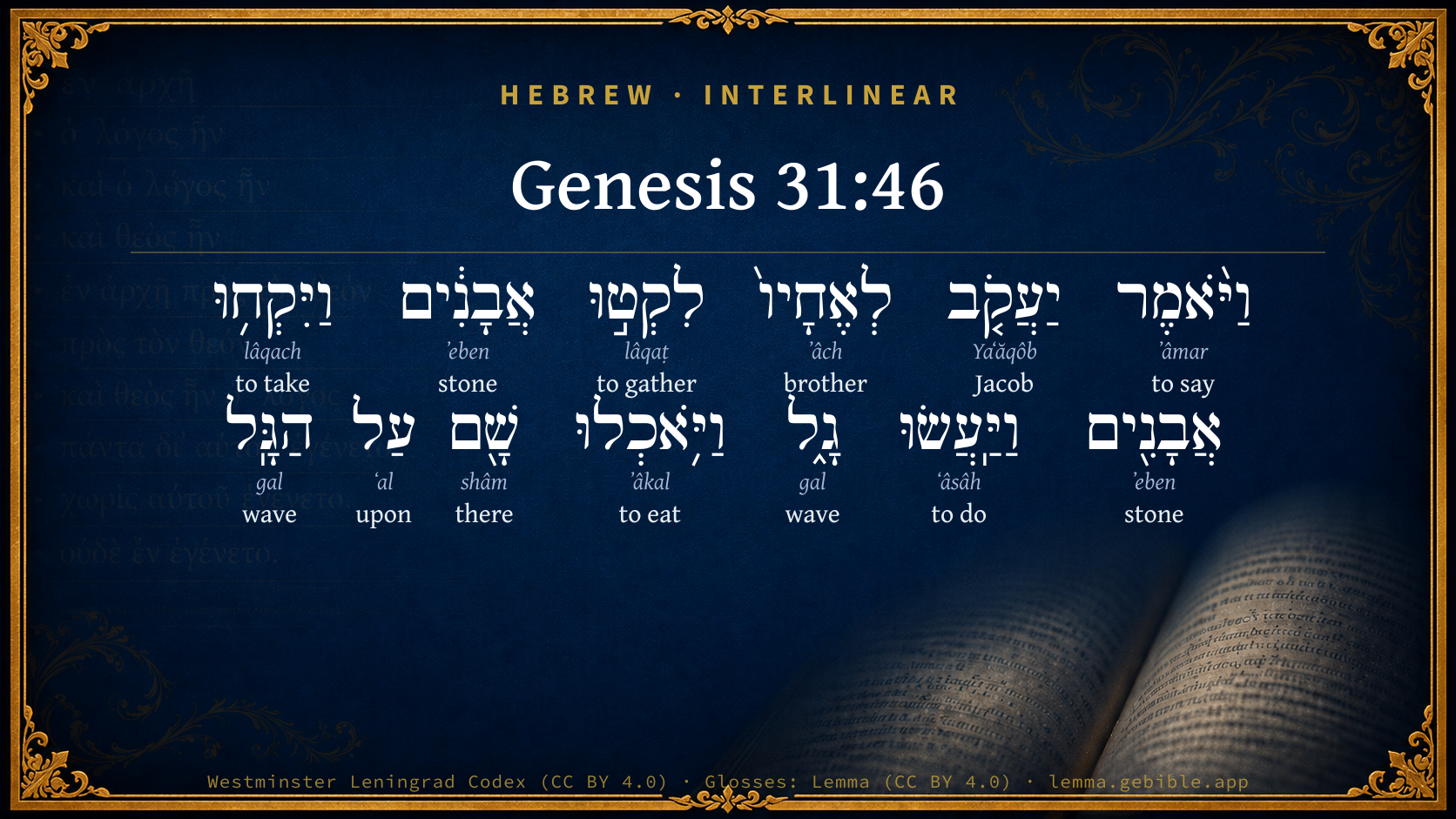
  1. וַיֹּ֨אמֶר ʼâmar H559 “and · to say” Conjunction + Verb, Qal, Sequential Imperfect, 3rd Person, Masculine, Singular
  2. יַעֲקֹ֤ב Yaʻăqôb H3290 “Jacob” Noun, Proper
  3. לְאֶחָיו֙ ʼâch H251 “to/for · brothers · his” Preposition + Noun, Common, Masculine, Plural, Construct + Suffix, Personal, 3rd Person, Masculine, Singular
  4. לִקְט֣וּ lâqaṭ H3950 “gather” Verb, Qal, Imperative, 2nd Person, Masculine, Plural
  5. אֲבָנִ֔ים ʼeben H68 “stones” Noun, Common, Feminine, Plural, Absolute
  6. וַיִּקְח֥וּ lâqach H3947 “and · to take” Conjunction + Verb, Qal, Sequential Imperfect, 3rd Person, Masculine, Plural
  7. אֲבָנִ֖ים ʼeben H68 “stones” Noun, Common, Feminine, Plural, Absolute
  8. וַיַּֽעֲשׂוּ ʻâsâh H6213 “and · to do” Conjunction + Verb, Qal, Sequential Imperfect, 3rd Person, Masculine, Plural
  9. וַיֹּ֥אכְלוּ ʼâkal H398 “and · to eat” Conjunction + Verb, Qal, Sequential Imperfect, 3rd Person, Masculine, Plural
  10. שָׁ֖ם shâm H8033 “there” Adverb
  11. עַל ʻal H5921 “upon” Preposition
  12. הַגָּֽל gal H1530 “the · wave” Particle, Definite Article + Noun, Common, Masculine, Singular, Absolute

About this verse

These counts appear in no published source. They are computed here, from the morphology-tagged text and Lemma’s own curated glosses. What Lemma adds →

13
words
11
distinct lemmas
Pentateuch
section

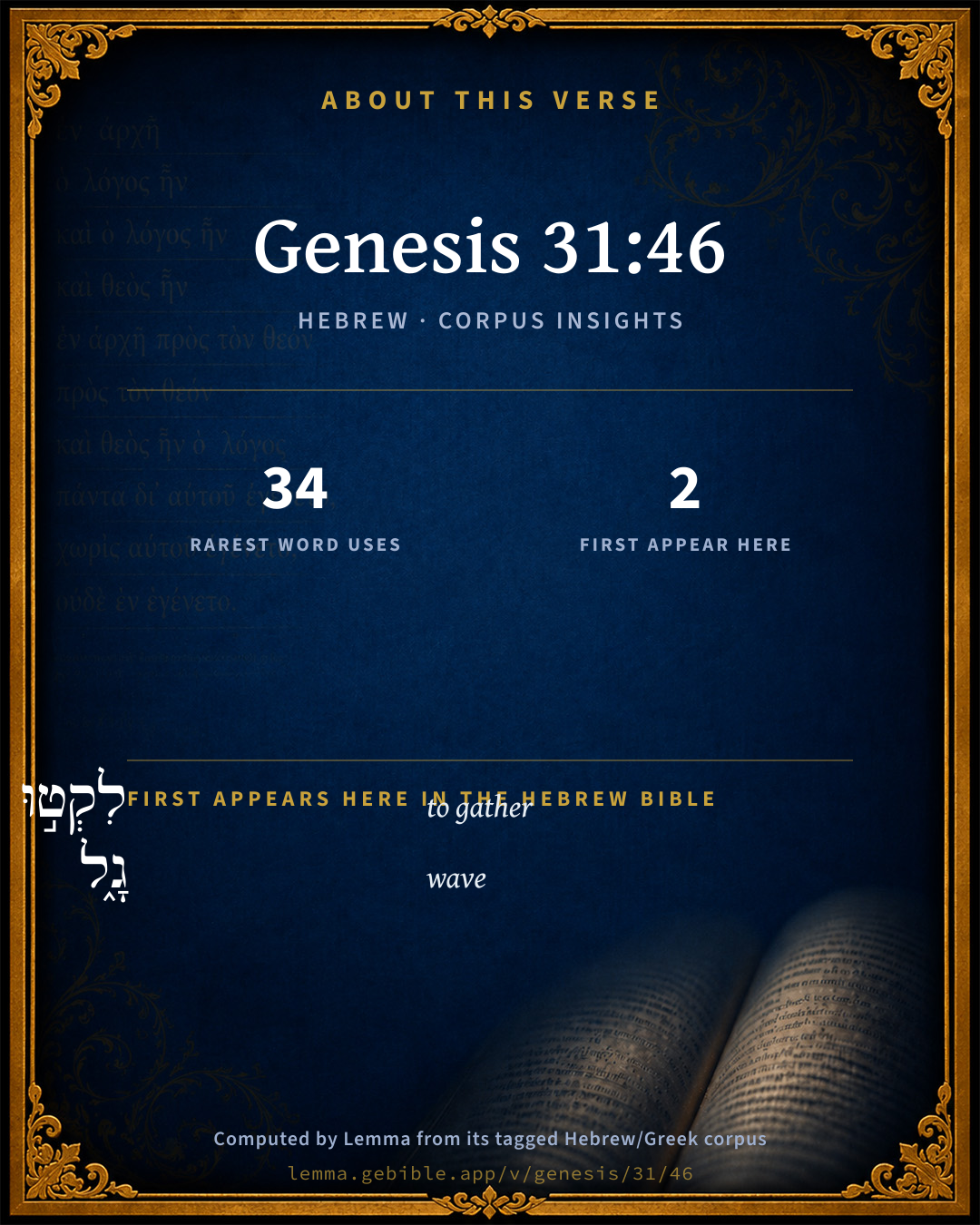
First appearance in Scripture

These words make their first canonical appearance in the Hebrew Bible here:

  • לִקְט֣וּ to gather H3950
  • גָ֑ל wave H1530

Shared distinctive vocabulary

גָ֑ל wave H1530 occurs in 31 verses of the Hebrew Bible. Also found in:

Grammatical profile

  • 5 verbs
  • 6 nouns
  • 1 preposition
  • 1 adverb

Verb forms

  • וַיֹּ֨אמֶר Qal · Sequential Imperfect
  • לִקְט֣וּ Qal · Imperative
  • וַיִּקְח֥וּ Qal · Sequential Imperfect
  • וַיַּֽעֲשׂוּ Qal · Sequential Imperfect
  • וַיֹּ֥אכְלוּ Qal · Sequential Imperfect

Repetition

Words recur within this verse — often emphatic in Hebrew:

  • אֲבָנִ֔ים stone H68 ×2
  • גָ֑ל wave H1530 ×2

Hebrew & Septuagint length

In English translation the verse runs 20 words from the Hebrew and 35 from the Septuagint (LXX English) — the Septuagint runs noticeably longer here. See the side-by-side →

A rough comparison of the two English renderings, which tokenize alike — not a word-level alignment.

Word counts can differ between the Hebrew and the Greek without any difference in meaning — e.g. the Hebrew direct-object marker אֵת has no separate Greek word, and Greek often adds the article ὁ.

Cross-references

9

Topical passages linked to Genesis 31:46 in the Treasury of Scripture Knowledge — connected by theme and wording, ordered by reader-vote popularity; previews shown in the World English Bible.

  • Ecclesiastes 3:5 A time to cast away stones, And a time to gather stones together; A time to embrace, And a time to refrain from embracing;
  • Genesis 31:23 He took his relatives with him, and pursued after him seven days' journey. He overtook him in the mountain of Gilead.
  • Genesis 31:32 With whoever you find your gods, he shall not live. Before our relatives, discern what is yours with me, and take it." For Jacob didn't know that Rachel had stolen them.
  • Genesis 31:37 Now that you have felt around in all my stuff, what have you found of all your household stuff? Set it here before my relatives and your relatives, that they may judge between us two.
  • Genesis 31:54 Jacob offered a sacrifice in the mountain, and called his relatives to eat bread. They ate bread, and stayed all night in the mountain.
  • Joshua 4:5–9 and Joshua said to them, Pass over before the ark of Yahweh your God into the midst of the Jordan, and take up every man of you a stone on his shoulder, according to the number of the tribes of the children of Israel;
  • Joshua 4:20–24 Those twelve stones, which they took out of the Jordan, did Joshua set up in Gilgal.
  • Joshua 7:26 They raised over him a great heap of stones, to this day; and Yahweh turned from the fierceness of his anger. Therefore the name of that place was called "The valley of Achor" to this day.
  • 2 Samuel 18:17 They took Absalom, and cast him into the great pit in the forest, and raised over him a very great heap of stones: and all Israel fled everyone to his tent.

Cross-references courtesy of OpenBible.info (CC BY 4.0).

Hebrew and Greek witnesses Masoretic Hebrew ↔ Greek Septuagint

The same verse in the two great witnesses to the Old Testament, shown verse-for-verse.

Here the Septuagint runs noticeably longer than the Hebrew — LXX2012 (modern English Septuagint) 35 words vs World English Bible 20. A rough length comparison of the two English translations, not a word-level alignment — read both below.

These are two independent witnesses, not word-aligned to each other, and the Septuagint is shown in lemma (dictionary) form.

Hebrew Genesis 31:46 Masoretic · Westminster Leningrad Codex

וַיֹּ֨אמֶר יַעֲקֹ֤ב לְאֶחָיו֙ לִקְט֣וּ אֲבָנִ֔ים וַיִּקְח֥וּ אֲבָנִ֖ים וַיַּֽעֲשׂוּ גָ֑ל וַיֹּ֥אכְלוּ שָׁ֖ם עַל הַגָּֽל

Jacob said to his relatives, "Gather stones." They took stones, and made a heap. They ate there by the heap.

World English Bible · Public Domain

Greek LXX Genesis 31:46 Septuagint · lemma form

εἶπον δέ ἰακώβ ὁ ἀδελφός αὐτός συνλέγω λίθος καί συνλέγω λίθος καί ποιέω βουνός καί ἐσθίω καί πίνω ἐκεῖ ἐπί ὁ βουνός καί εἶπον αὐτός λαβαν ὁ βουνός οὗτος μαρτυρέω ἀνά μέσος ἐγώ καί σύ σήμερον

And Jacob said to his brethren, Gather stones; and they gathered stones and made a heap, and ate there upon the heap; and Laban said to him, This heap witnesses between me and you today.

LXX2012 (modern English Septuagint) · Public Domain

Hebrew: Westminster Leningrad Codex (CC BY 4.0). Greek: Septuagint (public domain); English from LXX2012 (modern English Septuagint) (Public Domain). How the Septuagint differs from the Hebrew →

Targum (Aramaic paraphrase)

2

The Targum is the ancient Jewish Aramaic paraphrase of the Hebrew Scriptures — an interpretive translation, not the Hebrew text itself. Onkelos (literal) and Pseudo-Jonathan (expansive) render the Torah, and Jonathan the Prophets. Coverage is partial: where no permissively-licensed English translation exists for a verse, only the Aramaic is shown. This is verse-level text, not a word-by-word alignment to the Hebrew.

  1. Targum Onkelos Torah (Genesis–Deuteronomy)
    וַאֲמַר יַעֲקֹב לַאֲחוֹהִי לְקוּטוּ אַבְנִין וּנְסִיבוּ אַבְנִין וַעֲבָדוּ דְּגוֹרָא וַאֲכָלוּ תַמָּן עַל דְּגוֹרָא

    (no public-domain English translation for this verse)

    Targum Onkelos — Aramaic: “Onkelos Genesis” (public domain); “Onkelos Exodus” (public domain); “Onkelos Leviticus” (public domain); “Onkelos Numbers” (public domain); “Onkelos Deuteronomy” (public domain). English: “Sefaria Community Translation” (CC0 1.0 (public-domain dedication)); “J.W. Etheridge. The Targums of Onkelos and Jonathan Ben Uzziel on the Pentateuch. London: Longmans, Green, 1862” (public domain). Text via Sefaria.

  2. Targum Pseudo-Jonathan Torah (Genesis–Deuteronomy)
    וַאֲמַר יַעֲקב לִבְנוֹי דַהֲוָה קָרֵי לְהוֹם אָחוּי לְקוּטוּ אַבְנִין וְלַקִטוּ אַבְנִין וַעֲבָדוּ אוֹגַר וַאֲכָלוּ תַמָן עַל אוֹגְרָא

    And Jakob said to his sons, whom he called his brethren, Collect stones. And they collected stones, and made a mound, and they ate upon the mound.

    Targum Pseudo-Jonathan — Aramaic: “Targum Jonathan on Genesis” (public domain); “Targum Jonathan on Exodus” (public domain); “Targum Jonathan on Leviticus” (public domain); “Targum Jonathan on Numbers” (public domain); “Targum Jonathan on Deuteronomy” (public domain). English: “The Targum of Jonathan ben Uzziel, trans. J. W. Etheridge, London, 1862” (public domain). Text via Sefaria.

Commentary

Notes on Genesis 31:46 from classic Christian and Jewish commentators (each source and its license shown beneath its notes). The classic Christian expositions comment on the surrounding passage and are grouped to its opening verse, so a note may address several verses; the Jewish commentaries on the Tanakh (Rashi and others) are per-verse, so they appear only where the commentator wrote on this verse.

Lemma curates 59 commentaries, every one of them public domain or Creative Commons licensed, each selected and text-cleaned for this edition rather than reprinted as found. About our sources →

Trapp's Complete Commentary

John Trapp

Gen 31:46 And Jacob said unto his brethren, Gather stones; and they took stones, and made an heap: and they did eat there upon the heap.

Ver.46. And Jacob said unto his brethren.] As well Laban’s company as his own, Gen 31:51.

John Trapp, A Commentary or Exposition upon All the Books of the Old and New Testament (1647–1656) — public domain. Text from a community e-Sword module.

Adam Clarke's Commentary

Verse 46. Made a heap] גל gal, translated heap, signifies properly a round heap; and this heap was probably made for the double purpose of an altar and a table, and Jacob's stone or pillar was set on it for the purpose of a memorial.

Adam Clarke's Commentary on the Bible (1810–1826) — public domain. Text from a community e-Sword/MySword module.

The Cambridge Bible for Schools and Colleges

gen. ed. J. J. S. Perowne

46. his brethren] i.e. his followers and companions; see Gen_31:23; Gen_31:32.

an heap] Heb. gal. What we should now call a “cairn,” on the top of a mountain. Lat. tumulus.

The Cambridge Bible for Schools and Colleges (gen. ed. J. J. S. Perowne; Cambridge University Press, 1878–1918) — public domain. Text from a community e-Sword module.

John Gill's Exposition

And Mizpah,.... Which being an Hebrew word, it looks as if the heap had also this name given it by Jacob, which signifies a "watch" or "watchtower"; though, by what follows, it seems to be given by Laban, who could speak Hebrew as well, as Syriac, or Chaldee:

for he said, the Lord watch between me and thee, when we are absent one from another; or "hid one from another" (q); when being at a distance, they could not see each other, or what one another did in agreement or disagreement with their present covenant: but he intimates, that the Lord sees and knows all things, and therefore imprecates that God would watch over them both, them and their actions, and bring upon them the evil or the good, according as their actions were, or as they broke or kept this covenant.

(q) "abscondemur", Montanus, Vatablus, Drusius; "absconditi erimus", Junius & Tremellius, Piscator; so Ainsworth.

John Gill's Exposition of the Whole Bible (1746–1763) — public domain (CC PDM 1.0). Text via the HelloAO Bible API.

Matthew Poole's English Annotations

To wit, afterwards, Gen 31:54, though it be here mentioned by anticipation.

They did eat there upon the heap, or rather by or beside the heap, as the Hebrew particle al is oft understood, as Psa 23:2; 81:7.

Matthew Poole's English Annotations on the Holy Bible (1683–1685) — public domain. Text from a community e-Sword/MySword module.

The Pulpit Commentary

And Jacob said unto his brethren, Laban"s kinsmen and his own (vide ver. 37)Gather stones; and they took stones, and made a heap: Gal, from Galal, to roll, to move in a circle, probably signified a circular cairn, to be used not as a seat (Gerlach), but as an altar (ver. 54), a witness (ver. 48), and a table (ver. 54), since it is addedand they did eat there not immediately (Lange), but afterwards, on the conclusion of the covenant (ver. 54)upon the heap.

The Pulpit Commentary (1880–1919), ed. H.D.M. Spence-Jones & Joseph S. Exell — public domain. Text from a community e-Sword module.

Rashi

Rabbi Shlomo Yitzchaki (Rashi)

לאחיו UNTO HIS BRETHREN — really his sons, who were like brothers to him since they were standing by him in trouble and in battle (Genesis Rabbah 74:13).

Rashi on the Tanakh — English translations: “The Judaica Press complete Tanach with Rashi, translated by A. J. Rosenberg” (CC BY 4.0); “Pentateuch with Rashi's commentary by M. Rosenbaum and A.M. Silbermann, 1929-1934” (public domain); “The Metsudah Tanach series, Lakewood, N.J” (CC BY 4.0); and “The Book of Joshua, Metsudah Publications, 1997” (CC BY 4.0). Text via Sefaria.

Ramban (Nachmanides)

Rabbi Moshe ben Nachman (Ramban / Nachmanides)

AND JACOB SAID UNTO HIS BRETHREN. I.e., to Laban’s brothers mentioned above, who had accompanied him, as Jacob did not want to say it to his father-in-law whom he treated with respect. Likewise, the verse, And he [Jacob] called his brethren to eat bread, also refers to Laban’s brothers, and he did not invite Laban to eat bread as an act of respect, as if everything is under his authority and is all his. A similar case is the verse, And Pharaoh said unto his brethren: What is your occupation? [which means he said it to Joseph’s brethren]. But Rashi explained: “And Jacob said unto his brethren — to Jacob’s brothers, [meaning, his sons, who were like brothers to him since they stood by him in trouble and in battle].” However, those that came with Laban, whom Scripture calls “his brethren”, were really his friends and companions.It is possible that that which is said concerning Laban, And he took his brethren with him, refers to his kinsmen, members of his family from the seed of Nahor the brother of Abraham. He did this because he did not want to bring against Jacob strangers lest they fight with him intensely, or covet, rob and steal his belongings. Thus these men were kinsmen to Jacob just as to Laban, and therefore they are called “brethren” of both.And some say that Jacob ethically referred to them as “my brothers,” just as he said to the shepherds, My brethren, whence are ye? And in Bereshith Rabbah, the Sages have said: “And Jacob said unto his brethren — these are his sons, whom, in a respectful manner, he called his brothers.” However, with respect to the verse, And he called his brethren to eat bread, the Midrash did not explain [that “his brethren” refers to his sons]! The correct interpretation is the one I wrote at the outset.

AND THEY DID EAT THERE UPON THE STONE-HEAP. They ate a little there as a remembrance. Perhaps it was customary for both of those who made a covenant to eat from one bread as a sign of love and companionship. After having entered into an oath and a covenant, they offered sacrifices and made a great feast. It is possible that the verse stating, and they did eat there upon the stone-heap, refers to the offerings mentioned below, for he said to them, “Gather stones and we will make a heap to eat thereon, and it will also serve as a witness when we make the covenant,” and afterwards they ate the offerings upon it. And the meaning of the verse, And they did eat bread, is that Jacob made them a great feast, and not just a party, in order that they should tarry with him all night.

Ramban (Nachmanides) on the Tanakh — English translation: “Commentary on the Torah by Ramban (Nachmanides). Translated and annotated by Charles B. Chavel. New York, Shilo Pub. House, 1971-1976” (CC BY 4.0). Text via Sefaria.

Radak

Rabbi David Kimhi (Radak)

ויאמר... לאחיו, to his companions. Although Yaakov used the expression “to his brothers,” in telling them to collect stones for the monument, Lavan and his men did likewise and between them they built them into a pile before sharing a meal together. Yaakov ate a meal with his men, Lavan with his, both near the heap of stones they had erected. It is also possible that the meaning of the word לאחיו includes also the men traveling with Lavan, as they were all included in that term now that their war had been settled peacefully. The meal then would be similar to placing a seal on the newly concluded covenant between them.

Radak on the Tanakh — English translations: “Sefaria Community Translation” (CC0 1.0 (public-domain dedication)); “Eliyahu Munk, HaChut Hameshulash” (CC BY 4.0); “Rabbi Mike Feuer, Jerusalem Anthology” (CC BY 4.0); and “R. David Kimhi on the first book of Psalms, Translated by R.G. Finch, London, 1919” (public domain). Text via Sefaria.

Lesson kit

Teaching starters — assembled from the data on this page, not authored interpretation. Every prompt links to the verse data it draws on. Edit before teaching.

Genesis, in the Pentateuch, opens this verse with 13 words (11 distinct Hebrew lemmas). Its most distinctive word is gal (“wave”). The Greek Septuagint runs longer here. A historical commentator’s framing appears above. Read the whole chapter for the surrounding context.

Discussion questions

  1. The word gal carries the sense “wave.” How does it shape the verse?
  2. 2 words here appear for the first time in Scripture. What is being introduced at this debut?
  3. Genesis 31:48 shares the word «wave» with this verse. How do the two illuminate each other?
  4. “stone” occurs 2× in this one verse. What is the effect of the repetition?
  5. Compared with the Hebrew, the Septuagint runs longer here. What questions does that raise?
  6. These translations render this verse differently; the difference is in the English rendering, not the original. What questions does that raise?
  7. The verb «וַיֹּ֨אמֶר» is Qal Sequential Imperfect. How does its form color the action?
  8. Reading how Trapp's Complete Commentary and Adam Clarke's Commentary read this verse, where do the two commentators agree and where do they part?

Things to notice

  • 2 words make their first canonical appearance in Scripture here.
  • These translations choose different wording for 6 words in this verse.
  • “stone” occurs 2× in this single verse.
  • 11 distinct Hebrew lemmas span 13 words in this verse.

Reading settings

Reading text

Shown beneath each verse's original-language words.

Old Testament
Old Testament edition

Read the OT as the Masoretic Hebrew (MT) or the Greek Septuagint (LXX).

English shown for the Greek Septuagint (in the Hebrew ↔ Greek comparison).

Comparing translations? Open the Compare panel on any verse page to stack up to four side by side.