Genesis 32:25

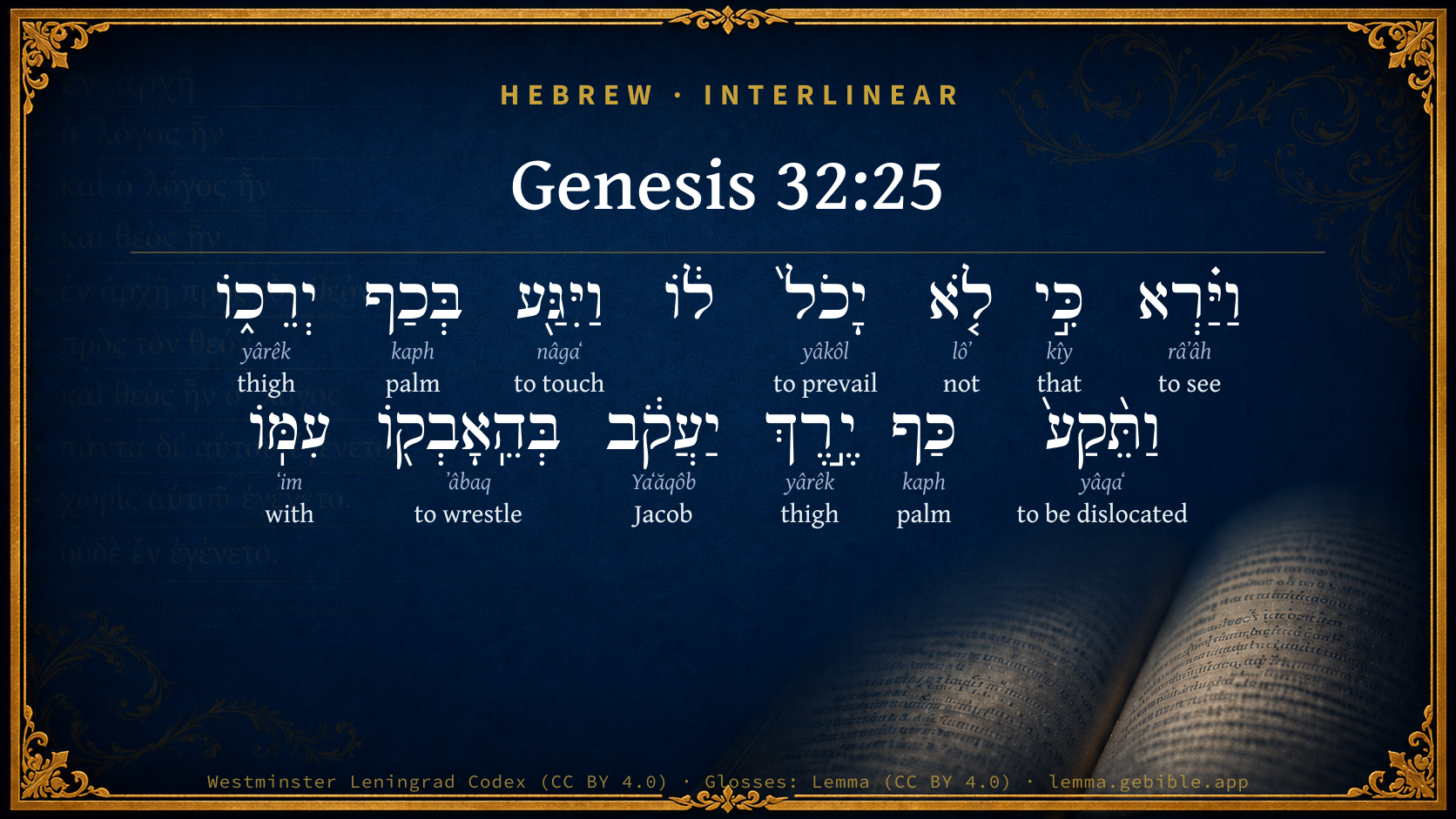
Hebrew (Westminster Leningrad Codex) Genesis 32:25 appears in the Hebrew Old Testament. The text above is from the Westminster Leningrad Codex. Each word links to its Strong’s number, a concise gloss, and parsing drawn from the Open Scriptures Hebrew Bible morphology. Click any word for its full Brown-Driver-Briggs (BDB) entry.
Download image
Cite this verse

Genesis 32:25 (World English Bible). Public Domain. Lemma interlinear Bible study tool, https://lemma.gebible.app/v/genesis/32/25.

Show BibTeX & RIS
BibTeX
RIS
English Translation
When he saw that he didn't prevail against him, he touched the hollow of his thigh, and the hollow of Jacob's thigh was strained, as he wrestled.
World English Bible · Public Domain
Highlights
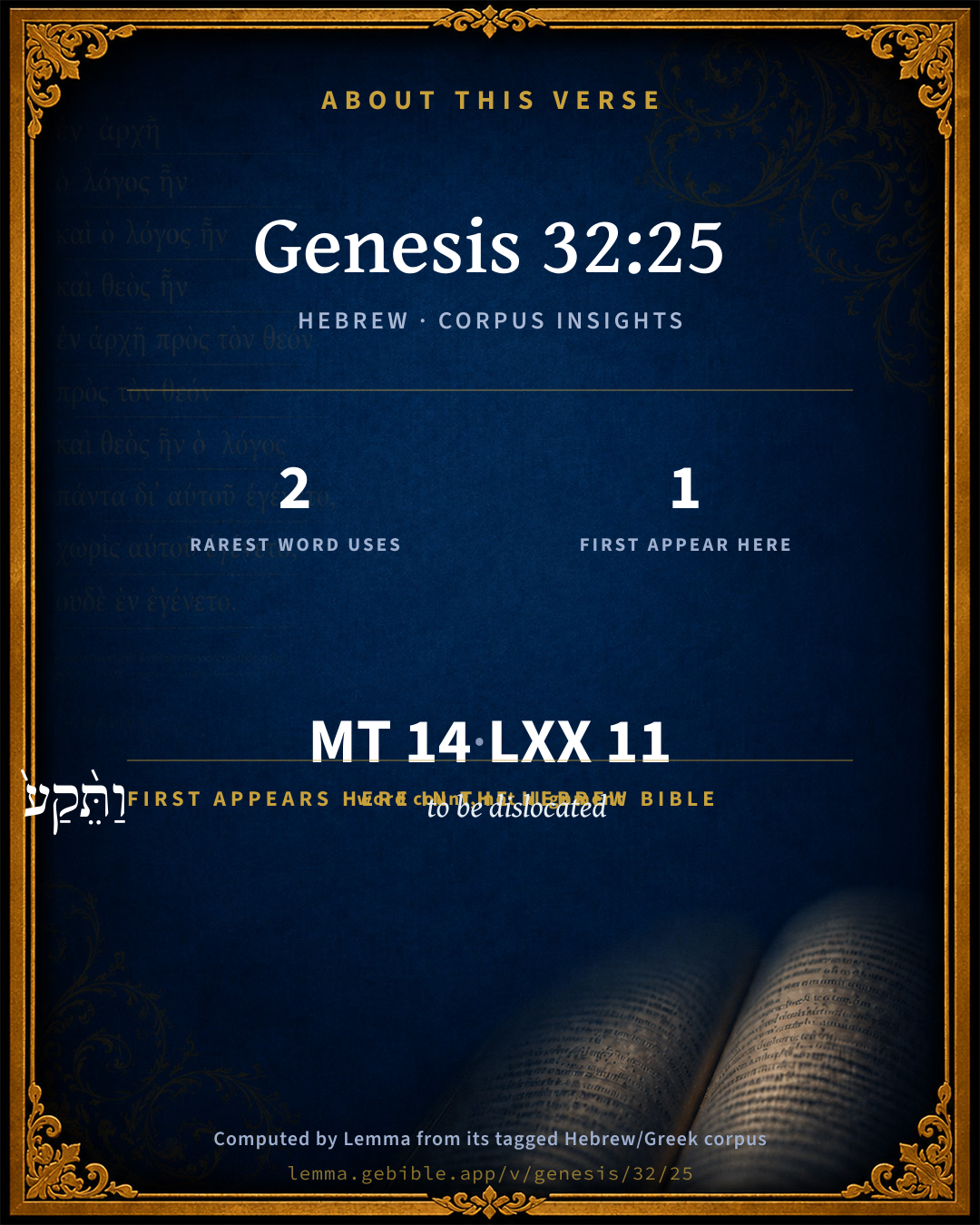
  • 1 first appearance in the Hebrew Bible
Full analysis ↓
Download a study sheet

One document with this verse’s original text, its word-by-word gloss line, the meaning frame, cross-references with their text, attributed commentary, and full source and license credits — printable, and it pastes into notes with its structure intact.

This verse Autodidact and up

Study sheet (.html) Plain text (.txt)

A passage Seminary Student

Up to 50 verses in one chapter. A passage sheet keeps up to 6 commentary sources and 12 cross-references per verse, in the order this page ranks them, and says so on the sheet whenever that leaves anything out. Ask for a single verse and you get the Autodidact verse sheet above.

Everything on this page stays free to read, with no account — the sheet is a download of what is already on screen, not access to it.

Want to remove ads? Support Godless Engineer
Compare translations 3

The same verse in 3 English versions, stacked beneath the original-language interlinear above. Click any original word for its lexicon entry.

Each is an independent rendering of the whole verse — the interlinear is not word-aligned to these translations.

Highlighted words mark where these versions differ — a whole-verse word diff, not a word-by-word alignment.

  • World English Bible Public Domain
    When he saw that he didn't prevail against him, he touched the hollow of his thigh, and the hollow of Jacob's thigh was strained, as he wrestled.
  • King James Version Public Domain
    And when he saw that he prevailed not against him, he touched the hollow of his thigh; and the hollow of Jacob's thigh was out of joint, as he wrestled with him.
  • unfoldingWord Literal Text CC BY-SA 4.0
    And he saw that he was not prevailing over him, so he touched on the socket of his hip, so that the socket of Jacob’s hip was dislocated as he wrestled with him.

unfoldingWord Literal Text — © unfoldingWord, licensed CC BY-SA 4.0. Word-aligned USFM3 via Door43 (git.door43.org/unfoldingWord/en_ult).

Versions to compare (up to 4)

3 of 4 selected

Show all 18 translations

Every available English version of this verse, each an independent rendering of the whole verse.

  • World English Bible Public Domain
    When he saw that he didn't prevail against him, he touched the hollow of his thigh, and the hollow of Jacob's thigh was strained, as he wrestled.
  • Berean Standard Bible Public Domain
    When the man saw that he could not overpower Jacob, he struck the socket of Jacob’s hip and dislocated it as they wrestled.
  • Majority Standard Bible Public Domain
    When the man saw that he could not overpower Jacob, he struck the socket of Jacob’s hip and dislocated it as they wrestled.
  • King James Version Public Domain
    And when he saw that he prevailed not against him, he touched the hollow of his thigh; and the hollow of Jacob's thigh was out of joint, as he wrestled with him.
  • American Standard Version (1901) Public Domain
    And when he saw that he prevailed not against him, he touched the hollow of his thigh; and the hollow of Jacob's thigh was strained, as he wrestled with him.
  • Revised Version (1885) Public Domain
    And when he saw that he prevailed not against him, he touched the hollow of his thigh; and the hollow of Jacob’s thigh was strained, as he wrestled with him.
  • Geneva Bible (1599) Public Domain
    And he sawe that he could not preuaile against him: therefore he touched the holowe of his thigh, and the holowe of Iaakobs thigh was loosed, as he wrestled with him.
  • Douay-Rheims (1899) Public Domain
    And when he saw that he could not overcome him, he touched the sinew of his thigh, and forthwith it shrank.
  • Young's Literal Translation Public Domain
    and he seeth that he is not able for him, and he cometh against the hollow of his thigh, and the hollow of Jacob's thigh is disjointed in his wrestling with him;
  • Literal Standard Version CC BY-SA 4.0
    and He sees that He is not able for him, and He comes against the hollow of his thigh, and the hollow of Jacob’s thigh is disjointed in his wrestling with Him;
  • Unlocked Literal Bible CC BY-SA 4.0
    When the man saw that he could not defeat him, he struck Jacob's hip. Jacob's hip was dislocated as he wrestled with him.
  • unfoldingWord Literal Text CC BY-SA 4.0
    And he saw that he was not prevailing over him, so he touched on the socket of his hip, so that the socket of Jacob’s hip was dislocated as he wrestled with him.
  • Darby Bible Public Domain
    And when he saw that he did not prevail against him, he touched the joint of his thigh; and the joint of Jacob's thigh was dislocated as he wrestled with him.
  • World Messianic Bible Public Domain
    When he saw that he didn’t prevail against him, the man touched the hollow of his thigh, and the hollow of Jacob’s thigh was strained as he wrestled.
  • Webster's Bible Public Domain
    And when he saw that he prevailed not against him, he touched the hollow of his thigh: and the hollow of Jacob's thigh was out of joint, as he wrestled with him.
  • Free Bible Version CC BY-SA 4.0
    When the man realized he couldn't beat Jacob, he hit Jacob's hip socket and put it out of joint as he wrestled with him.
  • Bible in Basic English Public Domain
    But when the man saw that he was not able to overcome Jacob, he gave him a blow in the hollow part of his leg, so that his leg was damaged.
  • JPS Tanakh (1917) Public Domain
    (32-26) And when he saw that he prevailed not against him, he touched the hollow of his thigh; and the hollow of Jacob's thigh was strained, as he wrestled with him.

Literal Standard Version (2020), Covenant Press — licensed CC BY-SA 4.0. Text via the HelloAO Bible API (eBible.org). Unlocked Literal Bible (unfoldingWord) — licensed CC BY-SA 4.0. Text via the HelloAO Bible API (eBible.org). unfoldingWord Literal Text — © unfoldingWord, licensed CC BY-SA 4.0. Word-aligned USFM3 via Door43 (git.door43.org/unfoldingWord/en_ult). Free Bible Version, Dr. Jonathan Gallagher — licensed CC BY-SA 4.0. Text via the HelloAO Bible API (eBible.org).

Word by word

More ways to search: Search by grammar → Find every occurrence → Compare this word →

Practice this passage: Drill this verse → Learn its vocabulary →

בְּהֵֽאָבְק֖וֹ
ʼâbaq
H79
“in/at · to wrestle · him”
Preposition + Verb, Niphal, Infinitive Construct + Suffix, Personal, 3rd Person, Masculine, Singular
Part of Speech
Preposition + Verb
Stem
Niphal
Form
Infinitive Construct
Full BDB Definition

Origin: a primitive root, probably to float away (as vapour), but used only as denominative from H80

TWOT: 12

(Niphal) to wrestle, grapple (get dusty), bedust
  1. וַיַּ֗רְא râʼâh H7200 “and · to see” Conjunction + Verb, Qal, Sequential Imperfect, 3rd Person, Masculine, Singular
  2. כִּ֣י kîy H3588 “that” Conjunction
  3. לֹ֤א lôʼ H3808 “not” Particle, Negative
  4. יָכֹל֙ yâkôl H3201 “to prevail” Verb, Qal, Perfect, 3rd Person, Masculine, Singular
  5. וַיִּגַּ֖ע nâgaʻ H5060 “and · to touch” Conjunction + Verb, Qal, Sequential Imperfect, 3rd Person, Masculine, Singular
  6. בְּכַף kaph H3709 “in/at · palm of” Preposition + Noun, Common, Feminine, Singular, Construct
  7. יְרֵכ֑וֹ yârêk H3409 “thigh · his” Noun, Common, Feminine, Singular, Construct + Suffix, Personal, 3rd Person, Masculine, Singular
  8. וַתֵּ֨קַע֙ yâqaʻ H3363 “and · to be dislocated” Conjunction + Verb, Qal, Sequential Imperfect, 3rd Person, Feminine, Singular
  9. כַּף kaph H3709 “palm of” Noun, Common, Feminine, Singular, Construct
  10. יֶ֣רֶךְ yârêk H3409 “thigh of” Noun, Common, Feminine, Singular, Construct
  11. יַעֲקֹ֔ב Yaʻăqôb H3290 “Jacob” Noun, Proper
  12. עִמּֽוֹ ʻim H5973 “with · him” Preposition + Suffix, Personal, 3rd Person, Masculine, Singular

About this verse

These counts appear in no published source. They are computed here, from the morphology-tagged text and Lemma’s own curated glosses. What Lemma adds →

14
words
11
distinct lemmas
Pentateuch
section

Notable vocabulary

The rarest word here is בְּהֵֽאָבְק֖וֹ to wrestle H79 — appearing just 2 times in the whole Hebrew Bible.

First appearance in Scripture

This word makes its first canonical appearance in the Hebrew Bible here:

  • וַתֵּ֨קַע֙ to be dislocated H3363

Shared distinctive vocabulary

בְּהֵֽאָבְק֖וֹ to wrestle H79 occurs in 2 verses of the Hebrew Bible. Also found in:

Grammatical profile

  • 5 verbs
  • 5 nouns
  • 2 prepositions
  • 1 conjunction
  • 1 particle

Verb forms

  • וַיַּ֗רְא Qal · Sequential Imperfect
  • יָכֹל֙ Qal · Perfect
  • וַיִּגַּ֖ע Qal · Sequential Imperfect
  • וַתֵּ֨קַע֙ Qal · Sequential Imperfect
  • בְּהֵֽאָבְק֖וֹ Niphal · Infinitive Construct

Repetition

Words recur within this verse — often emphatic in Hebrew:

  • בְּכַף palm H3709 ×2
  • יְרֵכ֑וֹ thigh H3409 ×2

Hebrew & Septuagint length

In English translation the verse runs 27 words from the Hebrew and 32 from the Septuagint (LXX English) — closely comparable.

A rough comparison of the two English renderings, which tokenize alike — not a word-level alignment.

Word counts can differ between the Hebrew and the Greek without any difference in meaning — e.g. the Hebrew direct-object marker אֵת has no separate Greek word, and Greek often adds the article ὁ.

In the original languages it is 14 Hebrew tokens and 11 Greek tokens — but the two are counted differently (Hebrew bundles its prefixes and suffixes into one token; the Greek is in lemma form), so that isn’t a like-for-like length.

Cross-references

10

Topical passages linked to Genesis 32:25 in the Treasury of Scripture Knowledge — connected by theme and wording, ordered by reader-vote popularity; previews shown in the World English Bible.

  • 2 Corinthians 12:7–9 By reason of the exceeding greatness of the revelations, that I should not be exalted excessively, there was given to me a thorn in the flesh, a messenger of Satan to buffet me, that I should not be exalted excessively.
  • Hosea 12:3–4 In the womb he took his brother by the heel; And in his manhood he had power with God.
  • Genesis 32:32 Therefore the children of Israel don't eat the sinew of the hip, which is on the hollow of the thigh, to this day, because he touched the hollow of Jacob's thigh in the sinew of the hip.
  • Isaiah 41:14 Don't be afraid, you worm Jacob, and you men of Israel; I will help you, says Yahweh, and your Redeemer is the Holy One of Israel.
  • Isaiah 45:11 Thus says Yahweh, the Holy One of Israel, and his Maker: Ask me of the things that are to come; concerning my sons, and concerning the work of my hands, command you me.
  • Matthew 26:41 Watch and pray, that you don't enter into temptation. The spirit indeed is willing, but the flesh is weak."
  • Genesis 19:22 Hurry, escape there, for I can't do anything until you get there." Therefore the name of the city was called Zoar.
  • Numbers 14:13–14 Moses said to Yahweh, Then the Egyptians will hear it; for you brought up this people in your might from among them;
  • Psalms 30:6–7 As for me, I said in my prosperity, "I shall never be moved."
  • Matthew 15:22–28 Behold, a Canaanite woman came out from those borders, and cried, saying, "Have mercy on me, Lord, you son of David! My daughter is severely demonized!"

Cross-references courtesy of OpenBible.info (CC BY 4.0).

Hebrew and Greek witnesses Masoretic Hebrew ↔ Greek Septuagint

The same verse in the two great witnesses to the Old Testament, shown verse-for-verse.

These are two independent witnesses, not word-aligned to each other, and the Septuagint is shown in lemma (dictionary) form.

Hebrew Genesis 32:25 Masoretic · Westminster Leningrad Codex

וַיַּ֗רְא כִּ֣י לֹ֤א יָכֹל֙ ל֔וֹ וַיִּגַּ֖ע בְּכַף יְרֵכ֑וֹ וַתֵּ֨קַע֙ כַּף יֶ֣רֶךְ יַעֲקֹ֔ב בְּהֵֽאָבְק֖וֹ עִמּֽוֹ

When he saw that he didn't prevail against him, he touched the hollow of his thigh, and the hollow of Jacob's thigh was strained, as he wrestled.

World English Bible · Public Domain

Greek LXX Genesis 32:25 Septuagint · lemma form

ὑπολείπω δέ ἰακώβ μόνος καί παλαίω ἄνθρωπος μετά αὐτός ἕως πρωΐ

And he saw that he prevailed not against him; and he touched the broad part of his thigh, and the broad part of Jacob's thigh was benumbed in his wrestling with him.

LXX2012 (modern English Septuagint) · Public Domain

Hebrew: Westminster Leningrad Codex (CC BY 4.0). Greek: Septuagint (public domain); English from LXX2012 (modern English Septuagint) (Public Domain). How the Septuagint differs from the Hebrew →

Targum (Aramaic paraphrase)

2

The Targum is the ancient Jewish Aramaic paraphrase of the Hebrew Scriptures — an interpretive translation, not the Hebrew text itself. Onkelos (literal) and Pseudo-Jonathan (expansive) render the Torah, and Jonathan the Prophets. Coverage is partial: where no permissively-licensed English translation exists for a verse, only the Aramaic is shown. This is verse-level text, not a word-by-word alignment to the Hebrew.

  1. Targum Onkelos Torah (Genesis–Deuteronomy)
    וְאִשְׁתָּאַר יַעֲקֹב בִּלְחוֹדוֹהִי וְאִשְׁתַּדֵּל גַּבְרָא עִמֵּהּ עַד דִּסְלֵק צַפְרָא

    (no public-domain English translation for this verse)

    Targum Onkelos — Aramaic: “Onkelos Genesis” (public domain); “Onkelos Exodus” (public domain); “Onkelos Leviticus” (public domain); “Onkelos Numbers” (public domain); “Onkelos Deuteronomy” (public domain). English: “Sefaria Community Translation” (CC0 1.0 (public-domain dedication)); “J.W. Etheridge. The Targums of Onkelos and Jonathan Ben Uzziel on the Pentateuch. London: Longmans, Green, 1862” (public domain). Text via Sefaria.

  2. Targum Pseudo-Jonathan Torah (Genesis–Deuteronomy)
    וְאִשְׁתְּאַר יַעֲקב בִּלְחוֹדוֹי מֵעִיבְרָא לְיוּבְקָא וְאִתְבַּחַשׁ מַלְאָכָא עִמֵיהּ כִּדְמוּת גְבַר וְאָמַר הֲלָא אָמַרְתָּ לְעַשְרָא כָּל דִילָךְ וְהָא אִית לָךְ תְּרֵיסַר בְּנִין וּבְרַתָּא חֲדָא וְלָא עֲשַרְתִּינוּן מִן יַד אַפְרַשׁ אַרְבַּע בּוּכְרִין לְאַרְבַּע אִימְהָתָא וְאִשְׁתַּיָירוּ תְּמַנְיָא וְתַנָא לְמִמְנֵי מִשִׁמְעוֹן וְסַלִיק לֵוִי בִּמְעַשְרָא עָנֵי מִיכָאֵל וַאֲמַר רִבּוֹנֵיהּ דְעַלְמָא דֵין הוּא עַדְבָךְ וְעַל עֵיסַק פִּתְגָמַיָא הָאִילֵין אִשְׁתְּהִי מִן הָאֵל לְנַחֲלָא עַד מֵיסַק עַמוֹד קְרִיצְתָּא

    And Jakob remained alone beyond the Jubeka; and an Angel contended with him in the likeness of a man. And he said, Hast thou not promised to give the tenth of all that is thine? And, behold, thou hast ten sons and one daughter: nevertheless thou hast not tithed them. Immediately he set apart the four firstborn of the four mothers, and there remained eight. And he began to number from Shimeon, and Levi came up for the tenth. Michael answered and said, Lord of the world, this is Thy lot. And on account of these things he (Michael) remained from God at the torrent till the column of the morning was ascending.

    Targum Pseudo-Jonathan — Aramaic: “Targum Jonathan on Genesis” (public domain); “Targum Jonathan on Exodus” (public domain); “Targum Jonathan on Leviticus” (public domain); “Targum Jonathan on Numbers” (public domain); “Targum Jonathan on Deuteronomy” (public domain). English: “The Targum of Jonathan ben Uzziel, trans. J. W. Etheridge, London, 1862” (public domain). Text via Sefaria.

Commentary

Notes on Genesis 32:25 from classic Christian and Jewish commentators (each source and its license shown beneath its notes). The classic Christian expositions comment on the surrounding passage and are grouped to its opening verse, so a note may address several verses; the Jewish commentaries on the Tanakh (Rashi and others) are per-verse, so they appear only where the commentator wrote on this verse.

Lemma curates 59 commentaries, every one of them public domain or Creative Commons licensed, each selected and text-cleaned for this edition rather than reprinted as found. About our sources →

Trapp's Complete Commentary

John Trapp

Gen 32:25 And when he saw that he prevailed not against him, he touched the hollow of his thigh; and the hollow of Jacob’s thigh was out of joint, as he wrestled with him.

Ver. 25. And when he saw that he prevailed not.] He, that is, "the angel" (Christ) "that redeemed Jacob from all evil," {Gen 48:16} and here held him up with the one hand as he strove against him with the other; and yielded himself overcome by the patriarch’s prayers and tears. Deus ipse, qui nullis contra se viribus superari potest, precibus vincitur , saith Jerome.

He touched the hollow of his thigh.] That, if he would needs have the blessing, he might have somewhat with it, {a} that might keep him humble, not ascribing the victory to his own strength. Pride is a weed that will grow out of any ground (like misletoe that will grow upon any tree); but, for most part, from the best. Like air in all bodies, it will have a being in every soul, and creeps into every action, either in the beginning, proceeding, or conclusion. Now therefore it is God’s care to cure his people of this dangerous disease, as he did Jacob here, and afterwards Paul; {2Co 12:7} who, if he had not been buffeted, "had been exalted," and carried higher in conceit than ever he was in his ecstasy.

{a} Victoria non fit sine vulnere: luxat nobis femur: immittit stimulum carni, &c.

John Trapp, A Commentary or Exposition upon All the Books of the Old and New Testament (1647–1656) — public domain. Text from a community e-Sword module.

Joseph Benson's Commentary

Gen 32:25. He prevailed not against him — The angel suffered himself to be conquered, to encourage Jacob’s faith and hope against the approaching danger: nay, he even imparted strength to him to maintain the conflict. For it was not in his own strength that Jacob wrestled, nor by his own strength that he prevailed, but by strength derived from Heaven, by which alone he had power over the angel, Hos 12:3. Jacob’s thigh was out of joint as he wrestled with him — This was to humble him, and make him sensible of his own weakness, that he might ascribe his victory, not to his own power, but to the grace of God, and might be encouraged to depend on that grace for the deliverance he was so much concerned to obtain. It is probable Jacob felt little or no pain from this hurt, for he did not so much as halt till the struggle was over, Gen 32:31. If so, it evidenced itself to be a divine touch indeed, wounding and healing at the same time.

Joseph Benson's Commentary on the Old and New Testaments (1811–1818) — public domain. Text from a community e-Sword module.

Keil & Delitzsch

C. F. Keil & F. Delitzsch

When Jacob was left alone on the northern side of the Jabbok, after sending all the rest across, "there wrestled a man with him until the breaking of the day." נאבק, an old word, which only occurs here (Gen 32:25, Gen 32:26), signifying to wrestle, is either derived from אבק to wind, or related to חבק to contract one's self, to plant limb and limb firmly together. From this wrestling the river evidently received its name of Jabbok (יבּק = יאבּק).

Keil & Delitzsch — Biblical Commentary on the Old Testament (1861–1891) — public domain (CC PDM 1.0). Text via the HelloAO Bible API. (Old Testament only.)

Tyndale Open Study Notes

Tyndale Open Resources

32:25 he touched Jacob’s hip and wrenched it out of its socket: Jacob, the deceitful fighter, could fight no more. When his assailant fought him as man to man, Jacob could hold his own. But like so many of his own rivals, he had now more than met his match.

Tyndale Open Study Notes — © Tyndale Open Resources, licensed CC BY-SA 4.0. Text via the HelloAO Bible API.

Geneva Bible (1599)

Geneva Bible translators

For God assaileth his with the one hand, and upholdeth them with the other.

Geneva Bible (1599) marginal notes — public domain. Text via Bolls.life.

Adam Clarke's Commentary

Verse 25. The hollow of Jacob's thigh was out of joint] What this implies is difficult to find out; it is not likely that it was complete luxation of the thigh bone. It may mean no more than he received a stroke on the groin, not a touch; for the Hebrew word naga often signifies to smite with violence, which stroke, even if comparatively slight, would effectually disable him for a time, and cause him to halt for many hours, if not for several days. I might add that in this place-the groin, a blow might be of fatal consequence; but as the angel gave it only as a proof of his power, and to show that he could not prevail because he would not, hence the blow was only disabling, without being dangerous; and he was probably cured by the time the sun arose.

Adam Clarke's Commentary on the Bible (1810–1826) — public domain. Text from a community e-Sword/MySword module.

John Calvin's Commentaries

25. And when he saw that he prevailed not against him. Here is described to us the victory of Jacob, which, however, was not gained without a wound. In saying that the wrestling angel, or God, wished to retire from the contest, because he saw he should not prevail, Moses speaks after the manner of men. For we know that God, when he descends from his majesty to us, is wont to transfer the properties of human nature to himself. The Lord knew with certainty the event of the contest, before he came down to engage in it; he had even already determined what he would do: but his knowledge is here put for the experience of the thing itself.

He touched the hollow of his thigh. Though Jacob gains the victory; yet the angel strikes him on the thigh, from which cause he was lame even to the end of his life. And although the vision was by night, yet the Lord designed this mark of it to continue through all his days, that it might thence appear not to have been a vain dream. Moreover, by this sign it is made manifest to all the faithful, that they can come forth conquerors in their temptations, only by being injured and wounded in the conflict. For we know that the strength of God is made perfect in our weakness, in order that our exaltation may be joined with humility; for if our own strength remained entire, and there were no injury or dislocation produced, immediately the flesh would become haughty, and we should forget that we had conquered by the help of God. But the wound received, and the weakness which follows it, compel us to be modest.

John Calvin's Commentaries (1540-1563) — public domain. Text from the Calvin Translation Society English edition (1840s-50s) via the Christian Classics Ethereal Library (ccel.org). Calvin's coverage is partial (roughly two-thirds of the Bible); uncommented books and verses are honest gaps, never fabricated. The 19th-century editor's footnotes and remarks are omitted so the notes are faithfully Calvin's own voice.

Ellicott's Commentary for English Readers

(25) The hollow of Jacob’s thigh was out of joint.—The hollow is in the Hebrew the pan or socket into which the end of the thigh bone is inserted, and the verb more probably signifies that it was sprained from the over-tension of the muscles in the wrestling. But, in spite of his sprained tendons, Jacob still resisted, and could not be thrown down, and the angel, unable to gain any further advantage, at last acknowledges Jacob’s superiority, and at sunrise craves permission to depart.

A Bible Commentary for English Readers, edited by Charles John Ellicott (1878–1897) — public domain. Text from a community e-Sword module.

The Cambridge Bible for Schools and Colleges

gen. ed. J. J. S. Perowne

25. he saw] In the narrative, as we have it, these words refer to the mysterious combatant with whom Jacob wrestled. But the omission of the subject both in this and the subsequent clause, in the Hebrew as well as in the English, leaves the meaning ambiguous. That it was Jacob, and not “the man,” who by some trick of wrestling got the mastery, may have been the version of the story referred to in Hos_12:4, “he had power over the angel, and prevailed.”

The Cambridge Bible for Schools and Colleges (gen. ed. J. J. S. Perowne; Cambridge University Press, 1878–1918) — public domain. Text from a community e-Sword module.

John Gill's Exposition

And when he saw that he prevailed not against him,.... That he, the man, or the Son of God in the form of man, prevailed not against Jacob, by casting him to the ground, or causing him to desist and leave off wrestling with him; not because he could not, but because he would not, being willing to encourage the faith of Jacob against future trials and exercises, and especially under his present one: besides, such were the promises that this divine Person knew were made to Jacob, and so strong was Jacob's faith at this time in pleading those promises in prayer to God, that he could not do otherwise, consistent with the purposes and promises of God, than suffer himself to be prevailed over by him:

he touched the hollow of his thigh; the hollow part of the thigh or the groin, or the hollow place in which the thigh bone moves, and is said to have the form of the hollow of a man's hand recurved:

and the hollow of Jacob's thigh was out of joint, as he wrestled with him; that is, the huckle bone, or the thigh bone, was moved out of the hollow place in which it was: this was done to let Jacob know that the person he wrestled with was superior to him, and could easily have overcome him, and obliged him to cease wrestling with him if he would; and that the victory he got over him was not by his own strength, but by divine assistance, and by the sufferance of the himself he wrestled with; so that he had nothing to boast of: and this shows the truth and reality of this conflict; that it was not visionary, but a real fact, as well as it teaches the weakness and infirmities of the saints, that attend them in their spiritual conflicts. The word used in this and the preceding verse comes from a root which signifies dust; it being usual with wrestlers to raise up the dust with their feet when they strive together, as Kimchi (g) remarks, as well as it was common with the ancients to wrestle in dust, and sand (h); and hence the phrase "descendere in arenam", combatants were called "arenarii".

(g) Sepher Shorash rad (h) "Fulva luctantur arena." --Virgil.

John Gill's Exposition of the Whole Bible (1746–1763) — public domain (CC PDM 1.0). Text via the HelloAO Bible API.

Haydock's Catholic Bible Commentary

Sinew, near the coxendix, or huckel-bone. (Du Hamel) This was to convince Jacob, how easily he could have gained the victory over him; and to make him remember, that it was not simply a vision, but a real wrestling. (Tirinus)

George Leo Haydock (1774–1849), Haydock's Catholic Family Bible and Commentary, 1859 edition — public domain. Excludes Psalms (Douay-Rheims chapter numbering differs from Protestant) and Deuterocanonical books (Catholic canon only).

Matthew Poole's English Annotations

Not through impotency, but in design, the angel suffered himself to be conquered, to encourage Jacob’s faith and hope against the approaching danger.

The hollow of his thigh, the joint of his hip-bone, or rather the hollow in which that joint was.

The hollow of Jacob’s thigh was out of joint, which was done that Jacob might see that it was not his own strength, but only God’s grace, which got him this victory, and could give him the deliverance which he hoped for.

Matthew Poole's English Annotations on the Holy Bible (1683–1685) — public domain. Text from a community e-Sword/MySword module.

Whedon's Commentary on the Bible

Daniel D. Whedon

25. When he saw that he prevailed not — That is, when the angel saw this. Let us not marvel at such an anthropomorphism, but remember that the angel of Jehovah yielded to Abraham’s intercession; ate with him like a man; found Hagar in the desert; led Lot by the hand out of Sodom, and said, “I cannot do any thing till thou escape.” These self-limitations of the Divine One are manifesting themselves continually through all the history of his revealing himself to the chosen people, and we are not competent to say that he could have revealed himself as well in any other way.

Touched the hollow of his thigh — The socket of the hip-joint, which is here called caph, (כŠ,) from its resembling the hollow palm of the hand. The angel’s touch dislocated this joint; and gave Jacob to know that the mighty wrestler could at any moment disable him, and in so far contending with him had only been graciously condescending to his weakness. “The reason of this act of the angel was very probably lest Jacob should be puffed up by the ‘abundance of the revelations.’ He might think that of his own strength, and not by grace, he had prevailed with God; as St. Paul had the thorn in the flesh sent to him lest he ‘should be exalted above measure.’ 2Co_12:7.” — Speaker’s Commentary.

Daniel D. Whedon (gen. ed.), Commentary on the Old and New Testaments (1874–1909) — public domain. Text from a community e-Sword module.

The Pulpit Commentary

And when he (the unknown wrestler) saw that he prevailed not against him, he touched not struck (Knobel)the hollow of his thigh (literally, the socket of the hip); and the hollow of Jacob"s thigh was out of joint, as he wrestled with him literally, in his wrestling with him.

The Pulpit Commentary (1880–1919), ed. H.D.M. Spence-Jones & Joseph S. Exell — public domain. Text from a community e-Sword module.

John Wesley's Explanatory Notes

The angel prevailed not against him - That is, this discouragement did not shake his faith, nor silence his prayer. It was not in his own strength that he wrestled, nor by his own strength that he prevails; but by strength derived from heaven. That of Job illustrates this, Job xxiii, 6. Will he plead against me with his great power? No; had the angel done so, Jacob had been crushed; but he would put strength in me: and by that strength Jacob had power over the angel, Hosea xii, 3. The angel put out Jacob's thigh, to shew him what he could do, and that it was God he was wrestling with, for no man could disjoint his thigh with a touch. Some think that Jacob felt little or no pain from this hurt; it is probable be did not, for he did not so much as halt 'till the struggle was over, ver. 31, and if so, that was an evidence of a divine touch indeed, which wounded and healed at the same time.

John Wesley, Explanatory Notes Upon the Whole Bible (1754–1765) — public domain. Text via the GEBible commentary corpus.

Rashi

Rabbi Shlomo Yitzchaki (Rashi)

ויותר יעקב AND JACOB WAS LEFT ALONE — He had forgotten some small jars and he returned for them (Chullin 91a).

ויאבק איש AND A MAN WRESTLED — Menachem (ben Seruk) explains: “a man covered himself with dust”, taking the verb as connected in sense with אבק “dust”. It would mean that they were raising the dust with their feet through their movements. I, however, am of opinion that it means “he fastened himself on”, and that it is an Aramaic word, as (Sanhedrin 63b) “after they have joined (אביקו) it", and (Menachot 42a) “and he twined (the “Fringes”) with loops”. It denotes “intertwining”, for such is the manner of two people who make strong efforts to throw each other — one clasps the other and twines himself round him with his arms. Our Rabbis of blessed memory explained that he was Esau’s guardian angel (Genesis Rabbah 77:3).

Rashi on the Tanakh — English translations: “The Judaica Press complete Tanach with Rashi, translated by A. J. Rosenberg” (CC BY 4.0); “Pentateuch with Rashi's commentary by M. Rosenbaum and A.M. Silbermann, 1929-1934” (public domain); “The Metsudah Tanach series, Lakewood, N.J” (CC BY 4.0); and “The Book of Joshua, Metsudah Publications, 1997” (CC BY 4.0). Text via Sefaria.

Ramban (Nachmanides)

Rabbi Moshe ben Nachman (Ramban / Nachmanides)

AND JACOB WAS LEFT ALONE. That is, for he had forgotten some small jars, and he returned for them. These are the words of Rashi. But in line with the plain meaning of Scripture, the verse, And he took them, and made them pass the brook, means that he made them [his family] pass together with him, and he made pass that which was his — [i.e., his camp and his belongings] — by commanding others to do it. He returned [to his camp after ferrying his family across], and he commanded that all others pass over the brook before him, and so he remained behind them.

‘VAYEI’AVEIK’ A MAN WITH HIM, A man covered himself with dust. So Menachem ben Saruk explained it, being derived from the word avak (dust); by their movements, they were raising dust with their feet. I, however, am of the opinion that it means “and he attached himself to,” and that it is an Aramaic word, as in, “After they have joined (aviku) it;” “And they twined the Fringes with loops.” This is all the language of Rashi.In the language of the Sages, avikah is often used to convey the sense of chavikah (loop), as in: “There are avkso (loops) in the punishing scourge;”, “A couch is called dargesh when it is set up and taken apart by means of loops, through which the cords are fastened.” Similarly the word avukah (a torch) is so called in the language of the Sages because it is made up of small pieces of wood which are tied and bound together. This is because the letter cheth is difficult to pronounce in their language and so they used the easier aleph. Many times the cheth disappears completely as in tuteich (from beneath her feet). (underneath) in place of techuteich; mesuta (a bath) in place of maschuta; asita (a mortar) in place of chasita. And it is possible that the word vayei’aveik is actually vayeichaveik, as vayechabkeihu (and he embraced him), for perhaps it is the way of the Hebrew language to interchange the aleph and cheth. Thus we find: And in the fourth chariot grizzled ‘amutzim’ horses, which is the same as chamitzim, derived from the expression, ‘chamutz’ (crimsoned) garments. Commentators. have said that ‘va’aruzim’ for thy merchandise is like vecharuzim, derived from the expression, thy neck ‘bacharuzim’ (with beads). So too did they say concerning the word vate’altzeihu that it is like vatechaltzeihu (and she pressed him), this being an inverted form of vatilchatzeihu, [the root of which is lachatz (oppression)]. Perhaps this is the opinion of Onkelos who said, in translation of the word vayei’aveik, ve’ishtadeil, and so also he translated the expression, And if a man ‘yephateh’ “as if yeshadeil,” if he embraces and kisses which is the manner of seduction. It may be that Onkelos found no word comparable to vayei’aveik, and so he considered it a matter of cunning, for all effort implies cunning and a clarification of circumstances. In Bereshith Rabbah the Sages said: “Who became filled with dust? The man that was with him.” This agrees with the words of Menachem [ben Saruk, who said that vayei’aveik means “he covered himself with dust] “, and this is the correct interpretation.

Ramban (Nachmanides) on the Tanakh — English translation: “Commentary on the Torah by Ramban (Nachmanides). Translated and annotated by Charles B. Chavel. New York, Shilo Pub. House, 1971-1976” (CC BY 4.0). Text via Sefaria.

Radak

Rabbi David Kimhi (Radak)

ויאבק איש עמו, he wrestled with him so intensely that a cloud of dust enveloped them while they were struggling.

איש, the same type of איש as in Joshua 5,13, i.e. an angel. This was the angel Gavriel, described as איש par excellence in Daniel 9,21. The reason why these angels are called איש is because they appear to the people with whom they converse in human guise. The types of angels who speak with man are referred to as איש, as they appear either in a vision or while the person to whom they appear is fully awake. G’d had sent this angel to Yaakov to strengthen his courage, not to fear Esau. If Yaakov could prevail over an angel, surely he had no reason to be afraid of an encounter with someone like Esau! The fact that the struggle lasted until daybreak was an allusion to Yaakov that after a period of night, i.e. problems, adversity, there would come a period of light, peace and prosperity coupled with security..

Radak on the Tanakh — English translations: “Sefaria Community Translation” (CC0 1.0 (public-domain dedication)); “Eliyahu Munk, HaChut Hameshulash” (CC BY 4.0); “Rabbi Mike Feuer, Jerusalem Anthology” (CC BY 4.0); and “R. David Kimhi on the first book of Psalms, Translated by R.G. Finch, London, 1919” (public domain). Text via Sefaria.

Lesson kit

Teaching starters — assembled from the data on this page, not authored interpretation. Every prompt links to the verse data it draws on. Edit before teaching.

Genesis, in the Pentateuch, opens this verse with 14 words (11 distinct Hebrew lemmas). Its most distinctive word is ʼâbaq (“to wrestle”). A historical commentator’s framing appears above. Read the whole chapter for the surrounding context.

Discussion questions

  1. What does “to wrestle” (ʼâbaq) contribute to the verse as a whole?
  2. The word “to be dislocated” first appears here in Scripture. What is being introduced at this debut?
  3. Genesis 32:24 shares the word «to wrestle» with this verse. How do the two illuminate each other?
  4. “palm” occurs 2× in this one verse. What is the effect of the repetition?
  5. These translations render this verse differently; the difference is in the English rendering, not the original. What questions does that raise?
  6. The verb «וַיַּ֗רְא» is Qal Sequential Imperfect. How does its form color the action?
  7. Reading how Trapp's Complete Commentary and Joseph Benson's Commentary read this verse, where do the two commentators agree and where do they part?

Things to notice

Reading settings

Reading text

Shown beneath each verse's original-language words.

Old Testament
Old Testament edition

Read the OT as the Masoretic Hebrew (MT) or the Greek Septuagint (LXX).

English shown for the Greek Septuagint (in the Hebrew ↔ Greek comparison).

Comparing translations? Open the Compare panel on any verse page to stack up to four side by side.