
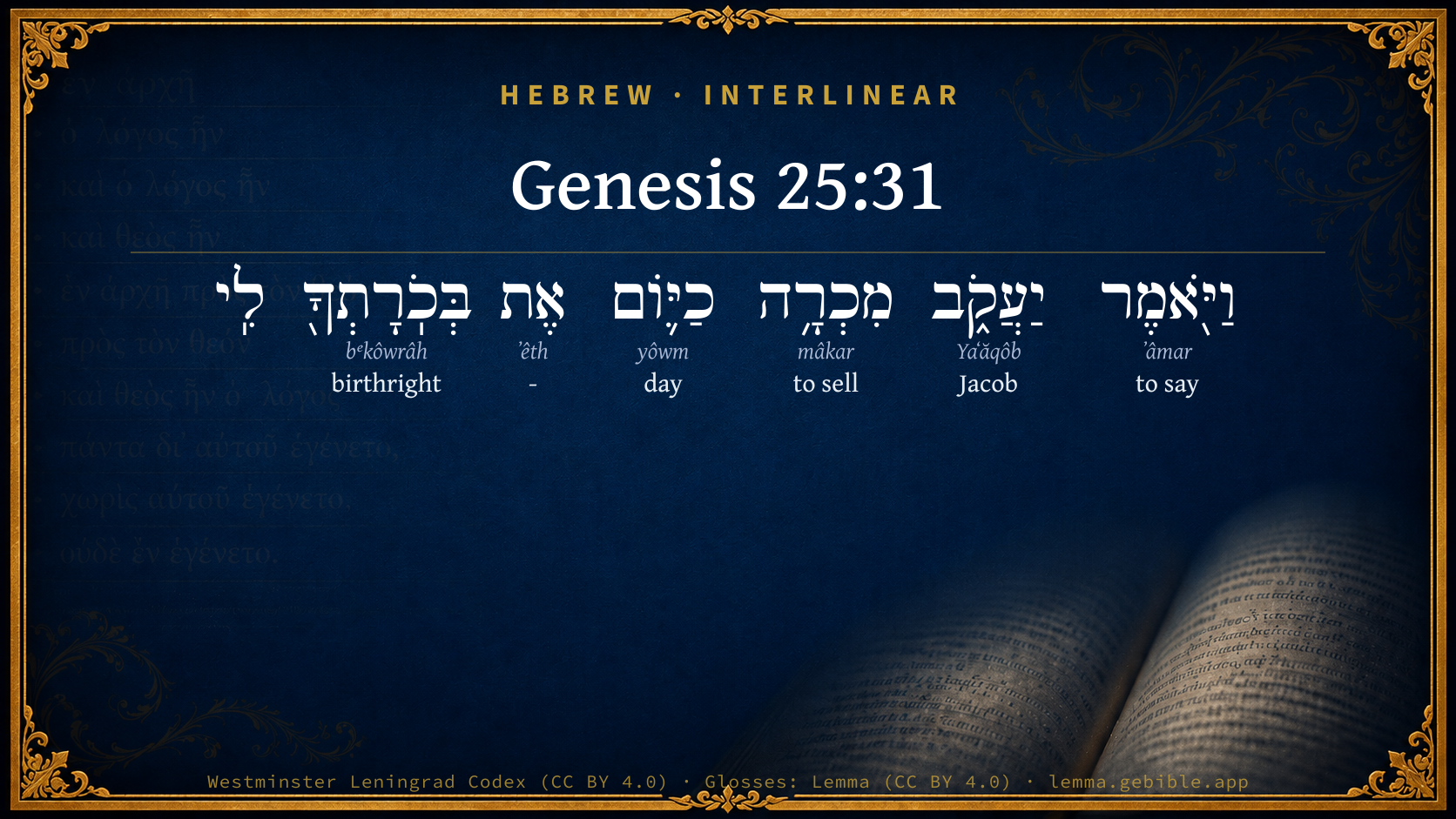
Genesis 25:31

Hebrew (Westminster Leningrad Codex) Genesis 25:31 appears in the Hebrew Old Testament. The text above is from the Westminster Leningrad Codex. Each word links to its Strong’s number, a concise gloss, and parsing drawn from the Open Scriptures Hebrew Bible morphology. Click any word for its full Brown-Driver-Briggs (BDB) entry.
Download image
Cite this verse

Genesis 25:31 (World English Bible). Public Domain. Lemma interlinear Bible study tool, https://lemma.gebible.app/v/genesis/25/31.

Show BibTeX & RIS
BibTeX
RIS
English Translation
Jacob said, "First, sell me your birthright."
World English Bible · Public Domain
Highlights Full analysis ↓
Download a study sheet

One document with this verse’s original text, its word-by-word gloss line, the meaning frame, cross-references with their text, attributed commentary, and full source and license credits — printable, and it pastes into notes with its structure intact.

This verse Autodidact and up

Study sheet (.html) Plain text (.txt)

A passage Seminary Student

Up to 50 verses in one chapter. A passage sheet keeps up to 6 commentary sources and 12 cross-references per verse, in the order this page ranks them, and says so on the sheet whenever that leaves anything out. Ask for a single verse and you get the Autodidact verse sheet above.

Everything on this page stays free to read, with no account — the sheet is a download of what is already on screen, not access to it.

Want to remove ads? Support Godless Engineer
Compare translations 3

The same verse in 3 English versions, stacked beneath the original-language interlinear above. Click any original word for its lexicon entry.

Each is an independent rendering of the whole verse — the interlinear is not word-aligned to these translations.

Highlighted words mark where these versions differ — a whole-verse word diff, not a word-by-word alignment.

  • World English Bible Public Domain
    Jacob said, "First, sell me your birthright."
  • King James Version Public Domain
    And Jacob said, Sell me this day thy birthright.
  • unfoldingWord Literal Text CC BY-SA 4.0
    But Jacob said, “On this day sell your birthright to me.”

unfoldingWord Literal Text — © unfoldingWord, licensed CC BY-SA 4.0. Word-aligned USFM3 via Door43 (git.door43.org/unfoldingWord/en_ult).

Versions to compare (up to 4)

3 of 4 selected

Show all 18 translations

Every available English version of this verse, each an independent rendering of the whole verse.

  • World English Bible Public Domain
    Jacob said, "First, sell me your birthright."
  • Berean Standard Bible Public Domain
    “First sell me your birthright,” Jacob replied.
  • Majority Standard Bible Public Domain
    “First sell me your birthright,” Jacob replied.
  • King James Version Public Domain
    And Jacob said, Sell me this day thy birthright.
  • American Standard Version (1901) Public Domain
    And Jacob said, Sell me first thy birthright.
  • Revised Version (1885) Public Domain
    And Jacob said, Sell me this day thy birthright.
  • Geneva Bible (1599) Public Domain
    And Iaakob sayd, Sell me euen nowe thy birthright.
  • Douay-Rheims (1899) Public Domain
    And Jacob said to him: Sell me thy first birthright.
  • Young's Literal Translation Public Domain
    and Jacob saith, `Sell to-day thy birthright to me.'
  • Literal Standard Version CC BY-SA 4.0
    and Jacob says, “Sell your birthright to me today.”
  • Unlocked Literal Bible CC BY-SA 4.0
    Jacob said, “First sell me your birthright.”
  • unfoldingWord Literal Text CC BY-SA 4.0
    But Jacob said, “On this day sell your birthright to me.”
  • Darby Bible Public Domain
    And Jacob said, Sell me now thy birthright.
  • World Messianic Bible Public Domain
    Jacob said, “First, sell me your birthright.”
  • Webster's Bible Public Domain
    And Jacob said, Sell to me this day thy birth-right.
  • Free Bible Version CC BY-SA 4.0
    “First sell me your rights as the firstborn son,” Jacob replied.
  • Bible in Basic English Public Domain
    And Jacob said, First of all give me your birthright.
  • JPS Tanakh (1917) Public Domain
    And Jacob said: 'Sell me first thy birthright.'

Literal Standard Version (2020), Covenant Press — licensed CC BY-SA 4.0. Text via the HelloAO Bible API (eBible.org). Unlocked Literal Bible (unfoldingWord) — licensed CC BY-SA 4.0. Text via the HelloAO Bible API (eBible.org). unfoldingWord Literal Text — © unfoldingWord, licensed CC BY-SA 4.0. Word-aligned USFM3 via Door43 (git.door43.org/unfoldingWord/en_ult). Free Bible Version, Dr. Jonathan Gallagher — licensed CC BY-SA 4.0. Text via the HelloAO Bible API (eBible.org).

Word by word

More ways to search: Search by grammar → Find every occurrence → Compare this word →

Practice this passage: Drill this verse → Learn its vocabulary →

About this verse

These counts appear in no published source. They are computed here, from the morphology-tagged text and Lemma’s own curated glosses. What Lemma adds →

7
words
6
distinct lemmas
Pentateuch
section

Notable vocabulary

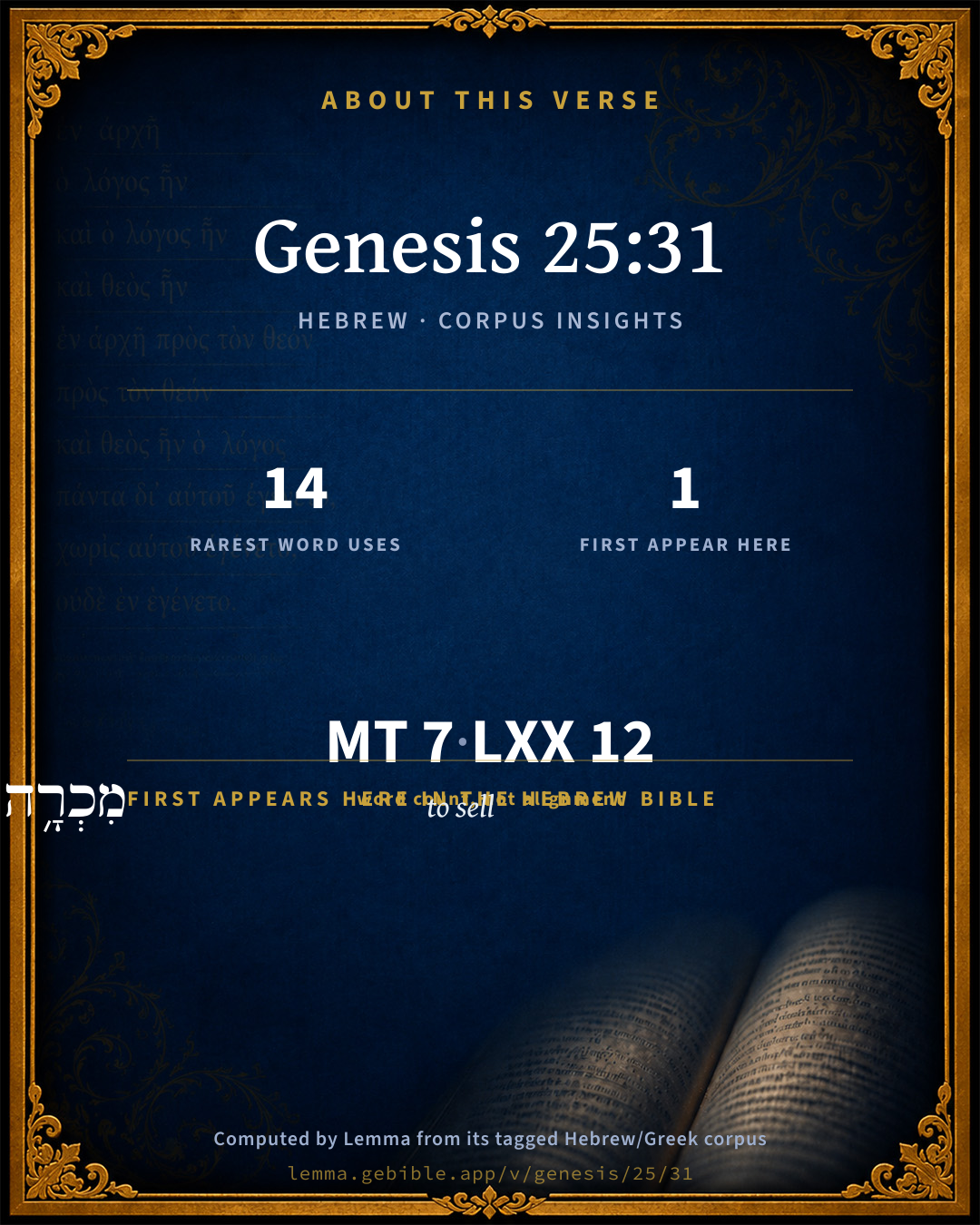
The rarest word here is בְּכֹֽרָתְךָ֖ birthright H1062 — appearing just 14 times in the whole Hebrew Bible.

First appearance in Scripture

This word makes its first canonical appearance in the Hebrew Bible here:

  • מִכְרָ֥ה to sell H4376

Shared distinctive vocabulary

בְּכֹֽרָתְךָ֖ birthright H1062 occurs in 13 verses of the Hebrew Bible. Also found in:

Grammatical profile

  • 2 verbs
  • 3 nouns
  • 1 preposition
  • 1 particle

Verb forms

  • וַיֹּ֖אמֶר Qal · Sequential Imperfect
  • מִכְרָ֥ה Qal · Imperative

Hebrew & Septuagint length

In English translation the verse runs 7 words from the Hebrew and 11 from the Septuagint (LXX English) — the Septuagint runs noticeably longer here. See the side-by-side →

A rough comparison of the two English renderings, which tokenize alike — not a word-level alignment.

Word counts can differ between the Hebrew and the Greek without any difference in meaning — e.g. the Hebrew direct-object marker אֵת has no separate Greek word, and Greek often adds the article ὁ.

In the original languages it is 7 Hebrew tokens and 12 Greek tokens — but the two are counted differently (Hebrew bundles its prefixes and suffixes into one token; the Greek is in lemma form), so that isn’t a like-for-like length.

Hebrew and Greek witnesses Masoretic Hebrew ↔ Greek Septuagint

The same verse in the two great witnesses to the Old Testament, shown verse-for-verse.

Here the Septuagint runs noticeably longer than the Hebrew — LXX2012 (modern English Septuagint) 11 words vs World English Bible 7. A rough length comparison of the two English translations, not a word-level alignment — read both below.

These are two independent witnesses, not word-aligned to each other, and the Septuagint is shown in lemma (dictionary) form.

Hebrew Genesis 25:31 Masoretic · Westminster Leningrad Codex

וַיֹּ֖אמֶר יַעֲקֹ֑ב מִכְרָ֥ה כַיּ֛וֹם אֶת בְּכֹֽרָתְךָ֖ לִֽי

Jacob said, "First, sell me your birthright."

World English Bible · Public Domain

Greek LXX Genesis 25:31 Septuagint · lemma form

εἶπον δέ ἰακώβ ὁ ησαυ ἀποδίδωμι ἐγώ σήμερον ὁ πρωτοτόκιον σύ ἐγώ

And Jacob said to Esau, Sell me this day your birthright.

LXX2012 (modern English Septuagint) · Public Domain

On this verse, The Pulpit Commentary discusses the Septuagint’s reading. Read the note in Commentary ↓

Hebrew: Westminster Leningrad Codex (CC BY 4.0). Greek: Septuagint (public domain); English from LXX2012 (modern English Septuagint) (Public Domain). How the Septuagint differs from the Hebrew →

Targum (Aramaic paraphrase)

2

The Targum is the ancient Jewish Aramaic paraphrase of the Hebrew Scriptures — an interpretive translation, not the Hebrew text itself. Onkelos (literal) and Pseudo-Jonathan (expansive) render the Torah, and Jonathan the Prophets. Coverage is partial: where no permissively-licensed English translation exists for a verse, only the Aramaic is shown. This is verse-level text, not a word-by-word alignment to the Hebrew.

  1. Targum Onkelos Torah (Genesis–Deuteronomy)
    וַאֲמַר יַעֲקֹב זַבִּין כְּיוֹם דִּלְהֵן יָת בְּכֵרוּתָךְ לִי

    (no public-domain English translation for this verse)

    Targum Onkelos — Aramaic: “Onkelos Genesis” (public domain); “Onkelos Exodus” (public domain); “Onkelos Leviticus” (public domain); “Onkelos Numbers” (public domain); “Onkelos Deuteronomy” (public domain). English: “Sefaria Community Translation” (CC0 1.0 (public-domain dedication)); “J.W. Etheridge. The Targums of Onkelos and Jonathan Ben Uzziel on the Pentateuch. London: Longmans, Green, 1862” (public domain). Text via Sefaria.

  2. Targum Pseudo-Jonathan Torah (Genesis–Deuteronomy)
    וַאֲמַר יַעֲקב זַבִּין יוּמָנָא כְּיוֹם דִאַנְתְּ עָתִיד לְמֵיחְסָן יַת בְּכֵירוּתָךְ לִי

    And Jakob said, Sell today, as (on this very) day, what thou wouldst hereafter appropriate, thy birthright, unto me.

    Targum Pseudo-Jonathan — Aramaic: “Targum Jonathan on Genesis” (public domain); “Targum Jonathan on Exodus” (public domain); “Targum Jonathan on Leviticus” (public domain); “Targum Jonathan on Numbers” (public domain); “Targum Jonathan on Deuteronomy” (public domain). English: “The Targum of Jonathan ben Uzziel, trans. J. W. Etheridge, London, 1862” (public domain). Text via Sefaria.

Commentary

Notes on Genesis 25:31 from classic Christian and Jewish commentators (each source and its license shown beneath its notes). The classic Christian expositions comment on the surrounding passage and are grouped to its opening verse, so a note may address several verses; the Jewish commentaries on the Tanakh (Rashi and others) are per-verse, so they appear only where the commentator wrote on this verse.

Lemma curates 59 commentaries, every one of them public domain or Creative Commons licensed, each selected and text-cleaned for this edition rather than reprinted as found. About our sources →

Trapp's Complete Commentary

John Trapp

Gen 25:31 And Jacob said, Sell me this day thy birthright.

Ver. 31. Sell me this day thy birthright.] Which he knew, by the instruction of his mother, to be his by God’s appointment; and therefore takes this opportunity to get it. A well chosen season is the greatest advantage of any action.

John Trapp, A Commentary or Exposition upon All the Books of the Old and New Testament (1647–1656) — public domain. Text from a community e-Sword module.

Tyndale Open Study Notes

Tyndale Open Resources

25:31-33 Jacob was the better hunter on this occasion, but great danger lay in exercising such strong ambition. God’s people should desire the things of God, but they must not seek them in the flesh (see Zech 4:6; Gal 5:16-17; Eph 6:10-12). The Lord dealt severely with Jacob to purge him of carnal methods. He later received the promise not as crafty Jacob the usurper, but as Israel (meaning, “God fights”), with God fighting on his behalf (Gen 32:28).

Tyndale Open Study Notes — © Tyndale Open Resources, licensed CC BY-SA 4.0. Text via the HelloAO Bible API.

Jamieson, Fausset & Brown

Robert Jamieson, A. R. Fausset & David Brown

Jacob said, Sell me . . . thy birthright--that is, the rights and privileges of the first-born, which were very important, the chief being that they were the family priests (Exo 4:22) and had a double portion of the inheritance (Deu 21:17).

Jamieson, Fausset & Brown — Commentary Critical and Explanatory on the Whole Bible (1871) — public domain (CC PDM 1.0). Text via the HelloAO Bible API.

Adam Clarke's Commentary

Verse 31. Sell me this day thy birthright.] What the בחרה bechorah or birthright was, has greatly divided both ancient and modern commentators. It is generally supposed that the following rights were attached to the primogeniture:

1. Authority and superiority over the rest of the family.

2. A double portion of the paternal inheritance.

3. The peculiar benediction of the father.

4. The priesthood, previous to its establishment in the family of Aaron.

Calmet controverts most of these rights, and with apparent reason, and seems to think that the double portion of the paternal inheritance was the only incontestable right which the first-born possessed; the others were such as were rather conceded to the first-born, than fixed by any law in the family. However this may be, it appears,

1. That the first-born were peculiarly consecrated to God, Ex 22:29.

2. Were next in honour to their parents, Ge 49:3.

3. Had a double portion of their father's goods, De 21:17.

4. Succeeded him in the government of the family or kingdom, 2Ch 21:3.

5. Had the sole right of conducting the service of God, both at the tabernacle and temple; and hence the tribe of Levi, which was taken in lieu of the first-born, had the sole right of administration in the service of God, Nu 8:14-18; and hence we may presume, had originally a right to the priesthood previous to the giving of the law; but however this might have been, afterwards the priesthood is never reckoned among the privileges of the first-born.

That the birthright was a matter of very great importance, there can be no room to doubt; and that it was a transferable property, the transaction here sufficiently proves.

Adam Clarke's Commentary on the Bible (1810–1826) — public domain. Text from a community e-Sword/MySword module.

The Cambridge Bible for Schools and Colleges

gen. ed. J. J. S. Perowne

31. this day] Rather, as R.V. marg., first of all. So also in Gen_25:33. See 1Sa_2:16, “they will surely burn the fat presently,” where “presently” = Heb. “this day,” i.e. “first of all.” The same idiom explains 1Ki_22:5, where “to-day” should be rendered “first of all.”

Jacob seizes his opportunity: Esau is too faint to question or oppose: the coveted privilege may be won at once by a bold bid.

thy birthright] i.e. the rights and privileges of the firstborn. What these were is not defined. In 27 the blessing of the firstborn is chiefly regarded as a religious privilege rather than as a transfer of property. But it is clear from Gen_43:33, Gen_48:13-19, that the firstborn was regarded as entitled to a more honourable position and to a larger share of the inheritance than his brethren (cf. Deu_21:17). Jacob’s action on this occasion is recorded without disapproval. There is probably a touch of humour in the tradition, that by a stroke of cleverness Jacob, the younger, deprived his elder brother Esau of the advantage of the birthright; and, hence, Israel obtained a richer and more fertile land than Edom. The carelessness of Esau rather than the meanness of Jacob seems to meet with the contempt of the narrator.

The Cambridge Bible for Schools and Colleges (gen. ed. J. J. S. Perowne; Cambridge University Press, 1878–1918) — public domain. Text from a community e-Sword module.

John Gill's Exposition

And Jacob said, sell me this day thy birthright. Which had many privileges annexed to it, as honour and authority in the family next to parents; a double portion of inheritance; some say the exercise of priesthood, but that is questioned; the parental blessing, and especially in this the promises of the Messiah, and of inheritance of the land of Canaan, and which was typical of the heavenly inheritance: all which Rebekah knew by the divine oracle were designed for Jacob, and which no doubt she had acquainted him with, and advised him to deal with his brother about parting with his birthright as he had opportunity; and very likely they had talked together about it before in a distant manner, and Esau had shown some indifference to his right, and made no great account of it; and now, an opportunity offering to get him in the mind to part with it, he takes it, and moves for a sale of it immediately, at once, without any more delay, and even before he had his pottage; thus taking the advantage of his brother's necessity: or, sell it me "as the day" (x), let the bargain be as clear as the day, as Jarchi interprets it; let it be made in plain and full terms, that there may be no dispute about it hereafter, or any revocation of it: but the former sense seems best, as appears from Gen 25:33, where the same way of speaking is used.

(x) "juxta hunc diem", Fagius, Drusius.

John Gill's Exposition of the Whole Bible (1746–1763) — public domain (CC PDM 1.0). Text via the HelloAO Bible API.

Haydock's Catholic Bible Commentary

Sell me. He had been informed by his mother, that God had transferred the birth-right to him; and, therefore, he takes this opportunity to obtain the consent of Esau quietly. The latter, who knew nothing of God’s decree, shewed his little regard for that privilege. (Haydock) --- He perhaps intended to assert his claim by force, notwithstanding this agreement. (Menochius) --- It is not probable that he could plead in earnest, that he was famishing in the midst of his father’s house. (Du Hamel) --- The birth-right was a temporal honour; though some assert that the office of priesthood belonged also to it. This, however, does not seem to be certain; for we find Abel, Abraham, and other younger children offering sacrifice. The first-born were entitled to a double portion, (Deuteronomy xxi. 17; 1 Paralipomenon v. 2, 5) and to their father’s peculiar blessing, Ecclesiasticus iii. 12. To despise such advantages betrayed a bad disposition, for which Esau is condemned, Hebrews xii. 16; Romans ix. (Calmet) --- Jacob’s conduct was perfectly innocent, whether we consider this transaction as serious or not. Isaac never ratified the bargain; nor do we find that Jacob rested his claim on it. (Haydock) --- But it is recorded by Moses, to shew the disposition of these two young men. (Calmet)

George Leo Haydock (1774–1849), Haydock's Catholic Family Bible and Commentary, 1859 edition — public domain. Excludes Psalms (Douay-Rheims chapter numbering differs from Protestant) and Deuterocanonical books (Catholic canon only).

Matthew Poole's English Annotations

1805

i.e. Speedily, without delay. So this Hebrew word is used 1Sa 2:16; 9:13,27; 2Ch 18:4. The birthright then had divers singular privileges; as,

1. Dignity and authority over his brethren, Gen 4:7; 27:29,37; 49:3.

2. A double portion, Deu 21:17; 1Ch 5:1.

3. A special blessing from his father, Gen 27:4.

4. The priesthood and chief government of the affairs of the church in his father’s absence, or sickness, and after his death, Num 8:16,17, &c.

5. The first-born was a special type, both of Christ, who was to be a first-born; and of the church, which is called God’s first-born, as Exo 4:22; and of the great privileges of the church, particularly of adoption and eternal life. See Heb 12:23. And therefore he is justly called profane, Heb 12:16, for slighting so sacred and glorious a privilege.

Quest.

1. Could the birthright be lost?

Answ. Yes. See Gen 4:7; 1Ch 5:1.

Quest.

2. Did Jacob well in this matter?

Answ. No; because he tempted his brother to an act of profaneness and folly, and so was guilty of his sin. And though God had designed and promised this privilege to him, yet he should have waited till God had executed his promise in his own way, as David did till God gave him possession of Saul’s kingdom; and not have anticipated God, and snatched it by an irregular act of his own, as Jeroboam did the kingdom from Rehoboam.

Matthew Poole's English Annotations on the Holy Bible (1683–1685) — public domain. Text from a community e-Sword/MySword module.

Whedon's Commentary on the Bible

Daniel D. Whedon

31. Sell me this day thy birthright — “This birthright not only embraced the authority and honour of the patriarchal headship of the chosen family, but made its possessor heir to the Abrahamic covenant, and thus the channel of God’s great revealed mercies to mankind — a mediator between God and the race — typifying the God-man. Jacob, who was on a much lower spiritual plane than Abraham, by no means comprehended the vastness and dignity of these spiritual blessings, but he appreciated them far more than the worldly and sensual Esau. He knew that he was predestinated to this heir-ship, although he was the younger son. Dreading a collision with his ferocious brother, which seemed inevitable in the event of his father’s death, when the succession would be contested, and lacking faith in God’s unfolding providence, he resolves to avail himself of Esau’s weakness to obtain the birthright by peaceful purchase. The cautious Jacob knows well that Esau will repent as soon as his hunger is sated, and takes care to have the contract ratified by a solemn oath.” — Newhall.

Daniel D. Whedon (gen. ed.), Commentary on the Old and New Testaments (1874–1909) — public domain. Text from a community e-Sword module.

The Pulpit Commentary

And Jacob said, Sell me this day literally, as the day; as clearly as the day (Jarchi, Kimchi, Drusius); immediately, statim (Rosenm perhaps simply today, shmeron (LXX, Glassius, Gesenius, Kalisch; cf. 1Sa_9:13, 1Sa_9:27; 1Ki_1:49) thy birthright. The right of primogeniture in the family of Abraham implied

(1) succession to the earthly inheritance of Canaan;

(2) possession of the covenant blessing transmitted through the paternal benediction; and

(3) progenitorship of the promised seed.

Under the Mosaic institute the privileges of the firstborn were clearly defined. They involved succession to

(1) the official authority of the father;

(2) a double portion of the father s property; and

(3) the functions of the domestic priesthood (vide Gen_27:4, Gen_27:19, Gen_27:27-29; Gen_49:3; Exo_22:29; Num_8:14-17; Deu_21:17)

The Pulpit Commentary (1880–1919), ed. H.D.M. Spence-Jones & Joseph S. Exell — public domain. Text from a community e-Sword module.

John Wesley's Explanatory Notes

Sell me this day thy birth-right - He cannot be excused in taking advantage of Esau's necessity, yet neither can Esau be excused who is profane, Heb. xii, 16, because for one morsel of meat he sold his birth-right. The birth-right was typical of spiritual privileges, those of the church of the first-born: Esau was now tried how he would value those, and he shews himself sensible only of present grievances: may he but get relief against them, he cares not for his birth-right. If we look on Esau's birth-right as only a temporal advantage, what he said had something of truth in it, that our worldly enjoyments, even those we are most fond of, will stand us in no stead in a dying hour. They will not put by the stroke of death, nor ease the pangs, nor remove the sting. But being of a spiritual nature, his undervaluing it, was the greatest profaneness imaginable. It is egregious folly to part with our interest in God, and Christ, and heaven, for the riches, honours, and pleasures of this world.

John Wesley, Explanatory Notes Upon the Whole Bible (1754–1765) — public domain. Text via the GEBible commentary corpus.

Scofield Reference Notes

C. I. Scofield

birthright

The "birthright" had three elements:

(1) Until the establishment of the Aaronic priesthood the head of the family exercised priestly rights.

(2) The Abrahamic family held the Edenic promise of the Satan-Bruiser Gen 3:15. --Abel, Seth, Shem, Abraham, Isaac, Esau.

(3) Esau, as the firstborn, was in the direct line of the Abrahamic promise of the Earth-Blesser Gen 12:3.

For all that was revealed, in Esau might have fulfilled those two great Messianic promises. This birthright Esau sold for a momentary fleshly gratification. Jacob’s conception of the birthright at that time was, doubtless, carnal and inadequate, but his desire for it evidenced true faith.

The Scofield Reference Bible (1917 edition), notes by C. I. Scofield — public domain. Text from a community e-Sword module.

unfoldingWord translationNotes

Door43 World Missions Community

birthright

right as firstborn to inherit most of the father's wealth

I am about to die

Esau was exaggerating to emphasize how hungry he was. AT: "I am so hungry I feel like I could die" (See: Hyperbole and Generalization)

What good is the birthright to me?

Esau used a question to emphasize that eating was more important than a birthright. This can be translated as a statement. AT: "My inheritance is no good to me if I die of hunger!" (See: Rhetorical Question)

First swear to me

What Jacob wanted Esau to swear can be stated explicitly. AT: "First swear to me that you will sell me your birthright" (See: Assumed Knowledge and Implicit Information)

lentils

These are like beans, but their seeds are very small, round, and somewhat flat. (See: Translate Unknowns)

Esau despised his birthright

"Esau showed that he did not value his birthright"

translationWords

birthright

oath

bread

unfoldingWord translationNotes — © Distant Shores Media and the Door43 World Missions Community, licensed CC BY-SA 4.0. Source: git.door43.org/Door43/en_tn.

Rashi

Rabbi Shlomo Yitzchaki (Rashi)

מכרה כיום SELL ME THIS DAY (literally, like the day) — Explain it as the Targum renders it “as this day”: just as this day is certain, so make me a sure sale.

בכרתך THY BIRTHRIGHT — Because the sacrificial service was then carried out by the first-born sons, Jacob said, “This wicked man is unworthy to sacrifice to the Holy One, blessed be He” (Genesis Rabbah 63:13).

Rashi on the Tanakh — English translations: “The Judaica Press complete Tanach with Rashi, translated by A. J. Rosenberg” (CC BY 4.0); “Pentateuch with Rashi's commentary by M. Rosenbaum and A.M. Silbermann, 1929-1934” (public domain); “The Metsudah Tanach series, Lakewood, N.J” (CC BY 4.0); and “The Book of Joshua, Metsudah Publications, 1997” (CC BY 4.0). Text via Sefaria.

Ramban (Nachmanides)

Rabbi Moshe ben Nachman (Ramban / Nachmanides)

SELL ME THIS DAY (‘KAYOM’) THY BIRTHRIGHT. “I.e., as this day. (Explain it as the Targum rendered it), ‘as this day.’” Rashi now proceeds to interpret the Targum to mean, “just as this day is certain, etc.” Just as this day is certain, so make me a binding sale.” This is Rashi’s language.The literal meaning of the word kayom is “at this time,” just as: But stand thou still at this time (‘kayom’), that I may cause thee to hear the word of G-d; At this time (‘kayom’) you shall find him;, Verse 13. Let the fat be made to smoke at this time (‘kayom’);, 2:16. But unto us belongeth confusion of face, as at this day (‘kayom’). It would appear from the opinion of Onkelos, it would appear from this, etc. that because the sale of the birthright was to take effect after the death of his father Isaac, he [Jacob] said, “Sell me the birthright, with the sale to take effect on whatever day [our father’s death] may occur.” This is a typical usage of lahein in the Aramaic language: “Wherever (lahein) are you going?”. This means, “To what place are you going?” This is derived from the expression, “Whatever (hein) you let me know.” Similarly in Bereshith Rabbah, Parshath Vayishlach, “Wherever (velahein) are they going?”. See, however, Theodore’s edition of this Midrash, p. 906, where he quotes from manuscript, velahein, as Ramban has it. is derived from the expression, “Whatever (hein) is broken.” This is their customary usage of language in many places. And in the book of Daniel this form appears with a patach. under the letter lamed, similar in meaning to the word ilahin (which): Which ‘lohin’ the angels whose dwelling is not with flesh; whatever (‘lohin’), O king, let my counsel be acceptable unto thee., 4:24. Now Onkelos translated the Hebrew word zulathi as ilahin (excepting Caleb) is translated by Onkelos as elahin Caleb. To the Aramaic root lahin which appears in the book of Daniel — (see my Hebrew text, p. 145 line 2 from bottom, covering Notes 53 and 55 here) — Onkelos added the letters aleph and yod, thus making it elahin. The intent of Ramban is to indicate that it should not surprise us that Onkelos added a dalet in the text before us, thus making it dilhein, for just as the original word hen was augmented to become lahein so he further expanded it to read dilhein. (Aboab.) its meaning being as the two words, ila hin.Now in carefully edited texts of Onkelos I found the reading, kayom dilhei. This conforms with my interpretation, for hei in their language means “which,” as it is said in the Talmud: “Which (hei) Rabbi Meir?” “Which (hei) Rabbi Yehudah?” and others.It is possible that Onkelos understood the word kayom (as the day) as if it were bayom (on the day). The verse would then be stating, “Sell the birthright to me on the day it will come into your possession.” We find such usage of the letter kaf elsewhere: As (‘Ka’asher’) they go, I will spread My net upon them, meaning ba’asher (wherever they go) rather than “whenever they go.” Similarly, And for the blood (‘kidmei’) of thy children that thou didst give unto them; is to be interpreted as ubidmei (and in the blood). For I have spread you abroad as the four (‘ke’arba’) winds of the heavens. is here to be interpreted as be’arba (in the four).And some scholars say that the price for the birthright was not the pottage at all. Rather, Scripture tells that when Esau, being faint, desired to eat, Jacob said to him, “Sell me your birthright for money and then eat,” and Esau, in his haste for food, answered him, “What is this birthright to me? It is sold to you.” He then swore to him upon it, and they sat down to eat and drink. Scripture however did not reveal the price. I do not agree with this interpretation.

Ramban (Nachmanides) on the Tanakh — English translation: “Commentary on the Torah by Ramban (Nachmanides). Translated and annotated by Charles B. Chavel. New York, Shilo Pub. House, 1971-1976” (CC BY 4.0). Text via Sefaria.

Radak

Rabbi David Kimhi (Radak)

ויאמר יעקב מכרה כיום, the letter כ in the word כיום is known as the כ האמתי, a formulation we also encounter in Samuel I 9,13 כי אותו כהיום תמצאון אותו, “for truly today you will find him.” Other examples of this prefixכ being used to emphasise the truth of something are found in Numbers 11,1 and Proverbs 10,20, as well as in Hoseah 5,10. In our verse the letter כ means that Yaakov did not want Esau to sell him the birthright symbolically, but that he meant for a fully fledged legal transaction to be completed, his making a proper kinyan acquisition. [I believe this supports the view of our sages that what was at stake was not Esau’s share as a firstborn in an extra third of his father’s estate, something that at this point was only a potential claim as opposed to an actual claim, and therefore could not have been transferred legally in a binding manner. What was at stake were obligations a firstborn is duty bound to fulfill from the time he is physically and mentally capable of doing so. Yaakov felt that Esau was spiritually not equipped to perform such duties, hence he wanted to relieve him of them. Yaakov could not acquire the spiritual aspects of the birthright merely by pointing out to Esau that it was a burden for him anyway, as the position of the firstborn was something firmly entrenched in the culture of his time. Seeing that the world at that time was concerned with material wealth primarily, Yaakov had to compensate Esau according to the terms other people would understand as being appropriate. Ed.] In spite of Yaakov compensating his brother Esau in “real” terms for something to which his claim was thus far only potential, he was punished for initiating such a sale because he had upset the norms of civilised society by doing so. The fact that Esau rose to great prominence and distinction and hardly seems to have suffered any disadvantage for the deal Yaakov offered him, did not exonerate Yaakov from trying to upset the norms of society. [this view, i.e. that Yaakov paid Esau with money, not with a dish of lentils, is supported at least in part by Rashbam. Ed.]

Radak on the Tanakh — English translations: “Sefaria Community Translation” (CC0 1.0 (public-domain dedication)); “Eliyahu Munk, HaChut Hameshulash” (CC BY 4.0); “Rabbi Mike Feuer, Jerusalem Anthology” (CC BY 4.0); and “R. David Kimhi on the first book of Psalms, Translated by R.G. Finch, London, 1919” (public domain). Text via Sefaria.

Lesson kit

Teaching starters — assembled from the data on this page, not authored interpretation. Every prompt links to the verse data it draws on. Edit before teaching.

Genesis, in the Pentateuch, opens this verse with 7 words (6 distinct Hebrew lemmas). Its most distinctive word is bᵉkôwrâh (“birthright”). The Greek Septuagint runs longer here. A historical commentator’s framing appears above. Read the whole chapter for the surrounding context.

Discussion questions

  1. The word bᵉkôwrâh carries the sense “birthright.” How does it shape the verse?
  2. This is the first place “to sell” appears in Scripture (first appears here). What does its debut here establish?
  3. How does Genesis 4:4, which shares the word «birthright», read alongside this verse?
  4. The Septuagint runs longer here than the Hebrew. What might account for the difference?
  5. These translations render this verse differently. What is at stake in choosing one wording over another?
  6. «וַיֹּ֖אמֶר» is a Qal Sequential Imperfect verb. How does that grammatical form shape the action described?
  7. Compare how Trapp's Complete Commentary and Tyndale Open Study Notes read this verse. Where do they agree or differ?

Things to notice

Reading settings

Reading text

Shown beneath each verse's original-language words.

Old Testament
Old Testament edition

Read the OT as the Masoretic Hebrew (MT) or the Greek Septuagint (LXX).

English shown for the Greek Septuagint (in the Hebrew ↔ Greek comparison).

Comparing translations? Open the Compare panel on any verse page to stack up to four side by side.