
Genesis 25:28

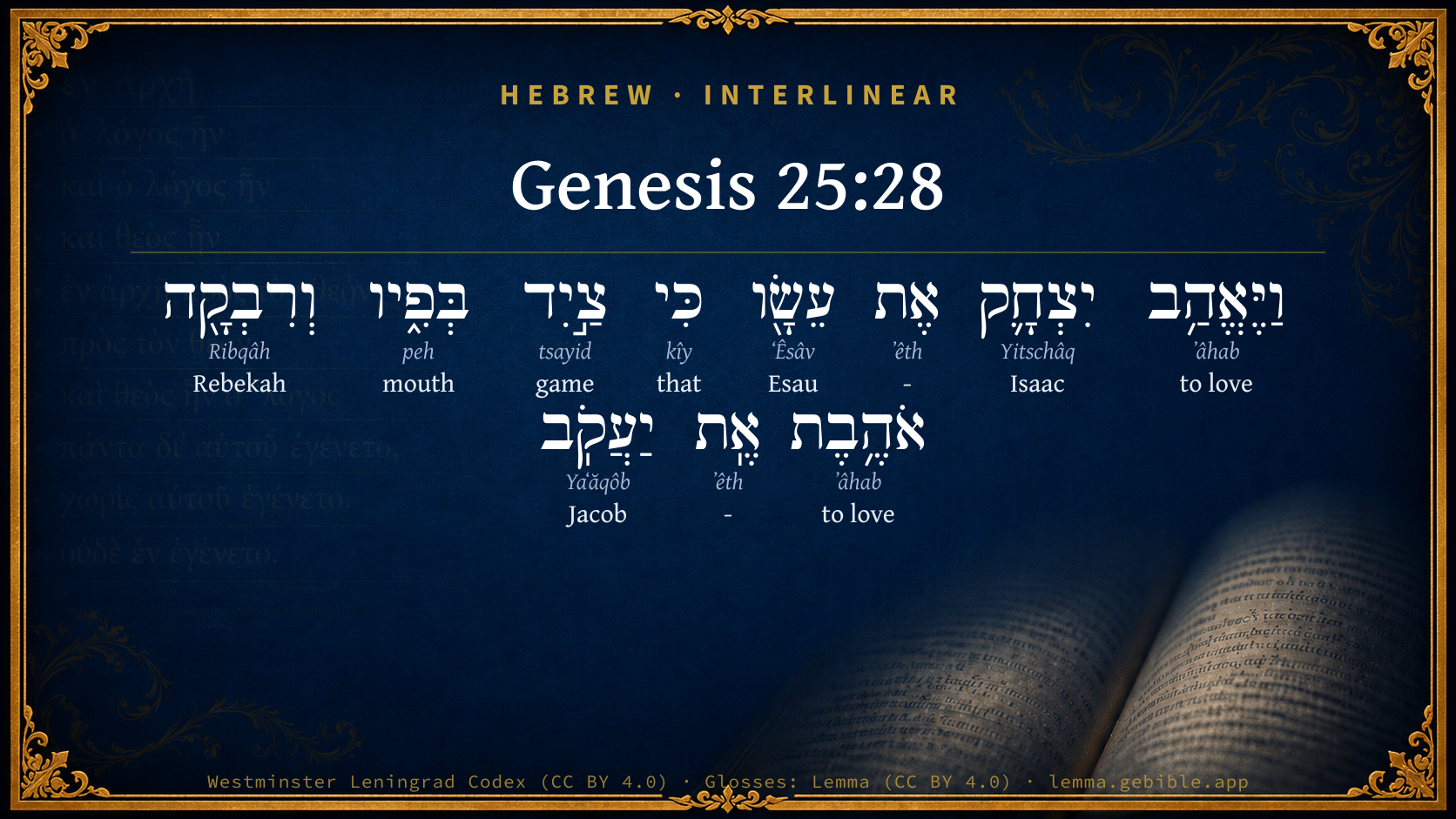
Hebrew (Westminster Leningrad Codex) Genesis 25:28 appears in the Hebrew Old Testament. The text above is from the Westminster Leningrad Codex. Each word links to its Strong’s number, a concise gloss, and parsing drawn from the Open Scriptures Hebrew Bible morphology. Click any word for its full Brown-Driver-Briggs (BDB) entry.
Download image
Cite this verse

Genesis 25:28 (World English Bible). Public Domain. Lemma interlinear Bible study tool, https://lemma.gebible.app/v/genesis/25/28.

Show BibTeX & RIS
BibTeX
RIS
English Translation
Now Isaac loved Esau, because he ate his venison. Rebekah loved Jacob.
World English Bible · Public Domain
Download a study sheet

One document with this verse’s original text, its word-by-word gloss line, the meaning frame, cross-references with their text, attributed commentary, and full source and license credits — printable, and it pastes into notes with its structure intact.

This verse Autodidact and up

Study sheet (.html) Plain text (.txt)

A passage Seminary Student

Up to 50 verses in one chapter. A passage sheet keeps up to 6 commentary sources and 12 cross-references per verse, in the order this page ranks them, and says so on the sheet whenever that leaves anything out. Ask for a single verse and you get the Autodidact verse sheet above.

Everything on this page stays free to read, with no account — the sheet is a download of what is already on screen, not access to it.

Want to remove ads? Support Godless Engineer
Compare translations 3

The same verse in 3 English versions, stacked beneath the original-language interlinear above. Click any original word for its lexicon entry.

Each is an independent rendering of the whole verse — the interlinear is not word-aligned to these translations.

Highlighted words mark where these versions differ — a whole-verse word diff, not a word-by-word alignment.

  • World English Bible Public Domain
    Now Isaac loved Esau, because he ate his venison. Rebekah loved Jacob.
  • King James Version Public Domain
    And Isaac loved Esau, because he did eat of his venison: but Rebekah loved Jacob.
  • unfoldingWord Literal Text CC BY-SA 4.0
    And Isaac loved Esau, because game meat in his mouth, but Rebekah loved Jacob.

unfoldingWord Literal Text — © unfoldingWord, licensed CC BY-SA 4.0. Word-aligned USFM3 via Door43 (git.door43.org/unfoldingWord/en_ult).

Versions to compare (up to 4)

3 of 4 selected

Show all 18 translations

Every available English version of this verse, each an independent rendering of the whole verse.

  • World English Bible Public Domain
    Now Isaac loved Esau, because he ate his venison. Rebekah loved Jacob.
  • Berean Standard Bible Public Domain
    Because Isaac had a taste for wild game, he loved Esau; but Rebekah loved Jacob.
  • Majority Standard Bible Public Domain
    Because Isaac had a taste for wild game, he loved Esau; but Rebekah loved Jacob.
  • King James Version Public Domain
    And Isaac loved Esau, because he did eat of his venison: but Rebekah loved Jacob.
  • American Standard Version (1901) Public Domain
    Now Isaac loved Esau, because he did eat of his venison. And Rebekah loved Jacob.
  • Revised Version (1885) Public Domain
    Now Isaac loved Esau, because he did eat of his venison: and Rebekah loved Jacob.
  • Geneva Bible (1599) Public Domain
    And Izhak loued Esau, for venison was his meate, but Rebekah loued Iaakob.
  • Douay-Rheims (1899) Public Domain
    Isaac loved Esau, because he ate of his hunting: and Rebecca loved Jacob.
  • Young's Literal Translation Public Domain
    and Isaac loveth Esau, for `his' hunting `is' in his mouth; and Rebekah is loving Jacob.
  • Literal Standard Version CC BY-SA 4.0
    and Isaac loves Esau, for [his] game [is] in his mouth; and Rebekah is loving Jacob.
  • Unlocked Literal Bible CC BY-SA 4.0
    Now Isaac loved Esau because he ate the animals that he had hunted, but Rebekah loved Jacob.
  • unfoldingWord Literal Text CC BY-SA 4.0
    And Isaac loved Esau, because game meat in his mouth, but Rebekah loved Jacob.
  • Darby Bible Public Domain
    And Isaac loved Esau, because venison was to his taste; and Rebecca loved Jacob.
  • World Messianic Bible Public Domain
    Now Isaac loved Esau, because he ate his venison. Rebekah loved Jacob.
  • Webster's Bible Public Domain
    And Isaac loved Esau, because he ate of his venison: but Rebekah loved Jacob.
  • Free Bible Version CC BY-SA 4.0
    Isaac loved Esau because he brought him tasty wild game to eat, while Rebekah loved Jacob.
  • Bible in Basic English Public Domain
    Now Isaac's love was for Esau, because Esau's meat was greatly to his taste: but Rebekah had more love for Jacob.
  • JPS Tanakh (1917) Public Domain
    Now Isaac loved Esau, because he did eat of his venison; and Rebekah loved Jacob.

Literal Standard Version (2020), Covenant Press — licensed CC BY-SA 4.0. Text via the HelloAO Bible API (eBible.org). Unlocked Literal Bible (unfoldingWord) — licensed CC BY-SA 4.0. Text via the HelloAO Bible API (eBible.org). unfoldingWord Literal Text — © unfoldingWord, licensed CC BY-SA 4.0. Word-aligned USFM3 via Door43 (git.door43.org/unfoldingWord/en_ult). Free Bible Version, Dr. Jonathan Gallagher — licensed CC BY-SA 4.0. Text via the HelloAO Bible API (eBible.org).

Word by word

More ways to search: Search by grammar → Find every occurrence → Compare this word →

Practice this passage: Drill this verse → Learn its vocabulary →

About this verse

These counts appear in no published source. They are computed here, from the morphology-tagged text and Lemma’s own curated glosses. What Lemma adds →

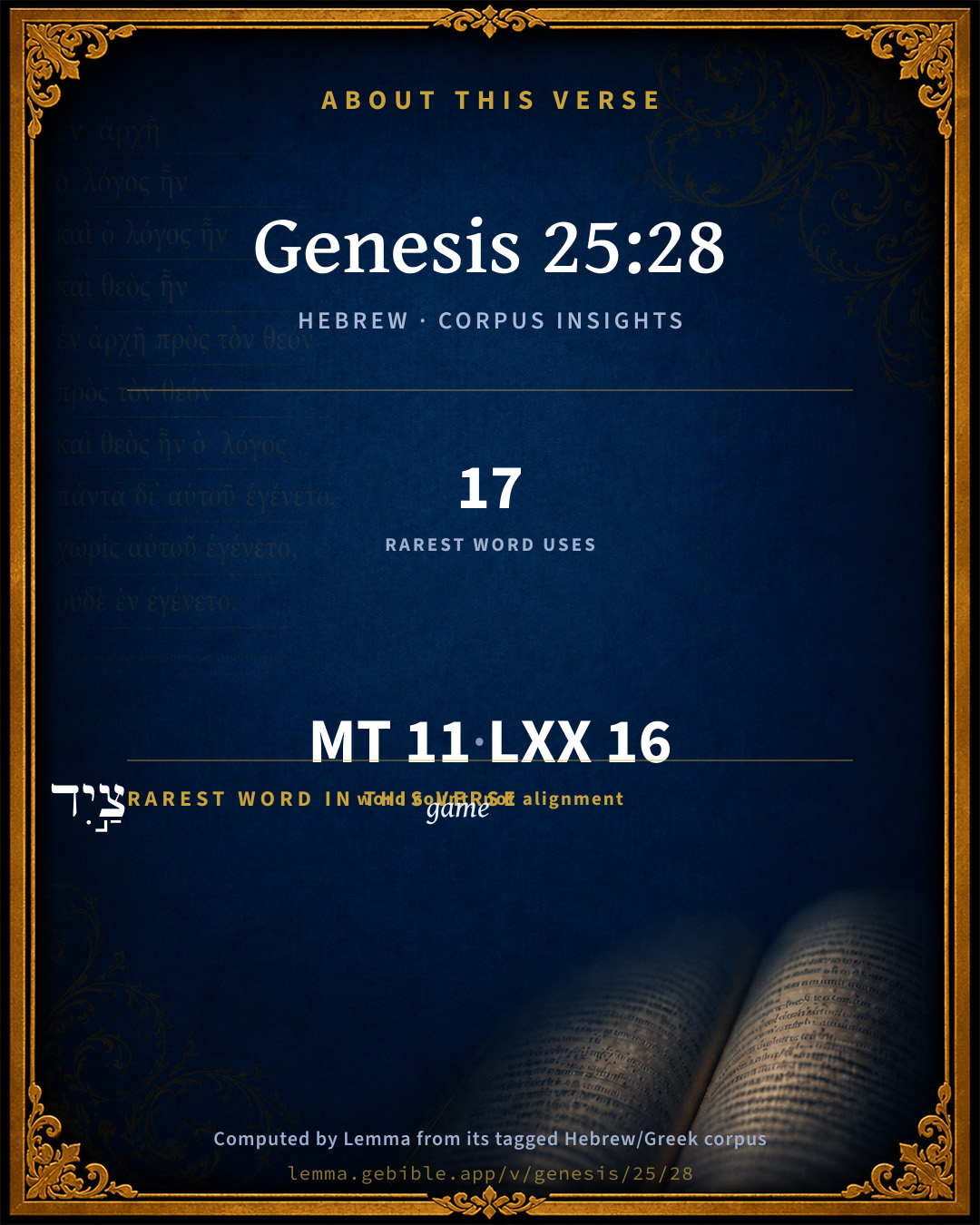
11
words
9
distinct lemmas
Pentateuch
section

Notable vocabulary

The rarest word here is צַ֣יִד game H6718 — appearing just 17 times in the whole Hebrew Bible.

Shared distinctive vocabulary

צַ֣יִד game H6718 occurs in 16 verses of the Hebrew Bible. Also found in:

Grammatical profile

  • 2 verbs
  • 6 nouns
  • 1 conjunction
  • 2 particles

Verb forms

  • וַיֶּאֱהַ֥ב Qal · Sequential Imperfect
  • אֹהֶ֥בֶת Qal · Participle Active

Repetition

A word recurs within this verse — often emphatic in Hebrew:

  • וַיֶּאֱהַ֥ב to love H157 ×2

Hebrew & Septuagint length

In English translation the verse runs 12 words from the Hebrew and 14 from the Septuagint (LXX English) — closely comparable.

A rough comparison of the two English renderings, which tokenize alike — not a word-level alignment.

Word counts can differ between the Hebrew and the Greek without any difference in meaning — e.g. the Hebrew direct-object marker אֵת has no separate Greek word, and Greek often adds the article ὁ.

In the original languages it is 11 Hebrew tokens and 16 Greek tokens — but the two are counted differently (Hebrew bundles its prefixes and suffixes into one token; the Greek is in lemma form), so that isn’t a like-for-like length.

Cross-references

6

Topical passages linked to Genesis 25:28 in the Treasury of Scripture Knowledge — connected by theme and wording, ordered by reader-vote popularity; previews shown in the World English Bible.

  • Genesis 27:19 Jacob said to his father, "I am Esau your firstborn. I have done what you asked me to do. Please arise, sit and eat of my venison, that your soul may bless me."
  • Genesis 27:4 Make me savory food, such as I love, and bring it to me, that I may eat, and that my soul may bless you before I die."
  • Genesis 27:31 He also made savory food, and brought it to his father. He said to his father, "Let my father arise, and eat of his son's venison, that your soul may bless me."
  • Genesis 27:9 Go now to the flock, and get me from there two good kids of the goats. I will make them savory food for your father, such as he loves.
  • Genesis 27:25 He said, "Bring it near to me, and I will eat of my son's venison, that my soul may bless you." He brought it near to him, and he ate. He brought him wine, and he drank.
  • Genesis 27:6–7 Rebekah spoke to Jacob her son, saying, "Behold, I heard your father speak to Esau your brother, saying,

Cross-references courtesy of OpenBible.info (CC BY 4.0).

Hebrew and Greek witnesses Masoretic Hebrew ↔ Greek Septuagint

The same verse in the two great witnesses to the Old Testament, shown verse-for-verse.

These are two independent witnesses, not word-aligned to each other, and the Septuagint is shown in lemma (dictionary) form.

Hebrew Genesis 25:28 Masoretic · Westminster Leningrad Codex

וַיֶּאֱהַ֥ב יִצְחָ֛ק אֶת עֵשָׂ֖ו כִּי צַ֣יִד בְּפִ֑יו וְרִבְקָ֖ה אֹהֶ֥בֶת אֶֽת יַעֲקֹֽב

Now Isaac loved Esau, because he ate his venison. Rebekah loved Jacob.

World English Bible · Public Domain

Greek LXX Genesis 25:28 Septuagint · lemma form

ἀγαπάω δέ ισαακ ὁ ησαυ ὅτι ὁ θήρα αὐτός βρῶσις αὐτός ρεβεκκα δέ ἀγαπάω ὁ ἰακώβ

And Isaac loved Esau, because his venison was his food, but Rebecca loved Jacob.

LXX2012 (modern English Septuagint) · Public Domain

On this verse, The Pulpit Commentary discusses the Septuagint’s reading. Read the note in Commentary ↓

Hebrew: Westminster Leningrad Codex (CC BY 4.0). Greek: Septuagint (public domain); English from LXX2012 (modern English Septuagint) (Public Domain). How the Septuagint differs from the Hebrew →

Targum (Aramaic paraphrase)

2

The Targum is the ancient Jewish Aramaic paraphrase of the Hebrew Scriptures — an interpretive translation, not the Hebrew text itself. Onkelos (literal) and Pseudo-Jonathan (expansive) render the Torah, and Jonathan the Prophets. Coverage is partial: where no permissively-licensed English translation exists for a verse, only the Aramaic is shown. This is verse-level text, not a word-by-word alignment to the Hebrew.

  1. Targum Onkelos Torah (Genesis–Deuteronomy)
    וּרְחֵם יִצְחָק יָת עֵשָׂו אֲרֵי מִצֵידֵהּ הֲוָה אָכִיל וְרִבְקָה רְחִימַת יָת יַעֲקֹב

    (no public-domain English translation for this verse)

    Targum Onkelos — Aramaic: “Onkelos Genesis” (public domain); “Onkelos Exodus” (public domain); “Onkelos Leviticus” (public domain); “Onkelos Numbers” (public domain); “Onkelos Deuteronomy” (public domain). English: “Sefaria Community Translation” (CC0 1.0 (public-domain dedication)); “J.W. Etheridge. The Targums of Onkelos and Jonathan Ben Uzziel on the Pentateuch. London: Longmans, Green, 1862” (public domain). Text via Sefaria.

  2. Targum Pseudo-Jonathan Torah (Genesis–Deuteronomy)
    וְרָחֵים יִצְחָק יַת עֵשָו אֲרוּם מִלֵי רַמְיוּתָא בְּפוּמֵיהּ וְרִבְקָה רְחֵימַת יַת יַעֲקב

    And Izhak loved Esau, for words of deceit were in his mouth; but Rivekah loved Jakob.

    Targum Pseudo-Jonathan — Aramaic: “Targum Jonathan on Genesis” (public domain); “Targum Jonathan on Exodus” (public domain); “Targum Jonathan on Leviticus” (public domain); “Targum Jonathan on Numbers” (public domain); “Targum Jonathan on Deuteronomy” (public domain). English: “The Targum of Jonathan ben Uzziel, trans. J. W. Etheridge, London, 1862” (public domain). Text via Sefaria.

Commentary

Notes on Genesis 25:28 from classic Christian and Jewish commentators (each source and its license shown beneath its notes). The classic Christian expositions comment on the surrounding passage and are grouped to its opening verse, so a note may address several verses; the Jewish commentaries on the Tanakh (Rashi and others) are per-verse, so they appear only where the commentator wrote on this verse.

Lemma curates 59 commentaries, every one of them public domain or Creative Commons licensed, each selected and text-cleaned for this edition rather than reprinted as found. About our sources →

Trapp's Complete Commentary

John Trapp

Gen 25:28 And Isaac loved Esau, because he did eat of [his] venison: but Rebekah loved Jacob.

Ver. 28. And Isaac loved Esau, &c.] Here, as likewise in Manoah’s wife, more grace appears in the woman than in the man; whose blind and misplaced love, for carnal ends, commends and illustrates the divine adoption.

John Trapp, A Commentary or Exposition upon All the Books of the Old and New Testament (1647–1656) — public domain. Text from a community e-Sword module.

The Biblical Illustrator

Joseph S. Exell

Gen_25:28

Rebekah loved Jacob

Rebekah; or, undue natural affection and partiality in parents

1.

While the account of Rebekah in Holy Scripture is so brief, that it would be difficult to draw many reflections from the study of her character, her position is suggestive, and her conduct by no means without important practical results. She first comes before our notice as the future wife of

Isaac, and, in that capacity, at once attracts the interest of the student of the patriarchal age. She found Isaac walking, meditating at eventide, and he received her into his tent. Isaac was forty years old when he took Rebekah to wife--the daughter of Bethuel the Syrian, of Padanaram, the sister of Laban the Syrian. Isaac entreated the Lord for his wife, because she was barren; and Isaac loved Esau because he did eat of his venison, but Rebekah loved Jacob. The next we hear of her was in Gerar, where her beauty attracting the notice of the inhabitants, Isaac called her his sister. Esaus marriage became a grief of mind to Isaac and Rebekah, for he married a Hittite. The next and hinging circumstance of Rebekahs life is the account of the deception passed upon his father by Jacob, at the suggestion of his mother.

2. The character which we have brought before us by the preceding acts is one, which to our eye, would wear the appearance of duplicity and self-seeking in a high degree; but placing aside for a moment the impression which is thus forced upon us, it will be well to study the many practical suggestions which are started by reading Rebekahs life. And first, this trait which I have just called duplicity, whatever if may be, belonged to the mother of Israel, and characterized each succeeding scion of her race. The Jew is essentially subtle. In whatever degree this may be traceable to Rebekah and her son, it nevertheless is very clear that a parents fault is constantly transmitted to its child and onward to successive generations. More than this. If the parent yields to his natural disposition, he strengthens his own habit of evil and transmits to his descendants a nature more strongly inclined to the same evil; whereas if, on the other hand, he succeeds in checking his own disposition, the result becomes apparent in the healthier moral condition of his offspring. All this is very sad to contemplate, inasmuch as countless beings become responsible for the fault of one; but it is in accordance with the history of mankind, with the moral impressions of antiquity, and with distinct statements of Divine revelation. The sin of Adam has effected his remotest descendant; the oft told tales of the Atreidae and OEdipus remind us how strongly the heathen world was impressed with the belief that the sin of the parent predisposed the child for the committal of a similar fault, and became the cause of punishment to distant posterity; while the second commandment tells us in clear terms, that God visits the sins of the fathers on the children to the third and fourth generation. But it is not only to punishment, but the physical tendency to a definite form of immorality to which I specially refer. It has been observed, with regard to the population of our own country, that in districts where certain crimes are prevalent children are born with bodily constitutions and mental conformations, such as strongly to predispose the will to yield the same faults of which the parents are guilty; and so remarkably is this the case, that in some places the brevity of life and the rapid increase of the committal of crime are appalling; and though perhaps in a less degree, the indulged fault of a parent is often seen to be the habitual condition of the child. This being the case, what a motive it offers to parents to cheek their own evil tendencies and to lead a godly and upright life. Rebekahs fault was perpetuated to onward centuries; and the wilfulness of overweening affection--mingled with a disregard to truthfulness--has marked the descendant of Israel down to the day we live in. So pride, vanity, extravagance, uncharitableness of judgment or opinion, though but perhaps a slight intentional offence in father or mother, may receive severe penalties inflicted on the descendants of the third and fourth generation. How striking to see the pride of aristocracy, though perhaps resulting from some acts of which a man may be proud, inherited by a child who has nothing on which to plume himself, except the fact of being descended from a parent who earned for himself his position and his titles. Yet we are frequently called upon to see this condition of childhood, the result of the indulged temper and feeling of the parent.

3. But the character of Rebekah is suggestive in other ways; she indulged favouritism, and, like a mother, loved her youngest son the best. Partiality of this kind is either selfishness or worse. If it simply flows from an actual preference, it is selfish to yield to it; if, as it often does, it springs from noticing a reflection of self in the child of our partiality, it becomes idolatry, or the worshipping of self in another shape.

4. But there is another lesson which Rebekah teaches us, which we cannot pass by; the way in which intense and partial affection blinds the eye to pure morality. Rebekahs love for Jacob was so great that she betrayed her husband for the sake of securing the birthright for her younger son; and she infringed Gods law by indulging in deceitfulness. The forms of morality and religion are in themselves clear, keen, and definite, even as the statue carved from the hardest marble; but between our eye and those forms it is easy enough to let mists arise so blinding and deceiving as wholly to change the appearance of the form which we are gazing at. This is especially the case with regard to the forms of truthfulness. (E. Monro, M. A.)

The Biblical Illustrator, edited by Joseph S. Exell (c. 1880s–1900s) — public domain. Text from a community e-Sword module.

Joseph Benson's Commentary

Gen 25:28. Isaac loved Esau — The conduct of both these parents was blameable: they had but these two children, and the father was peculiarly attached to the one, and the mother to the other. And this improper partiality gave occasion to that strife which once threatened their being deprived of them both. Such partiality should be carefully guarded against in parents, as being both sinful in itself, and of dangerous tendency. It is true some children may be of a much more amiable spirit and conduct than others of the same family; yet all ought to have a due share of parental regard, and none be in any manner slighted or neglected.

Joseph Benson's Commentary on the Old and New Testaments (1811–1818) — public domain. Text from a community e-Sword module.

Tyndale Open Study Notes

Tyndale Open Resources

25:28 The parents each practiced favoritism. • because: Isaac’s love for Esau was conditioned upon his son’s performance. Rebekah’s love for Jacob was constant and unconditional.

Tyndale Open Study Notes — © Tyndale Open Resources, licensed CC BY-SA 4.0. Text via the HelloAO Bible API.

Geneva Bible (1599)

Geneva Bible translators

Hebrew, venison in his mouth.

Geneva Bible (1599) marginal notes — public domain. Text via Bolls.life.

Jamieson, Fausset & Brown

Robert Jamieson, A. R. Fausset & David Brown

The parents were divided in their affection; and while the grounds, at least of the father's partiality, were weak, the distinction made between the children led, as such conduct always does, to unhappy consequences.

Jamieson, Fausset & Brown — Commentary Critical and Explanatory on the Whole Bible (1871) — public domain (CC PDM 1.0). Text via the HelloAO Bible API.

Adam Clarke's Commentary

Verse 28. Isaac loved Esau - but Rebekah loved Jacob.] This is an early proof of unwarrantable parental attachment to one child in preference to another. Isaac loved Esau, and Rebekah loved Jacob; and in consequence of this the interests of the family were divided, and the house set in opposition to itself. The fruits of this unreasonable and foolish attachment were afterwards seen in a long catalogue of both natural and moral evils among the descendants of both families.

Adam Clarke's Commentary on the Bible (1810–1826) — public domain. Text from a community e-Sword/MySword module.

John Calvin's Commentaries

28. And Isaac loved Esau. That God might more clearly show his own election to be sufficiently firm, to need no assistance elsewhere, and even powerful enough to overcome any obstacle whatever, he permitted Esau to be so preferred to his brother, in the affection and good opinion of his father, that Jacob appeared in the light of a rejected person. Since, therefore, Moses clearly demonstrates, by so many circumstances, that the adoption of Jacob was founded on the sole good pleasure of God, it is an intolerable presumption to suppose it to depend upon the will of man; or to ascribe it, in part, to means, (as they are called,) and to human preparations. But how was it possible for the father, who was not ignorant of the oracle, to be thus predisposed in favor of the firstborn, whom he knew to be divinely rejected?. It would rather have been the part of piety and of modesty to subdue his own private affection, that he might yield obedience to God. The firstborn prefers a natural claim to the chief place in the parent’s affection; but the father was not at liberty to exalt him above his brother, who had been placed in subjection by the oracle of God. That also is still more shameful and more unworthy of the holy patriarch, which Moses adds; namely, that he had been induced to give this preference to Esau, by the taste of his venison. Was he so enslaved to the indulgence of the palate, that, forgetting the oracle, he despised the grace of God in Jacob, while he preposterously set his affection on him whom God had rejected? Let the Jews now go and glory in the flesh; since Isaac, preferring food to the inheritance destined for his son, would pervert (as far as he had the power) the gratuitous covenant of God! For there is no room here for excuse; since with a blind, or, at least, a most inconsiderate love to his firstborn, he undervalued the younger. It is uncertain whether the mother was chargeable with a fault of the opposite kind. For we commonly find the affections of parents so divided, that if the wife sees any one of the sons preferred by her husband, she inclines, by a contrary spirit of emulation, more towards another. Rebekah loved her son Jacob more than Esau. If, in so doing, she was obeying the oracle, she acted rightly; but it is possible that her love was ill regulated. And on this point the corruption of nature too much betrays itself. There is no bond of mutual concord more sacred than that of marriage: children form still further links of connection; and yet they often prove the occasion of dissension. But since we soon after see Rebekah chiefly in earnest respecting the blessing of God, the conjecture is probable, that she had been induced, by divine authority, to prefer the younger to the firstborn. Meanwhile, the foolish affection of the father only the more fully illustrates the grace of the divine adoption.

John Calvin's Commentaries (1540-1563) — public domain. Text from the Calvin Translation Society English edition (1840s-50s) via the Christian Classics Ethereal Library (ccel.org). Calvin's coverage is partial (roughly two-thirds of the Bible); uncommented books and verses are honest gaps, never fabricated. The 19th-century editor's footnotes and remarks are omitted so the notes are faithfully Calvin's own voice.

Ellicott's Commentary for English Readers

(28) Because he did eat of his venison.—Literally, because the venison—that is, the produce of Esau’s hunting—was in his mouth; in our phrase, was to his taste—was what he liked. The diet of an Arab sheik is very simple (see Note on Gen_18:6); and Isaac, a man wanting in physical vigour and adventurousness—as is usually the case with the children of people far advanced in years—both admired the energy which Esau had inherited from Rebekah, and relished the fruits of it.

A Bible Commentary for English Readers, edited by Charles John Ellicott (1878–1897) — public domain. Text from a community e-Sword module.

The Cambridge Bible for Schools and Colleges

gen. ed. J. J. S. Perowne

28. because … venison] Cf. Gen_27:3-4.

Rebekah loved Jacob] i.e. more than Esau. We have in this verse the division of the two pairs, Isaac and Esau, Rebekah and Jacob, on which turns the narrative in chap. 27.

The contrast between the hunter and the shepherd is drawn with a settled preference for the shepherd.

The Cambridge Bible for Schools and Colleges (gen. ed. J. J. S. Perowne; Cambridge University Press, 1878–1918) — public domain. Text from a community e-Sword module.

John Gill's Exposition

And Isaac loved Esau, because he did eat of his venison,.... Better than Jacob, not only because he was his firstborn, but because he brought him of the flesh of creatures, which he took in hunting, and being dressed, were savoury food to him: it is in the original, "because venison (or what he hunted) was in his mouth" (h), into which he put it, and was very grateful to his taste:

but Rebekah loved Jacob; more than Esau, being more at home with her, and of a milder disposition; and more especially being a good man, a partaker of the grace of God, and to whom she knew by the oracle the blessing and promise belonged.

(h) "quia venatio in ore ejus", Pagninus, Montanus.

John Gill's Exposition of the Whole Bible (1746–1763) — public domain (CC PDM 1.0). Text via the HelloAO Bible API.

Haydock's Catholic Bible Commentary

Loved Esau, as his first-born, who shewed him all attention, and whom he would naturally have appointed his heir, if the will of God had not afterwards been revealed to him. Rebecca, to whom this was already known, gave the preference in her love to Jacob. (Haydock)

George Leo Haydock (1774–1849), Haydock's Catholic Family Bible and Commentary, 1859 edition — public domain. Excludes Psalms (Douay-Rheims chapter numbering differs from Protestant) and Deuterocanonical books (Catholic canon only).

Matthew Poole's English Annotations

Isaac loved Esau, not simply nor chiefly because he pleased his palate, but because this was an evidence of his son’s great respect and affection to him, that he would take such pains and incur such hazards to which that course of life exposed him, that he might please and serve his father.

But Rebekah loved Jacob upon better grounds, both because of his more pious and meek temper, and because of the oracle and promise of God.

Matthew Poole's English Annotations on the Holy Bible (1683–1685) — public domain. Text from a community e-Sword/MySword module.

Whedon's Commentary on the Bible

Daniel D. Whedon

28. Because he did eat — Literally, for hunting was in his mouth, that is, the results of hunting — game. Comp. Gen_27:4.

Rebekah loved Jacob — No reason is given for her partial love, but we easily infer it was owing to Jacob’s more domestic habits, and the prophecy which had gone before his birth. Isaac seems, after the birth of his sons, to have been strangely swayed by carnal appetite. Quiet, unenterprising, and timid, he was drawn by the law of attraction of opposites to his daring, impetuous, and resolute son, while the quick and impulsive Rebekah loved (best) the mild and undemonstrative, but scheming, Jacob. Esau was frank and bold, but coarse and carnal; Jacob was timid, reticent, and shrewd, but spiritual. Esau had no spiritual insight, no relish whatever for the blessings and duties of the great Abrahamic covenant, he cared only for the carnal portion of the birthright; Jacob, though selfish and cunning, yet had a genuine hunger for the things of God; but it required a long and painful discipline, mighty, spiritual strugglings and angelic wrestlings to qualify him to become the heir of Abraham. In this patriarchal home the mother was the ruling spirit, and the timorous Isaac and unsuspecting Esau were no match for the resolute Rebekah and scheming Jacob. God used, yet punished, these sins. The shortsightedness of Isaac, the wild ferocity of Esau, the deception of Rebekah and Jacob, were woven into the web of providence for man’s good and God’s glory.

Daniel D. Whedon (gen. ed.), Commentary on the Old and New Testaments (1874–1909) — public domain. Text from a community e-Sword module.

The Pulpit Commentary

And Isaac loved Esau, because he did eat of his venison: literally, because his hunting (i.e. its produce) was in his mouth; oJti hJ qhra aujtou brwsiv aujtw (LXX); not perhaps the sole reason for Isaac"s preference of Esau, though mentioned here because of its connection with the ensuing narrative. Persons of quiet and retiring disposition, like Isaac, are often fascinated by those of more sparkling and energetic temperament, such as Esau; mothers, on the other hand, are mostly drawn towards children that are gentle in disposition and home-keeping in habit. Accordingly it is addedbut Rebekah loved Jacob.

The Pulpit Commentary (1880–1919), ed. H.D.M. Spence-Jones & Joseph S. Exell — public domain. Text from a community e-Sword module.

John Wesley's Explanatory Notes

And Isaac loved Esau - Isaac though he was not a stirring man himself, yet he loved to have his son active. Esau knew how to please him, and shewed a great respect for him, by treating him often with venison, which won upon him more than one would have thought. But Rebekah loved him whom God loved.

John Wesley, Explanatory Notes Upon the Whole Bible (1754–1765) — public domain. Text via the GEBible commentary corpus.

Rashi

Rabbi Shlomo Yitzchaki (Rashi)

בפיו [THERE WAS HUNTING] IN HIS MOUTH — Understand this as the Targum renders it: in Isaac’s mouth (i. e. Isaac ate the venison he brought home). But its Midrashic explanation is: there was hunting in Esau’s mouth, meaning that he used to entrap and deceive him by his words (Genesis Rabbah 63:10).

Rashi on the Tanakh — English translations: “The Judaica Press complete Tanach with Rashi, translated by A. J. Rosenberg” (CC BY 4.0); “Pentateuch with Rashi's commentary by M. Rosenbaum and A.M. Silbermann, 1929-1934” (public domain); “The Metsudah Tanach series, Lakewood, N.J” (CC BY 4.0); and “The Book of Joshua, Metsudah Publications, 1997” (CC BY 4.0). Text via Sefaria.

Ramban (Nachmanides)

Rabbi Moshe ben Nachman (Ramban / Nachmanides)

BECAUSE THERE WAS VENISON IN HIS MOUTH. The commentators explained it as meaning either that he [Esau] gave venison into Isaac’s mouth, or that he brought Isaac venison. The act of giving or bringing is thus missing from the verse. Similarly: The set time which Samuel; But the Lord — presented or made — me as a mighty warrior. It is possible to explain that Isaac loved Esau because there was always venison in the mouth of Isaac. All day he would desire to eat the venison, and it was always in his mouth. He would not eat anything else, and Esau was the one who brought it to him, as Scripture said, A cunning hunter. In my opinion the correct interpretation is that it is a metaphor which tells us that Esau, in the mouth of his father, was a hunter, as a person is surnamed by his constant occupation. Similarly, Thy habitation is in the midst of deceit; of deceit.” But the verse refers to the people by their constant practice. likewise, But I am all prayer. of constant prayer.” And so they said in Bereshith Rabbah, “Good meat for his mouth, good drink for his mouth.”

Ramban (Nachmanides) on the Tanakh — English translation: “Commentary on the Torah by Ramban (Nachmanides). Translated and annotated by Charles B. Chavel. New York, Shilo Pub. House, 1971-1976” (CC BY 4.0). Text via Sefaria.

Radak

Rabbi David Kimhi (Radak)

ויאהב, there was no need to mention that Yitzchok loved Yaakov; clearly his love for Yaakov was constantly on the increase seeing that Yaakov was righteous, etc. Esau’s claim to his father’s love was due only to the venison he brought his father from his hunting expeditions.

בפיו. This meat was especially tasty. Moreover Yitzchok was already aged, being more than seventy years old, Clearly, unless Esau had been at least 12 years old at the time he would not have known how to hunt with bow and arrow.

ורבקה אוהבת את יעקב, exclusively; the reason was that Yaakov pursued a lifestyle that would lead to eternal life, whereas Esau did the opposite. Not only did he not lead a life leading to eternal life after death, but he actively forfeited even life on earth, exposing himself to needless dangers. Seeing that Yitzchok was aging and sitting at home most of the time, he was not aware of Esau’s doings and was easily led to believe that Esau led a virtuous life, basing his belief on the daily supply of venison his son provided for him. The story unfolds at a time when Yitzchok was already incapable of seeing well with his physical eyes. The story of the sale of the birthright is told primarily to illustrate the disdain with which Esau looked upon spiritual values as a valuable acquisition, something guaranteeing a person life beyond death.

Radak on the Tanakh — English translations: “Sefaria Community Translation” (CC0 1.0 (public-domain dedication)); “Eliyahu Munk, HaChut Hameshulash” (CC BY 4.0); “Rabbi Mike Feuer, Jerusalem Anthology” (CC BY 4.0); and “R. David Kimhi on the first book of Psalms, Translated by R.G. Finch, London, 1919” (public domain). Text via Sefaria.

Lesson kit

Teaching starters — assembled from the data on this page, not authored interpretation. Every prompt links to the verse data it draws on. Edit before teaching.

Genesis, in the Pentateuch, opens this verse with 11 words (9 distinct Hebrew lemmas). Its most distinctive word is tsayid (“game”). A historical commentator’s framing appears above. Read the whole chapter for the surrounding context.

Discussion questions

  1. The word tsayid carries the sense “game.” How does it shape the verse?
  2. How does Genesis 10:9, which shares the word «game», read alongside this verse?
  3. What does the repetition of “to love” (2× in this one verse) do in this verse?
  4. These translations render this verse differently; the difference is in the English rendering, not the original. What questions does that raise?
  5. «וַיֶּאֱהַ֥ב» is a Qal Sequential Imperfect verb. How does that grammatical form shape the action described?
  6. Compare how Trapp's Complete Commentary and The Biblical Illustrator read this verse. Where do they agree or differ?

Things to notice

Reading settings

Reading text

Shown beneath each verse's original-language words.

Old Testament
Old Testament edition

Read the OT as the Masoretic Hebrew (MT) or the Greek Septuagint (LXX).

English shown for the Greek Septuagint (in the Hebrew ↔ Greek comparison).

Comparing translations? Open the Compare panel on any verse page to stack up to four side by side.