
Ezekiel 28:25

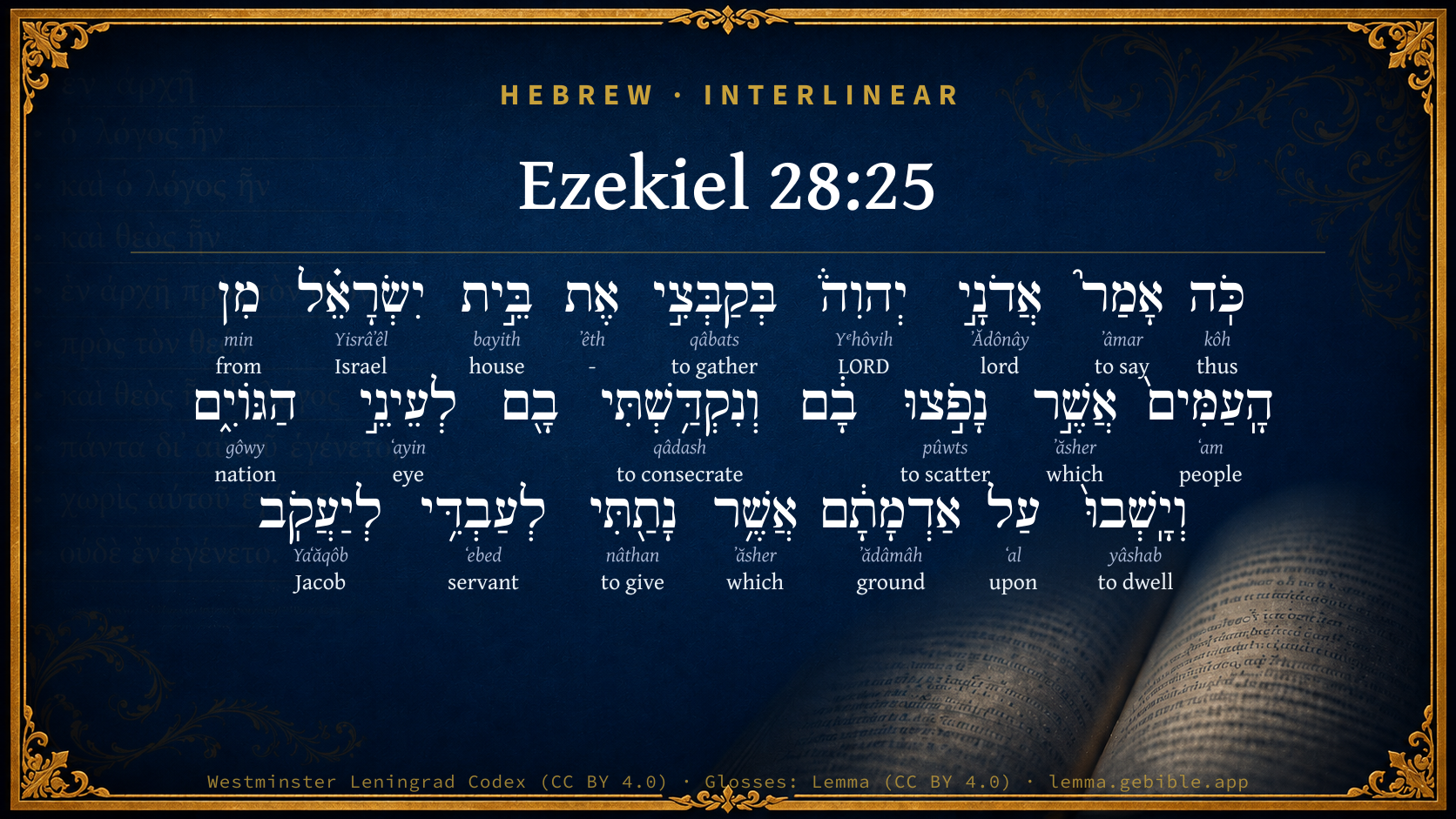
Hebrew (Westminster Leningrad Codex) Ezekiel 28:25 appears in the Hebrew Old Testament. The text above is from the Westminster Leningrad Codex. Each word links to its Strong’s number, a concise gloss, and parsing drawn from the Open Scriptures Hebrew Bible morphology. Click any word for its full Brown-Driver-Briggs (BDB) entry.
Download image
Cite this verse

Ezekiel 28:25 (World English Bible). Public Domain. Lemma interlinear Bible study tool, https://lemma.gebible.app/v/ezekiel/28/25.

Show BibTeX & RIS
BibTeX
RIS
English Translation
Thus says the Lord Yahweh: When I shall have gathered the house of Israel from the peoples among whom they are scattered, and shall be sanctified in them in the sight of the nations, then shall they dwell in their own land which I gave to my servant Jacob.
World English Bible · Public Domain
Download a study sheet

One document with this verse’s original text, its word-by-word gloss line, the meaning frame, cross-references with their text, attributed commentary, and full source and license credits — printable, and it pastes into notes with its structure intact.

This verse Autodidact and up

Study sheet (.html) Plain text (.txt)

A passage Seminary Student

Up to 50 verses in one chapter. A passage sheet keeps up to 6 commentary sources and 12 cross-references per verse, in the order this page ranks them, and says so on the sheet whenever that leaves anything out. Ask for a single verse and you get the Autodidact verse sheet above.

Everything on this page stays free to read, with no account — the sheet is a download of what is already on screen, not access to it.

Want to remove ads? Support Godless Engineer
Compare translations 3

The same verse in 3 English versions, stacked beneath the original-language interlinear above. Click any original word for its lexicon entry.

Each is an independent rendering of the whole verse — the interlinear is not word-aligned to these translations.

Highlighted words mark where these versions differ — a whole-verse word diff, not a word-by-word alignment.

  • World English Bible Public Domain
    Thus says the Lord Yahweh: When I shall have gathered the house of Israel from the peoples among whom they are scattered, and shall be sanctified in them in the sight of the nations, then shall they dwell in their own land which I gave to my servant Jacob.
  • King James Version Public Domain
    Thus saith the Lord GOD; When I shall have gathered the house of Israel from the people among whom they are scattered, and shall be sanctified in them in the sight of the heathen, then shall they dwell in their land that I have given to my servant Jacob.
  • unfoldingWord Literal Text CC BY-SA 4.0
    The Lord Yahweh says this, ‘When I gather the house of Israel from the peoples among whom they were scattered, and when I am set apart among them, so the nations may see, then they will make their homes in the land I will give to my servant Jacob.

unfoldingWord Literal Text — © unfoldingWord, licensed CC BY-SA 4.0. Word-aligned USFM3 via Door43 (git.door43.org/unfoldingWord/en_ult).

Versions to compare (up to 4)

3 of 4 selected

Show all 18 translations

Every available English version of this verse, each an independent rendering of the whole verse.

  • World English Bible Public Domain
    Thus says the Lord Yahweh: When I shall have gathered the house of Israel from the peoples among whom they are scattered, and shall be sanctified in them in the sight of the nations, then shall they dwell in their own land which I gave to my servant Jacob.
  • Berean Standard Bible Public Domain
    This is what the Lord GOD says: ‘When I gather the house of Israel from the peoples among whom they have been scattered, I will show Myself holy among them in the sight of the nations. Then they will dwell in their own land, which I have given to My servant Jacob.
  • Majority Standard Bible Public Domain
    This is what the Lord GOD says: ‘When I gather the house of Israel from the peoples among whom they have been scattered, I will show Myself holy among them in the sight of the nations. Then they will dwell in their own land, which I have given to My servant Jacob.
  • King James Version Public Domain
    Thus saith the Lord GOD; When I shall have gathered the house of Israel from the people among whom they are scattered, and shall be sanctified in them in the sight of the heathen, then shall they dwell in their land that I have given to my servant Jacob.
  • American Standard Version (1901) Public Domain
    Thus saith the Lord Jehovah: When I shall have gathered the house of Israel from the peoples among whom they are scattered, and shall be sanctified in them in the sight of the nations, then shall they dwell in their own land which I gave to my servant Jacob.
  • Revised Version (1885) Public Domain
    Thus saith the Lord GOD: When I shall have gathered the house of Israel from the peoples among whom they are scattered, and shall be sanctified in them in the sight of the nations, then shall they dwell in their own land which I gave my servant Jacob.
  • Geneva Bible (1599) Public Domain
    Thus saith the Lord God, When I shall haue gathered the house of Israel from the people where they are scattered, and shalbe sanctified in them in the sight of the heathen, then shall they dwel in the land, that I haue giuen to my seruant Iaakob.
  • Douay-Rheims (1899) Public Domain
    Thus saith the Lord God: When I shall have gathered together the house of Israel out of the people among whom they are scattered: I will be sanctified in them before the Gentiles: and they shall dwell in their own land, which I gave to my servant Jacob.
  • Young's Literal Translation Public Domain
    Thus said the Lord Jehovah: In My gathering the house of Israel, Out of the peoples among whom they were scattered, I have been sanctified in them, Before the eyes of the nations, And they have dwelt on their ground, That I gave to My servant, to Jacob,
  • Literal Standard Version CC BY-SA 4.0
    Thus said Lord YHWH: In My gathering the house of Israel, || Out of the peoples among whom they were scattered, || I have been sanctified in them, || Before the eyes of the nations, || And they have dwelt on their ground, || That I gave to My servant, to Jacob,
  • Unlocked Literal Bible CC BY-SA 4.0
    The Lord Yahweh says this, 'When I gather the house of Israel from the peoples among whom they were scattered, and when I am set apart among them, so the nations may see, then they will make their homes in the land I will give to my servant Jacob.
  • unfoldingWord Literal Text CC BY-SA 4.0
    The Lord Yahweh says this, ‘When I gather the house of Israel from the peoples among whom they were scattered, and when I am set apart among them, so the nations may see, then they will make their homes in the land I will give to my servant Jacob.
  • Darby Bible Public Domain
    Thus saith the Lord Jehovah: When I shall have gathered the house of Israel from the peoples among whom they are scattered, and shall be hallowed in them in the sight of the nations, then shall they dwell in their land which I have given to my servant Jacob.
  • World Messianic Bible Public Domain
    “‘The Lord GOD says: “When I have gathered the house of Israel from the peoples among whom they are scattered, and am shown as holy among them in the sight of the nations, then they will dwell in their own land which I gave to my servant Jacob.
  • Webster's Bible Public Domain
    Thus saith the Lord GOD; When I shall have gathered the house of Israel from the people among whom they are scattered, and shall be sanctified in them in the sight of the heathen, then shall they dwell in their land that I have given to my servant Jacob.
  • Free Bible Version CC BY-SA 4.0
    This is what the Lord God says: When I bring back the people of Israel from the nations where they've been scattered. I will show my holy character through them as everyone watches. Then they will live in their own country, which I gave to my servant Jacob.
  • Bible in Basic English Public Domain
    This is what the Lord has said: When I have got together the children of Israel from the peoples among whom they are wandering, and have been made holy among them before the eyes of the nations, then they will have rest in the land which is theirs, which I gave to my servant Jacob
  • JPS Tanakh (1917) Public Domain
    Thus saith the Lord GOD: When I shall have gathered the house of Israel from the peoples among whom they are scattered, and shall be sanctified in them in the sight of the nations, then shall they dwell in their own land which I gave to My servant Jacob.

Literal Standard Version (2020), Covenant Press — licensed CC BY-SA 4.0. Text via the HelloAO Bible API (eBible.org). Unlocked Literal Bible (unfoldingWord) — licensed CC BY-SA 4.0. Text via the HelloAO Bible API (eBible.org). unfoldingWord Literal Text — © unfoldingWord, licensed CC BY-SA 4.0. Word-aligned USFM3 via Door43 (git.door43.org/unfoldingWord/en_ult). Free Bible Version, Dr. Jonathan Gallagher — licensed CC BY-SA 4.0. Text via the HelloAO Bible API (eBible.org).

Word by word

More ways to search: Search by grammar → Find every occurrence → Compare this word →

Practice this passage: Drill this verse → Learn its vocabulary →

נָפֹ֣צוּ
pûwts
H6327
“to scatter”
Verb, Niphal, Perfect, 3rd Person, Common, Plural
Part of Speech
Verb
Stem
Niphal
Form
Perfect
Person
3rd Person
Gender
Common
Number
Plural
Full BDB Definition

Origin: a primitive root

TWOT: 1745 , 1746 , 1800

to scatter, be dispersed, be scattered - (Qal) to be dispersed, be scattered - (Niphal) - to be scattered - to be spread abroad - (Hiphil) to scatter - Hithpael) scatter - (Qal) to flow, overflow - to break - (Polel) to shatter - (Pilpel) to dash to pieces
  1. כֹּֽה kôh H3541 “thus” Adverb
  2. אָמַר֮ ʼâmar H559 “to say” Verb, Qal, Perfect, 3rd Person, Masculine, Singular
  3. אֲדֹנָ֣י ʼĂdônây H136 “Lord · my” Noun, Common, Masculine, Plural, Construct + Suffix, Personal, 1st Person, Common, Singular
  4. יְהוִה֒ Yᵉhôvih H3069 “LORD” Noun, Proper
  5. בְּקַבְּצִ֣י qâbats H6908 “in/at · to gather · me” Preposition + Verb, Piel, Infinitive Construct + Suffix, Personal, 1st Person, Common, Singular
  6. אֶת ʼêth H853 “-” Particle, Direct Object
  7. בֵּ֣ית bayith H1004 “house of” Noun, Common, Masculine, Singular, Construct
  8. יִשְׂרָאֵ֗ל Yisrâʼêl H3478 “Israel” Noun, Proper
  9. מִן min H4480 “from” Preposition
  10. הָֽעַמִּים֙ ʻam H5971 “the · peoples” Particle, Definite Article + Noun, Common, Masculine, Plural, Absolute
  11. אֲשֶׁ֣ר ʼăsher H834 “which” Particle, Relative
  12. וְנִקְדַּ֥שְׁתִּי qâdash H6942 “and · to consecrate” Conjunction + Verb, Niphal, Sequential Perfect, 1st Person, Common, Singular
  13. לְעֵינֵ֣י ʻayin H5869 “to/for · eyes of” Preposition + Noun, Common, Both, Dual, Construct
  14. הַגּוֹיִ֑ם gôwy H1471 “the · nations” Particle, Definite Article + Noun, Common, Masculine, Plural, Absolute
  15. וְיָֽשְׁבוּ֙ yâshab H3427 “and · to dwell” Conjunction + Verb, Qal, Sequential Perfect, 3rd Person, Common, Plural
  16. עַל ʻal H5921 “upon” Preposition
  17. אַדְמָתָ֔ם ʼădâmâh H127 “ground · their” Noun, Common, Feminine, Singular, Construct + Suffix, Personal, 3rd Person, Masculine, Plural
  18. אֲשֶׁ֥ר ʼăsher H834 “which” Particle, Relative
  19. נָתַ֖תִּי nâthan H5414 “to give” Verb, Qal, Perfect, 1st Person, Common, Singular
  20. לְעַבְדִּ֥י ʻebed H5650 “to/for · servant · my” Preposition + Noun, Common, Masculine, Singular, Construct + Suffix, Personal, 1st Person, Common, Singular
  21. לְיַעֲקֹֽב Yaʻăqôb H3290 “to/for · Jacob” Preposition + Noun, Proper

About this verse

These counts appear in no published source. They are computed here, from the morphology-tagged text and Lemma’s own curated glosses. What Lemma adds →

24
words
21
distinct lemmas
Prophets
section

Grammatical profile

  • 6 verbs
  • 10 nouns
  • 4 prepositions
  • 1 adverb
  • 3 particles

Verb forms

  • אָמַר֮ Qal · Perfect
  • בְּקַבְּצִ֣י Piel · Infinitive Construct
  • נָפֹ֣צוּ Niphal · Perfect
  • וְנִקְדַּ֥שְׁתִּי Niphal · Sequential Perfect
  • וְיָֽשְׁבוּ֙ Qal · Sequential Perfect
  • נָתַ֖תִּי Qal · Perfect

Repetition

A word recurs within this verse — often emphatic in Hebrew:

  • אֲשֶׁ֣ר which H834 ×2

Hebrew & Septuagint length

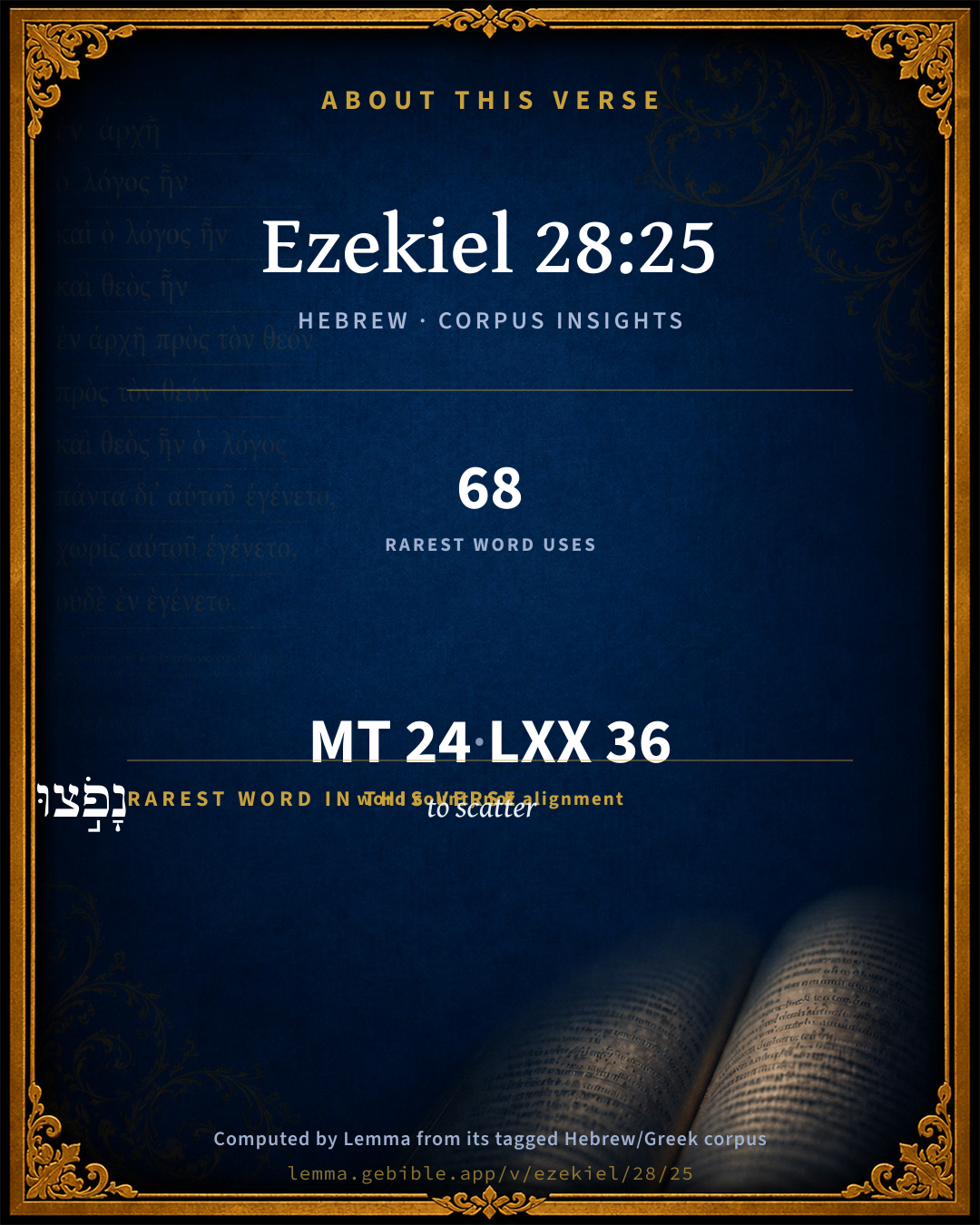
In English translation the verse runs 49 words from the Hebrew and 46 from the Septuagint (LXX English) — closely comparable.

A rough comparison of the two English renderings, which tokenize alike — not a word-level alignment.

Word counts can differ between the Hebrew and the Greek without any difference in meaning — e.g. the Hebrew direct-object marker אֵת has no separate Greek word, and Greek often adds the article ὁ.

In the original languages it is 24 Hebrew tokens and 36 Greek tokens — but the two are counted differently (Hebrew bundles its prefixes and suffixes into one token; the Greek is in lemma form), so that isn’t a like-for-like length.

Cross-references

29

Topical passages linked to Ezekiel 28:25 in the Treasury of Scripture Knowledge — connected by theme and wording, ordered by reader-vote popularity; previews shown in the World English Bible.

  • Jeremiah 32:37 Behold, I will gather them out of all the countries, where I have driven them in my anger, and in my wrath, and in great indignation; and I will bring them again to this place, and I will cause them to dwell safely:
  • Ezekiel 20:41 As a sweet savor will I accept you, when I bring you out from the peoples, and gather you out of the countries in which you have been scattered; and I will be sanctified in you in the sight of the nations.
  • Psalms 106:47 Save us, Yahweh, our God, Gather us from among the nations, To give thanks to your holy name, To triumph in your praise!
  • Jeremiah 23:8 but, As Yahweh lives, who brought up and who led the seed of the house of Israel out of the north country, and from all the countries where I had driven them. They shall dwell in their own land.
  • Ezekiel 11:17 Therefore say, Thus says the Lord Yahweh: I will gather you from the peoples, and assemble you out of the countries where you have been scattered, and I will give you the land of Israel.
  • Ezekiel 36:28 You shall dwell in the land that I gave to your fathers; and you shall be my people, and I will be your God.
  • Ezekiel 37:25 They shall dwell in the land that I have given to Jacob my servant, in which your fathers lived; and they shall dwell therein, they, and their children, and their children's children, forever: and David my servant shall be their prince for ever.
  • Isaiah 11:12–13 He will set up an ensign for the nations, and will assemble the outcasts of Israel, and gather together the dispersed of Judah from the four corners of the earth.
  • Ezekiel 28:22 and say, Thus says the Lord Yahweh: Behold, I am against you, Sidon; and I will be glorified in the midst of you; and they shall know that I am Yahweh, when I shall have executed judgments in her, and shall be sanctified in her.
  • Ezekiel 34:13 I will bring them out from the peoples, and gather them from the countries, and will bring them into their own land; and I will feed them on the mountains of Israel, by the watercourses, and in all the inhabited places of the country.
  • Genesis 28:13–14 Behold, Yahweh stood above it, and said, "I am Yahweh, the God of Abraham your father, and the God of Isaac. The land whereon you lie, to you will I give it, and to your seed.
  • Leviticus 26:44–45 Yet for all that, when they are in the land of their enemies, I will not reject them, neither will I abhor them, to destroy them utterly, and to break my covenant with them; for I am Yahweh their God;
  • Deuteronomy 30:3–4 that then Yahweh your God will turn your captivity, and have compassion on you, and will return and gather you from all the peoples, where Yahweh your God has scattered you.
  • Jeremiah 27:11 But the nation that shall bring their neck under the yoke of the king of Babylon, and serve him, that [nation] will I let remain in their own land, says Yahweh; and they shall till it, and dwell therein.
  • Jeremiah 30:18 Thus says Yahweh: Behold, I will turn again the captivity of Jacob's tents, and have compassion on his dwelling-places; and the city shall be built on its own hill, and the palace shall be inhabited after its own manner.
  • Zephaniah 3:19–20 Behold, at that time I will deal with all those who afflict you, and I will save those who are lame, and gather those who were driven away. I will give them praise and honor, whose shame has been in all the earth.
  • Isaiah 5:16 But Yahweh of Hosts is exalted in justice, And God the Holy One is sanctified in righteousness.
  • Isaiah 27:12–13 It shall happen in that day, that Yahweh will beat off [his fruit] from the flood of the River to the brook of Egypt; and you shall be gathered one by one, you children of Israel.
  • Jeremiah 31:8–10 Behold, I will bring them from the north country, and gather them from the uttermost parts of the earth, [and] with them the blind and the lame, the woman with child and her who travails with child together: a great company shall they return here.
  • Ezekiel 34:27 The tree of the field shall yield its fruit, and the earth shall yield its increase, and they shall be secure in their land; and they shall know that I am Yahweh, when I have broken the bars of their yoke, and have delivered them out of the hand of those who made slaves of them.
  • Ezekiel 36:23–24 I will sanctify my great name, which has been profaned among the nations, which you have profaned in the midst of them; and the nations shall know that I am Yahweh, says the Lord Yahweh, when I shall be sanctified in you before their eyes.
  • Ezekiel 37:21 Say to them, Thus says the Lord Yahweh: Behold, I will take the children of Israel from among the nations, where they are gone, and will gather them on every side, and bring them into their own land:
  • Ezekiel 38:23 I will magnify myself, and sanctify myself, and I will make myself known in the eyes of many nations; and they shall know that I am Yahweh.
  • Ezekiel 39:27 when I have brought them back from the peoples, and gathered them out of their enemies' lands, and am sanctified in them in the sight of many nations.
  • Hosea 1:11 The children of Judah and the children of Israel will be gathered together, and they will appoint themselves one head, and will go up from the land; for great will be the day of Jezreel.
  • Joel 3:7 Behold, I will stir them up out of the place where you have sold them, And will return your repayment on your own head;
  • Amos 9:14–15 I will bring back the captivity of my people Israel, And they will rebuild the ruined cities, and inhabit them; and they will plant vineyards, and drink wine from them. They shall also make gardens, And eat the fruit of them.
  • Obadiah 1:17–21 But in Mount Zion, there will be those who escape, and it will be holy. The house of Jacob will possess their possessions.
  • Micah 7:11–14 A day to build your walls-- In that day, he will extend your boundary.

Cross-references courtesy of OpenBible.info (CC BY 4.0).

Hebrew and Greek witnesses Masoretic Hebrew ↔ Greek Septuagint

The same verse in the two great witnesses to the Old Testament, shown verse-for-verse.

These are two independent witnesses, not word-aligned to each other, and the Septuagint is shown in lemma (dictionary) form.

Hebrew Ezekiel 28:25 Masoretic · Westminster Leningrad Codex

כֹּֽה אָמַר֮ אֲדֹנָ֣י יְהוִה֒ בְּקַבְּצִ֣י אֶת בֵּ֣ית יִשְׂרָאֵ֗ל מִן הָֽעַמִּים֙ אֲשֶׁ֣ר נָפֹ֣צוּ בָ֔ם וְנִקְדַּ֥שְׁתִּי בָ֖ם לְעֵינֵ֣י הַגּוֹיִ֑ם וְיָֽשְׁבוּ֙ עַל אַדְמָתָ֔ם אֲשֶׁ֥ר נָתַ֖תִּי לְעַבְדִּ֥י לְיַעֲקֹֽב

Thus says the Lord Yahweh: When I shall have gathered the house of Israel from the peoples among whom they are scattered, and shall be sanctified in them in the sight of the nations, then shall they dwell in their own land which I gave to my servant Jacob.

World English Bible · Public Domain

Greek LXX Ezekiel 28:25 Septuagint · lemma form

ὅδε λέγω κύριος κύριος καί συνἄγω ὁ ἰσραήλ ἐκ ὁ ἔθνος ὅς διασκορπίζω ἐκεῖ καί ἁγιάζω ἐν αὐτός ἐνώπιον ὁ λαός καί ὁ ἔθνος καί καταοἰκέω ἐπί ὁ γῆ αὐτός ὅς δίδωμι ὁ δοῦλος ἐγώ ἰακώβ

Thus says the Lord God; I will also gather Israel from the nations, among whom they have been scattered, and I will be sanctified among them, and before the peoples and nations: and they shall dwell upon their land, which I gave to my servant Jacob.

LXX2012 (modern English Septuagint) · Public Domain

Hebrew: Westminster Leningrad Codex (CC BY 4.0). Greek: Septuagint (public domain); English from LXX2012 (modern English Septuagint) (Public Domain). How the Septuagint differs from the Hebrew →

Targum (Aramaic paraphrase)

1

The Targum is the ancient Jewish Aramaic paraphrase of the Hebrew Scriptures — an interpretive translation, not the Hebrew text itself. Onkelos (literal) and Pseudo-Jonathan (expansive) render the Torah, and Jonathan the Prophets. Coverage is partial: where no permissively-licensed English translation exists for a verse, only the Aramaic is shown. This is verse-level text, not a word-by-word alignment to the Hebrew.

  1. Targum Jonathan Prophets (Joshua–Malachi)
    כִּדְנַן אֲמַר יְיָ אֱלֹהִים כַּד אַכְנַשׁ יַת בֵּית יִשְׂרָאֵל מִבֵּינֵי עַמְמַיָא דְאִתְבַּדַרוּ לְתַמָן וְאִתְקַדֵשׁ בְּהוֹן לְעֵינֵי עַמְמַיָא וִיתוּבוּן עַל אַרְעֲהוֹן דִיהֲבִית לְעַבְדִי לְיַעֲקֹב:

    (no public-domain English translation for this verse)

    Targum Jonathan — Aramaic: “Mikraot Gedolot” (public domain). English: “Sefaria Community Translation” (CC0 1.0 (public-domain dedication)); “London "Chaldee Paraphrase," 1871” (public domain). Text via Sefaria.

Commentary

Notes on Ezekiel 28:25 from classic Christian and Jewish commentators (each source and its license shown beneath its notes). The classic Christian expositions comment on the surrounding passage and are grouped to its opening verse, so a note may address several verses; the Jewish commentaries on the Tanakh (Rashi and others) are per-verse, so they appear only where the commentator wrote on this verse.

Lemma curates 59 commentaries, every one of them public domain or Creative Commons licensed, each selected and text-cleaned for this edition rather than reprinted as found. About our sources →

Trapp's Complete Commentary

John Trapp

Eze 28:25 Thus saith the Lord GOD; When I shall have gathered the house of Israel from the people among whom they are scattered, and shall be sanctified in them in the sight of the heathen, then shall they dwell in their land that I have given to my servant Jacob.

Ver. 25. Then shall they dwell in their land.] Provided that they cleave close to me; otherwise I will out them again. It hath been elsewhere noted that the promises are with a condition; which is as an oar in a boat, or stern of a ship, and turns the promise another way.

John Trapp, A Commentary or Exposition upon All the Books of the Old and New Testament (1647–1656) — public domain. Text from a community e-Sword module.

Whedon's Commentary on the Bible

Daniel D. Whedon

25. People — Literally, peoples.

Shall be sanctified — Literally, have shown myself holy. (See also Eze_28:22.)

My servant Jacob — Used for Israel (Eze_20:5; Eze_28:25; Eze_37:25).

Daniel D. Whedon (gen. ed.), Commentary on the Old and New Testaments (1874–1909) — public domain. Text from a community e-Sword module.

Tyndale Open Study Notes

Tyndale Open Resources

28:25-26 The Lord would not reveal his holiness simply by judging the nations for their pride, arrogance, and enmity toward his chosen people. He would also gather his people back to the land of Israel. There they would live safely and be able to build homes and plant vineyards, which were typical signs of covenantal blessing in the Old Testament (see Mic 4:4; Zech 3:10). After God acted to punish the neighboring nations and restore his people, they would be at rest. The nations would know that God is the Sovereign Lord through his powerful acts of judgment, and Israel would know that he was the Lord their God, a title that speaks of God’s covenant relationship of worship and fellowship with them.

Tyndale Open Study Notes — © Tyndale Open Resources, licensed CC BY-SA 4.0. Text via the HelloAO Bible API.

Geneva Bible (1599)

Geneva Bible translators

He showeth for what cause God will assemble his Church, and preserve it still, though he destroy his enemies: to wit, that they should praise him, and give thanks for his great mercies.

Geneva Bible (1599) marginal notes — public domain. Text via Bolls.life.

Jamieson, Fausset & Brown

Robert Jamieson, A. R. Fausset & David Brown

Fulfilled in part at the restoration from Babylon, when Judaism, so far from being merged in heathenism, made inroads by conversions on the idolatry of surrounding nations. The full accomplishment is yet future, when Israel, under Christ, shall be the center of Christendom; of which an earnest was given in the woman from the coasts of Tyre and Sidon who sought the Saviour (Mat 15:21, Mat 15:24, Mat 15:26-28; compare Isa 11:12).

dwell safely-- (Jer 23:6).

This is the last of the world kingdoms against which Ezekiel's prophecies are directed, and occupies the largest space in them, namely, the next four chapters. Though farther off than Tyre, it exercised a more powerful influence on Israel.

Next: Ezekiel Chapter 29

Jamieson, Fausset & Brown — Commentary Critical and Explanatory on the Whole Bible (1871) — public domain (CC PDM 1.0). Text via the HelloAO Bible API.

Adam Clarke's Commentary

Verse 25. When I shall have gathered the house of Israel] In their long captivity, God had been preparing the land for them so as to make it a safe dwelling; and hence he executed judgments on all the heathen nations round about by means of the Chaldeans. Thus Tyre and Sidon were destroyed, as were the Ammonites and others who had been the inveterate enemies of the Jews. Judgment first began at his own house, then proceeded to the heathen nations; and when they were brought down, then he visited and redeemed his people. Thus God's ways are proved to be all equal; partialities and caprices belong not to him.

Adam Clarke's Commentary on the Bible (1810–1826) — public domain. Text from a community e-Sword/MySword module.

Ellicott's Commentary for English Readers

(25) Sanctified in them in the sight of the heathen.—The course of God’s providence is very distinctly marked out in these verses of promise. The judgment upon Judah had already come, in the fall of their holy city and the captivity of the people. This leads them to repentance, and thus God is “sanctified in the sight of the heathen;” His holiness and justice are exhibited to the world. Then comes the promise of the return, and the judgment of the ungodly enemies who have despised Judah (Eze_28:26). This, too, shall be accomplished in its time, and then peace and prosperity shall return to Israel.

The immediate point of this prophecy is the return of the Jews to their own land; yet, as the struggle between them and their enemies has been a struggle between the Church of God and the powers of the world, and as this particular struggle thus in some sort symbolises the greater contest between religion and the world in all ages, so this promise of rest looks forward in some sense to the final victory over all evil.

A Bible Commentary for English Readers, edited by Charles John Ellicott (1878–1897) — public domain. Text from a community e-Sword module.

The Cambridge Bible for Schools and Colleges

gen. ed. J. J. S. Perowne

25. Read peoples for people.

sanctified in them] i.e. through them, in their restoration. Jehovah is sanctified through the chastisement of the nations who distress His people, and He is sanctified through His people’s restoration. On “sanctify” cf. Eze_28:22.

my servant Jacob] Cf. ch. Eze_37:25; the phrase already in Jer_30:10, and frequently in Isaiah 40-66.

The Cambridge Bible for Schools and Colleges (gen. ed. J. J. S. Perowne; Cambridge University Press, 1878–1918) — public domain. Text from a community e-Sword module.

John Gill's Exposition

Thus saith the Lord God, when I shall have gathered the house of Israel,.... Not at the return of them from captivity in Babylon; for the ten tribes or house of Israel did not then return; though there might some few of those tribes, as a pledge of what would be hereafter; but in the latter day, upon the destruction of antichrist, when all Israel shall be saved: and when they will be collected

from the people among whom they are scattered; in the several nations of the world, in Asia, Africa, and Europe:

and shall be sanctified in them in the sight of the Heathen; being believed in by them; prayed unto and worshipped in a spiritual manner by them; professed and owned to be their Saviour and Redeemer in the face of the whole world, Christians and even Heathens, whom before they rejected: then shall they dwell in their land that I have given to my servant Jacob; the land of Canaan, given by promise to Abraham, Isaac, and Jacob; which last is only here mentioned, because it was his posterity that was to possess it; not all Abraham's, only those in the line of Isaac; nor all Isaac's, only those in the line of Jacob; but all his; and this they will do when they are converted in the latter day, and be no more a vagabond people, as they now are.

John Gill's Exposition of the Whole Bible (1746–1763) — public domain (CC PDM 1.0). Text via the HelloAO Bible API.

Albert Barnes' Notes on the Bible

The contrast of the future of Israel with that of the surrounding nations. This prophecy reaches far beyond a mere temporal restoration. It points to times of more permanent security, when from all nations and kingdoms the Church of Christ, the Israel of God, shall be gathered in, when the power of the world shall be forever broken, and the kingdom of Christ shall be established forever.

This transition from the enemies to the people of God closes the portion of the prophecies against the nations in the immediate vicinity of the Israelites, before passing to the more distant Egypt.

Albert Barnes' Notes on the Bible (1834–1885) — public domain. Text from a community e-Sword/MySword module.

Haydock's Catholic Bible Commentary

When. All shall praise God, seeing that he receives his people again after he has justly chastised them. (Worthington)

George Leo Haydock (1774–1849), Haydock's Catholic Family Bible and Commentary, 1859 edition — public domain. Excludes Psalms (Douay-Rheims chapter numbering differs from Protestant) and Deuterocanonical books (Catholic canon only).

Matthew Poole's English Annotations

When seventy years is expired, which is the term of their captive state.

I shall have gathered; moved the hearts of my people to come together upon Cyrus’s proclamation, and from all parts of that vast kingdom, to prepare for a return to the country most of them never saw: it was God who moved Cyrus to give them leave; it was as much God’s work to stir up the people to return.

The house of Israel; the generality of them, those that were Israelites indeed.

From the people; several nations subjects to the king of Babylon.

Scattered, by the Babylonish king at first, and afterward by incident, necessity, or their own choice.

Shall be sanctified; have vindicated my name, which by them was blasphemed.

In the sight of the heathen: I was dishonoured by the Jews in the sight of the heathen, and I will be honoured by the Jews in their sight, they shall be witnesses of my vindication.

Dwell; settle in peace, and for continuance.

In their land; in a land that is theirs,

their own, as it is often called.

That I have given; their title is of me by deed of gift, not of late, but to one that was long since my servant; to Jacob, father to these returning captives. The Hebrew repeats the preposition,

to my servant, to Jacob, with an emphasis, to mind them of God’s faithfulness.

Matthew Poole's English Annotations on the Holy Bible (1683–1685) — public domain. Text from a community e-Sword/MySword module.

The Pulpit Commentary

My servant Jacob. The use of "Jacob" for "Israel" is not common in Ezekiel, but Eze_20:5 Eze_27:25 Eze_34:25 may be noted as parallels.

The home-gathering.

It is a relief to turn from repeated threatenings of approaching doom to the voice of gracious promises. We have here a gleam of sunshine breaking for a moment through the clouds of judgment. As there was light in the land of Goshen while a plague of darkness fell on the rest of Egypt, (Exo_10:23) so now the Jews are to be blessed when every neighboring nation lies in ruins. The home-gathering of the Jews is their great expected blessing, which stands out in strong contrast with the hopeless desolation of the heathen. A wider Christian vision will desire to see in this a type of that great spiritual restoration which is for all the people of God, and for all who are willing to become his people, even though they now belong to lost heathen races. A Jewish prophet predicted this wider and more glorious future. (Isa_19:25)

I THE FRUIT OF DIVINE REDEMPTION IS A GREAT HOMEGATHERING. It was so physically with Israel; it is so spiritually with Christians.

1. Sin scatters. It drives men from God, banishes them from their old privileges, breaks up the brotherhood of fellow-men, and destroys the true family spirit. All evil is a solvent of society.

2. Christ restores.

(1) To God. The first departure was from God. Where the parent is, there is the home. We leave our home in leaving God; in restoration we first come hack to God. The first great result of it is a return of the soul to communion with God.

(2) To the home. Israel is restored to Palestine, the land flowing with milk and honey. The redeemed are now restored to what is better than Caanan even in its palmy days to the kingdom of heaven brought down to the earth. Here the Christian may eat of the tree of life and drink of the river of water of life. Here no pricking briars may grow.

(3) To Christian fellowship. The home is the abode of the family. By redemption Christ heals enmity, destroys selfishness, inspires sympathy, draws and binds souls together. This is the earthly blessedness of the Divine recovery.

II THIS GREAT HOME-GATHERING IS FOR THE GLORY OF GOD. God was to be glorified in the punishment of the wicked (Ver. 22). But he gains a fresh glory from redemption. When Israel is restored God "shall be sanctified in them in the sight of the heathen." The holiness of God will then be made apparent to the world. The restoration of Israel reveals the power and goodness of God, and shows how he cares for and saves the people who acknowledge him. In a much higher way the redemption of the world sanctifies God by revealing his holiness.

1. It shows his power over sin. He restrains the wicked, that those who obey his Word may have freedom to do so.

2. It shows his recovering grace. The Jews had sinned and had been banished as a punishment for their wickedness, in which they resembled the heathen. But they were penitent, and, being pardoned, they were also restored. There is greater glory in redemption than in retribution. If God conquers sin, not by destroying the sinner, but by converting him, God"s holiness is most fully glorified. There is nothing on earth that so sanctifies God, by revealing him in separate, supreme goodness, as the triumphs of the gospel. Nebuchadnezzar glorified God, but Cyrus more so. God was glorified in the destruction of Jerusalem; he was more glorified in the preaching of St. Paul.

Vers. 25, 26. The favor shown to Israel.

In the writings of Ezekiel, as in those of other prophets, we cannot but observe the remarkable conjunction of passages denouncing judgment with passages revealing Divine grace and promising Divine clemency. The attentive reader cannot but be surprised and charmed upon meeting with such a promise as is contained in these two verses, coming in between the denunciation of Tyre and the denunciation of Egypt. Undoubtedly, the fate of surrounding nations had relation to the history and prospects of Israel, though it would be presumption in us to define those relations too exactly.

It was not a mere rhetorical art which led to the introduction of this portion of the prophecies just in this place. Yet we feel that its position both enhances its beauty and deepens its interest and significance.

I THE FAVOR TO BE SHOWN TO ISRAEL IS IN CONTRAST TO THE FATE OF OTHER NATIONS. Tyre should perish from off the earth; Egypt should be trodden underfoot, and should be degraded in the scale of nations; but Israel should dwell in their own land with confidence.

II THE FAVOR SHOWN TO ISRAEL IS CONSEQUENT UPON ISRAEL"S DEPRESSION, CONQUEST, AND CAPTIVITY. It is not to be supposed that Israel, because the chosen nation, was exempt from calamity and discipline. On the contrary, it was because, to some extent, the discipline was answering its intended purpose, that brightness followed the storm, that the winter of Israel"s discontent was succeeded by the genial and happy springtime.

III THE FAVOR SHOWN TO ISRAEL WAS, HOWEVER, UNDESERVED BY ISRAEL"S OWN CHARACTER AND ACTION. So it had been from the beginning. Israel was a rebellious and stiff-necked people, lapsing now into idolatry and again into murmuring or licentiousness. God had a purpose in Israel"s election, and that purpose must needs be carried out. But in any case, it was no virtue, excellence, or merit in Israel that accounted for the forbearance continually and repeatedly extended towards the people of the covenant.

IV THE FAVOR SHOWN TO ISRAEL WAS OWING TO THE CLEMENCY OF THE DIVINE RULER. Why such clemency was extended to Israel, and was withheld from Tyre, it may not be possible for us to explain. But there is no caprice in the government of God; justice and mercy are his attributes, and it would be folly in man to impugn them. Who is there who is not indebted to Divine long-suffering and loving-kindness? What nation has not been spared and delivered from its enemies, once and again in the course of its history? Certainly, the mercy of the God of Abraham towards the people that sprang from the father of the faithful was great and marvelous.

V THE FAVOR SHOWN TO ISRAEL WAS MANIFEST IN THE DELIVERANCE OF THE PEOPLE FROM CAPTIVITY AND EXILE. They were "gathered from the people among whom they were scattered." Instead of being reduced to perpetual bondage or absorbed by their conquerors, the Hebrew people, though appointed to exile, were in due time redeemed from their subjection, dependence, and expatriation.

VI THE FAVOR SHOWN TO ISRAEL WAS MANIFEST IN THEIR PEACEFUL RE-ESTABLISHMENT IN THEIR OWN LAND. It was the land given by Jehovah to his servant Jacob, the land of promise, the land of the covenant. God had his own wise purposes to work out by this replanting and resettling of the people of Israel upon the sacred soil. There it was appointed for them to dwell in safety and confidence, to build their houses and to plant their vineyards, and above all to worship the God of their fathers in his chosen sanctuary.

VII THE FAVOR SHOWN TO ISRAEL WAS INTENDED TO AWAKEN THE ACKNOWLEDGMENTS OF GRATEFUL PIETY. The services and their motives may not always have been spiritual and pure, free from every taint of selfishness and self-satisfaction. The Israelites, thinking of the judgments God had executed upon all those who had despised them round about them, congratulating themselves that, whilst their foes had been humiliated or destroyed, they had been spared, restored, and blessed, may, perhaps, have allowed some feelings of self-righteousness to take possession of their hearts. Yet they could not fail to acknowledge Jehovah as their true Friend and mighty Deliverer; they could not but offer grateful sacrifices of adoring praise to him who had remembered them in their low estate; for his mercy endureth forever. They could not but know and confess him as the Lord their God. T.

Vers. 25, 26. God glorified in his dealings with his people under chastisement.

saith the Lord God; When I shall have gathered the house of Israel from the peoples among whom they are scattered," etc. In bringing to a close the prophecies against the heathen nations which bordered upon the Holy Land, Ezekiel briefly outlines the glorious restoration of the people of God in contrast to the judgments which destroyed those nations. He also declares that he will be sanctified in his people in the sight of the nations. His dealings with his people who were in captivity would be of such a character as to promote his honor in the eyes of the nations who were cognizant of those dealings. Thus the subject is presented to us of God glorified in his treatment of his people under chastisement .

I IN HIS CARE FOR THEM WHILE THEY ARE UNDER CHASTISEMENT BECAUSE OF THEIR SINS. Our text is itself an evidence of this care. They needed some strong encouragement to counteract "the despondency which was now, after the opening of the siege of Jerusalem, the most dangerous foe" which they had to contend against. God recognized their need, and the inspiring promises of the text were a contribution towards its supply. Moreover, his purpose to gather them again and restore them to their own land necessitated the exercise of care over them during their exile. We have reason to believe that when his people are under chastisement they are the objects of his special care. This is taught, in his holy Word, especially in Mal_3:3, "He shall sit as a refiner and purifier of silver, and he shall purify the sons of Levi, and purge them as gold and silver." In purifying silver from its dross "the refiner not only places his crucible on a hot fire, but heaps fire around and above it. Under this process it at first throws out a dark and offensive smoke, which, as the heat and its effects increase, becomes less offensive, until it altogether ceases, and the silver becomes beautifully white. The point of requisite purity and perfection is when the refiner sees his own likeness reflected in the silver. How admirably does this illustrate the gracious process by which, through means of affliction, our heavenly Father carries on the work of purification in the hearts of his children!" The refiner of silver keeps his eye steadily on the furnace, lest the silver should be injured by the intense heat, and that he may see when the process is complete; so the great Refiner watches over his children when they are passing through the cleansing fires of Divine chastisement. Here, then, is encouragement to the people of God in seasons of trial. God himself is graciously observing you. His eye is constantly and tenderly upon you. In this fact there is also vindication of the Divine honor in relation to the afflictions of his people.

II IN HIS REMOVAL OF THE CHASTISEMENT WHEN IT HAS ACCOMPLISHED ITS PURPOSE. "Thus saith the Lord; When I shall have gathered the house of Israel from the peoples among whom they are scattered," etc. (Ver. 25), When the object for which the covenant people were sent into captivity was achieved, he brought them together and reinstated them in the land which he gave to his servant Jacob, "In that furnace of affliction the national tendency to idolatry was burnt out of the national heart, never to reappear;" and then they were delivered out of the furnace. In their restoration to their own land the nations would see that the Lord had not cast them off or forsaken them. "For the Lord will not cast off forever. For though he cause grief," etc.. (Lam_3:31-33) Moreover, in that restoration there was a manifestation of the faithfulness, power, and goodness of the Lord to his people. Faithfulness in his remaining true to them and to his engagements to them, notwithstanding their former long-continued unfaithfulness to him. If we are faithless, he abideth faithful; for he cannot deny himself." Power in his controlling the hearts and actions of men for the accomplish; meat of his purposes in relation to his people. And goodness in dealing with them so graciously, notwithstanding their ill desert. Thus would the Lord God be sanctified in them in the sight of the nations; And still he speedily removes the chastisements of his people when they have effected the purpose for which they were inflicted.

Praise him still the same forever, Slow to chide, and swift to bless.

III IN HIS RESTORATION OF PEACE AND PROSPERITY TO THEM. "And they shall dwell securely therein; yea, they shall build houses, and plant vineyards," etc. (Ver. 26). "As we have seen that the prophecies against the heathen reached, not merely to the particular nations, but to the world-power which they represented; as the same predictions are directed against Tyre by Ezekiel, against Babylon by Isaiah, and against the Apocalyptic Babylon by St. John; so this prophecy reaches far beyond a mere temporal restoration. It points to times of more permanent security, when from all nations and kingdoms the Church of Christ, the Israel of God, shall be gathered in, when the power of the world shall be for ever broken, and the kingdom of Christ shall be established forever" ("Speaker"s Commentary"). Two blessings are particularly mentioned by the prophet.

1. Safety. "They shall dwell securely." Israel was not free from enemies and molestations after their return from captivity. Delivered from idolatry, yet their evil hearts broke out into other forms of sin; and distresses followed transgressions. Christian believers are not exempted from either enemies or trials. Yet we may say that "believers always dwell safely under the Divine protection, and may be quiet from the fear of evil." For "if God is for us, who is against us? In all these things we are more than conquerors, through him that loved us". (Rom_8:31, Rom_8:37; Heb_13:6; 1Pe_3:13)

2. Prosperity. "They shall build houses, and plant vineyards, and dwell securely." These operations denote the return of prosperity to the people. And it is certain that at times they flourished considerably in their condition and circumstances. There is evidence of this in the sumptuous houses which they built for themselves. (cf. Haggai.). In thus dealing with his people also the Lord would "be sanctified in them in the sight of the nations." But the text points onward to blessings yet in store for the Israel of God. Seasons of unprecedented power and prosperity await the Church in the future, when men everywhere shall know and acknowledge the Lord God. "All the earth shall be filled with the glory of the Lord". (Num_14:21) "In the name of Jesus every knee shall bow, of things in heaven, and things on earth," etc.. (Php_2:10, 11) And in the heavenly Canaan shall be enjoyed the complete triumph, and the undisturbed peace, and the deep, eternal joy.

And the temple again shall be built, And filled as it was of yore; And the burden be lift from the heart of the world, And the nations all adore; Prayers to the throne of heaven Morning and eve shall rise, And unto, and not of the Lamb Shall be the sacrifice. (P. J. Bailey. ) W.J.

The Pulpit Commentary (1880–1919), ed. H.D.M. Spence-Jones & Joseph S. Exell — public domain. Text from a community e-Sword module.

John Wesley's Explanatory Notes

Sanctified - I was dishonoured by the Jews in the sight of the heathen, and I will be honoured by the Jews in their sight.

John Wesley, Explanatory Notes Upon the Whole Bible (1754–1765) — public domain. Text via the GEBible commentary corpus.

unfoldingWord translationNotes

Door43 World Missions Community

the house of Israel

The word "house" is a metonym for the family that lives in the house. In this case it refers to Israel's descendants. See how you translated this in Ezekiel 3:1. AT: "the Israelites" or "the Israelite people group" (See: Metonymy)

among whom they were scattered

This can be expressed in active form. AT: "among whom I scattered them" (See: Active or Passive)

so the nations may see

"in such a way as the nations will see it"

my servant Jacob

Here "Jacob" represents the descendants of Jacob. AT: "the descendants of my servant Jacob" (See: Metonymy)

within her

"in the land"

when I execute justice on all

The abstract noun "justice" can be translated using the verb "judge." AT: "when I judge all" (See: Abstract Nouns)

translationWords

set apart

nation

servant

Jacob

life

vineyard

just

unfoldingWord translationNotes — © Distant Shores Media and the Door43 World Missions Community, licensed CC BY-SA 4.0. Source: git.door43.org/Door43/en_tn.

Rashi

Rabbi Shlomo Yitzchaki (Rashi)

to My servant, to Jacob As it was given to Jacob, an inheritance without boundaries (Gen. 28: 14): “and you will spread out toward the west and the east, toward the north and the south.”

Rashi on the Tanakh — English translations: “The Judaica Press complete Tanach with Rashi, translated by A. J. Rosenberg” (CC BY 4.0); “Pentateuch with Rashi's commentary by M. Rosenbaum and A.M. Silbermann, 1929-1934” (public domain); “The Metsudah Tanach series, Lakewood, N.J” (CC BY 4.0); and “The Book of Joshua, Metsudah Publications, 1997” (CC BY 4.0). Text via Sefaria.

Lesson kit

Teaching starters — assembled from the data on this page, not authored interpretation. Every prompt links to the verse data it draws on. Edit before teaching.

Ezekiel, in the Prophets, opens this verse with 24 words (21 distinct Hebrew lemmas). Its most distinctive word is pûwts (“to scatter”). A historical commentator’s framing appears above. Read the whole chapter for the surrounding context.

Discussion questions

  1. The word pûwts carries the sense “to scatter.” How does it shape the verse?
  2. Jeremiah 32:37 shares this passage’s theme. How do the two illuminate each other?
  3. “which” occurs 2× in this one verse. What is the effect of the repetition?
  4. These translations render this verse differently. What is at stake in choosing one wording over another?
  5. The verb «אָמַר֮» is Qal Perfect. How does its form color the action?
  6. Reading how Trapp's Complete Commentary and Whedon's Commentary on the Bible read this verse, where do the two commentators agree and where do they part?

Things to notice

Reading settings

Reading text

Shown beneath each verse's original-language words.

Old Testament
Old Testament edition

Read the OT as the Masoretic Hebrew (MT) or the Greek Septuagint (LXX).

English shown for the Greek Septuagint (in the Hebrew ↔ Greek comparison).

Comparing translations? Open the Compare panel on any verse page to stack up to four side by side.