Genesis 34:3

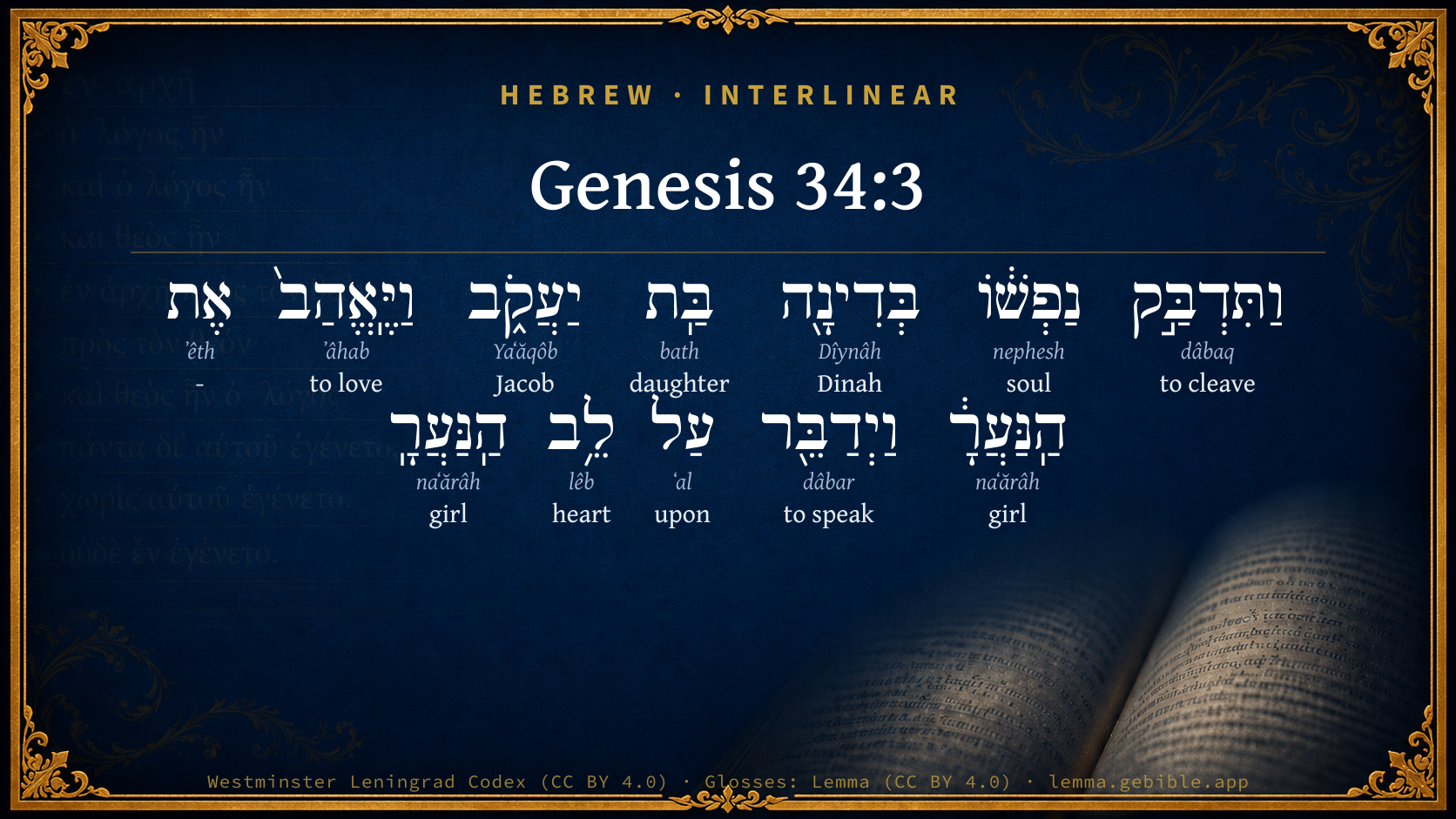
Hebrew (Westminster Leningrad Codex) Genesis 34:3 appears in the Hebrew Old Testament. The text above is from the Westminster Leningrad Codex. Each word links to its Strong’s number, a concise gloss, and parsing drawn from the Open Scriptures Hebrew Bible morphology. Click any word for its full Brown-Driver-Briggs (BDB) entry.
Download image
Cite this verse

Genesis 34:3 (World English Bible). Public Domain. Lemma interlinear Bible study tool, https://lemma.gebible.app/v/genesis/34/3.

Show BibTeX & RIS
BibTeX
RIS
English Translation
His soul joined to Dinah, the daughter of Jacob, and he loved the young lady, and spoke kindly to the young lady.
World English Bible · Public Domain
Download a study sheet

One document with this verse’s original text, its word-by-word gloss line, the meaning frame, cross-references with their text, attributed commentary, and full source and license credits — printable, and it pastes into notes with its structure intact.

This verse Autodidact and up

Study sheet (.html) Plain text (.txt)

A passage Seminary Student

Up to 50 verses in one chapter. A passage sheet keeps up to 6 commentary sources and 12 cross-references per verse, in the order this page ranks them, and says so on the sheet whenever that leaves anything out. Ask for a single verse and you get the Autodidact verse sheet above.

Everything on this page stays free to read, with no account — the sheet is a download of what is already on screen, not access to it.

Want to remove ads? Support Godless Engineer
Compare translations 3

The same verse in 3 English versions, stacked beneath the original-language interlinear above. Click any original word for its lexicon entry.

Each is an independent rendering of the whole verse — the interlinear is not word-aligned to these translations.

Highlighted words mark where these versions differ — a whole-verse word diff, not a word-by-word alignment.

  • World English Bible Public Domain
    His soul joined to Dinah, the daughter of Jacob, and he loved the young lady, and spoke kindly to the young lady.
  • King James Version Public Domain
    And his soul clave unto Dinah the daughter of Jacob, and he loved the damsel, and spake kindly unto the damsel.
  • unfoldingWord Literal Text CC BY-SA 4.0
    And his soul was attached to Dinah the daughter of Jacob, and he loved the young woman and spoke to the heart of the young woman.

unfoldingWord Literal Text — © unfoldingWord, licensed CC BY-SA 4.0. Word-aligned USFM3 via Door43 (git.door43.org/unfoldingWord/en_ult).

Versions to compare (up to 4)

3 of 4 selected

Show all 18 translations

Every available English version of this verse, each an independent rendering of the whole verse.

  • World English Bible Public Domain
    His soul joined to Dinah, the daughter of Jacob, and he loved the young lady, and spoke kindly to the young lady.
  • Berean Standard Bible Public Domain
    And his soul was drawn to Dinah, the daughter of Jacob. He loved the young girl and spoke to her tenderly.
  • Majority Standard Bible Public Domain
    And his soul was drawn to Dinah, the daughter of Jacob. He loved the young girl and spoke to her tenderly.
  • King James Version Public Domain
    And his soul clave unto Dinah the daughter of Jacob, and he loved the damsel, and spake kindly unto the damsel.
  • American Standard Version (1901) Public Domain
    And his soul clave unto Dinah the daughter of Jacob, and he loved the damsel, and spake kindly unto the damsel.
  • Revised Version (1885) Public Domain
    And his soul clave unto Dinah the daughter of Jacob, and he loved the damsel, and spake kindly unto the damsel.
  • Geneva Bible (1599) Public Domain
    So his heart claue vnto Dinah the daughter of Iaakob: and he loued the maide, and spake kindely vnto the maide.
  • Douay-Rheims (1899) Public Domain
    And his soul was fast knit unto her, and whereas she was sad, he comforted her with sweet words.
  • Young's Literal Translation Public Domain
    and his soul cleaveth to Dinah, daughter of Jacob, and he loveth the young person, and speaketh unto the heart of the young person.
  • Literal Standard Version CC BY-SA 4.0
    and his soul cleaves to Dinah, daughter of Jacob, and he loves the young person, and speaks to the heart of the young person.
  • Unlocked Literal Bible CC BY-SA 4.0
    He was drawn to Dinah, the daughter of Jacob. He loved the young woman and spoke tenderly to her.
  • unfoldingWord Literal Text CC BY-SA 4.0
    And his soul was attached to Dinah the daughter of Jacob, and he loved the young woman and spoke to the heart of the young woman.
  • Darby Bible Public Domain
    And his soul fastened on Dinah the daughter of Jacob, and he loved the maiden, and spoke consolingly to the maiden.
  • World Messianic Bible Public Domain
    His soul joined to Dinah, the daughter of Jacob, and he loved the young lady, and spoke kindly to the young lady.
  • Webster's Bible Public Domain
    And his soul cleaved to Dinah the daughter of Jacob, and he loved the damsel, and spoke kindly to the damsel.
  • Free Bible Version CC BY-SA 4.0
    However, then he fell deeply in love with Dinah and tried to get her to love him too.
  • Bible in Basic English Public Domain
    Then his heart went out in love to Dinah, the daughter of Jacob, and he said comforting words to her.
  • JPS Tanakh (1917) Public Domain
    And his soul did cleave unto Dinah the daughter of Jacob, and he loved the damsel, and spoke comfortingly unto the damsel.

Literal Standard Version (2020), Covenant Press — licensed CC BY-SA 4.0. Text via the HelloAO Bible API (eBible.org). Unlocked Literal Bible (unfoldingWord) — licensed CC BY-SA 4.0. Text via the HelloAO Bible API (eBible.org). unfoldingWord Literal Text — © unfoldingWord, licensed CC BY-SA 4.0. Word-aligned USFM3 via Door43 (git.door43.org/unfoldingWord/en_ult). Free Bible Version, Dr. Jonathan Gallagher — licensed CC BY-SA 4.0. Text via the HelloAO Bible API (eBible.org).

Word by word

More ways to search: Search by grammar → Find every occurrence → Compare this word →

Practice this passage: Drill this verse → Learn its vocabulary →

בְּדִינָ֖ה
Dîynâh
H1783
“in/at · Dinah”
Preposition + Noun, Proper
Part of Speech
Preposition + Noun
Type
Proper
Full BDB Definition

Origin: from H1779

TWOT: None

Dinah = "judgment" - daughter of Jacob by Leah, full sister of Simeon and Levi
  1. וַתִּדְבַּ֣ק dâbaq H1692 “and · to cleave” Conjunction + Verb, Qal, Sequential Imperfect, 3rd Person, Feminine, Singular
  2. נַפְשׁ֔וֹ nephesh H5315 “soul · his” Noun, Common, Both, Singular, Construct + Suffix, Personal, 3rd Person, Masculine, Singular
  3. בַּֽת bath H1323 “daughter of” Noun, Common, Feminine, Singular, Construct
  4. יַעֲקֹ֑ב Yaʻăqôb H3290 “Jacob” Noun, Proper
  5. וַיֶּֽאֱהַב֙ ʼâhab H157 “and · to love” Conjunction + Verb, Qal, Sequential Imperfect, 3rd Person, Masculine, Singular
  6. אֶת ʼêth H853 “-” Particle, Direct Object
  7. הַֽנַּעֲרָ֔ naʻărâh H5291 “the · girl” Particle, Definite Article + Noun, Common, Feminine, Singular, Absolute
  8. וַיְדַבֵּ֖ר dâbar H1696 “and · to speak” Conjunction + Verb, Piel, Sequential Imperfect, 3rd Person, Masculine, Singular
  9. עַל ʻal H5921 “upon” Preposition
  10. לֵ֥ב lêb H3820 “heart of” Noun, Common, Masculine, Singular, Construct
  11. הַֽנַּעֲרָֽ naʻărâh H5291 “the · girl” Particle, Definite Article + Noun, Common, Feminine, Singular, Absolute

About this verse

These counts appear in no published source. They are computed here, from the morphology-tagged text and Lemma’s own curated glosses. What Lemma adds →

12
words
11
distinct lemmas
Pentateuch
section

Notable vocabulary

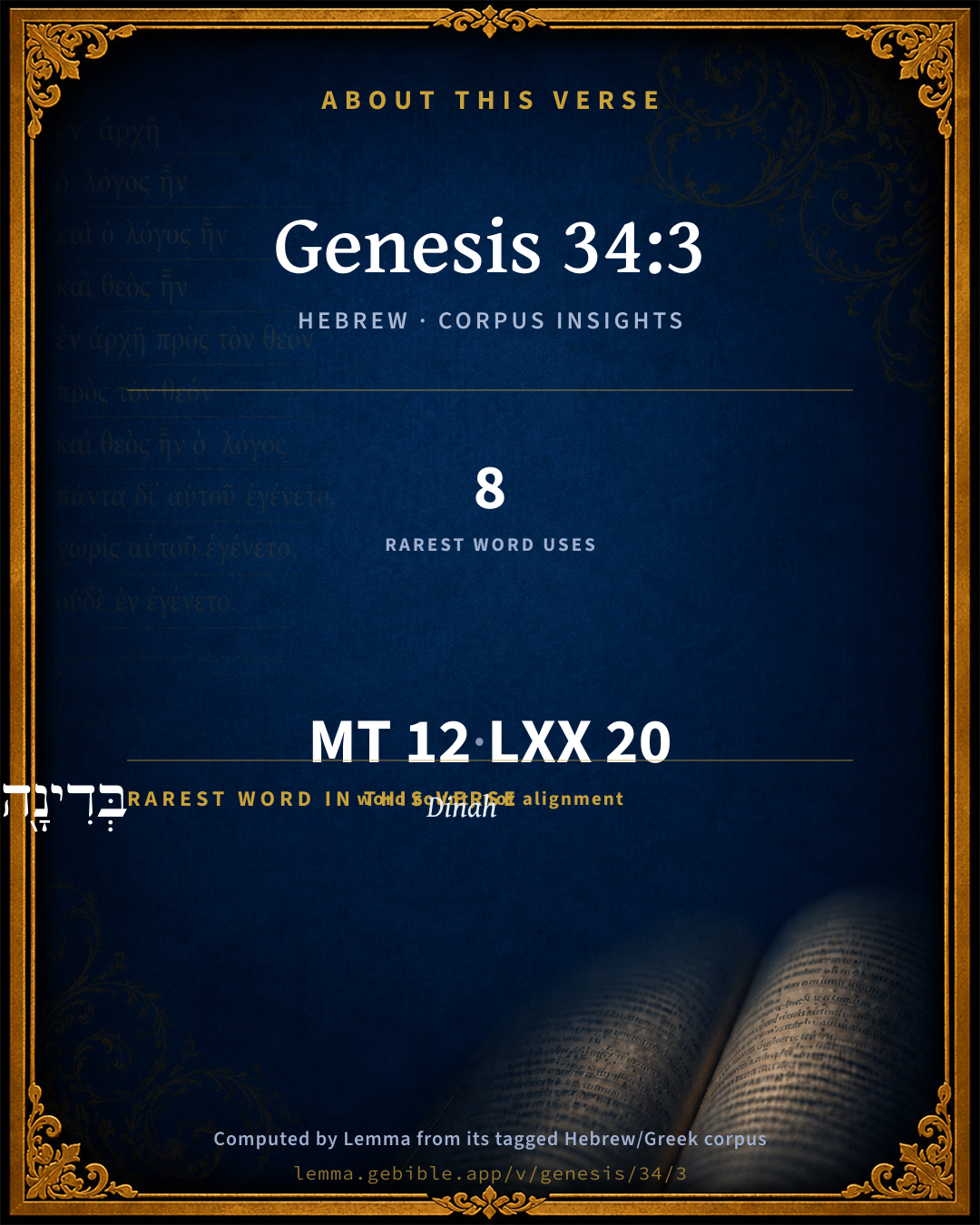
The rarest word here is בְּדִינָ֖ה Dinah H1783 — appearing just 8 times in the whole Hebrew Bible.

Shared distinctive vocabulary

בְּדִינָ֖ה Dinah H1783 occurs in 8 verses of the Hebrew Bible. Also found in:

Grammatical profile

  • 3 verbs
  • 7 nouns
  • 1 preposition
  • 1 particle

Verb forms

  • וַתִּדְבַּ֣ק Qal · Sequential Imperfect
  • וַיֶּֽאֱהַב֙ Qal · Sequential Imperfect
  • וַיְדַבֵּ֖ר Piel · Sequential Imperfect

Repetition

A word recurs within this verse — often emphatic in Hebrew:

  • הַֽנַּעֲרָ֔ girl H5291 ×2

Hebrew & Septuagint length

In English translation the verse runs 22 words from the Hebrew and 25 from the Septuagint (LXX English) — closely comparable.

A rough comparison of the two English renderings, which tokenize alike — not a word-level alignment.

Word counts can differ between the Hebrew and the Greek without any difference in meaning — e.g. the Hebrew direct-object marker אֵת has no separate Greek word, and Greek often adds the article ὁ.

In the original languages it is 12 Hebrew tokens and 20 Greek tokens — but the two are counted differently (Hebrew bundles its prefixes and suffixes into one token; the Greek is in lemma form), so that isn’t a like-for-like length.

Cross-references

6

Topical passages linked to Genesis 34:3 in the Treasury of Scripture Knowledge — connected by theme and wording, ordered by reader-vote popularity; previews shown in the World English Bible.

  • Isaiah 40:2 Speak comfortably to Jerusalem; and cry to her, that her warfare is accomplished, that her iniquity is pardoned, that she has received of Yahweh's hand double for all her sins.
  • Hosea 2:14 "Therefore, behold, I will allure her, And bring her into the wilderness, And speak tenderly to her.
  • Ruth 1:14 They lifted up their voice, and wept again: and Orpah kissed her mother-in-law, but Ruth joined with her.
  • 1 Samuel 18:1 It happened, when he had made an end of speaking to Saul, that the soul of Jonathan was knit with the soul of David, and Jonathan loved him as his own soul.
  • 2 Samuel 19:7 Now therefore arise, go forth, and speak comfortably to your servants; for I swear by Yahweh, if you don't go forth, there will not stay a man with you this night: and that will be worse to you than all the evil that has happened to you from your youth until now.
  • 2 Chronicles 30:22 Hezekiah spoke comfortably to all the Levites who had good understanding [in the service] of Yahweh. So they ate throughout the feast for the seven days, offering sacrifices of peace-offerings, and making confession to Yahweh, the God of their fathers.

Cross-references courtesy of OpenBible.info (CC BY 4.0).

Hebrew and Greek witnesses Masoretic Hebrew ↔ Greek Septuagint

The same verse in the two great witnesses to the Old Testament, shown verse-for-verse.

These are two independent witnesses, not word-aligned to each other, and the Septuagint is shown in lemma (dictionary) form.

Hebrew Genesis 34:3 Masoretic · Westminster Leningrad Codex

וַתִּדְבַּ֣ק נַפְשׁ֔וֹ בְּדִינָ֖ה בַּֽת יַעֲקֹ֑ב וַיֶּֽאֱהַב֙ אֶת הַֽנַּעֲרָ֔ וַיְדַבֵּ֖ר עַל לֵ֥ב הַֽנַּעֲרָֽ

His soul joined to Dinah, the daughter of Jacob, and he loved the young lady, and spoke kindly to the young lady.

World English Bible · Public Domain

Greek LXX Genesis 34:3 Septuagint · lemma form

καί προςἔχω ὁ ψυχή δινα ὁ θυγάτηρ ἰακώβ καί ἀγαπάω ὁ παρθένος καί λαλέω κατά ὁ διάνοια ὁ παρθένος αὐτός

And he was attached to the soul of Dina the daughter of Jacob, and he loved the damsel, and he spoke kindly to the damsel.

LXX2012 (modern English Septuagint) · Public Domain

On this verse, The Pulpit Commentary discusses the Septuagint’s reading. Read the note in Commentary ↓

Hebrew: Westminster Leningrad Codex (CC BY 4.0). Greek: Septuagint (public domain); English from LXX2012 (modern English Septuagint) (Public Domain). How the Septuagint differs from the Hebrew →

Targum (Aramaic paraphrase)

2

The Targum is the ancient Jewish Aramaic paraphrase of the Hebrew Scriptures — an interpretive translation, not the Hebrew text itself. Onkelos (literal) and Pseudo-Jonathan (expansive) render the Torah, and Jonathan the Prophets. Coverage is partial: where no permissively-licensed English translation exists for a verse, only the Aramaic is shown. This is verse-level text, not a word-by-word alignment to the Hebrew.

  1. Targum Onkelos Torah (Genesis–Deuteronomy)
    וְאִתְרְעִיאַת נַפְשֵׁהּ בְּדִינָה בַּת יַעֲקֹב וּרְחֵים יָת עוּלֶמְתָּא וּמַלִּיל עַל לִבָּא דְעוּלֶמְתָּא

    (no public-domain English translation for this verse)

    Targum Onkelos — Aramaic: “Onkelos Genesis” (public domain); “Onkelos Exodus” (public domain); “Onkelos Leviticus” (public domain); “Onkelos Numbers” (public domain); “Onkelos Deuteronomy” (public domain). English: “Sefaria Community Translation” (CC0 1.0 (public-domain dedication)); “J.W. Etheridge. The Targums of Onkelos and Jonathan Ben Uzziel on the Pentateuch. London: Longmans, Green, 1862” (public domain). Text via Sefaria.

  2. Targum Pseudo-Jonathan Torah (Genesis–Deuteronomy)
    וְאִתְרְעִיַית נַפְשֵׁיהּ בְּדִינָה בְּרַת יַעֲקב וּרְחַם יַת רִיבָא וּמַלֵיל פִּיוּסִין עַל לִבָּא דְרִיבָא

    And his soul delighted in Dinah the daughter of Jakob; and he loved the girl, and spake kindly to the heart of the girl.

    Targum Pseudo-Jonathan — Aramaic: “Targum Jonathan on Genesis” (public domain); “Targum Jonathan on Exodus” (public domain); “Targum Jonathan on Leviticus” (public domain); “Targum Jonathan on Numbers” (public domain); “Targum Jonathan on Deuteronomy” (public domain). English: “The Targum of Jonathan ben Uzziel, trans. J. W. Etheridge, London, 1862” (public domain). Text via Sefaria.

Commentary

Notes on Genesis 34:3 from classic Christian and Jewish commentators (each source and its license shown beneath its notes). The classic Christian expositions comment on the surrounding passage and are grouped to its opening verse, so a note may address several verses; the Jewish commentaries on the Tanakh (Rashi and others) are per-verse, so they appear only where the commentator wrote on this verse.

Lemma curates 59 commentaries, every one of them public domain or Creative Commons licensed, each selected and text-cleaned for this edition rather than reprinted as found. About our sources →

Trapp's Complete Commentary

John Trapp

Gen 34:3 And his soul clave unto Dinah the daughter of Jacob, and he loved the damsel, and spake kindly unto the damsel.

Ver. 3. And his soul clave unto Dinah.] He kicked her not out of doors, as Amnon did Tamar, far sweeter to him in the ambition, than in the fruition; but to make amends, as they call it, by marriage, he seeks to go by the old rule in that case, Et doter, et ducat. Howbeit, marriage, God’s ordinance, is not to be entered into through the devil’s portal.

John Trapp, A Commentary or Exposition upon All the Books of the Old and New Testament (1647–1656) — public domain. Text from a community e-Sword module.

Joseph Benson's Commentary

Gen 34:3. He spake kindly unto the damsel — Desiring not only to comfort her after the ignominy he had brought upon her, but to conciliate her mind, and get her consent to marry him, that he might thereby repair, as far as possible, the injury he had done her. So that, though his behaviour had been very sinful in the first action; yet in the sequel it was honest and noble, and such as may fill with confusion of face too many who, with the utmost baseness, act a very different part.

Joseph Benson's Commentary on the Old and New Testaments (1811–1818) — public domain. Text from a community e-Sword module.

Tyndale Open Study Notes

Tyndale Open Resources

34:3-4 While Shechem’s intense feelings for Dinah made him willing to undergo significant hardship (34:11-12, 17-18, 24), the way he showed his “love” for her was selfish, impetuous, and in violation of customary decency (cp. Judg 14:2; see 1 Cor 13:4-7; 1 Jn 4:10). His character illustrated why Israel needed to remain separate from the Canaanites.

Tyndale Open Study Notes — © Tyndale Open Resources, licensed CC BY-SA 4.0. Text via the HelloAO Bible API.

Geneva Bible (1599)

Geneva Bible translators

Hebrew, spake to the heart of the maid.

Geneva Bible (1599) marginal notes — public domain. Text via Bolls.life.

Adam Clarke's Commentary

Verse 3. Spake kindly unto the damsel.] Literally, he spake to the heart of the damsel - endeavoured to gain her affections, and to reconcile her to her disgrace. It appears sufficiently evident from this and the preceding verse that there had been no consent on the part of Dinah, that the whole was an act of violence, and that she was now detained by force in the house of Shechem. Here she was found when Simeon and Levi sacked the city, Ge 34:26.

Adam Clarke's Commentary on the Bible (1810–1826) — public domain. Text from a community e-Sword/MySword module.

John Calvin's Commentaries

3. And his soul clave unto Dinah. Moses intimates that she was not so forcibly violated, that Shechem having once abused her, treated her with contempt, as is usual with harlots; for he loved her as a wife; and did not even object to be circumcised that he might have her; but the fervor of lust had so prevailed, that he first subjected her to disgrace. And therefore although he embraced Dinah with real and sincere attachment, yet, in this want of self-government, he grievously sinned. Shechem “spoke to the heart” of the maid, that is, he addressed her courteously, to allure her to himself by his bland speeches: whence it follows, that when she was unwilling and resisted, he used violence towards her.

John Calvin's Commentaries (1540-1563) — public domain. Text from the Calvin Translation Society English edition (1840s-50s) via the Christian Classics Ethereal Library (ccel.org). Calvin's coverage is partial (roughly two-thirds of the Bible); uncommented books and verses are honest gaps, never fabricated. The 19th-century editor's footnotes and remarks are omitted so the notes are faithfully Calvin's own voice.

The Cambridge Bible for Schools and Colleges

gen. ed. J. J. S. Perowne

3. his soul] i.e. his affections. Heb. nephesh. Cf. Gen_12:13, Gen_27:4.

kindly, &c.] Heb. to the heart of the damsel. The same phrase, sometimes rendered “comfortably,” occurs in Gen_50:21; 2Sa_19:7; Isa_40:2; Hos_2:14.

The Cambridge Bible for Schools and Colleges (gen. ed. J. J. S. Perowne; Cambridge University Press, 1878–1918) — public domain. Text from a community e-Sword module.

John Gill's Exposition

And his soul clave unto Dinah the daughter of Jacob,.... His inclination was to her, she was always in his thoughts; it was not a mere lustful desire that was suddenly raised, and soon over, but a constant and continued affection he bore to her, as follows:

and he loved the damsel; sincerely and heartily:

and spake kindly unto the damsel; or "to the heart" (g) of her, such things as tended to comfort her, she being sad and sorrowful; or to soften her mind towards him, and take off the resentment of it to him, because of the injury he had done her, and to gain her good will and affection, and her consent to marry him; professing great love to her, promising her great things, what worldly grandeur and honour she would be advanced to, and how kindly he would behave towards her; which might take with her, and incline her to yield to his motion, which having obtained, he took the following method.

(g) "ad cor", Pagninus, Vatablus, Drusius, Schmidt; super cor, Montanus, Munster; "cordi", Junius & Tremellius, Piscator.

John Gill's Exposition of the Whole Bible (1746–1763) — public domain (CC PDM 1.0). Text via the HelloAO Bible API.

Matthew Poole's English Annotations

Perceiving her to be exceedingly enraged and perplexed at this horrid violence, he endeavours to appease and sweeten her, and to get her consent to marry him.

Matthew Poole's English Annotations on the Holy Bible (1683–1685) — public domain. Text from a community e-Sword/MySword module.

Whedon's Commentary on the Bible

Daniel D. Whedon

3. Spake kindly — Hebrews, spoke to the heart of the girl. He won her by tender words. She appears not to have been an unwilling party to the sin. “A gadding girl,” says Schroder, “and a lad who has never gone beyond the precincts of home, are good for nothing.”

Daniel D. Whedon (gen. ed.), Commentary on the Old and New Testaments (1874–1909) — public domain. Text from a community e-Sword module.

The Pulpit Commentary

Vers. 3, 4. And his soul clave (vide infra on ver. 8) unto Dinah the daughter of Jacob, it was in some degree an extenuation of the wickedness of Shechem that he did not cast off the victim of his violence and lust, but continued to regard her with affectionand he loved the damsel, on the use of naar for a youth of either sex vide Gen_24:14and spake kindly unto the damsel literally, spoke to the heart of the damsel, ejlalhse kata thnoian thv parqinou aujth (LXX), i.e. addressed to her such words as were agreeable to her inclinations (cf. on the import of the phrase Gen_1:21; Jud_1:19:3; Isa_40:2; Hos_2:14) probably expressing his affection, and offering the reparation of honorable marriage, as may be legitimately inferred from what is next recorded of his behavior. And Shechem spake unto his father Hamor, saying, Get me this damsel to wife cf. the ease of Samson. (Jud_1:14:2)

The Pulpit Commentary (1880–1919), ed. H.D.M. Spence-Jones & Joseph S. Exell — public domain. Text from a community e-Sword module.

Keil & Delitzsch

C. F. Keil & F. Delitzsch

Shechem "loved the girl, and spoke to her heart;" i.e., he sought to comfort her by the promise of a happy marriage, and asked his father to obtain her for him as a wife.

Keil & Delitzsch — Biblical Commentary on the Old Testament (1861–1891) — public domain (CC PDM 1.0). Text via the HelloAO Bible API. (Old Testament only.)

Rashi

Rabbi Shlomo Yitzchaki (Rashi)

על לב הנערה [AND SPAKE] LOVINGLY TO THE DAMSEL (literally, he spoke to the heart of the maiden) words that would appeal to her heart: See how much money your father has lavished for a small plot of field. I will marry you and you will then possess the city and all its fields (Genesis Rabbah 80:7).

Rashi on the Tanakh — English translations: “The Judaica Press complete Tanach with Rashi, translated by A. J. Rosenberg” (CC BY 4.0); “Pentateuch with Rashi's commentary by M. Rosenbaum and A.M. Silbermann, 1929-1934” (public domain); “The Metsudah Tanach series, Lakewood, N.J” (CC BY 4.0); and “The Book of Joshua, Metsudah Publications, 1997” (CC BY 4.0). Text via Sefaria.

Radak

Rabbi David Kimhi (Radak)

ותדבק נפשו בדינה בת יעקב, his soul felt a strong attachment to her on account of her beauty as well as on account of the fact that she was the daughter of an outstanding personality, Yaakov.

וידבר על לב הנערה, seeing that he had caused her pain, he now did his best to soothe her feelings as he was intent of marrying her and needed her consent. He hoped that his being the crown prince would help sway her opinion in his favour.

Radak on the Tanakh — English translations: “Sefaria Community Translation” (CC0 1.0 (public-domain dedication)); “Eliyahu Munk, HaChut Hameshulash” (CC BY 4.0); “Rabbi Mike Feuer, Jerusalem Anthology” (CC BY 4.0); and “R. David Kimhi on the first book of Psalms, Translated by R.G. Finch, London, 1919” (public domain). Text via Sefaria.

Lesson kit

Teaching starters — assembled from the data on this page, not authored interpretation. Every prompt links to the verse data it draws on. Edit before teaching.

Genesis, in the Pentateuch, opens this verse with 12 words (11 distinct Hebrew lemmas). Its most distinctive word is Dîynâh (“Dinah”). A historical commentator’s framing appears above. Read the whole chapter for the surrounding context.

Discussion questions

  1. How does “Dinah” (Dîynâh) shape what this verse is saying?
  2. Genesis 30:21 shares the word «Dinah» with this verse. How do the two illuminate each other?
  3. “girl” occurs 2× in this one verse. What is the effect of the repetition?
  4. These translations render this verse differently. What is at stake in choosing one wording over another?
  5. The verb «וַתִּדְבַּ֣ק» is Qal Sequential Imperfect. How does its form color the action?
  6. Reading how Trapp's Complete Commentary and Joseph Benson's Commentary read this verse, where do the two commentators agree and where do they part?

Things to notice

Reading settings

Reading text

Shown beneath each verse's original-language words.

Old Testament
Old Testament edition

Read the OT as the Masoretic Hebrew (MT) or the Greek Septuagint (LXX).

English shown for the Greek Septuagint (in the Hebrew ↔ Greek comparison).

Comparing translations? Open the Compare panel on any verse page to stack up to four side by side.