Genesis 46:2

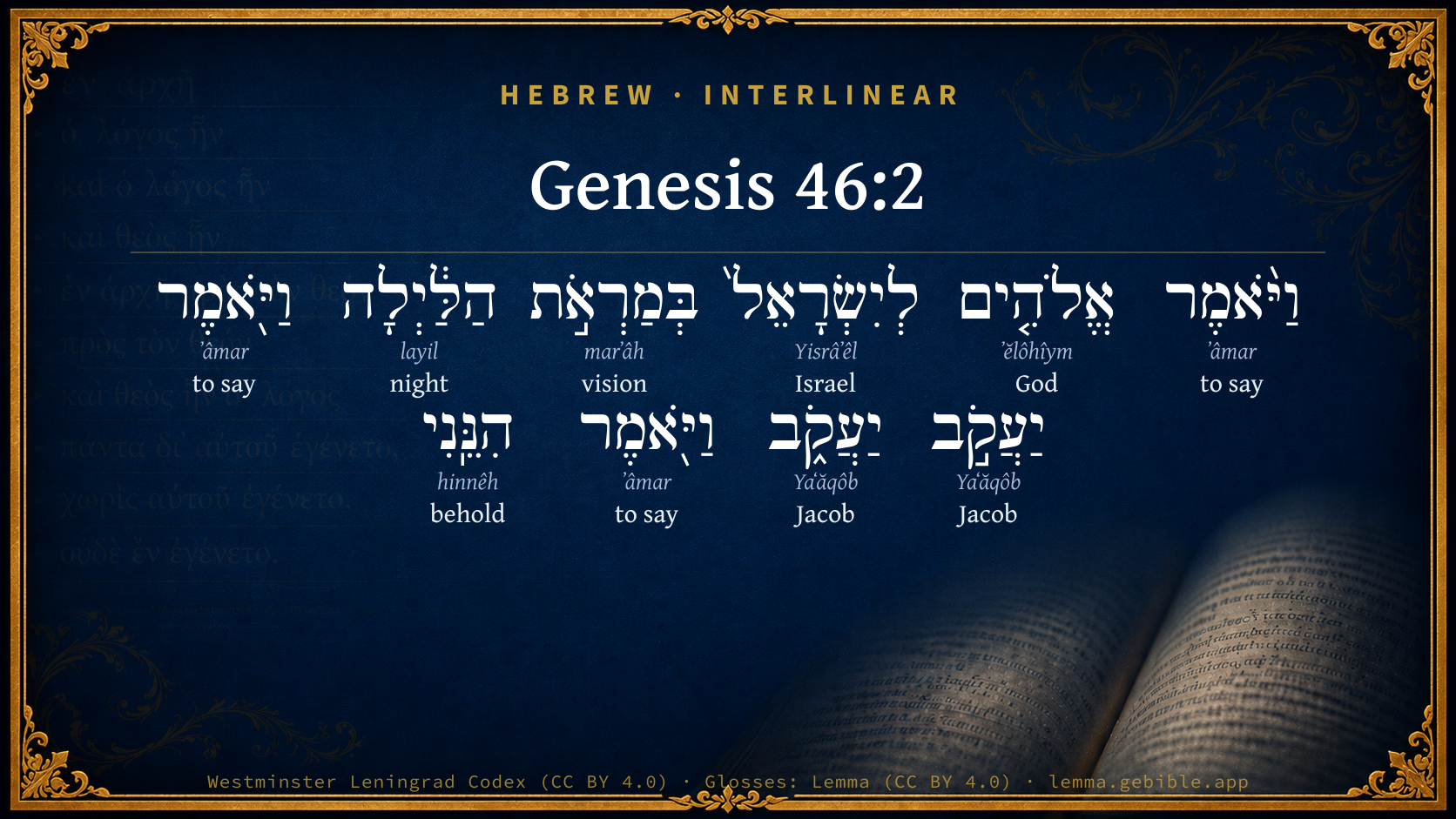
Hebrew (Westminster Leningrad Codex) Genesis 46:2 appears in the Hebrew Old Testament. The text above is from the Westminster Leningrad Codex. Each word links to its Strong’s number, a concise gloss, and parsing drawn from the Open Scriptures Hebrew Bible morphology. Click any word for its full Brown-Driver-Briggs (BDB) entry.
Download image
Cite this verse

Genesis 46:2 (World English Bible). Public Domain. Lemma interlinear Bible study tool, https://lemma.gebible.app/v/genesis/46/2.

Show BibTeX & RIS
BibTeX
RIS
English Translation
God spoke to Israel in the visions of the night, and said, "Jacob, Jacob!" He said, "Here I am."
World English Bible · Public Domain
Highlights
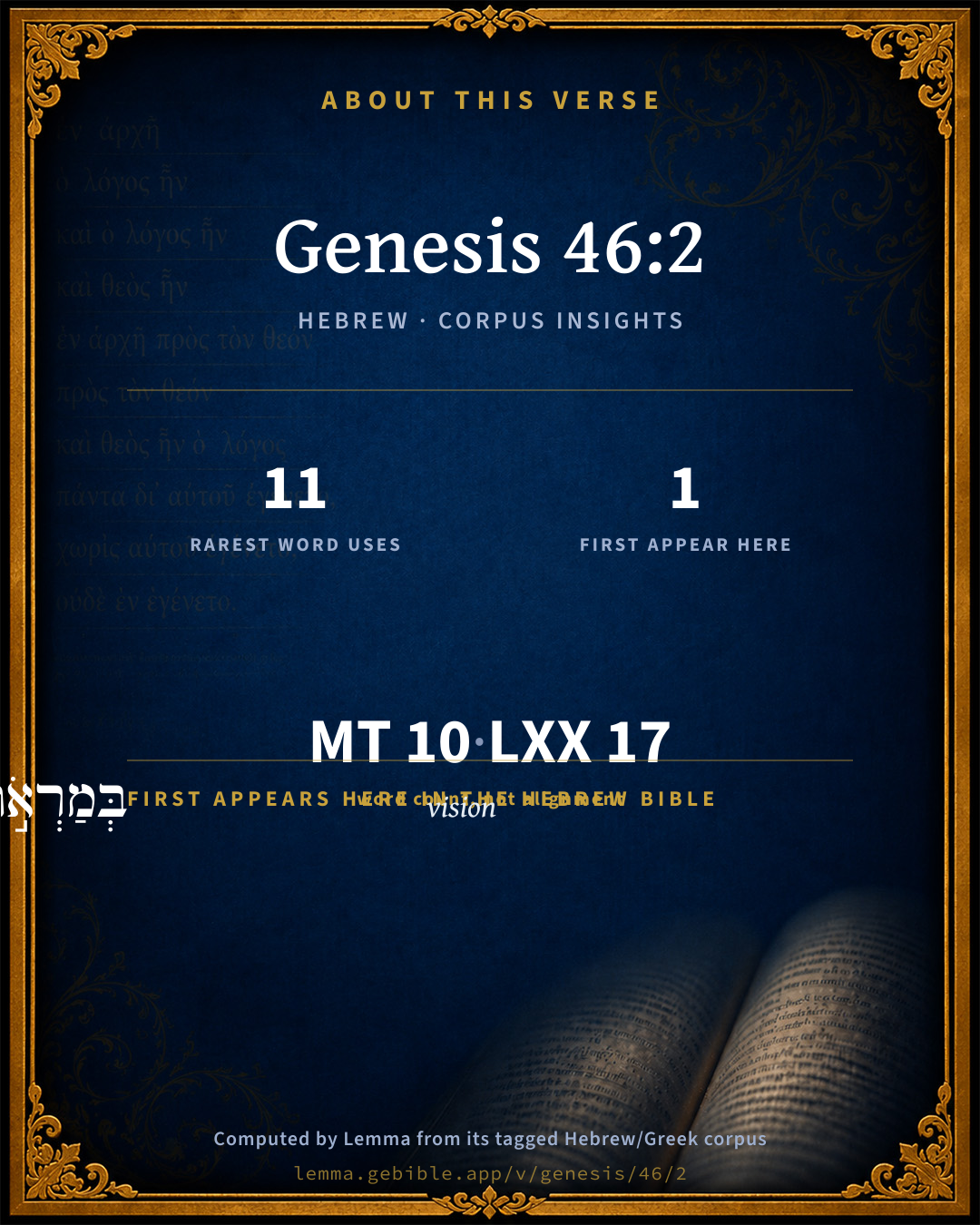
  • 1 first appearance in the Hebrew Bible
Full analysis ↓
Download a study sheet

One document with this verse’s original text, its word-by-word gloss line, the meaning frame, cross-references with their text, attributed commentary, and full source and license credits — printable, and it pastes into notes with its structure intact.

This verse Autodidact and up

Study sheet (.html) Plain text (.txt)

A passage Seminary Student

Up to 50 verses in one chapter. A passage sheet keeps up to 6 commentary sources and 12 cross-references per verse, in the order this page ranks them, and says so on the sheet whenever that leaves anything out. Ask for a single verse and you get the Autodidact verse sheet above.

Everything on this page stays free to read, with no account — the sheet is a download of what is already on screen, not access to it.

Want to remove ads? Support Godless Engineer
Compare translations 3

The same verse in 3 English versions, stacked beneath the original-language interlinear above. Click any original word for its lexicon entry.

Each is an independent rendering of the whole verse — the interlinear is not word-aligned to these translations.

Highlighted words mark where these versions differ — a whole-verse word diff, not a word-by-word alignment.

  • World English Bible Public Domain
    God spoke to Israel in the visions of the night, and said, "Jacob, Jacob!" He said, "Here I am."
  • King James Version Public Domain
    And God spake unto Israel in the visions of the night, and said, Jacob, Jacob. And he said, Here am I.
  • unfoldingWord Literal Text CC BY-SA 4.0
    And God spoke to Israel in visions of the night and said, “Jacob! Jacob!” And he said, “Behold me.”

unfoldingWord Literal Text — © unfoldingWord, licensed CC BY-SA 4.0. Word-aligned USFM3 via Door43 (git.door43.org/unfoldingWord/en_ult).

Versions to compare (up to 4)

3 of 4 selected

Show all 18 translations

Every available English version of this verse, each an independent rendering of the whole verse.

  • World English Bible Public Domain
    God spoke to Israel in the visions of the night, and said, "Jacob, Jacob!" He said, "Here I am."
  • Berean Standard Bible Public Domain
    And that night God spoke to Israel in a vision: “Jacob, Jacob!” He said. “Here I am,” replied Jacob.
  • Majority Standard Bible Public Domain
    And that night God spoke to Israel in a vision: “Jacob, Jacob!” He said. “Here I am,” replied Jacob.
  • King James Version Public Domain
    And God spake unto Israel in the visions of the night, and said, Jacob, Jacob. And he said, Here am I.
  • American Standard Version (1901) Public Domain
    And God spake unto Israel in the visions of the night, and said, Jacob, Jacob. And he said, Here am I.
  • Revised Version (1885) Public Domain
    And God spake unto Israel in the visions of the night, and said, Jacob, Jacob. And he said, Here am I.
  • Geneva Bible (1599) Public Domain
    And God spake vnto Israel in a vision by night, saying, Iaakob, Iaakob. Who answered, I am here.
  • Douay-Rheims (1899) Public Domain
    He heard him by a vision in the night calling him, and saying to him: Jacob, Jacob. And he answered him: Lo, here I am.
  • Young's Literal Translation Public Domain
    and God speaketh to Israel in visions of the night, and saith, `Jacob, Jacob;' and he saith, `Here `am' I.'
  • Literal Standard Version CC BY-SA 4.0
    and God speaks to Israel in visions of the night and says, “Jacob, Jacob”; and he says, “Here I [am].”
  • Unlocked Literal Bible CC BY-SA 4.0
    God spoke to Israel in a vision at night, saying, “Jacob, Jacob.” He said, “Here I am.”
  • unfoldingWord Literal Text CC BY-SA 4.0
    And God spoke to Israel in visions of the night and said, “Jacob! Jacob!” And he said, “Behold me.”
  • Darby Bible Public Domain
    And God spoke to Israel in the visions of the night and said, Jacob, Jacob! And he said, Here am I.
  • World Messianic Bible Public Domain
    God spoke to Israel in the visions of the night, and said, “Jacob, Jacob!” He said, “Here I am.”
  • Webster's Bible Public Domain
    And God spoke to Israel in the visions of the night, and said, Jacob, Jacob: and he said, Here am I.
  • Free Bible Version CC BY-SA 4.0
    During the night God spoke to Israel in a vision. “Jacob! Jacob!” he called. “I'm here,” he replied.
  • Bible in Basic English Public Domain
    And God said to Israel in a night-vision, Jacob, Jacob. And he said, Here am I.
  • JPS Tanakh (1917) Public Domain
    And God spoke unto Israel in the visions of the night, and said: 'Jacob, Jacob.' And he said: 'Here am I.'

Literal Standard Version (2020), Covenant Press — licensed CC BY-SA 4.0. Text via the HelloAO Bible API (eBible.org). Unlocked Literal Bible (unfoldingWord) — licensed CC BY-SA 4.0. Text via the HelloAO Bible API (eBible.org). unfoldingWord Literal Text — © unfoldingWord, licensed CC BY-SA 4.0. Word-aligned USFM3 via Door43 (git.door43.org/unfoldingWord/en_ult). Free Bible Version, Dr. Jonathan Gallagher — licensed CC BY-SA 4.0. Text via the HelloAO Bible API (eBible.org).

Word by word

More ways to search: Search by grammar → Find every occurrence → Compare this word →

Practice this passage: Drill this verse → Learn its vocabulary →

בְּמַרְאֹ֣ת
marʼâh
H4759
“in/at · visions of”
Preposition + Noun, Common, Feminine, Plural, Construct
Part of Speech
Preposition + Noun
Type
Common
Gender
Feminine
Number
Plural
State
Construct
Full BDB Definition

Origin: from H4758

TWOT: 2095g , 2095h

vision - mode of revelation - mirror
  1. וַיֹּ֨אמֶר ʼâmar H559 “and · to say” Conjunction + Verb, Qal, Sequential Imperfect, 3rd Person, Masculine, Singular
  2. אֱלֹהִ֤ים ʼĕlôhîym H430 “God(s)” Noun, Common, Masculine, Plural, Absolute
  3. לְיִשְׂרָאֵל֙ Yisrâʼêl H3478 “to/for · Israel” Preposition + Noun, Proper
  4. הַלַּ֔יְלָה layil H3915 “the · night” Particle, Definite Article + Noun, Common, Masculine, Singular, Absolute
  5. וַיֹּ֖אמֶר ʼâmar H559 “and · to say” Conjunction + Verb, Qal, Sequential Imperfect, 3rd Person, Masculine, Singular
  6. יַעֲקֹ֣ב Yaʻăqôb H3290 “Jacob” Noun, Proper
  7. יַעֲקֹ֑ב Yaʻăqôb H3290 “Jacob” Noun, Proper
  8. וַיֹּ֖אמֶר ʼâmar H559 “and · to say” Conjunction + Verb, Qal, Sequential Imperfect, 3rd Person, Masculine, Singular
  9. הִנֵּֽנִי hinnêh H2009 “behold · me” Particle, Demonstrative + Suffix, Personal, 1st Person, Common, Singular

About this verse

These counts appear in no published source. They are computed here, from the morphology-tagged text and Lemma’s own curated glosses. What Lemma adds →

10
words
7
distinct lemmas
Pentateuch
section

Notable vocabulary

The rarest word here is בְּמַרְאֹ֣ת vision H4759 — appearing just 11 times in the whole Hebrew Bible.

First appearance in Scripture

This word makes its first canonical appearance in the Hebrew Bible here:

  • בְּמַרְאֹ֣ת vision H4759

Shared distinctive vocabulary

בְּמַרְאֹ֣ת vision H4759 occurs in 10 verses of the Hebrew Bible. Also found in:

Grammatical profile

  • 3 verbs
  • 6 nouns
  • 1 particle

Verb forms

  • וַיֹּ֨אמֶר Qal · Sequential Imperfect
  • וַיֹּ֖אמֶר Qal · Sequential Imperfect
  • וַיֹּ֖אמֶר Qal · Sequential Imperfect

Repetition

Words recur within this verse — often emphatic in Hebrew:

  • וַיֹּ֨אמֶר to say H559 ×3
  • יַעֲקֹ֣ב Jacob H3290 ×2

Hebrew & Septuagint length

In English translation the verse runs 19 words from the Hebrew and 18 from the Septuagint (LXX English) — closely comparable.

A rough comparison of the two English renderings, which tokenize alike — not a word-level alignment.

Word counts can differ between the Hebrew and the Greek without any difference in meaning — e.g. the Hebrew direct-object marker אֵת has no separate Greek word, and Greek often adds the article ὁ.

In the original languages it is 10 Hebrew tokens and 17 Greek tokens — but the two are counted differently (Hebrew bundles its prefixes and suffixes into one token; the Greek is in lemma form), so that isn’t a like-for-like length.

Cross-references

19

Topical passages linked to Genesis 46:2 in the Treasury of Scripture Knowledge — connected by theme and wording, ordered by reader-vote popularity; previews shown in the World English Bible.

  • Genesis 15:1 After these things the word of Yahweh came to Abram in a vision, saying, "Don't be afraid, Abram. I am your shield, your exceedingly great reward."
  • Job 33:14–15 For God speaks once, Yes twice, though man pays no attention.
  • Genesis 15:13 He said to Abram, "Know for sure that your seed will live as foreigners in a land that is not theirs, and will serve them. They will afflict them four hundred years.
  • Genesis 22:1 It happened after these things, that God tested Abraham, and said to him, "Abraham!" He said, "Here I am."
  • Genesis 22:11 The angel of Yahweh called to him out of the sky, and said, "Abraham, Abraham!" He said, "Here I am."
  • Genesis 31:11 The angel of God said to me in the dream, 'Jacob,' and I said, 'Here I am.'
  • Exodus 3:3–4 Moses said, I will turn aside now, and see this great sight, why the bush is not burnt.
  • Numbers 12:6 He said, Hear now my words: if there be a prophet among you, I Yahweh will make myself known to him in a vision, I will speak with him in a dream.
  • Numbers 24:4 He says, who hears the words of God, Who sees the vision of the Almighty, Falling down, and having his eyes open:
  • 1 Samuel 3:4 that Yahweh called Samuel; and he said, Here am I.
  • 1 Samuel 3:10 Yahweh came, and stood, and called as at other times, Samuel, Samuel. Then Samuel said, Speak; for your servant hears.
  • 2 Chronicles 26:5 He set himself to seek God in the days of Zechariah, who had understanding in the vision of God: and as long as he sought Yahweh, God made him to prosper.
  • Job 4:13 In thoughts from the visions of the night, When deep sleep falls on men,
  • Daniel 2:19 Then was the secret revealed to Daniel in a vision of the night. Then Daniel blessed the God of heaven.
  • Acts 9:4 He fell on the earth, and heard a voice saying to him, "Saul, Saul, why do you persecute me?"
  • Acts 9:10 Now there was a certain disciple at Damascus named Ananias. The Lord said to him in a vision, "Ananias!" He said, "Behold, it's me, Lord."
  • Acts 10:3 At about the ninth hour of the day, he clearly saw in a vision an angel of God coming to him, and saying to him, "Cornelius!"
  • Acts 16:9 A vision appeared to Paul in the night. There was a man of Macedonia standing, begging him, and saying, "Come over into Macedonia and help us."
  • Acts 10:13 A voice came to him, "Rise, Peter, kill and eat!"

Cross-references courtesy of OpenBible.info (CC BY 4.0).

Hebrew and Greek witnesses Masoretic Hebrew ↔ Greek Septuagint

The same verse in the two great witnesses to the Old Testament, shown verse-for-verse.

These are two independent witnesses, not word-aligned to each other, and the Septuagint is shown in lemma (dictionary) form.

Hebrew Genesis 46:2 Masoretic · Westminster Leningrad Codex

וַיֹּ֨אמֶר אֱלֹהִ֤ים לְיִשְׂרָאֵל֙ בְּמַרְאֹ֣ת הַלַּ֔יְלָה וַיֹּ֖אמֶר יַעֲקֹ֣ב יַעֲקֹ֑ב וַיֹּ֖אמֶר הִנֵּֽנִי

God spoke to Israel in the visions of the night, and said, "Jacob, Jacob!" He said, "Here I am."

World English Bible · Public Domain

Greek LXX Genesis 46:2 Septuagint · lemma form

εἶπον δέ ὁ θεός ἰσραήλ ἐν ὅραμα ὁ νύξ εἶπον ἰακώβ ἰακώβ ὁ δέ εἶπον τίς εἰμί

And God spoke to Israel in a night vision, saying, Jacob, Jacob; and he said, What is it?

LXX2012 (modern English Septuagint) · Public Domain

Hebrew: Westminster Leningrad Codex (CC BY 4.0). Greek: Septuagint (public domain); English from LXX2012 (modern English Septuagint) (Public Domain). How the Septuagint differs from the Hebrew →

Targum (Aramaic paraphrase)

2

The Targum is the ancient Jewish Aramaic paraphrase of the Hebrew Scriptures — an interpretive translation, not the Hebrew text itself. Onkelos (literal) and Pseudo-Jonathan (expansive) render the Torah, and Jonathan the Prophets. Coverage is partial: where no permissively-licensed English translation exists for a verse, only the Aramaic is shown. This is verse-level text, not a word-by-word alignment to the Hebrew.

  1. Targum Onkelos Torah (Genesis–Deuteronomy)
    וַאֲמַר יְיָ לְיִשְׂרָאֵל בְּחֶזְוֵי דְלֵילְיָא וַאֲמַר יַעֲקֹב יַעֲקֹב וַאֲמַר הָא אֲנָא

    (no public-domain English translation for this verse)

    Targum Onkelos — Aramaic: “Onkelos Genesis” (public domain); “Onkelos Exodus” (public domain); “Onkelos Leviticus” (public domain); “Onkelos Numbers” (public domain); “Onkelos Deuteronomy” (public domain). English: “Sefaria Community Translation” (CC0 1.0 (public-domain dedication)); “J.W. Etheridge. The Targums of Onkelos and Jonathan Ben Uzziel on the Pentateuch. London: Longmans, Green, 1862” (public domain). Text via Sefaria.

  2. Targum Pseudo-Jonathan Torah (Genesis–Deuteronomy)
    וַאֲמַר יְיָ לְיִשְרָאֵל בִּנְבוּאָה בְּלֵילְיָא וַאֲמַר יַעֲקב יַעֲקב וַאֲמַר הָא נָא

    And the Lord spake to Israel in a prophecy of the night, and said, Jakob! and he said, Behold me.

    Targum Pseudo-Jonathan — Aramaic: “Targum Jonathan on Genesis” (public domain); “Targum Jonathan on Exodus” (public domain); “Targum Jonathan on Leviticus” (public domain); “Targum Jonathan on Numbers” (public domain); “Targum Jonathan on Deuteronomy” (public domain). English: “The Targum of Jonathan ben Uzziel, trans. J. W. Etheridge, London, 1862” (public domain). Text via Sefaria.

Commentary

Notes on Genesis 46:2 from classic Christian and Jewish commentators (each source and its license shown beneath its notes). The classic Christian expositions comment on the surrounding passage and are grouped to its opening verse, so a note may address several verses; the Jewish commentaries on the Tanakh (Rashi and others) are per-verse, so they appear only where the commentator wrote on this verse.

Lemma curates 59 commentaries, every one of them public domain or Creative Commons licensed, each selected and text-cleaned for this edition rather than reprinted as found. About our sources →

Trapp's Complete Commentary

John Trapp

Gen 46:2 And God spake unto Israel in the visions of the night, and said, Jacob, Jacob. And he said, Here [am] I.

Ver. 2. Here am I.] Josephus tells us, {a} he said, Who is there? He seems never seriously to have read the Bible; but only in transcursu, et quasi aliud agens. Is not that then a proper excuse for the Church of Rome’s sacrilege, in robbing the common people of the Holy Scriptures, that she allows them to read Josephus, where they may find the history of the Old Testament more plainly and plentifully set forth than in the Bible! But Barclay, {b} that made this apology, was of the mind, belike, of Walter Mapes, sometime archdeacon of Oxford, who, relating the gross simony (traffic in sacred things) of the Pope, for confirming the election of Reginald, bastard son to Jocelin, bishop of Sarum into the see of Bath, concludes his narration thus: Sit tamen domina materque nostra Roma baculus in aqua fractus, et absit credere quae vidimus; { c} howbeit, far be it from us to believe our own eyes.

{a} Antiq., lib. i.

{b} Quod vero ad historiam Vet. Test. eam fuse et magis ex vulgi intellectu in Iosepho inveniunt. - Barcl. Paraen.

{c} Dr Sanderson.

John Trapp, A Commentary or Exposition upon All the Books of the Old and New Testament (1647–1656) — public domain. Text from a community e-Sword module.

Joseph Benson's Commentary

Gen 46:2. God spake unto Israel in the visions of the night — Probably the next night after he had offered his sacrifices. Those who desire to keep up communion with God, shall find that it never fails on his side. If we speak to him as we ought, he will not fail to speak to us.

Joseph Benson's Commentary on the Old and New Testaments (1811–1818) — public domain. Text from a community e-Sword module.

Tyndale Open Study Notes

Tyndale Open Resources

46:2-4 In a night vision, the Lord repeated his promise to go with Jacob and make his family into a great nation in Egypt. The same God who led the family into Egypt promised to bring them out of Egypt to live once again in the land of Canaan.

Tyndale Open Study Notes — © Tyndale Open Resources, licensed CC BY-SA 4.0. Text via the HelloAO Bible API.

Jamieson, Fausset & Brown

Robert Jamieson, A. R. Fausset & David Brown

God spake unto Israel--Here is a virtual renewal of the covenant and an assurance of its blessings. Moreover, here is an answer on the chief subject of Jacob's prayer and a removal of any doubt as to the course he was meditating. At first the prospect of paying a personal visit to Joseph had been viewed with unmingled joy. But, on calmer consideration, many difficulties appeared to lie in the way. He may have remembered the prophecy to Abraham that his posterity was to be afflicted in Egypt and also that his father had been expressly told not to go [Gen 15:13; Gen 26:2]; he may have feared the contamination of idolatry to his family and their forgetfulness of the land of promise. These doubts were removed by the answer of the oracle, and an assurance given him of great and increasing prosperity.

Jamieson, Fausset & Brown — Commentary Critical and Explanatory on the Whole Bible (1871) — public domain (CC PDM 1.0). Text via the HelloAO Bible API.

John Calvin's Commentaries

2. And God spake unto Israel. In this manner, God proves that the sacrifice of Jacob was acceptable to him, and again stretches out his hand to ratify anew his covenant. The vision by night availed for the purpose of giving greater dignity to the oracle. Jacob indeed, inasmuch as he was docile and ready to yield obedience to God, did not need to be impelled by force and terror; yet, because he was a man encompassed with flesh, it was profitable for him that he should be affected as with the glory of a present God, in order that the word might penetrate more effectually into his heart. It is, however, proper to recall to memory what I have said before, that the word was joined with it; because a silent vision would have profited little or nothing. We know that superstition eagerly snatches at mere spectres; by which means it presents God in a form of its own. But since no living image of God can exist without the word, whenever God has appeared to his servants, he has also spoken to them. Wherefore, in all outward signs, let us be ever attentive to his voice, if we would not be deluded by the wiles of Satan. But if those visions, in which the majesty of God shines, require to be animated by the word, then they who obtrude signs, invented at the will of men, upon the Church, exhibit nothing else than the empty pomps of a profane theater. Just as in the Papacy, those things which are called sacraments, are lifeless phantoms which draw away deluded souls from the true God. Let this mutual connection, then, be observed, that the vision which gives greater dignity to the word, precedes it; and that the word follows immediately, as if it were the soul of the vision. And there is no question that this was an appearance of the visible glory of God, which did not leave Jacob in suspense and hesitation; but which, by removing his doubt, firmly sustained him, so that he confidently embraced the oracle.

John Calvin's Commentaries (1540-1563) — public domain. Text from the Calvin Translation Society English edition (1840s-50s) via the Christian Classics Ethereal Library (ccel.org). Calvin's coverage is partial (roughly two-thirds of the Bible); uncommented books and verses are honest gaps, never fabricated. The 19th-century editor's footnotes and remarks are omitted so the notes are faithfully Calvin's own voice.

The Cambridge Bible for Schools and Colleges

gen. ed. J. J. S. Perowne

2. in the visions of the night] A generic plural for the phenomena of dreams. The versions give the sing. For the word, cf. Num_12:6; 1Sa_3:15; Dan_10:7-8. For revelations granted at night, cf. Gen_20:3, Gen_28:12 ff.

Jacob, Jacob] The sentence, as it stands, is striking: “God said to Israel, ‘Jacob, Jacob.’  ” The juxtaposition of the two names “Israel” and “Jacob” may indicate the fusion of the two narratives—J, which prefers “Israel,” and E, which prefers “Jacob.”

The Cambridge Bible for Schools and Colleges (gen. ed. J. J. S. Perowne; Cambridge University Press, 1878–1918) — public domain. Text from a community e-Sword module.

John Gill's Exposition

And God spake unto Israel in the visions of the night,.... He appeared to Jacob as he lay upon his bed in the night season, and with an articulate voice spoke to him as follows:

and said, Jacob, Jacob: not "Israel", the more honourable name he had given him, but Jacob, putting him in mind of his former low estate; and doubling this name, either out of love and affection to him, as Jarchi intimates; or rather in order to awake him, at least to stir up his attention to what he was about to say to him:

and he said, here am I; signifying his readiness to hearken to him in what he should say to him, and to obey him in whatsoever he should command him.

John Gill's Exposition of the Whole Bible (1746–1763) — public domain (CC PDM 1.0). Text via the HelloAO Bible API.

Matthew Poole's English Annotations

In the visions of the night, i.e. in that way or manner of visions which God affordeth to men by night, and in their sleep. See Gen 20:3; Job 33:15-16; Mat 1:20; 2:13,19; Act 16:9; 18:9, &c.

Jacob, Jacob; he doubles the name both in token of his friendship and familiarity with him, and to raise Jacob's attention. Compare Gen 22:11; 1Sa 3:10.

Matthew Poole's English Annotations on the Holy Bible (1683–1685) — public domain. Text from a community e-Sword/MySword module.

Whedon's Commentary on the Bible

Daniel D. Whedon

2. God spake unto Israel — “Jacob thought himself led by the hand of Providence, yet we may imagine him oppressed by sadness as he turns his back upon the land of promise — the land of his childhood and manhood, the land where were the graves of Abraham, and Isaac, and of his beloved Rachel — and sets his face towards the dreary desert. Is it thus that God is to make Canaan his inheritance? But in his trial God appears to him, as he did to Abraham in a similar crisis, (Gen_15:1,) and to Isaac, when the same doubt oppressed him, (Gen_25:24,) and the same cheering words come to Jacob that came to them.” — Newhall.

Daniel D. Whedon (gen. ed.), Commentary on the Old and New Testaments (1874–1909) — public domain. Text from a community e-Sword module.

The Pulpit Commentary

And God (Elohim) spake unto Israel in the visions of the night, and said, Jacob, Jacob the name Jacob being employed probably to remind Jacob of what he had been (Lawson, Bush, Wordsworth), and repeated ut magis attentus reddatur (Calvin). And he said, Here am I literally, behold me, (cf. Gen_22:1)

The Pulpit Commentary (1880–1919), ed. H.D.M. Spence-Jones & Joseph S. Exell — public domain. Text from a community e-Sword module.

John Wesley's Explanatory Notes

And God spake unto Israel in the visions of the night - (Probably the next night after he had offered his sacrifices.) Those who desire to keep up communion with God, shall find that it never fails on his side. If we speak to him as we ought, he will not fail to speak to us. God called him by his name, by his old name, Jacob, Jacob, to mind him of his low estate. Jacob, like one well acquainted with the visions of the Almighty, answers, Here am I - Ready to receive orders. And what has God to say to him?

John Wesley, Explanatory Notes Upon the Whole Bible (1754–1765) — public domain. Text via the GEBible commentary corpus.

Rashi

Rabbi Shlomo Yitzchaki (Rashi)

יעקב יעקב JACOB, JACOB — The repetition of the name is a mark of affection (Sifra, Vayikra Dibbura d'Nedavah, Chapter 1 12).

Rashi on the Tanakh — English translations: “The Judaica Press complete Tanach with Rashi, translated by A. J. Rosenberg” (CC BY 4.0); “Pentateuch with Rashi's commentary by M. Rosenbaum and A.M. Silbermann, 1929-1934” (public domain); “The Metsudah Tanach series, Lakewood, N.J” (CC BY 4.0); and “The Book of Joshua, Metsudah Publications, 1997” (CC BY 4.0). Text via Sefaria.

Ramban (Nachmanides)

Rabbi Moshe ben Nachman (Ramban / Nachmanides)

AND HE SAID, JACOB, JACOB. After G-d had told him, Thy name shall not be called any more Jacob, but Israel shall be thy name, it would be proper that He call him by this glorious name, and so he is indeed mentioned three times in this section. However, He called him Jacob in order to hint that now he will not contend with G-d and men and prevail, [as the name Israel indicates], but he will be in a house of bondage until He will also bring him up again, since the exile now begins with him. This is the meaning of the verse, And these are the names of the children of Israel who came into Egypt, Jacob and his sons, for they would come there with the appellation, “children of Israel,” since the children would multiply and increase there and their name and glory would extend. However, he is “Jacob” when descending thereto.The reason why Scripture mentions Er and Onan together with the children of Israel who came into Egypt, [although they had already died, as clearly stated in Verse 12]; is due to a secret which can be known from the words we have already written. The learned student [of the mystic lore of the Cabala] will understand this, as well as the meaning of the entire Verse [12]. Scripture likewise mentioned them among those numbered in the desert: The sons of Judah: Er and Onan; and Er and Onan died in the land of Canaan. And the sons of Judah after their families were, etc. And there, in the book of Chronicles, Scripture enumerates them in another count: The sons of Judah: Er, and Onan and Shelah; which were born unto him of Bath-shua the Canaanitess…And Tamar his daughter-in-law bore him Perez and Zerah. All the sons of Judah were five.

Ramban (Nachmanides) on the Tanakh — English translation: “Commentary on the Torah by Ramban (Nachmanides). Translated and annotated by Charles B. Chavel. New York, Shilo Pub. House, 1971-1976” (CC BY 4.0). Text via Sefaria.

Radak

Rabbi David Kimhi (Radak)

!ויאמר: יעקב! יעקב; the reason this call to Yaakov is repeated is to illustrate that for how many years Yaakov had not been favoured with a communication from G’d. By repeating his name at this point, Yaakov was alerted to the fact that he would receive a prophetic insight.

Radak on the Tanakh — English translations: “Sefaria Community Translation” (CC0 1.0 (public-domain dedication)); “Eliyahu Munk, HaChut Hameshulash” (CC BY 4.0); “Rabbi Mike Feuer, Jerusalem Anthology” (CC BY 4.0); and “R. David Kimhi on the first book of Psalms, Translated by R.G. Finch, London, 1919” (public domain). Text via Sefaria.

Lesson kit

Teaching starters — assembled from the data on this page, not authored interpretation. Every prompt links to the verse data it draws on. Edit before teaching.

Genesis, in the Pentateuch, opens this verse with 10 words (7 distinct Hebrew lemmas). Its most distinctive word is marʼâh (“vision”). A historical commentator’s framing appears above. Read the whole chapter for the surrounding context.

Discussion questions

  1. How does “vision” (marʼâh) shape what this verse is saying?
  2. The word “vision” first appears here in Scripture. What is being introduced at this debut?
  3. Exodus 38:8 shares the word «vision» with this verse. How do the two illuminate each other?
  4. “to say” occurs 3× in this one verse. What is the effect of the repetition?
  5. The translations on this page render this verse differently — a whole-verse word diff, not a word-by-word alignment. What might account for the different wordings?
  6. The verb «וַיֹּ֨אמֶר» is Qal Sequential Imperfect. How does its form color the action?
  7. Reading how Trapp's Complete Commentary and Joseph Benson's Commentary read this verse, where do the two commentators agree and where do they part?

Things to notice

Reading settings

Reading text

Shown beneath each verse's original-language words.

Old Testament
Old Testament edition

Read the OT as the Masoretic Hebrew (MT) or the Greek Septuagint (LXX).

English shown for the Greek Septuagint (in the Hebrew ↔ Greek comparison).

Comparing translations? Open the Compare panel on any verse page to stack up to four side by side.