Genesis 35:5

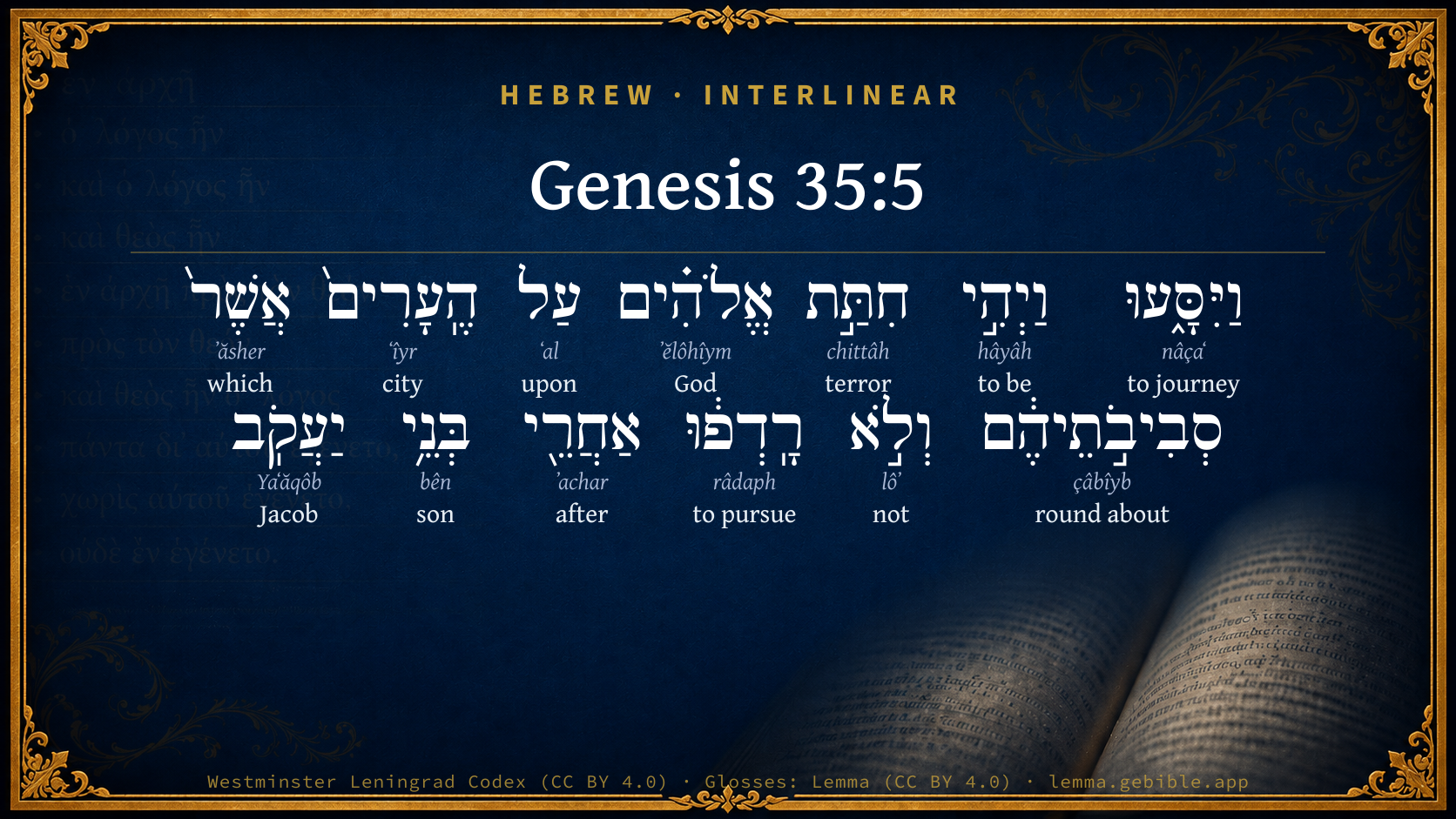
Hebrew (Westminster Leningrad Codex) Genesis 35:5 appears in the Hebrew Old Testament. The text above is from the Westminster Leningrad Codex. Each word links to its Strong’s number, a concise gloss, and parsing drawn from the Open Scriptures Hebrew Bible morphology. Click any word for its full Brown-Driver-Briggs (BDB) entry.
Download image
Cite this verse

Genesis 35:5 (World English Bible). Public Domain. Lemma interlinear Bible study tool, https://lemma.gebible.app/v/genesis/35/5.

Show BibTeX & RIS
BibTeX
RIS
English Translation
They traveled: and a terror of God was on the cities that were round about them, and they didn't pursue the sons of Jacob.
World English Bible · Public Domain
Highlights
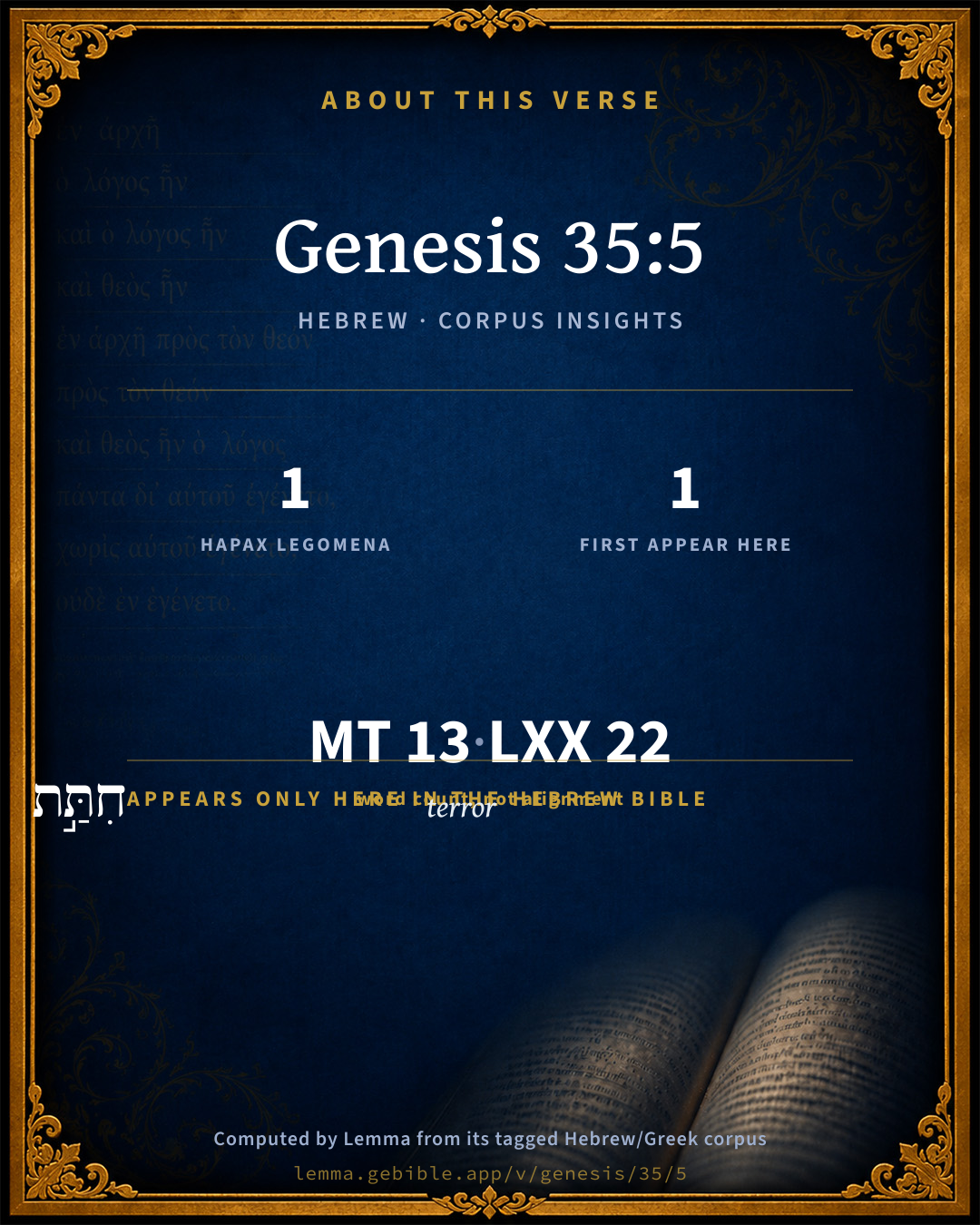
  • 1 hapax legomenon — only here in the Hebrew Bible
  • 1 first appearance in the Hebrew Bible
Full analysis ↓
Download a study sheet

One document with this verse’s original text, its word-by-word gloss line, the meaning frame, cross-references with their text, attributed commentary, and full source and license credits — printable, and it pastes into notes with its structure intact.

This verse Autodidact and up

Study sheet (.html) Plain text (.txt)

A passage Seminary Student

Up to 50 verses in one chapter. A passage sheet keeps up to 6 commentary sources and 12 cross-references per verse, in the order this page ranks them, and says so on the sheet whenever that leaves anything out. Ask for a single verse and you get the Autodidact verse sheet above.

Everything on this page stays free to read, with no account — the sheet is a download of what is already on screen, not access to it.

Want to remove ads? Support Godless Engineer
Compare translations 3

The same verse in 3 English versions, stacked beneath the original-language interlinear above. Click any original word for its lexicon entry.

Each is an independent rendering of the whole verse — the interlinear is not word-aligned to these translations.

Highlighted words mark where these versions differ — a whole-verse word diff, not a word-by-word alignment.

  • World English Bible Public Domain
    They traveled: and a terror of God was on the cities that were round about them, and they didn't pursue the sons of Jacob.
  • King James Version Public Domain
    And they journeyed: and the terror of God was upon the cities that were round about them, and they did not pursue after the sons of Jacob.
  • unfoldingWord Literal Text CC BY-SA 4.0
    Then they set out, and the dread of God was on the cities that around them, so that they did not pursue after the sons of Jacob.

unfoldingWord Literal Text — © unfoldingWord, licensed CC BY-SA 4.0. Word-aligned USFM3 via Door43 (git.door43.org/unfoldingWord/en_ult).

Versions to compare (up to 4)

3 of 4 selected

Show all 18 translations

Every available English version of this verse, each an independent rendering of the whole verse.

  • World English Bible Public Domain
    They traveled: and a terror of God was on the cities that were round about them, and they didn't pursue the sons of Jacob.
  • Berean Standard Bible Public Domain
    As they set out, a terror from God fell over the surrounding cities, so that they did not pursue Jacob’s sons.
  • Majority Standard Bible Public Domain
    As they set out, a terror from God fell over the surrounding cities, so that they did not pursue Jacob’s sons.
  • King James Version Public Domain
    And they journeyed: and the terror of God was upon the cities that were round about them, and they did not pursue after the sons of Jacob.
  • American Standard Version (1901) Public Domain
    And they journeyed: and a terror of God was upon the cities that were round about them, and they did not pursue after the sons of Jacob.
  • Revised Version (1885) Public Domain
    And they journeyed: and a great terror was upon the cities that were round about them, and they did not pursue after the sons of Jacob.
  • Geneva Bible (1599) Public Domain
    Then they went on their iourney, and the feare of God was vpon the cities that were roud about them: so that they did not follow after the sonnes of Iaakob.
  • Douay-Rheims (1899) Public Domain
    And when they were departed, the terror of God fell upon all the cities round about, and they durst not pursue after them as they went away.
  • Young's Literal Translation Public Domain
    and they journey, and the terror of God is on the cities which `are' round about them, and they have not pursued after the sons of Jacob.
  • Literal Standard Version CC BY-SA 4.0
    and they journey, and the terror of God is on the cities which [are] around them, and they have not pursued after the sons of Jacob.
  • Unlocked Literal Bible CC BY-SA 4.0
    As they traveled, God made panic to fall on the cities that were around them, so those people did not pursue the sons of Jacob.
  • unfoldingWord Literal Text CC BY-SA 4.0
    Then they set out, and the dread of God was on the cities that around them, so that they did not pursue after the sons of Jacob.
  • Darby Bible Public Domain
    And they journeyed; and the terror of God was upon the cities that were round about them, and they did not pursue after the sons of Jacob.
  • World Messianic Bible Public Domain
    They traveled, and a terror of God was on the cities that were around them, and they didn’t pursue the sons of Jacob.
  • Webster's Bible Public Domain
    And they journeyed: and the terror of God was on the cities that were round them, and they did not pursue after the sons of Jacob.
  • Free Bible Version CC BY-SA 4.0
    As they left on their journey, the terror of God spread over all the surrounding towns, so nobody tried to retaliate against Jacob's sons.
  • Bible in Basic English Public Domain
    So they went on their journey: and the fear of God was on the towns round about, so that they made no attack on the sons of Jacob.
  • JPS Tanakh (1917) Public Domain
    And they journeyed; and a terror of God was upon the cities that were round about them, and they did not pursue after the sons of Jacob.

Literal Standard Version (2020), Covenant Press — licensed CC BY-SA 4.0. Text via the HelloAO Bible API (eBible.org). Unlocked Literal Bible (unfoldingWord) — licensed CC BY-SA 4.0. Text via the HelloAO Bible API (eBible.org). unfoldingWord Literal Text — © unfoldingWord, licensed CC BY-SA 4.0. Word-aligned USFM3 via Door43 (git.door43.org/unfoldingWord/en_ult). Free Bible Version, Dr. Jonathan Gallagher — licensed CC BY-SA 4.0. Text via the HelloAO Bible API (eBible.org).

Word by word

More ways to search: Search by grammar → Find every occurrence → Compare this word →

Practice this passage: Drill this verse → Learn its vocabulary →

חִתַּ֣ת
chittâh
H2847
“terror of”
Noun, Common, Feminine, Singular, Construct
Part of Speech
Noun
Type
Common
Gender
Feminine
Number
Singular
State
Construct
Full BDB Definition

Origin: from H2865

TWOT: 784d

terror, fear
  1. וַיִּסָּ֑עוּ nâçaʻ H5265 “and · to journey” Conjunction + Verb, Qal, Sequential Imperfect, 3rd Person, Masculine, Plural
  2. וַיְהִ֣י hâyâh H1961 “and · to be” Conjunction + Verb, Qal, Sequential Imperfect, 3rd Person, Masculine, Singular
  3. אֱלֹהִ֗ים ʼĕlôhîym H430 “God(s)” Noun, Common, Masculine, Plural, Absolute
  4. עַל ʻal H5921 “upon” Preposition
  5. הֶֽעָרִים֙ ʻîyr H5892 “the · cities” Particle, Definite Article + Noun, Common, Feminine, Plural, Absolute
  6. אֲשֶׁר֙ ʼăsher H834 “which” Particle, Relative
  7. סְבִיבֹ֣תֵיהֶ֔ם çâbîyb H5439 “surroundings · their” Noun, Common, Both, Plural, Construct + Suffix, Personal, 3rd Person, Masculine, Plural
  8. וְלֹ֣א lôʼ H3808 “and · not” Conjunction + Particle, Negative
  9. רָֽדְפ֔וּ râdaph H7291 “to pursue” Verb, Qal, Perfect, 3rd Person, Common, Plural
  10. אַחֲרֵ֖י ʼachar H310 “after” Preposition
  11. בְּנֵ֥י bên H1121 “sons of” Noun, Common, Masculine, Plural, Construct
  12. יַעֲקֹֽב Yaʻăqôb H3290 “Jacob” Noun, Proper

About this verse

These counts appear in no published source. They are computed here, from the morphology-tagged text and Lemma’s own curated glosses. What Lemma adds →

13
words
13
distinct lemmas
Pentateuch
section

Notable vocabulary

1 hapax legomenon — a word that appears only here in the entire Hebrew Bible:

  • חִתַּ֣ת terror H2847

First appearance in Scripture

This word makes its first canonical appearance in the Hebrew Bible here:

  • חִתַּ֣ת terror H2847

Grammatical profile

  • 3 verbs
  • 6 nouns
  • 2 prepositions
  • 2 particles

Verb forms

  • וַיִּסָּ֑עוּ Qal · Sequential Imperfect
  • וַיְהִ֣י Qal · Sequential Imperfect
  • רָֽדְפ֔וּ Qal · Perfect

Hebrew & Septuagint length

In English translation the verse runs 24 words from the Hebrew and 27 from the Septuagint (LXX English) — closely comparable.

A rough comparison of the two English renderings, which tokenize alike — not a word-level alignment.

Word counts can differ between the Hebrew and the Greek without any difference in meaning — e.g. the Hebrew direct-object marker אֵת has no separate Greek word, and Greek often adds the article ὁ.

In the original languages it is 13 Hebrew tokens and 22 Greek tokens — but the two are counted differently (Hebrew bundles its prefixes and suffixes into one token; the Greek is in lemma form), so that isn’t a like-for-like length.

Cross-references

12

Topical passages linked to Genesis 35:5 in the Treasury of Scripture Knowledge — connected by theme and wording, ordered by reader-vote popularity; previews shown in the World English Bible.

  • Exodus 23:27 I will send my terror before you, and will confuse all the people to whom you come, and I will make all your enemies turn their backs to you.
  • 2 Chronicles 17:10 The fear of Yahweh fell on all the kingdoms of the lands that were round about Judah, so that they made no war against Jehoshaphat.
  • Joshua 5:1 It happened, when all the kings of the Amorites, who were beyond the Jordan westward, and all the kings of the Canaanites, who were by the sea, heard how that Yahweh had dried up the waters of the Jordan from before the children of Israel, until we were passed over, that their heart melted, neither was there spirit in them any more, because of the children of Israel.
  • Psalms 14:5 There they were in great fear, For God is in the generation of the righteous.
  • Exodus 15:15–16 Then the chiefs of Edom were dismayed. Trembling takes hold of the mighty men of Moab. All the inhabitants of Canaan are melted away.
  • Exodus 34:24 For I will drive out nations before you and enlarge your borders; neither shall any man desire your land when you go up to appear before Yahweh, your God, three times in the year.
  • Joshua 2:9–11 and she said to the men, I know that Yahweh has given you the land, and that the fear of you is fallen on us, and that all the inhabitants of the land melt away before you.
  • Genesis 34:30 Jacob said to Simeon and Levi, "You have troubled me, to make me odious to the inhabitants of the land, among the Canaanites and the Perizzites. I am few in number. They will gather themselves together against me and strike me, and I will be destroyed, I and my house."
  • Deuteronomy 11:25 There shall no man be able to stand before you: Yahweh your God shall lay the fear of you and the dread of you on all the land that you shall tread on, as he has spoken to you.
  • 1 Samuel 11:7 He took a yoke of oxen, and cut them in pieces, and sent them throughout all the borders of Israel by the hand of messengers, saying, Whoever doesn't come forth after Saul and after Samuel, so shall it be done to his oxen. The dread of Yahweh fell on the people, and they came out as one man.
  • 1 Samuel 14:15 There was a trembling in the camp, in the field, and among all the people; the garrison, and the spoilers, they also trembled; and the earth quaked: so there was an exceeding great trembling.
  • 2 Chronicles 14:14 They struck all the cities round about Gerar; for the fear of Yahweh came on them: and they despoiled all the cities; for there was much spoil in them.

Cross-references courtesy of OpenBible.info (CC BY 4.0).

Hebrew and Greek witnesses Masoretic Hebrew ↔ Greek Septuagint

The same verse in the two great witnesses to the Old Testament, shown verse-for-verse.

These are two independent witnesses, not word-aligned to each other, and the Septuagint is shown in lemma (dictionary) form.

Hebrew Genesis 35:5 Masoretic · Westminster Leningrad Codex

וַיִּסָּ֑עוּ וַיְהִ֣י חִתַּ֣ת אֱלֹהִ֗ים עַל הֶֽעָרִים֙ אֲשֶׁר֙ סְבִיבֹ֣תֵיהֶ֔ם וְלֹ֣א רָֽדְפ֔וּ אַחֲרֵ֖י בְּנֵ֥י יַעֲקֹֽב

They traveled: and a terror of God was on the cities that were round about them, and they didn't pursue the sons of Jacob.

World English Bible · Public Domain

Greek LXX Genesis 35:5 Septuagint · lemma form

καί ἐκαἴρω ἰσραήλ ἐκ σικιμος καί γίγνομαι φόβος θεός ἐπί ὁ πόλις ὁ κύκλος αὐτός καί οὐ καταδιώκω ὀπίσω ὁ υἱός ἰσραήλ

So Israel departed from Secima, and the fear of God was upon the cities round about them, and they did not pursue after the children of Israel.

LXX2012 (modern English Septuagint) · Public Domain

Hebrew: Westminster Leningrad Codex (CC BY 4.0). Greek: Septuagint (public domain); English from LXX2012 (modern English Septuagint) (Public Domain). How the Septuagint differs from the Hebrew →

Targum (Aramaic paraphrase)

2

The Targum is the ancient Jewish Aramaic paraphrase of the Hebrew Scriptures — an interpretive translation, not the Hebrew text itself. Onkelos (literal) and Pseudo-Jonathan (expansive) render the Torah, and Jonathan the Prophets. Coverage is partial: where no permissively-licensed English translation exists for a verse, only the Aramaic is shown. This is verse-level text, not a word-by-word alignment to the Hebrew.

  1. Targum Onkelos Torah (Genesis–Deuteronomy)
    וּנְטָלוּ וַהֲוַת דַּחֲלָא דַיְיָ עַל עַמְמַיָא דִי בְּקִרְוֵי סַחֲרָנֵיהוֹן וְלָא רְדָפוּ בָּתַר בְּנֵי יַעֲקֹב

    (no public-domain English translation for this verse)

    Targum Onkelos — Aramaic: “Onkelos Genesis” (public domain); “Onkelos Exodus” (public domain); “Onkelos Leviticus” (public domain); “Onkelos Numbers” (public domain); “Onkelos Deuteronomy” (public domain). English: “Sefaria Community Translation” (CC0 1.0 (public-domain dedication)); “J.W. Etheridge. The Targums of Onkelos and Jonathan Ben Uzziel on the Pentateuch. London: Longmans, Green, 1862” (public domain). Text via Sefaria.

  2. Targum Pseudo-Jonathan Torah (Genesis–Deuteronomy)
    וּנְטָלוּ מִתַּמָן מוֹדִים וּמַצְלָן קֳדָם יְיָ וַהֲוָה רְתִיתָא מִן קֳדָם יְיָ עַל עַמְמַיָא דִבְקִרְוֵי חוּזְרָנֵיהוֹם וְלָא רָדָפוּ בָּתַר בְּנֵי יַעֲקב

    And they journeyed from thence, offering praise and prayer before the Lord. And there was a tremor from before the Lord upon the people of the cities round about them, and they pursued not after the sons of Jakob.

    Targum Pseudo-Jonathan — Aramaic: “Targum Jonathan on Genesis” (public domain); “Targum Jonathan on Exodus” (public domain); “Targum Jonathan on Leviticus” (public domain); “Targum Jonathan on Numbers” (public domain); “Targum Jonathan on Deuteronomy” (public domain). English: “The Targum of Jonathan ben Uzziel, trans. J. W. Etheridge, London, 1862” (public domain). Text via Sefaria.

Commentary

Notes on Genesis 35:5 from classic Christian and Jewish commentators (each source and its license shown beneath its notes). The classic Christian expositions comment on the surrounding passage and are grouped to its opening verse, so a note may address several verses; the Jewish commentaries on the Tanakh (Rashi and others) are per-verse, so they appear only where the commentator wrote on this verse.

Lemma curates 59 commentaries, every one of them public domain or Creative Commons licensed, each selected and text-cleaned for this edition rather than reprinted as found. About our sources →

Trapp's Complete Commentary

John Trapp

Gen 35:5 And they journeyed: and the terror of God was upon the cities that [were] round about them, and they did not pursue after the sons of Jacob.

Ver. 5. The terror of God was upon the cities.] The Hebrews tell us, that they pursued Jacob, and were beaten back by him: whereupon he saith, {Gen 48:22} that he took that country "out of the hand of the Amorites, with his sword and with his bow." God might send a panic terror upon them as they were fighting against Jacob, and so bridle them from further attempts. The Syrians heard a noise of chariots and horses in the air, {2Ki 7:7} made by angels, likely; or whether it were but their own fancy, as Jdg 9:36, and as the Burgundians took a field of standing corn for an army of fighting men, and fled for their lives. Theodosius, the Emperor, overcame the Persians and Saracens by means of a panic terror smitten into them by God; so that they ran into the river Euphrates, and above a hundred thousand of them perished in the waters. {a}

{a} Alsted, Chronol, p. 300.

John Trapp, A Commentary or Exposition upon All the Books of the Old and New Testament (1647–1656) — public domain. Text from a community e-Sword module.

Joseph Benson's Commentary

Gen 35:5. The terror of God — A great terror from God; was upon the cities — Especially the cities nearest to Shechem, so that, although, humanly speaking, they were able, they were restrained from pursuing or destroying Jacob and his family. Nothing less could have secured them, considering the number, power, and rage of their enemies. God governs the world more by secret terrors on men’s minds than we are aware of.

Joseph Benson's Commentary on the Old and New Testaments (1811–1818) — public domain. Text from a community e-Sword module.

Tyndale Open Study Notes

Tyndale Open Resources

35:5 a terror from God: People had heard about the massacre of Shechem (34:25-30).

Tyndale Open Study Notes — © Tyndale Open Resources, licensed CC BY-SA 4.0. Text via the HelloAO Bible API.

Geneva Bible (1599)

Geneva Bible translators

Thus, notwithstanding the inconvenience that came before, God delivered Jacob.

Geneva Bible (1599) marginal notes — public domain. Text via Bolls.life.

Jamieson, Fausset & Brown

Robert Jamieson, A. R. Fausset & David Brown

the terror of God was upon the cities--There was every reason to apprehend that a storm of indignation would burst from all quarters upon Jacob's family, and that the Canaanite tribes would have formed one united plan of revenge. But a supernatural panic seized them; and thus, for the sake of the "heir of the promise," the protecting shield of Providence was specially held over his family.

Jamieson, Fausset & Brown — Commentary Critical and Explanatory on the Whole Bible (1871) — public domain (CC PDM 1.0). Text via the HelloAO Bible API.

Adam Clarke's Commentary

Verse 5. The terror of God] A supernatural awe sent by the Almighty, was upon the cities that were round about, so that they were not molested in their departure. This could be owing to nothing less than the especial providence of God.

Adam Clarke's Commentary on the Bible (1810–1826) — public domain. Text from a community e-Sword/MySword module.

John Calvin's Commentaries

5. And the terror of God was upon the cities. It now manifestly appears that deliverance was not in vain promised to the holy man by God; since, amidst so many hostile swords, he goes forth not only in safety but undisturbed. By the destruction of the Shechemites all the neighboring people were inflamed with enmity against a single family; yet no one moves to take vengeance. The reason is explained by Moses, that the terror of God had fallen upon them, which repressed their violent assaults. Hence we may learn that the hearts of men are in the hands of God; that he can inspire those with fortitude who in themselves are weak; and, on the other hand, soften their iron-hardness whenever he pleases. Sometimes, indeed, he suffers many to cast up the foam of their pride, against whom he afterwards opposes his power: but he often weakens those with fear who were naturally bold as lions: thus we find these giants, who were able to devour Jacob a hundred times, so struck with terror that they faint away. Wherefore, whenever we see the wicked furiously bent on our destruction, lest our hearts should fail with fear and be broken by desperation, let us call to mind this terror of God, by which the rage, however furious, of the whole world may be easily subdued.

John Calvin's Commentaries (1540-1563) — public domain. Text from the Calvin Translation Society English edition (1840s-50s) via the Christian Classics Ethereal Library (ccel.org). Calvin's coverage is partial (roughly two-thirds of the Bible); uncommented books and verses are honest gaps, never fabricated. The 19th-century editor's footnotes and remarks are omitted so the notes are faithfully Calvin's own voice.

Ellicott's Commentary for English Readers

(5) The terror . . . —Heb., a terror of God, that is, a very great terror (see Gen_23:6; Gen_30:8). But to the deeply religious mind of the Hebrew everything that was great and wonderful was the result of the direct working of the Deity. (But see Note on Gen_48:22.)

A Bible Commentary for English Readers, edited by Charles John Ellicott (1878–1897) — public domain. Text from a community e-Sword module.

The Cambridge Bible for Schools and Colleges

gen. ed. J. J. S. Perowne

5. a great terror] Heb. a terror of God. The inhabitants were under the influence of a mysterious dread or panic, inspired by God. Cf. Exo_15:16; Exo_23:27; Deu_2:25; Jos_2:9; 2Ch_14:14.

did not pursue] These words which imply that “the sons of Jacob” had by their violence given just cause of provocation, presuppose ch. 34.

The Cambridge Bible for Schools and Colleges (gen. ed. J. J. S. Perowne; Cambridge University Press, 1878–1918) — public domain. Text from a community e-Sword module.

John Gill's Exposition

And they journeyed,.... Jacob and his family, with all that were with them, from Shechem to Bethel:

and the terror of God was upon the cities that were round about them; an exceeding great panic seized the inhabitants of the cities of the land of Canaan, all about Shechem, which was from God himself impressing it on their minds, through what the sons of Jacob had done to that city:

and they did not pursue after the sons of Jacob; as it might have been thought they would, and take revenge on them for their ill usage of the inhabitants of a neighbouring city; but instead of this, they were afraid they should be used in the same manner; wherefore Jacob and his family journeyed in safety, and came to Bethel in peace.

John Gill's Exposition of the Whole Bible (1746–1763) — public domain (CC PDM 1.0). Text via the HelloAO Bible API.

Haydock's Catholic Bible Commentary

Terror of God. A panic fear, which the pagans thought was sent by Pan. (Calmet) --- God can easily make the most powerful flee before a few. St. Augustine, q. 112.

George Leo Haydock (1774–1849), Haydock's Catholic Family Bible and Commentary, 1859 edition — public domain. Excludes Psalms (Douay-Rheims chapter numbering differs from Protestant) and Deuterocanonical books (Catholic canon only).

Matthew Poole's English Annotations

The terror of God, i.e. a great terror sent from God, as Exo 23:27; Jos 2:9,11; 2Ch 14:14; 17:10. So we read of a sleep of God, 1Sa 26:12. Nothing less could have secured Jacob, considering the great number, power, and rage of his enemies.

Matthew Poole's English Annotations on the Holy Bible (1683–1685) — public domain. Text from a community e-Sword/MySword module.

Whedon's Commentary on the Bible

Daniel D. Whedon

5. Terror of God — A terror inspired and intensified by God himself, who, on the other hand, had softened the heart of Esau to tenderness towards his brother.

Daniel D. Whedon (gen. ed.), Commentary on the Old and New Testaments (1874–1909) — public domain. Text from a community e-Sword module.

The Pulpit Commentary

And they journeyed (from Shechem, after the work of reformation just described): and the terror of God meaning not simply a great terror, as in Gen_23:6 Gen_30:8 (Dathe, Bush), but either a supernatural dread inspired by Elohim (Ainsworth, Clericus, Rosenm Keil, Kalisch, and others), or a fear of Elohim, under whose care Jacob manifestly bad been taken (Murphy, Quarry)was upon the cities that were round about them, literally, in their circuits, i.e. wherever they wentand they did not pursue after the sons of Jacob as might have been expected.

The Pulpit Commentary (1880–1919), ed. H.D.M. Spence-Jones & Joseph S. Exell — public domain. Text from a community e-Sword module.

John Wesley's Explanatory Notes

And the terror of God was upon the cities - Though the Canaanites were much exasperated against the sons of Jacob for their barbarous usage of the Shechemites; yet they were so restrained by a divine power, that they could not take this fair opportunity to avenge their neighbours quarrel. God governs the world more by secret terrors on men's minds than we are aware of.

John Wesley, Explanatory Notes Upon the Whole Bible (1754–1765) — public domain. Text via the GEBible commentary corpus.

Rashi

Rabbi Shlomo Yitzchaki (Rashi)

חתת means terror.

Rashi on the Tanakh — English translations: “The Judaica Press complete Tanach with Rashi, translated by A. J. Rosenberg” (CC BY 4.0); “Pentateuch with Rashi's commentary by M. Rosenbaum and A.M. Silbermann, 1929-1934” (public domain); “The Metsudah Tanach series, Lakewood, N.J” (CC BY 4.0); and “The Book of Joshua, Metsudah Publications, 1997” (CC BY 4.0). Text via Sefaria.

Sforno

Rabbi Ovadia Sforno

They began their journey. As long as they were behind the walls of Shechem they were safe, but now they were in need of the “terror of Elokim”.

Sforno on the Tanakh — English translation: “Yalkut, Sifsei Chachomim Chumash, Metsudah Publications, 2009” (CC BY 4.0). Text via Sefaria.

Lesson kit

Teaching starters — assembled from the data on this page, not authored interpretation. Every prompt links to the verse data it draws on. Edit before teaching.

Genesis, in the Pentateuch, opens this verse with 13 words (13 distinct Hebrew lemmas). Its most distinctive word is chittâh (“terror”). A historical commentator’s framing appears above. Read the whole chapter for the surrounding context.

Discussion questions

  1. How does “terror” (chittâh) shape what this verse is saying?
  2. 1 word here appears nowhere else in the Hebrew Bible. Why might the author reach for such rare wording?
  3. This is the first place “terror” appears in Scripture (first appears here). What does its debut here establish?
  4. How does Exodus 23:27, which shares this passage’s theme, read alongside this verse?
  5. These translations render this verse differently; the difference is in the English rendering, not the original. What questions does that raise?
  6. «וַיִּסָּ֑עוּ» is a Qal Sequential Imperfect verb. How does that grammatical form shape the action described?
  7. Compare how Trapp's Complete Commentary and Joseph Benson's Commentary read this verse. Where do they agree or differ?

Things to notice

Reading settings

Reading text

Shown beneath each verse's original-language words.

Old Testament
Old Testament edition

Read the OT as the Masoretic Hebrew (MT) or the Greek Septuagint (LXX).

English shown for the Greek Septuagint (in the Hebrew ↔ Greek comparison).

Comparing translations? Open the Compare panel on any verse page to stack up to four side by side.