Exodus 6:3

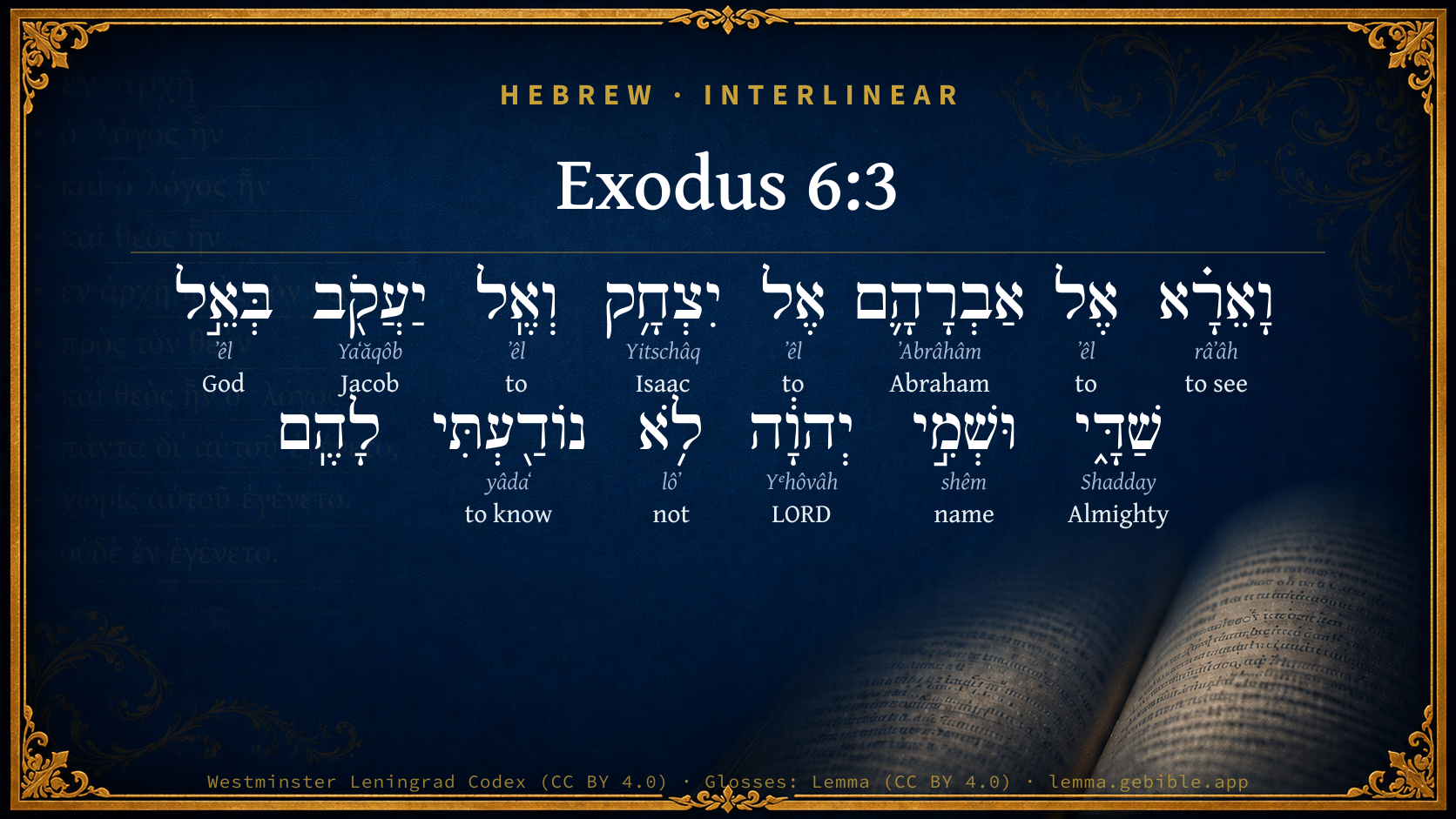
Hebrew (Westminster Leningrad Codex) Exodus 6:3 appears in the Hebrew Old Testament. The text above is from the Westminster Leningrad Codex. Each word links to its Strong’s number, a concise gloss, and parsing drawn from the Open Scriptures Hebrew Bible morphology. Click any word for its full Brown-Driver-Briggs (BDB) entry.
Download image
Cite this verse

Exodus 6:3 (World English Bible). Public Domain. Lemma interlinear Bible study tool, https://lemma.gebible.app/v/exodus/6/3.

Show BibTeX & RIS
BibTeX
RIS
English Translation
and I appeared to Abraham, to Isaac, and to Jacob, as God Almighty; but by my name Yahweh I was not known to them.
World English Bible · Public Domain
Download a study sheet

One document with this verse’s original text, its word-by-word gloss line, the meaning frame, cross-references with their text, attributed commentary, and full source and license credits — printable, and it pastes into notes with its structure intact.

This verse Autodidact and up

Study sheet (.html) Plain text (.txt)

A passage Seminary Student

Up to 50 verses in one chapter. A passage sheet keeps up to 6 commentary sources and 12 cross-references per verse, in the order this page ranks them, and says so on the sheet whenever that leaves anything out. Ask for a single verse and you get the Autodidact verse sheet above.

Everything on this page stays free to read, with no account — the sheet is a download of what is already on screen, not access to it.

Want to remove ads? Support Godless Engineer
Compare translations 3

The same verse in 3 English versions, stacked beneath the original-language interlinear above. Click any original word for its lexicon entry.

Each is an independent rendering of the whole verse — the interlinear is not word-aligned to these translations.

Highlighted words mark where these versions differ — a whole-verse word diff, not a word-by-word alignment.

  • World English Bible Public Domain
    and I appeared to Abraham, to Isaac, and to Jacob, as God Almighty; but by my name Yahweh I was not known to them.
  • King James Version Public Domain
    And I appeared unto Abraham, unto Isaac, and unto Jacob, by the name of God Almighty, but by my name JEHOVAH was I not known to them.
  • unfoldingWord Literal Text CC BY-SA 4.0
    and I appeared to Abraham, to Isaac, and to Jacob as El Shaddai; but by my name Yahweh I was not known to them.

unfoldingWord Literal Text — © unfoldingWord, licensed CC BY-SA 4.0. Word-aligned USFM3 via Door43 (git.door43.org/unfoldingWord/en_ult).

Versions to compare (up to 4)

3 of 4 selected

Show all 18 translations

Every available English version of this verse, each an independent rendering of the whole verse.

  • World English Bible Public Domain
    and I appeared to Abraham, to Isaac, and to Jacob, as God Almighty; but by my name Yahweh I was not known to them.
  • Berean Standard Bible Public Domain
    I appeared to Abraham, to Isaac, and to Jacob as God Almighty, but by My name the LORD I did not make Myself known to them.
  • Majority Standard Bible Public Domain
    I appeared to Abraham, to Isaac, and to Jacob as God Almighty, but by My name the LORD I did not make Myself known to them.
  • King James Version Public Domain
    And I appeared unto Abraham, unto Isaac, and unto Jacob, by the name of God Almighty, but by my name JEHOVAH was I not known to them.
  • American Standard Version (1901) Public Domain
    and I appeared unto Abraham, unto Isaac, and unto Jacob, as God Almighty; but by my name Jehovah I was not known to them.
  • Revised Version (1885) Public Domain
    and I appeared unto Abraham, unto Isaac, and unto Jacob, as God Almighty, but by my name JEHOVAH I was not known to them.
  • Geneva Bible (1599) Public Domain
    And I appeared vnto Abraham, to Izhak, and to Iaakob by the Name of Almightie God: but by my Name Iehouah was I not knowen vnto the.
  • Douay-Rheims (1899) Public Domain
    That appeared to Abraham, to Isaac, and to Jacob, by the name of God Almighty; and my name ADONAI I did not shew them.
  • Young's Literal Translation Public Domain
    and I appear unto Abraham, unto Isaac, and unto Jacob, as God Almighty; as to My name Jehovah, I have not been known to them;
  • Literal Standard Version CC BY-SA 4.0
    and I appear to Abraham, to Isaac, and to Jacob, as God Almighty; as for My Name YHWH, I have not been known to them;
  • Unlocked Literal Bible CC BY-SA 4.0
    I appeared to Abraham, to Isaac, and to Jacob as God Almighty; but by my name, Yahweh, I was not known to them.
  • unfoldingWord Literal Text CC BY-SA 4.0
    and I appeared to Abraham, to Isaac, and to Jacob as El Shaddai; but by my name Yahweh I was not known to them.
  • Darby Bible Public Domain
    And I appeared unto Abraham, unto Isaac, and unto Jacob, as the Almighty ùGod; but by my name Jehovah I was not made known to them.
  • World Messianic Bible Public Domain
    I appeared to Abraham, to Isaac, and to Jacob, as God Almighty; but by my name the LORD I was not known to them.
  • Webster's Bible Public Domain
    And I appeared to Abraham, to Isaac, and to Jacob, by the name of God Almighty, but by my name JEHOVAH was I not known to them.
  • Free Bible Version CC BY-SA 4.0
    I revealed myself as God Almighty to Abraham, to Isaac, and to Jacob, but they didn't know my name, ‘Yahweh.’
  • Bible in Basic English Public Domain
    I let myself be seen by Abraham, Isaac, and Jacob, as God, the Ruler of all; but they had no knowledge of my name Yahweh.
  • JPS Tanakh (1917) Public Domain
    and I appeared unto Abraham, unto Isaac, and unto Jacob, as God Almighty, but by My name Jehovah I made Me not known to them.

Literal Standard Version (2020), Covenant Press — licensed CC BY-SA 4.0. Text via the HelloAO Bible API (eBible.org). Unlocked Literal Bible (unfoldingWord) — licensed CC BY-SA 4.0. Text via the HelloAO Bible API (eBible.org). unfoldingWord Literal Text — © unfoldingWord, licensed CC BY-SA 4.0. Word-aligned USFM3 via Door43 (git.door43.org/unfoldingWord/en_ult). Free Bible Version, Dr. Jonathan Gallagher — licensed CC BY-SA 4.0. Text via the HelloAO Bible API (eBible.org).

Word by word

More ways to search: Search by grammar → Find every occurrence → Compare this word →

Practice this passage: Drill this verse → Learn its vocabulary →

שַׁדָּ֑י
Shadday
H7706
“Almighty”
Noun, Proper
Part of Speech
Noun
Type
Proper
Full BDB Definition

Origin: from H7703

TWOT: 2333

almighty, most powerful - Shaddai, the Almighty (of God)
  1. וָאֵרָ֗א râʼâh H7200 “and · to see” Conjunction + Verb, Niphal, Sequential Imperfect, 1st Person, Common, Singular
  2. אֶל ʼêl H413 “to” Preposition
  3. אַבְרָהָ֛ם ʼAbrâhâm H85 “Abraham” Noun, Proper
  4. אֶל ʼêl H413 “to” Preposition
  5. יִצְחָ֥ק Yitschâq H3327 “Isaac” Noun, Proper
  6. וְאֶֽל ʼêl H413 “and · to” Conjunction + Preposition
  7. יַעֲקֹ֖ב Yaʻăqôb H3290 “Jacob” Noun, Proper
  8. בְּאֵ֣ל ʼêl H410 “in/at · God” Preposition + Noun, Common, Masculine, Singular, Absolute
  9. וּשְׁמִ֣י shêm H8034 “and · name · my” Conjunction + Noun, Common, Masculine, Singular, Construct + Suffix, Personal, 1st Person, Common, Singular
  10. יְהוָ֔ה Yᵉhôvâh H3068 “LORD” Noun, Proper
  11. לֹ֥א lôʼ H3808 “not” Particle, Negative
  12. נוֹדַ֖עְתִּי yâdaʻ H3045 “to know” Verb, Niphal, Perfect, 1st Person, Common, Singular

About this verse

These counts appear in no published source. They are computed here, from the morphology-tagged text and Lemma’s own curated glosses. What Lemma adds →

14
words
11
distinct lemmas
Pentateuch
section

Shared distinctive vocabulary

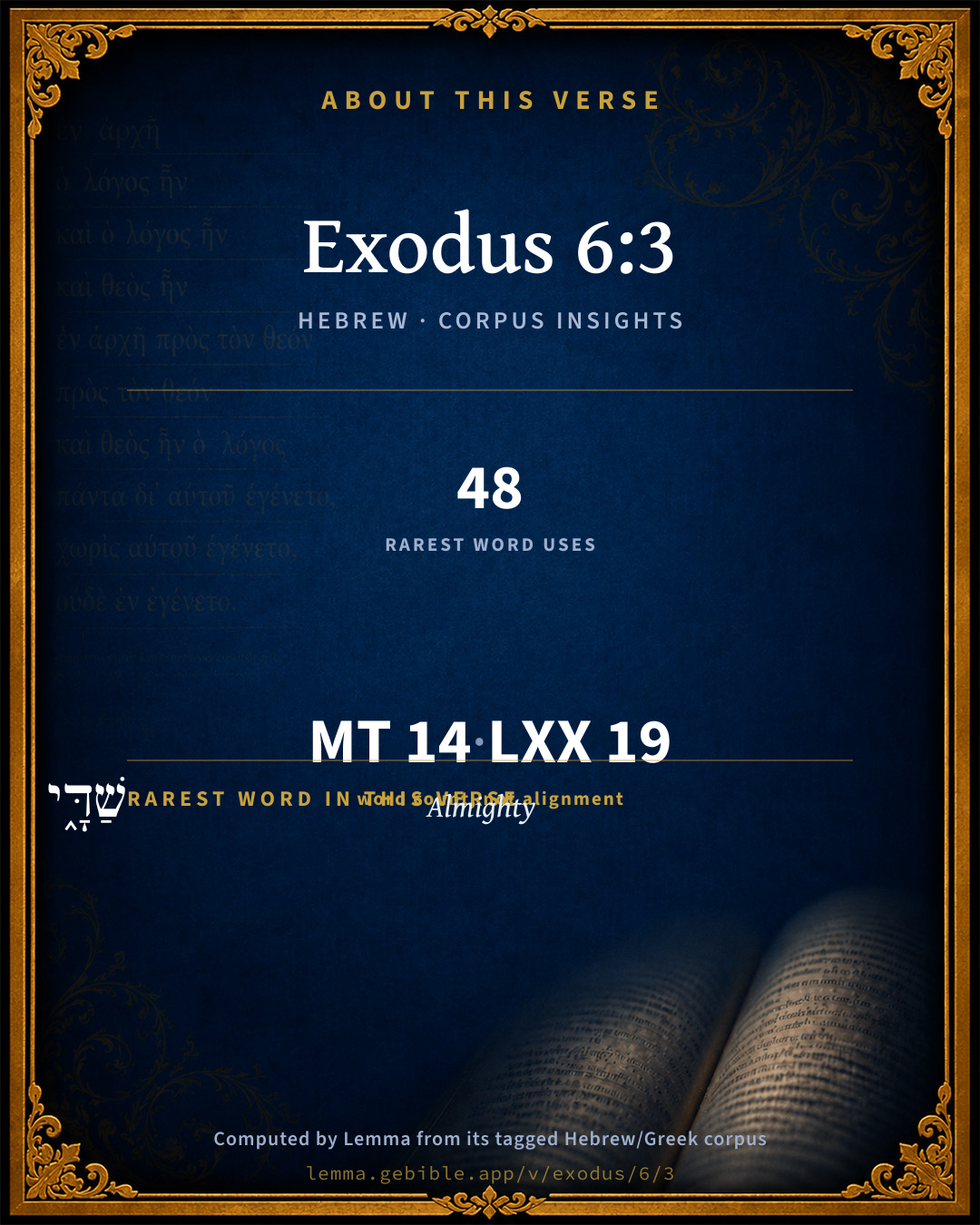
שַׁדָּ֑י Almighty H7706 occurs in 48 verses of the Hebrew Bible. Also found in:

Grammatical profile

  • 2 verbs
  • 7 nouns
  • 4 prepositions
  • 1 particle

Verb forms

  • וָאֵרָ֗א Niphal · Sequential Imperfect
  • נוֹדַ֖עְתִּי Niphal · Perfect

Repetition

A word recurs within this verse — often emphatic in Hebrew:

  • אֶל to H413 ×3

Hebrew & Septuagint length

In English translation the verse runs 24 words from the Hebrew and 22 from the Septuagint (LXX English) — closely comparable.

A rough comparison of the two English renderings, which tokenize alike — not a word-level alignment.

Word counts can differ between the Hebrew and the Greek without any difference in meaning — e.g. the Hebrew direct-object marker אֵת has no separate Greek word, and Greek often adds the article ὁ.

In the original languages it is 14 Hebrew tokens and 19 Greek tokens — but the two are counted differently (Hebrew bundles its prefixes and suffixes into one token; the Greek is in lemma form), so that isn’t a like-for-like length.

Cross-references

15

Topical passages linked to Exodus 6:3 in the Treasury of Scripture Knowledge — connected by theme and wording, ordered by reader-vote popularity; previews shown in the World English Bible.

  • Psalms 83:18 That they may know that you alone, whose name is Yahweh, Are the Most High over all the earth.
  • Genesis 17:1 When Abram was ninety-nine years old, Yahweh appeared to Abram, and said to him, "I am God Almighty. Walk before me, and be blameless.
  • Psalms 68:4 Sing to God! Sing praises to his name! Extol him who rides on the clouds: To Yah, his name! Rejoice before him!
  • Exodus 3:14 God said to Moses, "I AM WHO I AM," and he said, "You shall tell the children of Israel this: "I AM has sent me to you."
  • Genesis 35:11 God said to him, "I am God Almighty. Be fruitful and multiply. A nation and a company of nations will be from you, and kings will come out of your loins.
  • Genesis 48:3 Jacob said to Joseph, "God Almighty appeared to me at Luz in the land of Canaan, and blessed me,
  • Isaiah 44:6 Thus says Yahweh, the King of Israel, and his Redeemer, Yahweh of Hosts: I am the first, and I am the last; and besides me there is no God.
  • Genesis 12:7–8 Yahweh appeared to Abram, and said, "I will give this land to your seed." He built an altar there to Yahweh, who appeared to him.
  • Isaiah 42:8 I am Yahweh, that is my name; and my glory will I not give to another, neither my praise to engraved images.
  • Isaiah 52:5–6 Now therefore, what do I here, says Yahweh, seeing that my people is taken away for nothing? those who rule over them do howl, says Yahweh, and my name continually all the day is blasphemed.
  • John 8:58 Jesus said to them, "Most assuredly, I tell you, before Abraham came into existence, I AM."
  • Genesis 22:14 Abraham called the name of that place Yahweh-Jireh. As it is said to this day, "In Yahweh's mountain it will be provided.
  • Genesis 13:18 Abram moved his tent, and came and lived by the oaks of Mamre, which are in Hebron, and built an altar there to Yahweh.
  • Revelation 1:4 John, to the seven assemblies that are in Asia: Grace to you and peace, from God, who is and who was and who is to come; and from the seven Spirits who are before his throne;
  • Genesis 28:3 May God Almighty bless you, and make you fruitful, and multiply you, that you may be a company of peoples,

Cross-references courtesy of OpenBible.info (CC BY 4.0).

Hebrew and Greek witnesses Masoretic Hebrew ↔ Greek Septuagint

The same verse in the two great witnesses to the Old Testament, shown verse-for-verse.

These are two independent witnesses, not word-aligned to each other, and the Septuagint is shown in lemma (dictionary) form.

Hebrew Exodus 6:3 Masoretic · Westminster Leningrad Codex

וָאֵרָ֗א אֶל אַבְרָהָ֛ם אֶל יִצְחָ֥ק וְאֶֽל יַעֲקֹ֖ב בְּאֵ֣ל שַׁדָּ֑י וּשְׁמִ֣י יְהוָ֔ה לֹ֥א נוֹדַ֖עְתִּי לָהֶֽם

and I appeared to Abraham, to Isaac, and to Jacob, as God Almighty; but by my name Yahweh I was not known to them.

World English Bible · Public Domain

Greek LXX Exodus 6:3 Septuagint · lemma form

καί ὁράω πρός αβρααμ καί ισαακ καί ἰακώβ θεός εἰμί αὐτός καί ὁ ὄνομα ἐγώ κύριος οὐ δηλόω αὐτός

And I appeared to Abraam and Isaac and Jacob, being their God, but I did not manifest to them my name Lord.

LXX2012 (modern English Septuagint) · Public Domain

On this verse, Haydock's Catholic Bible Commentary discusses the Septuagint’s reading. Read the note in Commentary ↓

Hebrew: Westminster Leningrad Codex (CC BY 4.0). Greek: Septuagint (public domain); English from LXX2012 (modern English Septuagint) (Public Domain). How the Septuagint differs from the Hebrew →

Targum (Aramaic paraphrase)

2

The Targum is the ancient Jewish Aramaic paraphrase of the Hebrew Scriptures — an interpretive translation, not the Hebrew text itself. Onkelos (literal) and Pseudo-Jonathan (expansive) render the Torah, and Jonathan the Prophets. Coverage is partial: where no permissively-licensed English translation exists for a verse, only the Aramaic is shown. This is verse-level text, not a word-by-word alignment to the Hebrew.

  1. Targum Onkelos Torah (Genesis–Deuteronomy)
    וְאִתְגְלֵיתִי לְאַבְרָהָם לְיִצְחָק וּלְיַעֲקֹב בְּאֵל שַׁדָי וּשְׁמִי יְיָ לָא הוֹדָעִית לְהוֹן:

    (no public-domain English translation for this verse)

    Targum Onkelos — Aramaic: “Onkelos Genesis” (public domain); “Onkelos Exodus” (public domain); “Onkelos Leviticus” (public domain); “Onkelos Numbers” (public domain); “Onkelos Deuteronomy” (public domain). English: “Sefaria Community Translation” (CC0 1.0 (public-domain dedication)); “J.W. Etheridge. The Targums of Onkelos and Jonathan Ben Uzziel on the Pentateuch. London: Longmans, Green, 1862” (public domain). Text via Sefaria.

  2. Targum Pseudo-Jonathan Torah (Genesis–Deuteronomy)
    וְאִיתְגְלֵיתִי לְאַבְרָהָם לְיִצְחָק וּלְיַעֲקב בְּאֵל שַׁדָי וּשְׁמִי יְיָ בְּרַם בְּאַפֵּי שְׁכִינְתִּי לָא אִתְיְדִיעַת לְהוֹן

    And I was revealed unto Abraham, and to Izhak, and to Jakob, as EI-Shaddai; but My Name Ye-ya, as it discovereth My Glory,* was not known to them. *Or, in the face of My Shekinah

    Targum Pseudo-Jonathan — Aramaic: “Targum Jonathan on Genesis” (public domain); “Targum Jonathan on Exodus” (public domain); “Targum Jonathan on Leviticus” (public domain); “Targum Jonathan on Numbers” (public domain); “Targum Jonathan on Deuteronomy” (public domain). English: “The Targum of Jonathan ben Uzziel, trans. J. W. Etheridge, London, 1862” (public domain). Text via Sefaria.

Commentary

Notes on Exodus 6:3 from classic Christian and Jewish commentators (each source and its license shown beneath its notes). The classic Christian expositions comment on the surrounding passage and are grouped to its opening verse, so a note may address several verses; the Jewish commentaries on the Tanakh (Rashi and others) are per-verse, so they appear only where the commentator wrote on this verse.

Lemma curates 59 commentaries, every one of them public domain or Creative Commons licensed, each selected and text-cleaned for this edition rather than reprinted as found. About our sources →

Trapp's Complete Commentary

John Trapp

Exo 6:3 And I appeared unto Abraham, unto Isaac, and unto Jacob, by [the name of] God Almighty, but by my name JEHOVAH was I not known to them.

Ver. 3. By the name of God Almighty.] {See Trapp on "Gen 17:1"} The sense is this, saith Cameron, {a} Quantum illis sufficiebat tantum indulsit, non indulsit quod erat summum. He gave them enough, but not the main.

But by my name JEHOVAH.] That is, by the import of this his name, the full performance of his promises. God was known to the patriarchs by this name Jehovah, quoad esse De, but not quoad esse rei.

{a} Camer, De Eccles.

John Trapp, A Commentary or Exposition upon All the Books of the Old and New Testament (1647–1656) — public domain. Text from a community e-Sword module.

Geneva Bible (1599)

Geneva Bible translators

Or, all sufficient.

Whereby he signifieth that he will perform indeed that which he promised to their fathers: for this name declareth that he is constant and will perform his promise.

Geneva Bible (1599) marginal notes — public domain. Text via Bolls.life.

Jamieson, Fausset & Brown

Robert Jamieson, A. R. Fausset & David Brown

I . . . God Almighty--All enemies must fall, all difficulties must vanish before My omnipotent power, and the patriarchs had abundant proofs of this.

but by my name, &c.--rather, interrogatively, by My name Jehovah was I not known to them? Am not I, the Almighty God, who pledged My honor for the fulfilment of the covenant, also the self-existent God who lives to accomplish it? Rest assured, therefore, that I shall bring it to pass. This passage has occasioned much discussion; and it has been thought by many to intimate that as the name Jehovah was not known to the patriarchs, at least in the full bearing or practical experience of it, the honor of the disclosure was reserved to Moses, who was the first sent with a message in the name of Jehovah, and enabled to attest it by a series of public miracles.

Jamieson, Fausset & Brown — Commentary Critical and Explanatory on the Whole Bible (1871) — public domain (CC PDM 1.0). Text via the HelloAO Bible API.

Adam Clarke's Commentary

Verse 3. By the name of God Almighty] אל שדי EL-SHADDAl, God All-sufficient; God the dispenser or pourer-out of gifts. See Clarke on Ge 17:1.

But by my name JEHOVAH was I not known to them.] This passage has been a sort of crux criticorum, and has been variously explained. It is certain that the name Jehovah was in use long before the days of Abraham, see Ge 2:4, where the words יהוה אלהים Jehovah Elohim occur, as they do frequently afterwards; and see Ge 15:2, where Abraham expressly addresses him by the name Adonai JEHOVAH; and see Ge 15:7, where God reveals himself to Abraham by this very name: And he said unto him, I am JEHOVAH, that brought thee out of Ur of the Chaldees. How then can it be said that by his name JEHOVAH he was not known unto them? Several answers have been given to this question; the following are the chief: -

1. The words should be read interrogatively, for the negative particle לא lo, not, has this power often in Hebrew. "I appeared unto Abraham, Isaac, and Jacob by the name of God Almighty, and by my name Jehovah was I not also made known unto them?"

2. The name JEHOVAH was not revealed before the time mentioned here, for though it occurs so frequently in the book of Genesis, as that book was written long after the name had come into common use, as a principal characteristic of God, Moses employs it in his history because of this circumstance; so that whenever it appears previously to this, it is by the figure called prolepsis or anticipation.

3. As the name יהוה JEHOVAH signifies existence, it may be understood in the text in question thus: "I appeared unto Abraham, Isaac, and Jacob by my name God Almighty, or God All-sufficient, i.e., having all power to do all good; in this character I made a covenant with them, supported by great and glorious promises; but as those promises had respect unto their posterity, they could not be fulfilled to those fathers: but now, as JEHOVAH, I am about to give existence to all those promises relative to your support, deliverance from bondage, and your consequent settlement in the promised land."

4. The words may be considered as used comparatively: though God did appear to those patriarchs as JEHOVAH, and they acknowledged him by this name, yet it was but comparatively known unto them; they knew nothing of the power and goodness of God, in comparison of what the Israelites were now about to experience.

I believe the simple meaning is this, that though from the beginning the name JEHOVAH was known as one of the names of the Supreme Being, yet what it really implied they did not know. אל שדי El-Shaddai, God All-sufficient, they knew well by the continual provision he made for them, and the constant protection he afforded them: but the name יהוה JEHOVAH is particularly to be referred to the accomplishment of promises already made; to the giving them a being, and thus bringing them into existence, which could not have been done in the order of his providence sooner than here specified: this name therefore in its power and significancy was not known unto them; nor fully known unto their descendants till the deliverance from Egypt and the settlement in the promised land. It is surely possible for a man to bear the name of a certain office or dignity before he fulfils any of its functions. King, mayor, alderman, magistrate, constable, may be borne by the several persons to whom they legally belong, before any of the acts peculiar to those offices are performed. The KING, acknowledged as such on his coronation, is known to be such by his legislative acts; the civil magistrate, by his distribution of justice, and issuing warrants for the apprehending of culprits; and the constable, by executing those warrants. All these were known to have their respective names, but the exercise of their powers alone shows what is implied in being king, magistrate, and constable. The following is a case in point, which fell within my own knowledge.

A case of dispute between certain litigious neighbours being heard in court before a weekly sitting of the magistrates, a woman who came as an evidence in behalf of her bad neighbour, finding the magistrates inclining to give judgment against her mischievous companion, took her by the arm and said, "Come away! I told you you would get neither law nor justice in this place." A magistrate, who was as much an honour to his function as he was to human nature, immediately said, "Here, constable! take that woman and lodge her in Bridewell, that she may know there is some law and justice in this place."

Thus the worthy magistrate proved he had the power implied in the name by executing the duties of his office. And God who was known as JEHOVAH, the being who makes and gives effect to promises, was known to the descendants of the twelve tribes to be THAT JEHOVAH, by giving effect and being to the promises which he had made to their fathers.

Adam Clarke's Commentary on the Bible (1810–1826) — public domain. Text from a community e-Sword/MySword module.

Ellicott's Commentary for English Readers

(3) I appeared . . . by the name of God Almighty.—This name, “El Shaddai,” is first found in the revelation made of Himself by God to Abraham (Gen_17:1). It is used by Isaac (Gen_28:3), and repeated in the revelation made to Jacob (Gen_35:11 ). Its primary idea is, no doubt, that of “overpowering strength.” (See the comment on Gen_17:1.) The primary idea of “Jehovah” is, on the contrary, that of absolute, eternal, unconditional, independent existence. Both names were probably of a great antiquity, and widely spread among Semitic races; but, at different times and in different places, special stress was laid on the one or on the other. To the early patriarchs God revealed Himself as “El Shaddai,” because He desired to impress upon them His ability to fulfil the promises which He had made to them; to Moses and Israel generally, at the date of the Exodus, He insisted on His name Jehovah, because they were in the closest contact with polytheism, and had themselves, in many cases, fallen into polytheism (Jos_24:14), against which this Name was a standing protest, since “the Existent” must mean “the Self Existent,” and so “the Only Existent.” (See Deu_4:39 : “Jehovah, he is God in heaven above, and upon the earth beneath: there is none else”)

By my name Jehovah was I not known to them.—Rather, was I not made manifest to them. The antiquity of the name itself appears—(1) from its derivation, which is from the obsolete havah, a form already in the time of Moses superseded by hayah; (2) from its occurrence in some of the most ancient documents inserted by Moses into the Book of Genesis, e.g., Exo_2:4; Exo_2:3-4; Exo_11:1-9, &c.; (3) from its employment by Abraham as an element in a name (Gen_22:14). But though the name was ancient, and known to the patriarchs, its full meaning was not known to them, and so God was not manifested to them by it.

A Bible Commentary for English Readers, edited by Charles John Ellicott (1878–1897) — public domain. Text from a community e-Sword module.

John Gill's Exposition

And I have also established my covenant with them,.... With Abraham, Isaac, and Jacob, and with their posterity, so that it is sure and firm, and shall never be made null and void:

to give them the land of Canaan; or to their children, which were as themselves:

the land of their pilgrimage, wherein they were strangers; not being in actual possession of any part of it, but lived as pilgrims and strangers in it, as their posterity now did in another land not theirs; see Heb 11:9.

John Gill's Exposition of the Whole Bible (1746–1763) — public domain (CC PDM 1.0). Text via the HelloAO Bible API.

Haydock's Catholic Bible Commentary

My name Adonai. The name which is in the Hebrew text, is that most proper name of God, which signifieth his eternal self-existent being, (Exodus iii. 14,) which the Jews, out of reverence, never pronounce; but instead of it, whenever it occurs in the Bible, they read Adonai, which signifies the Lord; and therefore they put the points or vowels, which belong to the name Adonai, to the four letters of that other ineffable name, Jod, He, Vau, He. Hence some moderns have framed the name Jehovah: unknown to all the ancients, whether Jews or Christians: for the true pronunciation of the name, which is in the Hebrew text, by long disuse, is now quite lost. (Challoner) --- This name was first clearly revealed to Moses, that he might have confidence in his special protection and love. (Menochius) --- To know one by his name is to treat him with familiarity and distinction, Exodus xxxiii. 17. The pronunciation of the name of God might be known to Abraham, &c., but it was not so fully explained, nor the power and excellence of it declared in such a stupendous manner, as it was to Moses. (Du Hamel) --- Or perhaps Moses made use of this name in the history of the patriarchs, because he wrote his account of them after this revelation. (Calmet) --- The Septuagint always put Kurios, "the Lord," instead of the ineffable name; and our Saviour and his apostles, citing text where it occurs, follow their example. (Matthew iv. 7, 10; Romans xv. 11.) (Worthington) --- Philo informs us, that it was death to pronounce it out of the temple, and since that was destroyed, it has never been heard. (Calmet) --- Galatinus, who wrote in 1518, is supposed to have invented the word Jehovah, (see Amama Antib. p. 319,) the year after the pretended reformation began. (Haydock) --- St. Jerome (ep. 136 ad Marc.) explains the ten names of God, but never reads Jehovah. (Tirinus)

George Leo Haydock (1774–1849), Haydock's Catholic Family Bible and Commentary, 1859 edition — public domain. Excludes Psalms (Douay-Rheims chapter numbering differs from Protestant) and Deuterocanonical books (Catholic canon only).

Matthew Poole's English Annotations

Quest. How is this true, when God was known to them, and called by the name Jehovah? Gen 15:7; 26:24, &c.

Answ. 1. He speaks not of the letters or syllables, but of the thing signified by that name. For that denotes all his perfections, and, amongst others, the eternity, constancy, and immutability of his nature and will, and the infallible certainty of his word and promises. And this, saith he, though it was believed by Abraham, Isaac, and Jacob, yet it was not experimentally known to them; for they only saw the promises afar off, Heb 11:13.

Answ. 2. This negative expression may be understood comparatively, as many others are, as Gen 32:29; Mat 9:13; 1Co 1:17; q.d. They knew this but darkly and imperfectly, which will now be made known more clearly and fully.

Matthew Poole's English Annotations on the Holy Bible (1683–1685) — public domain. Text from a community e-Sword/MySword module.

The Pulpit Commentary

I appeared unto Abraham, unto Isaac, and unto Jacob, by the name of God Almighty. See Gen_17:1 for the revelation of this name to Abraham, and Gen_35:11 for its repetition to Jacob. We do not find the full name used by God in any appearance to Isaac; but Isaac himself uses it in Gen_28:3. By my name Jehovah was I not known unto them. The explanation of this passage is by no means easy. God himself, according to Gen_15:7, revealed himself to Abraham as Jehovah before declaring his name to be El-Shaddai (God Almighty) and again revealed himself to Jacob as Jehovah-Elohim. (Gen_38:13) Abraham named the place where he had been about to sacrifice Isaac, "Jehovah-jireh". (Gen_22:14) That Moses regarded the name as known even earlier, appears from Gen_4:1. It was probably as old as language. The apparent meaning of the present passage cannot therefore be its true meaning. No writer would so contradict himself. Perhaps the true sense is, "I was known to them as a Being of might and power, not as mere absolute (and so eternal and immutable) existence." This meaning of the word, though its etymological and original meaning, may have been unknown to the patriarchs, who were not etymologists. It was first distinctly declared to Moses at Sinai. (Exo_3:14, Exo_3:15)

The Pulpit Commentary (1880–1919), ed. H.D.M. Spence-Jones & Joseph S. Exell — public domain. Text from a community e-Sword module.

Rashi

Rabbi Shlomo Yitzchaki (Rashi)

וארא AND I APPEARED — to the patriarchs.

באל שדי BY THE NAME OF GOD ALMIGHTY — I made certain promises to them and in the case of all of these I said unto them, “I am God Almighty”.

ושמי ה׳ לא נודעתי להם BUT BY MY NAME THE LORD WAS I NOT KNOWN TO THEM — It is not written here לא הודעתי [My name the Lord] I did not make known to them, but לא נודעתי [by My name, the Lord], was I not known [unto them] — i. e. I was not recognised by them in My attribute of “keeping faith”, by reason of which My name is called ה׳, which denotes that I am certain to substantiate My promise, for, indeed, I made promises to them but did not fulfill them [during their lifetime].

Rashi on the Tanakh — English translations: “The Judaica Press complete Tanach with Rashi, translated by A. J. Rosenberg” (CC BY 4.0); “Pentateuch with Rashi's commentary by M. Rosenbaum and A.M. Silbermann, 1929-1934” (public domain); “The Metsudah Tanach series, Lakewood, N.J” (CC BY 4.0); and “The Book of Joshua, Metsudah Publications, 1997” (CC BY 4.0). Text via Sefaria.

Ramban (Nachmanides)

Rabbi Moshe ben Nachman (Ramban / Nachmanides)

“AND I APPEARED UNTO ABRAHAM, etc., BY THE NAME ‘E-IL SHA-DAI’ (G-D ALMIGHTY). I made many promises to him, and in all cases I said to him, I am G-d Almighty. BUT BY MY NAME, THE ETERNAL, WAS I NOT KNOWN UNTO THEM.” It was not written here, [“But My Name, the Eternal], I did not make known to them.” Rather, it is written, [But by My Name, the Eternal], was I not known unto them, meaning: “I was not recognized by them in My attribute of keeping faith, by reason of which My Name is called Eternal, which denotes that I am certain to fulfill the words [of My promise]. Indeed I made promises to the patriarchs but did not fulfill them [during their lifetime].”All these are the words of Rashi. His intent is to explain that the fulfillment of His promise [to the patriarchs] had not taken place. Even though the time for the fulfillment had not arrived [in their lifetime, and consequently the absence of such fulfillment was no indication of a lack of His “keeping faith” since the time had not arrived], yet He was not known to the patriarchs in the fulfillment of His promise.But with all this interpretation, Rashi has not properly explained the language of the text. (literally: and My Name the Eternal I was not made known to them). Ramban’s point is that according to Rashi’s interpretation, the verse should have read either (a) lo hodati (I did not make known), or (b) ush’mi Hashem lo noda lahem (and My Name the Eternal was not known to them). [According to his interpretation], it should be said, lo hodati [“and My Name, the Eternal, ‘I did not make known’ to them,” instead of lo nodati (I was not made known), as the text reads]. Or it should have said, “and My Name, the Eternal, lo noda (was not known) to them.” Perhaps according to Rashi’s opinion, the sense of the verse is: “and My Name is the Eternal, v’lo to the word lo — v’lo — thus making it independent of the expression ush’mi Hashem. Accordingly, there are two separate thoughts expressed: “and My Name is the Eternal,” which denotes that “I am certain to substantiate My promise,” and “I was not made known to them by that Name since I made promises to them but did not fulfill them.” nodati lahem,” meaning that “I was not made known to them by that Name.”

And the learned Rabbi Abraham ibn Ezra explained that the letter beth of the words b’E-il Sha-dai (by the Name G-d Almighty) connected [with the ensuing words ush’mi Hashem, making it ubish’mi Hashem], which has the following meaning: “And I appeared unto Abraham, etc., by the Name E-il Sha-dai (G-d Almighty), but by My Name the Eternal I was not made known unto them.” — [instead of ush’mi] — Hashem lo nodati lahem (and by My Name the Eternal I was not made known to them).”The purport of the verse is that He appeared to the patriarchs by this Name [E-il Sha-dai], which indicates that He is the victor [and prevailer] in this volume. over the hosts of heaven, doing great miracles for them except that no change from the natural order of the world was noticeable, [as was the case with the miracles performed through Moses our teacher]. In famine, He redeemed them from death, and in war from the power of the sword, and He gave them riches and honor and all the goodness, just like all the assurances mentioned in the Torah [in the section dealing] with the blessings and curses. It is not [in nature] that man should be rewarded for performance of a commandment or punished for committing a transgression but by a miracle. If man were left to his nature or his fortune, his deeds would neither add to him nor diminish from him. Rather, reward and punishment in this world, as mentioned in the entire scope of the Torah, are all miracles, but they are hidden. They appear to the onlooker as being part of the natural order of things, but in truth they come upon man as punishment and reward [for his deeds]. It is for this reason that the Torah speaks at great length of the assurances concerning this world, and does not explain the assurances of the soul in “the World of Souls.” (the Coming World). Ramban thus distinguishes between Olam Han’shamoth (the World of Souls) and Olam Haba. The Olam Han’shamoth is concomitant with this world, and Olam Haba is the world of the future. These [assurances mentioned in the Torah as recompense for the observance or transgression of the Divine Commandments] are wonders which go contrary to nature, while the existence of the soul [after the death of the body] and its cleaving unto G-d are the proper way inherent in its nature that she returneth unto G-d Who gave it. I will yet explain it further if G-d accomplishes it for me. Thus G-d said to Moses: “I have appeared to the patriarchs with the might of My arm with which I prevail over the constellations and help those whom I have chosen, but with My Name Yod Hei with which all existence came into being I was not made known to them, that is, to create new things for them by the open change of nature. And Wherefore say unto the children of Israel: I am the Eternal, and inform them once again of the Great Name, [i.e., the Tetragrammaton], for by that Name I will deal wondrously with them, and they will know that I am the Eternal, that maketh all things. ” All the words of Rabbi Abraham ibn Ezra on this matter were thus correct except that he was as one who prophesies but does not know it. in b’E-il Sha-dai is connected also to ush’mi Hashem, making it ubish’mi Hashem, as explained above (see Note 8). But, suggests Ramban, there is still a question to be raised on Ibn Ezra’s explanation, as explained further in the text. Even according to his interpretation, the verse should have said, “And I made Myself known to Abraham, etc., by the name of E-il Sha-dai, but by My Name Hashem, [which describes My true essence], I did not make Myself known to them,” or it should have said, “but by the Name Hashem I did not appear to them.” (and I appeared) and nodati (made Me known)? One term — “appear” or “made Me known” — should have sufficed in both cases. However, Ibn Ezra can answer this by saying that because the prophecy of the patriarchs came to them in the visions of the night, 15:1 (Vol. I, p. 193). He said here, Va’eira (And I appeared) to them, and because that of Moses was face to face He said here, “I made Me not known to them [the patriarchs] as I made Myself known to you [Moses].” By way of the Truth, [the mystic teachings of the Cabala], the verse can be explained in consonance with its plain meaning and intent. He is saying: “I the Eternal appeared to the patriarchs through the speculum of E-il Sha-dai,” just as is the sense of the verse, In a vision do I make Myself known to him. “But Myself, I the Eternal did not make Myself known to them, as they did not contemplate [Me] through a lucid speculum so that they should know me,” just as is the sense of the verse, And there hath not arisen a prophet since in Israel like unto Moses, whom the Eternal knew face to face. The patriarchs did know the Proper Name of the Eternal, but it was not known to them through prophecy. Therefore when Abraham spoke with G-d, he mentioned the Proper Name together with the Name Aleph Dalet, 17:1 (Vol. I, p. 216). or Aleph Dalet alone., 18:30. The purport thereof is that the revelation of the Divine Presence and His communication with them came to them through an ameliorated attribute of justice, and with that attribute was His conduct towards them. But with Moses, His conduct and His recognition to him were by the attribute of mercy, which is indicated by His Great Name, [i.e., the Tetragrammaton — the Eternal], just as is denoted in the verse, He caused His glorious arm to go at the right hand of Moses, and it is written, So didst Thou lead Thy people, to make Thyself a glorious name., Verse 14. Therefore Moses does not henceforth mention the name E-il Sha-dai, for the Torah was given with His great Name, as it is said, I am the Eternal thy G-d. This is the sense of the verse, Our of heaven He made thee to hear His voice, that He might instruct thee; and upon earth He made thee to see His great fire. I have already alluded to the explanation of the word hashamayim (the heaven). May the Holy One, blessed be He, open our eyes and show us wonders in His Torah.

Ramban (Nachmanides) on the Tanakh — English translation: “Commentary on the Torah by Ramban (Nachmanides). Translated and annotated by Charles B. Chavel. New York, Shilo Pub. House, 1971-1976” (CC BY 4.0). Text via Sefaria.

Lesson kit

Teaching starters — assembled from the data on this page, not authored interpretation. Every prompt links to the verse data it draws on. Edit before teaching.

Exodus, in the Pentateuch, opens this verse with 14 words (11 distinct Hebrew lemmas). Its most distinctive word is Shadday (“Almighty”). A historical commentator’s framing appears above. Read the whole chapter for the surrounding context.

Discussion questions

  1. What does “Almighty” (Shadday) contribute to the verse as a whole?
  2. How does Genesis 17:1, which shares the word «Almighty», read alongside this verse?
  3. What does the repetition of “to” (3× in this one verse) do in this verse?
  4. The translations on this page render this verse differently — a whole-verse word diff, not a word-by-word alignment. What might account for the different wordings?
  5. «וָאֵרָ֗א» is a Niphal Sequential Imperfect verb. How does that grammatical form shape the action described?
  6. Compare how Trapp's Complete Commentary and Geneva Bible (1599) read this verse. Where do they agree or differ?

Things to notice

Reading settings

Reading text

Shown beneath each verse's original-language words.

Old Testament
Old Testament edition

Read the OT as the Masoretic Hebrew (MT) or the Greek Septuagint (LXX).

English shown for the Greek Septuagint (in the Hebrew ↔ Greek comparison).

Comparing translations? Open the Compare panel on any verse page to stack up to four side by side.